Showing posts with label conservatorship fight. Show all posts

Monday, May 22, 2023

The Conservatorship fight over Opal

1.3 million people in the United States are living under a legal system that allows someone else, often unrelated, to make personal, financial and medical decisions for them. 

by Jimmie E. Gates

Opal Smith of Columbia, Mississippi, is picturing enjoying a glass of wine prior to being put under a conservatorship in 2013. Credit: Photo courtesy of Nancy DeVoe

Opal K. Smith celebrated her 93rd birthday in March under a conservatorship that for the past eight years has left her with no control over her finances or where she lives.

She is one of the 1.3 million people in the United States living under a legal system that allows someone else, often unrelated, to make personal, financial and medical decisions for them.

Her conservator has her living in an assisted living facility in Hattiesburg, about 35 miles from her home of Columbia. 

When reached via phone, Opal wouldn’t comment on the matter. However, in a court affidavit, she said: “I want out of this conservatorship now and into a home of my own in or near Columbia, Mississippi.”

Opal wants to go home and live with a sitter, and so do some family members, including her daughter, Nancy DeVoe, and Nancy’s husband, John. But Smith’s two other daughters filed the initial conservatorship petition in 2015 after her husband died, saying Smith was experiencing memory decline.

The fight over her conservatorship stretches from Mississippi to England.

In their petition to create a conservatorship over Opal, Nancy’s two sisters — Jill Kendrick Weber, then of Columbia, and Elizabeth Houser of Little Rock — blamed her for initiating the conservatorship. Neither could be reached for comment.

But their 2015 conservatorship petition said that, for approximately the last five years of their father’s life, Weber provided assistance and care for her parents as needed, and was motivated by their best interest.

Subsequent to their father’s death, the sisters said Nancy traveled to Mississippi from her residence in the United Kingdom in an attempt to control Opal and her assets.

They alleged Nancy engaged Opal in conduct and activities out of character for her and not in her best interest. They said Nancy procured a debit card in Opal’s name and compelled her to execute contracts and documents she was not capable of understanding.

Further, they said a physician had indicated Opal was unable to make informed decisions regarding her personal finances, health care, or other serious decisions pertaining to herself or her family.

“Accordingly, the petitioners contend that the Ward, Opal K. Smith, by reason of mental weakness, is incapable of managing her own estate,” the petition said.

Nancy said she never attempted to control her mother or her assets, nor did she engage her mother in any activities or conduct that a reasonable person could contend were out of character for her or not in her best interest. She also said she didn’t compel her mother to execute any contracts or documents.

John and Nancy DeVoe said the constitution mandates no one be deprived of liberty or property without due process of law. A conservatorship decree, they said, always deprives the individual of property and, in many cases, of liberty.

“Opal never had a chance to testify, present evidence, confront her accusers, or call witnesses,” they said in court papers opposing the ongoing conservatorship. 

Conservatorships are responsible for $50 billion in assets, according to a 2018 report by the National Council on Disability.

The Mississippi Administrative Office of Courts reports that 2,481 conservatorship petitions were filed between January 2019 and this past February. The figures include conservatorship petitions for both minors and adults.

In Mississippi, some court records appear to show prior to a 2020 update in guardian and conservatorship laws, that some judges didn’t expend much effort investigating conservatorship cases before approving petitions.

The Mississippi Center for Investigative Reporting viewed court dockets from multiple counties, and records show in some cases, conservatorship petitions were approved the same day they were filed.

Attorney George Dickerman, an elder law expert and author in Riverside, California, said conservatorships should be a last resort, only when no reasonable alternatives are available.

Dickerman said sometimes an older person will need assistance but will not voluntarily agree to accept it. He said a conservatorship can be necessary when a perpetrator manipulates an older person and wrongfully takes money or property.

But Dickerman also said some unscrupulous individuals will use conservatorships as a license to steal.

Across the country, there is a hodgepodge of state laws when it comes to conservatorships, and often there are no requirements to record all financial transactions through a state’s software application. And there is no national database tracking the number of conservatorships in the country. 

The data available on conservatorships and the conditions them varies from state to state. And there is no mandate on a state or federal level for standardized requirements to become a conservator.

Mississippi Supreme Court Justice Dawn Beam, a former chancery judge, played an integral role in updating the state guardian and conservatorship law that took effect Jan. 1, 2020.

Beam told the Mississippi Center for Investigative Reporting there was a time when conservators — often family members of the person under conservatorship — would seek court approval to spend money on such things as swimming pools, four-wheelers and lavish vacations.

She said the goal of the updated law is to protect people with large estates as well as those with only Social Security benefits. It covers minors, older people and other adults unable to care for themselves.

There is a computer system now that allows courts to better manage cases, she said.

“It’s a lot easier to control money going out than trying to claw it back.”

The FBI elder fraud report for 2022 said total losses reported by those 60 and older were $3.1 billion, an increase of 84% from 2021. Although the average loss per victim was $35,101, more than 5,400 victims each lost more than $100,000.

“Our oath is to administer justice regardless of rich or poor,” Beam said. “We want to make sure we administer justice. We are doing what we have to do to protect an individual’s assets. We used to just focus on assets. We now have a wellness report that the court can require for the elderly.”

In most states, a judge decides whether to establish a conservatorship after a petition is filed stating why a person can’t manage his or her financial affairs or make appropriate decisions concerning personal care.

The Family Caregivers Alliance says a conservatorship is supposed to provide a higher degree of protection than alternatives, such as powers of attorneys, trusts and health care directives, due to court oversight.

Government agencies and human rights organizations report older people are more likely to experience neglect, both mental and physical, and more likely to have their assets broken up and sold off piece by piece. 

In Mississippi, the Department of Human Service reported 4,252 cases to its adult protective services. Of those, it initiated 4,110 investigations in 2022. August had the highest number — 407. 

Opal Smith on her 93rd birthday in March at the facility in Hattiesburg where she is assigned as part of her conservatorship. Credit: Photo courtesy of Nancy DeVoe

In September 2015, when Smith was put under a conservatorship, all three sisters were in town to see their father before he died. After his death, Nancy and her sisters disagreed about what to do about their mother. Nancy said any discussion should include their mother and opposed the conservatorship.

Her sisters initially were appointed co-conservators for their mother. However, a Lamar County chancery judge later replaced them with a third-party conservator because of a dispute. 

Smith’s conservator has changed three more times, and, since 2015, the fees drawn from her account to pay conservators total more than $160,000, according to the DeVoes. In court records, Smith’s estate was valued at almost $900,000 in 2021.

The DeVoes’ opposition to the conservatorship has led to a contentious court fight that could almost mirror that of Brittany Spears, who was under a conservatorship from 2008 until 2021.

In 2016, John and Nancy were ordered to post $10,000 bonds each before they could file any additional opposition to the conservatorship.

On. Jan. 30, Lamar County Chancery Judge Chad Smith, no relation to Opal Smith, ordered John DeVoe to pay $8,397.43 into Opal’s conservatorship account, fined Nancy $10,000 for contempt, and fired Opal’s lawyer because he said it was a conflict for the lawyer to represent both Nancy and Opal.

Nancy DeVoe had opposed the approval of $43,747,82 from Opal’s account to her conservator and ex-conservator in a January order. Chad Smith said in court papers that he had ordered and reiterated she was prohibited from seeking relief until she had posted the bond, which led to her being fined for contempt “due to her contemptuous conduct,” Judge Smith wrote in the Jan. 30 order.

“Nancy shall reimburse the conservatorship $10,000 in attorney’s fees. The amount represents the fees expended by the conservator litigating meritless opposition by Nancy during the time period requested,” he wrote.

Chad Smith warned that any future unsuccessful legal challenge resulting in the conservator incurring legal fees will result in the fees and expenses being imposed against those presenting an unsuccessful challenge.

The DeVoes, who live in England, have filed a court motion seeking to remove Chad Smith from Opal Smith’s case.

Chad Smith is the second judge to handle Opal Smith’s conservatorship case. The previous judge, M. Ronald Doleac, retired in 2018 after not seeking reelection.

The DeVoes maintain in court papers that Doleac granted a conservatorship petition on Smith despite insufficient process and without notice, evidence, or opportunity to defend. And they said the conservatorship letter was issued the same day, naming Opal’s daughters, Houser and Weber, co-conservators, which they say was a violation of the law.

A typical docket report of a successful Mississippi conservatorship case should show, before the judgment or decree is filed: a sworn petition, summons issued to the target of the conservatorship and a relative, two sworn certificates from licensed physicians or a physician and a licensed psychologist and an entry showing a hearing was held at least seven days after the petition.

After the decree, the docket report should show the letters of conservatorship were issued and entry of a bond securing the performance of the fiduciary duties owed by the conservator to the target and an inventory of the newly created conservatorship estate, to be filed once each year during the term of the conservatorship.

Most conservatorship records in Mississippi are sealed from viewing for anyone not a party to the case. A judge has the discretion whether to make public any documents in a case.

According to a transcript from a July 2022 hearing in Opal’s case, attorney Carol Bustin of Hattiesburg, representing Nancy and Opal, argued that “due process requires fairness. It requires that everybody have their day in court, and Opal Smith never had her day in court. There was never any testimony. She never testified as to whether she wanted this conservatorship or whether she agreed with it, or why she didn’t agree with it.”

Attorney Larry Buffington of Collins, a former chancery judge, represented Opal’s other two daughters. Buffington said at the July hearing, “Maybe I did it wrong for 20 years, but I don’t know that I ever conducted a hearing unless there was a request from somebody on a conservatorship. Most of those actually were done in chambers.”

In a court order, Chad Smith said Doleac initially set the matter for a hearing on Aug. 10, 2015, but continued it until Sept. 15, 2015. Doleac then scheduled a trial for Nov. 3, 2015. 

What occurred isn’t documented. Chad Smith said state law doesn’t require a record to be made of the trial and that a judge has the discretion to decide what evidence to hear.

In August 2016, Doleac replaced the daughters, without their opposition, as conservators, replacing them with attorney Derek Arrington. Seven months later, Doleac appointed Arrington’s law partner, G. Neil Rogers, as substitute conservator. 

Judge Smith, who took over the case in 2019, granted Rogers’ request in 2021 to withdraw as conservator and appointed attorney William Andrews III as his substitute. He also named Andrews to serve as Opal’s guardian, meaning he was given responsibility for Smith’s care and wellbeing as well as control of her finances.

Doleac wouldn’t address the Opal Smith case specifically but said there is a process for the DeVoes to appeal the case, which they did in 2021. A three-judge panel of the state high court denied the request in January 2022 without comment.

John DeVoe said that with them being in England, it has been difficult to find a lawyer to handle their appeal. He said some lawyers they contacted expressed reservations about taking the case since it would be going against a judge.

The DeVoes filed the paperwork themselves seeking Smith’s removal from the case to the state Supreme Court. The motion was filed with the court April 18. It has yet to be decided.

“You can’t be on the bench and not be criticized,” Doleac said in a phone interview. “We have an excellent judiciary in the state. I have never seen anyone take a shortcut.”

This project was produced by the Mississippi Center for Investigative Reporting, now part of Mississippi Today, in partnership with the Fund for Investigative Journalism.

Full Article & Source:
The Conservatorship fight over Opal

Friday, September 9, 2022

'Star Trek' icon Nichelle Nichols' ashes to launch into space, son Kyle calls Enterprise mission 'great honor'

By Tracy Wright

Nichelle Nichols will rest among the stars when her ashes are launched into deep space later this year on an Enterprise Flight with a few of her late "Star Trek" colleagues.

Nichols, who was known for playing the iconic Lieutenant Nyota Uhura on all three seasons of the original show from 1966-1969, died on July 30. She was 89. Thursday, Sept. 8, marks the 56th anniversary of the first episode of the show and is now known as "Star Trek Day."

Her son, Kyle Johnson, exclusively told Fox News Digital that his mother had been "in pretty good health" before she passed away, and he was "expecting that she would be around a bit longer," so her sudden death threw him in a bit of turmoil.

Nichols boldly went where few had gone before and broke barriers for Black women in Hollywood, and she was an incredible advocate for space flight programs as NASA’s recruiter-in-chief.

"Star Trek" legend Nichelle Nichols will make a historic final flight aboard the Enterprise as her ashes will be launched into deep space. (Getty Images)

"As I was thinking about it in the aftermath of arrangements and so forth, what would be essentially family and very close friends service," Johnson said. "But there's also her larger base of fans, supporters, those whom she has affected and inspired. I was trying to think of what might be an appropriate way to acknowledge that."

He recalled an interesting phone call from a scientist that was like a "bolt from the blue room" and an opportunity he knew his mother would not want to miss.

Charles Chafer, Celestis Inc. CEO and co-founder, proposed honoring Nichols in the most unique way by including her remains in a memorial space flight mission aboard the Enterprise Flight.

Johnson said the mere opportunity is "a great honor" for his late trailblazing mother.

"They will include a portion of her remains to go up on the mission and also her DNA along with mine, which I very much appreciate," he said. "I thought there would be no more fitting and lasting tribute to her than this mission."

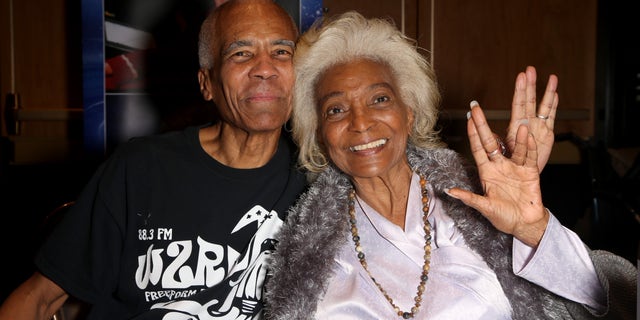
Kyle Johnson often attended "Star Trek" conventions with mother Nichelle Nichols (seen in 2019). He said her final deep-space mission would be a true honor.

Kyle Johnson often attended "Star Trek" conventions with mother Nichelle Nichols (seen in 2019). He said her final deep-space mission would be a true honor. (Gabe Ginsberg)

 "I thought there would be no more fitting and lasting tribute to her than this mission."

— Kyle Johnson

Launching later this year on board United Launch Alliance’s aptly named Vulcan rocket, Nichols' remains will also be included with late "Star Trek" creator Gene Roddenberry, who died in 1991, and his deceased wife and "First Lady of 'Star Trek'" Majel Barrett-Roddenberry, who passed in 2008.

The cremated remains of late "Star Trek" actor James Doohan, who played Montgomery "Scotty" Scott and died in 2005, and visual effects pioneer Douglas Trumbull, who died in February, will also be included in the mission to mark the unique "Star Trek" reunion flight.

Celestis has conducted 18 memorial space flights to date and has five more in the works.

They’ve since put close to "1,500 folks in space," which Chafer said is "more than all the governments combined."

Each flight is a unique experience, and the company offers seven different destinations. The "Earth Rise" suborbital mission launches a flight capsule with cremated remains and DNA into space before returning to planet Earth via parachute.

Nichelle Nichols (as Lieutenant Nyota Uhura) and William Shatner (as Captain James T. Kirk) are shown in a scene from "The Man Trap," the premiere episode of "Star Trek" that aired on Sept. 8, 1966.

Nichelle Nichols (as Lieutenant Nyota Uhura) and William Shatner (as Captain James T. Kirk) are shown in a scene from "The Man Trap," the premiere episode of "Star Trek" that aired on Sept. 8, 1966. (CBS Photo Archive)

Another option offered allows a capsule to orbit Earth on satellites or rockets that can circle for anywhere up to 200 years, and depending upon the altitude of the mission, they may re-enter the Earth’s atmosphere like a shooting star.

Celestis even offers flights to the moon.

"We first went to the moon at NASA’s request with their eminent scientist, Dr. Eugene Shoemaker. That flight was in 1999," Chafer said. To date, Shoemaker is still the only person buried on the moon, a mission carried out by the Lunar Prospector in honor of Shoemaker’s contributions to planetary sciences.

"It’s been a while, but our second mission will go this year, and we’ll put 90 folks on the surface of the moon as a memorial where people can step out at night, look up to the moon and say, ‘Hey Pops!'"

Nichols and a few of her late "Star Trek" colleagues will be part of the first deep-space mission, which will launch from Cape Canaveral, Florida, later this year and into a "forever orbit around the sun, about 300 million kilometers from Earth." Chafer noted her place among the stars is "an infinite voyage."

Clockwise from top left: Nichelle Nichols, DeForest Kelley, William Shatner and Leonard Nimoy in the television series "Star Trek" circa 1969.

Clockwise from top left: Nichelle Nichols, DeForest Kelley, William Shatner and Leonard Nimoy in the television series "Star Trek" circa 1969. (CBS Photo Archive)

"It’s been a while, but our second mission will go this year, and we’ll put 90 folks on the surface of the moon as a memorial where people can step out at night, look up to the moon and say, ‘Hey Pops!’"

— Charles Chafer, CEO of Celestis, Inc.

An important element of Nichols' voyage was including her fans in memorial efforts and making sure the people who have always been a guiding force in her career had the chance to stay with her forever, too.

Fans from around the world can send their names, tributes, drawings and images to include in the mission with Nichols for free through Celestis MindFiles, which will be digitized and sent aboard the Enterprise Flight.

Chafer added that for each space mission Celestis donates to two charities who "embody the commitment to space exploration and planetary preservation."

Johnson, who shares just as much of a passion for interplanetary sciences as his mother did, explained how Nichols was invested in science and education for the future.

He noted how early space programs, which were severely lacking in suitable candidates, were positively affected by Nichols’ involvement in recruiting new astronauts into the field.

"Her vision adhered to what the show represented and was coincident with what NASA was feeling but didn’t know quite how to implement it," he said. "Yet all of a sudden, and I’m sure that many of them were to this day, they are big fans of ‘Star Trek.’"

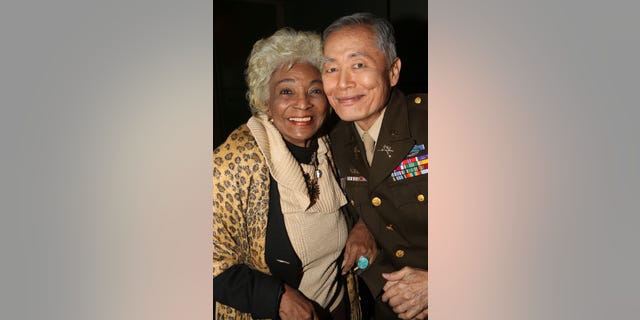
Nichelle Nichols and "Star Trek" co-star George Takei (pictured in 2015) worked together on dozens of episodes of the futuristic series.

Nichelle Nichols and "Star Trek" co-star George Takei (pictured in 2015) worked together on dozens of episodes of the futuristic series. (Bruce Gilkas/FilmMagic)

Johnson, who will be attending the send-off later this year, will also carry on his mother’s legacy of inspiring the future generations through the Nichelle Nichols Foundation, which launches on Dec. 28 and what would have been her 90th birthday.

"The number of supportive messages and letters and emails and phone calls that came in throughout the last 30 days are more valuable than I ever would have thought," he said. "The kindness and the thoughtfulness of so many people made it possible for me to get through this."

When asked if he had any final words to remember his mother, Johnson simply said, "Live long and prosper."

Full Article & Source:

Thursday, August 19, 2021

‘Star Trek’ actress Nichelle Nichols caught in conservatorship battle

by Biba Adams

Nichols’ son, her former manager and a good friend appear to be waging a fight to oversee the finances of the aging actress.

Legendary actress Nichelle Nichols, best known for her role as Lieutenant Uhura on Star Trek, is caught in the middle of what has been a years-long conservatorship battle.

Nichols’ only child Kyle Johnson won a petition for conservatorship of the actress — who is suffering from dementia — in 2018. He alleged that her former manager, Gilbert Bell, had been living in Nichols’ guest home taking advantage of her finances and personal affairs.

Legendary “Star Trek” actress Nichelle Nichols is shown accepting an Inkpot Award onstage at the “From The Bridge” panel during Comic-Con International 2018 in San Diego. (Photo by Mike Coppola/Getty Images)

A third party is involved in the case, a close friend whom Nichols named as her successor, Angelique Fawcette. She is pushing back against the conservatorship, saying that Nichols can manage her affairs.

The 88-year-old no longer lives in Los Angeles, where the case is playing out and where the actual home in question is located. She moved to New Mexico with her son and his wife amid the coronavirus pandemic.

A recent exploration in The Los Angeles Times compared Nichols’ case to that of singer Britney Spears, who remains under conservatorship, although her father, Jamie Spears, who was her estate’s previous conservator, has stepped down.

The #FreeBritney movement has raised awareness about conservatorship, which has long been used in cases like Nichols’ of those who are elderly and struggling with health problems.

Nichols was one of the first Black women on television to play a non-stereotypical role. Lt. Nyota Uhura was beautiful, well-spoken and a knowledgeable communications officer on Star Trek. Nichols appeared in the series and a string of feature films, plus lent her voice to an animated show.

Her character was beloved by Star Trek fans, and for years, Nichols traveled and attended conventions greeting admirers. She was able to book such events with the support of Bell, who helped grow her income.

In 2013, after a pancreatitis diagnosis due to heavy alcohol use, Nichols was admitted to a hospital. She later moved to a nursing facility, where she signed an advance health care directive and a general power of attorney naming Bell as her primary agent and Fawcette as her successor.

According to Fawcette, Johnson and Nichols’ other family members rarely engaged in her life.

All three parties — Johnson, Bell and Fawcette — may ultimately meet in court to decide Nichol’s fate, but for now, the pioneering actress remains in New Mexico with her kin, where her son says she lives in a rental home, and he is her primary caregiver.

A $200,000 GoFundMe effort has been established to help support the star, one started by her sister, Marian Nichols Smothers. It has raised just over $148,000.

Full Article & Source:

Tuesday, August 17, 2021

Nichelle Nichols, Star Trek’s Lt. Uhura, faces heartbreaking conservatorship fight

MANHATTAN BEACH, CA - MARCH 05: Actress and Original Star Trek cast member Nichelle Nichols films her final performance for "Renegades: Ominara" at Northrop Grumman on March 5, 2021 in Manhattan Beach, California. (Photo by Albert L. Ortega/Getty Images)Getty Images

By Makeda Easter
 
Tucked away at the end of a secluded cul-de-sac, Nichelle Nichols’ Woodland Hills home was a testament to her boundary-breaking career spanning more than 70 years. Nichols lined walls and shelves with photos of herself as Lt. Uhura on the original “Star Trek” series, memorabilia from her legions of fans and documentation of her contributions to NASA’s recruitment of women and people of color in the 1970s.

The home was Nichols’ pride and joy, say those close to the star. She purchased it in 1982 for $12,000 and meticulously planned its details, from her plush, oversize furniture to the garden where she planted roses to the neighboring property she purchased in 1994 to use as a guesthouse and workspace for projects.

Questions around the fate of Nichols’ home — who lives in it and what happens to it — have been central to an ongoing, years-long legal battle over the finances and care of the beloved TV star, who friends and family say is financially drained and struggling with dementia.

A three-way fight over Nichols’ fate involves her only child, Kyle Johnson, who is also her conservator; her former manager Gilbert Bell; and a concerned friend, Angelique Fawcette.

In 2018, Johnson filed a petition for conservatorship, arguing that his mother’s dementia made her susceptible to exploitation. In 2019, Bell filed a lawsuit against Johnson, alleging attempts to remove him from Nichols’ guest home, where he has lived since 2010, and “aggressive and combative behavior.”

Bell says that while living in close proximity to Nichols, he helped to restore her career and financial well-being. According to Johnson, who filed a countersuit against Bell in 2020, Nichols’ home was the place where her former manager “exerted his undue influence and took control over Ms. Nichols’ assets and personal affairs,” misappropriating the star’s income as her health deteriorated and memory faded.

Fawcette, a producer and actress who met Nichols in 2012, entered the legal fight opposing Johnson’s conservatorship petition. Fawcette pushed for visitation rights to spend time with her friend, and she argued for Nichols to stay in Woodland Hills — a scenario that has looked increasingly improbable.

At 88, Nichols no longer occupies the house. Last year, Johnson moved her to New Mexico, where he and his wife live. Johnson declined The Times’ requests to speak with Nichols directly.

Against the backdrop of the #FreeBritney movement around Britney Spears raising public consciousness about conservatorships, Nichols’ former agent and friend have launched court battles to intervene, they said in interviews. Their fear: Nichols is being denied a chance to live out her remaining years as she wants.

° ° °

Born in Robbins, Ill., Grace Nichols was renamed Nichelle as a teenager moving into the world of professional entertainment. She sang and danced through the Chicago club circuit in the 1940s and 1950s, and after her brief marriage to fellow dancer Foster Johnson and the birth of son Kyle, she moved to L.A. to focus on film and television.

In 1959, Nichols had a small role in the Samuel Goldwyn production of “Porgy and Bess,” which brought her together with some of the most successful Black stars of the day, including Sammy Davis Jr. and Dorothy Dandridge. Nichols met “Star Trek” creator Gene Roddenberry in 1963 after being cast in an episode of his TV series “The Lieutenant,” and in 1966 she made her debut as communications officer Lt. Nyota Uhura in “Star Trek.”

Frustrated with the lack of depth in her role, Nichols considered leaving “Star Trek” during the first season. A chance encounter with Martin Luther King Jr., a Trekker, changed her mind. He told her she was a trailblazer — a Black woman on TV in a nonstereotypical role. Although the original “Star Trek” series was short-lived, running three years until 1969, Nichols became an icon, appearing in the many manifestations of the “Star Trek” franchise, including the animated show and a string of feature films.

In 1970, Nichols attended her first “Star Trek” convention, and at a 1975 event, NASA representative Jesco von Puttkamer sparked her relationship with the space agency. In 1977, NASA hired Nichols to help recruit astronauts for its space shuttle program.

Over four months, she appeared in TV public service announcements and traveled the country to speak at universities and professional science organizations to encourage women and people of color to apply. NASA credited Nichols for helping to attract astronauts including Sally Ride and Frederick Gregory.

But for many years, conventions provided Nichols’ primary connection to the public. In her 1994 autobiography, she writes, “Star Trek” conventions “are unlike any other fan gathering, perhaps because a Trekker is unlike any other fan in the world. One would be hard-pressed to find such a large group of intelligent, sensitive, aware people.”

And fans loved Nichols, says Adam Malin, co-founder of Creation Entertainment, which has staged traveling fan conventions since 1971. Malin considers her “the ultimate ambassador for what we hope the future could be.”

The fan gatherings were a major source of income for Nichols, who commanded top dollar for her signature and photos. She drew lines that would last all day long, says Chase Masterson, a “Star Trek: Deep Space Nine” actor who appeared with Nichols at conventions.

But by the time Bell began working with Nichols — in 2009, according to court documents — the convention appearances had dried up, and Nichols was struggling financially, says Bell, 82.

The two had met earlier that year, hitting it off over lunch at P.F. Chang’s. Bell became Nichols’ manager, helping her book conventions, other appearances, films and TV projects.

After he sold his home in Studio City, Bell says, Nichols encouraged him to move into her guesthouse for free in 2010. (He began paying rent, $300 a month, after two years of living in the guesthouse.) Bell recalls her saying, “We’re only across the driveway from each other, and we’ll be able to develop these projects much faster.”

Under his guidance, Nichols began to recover financially, going from one or two convention bookings a year to at least three a month, Bell says. Nichols could earn $10,000 to $15,000 for attending a small convention and $40,000 to $50,000 participating in major conventions, he says.

While Bell was her manager, her annual income reached several hundred thousand dollars, he claimed, although her son Johnson disputes that number and characterizes Bell’s accounting records as “extremely deficient.”

In January 2013, Nichols collapsed in her living room and was taken to the hospital, where she was diagnosed with pancreatitis — attributed to alcohol, Johnson says. Johnson, 70, says he and other family members noticed an increase in her drinking over the years. Bell attributes Nichols’ struggles with convention bookings at the time to alcohol.

“She denied it,” Johnson says, “and did not want to do any kind of [ Alcoholics Anonymous], Betty Ford [Center] or any such alcohol treatment.”

While Nichols recovered in the hospital, Bell, Johnson and Fawcette crossed paths. Fawcette and her husband, writer-director Steven Fawcette, met Nichols while casting their “Star Trek” parody film “Unbelievable!!!!!” They describe Nichols at the time as gravely ill.

On a low point during her recovery, the couple say, they were the only two people by Nichols’ side.

“She was definitely gasping for breath,” Angelique Fawcette, 51, says. “She was calling out to her people who had passed away.”

After weeks in the hospital, Nichols moved into a nursing and rehabilitation facility. Nichols tried to leave the facility twice on her own, Bell says, so he took her home — against medical advice and without the consent of her family.

On the day Bell helped Nichols leave the rehabilitation facility, she signed an advance health care directive and a general power of attorney naming Bell as primary agent, allowing him to make healthcare decisions and to manage finances for her. Angelique Fawcette was named as a successor.

That night, Fawcette says, Nichols asked her to record a video about what she wanted in her later years. In the interview, titled “Nichelle’s Own Words,” Nichols responds to questions about her career and desire to work.

During an edited, hourlong interview posted over three videos, Nichols — then 80 — appears coherent at times but repeats herself at others. She says relatives, including Johnson, tried to convince her to work less.

“My son thinks that I should be letting up, you know. I say to him, ‘Kyle, when you pay my bills you’ll be able to tell me what to do.’”

Fawcette says Nichols told her that she would know when to release the video. And five years later, in 2018, Fawcette published it to YouTube during the conservatorship proceedings.

After the hospitalization, Nichols continued working, making the convention rounds and appearing in film and on TV, including on “The Young and the Restless” in 2016.

“It was because I got her off alcohol and turned her career around professionally that she was working,” Bell says.

With Bell and Nichols, the line blurred between manager, caregiver and friend, he says. Bell cooked meals every day. After Nichols had a mild stroke in 2015, she required more intense care. Bell arranged for physical therapists, caregivers and assistants.

“It was very, very close, as it often happens between managers and their clients in Los Angeles, because it’s intensely personal work,” says Bell’s attorney, William Bowen.

Fawcette says her bond with Nichols also deepened, as she came to view the star as a family member. She describes Bell as Nichols’ “gatekeeper,” controlling who had access to the performer. “I never really liked the guy. ... I had to deal with him in order to see my friend.”

Fawcette says Nichols’ home fell into a state of disrepair. Before Nichols’ 85th birthday celebration, she found the performer’s closet empty. At one point, she reached out to Nichols’ younger sister, Marian Nichols Smothers, for help.

“It was just getting to be too much, where the family was not intervening in the manner in which they should,” Fawcette says.

Johnson says he came to L.A. intermittently to help Nichols with tasks around the home, but Bell and Fawcette say Johnson was a rare presence in Nichols’ life in the years leading up to the conservatorship.

Then Bell reached out to Steven Fawcette with a surprise: Bell wanted to marry Nichols. Bell says he and Nichols talked about marriage as a business partnership, a way to ensure that she was protected financially.

The Fawcettes called Smothers and Johnson in a state of panic. That was around early 2018.

In May 2018, Johnson petitioned for conservatorship, known in other states as a legal guardianship, nominating a team of licensed professional fiduciaries to temporarily control Nichols’ person — including healthcare, food, clothing and housing — as well as her estate, the financial assets. In the petition, Johnson claimed Nichols has “severe short-term memory loss impacting her executive functioning. ... Certain individuals have unduly exerted themselves into Ms. Nichols’ life to her detriment.”

Johnson says the trigger for filing a conservatorship petition was learning that Bell in 2017 had transferred Nichols’ home into his name as power of attorney. The petition kicked off three years of legal proceedings — with objections and battles over the cost of legal representation.

In 2019 court documents, Johnson indicated that for one 144-day period, Nichols’ temporary conservator had requested nearly $115,000 to cover fiduciary and attorney fees. Fighting over conservatorship can be so costly it often hurts the conservatee, says Kurt Eggert, director of the Elder Law Center at Chapman University’s Dale E. Fowler School of Law. “It’s a tragedy if fighting over who gets to control the estate chews up too much of that estate; the conservatee is powerless to stop that.”

After filing the petition, the probate court suspended Bell’s power of attorney, and Nichols’ home was transferred back into her name. Johnson moved to L.A. to serve as Nichols’ sole caregiver and mapped out appearances at conventions, “which allowed us to pull her back from the brink, financially,” he says. “She was completely underwater at her own bank.”

In August 2018, Fawcette went to court to object to Johnson’s petition for conservatorship, arguing that Nichols was able to manage her personal and financial affairs with limited help from a caregiver or assistant. Fawcette accused Johnson of primarily wanting access to Nichols’ income and personal property. In a court response he filed to Fawcette’s petition to enforce visitation rights, Johnson accused the producer of wanting to profit from Nichols’ fame.

In January 2019, Johnson was appointed conservator of Nichols’ person and estate, but the battle continued.

In a video Bell recorded in April of that year, Nichols reads conservatorship documents in her guesthouse. “I didn’t give permission to have conservatorship over me,” she says to Bell. When Johnson enters and leads her back to her main house, she shrieks, “You get your hands off of me.”

The video, first reported by a CBS station in Atlanta, cast doubt not only on Johnson but also on Bell, criticized for releasing upsetting footage of a dementia patient who might not have had the capacity to approve of its public release.

People with dementia often “object to somebody else making decisions for them. Even if it’s necessary, even if they are no longer able to make their own decisions,” Eggert says. “You can imagine how frustrating it is to feel like your decision-making power is being taken away from you.”

A 2020 deposition of the former court-appointed temporary conservator of the estate, licensed professional fiduciary BJ Hawkins, shed additional light on the substantial financial difficulties Nichols faced. In an analysis, Hawkins cited money that couldn’t be accounted for, poorly written contracts and a significant amount of debt.

“It was clear that other people had handled her financial affairs and that there was no evidence that they handled them in a way that was to her best benefit,” Hawkins told The Times, echoing her court testimony.

In the deposition, Hawkins also said that in her experience with Johnson, he was prone to explosive outbursts of anger and that she had “areas of deep and grave concern that he would not be able to act in the best interest of the conservatee, despite the fact that it was his mother and despite the fact that it is my general position that a member of the family is in the best position to act in the role of conservatorship of the person.”

° ° °

What is Nichols’ condition these days? How exactly does the “Star Trek” legend want to live out her final years? And if her wish was to be cared for at home in Woodland Hills, as friends suggest, would that even be an option, given her financial problems and the high cost of in-home care?

The answers remain unclear. After initially talking with The Times, Johnson largely declined to respond to subsequent requests for comment.

For many people struggling with dementia — financially, logistically, emotionally — moving in with family or even into a care facility sometimes is the best choice, especially as needs increase. But while Johnson says the isolation in New Mexico protects Nichols from exploitation, others say she’s being deprived of the love and support of friends. Sci-fi magazine founder Kerry O’Quinn, who has been close with Nichols since they met 40 years ago at a “Star Trek” convention, hasn’t seen his friend in more than two years.

Fawcette, who last saw Nichols in mid-2019, is working with an attorney to win the right to visit in New Mexico.

Meanwhile the progression of Nichols’ dementia is unclear. Smothers says her sister has had considerable memory loss.

“I feel like I’ve already lost my sister in so many ways,” Smothers says. “She’s not the person she used to be, the vibrant, in-charge, take care of everything person.”

“Star Trek: Deep Space Nine” actor Nana Visitor, who last saw Nichols two years ago at a Las Vegas convention, says Nichols appeared frightened and confused at times. Even though they had appeared at conventions together for more than 20 years, Nichols didn’t recognize Visitor. “I would say something, and then she would ask immediately,” Visitor says. “It was as if I had not said it.”

What some are calling a farewell tour, organized by Johnson and agent Sky Conway, is moving forward despite Nichols’ condition. In March, Nichols visited L.A. to shoot a scene for the pilot “Renegades: Ominara,” billed on Kickstarter as her final performance. While shooting, Nichols needed a teleprompter to recite her lines.

“She likes attention, so when she was on set, she was fine,” producer Frank Zanca says.

Nichols was scheduled to sign autographs at a Creation Entertainment “Star Trek” convention running this weekend, along with fellow headliners William Shatner, George Takei and Walter Koenig, but she canceled her appearance for unknown reasons. The Times reached out to the original “Star Trek” actors for comment, but none responded.

Nichols was scheduled for a visit in September to the Ohio headquarters of the International Federation of Trekkers, a “Star Trek” fan club created in 1984. The live event, recently canceled because of the nationwide surge in COVID-19, was described as Nichols’ “last public appearance east of Los Angeles before she enters retirement.”

One year ago Smothers launched a GoFundMe campaign to support Johnson on behalf of Nichols’ family — including her sister Diane Robinson and older brother Samuel Nichols. The campaign has raised about $146,000.

Bell continued to live in Nichols’ neighboring property and last saw her about two years ago. In his lawsuit, Johnson alleges that in 2015, Bell “induced” Nichols to procure a reverse mortgage on the property for more than $400,000. Bell says that he had nothing to do with the reverse mortgage and that Nichols pursued it independently.

He denies the allegations that he mishandled Nichols’ income. And he says he misses her “tremendously.”

Fawcette is upset that Nichols is not in her own house.

“She’s not getting the life that she wished for,” Fawcette says. “She’s getting the life that other people have chosen for her.”

The quest to bring Nichols home to Woodland Hills appears to be futile, however. Property records show that her house and guesthouse were sold last week for nearly $2.2 million to Baron Construction & Remodeling Co. On Friday, Bell confirmed that he moved out two weeks prior; in a brief email Saturday, Johnson says proceeds from the sale were placed in his mother’s conservatorship account to ensure her continued care.

Johnson says Nichols is living in a rental house in an undisclosed New Mexico location, where he serves as the primary caregiver.

“There’s still some sensitive issues,” Johnson says, explaining why he is declining The Times’ request to speak with Nichols. He’s just trying to protect his mother’s privacy, he says.

“We have moved here, and we’re going to remain here,” Johnson says from New Mexico. Nichols still has “financial issues that need to be settled.”

In the meantime, he says, Nichols’ home in New Mexico is “a nice place. Smaller, a little more modest than being in Los Angeles, but meeting our needs.”

This story originally appeared in Los Angeles Times.

Full Article & Source: