People with disabilities frequently are appointed a guardian, but judges should rule out a less restrictive alternative first.
“Kate is thriving and happy and flourishing because I’m in her life and
making sure that happens," said Debbie Dionne, the mother and guardian
of Kate Riordan. Photo by Fred J. Field.
Last Sunday, The Maine Monitor published an investigation about adult guardianships and a new law that requires probate judges to consider a less restrictive alternative called “supported decision-making.”
The Monitor spoke with guardians, judges, disability rights lawyers, national guardianship experts and people with disabilities.
We shared the stories of
two women: Kate Riordan, 43, who has cerebral palsy and an intellectual
disability, and is “thriving” under guardianship, and Cindy Thielen,
31, who has autism and was able to terminate her mother’s guardianship
in 2022.
Here are six takeaways from that story.
“Supported decision-making” is an alternative to guardianship in multiple states, including Maine
“Supported decision-making” is a nationally recognized tool used by
people with disabilities to help them assess the consequences of big and
small decisions. The person picks supporters and talks through a
decision.
About one-third of states have a definition of supported decision-making in state law, according to a 2022 analysis by the American Bar Association.
Maine’s probate judges infrequently opt for supported decision-making
A state law that went into effect in late 2019 requires probate
judges to consider supported decision-making before appointing a
guardian. Yet, Maine’s judges have infrequently gone for supported
decision-making.
Guardians are supposed to be a last resort to make medical, financial
and housing decisions for an adult whom a judge deems cannot make or
communicate their own choices.
No court or state entity has tracked the probate courts’ use of supported decision-making in Maine.
Guardianship takes away a person’s civil rights
“Guardianship takes away your civil rights. It takes away your civil
liberties and formally — not in some abstract way — is the court taking
away your rights and giving those rights to someone else to hold on your
behalf or exercise on your behalf,” said Zoe Brennan-Krohn, an attorney
with the national ACLU Disability Rights Program.
Under guardianship in Maine, adults retain only three privileges —
the right to marry, vote and retain a lawyer. Still, probate judges have
the discretion to take away the privileges to marry and vote.
Guardianships can be difficult and time-consuming to end
Thielen’s mother was appointed as her guardian in 2011. This meant
Thielen could not technically make financial or medical decisions on her
own.
Thielen applied to the University of Maine and was halfway to
completing her degree when she asked the probate court to end the
guardianship. After one hearing, the probate judge suspended the guardianship. But her case was left in limbo for years.
The state’s top disability advocacy organization, Disability Rights Maine, intervened in 2021.
Eleven years after the guardianship was granted, a probate judge gave Thielen control of her life back on April 12, 2022.
Supported decision-making may not work for everyone
Kate Riordan has used sign language since she was in preschool, but
because she has cerebral palsy, she lacks the fine motor skills to spell
words with her fingers. She fills in the gaps with gestures, spoken
words and an iPad filled with icons and programmed responses.
We spent a day with Riordan and watched how with gentle suggestions
from her mother Debbie Dionne, Riordan can find answers to questions
using her iPad. Riordan knows her mother is her guardian. She doesn’t
have the words to say what a guardian does.
A barrier to
Dionne and Riordan using supported decision-making is that Riordan does
not initiate decision-making. She does not have the language tools to
ask for advice, Dionne said. When a decision needs to be made, Dionne
starts their discussions.
“Kate is thriving and happy and flourishing,” Dionne said, “because I’m in her life and making sure that happens.”
Stigmatization of guardians could have negative consequences
Opposition to guardianship risks cutting services, policies, money and resources for people who still need them.
It also risks dividing the disability community between the people
who need guardians and those who don’t, said Kim Humphrey, whose adult
son Dan has autism and requires multiple support people to get through
the day.
“If you say that ‘nobody’ needs a guardian and then you meet somebody like him, well then, is he nobody?” Kim said.
Supported decision-making is a less restrictive alternative to
guardianship for adults with disabilities, but it might not work for
all.
Cindy Thielen, 31, lives independently in Bangor. In 2011, the Hancock
County Probate Court appointed her mother as Thielen's guardian — giving
her mother legal control of all decisions in her daughter's life.
Thielen attended the University of Maine, and in 2015 she asked the
court to terminate the guardianship. It took until 2022 to end the
guardianship. Photo by Samantha Hogan.
She didn’t drive.
She couldn’t schedule appointments on her own.
She wouldn’t be able to hold a job and was dependent on others to get through the day.
The petition filed in the Hancock County Probate Court by Julie
Thielen-Montgomery in 2011 painted a helpless picture of her daughter,
Cindy Thielen.
Thielen-Montgomery was asking the court to make her the guardian of
her 19-year-old daughter, who was diagnosed with autism at 13. That
meant the mother would have complete control of her daughter’s life
choices for years to come.
Cindy Thielen didn’t want this. She knew she needed some help but wanted to control her own life.
She was soft spoken and kept her eyes downcast when a court-appointed
assessor, known as a “visitor,” met her to prepare a report for the
judge. Her autism was a “pervasive developmental disorder” that may
require Thielen to have a guardian for the rest of her life, the visitor
wrote, urging that the guardianship be approved.
On the day of the hearing, Thielen wasn’t in the courtroom even
though she wanted to be, she said later. A case manager told the judge
it would cause Thielen too much anxiety to attend the hearing.
Thielen-Montgomery, in an interview, didn’t recall her daughter
asking to be at the court, although she said her memory has faded in the
12 years since then. Thielen signed a court notice of the hearing, and
she went to school that day like it was any other Tuesday. By the time
she got home to their Ellsworth apartment that afternoon, her mother had
the guardianship paperwork.
Thielen-Montgomery said guardianship was the right choice, “at the time, but I should have given her a chance.”
“I felt afraid of her getting used by somebody, (and them) taking
advantage of her in regards to money,” Thielen-Montgomery said in a
recent interview.
Everyone in Thielen’s life, at the time, was saying she couldn’t be on her own.
“I don’t think they felt like I was going to amount to much or have
the chance to live on my own,” said Thielen, now 31 and living
independently in Bangor. “It made me feel sad, because I knew that there
was more that I could do to try to do good things in the world.”
For decades in Maine, when someone with an intellectual or
developmental disability has turned 18, the decision by the courts often
has been to put them in a guardianship — one that can last a lifetime.
Laws that went into effect in Maine in late 2019 require judges to
first consider a less restrictive alternative called “supported
decision-making,” a nationally recognized tool used by people with
disabilities to help them assess the consequences of big and small
decisions.
The person picks supporters and talks through a decision — like any
adult might consult a friend in the medical profession before agreeing
to surgery, or a group of friends would discuss ways to save money for a
car.
Guardians are supposed to be a last resort to make medical, financial
and housing decisions for an adult whom a judge deems cannot make or
communicate their own choices.
But in the nearly four years since the law passed, Maine’s probate
judges have infrequently gone for supported decision-making. A limited
amount of training has been offered to probate judges on this
alternative, and some say they are unsure how to apply it.
No court or state entity has tracked the use of supported decision-making. Nor does anyone track guardianships statewide.
Some of Maine’s 16 independent county probate courts only recently
began tracking adult guardianships, a survey sent by The Maine Monitor
in April found. Among the probate courts that responded to the survey,
several didn’t know the number of active guardianships in their
counties. A few courts said they don’t know if the people in
guardianships are still alive, the Monitor reported in June as part of an ongoing investigation of the state’s part-time probate courts.
Supported decision-making avoids the severe restrictions of
guardianship. The judge decides the adult can make choices, with help,
and retains the right to make decisions without any further court
involvement. But it may not work for everyone.
Some family members of adults with a range of disabilities say a full
guardianship is essential to protect their relatives, who are
vulnerable to scams, exploitation or abuse. They say having legal status
as a guardian allows them to make decisions about medical care,
education, housing and how fixed Social Security incomes are spent.
They are at odds with the state’s top disability advocacy
organization, Disability Rights Maine, which has taken a hard-line
stance against guardianship. The disability rights group contends that
guardianships are overused in Maine. The organization has represented
people with disabilities in probate court to end their guardianships.
Too often attorneys with the organization said they find that people
were not assigned a lawyer when a petition for guardianship was first
filed with the probate court, said Lauren Wille, a disability rights
attorney who used to be a criminal defense lawyer.
“If the same percentage of criminal defendants did not have attorneys
as people coming under guardianship — which is really just as
restrictive — I think people would be flabbergasted,” said Wille.
One Topsham mother, Debbie Dionne, agonized about whether
guardianship was necessary for her daughter, Kate Riordan, who has
cerebral palsy and an intellectual disability following a traumatic
birth four decades ago. Dionne ultimately decided Riordan needed a
guardian.
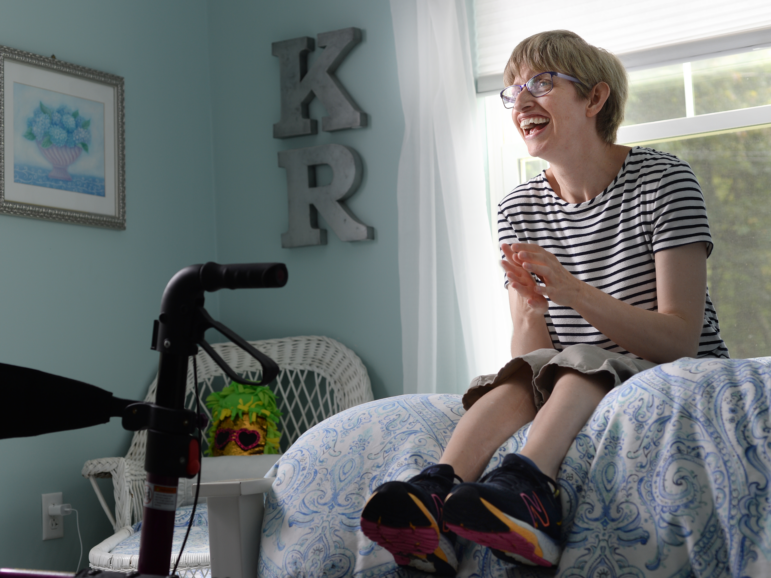
Kate
Riordan, 43, smiles while visiting with her mother Debbie Dionne in
Brunswick. Riordan has cerebral palsy and an intellectual disability due
to a traumatic birth. Photo by Fred J. Field.
Now 43, Riordan can select quickly on an iPad the people she wants to
be with — Nancy, Kristi and Matt, who are friends she grew up with or
lives with at a Brunswick group home. But she doesn’t know how long she
has lived at her home or how to describe her medical needs.
Many are pushing supported decision-making, Dionne said, but she doesn’t see it as the right choice for everyone.
“You know in your heart what is best for your son or daughter, and I
would never presume to make decisions for her,” Dionne said.
“Yeah!” Riordan said immediately.
Judges unsure
Probate judges considering less restrictive alternatives to a
guardianship said there is little direction in the law. This has left
some of them unsure about how to apply “supported decision making.” Yet
the law requires probate judges to rule it out before appointing a
guardian.
Judge William Avantaggio said he made supported decision-making a
part of an order for limited guardianship in a few cases at the Lincoln
County Probate Court.
The most successful supported
decision-making cases are among family members who were already using it
before coming to court, Avantaggio said.
“It is difficult to
blend with a court order,” Avantaggio said. “I’ve tried … in cases where
it’s warranted to use more language like ‘obtain,’ ‘consider’ — that
sort of stuff — but ultimately someone has to make a decision.”
The American Bar Association adopted a resolution
in 2017 that urged states to amend their guardianship laws, and for
courts to recognize supported decision-making as an alternative to
guardianship.
About one-third of states have a definition of
supported decision-making in state law, according to a 2022 analysis by
the American Bar Association.
Supported Decision-Making
Supported
decision-making is a less-restrictive alternative to a full
guardianship. It can be used in cases where an individual is able to
function independently but needs help making some decisions.
Disability
Rights Maine describes it as “a model to support people with
disabilities in making and communicating their own decisions about their
lives.’’
New legislation from 2019 requires probate judges to
first consider “supported decision-making” before appointing a guardian.
The person selects family members, friends or other trusted people to
help them make big and small decisions outside the oversight or control
of the probate courts.
Fifteen states have taken an additional step to define what a
supported decision-making agreement entails or how it can be terminated,
but Maine law does not.
For example, Rhode Island has strict rules
about having written, signed and dated supported decision-making
agreements that authorize certain people to help with specific
decisions. The law also disqualifies an employer or a person paid to
provide direct support services from helping with those decisions.
There is disagreement among guardianship experts about whether
detailed laws about supported decision-making are necessary, said David
English, a University of Missouri law professor and chair of the
national committee that wrote the revised guardianship laws Maine
adopted.
These laws can formalize the supported decision-making process and
potentially give banks or medical providers more confidence in a
person’s capacity to make their own choices, English said. But the laws
various states passed are very detailed and are all different.
“There’s a serious debate whether these detailed statutes are useful or effective,” said English.
There are also options other than full guardianship that already give
another person the right to make limited decisions for another adult,
such as a power of attorney or an advanced health-care directive. There
are also arrangements that allow someone to manage the Social Security
benefits of an adult who needs help.
The test
A probate judge in any adult guardianship case ultimately decides
whether a person can safely make their own decisions or whether they
need someone else to make them.
Families in all walks of life find themselves in the courtroom to
make this decision for parents with dementia, people in early adulthood
with schizophrenia or teens with disabilities approaching their 18th
birthdays.
Resisting a petition for guardianship can be particularly challenging
for young adults with intellectual or developmental disabilities. They
are in the unique position of having to prove to a judge at age 18 that
they are capable of making “good choices.” Complex family dynamics are
often at play and teens don’t realize the rights they are giving up when
they agree to let a parent be a guardian, legal experts said. And the
outcome can be permanent.
“Guardianship takes away your civil rights. It takes away your civil
liberties and formally — not in some abstract way — is the court taking
away your rights and giving those rights to someone else to hold on your
behalf or exercise on your behalf,” said Zoe Brennan-Krohn, an attorney
with the national ACLU Disability Rights Program.
Guardianship can be hard to undo. It is not a simple matter of a
guardian agreeing to relinquish their decision-making power, she said. A
judge needs to be convinced that the adult has regained the capacity to
make their own decisions. The judge can assign another guardian if the
judge thinks the person still lacks a decision-making capacity. It’s a
monumental task for any adult, whether they have a guardian because of
illness, injury, age or disability.
“Very often, people end up staying in guardianships because they
still have a disability,” Brennan-Krohn said. “You don’t stop having
most types of disabilities.”
Brenda Clough has worked as a case manager for Special Children’s
Friends in Hancock County for more than 15 years. She starts advising
parents about guardianship when their children reach high school. It all
comes down to safety, she said. Together they go in detail through the
teen’s skills, such as their ability to use a stove or a toaster oven
without catching themselves or the kitchen on fire, she said.
“Most of my kids have gone to full guardianship with the intent that
supported decision-making will be reconsidered in the future once the
skills are learned,” Clough said.
But reconsideration of a guardianship for supported decision-making
has not happened with her clients, Clough acknowledged. In fact, the
opposite has happened, with some parents seeking full guardianships, she
said.
Disability Rights Maine trained 2,000 family members, case workers,
lawyers and probate judges about supported decision-making as the law
was coming into effect. The group also wrote a user guide and provided copies to each probate court.
“The default in Maine used to be full guardianship at 18,” said Staci
Converse, a managing attorney with Disability Rights Maine.
Maine’s new guardianship law is a leap forward in progressive thinking about guardianship, she said.
Still, some forms the probate courts rely on to evaluate the need for
a guardian are skewed toward finding the adult lacks the ability to
make decisions on their own, she said.
For example, a doctor’s report is required with every guardianship
petition. The two-page form asks the medical professional to check boxes
on a list of skills the person is incapable of doing, such as finding a
home, pursuing medical care or appropriately spending money.
“It leads almost to a determination that a person needs a guardian as written,” Converse said.
A court-appointed visitor also is assigned during every adult
guardianship case to advise the person of their rights and make a
recommendation to the probate judge. There is no formal training program
for the visitors, and they had limited training after the guardianship
law changed in 2019.
Susan Mauro, a visitor contracted with the Kennebec County Probate
Court, said adding supported decision-making to the law made her job
more difficult and “clouded” the choice between guardianship or not.
Mauro’s recommendations are based on an interview with the adult and
proposed guardian. She watches their behavior to see if they’re aware of
their surroundings, she said. For example, when she asks a teen with an
intellectual disability about their date of birth or hobbies and they
look to their parents, “you can see that they’re not ready to be a fully
independent adult,” Mauro said.
Judge Elizabeth Mitchell, who assigns Mauro to cases, said she makes
her own determination and doesn’t always follow a visitor’s
recommendation.
“(The) probate court does not order supported decision-making. We ask
on all our forms that petitioners and visitors explore that as a
possibility,” Mitchell said.
‘Kate is thriving’
Kate Riordan wants to know when certain workers will be at the house.
She wants the pictures, plush bears and flowers on her nightstand
arranged a certain way. And she wants to spontaneously call family
members on FaceTime. Riordan is a strong-willed woman living with
cerebral palsy and an intellectual disability, and she relies on her
mother, who is also her guardian, to make major decisions.
Riordan’s mother, Debbie Dionne, struggled to decide whether to seek
guardianship when Riordan turned 18. Dionne decided it was the best
option to ensure Riordan’s medical and housing needs were met while
leaving Riordan in control of her daily social decisions.
A barrier to Dionne and Riordan using supported decision-making is
that Riordan does not initiate decision-making. She does not have the
language tools to ask for advice, Dionne said. When a decision needs to
be made, Dionne starts their discussions.
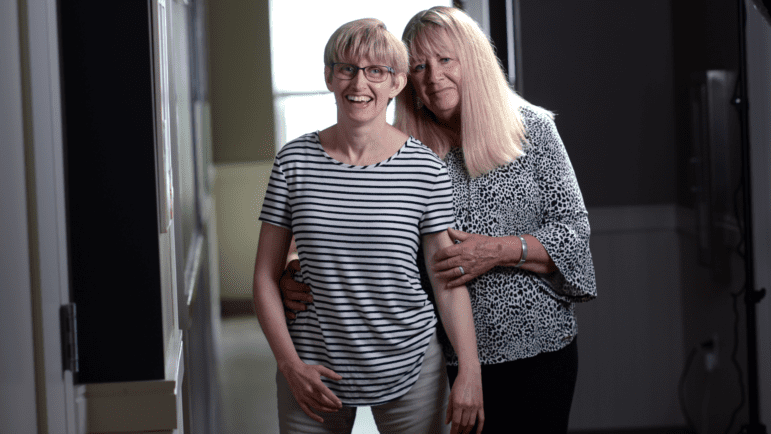
Kate
Riordan, left, and her mother Debbie Dionne in the hallway of Riordan’s
group home in Brunswick. Dionne struggled with the choice to seek
guardianship of Riordan when she turned 18. Ultimately, Dionne decided
guardianship was the best option. Photo by Fred J. Field.
Riordan has used sign language since she was in preschool, but
because she has cerebral palsy, she lacks the fine motor skills to spell
words with her fingers. She fills in the gaps with gestures, spoken
words, and an iPad filled with icons and programmed responses
representing her favorite foods, family members and critical information
like her full name and address.
Dionne fills in the missing details during an interview on a recent
Tuesday, asking Riordan, “Can I add a little bit to that? Is that OK?”
Riordan’s life is full of choices at the home she shares with other
adults with intellectual or developmental disabilities run by the
Independence Association in Brunswick. She moves freely around the
one-story building, eating meals in the large central kitchen, watching
Animal Planet in the living room, and making crafts from the beads,
paper and paints that are always available.
Riordan is Dionne’s only child. Dionne labored for more than 14 hours
at the Parkview Adventist Medical Center, now Mid Coast Hospital, in
Brunswick on Oct. 28, 1979. The fetal monitor strapped across her
full-term abdomen showed a flat line. Riordan arrived in the world
without a sound.
“It seemed like forever, but it was 10 minutes,” Dionne said. “She
was resuscitated by the pediatrician. He just kept working on her and
working on her. And she didn’t cry and she didn’t cry; then finally, it
was this horrid cry.”
Doctors said Riordan would be tube-fed the rest of her life, wouldn’t
sit up, wouldn’t walk and would be blind. Dionne was advised soon after
birth to send Riordan to live at the Pineland Center, the state’s
institution for the disabled. Pineland closed in 1996.
Only one doctor offered a different opinion: “You should take her
home and love her just like you would have if this never happened. Just
love her.”
Riordan rose above the doctors’ expectations. She started walking
when she was 8 years old and still uses a rolling walker for balance.
She wears lavender glasses over attentive blue eyes. She loves to eat
lobster – like a true Mainer.
Her favorite hobby is “bowling,” she says, using an iPad. She
navigates to the “people in my life” and selects Matt, or “Hubba Hubba,”
who she plays Wii bowling with, and is her longterm boyfriend. There’s a
framed picture of them on her dresser.
“I’m a very different person than I was when she was born,” said
Dionne. “Sometimes you don’t always get what you want, but it’s actually
better. You have all these dreams.”
Dionne, 71, trails off at the end of her thought. She, like many
parents, dreams of a day that their child could be independent. She
worries about who will take over as guardian when she is gone.
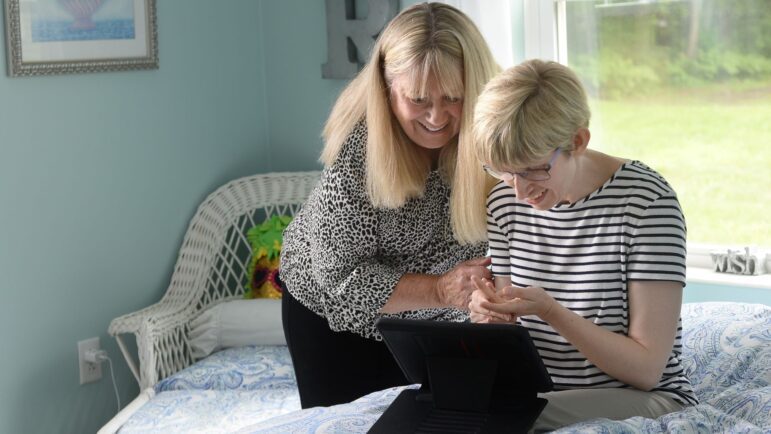
Debbie
Dionne, left, and her daughter Kate Riordan, shared a FaceTime call
with Riordan’s aunt on an iPad. Photo by Fred J. Field.
Dionne has seen Riordan shut down when she can’t tell people what she
likes. During one particularly difficult period, “she retreated, got
depressed, lost 10 pounds,” said Dionne. Riordan started seeing a
counselor who uses sign language and has improved.
Riordan’s life is the best and most stable it has been in a long
time, and that is because she’s had a guardian intervening. Riordan pats
a spot on the bed beside her, inviting her mother to sit. Together,
with gentle suggestions from Dionne, Riordan finds the answers to
questions on her iPad. When asked, Riordan knows that her mother is her
guardian. She doesn’t have the words to say what a guardian does.
“Kate is thriving and happy and flourishing,” Dionne said, “because I’m in her life and making sure that happens.”
Overuse of guardianship?
Maine adults with intellectual or developmental disabilities who
receive state services appear to be subjected to full guardianship much
more often than the national average, although that may be changing.
Maine contracts with providers of group homes, day programs and
shared living arrangements to meet people’s needs, which are funded by
MaineCare. Two major programs are the Section 21 and Section 29 waivers.
There are 1,985 adults waiting for the Section 21 waiver, which
supports people who need near-constant supervision, according to state data.
People with intellectual or developmental disabilities who are at
risk of abuse, neglect or exploitation are the state’s top priority for
any opening in the Section 21 waiver program, according to state rules.
Those with a lower priority level can wait years for a spot to open. The
state is in the process of creating a new “lifetime waiver” to
eliminate the wait lists, the Monitor reported in January.
A survey of 400 adults in Maine receiving Section 21 and Section 29
waiver services found 60% had a full guardianship. The finding, part of
the 2018-2019 National Core Indicators survey,
is above the national average of 33% of surveyed adults with
intellectual and developmental disabilities having full guardianships.
The Maine Developmental Disabilities Council testified
to state lawmakers in 2019 that they did not know why Maine’s use of
guardianship is so high, and would welcome legislation “that has the
potential to impact guardianships.”
Current state data indicates that 495 adults with intellectual or
developmental disabilities are subject to guardianship in Maine, making
up 8% of individuals in the state’s Sections 21 and 29 waiver programs,
said Jackie Farwell, a spokeswoman with the Department of Health and
Human Services.
Disability Rights Maine, the state’s designated Protection and
Advocacy agency for people with disabilities, has taken the stance that
guardianship is not justified if a person can communicate, even
minimally.
There are people within the disability community who may never be
able to use supported decision-making. And attempts to remove
guardianship as an option in Maine have frightened parents of adults
with complex needs.
One of those parents, Kim Humphrey of Auburn, gave up a career in public health to advocate for her son, Dan Humphrey.
At age 2, Dan was diagnosed with congenital dysphagia with the
possibility of autism, which was later confirmed to be autism. He
requires around-the-clock support from multiple people to get through
the day. He communicates with head nods, and has an iPad but only
limited capacity to navigate it. He was enrolled at an out-of-state
school specializing in students with autism and intellectual and
developmental disabilities from ages 11 to 20, where he received
one-to-one support.
With the right help, Dan, now 34, can help deliver food through Meals
on Wheels with his support team, be better understood by those who help
care for him, and care for his basic hygiene. Without support, those
skills diminish. And when there are not enough direct support
professionals or if the people don’t understand Dan, or if he’s in pain,
he can also become aggressive, his mother said.
“If you say that ‘nobody’ needs a guardian and then you meet somebody like him, well then, is he nobody?” Kim said.
Kim explored 10 provider agencies that operate group homes that could
possibly meet her son’s needs when it was time to move Dan back to
Maine. Without the full authority of guardianship, she doesn’t think she
could have gotten him into the right home. Dan was approved for a
Section 21 waiver in 2009.
None of the nine guardians interviewed by the Monitor said they
wanted to take away decisions from their relative with a disability.
Their fears were of fires – set in kitchens when unattended – food eaten
in excess, to the point they became sick, or situations where sexual
exploitation was possible.
Maine is transitioning from all guardianships to some supported
decision-making, said Margaret Cardoza of Portland, an adult living with
a developmental disability.
“Just like any law that gets changed. It may be the law, but the
lifestyle, the culture, the traditions, the attitudes take longer to
adjust. And attitudes are the most difficult part that needs to change,”
Cardoza said. “It’s about time.”
Cardoza is married and owns a home. She is also a vocal self-advocate
and has pushed for the state to make supported decision-making
available to people with disabilities since 2013. Through her advocacy
she’s met other people with disabilities who have not been allowed to
get married, live in places that allow them to come and go freely, or
even vote.
Under guardianship, adults retain only three privileges — the right
to marry, vote and retain a lawyer. Still, probate judges have the
discretion to take away the privileges to marry and vote.
People with disabilities, such as Cardoza, who are visibly “on the
front lines” advocating for themselves for self-determination, choice,
independence and civil rights, have the potential to do a lot of good to
eliminate the stigma of people with disabilities, Kim said.
But people like her son, and some people with higher needs, are not among them and may never be, she said.
The strong opposition to anything other than supported
decision-making risks cutting services, policies, money and resources
for people who need guardianship. The stigmatization of guardians also
has the risk of dividing the disability community between the people who
need guardians and those who don’t — making the people in guardianship
invisible, Kim said.
A journey to be free
As Cindy Thielen tells it, no one would listen when she spoke about her future.
A curtain of long brown hair covers Thielen’s profile, and she speaks
softly with a unique rhythm. Years of speech therapy fixed what she
describes as “gibberish” she spoke as a young child. She also spent a
long time working on making eye contact with people.
One of her special education teachers in high school said she “sounded like a 5-year-old,” Thielen recalled.
How a person speaks can be a flawed measure of their ability to make
decisions, especially people with disabilities who may speak in an
unconventional way.
“A lot of our clients communicate in sort of non-traditional ways,”
said Wille, the lawyer with Disability Rights Maine. “You spoke with
Cindy (Thielen); her voice is not a traditional voice. People hear her
voice and they jump to all sorts of conclusions about her. And then when
you hear what she’s actually saying, she breaks apart those notions.”
Cindy Thielen, who has autism, was under guardianship until 2022. Photo by Samantha Hogan.
Thielen, who uses supported decision-making informally, said people
see her differently because of her autism. With her disability, it was
assumed she couldn’t attend college, even with good grades and after
taking the SAT.
The special education teachers recommended Thielen do two more years
of high school and not graduate when she was 18. Instead, her mom
suggested a compromise, Thielen recalled. She would complete an
additional year at the Hancock County Technical Center, where she was
already attending half of the school day.
“I would say what I wanted, and it seemed like it would go their way
anyway,” Thielen said. “They wanted me to stay back and graduate
essentially with a blank diploma cover, and I didn’t want that. I got so
upset, I wanted to almost walk out the door.”
Most parents pursue guardianship of a child with disabilities, said
Linda Henderson, who was Thielen’s case manager and who filled out much
of the guardianship petition and plan that was submitted to the probate
court in 2011. Parents often want help going through the court process,
she said.
Henderson said she did not remember Thielen, and that she was not the
typical client if she was able to attend college. Thielen clearly had
strengths, Henderson said.
“I don’t think she quite understood the legality of what guardianship
meant,” Thielen said of her mother, who went to probate court in 2011
to gain guardianship of Thielen, “because I don’t think she really
understood what was involved and what she had to do.”
Thielen told The Maine Monitor that her life was far less stable than the one described on paper to the probate court.
Thielen-Montgomery struggled to get approved for Social Security
disability benefits for more than three years following a workplace
injury, she said. The checks were not enough to cover all their living
expenses.
They were forced out of their apartment in Ellsworth because the
electricity was shut off, and they briefly lived in a homeless shelter
in late 2011, Thielen said. Her mother abandoned another apartment and
moved into a private residence where Thielen said she didn’t feel safe.
In 2015, her mother withheld two months of Thielen’s Social Security
disability payments — worth $1,466, a probate judge ruled.
Thielen doesn’t believe her mother was ill-intended with the
guardianship. But it meant Thielen-Montgomery controlled the bank
account where her Social Security disability payments were deposited.
Thielen-Montgomery said Thielen had a debit card and they would discuss
what to buy.
Thielen also could not sign paperwork at the doctor’s office on her
own, and the physician would speak directly to her mother — even when
Thielen was in the room, she said. Thielen-Montgomery said this was
true, and that the doctors should have spoken to Thielen.
During those tumultuous years, Thielen had applied and was accepted
into college. From her dorm room in 2015, Thielen emailed the probate
court and asked to terminate her mother’s guardianship.
By then, she was about halfway to graduating from the University of
Maine with a bachelor’s degree in journalism and a minor in studio art.
She’d lived on campus, and had navigated the social and academic demands
of college.
She was immediately appointed an attorney, which Thielen had not been
afforded when she was 19 and her mom was first seeking to be made
Thielen’s guardian.
After one hearing, the judge suspended the guardianship.
Adults subject to a guardianship petition are advised they have the
right to hire a lawyer, but are also told that the cost of paying for a
lawyer may come out of their own pockets.
A state bill proposed in 2019 would have required lawyers for all
adult guardianship cases. Probate judges were among the stakeholders to
object, in part because of the added cost to county budgets. The bill
did not pass.
“This is another unfunded mandate, mostly unnecessary. Now if the
State agrees to pay for all those attorneys, I might be OK with it even
though I’m not convinced that it is totally necessary,” Somerset County
Probate Judge Robert Washburn wrote in an email to the other judges at the time.
All 10 probate courts that responded to a Monitor survey said they
will assign an attorney if the person opposes a guardianship. Probate
courts are separate from the rest of Maine’s judiciary and are funded by
county governments.
In Thielen’s situation, the guardianship suspension left her case in
limbo. She graduated from college in 2017, started working in the Center
for Community Inclusion and Disability Studies at the university, and
moved into her own apartment, but technically she was not free.
In November 2021, Disability Rights Maine intervened to finish the
termination of her mother’s guardianship. Thielen-Montgomery didn’t
fight the request, she said.
“I felt as though she could handle it and I knew my daughter well
enough — she still calls me on a daily basis. We do that. She
communicates with me what she needs and what she might get and she asks
me, ‘what do I think?’ ” Thielen-Montgomery said.
It had been nearly 11 years since the day Thielen came home from school and her mom had those guardianship papers.
Eleven years since she lost control of her own life.
Eleven years since she could make almost any significant decision on her own.
On April 12, 2022, a probate judge gave Thielen her life back.
“There’s a lot of us out there that want to prove — yes we can,” she said.