Showing posts with label supported decision-making. Show all posts

Sunday, August 30, 2026

Supported Decision-Making Facilitation Model Shortlisted for International Innovation Award!


August 26, 2026

Dear Friends and Colleagues,

I have some exciting news! The Supported Decision-Making facilitation model has been shortlisted for the Zero Project Awards 2027!  If you are not familiar with Zero Project, it is a global initiative to identify and share innovative solutions that remove barriers for people with disabilities. This year, Zero Project’s call for submissions focused on the topics of Independent Living, Political Participation, and Assistive Technology (AT). After receiving more than 615 nominations from around the world, Zero Project's research team and experts from the global Zero Project Network selected their “shortlist” of 159 solutions.

Supported-Decision Making’s inclusion on this list represents an incredible milestone in OPWDD’s effort to empower people with developmental disabilities to experience the dignity and independence of decision-making with support. It demonstrates that the Project's experts recognize that New York’s Supported Decision-Making facilitation model, which provides a legally enforceable way for people with developmental disabilities to demonstrate their capacity to make legal, financial, medical, and life decisions on their own behalf, is an innovative solution worthy of potential replication.

While this shortlist is only the first step of the award process, I can't tell you how proud it makes me to see Supported Decision-Making on this list. It’s inclusion in this global competition is a testament to the important work we’ve been doing here in New York State under the leadership of Governor Hochul and in partnership with our provider agencies and advocates.  While several other states and countries have laws that recognize decisions made under Supported Decision-Making Agreements, New York is the only state in the nation that supports and funds the facilitation process for people with developmental disabilities.  

While the scope of OPWDD services may be limited to New York, the reach of our work, led by our community that includes our partners and self-advocates, knows no borders.  Freedom from all kinds of barriers is so essential to living a rich, fulfilling life. Because we live in a global environment, it is so important that we continue to work with, learn from, and collaborate with our neighbors across the globe to achieve zero barriers for people with developmental disabilities.

For more information on Support Decision Making in NY, available through AIM Services, Inc, please visit their website.

The final Zero Project Awards will be announced on December 3, International Day of Persons with Disabilities. Stay tuned!

Sincerely,

Willow Baer 
Commissioner

Source:
Supported Decision-Making Facilitation Model Shortlisted for International Innovation Award! 

Sunday, May 24, 2026

Guardianship Reform Arrives: Judges Must Try Less-Restrictive Alternatives, and Power-of-Attorney Forms Get a Major Overhaul

by Drew Blankenship


A lot of the time, guardianship begins with good intentions. However, it can quickly become a really emotionally draining legal process. A court-appointed guardianship can strip away major personal rights, including financial control, healthcare choices, and even decisions about where someone lives. Now, a growing wave of guardianship reform laws across the country is changing how courts approach these cases. Judges are increasingly being required to consider less-restrictive alternatives before removing someone’s legal independence, while updated power-of-attorney rules are reshaping how families plan for aging and incapacity. Ultimately, this should be good news, but you need to go into the situation knowledgeable.

Why Guardianship Reform Is Becoming a National Priority

Guardianship reform has gained momentum after years of criticism from elder advocates, disability-rights groups, and legal experts. Critics argued that traditional guardianship systems sometimes removed too many rights from older adults and disabled individuals even when less severe solutions were available. Newer laws now emphasize “person-centered” planning, which focuses on preserving as much independence as possible while still providing necessary support.

Several states adopting updated versions of the Uniform Guardianship, Conservatorship, and Other Protective Arrangements Act now require courts to explore alternatives before imposing full guardianship

Judges Are Now Being Told to Consider Less-Restrictive Alternatives First

One of the biggest changes in guardianship reform involves requiring courts to evaluate alternatives before approving guardianship petitions. These alternatives can include supported decision-making agreements, healthcare directives, representative payees, trusts, and financial power-of-attorney arrangements. In states adopting updated reform measures, judges must often document why less-restrictive options are insufficient before granting broad guardianship powers.

Some states, including Pennsylvania and North Carolina, now specifically require courts to make factual findings showing why less-restrictive alternatives would not adequately protect the person involved.

Power-of-Attorney Documents Are Receiving Major Attention

Power-of-attorney forms are also becoming a major focus under guardianship reform efforts. Attorneys say many older power-of-attorney documents were written too broadly, too vaguely, or without enough safeguards against abuse.

Updated forms in many states now include clearer language about financial authority, healthcare decision-making, fiduciary responsibilities, and limitations on an agent’s powers. Some newer laws also encourage narrower or customized powers rather than automatically granting blanket authority over every aspect of someone’s life.

Families Are Discovering Guardianship Is More Complex Than Expected

Many families assume guardianship simply allows them to “help out” an aging parent, but the legal reality is far more serious. Guardianship can remove rights involving finances, medical care, contracts, housing decisions, and other deeply personal areas of life, depending on the court order. Online discussions from caregivers and social workers show that families are often shocked to learn that guardianship does not automatically give unlimited control over another adult.

Supported Decision-Making Is Emerging as a Popular Alternative

Supported decision-making is becoming one of the fastest-growing alternatives under guardianship reform laws. Instead of transferring legal authority to someone else, supported decision-making allows individuals to retain their rights while receiving help understanding options and communicating decisions.

This approach works especially well for many older adults with mild cognitive decline or individuals with developmental disabilities who still want to participate actively in their lives. The American Bar Association and several state legislatures now encourage courts to prioritize supported decision-making whenever appropriate before imposing guardianship restrictions.

Guardianship Reform Is Changing How Families Plan for Aging

More often than not, judges have started turning to less-restrictive alternatives to traditional guardianship. The goal is to preserve independence whenever possible. That said, at the same time, updated power-of-attorney laws are encouraging families to create more thoughtful, detailed legal plans before emergencies happen. When it’s all said and done, these reforms should reduce unnecessary loss of rights while still protecting vulnerable adults from exploitation or neglect. 

Full Article & Source:
Guardianship Reform Arrives: Judges Must Try Less-Restrictive Alternatives, and Power-of-Attorney Forms Get a Major Overhaul 

Saturday, May 2, 2026

New York OPWDD Awards $8 Million Contract To Expand Supported Decision-Making Model For Individuals With I/DD

The New York State Office for People With Developmental Disabilities (OPWDD) announced that, through a competitive procurement process, it has awarded AIM Services Inc. a statewide contract valued at nearly $8 million to implement New York’s Supported Decision-Making model for individuals with intellectual and developmental disabilities (I/DD). Supported Decision-Making (SDM) empowers people to make their own decisions with help from trusted supporters. Supported Decision Making is an alternative to guardianship, that maintains the person’s basic human right to make their own decisions through the execution of a Supported Decision-Making Agreement, which is a legally recognized document and must be accepted by third parties. The contract will establish a structured, replicable framework for use across the state.

New York has been testing supported decision-making since 2016, when it launched a pilot led by Supported Decision-Making New York (SDMNY) and CUNY Hunter College. Funding for the pilot was provided by the New York State Council on Developmental Disabilities. SDMNY was formed as a consortium of Hunter College/CUNY, the New York Alliance for Inclusion and Innovation (formerly NYSACRA), and Arc Westchester, a major provider organization. The pilot aimed to educate stakeholders on supported decision-making as an alternative to guardianship, reduce reliance on guardianship for individuals with I/DD, and restore rights for individuals already under guardianship.

In 2021, OPWDD allocated a portion of its American Rescue Plan Act (ARPA) funding to expand and extend the pilot program. The expansion focused on engaging individuals with I/DD, exploring supported decision-making options, and developing effective, sustainable agreements. OPWDD also contracted with SDMNY during this phase of the pilot.

For the statewide contract, OPWDD issued a request for proposals (RFP OPD-2024-39) on April 29, 2025, with responses due June 10, 2025. The state reported receiving no additional responses. The contract was scheduled to begin on September 1, 2025, and run for five years. OPWDD announced the award on March 17, 2026.

Under the contract, AIM Services will be responsible for four core activities:

  • Establishing the program by training facilitators, recruiting individuals served by OPWDD, and developing billing standards
  • Conducting quality assurance oversight of third-party supported decision-making providers to ensure compliance with regulatory standards and adherence to pilot-developed processes
  • Providing community education on the supported decision-making model, its goals, and its role as an alternative or complement to adult guardianship
  • Completing data collection and reporting to evaluate statewide implementation, identify trends, and inform ongoing training and quality assurance

Founded in 1979, AIM Services, Inc. is a 501(c)(3) nonprofit organization that provides residential and community-based services to individuals with I/DD.

OPWDD delivers services both directly and through a network of approximately 500 nonprofit providers. Roughly 80% of services are delivered by private nonprofit agencies, while 20% are provided by state-operated programs. Individuals served by OPWDD reside in a range of settings, including residential homes, group homes, supported apartments, and institutional environments such as developmental centers and other secure facilities.

OPWDD also provides residential supports and services for approximately 43,000 people with I/DD throughout the state. To serve them, OPWDD operates about 1,500 residential and institutional sites across the state.

The RFP is available for download from the OPEN MINDS Government RFP & Contract Database at no charge to OPEN MINDS Circle subscribers.

OPEN MINDS last reported on this topic in New York State OPWDD Provides Funding To Extend A Supported Decisionmaking Pilot on January 20, 2022.

For more information, contact:

Source:
New York OPWDD Awards $8 Million Contract To Expand Supported Decision-Making Model For Individuals With I/DD 

Friday, April 24, 2026

Polk County Approves Funding to Support Health & Wellness for Seniors & Disabled


Des Moines, IA- The Polk County Board of Supervisors, on Tuesday, approved agreements aimed at enhancing assistance for elderly and those individuals with developmental  disabilities. The first agreement, in collaboration with the Iowa Developmental Disability Council and 
the Iowa Department of Health and Human Services Division of Aging and Disability Services, is designed to launch a Supported Decision-Making demonstration project, made possible through grant 
funding.

Supported Decision-Making is an innovative approach that seeks to empower individuals by providing them with the necessary support to understand, consider, and communicate their decisions effectively. 
This practice not only promotes autonomy and preserves legal rights but also contributes significantly to informed decision-making.

With the second agreement, Aging Resources of Central Iowa will contribute $404,000 each year for the next two years to assist with nutrition, transportation needs, program outreach, health promotion 
and disease prevention.

Polk County Board Chair Matt McCoy states, “This project is a crucial step in ensuring that our elderly and those with disabilities have the support they need to make informed choices about their 
health and wellbeing.”

“Through Supported Decision-Making, we are paving the way for a future where individuals feel empowered to make decisions that affect their lives, promoting both dignity and independence.” Said, 
Joel Olah, Executive Director, Aging Resources of Central Iowa.

Please call your closest Polk County Senior Center for more information or call the Senior Services Administration office at 515-286-3679.
 
Information also available at https://www.polkcountyiowa.gov/community-family-youthservices/senior-services/about-us/

Source:
Polk County Approves Funding to Support Health & Wellness for Seniors & Disabled  

Tuesday, April 21, 2026

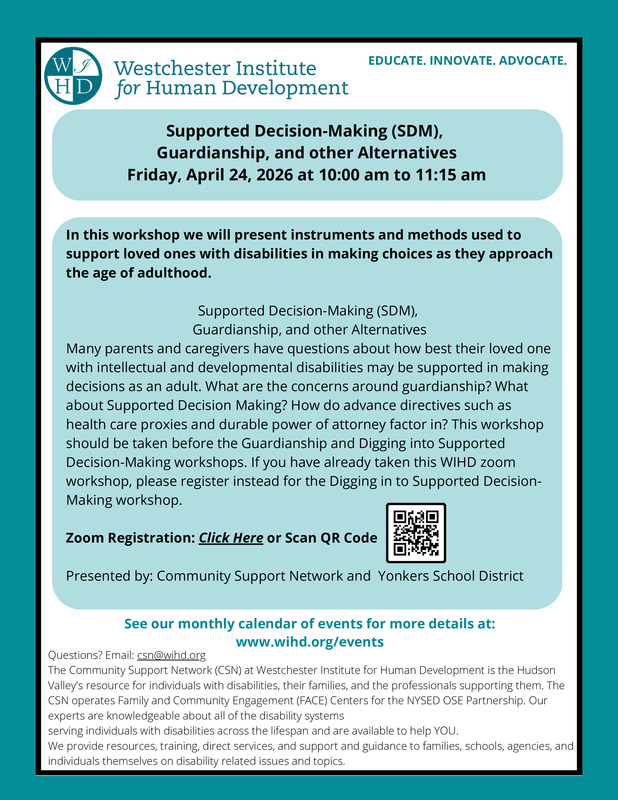
Parent Workshop: Supported Decision-Making, Guardianship, and Other Alternatives

Parents and caregivers of students with disabilities are invited to attend an important virtual workshop focused on decision-making as students approach adulthood. This session will explore Supported Decision-Making (SDM), guardianship, and other legal and practical alternatives that help young adults with intellectual and developmental disabilities make informed choices about their lives.

The workshop will also discuss advance planning tools such as health care proxies and durable power of attorney, and help families better understand the benefits and concerns associated with each option. This session is recommended for families beginning to plan for the transition to adulthood.

Date: Friday, April 24, 2026

Time: 10:00–11:15 AM

Format: Zoom (virtual)

Presented by: Community Support Network in partnership with the Yonkers School District

Registration: Click the Zoom registration link or scan the QR code on the flyer

Questions: csn@wihd.org

This workshop is presented by the Community Support Network at the Westchester Institute for Human Development, a trusted regional resource supporting individuals with disabilities and their families across the lifespan.

flyer

Source:
Parent Workshop: Supported Decision-Making, Guardianship, and Other Alternatives 

Thursday, April 16, 2026

Movement grows on Connecticut disability bills, but key issues remain

By

Mary-Ann Langton, foreground, with her aid Patty Ellis, speak to Governor Ned Lamont staffer Abigail Cotto after members of ADAPT CT enter the governor’s office wanting to speak to the governor, they were told he was not in, on Thursday, March 5, 2026, at the Capitol in Hartford. The advocates returned twice more before being able to secure a meeting with Lamont. 

Jim Michaud/Hearst Connecticut Media

After months of advocacy, Gov. Ned Lamont is backing off a proposal that would’ve cut funding to a community-based Medicaid program serving more than 7,200 residents.

​Community First Choice, or CFC, is a longstanding entitlement program that allows enrollees to directly hire personal care aides to support their day-to-day needs while living in the community or at home. 

​As part of his budget proposal, Lamont sought to end funding for the program, arguing that rising enrollment was also driving up the costs to sustain it. The program also faces administrative challenges, particularly payroll-related issues. If it had been finalized, all of the current participants would have been moved to one of the state’s capped Medicaid waivers offering similar services.​ 

​However, advocates and community members have instead argued that the waivers lack sufficient slots and funding to meet the growing demand. As a result, folks may end up on years-long waiting lists or be pushed into already-stretched institutional care systems.

Lamont backed off the CFC proposal following a meeting with several disability rights advocates in early April. The state’s Appropriation Committee also rejected the proposal when advancing its budget forward. 

Connecticut Public first reported that none of the original proposal is expected to be included in the final budget set to be approved in the coming weeks.

Here are other major proposals on disability rights to keep an eye on as the 2026 legislative season winds down:

​HUSKY C 

Eliminating the asset limits on the state’s Medicaid plan for people with disabilities is back on the lawmakers’ docket, marking the third year advocates have pushed to address what they describe as restrictive and discriminatory eligibility.

HUSKY offers coverage based on specific categories, such as income, age, disability, and more. People with disabilities, however, are only categorically eligible for HUSKY C, which covers residents who are disabled, blind and elderly. It has the lowest income limit of any of the state’s programs — set at $1,370 — and asset limits of $1,600 and $2,400 for singles and couples. 

The latest proposal, if passed, would increase HUSKY C’s asset limits for an unmarried person to $5,000 and a married couple to $7,500. It would also require DSS to report asset data to the Human Services committee, which Sen. Matt Lesser said has been a challenge over the years and may yield a more accurate fiscal impact. 

As of April 14, the proposal was referred to the state Appropriations Committee by the House. 

Community members and advocates have asked lawmakers to increase income and asset limits, yet have struggled to secure any finalization.  In April 2025, Disability Rights Connecticut and the Medical-Legal Partnership Clinic filed a civil rights lawsuit on behalf of two residents arguing that the strict eligibility requirements violate the state Constitution's equal protection clause. 

But a lawsuit can take years and would be resolved if the issue were addressed through legislation, said Sheldon Toubman, a litigation attorney at Disability Rights Connecticut. 

And with incoming changes to the federal Medicaid program, such as work requirements, more people may lose their coverage and fall through the cracks in the insurance system over the next few years. 

Some residents will be directly affected by eligibility changes and funding cuts and may see coverage changes as early as next year. Others will drop off Medicaid, despite their eligibility, because they can't keep up with all the requirements, like Karen Healy.  

Healy began struggling with severe mental health issues, like PTSD, ADHD, and borderline personality disorder, at 16 years old. In 1989, she entered institutionalized care and spent more than 24 years receiving treatment before being discharged in 2014. 

She currently lives on her own in Hartford with 24/7 support and has been working as a ShopRite bagger for the last 3 years. Healy’s mental health care and medications are currently covered under MED-Connect, a state program that offers Medicaid coverage to employees with disabilities. 

Having a steady job, Healy said, has helped build her confidence over the years and has slowly helped her build out her life in the community after so many years of institutionalized care. 

Even just working 20 hours can be a lot on her body, Healy said, noting it impacts her sleep, mental health and leads to orthopedic issue flare-ups. However, starting Jan. 1, 2027, Medicaid enrollees will have to prove they’ve worked, volunteered or attended school for at least 80 hours a month to keep their coverage. 

“I would have to work, but my body would be shot,” Healy said. “It wouldn't be right. It wouldn’t be fair.”

If she were to quit her job and rely on disability payments, Healy said her income would be too high, by a few hundred dollars, to qualify for HUSKY C, which is why she’s advocating for the increased asset limits.  

Healy recalled once trying to meet a roughly $5,000 medical spend-down requirement when she didn’t have a job to meet HUSKY eligibility. Since then, she said she believes the amount has likely increased, making it more difficult to meet the spend-down requirement.

“If I don't have HUSKY C, all my meds would come out of my own pocket…my meds are what keep me out of psychiatric hospitals. So, I take them like if I were a diabetic and depended on my insulin,” Healy said. “I will always take my meds, no matter what. And if I had to, I would have to pay for all of them, and I might not have any money for myself.” 

Wheelchair repair 

​​Wheelchair repairs are once again on the lawmakers' proposed bill docket. 

​Two private equity companies — Numotion and National Seating & Mobility — provide most of the repair services in Connecticut and nationwide. 

​In 2024, Lamont signed a multifaceted law aimed at reducing the months-long wait wheelchair users faced when trying to repair their chairs. This included a 10-business-day deadline for wheelchair technicians to fix equipment, eliminating insurance prior authorization for repairs and creating a Complex Rehabilitation Technology and Wheelchair Repair Advisory Council to implement the law. 

​Yet, in the two years since the bill passed, wheelchair users have reported mixed progress. 

​Although there has been some improvement, Joe Shortt, an advocate with the Connecticut Wheelchair Repair Coalition, said Numotion “actively deceives” customers by not informing them that repairs can now be offered at home, instead forcing people to come into the store for services. 

​The proposed legislation would require customer notification about current standards, available at-home service options and how to file a complaint with the state if the work is not completed properly. It’d also require wheelchair dealers to submit monthly reports and provide data to the Department of Social Services and the state’s Complex Rehabilitation Technology and Wheelchair Repair Advisory Council. 

​“Unfortunately, there are still some repairs taking months, such as Gary, who's been waiting, who's been stuck in the same uncomfortable position for seven months because his power wheelchair needs a tilt actuator repair. Or Mary, who's been waiting months for her foot plate to get repaired, which resulted in additional injuries to her feet,” Shortt said at a press conference in March. “We shouldn't have to be subjected to preventable injuries because of long repair times.”

​Although the proposal made it out of committee and is headed for further debate in the Senate with bipartisan support, state Rep. Jay Case, who voted against it, worries that it’s an issue that needs further input from other committees to fully address. 

​“I think we made some good movement on it,” he said in March when the bill was voted out of the Human Services Committee. “I just think we have to be careful. We need to make sure that they're getting what they need, and we're doing what's within our purview.” 

​Supported decisions

​There’s also a proposal that looks to require businesses, government agencies, organizations, medical providers, and educational institutions to recognize a supported decision-making agreement.

​​Unlike guardianship, support decision-making is a process that lets individuals with disabilities maintain legal, self-determined control with the help of a trusted support system, such as friends or family. 

​Around 30 states recognize supported decision making, but Connecticut has yet to catch up, said Molly Cole, executive director of the CT State Independent Living Council. Cole said the bill would not eliminate guardianship as an option but would create an opportunity for those who can make their own decisions to do so.

​“If I needed to buy a car, I would be asking somebody to tell me about a car. That's supported decision making,” she said at a press conference in March. “All of us do it every day, and yet we deny that right to so many people with disabilities.” 

The proposed bill was developed in collaboration with disability advocates and bipartisan lawmakers over the course of 10 months, but it’s been an issue that they’ve been working to address since 2023, said state Rep. Lucy Dathan. She explained that minors turning 18 years old and transitioning out of pediatric support systems would especially benefit from having a new avenue for decision-making. 

In addition, the proposal seeks to establish a program through the Department of Aging and Disability Services to provide information and resources on supported decision-making agreements and to facilitate their creation, execution, and termination.

As of April 14, the proposal has cleared the Human Services Committee and is headed to the House for further debate, with bipartisan support. 

Full Article & Source:
Movement grows on Connecticut disability bills, but key issues remain 

Saturday, March 28, 2026

New program expands in­de­pen­dence for New Yorkers with dis­abil­ities

New strides are being made to help New Yorkers with disabilities live more independently and make more of their own choices.

For Keith Knox, that starts with something as simple as checking the mail. The routine walk to his mailbox is easy. Reading what is inside is not.

“I’m visually impaired,” Knox said in an interview. Once a month, he brings his mail to the Capital District Center for Independence, where staff read it with him, help him fill out food stamp and Medicaid forms, and navigate paperwork that has become harder to see as his vision declines.

Knox has hydrocephalus, a condition that can cause blurry, impaired vision. As his sight worsened over the years, he turned to the center for help staying in his own home.

“They call me frequently to check on me,” he said. “I told them I needed housing, and then they referred me.”

Beyond regular check-ins with Knox, the Capital District Center for Independence serves people of all ages with all types of disabilities from across the region and partners with organizations around New York state.

“People with disabilities are people first,” said Laurel Kelley, executive director of the center. “So everyone wants to live in the community. I mean, I think it’s a human need.”

Kelley said the organization follows the independent living philosophy, the idea that people with disabilities should have the same rights and choices as anyone else about where and how they live.

That push for independence is increasingly reflected in state policy. On Tuesday, the state Office for People With Developmental Disabilities and AIM Services, a nonprofit that supports people with developmental and other disabilities across New York, announced a new supported decision-making program.

Supported decision-making allows a person with a disability to choose trusted supporters to help them understand options and communicate decisions, instead of handing that authority to a court-appointed guardian. Advocates say it is a less restrictive alternative to guardianship and keeps control in the hands of the person.

“I do my own cooking, do my own meds,” said Dwight Joyner, who receives services through AIM. “When my meds get low, I can call people. I can call the pharmacy [and] tell them I’m low on meds, low on pills [and] low on insulin.”

Christopher Lyons, chief executive officer of AIM Services, said the model is designed to replace “draconian” forms of control.

“This replaces the draconian control of guardianship with the opportunity for people to learn from their choices, with support from those who they identify to impart meaning in their lives, on their terms,” Lyons said. “That’s what supported decision-making is designed to do.”

OPWDD Commissioner Willow Baer said the state’s goal is to expand tools that let people direct their own lives.

“We are putting the right tools in the hands of people with disabilities to make sure they can direct their own decisions about their own lives,” Baer said.

As more programs like this roll out, advocates say the goal is simple: treat everyone equally, and keep supporting independence for people with disabilities, no matter the label.

Full Article & Source:
New program expands in­de­pen­dence for New Yorkers with dis­abil­ities 

Thursday, March 26, 2026

AIM Services will lead Supported Decision Making in New York

By Aaron Shellow-Lavine


A nonprofit based in Saratoga County is set to pioneer the statewide expansion of a program that supports individuals with intellectual and developmental disabilities.

Dwight Joyner says supported-decision making has allowed him to live a more independent, fulfilling life.

“It means that I can make my own choices and I can do things I want to do – making my own meals, take a walk down the street, be able to have relationships without somebody telling me I can’t be in a relationship,” said Joiner.

First piloted in New York in 2016, supported decision-making, or SDM, is a process that allows people with intellectual and developmental disabilities to make decisions with the help of a network of trusted individuals. The idea is to promote independence for people with IDD, putting them at the center of their day-to-day management, rather than relying on a singular person – typically a parent – as often happens in a traditional guardianship model.

In 2021, the New York Office for People With Developmental Disabilities expanded the state's pilot SMD program utilizing federal American Rescue Plan Act funds. Now, a nonprofit in Saratoga County — AIM Services — is continuing to expand SDM programming within the state over the next five years with a nearly $8 million contract.

OPWDD Commissioner Willow Baer says with AIM’s guidance, New York could be a model for the rest of the country.

“It's also available in New York State for people without disabilities, other people who are aging, for example, might need a little support in making decisions as they age. And supported decision making is available in New York State for anyone that wants to use it right. The $8 million contract focuses on people with developmental disabilities. We are excited to be the first in the nation to make that available, and to really be a model nationally for this program and for how person-centered it makes services in New York State,” said Baer.

Through SDM, an individual creates and signs an agreement that outlines various people, or supporters, to whom they can turn to help make decisions regarding their health, finances, and living opportunities.

“So, for example, for medical or health decisions, maybe somebody really wants their mom to assist with that. But when it comes to relationships, they actually want their best friend to help,” said Alexis Harrington.

Alexis Harrington is chief of program implementation at AIM, which in 2024 served 4,000 people in nearly 400 supported and independent residential facilities in Saratoga, Washington and Warren counties.

She says individuals participating in SDM are better equipped to lead their own lives.

“We make decisions every single day of our lives, and we don't even think twice about that. So, the fact that we have people with disabilities that are discriminated against for assuming no capacity. Right? We are now flipping that concept on its head. We are aligning with the United Nations perspective that every person is a person and a human being that is able to make their own decisions,” said Harrington.

AIM CEO Christopher Lyons says the organization is well on its way to reaching the roughly 100,000 New Yorkers who live with intellectual and developmental disabilities.

“People are having legal capacity. They're having autonomy. They're making their own choices. It's a beautiful thing to see somebody enjoy the good and the bad of their own choices. That's what makes us human right. It's the mosaic of our choices, our experiences, the good and the bad. You know, we used to keep somebody from dating somebody because they might break their heart who hasn't had their heart broken. So now everything is natural. It's we don't substitute our judgment. We're not in a control model or in a support model. Life is messy, but because of that, it’s beautiful,” said Lyons. 

Full Article & Source:
AIM Services will lead Supported Decision Making in New York 

Sunday, March 22, 2026

Honoring People’s Autonomy Through Supported Decision-Making


Dear Friends and Colleagues,

I was honored to join AIM Services in Saratoga to celebrate the official launch of facilitated Supported Decision-Making in New York State. At its core, Supported Decision-Making honors people’s ability to control their own lives by giving them the freedom to make decisions without the stigma of relying on support.

The road to Supported Decision-Making, as a less restrictive alternative to guardianship, has been a long one. New York’s Supported Decision-Making began ten years ago as a pilot program, led by Supported Decision-Making New York (SDMNY) and CUNY Hunter College, and funded by the Council on Developmental Disabilities. In 2021, OPWDD dedicated funding to extend and expand the pilot program, including the process of facilitating as an effective way to assist people in creating sustainable Supported Decision-Making Agreements.

In 2022 Governor Kathy Hochul signed Supported Decision-Making legislation into law, making it available to anyone in New York State and laying the groundwork for this monumental accomplishment.  Now, Supported Decision-Making expands even further. With the launch of paid facilitation, every New Yorker with a developmental disability who wants to choose this option will be able to do so as AIM Services assumes its role as the designated statewide coordinator of Supported Decision-Making Facilitation. AIM has already begun working with people to create Supported Decision-Making agreements and to develop a structured, replicable model for use across New York State.

As we continue our celebration of Developmental Disabilities Awareness Month, we are grateful for the self-advocates who dare to ask for more for themselves and who inspire us every day to continue pushing for autonomy, inclusion, and a life of dignity.

I am so proud of the work of everyone who had a hand in making this program a reality and I am excited to see more stories from people like Trina, who are making Supported Decision-Making work for them!

Sincerely, 

Willow Baer
Commissioner

Source:
Honoring People’s Autonomy Through Supported Decision-Making  

Friday, June 27, 2025

More online resources needed for Californians with disabilities requiring help making critical decisions

In supported decision-making, individuals get the assistance they need to make decisions for themselves.

by Mike Fricano

Key takeaways

  • Supported decision-making is an alternative to guardianship or conservatorship that protects the autonomy of people with disabilities to make important choices about their lives with the help of trusted individuals.
  • Nearly 85% of supported decision-making resources reviewed by UCLA experts were targeted toward caregivers and people with disabilities, with fewer resources for professionals who work with them.
  • There were few tailored resources for people with dementia, neurological issues or serious mental illness, and youth transitioning from adolescence into adulthood with disabilities.

A California law designed to protect the autonomy of individuals with disabilities to make their own decisions may fall short of its intended goals due to insufficient online resources, according to a new report from the UCLA Center for Health Policy Research.

Supported decision-making (SDM) enables individuals with disabilities to select a trusted person or persons (often a family member or friend) to aid them in making important decisions about things like their health care and finances. The law (AB 1663) took effect  Jan. 1, 2023, and it provides an alternative to guardianship (called conservatorship in California), which places full decision-making authority for an individual in someone else’s hands.

Yet when UCLA researchers reviewed online resources about supported decision-making, they found some important gaps in the kinds of available information and tools. More than 60% of the resources were targeted toward adults 18–64 years old, with fewer resources designed for older adults (65 years and older) or younger people with disabilities.

They also found that while 44.1% of California households speak a language other than English in their home, only 21.4% of SDM resources reviewed were available in other languages. Additionally, few resources were intended for professionals in systems serving people with disabilities, such as health care (4.8%) or employment (1.2%).

“Imagine someone else deciding for you where you get to live, how to manage your money, or what medical care you need or want,” said Kristen Choi, an associate professor at the UCLA School of Nursing and UCLA Fielding School of Public Health and the report’s lead author. “Supported decision-making empowers individuals with disabilities to make — with the help of trusted supporters — these types of decisions. This is in stark contrast with conservatorship, a one-size-fits-all approach that removes autonomy.”

Among other areas where the study found gaps were webpages that did not comply with Americans with Disabilities Act (ADA) standards for accessibility for people with vision impairment, language and word choice that was too difficult to understand for individuals with cognitive impairment, and a lack of cultural relevance that included provisions for values related to religion, ethnicity, traditions and communication styles. For example, templates for supported decision-making agreements rarely included options for deciders to specify their cultural values and preferences.

Although conservatorships are poorly tracked in the United States, estimates suggest that as many as 1 to 3 million Americans, including thousands of Californians, live under conservatorships. People with intellectual and developmental disabilities are at risk for being placed under conservatorship without sufficient consideration of alternatives, along with people who have dementia, neurological issues or serious mental illness. Youth with disabilities who are transitioning from adolescence into adulthood are vulnerable to being placed under a conservatorship at this pivotal life juncture, Choi said.

With SDM, individuals select chosen supporters to aid in decision-making, which can include being present in meetings where decisions are made, including legal hearings and medical appointments.  

“Supported decision-making doesn’t just improve social inclusion, it ensures full civil rights,” said Choi, who is also an affiliate at the UCLA Center for Health Policy Research.

Choi’s policy brief is part of her work as co-leader of a multidisciplinary team that received funding from the California State Council on Developmental Disabilities to develop and evaluate a digital resource library for supported decision-making. The first step was to evaluate 84 digital SDM resources identified from the California State Council on Developmental Disabilities website and other states with SDM legislation.

Resources were classified by audience, disability type, format, language, type and sector. Researchers assigned quality grades to each resource across six domains: accessibility, strengths-based approach (which emphasizes an individual’s capabilities rather than what they may not be able to do), promoting autonomy, cultural relevance, language and readability. 

Some of the report’s key recommendations include:

  • Develop targeted resources for high-risk populations. Create tailored SDM resources for individuals with dementia, neurological disorders (e.g., traumatic brain injury, cerebral palsy), serious mental illness (e.g., schizophrenia), and transition-age youth with disabilities, all of whom face a heightened risk of conservatorship.
  • Improve linguistic accessibility. Develop resources in multiple languages that reflect California’s diverse population, with a priority on Spanish and other languages widely used in the state.
  • Improve accessibility. To accommodate various disabilities, ensure that resources are accessible through multiple formats, such as audio, visual (including alt text), and plain language (simplified syntax and grade-school vocabulary).
  • Develop professional resources. Create materials for professionals in systems serving people with disabilities — such as health care, education and employment — to reduce the burden of self-advocacy and promote shared responsibility for SDM implementation.

“To help ensure that supported decision-making genuinely improves the lives of Californians with disabilities, we need accessible, high-quality resources that provide specific information on what SDM is, how it is to be used and how individuals can create formal SDM agreements,” Choi said. 

Full Article & Source:
More online resources needed for Californians with disabilities requiring help making critical decisions 

Tuesday, March 25, 2025

Addressing the School-to-Guardianship Pipeline


Approximately 1.5 million adults are under active guardianship or conservatorship, according to Bloomberg Law. An unknown number of these adults are young adults with disabilities, often intellectual and/or developmental disabilities (I/DD). These young adults are often funneled into guardianship by what the National Council on Disability (NCD) in its 2018 report called the “school-to-guardianship pipeline,” a phenomenon where schools are, by default, recommending to parents that they start the process of assuming guardianship over their disabled child before they become an adult. The NCD stated that schools often recommend guardianship due to the widespread and erroneous belief that people with disabilities are less capable of making autonomous decisions. This line of thinking is unnecessary, Jonathan Martinis, Senior Director for Law and Policy, Esq., J.D. at Syracuse University’s Burton Blatt Institute, said in an interview with the American Bar Association’s Commission on Disability Rights, because it frequently strips adults capable of making their own decisions of their rights.

“What rights are the most important to you?” Martinis asked, rhetorically, then enumerated some examples of freedoms that the average American has, such as the freedom of speech or to determine one’s living or work arrangements. He added, “If those rights are important to you, then that answers the question” of why guardianship should not be the default for students who have reached the age of majority. “Because, by definition, guardianship takes away rights from people.” Studies have shown that when people with disabilities have more control over their lives, when they have self-determination, they tend to thrive at school, work, and in their communities.

Schools should be suggesting alternatives to guardianship to parents instead, Martinis said. He is best known for his work on Supported Decision-Making (SDM), an alternative to guardianship and a process of making decisions with the support of one’s community. Through SDM, adults with disabilities can make informed decisions, maintaining their autonomy and independence, and fulfilling one of the mandates of the Individuals with Disabilities in Education Act to enable students to “be prepared to lead productive and independent adult lives, to the maximum extent possible.”

Martinis secured a major victory for proponents of SDM more than a decade ago. On August 2, 2013, a judge declared that Jenny Hatch, then a 29-year-old woman with Down syndrome under a temporary guardianship she did not want, could, after one year, regain decision-making authority. Most significantly, the Court determined that, while in guardianship and after the guardianship terminated, Hatch should use SDM. Since then, more than half of the states in the U.S. have changed their laws to recognize SDM as an alternative to guardianship. Particularly noteworthy, six states and D.C. have passed laws that recognize SDM within transition planning and transfer-of-rights discussions for students with disabilities approaching the age of majority.

Asked how parents, many of whom don’t have the money to hire an attorney, can determine whether guardianship is necessary, Martinis responded that they can ask the school, “Where is my child needing support?” Once it’s clear what those needs are, parents and school can start to address them. And it’s best to include the student, who can use SDM to develop a plan, Martinis said.

The District of Columbia Public Schools created the first education policy on SDM. “They talk about working with kids in pre-K on building networks to help them make decisions,” Martinis said. “I always say it sounds like a joke. You have a three-year-old trying to decide between cookies and crackers or orange juice and apple juice. But here’s why it’s brilliant. Because if you take a pre-K student and tell them that they have a choice to make, and [that] it’s their choice to make, and that they should seek help and support in making that choice, what you’ve done is you’ve started a habit. And as decisions get tougher, as they get older, they’ll use that habit, and they’ll know that decision-making is important, and that support is important, and those things carry through the rest of their lives.”

Rebecca Smith-Hill, Ph.D., serves as Associate Director, Center for Transition Research and Leadership at the University of South Carolina, and is a social worker, a former middle school and high school special education teacher, and an adjunct professor. She agrees that teaching students SDM skills early on is critical. She said that the issue at the heart of the pipeline is “the over-protection of people with disabilities—in particular, those with an intellectual disability.” Smith-Hill added that “the whole idea of low expectations for people with disabilities, particularly intellectual disabilities, must be changed for the guardianship conversation to change substantially.”

Smith-Hill has written about the role of social workers in improving transition outcomes through alternatives to guardianship. She noted that there are “so many alternatives to guardianship—and there are alternatives along a continuum as well,” including medical or financial power of attorney. Social workers should learn as much as they can about SDM and then share their knowledge with other social workers, professionals, teachers, and parents. Smith-Hill added that “social workers who are doing direct service/support work with students with disabilities can empower these folks by giving them opportunities for and teaching them skills toward self-determination,” and that their parents should be educated on their importance.

Shawn Ullman serves as the Chief Executive Officer at Quality Trust, a DC-based nonprofit advocacy organization dedicated to ensuring that people with intellectual and developmental disabilities have the supports and services they need to live full and meaningful lives. In an interview with the Commission, she stated that lawyers working with young adults with disabilities and their families “have a responsibility to ensure they understand and are guiding their clients through the wide array of decision-making options available beyond guardianship.”

Quality Trust helped create the National Resource Center for Supported Decision-Making, launched in January 2015. For more than a decade, the Center has trained thousands of people throughout the country on SDM and continues to provide training and technical assistance. They also assist young adults residing in the District of Columbia to execute legal documents that implement alternatives to guardianship, such as SDM Agreements and Powers of Attorney.

Funding cuts to federal programs and other legislative decisions could exacerbate the school-to-guardianship pipeline, Ullman and Smith-Hill said. For example, if Medicaid is cut or restructured, fewer services funded through Medicaid such as in-home care will be available, which could “roll back decades of advocacy for people with disabilities and a possible regression to large, congregate facilities where people are isolated from their families and support networks, have limited if any choices, and little opportunity for employment or growth toward independence,” Ullman explained.

In conclusion, where guardianship is being considered for special education students who age out of IDEA eligibility (usually age 21 or upon graduation), it is essential that schools, parents, social workers, and lawyers explore alternatives such as SDM that empower individuals with disabilities to make informed choices about how they want to live their lives. 

Full Article & Source:
Addressing the School-to-Guardianship Pipeline

Thursday, March 20, 2025

Opinion: Give people with disabilities a voice

by Stephen Byers and Kathy Flaherty


What’s your favorite right?  Is it freedom of speech? Voting? Life, liberty, and the pursuit of happiness?

What do these and all our other bedrock rights have in common? Choice.

Choice gives us the power to decide what to say and what to keep secret, who governs us, and how, where, and with whom we live, work, and play. By choosing – even when others may disagree with our decisions – we assert our independence and honor those who marched, fought, voted, and taught to ensure that we, and the people we love, have choices to make.

What do you do when you have to make a choice but don’t know what to do? Or when you don’t know enough about the issue? Or when you just want to “talk it out?” You get help, don’t you? You may ask a friend or family member for advice or a professional for information. They help you think about the issues, identify your options, and choose the one that best for you.

When you do that, you’re using Supported Decision-Making: people you choose give you support, so you can make decisions. We all do that, every day, to make decisions as simple as what to eat or where to go and as complicated as whether to have surgery or how to budget and spend our money.

A new bill, HB 6165, An act concerning the use of supported decision-making agreements in lieu of conservatorships or guardianships, will, if it becomes law, ensure that people with disabilities have the same right to use Supported Decision-Making as everyone else. HB 6165 will give parents a choice and a way to protect and support their children with disabilities, throughout their adult lives, other than asking a court to put their children in guardianship or conservatorship.

When courts put people with disabilities in guardianship or conservatorship, they take away some or all of the person’s rights and give someone else – usually a parent or family member – the power to make decisions in their place. Guardianship and conservatorship can be helpful or even lifesaving when they are needed; so parents must always have those options. But, what if parents want their children to keep their rights but want to stay involved in their lives as a safety net, to ensure that they have the help they need? What if they want to be there for their children but don’t want to go through the time and expense of seeking guardianship or conservatorship or don’t want the court involved in their lives? Where is the “middle ground” between guardianship/conservatorship and nothing?

Most parents think they have to put their children in guardianship or conservatorship if they want to stay involved in their children’s lives. HB 6165 will give them another option, by explicitly saying that people with disabilities have the right to use Supported Decision-Making, if they can and choose to do so, as an alternative to being put into guardianship or conservatorship.

Giving parents more choices and ways to help their children is a good thing. Giving people with disabilities more ways to make choices is a good thing. Unfortunately, HB 6165 has been referred to the Judiciary Committee, but the committee has not scheduled it for a hearing.  We believe that, at the very least, the committee should listen to the people with disabilities, parents, family members, advocates and professionals who want the right to choose to use Supported Decision Making in Connecticut.

In the last decade, more than half the states, including our neighbors in New York, New Hampshire, and Rhode Island, have passed laws ensuring that people have the right to choose Supported Decision-Making. It’s time for Connecticut to join them.

Stephen Byers is an Attorney with Disability Rights Connecticut and Kathy Flaherty is Executive Director of the Connecticut Legal Rights Project, on behalf of the Connecticut Supported Decision Making Coalition, a collaboration between state agencies and nonprofit organizations, education agencies, youth and adults with disabilities, family members and advocates.

Full Article & Source:
Opinion:  Give people with disabilities a voice

Monday, March 17, 2025

In Senate testimony, county supervisor supports alternative to guardianship

Megan Thomas, Rice County Adult Services Manager, testifies before the Minnesota Senate Human Services Committee Wednesday, endorsing a bill that would ensure unspent funds intended to help launch supported decision-making programs across the state can be used for that purpose in 2026. (YouTube screenshot)

$2.6 million — that’s how much Rice County spent on guardianship-associated costs between 2022-24.

In just the last six months, Rice County Adult Services Manager Megan Thomas told a Minnesota Senate committee Wednesday, the county, through its Supported Decision-Making unit, has diverted three people from court-ordered guardianship and moved one resident, who had been homeless for five years, into assisted living and helped get his medical needs met. In addition, it’s received 35 referrals for assistance.

By allowing residents able to manage their lives without the constraints of guardianship retain their ability to make important life decisions, individuals not only maintain their dignity and control of their lives, but counties reduce staff costs and attorneys’ fees and eliminate an unnecessary burden on the courts, Thomas said of her support of a bill extending funding for supported decision making programs.

“The more we can divert people out of our system, the more we can save our taxpayers,” she said.

Rice County launched its supportive decision making unit in late 2024 with help from a $291,500 state grant. The funds helped it employ, educate and train staff who serve individuals who need or want an advocate to guide them through a decision-making Thomas, who oversaw group homes for people with disabilities for 20 years before coming to work for Rice County, understands there are individuals who need guardianship. But, she says, one size does not fit all.

Supported Decision-Making staff are social workers, but unlike guardians, they don’t make decisions for clients, which Thomas says causes tension and animosity toward people trying to help. Instead, Supported Decision-Making connects clients with experts and/or services, ensuring they have accurate information on which to base their decisions.

“We need to do better in Minnesota, recognizing the rights and responsibilities that people have when it comes to making their own decisions and being able to live out their life in a way they choose,” she said, adding that supported decision-making programs allow just that.

The bill (SF 2310), authored by state Sen. Jordan Rasmusson and supported by a number of statewide organizations serving the disabled and elderly, would allow unspent grant dollars from 2023 that were intended to help launch supported decision-making programs across the state to be available in 2026. It also amends the deadline for the Human Services commissioner to deliver a final report on the impact and outcomes of the grants.

“As a less restrictive alternative to guardianship, Supported Decision-Making of Rice County is having an immeasurable positive impact and benefit to individuals, their families and the community,” said Rick Gieseke, Rice County Deputy Administrator Community Services. “We look forward to its continued success.”

LEARN MORE: Find information about Supported Decision-Making of Rice County at https://bit.ly/RiceCo_SupportedDecision-Making.

Full Article & Source:
In Senate testimony, county supervisor supports alternative to guardianship

Tuesday, July 2, 2024

Law to promote alternative to guardianship goes into effect

by Danielle DaRos


TALLAHASSEE, Fla. (CBS12) — A new law goes into effect Monday that directs judges to consider a less restrictive alternative to guardianships, called Supported Decision Making.

For years, the CBS12 News I-Team has been reporting on the problems in Florida's guardianship system, in which incapacitated people lose all of their rights, access to money, and too often, become victims of abuse.

Now, a new law requires judges to consider Supported Decision Making for Floridians with disabilities, who do not need full-fledged guardianship. 

Instead of having a professional guardian exercise complete control over an individual in a restrictive court-ordered arrangement, Supported Decision Making allows an individual to maintain their freedom and rights. The individual has trusted advisors, like friends, relatives, mentors, pastors, etc., that help them make certain decisions.  

"I'm hearing from families all over the state about how much this is going to help them," Rep. Allison Tant, D-Tallahassee said. She said under guardianships, families used to have to go to court to help their loved ones make decisions.

Rep. Tant has been advocating for a Supported Decision Making law for years and finally saw it pass this year with unanimous support in the legislature.

Disability Rights Florida supported the passage of the law, and celebrated by calling it a "huge win" when Gov. DeSantis signed it last month.

"It’s really important to have other options," said Caitlyn Clibbon, Director of Community and Healthcare Services for Disability Rights Florida. "If there’s any way for a person to maintain their rights, whether that’s through power of attorney or through someone helping to make decisions through supported decision making, [we want to] to preserve everyone’s rights to the greatest extent possible."

A Port St. Lucie man named Michael Lincoln McCreight was an inspiration for the Supported Decision Making law. Three years ago, the I-Team profiled his journey of breaking out of a guardianship using the Supported Decision Making model. He was the first Floridian to do so. 

Full Article & Source:
Law to promote alternative to guardianship goes into effect

Sunday, June 23, 2024

Missouri is putting people in nursing homes who don't belong there, DOJ says

by John Murphy

The department found Missouri puts adults with mental disabilities in nursing homes who do not require that care, violating the Americans with Disabilities Act.

After an 18-month investigation, the U.S. Department of Justice has determined the state of Missouri is violating the Americans with Disabilities Act by unnecessarily institutionalizing adults with mental health disabilities in nursing homes.

The department said in its Tuesday report that Missouri is failing to provide community-based services for these people. 

Supportive community-based services include assertive community treatment, case management, supported employment, mobile crisis response, crisis stabilization services, permanent supportive housing, peer support and supported decision-making, according to the report.

The Justice Department alleges Missouri is violating Title II of the ADA.

“People with mental health disabilities should not have to be confined to a nursing facility because they cannot access the community-based services they need," Kristin Clarke, the assistant attorney general of the Justice Department's Civil Rights Division, said in a news release. 

Nearly half of these people unnecessarily placed in nursing facilities are under the age of 65, the investigation found.

"Most require little or no assistance with basic physical activities and simply don't need skilled nursing care," Clarke said in a video posted to the Department of Justice's website. 

Julie Schupp is the founder and CEO of Boone Supported Living, which helps people with mental health disabilities find community-integrated living accommodations.

Schupp said some of her organization's work includes getting people out of nursing homes. 

"That's one of the most fun things about my job is getting people out of the nursing homes that don't need to be there," Schupp said.

She said her organization receives 40% of its funding from the state and the other 60% from Medicaid, making it fully publicly funded — though it is independently operated.

Schupp said Boone Supported Living's biggest budget constraint is finding and paying employees. She said it's not only hard to find workers, but it's also hard work once they're hired.

"What we do is people's lives are in your hands," Schupp said. "This is a big job. You have to be a nurse, you have to be a taxi driver, you have to be a social worker. You have to have all these skills, and we have trouble staying above the curve." 

Schupp said living conditions for people with mental health disabilities have improved drastically from decades ago, including in nursing homes. 

Mathew Gass is the president of the Central Region of Burrell Health.

He said his organization has grown in staffing by 30%, but that still isn’t enough.

"I think individuals that are working in the mental health field or organizations that are hiring people to grow their mental health work force would also say a skilled workforce, the number of people that are going to college to study the mental health field — none of that has caught up with the increase in demand organizations like us have seen since the pandemic," Gass said.

KOMU 8 reached out to the Missouri Department of Mental Health regarding the Justice Department's report. It said it is currently reviewing the report.

As part of its report, the Justice Department encouraged anyone with relevant information to the matter to leave a voicemail at 833-610-1242 or email Community.Missouri@usdoj.gov.

Full Article & Source:
Missouri is putting people in nursing homes who don't belong there, DOJ says