 |
Courtesy Barry Jacobs
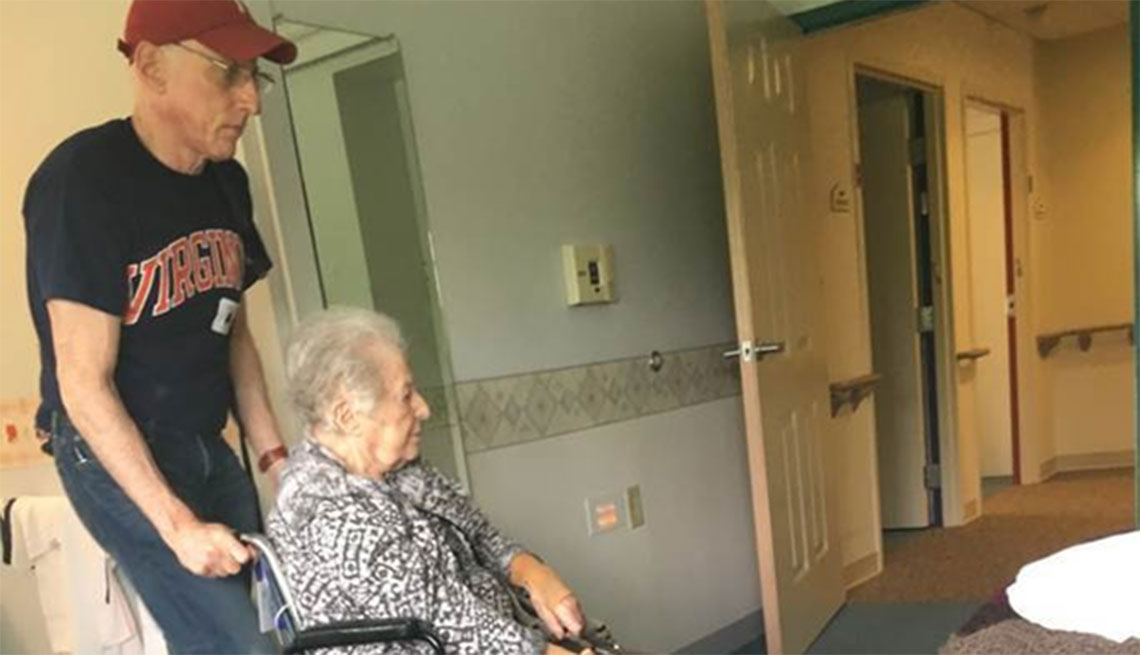
Barry Jacobs provided care for his mother, who suffered from kidney failure and vascular dementia. |
There were times when we stared across the kitchen table at one
another in tight-lipped anger during yet another argument. My mother
bridled at my efforts to control her. I bristled at her resistance to
using her walker and budgeting her money, even though her
frequent falls and financial woes were negatively affecting me and my family.
There were moments of
tenderness,
too. We never had a “huggy” relationship or even one in which we talked
much. But as we sat silently in the car, sometimes for hours, on the
way to visiting her sister or nieces or friends, she would suddenly say
“Thank you for driving me” in a clear voice that brought a lump of
emotion to my throat. Much later on, as we sat eating lunch together in
the sunroom at her nursing home, in the days when her halting speech and
fumbling fingers made it evident she was declining, I tried to show her
through gently wiping her mouth and touching her shoulder that I
understood her fears and sadness and would be there for her.
Anniversaries are times for family caregivers to look back and take
the measure of themselves. As the first anniversary of my mother’s death
arrives, I’ve been reflecting on the nearly seven years of caregiving I
provided for her before her death from complications of vascular
dementia and kidney failure. I’ve been asking several questions: What
did I learn about myself — good and bad — through this often difficult
challenge? How does that matter to me in my life now? What lessons have I
gleaned to share with those still in the middle of the daily grind of
self-sacrifice and caregiving? Here are some thoughts.
No one should posture as a hero: I used to hate when others
would make me out to be some kind of saint for taking care of my mother.
They seemed to be making an implicit gender judgment — “It’s so special
for a son to be a caregiver” — which I knew from national statistics
and my personal experience wasn’t true. I also knew I didn’t act like a
saint, and their praise just made me feel guiltier.
In the face of my
mother’s sometimes wanton disregard for her health and safety, I acted
like a stern taskmaster, forcing her to get out of bed, take her pills
and interact with her home health aides. She in turn described me as
“sour” to her friends and called me a “bastard” to my face. In
hindsight, I should have been gentler, less task-oriented and more
patient and sensitive to her feelings. If an iron fist was ever needed,
then I should have wrapped it in a velvet glove.
Nor play the victim: Sure, I complained. Sitting for long
hours in doctors’ offices and emergency rooms, emptying commodes, and
making frequent drugstore runs weren’t particularly fun. But when I
invited my mother to move up from Florida to live near me, my wife and
kids in Pennsylvania, I kept in mind — just like I counsel my
family-caregiver clients — that I had chosen to make a commitment which I
had the right to define in more detail. Yes, I would and did give her
comfortable shelter, good food and opportunities for company. No, I
wouldn’t and didn’t always take her to the concerts, museums and family
gatherings to which she wanted to go. I wanted to take care of my
mother, and did it my way without feeling too sorry for myself.
Relish the gifts: Even though I’d known my mother all of my
life, I learned through caregiving just how tough she was — gumption I
now grudgingly admire. Even though I had spent decades working in health
care, I learned how many obstacles — such as long wait-times and poor
communication systems — we professionals unthinkingly place in the
caregivers’ way. Even though I’d written myriad articles and a book on
caregiver psychology, I learned just how much anguish and perseverance
caregiving can take.
Remember the forest: For me and many others,
caregiving
is a classic tree-and-forest scenario in which each tree, like each
daily task, looms so large that it obscures awareness of the wider
terrain and greater mission. I would get so caught up in the day-to-day
frustrations of juggling schedules, calling insurers and managing
pillboxes that I sometimes lost sight of the purpose for all of my
self-sacrifice — to help my mother live as well as possible in her last
years. Thankfully, from a full year’s distance, it is the forest, not
the trees, that now stands tall in my memory and makes me mostly proud
to have been the caregiver I was.


