Kurt Falke sat in his room in a residential hotel in Anchorage,
reflecting on the second guardian the state assigned him. He said he
appreciates the work his guardian did behind the scenes
“I was recovering from my brain damage and I was pretty much a kid,”
Falke said. “He was working with other people without me being aware of
it, my counselors and all this.”
Falke’s had guardians on and off since the mid 1990s. That’s because
he was homeless and struggling with substance abuse and later suffered a
serious head injury. He tears up when he talks about how one of his
guardians, Ezra Stone, helped him change his life for the better.
“Ezra, Ezra stone- He became my friend and I started to learn how to
trust somebody because I started trusting myself,” Falke said.
Guardians are assigned to people by the courts when they aren’t able
to make important decisions for themselves. That may be because of an
injury, a mental disability or illness, or because of dementia.
Guardians can then help with or make decisions about medical care,
housing, finances, or even real estate on behalf of their clients.
But patients throughout Alaska have been denied new guardians over
the past seven months. Since April, OPA stopped taking all new
assignments of guardians and conservators because of a severe staffing
shortage. Guardians now have 80 to 100 cases on their plate instead of
the recommended 20-40.
Falke said the guardian he works with now is great at his job and cares.
“David Harper- Now, he’s a good kid. He tries real hard,” Falke said.
But he said Harper has way too many cases on his plate to be able to help everyone.
“It was about 20 then it went up to 50 then 100 and now David’s like ‘oof.’ He’s swamped,” Falke said.
James Stinson, director at OPA, co-signed a letter to the courts in
April saying OPA’s staffing crisis is partially because a number of
public guardians retired or resigned. Stinson said this guardianship
crisis is about more than just OPA.
“It’s not just that case loads are continuing to grow,” Stinson said.
“It’s also that all of the things that a public guardian depends on to
provide services for their wards are becoming more and more constrained
and much more scarce. And the hiring pool has changed considerably.”
Stinson said they’ve done some hiring, but it typically takes two
years for guardians to be fully trained on their job. That’s because
they need a vast variety of expertise to be able to help people with
decisions ranging from real estate to healthcare.
Right now, guardians at OPA have two to three times what Stinson said
is a typical maximum caseload. And because of the state supreme court’s
order, OPA has to continue putting more cases on Guardian’s plates no
matter how many they have. Stinson said that means guardians won’t be
able to do their jobs well.
“Public guardians are just people and they’re people that want to do a
good job, and the staffing situation we’re in is a candle burning on
both ends,” Stinson said. “You can’t afford to overload your most
experienced guardians to the point that they just give up and quit
because they just can’t do anything because that’s disastrous. And you
can’t place a bunch of cases on somebody who’s new and inexperienced,
who doesn’t know how to do it either.”
He said he’s worried Guardians will get burnt out and quit, which will make the problem worse.
Corinne O’Niell, senior director of care management for Providence
Alaska Medical Center, said most people have friends or family that can
make decisions for them. But not everyone has that and that’s when they
need an appointed guardian.
“They’re some of the most vulnerable people in Alaska because they
just don’t have anybody that can step in and fill that role of a
guardian,” O’Niell said.
O’Niell said that if someone can’t get a guardian after medical care,
they might have to stay in the hospital for longer than needed.
“We can’t safely discharge them to the community, because we have
nobody to sign their paperwork to go into a long term care facility, or
an assisted living facility, or sign for their durable medical
equipment, because they can’t understand those decisions and we don’t
have a guardian appointed,” O’Niell said.
And she said that impacts healthcare for all Alaskans.
“Even when we tie up one bed or two beds, or five beds for long
periods of time, those are beds that are then not available right to the
general public to get the right care that they need at the right time,”
said O’Niell.
She also said Alaskans should consider creating an advanced care
directive just in case of injury or illness. She said it can help
prevent the need for a guardian to make decisions for you.
The
tragedy of the Office of Public Advocacy to provide adequate public
guardians may seem abstract to many, but affects us all - as it
contributes to homelessness.
Bear
in mind that some of the most visible and troubled unhoused people
would benefit from a guardian, because of severe mental illness and/or
cognitive impairment. As a doctor who works with some of them, I suspect
that we need more, not fewer, guardians.
The
recently reported failure of a private guardian led to some of his
clients losing housing or benefits. This is how people end up on the
street.
There
are many reasons for the increase in unhoused citizens, but the
failures of Alaska’s safety net - the prolonged loss of food stamps,
lengthy delays getting on Medicaid, and the multiple Medicaid
disenrollments - certainly contribute.
The
Anchorage Assembly and Mayor Dave Bronson are correct in calling for
the state government to help the city with its homeless crisis. Fixing
the shameful holes in our safety net would help.
Some probate courts say they don’t know how many adults are in guardianships or whether they’re still alive.
Judge David Paris runs the Sagadahoc County Probate Court without a
permanent courtroom. Paris wasn't even provided a robe, his wife ordered
him a set online. He holds hearings in the county commissioners’ room,
grand jury room or even the lunchroom. Still, he says, he runs his court
like any other judge and as professionally as he can. Photo by Fred J.
Field.
Norman Fisher’s enemy lived within him.
If he didn’t properly mix two medications each day, his diabetes
would attack his body and mind. Once, his out-of-control blood sugar
left him so delirious that he drove his car into a ditch.
For two decades, support staffers defended Fisher against the disease
by helping him organize his medications and buying his groceries. But
in late 2014, the people assisting the Biddeford man, who was mentally
disabled, said he needed more help than they could provide.
With none of Fisher’s family able to step in as his caretaker, the
York County Probate Court turned to the program of “last resort,” a
public guardianship administered by the state. The state assigned him
two public guardians at different times during the next four years, and
they were responsible for making all medical and housing decisions for
him.
Those guardians submitted one-page reports once a year to the probate
judge overseeing Fisher’s case, but the reports offer little detail of
his care: How often the guardians went to see him. If they talked to
Fisher about his medications. Whether they knew his needs and wants.
There’s also no evidence in the court records that the probate judge
raised questions, even after each guardian submitted virtually identical
reports two years in a row.
Then, in August 2019, Fisher was taken to a hospital and released to a
home for adults with disabilities, one run by Residential and Community
Support Services (RCSS), where the workers didn’t properly administer
his medications, according to court records.
Within 72 hours, Fisher was dead.
“Norman’s death was the type of death that you really hope won’t ever
happen,” said Rory Robb, a now-retired director of Community Partners,
which ran an independent living program that supported Fisher.
Two RCSS workers were charged in Fisher’s death and their cases are
pending, but little attention has been paid to the probate court system
that oversaw his guardianship.
The tragedy was yet another blemish in a decades-long history of
Maine’s probate courts — a collection of 16 part-time county judges
whose independent operations are unique in Maine’s judiciary.
For nearly 56 years, state lawmakers, county officials and probate
judges have rejected plans to overhaul the structure of and increase
funding for Maine’s county probate courts. Legal experts say the probate
courts need to become part of the state’s judicial branch to protect
Maine’s most vulnerable residents — people like Fisher.
State law gives county probate judges the authority to approve adult
guardianships, handing them the responsibility to select the people who
will decide about the care of seniors deemed incapacitated, adults with
disabilities and people with debilitating mental illness.
Yet probate courts don’t have sufficient budgets or employees to
consistently screen, train or monitor the guardians they appoint, the
Monitor found.
There is such a lack of oversight that multiple probate courts don’t
know how many guardianships they have approved, or even whether the
people they are responsible for are still alive, an ongoing
investigation by The Maine Monitor found.
Nor do the courts employ full-time investigators whose sole job would
be to follow up on guardianships to make sure the individuals are being
treated well.
Lawmakers tried to improve oversight by revising the state’s probate
laws in 2019. The new law reflects the conclusion of experts nationally
who said probate courts need to pay closer attention to guardianships,
said Deirdre Smith, a professor at the University of Maine School of Law
and former director of the Cumberland Legal Aid Clinic, which helps
people navigate the probate courts.
“There needs to be very robust oversight by the judge to make sure
people aren’t exploited,” Smith said. “We certainly heard plenty of
instances of that kind of exploitation with guardianship appointments.”
Robb, whose career for decades centered on working with vulnerable
people and their guardians, added: “There’s no real oversight of
guardians.”
A unique system
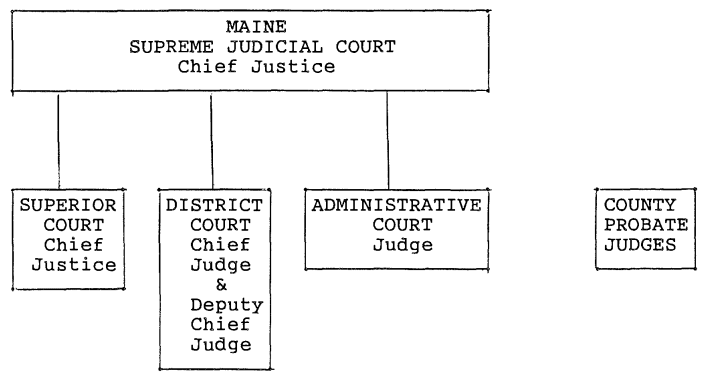
Maine’s probate courts stand alone. They are not a part of the state
judicial branch. Their judges are part-time and elected, which bypasses
the state’s review and appointment process for all other judges. They
operate largely autonomously from each other and the state supreme
court. County-funded and county-run, probate courts operate on
shoestring budgets, with judges paid as little as $25,000 a year and few
court administrators.
Every state has a probate system, and in Maine it has growing
importance: The state of nearly 1.4 million people has the oldest
population in the country and the highest percentage of people over age
65. Beyond guardianships, Maine’s probate courts also oversee estates,
wills and name changes.
Maine’s
county-run probate courts are the only courts that are not a part of
the state judicial branch. A 1986 illustration in the Commission to Study Family Matters in Court report shows the separation of the state courts and county probate courts.
Guardianship is the most intrusive arrangement the probate court can
order. It restricts an adult’s right to make choices about where to
live, medications to take, friends to visit or how money is spent, and
instead delegates those decisions to another person. Guardians are an
unpaid position but they can get reimbursed for fees.
Approximately 1,200 adults are currently subject to a public
guardianship through the Maine Department of Health and Human Services.
Like Fisher, they have no family willing or able to manage their
medical, financial or social needs as they age or because of
disability.
In addition, hundreds if not thousands more adults are under the
guardianship of family members or friends appointed by probate courts.
The exact number of adults in guardianships in Maine is unknown because
several probate courts said they don’t track it.
A top court administrator in Androscoggin County said there were
simply “thousands” of guardianships in the county. An administrator in
Piscataquis County said she had “no idea.”
The Cumberland County Probate Court acknowledged it has lost track
of an unknown number — potentially thousands — of incapacitated adults
and doesn’t know whether some are still alive.
The change to state law in 2019 required new guardians to file a
report each year with the probate court to update the judge on the
well-being of the adult in their care. Guardians appointed before the
law change also are encouraged to check in periodically but are not
required to update the court.
“Unfortunately, without them staying in contact with the court,
there’s no way of knowing where they’re living or if they’re alive or
dead,” said Erica Rickards, deputy register at the Cumberland County
Probate Court.
Kennebec, Lincoln, Sagadahoc and Waldo counties are exceptions and
were able to provide a count of active guardianships when asked by the
Monitor. On Friday, workers at the York County Probate Court said they
had learned how to close guardianship cases. It would take a manual
review of files, however, to determine what cases were still active.
Smith pointed to the new requirement for guardians to file an annual
report as as step forward, but that doesn’t mean the standards are being
implemented consistently across the state.
“We need to make sure that we have someone who’s available to
actually read (guardian reports) and to take steps if something
concerning is raised. I don’t see how our probate judges possibly have
time to do that,” Smith said.
The Maine Monitor sent a survey to the 16 county probate courts and
received responses from 10 that revealed some probate judges and
registers do little to assess the fitness of a guardian before or after
they are appointed.
Only three probate courts that responded run background checks on
prospective guardians to see whether they have been convicted of a
crime. None of the responding probate courts run credit checks to see if
the guardian filed for bankruptcy, which must be disclosed by the
applicant. State law says guardians must have “regular” visits, although
none of the probate courts that responded have policies about how
frequent those visits should be.
The state doesn’t cap the number of adults a public guardian is
responsible for at once. But generally public guardians employed by the
Department of Health and Human Services are responsible for
approximately 25 “clients,” adults subject to a guardianship order from a
probate court, wrote Jackie Farwell, spokeswoman for the department in
response to questions from the Monitor.
They must meet with their clients in-person at least once every 60
days, although the goal is to not go longer than a month, she said.
Unlike family members who agree to be guardians and undergo no mandatory
training, public guardians receive some training and have ongoing
supervision from the state.
Although the department coordinates Maine’s public guardianship
program, the regular oversight of guardianships is the court’s job, she
said.
“The probate courts are responsible for oversight of all adult guardianships,” Farwell wrote.
Fewer than a dozen workers run each county probate court. Several
counties reported having just three court employees, some part-time.
Each probate court is supported by a handful of volunteers —
typically retired social workers or lawyers — that the probate judges
can assign for a small fee as “visitors” to evaluate whether a
guardianship is appropriate. Each county also budgets money each year to
appoint lawyers to represent adults at risk of losing their rights.
The Monitor spoke with eight county probate judges, who all said they
believe they are doing a good job. They lauded their efficiency
compared to the state courts, and while acknowledging they lacked money,
many said being a judge was a public service they took seriously.
“At least in this county, we give people very good and quick service.
I think if they got people in the state system, they wouldn’t be as
quick and efficient,” said Judge Paul Aranson of Cumberland County.
Judge Paul Aranson is at the Cumberland County Probate Court in
Portland, Maine three days a week as its part-time judge. Photo by Fred
J. Field.
Probate courts are supposed to monitor reports by family and public
guardians to ensure they are caring for the adult for whom they are
responsible, according to state law.
Yet Robb, who retired in 2018 before yearly guardian reports were
required by the state, said oversight of guardianships was basically
“non-existent.” As for the Fisher case, she said there were failures in
several aspects of his care, even though the law enforcement
investigation zeroed in on two care workers.
Asked if probate courts have a responsibility to keep a closer watch on guardianship cases, she said:
“There is no follow-through. That’s why I can’t point the finger at
the judge and say, ‘You are responsible,’ because it’s not built into
the current system,” Robb said. “The system needs to be revamped to see
what kind of oversight the court should be providing once they’ve
awarded guardianship.”
A state review concluded that serious medical neglect by workers at
RCSS led to Fisher’s death in August 2019. The state moved quickly to
terminate its contract with the company.
A few weeks before his death, Fisher was already in a dire situation.
His Biddeford apartment was infested with bed bugs, according to court
records. The people who were supposed to help him refused to go inside,
and the independent living program discharged him from its care before
Fisher was moved to RCSS. For three weeks, Fisher’s blood sugar was
erratic and his public guardian didn’t report the conditions to the
probate court. Instead, on July 26, 2019, he filed the same report as
the year before, which did not mention those issues.
The probate judge had the power to demand the guardian come into
court and provide more detail about Fisher’s well being, but there is no
evidence in the court file that he did so. And soon after, it was too
late.
Carol Lovejoy has worked in the York County Probate Court for 43
years, including 19 as the elected register. After a Monitor reporter
reviewed the details of Fisher’s case with her, Lovejoy said no one is
assigned to check whether guardians are duplicating past reports. She
added that the probate court plans to hire a paralegal whose duties may
include checking for duplicate reports.
“We don’t necessarily read every report that comes in — the staff
doesn’t,” Lovejoy said. “We give it to the judge, so I would hope that
the judge would catch that.”
The York County probate judge in Fisher’s guardianship, Bryan Chabot,
declined to answer questions about the specifics of Fisher’s case, but
said that he and the court staff had protocols in place if a guardian’s
reporting seemed lacking. Chabot has not been accused of wrongdoing. The
state investigation of Fisher’s death does not appear to have included a
review of the judge’s role, and the state declined to comment further.
Low pay, big responsibility
In Sagadahoc County, David Paris runs the probate court without a
permanent courtroom. His office is on the third floor of the county
building in Bath. The state courts lease a courtroom in the same
building, but Paris isn’t allowed to use it, he said.
Sometimes, Paris presides over adoptions in the county commissioners’
meeting room downstairs. He holds hearings in the grand jury room when
it’s available. If a virtual meeting needs to happen, he holds court
from the lunchroom.
Paris didn’t even receive robes when he was elected in November 2020. His wife ordered him a set online for less than $100.
“I run it like any other judge would run their court. I run it as professionally as I can,” Paris said.
Probate judge candidates must be licensed to practice law and reside
in the state. They are elected by county residents to serve four-year
terms.
After 30 years of private practice doing criminal and civil
litigation in the state’s district, superior and supreme courts,
becoming a judge was on Paris’ bucket list. He said he didn’t believe he
had the political connections to be appointed to the state courts, so
he chose to campaign for probate judge.
“I’ve got to go out and beat the street and earn it from the people.
I’ve got to tell the people, ‘This is why I can do the job.’ The other
ones, a lot of times, people will be tapped on the shoulders,” Paris
said. “You’ll see where judges go from never being in the courtroom to
the law court.”
Paris is being paid approximately $37,500 this year. The median
probate judge salary in Maine was approximately $36,200 in 2021,
according to a state study commission that looked at moving probate
courts into the state judicial branch.
Piscataquis County pays its probate judge the least, just $25,000 a
year. Most counties also provide health insurance and retirement
benefits to the elected, part-time officials, although Sagadahoc County
doesn’t.
Members of the 2021 study commission proposed that probate judges be
made full-time and paid the same as a district court judge — currently
$145,642 a year — if the probate courts were moved into the judicial
branch.
Their pay would be below the national median judge salary of $168,761, according to the National Center for State Courts. Maine consistently ranks among the lowest in the nation for judicial compensation, even without factoring in probate judges.
“The salary of the probate (judge) can’t sustain a lawyer,” said Paris, who continues to work in private practice.
“They should stay on the bench”
No Maine law or rule of professional conduct requires elected judges
to close their law offices or stop private practice. In fact, there is a
special carveout in Maine’s judicial rules for probate judges to
practice law. Critics say it creates, at a minimum, the appearance of a
conflict of interest.
Most probate judges in Maine have an active practice in criminal,
civil, real estate or probate law, according to a review by the Monitor.
Some probate judges have agreed not to appear in each other’s
courtrooms to represent clients in contested probate cases, but the
agreements are nonbinding and unenforceable.
Practicing in the state court system also has never been off-limits
to probate judges, creating situations that are, at the least, awkward
for the attorneys involved, some lawyers said.
As a lawyer, Elizabeth Stout represented clients in state court and
probate court in southern Maine for 30 years. During one case in the
Biddeford District Court, her opposing counsel was Robert Nadeau, who
was the York County probate judge. Nadeau and Stout heatedly argued in
district court, and the case became more contentious than it needed to
be, she said. Later, Stout found herself arguing on behalf of another
client to the same man, but this time he was the judge.
“It’s just really uncomfortable,” Stout said.
Nadeau held a position of power as a judge, and Stout said she didn’t
want to anger him in a way that could affect a future client. She said
Nadeau appeared fair during her future cases, but his dual roles were a
concern.
“Why are they appearing as litigants? They should stay on the bench if they’re on the bench,” Stout said.
Nadeau was suspended from practicing law by the state supreme court
in 2017 for multiple violations of Maine’s judicial ethics rules while
he was the county probate judge. He did not return a voicemail request
for comment.
It doesn’t look good to lawyers or their clients when an elected
probate judge appears as a lawyer in another county probate court, said
retired state supreme court Associate Justice Ellen Gorman.
When serving on the state supreme court from 2007 to 2022, Gorman saw
instances in which a probate judge could have benefited from training.
In some cases, probate judges failed or refused to create a complete
record of what had happened in a case, or appeared unfamiliar with the
probate code, she said. But because probate judges work as lawyers, the
state courts did not think it was appropriate to train them alongside
the other judges, she said.
“When you are not devoting all of your time to being a judge, it is
hard to maintain the level of professionalism and education of law that
is necessary for the position. I have the utmost respect for the probate
judges. It’s not that they are incapable of the work; it is that the
time is not provided to them. The amount of time they have available to
them to be judges is simply not sufficient,” Gorman said.
State considers consolidating probate courts
Maine voters passed a constitutional amendment in November 1967 to
get rid of part-time probate judges and replace them with full-time
judges, but the amendment never went into effect.
State lawmakers have disagreed about what to do for nearly 56 years.
The studies they commissioned, including the most recent one in 2021,
reach the same broad conclusion: Probate judges should be full-time to
eliminate the appearance of a conflict that occurs because they are
practicing lawyers. The recommendations also urge the probate courts to
become part of the judicial branch.
A bill in 2022 to reduce the 16 part-time judges to nine full-time
judges was passed by the House and Senate, but wasn’t funded and Gov.
Janet Mills never signed it into law.
“Personally, I continue to feel that implementing the 2021 plan is a
goal. I think the new system would both fulfill the constitutional
amendment and benefit the people of Maine,” said Sen. Anne Carney
(D-Cape Elizabeth), a chair of the legislative Judiciary Committee.
Consolidation of the probate courts under the most recent proposal
would mean that several counties would no longer have a local probate
court. Some say that would be a good thing, because it would even out
the workload across counties with smaller populations.
“The volume of probate court work varies, and some counties do not
have enough probate work to keep a full-time judge busy,” Carney said.
The price tag for the state to run the probate courts was estimated
by legislative analysts to be $7.4 million annually, compared to the
$5.1 million counties collectively spent to operate them in 2022.
Counties have resisted moving the probate courts under the control of
the state because of the increased cost and a fear of losing local
control, said Michael Carpenter, a former state lawmaker and lawyer in
Aroostook County who is a critic of the current set-up.
“Courts should be above local control. Local control is about
electing your school board, electing your town council and that sort of
thing. It’s not about, it shouldn’t be about, interpreting the law, in
my opinion,” Carpenter said.
The debate over state control of probate courts re-emerges every few
years, and the effort to move forward always has stalled because of
money, said Peter Baldacci, who is in his 35th year as a Penobscot
County commissioner. County leaders are skeptical of the strings that
will come attached to any deal for the state to take over paying for
probate judges, lawyers and visitors, he said.
“The more that the state pays, the more they have an ability to say how to operate,” Baldacci said.
The probate courts’ independence from state courts and each other has
been criticized for creating a lack of uniformity among the probate
courts. Processes vary county to county. There is no chief probate judge
to set standards. There is no central administrative office and no
collective money for the probate courts to use to implement systemic
reforms.
An “assembly” of the state’s 16 probate judges does, however, meet twice a year to discuss policy and legal matters.
The state government’s “one-size-fits-all” approach doesn’t address
the counties’ differences, Baldacci said. There’s mistrust among county
leaders that the state also will eventually seek control of the probate
court’s top elected administrators, called registers. Or that the
probate courts won’t be a permanent part of the judicial branch budget,
and funding will become an annual fight between state leaders and county
commissioners, he said.
The state court system has its own problems. Chief Justice Valerie Stanfill said earlier this year that Maine’s judicial branch was “frail” amid a record backlog of unresolved criminal and civil cases, and high turnover of judges.
“They need to take care of their house before they expand into probate,” Baldacci said.
Counties go without resources
On a recent Wednesday morning, neat stacks of files sat on Judge Paul
Aranson’s desk as he readied for a day of cases at the Cumberland
County Probate Court.
Inside the files were doctor’s notes and guardianship plans submitted
by family members seeking to take responsibility for a loved one’s
care. Other files contained letters from parents seeking to regain
guardianship of minor children, or adults asking to end the state’s
control of their medical, financial and social decisions.
Aranson’s mornings are scheduled in 20-minute increments. He checks
the status of cases remotely on Google Meets or in person in his
courtroom, a place with decorative ceilings, thick red curtains and a
large wooden dais where he sits behind a wall of Plexiglass installed
during the COVID-19 pandemic. Although many of the cases are
confidential, there are rows of benches for observers.
During one of the morning’s cases, Aranson struck up a conversation
with a man in his mid-20s about the man’s part-time job at Home Depot
and why the Boston Celtics are doing so poorly. The man’s parents were
petitioning to be appointed as his legal guardians. After a few minutes,
Aranson decided to appoint a lawyer to represent the man before
deciding the guardianship question.
At 72, Aranson is mostly retired from private practice and is several
decades removed from being the county’s district attorney. He is at the
courthouse three days a week, which is more often than most judges.
Probate Judge Paul Aranson listens to justifications for why multiple
adults are in need of guardianship in Cumberland County. He sits at his
desk behind a Plexiglass wall that was installed during COVID-19. Photo
by Fred J. Field.
Cumberland County’s probate court in downtown Portland has as many,
if not more, resources than any other county in the state. And still,
it’s not enough to ensure the court maintains contact with each
incapacitated adult in its jurisdiction.
Since September 2019, Aranson has authorized approximately 712
guardianships or conservatorships that provide financial oversight to
individuals. But there are thousands more from before his time on the
bench that court administrators said they do not track or have regular —
or sometimes any — contact with the guardian or adult.
The court workers often don’t even know whether those people are still alive.
One Cumberland County worker keeps a spreadsheet of recent
guardianships to track reports that guardians are supposed to submit,
the deputy register said. If a guardian fails to file the annual report,
they are scheduled for court to explain the deficiency and could be
stripped of their guardianship.
Other courts also are dealing with a shortage of workers and money to handle the guardianships.
The York County Probate Court, for example, is not able to schedule
all hearings within the 14 days required by law when an adult objects to
an emergency guardianship, said Lovejoy, the county register. A
shortage of court-appointed lawyers and visitors, and the time it takes
to send everyone proper notice of a guardianship petition, are among the
reasons the hearings do not happen in time, she said.
Penobscot County also frequently can’t find enough local lawyers
willing to accept court appointments to probate cases, said Register
Renée Stupak.
Voluminous probate files are housed in the probate office in the
Cumberland County Courthouse in Portland, Maine. The court has approved
at least 712 guardianships or conservatorships since September 2019.
Photo by Fred J. Field.
Payment is a major reason.
The county pays court-appointed lawyers $80 an hour, which used to
match the wage paid by the state system to defense lawyers. But state
lawmakers bumped those attorneys’ pay to $150 an hour in February,
which not all of the probate courts have been able to match. Stupak
said she plans to ask county commissioners to pay $100 an hour.
“If we can’t get attorneys, what are we going to do?” Stupak asked. “We can’t leave these people hanging.”
Another gap in the probate court system is people whose job is to check that a court order is being followed.
The county probate courts that responded to the Maine Monitor survey
do not employ full-time investigators to check on cases. The only people
who investigate guardianships are court-hired “visitors,” but they do
only initial interviews with guardians and those needing guardians. They
often don’t remain engaged.
“I think a visitor is adequate. Some are better than others but
they’re all pretty decent,” Aranson said. “It might be certainly
worthwhile to have money for a visitor to go out on a spot-check
investigation, but the reality is that most people under guardianship
are in a state-licensed institution.”
That’s not how other states do it. In Ohio, for example, probate
courts must employ or contract with investigators with a degree in
social work, special education or psychology to do the initial review
and also to read annual reports submitted by guardians and receive
complaints.
“We do not have good oversight,” said Lyman Holmes, the Washington
County probate judge for more than 30 years. “Certainly, in some states,
the probate courts have investigators, and they can go around and
investigate. They have full-time investigators on their staff but we
certainly don’t.”
Norman Fisher’s final days
Even though he was supported by direct support professionals for much of his life, Fisher guarded his independence.
His apartment was filled with treasures he found throughout his day —
newspapers and items that most people would consider junk, said Rory
Robb, the retired director at the independent living program that worked
with Fisher for two decades.
“He struggled with having to have any staff in his home and anybody
that was going to touch his things,” Robb said. “He, unfortunately, was
institutionalized earlier on in life, and that really sets people on a
different path. You really care about your possessions because you
didn’t have many things, or things were taken away from you. So we
understood why he had this need to try to keep everything. We just tried
to keep his apartment somewhat safe.”
Even so, food rotted in his fridge. He neglected his hygiene. And he
stacked boxes against the door after a break-in, creating a personal
safety hazard.
These parts of Fisher’s life were manageable. It was his worsening
diabetes that concerned those who supported his independent life, Robb
said. Fisher needed up to four insulin shots a day and had to determine
the dosage based on a sliding scale to manage his blood sugar, court
records show. His support team told the Monitor that Fisher couldn’t
comprehend the severity of his diabetes or accurately describe doctor’s
orders to his caregivers.
In late 2014, the team decided that Fisher needed a guardian, Robb said.
For 4 1/2 more years, with a guardian occasionally checking on his
case, Fisher lived independently until his apartment in Biddeford became
infested with bed bugs and caregivers would no longer enter. Instead
they checked on him from his front porch.
Fisher’s public guardian and case manager worried that for his health
and safety, he couldn’t live alone, and they persuaded him to go to the
emergency room for an evaluation in 2019, court records show. One of
the last items his public guardian grabbed as they left Fisher’s
apartment was a bag of medications near the door, but it was missing his
insulin and glucometer, the machine used to measure his blood sugar,
according to court records.
At the hospital, they broke the news to Fisher: He couldn’t return to his home.
Fisher was discharged from the hospital directly to RCSS on Saturday,
Aug. 24, 2019. For three days no one checked his blood or gave him
insulin, according to court records. When a nurse finally went to the
house and tested him the following Tuesday, the meter read “high,” which
meant Fisher’s blood sugar was too high for the glucometer to measure,
according to court records. The nurse called 911, but Fisher stopped
breathing before the ambulance arrived.
Fisher died on the floor at age 62 of hyperglycemia with ketoacidosis, according to court records.
Two RCSS workers were criminally charged with endangering the welfare
of a dependent person. Their cases are pending in Cumberland County
Superior Court. One ex-worker declined an interview request through her
lawyer. The other worker, through her own lawyer, said she is pleading
not guilty to the charge.
Following a broader investigation, the state ordered
RCSS to repay $30.2 million of MaineCare funds because it hadn’t
performed required background checks on every employee or ensured they
were properly trained in CPR and first aid, in violation of state
rules. The company is appealing the state’s decision.
Fisher’s death was investigated by law enforcement and the Maine
Department of Health and Human Services. His public guardian, case
manager and a member of the state’s crisis team were found not
responsible for the death. The guardian has since died. The judge’s role
is not mentioned. The department’s policies were not found to be a
contributing factor to Fisher’s death, wrote the department spokeswoman
Farwell in response to questions from the Monitor.
Norman Fisher, 62, died in a home run by Residential and Community
Support Services (RCSS) in August 2019. Two workers were substantiated
by the state for abuse or neglect of Fisher, who was mentally disabled,
after he went 72 hours without blood sugar tests or insulin for his
diabetes. The superior court upheld the findings after appeal, as seen
in court records. Photo by Samantha Hogan
Judge Bryan Chabot was in charge of the York County Probate Court in August 2019.
There’s no indication in the court file that Chabot noticed that the
report Fisher’s guardian filed was the same as the one submitted the
year before. And Chabot didn’t flag the duplicated report for further
review, probate court records show.
While he declined to comment on the specifics of Fisher’s case, he
said that in general, the probate court’s role in monitoring
guardianships is to see whether guardians have done their duties, if the
guardianships should continue and if fees should be approved, Chabot
wrote in an email.
Chabot resigned as probate judge in 2019 to accept a job in Portland
as an administrative law judge with the state Workers’ Compensation
Board.
The Monitor interviewed two dozen people for this article and they
were unwilling to comment on the judge’s role in Fisher’s case. Instead
they criticized broad issues with how probate courts are structured.
“Having a centralized system with centralized oversight, with clear
expectations, with sufficient resources — all of those things are
essential to ensure that the legislative intent behind regular reporting
requirements are actually being fulfilled,” said Smith, the law
professor.
Adult Protective Services would not release meeting notes or dates
that Fisher’s guardians met with him between 2015 and 2019. The agency
said in response to a public records request by the Monitor that all
records created while an adult is under the jurisdiction of the
department are confidential.
Erin Salvo, associate director of Adult Protective Services, said in a
written response denying access to the records that the guardians’
reports were in compliance with rules in place at the time.
A single page
The plain manila file for Norman Fisher, case number 2014-1050 in
York County Probate Court, includes no mention of the investigations
that followed his death. There’s nothing about the criminal charges
against the two workers, or the termination of the home’s license, or
the plans by York County to hire a paralegal who would keep a closer eye
on the annual reports by guardians.
The last record filed by the Department of Health and Human Services
is a notice dated Aug. 29, 2019, informing the court of Fisher’s death.
Typed onto it a few days later and signed by the judge is a brief
message, “The incapacitated person’s death is noted. No further
guardianship-related action is necessary.”
This story is part of an ongoing series by The Maine Monitor about the county probate court system. If you have a tip or story to share, please email reporter Samantha Hogan at samantha@themainemonitor.orgor anonymously fill out ourcontact form.
The Office of Public Guardian is under the
Nebraska court system, headed by Supreme Court Chief Justice Mike
Heavican, shown here.
No one, no matter one’s profession,
income or background, has an absolute guarantee they won’t become
incapacitated in later life. That debilitation, physical or mental, can
cause them to need help in managing personal financial and household
needs.
Vulnerable, too, are
non-elderly residents coping with disabilities, mental health
challenges, substance abuse problems or other impairments.
Troubling
instances of financial abuse of such individuals have sometimes arisen
in Nebraska, such as the court-appointed guardian in Omaha who took at
least $350,000 from several wards.
To
prevent such abuses, the Nebraska state government took commendable
action in 2014 by creating publicly funded guardians, under the Nebraska
court system, to help vulnerable adults. Then-State Sen. Colby Coash of
Lincoln introduced the legislation after World-Herald investigative
reporting on the issue.
The
program has charted encouraging successes, but it also faces daunting
challenges as the state-paid public guardians work to provide these
needed services, according to a new report from the Office of Public
Guardian. The state currently has 17 public guardians, who each handle a
maximum of 20 wards. Cases are assigned based on their crisis level,
with lower-level cases placed on a waiting list. At the end of October,
40 cases had been referred to the waiting list.
The
guardians face considerable stress in their work, the report says, and
turnover is considerable, which adds to the burdens of remaining
guardians and lengthens the waiting list. Six applicants died in 2017
while waiting for services. The Supreme Court is trying to help by
allowing guardians to earn compensatory time or overtime for handling
cases after hours or on weekends.
A
frequent problem, the report says, is that medical and mental health
services are inadequate in many cases for wards’ needs. The report cites
concern, for example, regarding “hospitals and inpatient facilities
(that) discharge wards without appropriate discharge planning resulting
in lack of adequate services, putting at risk the health and well-being
of wards.”
Other problems: “lack of permanent
supportive housing for individuals with mental illness,” “nursing home
and assisted living facilities with multiple licensure and regulation
issues” and “difficulties in obtaining Medicaid when a ward has been a
victim of financial abuse.”
The
Office of Public Guardian works to recruit guardians and promote
alternative supports. The office held 102 presentations across Nebraska
from December 2017 through October 2018 to train private guardians and
conservators. The office has developed procedures to better identify
relatives and friends who could help individuals in need.
This
need for assistance for elderly Nebraskans from public or private
guardians is likely to increase in coming years. From 2010 to 2030, the
number of the state’s residents ages 65 and above is projected to
increase from 240,000 to 400,000.
The
new report describes encouraging instances of how public guardians have
helped wards. One example is a retired minister, described in the
report by the pseudonym Mark. Mark had properly prepared his retirement
finances through investments, annuities, long-term care insurance and a
pre-paid burial plan. But he fell into a catastrophic situation after
entrusting his assets to his only grandchild, who suffered from a drug
addiction. The granddaughter liquidated his assets, had check deposits
redirected to her and took out multiple lines of credits in Mark’s name.
Mark lost personal items dear to him, including family photos and
heirlooms.
The Nebraska
Department of Health and Human Services nominated Mark for emergency
protection by a state guardian, and matters turned around. He entered a
nursing home and enrolled in Medicaid. He was able to resume contacts
with friends in a local club. The guardian helped document Mark’s
preferences for his memorial service, burial and organ donation.
Before he died, he told his guardian, “I feel so fortunate to have you.”
The
Office of Public Guardian is to be commended for the services it’s
providing to such Nebraskans — the need is great. This initiative
deserves continued support, buttressed by a strengthening of Nebraska’s
medical and behavioral health communities.
Individuals who
have no family caregivers are known as "elder orphans." When they become
incapacitated (often due to a dementia), they are known as the "unbefriended."
Since the unbefriended lack a willing or capable family support system, they often require a public guardian. Public guardians are case workers whose job is to make legal and personal decisions for people who are alone and incapacitated.
For many without a family caregiver, this protects against abuse and neglect.
After reviewing thousands of abstracts and more than 100 papers, we found little information on this vulnerable group.
Studies from the U.S. indicated that unbefriended older adults were
childless or had fewer children. They were more cognitively impaired
than individuals with family guardians.
Unbefriended older adults are exceptionally vulnerable to poor
quality of care. Without family or friends who are familiar with their
wants and needs, it is unclear if they receive treatment that is in line
with their values and desires.
Since our review found no Canadian studies or reports on the
characteristics or health of unbefriended older adults, we have no idea
how Canada may or may not compare to the U.S.
As a result, we are conducting research to estimate the prevalence
and the unmet needs of unbefriended older adults in LTC facilities.
One thing is clear: This is population is likely to grow. Research on
the health and care needs of unbefriended older adults, and the
potential health impacts of public guardianship, are urgently needed.
Without such studies, we are unable to adapt our continuing care system
to meet the needs of this unique population.
We cannot solely rely on our children and other family members to care for us as we age. We need health and social systems that are prepared to care for our most vulnerable.
Further inquiry is imperative to examine guardianship services for older adults in Canada and around the world.
ANCHORAGE, Alaska (CN) - In the last five years, the caseloads of public guardians in Alaska have steadily increased to a current total of 83 wards for each guardian. This leaves guardians with the Office of Public Advocacy just one hour and 42 minutes per month to manage each ward's medical care, government benefits, housing, vocational services and any income the ward is eligible to receive.
"Public guardians are some of the hardest working people in this state. But, when you saddle them with twice as much work as humanly manageable, there is one obvious result - thousands of disabled Alaskans suffer. This lawsuit will end it," said Meg Zaletel, a partner with the Anchorage-based Northern Justice Project that represents M.M. in his class action filed Oct. 26 against the state of Alaska, the Office of Public Advocacy and its oversight agency the Department of Administration.
Alaska's guardian caseload is more than double the national standard of 40 set by the National Guardianship Association, a membership organization representing professional guardians from across the United States. Even the Office of Public Advocacy admitted in its 2016 budget request that the office is chronically underfunded and its hard-working guardians are unable to keep up with their increasing caseload.
Under to Alaska statute, a guardian must visit each of their protected persons at least once per quarter to monitor their welfare. There are four office locations: Anchorage, Fairbanks, Palmer and Juneau.
But Alaska is a large state where many wards live more than a short drive from their guardian's office. Some require travel by air or boat.
Plaintiff M.M. is on the autism spectrum. In 2014, a court ordered that all his affairs be managed by a public guardian. The Office of Public Advocacy charges wards a monthly fee for its services, plus an initial case set-up fee upon appointment as guardian.
According to the complaint, M.M.'s public advocate has not submitted the proper paperwork so that his supplemental security income continues and has not had adequate time to insure that critical Medicaid benefits remain in place. As a result, M.M. has been left without funds for groceries and other essentials for basic living including rent for his group home. He now stands on the verge of homelessness.
He has attempted unsuccessfully to contact his guardian by phone. He also tried going in person to his guardian's Anchorage office, where he was told that his guardian was not available to see him. He has also not received the mandated quarterly in-person visits.
It took a friend of M.M.'s, Erin Kirkland - listed on the complaint as his "next friend" - to seek legal help. Kirkland declined to comment and referred Courthouse News to Zalatel, whose firm is representing M.M. pro bono.
"We fully expect that [the Office of Public Advocacy] will want to address our requests," Zalatel said. She explained that the defendants have 40 days from the date the complaint was filed to respond.
M.M. seeks an order requiring caseworkers to visit their wards once per quarter and that they will have no more than 40 wards per guardian as the National Guardianship Association recommends. He also wants a refund of the monthly fees for each quarter that guardians did not visit their wards.
Leslie Ridle, deputy commissioner for the state of Alaska Department of Administration defended the agency in an email to Courthouse News.
"The Office of Public Advocacy does an excellent job providing guardians to vulnerable Alaskans," Ridle said. "We are constantly working to create efficiencies in the division to make sure resources are used to help our clients. We are reviewing the case, and at this time we have no further comment."
In his complaint, M.M. says he recognizes that Alaska's public guardians are working extremely hard under an overwhelming set of circumstances. Zalatel said she hopes her client's lawsuit changes things for the guardians and their wards.
"The intent of this lawsuit is to help," she said. "Ultimately, [plaintiffs and defendants both] want to the best possible care for thousands of disabled Alaskans."
M.M.'s case was filed in the Third Judicial District in Anchorage.
---- (AP) _ Five social workers in the public guardian’s office
here control the lives of 1,000 elderly people. The office also controls
$200 million in assets and has run a hardware store, a plant nursery
and an oil drilling operation owned by its wards.
It
is the largest and one of the oldest public guardianship offices in the
country, and its critics say it now turns away cases and favors monied
wards over the indigent.
Both criticisms are true to some extent, the public
guardian says. His office is swamped, and his budget is constantly under
threat.
″We don’t want any more. We have too many,″ said Gordon Treharne,
the Los Angeles public guardian. ″Everyone thinks we should expand and
we’re not. We’re retrenching.″
And it’s happening all across the country.
Faced with a crush of elderly who either outlive their money or live
far from family, states are setting up - and loading up - public
guardians as a catchall for those who have no one else.
While numbers remain unclear, an Associated Press study of more than
2,200 guardianship cases around the country shows that 2.3 percent of
the 300,000 to 400,000 people under guardianship may be wards of public
guardians.
The public guardians take direct control of
the lives of old people and make the decisions any guardian makes -
where the ward will live, whether to pull the plug on life-support
systems, how much money is spent on groceries.
″Public
guardianship is brand-new by government definitions,″ said James
Scannell, the public guardian in San Francisco. ″We’re in our infancy.
We’re really just evolving now to meet the needs of the community.″
Meeting those needs is becoming increasingly difficult. In Phoenix,
caseworkers have time to visit their wards only four times a year.
Tennessee’s new public guardian’s office took in 37 people in the first
two months and expects to reach 300 in the first year.
Thirty-two states have some form of public guardianship, and almost all are finding big problems that are getting worse.
Some public guardians have been indicted, others criticized for neglecting wards or ″warehousing″ them in nursing homes.
In California, a grand jury blamed the Santa Clara County public
guardian’s office for the 1985 starvation death of 79-year-old John
Nagle. The office hadn’t seen the ward in two years. The grand jury’s
report helped establish new guidelines for the office.
The public guardian for Du Page County, Ill., pleaded guilty to
charges of official misconduct and theft last year after he was accused
of investing wards’ money for his own benefit. He was ordered to repay
$12,600.
John M. Hartman, a former Bay County, Mich.,
public guardian, admitted in 1985 that he embezzled $129,506 from some
of his 75 wards. He was sentenced to five years in prison.
Las Vegas’ public guardian, Jared Shafer, has drawn fire for making
real estate investments with partners in the law firm he chose to handle
most of his office’s business.
In North Dakota, wards
are placed in the hands of part-time public administrators, appointed
officials with no training, staff or money to care for their charges. In
one case, a public administrator put two wards in the care of a friend
who charged each estate $2,000 a month for room and board.
″When you don’t have the appropriate staff, you get into these
binds,″ said Verdine Dunham, president of the California Association of
Public Administrators. ″Sometimes I wake up in the middle of the night
... (worried) that I haven’t done something that will come back to haunt
me.″
Added Phoenix public guardian Dean Trebesch:
″There’s more realization now that the power that goes with guardianship
is so awesome and the loss of rights so awesome that we’d better make
darn sure we do it right.″
While some social service
professionals hail the care and services provided by public guardians,
other experts point to the problems of handling so many with so few.
In Phoenix, for example, so many are now under the umbrella of the
public guardian that caseworkers handle 75 wards apiece. San Francisco
has 315 wards and two caseworkers. Alameda County, Calif., which
includes the city of Oakland, has frozen its caseload at 450 with just
three caseworkers. Alaska’s six public guardians handle 280 cases. Four
guardianship officers in Kentucky have an average case load of 150 each.
In Portland, Ore., five people handle 180 wards with a
$180,000 annual budget. ″We’re stretched thin,″ said Jeff Brandon,
deputy public guardian. ″There’s probably 500 cases that are not even
sent here, because they figure they’ll get a ‘no’ from us.″
In Los Angeles, the case load breaks down to more than 200 wards per worker.
″The reality is with those case loads we’re not getting out there very often,″ Treharne said.
Few guidelines exist for running public guardianship offices, but some experts have suggested limits.
″The public guardian must be adequately staffed and funded to the
extent that no office is responsible for more than 500 wards, and each
professional in the office is responsible for no more than 30 wards,″
said Winsor Schmidt, a guardianship expert and law professor at Memphis
State University.
In its year-long investigation into
guardianship of the elderly, the AP found the push to public
guardianship is due in part to a lack of private guardians, including
family members, willing to take on non-paying or low- paying cases.
Needing someone to authorize medical procedures, guarantee payment,
sign hospital discharge papers, pay monthly bills or even recover money
lost to swindlers, many agencies and social workers are looking for a
place to turn.
One survey obtained by the AP in
Massachusetts, where there is no public guardian, showed that 94 percent
of the state’s hospitals reported ″experiencing guardianship problems
with patients, the largest being the lack of potential guardians.″
Without a public guardianship program the mentally ill, some of them
elderly, who have been declared incompetent have no one to speak for
them. In Pennsylvania, it is estimated 5,000 to 6,000 mentally ill
people have been declared incompetent since 1979, and half have been
released from institutions.
″It’s a mess. These people
are in no-man’s land. No one is protecting them,″ said Edward Carey, a
member of the Pennsylvania bar association’s subcommittee on the elderly
and infirmed.
Yet some oppose the idea of public guardianship.
Lawrence Frolik, a law professor at the University of Pittsburgh,
sees it as another layer of bureaucracy. ″The last thing you want is a
state office whose existence depends upon taking away the rights of
others,″ Frolik said.
Terry Roth, a consultant to the
Pennsylvania Association of Retarded Citizens, fears a return to
institutionalization of the mentally ill.
″As soon as
you create a public guardianship, you’re going to have someone filing
against every bag lady out there,″ he said.
In some
places that do have public guardianship, officials have begun cutting
budgets, asking the public guardians to become more self-sufficien t
through fees charged to the wards’ accounts.
In Los
Angeles, income from fees was supplemented last year with $2.5 million
from county tax coffers for a total budget of $9 million. This year the
county commissioners cut that $2.5 million to less than $1 million.
In the last nine years, county support has fallen from 67 percent of
Treharne’s budget to less than 15 percent. About 85 percent of
Treharne’s cases are indigent.
″We do want some big cases (large estates to which fees could be charged) ourselves, but we don’t hustle them,″ he said.
Treharne’s office has been criticized by a public interest group
claiming too many people have been moved out of their homes and routed
to institutions. Of 1,000 elderly wards (the office is responsible for
2,200 people, half of them mentally ill), only 50 are maintained in
their homes.
Florida, which has a huge elderly population, only this year launched pilot public guardianship programs in two counties.
Ten years ago a count by Florida’s Office of Aging and Adult
Services found that 2,700 people, 63 percent of them older than 60,
needed guardians. About 1,000 of them had already been found incompetent
in court. Today the figure is believed to have doubled.
The three-person operation in Fort Lauderdale will fill its 40 spaces
by October, its 10th month of operation, public guardian Lisa Goldstein
said.
″It took 10 years of resistance and I still get
told all the time, ’We don’t need you,‴ Ms. Goldstein said. ″If we
don’t get an increase in staff we will not be able to accept people. To
me, it would be a crime if the state opened the floodgates and closed
them without fully realizing the potential of the problem.″
Public guardians agree that as the population ages, as people live
longer and as hospitals and nursing homes require more guardianships,
there will be even greater strains on public guardians.
″I think we provide a needed service,″ said Shafer, the Las Vegas
public guardian. ″But as our senior population grows, it’s gonna get
worse.″
In San Francisco, the public guardian has
begun diverting people from guardianship by establishing payment
programs and arranging for sales contracts that allow the elderly to
remain in their homes until death.
Said Scannell, ″Alternatives to conservatorship (guardianship) is really where the emphasis should be.″