|
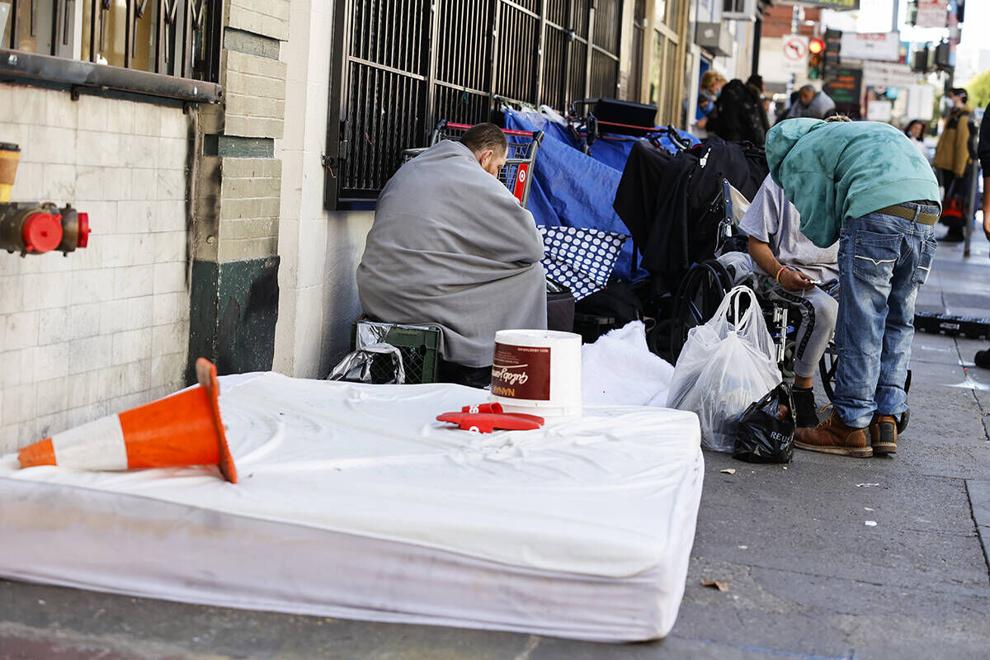
| Homeless people line Ellis Street between Taylor and Jones streets in the Tenderloin in March. |
As San Francisco grapples with overlapping crises of homelessness,
drug overdoses and lagging mental health resources, political momentum
is building toward expanding the use of conservatorships to legally
compel more people into treatment.
But the revival of forced
treatment has prompted deep concern among mental health and disability
advocates, as well as civil liberties experts. Conservatorships have
traditionally been reserved for last-resort cases where severely
disabled individuals are unable to care for their own basic needs, not
street-level homelessness or drug issues. Moreover, critics note that
compelling people into treatment falls flat when there are still too few
housing options and care facilities.
“This is definitely something I’ve noticed is gaining support over the
last five years,” said Raia Small, an organizer with the San Francisco
advocacy organization Senior and Disability Action. “And I have a lot of
concerns about it. This is not what people who are homeless are asking
for or people who have struggled to access housing or treatment care.”
There are different types of conservatorships in California,
including mental health conservatorships specifically for people who are
considered to be “gravely disabled,” meaning they have a mental health
disorder that prevents them from providing their own food, clothing and
shelter. Those who are conserved for mental disabilities can be subject
to confinement in a locked facility, although some may live in open
facilities or group homes.
New proposals
Rising
rates of homelessness and overdoses across California backdrop the
growing interest in conservatorships. While San Francisco saw a 3.5%
drop in homelessness over the pandemic, likely due to a dramatic
increase in funding for homelessness services and housing through
Proposition C, many individuals still can’t access the kind of housing
or care they need.
Gov. Gavin Newsom recently unveiled a proposal,
called CARE Court, which would connect individuals with a 12-month
court-ordered care plan. It targets those living with homelessness,
substance use disorder and schizophrenia or another psychotic disorder.
It’s an attempt to prevent incarcerations, but if participants can’t
successfully complete their care plans, they could be placed under a
conservatorship. That means the court would appoint someone else to take
over the individual’s finances, medical and other important personal
decision-making, and could place the individual into a locked mental
health facility.
The governor’s plan, which is now making its way through the state
legislature, would also enable family members, first responders,
clinicians and others to refer an individual to CARE Court.
There’s
also a plan by Michael Shellenberger, an author and now a gubernatorial
candidate. He has proposed creating Cal-Psych, a statewide psychiatric
and addiction care system that comes alongside his proposal that
California should ban illegal outdoor camping.
Although the legal
mechanics and heavy-handedness differ between the two approaches, they
find common ground in a philosophy that people experiencing homelessness
and substance use disorder need a stronger push toward care.
Mayor
London Breed has backed a handful of state bills aiming at reforming
conservatorships, citing frustration with a lack of options for
residents she sees struggling in the streets.
But those who work
closely with conservators across the state say there are vast
misunderstandings from all sides about their profession. Even those who
support increased funding and resources for conservatorships question
the expansion of eligibility criteria.
“Half the state thinks we
conserve too many people, and the other half thinks we don’t conserve
enough,” said Scarlet Hughes, executive director of the California State
Association of Public Administrators, Public Guardians, and Public
Conservators. “The public thinks, ‘just put them on conservatorship and
then you can control them.’ Not so much. We don’t have power and control
over their lives to the extent people think we do.”
Public conservator programs are guided by state law but do not
receive any state or federal funding; counties fund the programs
entirely. That can create discrepancies on a county-to-county level
about how conservatorships operate. And it puts financial strain on
caseloads for public conservators who already oversee unsustainable
caseloads, Hughes said.
“Most of our members have caseloads of 60
to 80 clients, and you’re totally responsible for their life. We see
clients about once every three months, which isn’t enough,” said Hughes.
“We make really critical life decisions for people. You want to have as
reasonable of a caseload as possible, but the funding structure hasn’t
changed in 40 years.”
Conservators in San Francisco have a more
moderate caseload of around 40 conservatees, according to Jill Nielsen,
deputy director of programs at San Francisco Human Services Agency, who
oversees the county’s public conservator program. Most of their
communication with clients is over the phone or in person at residential
facilities where clients live.
“The conservator is an advocate.
They will call and ask for help with issues that may come up at the
client’s facility, for example. We are trying to help them problem solve
or support effective decision-making,” she said, adding that The City
supports Newsom’s CARE Court proposal. “The goal is to move our clients
into recovery and out of conservatorship.”
Meanwhile, legal experts are raising the alarm about infringing on people’s rights.
By
expanding eligibility for conservatorships to individuals who could
benefit from wider access to other solutions like housing, health care
and overdose prevention, “you’re taking people’s liberties away without
committing a crime,” said Kim Lewis, managing attorney at the National
Health Law Program. “These laws are designed to seek this coercive
compliance.”
A San Franciscoexperiment
Here
in San Francisco — often the focal point of national conversations
around homelessness, substance use and mental illness — public
conservatorships are not new, or entirely rare.
In fact, San
Francisco has a higher number of conservatorships compared with 12 other
large California counties according to a January report from the Budget
and Legislative Office. And that number has been on the rise in San
Francisco since 2014, going from 626 in 2014 to 769 in 2020.
At
the same time, referrals to conservatorships have exceeded discharges
over the last four years, the report shows, meaning more people are
being conserved for longer periods of time. Discharges dropped by 16%
from 2014 to 2020.
But some local officials say it hasn’t been enough.
“I
think there plainly are lots of people dying because they are not
getting the right kind of care and we ought to do much better job.
Sometimes that requires caring for them even when they insist they don’t
want or need it,” said San Francisco Supervisor Rafael Mandelman, who
has advocated for using conservatorships to get more people into
treatment when other interventions have failed.
The supervisor
points out how increasingly common it has become to see people suffering
on the streets who may not voluntarily take themselves in for care.
“This
is not a new thing; this has been an option in California for decades,”
Mandelman said “But the need for it becomes more acute as the
institutions that might once have held some of these folks have closed
and we are now in the process of decarcerate and closing prisons and
jails. There are many people with great needs who need intervention and
care and oversight.”
In 2018, California opened a new housing conservatorship program to
compel individuals with mental illness and substance use disorders into
treatment. San Francisco officials gave it a shot. The City was facing a
disastrous homelessness and substance use disorder crisis, and local
leaders were ready to try all possible solutions.
The 2018 state
bill, SB 1045, created the Housing Conservatorship Program for unhoused
adults with serious mental illness and substance use disorder. The
program targeted individuals frequently landing in places such as jail
or the emergency room. Between 50-100 people were estimated to qualify
for the program in San Francisco.
Only three individuals have been treated under the program so far, and one of those is no longer under conservatorship.
Those
who initially supported the program were hopeful it could connect a
small group of vulnerable individuals to the treatment they may not even
recognize could help them.
But the bill was watered down in the
legislative process, making it more difficult to qualify, its supporters
say. An early version of the bill would have required only three 5150
holds within a year, meaning an individual is involuntarily detained for
a 72-hour psychiatric hospitalization. The final version required eight
annually before steps toward conservatorships could be initiated.
“It
is very disappointing that at this point we have not been able to
utilize the housing conservatorship program to the extent that we had
hoped,” said Neilson. “Many eligibility requirements were added into the
bill and the number of individuals who we have been able to help is
very small.”
The flopped results of the program have led some homelessness and
mental health advocates to question and oppose the expansion of who
could qualify for court-ordered care when they say there’s little
evidence that expanding eligibility for conservatorships could solve
homelessness or drug overdose rates.
“Talking about expanding ways
to lock people up is very politically popular. Unfortunately, it
doesn’t work. That is our system already,” said Jennifer Friedenbach,
executive director of the Coalition on Homelessness. “We are totally
dependent on (72-hour holds) to connect people with the mental health
system. Most people’s first experience with the mental health system is
in the back of a police car in handcuffs.”
Friedenbach and others
argue instead for increasing the availability of affordable and
supportive housing and low-barrier health care. People in crisis often
must wait weeks and months for placements into residential treatment in
San Francisco.
Many cases, few resources
Before
1960, most mental health services took place in large state-run
hospitals known for having disastrous conditions and rampant abuse and
segregation. In 1967, the Lanterman-Petris-Short (LPS) Act created a
statewide civil process for the involuntary detention of people who
could not care for themselves due to mental disabilities.
Many
state-run hospitals closed as a result of the reform, which aimed to
improve patient experiences and more clearly define rights. But adequate
funding for alternative care facilities never followed, leaving a major
gap in the state’s mental health care system.
Moreover, conserving people living on the street will not guarantee
they have timely access to housing or high-quality mental health
treatment.
“There is a belief we can fix homelessness like somehow
we have a magic wand, but we don’t have any more access to (housing)
placement than any other entity,” said Hughes. “We can authorize
medications and sign someone who is under a conservatorships into a
locked facility if the court authorizes it. But we can’t control the
behavior of clients on the street. We don’t have more control over that
individual than anyone else.”
In addition to a massive housing
crisis, California is facing a shortage of psychiatric beds at all
levels of adult inpatient and residential care, according to a 2021
study by the Rand Corporation and California Mental Health Services
Authority. The report estimates the state needs to add about 1.7% more
psychiatric beds in the next four years.
San Francisco is working
toward meeting a goal of adding 400 mental health care beds, including
30 beds for individuals with co-occurring mental illness and substance
use disorder.
Critics also argue there are enough individuals who want mental health treatment and struggle to get it.
“What
the state hasn’t spent a lot of energy trying to do is find more
effective ways to seek people’s interest in getting care by offering
enough services in the community” said Lewis. “People can’t even get in
when they want to. So this idea we push people to the front of the line
who don’t want it doesn’t make sense anyway.”
Correction: This
story previously stated 4,000 individuals could qualify for a housing
conservatorship program in San Francisco. It is estimated to be closer
to 50-100. The story has been updated.