Sunday, April 3, 2022

NOT IN CONTROL Why Wendy Williams’ family including son Kevin Jr ‘will NOT file for guardianship of star amid serious health issues’

by Jessica Finn

WENDY Williams' family, including her son Kevin Jr., will not file for guardianship of the star amid her serious health issues, per sources.

The former queen of daytime TV has been locked in a bitter legal battle with Wells Fargo over access to her bank accounts, and as The Sun previously reported that case has been rolled over into a guardianship case in a New York state court, with her former manager Bernie Young, 75, vying for control of her and her estate.  

Wendy Williams is in the center of a contentious guardianship case in New York
Wendy Williams is in the center of a contentious guardianship case in New YorkCredit: Getty
Wendy has several family members who could step into guardianship role but have not
Wendy has several family members who could step into guardianship role but have notCredit: Tommy Williams/Facebook

Meanwhile, Wendy, 57, has several family members around her who could try to step into the role of guardian, but a close source said they don't believe control over the host's affairs is necessary, as they feel she is capable of handling her own matters

"Wendy has plenty of people in her orbit that could step in and go up against Bernie for guardianship but the family is adamant- they don't think she needs one," an insider told The Sun.  

Wendy's sister Wanda has worked as an attorney and is an advocate for kids alongside the child welfare system in Florida, and their brother Tommy is a teacher

The famous TV star and her siblings have gotten closer in recent months and have been spotted out together several times as she has been recovering nearby in Florida from health issues.

"No one in her family feels like she needs guardianship in place, they believe she is capable of handling her own life," the source claimed.  

Additionally, Wendy's son, Kevin Jr., 21, has power of attorney over his mother, as The Sun previously reported, but is also not filing for guardianship, according to the insider, because neither he nor his mother believes one is necessary.  

Sources close to Wendy have insisted that the star's health has been improving since she first moved to Florida to be with family while she recovers from a myriad of medical crises.     

GOING FOR CONTROL

Multiple sources told The Sun that Wendy's former manager Bernie, 75, is pursuing guardianship over the ailing star.  

Meanwhile, one source exclusively alleged that Bernie, who Wendy fired at the start of this year, used her American Express card to pay for the hiring of attorney Carolyn Wolf at powerhouse law firm Abrams Fensterman, LLP to pursue guardianship over the mom of one.   

Carolyn’s impressive bio on the law firm’s website touts her expertise in the field of guardianship cases, along with her specific experience within various focuses of mental health and hygiene law.  

Recently, Wendy addressed Bernie in a rare video that she shared to Instagram, in which she accused her axed manager of using her “American Express card to hire an attorney to file a petition against” her. 

Wendy’s former manager Bernie has not responded to The Sun’s repeated requests for comment.   

IS WENDY OKAY?

As The Sun previously reported, the former daytime presenter has been battling medical problems for some time and ultimately lost The Wendy Williams Show after a months-long absence.     

A source close to the show previously told The Sun: “The spark is gone. That Wendy, who for ten years had that spark in her eyes, that cheeky grin and that little wink is not the same now.”          

The insider added some days are better than others for the once feisty daytime diva.            

“She’s not always functioning like she used to be. She has days where she needs help eating, getting out of bed and getting dressed."      

Wendy's son, Kevin Jr., has not filed for guardianship over his mother
Wendy's son, Kevin Jr., has not filed for guardianship over his motherCredit: Getty
The 21-year-old currently holds power of attorney over the star
The 21-year-old currently holds power of attorney over the starCredit: Instagram

Full Article & Source:

Sacramento-area nurse guilty of raping incapacitated surgical patients in 2011, 2019

By Darrell Smith
 

Sacramento jurors this week convicted a surgical nurse who raped two of his patients as they recovered from surgery. 
 
Gregory Harms faces a maximum term of 29 years to life in state prison for the sexual assaults in April 2011 and January 2019 at his April 29 sentencing before Sacramento Superior Court Judge Ernest Sawtelle, the Sacramento County District Attorney’s Office said in a statement. Sacramento Superior Court jurors handed down their verdict on Tuesday. 
 
Harms was working at a Carmichael surgery center in April 2011 when he sexually assaulted a woman in his care who was incapacitated and recovering from her surgery, county prosecutors said. The woman immediately reported the assault.

In January 2019 at a Folsom hospital, Harms found another victim, this time, a woman unable to move her arms and legs and unable to speak. The woman could only signal with her hand and had limited writing capability, prosecutors told jurors. Harms, the woman’s nurse, bound her hand to her bed and sexually assaulted her. 
 
The woman was found tied to her bed by a respiratory therapist who walked into the room and she reported her attack, said District Attorney’s officials.
 
Full Article & Source:

Saturday, April 2, 2022

Why did Amanda Bynes need a conservator?


Britney Spears & Amanda Bynes are the current best-known references of conservatorships, but, are there more celebrities under the regime of a conservator? Also, it’s important to question if this is a fair way to rescue someone from a personal crisis, or if there’s a legal way to make sure conservators won’t be abusive. Let’s keep in mind what happened to Britney with her conservator, which was her own father. 

In the end, celebrities are always exposed to being victims of media assault, and this should be talked about along with celebrating Bynes & Spears’s freedom. It must be overwhelming having so much talent & wealth and not being able to fully enjoy the fruits of labor due to social pressure & substance abuse. These two factors are the usual reasons celebrities get under a conservatorship.  

The number of either overdosed or suicide celebrities is astonishing. However, unlike the 90s when all eyes were posed over T.V. celebrities, this is the era of mediation & visibility. Andy Warhol once said that in the future, everyone will be world-famous for fifteen minutes, that future is now, just think of how easy it is to make a  TikTok go viral. However, we’re now collectively sensitizing ourselves to deal with visibility.   


What are conservatorships for? 

A conservatorship is a court case where a person or organization has a legal responsibility to someone else. The “conservator” cares for a “conservatee” which is another adult who for some reason, cannot take care of themself or manage their finances. This is a convenient way to protect people with different mental abilities, however, there are other situations that can make someone unable to self-decide. 

Even though the situation is officially managed by a judge, several ethical debates can appear when a conservatorship is decided. A lot of people wonder why Amy Winehouse wasn’t under a regime like this, and if having a conservator would’ve changed her destiny. In fact, Winehouse’s parents have been questioned about it and said that even though they didn’t control her finances, they did put effort into her.

After Jamie Spears became Britney Spears’s conservator in 2008, Lindsay Lohan’s father tried to do the same, but her siblings disagreed with the arrangement. In 2013, Lohan admitted being an addict to Oprah, however, she also mentioned a lot of situations were going on with her family. This shows how complex conservatorships can be, and the way family is not always the best option to care for you. 

Just recently, former actress Amanda Bynes went out of a nine years conservatorship. According to the media, her mother Lynn, now former conservator, was supportive of Bynes’s decision to terminate this condition, due to her recovery process. Yet, why did Amanda Bynes end up under a conservatorship? 


Why was Amanda Bynes under conservatorship?

While people remember Britney’s shaved head when thinking of her hardest time, with Amanda Bynes things are blurry. Looking at a before and after picture of her might give some clues about her having a rocky time, in fact, Bynes started working on her appearance after starting the liberation process. Her recently reopened Instagram shows her tattoo removal. 

But something stronger than a face tattoo & substance abuse had to happen for someone to end up under a conservatorship at twenty-seven. Well, Bynes almost killed a dog and a stranger. She started a fire in someone’s garage and almost set her dog on fire, apparently she only poured gasoline over it. Fortunately, she didn’t kill anyone.

After these events, her mother declared to the court that Bynes was dangerous to people, property, and herself. Also, Amanda’s parents started to fear for her daughter who started getting unnecessary & expensive plastic surgery and spent her entire net worth on it

Nonetheless, time has gone by and Bynes has transformed into another person with the full support of her family & fiance. Hopefully, this new era will bring Bynes the peace & happiness she couldn’t find before. 

Full Article & Source:

South Whitehall attorney sentenced to prison for stealing $500,000 settlement from father of man killed in drunken-driving crash

By Peter Hall

A disbarred South Whitehall Township attorney was sentenced to prison Tuesday for stealing more than $500,000 from a client who hired him to pursue an insurance settlement on behalf of his dead son’s estate.

A Lehigh County jury convicted Glenn D. McGogney in February of theft by deception for concealing the settlement from his client for more than five years and keeping a third of the money as an attorney fee. Another lawyer uncovered the theft.

McGogney, who was disbarred in 2012 for misleading a partner in a failed Bucks County strip club venture, also pleaded guilty Tuesday to forgery for doctoring a document presented as evidence in his disbarment hearing and no contest to a charge that he falsified a receipt stating that he had paid $52,000 in estate taxes on behalf of his sister-in-law when he had kept the money for himself.

McGogney was sentenced to two to five years in the theft case and two years of probation in the forgery and falsified receipt cases. With the benefit of a program for first-time offenders, McGogney could be released from prison in 18 months, his attorney, Gavin Holihan said. The Pennsylvania attorney general’s office filed the charges in all three cases.

“It doesn’t appear to represent the finest hour for the legal profession,” Holihan said.

Attorney General Josh Shapiro said in a statement that lawyers take an oath to serve the best interests of their clients, to act ethically and to follow the law.

“Mr. McGogney swindled his victim out of more than $500,000 of their hard-earned money. As a result of this conviction, he has been held accountable, and will never again be able steal from his clients,” Shapiro said.

The sentencing Tuesday is the culmination of legal difficulties that began 14 years ago with McGogney’s efforts to save a foundering Milford Township strip club, Coyotes Show Club, by bringing in investors.

One was John Sibley, who needed $50,000 to repay a partner who had pulled out of a land development deal. According to court records, McGogney persuaded him to mortgage the equity in the land Sibley and the partner had planned to develop and invest the money in McGogney’s club. Sibley said he believed that McGogney represented him in the transaction because McGogney prepared the mortgage papers. Sibley later learned that there were liens on the property and that it had been listed for sheriff’s sale just days after he signed the mortgage papers.

Sibley sued McGogney alleging breach of contract and fraud and reported him to the Pennsylvania office of disciplinary counsel, which prosecutes misconduct allegations against attorneys. In a hearing, McGogney presented as evidence a document purporting to show that Sibley understood that McGogney represented the strip club and not Sibley.

Sibley testified that he had never seen the document and said he believed that his signature had been “cut and pasted” from another document. A forensic document examiner later determined that Sibley’s signature had been copied from another document, court documents say.

In the theft case, George Fetchko of Northampton hired McGogney to represent his son’s estate after Nicholas Fetchko was killed in a drunken driving crash in 2010. Over the next five years, George Fetchko inquired of McGogney about a settlement with Erie Insurance over his son’s death but received only excuses about the settlement being delayed, court documents say.

In 2015, George Fetchko hired another attorney who obtained court documents showing that Erie had settled the case in 2011 for $510,000. McGogney later handed over about $330,000 of the settlement proceeds but kept one-third for himself as an attorney fee, court documents say. In addition to his prison sentence, McGogney was ordered to repay more than $170,000 in restitution.

The attorney general’s office also investigated after a Delaware County attorney told an agent that McGogney assisted his client, McGogney’s sister-in-law Carole Knopf, with her husband’s estate following his death in 2014. Although McGogney had been disbarred, he represented Knopf on a pro bono basis, court records say.

In the course of settling the estate, McGogney told Knopf that she needed to pay $52,000 in inheritance taxes to the Pennsylvania Department of Revenue. Knopf wrote a personal check for the amount and gave it to McGogney to remit to the state through the Lehigh County register of wills.

When Knopf hired the Delaware County attorney to file her taxes in 2015, the attorney contacted McGogney for records from the estate needed to complete the tax returns. He wrote to McGogney that the register of wills had no record of the estate and had not received an inheritance tax return.

The lawyer later received a fax from McGogney with a copy of an inheritance tax receipt. When the lawyer sent a copy of the receipt to the register of wills for confirmation, the Lehigh County solicitor’s office informed him that there was no record of the inheritance tax payment being made and that the receipt number on the receipt McGogney provided corresponded to another person’s estate.

The cases were prosecuted by Deputy Attorney General Kirsten E. Heine.

Full Article & Source:

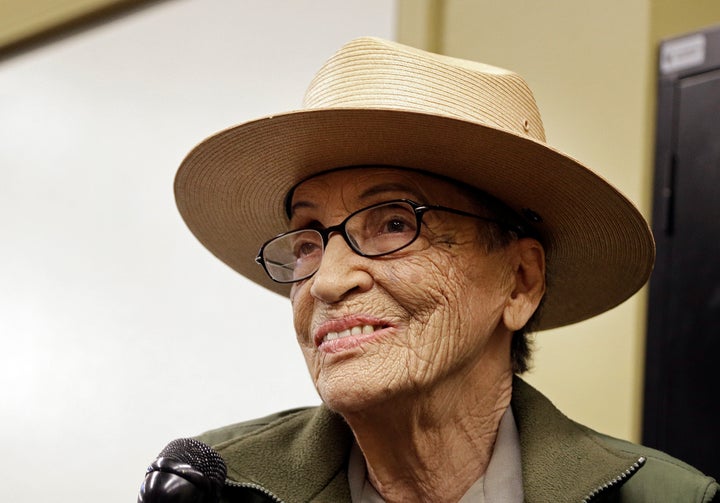
Betty Reid Soskin, Oldest National Park Service Ranger, Retires At 100

By Hilary Hanson 

The National Park Service’s oldest active ranger has announced her retirement at the age of 100.

Betty Reid Soskin’s last day was Thursday at the Rosie the Riveter/WWII Home Front National Historical Park in Richmond, California, where she led programs with the public and shared her own experiences from the war with visitors.

“Being a primary source in the sharing of that history — my history — and giving shape to a new national park has been exciting and fulfilling,” Soskin said in a statement from the National Park Service. “It has proven to bring meaning to my final years.”

Betty Reid Soskin in 2016.
AP Photo/Ben Margot

Soskin was born in Detroit in 1921, and her Cajun-Creole family moved to Louisiana when she was a child. They moved again, to California, after being displaced along with hundreds of thousands of others by the Great Mississippi Flood of 1927.

During World War II, she faced discrimination working for the U.S. Air Force before going on to work as a file clerk in a segregated union auxiliary. In 1945, she and then-husband Mel Reid opened Reid’s Records, a Berkeley music store that became an institution and, when it closed in 2019, was the oldest record store in the state.

She was a political staffer at the local and state levels, and in the early 2000s, started helping develop plans for the Rosie the Riveter/WWII Home Front National Historical Park, which opened in 2001 to honor the working women of World War II. She got more and more involved with the park, and by 2011, she was a permanent NPS employee.

Soskin has been a devoted advocate for making sure that Black women’s experiences are included in the history the park commemorates. She’s also said she hoped that seeing her could inspire girls of color.

“I still love this uniform,” she told the “Today Show” in 2015. “Partly because there’s a silent message to every little girl of color that I pass on the street or in an elevator or on an escalator ... that there’s a career choice she may have never thought of.”

The park plans to hold a celebration of Soskin’s retirement in April.

Full Article & Source:

Friday, April 1, 2022

House lawmakers target embattled Office of Public Guardianship, reject funding for expansion

By MARIANNE GOODLAND

The Colorado Office of Public Guardianship sits inside a building on the southwest corner of East Mexico Avenue and South Colorado Boulevard on Wednesday, March 2, 2022, in Denver, Colo. (Timothy Hurst/The Denver Gazette)


Problems with the state's Office of Public Guardianship, as reported by Colorado Politics last month, led state House lawmakers Wednesday to halt the program's expansion. 

The decision to keep the program from expanding occurred during the debate in the legislature over the proposed 2022-23 state budget. 

Democratic Reps. Meg Froelich of Greenwood Village and Adrienne Benavidez of Adams County, and Rep. Stephanie Luck, R-Penrose, persuaded their colleagues to support an amendment to eliminate $1.5 million in cash funds from the next fiscal year's budget– money the Office of Public Guardianship sought to allow it to expand into two more judicial districts.

Lawmakers initially rejected the amendment on a voice vote, but later voted in favor of it on a bipartisan 35-29 vote.

Legislation in 2017 and again in 2019 authorized the guardianship office to run a three-district pilot program to provide guardianship to indigent and elderly Coloradans who have no one else to care for them. Currently, the program is operating in the 2nd Judicial District, which covers Denver.

The office, housed in Colorado's Judicial Department, is under scrutiny from policymakers who created it following warehousing in hospitals of elderly people who had no one to look after them. Alarmed by the deaths, Gov. Jared Polis earlier indicated he would seek more oversight of the Office of Public Guardianship, which, as legislators noted, began with the best of intentions but is beset with problems, precisely because it is dealing with a population that faces grave socio-economic, and acute care and behavioral health challenges.

The overarching question before legislators is whether to expand the pilot program or scuttle it, although the sentiment at the Capitol appears to favor continuing its work, at the very least.

In the program's first 14 months, 14 out of the 86 clients assigned to the office have died. With nearly two years under its belt, the office faces criticism in how it operates and monitors its guardians from one of its biggest backers and its primary source for client referrals – Denver Health, which has raised questions about the program's efficacy and professionalism

Despite those concerns, the Joint Budget Committee, on a 4-2 vote, approved a funding boost for the office in the upcoming year budget to allow it to expand into two more judicial districts – in LaJunta and Montrose. 

Froelich, who has been critical of the program, told the House Wednesday the office serves an incredible need and noted testimony from Denver Health representative during a January SMART Act hearing that the health system does not want to live in a world without public guardianship but it also "does not want to live in a world where our office of public guardianship is ineffective.” 

The office already receives $1.2 million in court fees to fund its operation, but there are big questions about the program, notably surrounding the death of 14 of its wards.

"There's a lack of transparency and lack of responsiveness," Froelich said. 

The office currently has seven full-time employees and the funding increase it would receive in next year's budget would allow for the hiring of another four, including a deputy director, said Benavidez, who questioned why a staff of 11 needs a deputy director and an executive director. She also pointed out that the additional funding is only for a short time – until January 2023 and suggested to colleagues waiting for the office's required report, which is also due in January next year, before deciding to expand or nix the program.   

At a minimum, the report must quantify the unmet need for public guardianship and the average cost, Benavidez said.

So far, 80 individuals have been clients of the office at a cost of $5,000 per client, she estimated, adding, the office is "supposed to tell us" whether it should be a state agency or a non-profit entity.

"I'm not ready to say this is the best way to move forward... and why would we want to continue to put money in this program?" Benavidez said.

Rep. Marc Snyder, D-Colorado Springs, who was among the sponsors of the 2019 legislation, told the House the additional funding would put the program on track to serve rural Coloradans.

"It's had some troubles getting off the ground but is doing excellent work now," Snyder said. "We need to keep the momentum going."

Regardless of what's going on with the office, the pilot's scope was supposed to be narrow, and lawmakers need to ask whether it's working before expanding it, said Luck, a Penrose Republican.

"if we can limit the scope and make sure it's being effective, that's a better way forward," she said.

"We cannot show whether the program is working properly," Luck added, noting an allegation by Denver Health that it had to escort the program's guardians out of hospital premises for unprofessional conduct. OPG Executive Director Sophia Alvarez said she accepts “full responsibility for addressing any instances of unprofessional behavior once I have been provided with appropriate details.” 

Rep. Susan Lontine, D-Denver, said eight people are waiting for a guardian at Denver Health, and they will stay there until a guardian becomes available. Because OPG isn't adequately funded, they cannot be responsive to those needs and isn't prepared to expand, Lontine said, adding, "I know there is unhappiness with the effectiveness of the pilot."  

Benavidez countered that Denver judicial district is still being served by the program, and the amendment only opposes expansion into the other two districts.

"We need to evaluate this program before it expands," she said. "It's not prudent to hire people for an expansion we could decide next year we don't want." 

Benavidez also cited remarks by Alvarez on the deaths of wards. Alvarez had told Colorado Politics that she had no reason to disclose the 14 deaths during the January meeting with lawmakers.

Joint Budget Committee Chair Rep. Julie McCluskie, D-Dillon, asked colleagues to vote down the amendment, saying the guardianship office has no direct responsibility for medical care for its clients and noted that the latter are either indigent, elderly or medically frail. 

Full Article & Source:

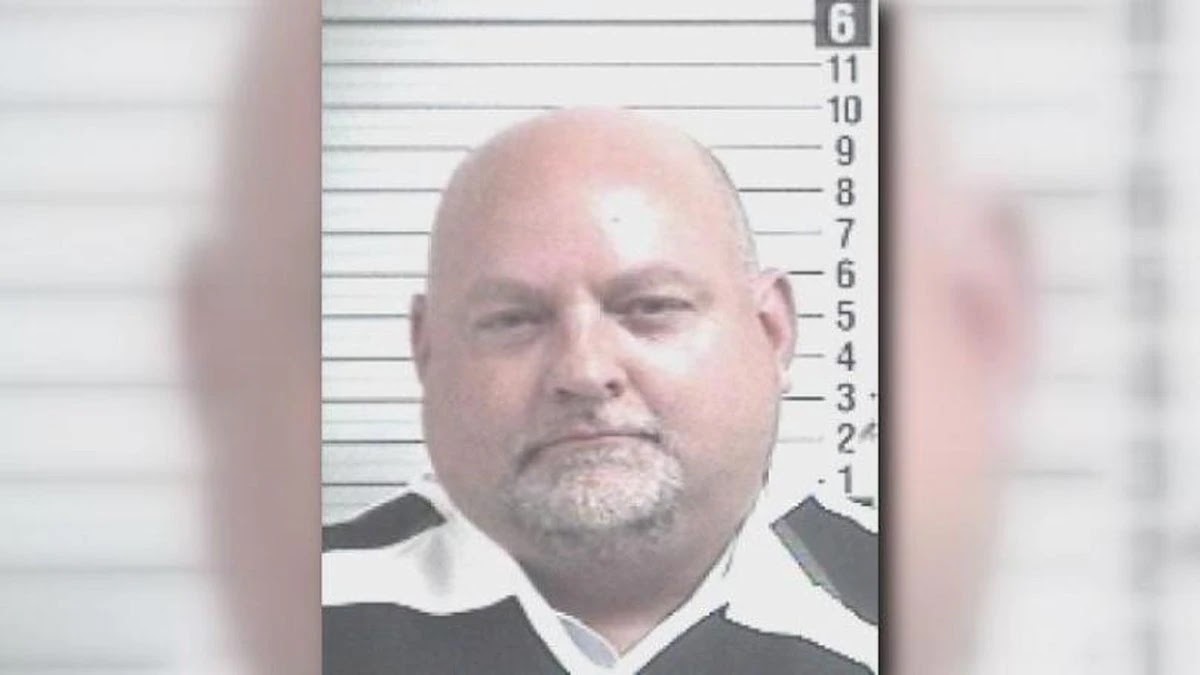
Former Bay County attorney disbarred

In 2018, a Bay County jury found Greg Wilson guilty of introducing contraband into the jail and for perjury.(WJHG)

By WJHG Newsroom

PANAMA CITY, Fla. (WJHG/WECP) - The Florida Supreme Court has disbarred a former Bay County attorney who was found guilty of introducing contraband into the jail.

In 2018, a Bay County jury found Greg Wilson guilty of introducing contraband into the jail and perjury.

Thursday, the Florida Supreme Court released a list of attorneys who were disciplined, and Wilson was on the list. He is one of four attorneys who were disbarred between February 24th and March 28th.

The summary reads, “Gregory Thomas Wilson, Panama City, disbarred effective nunc pro tunc to Oct. 27, 2018, the date of his suspension following a Jan. 27 court order. (Admitted to practice: 2003) Wilson was felony suspended on Oct. 27, 2018, for one felony count of possession of contraband at a county detention facility and a second count of misdemeanor perjury. (Case No: SC21-1567)”

Full Article & Source:
Former Bay County attorney disbarred 

This 101-year-old man finally received his high school diploma

 By Zoe Sottile

A 101-year-old Storer College attendee, Merrill Pittman Cooper, has been awarded an honorary diploma.

After waiting more than 80 years, Merrill Pittman Cooper finally received his high school diploma.

Cooper, 101, attended Storer College in Harpers Ferry, West Virginia, from 1934 to 1938, but dropped out during his senior year when his family relocated to Philadelphia for financial reasons, Jefferson County Schools said in a statement.

Storer College was established in 1865 to serve newly freed slaves in the wake of the Civil War, according to the US National Park Service. The school was one of the only educational resources for Black residents of West Virginia. It served more than 7,000 students before closing in the mid-1950s. At the college, Cooper studied Latin, biology, history, English, and mathematics. 

In 2018, after a long and accomplished career in the transportation industry, Cooper visited the school, which is now part of Harpers Ferry National Historical Park. There, he expressed to family members his regret over not earning a diploma.  

To help him realize his dream, his family reached out to park staff, who worked with local, regional and state partners to honor the centenarian with a ceremony and diploma on March 19.

Jefferson County Schools, the Harpers Ferry National Historical Park, the Storer College National Alumni Association, and the West Virginia Department of Education were all involved.

“Jefferson County Schools is committed to helping every student, young or old, fulfill their dreams,” Bondy Shay Gibson-Learn, the school system’s superintendent, said in the JCS statement.

“For Mr. Cooper, that meant receiving a high school diploma. We are honored to help make that dream a reality.” 

Full Article & Source:

Thursday, March 31, 2022

Netflix Faces Defamation Suit for Documentary on Alleged Guardianship Abuse

The episode reported on the guardianship system in general and on two cases in particular.

Netflix Inc. and a prominent team of documentary filmmakers are appealing a trial court decision in a defamation lawsuit that attacks their portrayal of a guardianship case as an abuse of an elderly man.

The media defendants include documentary film director and producer Alex Gibney and his company, Jigsaw Productions LLC; the affiliate firm Muddy Waters Productions LLC; Peabody award-winning filmmaker Kyoko Miyake; story producer Sarit G Work; associate producer Samantha Knowles; and researcher Kate Gill.

The plaintiff, Tonya Barina, is the appointed guardian of the estate of Charles Thrash, a retired businessman whose estate was once valued at about $3 million. Barina alleges that after an episode of “Dirty Money” on the subject of guardianships was released, she received hundreds of death threats and threats of bodily harm from all over the world.

In August 2010, a trial court in Bexar County denied the defendants’ motion to dismiss. The 285th Judicial District Judge Cathleen Styker “correctly determined that Barina had established the prima facie case of libel,” counsel for Barina stated in their appellee brief to the Fourth Court of Appeals.

Carl J. Kolb of Austin and Glenn Deadman of San Antonio represent Barina.

Oral argument is scheduled for June 28, according to an order issued Friday.

Rachel F. Strom and Katherine M. Bolger of Davis Wright Tremaine in New York and Laura Lee Prather of Haynes and Boone in Austin represent Netflix and the other defendants.

The media defendants claim in the appellant brief that Barina failed to satisfy her burden under Texas law to establish by “clear and specific evidence” a prima facie case of each essential element of the defamation claim.

The episode reported on the guardianship system in general and on two cases in particular, including In re Guardianship of Thrash.

“Tonya Barina—who is named in the program because she is one of Thrash’s guardians—is displeased with her accurate, albeit unflattering, portrayal,” the media defendants claim. They assert that Barina sidesteps an obligation to identify actionable statements “by simply alleging that the gist of the Program as a whole defames her.”

The episode discusses the Thrash case through the experience of Thrash’s girlfriend, Laura Martinez, her daughter Brittany and their attorney, Philip Ross. Thrash began dating Martinez in 2009 and she moved in with him in 2012. In 2016, Thrash bought a new house and around the same time he signed a new will naming Martinez as the beneficiary.

Thrash’s bank became concerned about the home purchase and numerous transactions involving his business, and alerted the Texas Department of Health and Human Services. The agency filed an application for temporary and permanent guardianship in probate court, and a temporary guardian was appointed in August 2017.

The episode referred to Thrash’s court-appointed attorney ad litem, Ben A. Wallis III, who testified that Thrash was happy living in his home with Martinez and wished only that the guardianship proceedings cease.

At the request of Thrash’s sister, Barina applied to become permanent guardian a few months later and settlement negotiations began between Thrash’s relatives, Thrash and Martinez, according to court documents. Wallis told the court that the principal purpose of the Thrash family’s involvement was to obtain a 50% share of his estate, which he refused.

The parties were at a stalemate throughout 2018, court records show. On Jan. 29, 2019, the court appointed Barina guardian of the Thrash estate and she received a yearly percentage of the estate’s gross income. She closed his business, against his wishes, and moved to sell much of his assets. In addition, the appointed guardian of his person, Mary Werner, removed Thrash from his home to a secret location; he had been by then declared mentally incompetent.

Martinez and her attorney’s efforts to contest the orders have to date been unsuccessful.

Barina alleges the episode was too one-sided and deliberately omitted facts that reflected poorly on Martinez and her attorney. The media defendants’ “sources,” according to court records, showed a “complete disregard for the obligation to be truthful.”

The court found that Ross had carried out a “vexatious litigation campaign” against Thrash and his property; Martinez attempted to claim that she was the wife through a document that was later annulled, and to have the adult children adopted by Thrash.

“To present Thrash’s story, it features Ross, Laura, and Brittany, who all were severely sanctioned in the Thrash proceedings for their ‘guardianship exploitation,’ without ever mentioning the sanctions order,” the Barina brief states. “All of the Ross-Martinez defendants’ pleadings had been stricken by May 19, 2019, a year before the episode ran.”

Full Article & Source: