A judge declined to hold Peggy Hill’s son and daughter-in-law in
contempt but found they had significantly interfered with her
guardianship.
Author: Tanya Eiserer
DALLAS — Peggy Hill will get to stay in Colorado — at least until further notice.
A Dallas County probate judge issued an order Wednesday allowing the
83-year-old retired real estate agent to remain in Colorado to undergo
brain surgery next month and recuperate there afterward. Hill, who has
dementia, is under a court-ordered guardianship. She repeatedly refused
court orders to return to Dallas from Fort Collins, Co., where she has
been living with her youngest son, Rucker Hill, his wife, Rebecca, and
their three young sons.
Under
a court-approved settlement among Peggy Hill’s four adult children, she
was to spend six months of the year in Colorado and the other six
months at a Dallas assisted living facility. Peggy has been in Colorado
since October and repeatedly refused efforts to return her to Dallas.
In a series of rulings following that hearing, Judge Julia Malveaux
stayed enforcement of her prior orders that would have required Hill to
return to Dallas.
“Ms.
Hill is pleased with the Judge’s ruling and appreciates her careful
consideration of all the evidence and Ms. Hill’s expressed preferences
in accordance with the Ward’s Bill of Rights,” Brian Hill, an attorney
representing Peggy Hill wrote in a statement. “Ms. Hill looks forward to
remaining in Colorado for the foreseeable future.”
A second order indicates Peggy Hill may ultimately be allowed to stay
in Colorado permanently. The judge wrote that pending additional orders
from the court regarding transfer of the guardianship to Colorado and
acceptance by a Colorado court, Hill “shall be authorized to remain in
Colorado.”
The orders came a day after Rucker and Rebecca Hill were forced to
testify about whether they had violated the court’s order to get Peggy
back to Dallas. The hearing stretched for more than three hours, and the
couple faced the possibility of being held in contempt of court.
“The actions of the Colorado family members do not rise to the level
of contempt,” Probate Judge Julia Malveau wrote in the order.
But the judge also concluded Rucker and Rebecca Hill had engaged in
“significant interference” with the guardianship, including disclosing
Peggy’s private health and personal information.
The judge found that the Colorado family members:
Failed to cooperate fully with the guardian and guardian ad litem.
Failed to provide care managers reasonable access to Peggy.
Enabled Peggy’s living situation to become public even though, according to the court, she lacked the legal capacity to consent.
“Likely” failed to follow instructions from Peggy’s medical providers.
The
order requires the Colorado family members to get advance written
approval from Peggy’s attorney ad litem (which is akin to a defense
attorney and is appointed by the court to represent what the person
under guardianship wants), guardian ad litem (who is court-appointed and
is supposed to represent what’s in the best interest of the person
under guardianship) and guardian before providing any of her health,
financial or personal information to a news, internet or other media
outlet.
“They shall not engage in any act or omission that might reasonable
be interpreted as interference with Ward’s guardianship, protection and
safety,” the judge wrote.
The judge also ordered that Peggy receive examinations and treatments
recommended by her medical providers. The order prohibits the family
from interfering with the guardian’s access to medical providers or
Peggy’s medical and health information.
Rebecca and Rucker Hill have previously said they did everything they
could to get Peggy to return. They also denied in court testimony
interfering with her care.
The judge’s order applies to all family members, not just Rucker and Rebecca Hill.
Brian Hill, the attorney representing Peggy, also has asked the court
to direct the bank managing Peggy’s finances to end lease at an
assisted living facility, which has been costing her estate $6,000 a
month. The motion asks that her “personal effects” be sent to her in
Colorado.
In a separate motion, he asked that the court approve transferring her guardianship to Colorado.
Colorado’s guardianship program, long
criticized for mismanagement and high staff attrition, is undergoing a
“cultural reset,” as its new director works to repair partnerships and
prepare for a major expansion under recent legislation.
Created by lawmakers in 2017, the Office
of Public Guardianship serves as a ward of last resort for indigent or
incapacitated people who lack family, friends or a private guardian to
care for them.
The public guardians are responsible for
protecting their clients’ rights and supporting their independence to
the greatest extent possible.
Staff turnover crippled early operations
The office struggled from the outset.
Lawmakers did not seek state funding for
it in 2017, instead expecting the program to run on gifts, grants and
donations — with hopes of raising $1.7 million. In its first two years,
it collected only about $2,000.
In 2019, lawmakers stepped in to fund the
office through probate fees that generated about $800,000 per year. The
first guardians began taking referrals in Denver’s 2nd Judicial
District, with planned expansion into the districts serving Delta and
Trinidad.
Legislation passed in 2023 broadened the office’s authority, directing it to operate in all 23 judicial districts by 2030.
Later in 2019, the five-member board hired Sophia Alvarez as executive director.
The guardianship office began accepting referrals in 2020 but quickly encountered a major obstacle — severe staff turnover.
The agency
struggled to even get enough guardians to cover the three districts it
was authorized to operate in. Most guardians, frustrated with an alleged
toxic work environment they attributed to Alvarez and the agency’s
deputy director, Janelle Cantu, lasted less than a year.
Some employees left after only a few months.
In its 2024 end-of-year report, the office had listed 11 guardians. By Jan. 19, 2025, seven of the 11 were gone.
In 2024, seven of the division’s former guardians
asked Gov. Jared Polis for an audit. Another former guardian filed a
complaint with the state’s Civil Rights Commission, although the status
of that complaint is unknown due to the privacy laws.
At the same time, several partner agencies
— including Denver Health, its largest — stopped sending referrals,
saying the office was mismanaged. In a 2022 state hearing, Denver Health
reported that one guardian had physically confronted a client at the
hospital and that another client, who died there, had been effectively
abandoned by the agency.
As staffing problems persisted, the
agency’s mortality rate came under scrutiny. Of the first 80 clients,
more than two dozen died during the office’s first three years. Most
were elderly and medically fragile, though some were in their 20s or
30s. The agency declined to release even basic public information beyond
a client’s age or limited details.
The governor’s office showed little
interest in the unfolding problems, even after seven former guardians
sent the 2024 letter pleading for stronger oversight. One former
guardian told Colorado Politics the office replied with a form letter
and never followed up.
The agency’s board meetings showed the agenda was swamped with personnel issues.
New leadership takes charge
Following Alvarez’s resignation in 2025, officials said the agency finally began moving toward the mission it was created to fulfill.
In November, the board hired Amelia Milton
McKeon, a veteran with more than two decades of experience working with
people with disabilities. In Florida, she helped launch the state’s
first statewide public guardianship program and later led three agencies
serving people with intellectual and developmental disabilities.
Amelia McKeon, executive director of Colorado’s Office of Public Guardianship. (Photo courtesy of Amelia McKeon)
She arrived in Colorado fully aware of the
office’s troubled past. Before accepting the job, she said she read
every Colorado Politics story detailing the agency’s dysfunction. She
wasn’t deterred, she said, adding she has weathered “tough press”
before.
McKeon’s background is steeped in human
services. Her mother was a health and human services lobbyist who helped
build Florida’s intellectual and developmental disabilities agency. Her
father, a longtime Florida State University professor, taught
educational leadership. Together, they published research in the field
and became guardianship experts.
McKeon jokes she had “no choice” but to follow the same path.
“I love it,” she said.
She started early, at 17, working in a
high school pilot program supporting special‑education students who were
pressured to meet state testing requirements despite qualifying for
exemptions. She mentored those students and met two attorneys, Twyla
Sketchley and Karen Campbell, who specialized in guardianship and
independence. She later worked as Sketchley’s paralegal.
Those experiences shaped her philosophy,
she said, nothing that systems are built for the masses and the
challenge is to tailor services to each person’s needs. She carried that
into her role as a clients’ rights advocate at Florida’s Agency for
Persons with Disabilities, where the state was facing multiple lawsuits
over how it applied waiver services.
“They needed someone to be a thorn in their behind,” she said. “I was that thorn.”
Her approach to guardianship centers on preserving independence, she said.
“Even in a guardianship, it is my
statutory obligation that anything they can exercise, anything they can
choose, I’m going to support them in doing that,” she said.
Guardianship, she added, is not about taking over someone’s life —
ethically or legally. “It is not to substitute our opinions for theirs.”
Florida’s experience closely mirrored
Colorado’s — beginning with guardians in three judicial districts before
expanding statewide, with the same number of districts and similarly
rural regions.
The Colorado office had long struggled to
retain guardians in its two rural districts. McKeon made stabilizing
those areas an early priority. There was also the issue of ensuring that
people in rural areas knew these services were available.
“We need to be available, especially in
the most rural areas that have no other resources,” McKeon said. She
said she wants to avoid a system where people must travel to metro
Denver to get help. “We want them to stay where they are, in their
homes, in their communities.”
It points to another challenge for rural
Colorado: ensuring the services clients need are available and the
barriers to access removed. McKeon said that, too, has been part of her
focus.
Mending bridges
Among McKeon’s major challenges is to repair the relationships with Denver Health and other partner agencies.
Those efforts have been noticed.
Brad Torch, guardianship director for the
Guardianship Alliance, said his organization had been absorbing
referrals when the state office became an unreliable option. Last year,
he told Colorado Politics the alliance was effectively filling the gap
left by the agency’s instability.
The last nine months have been a different story, he said.
“It’s much better,” Torch said, adding the work environment has become collaborative.
He meets weekly with McKeon to work
through the issues, and she’s helping the alliance on some of its state
funding challenges, he said.
The state office recently hired a
Guardianship Alliance staffer, he noted. That guardian is now in the
16th Judicial District, based in Pueblo, a sign of slow but steady
expansion.
Competency mandate reshapes role
The Office of Public Guardianship’s “cultural shift” is not the only big change in the agency in the last nine months.
During the 2026 session, it became part of
state’s efforts to address the competency issue, as enacted through
Senate Bill 26-149.
“We should be involved in this space and have a seat at the table,” McKeon said.
She argued that the state office offers
not only the most cost-effective option, but also long-term stability
and support for people — helping them live better lives, improving
community safety and reducing the likelihood they will cycle back into
the criminal justice system.
Under the new law, if a person is
adjudicated not restorable to competency, it will be up to OPG, working
alongside other state agencies, to stand as an emergency guardian,
responsible for providing long-term care.
McKeon also added staff to ensure the bill
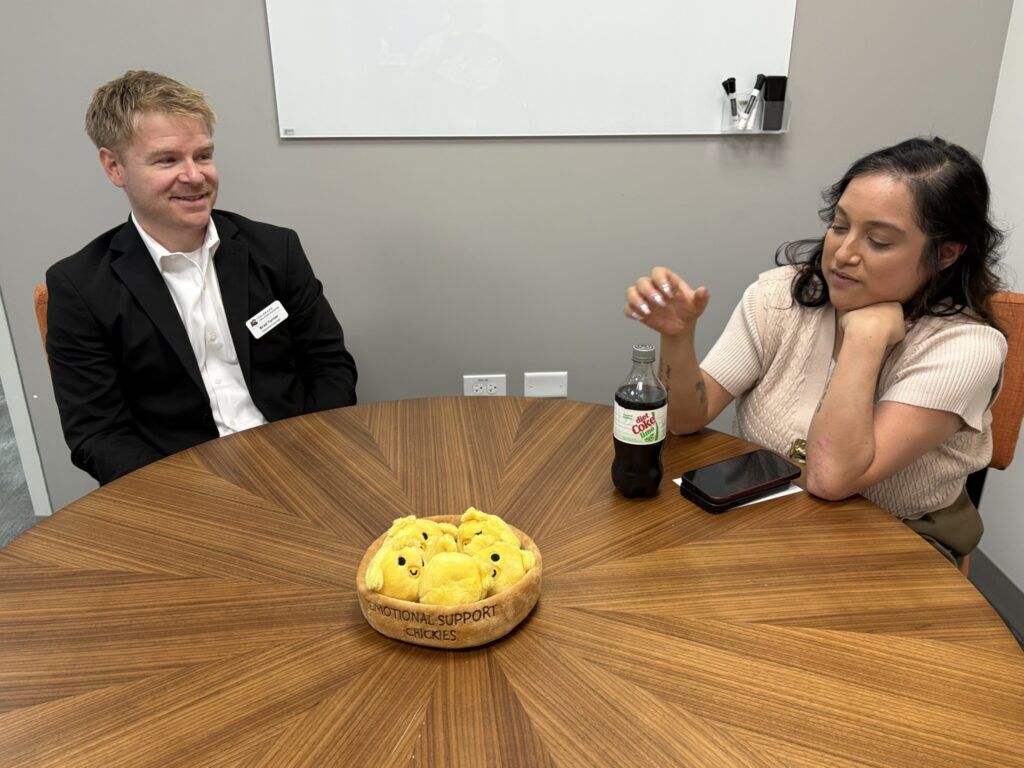
works as intended on their side. She recently hired Brad Turner to
serve as in-house counsel.
Office
of Public Guardianship Executive Director Amelia McKeon and Brad
Turner, its in-house counsel. (Marianne Goodland, Colorado Politics)
Turner wrote the 2026 bill in his role
with the Colorado District Attorney’s Council and in collaboration with
the Colorado State Public Defender.
He explained that the bill requires that,
when a criminal defendant is deemed incompetent, any interested person
can petition the criminal court for the appointment of an emergency
guardian.
That excludes the City and County of Denver, which constitutionally has jurisdiction over appointing a guardian in some cases.
“We wanted to make that process
transparent and easy,” and it’s identical to the process of appointing
an emergency guardian in a civil case, Turner said.
Prior to SB 149, there was a significant
gap in moving someone into the civil or voluntary treatment system. The
new law allows courts to direct district or county attorneys to file
civil petitions for involuntary treatment.
If the guardian agrees, that guardian can take over those petitions instead of the county attorney.
Turner said the major shift under SB 149
is that, once the criminal case or short-term treatment ends, the
guardian remains involved.
The in-house counsel said that distinction
matters: Incompetence determines whether someone can be prosecuted,
while incapacity means they need another person to make decisions for
them.
To meet its new responsibilities, the
office also hired a “flex” guardian — someone who can take cases
anywhere in the state, help people access the civil treatment system and
provide services in districts that don’t yet have an assigned guardian.
McKeon said her office’s role is to
provide guardianship services to those who are incompetent and
incapacitated, and she believes there is more overlap than people might
expect.
When guardianship first came into being,
it was mostly age-based, she explained. That’s shifting now to handling
intellectual or developmental disabilities and mental health, and she
believes individuals in substance abuse will be the next population that
could require guardianship.
“If you have a high-involvement case,
someone committing significant felonies and they have been deemed
incompetent and continue to reoffend, it begs the question if there is a
legal incapacity issue,” she said.
While it hasn’t happened in the past, there’s nothing to prevent the civil and criminal sides from working together, she said.
Navigating ethical dilemmas
Colorado Politics recently visited the
office’s Greenwood Village office, where staff gather weekly to work
through some of the most complicated situations guardians face.
One recent training scenario involved two
residents of the same apartment complex. The woman, 30, is
developmentally disabled but able to live independently. The man, 38, is
a registered sex offender whose offense occurred when he was a teenager
and has not reoffended. The pair are in love, want to marry and may
want children, though the woman cannot care for a child and shows little
interest in doing so.
Guardians — each client has their own —
were asked how they would support the couple’s plans. Then McKeon added a
twist: the woman is now pregnant.
The staff split into two groups, one for
each guardian, to discuss privacy rights and how to approach the
situation. McKeon emphasized that these exercises aren’t meant to
produce clear-cut answers.
In this case, they didn’t. The group
advising the woman’s guardian suggested seeking court guidance but
acknowledged numerous unresolved issues and no simple path forward.
The state office has also created an
on-call guardian role, one of the agency’s biggest operational lifts.
That guardian can respond to emergencies anywhere in the state —
including the death of a client, threats to safety, suspected criminal
activity involving a client, attempted suicide, mistreatment or
disappearance.
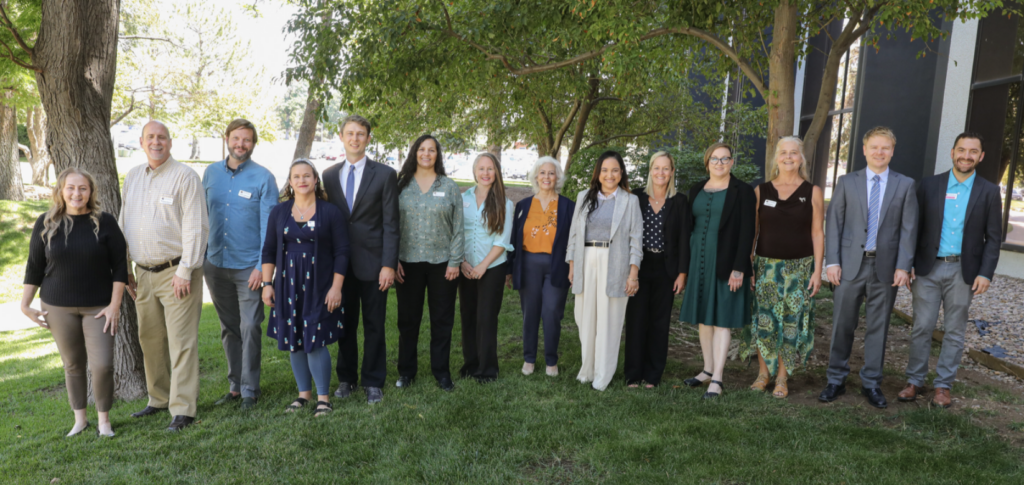
The staff of the Office of Public Guardianship as seen on July 2026. (Photo courtesy of the Office Public Guardianship)
Critics question the office’s purpose
Maureen Welch of Navigating Disability
remains a vocal critic of the state office, though she acknowledged the
new director is an improvement over what she called “awful” past
leadership.
Welch argues the agency shouldn’t exist at
all, describing it as “a state office that sanctions civil death by
court appointments of public employees who make life-impacting
decisions.” She contends that many guardian clients have friends or
family who were wrongly excluded from consideration by courts or by the
guardianship office.
Her primary interactions with the agency
have been through board meetings, where she said she was cut off while
attempting to give public comment on July 22. Welch said the board
should be more open to public participation, hold meetings in person so
the public can see “the expensive office space” and improve a website
she finds difficult to navigate. She also noted the director’s monthly
report no longer lists when clients die.
Welch pointed to the office’s $3 million
budget, funded through what she described as a drafting error in the
original bill — one that allows the office to collect fees on every
probate filing statewide, not just guardianship filings or filings in
counties where the office operates. She believes the original intent was
far narrower. To her, the current structure amounts to “empire
building.”
McKeon said she has been in conversation with Welch and welcomes scrutiny of guardianship itself.
“It is the most restrictive option available; it should be questioned and used sparingly and appropriately,” she said.
“I welcome her feedback and criticism.”
The road ahead
McKeon acknowledged the agency still has
significant ground to make up, especially in rebuilding trust and
repairing its reputation, but that signs of progress are emerging.
Among the new hires is a senior guardian
who has followed the agency since its inception and only recently felt
confident enough to join. The office now has nine guardians and plans to
hire at least 12 more over the next year, in part to handle the
caseload expected under the competency bill.
Another recent addition is a guardian
assigned to the 18th Judicial District in Arapahoe County — the site of
one of last year’s most high-profile competency cases, which helped
drive the 2026 legislation.
Since McKeon arrived last November, not a single staff member has left.
The federal government’s proposal to expand guardianship for homeless
veterans is being framed as compassionate. It is anything but. It is a
dangerous shift toward using one of the most restrictive legal tools we
have as a substitute for real solutions — and it risks turning
guardianship into a mechanism for forced institutionalization.
In
Colorado, we already have a system designed for exactly that purpose.
It is called civil commitment. And that distinction matters.
But that is not what this proposal risks creating.
Consider a different scenario — one that is already playing out in
systems across the country. A man experiencing homelessness cycles in
and out of emergency rooms. He has untreated mental illness and often
leaves against medical advice. He is difficult to engage. Under an
expanded guardianship approach, he could be deemed incapacitated and
placed under guardianship — not because all alternatives were exhausted,
but because the system does not have the resources to support him in
the community.
Once under guardianship, the path of least resistance becomes clear:
placement in an institutional setting whe
This is where Colorado offers a critical lesson.
If someone truly cannot make decisions due to mental illness and
poses a risk to themselves or others, Colorado law already provides a
structured, rights-protective process: a mental health hold, followed by
short-term certification, and, if necessary, longer-term commitment.
Guardianship is one of the most serious interventions a court can
impose. It transfers decision-making authority from an individual to
another person because the court has determined that the individual
cannot safely make certain decisions on their own. But even under
guardianship, the person does not disappear. A guardian does not
override a person’s life — they support it. They honor the individual’s
preferences and values, use the least restrictive options available, and
make decisions with the person, not for them.
I have worked with individuals under guardianship who refused certain
medications but were open to therapy and stable housing. Instead of
forcing compliance, we built a plan around what they would accept. Over
time, their stability improved — not because we overrode them, but
because we respected them. That is what good guardianship looks like.
Let’s be clear: guardianship itself is not the problem. The misuse of it is.
That process includes medical evaluation, legal standards, court
oversight, and defined timelines. It is designed specifically for
involuntary treatment and placement.
Guardianship is not.
When guardianship is used to force people into institutional care —
especially in systems that have historically been costly, restrictive,
and misaligned with individual preference — it stops being protective
and starts being coercive. We have seen this before. Institutional
systems have long prioritized placement over people, efficiency over
autonomy, and liability reduction over dignity. Guardianship should
never be the legal justification that makes that easier.
I have seen individuals placed in higher levels of care simply
because there was nowhere else for them to go — despite clearly
expressing that they wanted something different. In those moments,
guardianship was not empowering. It was a legal pathway to override
preference in the name of system convenience.
There is a fundamental principle in guardianship practice that every
good guardian understands: you do not substitute your judgment for the
person’s life — you carry it forward. That means respecting expressed
wishes, even when they are complicated. It means balancing safety with
autonomy, not replacing one with the other. It means avoiding
unnecessary institutionalization at all costs. This is first and most
important in the National Guardianship Association’s Standards of
Practice.
The proposal also risks conflating homelessness with incapacity. A
person can be unhoused, struggling, and still capable of making
decisions about their life. I have seen individuals stabilize once given
access to housing and consistent support without ever needing
guardianship. What they lacked was not capacity. It was access.
If guardianship becomes the entry point to services, rather than the
last resort after all else fails, we have inverted the system.
And that is what this is really about. We need improved access to
supportive housing. We need support and access for behavioral health
resources. We do not have enough community-based services. So instead of
building those systems, we are reaching for control. Guardianship
becomes the workaround.
But in a state like Colorado, where a legal pathway for involuntary
care already exists, using guardianship this way is not just
inappropriate — it is redundant and dangerous. It blurs legal standards,
attempts to bypass safeguards, and expands a tool that was never meant
to carry that weight.
If guardianship is expanded in any context, the standard must be
unwavering: it must remain a true last resort, it must be
individualized, it must prioritize the person’s will and preferences,
and it must never be used to justify unnecessary institutionalization.
Anything less is not guardianship — it is control disguised as care.
We owe veterans more than safety at any cost. We owe them dignity, autonomy, and real options — not forced ones.
Guardianship has a role to play. But it cannot — and must not —
become a shortcut to manage people when we have failed to support them.
Because the moment we use it that way, we are no longer protecting
rights.
John Amos’ daughter is suing her brother over allegations of elder abuse, fraud, and wrongful death.
John Amos’ children have launched a legal war against each other over the late actor’s estate, with his daughter suing her brother over claims of elder abuse and fraud.
Shannon Amos has filed
a lawsuit against her brother, Kelly ‘K.C.’ Christopher Amos, accusing
him of elder abuse, fraud, and wrongful death, as revealed by The Hollywood Reporter.
She claims K.C. manipulated their ailing father into signing new wills,
trusts, and powers of attorney that handed him near-total control of
the estate, while neglecting the actor’s medical care and cutting her
and other heirs out of any inheritance.
The petition also names
John Amos’ former caretaker, Belinda Foster, his close associate Eugene
Brummett, and his production company, Step and One Half Productions,
which K.C. claimed sole ownership of in 2020. It further seeks a court
order to freeze the estate’s assets.
According to the suit, K.C.
repeatedly left Amos, whose mental capacity was rapidly declining, in
unsafe and unsanitary conditions. Shannon recalls alleged talks with
doctors who warned her that his medications weren’t being properly
administered.
In 2023, Amos was hospitalized multiple times,
including for a foot infection caused by maggots, which led Adult
Protective Services to step in. By August 2024, he was suffering severe
abdominal pain, but caretaker Belinda Foster allegedly posed as his
daughter and delayed taking him to the hospital until it was too late.
The
petition includes affidavits from Amos’s close friends and former
business managers, who all accuse K.C. of attempting to isolate his
father to seize control of his finances. In one affidavit, longtime
friend Leslie Franklin claimed the actor was kept in hotels surrounded
by piles of soiled adult diapers and trash.
The lawsuit holds K.C. responsible for his father’s August 2024 death
and calls for the estate’s assets to be frozen until the court rules.
This follows a messy fallout between the two siblings in their father’s
final years, where Shannon first accused her brother of elder abuse and
attempts to control his money.
CENTENNIAL, Colo. (KRDO) – Two Centennial nursing home employees have
been arrested after a 92-year-old woman with severe dementia was
discovered with unexplained broken bones, leading to an elder abuse
investigation.
According to the Arapahoe County Sheriff's Office (ACSO), 33-year-old
Patience Jackson, an employee of the Orchard Park Health Care Center,
was arrested at her home on June 11. She's now facing charges of
criminal negligence, crimes against an at-risk person, and complicity –
all class 5 felonies.
Authorities said that on May 9, an investigator was called to Sky
Ridge Medical Center in Lone Tree to look into allegations of elder
abuse against a 92-year-old woman suffering from severe dementia.
The investigator was called after hospital employees noticed the
woman, who had been transported to the hospital via ambulance from
Orchard Park Health Care Center, had two separate broken bones in her
lower leg.
Hospital employees told the investigator that the woman's injuries
didn't seem to match up with the report given to them by Orchard Park,
who said that the woman was "found sitting in her wheelchair, screaming
for help in terrible pain." The nursing home also reported that no one
had seen her fall, and that they did not know what had happened, ACSO
said.
After a four-week investigation, investigators gathered evidence showing
that two Orchard Park employees – Patience Jackson, a certified nursing
assistant, and Zainab Namale, a licensed practical nurse – had provided
false information about how the woman was injured and worked to hide
the truth.
Investigators now believe the woman’s injuries occurred on May 8 and
were the result of criminal negligence, a crime against an at-risk
person, leading them to obtain arrest warrants for both employees.
ACSO said Jackson was booked into the Arapahoe County Detention
Facility, where she's being held on a $2,500 bond. There is currently an
active arrest warrant for Namale.
The sheriff's office said the case remains an active and ongoing investigation.
"If you ever encounter someone being abused, it is critical to take
action," ACSO said in a press release Wednesday. "Please contact your
local law enforcement or County Department of Adult Protective Services.
Your prompt response can make a difference in ensuring the safety and
well-being of vulnerable citizens."
Caring for our elderly loved ones is a responsibility that unites
communities across Colorado. Seniors have spent their lives building the
foundations of the places we call home, and it’s our collective duty to
ensure they live their golden years in comfort, dignity, and safety.
Unfortunately, elder abuse remains a pressing issue, often hidden behind
closed doors in nursing homes and long-term care facilities.
From bustling urban centers like Aurora to the vibrant community of
Boulder, safeguarding seniors is a statewide concern. Understanding the
signs of elder abuse and knowing how to take action are vital steps
every family should take to protect their loved ones and hold
accountable those who fail to provide proper care.
Recognizing the Signs of Elder Abuse
Elder abuse can take many forms, often going unnoticed until
significant harm has occurred. For families, understanding the warning
signs is the first step toward ensuring their loved ones are safe and
well cared for.
Common signs of elder abuse include:
Physical Abuse: Unexplained bruises, burns, or fractures.
Emotional Abuse: Sudden withdrawal, depression, or fearfulness around specific caregivers.
Financial Exploitation: Missing belongings, unauthorized withdrawals, or unexpected changes in legal documents.
Neglect: Dehydration, malnutrition, poor hygiene, or untreated medical conditions.
In Colorado, families can draw on the strong community connections
that exist across the state to support their seniors. Whether in
Boulder’s close-knit neighborhoods or Aurora’s bustling urban centers,
maintaining regular communication with elderly loved ones and staying
attentive to warning signs can significantly improve their safety and
well-being.
A Statewide Effort to Protect Seniors
Caring for seniors is a shared commitment across Colorado.
Communities like Boulder and Aurora exemplify how collective efforts can
address elder care challenges and improve conditions in nursing homes.
Boulder fosters a culture of health and wellness through programs
that enhance seniors’ quality of life, while Aurora’s diversity brings
unique challenges and opportunities for elder care advocacy. Despite
their differences, both cities share the goal of ensuring seniors are
safe, respected, and cared for.
Families concerned about mistreatment in Aurora nursing homes can
seek justice and explore their options with the help of an experienced Aurora nursing home attorney.
By fostering collaboration and staying vigilant, communities across
Colorado can create safer environments where seniors can thrive.
Taking Action to Prevent Elder Abuse
Preventing elder abuse requires a proactive approach, combining family vigilance with community and professional support.
Steps families can take to prevent elder abuse:
Stay Involved: Regular visits and open communication with loved ones.
Educate Yourself: Learn about residents’ rights and responsibilities of nursing homes.
Know the Warning Signs: Identify physical, emotional, financial, and neglect-related abuse early.
Report Suspicious Behavior: Speak up if you suspect abuse.
Education is key to empowering families to advocate effectively. Reputable resources, like the National Center on Elder Abuse’s guide to prevention, provide valuable information on identifying abuse and taking action to protect vulnerable seniors.
Communities also play a vital role by organizing local support groups
and hosting informational sessions to raise awareness. By working
together, families and communities can ensure seniors live in safety,
dignity, and respect.
Resources for Colorado Families
Ensuring the well-being of our seniors requires a collective effort,
and Colorado offers a variety of resources to support families in this
endeavor. Boulder boasts numerous programs aimed at improving seniors’
quality of life, offering opportunities for social engagement and
services like transportation and home assistance. These initiatives
strengthen the bonds within the community while helping seniors thrive.
When families suspect mistreatment in nursing homes, knowing when to seek legal help
is essential for protecting their loved ones and holding facilities
accountable. Professionals with experience in Colorado’s elder care laws
can guide families through the process and ensure justice is served.
Statewide programs and support groups provide education, emotional
support, and practical assistance to families. These resources ensure
that both seniors and their caregivers have the support they need to
address challenges and maintain a high quality of life.
Conclusion
Caring for seniors in Colorado requires attention, action, and
collaboration from families and communities alike. By understanding the
signs of elder abuse, utilizing available resources, and taking timely
legal steps when necessary, families can help protect their loved ones
and ensure they live with dignity and respect.
Though Boulder and Aurora are different in their makeup, they
exemplify the shared commitment of Colorado communities to addressing
eldercare challenges. Together, we can foster an environment where
seniors live safely and with dignity.
John Amos passed away in August, but by the time his son Kelly Christopher announced his death, it had been over a month. Since then, the actor’s daughter, Shannon Amos, has launched an inquiry into his passing and hired a lawyer to lead her fight.
“The family deserves to know the full circumstances surrounding Mr.
Amos’ care and the events that led to his passing,” Shannon Amos’ lawyer
reportedly said in a statement. “We are committed to pursuing all
available avenues to ensure that these questions are answered.”
But Kelly is saying there’s no need for war, and a private
investigator has said there’s been no sign of “foul play” in the actor’s
death. Here’s the he-said-she-said between the siblings and what else
has been reported on the family conflict.
K.C. Amos Responds To Sister’s Elder Abuse Allegations
As previously reported, K.C. revealed the death
on October 1, but his dad had died on August 21. Additionally, he said
the ‘Good Times’ actor passed from congestive heart failure in Los
Angeles. He was 84.
Shannon’s lawyer, James H. Davis III, confirmed she hired legal help to look into her daddy’s death, per PEOPLE.
She outright accused her brother of elder abuse for seemingly the
second time. Shannon reportedly wants more information about her dad’s
admission to Centinela Hospital and his condition at the time. She
claimed someone falsely impersonating her dropped John off at the
hospital. Shannon claims she’s asked for his medical records in three
formal requests but has gotten no response.
Furthermore, she wants the LAPD and Adult Protective Services to
provide summaries of their investigations into her past allegations of
abuse involving John Amos.
Meanwhile, Kelly Christopher isn’t hesitating in shutting down his
sister’s claims with his own receipts! He provided an explanation to PEOPLE
about decisions made leading up to John Amos’ death. He claimed that
John requested to go to Centinela Hospital due to trust in its medical
staff. Additionally, he said his dad asked him not to contact other
family members, and K.C. said he “honored his request.”
“Let me be clear and transparent. There has been no
physical, financial, emotional, or psychological elder abuse or neglect
committed against my father by me, Gene Brummett, or Belinda Foster,”
K.C. said. “This has been documented by an independent investigation by
Homeland Security Services, Inc, Adult Protective Services, and other
law enforcement agencies. The reality is that he passed of natural
causes at the age of 84 years old. Stop making it more than what it is.”
Kelly also hired a defense investigator to conduct a “comprehensive
two-year investigation” into financial discrepancies, including missing
money and stolen material goods from his dad in Colorado, Memphis, New
Jersey, and Los Angeles. Ultimately, the investigator, Kevin Faler, said
any and all charges against Kelly Christopher in New Jersey have been
dismissed.
“The current allegations regarding foul play and elder
abuse are frivolous,” Kevin Faler said. “John Amos was happy working and
spending time with [K.C., Gene, and Belinda] writing, producing, and
praying with them as a family and as his team. John passed from natural
causes at the age of 84 years old. There was no foul play.”
Faler also cleared John Amos’ longtime manager, Belinda Foster, of any wrongdoing. “John told me Belinda was more of a daughter to him than his own biological daughter,” the investigator told PEOPLE.
Daughter Previously Questioned John Amos’ Safety
Shannon Amos’ death comes over a year after she claimed her dad was a
victim of elder abuse and financial exploitation and was hospitalized
in critical condition. She made the allegations in a GoFundMe campaign,
claiming John had called her from Memphis hospital. Shannon did not
specify who was executing the alleged abuse but claimed one of the
persons was a caregiver. Her GoFundMe campaign sought $500,000 for
alleged legal expenses, care, and aftercare.
But, John Amos later denied his daughter’s abuse claims in a video
message from the hospital bed. The actor cited confusion about the
fundraiser. He also seemed to suggest that if anyone were to abuse him,
it’d be Shannon. He said that they had issues leading up to his
hospitalization, saying his daughter took advantage of him.
“She would be the primary suspect — if you would,” John said.
“I don’t know if that’s the right term to use or not. But she’s the one
that I would attribute my elderly abuse to. It’s definitely a case of
elderly abuse.”
Additionally, his manager Belinda said his hospitalization was due to
problems with his heart caused by fluid filling his lower body and
abdomen. However, they both denied that his medical scare was
life-threatening.
Shannon Amos has not publicly reacted to her brother’s response to her investigation.
TELLER COUNTY, Colo. (KKTV) - A Teller
County deputy was at his home preparing for his shift when the Teller
County Dispatch Center contacted him about a 9-1-1 call on Nov. 30.
The
sheriff’s office said, on the other end of that 9-1-1 call, a man was
moaning into the phone unable to form words. Deputy Colton Sherraden was
called in to help. Sherraden clocked in and raced to the home of the
9-1-1 caller.
When Sherraden arrived,
he heard someone moaning inside and could smell propane from outside the
window. The sheriff’s office said entered the home to find an elderly
man on the floor unable to speak.
Quickly,
the deputy opened windows and doors to create airflow and cross breeze
through the propane-soaked home. The sheriff’s office said he quickly
found the source of the propane and shut it off before it could injure
him or the elderly man anymore.
“In doing so, he eliminated the risks to the elderly man, himself, and
the additional arriving first responders,” the sheriff’s office said.
“Deputy Sherraden’s proximity, quick thinking, and decisive actions at
great risk to himself were all factors in saving the life of one of our
fellow Teller County residents.”
A federal appeals court has affirmed a $5,000 sanction against a
professor at the Northwestern University Pritzker School of Law for
seeking to remove a state court motion to federal court, finding no
abuse of discretion by a federal judge who imposed it.
In an Oct. 30 unpublished opinion,
the 10th U.S. Circuit Court of Appeals at Denver said it discerned no
reversible error by U.S. District Judge Daniel D. Domenico of the
District of Colorado.
Domenico had sanctioned
professor Bernard S. Black for seeking to remove the state court motion
that sought to oust him as a trustee for the conservatorship estate of
his sister. The sister is mentally ill and unable to manage her affairs.
Lawyers for Black’s sister filed the motion to remove him after a
Colorado probate court found that Black improperly diverted some funds
from his sister while serving as executor of his mother’s estate.
Domenico said the removal attempt was improper because motions can’t
be removed to federal court and because the underlying probate matter
couldn’t be heard in federal court.
The $5,000 sanction represented the sister’s attorney fees plus
costs. A magistrate judge had found that the claimed fees were
reasonable, “particularly in light of the 269 pages of briefing Mr.
Black had filed in the matter,” the 10th Circuit said.
Black told the ABA Journal that he is “frankly shocked that I didn’t get a serious hearing before the 10th Circuit.”
The whole purpose of removal, he says, is to allow a party to escape from a state court judge who might be biased.
The probate judge, he says, is “running what can only be described as
a racket that extracts wealth from people subjected to guardianship or
conservatorship.”
Black had contended that removal was proper because his sister’s
motion to oust him as conservator initiated an independent controversy,
essentially constituting a new civil action.
The appeals court summarizes other arguments.
Black “contends that it was improper to impose a bar referral
sanction in addition to a monetary award; that the district court failed
to give him adequate notice that in considering whether to impose
sanctions, the court would consider his conduct in other cases; that the
district court misunderstood those other cases; that the sanctions were
punitive and therefore warranted ‘criminal-type procedural
protections;’ … and that it was improper to judge his conduct in cases
where he acted in a different legal capacity.”
The 10th Circuit rejected the arguments “upon review of the record,
the briefs, and the district court’s well-reasoned orders, and in light
of the appropriate review standards.”
In the probate case, Black contended that he was carrying out his
mother’s estate plan to put two-thirds of her estate into a special
needs trust for Black’s sister and one-third into a trust for Black and
his children. To do that, he disclaimed payable-on-death benefits in his
mother’s brokerage account that sent nearly all the funds directly to
the sister.
A probate judge ordered Black to reimburse his sister $1.5 million
and trebled the damages, which required Black to come up with an
additional $3 million.
Black told the Journal that the Colorado probate judge wrongly decided that he stole money from his sister.
“I didn’t,” Black says. “All the money is in trust. Nothing is stolen.”
In his 10th Circuit brief,
Black said the dispute has led to “cascading travesties of justice.”
The Denver probate court repeatedly ruled against him, “often without
notice, jurisdiction or evidence,” he wrote in the brief.
Black said in the brief his sister has lived in New York since 2013,
and she was found competent by a New York court in 2016. Yet the Denver
probate judge refused to terminate the conservatorship.
Then the federal courts relied on the Denver probate judge’s findings, he says.
“This is another instance in which I have been truly stunned at the
extent to which you get one judge who says bad things about you, and no
other judge will take a serious look at the merits,” Black told the
Journal. “The district court didn’t, and now, the 10th Circuit has not.
That’s not the way our justice system is supposed to work.”
“We need more willingness in our system to understand that not
everything a judge says is true. In another case, a second judge has to
be willing to have an open mind,” he says.
Black maintains that Domenico wrongly concluded that the case
shouldn’t be in federal court because of the probate exception. The
exception doesn’t appy, Black says, because the Colorado court was not
administering a decedent’s estate.
His appeal in state court maintains that there should be no
conservatorship in Colorado because his sister no longer needs it. He
has not paid $4.5 million “because I don’t have it,” he says.
What happens next?
“I wait and see if the New York bar wants to do anything with the
referral” for alleged ethics violations, he says. “If they do, I
defend.”
Hat tip to Law360, which covered the 10th Circuit’s decision.
The actor was also nominated for his role in 'Roots'
By
Brie Stimson
John Amos, who played the father on "Good Times," has died. He was 84 years old.
Amos’
publicist, Belinda Foster, confirmed the news of his death Tuesday to
The Associated Press. No other details were immediately available.
One
of Amos’ first prominent roles was as the WJM-TV weatherman on "The
Mary Tyler Moore Show." He was also frequently on "The Tim Conway Comedy
Hour," which ran in 1970, before he landed "Good Times" in 1974.
Amos was also nominated for his role in the 1977 miniseries "Roots."
Amos'
son K.C. said in a statement to the Hollywood Reporter on Tuesday, "It
is with heartfelt sadness that I share with you that my father has
transitioned. He was a man with the kindest heart and a heart of gold…
and he was loved the world over. Many fans consider him their TV father.
He lived a good life. His legacy will live on in his outstanding works
in television and film as an actor."
Amos played James Evans Sr. on the Norman Lear-produced sitcom "Good Times," which ran from 1974 until 1979.
Older Americans are at high risk for financial fraud, losing more than $20 billion annually, according to a 2023 report from AARP. To help protect this vulnerable population in the state of Colorado, the Paul Freeman Financial Security Program (PFFSP) in DU’s Knoebel Institute for Healthy Aging
formed a coalition in 2023, thanks to support from the federally funded
National Center for State and Tribal Elder Justice Coalitions.
The coalition is an interdisciplinary group
made up of state and local agencies, elder advocacy organizations and
DU researchers whose goal is to evaluate the complex issues related to
elder financial fraud and develop possible solutions for prevention. The
PFFSP team is tasked with building the coalition, developing tools and
trainings for frontline workers, and creating a central hub for
information and resources.
In
April, the coalition held their inaugural meeting and announced an
expanded collaboration with the Colorado Department of Regulatory
Agencies (DORA), the top consumer protection agency in the state. DORA’s
Financial Engagement Unit joins other members including the Office of
Governor Jared Polis, the offices of the state and Denver district
attorneys, the Colorado Office of Financial Empowerment, AARP ElderWatch
and AgeWise Colorado.
Eric Chess, clinical professor and director
of PFFSP, says the massive amount of money lost to exploitation is just
the tip of the iceberg. “When people lose money, it affects their
emotional health, their mental health, their cognitive health and entire
well-being,” he says. “This includes worsening chronic diseases and
symptoms that you see in the doctor's office.”
At
the root of the problem is the little-understood connection between
health and finances, which can turn into a vicious cycle, Chess says.
“The first signs of clinical cognitive impairment are often seen in
impaired financial decision making, which leaves individuals at an
increased risk of exploitation or fraud—which in turn can worsen
cognitive health.”
PFFSP aims to
highlight the importance of understanding this connection as they
develop frameworks and tools to protect and improve mental, physical and
financial health of people as they age.
However,
Chess notes, the issue is a concern not just for older adults. “Older
adults get taken for more money—often because they have more money—and
they also have less ability to recover from financial loss than younger
folks. But it's also under-appreciated that younger adults actually get
taken advantage of more often, just for lesser amounts.” What’s more,
“The older adults of tomorrow are today's kids. So, if you're really
going to tackle all these issues, you have to look at it throughout the
life spectrum.”
Chess and his team
are also developing a financial vulnerability scale that would alert
individuals when they are vulnerable to financial exploitation and,
crucially, provide detailed insight into why.
“A
key issue is that people are vulnerable for different reasons—it can be
from a social standpoint, a behavioral standpoint, or a cognitive
standpoint. There are a lot of different areas of vulnerability—and it's
necessary to have (multidisciplinary) expertise be part of building the
scale.”
Bringing policymakers, government agencies
and, in particular, frontline workers into the conversation is crucial
to successfully develop and implement any solution to combat financial
fraud and abuse. “They have to be part of this equation,” Chess says.
“You cannot try to create academic solutions and then impose them on the
community and the people who are doing the work.”
Denver, CO – May 7, 2024. Caregivers concerned about aging parents who refuse to plan for future care needs find that Wilson's YouTube video
on this topic offers practical advice for initiating conversations. The
video shares stories about why individuals hesitate to plan and offers
conversation starters to open the door to deeper discussions about what
aging parents do or do not want for their care.
Also mentioned
are the difficulties of planning for the care of loved ones with
dementia or Alzheimer's who may be cognitively beyond the ability to
navigate or have conversations about their wishes. In this case,
Wilson's online program How to Get Guardianship of an Elderly Parent offers information to determine if guardianship might be the next step in care planning.
Early Conversations about Care Reduce Caregiver Worry
Initiating
conversations about planning for advancing age and health concerns is
not easy. Parents or their adult children may be uncomfortable
initiating these discussions, which—in a perfect world—should happen
before health issues occur.
Good health today is a blessing and
an illusion that can disappear at a moment's notice. Early discussions
about needed care and financial and legal matters can reduce responding
in crisis mode when the unexpected happens.
Wilson Offers Virtual 1:1 Consultations and Keynotes
Caregiving
expert and speaker Pamela D. Wilson offers virtual 1:1 elder care
consultations, keynotes, and educational sessions worldwide for
organizations and groups on aging, caregiving, and elder care.
According to Wilson, "My
unique value proposition is my experience as a client care manager and
professional fiduciary across various channels, including clinical,
post-acute and home health care, social and community care, insurance,
financial and wealth management, and estate planning.
Specific
to fiduciary work, I served as a court-appointed guardian and
conservator, medical power of attorney, financial power of attorney,
trustee, and personal representative of the estate for clients for 11
years. I am an expert witness on care management and guardianship.
This
one-of-a-kind experience offers rare and relatable insight for
navigating healthcare systems, family, caregiver, and patient
experiences."
Wilson's practical approach to elder care
consulting and speaking results from nearly 25 years of professional
advocacy for caregivers and patients. Empathy and compassion for
difficult-to-imagine situations are necessary in caregiving
relationships.
Caregivers and individuals who need care experience
high levels of ongoing emotional stress and trauma. Education and
planning help families and individuals manage the uncertainty of
planning for the future.
Wilson's Programs Provide Practical Support for Family Caregivers, Care Receivers and Patients
Wilson
is a caregiving expert with over twenty years of lived experience
supporting caregivers and care receivers. Through information on her
website, online courses, YouTube Channel, 1:1 consultations, and
speaking events, she provides practical, detailed step-by-step education
and instructions to guide professional and family caregivers and adults
facing change in health and uncertainty about the future.
Brian Seitz and Laura Prats were arrested on
suspicion of crimes against an at-risk person resulting in death and
serious injury, sheriff’s officials said
By Lauren Penington
Sheriff’s deputies arrested two caregivers of a disabled Jefferson
County woman Wednesday on suspicion of crimes related to her death,
officials said Thursday.
When first responders found 58-year-old
Sheryl Seitz, she was lying on an air mattress in an Arvada garage,
covered in filth and maggots, according to a Thursday news release from the Jefferson County Sheriff’s Office.
Jefferson
County sheriff’s deputies arrested Seitz’s son and his girlfriend
Wednesday on suspicion of crimes against an at-risk person resulting in
death as well as crimes against an at-risk person resulting in serious
injury. The victim’s son also faces a charge of tampering with physical
evidence.
The Arvada Fire Department responded to reports of a
sick person at an Airbnb in the 6400 block of Kendall Street on Monday,
the release stated. Paramedics transported Seitz to a local hospital,
where she died from her injuries a day later.
Hospital records indicated that Seitz was suffering from bed sores,
two hip fractures, a “loosely connected wrist,” ulcers, septic shock and
maggots burrowing into her body when she arrived on Monday, sheriff’s
officials said Thursday.
The Arvada Police Department began the
initial investigation but quickly learned that the crimes likely
occurred at an RV storage lot in unincorporated Jefferson County where
the victim and the two suspects lived separately, according to
Thursday’s release.
On Wednesday, sheriff’s deputies executed search warrants at the
trailer where Brian Seitz and Laura Prats — the son and his girlfriend —
lived, Sheryl Seitz’s RV and the car driven by the two suspects,
Thursday’s release stated. Both suspects were arrested.
Because of
the victim’s declining medical condition and her inability to walk or
care for herself, the two suspects had been her caretakers for the last
six or seven years, sheriff’s officials said. The two received state
funding for the older woman’s care through a home healthcare company for
83 hours a week.
Seitz’s RV did not have running water or a bed for her to sleep in,
the release stated. The only source of heat in the RV was a space
heater.
The death is still under investigation and official
autopsy results are pending. The Jefferson County Coroner’s Office will
release Seitz’s official cause and manner of death at a later date.
John Amos
is not the victim of elder abuse, according to a police investigation
that found no proof to substantiate the claims made by the actor’s
daughter, Shannon Amos.
According to TMZ,
the Los Angeles Police Department spoke to parties on both sides of the
matter and officially closed the investigation. It was said that police
found no wrongdoing and that there was not enough evidence to bring
charges against anyone.
The latest news comes after Shannon opened a GoFundMe page for her father last June, claiming he was a victim of “elderly abuse.” However, the page was later taken down after John and his son, K.C. Amos, said the claims were false and that Shannon was the one inflicting the abuse.
At the time, Shannon claimed
she’d contacted the Colorado Bureau of Investigation and alleged that
her father was not receiving proper care at an intensive care unit. She
also claimed her brother was exploiting her father and not providing
adequate care.
“To all of my fans, I want you to know that I am doing well. I am not in ICU, nor was I ever fighting for my life,” John said in a statement last June.
“First, I want the GoFundMe campaign about me to stop immediately, and
the funds subsequently returned to those who made donations.”
Shannon later took down the GoFundMe page. A month later, K.C. was arrested
for allegedly threatening to kill his sister. In the complaint, Shannon
said she’d received several threats from her brother, including text
messages with photos of “firearms and gang affiliations.”
The situation seemed to have died down in recent months; however, per TMZ,
the allegations were brought up again when Shannon called Adult
Protective Services this spring. The APS sent the case to the LAPD, who
then launched an investigation.
Last month, John, who is best known for his roles in Good Times and Roots, once again denied that he was the victim of abuse.
“I
want to first say that I am feeling well and working diligently on
various projects that I am involved in at this time, including the
docuseries that my son and I are producing, along with a music release,”
he told People.
He
added, “Now, I will say this for now: This story about neglect is false
and unmerited. The real truth will come out soon and you will hear it
from me. Believe it.”