Showing posts sorted by relevance for query Michael Oher. Sort by date Show all posts

Monday, October 2, 2023

Judge ends conservatorship between Michael Oher and Tuohy family in 'Blind Side' fallout

Associated Press

MEMPHIS, Tenn. (AP) – A Tennessee judge said Friday she is ending a conservatorship agreement between former NFL player Michael Oher and a Memphis couple who took him in when he was in high school. 

Shelby County Probate Court Judge Kathleen Gomes said she is terminating the agreement reached in 2004 that allowed Sean and Leigh Anne Tuohy to control Oher’s finances. Oher signed the agreement when he was 18 and living with the couple as he was being recruited by colleges as a star high school football player.

Gomes said she was not dismissing the case. Oher has asked that the Tuohys provide a financial accounting of money that may have come to them as part of the agreement, claiming that they used his name, image and likeness to enrich themselves and lied to him that the agreement meant the Tuohys were adopting him. 

In Tennessee, a conservatorship removes power from a person to make decisions for themselves, and it is often used in the case of a medical condition or disability.

But Oher’s conservatorship was approved “despite the fact that he was over 18 years old and had no diagnosed physical or psychological disabilities,” his petition said.

Gomes said she was disturbed that such an agreement was ever reached. She said she had never seen in her 43-year career a conservatorship agreement reached with someone who was not disabled.

“I cannot believe it got done,” she said.

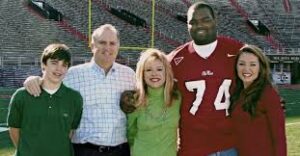
Offensive tackle Michael Oher poses with members of the Tuohy family after being selected by the Baltimore Ravens during the 2009 NFL Draft at Radio City Music Hall in New York on April 25, 2009.  Howard Smith, USA TODAY Sports

Oher and Tuohys listened in by video conference call but did not speak. Lawyers for both parties had agreed that the agreement should end, but the case will continue to address Oher’s claims. Gomes said it should have ended long ago.

In August, Oher, 37, filed a petition in probate court accusing the Tuohys of lying to him by having him sign papers making them his conservators rather than his adoptive parents nearly two decades ago. Oher wanted the conservatorship to be terminated, a full accounting of the money earned off his name and story and to be paid what he is due, with interest.

He accused the couple of falsely representing themselves as his adoptive parents, saying he discovered in February the conservatorship agreed to in 2004 was not the arrangement he thought it was – and that it provided him no familial relationship to them. 

Oher claims the Tuohys have kept him in the dark about financial dealings related to his name, image and likeness during the 19-year life of the agreement. 

The Tuohys have called the claims they enriched themselves at his expense outlandish, hurtful and absurd and part of a “shakedown” by Oher. 

In a court filing, the affluent couple said they loved Oher like a son and provided him with food, shelter, clothing and cars while he lived with them, but denied saying they intended to legally adopt him.

The Tuohys’ filing said Oher referred to them as “mom and dad,” and they occasionally referred to Oher as a son. They acknowledged that websites show them referring to Oher as an adopted son, but the term was only used “in the colloquial sense and they have never intended that reference to be viewed with legal implication.”

The Tuohys said the conservatorship was the tool chosen to comply with NCAA rules that would have kept Oher from attending the University of Mississippi, where Sean Tuohy had been a standout basketball player.

“When it became clear that the Petitioner could not consider going to the University of Mississippi (“Ole Miss”) as a result of living with the Respondents, the NCAA made it clear that he could attend Ole Miss if he was part of the Tuohy family in some fashion,” the Tuohys’ Sept. 14 court filing said.

The Tuohys also said Oher lied about finding out that he was not adopted in February. They said Oher’s 2011 book “I Beat the Odds” indicates that he was fully aware that the Tuohys were appointed as conservators. 

Agents negotiated a small advance for the Tuohys from the production company for “The Blind Side,” based on a book written by Sean Tuohy’s friend, Michael Lewis, the couple’s lawyers have said. That included “a tiny percentage of net profits” divided equally among a group that included Oher, they said.

The attorneys said they estimated each of the Tuohys and Oher received $100,000 apiece, and the couple paid taxes on Oher’s portion for him. 

The Tuohys’ filing said they never signed any pro football contracts for Oher, and he was happy with their financial arrangements from “The Blind Side.”

Oher was the 23rd overall pick in the 2009 draft out of Mississippi, and he spent his first five seasons with the Baltimore Ravens, where he won a Super Bowl. He played 110 games over eight NFL seasons, including 2014 when he started 11 games for the Tennessee Titans. Oher finished his career with the Carolina Panthers.

Full Article & Source:
Judge ends conservatorship between Michael Oher and Tuohy family in 'Blind Side' fallout

See Also:
Devastated Tuohys ready to end conservatorship for Michael Oher, lawyers say

"The Blind Side" lawsuit: Former NFL star Michael Oher sues

What is a conservatorship? The legal arrangement at the center of Michael Oher's case.

Michael Oher’s shocking conservatorship exposes court failures

Conservatorship Gone Wrong: Why Does it Seem to Happen So Often and How Can I Prevent It?

Friday, November 10, 2023

Michael Oher received $138K in 'The Blind Side' proceeds from Tuohy family, documents show

by Jason Munz

Michael Oher with the Titans

The dispute between Michael Oher and the Tuohy family − whose story was the subject of the Oscar-winning film "The Blind Side" − took another turn Wednesday.

The Tuohys' lawyers filed a court-ordered financial accounting that reveals Oher received $138,311.01 from the family since 2007. That figure represents approximately one-third of the net profit the Tuohys received off the success of the movie.

The sworn document filed in Shelby County Probate Court lists 10 separate payments the Tuohys made to Oher, beginning with a $22,500 installment on June 8, 2007. The filing shows Oher received his last check from the family in April 2023.

Oher, the former Briarcrest Christian and Ole Miss star and NFL offensive lineman, filed a petition in August to end the Sean and Leigh Anne Tuohy's conservatorship. Included in that filing, Oher alleged the family made millions off the movie while he didn't receive anything. The Tuohys, through their attorneys, Randy Fishman and Steven Farese Sr., pushed back against that claim.

Tax forms included in the court document show the Tuohy family made more than $432,000 in proceeds related to "The Blind Side" between 2007 and 2021.

“The Tuohys did not control any of Mr. Oher’s finances,” Farese said in August. “Mr. Oher picked his own agent. Mr. Oher signed his own contract, negotiated it through his agents. They don’t need his money. They’ve never needed his money.”

Oher has until Nov. 28 to make any objections to the document.

The central theme of Oher’s petition is the conservatorship and the fact that the Tuohys never adopted him, as he and many others were led to believe.

Full Article & Source:
Michael Oher received $138K in 'The Blind Side' proceeds from Tuohy family, documents show

See Also:
Judge ends conservatorship between Michael Oher and Tuohy family in 'Blind Side' fallout

Devastated Tuohys ready to end conservatorship for Michael Oher, lawyers say

"The Blind Side" lawsuit: Former NFL star Michael Oher sues

What is a conservatorship? The legal arrangement at the center of Michael Oher's case.

Michael Oher’s shocking conservatorship exposes court failures

Conservatorship Gone Wrong: Why Does it Seem to Happen So Often and How Can I Prevent It?

Oher’s ‘Blind Side’ Guardianship Case File Ignored for 19 Years


Friday, August 18, 2023

Devastated Tuohys ready to end conservatorship for Michael Oher, lawyers say

by ADRIAN SAINZ and TERESA M. WALKER


MEMPHIS, Tenn. (AP) — A prominent Memphis couple with a longstanding relationship to former NFL player Michael Oher want to end a conservatorship that he’s challenging in court, their lawyers said.

Sean and Leigh Anne Tuohy intend to enter into a consent order to end the conservatorship, lawyer Randall Fishman told reporters on Wednesday.

Oher filed a petition Monday in a Tennessee probate court accusing the Tuohys of lying to him by having him sign papers making them his conservators rather than his adoptive parents nearly two decades ago.

Oher, now 37, wants a full accounting of assets considering his life story produced millions of dollars, though he says he received nothing from the Oscar-nominated movie “The Blind Side.” He accuses the Tuohys of falsely representing themselves as his adoptive parents, saying that he discovered in February 2023 that the conservatorship was not the arrangement he thought it was — and that it provided him no familial relationship to the Tuohys.

But the Tuohys’ attorneys said Oher knew very well that he had not been adopted. Fishman said Oher mentioned the Tuohys being conservators for him three times in “I Beat The Odds: From Homeless, To The Blind Side,” Oher’s first book in 2011.

The couple’s attorneys also said that the Tuohys and Oher have been estranged for about a decade. Steve Farese said Oher has become “more and more vocal and more and more threatening” over the past decade or so, and this is “devastating for the family.”

The Tuohys have called the allegations a ridiculous shakedown attempt, and “a court of law is no place to play,” Fishman said. In a statement released by their lawyers Tuesday, the Tuohys said Oher had threatened before the court filing to plant a negative news story about them unless they paid him $15 million.

Oher’s lawyers did not immediately return messages seeking comment.

The conservatorship paperwork was filed months after Oher turned 18 in May 2004. Oher accuses the Tuohys of never taking legal action to assume custody from the Tennessee Department of Human Services before he turned 18, though he was told to call them “Mom” and “Dad.”

Oher alleges the Tuohys had him sign paperwork almost immediately after he moved in as part of the adoption process. Oher says he was “falsely advised” that it would be called a conservatorship because he was already 18, but that adoption was the intent.

The couple didn’t simply adopt Oher, Fishman said, because the conservatorship was the fastest way to satisfy the NCAA’s concerns that the Tuohys weren’t simply steering a talented athlete to Mississippi, their alma mater where Oher later attended.

Oher, who has never been a fan of the movie about his life, asks that the Tuohys be sanctioned and required by the probate court to pay damages. He asks to be paid what he is due, along with interest.

Agents negotiated a small advance for the Tuohys from the production company for “The Blind Side,” based on a book written by Sean Tuohy’s friend Michael Lewis, the couple said. That included “a tiny percentage of net profits” divided equally among a group that included Oher, they said in their statement.

The attorneys said they estimated each of the Tuohys and Oher received $100,000 apiece, and the couple paid taxes on Oher’s portion for him. “Michael got every dime, every dime he had coming,” Fishman said.

“They don’t need his money,” Farese said. “They’ve never needed his money. Mr. Tuohy sold his company for $220 million.”

Martin Singer, an attorney for the Tuohys, said that profit participation checks and studio accounting statements support their assertions. The movie won Sandra Bullock an Oscar for her portrayal of Leigh Anne Tuohy.

When Oher refused to cash the checks, the statement said, the Tuohys deposited Oher’s share into a trust account.

The Tuohys said that they set up the conservatorship to help Oher with health insurance, a driver’s license and being admitted to college. In Tennessee, a conservatorship removes power from a person to make decisions for themselves, and it is often used in the case of a medical condition or disability.

But Oher’s conservatorship was approved “despite the fact that he was over 18 years old and had no diagnosed physical or psychological disabilities,” his petition said.

Oher was the 23rd overall pick in the 2009 draft out of Mississippi, and he spent his first five seasons with the Baltimore Ravens where he won a Super Bowl. He played 110 games over eight NFL seasons, including 2014 when he started 11 games for the Tennessee Titans. Oher finished his career with two years in Carolina.

He last played in 2016 and was released in 2017 by Carolina. He is on a book tour for “When Your Back’s Against the Wall: Fame, Football, and Lessons Learned Through a Lifetime of Adversity.”

Full Article & Source:
Devastated Tuohys ready to end conservatorship for Michael Oher, lawyers say

See Also:
"The Blind Side" lawsuit: Former NFL star Michael Oher sues

What is a conservatorship? The legal arrangement at the center of Michael Oher's case.

Monday, August 28, 2023

Michael Oher’s shocking conservatorship exposes court failures

by Nina A. Kohn, opinion contributor

Baltimore Ravens offensive tackle Michael Oher sits on the bench during the first half of an NFL football game against the Buffalo Bills in Baltimore, Sunday, Oct. 24, 2010. Michael Oher, the former NFL tackle known for the movie “The Blind Side,” filed a petition Monday in a Tennessee probate court accusing Sean and Leigh Anne Tuohy of lying to him by having him sign papers making them his conservators rather than his adoptive parents nearly two decades ago.(AP Photo/Nick Wass, File)

In recent years, the national media have been awash in stories of unscrupulous guardians and conservators. Most prominently, headlines screamed about Britney Spears’ father — enemy number one of the #FreeBritney movement — who was accused of profiteering off his daughter.

Last week, NFL player Michael Oher became the focus of the nation’s newest high-profile conservatorship case. Oher, the subject of the blockbuster movie “The Blind Side,” filed a court petition alleging that he had been duped into “agreeing” to a conservatorship, and asking for it to be terminated and his conservators sanctioned.

Unlike Spears, he did not allege that his conservators absconded with his earnings or prevented him from making personal decisions. And within days of the lawsuit being filed, the conservators announced they were “glad” to terminate the arrangement (although that actually can be done only by the court that appointed them to make decisions for Oher).

Oher’s story is unfortunate, but it could have a silver lining. With past high-profile stories, the focus on “bad” people (Spears’ father, a Nevada guardian turned abuser, a scam artist obtaining guardianship over elderly marks) masked a much bigger problem: probate courts run amok. 

Oher’s case, in contrast, lays the core problem bare: courts unnecessarily strip people of their rights and then fail to monitor the risky arrangements they create.

Oher was put under conservatorship in Tennessee. Tennessee law prohibits a judge from imposing a conservatorship unless the judge finds clear and convincing evidence that the person is disabled and needs that assistance. Yet a Tennessee judge imposed a conservatorship on Oher despite explicitly finding that he did not have any disability. Likewise, the judge never found that conservatorship was needed, and there is no evidence the judge considered whether Oher’s alleged “needs” could be met in a less restrictive way.

The sheer wrongness of the court’s order is shocking. But it is an open secret that courts appoint conservators (called guardians in some states) without fully considering the alternatives, or evaluating the person’s needs and abilities. Likewise, courts routinely grant conservators broad powers when more limited ones would be sufficient to meet the needs of the situation.

The Oher case also reveals another core problem: inadequate representation for those alleged to need a conservator. Although conservatorship can strip people of the right to make even the most basic, intimate decisions about their own lives, many states — including Tennessee — do not ensure that they have an attorney to represent their wishes.

Worse yet, Oher alleges that a single attorney purported to represent both him and those petitioning for conservatorship over him. That’s akin to an attorney representing the plaintiff and defendant in the same lawsuit.

In addition, the Oher saga reflects courts’ failure to supervise their appointees. Oher alleged that in the 19 years during which he had been under conservatorship, his conservators did not file a single accounting of his funds even though Tennessee law requires this annually. That a court would allow no accounting to be filed for 19 years, with potentially millions of dollars at stake, is appalling if true. Moreover, as Oher’s apparent continued confusion about his conservatorship suggests, courts often fail to adequately explain to people subject to conservatorship what that arrangement means and what their rights are under it.

In short, the Oher case shows that we must fix court systems, not merely punish bad actors. 

Fixing court systems will require ensuring that all judges who appoint conservators have the training needed to understand when an appointment is legally appropriate, and how to determine if that standard is met in a particular case. It will also require ensuring that courts have the systems they need to track cases and monitor those they appoint. 

Congress could help. Conservatorship is governed by state law, but Congress could jumpstart court improvement by appropriating funds for state court systems to adopt needed reforms.  

For example, they could make funding for court improvement available to states that adopt the Uniform Act designed to prevent these types of court failures. Likewise, Congress could — much as state court leaders have urged — appropriate funds specifically for judicial training or case management. And recognizing that the federal Constitution is violated when states strip people of constitutional rights without due process, Congress could create new avenues of redress for people whose rights are unlawfully removed.

Voters can help too. Many of the judges who appoint conservators are elected. Voters and the media should ask judicial candidates running for probate court positions key questions.

How much time will they spend considering a petition for conservatorship? Do they believe the court should obtain an independent evaluation of a person’s needs and abilities before imposing a conservatorship? Will they remove people’s rights without hearing from them first? Many do. 

That could change if voters become savvy to the problems with conservatorship and select judges who will only impose it when there are no other feasible options for meeting individuals’ needs. 

“The Blind Side” inspired many with its powerful story of hope and redemption. Oher’s conservatorship saga could have greater power. By exposing profound court failures, it could inspire the changes to the court system that are needed to ensure that Americans won’t have to worry that, like Oher, they may be swept up in an unnecessary conservatorship.

Full Article & Source:
Michael Oher’s shocking conservatorship exposes court failures

See Also:
"The Blind Side" lawsuit: Former NFL star Michael Oher sues

 Conservatorship Gone Wrong: Why Does it Seem to Happen So Often and How Can I Prevent It?

 What is a conservatorship? The legal arrangement at the center of Michael Oher's case.

 Devastated Tuohys ready to end conservatorship for Michael Oher, lawyers say

Sunday, September 17, 2023

'Blind Side' Tuohy family say there was no 'intent to adopt’ Michael Oher, deny profiting off his name


By Marlene Lenthang and Diana Dasrath

Sean and Leigh Anne Tuohy hit back at former NFL star Michael Oher in a new court filing Thursday, saying they never intended to adopt him and denied enriching themselves off his name. 

The Tuohys took in Oher, now 39, when he was in high school. He went on to stardom playing for Ole Miss and then the NFL, a story documented in the Oscar-winning movie “The Blind Side.”

The rosy image of a happy, adoptive Tennessee family depicted in the film was shattered when Oher alleged in an Aug. 14 court filing that he didn’t know he had never actually been adopted. Instead, he claimed he had been placed in a conservatorship and the Tuohys had profited from his name and cut him out of “The Blind Side" profits.

In the August filing, Oher requested a Shelby County probate court judge end the conservatorship that started in 2004 when he was 18.

In a response filing Thursday, the Tuohys, both 63, said that while they thought of Oher as a son, they “admit that they never intended to, and in fact never did, take any action to assume legal custody through the Juvenile Court of Shelby County."

The Tuohys maintained they are “ready, willing, and able to terminate the conservatorship by consent at any time,” the filing said.

They “vehemently” denied Oher’s claim that they saw him as a “gullible young man whose athletic talent could be exploited for their own benefit.”

Oher claimed in his filing that he only learned in February that he had been placed in a conservatorship and hadn't actually been adopted — which the Tuohys called “demonstratively false.”

They cited his 2011 memoir “I Beat The Odds,” where Oher indicates he was aware the Tuohys were appointed as conservators. 

The Tuohys refuted his claim that they told him they intended to legally adopt him. But they said they considered Oher part of their family, and over time he referred to them as “mom” and “dad,” and they referred to him as “son.” 

“Clearly, the Respondents (The Tuohys) loved the Petitioner and as a result provided him with shelter, food, and clothing and in fact bought him more than one vehicle for his personal use,” the filing said. “In fact, they have always felt that the Petitioner was like a son and have used that on occasion but not in a legal sense.”

The Tuohys said they entered a conservatorship to allow Oher to play college football at the University of Mississippi, the Tuohys’ alma mater and where they were boosters. 

“When it became clear that the Petitioner could not consider going to the University of Mississippi (“Ole Miss”) as a result of living with the Respondents, the NCAA made it clear that the only way he could attend the Ole Miss if he was part of the Tuohy family in some fashion. Conservatorship was the tool chosen to accomplish this goal,” the filing said.

Oher enrolled at the University of Mississippi in Aug. 2005 on a football scholarship at the age of 19. 

The Tuohys denied having "ultimate control of his contracts" and said they never signed any contract for him when it came to his career. The only documents they "may or may not have been required to sign" were Ole Miss scholarship papers, the filing claimed.

Oher had claimed that the Tuohys raked in massive profits from "The Blind Side" film, but they say the profits were split equally.

Oher claimed in his petition that the Tuohys had contract negotiations with 20th Century Fox (now 20th Century Studios) regarding the creation of The Blind Side movie, based on the book “The Blind Side: Evolution of a Game” by Michael Lewis. The Tuohys denied that claim, saying they “signed but never negotiated any contact” with the movie studio. 

Oher claimed that the Tuohys negotiated for themselves and their natural born children a contract price of $225,000 plus 2.5% of all future “defined net proceeds.” The Tuohys denied this, saying they received a portion of the money paid to Michael Lewis, "which was something less than $225,000."

Michael Lewis, the author of “The Blind Side” book, told The Washington Post last month that no one made a windfall from the film. “Everybody should be mad at the Hollywood studio system,“ Lewis said. 

The Tuohys said that Oher's share of the profits was paid to them. They then "paid the taxes due on these funds for some period of time but still cut a check for a full share (20%) to Petitioner."

Oher claimed that due to the success of the movie, a donation was made to Leigh Ann Tuohy’s foundation for $200,000 in 2010 in Sean Tuohy’s name. Oher claimed that the Tuohys and movie studio did not ensure his benefit from the movie’s success. 

The Tuohys admitted that they received a $200,000 donation to their foundation, but said that Oher had the opportunity to receive that exact same sum to be placed in a foundation or charity of his choice. But he "failed to take the necessary action to initiate the foundation despite the recommendations of the Respondents" and an attorney, the Tuohys said.

The filing ended with the Tuohys requesting the court deny all the relief Oher seeks in his petition. 

A spokesperson for the Tuohys had no additional comment Thursday.

Don Barrett, attorney for Michael Oher, said Thursday: “The Tuohys have filed a response within the deadline required by Mike’s petition. We look forward to Mike finally getting his day in court, where we are confident that the truth will prevail.

Full Article & Source:
'Blind Side' Tuohy family say there was no 'intent to adopt’ Michael Oher, deny profiting off his name

See Also:
Michael Oher

Thursday, September 7, 2023

Oher’s ‘Blind Side’ Guardianship Case File Ignored for 19 Years


by  Ronnie Greene

Amid the eyebrow-raising contentions detailed in court this week by former NFL star Michael Oher — that his supposed adoptive parents never actually adopted him, and that an Oscar-winning movie about their relationship was built on a lie — another truth also was revealed.

In the US, adult conservatorships often fail to protect those under the court’s watch. In Oher’s case, records show, the system wasn’t watching at all for nearly two decades.

The judge who approved Oher’s conservatorship told Bloomberg Law no case papers ever crossed his desk after the initial approval. “To my recollection nothing was ever forwarded to me,” said former Probate Judge Robert Benham, who retired in 2013.

Instead of being adopted, as he thought, Oher had gone into a conservatorship in 2004 with the Tennessee family that took him in. Yet for 19 years, his conservators never filed annual accountings or other court papers, Oher’s filing contends and court records show.

Indeed, the court file in the Oher case is empty between December 2004, when the conservatorship was approved, and this week, when the new petition was filed. A court official said the Oher digitized file contains all of the case’s pleadings.

Did he ever ask questions about the case?

“No, and I would have had no reason to unless they would have filed something in court for an additional hearing,” Benham said.

Uplifting Journey

Oher, one of 12 children, grew up in the Hurt Village Housing Projects in Memphis, Tennessee, and became a ward of the state at age 10. By his junior year in high school, big-time college football programs were recruiting him, even as Oher was “nearly penniless” and took an hour on buses to get to a Christian school.

During 10th and 11th grades, he began staying with family friends. Soon, he also started staying with a prominent Memphis family headed by Sean and Leigh Anne Tuohy. In 2004, after he turned 18, the Tuohys invited Oher to live with them, his court filing said. Oher said the Tuohys told him they were adopting him, and he signed papers that December he thought had made the adoption official.

“The Tuohys presented him with what he understood to be legal papers that were a necessary step in the adoption process,” his court filing said. “Michael trusted the Tuohys and signed where they told him to sign.”

He went off to star as an offensive lineman for the Ole Miss Rebels, the Tuohys alma mater. In 2009, Oher became a first-round NFL draft pick. His journey, and the family’s support, inspired the movie “The Blind Side,” released later that year and featuring an Oscar-winning performance by Sandra Bullock as Leigh Anne Tuohy.


A Story Twist

This week, Oher’s court filing in Tennessee shattered that narrative, as first reported by ESPN.

Oher said the Tuohys never formally adopted him. Instead, when he signed those papers in 2004, he was actually agreeing to put himself under the conservatorship of the Tuohys. That distinction, his court petition contends, enriched the Tuohys at his expense.

The family, he contends, profited handsomely from the movie. The “Conservators and their children collectively received millions of dollars and Michael received nothing for his rights to a $330,000,000 (or more) story that would not have existed without him.”

Randall J. Fishman, an attorney who represented the Tuohys when they filed for the conservatorship, said he couldn’t answer questions. “I won’t have any comment about any of that until I talk to them and we’ll file an answer,” he told Bloomberg Law.

Bloomberg Law sent questions to the Tuohys about the conservatorship and the court petition, but they did not respond by Tuesday afternoon. To local Tennessee media, the Tuohys said they were “devastated” by the allegations and that they had tried to help Oher. Sean Tuohy said lawyers told the family at the time they had to use a conservatorship, not an adoption, because Oher was 18.

Anne Johnson, an attorney for Oher, said she could not comment about the case.

Nineteen years after it began, Oher is formally seeking to end his conservatorship and to require the Tuohys to account for their actions. He is asking a probate judge in Shelby County, Tennessee, to sanction the Tuohys “for their misconduct” and to require they pay him compensatory and punitive damages.

Leigh Anne Tuohy celebrates at the Baltimore Ravens’ 2013 Super Bowl victory. The Tuohy family told then-Ravens player Michael Oher that the family had adopted him at 18 when in fact he was placed under a guardianship, according to a new lawsuit by Oher.
Photographer: Ronald Martinez/Getty Images

No Oversight

Across the US, adult guardianships and conservatorships often feature scant judicial scrutiny. A Bloomberg Law investigation published this year, In the Name of Protection, revealed how lax oversight leaves those under guardianship vulnerable to abuse.

In their petition to end Oher’s case his lawyers, Johnson and J. Gerard Stranch IV, zero in on this lack of oversight.

The Tuohys, they said, never filed yearly accountings of the conservatorship, as required. Nor did they file required fiduciary or other statements “to inform the Court as to whether the conservatorship should continue.”

Retired probate judge Benham said the clerk’s office, not the judge, would be responsible for flagging any late or unfiled reports.

“The clerk’s office is a separate elected entity, and they are charged with the duty of notifying people who don’t file accountings,” he said, noting that the system handles a large caseload. “You’re talking about thousands of cases.”

Benham said he always knew the case was a conservatorship, not an adoption, and said he hoped the structure he approved would have benefited Oher over the ensuing years.

“And hopefully somebody was helping him with his investments because so many of them end up broke,” he said, referring to “professional athletes.”

Benham admitted he was “surprised” when he saw the news of Oher’s case filing.

“My first reaction was that I’d like to hear both sides of the story,” the retired judge said.

Full Article & Source:
Oher’s ‘Blind Side’ Guardianship Case File Ignored for 19 Years

See Also:
Michael Oher

Thursday, August 17, 2023

What is a conservatorship? The legal arrangement at the center of Michael Oher's case.

By Khristopher J. Brooks


Ex-NFL player Michael Oher shocked "The Blind Side" fans this week after revealing in court papers that contrary to the 2009 film's depiction of his life, the Tuohy family of Tennessee didn't actually adopt him.

In a reversal of the film's heartwarming ending, Oher alleges that Leigh Anne and Sean Tuohy misled him nearly 20 years ago into signing documents which gave them a conservatorship over him. The legal documents, which Oher claims he was falsely told was "for all intents and purposes, an adoption," provided the Tuohys with the ability to profit from his name and likeness. 

The conservatorship continues today but should be discontinued going forward, Oher claimed in his petition, arguing he's old enough to handle his own business affairs. 

In response to the petition, Sean Tuohy said this week that if Oher wants to end the conservatorship now, the family would "of course" be willing to end it. 

Here are more specifics about what a conservatorship is and how the legal action became the center of Michael Oher's case.

What is a conservatorship?

Under Tennessee law, a conservatorship is a legal proceeding where a court strips the decision-making abilities from someone who is a minor or has a disability or someone who cannot make decisions on their own. A conservatorship includes transferring that decision-making ability to someone else (a conservator) or a group of people (co-conservators). 

One of the most famous cases involving a conservatorship was that of singer Britney Spears, who lived under a court-appointed conservatorship from 2008 until 2021.

Because conservatorship laws vary between states, it's difficult to determine how many people live in conservatorships across the country, ACLU attorney Zoe Brennan-Krohn told CBS News in 2021 when speaking about Spears' case. She added that they are often granted when an individual encounters difficulties or age-related disabilities. 

Conservatorship vs. adoption

In a conservatorship, the conservator is legally allowed to make decisions on another person's behalf without technically making them a family member. The person with a disability or other challenge only needs to sign the proper legal documents to grant the conservatorship, as Oher did in August 2004. 

Under adoption laws, an adoptee legally becomes a permanent member of the applicant's family. 

Adoption laws vary by state, with a few states placing age limits on adoption. Tennessee, the home state of Oher and the Tuohys, is among the states that allow adults to adopt someone who is over 18, according to law firm Anderson Hunter.

Conservatorship meaning

Having a conservatorship also plays a role in the person's finances. A conservator or co-conservators typically have authority over the finances and personal affairs of the person they're overseeing.

Oher claims in his petition that the Tuohy family generated millions of dollars off the book "The Blind Side" by best-selling author Michael Lewis and its film adaptation starring Sandra Bullock and Tim McGraw, both of which carried Oher's name and likeness. Oher claims that he himself has received nothing off of the book or Oscar-nominated movie. The Tuohys will continue to profit from his name if the conservatorship isn't ended, he argues.

Aside from Britney Spears, actor Amanda Bynes also recently successfully fought to end her conservatorship, giving her full control of her medical, financial and personal decisions.

Full Article & Source:
What is a conservatorship? The legal arrangement at the center of Michael Oher's case.

Saturday, October 5, 2024

Michael Oher 'was paid $138,000 for his rights to The Blind Side'

Story by Jack Bezants

Michael Oher was reportedly paid $138,000 for his rights to The Blind Side, according to a new court filing by the Tuohy family.

According to PEOPLE, court documents that were filed on Wednesday show that the retired NFL star was paid $138,311.01 in 16 instalments across 16 years, from 2007.

The former NFL player Oher filed a bombshell legal filing in August that claimed he received nothing from the film and that Sean and Leigh Anne Tuohy 'collectively received millions of dollars' while misrepresenting their conservatorship. 

Oher's attorney has been approached for comment. The film itself grossed over $300million after it came out in 2009.

The conservatorship between Oher and the Tuohy family, struck in 2004, was ended by a judge in Tennessee at the end of September.


In Tennessee, a conservatorship removes power from a person to make decisions for themselves, and it is often used in the case of a medical condition or disability.

But Oher´s conservatorship was approved 'despite the fact that he was over 18 years old and had no diagnosed physical or psychological disabilities,' his petition said.

Shelby County Probate Court Judge Kathleen Gomes said she was disturbed that such an agreement was ever reached. She said she had never seen in her 43-year career a conservatorship agreement reached with someone who was not disabled.

In August, Oher, 37, filed a petition in probate court accusing the Tuohys of lying to him by having him sign papers making them his conservators rather than his adoptive parents nearly two decades ago. Oher wanted the conservatorship to be terminated, a full accounting of the money earned off his name and story and to be paid what he is due, with interest.

He accused the couple of falsely representing themselves as his adoptive parents, saying he discovered in February the conservatorship agreed to in 2004 was not the arrangement he thought it was - and that it provided him no familial relationship to them.

Oher claims the Tuohys have kept him in the dark about financial dealings related to his name, image and likeness during the 19-year life of the agreement.

The Tuohys have called the claims they enriched themselves at his expense outlandish, hurtful and absurd and part of a 'shakedown' by Oher. 

Full Article & Source:
Michael Oher 'was paid $138,000 for his rights to The Blind Side'

See Also:
‘Blind Side’ Subject Michael Oher’s Conservatorship Comes To An End: Judge Says They “Cannot Believe It Got Done” In The First Place

Monday, June 24, 2024

‘Blind Side’ Subject Michael Oher’s Conservatorship Comes To An End: Judge Says They “Cannot Believe It Got Done” In The First Place

Story by Radhamely De Leon

A judge has ruled to terminate the conservatorship between Michael Oher and Sean and Leigh Anne Tuohy, whose tale inspired the Sandra Bullock movie The Blind Side.

The Associated Press reports that Tennessee judge Kathleen Gomes ruled to end the conservatorship almost 19 years after it was put in place. She expressed her disbelief that the Tuohys were even able to reach the conservatorship agreement in the first place, saying she had never seen a conservatorship be reached for a person who was not disabled in her 43-year career.

“I cannot believe it got done,” she said.

Though the conservatorship was terminated, the case was not dismissed. In his filing, Oher requested that they no longer be allowed to use his name or likeness. He also requested a full accounting of the money made from his life story and would like to receive his “fair share” of the profits.

Oher filed the lawsuit earlier this year, claiming he believed he had been adopted by Sean and Leigh Anne when he signed the agreement in 2004. He also accused the couple of profiting off of his life story.

“The lie of Michael’s adoption is one upon which Co-Conservators Leigh Anne Tuohy and Sean Tuohy have enriched themselves at the expense of their Ward, the undersigned Michael Oher,” Oher’s lawsuit filing reads.

The conservatorship, which was signed in 2004 when Oher was 18, gave the Tuohys complete legal authority over any of his business deals.

Photo: Getty Images

“Mike didn’t grow up with a stable family life. When the Tuohy family told Mike they loved him and wanted to adopt him, it filled a void that had been with him his entire life,” his attorney J. Gerard Stranch IV said when the lawsuit was filmed. “Discovering that he wasn’t actually adopted devastated Mike and wounded him deeply.”


Stanch claimed that Oher’s relationship with the Tuohys began deteriorating when he saw he had been portrayed as “unintelligent” in The Blind Side. He also allegedly realized he was the only member of the family who was not receiving royalty checks from the movie due to an agreement that he believes he was misled into signing.

He then hired a lawyer to investigate why, leading to his discovery that he had never been adopted by the family.

The Tuohys have since denied his claims, saying they have always thought of him as a son. Though their response filing said they were “ready, willing, and able to terminate the conservatorship by consent at any time,” per NBC News, they “vehemently” denied that they thought he was a “gullible young man whose athletic talent could be exploited for their own benefit.”

However, the filing does note that they “never intended to, and in fact never did, take any action to assume legal custody through the Juvenile Court of Shelby County.”

Oher and the Tuohys reportedly did not speak during the hearing.

Full Article & Source:
‘Blind Side’ Subject Michael Oher’s Conservatorship Comes To An End: Judge Says They “Cannot Believe It Got Done” In The First Place

Monday, August 21, 2023

Conservatorship Gone Wrong: Why Does it Seem to Happen So Often and How Can I Prevent It?

Written by:  Burns & Levinson LLP

This week, we heard about yet another conservatorship that may have been improper or involved misconduct: that of Michael Oher, the former NFL player. I take no position on the truth of the matter, that is what the discovery process and trial are for, but today I wanted to write about why we seem to hear so often about conservatorships gone wrong.

There has been what feels like a lot of news in the past few years about conservatorships that have been used to allegedly exploit people and deny them money that is rightfully theirs. Remember Free Britney? Amanda Bynes? And now, Michael Oher, the subject of the movie The Blind Side, Super Bowl champion, and eight-year NFL veteran.

As is being widely reported, including by ESPN and NPR, the Tuohy family allegedly became conservators of Oher instead of adopting him. Thereafter, the Tuohy family allegedly profited significantly from Oher, including from royalties from The Blind Side. Oher was over eighteen at the time of the petition and therefore was involved in petitioning the court for the conservatorship, which he alleges the Tuohys told him was akin to being adopted. What does appear to be true is that Oher was not adopted and is indeed under a conservatorship, despite having no known intellectual disability or obstacle to managing his affairs.

The Oher case is proceeding in Tennessee but Burns and Levinson is primarily a Massachusetts firm. So, this post will address how a case like this might play out in Massachusetts: specifically, the potential grounds to avoid a conservatorship being put into place or to end a conservatorship that is no longer needed.

Generally, a conservatorship puts into place a fiduciary who can manage a protected person’s finances. A conservator can be appointed for a minor if the minor has significant financial assets in need of administration or needs protection from financial exploitation. If a conservator is appointed for a minor for no reason other than age, the conservatorship ends automatically when the minor is emancipated. See G. L. c. 190B, § 5-429(f). A conservator can also be appointed for an adult who is under a legal disability. For this type of conservatorship, the court is required to “make appropriate findings of fact” in support of the conservatorship decree. G. L. c. 190B, § 5-407.

In Massachusetts, a conservator cannot be appointed unless the court finds that “the person’s needs cannot be met by less restrictive means.” G. L. c. 190B, § 5-407(b)(8). This may be one reason the conservatorships in the news tend to have gone so wrong: the protected person is under too many restrictions.

In the case of Britney Spears, there was controversy over whether she would be allowed to make her own reproductive decisions. In Massachusetts, a conservator would not have authority over healthcare decisions: such authority belongs to the protected person, their healthcare proxy, if one has been invoked, or their guardian, if one has been appointed. However, as with a conservatorship, the presumption in Massachusetts is that a guardianship will be limited in scope. The person under guardianship should retain the ability to make as many medical decisions as are within their capabilities or even to make medical decisions in cooperation with the guardian rather than the guardian simply dictating outcomes.

Another reason that conservatorships in the news may go wrong is that the people under conservatorship do not have a disability that prevents them from managing their assets.

At least in the case of Oher, there is no evidence that he has any disability preventing him from managing his finances: had his case proceeded in Massachusetts, the court may not have appointed a conservator for him, even if he was the petitioner. An alert judge would have pointed out that there were many options to manage his money short of a conservatorship, including establishing a trust into which the royalties from the book and movie—and Oher’s NFL salary—could have been paid. Such a trust could have been set up to disburse money to Oher as needed or to pay his bills directly.

So, why do conservatorships seem to go wrong so often? I speculate that there are a few reasons that we seem to hear about the conservatorships that go off the rails: first, the conservatorships that are going right are not newsworthy. The people who genuinely need conservatorship and whose conservators are behaving as they should—the vast majority—are boring. There are likely hundreds of thousands of conservatorships that are operating as they should and offer genuine and important protections in the United States, none of which has ever been reported on in gossip magazines or national newspapers. Second, and relatedly, people may not publicize that a conservatorship exists. People under a conservatorship may feel stigmatized or may simply not want to let others know their business, and so they might choose to keep their conservatorship quiet.

Whatever the reason bad conservatorships make the news, there are steps to try to prevent a conservatorship from going bad. In Massachusetts, there are tools that the courts use to try to ensure that a conservator is performing their duties adequately. The first of these is the inventory requirement. A conservator is required to inform the court of the assets under management within ninety days of being appointed. G. L. c. 190B, § 5-417. The second of these is the annual accounting requirement. The conservator is required to file an accounting of all monies received and expended each year. G. L. c. 190B, § 5-418. Interested parties must receive notice and may object to the accounting. Lastly, some powers of a conservator require court approval to exercise. Almost all powers over real estate require court authorization before the conservator exercises those powers, including selling property, erecting new buildings, and leasing property. See G. L. c. 190B, § 5-423.

A conservator also has a fiduciary duty to the protected person to act on their behalf and in their best interests. Conservators must take seriously this fiduciary duty: any breach is grounds for removal as conservator and/or a potential lawsuit. Anyone appointed as a conservator should remember that they can no longer act as they would with their own money but must administer the protected person’s assets under a higher standard.

There are two takeaways here: first, a conservatorship is not always the answer and, second, a conservator must perform their duties adequately and according to the law. If someone you know is under a conservatorship that you have concerns about, talk to them about it and seek information. If someone is trying to put you under a conservatorship, you can fight the conservatorship if you think it unnecessary. 

Full Article & Source:
Conservatorship Gone Wrong: Why Does it Seem to Happen So Often and How Can I Prevent It?

Saturday, September 16, 2023

Rights at Risk: Michael Oher, Britney Spears, and You


Guest Blogger: Jonathan Martinis, Esq., J.D., Rethinking Guardianship Consultant

What’s your favorite right?  What’s the right that makes you proudest, the one you’d fight for if someone tried to take it away? Is it freedom of speech? Voting? Life, liberty, and the pursuit of happiness?

What do these and all our other basic and bedrock rights have in common? Choice. Without choice, we have no rights. Choice gives us the power to decide what to say and keep secret, who governs us, and how, where, and with whom we live, work, and play. By choosing – even when others may disagree with our decisions – we assert our independence and honor those who marched, fought, voted, and taught to ensure that we have choices to make.

Britney Spears and Michael Oher should make us think about how fragile our rights and choices are. Both were court-ordered into conservatorship (called “guardianship” in most states) and lost their right to make fundamental choices about their lives. They, like millions of others, became “wards,” with their appointed conservators given “substantial and often complete authority over [their] lives.”[1] Both have been in the news because, after more than a decade in conservatorship, they fought to regain the rights they lost, and made us wonder whether they should have lost their rights in the first place.

When people truly cannot make decisions and direct their lives, guardianship and conservatorship can be helpful or even life-saving. However, research and scholarship show that, if people can make choices, by themselves or with support, taking away their legal right to do so can cause “significant negative impacts on physical and mental health, longevity, ability to function, and reports of subjective well-being.” [2]

This is not a new concern. Decades before the #FreeBritney movement, Congress found that “the typical ward has fewer rights than the typical convicted felon” and called guardianship and conservatorship the “most punitive civil penalty that can be levied against an American citizen, with the exception . . . of the death penalty.”[3]  Since then, study after study has found that older adults and people with disabilities who make more decisions and exercise more control over their lives – who have more self-determination –  have a better quality of life.[4] A recent national study found that, among people with disabilities who had similar abilities and limitations, those that did not have guardians were more likely to live independently, work, have friends, and be active in their communities than those with guardians.[5] In just the last ten years, since I had the honor of representing a young Virginian named Jenny Hatch in the first trial holding that a person had the right to use an alternative called Supported Decision-Making instead of being ordered into a permanent guardianship,[6] over 20 states have changed their laws to recognize and prefer such alternatives, when appropriate, over guardianship and conservatorship.[7]

Even still, at a time when there are more laws, supports, services, and technology designed to enhance our independence than ever before, the estimated number of adults in guardianship and conservatorship has tripled since 1995.[8] And even though most state laws say that guardianships and conservatorships should be limited and remove only the rights that people cannot exercise, a study found that over 90% remove all rights.[9] Most disturbingly, research has documented a “school to guardianship pipeline” funneling young adults with disabilities into legal dependency and loss of rights from which the vast majority will never return.[10]

Why? Guardianship was originally envisioned as a last resort. Almost all state laws say that people should not be ordered into guardianship unless they are “unable” or “incapable” of making decisions and, even then, only if there are no less-restrictive alternatives available.[11]  Nevertheless, the sad but true fact remains: laws alone don’t and can’t change minds or behavior – if they did, no one would speed.

Despite laws and policy, research, best intentions and practices, people like Michael Oher, Britney Spears, and countless others who aren’t celebrities, will continue to be ordered into guardianship every day unless we ask ourselves the question I began with: what’s your favorite right?  Then, and only then, will we realize that we’re all only one accident, stroke, or diagnosis, and one well-meaning (or not) family member, friend, or stranger away from losing it, from having “fewer rights than a convicted felon.” Then we can begin asking questions before seeking guardianship or conservatorship like, “What else have we tried? What else could we try to help this person without taking away their rights?” Maybe alternatives like Supported Decision-Making, Powers of Attorney, or Psychiatric Advance Directives would work for the person and improve their quality of life. Maybe they won’t and guardianship or conservatorship will be appropriate.

If we don’t ask those questions now – if we don’t make sure that guardianship and conservatorship are the last resorts they’re meant to be – who is going to ask them when we need help?


[1] Judge David Hardy, Who Is Guarding the Guardians? A Localized Call for Improved Guardianship Systems and Monitoring, 4 NAELA J. 1, 7 (2008).

[2] Wright JL. Guardianship for your own good: Improving the well-being of respondents and wards in the USA. Int J Law Psychiatry. 2010 Nov-Dec;33(5-6):350-68.

[3] H.R. Rep. No. 100-641, at 1 (1987).

[4] E.g., g., Karrie A. Shogren et al., Relationships Between Self-Determination and Postschool Outcomes for Youth with Disabilities, 4 J. Special Educ. 256 (2015); Laurie Powers et al., My Life: Effects of a Longitudinal, Randomized Study of Self-Determination Enhancement on the Transition Outcomes of Youth in Foster Care and Special Education, 34 Child. & Youth Services Rev. 2179 (2012); Janette McDougall et al., The Importance of Self-Determination to Perceived Quality of Life for Youth and Young Adults with Chronic Conditions and Disabilities, 31 Remedial & Special Educ. 252 (2010); Ishita Khemka et al., Evaluation of a Decision-Making Curriculum Designed to Empower Women with Mental Retardation to Resist Abuse, 110 Am. J. Mental Retardation 193 (2005)

[5] Bradley, V. J., Hiersteiner, D., Li, H., Bonardi, A., & Vegas, L. (2020). What Do NCI Data Tell Us About the Characteristics and Outcomes of Older Adults with IDD? The Developmental Disabilities Network Journal, 2(2), 50–69.

[6] Www.jennyhatchjusticeproject.org

[7] National Resource Center for Supported Decision-Making (n.d.) In your state. https://supporteddecisionmaking.org/in-your-state/

[8] See, Windsor C. Schmidt, Guardianship: Court of Last Resort for the Elderly and Disabled. Durham, NC: Carolina Academic Press (1995); Sandra L. Reynolds, Guardianship Primavera: A First Look at Factors Associated with Having a Legal Guardian Using a Nationally Representative Sample of Community-Dwelling Adults. 6 Aging and Ment. Health, 109-120 (2002); Brenda K. Uekert, Richard Van Duizend, R., Adult Guardianships: A “Best Guess” National Estimate and the Momentum for Reform. In Future Trends in State Courts 2011: Special Focus on Access to Justice (2011).
[9] Pamela Teaster, et al., Wards of the State: A National Study of Public Guardianship. Stetson Law Review, 37, 193-241 (2007).
[10] National Council on Disability. New Federal Research Examines Guardianships of People with Intellectual and Developmental Disabilities, finds School to Guardianship Pipeline. (2019) Available at: https://ncd.gov/newsroom/2019/new-federal-research-examines-guardianships

[11] Martinis, J., Harris, J., Fox, D., & Blanck, P. (2023). State guardianship laws and supported decision-making in the United States after Ross and Ross v. Hatch: Analysis and implications for research, policy, education, and advocacy. Journal of Disability Policy Studies34(1), 8-16. 

Full Article & Source:
Rights at Risk: Michael Oher, Britney Spears, and You

Thursday, March 28, 2024

Lessons Learned From Britney Spears’ Financial Conservatorship


By Stacy Francis, CFP®, CDFA®, CES™

The ongoing saga of Britney Spears and her conservatorship has shone a spotlight on the challenges associated with financial conservatorships, exposing both their potential benefits and serious pitfalls.

This legal arrangement, meant to protect those unable to handle their affairs due to mental or physical challenges, can transform into a precarious situation when misused. Spears' story, as told in her recent memoir, The Woman in Me, serves as a stark example of how a well-intentioned legal tool can turn into a distressing ordeal, sparking a call for reforms to uphold the autonomy and rights of individuals under conservatorships. Here are several possible reasons a conservatorship might go awry.

Loss of autonomy

New York attorney Jill H. Teitel reports, “Despite the legal protections put into place by the majority of states in the United States via the Uniform Guardianship, Conservatorship and Other Protective Arrangements Act, guardianship judges still remain protective and inflexible to the wards’ particular strengths and areas of independence out of fear that these persons will be taken advantage of by those who do not petition the court. By encouraging courts to issue orders reflecting the ability of wards to act independently, we have seen a shift in how the courts should view a person’s ability to make certain decisions for him/herself. However, for some persons, ironically, the effect of financial conservatorship is the unfortunate erosion of personal autonomy.”

Individuals under conservatorship surrender control over their financial decisions and personal lives to a court-appointed conservator. While this may be justified in cases of genuine incapacity, it often results in a loss of personal freedom. Spears' decade-long struggle highlights the emotional distress accompanying this loss of autonomy.

As attorney Laura Fischer says, “There is no greater loss than that of your own free will. It is imperative to manage your own planning and have the proper ancillary documents in place to specify under exactly what conditions your affairs should be managed and by which trusted individuals.”

Potential for abuse

Financial conservatorships create an environment prone to abuse, as conservators wield substantial power over the individual's assets. Financial abuse is a controlling tactic used by abusers over their victims in ways such as sabotaging income and access to money, restricting how the victim is allowed to use money and the things they can own and financially exploiting the victim’s financial situation by stealing or misuse of funds.

Fischer reminds us, “Abuse comes in all shapes and sizes, from physical to financial to mental. Establishing a care plan, in advance, with a team of knowledgeable professionals ensures that your carefully considered wishes can be fulfilled.”

Victims are often prevented from leaving their abusers because they lack the financial knowledge to be successfully independent. Teitel sees in her practice that “the cycle of dependence perpetuates, disempowering some wards to be in control of their financial situation.”

In the Spears case, concerns arose about financial mismanagement and excessive fees, raising questions about the exploitation of the conservatorship for financial gain. Abuse can manifest through misappropriation of funds or decisions prioritizing the conservator's interests over the individual's, jeopardizing financial stability.

Fischer points out, “Legal documents, themselves, can specify not only the persons in charge, but also the appropriate fees that are to be paid to them.”

Lack of accountability

While subject to court oversight, the scrutiny of financial conservatorships varies, allowing potential abuses to go unchecked. Spears’ situation underscores the need for robust oversight, emphasizing transparency and accountability in the conservatorship process.

“Even though the courts must adjudicate their cases pursuant to the law, if the attorneys and their clients are not motivated to use these alternatives to conservatorship and guardianship, wards will continue to suffer,” Teitel says.

It is a real definitive possibility that ending a conservatorship will be a prolonged and expensive legal process, placing additional burdens on the individual. Legal battles to regain financial control can deplete both financial and emotional resources. Spears’ enduring struggle exemplifies the challenges individuals face in reclaiming their autonomy. But “it is generally lack of clarity that creates opportunities for people to exploit individuals and their assets,” Fischer says. “Through deliberate and informed planning, one can lay out a clear plan that leaves no room for such exploitation.”

Stigma and mental health implications

Being under a conservatorship carries a significant stigma, potentially portraying the individual as incapable of making sound decisions. This can have detrimental effects on mental health and self-esteem, as demonstrated by Spears' revelations about the impact of the conservatorship on her well-being.

Conclusion

The Spears case highlights the hazards of financial conservatorships and the urgent need for legal reforms. Spears is not the only celebrity who has dealt publicly with these abuses. In September 2023, NFL player Michael Oher — who inspired the 2009 film The Blind Side — had his conservatorship terminated by Shelby County Probate Court Judge Kathleen Gomes. Oher signed the conservatorship under the misconception it was adoption papers when, in fact, it allowed Leigh Anne and Sean Tuohy to have all powers of attorney to act on Oher’s behalf, and he was not allowed to enter any contracts or bind himself without the direct approval of his conservators.

While conservatorships can be necessary, careful monitoring is crucial to prevent abuse and preserve individual rights. Proposed reforms include enhanced transparency, regular capacity evaluations and mechanisms for individuals to petition for conservatorship termination. Addressing these issues is vital to strike a balance between protecting vulnerable individuals and safeguarding their fundamental rights and autonomy.

Full Article & Source:
Lessons Learned From Britney Spears’ Financial Conservatorship

See Also:
Britney Spears

Michael Oher