Showing posts with label Ronnie Greene. Show all posts

Thursday, September 7, 2023

Oher’s ‘Blind Side’ Guardianship Case File Ignored for 19 Years


by  Ronnie Greene

Amid the eyebrow-raising contentions detailed in court this week by former NFL star Michael Oher — that his supposed adoptive parents never actually adopted him, and that an Oscar-winning movie about their relationship was built on a lie — another truth also was revealed.

In the US, adult conservatorships often fail to protect those under the court’s watch. In Oher’s case, records show, the system wasn’t watching at all for nearly two decades.

The judge who approved Oher’s conservatorship told Bloomberg Law no case papers ever crossed his desk after the initial approval. “To my recollection nothing was ever forwarded to me,” said former Probate Judge Robert Benham, who retired in 2013.

Instead of being adopted, as he thought, Oher had gone into a conservatorship in 2004 with the Tennessee family that took him in. Yet for 19 years, his conservators never filed annual accountings or other court papers, Oher’s filing contends and court records show.

Indeed, the court file in the Oher case is empty between December 2004, when the conservatorship was approved, and this week, when the new petition was filed. A court official said the Oher digitized file contains all of the case’s pleadings.

Did he ever ask questions about the case?

“No, and I would have had no reason to unless they would have filed something in court for an additional hearing,” Benham said.

Uplifting Journey

Oher, one of 12 children, grew up in the Hurt Village Housing Projects in Memphis, Tennessee, and became a ward of the state at age 10. By his junior year in high school, big-time college football programs were recruiting him, even as Oher was “nearly penniless” and took an hour on buses to get to a Christian school.

During 10th and 11th grades, he began staying with family friends. Soon, he also started staying with a prominent Memphis family headed by Sean and Leigh Anne Tuohy. In 2004, after he turned 18, the Tuohys invited Oher to live with them, his court filing said. Oher said the Tuohys told him they were adopting him, and he signed papers that December he thought had made the adoption official.

“The Tuohys presented him with what he understood to be legal papers that were a necessary step in the adoption process,” his court filing said. “Michael trusted the Tuohys and signed where they told him to sign.”

He went off to star as an offensive lineman for the Ole Miss Rebels, the Tuohys alma mater. In 2009, Oher became a first-round NFL draft pick. His journey, and the family’s support, inspired the movie “The Blind Side,” released later that year and featuring an Oscar-winning performance by Sandra Bullock as Leigh Anne Tuohy.


A Story Twist

This week, Oher’s court filing in Tennessee shattered that narrative, as first reported by ESPN.

Oher said the Tuohys never formally adopted him. Instead, when he signed those papers in 2004, he was actually agreeing to put himself under the conservatorship of the Tuohys. That distinction, his court petition contends, enriched the Tuohys at his expense.

The family, he contends, profited handsomely from the movie. The “Conservators and their children collectively received millions of dollars and Michael received nothing for his rights to a $330,000,000 (or more) story that would not have existed without him.”

Randall J. Fishman, an attorney who represented the Tuohys when they filed for the conservatorship, said he couldn’t answer questions. “I won’t have any comment about any of that until I talk to them and we’ll file an answer,” he told Bloomberg Law.

Bloomberg Law sent questions to the Tuohys about the conservatorship and the court petition, but they did not respond by Tuesday afternoon. To local Tennessee media, the Tuohys said they were “devastated” by the allegations and that they had tried to help Oher. Sean Tuohy said lawyers told the family at the time they had to use a conservatorship, not an adoption, because Oher was 18.

Anne Johnson, an attorney for Oher, said she could not comment about the case.

Nineteen years after it began, Oher is formally seeking to end his conservatorship and to require the Tuohys to account for their actions. He is asking a probate judge in Shelby County, Tennessee, to sanction the Tuohys “for their misconduct” and to require they pay him compensatory and punitive damages.

Leigh Anne Tuohy celebrates at the Baltimore Ravens’ 2013 Super Bowl victory. The Tuohy family told then-Ravens player Michael Oher that the family had adopted him at 18 when in fact he was placed under a guardianship, according to a new lawsuit by Oher.
Photographer: Ronald Martinez/Getty Images

No Oversight

Across the US, adult guardianships and conservatorships often feature scant judicial scrutiny. A Bloomberg Law investigation published this year, In the Name of Protection, revealed how lax oversight leaves those under guardianship vulnerable to abuse.

In their petition to end Oher’s case his lawyers, Johnson and J. Gerard Stranch IV, zero in on this lack of oversight.

The Tuohys, they said, never filed yearly accountings of the conservatorship, as required. Nor did they file required fiduciary or other statements “to inform the Court as to whether the conservatorship should continue.”

Retired probate judge Benham said the clerk’s office, not the judge, would be responsible for flagging any late or unfiled reports.

“The clerk’s office is a separate elected entity, and they are charged with the duty of notifying people who don’t file accountings,” he said, noting that the system handles a large caseload. “You’re talking about thousands of cases.”

Benham said he always knew the case was a conservatorship, not an adoption, and said he hoped the structure he approved would have benefited Oher over the ensuing years.

“And hopefully somebody was helping him with his investments because so many of them end up broke,” he said, referring to “professional athletes.”

Benham admitted he was “surprised” when he saw the news of Oher’s case filing.

“My first reaction was that I’d like to hear both sides of the story,” the retired judge said.

Full Article & Source:
Oher’s ‘Blind Side’ Guardianship Case File Ignored for 19 Years

See Also:
Michael Oher

Saturday, July 15, 2023

‘General Hospital’ Star Mired in Off-Screen Guardianship Drama


Deep Dive

by Ronnie Greene

INDIANAPOLIS – Tyler Christopher, a daytime soap actor once married to actress Eva Longoria, fell in his bathroom as he withdrew from alcohol. Christopher had fallen before. But this time, at home in Indiana, he hit his head on the back of the bathtub, fracturing his skull and causing bleeding on the brain.

Rushed to the hospital that day in November 2019, he underwent life-saving craniotomy surgery, with doctors drilling holes in his head to relieve pain and pressure.

While Christopher was recovering, his sister filed a petition in 2020 to put him under guardianship. And that, the veteran ‘General Hospital’ performer said, is when his troubles truly began.

“I never thought in a million years that I would be taken advantage of by a family member,” Christopher, 50, said in an interview.

While he was under guardianship in Indiana, Christopher alleged in court papers, his sister misspent or improperly received reimbursement for $40,000 to pay down her own credit card debt, bankroll her move, even buy her son a MacBook.

His sister, Susan Asmo Baker, has defended her stewardship and described her brother’s complaints as unproven “allegations.”

Baker declined an interview request to discuss the case. But in court papers, and in an email to Bloomberg Law, she said her actions protected her brother.

“If I hadn’t been his Guardian he’d be DEAD!” she wrote to Bloomberg Law.

Shortly before the guardianship ended in 2021, she emailed her brother, “I would have never done you wrong, not before your injury, during or after and for some reason you think I need your money … I DO NOT TYLER!” She added, “Sad that you don’t even trust me. That’s what hurts the most.”

Their tussle highlights the deep friction adult guardianships can cause amongst families. The complications can ensnare everyone from nursing home residents to young adults with disabilities to Daytime Emmy-winning stars such as Christopher.

In April, the sister agreed to pay for a forensic accountant to examine her spending under the guardianship. If the review supports her brother’s contentions, Baker will be on the hook to pay him back. If it clears her, Christopher would likely help cover the cost of the forensic accounting.

Family Conflict

Bloomberg Law’s ongoing investigation explores how guardianships deprive citizens of basic rights, often requiring them to get approval for everything from where to shop to who they can marry. All the while, probate courts typically provide a flimsy safety net of protection for those under guardianship.

As in the case of pop star Britney Spears, Christopher’s experience shows how guardianships can become contentious even when family is involved. And like that of artist Peter Max, whose case has been engulfed in so many legal disputes a judge called it “toxic,” Christopher’s guardianship escalated family legal entanglements.

For families, entering into formal guardianships can be tricky terrain. Family members, not always formally trained before taking the role, must contend with the medical or mental health impairments of their kin, but also write checks, manage their affairs, and even buy or sell properties.

While large-scale fraud cases from Nevada to New Mexico to Florida have exposed criminal guardians and lawyers, family members can also be susceptible to problems, said Anthony Palmieri, former president of the National Guardianship Association.

“So, we see just as many issues with family and non-professional guardians as with professional guardians,” said Palmieri, deputy inspector general of the Palm Beach Clerk of the Circuit Court & Comptroller. Abuses are typically “a lot more egregious” when professionals are involved, he said.

In Palm Beach County, family members and non-professionals are guardians in two-thirds to three-fourths of cases, said Palmieri. Studies have found that family members serve as the majority of guardians in other localities too; since detailed data on US guardianships is scant, it’s not possible to pinpoint a national figure.

Yet some states set less stringent training and oversight standards for family members than professional guardians, said Morgan Whitlatch, a lawyer and director with the Center for Public Representation public interest law firm.

While many family members become guardians with best intentions, Whitlatch said, they may not be fully prepared for the legal process they are entering.

“I think there are more loopholes for family guardians than for others,” she said. “There are different requirements that would apply to them that would allow for more opportunities for problems to go unnoticed.”

When Christopher was placed under guardianship, he said, “I didn’t know what I was getting myself into and I didn’t have a choice.”

Starry Roles

Christopher made his name starring in ‘General Hospital,’ where the IMDb database says he appeared in 1,150 episodes from 1996-2016, and ‘Days of Our Lives,’ where he appeared in 155 shows from 2001-2019.

He was nominated for five Daytime Emmys on ‘General Hospital,’ winning the lead actor in a drama series prize in 2016 for his role as Nikolas Cassadine. He was also nominated in 2019 as lead actor on ‘Days of Our Lives’ for portraying the character Stefan DiMera.

Actor Tyler Christopher accepts the award for outstanding lead actor at the 43rd Annual Daytime Emmy Awards in 2016. He was placed under a guardianship after a serious fall in 2019 and later pressed to escape the system.
Photographer: Earl Gibson III/Getty Images

Christopher also attracted paparazzi for his relationships with well-known actresses, most notably with Longoria. Their marriage was brief, lasting from 2002-2004.

The actor has told interviewers that his excessive alcohol use led to his departure from the shows that made him famous, saying “I threw it away.”

“When I looked in the mirror, there was only one person to point the finger at,” he said.

Between 2019-2022, the IMDb site lists no acting credits for Christopher. It was during that time he suffered the near-fatal fall, and began his trip into the world of adult guardianships.

While his soap opera travails attracted tabloid attention, his guardianship drama, playing off-screen, has not generated similar headlines.

‘In the Dark’

Christopher’s case dates to January 2020, when Asmo Baker filed a petition in Morgan County, Indiana, to put her brother under guardianship. He was in a rehabilitation hospital in Indianapolis at the time.

Baker described him as a “flight risk,” saying he had “aggressively verbalized” his wish to leave the hospital and was refusing a pending move to a neurological center. She said he was unable to drive “or otherwise make decisions for his care or care for himself.”

Living in North Carolina at the time, she asked a judge to formally rule that her brother was incapacitated and to appoint her as his temporary guardian. A day later, a judge approved her request, deeming it an emergency situation.

Two months later, Baker became his permanent guardian, tasked with negotiating with Christopher’s creditors, hiring a lawyer to represent her brother in his pending divorce from his second wife, and selling his house.

Among other duties, she was to sell his personal property “and use the proceeds for Tyler’s sole benefit,” the court order says.

Oversight of guardians is scant, Bloomberg Law found. In Indiana, for instance, guardians are required only to file biennial reports, or once every two years; Baker wasn’t her brother’s guardian long enough to even have to file that.

As the case evolved, Christopher said, he was “completely in the dark about everything.”

“I was recovering from a brain injury so the choice for guardianship was made for me without my knowledge,” he said.

Once he learned what was happening, he said, he began questioning his sister about how she was spending his money. “And she really didn’t have an answer for me,” he said.

In court papers, Christopher said he “does not doubt” that his sister’s “initial motivation to become his legal guardian was rooted at least in part in a genuine desire to help her younger brother in his time of need.”

But once he and his lawyer began digging into his finances, he said their relationship became “fractured.”

Tyler Christopher said he was “in the dark” during his guardianship; he’s now pressing for an accounting of his funds.
Photographer: Sandy Huffaker/Bloomberg

Questioned Spending

On Feb. 12, 2021, the court transferred Christopher’s guardianship from Indiana to Ohio, where he had relocated. While there, Christopher successfully pushed to end the guardianship in September 2021. His sister agreed to his request and an Ohio judge approved.

Then, he said, he discovered “various irregularities” in his sister’s handling of his accounts.

Under Indiana rules, Christopher had a year after the case closed in that state to challenge any actions by his guardian.

On Feb. 10, 2022, on the eve of that one-year deadline in Indiana, his lawyer Justin Schrock filed a motion challenging Baker’s spending.

As the case closed in Indiana, the sister had to file a final accounting of the guardianship in that state. Christopher and Schrock challenged her final accounting and then a revised version.

In one court filing, Schrock, senior attorney with Indiana Disability Rights, alleged she “had engaged in significant commingling of funds with the guardianship estate.”

He cited $40,000 in spending she “cannot legitimately account for.” Among the questioned costs detailed in court filings: More than $10,000 in her personal credit card debt paid after she received thousands from her brother’s accounts, another $13,000 to move herself and family from North Carolina to Ohio, and $5,000 for furniture, electronics, and appliances.

During the time Christopher was under guardianship in Indiana, he received more than $75,000 in income, between acting residuals and disability insurance following his brain injury. So, the questioned $40,000 exceeds more than half that total.

Schrock cited thousands of dollars more she spent “without evidence or legal support,” and said her actions represented an “egregious abuse” of the authority a guardian holds.

“Petitioner treated his income as her personal slush fund,” Schrock wrote.

In court papers, Baker said she and other family members paid expenses “out of pocket” for her brother before the guardianship was formally approved in March 2020. She also said she hadn’t been “availed the opportunity to defend against said allegations in open Court.” Her lawyer, Jerald L. Miller, could not be reached despite three interview requests.

Forensic Accounting

In June 2022, Schrock filed a motion on Christopher’s behalf seeking a forensic accountant to examine Baker’s spending.

Initially, Baker asked the judge to deny her brother’s bid, saying the forensic accounting could cost $10,000.

Ten months later, the siblings came to a rare pact: Baker agreed to submit to a full forensic accounting that could cover all 20 months Christopher was under guardianship, covering both Indiana and Ohio.

Baker has hired an accountant to conduct the review. Under the agreement, she is paying for the work. If the review finds misspending, the sides could come to a financial settlement that would close the case.

Christopher said he’s long looked for a full examination of what happened while he was “in the dark.” The forensic accounting, he said, should finally provide it.

“It’s long past due.”

Though she declined an interview request about her management of his assets, Baker noted that she became guardian in a bid to aid her brother. And while the siblings are engaged in a legal skirmish whose final act is still playing out, they have at times put that acrimony aside. “Love you Ty,” she wrote him in 2021. “Keep pressing up!”

Christopher said the guardianship was deeply restrictive and that, “She controlled everything.”

Relapse and Recovery

Christopher has openly discussed his fight with alcohol and said he remains in recovery. Before his near-fatal bathroom collapse, he had fallen at least twice while under the influence.

After his guardianship formally ended, Christopher moved back to California. As he fought to stay sober, he said he was initially homeless in Southern California before landing acting work again. He has secured at least six acting roles since 2022, often in TV movies.

This May, he was arrested at a California airport on a misdemeanor charge of suspicion of public drunkenness. He was asleep on the floor near American Airlines when police arrived, and he “displayed the objective signs and symptoms of alcohol intoxication and was unable to care for himself,” Burbank Police told The Los Angeles Times.

Christopher acknowledged in an interview he had a “relapse” at the airport. “I’m back in recovery,” he said.

His recent travails, he said, were not as dire as his experience under guardianship. While relieved he was able to end the guardianship, Christopher said, “that just opened up a whole can of worms.”

“Being homeless was a far better circumstance than being in the guardianship,” he said.

Full Article & Source:
‘General Hospital’ Star Mired in Off-Screen Guardianship Drama

Friday, April 14, 2023

Senators to Seek Alternatives to ‘Civil Death’ of Guardianship

The US Senate Special Committee on Aging will hold a hearing Thursday to explore alternatives to guardianships, which limit the rights of adults to make their own decisions and can lead to fraud and abuse.
Photographer: Aaron P. Bernstein/Bloomberg via Getty Images

by Ronnie Greene 

When the US Senate Special Committee on Aging gathers Thursday to examine the nation’s fractured guardianship system, one prime focus will be to find ways to eliminate unnecessary guardianships by turning to less onerous options.

Sen. Bob Casey (D-Pa.), the committee chairman, said that even after Britney Spears’ fight to escape her conservatorship attracted global attention, “there are still countless families across the nation fighting against exploitative or abusive guardianships with little recourse.”

This week’s hearing, Casey said, will explore ways to help those in need without always turning to court-ordered guardianships.

“The Aging Committee will examine the Nation’s patchwork guardianship system and explore alternatives to guardianships to protect Americans’ civil rights while getting them the support they need,” he said in a statement to Bloomberg Law.

A Bloomberg Law investigation published this month revealed the cost of unnecessary guardianships: fraud, abuse, and a system that limits the rights of adults to make their own decisions while handing control to guardians who are rarely certified or regulated. Another investigation, by WLRN in Miami, exposed questionable real estate transactions in a county guardianship program.

One group, Disability Rights Texas, refers to guardianships as “civil death, saying they “not only remove a person’s ability to choose where they want to live, what doctor they want to visit, where they work, or how they spend their money, but they can often be as restrictive as limiting what a person wears, what they eat, or who they talk to.”

Those who find themselves under overly restrictive adult guardianships sometimes take years to escape the system.

In Indiana, a teenager who suffered a traumatic brain injury after a car accident remained under guardianship for years even after marrying, having a child, and gaining work. He needed permission for everything from essentials for his daughter to the type of car he could drive. In Georgia, a mother put her daughter with Asperger’s syndrome under guardianship only to have the judge improperly revoke her right to vote and limit her spending – and threaten the mother with jail time. In Indiana, a woman with autism just ended her guardianship after a six-plus-year journey in which her former guardian questioned the family’s spending while running up steep bills.

Less Restrictive Option

Guardianships are governed by states, but each state has its own rules, so no standard system limits the number of cases guardians can handle. Some take on hundreds of cases at a time. Guardians manage more than $50 billion in assets for those they supervise, experts conservatively estimate.

Across the US, disability rights lawyers, American Bar Association veterans, and state officials say guardianships should be a last resort. Instead, they say, adults with disabilities or impairments should more often enter a system called “supported decision making.”

Under this process, adults retain the right to make their own decisions – while turning to a network of supporters when they need counsel on their relationships, their healthcare, their living arrangements, their jobs, or other matters.

Their supporters could be family members, friends, co-workers, lawyers, or others.

Ruby Campos, a Texas woman who was under guardianship until last year, said she has such a network. She now feels empowered to make her own choices.

“At the end of the day, it’s my decision,” Campos said in an interview. “I make some mistakes every now and then. If my WiFi gets cut off, that’s on me. But we’re healing.”

At this week’s hearing, “Guardianship and Alternatives: Protection and Empowerment,” the committee will hear from witnesses including a licensed therapist, guardianship reform advocate, state guardian attorney, and developmental disabilities director.

Casey has pressed for years for a system overhaul, examining financial exploitation of guardianships in 2018 and, in 2021, joining Sen. Elizabeth Warren, (D-Mass.), in urging federal agencies to improve oversight and seek data on state guardianship systems.

Full Article & Source:
Senators to Seek Alternatives to ‘Civil Death’ of Guardianship

See Also:
Voiceless No More, Indiana Woman Freed From Fraught Guardianship

In the Name of Protection, Part 1: The Profiteers: Guardians' Dark Side: Lax Rules Open the Vulnerable to Abuse

In the Name of Protection, Part 2: The Judges: Judge’s Errors, Jail Threats Haunt Georgia Family’s Guardianship

In the Name of Protection, Part 3: The Profiteers: 420 Cases, One Guardian: System Runs Amok on Just $35 a Month

In the Name of Protection, Part 4: The Lawyers: Peter Max’s Bare Ledgers Show Guardianships Drain Even the Rich

In the Name of Protection, Part 5: Guardians’ Abuses Persist as One State’s Easy Fix Goes Unmatched

Friday, March 31, 2023

Voiceless No More, Indiana Woman Freed From Fraught Guardianship

Sara Abbott said she dreamed of the day she would escape her guardianship. This week, a judge granted her wish.
Photographer: Jim Vondruska/Bloomberg

by Ronnie Greene

An Indiana woman whose journey through adult guardianship was dogged by judicial scrutiny, steep legal fees and a profound sense of powerlessness has gotten her wish: freedom from the system.

More than six years after a judge put her under guardianship, Sara Abbott, 27, was formally removed from her arrangement Thursday—without a hearing—by a new judge overseeing her case.

“It’s finally done,” Abbott said. “It’s going to give me a lot more positive outlook on things. I couldn’t believe it really. I expected another possible big battle.”

Abbott’s experience was profiled as part of a Bloomberg Law investigation of the restrictive world of adult guardianships, In the Name of Protection, published earlier this month.

After Abbott was diagnosed with autism at age 20, professionals suggested her mother, Diana, put her under guardianship. The two live alone in Salem, Indiana.

But when Diana became her daughter’s guardian, she was given no formal training on the paperwork required. The guardianship petition had been approved without a hearing in August 2016, records show. Diana didn’t know, she said, she was supposed to file biennial reports documenting Sara’s care and finances.

In 2021, the presiding judge removed Diana and appointed a local lawyer as a temporary guardian. That guardian questioned the mother’s spending on everything from a used car to a new roof; the judge directed Diana to reimburse her daughter’s account more than $11,000. The two argued the spending benefited both of them because the roof keeps them safe and Diana provided all transportation for Sara, who doesn’t drive.

As the temporary guardian was questioning the family’s spending, she filed bills that, in one eight-month period, totaled 91% of Sara’s total income. Sara said she felt voiceless, requiring permission, for instance, to get her bank statements or host a yard sale to raise money. Ultimately her mother, who previously injured her back, had to return to work.

Sara’s lawyers, Justin Schrock and Amy Semones, filed a petition this week to formally end the guardianship. They said Sara demonstrated independence and doesn’t need a guardian. Sara’s new guardian, Loren Pilcher, also supported ending the guardianship.

A hearing on the petition had been scheduled for Friday. But on Thursday, Special Judge Susan Orth issued a three-page ruling freeing Sara.

Orth also ruled that Diana no longer has to reimburse Sara for spending that benefited them both. “At Sara’s request, Diana is hereby relieved of any responsibility to reimburse Sara’s estate for expenditures made as her former legal guardian and representative payee that have previously been questioned in this matter,” the judge wrote.

“I’m ecstatic,” Diana said. “She has her independence and everything and I thought all along I didn’t owe anything.”

Both said more needs to be done to ensure others aren’t ensnared in unnecessary guardianships. “I honestly think the system is broken,” Diana said. “They need to have somebody explain things. What guardianship is and what it entails.”

But on Thursday, they focused on the ruling Sara called “amazing.”

Diana asked her daughter how she wanted to celebrate.

“Mom, I want Kentucky Fried Chicken today,” Sara replied.

“And that’s what we got,” said Diana.

Full Article & Source:
Voiceless No More, Indiana Woman Freed From Fraught Guardianship

See Also:
In the Name of Protection, Part 1: The Profiteers: Guardians' Dark Side: Lax Rules Open the Vulnerable to Abuse

In the Name of Protection, Part 2: The Judges: Judge’s Errors, Jail Threats Haunt Georgia Family’s Guardianship

In the Name of Protection, Part 3: The Profiteers: 420 Cases, One Guardian: System Runs Amok on Just $35 a Month

In the Name of Protection, Part 4: The Lawyers: Peter Max’s Bare Ledgers Show Guardianships Drain Even the Rich

In the Name of Protection, Part 5: Guardians’ Abuses Persist as One State’s Easy Fix Goes Unmatched

Thursday, March 30, 2023

Guardians’ Abuses Persist as One State’s Easy Fix Goes Unmatched


by  Ronnie Greene

Across the US, uneven oversight and accountability mar the legal process by which adults are placed under guardianship. The lack of rigor has opened the door to stolen funds, judicial errors, bulging caseloads, and legal entanglements for vulnerable people.

But one straightforward reform could help ensure adults placed under guardianship aren’t abused, defrauded, or silenced. Nevada overhauled its system and achieved meaningful results. Advocates are waiting for the rest of the country to catch up.

Triggered by high-profile guardianship scandals, Nevada in 2017 began requiring independent lawyers be assigned to represent adults whenever a petition for guardianship is filed. This legal help comes at no cost, much like in criminal cases where indigent defendants are guaranteed free counsel.

States typically say adults under guardianship have a right to counsel, but Nevada goes significantly further. It requires that representation come before a petition is approved, that the lawyer’s sole role is to represent the protected person’s interests, and that the legal guidance is free. Court fees pay the costs.

With more than 2 million people, Clark County, home to Las Vegas, is the epicenter of a system in which legal aid lawyers scrutinize guardianship petitions.

The idea was to stop guardians from depriving people unnecessarily of their liberty and stealing their money. “Before the scandal, most of the time the individual and their families didn’t even have notice that this was going on or didn’t have the ability to challenge it,” said Barbara Buckley, executive director of the Legal Aid Center of Southern Nevada.

When a petition is filed, Buckley said, lawyers start by asking their clients to-the-point questions.

“Do you know a guardianship has been filed against you? And in some cases, they may say yes, this is my daughter and I need their help and this is fine,” she said. “In some cases, they say, ‘What? By who? I have never met this person before in my life.’”

When the client has grounds to push back, Legal Aid Center lawyers press the point in court.

In 2021, they defeated 25% of guardianship petitions in Clark County, according to the center’s most recent annual report. The core reason: The guardianship wasn’t needed.

In January, Buckley said the office had 2,344 open adult guardianship cases, plus 563 involving minors. Buckley’s staff includes 15 adult guardianship attorneys, four focusing on minor guardianship cases, four advocates, and five legal assistants. Its annual budget for the unit: $3.2 million.

Filling a Void

Nevada’s overhaul alone couldn’t resolve all the problems documented in the Bloomberg Law series. But having independent lawyers on the front end, courthouse veterans say, can steer away unnecessary cases and provide protection for vulnerable adults.

Such protections are crucial. Across the US, adults can be placed under guardianship with little warning or legal help; once in, they encounter a system in which guardians are rarely regulated or certified, and where judges often provide scant scrutiny. More stringent oversight could’ve aided Britney Spears, who spent years fighting a conservatorship.

Lawyers like those in Nevada fill a void, providing accountability often sorely lacking.

Nevada’s system is “a wonderful step forward,” said Erica Wood, the former assistant director of the American Bar Association Commission on Law and Aging.

She noted that many state laws provide a right to counsel, but that can be “an empty right” unless the court consistently appoints counsel for those without representation and the state covers the cost for those who can’t pay. “Having the right to counsel doesn’t mean the person will actually get counsel in practice–or if they do, often it’s not counsel as an independent advocate but more of a court investigator.”

A December 2022 ABA survey bears this out. At least 25 states say those under guardianship are “entitled” to counsel, have the “right to be represented,” or can request counsel, all standards below Nevada’s mandate. Another 21 states say counsel “shall” be appointed, but that can be murky. Pennsylvania says, for instance, that counsel “shall be appointed in appropriate cases.” Maine says lawyers shall be appointed “when respondent requests” or under other conditions.

New Hampshire, by contrast, says the right to counsel is “absolute, unconditional,” and the state seeks to avoid unnecessary guardianships. Nevada says legal counsel “must” occur.

So why aren’t others following Nevada’s model?

“All of this stuff costs money,” said Alice Liu McCoy, who became executive director of New Mexico’s Developmental Disabilities Council after guardianship fraud left that state agency in turmoil.

McCoy, a former disability rights lawyer, said guardianship is too often a first resort when it should be the last. She agrees the changes to Nevada’s system have worked.

Alice Liu McCoy became executive director of New Mexico’s Developmental Disabilities Council after a guardianship scandal rocked the state.
Photographer: Adria Malcolm/Bloomberg

Legal Help

Across the country, independent lawyers have been the difference in guardianship cases for those who get trapped in the system, Bloomberg Law found.

In Indiana, disability rights lawyer Justin Schrock helped Nicholas Clouse end a guardianship that lasted several years after he recovered from a brain injury sustained in a traffic accident; Clouse remained under guardianship even after marrying, having a child, and gaining work. Now Schrock is working to help Sara Abbott, a young adult with autism whose case was also detailed earlier in this series, terminate a guardianship in which her former guardian billed nearly Abbott’s entire monthly income while questioning the family’s spending.

Georgia Advocacy Office senior staff attorney Julie Kegley helped Kalei Bulwinkle be freed from guardianship in a case in which the local judge was found to have improperly restricted her rights. In Texas, disability rights lawyer Kayla Puga helped Ruby Campos end her guardianship more than a decade after it began. “One of the biggest decisions I couldn’t make on my own was the right to speak for myself,” Campos said.

Without such legal backing and support, fraud or abuse can fester.

In New Mexico, directors of Ayudando Guardians stole nearly $12 million from 1,000 clients, leaving many destitute as the guardians globe-trotted and rented sports skyboxes. In Nevada, a court-appointed financial guardian named April Parks was sent to prison for up to 40 years in 2019 after admitting she stole more than half a million dollars.

Bloomberg Law asked legal professionals to analyze topics including the role guardianship plays in states and what reforms would serve vulnerable populations.

No Traction

With more transparency, abuses occurring in the shadows could come to light.

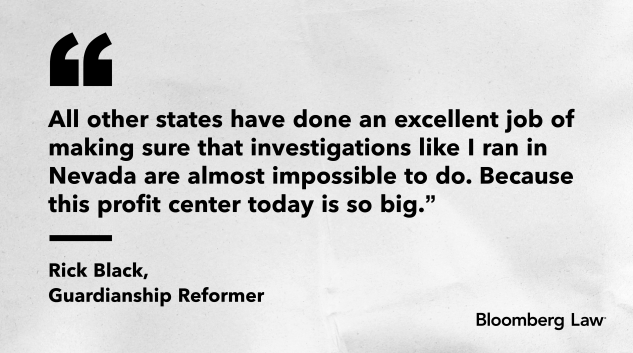
“All other states have done an excellent job of making sure that investigations like I ran in Nevada are almost impossible to do,” he said. “Because this profit center today is so big.” Experts speculate that guardians control more than $50 billion in assets for those under court control.

In Nevada, the changes have made a tangible difference.

Legal Aid Center lawyer Debra Bookout helped Victoria Gonzales, a 35-year-old woman with cerebral palsy, terminate a guardianship that had lasted more than a decade.

Victoria Gonzales, at left, escaped her guardianship with help of Legal Aid Center lawyer Debra Bookout.
Photographer: Bridget Bennett/Bloomberg

Gonzales had been adopted by her grandmother. But after her grandmother died, another relative became Gonzales’ guardian in 2009. Gonzales said she felt powerless. She later connected with Bookout, directing attorney for the office’s Guardianship Advocacy Project, and, in court in November 2021, officially escaped the system.

“Victoria, we’re going to give you your wish. We’re going to give you back your guardianship,” she recalled the judge saying. Her first thought: “Freedom!”

Now living on her own and working as a movie theater usher, she said she finally feels empowered to make her own decisions. “I feel like there’s a whole bunch of confidence,” she said, “and no one can tell me what to do.”

Full Article & Source:
Guardians’ Abuses Persist as One State’s Easy Fix Goes Unmatched

See Also:
In the Name of Protection, Part 1: The Profiteers: Guardians' Dark Side: Lax Rules Open the Vulnerable to Abuse

In the Name of Protection, Part 2: The Judges: Judge’s Errors, Jail Threats Haunt Georgia Family’s Guardianship

In the Name of Protection, Part 3: The Profiteers: 420 Cases, One Guardian: System Runs Amok on Just $35 a Month

In the Name of Protection, Part 4: The Lawyers: Peter Max’s Bare Ledgers Show Guardianships Drain Even the Rich


Not Just Britney: Guardianship System Rife With Abuse (Podcast)

by David Schultz

Court supervised guardianships are meant to protect people who can no longer manage themselves and their assets. But a Bloomberg Law investigation found that people in guardianships can easily be taken advantage of, and that getting out of one is extraordinarily difficult.

Listen here and subscribe to On The Merits on Apple Podcasts, Spotify, Google Podcasts, Megaphone, or Audible.

Reporters Ronnie Greene and Holly Barker just released a five-part series that looks at how guardianships can go wrong—from wealthy celebrities like Britney Spears to indigent senior citizens.

They join our weekly podcast, On The Merits, to talk about how a lack of oversight creates conditions ripe for fraud and abuse. Holly discusses the particularly galling case of a New Mexico guardianship company that stole millions from its clients and whose CFO she spoke to from jail.

Do you have feedback on this episode of On The Merits? Give us a call and leave a voicemail at 703-341-3690.


Full Article & Source:
Not Just Britney: Guardianship System Rife With Abuse (Podcast)

Thursday, March 16, 2023

In the Name of Protection, Part 4: The Lawyers: Peter Max’s Bare Ledgers Show Guardianships Drain Even the Rich

Illustration: Jonathan Hurtarte/Bloomberg Law. Photographer: Jim Vondruska/Bloomberg

by Ronnie Greene

Peter Max, who now has dementia, made millions creating psychedelic art that for a time put him on par with Andy Warhol as a ‘60s cultural icon.

Sara Abbott, who has a form of autism, gets by on $1,200 a month from Social Security disability and lives with her mother in a small house in southern Indiana.

Both are entangled in guardianships that were supposed to serve as salves but are instead mired in turmoil.

The similarities in their cases, despite deeply disparate lives, reveal the emotional and financial risks enshrouding guardianships. As Max’s memory faltered and his finances fell into disarray, he purportedly consented to having neutral guardians oversee his multimillion-dollar estate to achieve peace among his feuding family members. Abbott’s mother initiated a guardianship after a counselor suggested it.

Together their guardianships, which both began in 2016, highlight a simple truth found in a six-month Bloomberg Law investigation: It doesn’t matter how much money people have or how carefully loved ones watch over them; guardianships can evolve into costly quagmires where tussles over fees and control deter from the case’s core mission.

In New York, Max’s guardians and their lawyers have billed millions amid the family’s legal squabbles, suits, and countersuits. As a federal judge recently put it, it’s a “toxic situation.”

In Indiana, Abbott is pushing to terminate her guardianship after a tense journey. Her former guardian billed 91% of her total income during one eight-month period while questioning the family’s spending on everything from fixing the roof to buying a used car.

Across the US, guardianships are regulated in hodgepodge fashion, with different rules from state to state and no national requirements on who can become a guardian or how much they can earn. Adults in the system are protected by a flimsy regulatory safety net.

In any courtroom case, judicial oversight is vital to ensure legal costs don’t spiral out of control, said Jerome “Joe” Studer, a Chicago attorney who specializes in legal fee issues.

Studer said he was taken aback by Bloomberg Law’s findings on the fees in the two cases, particularly by the Indiana case in which the guardian billed nearly Abbott’s entire income. “The ratio strikes me as outrageous,” said Studer, founder of Legal Fee Analytics.

Max: Ceaseless Conflict

“Yeah, I understand,” was all it took for Max, 85, to enter into a guardianship that has done nothing to resolve the family’s feuds.

“You understand?” Judge Laura Visitacion-Lewis asked at the January 2016 hearing. She noted he was shaking his head to indicate he didn’t have any questions. With that, Max became a “Person In Need of a Guardian,” or PING, in court parlance.

Max, now in the advanced stages of Alzheimer’s, wasn’t formally adjudged to be incapacitated at the hearing, a ruling that could have negatively impacted the value of his art.

At the time, he was still painting and making public appearances.

Peter Max attends a 2014 event in New York City.
Photographer: Ben Gabbe/Getty Images for Gotham Magazine

His court-appointed counsel, Elizabeth Adinolfi, said he understood he needed assistance, “particularly in managing his finances,” and thought “it would be beneficial for him to have a neutral third party fulfilling that role,” court transcripts show.

The references to neutrality were a nod to the acrimony among Max’s family members over money, his art, and the family company ALP, Inc. “He loves his children very much. He loves his wife very much. And he does not want there to be any reason for the three of them to be in conflict,” Adinolfi said.

They hoped a neutral guardian could help “achieve some level of peace.”

More than six years later, conflict and litigation envelop the guardianship.

And it is costing Max a fortune.

Abbott: In the Dark

For Sara Abbott, 27, and her mother Diana Abbott, the legal morass began after a well-intentioned suggestion.

In 2016, a counselor recommended Diana put her daughter in a guardianship. She called the lawyer who handled her husband’s estate, and he agreed it made sense.

Sara Abbott wants to end her guardianship. “If I don’t, I’m going to lose my mom, my house, my life.”
Photographer: Jim Vondruska/Bloomberg

Diana was skeptical at first. “I said, Why do I need guardianship? I’m her mother.” But with two professionals suggesting that path, she became her daughter’s guardian that August.

A former stocker at a Dollar General store, Diana said she received no formal training. “I signed a paper, they pushed it through, and that was it.”

She failed to file biennial reports for 2018 and 2020 documenting her daughter’s financial affairs and well-being. Diana didn’t know, she said, she was supposed to file them. Washington Circuit Court Judge Larry W. Medlock removed her in 2021, questioning her oversight as guardian. He appointed a local lawyer, Lisa Fleming, as interim guardian, tasking her with documenting Sara’s spending and assessing her needs.

Thus began a contentious legal saga in which the temporary guardian’s fees would outpace Sara’s income.

Max: Fees on Fees

Max had paid about $1.8 million to his court-appointed lawyer, guardians, and their attorneys by the end of 2020, according to documents obtained by Bloomberg Law.

And that isn’t the half of it. Outstanding requests, either pending or approved, add more than $2 million, plus, conservatively, hundreds of thousands of dollars in accruing unpaid legal fees.

The guardianship order, filed in December 2016, revoked Max’s powers of attorney and health-care proxies, giving control of his finances and care to three court-appointed fiduciaries: a property guardian, Lawrence Flynn; a personal needs guardian, now Barbara Lissner; and his court-appointed lawyer, Adinolfi.

Flynn, who declined an interview request, is Max’s third property guardian, and he had two personal needs guardians before Lissner entered the picture in 2019.

The professionals have generated millions in expenses, either for their own services or for those of lawyers hired to litigate on Max’s behalf – often against his children over ownership of his art.

One pending fee request from Lissner, the personal needs guardian, is for her usual legal rate of $550 an hour. If approved by the court, it would total $598,664 for 13 months.

Libra Max, Peter’s daughter, has challenged that as “grossly excessive.” Lissner’s lawyer said she was unable to comment; the guardian has defended her billing in court filings.

Lissner doesn’t provide legal services to Max. Instead, her responsibilities are to attend to his personal needs and safety. Her time records describe over 1,000 hours of activities sometimes more akin to the services of a social worker or house manager.

One three minute entry reads “Guardian emails PING’s son that she hopes he is feeling better.” At Lissner’s proposed rate, that’s $27.50. Another entry for six-minutes reads “Guardian emails PING’s son to ask him if he visited his father the previous day and if he was able to fix the Netflix issue.” That’s $55.

The records also show that much of her time was spent managing inquiries from Libra and the daughter’s lawyers. Another attorney, hired by Max’s property guardian in the legal fight over his art, bills $650 an hour.

Lissner said in court filings she has yet to be paid. She isn’t alone.

As of May 2021, Max’s guardianship account had a balance below $5, according to an affidavit Flynn filed. Flynn said he had been forced to use some of his own money to pay for some of Max’s expenses.

Peter Max poses for a 1967 photo in New York. In 2022, a judge presiding over Max’s case visited Max and described his apartment as past its prime and said it’s “really unfortunate that such a formerly wealthy person is living like this.”
Photographer: Santi Visalli/Getty Images

Despite Max’s substantial estate – comprising more than $15 million in principal when Flynn took over in 2017 and more than $16 million in income from ALP over the same period – Flynn said Max was unable to meet his financial obligations.

Of the more than $16 million in income, more than $7 million went to cover back taxes, and roughly $893,000 went to a mortgage and apartment renovations.

The remainder of Max’s income has been spent trying to maintain the life the renowned artist had grown accustomed to with his late wife. Flynn said he needs at least $2.5 million a year for Max’s expenses but is receiving only a fraction of that.

The presiding judge has made clear the professionals will be paid.

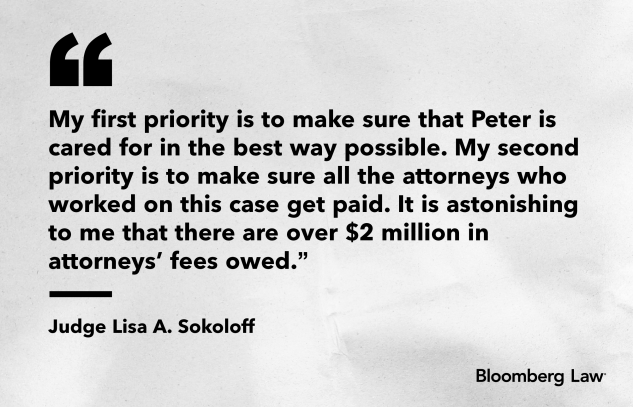
“My first priority is to make sure that Peter is cared for in the best way possible,” Judge Lisa A. Sokoloff said during an April 22, 2022, hearing. “My second priority is to make sure all the attorneys who worked on this case get paid. It is astonishing to me that there are over $2 million in attorneys’ fees owed.”

Abbott: Questions and Fees

After the guardian was appointed to examine her case, Sara Abbott’s legal fees skyrocketed.

The temporary guardian, Fleming, quickly raised red flags with the judge about Diana’s use of Sara’s $1,168 monthly income, which was derived from Social Security Disability Insurance and Supplemental Social Security.

Eight days after Sara received one check with back pay in 2018, Fleming wrote, Diana bought a 2015 Ford Escape for $19,455, writing a check from her daughter’s account. “It is important to note that Sara does not drive, and the car is in Diana’s name only,” she wrote.

Fleming also noted in court filings that Diana put a new roof on their house, spending $4,500 from Sara’s account.

Diana Abbott said she received no training to become her daughter’s guardian.
Photographer: Jim Vondruska/Bloomberg

The accusation, mother and daughter say, is a fundamental misunderstanding of their situation: The money Diana spent was for her daughter’s benefit. Since Sara doesn’t drive, her mother provides all of her transportation. They have lived alone in the tidy family home in Salem since Sara’s father, Stephen, died in 2011.

“Sara says she was told the roof had to be replaced or she would lose her Homeowner’s Insurance,” wrote lawyer Amy Semones, representing Sara.

Said Sara: “How is that not for me? I need a roof over my head so I don’t get rained on.”

Fleming questioned other spending for electric, water and sewer, property taxes, and insurance.

“I believe there is a continued need for a guardian,” Fleming wrote the court on March 22, 2021. She said Sara needed help with medical, mental health, and social interaction needs and suggested Diana have “no access” to her daughter’s bank account.

Semones said their spending wasn’t frivolous. Sara “was consulted about and consented to all of the transactions” while her mom was guardian, the lawyer wrote.

And while Fleming was scrutinizing the roof and other spending, she was charging fees that resulted in half a day’s work totaling more than half of Sara’s monthly income.

On June 6, 2021, Fleming submitted an invoice for her guardian services for her first 3½ months. Her rate was $175 an hour. One bill was for $700 for 4 hours of work reviewing documents Diana provided her, which Fleming used to help form her March report.

In all, the total equated to more than $1,500 a month, more than Sara’s entire monthly income. A day after Fleming submitted her invoice, Judge Medlock approved it. Sara was on the hook for the bill.

The judge also questioned other spending and told Diana not to “spend money frivolously.” That September, the judge told Diana to reimburse Sara’s account $900 spent for Sara’s video games and another $600 on streaming services.

In all, Medlock ordered Diana to reimburse Sara’s account $11,720, including $3,000 for the roof and $6,485 for the car. He suggested she “consider the sale” of the family home.

Semones quickly pressed the judge about the close scrutiny of Sara’s spending that simultaneously threatened to deplete her account.

Semones called some of Fleming’s charges “unnecessary, duplicative and excessive,” particularly in light of Sara’s modest income. Fleming billed $175 for one hour spent copying records; Sara said she could make copies for 10 cents per page. “The invoice contains billable time for unnecessary travel in situations where a fax, phone call, email or internet search would suffice.”

In court papers, Fleming said her actions were “made in good faith on behalf of the protected person” and that she is “entitled to reasonable compensation.” After Semones questioned her fees, Fleming reanalyzed her bills – and increased the total by $52.50. The in-person meetings, she said, “were necessary.”

Fleming declined to discuss the case with Bloomberg Law. “I will not be talking with you about Sara Abbott,” she said.

All the while, the court denied Sara’s request for money for personal expenses. After Fleming took over, Diana, who had previously injured her back, said she was forced to return to work to “make ends meet.” Sara had to make written requests to the guardian for her bank statements and required permission to host a yard sale to raise money, wrote Semones, who was billing Abbott a reduced rate of $50 an hour while also seeking a nonprofit to represent her at no cost.

Max: Art and Lawsuits

Max was placed into a guardianship in part to prevent family infighting, but that original intention has been thwarted.

Generally speaking, “the more dysfunction in the family, the higher the costs of the guardianship,” said Katherine Pearson, a professor at Penn State Dickinson Law who specializes in policies related to aging. As disputes escalate, the legal costs spike.

Adinolfi, Max’s lawyer, said she couldn’t comment on the case. Speaking generally, she said guardianships can “be the best thing for a family” when they’re not contested. But when family dynamics are volatile, “it can drive a guardian’s time through the roof.”

Max founded ALP Inc., named for his children, Adam and Libra, and himself, in 2000. His children hold equal 40% shares. Max owns the remaining 20%, now controlled by Flynn, the property guardian.

In December 2019, Flynn’s lawyer sought to recover “all artworks produced by Peter,” along with the remainder of his “valuable intellectual property.”

Peter Max poses in New York City in 2012 with portraits he created of Paul McCartney. His family and guardians continue to spar over his estate.
Photographer: Timothy A. Clary/AFP via Getty Images

Flynn asserts that Max never intended for ALP – and in effect his children – to control all of his work while he was alive.

He claims Max had been suffering from dementia for two years, according to one of his doctors, when he supposedly transferred his intellectual property rights to ALP. In effect, Flynn is arguing that Max didn’t have the capacity in 2014 to transfer his intellectual property, even though he possessed the capacity in 2016 to enter into a guardianship.

Flynn has also said he has no choice but to aggressively pursue Max’s claim over the art, alleging that Libra began intentionally starving the guardianship in 2019 amid her legal wars with her father’s guardians.

Libra has authority to determine her father’s ALP income, and in court filings, has said she reduced his salary to $800,000 because the company has less cash on hand than normal.

Initially siding with Libra, Flynn voted to oust her brother Adam as president of ALP in late 2018 but by March 2020, Flynn had changed his mind. He accused Libra of misconduct and agreed to reinstate Adam as president, provided Adam agree not to contest the claim to his father’s art – or to oppose the guardians’ fee requests.

Adam’s attorney blamed Libra for much of the case’s chaos. “The plain reason that this matter appears to have spiraled out of control and incurred large requests for compensation by fiduciaries is directly correlated to the litigation that was instigated by Libra Max,” wrote Matthew S. Seidner.

Libra’s lawyer counters that the fees are the consequence of Max being “ripped from his family and loved ones at the end of his life.”

“Simply stated, if Peter was being cared for by his family, as is his wish, there would be no legal fees,” Clifford Meirowitz said. It “strains credulity,” he added, that he wanted “his life run by strangers.”

Libra has been seeking unsuccessfully since 2019 to have Lissner removed as her father’s personal needs guardian.

Their discord escalated in December 2021, when Lissner sued Libra for defamation in state court following an interview Libra gave on Fox 5 New York two months earlier criticizing the guardian.

So now, the court-appointed official watching over Max is formally at legal odds with his daughter.

Libra can see her father, but only when Lissner agrees, and is generally prohibited from accessing his medical information or speaking with his physicians.

And it has all been approved by the court. Adam has said he has no problems seeing his father and, in court filings, has supported Lissner’s care.

In April 2022, Sokoloff – the fifth judge to preside over Max’s case – told Lissner and Libra to be civil, or communicate through lawyers. “I don’t want to be called to find out that Libra isn’t leaving, because I will come over with the police, and you don’t want that.”

About a week later the judge visited Max. She described his apartment as past its prime and said it’s “really unfortunate that such a formerly wealthy person is living like this.”

“He talked to me a little bit,” the judge said. “He was drawing and painting with markers.”

Abbott: Seeking a Way Out

As she found herself deeper in the system, Abbott said she felt invisible.

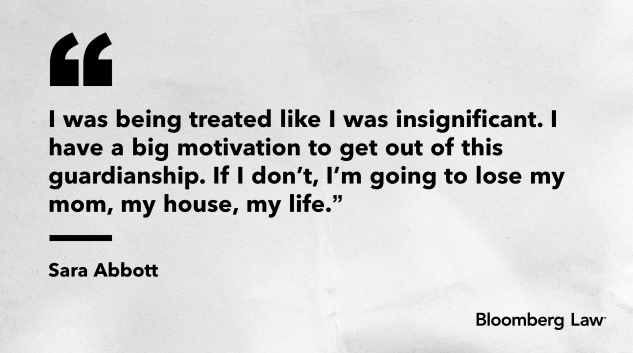
“I was being treated like I was insignificant,” she said from her hometown 100 miles south of Indianapolis. “I have a big motivation to get out of this guardianship. If I don’t, I’m going to lose my mom, my house, my life.”

Her friction with the guardian was clear to Medlock, who “observed in Court the behavior of the ward and her mother towards Ms. Fleming to be disrespectful.” But on this, too, there are two sides to the story.

Abbott is a detail-oriented woman who keeps careful track of her schedule. After the judge appointed Fleming as her guardian, she took to taking notes during their meetings.

“She has not once listened to a word I have said,” she wrote of their first session in 2021.

“Fleming claims that her goal is to ‘help me save money and be frugal’ despite the fact that she is/will be charging me for not only these weekly meetings but also any interactions with her,” she wrote. “The fees for these meetings will more than likely deplete my account.”

As they continued to meet, Abbott said Fleming objected to her taking notes. “Fleming asked me to put binder down. I told her I am more comfortable with it out,” she wrote of their second meeting. “It is hypocritical of her to complain of me taking notes for my own records if she does the same.”

Abbott is now also working with Justin Schrock, an attorney with Indiana Disability Rights representing her at no cost in her bid to end the guardianship.

Schrock formally challenged Fleming’s bills. By October 2021, Fleming had billed $8,915.85 for eight months – or $1,114 a month, 91% of Abbott’s total income, then at $1,225.

Indiana Attorney Justin Schrock is representing Sara Abbott as she fights to be released from her guardianship.
Photographer: Jim Vondruska/Bloomberg

As Abbott awaits her day in court, her case has undergone major change. Last March, Fleming was replaced as guardian by Loren Pilcher, chief operations officer of a behavioral therapy company called Sweet Behavior, who supports Sara ending the guardianship.

In June, Judge Medlock recused himself from the case, citing its “conflict and animosity” in an interview. Medlock said he had concerns about some of the “suspect transfers,” prompting him to appoint Fleming. “I was asking for a different set of eyes,” he said.

Asked about the family’s view that the spending benefited Sara, Medlock acknowledged some second thoughts. “Yes, honestly, when I do look back at it I think they do have something of a point.” But he said the costs should have been split between mother and daughter. Medlock agrees Indiana guardians “absolutely” don’t get enough training.

He said Fleming “did a lot of work and gave me significant insights into how the funds were spent,” but admitted her bills “were extensive” and “some of the meetings with Sara weren’t necessary.”

In the end, Fleming waived about half of her $12,000 final bill and Abbott paid $2,600, Schrock said. The judge got the county to pay the balance.

“I thought it best to recuse,” Medlock said. “I wanted to be fair to everybody. I wasn’t sure I could be.”

He said he’s not convinced Abbott is ready to terminate the guardianship and felt it better for another judge to resolve that question. “I had strong opinions about it.”

If the new judge frees her from the guardianship, Abbott said, “I might faint on the spot.”

Along the way, Diana has witnessed a more confident daughter emerge. “Sara has gotten her voice through all this,” she said.

Sara said she is ready to use that voice.

“Fight back,” she said. “Prove you’re functional. Don’t let people treat you like you’re lesser because you’re different.”

Full Article & Source:
Peter Max’s Bare Ledgers Show Guardianships Drain Even the Rich

See Also:
Guardians' Dark Side: Lax Rules Open the Vulnerable to Abuse

Judge’s Errors, Jail Threats Haunt Georgia Family’s Guardianship

420 Cases, One Guardian: System Runs Amok on Just $35 a Month