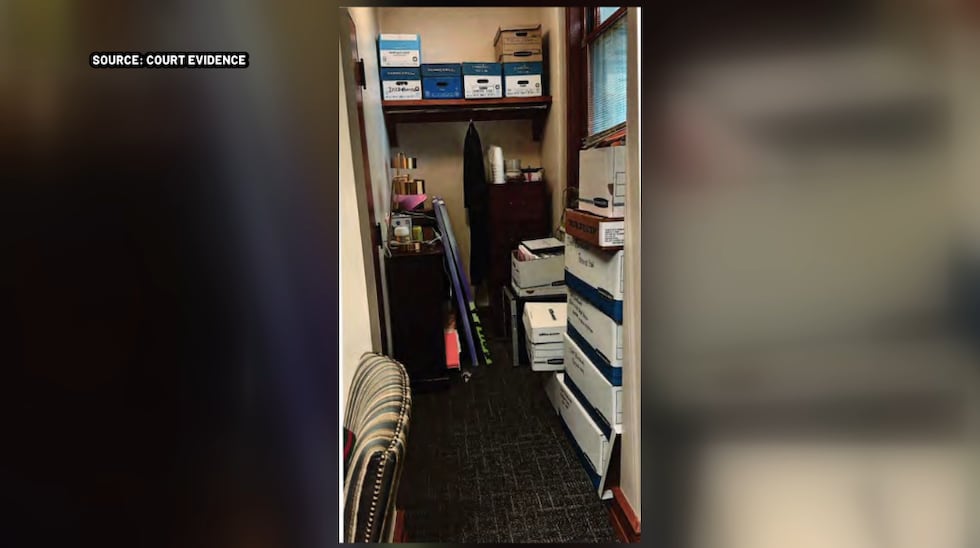
The Ogle County Sheriff's Office has arrested a woman following a financial crimes investigation.
Source:
Ogle County woman arrested and charged with financial exploitation of an elderly person
The Ogle County Sheriff's Office has arrested a woman following a financial crimes investigation.
Source:
Ogle County woman arrested and charged with financial exploitation of an elderly person
Note – suspect identified as Arian Mojaddidi according to the filing
“Caregivers are entrusted with attending to and caring for people in a vulnerable, and often, incapacitated state,” said Attorney General Bonta. “Sexual abuse is absolutely intolerable and sexually abusing a compromised individual while in a position of power over them is all the more deplorable. At the California Department of Justice, we will continue to fight against any form of sexual misconduct and elder abuse.”
The Division of Medi-Cal Fraud & Elder Abuse (DMFEA) received a referral from the California Department of Public Health regarding the inappropriate contact at Concord Post Acute. A felony complaint has been filed in Contra Costa County Superior Court, charging the nursing assistant with a lewd act by a caretaker upon a dependent adult. DMFEA is a division within the California Department of Justice whose mission is to protect the public and the state’s Medi-Cal program from those who defraud taxpayers and divert state health care resources. The investigation was made possible through the collaboration of government agencies and those who reported incidences of Medi-Cal fraud or elder abuse. If you suspect Medi-Cal fraud or elder abuse, please report it at https://oag.ca.gov/dmfea/reporting.
DMFEA receives 75 percent of its funding from the U.S. Department of Health and Human Services under a grant award totaling $77,652,892 for Federal Fiscal Year (FFY) 2026. The remaining 25 percent, totaling $25,884,297 for FFY 2026, is funded by the California Attorney General’s Office. FFY 2026 is from October 1, 2025 through September 30, 2026.
It is important to note that criminal charges must be proven in a court of law. Every defendant is presumed innocent until proven guilty.
Here is a copy of the complaint.
Full Article & Source:
Concord: Nursing Assistant Arrested and Charged for Alleged Sexual Abuse of an Elderly Resident
By Clark Kauffman
The Iowa Board of Nursing Home Administrators recently charged administrator Brian Douglas Reindl with failure to notify the board within 30 days of a criminal conviction. According to the board, Reindl was working in both Iowa and Minnesota care facilities when the offense occurred seven years ago.
The board has not disclosed the nature of the criminal offense, other than to say that on Oct. 11, 2019, it resulted in a conviction for an unspecified misdemeanor offense in Minnesota.
Minnesota state records indicate that on July 2, 2019, sheriff’s deputies responded to a complaint at Pioneer Memorial Care Center in Erskine, Minnesota. Reindl, the facility’s administrator at the time, had allegedly entered the office of the director of nursing while she was on break and refused to leave after being asked to do so.
The director of nursing alleged that when she attempted to leave the office, Reindl used his body to hold the door shut and only allowed her to leave after she indicated she was going to call the police. She alleged that she then entered the office of a third employee, locked the door, and called board members for the facility.
Reindl was charged with one count of misdemeanor harassment and one count of misdemeanor assault in the fifth degree, and a no-contact order was issued in the case.
According to the Minnesota Board of Nursing Home Administrators, Reindl’s employment at the home ended the next day, and he later pleaded guilty to a charge of assault causing fear and was placed on probation for one year. Several months later, in 2020, the Minnesota board issued an order of corrective action against Reindl, requiring him to complete six hours of educational training on professional conduct.
The Iowa Board of Nursing Home Administrators recently agreed to settle its case against Reindl with a $500 civil penalty and a requirement that he complete three hours of educational training on ethics.
The Iowa Capital Dispatch was not able to reach Reindl for comment.
Full Article & Source:
Board fines nursing home administrator for failing to report assault conviction
By Lance Orozco
A Ventura County man is facing elder abuse, grand theft, and identity theft charges after detectives say he stole nearly $100,000 from an 89-year-old man.
Investigators say in June 2024, William Ly of Simi Valley was introduced to the victim through a senior citizen breakfast club. They say Ly helped the victim with his smartphone, and in the process Ly reset the password on the victim's cryptocurrency account.
Last September, the victim noticed he was missing a substantial amount of money. He reported it to the Ventura County Sheriff’s Office. Detectives working with a county fraud team and the FBI say they discovered nearly $100,000 had been stolen in a string of more than 80 transactions. They say they traced the money to Ly’s accounts.
Investigators say they are now looking for more potential victims.
Full Article & Source:
Ventura County man charged with elder abuse after nearly $100,000 stolen from 89-year-old's account
The Lagos State High Court has ordered the Lagos State Administrator-General to take over the interim administration of the estate of late billionaire industrialist, Chief Labode Akindele, amid a legal dispute over his Will.
Justice Tanimola Ajorin-Ajose made the order following an application by the deceased’s first son, Mr. Oladipo Akindele, who is challenging the validity of the Will and seeking to prevent the dissipation of his late father’s assets pending the determination of the substantive suit.
Akindele, who was the Parakoyi of Ibadan, died on June 29, 2020, at the age of 88 at his residence in Lagos.
The claimant had sued 16 defendants, comprising the deceased’s widows, children, relatives, associates and officials of the Lagos State High Court Probate Registry, over the disputed Will.
Among those joined as defendants are Rev. Michael Stephen, Prof. Wale Tomori, Rev. Canon Kolawole Jaiyeoba, Mrs. Oluwatoyin Isemede, Mrs. Abiola Aderibige, Mrs. Abiodun Duduyemi, Mrs. Ajoke Braithwaite, Mrs. Oluyemisi Oladapo, Mrs. Titilola Madedor, Mrs. Afolake Coker, Miss Ayodele Akindele, Mr. Mobolaji Akindele, Mrs. Mojisola Shonibare, Mrs. Roseline Akindele, Miss Samantha Stevenson, the Registrar of the Probate Registry and the Administrator-General of Lagos State.
In the substantive suit, the claimant is asking the court to declare the entire Will invalid, arguing that it failed to comply with the provisions of the applicable Wills Law and therefore could not constitute the legal basis for administering the deceased’s estate.
The claimant had also raised concerns over the management of the estate, which includes properties generating rental income, alleging that some rents had remained unpaid and that income from some of the properties had not been properly accounted for.
He argued that the absence of an effective executor or administrator placed the estate at risk of waste, dissipation or mismanagement while the dispute over the Will remained pending.
Ruling on the application, Justice Ajorin-Ajose appointed the Lagos State Administrator-General as interim administrator of the estate pending the hearing and determination of the substantive suit.
The judge ordered the interim administrator to operate under the immediate control and direction of the court and to file quarterly reports on the administration of the estate.
The court further directed all parties to cooperate with the Administrator-General to ensure the preservation of the estate.
The application had been opposed by some of the defendants, who challenged the claimant’s case and questioned the jurisdiction of the Lagos State High Court.
The defendants argued, among other things, that the properties allegedly forming part of the estate had not been sufficiently identified and that the claimant’s affidavit contained vague and speculative allegations.
They also questioned the territorial jurisdiction of the Lagos State High Court, particularly in relation to assets said to be located outside Lagos State and Nigeria.
However, the court rejected the objections, holding that the immediate issue before it was the preservation of the estate and prevention of waste pending the determination of the substantive dispute.
Justice Ajorin-Ajose held that it was not necessary, at the interim stage, to determine the precise properties constituting the estate before taking steps to protect the assets.
The judge also noted that the deceased’s Will was under challenge and that, at the time of the application, there was no executor or administrator effectively in place to manage the estate.
The court consequently held that the application for the appointment of an interim administrator was meritorious and ordered the Administrator-General to assume responsibility for the interim administration of the estate.
The order will remain in force pending the hearing and final determination of the substantive suit challenging the validity of the Will.
Full Article & Source:
Court takes charge of late billionaire Akindele’s estate amid Will dispute
By Marianne Goodland
Created by lawmakers in 2017, the Office of Public Guardianship serves as a ward of last resort for indigent or incapacitated people who lack family, friends or a private guardian to care for them.
The public guardians are responsible for protecting their clients’ rights and supporting their independence to the greatest extent possible.
The office struggled from the outset.
Lawmakers did not seek state funding for it in 2017, instead expecting the program to run on gifts, grants and donations — with hopes of raising $1.7 million. In its first two years, it collected only about $2,000.
In 2019, lawmakers stepped in to fund the office through probate fees that generated about $800,000 per year. The first guardians began taking referrals in Denver’s 2nd Judicial District, with planned expansion into the districts serving Delta and Trinidad.
Legislation passed in 2023 broadened the office’s authority, directing it to operate in all 23 judicial districts by 2030.
Later in 2019, the five-member board hired Sophia Alvarez as executive director.
The guardianship office began accepting referrals in 2020 but quickly encountered a major obstacle — severe staff turnover.
The agency struggled to even get enough guardians to cover the three districts it was authorized to operate in. Most guardians, frustrated with an alleged toxic work environment they attributed to Alvarez and the agency’s deputy director, Janelle Cantu, lasted less than a year.
Some employees left after only a few months.
In its 2024 end-of-year report, the office had listed 11 guardians. By Jan. 19, 2025, seven of the 11 were gone.
In 2024, seven of the division’s former guardians asked Gov. Jared Polis for an audit. Another former guardian filed a complaint with the state’s Civil Rights Commission, although the status of that complaint is unknown due to the privacy laws.
At the same time, several partner agencies — including Denver Health, its largest — stopped sending referrals, saying the office was mismanaged. In a 2022 state hearing, Denver Health reported that one guardian had physically confronted a client at the hospital and that another client, who died there, had been effectively abandoned by the agency.
As staffing problems persisted, the agency’s mortality rate came under scrutiny. Of the first 80 clients, more than two dozen died during the office’s first three years. Most were elderly and medically fragile, though some were in their 20s or 30s. The agency declined to release even basic public information beyond a client’s age or limited details.
The governor’s office showed little interest in the unfolding problems, even after seven former guardians sent the 2024 letter pleading for stronger oversight. One former guardian told Colorado Politics the office replied with a form letter and never followed up.
The agency’s board meetings showed the agenda was swamped with personnel issues.
Following Alvarez’s resignation in 2025, officials said the agency finally began moving toward the mission it was created to fulfill.
In November, the board hired Amelia Milton McKeon, a veteran with more than two decades of experience working with people with disabilities. In Florida, she helped launch the state’s first statewide public guardianship program and later led three agencies serving people with intellectual and developmental disabilities.

She arrived in Colorado fully aware of the office’s troubled past. Before accepting the job, she said she read every Colorado Politics story detailing the agency’s dysfunction. She wasn’t deterred, she said, adding she has weathered “tough press” before.
McKeon’s background is steeped in human services. Her mother was a health and human services lobbyist who helped build Florida’s intellectual and developmental disabilities agency. Her father, a longtime Florida State University professor, taught educational leadership. Together, they published research in the field and became guardianship experts.
McKeon jokes she had “no choice” but to follow the same path.
“I love it,” she said.
She started early, at 17, working in a high school pilot program supporting special‑education students who were pressured to meet state testing requirements despite qualifying for exemptions. She mentored those students and met two attorneys, Twyla Sketchley and Karen Campbell, who specialized in guardianship and independence. She later worked as Sketchley’s paralegal.
Those experiences shaped her philosophy, she said, nothing that systems are built for the masses and the challenge is to tailor services to each person’s needs. She carried that into her role as a clients’ rights advocate at Florida’s Agency for Persons with Disabilities, where the state was facing multiple lawsuits over how it applied waiver services.
“They needed someone to be a thorn in their behind,” she said. “I was that thorn.”
Her approach to guardianship centers on preserving independence, she said.
“Even in a guardianship, it is my statutory obligation that anything they can exercise, anything they can choose, I’m going to support them in doing that,” she said. Guardianship, she added, is not about taking over someone’s life — ethically or legally. “It is not to substitute our opinions for theirs.”
Florida’s experience closely mirrored Colorado’s — beginning with guardians in three judicial districts before expanding statewide, with the same number of districts and similarly rural regions.
The Colorado office had long struggled to retain guardians in its two rural districts. McKeon made stabilizing those areas an early priority. There was also the issue of ensuring that people in rural areas knew these services were available.
“We need to be available, especially in the most rural areas that have no other resources,” McKeon said. She said she wants to avoid a system where people must travel to metro Denver to get help. “We want them to stay where they are, in their homes, in their communities.”
It points to another challenge for rural Colorado: ensuring the services clients need are available and the barriers to access removed. McKeon said that, too, has been part of her focus.
Among McKeon’s major challenges is to repair the relationships with Denver Health and other partner agencies.
Those efforts have been noticed.
Brad Torch, guardianship director for the Guardianship Alliance, said his organization had been absorbing referrals when the state office became an unreliable option. Last year, he told Colorado Politics the alliance was effectively filling the gap left by the agency’s instability.
The last nine months have been a different story, he said.
“It’s much better,” Torch said, adding the work environment has become collaborative.
He meets weekly with McKeon to work through the issues, and she’s helping the alliance on some of its state funding challenges, he said.
The state office recently hired a Guardianship Alliance staffer, he noted. That guardian is now in the 16th Judicial District, based in Pueblo, a sign of slow but steady expansion.
The Office of Public Guardianship’s “cultural shift” is not the only big change in the agency in the last nine months.
During the 2026 session, it became part of state’s efforts to address the competency issue, as enacted through Senate Bill 26-149.
“We should be involved in this space and have a seat at the table,” McKeon said.
She argued that the state office offers not only the most cost-effective option, but also long-term stability and support for people — helping them live better lives, improving community safety and reducing the likelihood they will cycle back into the criminal justice system.
Under the new law, if a person is adjudicated not restorable to competency, it will be up to OPG, working alongside other state agencies, to stand as an emergency guardian, responsible for providing long-term care.
McKeon also added staff to ensure the bill works as intended on their side. She recently hired Brad Turner to serve as in-house counsel.

Turner wrote the 2026 bill in his role with the Colorado District Attorney’s Council and in collaboration with the Colorado State Public Defender.
He explained that the bill requires that, when a criminal defendant is deemed incompetent, any interested person can petition the criminal court for the appointment of an emergency guardian.
That excludes the City and County of Denver, which constitutionally has jurisdiction over appointing a guardian in some cases.
“We wanted to make that process transparent and easy,” and it’s identical to the process of appointing an emergency guardian in a civil case, Turner said.
Prior to SB 149, there was a significant gap in moving someone into the civil or voluntary treatment system. The new law allows courts to direct district or county attorneys to file civil petitions for involuntary treatment.
If the guardian agrees, that guardian can take over those petitions instead of the county attorney.
Turner said the major shift under SB 149 is that, once the criminal case or short-term treatment ends, the guardian remains involved.
The in-house counsel said that distinction matters: Incompetence determines whether someone can be prosecuted, while incapacity means they need another person to make decisions for them.
To meet its new responsibilities, the office also hired a “flex” guardian — someone who can take cases anywhere in the state, help people access the civil treatment system and provide services in districts that don’t yet have an assigned guardian.
McKeon said her office’s role is to provide guardianship services to those who are incompetent and incapacitated, and she believes there is more overlap than people might expect.
When guardianship first came into being, it was mostly age-based, she explained. That’s shifting now to handling intellectual or developmental disabilities and mental health, and she believes individuals in substance abuse will be the next population that could require guardianship.
“If you have a high-involvement case, someone committing significant felonies and they have been deemed incompetent and continue to reoffend, it begs the question if there is a legal incapacity issue,” she said.
While it hasn’t happened in the past, there’s nothing to prevent the civil and criminal sides from working together, she said.
Colorado Politics recently visited the office’s Greenwood Village office, where staff gather weekly to work through some of the most complicated situations guardians face.
One recent training scenario involved two residents of the same apartment complex. The woman, 30, is developmentally disabled but able to live independently. The man, 38, is a registered sex offender whose offense occurred when he was a teenager and has not reoffended. The pair are in love, want to marry and may want children, though the woman cannot care for a child and shows little interest in doing so.
Guardians — each client has their own — were asked how they would support the couple’s plans. Then McKeon added a twist: the woman is now pregnant.
The staff split into two groups, one for each guardian, to discuss privacy rights and how to approach the situation. McKeon emphasized that these exercises aren’t meant to produce clear-cut answers.
In this case, they didn’t. The group advising the woman’s guardian suggested seeking court guidance but acknowledged numerous unresolved issues and no simple path forward.
The state office has also created an on-call guardian role, one of the agency’s biggest operational lifts. That guardian can respond to emergencies anywhere in the state — including the death of a client, threats to safety, suspected criminal activity involving a client, attempted suicide, mistreatment or disappearance.

Maureen Welch of Navigating Disability remains a vocal critic of the state office, though she acknowledged the new director is an improvement over what she called “awful” past leadership.
Welch argues the agency shouldn’t exist at all, describing it as “a state office that sanctions civil death by court appointments of public employees who make life-impacting decisions.” She contends that many guardian clients have friends or family who were wrongly excluded from consideration by courts or by the guardianship office.
Her primary interactions with the agency have been through board meetings, where she said she was cut off while attempting to give public comment on July 22. Welch said the board should be more open to public participation, hold meetings in person so the public can see “the expensive office space” and improve a website she finds difficult to navigate. She also noted the director’s monthly report no longer lists when clients die.
Welch pointed to the office’s $3 million budget, funded through what she described as a drafting error in the original bill — one that allows the office to collect fees on every probate filing statewide, not just guardianship filings or filings in counties where the office operates. She believes the original intent was far narrower. To her, the current structure amounts to “empire building.”
McKeon said she has been in conversation with Welch and welcomes scrutiny of guardianship itself.
“It is the most restrictive option available; it should be questioned and used sparingly and appropriately,” she said.
“I welcome her feedback and criticism.”
McKeon acknowledged the agency still has significant ground to make up, especially in rebuilding trust and repairing its reputation, but that signs of progress are emerging.
Among the new hires is a senior guardian who has followed the agency since its inception and only recently felt confident enough to join. The office now has nine guardians and plans to hire at least 12 more over the next year, in part to handle the caseload expected under the competency bill.
Another recent addition is a guardian assigned to the 18th Judicial District in Arapahoe County — the site of one of last year’s most high-profile competency cases, which helped drive the 2026 legislation.
Since McKeon arrived last November, not a single staff member has left.
Full Article & Source:
A new day? Colorado’s troubled guardianship office pursues ‘cultural reset’
By Olivia Evans
An Arizona couple is amid a tense, expensive legal battle.
Sam Meranto, a local Phoenix celebrity who rose to prominence for his self-help infomercials, and his wife of nearly 45 years Cynthia Meranto are currently fighting for control over their $2.6 million estate.
According to Maricopa County Probate Court records obtained by The Arizona Republic, Sam, 94, as well as his three living children Jeffrey “Rico” Meranto, April Meranto and Jason Meranto—he welcomed six kids with his first wife Maria Meranto—have alleged that he is “terrified” of Cynthia’s effort to place him in a guardianship and conservatorship that will “deprive him of money, friendships and family.” They further expressed fear he will be “sent to a facility to die.”
Cynthia, for her part, has stated in court documents obtained by The Arizona Republic that her husband is “unable to make meaningful decisions regarding his care and finance,” and that Rico and Jason had him removed from a care facility earlier this year without her knowledge and against her wishes.
The 65-year-old’s court filings also claim she is “afraid” of Sam’s children, especially Rico, who she alleged in the documents had previously accused her of stealing Sam’s valuables (she has made similar allegations toward him).
Meanwhile, Cynthia—who tied the knot with Sam in 1983—alleged that Rico manipulated her husband into signing a document that replaced her with him as Sam’s power of attorney. However, Sam and Rico argue that he had signed over the papers after the 94-year-old called his son multiple times begging for help to get out of the facility where Cynthia had placed him following a hospitalization in July 2025 after a bad fall. (According to court documents, Sam’s sons removed him from the care facility in February, and he’s currently residing in a “family home.”)

Cynthia’s attorney Carol Soderquist acknowledged elsewhere in court documents that the couple’s estate is estimated to be worth around $2.6 million, but noted that as of July the pair have lost around $100,000 due to their ongoing legal battle, which began in March.
Sam was an established television star at the time the pair tied the knot in 1983, but Cynthia’s petition alleges that due to their nearly 50-year marriage, “there are very few assets that are not community property.”
In a statement to The Arizona Republic in June, Cynthia said she loves her husband and the entire ordeal “has been very difficult for everyone involved.”
E! News has attempted to retrieve court documents and reach out to attorneys for Sam and Cynthia but has not yet heard back.
Full Article & Source:
Infomercial Star Sam Meranto, 94, Locked in Legal Battle With Wife, 65, Over $2.6 Million Estate
By Clark Kauffman
No criminal charges have been filed in the case, but a judge has issued a temporary protective order against elder abuse. The order limits the administrator’s contact with the resident.
State inspection records indicate that in July 2026, the niece of a 76-year-old male resident at the Accura Healthcare of LeMars care facility filed a complaint with the Iowa Department of Inspections, Appeals and Licensing. According to state records, the niece, Janelle Scoville, reported that on March 5, 2026, she was notified by her uncle’s bank of potentially fraudulent charges to his personal account.
Inspectors allege the bank reported the charges involved checks written by the resident’s stepdaughter, identified in court records as Katrina Bruner, who was the administrator at the care facility at that time and had power of attorney over some of the resident’s affairs. Scoville also reported concerns regarding medical decisions and care that was being provided at the facility, inspectors allege.
According to the inspectors, an Adult Protective Services worker reported that while at the care facility, she informed the home’s executive director of operations of the allegations of financial exploitation by Bruner, as well as concerns that were expressed about the resident having to sleep on a couch.
The inspection report indicates Bruner stopped working at the care facility on March 30, 2026, the same day the courts issued a protective order preventing her from contacting the resident in question.
The home’s former director of nursing allegedly told state inspectors Scoville had expressed concerns regarding financial and medical decisions made by Bruner but could not recall when those conversations took place. When asked whether the concerns should have been reported by the facility to DIAL as potential resident abuse, the former director of nursing allegedly responded, “Until something is proven, there is nothing we can do.”
In July, the home’s new administrator confirmed that the facility was required to have notified DIAL as soon as the abuse allegations were reported to the staff, inspectors allege.
Court records show that Scoville, of Dakota City, Nebraska, filed with the Plymouth County courts a petition for relief from elder abuse on March 30, 2026.
In her petition, Scoville alleged under oath that Bruner “has written $32,000 worth of checks to her children from (the resident’s) account that he didn’t authorize. She paid for her own home remodel with his money and paid for her own credit cards. She was supposed to take over payments of his new car but took the car and paid it off with his money. Is trying to sell his house. Has all his vehicles and keys. I have video of him saying he didn’t approve it.”
On March 30, Chief District Court Judge Patrick Tott approved a Temporary Protective Order Against Elder Abuse, barring Bruner from having any contact with the resident or exercising control over his finances.
On May 11, Scoville and Bruner filed a joint agreement with the court indicating Bruner, while admitting no liability in the matter, had agreed to relinquish power of attorney and any control she had over the resident’s finances and property.
“The issue of alleged financial exploitation and any claim for restitution shall be reserved and deferred for determination by the court at a later hearing,” the agreement stipulated.
The Iowa Capital Dispatch was not able to reach Bruner for comment on the case. Her attorney, Robert Brock, declined to comment on the matter.
Scoville said Friday she is still waiting for a copy of an investigative report from Adult Protective Services, adding that a criminal investigation is still ongoing.
Full Article & Source:
Nursing home administrator accused of elder abuse and financial exploitation
Under the new law, guardians must obtain court approval before changing a ward’s permanent residence except in limited circumstances. While temporary placements, including short-term rehabilitation stays, appear to be permitted, hospitals should review the legislation and consult legal counsel to understand how the new requirements may affect discharge planning for incapacitated patients who require a permanent change in residence.
The MHA was not involved in the development of this legislation and understands that the additional probate court steps may create barriers to timely care transitions, prolong hospital stays and increase administrative burdens for patients, families, guardians and providers. The association believes the law is a step backward in addressing guardianship issues and reducing discharge delays.
The MHA is evaluating options to address these concerns and will continue advocating for solutions that support safe, timely transitions of care while maintaining appropriate protections for individuals under guardianship. Hospitals are encouraged to familiarize themselves with the new law, assess potential operational impacts and share any challenges or examples with the MHA as the law takes effect.
Members experiencing guardianship-related discharge challenges are encouraged to share examples with the MHA.
Members with questions may contact Kelsey Ostergren at the MHA.
Full Article & Source:
New Guardianship Law May Affect Hospital Discharge Planning
A Montgomery County man is facing criminal charges after investigators discovered he was operating two unlicensed personal care homes out of residential houses where bedridden and disabled seniors were living without required fire safety equipment or state licensing.
Source:
Man arrested for running two unlicensed care homes in Montgomery County
WASHINGTON, D.C. — Concerns about guardianship abuse took center stage at the Whistleblower Summit and Film Festival on Capitol Hill, where the Lifetime film "The Bad Guardian" was screened for an audience that included lawmakers, advocates, and filmmakers.
The film, inspired by real stories, was selected for its accurate portrayal of guardianship abuse.
"It means that our film really hit a nerve," executive producer Elizabeth Stephen said.
The film first aired on Lifetime before reaching a wider audience on Netflix.
"It got a new life on Netflix, and in the 1st 3 weeks that it aired, it was in the top 10 movies in the country, which was incredible," Stephen said.
Stephen said viewers across the country have reached out to share their own experiences.
"I get emails from people all over the country, and it's always the same thing. This was my story. That was my father, my mother, my sister. That was the Guardian, and it's always heartbreaking," Stephen said.
Guardianship is a legal process that allows someone else to make decisions about a person's finances, healthcare, and even where they live.
The system is intended to protect vulnerable people who cannot care for themselves.
But over more than a decade of reporting, our I-Team has uncovered cases where families say guardianship led to isolation, exploitation, and abuse.
Following the screening, I joined a panel that included filmmaker Claudia Myers, National Center on Elder Abuse Director Julie Schoen, and guardianship reform advocate Rey Contreras.
"This was very real. It's very guttural. They got a lot of things right," I said during the panel discussion.
"People say this can't be true, and even attorneys who I speak to who end up by chance in probate court, they feel like they've gone off into Alice in Wonderland because the rules of a normal court system just don't seem to apply there," I said.
Contreras said his own family became entangled in the guardianship system despite years of estate planning.
His stepfather, Pete Beaty, created trust documents naming who should manage his affairs if he became incapacitated — wishes that were later disregarded in court.

"Trust documents to me are an admission ticket to a circus, a circus, because the lawyers make all the money on the back end," Contreras said.
Panelists repeatedly focused on accountability during the discussion.
"The next sequel should be called The Bad Judge because at the end of the day, everything these Guardians do is being rubber-stamped by the judge," Contreras said.
Schoen acknowledged that not all guardianship cases involve abuse.
"There are successful guardianship cases out there, but that's not what we're here to talk about today," Schoen said.
"The best kind of guardianship is to not have one at all. These are supposed to be last-resort measures," I said.
Myers said she hopes the film leads to meaningful change.
"I can just hope that it helps in some small way lead to change," Myers said. "I hope so. Eventually, I think they will. I think the question is how quickly and how efficiently can we tackle this very complex problem."
Myers offered a stark warning for viewers.
"The takeaway for me is very clearly that it could happen to you," Myers said.
After the event, members of the panel met with Senator Rick Scott, who chairs the Senate Special Committee on Aging, to discuss concerns surrounding guardianship and possible solutions at the federal level.
Stephen said raising public awareness remains a priority.

"We have to raise public awareness because if there's any way to prevent this from happening to people, we need to do that," Stephen said.
Full Article & Source:
'The Bad Guardian' film on guardianship abuse screened on Capitol Hill
Jurors deliberated into Monday evening before reaching the verdict after a nearly two-week trial over “Guardianship Inc.,” a 2020 episode of Netflix’s “Dirty Money” documentary series. Although Netflix and the documentary’s producers settled with Barina before trial, former San Antonio attorney Phil Ross and Jo Ann Rivera, Ross’ former associate, remained in the case and represented themselves at trial.
The lawsuit stemmed from a yearslong legal battle over the guardianship of one-time San Antonio businessman Charles Thrash, Barina’s great-uncle. Also named as defendants were Laura Martinez, whose marriage to Thrash was later annulled, and her children, Brittany, Michelle and Joe Martinez. Ross represented the Martinez family during the guardianship litigation before surrendering his law license in lieu of discipline stemming from his role in the guardianship.
Before the case went to the jury, state District Judge Nadine Nieto directed a verdict against the Martinez family after none of them presented a defense at trial.
The jury found Ross, Rivera, the Martinez family and Netflix defamed Barina by falsely portraying her as exploiting Thrash and awarded her $6 million in actual damages and almost $2.5 million in punitive damages.
After finding Barina had been defamed, jurors assigned percentages of responsibility to each defendant and to Netflix, which settled before trial.
They assigned responsibility as follows: Ross, 30%; Netflix, 27%; Laura Martinez, 20%; Rivera 10%; Brittany Martinez, 8%; Michelle Martinez, 4%; and Joe Martinez, 1%.
Before closing arguments, Nieto declined to remove Netflix from the apportionment question despite a request from Barina’s lawyers. But because Netflix resolved Barina’s claims before trial, no liability can be attached to it.
The jury also awarded punitive damages of $1 million against Ross, $200,000 against Rivera, $500,000 against Laura Martinez and $250,000 each against Brittany, Michelle and Jose Martinez.
“This verdict totally vindicates Tonya Barina and establishes she took no money from Charlie Thrash, nor was she ever involved in guardianship abuse,” her lawyers, Glenn Deadman and Carl Kolb, said in a statement. “The verdict shows that Ross, Rivera and the Martinez clan intentionally defamed Ms. Barina.”
Ross said he and Rivera intend to seek a new trial or appeal, arguing the judge improperly excluded evidence and that the verdict was unsupported by the evidence.
The lawsuit centered on “Guardianship Inc.,” a documentary that featured the Thrash guardianship and another case while portraying guardianship abuse as “the crime of the 21st century.” Barina alleged the episode falsely depicted her as exploiting Thrash and destroyed her reputation and banking career. The documentary was later taken off the air.
Thrash, now 88, owned a San Antonio automotive repair shop and amassed an estate valued at $3 million to $6 million before he was placed under a court-ordered guardianship after being diagnosed with dementia.
The guardianship sparked years of contentious litigation between Barina and Ross, who represented Laura Martinez and her family in challenging the court-appointed guardians.
Among the statements jurors were asked to consider were Ross’ assertions that what was happening to Thrash was “a crime,” that he was the victim of “textbook” guardianship abuse and that his estate was being exploited by the people appointed to manage it.
Jurors also considered whether Rivera defamed Barina by promoting the documentary and related allegations on a Facebook page called “The Journey of Charlie Thrash.” Barina alleged the posts republished the documentary’s false claims and further damaged her reputation.
During closing arguments, Ross told jurors he was exercising his constitutional right to free speech and that his statements in the documentary were true, not defamatory. He said he had no role in producing the documentary beyond giving interviews.
Ross argued the verdict would have consequences beyond the case, saying it could discourage people from speaking to journalists.
“Whatever happens in this trial is going to send a message to anybody that wants to talk to a reporter,” he said.
Rivera likewise denied defaming Barina, saying she neither created false statements nor acted with malice.
“I’m not responsible for this,” Rivera said during her closing arguments. “I didn’t defame her. I haven’t been malicious. I didn’t create lies.”
Kolb argued the documentary omitted an important part of the story. About 10 months before it aired, a probate judge sanctioned Ross and Laura and Brittany Martinez in connection with the guardianship litigation. Kolb said leaving out those findings made the documentary misleading.
Deadman said that after Ross and the Martinez family lost in the courts, they went to “the court of public opinion” to get Barina removed as guardian.
Deadman also urged jurors not to be swayed by Ross’ free-speech argument, saying the case was about accountability for false statements rather than the right to speak.
“Put a number in there that will redeem this lady’s reputation and get it published throughout the world,” he said. “Send a message.”
Full Article & Source:
San Antonio-area woman wins nearly $8.5M after jury finds Netflix documentary defamatory
by Lynnanne Nguyen
The victim, an 88-year-old woman with a medical condition, was reportedly left with no funds for her own care and had to be moved into a state-funded assisted living facility, according to police.
Bellevue police say the woman's nephew, 58-year-old Abner Eng, along with his wife, Manivone Misaengsay, and his son, Evun Eng, took advantage of their power of attorney to quickly sell off her assets for their own benefit.
Police allege the suspects quickly positioned themselves to control the woman’s finances.
"The day they get power of attorney, they end up quickly transferring the home to their care to sell, then sell off and benefit from that," said Capt. Ryan Parrott with the Bellevue Police Department. "So immediately after getting that power of attorney, they're already moving to sell the home and to start taking bank accounts."
Adult Protective Services alerted Bellevue police to the case in June 2024, after another family member reported suspicions to authorities. Investigators say the case has been under investigation for more than two years as they requested various search warrants to search through bank records and build their case.
"They're taking that money, now buying things for themselves, paying off bills, purchasing items for a catering business," Parrott said.
Parrott said the case is a stark example of financial exploitation by people the victim should have been able to trust.
"In this case, you're talking about family members who came in, someone you should trust," Parrott said. "And then the family members took advantage of that."
Police say another family member now has guardianship over the elderly victim. Eng and his family face charges of money laundering and theft from a vulnerable adult.
During the trio's court hearing Tuesday, defendants admitted to their role; Abner Eng, along with his wife, Manivone Misaengsay, were present.
Evun Eng was out on bond; his attorney waived his arraignment because the attorney was on vacation. Eng is expected to have his arraignment next week.
Bellevue police urged community members to stay vigilant for signs of abuse toward older or vulnerable adults, including staying connected with loved ones, monitoring bank accounts and helping protect valuables. Anyone who suspects abuse should report it immediately by calling 911 and notify adult protective services or a trusted health care provider, police said.
Full Article & Source:
3 family members accused of stealing $1M from vulnerable 88-year-old in Bellevue
by Ventura County Sheriff
On July 30, 2026, deputies responded to a report of an assault with a deadly weapon at a residence in the 5900 block of E. Sunny Vista Ave. in Oak Park. A 911 caller reported that her adult son was attacking her husband with a knife.
Deputies arrived quickly, and upon entering the residence, deputies found the suspect, Chad Nelson, standing over his injured 80-year-old stepfather, who was lying on the living room floor bleeding from multiple injuries.
Deputies immediately detained Nelson and allowed Ventura County Fire Department personnel and American Medical Response personnel to enter and provide emergency medical care for the injured victim.
While deputies were escorting Nelson from the residence, the victim spontaneously stated, “You saved my life,” indicating he feared he would have been killed had deputies not intervened.
The investigation determined Nelson allegedly became enraged at the victims following a family discussion. Nelson then armed himself with an approximately 10-inch butcher knife from the kitchen, advanced toward the mobility-impaired victim, and assaulted him with the knife. The victim sustained multiple non-life-threatening injuries and was transported to a local hospital for treatment.
Following the investigation, Chad Nelson was arrested and booked into the Ventura County Pre-Trial Detention Facility for the following felony offenses:
Nelson remains in custody at the Ventura County Pre-Trial Detention Facility with bail set at $200,000. He is scheduled to appear in Ventura County Superior Court on Aug. 3, 2026, at 1:30 p.m.
The Ventura County Sheriff’s Office reminds the public that domestic violence can affect victims of any age. Violence against elderly family members is a serious crime, and deputies remain committed to protecting vulnerable members of our community and holding violent offenders accountable.
Full Article & Source:
Oak Park Man Arrested After Alleged Knife Attack on Elderly Victims
By Nate Gartrell
Veronica Medina, 36, was originally charged with elder abuse after the June 28 confrontation. When Pamela Cox died from her injuries, prosecutors refiled the case with the manslaughter charge.
Medina is out of custody while the case is pending and is expected to enter a plea in late August.
Police say Medina and Cox got into an argument on the 1400 block of 171st Avenue. Video from a neighbor’s security camera reportedly showed that Medina walked up and shoved Cox, who stumbled off the sidewalk and fell into the street, hitting the back of her head. She was knocked unconscious, suffered a traumatic brain injury, and died after being taken off life support on July 1, records show.
Medina told police that Cox had grabbed a child on a bicycle, sparking the initial confrontation, and that Medina shoved Cox to prevent her from coming into her yard. Police say the video contradicted Medina’s claims that Cox was the aggressor.
Full Article & Source:
Hayward woman charged with shoving 78-year-old woman from sidewalk, killing her
By: CBS 58 Newsroom
MILWAUKEE (CBS 58) -- Macias made his initial appearance in Milwaukee County Court on Saturday, August 1, where a Judge set a $150,000 cash bond for the defendant.
Milwaukee County Circuit Court
The judge also issued a no contact order, and ordered Macias to maintain absolute sobriety, and said he could be in no possession of dangerous weapons or firearms.
Macias is due back in court Friday, August 7, for a preliminary hearing.
A woman searching for rehabilitation care says she walked away heartbroken after touring Rochester Manor and Villa, and a former maintenance director says he repeatedly warned management about problems inside the building. KDKA's Shelley Bortz reports.
Source:
Concerns raised about conditions inside Pennsylvania nursing home: "Heartbreaking"
Michigan Attorney General Dana Nessel called the care and sheer number of violations against a Southeast Michigan nursing home operator "atrocious."
LANSING – Today, Michigan Attorney General Dana Nessel announced a civil cause of action (PDF) filed against Fahim Uddin, Pioneer Health Care Management doing business as Legacy Healthcare Management, and nine nursing home facilities located throughout southeast Michigan for violations of the Michigan Medicaid False Claim Act. The complaint alleges Uddin and his companies accepted more than $111 million in Medicaid reimbursement while failing to maintain staffing levels necessary to provide the services for which they billed. The Attorney General contends that this intentional failure of care placed hundreds of nursing home patients at risk of harm while Uddin operated related companies to enrich himself.
“While our case is focused on staffing data, there is a real human cost to the defendants' choices and their failure of care,” said Attorney General Nessel. “The consequences of chronic understaffing placed vulnerable residents at unnecessary risk of harm, violated their rights, and resulted in numerous injuries. I would like to thank the U.S. Department of Health and Human Services, Office of Inspector General for their valuable assistance in this matter. My office remains committed to doing all we can to hold long-term care facilities accountable to ensure residents receive the high-quality care they deserve.”
"The complaint highlights two critical barriers to ensuring quality of care and life for nursing home residents: understaffing and related party transactions,” said Alison Hirschel, director of the Michigan Elder Justice Initiative. “We’re grateful to the Attorney General for seeking to hold nursing homes accountable.”
The civil complaint follows a 2-year investigation that began in October 2024 into chronic, severe understaffing at nine Michigan facilities owned and operated by Uddin:
Under the Michigan Medicaid False Claim Act, failure of care occurs when a nursing home, or nursing home owner and operator, knowingly provides care which is so substandard that it fails to meet the minimally required standards for Medicaid reimbursement, despite submitting claims that indicate otherwise. Attorney General Nessel alleges in the complaint that across the nine facilities, licensed for 508 beds and housing an average of 394 residents, the defendants failed to meet their minimal staffing requirements based on the acuity needs of their residents approximately 96% of the time.
Michigan law requires per-shift minimum ratios to ensure care and services are not concentrated in a single period. It is alleged that the defendants failed to meet these shift ratios on at least 496 instances. Michigan law also requires a nursing home to provide staff sufficient to provide not less than 2.25 hours of nursing care per resident, per day. It is further alleged that the defendants operated below the per resident, per day threshold on 1,454 occasions – higher than any other nursing home chain with four or more facilities in Michigan during this period. On at least 4,658 occasions, the defendants also allegedly failed to staff a registered nurse for at least eight consecutive hours a day, seven days a week, as required by federal law.
Between 2020 and 2025, the defendants billed Medicaid a total of $111,216,862. The Attorney General contends the defendants submitted claims for services that were not provided in accordance with Medicaid requirements and is seeking the full amount received by the defendants as a result of their alleged wrongful conduct – plus triple that amount, as well as a penalty of $5,000-$10,000 for each violation.
This matter is being handled by the Department of Attorney General’s Health Care Fraud Division (HCFD), with the assistance of the U.S. Department of Health and Human Services Office of Inspector General. The HCFD is the federally certified Medicaid Fraud Control Unit for Michigan, and it receives 75% of its funding from the U.S. Department of Health and Human Services under a grant award totaling $5,517,524.00 for the fiscal year 2026. The remaining 25% percent, totaling $1,839,170.00, is funded by the State of Michigan.