Showing posts with label Adam Walser. Show all posts

Friday, August 7, 2026

'The Bad Guardian' film on guardianship abuse screened on Capitol Hill

I-Team investigator Adam Walser appears as a panelist for the screening of Lifetime film based on real guardianship abuse cases 

WASHINGTON, D.C. — Concerns about guardianship abuse took center stage at the Whistleblower Summit and Film Festival on Capitol Hill, where the Lifetime film "The Bad Guardian" was screened for an audience that included lawmakers, advocates, and filmmakers.

The film, inspired by real stories, was selected for its accurate portrayal of guardianship abuse.

"It means that our film really hit a nerve," executive producer Elizabeth Stephen said.

From Lifetime to Netflix's top 10

The film first aired on Lifetime before reaching a wider audience on Netflix.

"It got a new life on Netflix, and in the 1st 3 weeks that it aired, it was in the top 10 movies in the country, which was incredible," Stephen said.

Stephen said viewers across the country have reached out to share their own experiences.

"I get emails from people all over the country, and it's always the same thing. This was my story. That was my father, my mother, my sister. That was the Guardian, and it's always heartbreaking," Stephen said.

A system meant to protect — but one that can harm

Guardianship is a legal process that allows someone else to make decisions about a person's finances, healthcare, and even where they live.

The system is intended to protect vulnerable people who cannot care for themselves.

But over more than a decade of reporting, our I-Team has uncovered cases where families say guardianship led to isolation, exploitation, and abuse.

Panel discussion puts accountability in focus

Following the screening, I joined a panel that included filmmaker Claudia Myers, National Center on Elder Abuse Director Julie Schoen, and guardianship reform advocate Rey Contreras.

"This was very real. It's very guttural. They got a lot of things right," I said during the panel discussion.

"People say this can't be true, and even attorneys who I speak to who end up by chance in probate court, they feel like they've gone off into Alice in Wonderland because the rules of a normal court system just don't seem to apply there," I said.

Contreras said his own family became entangled in the guardianship system despite years of estate planning.

His stepfather, Pete Beaty, created trust documents naming who should manage his affairs if he became incapacitated — wishes that were later disregarded in court.
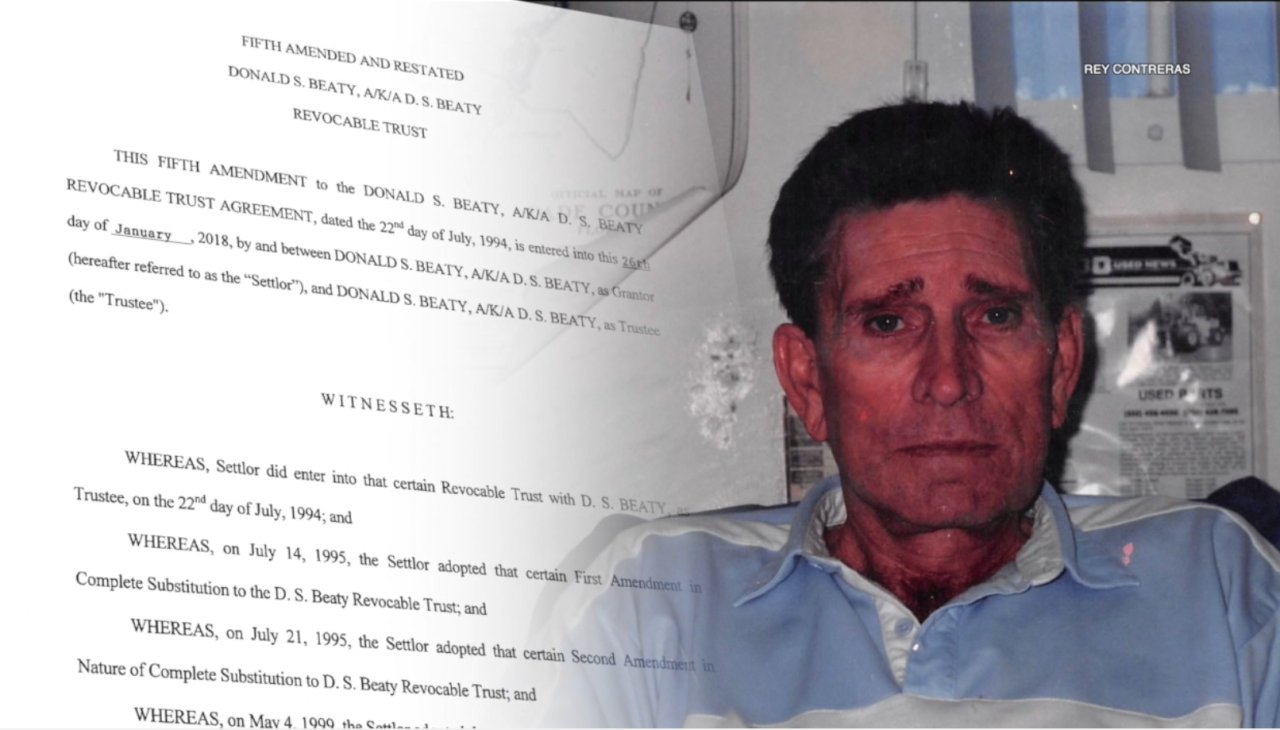
Pete Beaty.png

"Trust documents to me are an admission ticket to a circus, a circus, because the lawyers make all the money on the back end," Contreras said.

Panelists repeatedly focused on accountability during the discussion.

Full Article & Source:
'The Bad Guardian' film on guardianship abuse screened on Capitol Hill 

Thursday, November 13, 2025

State report: Dementia patient left in freezer '20 to 30' minutes after employee found him there alive


By: Adam Walser

TRINITY, Fla. — A new state inspection report reveals that the Waverly Assisted Living Facility in Trinity "failed to provide adequate personal supervision and oversight" on the night a dementia patient wandered into a walk-in freezer and later died of hypothermia.

William Eugene Ray, who had dementia, got out of bed and left his room just after 12:30 a.m. on September 26.

Watch report from Adam Walser 

His family had installed a Ring camera in his room due to staffing concerns at the facility.

Ray's daughter Kristen Spencer woke up to discover her father was missing from his room.


“I couldn’t even believe the words I was hearing”

She called the facility to notify staff, then drove there with her mother.

They were placed in a conference room while staff searched for Ray.


"The director came in and said they found him. And then she said he was in the freezer," Spencer said. "I couldn't even believe the words that I was hearing."

The 54-page report from the Florida Agency for Health Care Administration (AHCA) offers explanations of what happened that night.

Attorney Stephen Barnes, who represents Ray's family, said the state conducted a thorough investigation.


"The state did its due diligence. They not only talked to the administration. They talked to employees, they talked to staff, they talked to residents and got the complete picture," Barnes said.

Report says one employee was scheduled to care for 48 residents

The report reveals that only one staff member was scheduled to work that night in the assisted living side, which had 48 residents.


The report says two people were assigned to the memory care section of the facility. 

According to the report, an employee told investigators they had complained to the administrator days before the incident, saying, "We are always short-staffed. We don't take breaks and there are no breaks at night."

The report indicates video from the facility showed Ray wandered around unnoticed for hours, "entering and exiting the kitchen area and the kitchen's cooler multiple times”.

"How could this happen? Basic safety measures were not in place to secure the kitchen," Spencer said.

The report says a cook told investigators, "There was no way to lock the double doors leading to the kitchen, and the key to the fridge was missing, so the door could not be locked."

The Cook said a previous complaint was made to the administrator.

"I was concerned someone would come in and turn the stove on and start a fire,” the cook told investigators, according to the report.


"The kitchen staff told the facility. We can't lock the kitchen doors. We can't lock the freezer. And sounded like it happened more than once that they were asking for this to be taken care of. That simple remedy stops this from ever happening," Barnes said.

Report: Ray was left in freezer for “20 to 30 minutes” after he was found by employee

Ray was last seen on video at 4:30 a.m.

He was found inside the freezer at 8:10 a.m., lying on his side and shivering.

The report says he responded to commands by nodding, even though he could not speak.

The staff member who found Ray didn't move him, claiming it was against facility policy, and instead waited "20 to 30 minutes" for rescue workers to arrive.

"The family's devastated to learn that the patriarch of that family was left in a freezer after he was discovered still alive until the emergency personnel got there, and the excuse was that's the way we were trained," Barnes said.

Ray was taken to Trinity Medical Center, which is just a few hundred yards from the facility, but by the time he arrived, it was too late.

Spencer said she was told by medical staff that Ray’s core body temperature was 66 degrees when he arrived.

According to a report from the Pasco County Medical Examiner, the preliminary cause of death was hypothermia.

Barnes says he hopes the facility will learn from the tragedy, so others’ safety is not put at risk.

"Do your job. You know, if you're gonna take these residents in and you're gonna tell a family that you're gonna take care of them, do your job," Barnes said.

The Waverly did not respond by our deadline to requests for comment about the state report.

To check out nursing home inspection records:

https://quality.healthfinder.fl.gov/report-guides/nursing-homesfl

To check out assisted living facilities in Florida:

https://ahca.myflorida.com/health-quality-assurance/inspection-reports-for-health-care-providers

Full Article & Source:
State report: Dementia patient left in freezer '20 to 30' minutes after employee found him there alive 

Wednesday, March 26, 2025

'Appalling findings': Audit of Florida's guardianship watchdog agency exposes guardianship failures

OPPG received 174 complaints against professional guardians in two years but rarely took action


By: Adam Walser

TALLAHASSEE, Fla. — The Florida Auditor has released a scathing report involving the Office of Public and Professional Guardians or OPPG.

Under guardianship, a judge takes away a person’s rights and appoints someone to manage their finances and other aspects of their lives.

State lawmakers created OPPG to police guardians and protect wards under their care, like Willi Berchau, whose story prompted the creation of the watchdog agency in 2015.


Since OPPG opened, millions of tax dollars have been spent on funding the agency, even though auditors say it is failing some of Florida’s most vulnerable seniors.

“They can do whatever they want with you”


The I-Team's investigation into Florida's broken guardianship system started in 2013.

“My court-appointed guardian doesn’t allow me to leave the premises,” Willi Berchau told us when we secretly interviewed him at a church.

The 99-year-old German immigrant had been placed by his court-appointed guardian in a locked-down dementia unit where he didn’t belong.

“You see nobody. You have no contact with anybody,” Berchau said. “If you stayed there any longer, you would mentally go down. Mentally.”

Three months after our first story, a judge restored Berchau’s rights.

“The trouble is, if you have nobody behind your back, they can do whatever they want with you,” Berchau's said at a pizza party his friends threw for him on the day he was released.

In 2015, Florida lawmakers created the Office of Public and Professional Guardians, or OPPG, to protect people in guardianship from isolation, exploitation and abuse.


Former Florida Senator Jeff Brandes was one of the sponsors of the law.

“Willi’s story is what prompted it. We heard the story, and it was so compelling, and we knew that we needed to do something,” Brandes said at the time.

But a recent audit shows OPPG is failing those it is supposed to protect.

Professional guardians received 174 complaints in two years

“This is actually a follow-up audit we did. And to be honest, in some respects, it was worse the second time around,” Deputy Auditor Matthew Tracy told a State Senate committee last month, sharing results from a 33-page audit report.


The audit shows the state’s 566 professional guardians received 174 complaints.

It said OPPG “had not developed and implemented an effective monitoring tool” to make sure guardians complied with state law.

“The extent of the department's oversight of this was a self-asked questionnaire that asked basically did you comply with our requirements and how many wards did you monitor? Basically it was like grading your own test in school,” Tracy said.

The report also said OPPG didn’t promptly address serious complaints.

“People are being kept from their families. They take their money. They sell the house from underneath them,” Tracy testified.

The I-Team previously reported how OPPG often took years to investigate complaints.

“They go to a black hole,” Black said.

Gov. DeSantis acknowledged problems in 2019

Our reporting got Gov. Ron DeSantis’ attention in 2019.

“What troubled me about some of the issues you guys raised was obviously bad things are happening but there doesn’t seem to be anyone held accountable,” he said.

At that time, the I-Team reported OPPG had 132 open investigations.

“I think that over 130 cases and nothing has happened to anybody, that just doesn’t strike me as being acceptable,” DeSantis said.

The entire OPPG administrative staff resigned, but a year later, little had changed.

In 2020, the I-Team obtained internal documents showing a huge backlog of cases, many dating back to before the resignations.

“Every month I’m calling"

Among the cases ... complaints from Terri Kennedy about her Aunt Lille White’s guardianship.

“I never thought anything like this could have happened,” White said in a cell phone video Kennedy recorded the last time she saw her aunt.

Lillie was isolated from family after a dispute over who would inherit her fortune.

“Every month I’m calling and saying another year, another week, another month. Where’s the report?” Kennedy said.

Three years after filing a complaint, OPPG finally sent Kennedy a letter saying her allegations were substantiated, finding her Aunt Lillie’s guardian wasn’t registered and improperly billed her.

But OPPG didn’t discipline the guardian and closed the case.


“I was so angry when I got the OPPG letter,” Kennedy said.

Lillie died the next year.

“She died alone without her family knowing, and two weeks later we find out,” Kennedy said.

We uncovered that OPPG found that at least 8 other guardians broke the law but were allowed to continue serving as guardians.

“They got maybe a requirement to take a couple of continuing education classes, but you can keep the money that mysteriously disappeared,” Black said, describing how OPPG handled cases of guardians who were found to violate the Florida Guardianship statute.

Lawmakers at the hearing where the audit was presented were shocked by the auditors’ recent findings.

“The things that we're hearing in this committee are really appalling,” said Sen. Tom Wright (R-Port Orange).

“Accountability is something we owe our population,” Sen. Jay Collins (R-Tampa) said.

Advocates say unless OPPG begins to hold guardians accountable, more people like Willi Berchau will be isolated, exploited and abused.

“These are our most vulnerable members of our population. And they have almost no protections when they are in the adult guardianship system in the state of Florida,” Black said.

“I think it should be shut down and something else put in place,” Hogue said.

The Department of Elder Affairs Secretary didn’t agree to an interview

We requested an on-camera interview with the Florida Department of Elder Affairs Secretary Michelle Branham.

Her agency oversees OPPG.

We sent multiple emails and a list of topics we wanted to ask her about, but she didn’t agree to an interview.

Branham has an open invitation to sit down with us and discuss the ongoing and recurring problems at OPPG.

The previous OPPG director resigned before the audit was released.

He was the agency’s third director since it opened.

You can find out more about Florida’s broken guardianship system by checking out our years’ long series “The Price of Protection.”

Full Article & Source:
'Appalling findings': Audit of Florida's guardianship watchdog agency exposes guardianship failures

Thursday, December 26, 2024

Florida professional guardian's registration revoked amid allegations of exploitation


By: Adam Walser

NAPLES, Fla. — For the past year, the ABC Action News I-Team has reported on the way professional guardian Kathy Johnson has handled vulnerable adults under her care.

She was removed from dozens of cases after audits revealed she exploited people and mismanaged their assets.

Now, the state is taking action to make sure she never practices as a guardian again.

“At best, this is mismanagement. At worst, it’s something more,” said Collier County Circuit Court Judge Elizabeth Krier at a hearing in February.

She removed Kathy Johnson as the professional guardian in 34 Collier County cases at that hearing.


“I also am not going to allow these wards’ money to be flushed down the toilet for another minute,” Krier said.

Auditors found irregularities in Johnson's cases, including claims... which the auditors disputed... that her wards lost $85,000 because of “hacker activity.”

An audit report also included concerns that one ward’s Mercedes Benz didn’t appear in an inventory and another ward’s bank account shrank by nearly $609,000 in two years.


Report alleges multiple violations of Florida guardianship law

“You can be put in guardianship, and every right as an American citizen can be taken away with a five-minute hearing that more than likely you will not be allowed to attend,” said guardianship reform advocate Hillary Hogue.

Hogue said she complained about Johnson to the Florida Office of Public and Professional Guardians (OPPG).

That office released a 65-page administrative complaint against Johnson last month alleging “mismanagement or waste of assets," “exploitation, self-dealing or fraud," “breach of fiduciary duty," and “impeding the rights of wards."

“My intention was to get Johnson out”

Bridget Manning, 85, was visiting a friend in Florida when she fell, injured her leg, and wound up in a rehab center.

She was later declared incapacitated.

Manning wrote seven letters to judges complaining about Johnson and begging to get her rights back.

In the letters, Manning said she hoped to return to Ireland, where she lived most of her life.


“My intention was to get Johnson out. She did a lot of things to a lot of people,” Manning said.

We met her at the home care facility where Johnson placed her, which was previously cited by the state for its staff not having proper training or certification.

When asked to describe her living situation, Manning said, “Bad. Very bad.”

“I have to share a room. Kathy Johnson got both of us in there,” she said.

Two of Johnson’s wards shared a tiny room in the 1,400-square-foot home.

Living on the lam with burner phones and cash

“I was employed as a registered nurse. I was working two jobs,” said Karen Federighi.

When Federighi inherited money in 2016, her sisters in Ohio hired a lawyer to put her in guardianship.

She was just 56 years old.

Federighi lived independently at a LaQuinta Inn while Johnson controlled her money.


Records show Johnson charged Federighi $90 an hour to take her grocery shopping.

Federighi eventually escaped to California with help from supporters she met on Facebook.

“I literally lived on the lam for nearly a year using burner phones and cash,” Federighi said.

A lawyer got her case transferred to California and Federighi eventually got her rights restored.

“She told me his money runs out”

In June, we told you about Wilkins Vilcin, who is a former high school athlete from Haiti.

He suffered a major head injury when he fell on his head while doing a flip at a homecoming dance.

Vilcin ended up in guardianship, and Johnson was appointed as his guardian.


She was tasked by the court with overseeing his care and managing his money.

That included $614,000 from legal settlements related to the accident.

Reports say Johnson failed to help Vilcin apply for citizenship after the accident, which prevented him from qualifying for government benefits like Medicaid and Social Security disability, which would pay for his 24-hour-a-day care.

Vilcin’s sister, Fabiola Vilcin Borgelin, said she didn’t know her brother’s money was about to run out until it was too late.

“She told me his money runs out. That if he has nowhere to go, he’s going to end up in the street,” Borgelin said.

Johnson resigned as his guardian when his funds were nearly depleted, owing thousands of dollars to the facility that cared for Vilcin.

He has since gone to live with family members who oversee his 24-hour-a-day care.

His family members and supporters have worked with a volunteer attorney to set up the Wilkins Vilcin Special Needs Trust.

Donations are being coordinated by Wilkins’ former school... they can be mailed to St. John Neumann High School, 3500 53rd ST SW, Naples, FL 34116.

For more information about the trust, you can email the organizers at vilcintrust@gmail.com

The OPPG report said Johnson “at best mismanaged the financial resources and health, safety and welfare of the wards for which she was a guardian and at worst committed some criminal activity.”

Johnson’s and state’s response

We tried to talk to Johnson at her court hearing in February, but she declined to answer our questions.

Last month, the state revoked Johnson's registration as a guardian.

We contacted OPPG about the revocation of Johnson’s registration.

A spokesperson wrote in an email, “The Department of Elder Affairs expects all registered professional guardians to comply with the laws and standards governing their profession.”

According to the spokesperson, Johnson was the 15th public or professional guardian in Florida to have their registration revoked since 2019.

When we called Johnson for comment, she hung up the phone.

As of now, the answers are unclear.

You can learn more about problems with professional guardianship in Florida by reading our years-long investigation, “The Price of Protection."

Full Article & Source:
Florida professional guardian's registration revoked amid allegations of exploitation

Friday, October 25, 2024

82-year-old Florida scam victim sends multiple $6,000 cash payments to stranger in Indianapolis

The suspect told the woman she won the lottery and sent bogus checks to pay off her credit cards

An 82-year-old Florida woman was scammed for thousands of dollars after he told her she won the lottery and sent bogus payments to pay off her credit cards.

By: Adam Walser

LAND O' LAKES, Fla. — A Land O’ Lakes widow received a call saying she won millions in the lottery, even though she never even played.

The ABC Action News I-team talked to her about how a scammer convinced her to send thousands of dollars in cash to another state and how we’ve learned from federal authorities that this type of crime is growing rapidly.

Stranger promised $8 million prize

“They took advantage of somebody that was gullible,” said the victim.


Eighty-two-year-old Mary doesn’t want us to show her face or use her full name because she’s still afraid of the scammer who ruined her life.

It started with a “too good to be true” call from a man who introduced himself as “Michael Baxter” and said he represented Mega Millions.

“They told me they were coming to my home to present me with the check,” Mary said.

She said he told her she won $8 million.

Mary said the man then asked her for her credit card information.

“They told me they were going to pay off both Sam’s Club and Truist, and they did. They paid them both off,” she said.

Mary got confirmation from banks that payments had been made to her credit card accounts.

But it turns out those deposits were written with checks that weren’t good.

“About 10 or 12 days later, they reversed the payments,” Mary said.

Payments sent to “Michael Baxter” in Indianapolis

But in the meantime, the man told Mary he was going to send a $12,000 payment to her card, but she first had to take out $6,000 cash advance to cover the taxes.

She took $6,000, put it into an envelope and took it to a UPS store in Land O’ Lakes.

She then shipped the package to Michael Baxter at a residential address in Indianapolis.

When asked if she thought that made sense, Mary replied, “No, because my bank didn’t question me.”

UPS receipts show Mary sent multiple shipments of cash to recipients at the same address.

Shipping receipt showing cash envelope sent to address of 85-year-old woman in Indianapolis

One shipment was sent to a woman named “Ella."

“That he said was the bookkeeper,” she said.

We contacted investigative reporter Kara Kenney at our sister station in Indianapolis.

She went to the address where Mary sent the money and discovered an 85-year-old woman named Ella lived there.

WRTV reporter Kara Kenney goes to house where Mary sent shipments of cash

Ella said she did not know Michael Baxter and had not received any packages.

We also found a news account online about a Mega Millions lottery scheme in Indianapolis in 2015 involving a suspect who used the name Michael Baxter.

“Michael” calls us back

There are multiple people named Michael Baxter in Indianapolis, but none have the same phone number or address given to Mary.

One number had a Pennsylvania area code.

We called it and left a message.

A man who identified himself as Michael later called me back.

“What do you call me for?” the man asked in broken English.

We asked him what happened to Mary’s money.

Scammer calls ABC Action News investigative reporter Adam Walser looking for Mary

“I don’t know Mary,” he responded.

He called back minutes later, saying he wanted to talk to Mary.

Another number Mary said he used to call her was from outside the United States.

Reported elder fraud increases 11%

The FBI says elder fraud is on the rise.

“With any kind of fraud, what the fraudsters want to do is to get folks to not think clearly and send money immediately,” said FBI Special Agent Keith Givens.

In 2023, the bureau received 101,000 elder fraud complaints involving losses of 3.4 billion dollars.

That’s an 11-percent increase over 2022.

Mary contacted Truist and Synchrony Bank, which issued her Sam's Club card.

Neither would return her money.

She’s also contacted the Florida Attorney General’s Office and law enforcement in Pasco County and Indianapolis.

So far, no one has been charged.

“I know I'll never see a dime of it. My head’s not in the clouds that way, you know,” Mary said.

Mary now owes nearly $40,000 from the cash advances and charges.

She once had an 800-credit score, but now can barely pay her bills and is having to continue working.

“I'd like to get to the bottom of this to where I can get my credit rating restored,” Mary said.

She also is speaking out to try to keep the same thing from happening to someone else.

Full Article & Source:
82-year-old Florida scam victim sends multiple $6,000 cash payments to stranger in Indianapolis

Thursday, June 13, 2024

Star high school athlete placed in guardianship after head injury faces possible deportation

$614,000 accident settlement has run out, family seeks resources for 24-hour care

A star high school athlete who moved to Florida from Haiti suffered a major head injury in an accident more than a decade ago. He ended up in guardianship and received a substantial financial settlement. But now his money has now run out, his guardian was removed from his case, and he faces an uncertain future.

by: Adam Walser

NAPLES, Fla. — Our ongoing series “The Price of Protection” usually focuses on how professional guardianship impacts vulnerable seniors, but the I-Team has learned how guardianship can affect people of all ages.

A star high school athlete who moved to Florida from Haiti suffered a major head injury in an accident more than a decade ago.

He ended up in guardianship and received a substantial financial settlement.

But now his money has now run out, his guardian was removed from his case, and he faces an uncertain future.

From star athlete to brain injury patient

34-year-old Wilkins Vilcin is the youngest resident of his assisted living facility in the Golden Gate community.

He wears diapers and needs help dressing, bathing, and completing daily tasks.

“He needs 24-hour care... an eye on him,” said his sister Fabiola Vilcin Borgelin.

Photo collages on his wall show better days, when Wilkins was a stand-out athlete at St. John Neumann Catholic High School in Naples.

“Run track, play football, run cross country,” Wilkins said, struggling to find words to describe his participation in high school sports.

Wilkins, his father, his brother, and three sisters moved from Haiti in the early 2000s and were granted temporary protected status, which provided a pathway for citizenship.

“He went to states for the track 4x4. He was on the football team. He was on the soccer team,” said Brian Ullrich.

Brian, now a nurse in California, is Wilkins’ former teammate who has kept in touch with him over the years.

Brian is the only classmate Wilkins remembers since suffering a traumatic brain injury.

Wilkins and Brian Ullrich

“It was our homecoming dance, 2010. He was a senior,” Brian said. “There was a flip at the dance that he had done and got over-rotated and landed on the back of his head.”

“He was just having a fun night, and out of nowhere, it changed his life,” Fabiola said.

Wilkins was rushed to the hospital, where he spent weeks in intensive care and months in recovery.

“Eventually, he's starting rehab in the hospital. He can walk again. He can sit up in the chair. We threw a birthday party for him,” Brian said.

He said it was one of the most tragic things he remembers as a teenager.

“It was just unbelievable. You don't know, you know, until you have someone you know go through something like that,” Brian said.

Guardian appointed to manage funds and care

Wilkins was declared incapacitated in 2011, and Kathy Johnson was appointed as his professional guardian, overseeing his care and managing his money.

That included $614,000 from legal settlements related to the accident.

Fabiola says Johnson rarely communicated and didn’t call when he had COVID or was hospitalized for a seizure.

Under the state’s guardianship law, the guardian is not required to provide that type of information to wards’ family members.

“I’ve never met her. I've never seen her. Every time when I ask to see her, there’s always an excuse,” Fabiola said.

Johnson also moved Wilkins between facilities without telling them.

That is also allowed in Florida, although guardians are required to notify the court when they move a ward under state law.

“We just go see Wilkins, and he’s not there,” Fabiola said.

Fabiola Vilcin Borgelin

Brian had the same experience last Thanksgiving.

“Wilkins was moved. We can’t tell you where he’s at because you’re not the legal guardian,” Brian said.

Brian tracked down the guardian, and she told him Wilkins only had $4,000 left.

“He’s going to end up on the street”

“That’s kind of barely going to get us through December. We really need to figure something out, you know, because he can't see stay in the house anymore. We're going to get evicted,” Brian said Johnson told him.

“She told me his money runs out. That if he has nowhere to go, he’s going to end up on the street,” Fabiola said.

“Are we looking at going back to Haiti and in a time where we've got massive issues going on with gang warfare and all this stuff?” Brian said.

In August 2022, more than a decade into the guardianship, Johnson asked the court to move Wilkins’ remaining $158,900 into a pooled trust, telling the judge that would enable her to try to qualify him for government benefits.

But Johnson never managed to get Wilkins a Green Card, which would allow him to qualify for certain benefits.

16 months later, Johnson petitioned the court to resign, saying Wilkins no longer had any money and she feared she would be held liable for his expenses.

Guardian removed from cases

In late February, Circuit Court Judge Elizabeth Krier, who appointed Johnson, removed her from all her Collier County cases.

That followed a scathing audit alleging missing money, lost records, and hacked bank accounts.

“At best, this is mismanagement. At worst, it’s something more,” Krier said at the time.

We questioned Johnson about those cases at the hearing, but she declined to comment.

Records show Johnson billed Wilkins $48,000 for her services during Wilkins’ guardianship.

That included a bill for $500 the month before she told his sister he was running out of money.

Currently, there is no money to pay for Wilkins’ care.

“It’s almost $4,000 just to stay here,” Fabiola said.

A new emergency temporary guardian appointed in February is contacting state and federal authorities, trying to get Wilkins a Green Card so he can qualify for health insurance and other benefits.

The family says Johnson took his birth certificate and other documents and never gave them back.

“We're trying to take him back. So that’s the plan... for us to take him back,” Fabiola said.

Brian, his family and Wilkins’ classmates are also helping out.

Emergency fund established

They have worked with a volunteer attorney to set up the Wilkins Vilcin Special Needs Trust.

Donations are being coordinated by Wilkins’ former school... they can be mailed to St. John Neumann High School, 3500 53rd ST SW, Naples, FL 34116.

For more information about the trust, you can email the organizers at vilcintrust@gmail.com

Wilkins doesn’t understand what’s going on, but his friends and family see a broken system that failed to protect one of the most vulnerable people in its care.

“I can certainly work. I can certainly come up with some money to help him a little bit along. But this is this is the tiniest of Band-Aids on such a massive problem,” Brian said.

We contacted Kathy Johnson and her attorney for this story, but we have not heard back.

The most recent court filing in Wilkins’ case indicates the Florida Department of Children and Families is investigating.

Full Article & Source:
Star high school athlete placed in guardianship after head injury faces possible deportation

Saturday, May 18, 2024

Lifetime movie "The Bad Guardian" based on real accounts of guardianship abuse

Executive producer tells I-Team she wants to educate viewers


For more than a decade, ABC Action News investigative reporter Adam Walser and photojournalist Randy Wright have exposed problems with court-ordered guardianship in our ongoing series “The Price of Protection”. Guardianship is supposed to protect vulnerable seniors, but the I-Team has uncovered it often leads to isolation, exploitation, and abuse. The topic is at the center of a movie premiering on Lifetime Network Saturday.

HOLLYWOOD, CA — For more than a decade, ABC Action News investigative reporter Adam Walser and photojournalist Randy Wright have exposed problems with court-ordered guardianship in our ongoing series “The Price of Protection”.

Guardianship is supposed to protect vulnerable seniors, but the I-Team has uncovered it often leads to isolation, exploitation, and abuse.

The topic is at the center of a movie premiering on Lifetime Network Saturday.

Adam spoke with the movie’s producer about how she hopes the fictional story will educate viewers about the real-life dangers of guardianship.

The movie is called “The Bad Guardian” and stars Melissa Joan Hart and La La Anthony.

“The one way that I saw there was somewhat of a pattern of people getting their loved ones out was through the press, people like you who were shining a light on this story,” said the movie’s executive producer Elizabeth Stephen.

She said she spent years researching guardianship abuse.

“Every single turn of events is true. It's all real. And, you know, it's shocking. I mean, I was looking at some of your pieces this morning, and it reminded me that this is the stuff that really happens,” Stephen said. “What happens is they get into the system, and then, as you know, it's almost impossible to get out.”

She said the fictional story comes from real-life accounts of abusive guardianship she learned about in press accounts or from people who work in organizations to protect vulnerable seniors from abuse.

“It's just shocking. Anybody that I watched the film with, they all talk back to the screen, and they look at me and say, No, this couldn't happen. No,” Stephen said.

The movie airs on Lifetime Saturday at 8 p.m.

If you or your family is a victim of a predatory guardianship, contact the I-Team at adam@abcactionnews.com

Full Article & Source:
Lifetime movie "The Bad Guardian" based on real accounts of guardianship abuse

Friday, April 19, 2024

Family fight over money lands Florida woman under state court control

Guardian uses multi-million dollar estate to sue ward's child


By: Adam Walser

ST. PETERSBURG, Fla. — Our ongoing series “The Price of Protection” has exposed problems with Florida’s court-appointed guardianship system for more than a decade.

Professional guardianship is supposed to protect vulnerable seniors from isolation, neglect, exploitation and abuse.

A judge can appoint a stranger to make life and financial decisions for those people who have been declared incapacitated. 

Here in Florida, a person is alleged to be incapacitated after an evaluation by a panel of three healthcare professionals, including one physician.

“Things are getting worse and worse”

88-year-old Marie Lang was declared incapacitated in 2018 and appointed a professional guardian.

At that time, she lost most of her rights.

Marie Lang

Marie has called the I-Team multiple times, complaining about being under guardianship.

“Adam, this is Marie Lang in St. Peterburg,” she said in one voicemail message. “I need some help fast, please. I don’t know what to do, and things are getting worse and worse. I just don’t know what to do anymore!”

The call was made to an unlisted cell phone.

We met Marie outside her senior care facility in early April.

“I'm not going to live much longer, and I don’t want to live like this,” Marie said. “I think I should be free to do what I want, go where I want with who I want.”

Lang retained her right to vote and to make decisions about her social environment and other social aspects of her life when she was declared incapacitated.

She lost other rights, including the rights to consent to medical treatment, to determine residence, to marry, to apply for government benefits, to travel, to have a driver’s license, to seek and retain employment, to contract, to sue and defend lawsuits, to seek and retain employment, to manage property and income and to make any gift or disposition of property.

“It's terrible that I can’t go out with my son. I have to ask permission. That's not right. He's my family. He's the only one I have here,” Lang said.

Family trust at center of dispute

Kurt Lang cared for his mother after her husband died in 2006.

Kurt and Marie Lang

He’s one of five children but the only one in Florida.

His sister Kim Silver, who lives in Michigan, said Kurt has been devoted to his mom.

She said he played a major role in helping her with her day-to-day life before she was appointed a professional guardian.

“Basically, to help her pay bills, to take her to appointments, to go walk the dog,” Silver said.

“I would have to hire three or four people to do that, and he did everything,” Marie said.

Kurt began managing Marie's trust in 2012 after she had a stroke.

Kurt and Marie Lang

Marie designated him as her pre-need guardian and power of attorney in 2016.

The next year Kurt petitioned for guardianship, alleging in the petition that his out-of-state brothers attempted to “unduly influence her” by repeatedly asking Marie for money.

“They just wanted everything right away. And I said I'm sorry, but it doesn’t work that way,” Marie said.

Kurt’s brothers filed a counter-petition, accusing Kurt of tricking his mother into deeding her condo to Kurt.

In that petition, the brothers requested a professional guardian, which a judge approved.

Court order shows rights taken from Marie Lang in 2018

“They didn’t want him around me because they thought he was influencing me, but he doesn’t. He’s just doing what his father told him to do,” Marie said.

The 2006 Marie Lang Living Trust said, “Our real estate in Florida shall pass to our son Kurt W. Lang outright.”

“I was on the deed for my mom’s condo, alright. And they were jealous of that,” Kurt said.

Marie’s money funds lawsuit against her son

Marie’s guardian sued Kurt months later over the deed transfer and allegations that Kurt diverted $1.5 million from her accounts.

“It's all false. It was a jealousy that Kurt was there. That Kurt was taking care of my mother,” Silver said.

Statement of kurt lang.jpg
Letter Kurt Lang wrote to Governor DeSantis about issues with guardianship in Florida.

Kurt said the money was used to pay his mother’s bills, and his attorney responded that Marie had knowledge of and consented to those transactions.

Marie’s guardian filed the lawsuit on behalf of Marie, and her money was used to fund the suit against her son.

“I even had to pay her lawyers to do it,” Marie said.

Kurt said mounting legal bills forced him to settle.

“In order for them to stop the lawsuit, I had to sign off on the deed for the condo, and she sold it,” Kurt said.

The condo sold for $565,000 and Kurt received $150,000 in the settlement.

IRA transferred to new beneficiaries after incompetency evaluation

Kurt later learned his mother’s individual retirement account, worth about $1 million, was mysteriously moved to another state, and the beneficiary had been changed.

“I'm very curious to know why I was taken off as a beneficiary on an account,” Kurt said.

He said the account was moved to another bank, and the beneficiaries were changed after doctors had evaluated Marie and determined her to be incapacitated but before a judge appointed a professional guardian.

Marie denies signing anything to change her IRA in early 2018.

“It's up in Connecticut. I said what’s it doing up there? That's where my son lives,” Marie said.

She said that son was not originally a beneficiary upon her death.

“None of them were. Only Kurt,” she said.

Kurt sued his brothers in 2022, claiming in the complaint, “They conspired to deceive, coerce, exert undue influence or otherwise fraudulently convince Marie Lang to remove Kurt as sole beneficiary and substitute the Defendants.”

A judge dismissed the lawsuit, saying the claims can’t be brought until Marie’s death.

Florida Second District Court of Appeals
Florida Second District Court of Appeals heard appeal of lower court's ruling that dispute over IRA beneficiary designation could not be resolved until Lang's death

Marie said she never testified about signing the document to transfer the account.

Kurt’s attorney appealed, asking for Marie to be deposed in the case.

“Don’t we all want to know what went on Feb. 18, 2018? When all of the sudden the beneficiaries were changed from my client singularly to the three defendants?” attorney Robert Heyman said in a hearing.

After months of consideration, the judges denied the appeal.

Marie and daughter complain about guardian’s spending

Marie and Silver filed complaints with state and local agencies, including the Florida Office of Public and Professional Guardians and the Pinellas County Inspector General.

Among their complaints is that Marie’s money is wasted on hiring private nurses who they say aren’t needed at her full-care senior living facility.

“They told me they had to write down anybody that came, who they were, how long they stayed and what we talked about,” Marie said.

Judge warns family

Pinellas County Probate Judge Pamela Campbell, who is currently assigned to Marie's case, appointed a court monitor.

A recent investigation by the court monitor found no wrongdoing by the guardian.

In an order, Judge Campbell wrote, “The Court has repeatedly warned the family not to discuss their drama and negative suspicions with their mother.”

Order from Judge Pamela Campbell
Order from Judge Pamela Campbell warning family not to discuss disagreements with Marie Lang

She warned in the order, “These visits and telephone calls may need to truly be monitored, or restricted.”

Marie said she’s told her guardian how she feels about the situation.

She said her guardian told her, “That's just the way it is.”

We’re not naming Marie’s guardian because multiple investigations have not uncovered evidence of wrongdoing.

Full Article & Source:
Family fight over money lands Florida woman under state court control

Thursday, March 7, 2024

Florida guardian suspended amid reports of 'hacker activity,' missing Mercedes, and excessive spending

NAPLES, Fla. — For more than a decade, the ABC Action News I-Team exposed problems with Florida’s professional guardianship system in our award-winning series “The Price of Protection”.

Last week, we were there when Collier County professional guardian Kathy Johnson was suspended from more than 30 cases amid allegations of missing money, lost records, and hacked bank accounts.

“At best, this is mismanagement. At worst, it’s something more,” said Circuit Court Judge Elizabeth Krier.

Judge Elizabeth Krier

She addressed Johnson and her team of more than half a dozen lawyers at a hearing about how Johnson cared for 34 court-appointed wards and their money.

“I also am not going to allow these wards’ money to be flushed down the toilet for another minute,” Krier said.

“Hacker activity,” missing Mercedes, and excessive spending questioned

Johnson has been a professional guardian for more than two decades, even though she was convicted of driving under the influence twice and declared bankruptcy.

“Numerous complaints were made about Kathy Johnson. And again, they were all unsubstantiated and nothing was done until today. Too little and God knows too late,” said guardianship reform advocate Hillary Hogue, who lives in Collier County.

The Collier County Clerk of Courts, which monitors guardianships, found several irregularities in Johnson's cases.

Those included claims, which the auditor disputed, that three wards lost more than $85,000 as a result of "hacker activity,” which Johnson reported to the Collier County Sheriff’s Office.

There were also concerns that a ward’s Mercedes Benz didn’t appear in an inventory of her assets.

Accounts showed that a ward's bank account shrank by nearly $609,000 in two years while the woman was in Johnson’s care.

Johnson previously told auditors she couldn’t produce invoices and other records because they were in storage.

“All the records need to be turned over to the auditors’ office. Every single piece of paper,” Krier said

Judge Krier also questioned whether some wards should be in guardianship at all, based on shoddy capacity exams she observed in court records.

“I want a real capacity evaluation,” Krier said. “I'm not convinced that anybody’s seeing anybody in terms of these capacity evaluations.”

Ward wrote seven letters complaining about Johnson

85-year-old Bridget Manning was declared incapacitated after she fell, injured her leg, and wound up in a rehab center while visiting a friend.


Manning wrote seven letters to judges complaining about Johnson, begging to get her rights back and hoping to return to her native Ireland.

“My intention was to get Johnson out. She did a lot of things to a lot of people,” Manning said.

Johnson moved manning to a small home care facility in rural Lehigh Acres, in another county more than 50 miles from the Collier County Courthouse.

That facility was recently cited by the state for its “staff not having proper medical training and certification”.

When asked to describe her living situation, Manning replied, “Bad. Very Bad.”

“I have to share a room. Kathy Johnson got both of us in there,” Manning said.

Letter from Bridget Manning to judge begging to have Kathy Johnson removed as her guardian so she can return to her native Ireland

Johnson’s two wards share a tiny room in the 1,400 square foot home.

The women also share a single bathroom with two disabled men who live there.


56-year-old registered nurse placed in guardianship

“I was employed as a registered nurse. I was working two jobs,” Karen Federighi said, describing her situation when she was placed in guardianship in 2016 at age 56.

Federighi inherited money after the death of her stepfather and her estranged sisters from Illinois hired an attorney to petition to have her placed in guardianship and stripped of all her rights.

She says a court-appointed committee conducted brief mental exams.

“It was a retired Hospice nurse evaluating me at a McDonalds,” Federighi said. “And then the other two individuals to evaluate me were a retired 80-year-old OBGYN and an activities director at a skilled nursing facility.”


“When I needed food, oh I wasn’t allowed to go to the store myself and buy it. She had to drive me,” Federighi said.

We found bills in Federighi’s court file in which Johnson was paid $90 an hour to take her to Publix, Walmart, and the pharmacy.

Ward lived on the lam using burner phones and cash

With the help of guardianship reform advocates she met on Facebook, Karen escaped guardianship in Southwest Florida and fled to California.

“I literally lived on the lam for nearly a year using burner phones and cash,” Federighi said.

An “angel donor” regularly wired Federighi money at Western Union sites to help her stay hidden.

A California lawyer hired by a supporter was able to get Federighi’s guardianship transferred to Los Angeles County where it was later overturned.

But not before she lost everything she had before the process started.

“I was living in a condo, and I had a car,” Federighi said.

She said that wasn’t all she lost. “All gone. All my photographs, my Bibles, furniture, my pets. Everything gone,” she said.

“They treat them like they’re non-people”

Johnson was also the guardian of Rosalie Ziegler.

“There was no caring for my mother,” said her daughter Carmon Kaouk.

The guardianship was initiated as a voluntary guardianship as a result of a dispute between Kaouk and her siblings.

But Kaouk says she wasn’t allowed to talk to her 98-year-old mother in the months before she died.

She says she found out about her mother’s death from a text message.

“They would not tell me where she was, and they said there was not going to be any funeral. They told me she was already cremated,” Kaouk said.

Kaouk and Hillary Hogue called around to funeral homes and were able to locate Ziegler’s body before it was cremated.

Kaouk flew from North Carolina to say her final goodbye, finding her mother in a cardboard box.

“It's heartbreaking because they treat them like they’re non-people. Like they’re not important. Money is what’s important,” Kaouk said.

Letter to judge from Bridget Manning complaining about professional guardian Kathy Johnson

Johnson remains silent

After the hearing, we tried to ask Johnson about the allegations surrounding her suspension and the concerns of her wards and their families.

One of her attorneys repeatedly responded “no comment” as Johnson covered her face with a large envelope without responding to our questions.

Johnson’s wards’ bank accounts have all been frozen and her wards have been assigned emergency temporary guardians.

The clerk’s office has requested that the judge refer cases in which crimes may have occurred to law enforcement.

 If you have a story you’d like the I-Team to investigate, email at adam@abcactionnews.com

Full Article & Source:
Florida guardian suspended amid reports of 'hacker activity,' missing Mercedes, and excessive spending