CLIFTON PARK, N.Y. (NEWS10)
— Saratoga County Sheriff’s deputies arrested a Mechanicville woman
after a forgery investigation. 48-year-old Lisa McMahon faces felony
charges.
McMahon is accused of submitting forged documents involving a
guardianship account to a Clifton Park credit union in January 2024. The
account reportedly belongs to someone that she had court-appointed
guardianship over.
According to detectives, McMahon allegedly took out over $50,000 from
the account without getting court approval. The investigation resulted
in her being taken into custody on June 4.
McMahon was charged with second-degree grand larceny and second-degree
possession of a forged instrument. She was arraigned at Clifton Park
Town Court before being released on her own recognizance.
A 76-year-old woman from Denton, Texas, who was reported missing from
an assisted living facility and became the subject of a statewide
Silver Alert, was found alive at a hotel in Houghton Lake, Michigan—more
than 1,200 miles from her home, police said on Tuesday.
Karen May Taube was found with her sister, Eva Haron, and is reported to be safe.
The Context
The
Denton Police Department issued a Silver Alert for Taube on May 12
after detectives were notified that she had been taken by Haron without
consent from Willow Bend Assisted Living & Memory Care in Denton.
Taube is under court-appointed legal guardianship that excludes Haron
from contacting her, the Denton Police Department said in a press
release.
What To Know
Taube and Haron were found at a hotel in
Houghton Lake, Michigan, on Tuesday morning. Taube was positively
identified after the Roscommon County Sheriff's Office located her with
Haron.
A felony warrant was obtained for Haron's arrest in connection with Taube's removal, Fox
4 News reported. However, police did not release Haron's photo or
provide further details about their relationship at the time of the
alert.
Taube was transported to a hospital for medical evaluation
"as a precautionary measure," police said. She was expected to return to
Denton under her court-appointed guardian's direction.
Haron was
reportedly one of the initial applicants seeking guardianship but was
not granted authority, as detailed in Denton County court records
reviewed by Newsweek. The guardianship legally prevents Haron from removing or having contact with Taube without permission.
What People Are Saying
Denton Police Department, in a statement to Newsweek:
"Due to unique circumstances and the ongoing investigation, no arrest
was made at this time. As we have stated from the beginning, our primary
concern was to locate Karen Taube and return her safely to her legal
guardian. We will work with the Denton County District Attorney's office
to determine if charges against Eva Haron will be filed at a later
time."
Roscommon County Sheriff's Office, on Facebook: "Very
pleased that our deputies were able to help bring this to a resolution
today after receiving information from police in Texas and from the FBI."
What Happens Next
Denton
police and the Denton County District Attorney's Office are continuing
to review Taube's unauthorized removal. Authorities indicated that the
review will determine whether to pursue criminal charges against Haron
related to interference with the rights of a guardian.
Court-appointed
guardianship locked me in a soundproof closet with other adult
daughters navigating a world not designed for women.
(Maskot / Getty Images)
Britney
Spears’ autobiography revealed details of her father’s abuse of power
through a court-ordered conservatorship that lasted from 2008 to 2021.
Her father had reproductive control over her body and even what she ate.
My
experience with a court-ordered legal guardianship didn’t last 13
years, but I am an adult daughter who experienced abuse by a father. The
difference is Britney’s dad was the conservator of her, and I was the
guardian of my dad.
Before retiring, my
dad owned a small concrete business in our rural Kentucky hometown. He
rode a Harley Davidson and went to church on Sundays, except when the
weather was nice. He planned meticulously for his end of life like a
fantasy. He initiated durable power of attorney (POA) and healthcare
surrogate documentation for me to protect his interests in the future.
For 20 years, he trained me relentlessly so I would know exactly how to
execute his final wishes.
What he didn’t plan for was dementia.
My
dad was born during the Silent Generation. He served in the U.S. Army
Reserves. He wanted a son but got a daughter. Fathers should be grateful
to have a daughter, since research proves we provide twice as much caregiving for senior parents than sons do.
My dad also didn’t plan for his health to decline when I was part of the 71 percent of working mothers in America.
Working
mothers and adult daughters who make up the majority of
the sandwich generation need the ability to also care for their own
mental and physical well-being to avoid burnout.
Why
did I pursue court-appointed legal guardianship for my father? Because
POA failed me when he needed it most. My dad was on a path to wreck
himself financially. Before his second traumatic hospital stay, where he
received the Alzheimer’s diagnosis, he opened three new checking
accounts, closed two other bank accounts, opened credit cards at
different retail stores he did not frequent, bought a dog, and canceled
his Medicare Advantage insurance. A blizzard of yellow post-it notes
with his Social Security number and other account log-in information
were scattered around his house. Leeches and predators tried to gain
access to his life and also harassed and threatened me.
Alzheimer’s made
my dad physically aggressive. He lived with my family for six weeks. As
a mother, I could not have this behavior in my home around my
children.
While my POA indicated I was
my dad’s chosen healthcare surrogate and could make decisions when he
was incapacitated, every time I called to “fix” something he had broken,
I was asked to put him on the phone for his approval—even after I
explained he was incapacitated with Alzheimer’s. To complicate matters,
his Alzheimer’s diagnosis came during the worldwide pandemic in 2020. He
lived 800 miles away from me.
Trying to
undo damage my dad did to his Medicare health insurance while denied
rights as POA was a nightmare. Alzheimer’s care isn’t cheap. His long-term memory care cost up to $9,000 per month, and it was not easy to secure during the pandemic with a healthcare professional shortage.
Achieving
court-appointed guardianship was a different nightmare. Eleven months
and thousands of dollars later, I was appointed and bonded as his legal
guardian (of the person and of the estate) in Texas. But,
court-appointed guardianship locked me in a soundproof closet with other
adult daughters navigating a world not designed for women.
Why wasn’t the court order enough? Because a woman with legal power isn’t enough.
Banks,
health Insurance companies, and other businesses serving seniors do not
understand Alzheimer’s disease. Most businesses have standard legalize
for POA situations; however, guardianship overrides pre-existing POA.
This does no good when businesses are unaware of the differences between POA and guardianship.
POA is meant to help someone temporarily incapacitated due to health or advanced age.
Guardianship
is when someone is not of sound mind, cannot make safe or logical
decisions, and their situation is not expected to resolve itself for the
long term.
Why do businesses
expect a senior citizen diagnosed with an irreversible disease of the
mind to make financial or health decisions? Why wasn’t the court order
enough? Because a woman with legal power isn’t enough.
Being
a working mom of children doing virtual school during the pandemic,
also in the middle of a graduate degree, and suddenly caring for a
delusional and aggressive senior parent while being forced to educate
every single business on what guardianship legally appointed me to do
was overwhelming.
Guardianship paperwork
is thick. Do you know how many businesses asked if I had a fax machine?
What end consumer in the age of AI and self-driving cars has a fax
machine at home or can get to one easily during a pandemic? Why pay a
dollar per page to fax information in the age of Alexa, Google and
smartphones when I should be able to email or upload a file?
The most dehumanizing part of legal guardianship was being a woman.
I
was constantly put in my societal place. Businesses repeatedly denied
my rights. One financial institution denied my right to close an
account. They demanded a court order. Their ignorance was that my
court-appointed legal guardianship is
a court order. The experience of trying to advocate for my
incapacitated father and my rights as his guardian involved ghosting,
gaslighting and blurred interpretations of legal rights.
My dad died three months later.
Now
it’s eight months later, and I’m still waiting—only now, I’m stuck in
this legal guardianship and can’t get out. It is a ridiculously
desensitized process void of human compassion that prevents adult
daughters from properly grieving and processing trauma.
I’m an only child of divorce. There was no village of support.
Alzheimer’s
disease was not the worst part of my dad’s end of life. It was the
stress, isolation and trauma from the elder law experience.
It would’ve been different if I had been a son.
Facts. Caregiving falls to women. Alzheimer’s disease is on track to collapse the U.S. healthcare system with people living longer. Working mothers and adult daughters who make up the majority of the sandwich generation need the ability to also care for their own mental and physical well-being to avoid burnout.
The Road to Elder Law Reform
Elder law reform can be improved with four action items.
First, POA must define incapacitation and
quantify “temporary,” federally, for all states, in clear and detailed
terms. Dumb it down. It is currently too broad, too big, and open to
interpretation.
Second, when adult
daughters live in another state away from her senior parent, POA
documentation should be state-mobile so she can continue working and
caring for her children and senior parent.
Third, the federal government should require specialized training for banks, insurance companies, and other business legal departments so they communicate with POAs accurately and legally.
Fourth,
when adult children provide legitimate documentation from licensed
medical physicians who have diagnosed a senior citizen with Alzheimer’s
(translation: incapacitated), elder law attorneys need to make the legal
language clear that POA exists for a time such as this. Otherwise, the
United States risks working mothers leaving their jobs when there aren’t enough workers and ruining her own health—which will ironically further strain our healthcare system.
Judge demands records in 34 cases after scathing audit
For more than a decade, the ABC Action News I-Team exposed problems with
Florida’s professional guardianship system in our award-winning series
“The Price of Protection." Last week, we were there when Collier
County professional guardian Kathy Johnson was suspended from more than
30 cases amid allegations of missing money, lost records, and hacked
bank accounts. “At best this is mismanagement. At worst it’s something
more,” said Circuit Court Judge Elizabeth Krier.
By:
Adam Walser
NAPLES, Fla. — For more than a decade, the ABC Action News I-Team
exposed problems with Florida’s professional guardianship system in our
award-winning series “The Price of Protection”.
Last week, we were there when Collier County professional guardian Kathy Johnson was suspended from more than 30 cases amid allegations of missing money, lost records, and hacked bank accounts.
She addressed Johnson and her team of more than half a dozen lawyers
at a hearing about how Johnson cared for 34 court-appointed wards and
their money.
“I also am not going to allow these wards’ money to be flushed down the toilet for another minute,” Krier said.
“Hacker activity,” missing Mercedes, and excessive spending questioned
Johnson has been a professional guardian for more than two decades,
even though she was convicted of driving under the influence twice and
declared bankruptcy.
“Numerous complaints were made about Kathy Johnson. And again, they
were all unsubstantiated and nothing was done until today. Too little
and God knows too late,” said guardianship reform advocate Hillary
Hogue, who lives in Collier County.
The Collier County Clerk of Courts, which monitors guardianships, found several irregularities in Johnson's cases.
Those
included claims, which the auditor disputed, that three wards lost more
than $85,000 as a result of "hacker activity,” which Johnson reported
to the Collier County Sheriff’s Office.
There were also concerns that a ward’s Mercedes Benz didn’t appear in an inventory of her assets.
Accounts showed that a ward's bank account shrank by nearly $609,000 in two years while the woman was in Johnson’s care.
Johnson previously told auditors she couldn’t produce invoices and other records because they were in storage.
“All the records need to be turned over to the auditors’ office. Every single piece of paper,” Krier said
Judge
Krier also questioned whether some wards should be in guardianship at
all, based on shoddy capacity exams she observed in court records.
“I
want a real capacity evaluation,” Krier said. “I'm not convinced that
anybody’s seeing anybody in terms of these capacity evaluations.”
Ward wrote seven letters complaining about Johnson
85-year-old Bridget Manning was declared incapacitated after she
fell, injured her leg, and wound up in a rehab center while visiting a
friend.
Manning wrote seven letters to judges complaining about Johnson,
begging to get her rights back and hoping to return to her native
Ireland.
“My intention was to get Johnson out. She did a lot of things to a lot of people,” Manning said.
Johnson moved manning to a small home care facility in rural Lehigh
Acres, in another county more than 50 miles from the Collier County
Courthouse.
That facility was recently cited by the state for its “staff not having proper medical training and certification”.
When asked to describe her living situation, Manning replied, “Bad. Very Bad.”
“I have to share a room. Kathy Johnson got both of us in there,” Manning said.
Collier County Court Records
Johnson’s two wards share a tiny room in the 1,400 square foot home.
The women also share a single bathroom with two disabled men who live there.
56-year-old registered nurse placed in guardianship
“I was employed as a registered nurse. I was working two jobs,” Karen
Federighi said, describing her situation when she was placed in
guardianship in 2016 at age 56.
Federighi inherited money after
the death of her stepfather and her estranged sisters from Illinois
hired an attorney to petition to have her placed in guardianship and
stripped of all her rights.
She says a court-appointed committee conducted brief mental exams.
“It
was a retired Hospice nurse evaluating me at a McDonalds,” Federighi
said. “And then the other two individuals to evaluate me were a retired
80-year-old OBGYN and an activities director at a skilled nursing
facility.”
“When I needed food, oh I wasn’t allowed to go to the store myself and buy it. She had to drive me,” Federighi said.
We found bills in Federighi’s court file in which Johnson was paid $90 an hour to take her to Publix, Walmart, and the pharmacy.
Ward lived on the lam using burner phones and cash
With the help of guardianship reform advocates she met on Facebook,
Karen escaped guardianship in Southwest Florida and fled to California.
“I literally lived on the lam for nearly a year using burner phones and cash,” Federighi said.
An “angel donor” regularly wired Federighi money at Western Union sites to help her stay hidden.
A
California lawyer hired by a supporter was able to get Federighi’s
guardianship transferred to Los Angeles County where it was later
overturned.
But not before she lost everything she had before the process started.
“I was living in a condo, and I had a car,” Federighi said.
She said that wasn’t all she lost. “All gone. All my photographs, my Bibles, furniture, my pets. Everything gone,” she said.
“They treat them like they’re non-people”
Johnson was also the guardian of Rosalie Ziegler.
“There was no caring for my mother,” said her daughter Carmon Kaouk.
The guardianship was initiated as a voluntary guardianship as a result of a dispute between Kaouk and her siblings.
But Kaouk says she wasn’t allowed to talk to her 98-year-old mother in the months before she died.
She says she found out about her mother’s death from a text message.
“They
would not tell me where she was, and they said there was not going to
be any funeral. They told me she was already cremated,” Kaouk said.
Kaouk and Hillary Hogue called around to funeral homes and were able to locate Ziegler’s body before it was cremated.
Kaouk flew from North Carolina to say her final goodbye, finding her mother in a cardboard box.
“It's
heartbreaking because they treat them like they’re non-people. Like
they’re not important. Money is what’s important,” Kaouk said.
Collier County Court Records
Johnson remains silent
After the hearing, we tried to ask Johnson about the allegations
surrounding her suspension and the concerns of her wards and their
families.
One of her attorneys repeatedly responded “no comment”
as Johnson covered her face with a large envelope without responding to
our questions.
Johnson’s wards’ bank accounts have all been frozen and her wards have been assigned emergency temporary guardians.
The clerk’s office has requested that the judge refer cases in which crimes may have occurred to law enforcement.
If you have a story you’d like the I-Team to investigate, email at adam@abcactionnews.com
If
a judge determines an adult is unable to make responsible choices, the
person can be placed under a court-appointed guardianship or
conservatorship. The system came under scrutiny after details about
Britney Spears' conservatorship came to light.
HOUSTON - A pediatrician has filed a brief in opposition to a federal
magistrate’s recommendation to dismiss her lawsuit against a state
judge alleging racketeering and estate trafficking of her 91-year-old
mother who died under court-appointed guardianship.
Among Dr. Sheila Owens Collins’ objections to Southern District
Magistrate Peter Bray’s June 17 Report and Recommendation is his
depiction of her allegations as perceived wrongdoings, according to a
press release.
“These wrongdoings were proven with exhibits in previous
pleadings,” wrote Owens Collins in her July 1 reply in opposition.
“These wrongdoings are not perceived. They are grossly negligent actions
or non-actions that occurred in actuality.”
As previously reported in the SE Texas Record, Owens Collins sued
Harris County Probate Judge Michael Newman, individually and in his
official capacity, in the U.S. District Court for the Southern District
of Texas on Oct. 22, 2020, after her mother, Mrs. Hattie Owens died
under court supervision in 2019.
“The Magistrate Judge Peter Bray erred in his innuendo that the
court investigators and Adult Protective Services found Mrs. Owens to be
incapacitated,” Owens Collins brief in opposition stated. “If the
records are carefully reviewed and honestly reported, this honorable
court will find that they found Mrs. Owens to be lucent, aware of what
was happening to her, adamantly opposed to being guardianized and
fervently advocating for her eldest daughter [Dr. Sheila Owens Collins]
to continue providing for her.”
Owens Collins further alleges that Judge Newman abused his
discretion in awarding fees to appointees and allowing opposing lawyers
to make inflammatory, defamatory, and uncivil comments about her in open
court.
But Judge Bray rebutted in his June 17 Report and Recommendation to
the court that the complained-of actions are judicial in nature.
“Nothing in Owens Collins’ complaint can be construed as a judicial
action taken in the complete absence of jurisdiction,” Bray stated.
“Judicial immunity applies to all claims.”
However, according to Section 1201.003 of the Texas Estates Code, a
judge is liable on their bond to those damaged if damage or loss results
to a guardianship or ward because of the gross neglect of a judge.
“This immunity waiver permits recovery for losses directly tied to
the judge’s duties, including the use of reasonable diligence to
determine whether an appointed guardian performed the required duties,”
Owens Collins’ reply states. “This language does not limit recovery to
the guardian or the ward but makes the judge liable to anyone damaged by
the judge’s harm to the ward.”
The term ‘ward’ is used legally to reference an individual who has
been placed under court supervision, such as pop star Britney Spears.
“Judge Newman’s gross neglect and breach of duty of care resulted
in the following losses and damages to the guardianship and Mrs. Hattie
Owens: the unnecessary depletion of the estate of Mrs. Hattie Owens by
$93,000,” Owens Collins wrote.
Judge Newman, a Democrat, has been the sitting judge in Court No. 2
of Harris County Probate Court in Houston since January 1, 2019. Unless
re-elected, his term will end in 2022.
After graduating from Prairieview A&M University, Mrs. Hattie
Owens and her husband Emiel Owens, who is also deceased, amassed a
modest fortune that included two student housing properties in Prairie
View, Texas, a 5,000 square foot home in Houston's medical center worth
half a million dollars, two Mercedes Benz vehicles, and a Porsche.
U.S. District Judge Lynn Hughes, nominated to the federal bench by former President Ronald Reagan, is set to decide the case.
The physician plaintiff further stated in her brief that Harris
County officials were not immediately forthcoming in providing her with a
copy of Judge Newman's bond.
"Owens Collins has made several attempts to obtain a copy of Judge
Newman's bond and in the process has been sent on a wild goose chase,"
the brief in opposition states. "She was advised to order the bond
online at the Harris County Clerk website however there is no form
allowing for litigants to order a copy of a judge's bond through the
website."
HOUSTON - A federal judge is set to rule on whether to dismiss a
physician’s lawsuit against a Harris County probate judge who allegedly
turned a blind eye to the estate trafficking and elder abuse of her
91-year-old mother who was under a court-appointed guardianship when she
died, a press release states.
Owens-Collins v. The Honorable Judge Michael Newman is currently
pending before U.S. District Judge Lynn Hughes and Magistrate Peter Bray
in the Southern District of Texas in Houston.
Dr. Sheila Owens Collins, a pediatrician, sued Harris County
Probate Judge Michael Newman last year alleging he violated her mother
Mrs. Hattie Owens’ rights under the U.S. Constitution and the Americans
with Disabilities Act.
“Although Judge Newman employs the defense of judicial immunity in
an attempt to absolve himself of the estate trafficking and racketeering
that occurred under his purview, gross negligence is at play," Owens
Collins wrote in her March 11 response in opposition to Judge Newman’s
Motion to Dismiss. "Section 1201.003 of the Texas Estates Code
specifically states that a judge is liable on a Judge's bond to those
damaged if damage or loss results to a guardianship or ward because of
the gross neglect of the judge.”
As previously reported in the Southeast Texas Record, Judge Newman
disputed the allegations of estate trafficking and racketeering while
invoking the doctrine of judicial immunity. But Owens Collins alleges in
her reply opposing dismissal that when the defendant judge repeatedly
funneled money out of Mrs. Hattie Owens’ estate and into the pockets of
probate court insiders and the coffers of the Court, he committed gross
negligence in handling the guardianship and assets of Mrs. Hattie Owens.
“Judge Newman’s gross neglect and breach of duty of care resulted
in the unnecessary depletion of the estate of Hattie Owens by
$93,000.00,” Owens Collins stated.
After graduating from Prairieview A&M University, Mrs. Hattie
Owens and her husband Emiel Owens amassed a modest fortune that included
two student housing properties in Prairie View, Texas, a 5,000 square
foot home in Houston's medical center worth half a million dollars, two
Mercedes Benz vehicles, and a Porsche, according to a press release.
“The temporary guardian, Dana Drexler, requested fees of
$53,468.00,” said Owens-Collins in her pleading. “An expert witness
noted that Drexler billed either $350 or $100 per hour for a minimum of
15 minutes regardless of the actual time required for a task. The expert
witness testified to each and every page of the 36 pages of records and
identified charges that were not reasonable or necessary.”
Mrs. Hattie Owens became a ward of the state under guardianship
after her granddaughter, Aisha Ross, allegedly made a false report with
Adult Protective Services against Owens Collins who was her mother's
power of attorney at the time.
“The volume of guardianship proceedings in Harris County not only
supports specialized probate courts, but it also supports counsel with
practices that derive significant funds from court appointments in
various roles in guardianship proceedings,” Owens Collins stated. “This
case illustrates the failure of judicial supervision to ensure that
counsel fulfill their statutory duties, including diligently
investigating and seeking to carry out a client’s desire to avoid
guardianship.”
The physician plaintiff isn’t the only American disputing a
high-profile court-appointed guardianship. Popstar Britney Spears’
conservatorship was the subject of a New York Times documentary expose,
which lead GOP Congressmen Jim Jordan of Ohio and Matt Gaetz of Florida
to request a hearing before the House Judiciary Committee to review and
examine the plight of those trapped unjustly in conservatorships, which
are also known as guardianships.
“If the conservatorship process can rip the agency from a woman who
was in the prime of her life and one of the most powerful pop stars in
the world, imagine what it can do to people who are less powerful and
have less of a voice,” Congressman Gaetz said in a statement online.
Once appointed by a Judge, a guardian of an adult or senior
citizen, such as Britney Spears or Mrs. Hattie Owens, is empowered to
liquidate their assets, sedate the individual with physician-prescribed
psychotropic medication, to deny choice of food, marital status, health
insurance, medical care and even ban visits with friends and family
members.
“Mrs. Hattie Owens was forced into hospice,” Owens Collins states.
“Her early death was preventable. Dr. Owens Collins blames the court,
the judge, the guardian, and the guardian's attorney who conspired and
colluded in actions that caused the loss of life for Mrs. Hattie Owens
and the loss of a mother for Dr. Sheila Owens-Collins.”
HOUSTON - The physician who sued a Houston probate judge over her
guardianized mother’s will has also filed a complaint in federal court
against the Texas Department of Family and Protective Services accusing
the state agency of equal protection and due process violations.
Dr. Sheila Owens Collins named as defendants Adult Protective
Services (APS) Director Jamie Masters, APS Supervisor Lydia Bias, and
her niece Aisha Ross, alleging defamation, retaliation as well as
unconstitutional policies, procedures, and practices, according to a
press release.
“APS has a system in place to assure more experienced investigators
get appointed for difficult cases, especially where there are forensic
accounting issues,” Plaintiff’s attorney Martin J. Cirkiel wrote in the
complaint. “But Defendant Bias did not sufficiently supervise staff to
assure this occurred and rather appointed an inexperienced
investigator.”
A neonatologist on staff at a Clearlake hospital and other
hospitals nationwide, Dr. Owens Collins accuses Ross, her niece, of
filing a false report with APS alleging that the physician was
financially exploiting her mother Mrs. Hattie Owens.
“Aisha Ross took advantage of the obvious lack of experience of the
investigator and totally contaminated the process,” the complaint
states. “Not surprisingly, the first investigatory report from APS came
back with a finding that Dr. Collins had financially exploited her
mother.”
Ross allegedly used the APS finding to file for permanent guardianship of her grandmother Mrs. Hattie Owens.
“[Ross] cited the alleged exploitation of Mrs. Owens by Dr. Collins
as the primary rationale for the application,” Attorney Cirkiel wrote
in the lawsuit. “It totally polluted the guardianship proceeding with
the guardian, attorney ad litem and Judge turning against Dr. Collins.”
As previously reported in the SE Texas Record,
Dr. Owens Collins sued Harris County Probate Judge Michael Newman last
month in the U.S. District Court for the Southern District of Texas,
alleging unlawful treatment, rascality, and unfair judicial practices
that violated Mrs. Owen’s final wishes before she died under
court-appointed guardianship.
On Nov. 3, the Honorable Judge Newman recused himself from underlying litigation involving the estate of Mrs. Hattie Owens.
“Dr. Collins filed a response to the application which disputed the
need for a guardianship,” Attorney Cirkiel states in the plaintiff's
pleading. “First, that the durable power of attorney and joint account
were less restrictive means adequate to meet [Mrs. Hattie Owens’] needs.
Additionally, that because Ross had a long criminal history of
shoplifting and time in jail, it disqualified her from serving as
guardian in the event the court determined the need for temporary or
permanent guardianship.”
Dr. Owens Collins’ APS lawsuit, filed in the Western District of
Texas in Austin, requests that the state agency’s failure to have a full
appeal system in place be declared unconstitutional and that a
declaratory judgment be issued ordering the APS to develop such an
appeal process.
“Dr. Collins got in touch with Defendant Bias in the hope she could
help facilitate the appeal process,” Dr. Owens Collins’ attorney
states. “Rather than doing so, Bias threatened Dr. Collins that if she
proceeded with the appeal she would assure the findings would definitely
be reported to the Medical Board, the Houston Police Department and
Harris County District Attorney’s Office. Sometime thereafter, the
Houston APS Office did change the finding of exploitation to unable to
determine but that finding requires reporting to the medical board and
many other governmental entities.”
Durable power of attorney is one of the most important and useful
documents you will ever sign. It is also one of the most dangerous if it
falls into the wrong hands.
Your will controls what happens to
your money after your death. But the power of attorney can determine
what happens to it while you’re still alive. If abused, there may not be
any money for anyone to inherit.
“It really is essential that the person giving the power of
attorney understand how powerful the document is,” says Vincent Casiano,
a San Diego estate lawyer.
Legally, a person with power of
attorney has a fiduciary duty to serve the best interests of the person
on whose behalf he or she is acting. But the reality is that nobody
polices how most power-of-attorney agreements are used. While the vast
majority are used correctly, estate lawyers say that unscrupulous people
have used the designation to pay personal expenses, move real estate
into their name, or loot the assets of the person they’re representing.
Kerry Peck, a Chicago lawyer who specializes in litigating estate and
trust cases, says his firm handles a half dozen or so power-of-attorney
abuse cases a year. Some involve caregivers who enter into
relationships with ailing clients.
Peck handled a case some years
ago where a well-to-do man in his 70s began going to physical therapy
after suffering a stroke. He soon became involved with the therapist, a
woman in her 40s, and gave her power of attorney. The therapist used the
man’s money to go on a spending spree, including buying a car and
making a down payment on a vacation home. In all, she took close to half
a million, Peck said.
His firm was alerted by relatives and it
eventually got the man placed in a court-monitored guardianship to
safeguard his assets. Peck said lawyers were able to recover only a part
of what the therapist had taken from the man.
“When you pick
your agent under power or attorney, you need to pick someone who loves
you more than they love your money,” Peck said.
Power-of-attorney agreements for various purposes have existed for
centuries, but the durable power of attorney is a relatively recent
development. Previously, if you gave power of attorney to someone to
represent you in financial dealings, the agreement became invalid as
soon as you were incapacitated.
Your financial affairs would then
be handled by court-monitored guardianships, which are still used today
in cases where there is no power-of-attorney agreement. But
guardianships are cumbersome, expensive and can take many weeks to set
up. In the 1950s, states began permitting a durable power of attorney
that would persist even after a person was incapacitated.
Lawyers
say the durable power of attorney is an improvement from the delays of a
court-monitored guardianship. But with greater ease can come greater
abuses—even from trusted loved ones.
Ken
Russell, an estate lawyer from Huntington Valley, Pa., was involved in a
case years ago in which an 87-year-old woman who had recently inherited
nearly $1.8 million in assets gave power of attorney to her daughter.
Sixteen months later, the mother had little more than $100,000 remaining
in her account, Russell said.
The lawyer went to court on behalf of the mother to demand the
daughter account for her power-of-attorney transactions. The accounting
showed that the daughter had transferred hundreds of thousands of
dollars to herself, Russell said.
The mother and daughter reached
a settlement in which the daughter transferred back almost $800,000,
Russell said. The rest of the money was gone, and the mother didn’t want
to pursue further legal action against her daughter, he said.
Because
of the experience, Russell now drafts power-of-attorney agreements
mandating quarterly or yearly accountings to other siblings or heirs.
People with power of attorney tend to be more careful if they know they
are being watched, he said.
There are other safeguards that
lawyers use to limit power-of-attorney agreements. Andrew Hook, a
Virginia Beach, Va., estate lawyer sometimes drafts power of attorney
agreements with two agents, so each can keep an eye on the other.
For other clients, he drafts springing power-of-attorney agreements,
which aren’t effective until the client is certified as incapacitated.
Many estate lawyers dislike springing powers of attorney because they’re
more cumbersome, but Hook says some clients want “a speed bump.”
When it comes to his own affairs, Hook has a power-of-attorney agreement without limits for his wife.
“I’ve
been married since 1978,” he says. “My power of attorney is effective
immediately. If my wife was going to run off with the assets, she would
have done this a long time ago.”
Power-of-attorney disputes
frequently occur as siblings quarrel over control of their parents and
their finances. Deborah Tedford, a Mystic, Conn., estate lawyer handled a
case where a brother and sister shared power of attorney for their
father, who was in his 90s and had an estate over $1 million.
Then their younger brother moved in and persuaded the father to
switch power of attorney to him without his siblings’ knowledge, Tedford
says. The younger brother soon became the joint owner of his father’s
bank accounts, effectively disinheriting his older siblings, Tedford
says.
Eventually the brother moved the father out of state, and
his two siblings don’t know where their father is living now or even if
he is still alive.
HOUSTON - A Texas physician executive has sued a Houston-area probate
judge in federal court, alleging unlawful treatment, rascality, unfair
judicial practices that violated her mother Hattie Owen’s final wishes
before she died under court-appointed guardianship.
The plaintiff daughter, Dr. Sheila Owens Collins, named Harris
County Probate Judge Michael Newman in her complaint filed in the U.S.
District Court of the Southern District of Texas.
“The court conspired and colluded in actions that caused the loss
of life for Hattie Owens and loss of a mother for Dr. Sheila
Owens-Collins,” the Oct. 22 federal complaint states.
As previously reported by the SE Texas Record,
it is not uncommon for the elderly and people with disabilities to lose
their individual rights around choice of meals, health insurance,
marital status, medical care, medication, residence, visitation, assets
and property once they become a ward of most American states under a
court-ordered guardianship.
“Hon. Judge Newman declared that the plaintiff [Dr. Sheila Owens
Collins] was unsuitable to serve as the first-named executor,” the
opening brief states. “The stated reason of family discord is
unreasonable and not substantiated by case law. The siblings have been
disgruntled all of their lives. Their mother, Hattie Owens, was aware of
this and named plaintiff, Dr. Owens Collins to carry out her last
wishes. The Judge is arbitrarily non-compliant with her wish in favor of
channeling more monies out of the estate to the detriment of the
beneficiaries."
Dr. Owens-Collins, a neonatologist on staff at a Clearlake hospital
and other hospitals nationwide, alleges in the complaint that the
Honorable Judge Newman caused undue diminution of her mother's estate
and ignored her mother’s wishes, which were stated in a will, accepting
instead as truth the submission of unsubstantiated claims that slandered
the doctor's character, according to a press release.
"This case highlights the failures of the public entity known as
the Harris County Guardianship and Probate Court system, as well as the
failures of the agents and appointees of the Harris County guardianship
program under both Texas state law and the American with Disabilities
Act (ADA) for the acts and omissions of the Harris County guardianship
program,” the pleading states.
After the plaintiff's mother died on Jan. 1, 2019, Dr. Owens
Collins alleges that the Honorable Judge Newman abused his discretion by
closing the guardianship prematurely before the estate was
satisfactorily settled by all stakeholders.
“Defendant exploited Plaintiff by subjecting her to conditions and
mistreatment that are nothing short of vile,” according to the
complaint. “Hon. Judge Newman allowed a toxic environment in the court
proceedings by allowing Guardian Ad Litem [Tim Berlinger] to spew
inflammatory remarks about the plaintiff that were defaming,
unprofessional, and totally unsubstantiated.”
In the lawsuit, the plaintiff daughter states she has filed a
complaint against the Honorable Judge Newman with the State Commission
on Judicial Conduct. The relief she seeks includes a jury trial, public
injunctive relief as well as a declaration that reverses the alleged
weaponization of the court system while enjoining the judiciary.
At a Nov. 9 probate court hearing, Judge Newman is scheduled to
consider the plaintiff’s son Dr. Roy Collins, a Yale graduate and
psychiatrist-in-training at Stanford University in California, as the
second executor. However, the federal complaint states, "Judge Newman
has already signaled that the second executor, who happens to be the
Plaintiff’s son and decedent’s grandson, will not be named executor,
which is an abuse of judicial discretion."
SAN ANTONIO - A federal lawsuit filed in the Texas Western District
Court concerning the rights of an 81 year old San Antonio man under
court appointed guardianship has been voluntarily dismissed with
prejudice.
As reported in the Southeast Texas Record, Charles Thrash, 81,
owned an auto repair shop on West Avenue and had been in the news for
marrying his divorcee girlfriend, Laura Martinez, without his court
appointed guardian’s permission.
The marriage was subsequently annulled by the Honorable Bexar
County Probate Judge Oscar Kazen on March 15 without an evidentiary
hearing, according to a press release.
Ms. Martinez and her daughter Brittany alleged in their second
amended complaint against Guardian of the Estate Tonya M. Barina,
Guardian of the Person Mary C. Werner and five San Antonio attorneys
that the Honorable Judge Kazen’s voiding of her marriage to Thrash was
not only “a mistake of law but also showed callous indifference to
Charlie and Laura’s rights to due process.”
The five Defendant attornies include William Leighner, Laura Cavaretta, Barrett Ship, Les Katona, Jr and Karen Anderson.
But the Martinez family, through counsel, voluntarily dismissed
their federal claims on Aug. 26, the same day that Attorney George H.
Spencer, Jr. filed a Motion to Dismiss citing the state’s Attorney
Immunity Doctrine. Counselor Spencer is married to retired Bexar County
Probate Judge Polly Jackson Spencer who continues to preside over
guardianship cases by assignment.
“Well-settled Texas law provides that attorneys are immune from
liability to non-clients for conduct within the scope of the attorney’s
representation of his client,” wrote Counselor Spencer in his federal
Motion to Dismiss on behalf of Leighner, Cavaretta and Katona who
represented Guardian of the Estate Barina in the underlying Bexar County
Probate Court guardianship case.
Court-appointed adult guardianships are designed to help the aging
manage their lives, but in recent years, Texas, Florida, Ohio, Michigan
and other states have been plagued with federal lawsuits that allege
financial exploitation, civil rights violations, isolation, medical
neglect, abuse, wrongful death and Americans with Disabilities Act
violations.
Those allegations haven’t escaped the watchful eye of Congress,
which introduced HR 4174 to enact protections against elder abuse and
neglect under guardianship.
“It is our duty in Congress to speak up and protect the most
vulnerable members of our communities,” said Congressman Darren Soto.
“In Orlando, we saw firsthand the abuse of a former guardian which led
to a preventable death.”
Congressman Soto is referring to Rebecca Fierle, a court appointed
guardian in Orlando, Florida who is under investigation for allegedly
causing the death of a man who was under her care by issuing a “Do Not
Resuscitate” order without consent.
In Ohio, the son of an aging retired physician who was forced to
divorce his guardianized wife Fourough Bakhtiar [Saghafi] has moved the
Lorain County Probate Court to justify its relocation of the 85 year old
grandmother to the home of her guardian daughter Jaleh Presutto.
Ms. Presutto was appointed guardian of Mrs. Saghafi by Lorain
County Probate Court Judge James Walther and, according to Lorain
County police records, Ms. Presutto was found guilty of forgery and
other counts in a matter relating to the Amherst School district.
In some states, individuals who have a record cannot legally be
appointed the guardian of a senior citizen experiencing cognitive
decline or person with disabilities.
Khashayar Saghafi filed the Motion for Relief from Judgment
Granting [Zachary] Simonoff Plenary and Unsupervised Authority to
Relocate Ward on Sept. 9, after Cuyahoga County Court of Common Pleas
Judge Sherrie Miday Judge set a hearing for Sept. 25 in his father, Dr.
Mehdi Saghafi’s racketeering lawsuit. Simonoff is guardian of the
estate of the octogenarian couple’s estimated $8 million in assets,
according to a press release.
“The Notice of Relocation, filed by [Guardian of the Estate]
Zachary Simonoff, is by design intentionally vague and eliminates most
relevant information, specifically that the relocation of the Ward
[Mrs. Saghafi] was and has been to the Presutto residence, the same
residence which this Court deemed inappropriate as of May 16, 2016 when
Jaleh Presutto was indicted for various criminal felonies involving the
Amherst School system,” wrote the son's attorney Charles Longo.
Someone I loved very deeply was the victim of abuse by the Probate
Court, which destroyed her whole life and precipitated her premature
death.
The judge has sole control of guardianship. Guardianship is a dictatorship.
I met Gretchen in the mid 1980s. We started dating in 1998. Around
2000 she developed Parkinson’s disease. By the end of 2008 she also had
dementia. I took care of her at home so she would not have to go into a
nursing home.
I filed a petition for guardianship in 2011. Since it was a contested
case, the court appointed a Guardian ad Litem (GAL) and temporary
professional guardian as “disinterested” parties.
My first attorney negotiated a temporary agreement signed by all
parties under which I would continue to manage Gretchen’s daily care and
finances.
All of Gretchen’s doctors said she should stay at home under my care.
In July 2012 the guardian put Gretchen into a nursing home while I was
away on vacation, without prior notice.
I should explain: I was planning on going to dance camp with Gretchen
as we had done every year for many years. The professional guardian
refused to allow Gretchen to go, on the grounds that it would not be
safe because of her Parkinson’s and the rustic nature of the camp. She
demanded that I go by myself. I have a letter from the camp manager
saying that the camp is handicapped accessible. People no longer able to
dance are welcome to come to be with their long-time friends.
Gretchen’s daughter had wanted to put Gretchen into a nursing home so
she could live in her house. That was what triggered the petition for
guardianship. Gretchen did not have a lawyer at the time.
Gretchen’s son did not want her in a nursing home. However, he
supported the plan to put Gretchen into a nursing home “temporarily” so I
could be removed from Gretchen’s house with a restraining order. That’s
what happended while I was away. Then the guardian double crossed
Gretchen’s son by keeping her in the nursing home permanently.
When I returned from vacation, the GAL and professional guardian got a
restraining order preventing me from visiting Gretchen in the nursing
home. Without court authority, the guardian removed Gretchen from my
care.
At the hearing on the restraining order I testified that none of the
complaints in the affidavit for the restraining order were correct. The
judge allowed the restraining order that was based entirely on hearsay
and double hearsay.
In the nursing home Gretchen was required to sit in a chair all day.
This went directly against the advice of Gretchen’s neurologists who
said she needed to stay as physically and socially active as possible or
she would go downhill.
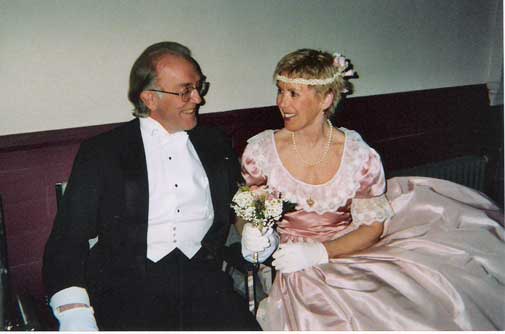
Despite her Parkinson’s, Gretchen was very physically active. She
loved all kinds of dancing. The picture on page one is from a vintage
dance.
We went ballroom dancing a few nights a week. Gretchen went for daily
walks (weather permitting), especially around the lake near her house.
She went to the movies, visited with friends and relatives, worked out
at the health club, went to dance events and dance camps. Her doctors
said her condition was approximately stable.
Within weeks after being placed in the nursing home, Gretchen had
lost the ability to walk on her own. Gretchen’s son and his wife filed
strong complaints with the guardian regarding Gretchen’s inactivity and
rapid decline. The guardian hired an attorney (paid for out of
Gretchen’s estate) and instructed them not to communicate with her
except through her attorney.
My first attorney was being treated for cancer and unable to continue
on the case. I hired a high-level Elder Law attorney. I asked him to
file a complaint with the court regarding Gretchen’s lack of proper
care. He told me we had to work through the GAL and the temporary
professional guardian. The guardian ignored the complaints by my
attorney.
Gretchen’s daughter-in-law (Reference 1) says Gretchen was being
drugged in the nursing home. This was unnecessary, harmful, and can be
fatal. Gretchen’s condition continued to deteriorate. In December 2012,
Gretchen’s son and his wife filed a blistering complaint with the court
asking for the removal of the guardian. The judge did nothing.
In late December 2012 Gretchen suffered an unexplained incident in
the nursing home. Her left wrist and left angle were swollen. Gretchen’s
doctor at Lahey Clinic recommended physical therapy for her ankle. The
guardian denied treatment, citing the DNR [Do Not Resuscitate] and other
statements in Gretchen’s HCP [Health Care Proxy].
The swelling in her wrist healed fairly quickly. The ankle never
healed. Gretchen spent the rest of her life in a wheelchair. The total
lack of activity accelerated her decline.
By the time of the trial in February 2013, Gretchen was terminal. At a
special session during the trial I testified that there was no valid
evidence in the affidavit for the restraining order. The GAL and
guardian offered no evidence to support the restraining order. The judge
ordered the records of the restraining order sealed to protect my
reputation.
The judge did nothing about the misconduct by the GAL and
professional guardian. The guardian put Gretchen on hospice care about a
week after the trial without notice to the parties. Gretchen died a few
months after the trial.
I requested recordings of all the hearings in order to file a
complaint. My testimony regarding the false restraining order and
misconduct by the GAL and guardian was missing. According to the Office
of the Chief Justice of the Probate Court, there is no evidence this
testimony was ever given.
The Office of the Chief Justice told me there is a bill
(S.1177/H.3027) before the Massachusetts Legislature proposed by
advocates for the elderly. The purpose of the bill is to provide
guardianship services to “unbefriended” people.
Unbefriended people are very vulnerable. They have no one to complain
to if they are subjected to abuse. Any system for providing
guardianship services to the unbefriended needs to have ironclad
protections against abuse.
This bill gives immunity to guardians. Guardians are already given
immunity by judges of the Probate Court. Regardless of the intent of
immunity, the result has been to create a system of legalized crime
where guardians commit crimes with impunity.
Other health care providers have to carry liability insurance.
Conservators have to be bonded. Guardians should have liability
insurance, not immunity.
A careful reading of the bill shows that the Executive Director of
the Office of the Adult Guardianship and Decisional Support Services is
the only entity given any authority. It is a dictatorship.
I have attempted to rewrite the bill in a way that makes maximum use
of the principles of democracy such as separation of powers (no one has
sole control), checks and balances, accountability (no immunity),
avoiding conflict of interest by putting authority in the hands of
disinterested parties, etc., to prevent the abuse of power (Reference
2).
Gretchen was definitely drugged at the nursing home immediately.
This experience was terrible and made our family lose trust in the
system. It was unbelievable what the courts get away with. They make you
feel guilty for fighting for your loved one’s care.
They “say” they are here to help, but feed on the family that are not getting along and pit family members against each other.
The guardian in our case was terrible and there was no recourse. When
we complained or brought up concerns about Gretchen’s care, she got her
own lawyer (paid for by Gretchen’s estate) and we could only
communicate with the guardian through her lawyer.
This was a long battle and at the last day of court we were told that
it was not about Gretchen’s best interest, it was about the law.
I could go on and on, but the bottom line is that this system is definitely broken and something needs to be done.
A bill or act to give these people more power is just ridiculous!
Would you hire someone to manage your personal affairs and finances who charged $50,599.18 in just three months?
What if they charged $1,560 to make two phone calls to your son to discuss “dates for (a) Christmas” visit with you? Or if you got a bill for more than $1,000 from this person because her “computer emails appear(ed) to be breached … (and) extensive work (was) done on (her) phone and computer as a result,” and she charged you for calls to her IT department and an attorney she consulted?
And what if this same person refused to communicate with two of your three children even when you were rushed to the hospital? And when they placed a couple of phone calls three days later to see how you were doing you were charged another $990? Is there any part of this that sounds reasonable?
This is the reality facing a woman I wrote about earlier this year. Widow Betty Winstanley, 94, is under a disputed court-ordered guardianship and lives in a retirement home in Pennsylvania. She is forced to pay her court-appointed guardian for the expenses I just described (and many more) because Pennsylvania Common Pleas Court Judge Jay J. Hoberg says she must.
After a perfunctory hearing in July 2014, just three weeks after her husband of 72 years died and during which Betty said not one word (she attended without her hearing aids), Judge Hoberg declared the very articulate and quick-witted Winstanley was “totally incapacitated.”
Hoberg appointed a guardian from the for-profit guardian conglomerate to take complete control of Betty’s life, including when her children can visit, where she can go and disbursement of all her assets. Betty is concerned that her estate will quickly be emptied and there will be nothing left to leave her heirs.
“If I was so demented, as they say, these things wouldn’t bother me,” Winstanley told me in her cut-to-the-chase, common sense fashion.
The first guardian appointed to Betty charged $125 an hour. Her current guardian charges $300 an hour, and now she’s petitioned to sell the Winstanley home in Somerset, Pennsylvania, and liquidate two investment accounts so she can pay Betty’s bills, including the $50,599.18 she says is due to her.
Even though this guardian has had control since December 2015, Betty’s monthly expenses at the retirement home haven’t been paid for months and she now owes back payments of $34,217.22. In addition, thousands more are owed to the attorney the guardian consults.
Since first writing about the growing problem of unwarranted court-ordered elder guardianships I have been deluged with horror stories from across the country. Wanting to understand the process better I recently attended one of Mrs. Winstanley’s hearings.
At issue the day I visited court was a motion by the guardian to subpoena Betty’s cellphone records. The guardian wanted the contents of all incoming and outgoing telephone calls, texts and voicemail messages to determine if Betty’s son, David, had “communicate(d) with his mother in an abusive and/or threatening manner.”
Back in 2014, David, frustrated with his mother’s new guardianship situation, had ranted a bit and left some unpleasant messages, but there have been no complaints against him since he was accused of “upsetting” his mother. Still, the hunt for conflict continues — at $300+ an hour.
An invasion of Betty’s privacy, you say? Yes, I thought so, too, and I wanted to see just how many civil rights a ward of the court loses after being declared “totally incompetent.”
I never got the chance. Judge Hoberg booted me from the courtroom along with two other journalists interested in Betty’s plight. His reason for closing the hearing to outside scrutiny? He wanted to protect “the ward’s” privacy! How ironic.
The judge ultimately ruled that Betty’s guardian could only ask the phone company if any numbers had been blocked on Betty’s phone. Her son Richard, who initiated the guardianship and has long been at odds with his brother David, had complained he had been blocked from contacting his mother. David, the actual owner of the phone, denies such action.
For almost two years now, Judge Hoberg has refused to look past the sibling sniping and rule on Betty’s simple request to move to a retirement home closer to David and her daughter, Liz, in Annapolis, Maryland. After all, Betty argues, they are the children who come to visit her most often, and she has other family in Maryland as well.
“I have no family near here,” Betty told me. “I just want to be near my family. Is that too much to ask?” (Continue Reading)
Elaine Ellbogen refused to be confined, even while under a
court-appointed guardianship.
At 85, she often signed herself out of her Libertyville
nursing home, walked to the Metra station and took the train to Chicago. She'd
board a bus, then window-shop along Michigan Avenue or stop in art stores and
greet the proprietors, who became friends.
She showed up at the Tribune Tower one frigid February
afternoon, after talking to me only once before by telephone.
She wanted her independence, she said. She wanted to punish
the people who had forced her out of her Highland Park home, citing her
inability to care for herself. "I do not believe I should be under
guardianship," she said.
That day earlier this year marked the beginning of a short
friendship that ended with tragedy, and proved to me, once again, that people
can be amazingly complex.
Elaine dressed fashionably, wearing a scarf and a splash of
red lipstick that offset a crown of white hair. Articulate, witty, and
dramatic, she quoted literature and discussed current events each time we met.
She spoke about working as an account executive in the 1950s
for Daniel Edelman's public relations firm in Chicago. Much like the era was depicted
in the "Mad Men" series, it was unusual to find a woman in that role
at the time. For Elaine, it clearly remained a source of great pride.
She left her job within a few years to marry and raise two
sons in Highland Park, filling the home with artwork and staying active with
her children's activities. At one point, she tried to get back into the public
relations world, but too much time had slipped by.
By the 1980s, when her sons left for college, Elaine's
collections of artwork, newspapers, mail and clothing from frequent shopping
sprees became unwieldy.
That was when the hoarding began and her marriage unraveled,
said her son Andrew Ellbogen. Elaine stopped allowing family members in the
house, which was in dire need of repairs. One side of the roof was caving in
and mold was spreading throughout the home.
"Early on, the art covered walls at home," Andrew
said. "In later years, the artwork was on the floor when she ran out of
wall space."
After a small fire in the home, her family members begged
her to move, offering options and financial help. They asked the city of
Highland Park to intervene, but Elaine refused to move or clean up the house as
needed for its sale. When I asked Elaine later if she considered herself a
hoarder, she replied, "That is a matter of interpretation."
Eventually, a phone repairman who was allowed entrance to
the house was so disturbed by what he saw that he took photographs and sent
them to city officials, who contacted the guardian's office, Andrew said.
And so in 2011, the private guardian removed Elaine from her
home by having her declared disabled in court. The guardian took control of her
finances and major decisions regarding her life. This was a drastic step, and
Elaine did not handle it well, feeling betrayed and lied to by the guardian.
She started to write letters, compelling and coherent in
tidy cursive handwriting. She addressed them to a Lake County judge, a former
presidential candidate and to news reporters, including myself.
"Awakened at 7:40 a.m. by pounding on my front door, I
was informed by (guardian) that she would personally return me to my home in
one hour if I would accompany her to the Highland Park hospital to answer a few
doctor's questions," she wrote in one four-page letter.
"I never saw my home again," she wrote. "Thus
began my surreal Kafka-like agonizing true story. I am a real-life example of
the horrifying fate that can befall a low-income, elderly woman."
I was interested in learning more about guardianships, which
are often necessary to obtain help for people who are incapacitated, but can
also be abused.
But Elaine's case, as I soon learned, was no simple matter.
She did not suffer dementia, as some court records stated, though she had
received psychiatric care and was not taking her medication as prescribed.
Elaine was moved into a skilled nursing home in Libertyville
in 2013, after a year of failed attempts to move her into a less-restrictive
setting, such as assisted living, court records state. "She was resistant
to the limits placed on her for spending and outings," the guardian wrote,
describing her as verbally abusive.
The last time I saw Elaine, at a coffee shop near her
nursing home, she spoke about the Oscar Wilde play, "A Woman of No
Importance" and her fear, after guardianship "that I was nothing now.
That I was absolutely unwanted, destroyed."
Yet she seemed happier than on past occasions. After her
funds ran out, the state took over Elaine's guardianship, and authorities were
working on moving her to an apartment. She was allowed more freedom, and
continued to leave the nursing home for short excursions.
She had begun piling papers and items in the private room
she had at the nursing home, and clothes still carrying their tags hung along
the wall. She had made some friends and enjoyed a good relationship with her
ex-husband, her son Andrew said.
"The goal was always to let her have as much
independence as possible," he said.
So, it was shocking to learn that, on June 2, Elaine left
for a shopping trip and never returned home.
She had been struck by a train in Deerfield, and was not
identified until a day later. Her death was ruled an accident by the Lake
County coroner's office.
"She just miscalculated crossing the tracks," said
Orlando Portillo, chief deputy coroner.
Her family members remain horrified that she met such a
violent end, despite their attempts to keep her safe. She had been looking
forward to her granddaughter's upcoming dance recital, Andrew said.
I couldn't stop thinking about her after learning the news.
She had astonished me with her eloquence and mobility, and I enjoyed our
visits. While I initially questioned why she was under a guardian's care, I
began to understand why her family had become frustrated and sought the city's
help.
Despite her eccentricities — or maybe because of them — I
was touched by her and considered her a "woman of importance."
I wish she had lived long enough for me to tell her that.