Showing posts with label Alzheimer's Research. Show all posts

Tuesday, September 22, 2026

Monday, November 26, 2018

New Alzheimer's vaccine 'could reduce dementia cases by half'

(KUTV) — A DNA vaccine, tested on mice, which could have a major impact on the development of Alzheimer' disease, may soon be headed to clinical trials in humans.

According to a new study published in Alzheimer's Research and Therapy, the experimental vaccine reduced the accumulation of two types of toxic proteins believed to be a cause of Alzheimer's, without any adverse effects like brain swelling.

The decade-long study was conducted by The University of Texas Southwestern's Peter O'Donnell Jr. Brain Institute.
“If the onset of the disease could be delayed by even five years, that would be enormous for the patients and their families,” said Dr. Doris Lambracht-Washington, the study’s senior author. “The number of dementia cases could drop by half."
Earlier promising vaccines caused "severe brain swelling" in some patients.

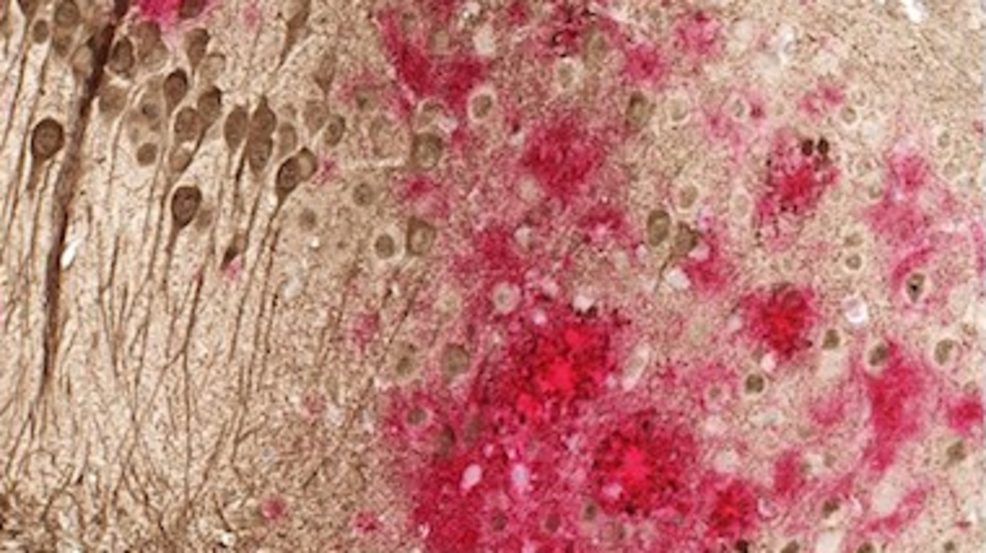
{p}Toxic amyloid plaques (red) and tau tangles (brown) form on the brain of a mouse modeled to have Alzheimer’s disease. A study shows a DNA vaccine reduces both amyloid and tau in the mouse AD model, with no adverse immune responses. (Photo: UT Southwestern){/p}

The skin-delivered vaccine activates an immune response which reduces build-up of harmful tau and beta-amyloids.

“This study is the culmination of a decade of research that has repeatedly demonstrated that this vaccine can effectively and safely target in animal models what we think may cause Alzheimer’s disease,” said Dr. Roger Rosenberg, founding Director of the Alzheimer’s Disease Center at UT Southwestern. “I believe we’re getting close to testing this therapy in people.”

Drs. Roger Rosenberg, left, and Doris Lambracht-Washington have developed a DNA vaccine that can reduce in mice both toxic proteins associated with Alzheimer’s disease. The vaccine has been tested in three mammals with no adverse immune response.(Photo: UT Southwestern)

So far, it has been safely tested in three mammals and that could soon pave the way to clinical trials.
"The vaccine is on a shortlist of promising antibody treatments aimed at protecting against both types of proteins that kill brain cells as they spread in deadly plaques and tangles on the brains of Alzheimer’s disease patients," a news release from UT Southwestern stated.
Alzheimer's progressively deteriorates the brain in roughly 5.7 million American patients. That number is expected to double by 2050, according to the Centers for Disease Control and Prevention (CDC).

Right now, there is no effective treatment for Alzheimer's.

The new study says the vaccine may be most effective in patients with high levels of "tau and amyloid stored in the brain," but before the patient has fully developed Alzheimer's.

“The longer you wait, the less effect it will probably have,” Dr. Rosenberg said. “Once those plaques and tangles have formed, it may be too late.”

Full Article & Source:
New Alzheimer's vaccine 'could reduce dementia cases by half'

Sunday, November 25, 2018

New Vaccine Could Cut Number Of Alzheimer's Cases In Half

A new Alzheimer's vaccine developed by scientists at the University of Texas Southwestern could conceivably cut the number of dementia cases in half.

Unlike a previous attempt that caused swelling in the brain when DNA was injected into the test mice's muscles, the new vaccine was administered by injecting it superficially into the skin.

Alzheimer’s, which is expected to strike triple the number of people by 2050, cripples the brain as human beings age, as beta-amyloid proteins in the brain get stuck together and tau proteins start to tangle, both of which inhibit neural connections. The new vaccine, injected into the skin, triggers the skin cells to produce a three-molecule chain of beta-amyloid. The immune system is then catalyzed to produce antibodies to fight beta-amyloid; the antibodies also fight tau proteins. This means the body anticipates the Alzheimer's plaques and tangles before they happen.

As the Daily Mail reports, the research team tested four groups of mice; the vaccinated mice experienced as much as 40% of their beta-amyloid plaques reduced and as much as 50% of their tau tangles diminished. No adverse immune response was observed.
The study explained:
We report, for the first time in an AD mouse model, that active DNA Aβ42immunization into the skin targets two pathologies: amyloid-containing plaques and tau. DNA vaccination, in which not the antigen (peptide or protein) but the DNA encoding this peptide is administered, is an alternative route of vaccination. Genes encoded by the DNA are expressed within the skin, and the peptides are taken up by dendritic cells traveling to the regional lymph nodes and presenting the antigen to B and T cells. Immune responses to DNA or peptide immunization differ qualitatively.
We have shown previously that full-length DNA Aβ42 trimer immunization is noninflammatory and induces a regulatory immune response. DNA Aβ42 trimer immunization has been shown to be effective in removing amyloid from the brain in immunized double-transgenic mice. In the present study, we used a triple-transgenic AD mouse model that exhibits Aβ and tau pathologies characteristic of human AD. We found that immunotherapy with DNA Aβ42 trimer leads to reduction of Aβ40/Aβ42 peptides and amyloid plaques, and we show for the first time that DNA Aβ42 trimer immunization leads also to significant reduction of tau from the mouse brain.
The study concluded, “It is expected that DNA Aβ42 trimer immunotherapy in a clinical trial will reduce both plaques and tangles in patients with AD.”

Dr. Roger Rosenberg, founding director of the Alzheimer's Disease Center at University of Texas Southwestern, said the new vaccine “is the culmination of a decade of research that has repeatedly demonstrated that this vaccine can effectively and safely target in animal models what we think may cause Alzheimer's disease.” He added, “I believe we're getting close to testing this therapy in people.”

Study senior author Dr. Doris Lambracht-Washington said: “If the onset of the disease could be delayed by even five years, that would be enormous for the patients and their families. The number of dementia cases could drop by half.”

The study was published in the journal Alzheimer's Research and Therapy.

Full Article & Source:
New Vaccine Could Cut Number Of Alzheimer's Cases In Half

Saturday, June 30, 2018

Senate panel looks to fund Alzheimer's research and resources

WASHINGTON – Public health leaders and caregivers coalesced Tuesday behind an effort to focus attention and funding on Alzheimer’s disease.

There was no dissent among the witnesses or the members of the Senate Special Committee on Aging about the need for more resources such as those called for in legislation introduced by U.S. Sens. Susan Collins, R-Maine, and Catherine Cortez Masto, D-Nevada.

Their bill would authorize $37 million annually to establish resource centers across the country, to enhance public-private partnerships, and to improve data collection on the incurable brain disease.

The Building Our Largest Dementia Infrastructure for Alzheimer’s Act – or BOLD Act – is an important step toward finding a cure, said U.S. Sen. Bob Casey of Pennsylvania, the committee’s ranking Democrat. He said the centers will particularly help rural Americans who need better access to resources.

Although there is no cure for Alzheimer’s, early diagnosis and intervention can be cost-effective and can help patients and their caregivers live better lives, testified Pennsylvania Secretary of Aging Teresa Osborne.

Better investment will afford Alzheimer’s patients “the opportunity to age in place in the setting of their choice with their friends and family with the dignity and respect that they deserve,” she said.

She also asked Congress to fund training and resources for first responders who can assist disoriented Alzheimer’s patients like the one another witness described.

Cheryll Woods-Flowers of Mount Pleasant, S.C., whose father died of Alzheimer’s in February, said his diagnosis came at age 70, shortly after he disappeared from home. Seven hours later he was found hungry, lost and crying.

He lived 16 more years with the disease, said his daughter, who is grateful for the early diagnosis that gave her and her five siblings time to talk through decisions, understand his wishes and get him on medication that reduced the severity of his symptoms.

Actress Marcia Gay Harden, whose mother, Beverly, has Alzheimer’s disease, said coping would have been easier if the BOLD Act already were in place.

“I wish we’d had BOLD,” because it would have provided specific resources directing them where to turn for resources about everything from finances to dietary needs of patients.

“Alzheimer’s becomes a stealthy thief, robbing families of their finances and security and forcing its victims to live only in the moment,” she said because it causes memories to evaporate.

Witnesses said they want Congress to pass the BOLD Act along with additional investments in Alzheimer’s research and education.

The current year’s appropriation is $1.8 billion – an increase of $414 million over last year, according to Aging Committee staff. Mr. Casey would like to see that funding reach $2 billion.

“Alzheimer’s disease and related dementias are among the greatest public health challenges facing older Americans,” Mr. Casey said. “As our population ages, the number of people living with the disease and their caregivers will only grow.”

Full Article & Source:
Senate panel looks to fund Alzheimer's research and resources

Tuesday, May 22, 2018

Researchers Neutralize A Gene In Human Brain Cells Associated With Alzheimer’s

By altering a gene associated with Alzheimer’s, researchers have been able to effectively neutralize it in tests and eliminate signs of the disease in lab-grown neurons.

The gene in question is called apoE4 and has been associated with the build-up of the tau tangles and beta-amyloid plaques that are linked to the devastating disease. Previously, studies looking into this connection and attempting to create drugs to target it have been mired in problems, mainly as they have tended to focus on mouse models rather than human cells.

“Drug development for Alzheimer’s disease has been largely a disappointment over the past 10 years,” explained Yadong Huang, who led this latest study published in Nature Medicine. “Many drugs work beautifully in a mouse model, but so far they’ve all failed in clinical trials. One concern within the field has been how poorly these mouse models really mimic human disease.”

In light of this, the team turned to using human cells in the lab, and took the skin cells from patients with Alzheimer’s who have two copies of apoE4 as well as samples from people with the normal variant known as apoE3, and turned them into stem cells. These were then coaxed into forming human neurons.

From this, the researchers were able to study exactly how the apoE4 gene variant influences the build-up of the tau proteins and beta-amyloid plaques that are associated with the development of Alzheimer’s. After finding that yes, it does indeed cause this build-up to occur, they then wanted to know how: does the presence of apoE4 causing a loss of apoE3 function, or is it itself causing the toxic effects seen? These answers are vital as to how we might treat the problem.

“If the damage is caused due to the loss of a protein’s function, you would want to increase protein levels to supplement those functions,” said Huang. “But if the accumulation of a protein leads to a toxic function, you want to lower production of the protein to block its detrimental effect.”

The lab-grown human neurons were able to prove that it was indeed the presence of apoE4 – and not simply the absence of apoE3 – that caused the damaging proteins to build-up in the cells. This meant that the researchers could use earlier work they had done in altering the abnormal apoE4 gene to resemble the innocuous apoE3 gene, using what are called “structure correctors.”

By targeting the gene in this way, they were in effect able to neutralize it and restored normal function to the neurons. They now hope to work with drug companies to see if they are able to translate what they found into a treatment that can then be put through clinical trials.

Full Article & Source:
Researchers Neutralize A Gene In Human Brain Cells Associated With Alzheimer’s

Thursday, November 16, 2017

Bill Gates Gives $100 Million To Alzheimer's Research. Move Called Game Changer By Advocates.

“Beating Alzheimer’s is going to be a team sport. We now have our new quarterback.” Referencing billionaire Microsoft co-founder Bill Gates’ announcement today to join the fight to cure Alzheimer’s, George Vradenburg, chairman, president and co-founder of UsAgainstAlzheimer’s - a movement bent on stopping Alzheimer's disease by 2020 - said Gates’ decision is a “game changer.”


Bill Gates, billionaire and co-chair of the Bill and Melinda Gates Foundation, speaks during a Bloomberg Television interview in Geneva, Switzerland, on Monday, April 17, 2017. The U.K., which announced a doubling of its commitment to the Bill & Melinda Gates Foundation this month, is entering an uncertain period after deciding to leave the European Union. Photographer: Michele Limina/Bloomberg

“I think Gates getting into this game and highlighting its importance to the world is going to be a game changer,” Vradenburg said. “I think he will follow with additional investments and lay out a much more consistent strategy. I think this is just the first step.”

 
 (Photo courtesy of Patricia Lakes)

Vradenburg, chairman, president and founding board member of UsAgainstAlzheimer’s Network

Vradenburg isn’t the only one who’s singing Gates’ praises today. Tim Armour, president and CEO of the Cure Alzheimer’s Fund said funding has always been the biggest obstacle to eradicating the disease. “We know that Alzheimer’s disease is having a devastating impact not only here in the U.S. but around the world.  Funding of research for Alzheimer’s disease lags far behind the other top 10 illnesses.  Bill Gates and his contributions to research of Alzheimer’s disease through private venture funding will help to elevate awareness of the disease and will make a true difference,” Armour said.

“In statements and interviews, Bill Gates has reinforced the importance of the kind of fundamental research done by Cure Alzheimer’s Fund, which enables the investments he is making to bring promising therapies to market. Dr. Rudy Tanzi, Chair of our Research Consortium, has stated many times that curing Alzheimer’s is not a science issue; it is now a funding issue.  We believe this to be the case and welcome Gates’ additional investments to hasten this process.”

 
 (Photo courtesy of Cure Alzheimer's Fund)

Tim Armour, president and CEO of the Cure Alzheimer’s Fund
Cure Alzheimer’s Fund - a non-profit founded in 2004 to fund the most promising research to prevent, slow or reverse Alzheimer’s disease - has contributed over $55 million to research, and its funded initiatives have been responsible for several key breakthroughs – including the groundbreaking “Alzheimer’s in a Dish” study at Harvard University. In that study, stem cell scientists successfully converted skin cells from patients with early-onset Alzheimer’s into the types of neurons that are affected by the disease, making it possible for the first time to study Alzheimer’s in living human cells. “With 100 percent of funds raised going directly to research, Cure Alzheimer’s Fund has been able to support some of the best scientific minds in the field of Alzheimer’s research,” Armour said.

Now one of the richest men in the world is joining the fight with his personal wallet in tow. By investing $100 Million in Alzheimer's research, Gates has effectively joined the fight that really began on an international scale with President Ronald Reagan’s death from the disease and has gained steam by researchers and philanthropists all around the globe.  (Click to Continue)

Full Article & Source:
Bill Gates Gives $100 Million To Alzheimer's Research. Move Called Game Changer By Advocates.