Showing posts with label Alzheimer's. Show all posts

Tuesday, August 18, 2026

Jay Leno to Register Wife’s Conservatorship in New Hampshire

Jay Leno, granted a conservatorship over the estate of his 79-year-old wife in 2024, is seeking to register the conservatorship in New Hampshire so he can sell community property real estate there.

Mavis Leno has advanced Alzheimer’s disease that sometimes leaves her unaware of her birthdate or who her husband is.

Leno, 76, filed a petition for conservatorship of the estate of Mavis Leno in Los Angeles Superior Court in January 2024 and Judge Brenda Penny granted his request in April of that year, telling the comedian he was doing the right thing. The judge also said Mavis Leno was in good care and that she understood the difficulty of Jay Leno’s situation.

On Aug. 5, Leno’s attorneys notified the court that he will be filing a “registration and recognition of foreign guardianship” along with protective orders with the New Hampshire 10th Circuit’s Probate Division “for the purpose of registering the conservatorship in New Hampshire in order to sell certain real estate” located in the New England state that is held as community property by the Lenos.

The court papers do not state what kind of real estate the couple own in New Hampshire or in what part of the state. Jay Leno was born in Massachusetts and also owns real estate in Rhode Island.

Mavis Leno’s lawyer, Ronald Ostrin, filed a report with the court in 2024, saying he supported a conservatorship and that Mavis Leno did as well.

Ostrin further said that according to Mavis Leno’s neurologist, Dr. Hart Cohen, Mavis not only sometimes does not know her husband or her birthdate, but also has “a lot of disorientation, (and) will ruminate about her parents who have both passed (including) her mother who died about 20 years ago.”

Cohen was hired for consultation after Mavis Leno had a car accident in 2018 and has been following her mental condition since, according to Ostrin.

The couple married in 1980. Mavis Leno is a philanthropist and feminist who kept a low profile compared to her comedian husband, a former host of “The Tonight Show.” 

Full Article & Source:
Jay Leno to Register Wife’s Conservatorship in New Hampshire

Wednesday, June 3, 2026

SAPD: Nursing assistant accused of exploiting 79-year-old woman at nursing home with Alzheimer’s

Nate Kotisso, Digital Journalist
Katrina Webber, Reporter

Destiny Lashell Houston, 36, is facing 3 felonies, records show

San Antonio police arrested Destiny Houston, who investigators believe paid for personal items with a debit card that belonged to a 79-year-old resident at a North Side nursing home. (Bexar County Sheriff's Office)

SAN ANTONIO – Police arrested a certified nursing assistant who investigators believe paid for personal items with a debit card that belonged to a 79-year-old resident at a North Side nursing home.

The San Antonio Police Department took Destiny Lashell Houston, 36, into custody Tuesday afternoon on the following charges, which are all considered third-degree felonies:

  • Exploitation of an elderly individual
  • Abuse of a credit card or debit card belonging to an elderly individual
  • Fraudulent use or possession of items belonging to an elderly individual

At the time of the alleged crimes, police said Houston worked directly with the victim as a certified nursing assistant at The Forum at Lincoln Heights, a nursing home located in the 300 block of Nottingham Drive.

‘Numerous purchases’

Authorities said the victim, who was diagnosed with Alzheimer’s disease in 2024, moved into the facility’s mental care unit in June 2025. Due to the diagnosis, the victim’s daughter is in charge of her mother’s financial accounts in order to pay bills and monitor expenses, the affidavit states.

In August 2025, the victim’s daughter checked one of the accounts and noticed “numerous purchases” were made with the victim’s debit card over multiple days, according to police. SAPD said one purchase was made at a vending machine inside the nursing home’s employee lounge. 

After checking her mother’s wallet, investigators said her daughter learned that the victim’s cards were missing and subsequently filed a report with SAPD.

Suspect denies allegations

Detectives said they obtained surveillance videos and photos of Houston from several stores where the debit card was used. Investigators showed the pictures to supervisors at the nursing home, who identified Houston as the woman in those photos.

In an interview with police, Houston admitted that she was the person in the surveillance photos.

However, she denied using the victim’s debit card. According to the affidavit, Houston told police that the card she used was a “gift card” she found on the floor at the nursing home.

Houston bonded out of jail just after 10 p.m. Tuesday, according to jail records. She is expected to make her next court appearance on Aug. 24. 

Full Article & Source:
SAPD: Nursing assistant accused of exploiting 79-year-old woman at nursing home with Alzheimer’s 

Friday, March 27, 2026

Judge orders disclosure in dispute over Milford lawyer's estate conservatorship

by Ethan Fry


MILFORD - Probate Judge Ben Gettinger did not exceed his authority by ordering the disclosure of documents related to the estate of a former lawyer whose housekeeper became her new conservator the month she was diagnosed with Alzheimer's, a state Superior Court judge ruled this month.

In a 14-page ruling, Judge Barbara Bellis wrote that the documents requested by a longtime friend and prior conservator of the lawyer, Jackale Williams, "could reasonably lead to the discovery of admissible evidence" related to whether Williams' housekeeper, Sylvia Ponzo, or the housekeeper's mother, Gina McKay, who became conservator of Williams' estate in September 2024, acted in good faith and in accordance with Williams' best interests.

"It is undisputed that after being appointed power of attorney, McKay changed the beneficiary designations of certain financial accounts to the 2024 trust and also transferred over $32,000 from an account outside of the defendants' control," said Bellis' decision. "All these acts occurred in the same month the plaintiff was diagnosed with Alzheimer's disease."

In court filings, Williams' cousin and lifelong friend, Claudia Montecalvo, said she and Williams "had long ago made a pact to take each other 'from cradle to grave'" and that she had been appointed conservator following the death of Williams' husband.

But after Williams began having trouble with her memory three years later, Montecalvo and her daughter alleged in court papers, 18 of "Williams' friends and family began reporting that they were being denied access to Williams by Williams' cleaning person, Sylvia Ponzo."

The Montecalvos alleged that a few months later, Ponzo took Williams' phone away "such that Williams stopped responding to calls and texts, when it had otherwise been normal for her to do so." Later that year, Montecalvo's power of attorney was revoked, and a new power of attorney named Ponzo's daughter, McKay, as her new agent.

Montecalvo alleged Ponzo and McKay told Williams "that Claudia planned to sell Williams' home and commit Williams to a nursing home" before a revocable living trust was set up in Williams' name and her home was transferred into it.

After Gettinger ordered the disclosure of documents related to the setup of Williams' 2024 estate, the estate appealed to Superior Court.

Judge Bellis' decision denying the appeal, dated March 20, noted that the prior conservator will "ultimately have the burden of proving any breaches of an agent's duties."

Bellis wrote that the arguments cited by Williams' current conservator arguing against the documents' disclosure while Williams is alive is not consistent with state law or prior cases.

"Under the plaintiff's interpretation, a power of attorney could act in accordance with estate plans despite possibly knowing that (1) the principal was mentally compromised when making them, and (2) the estate plans were changed to benefit her and her relative," the decision said. "The court cannot hold, as a matter of law, that a breach of duty cannot be found under those circumstances." 

Full Article & Source:
Judge orders disclosure in dispute over Milford lawyer's estate conservatorship 

Monday, March 9, 2026

Jury awards $110M in death of 100-year-old at Sacramento assisted living facility

The family said the verdict cannot bring their mother back, but they hope it will lead to stronger protections for seniors living in assisted living facilities.

Author: Staff (ABC10) 

SACRAMENTO, Calif. — A jury has awarded the family of Mildred Hernandez $110 million after finding an assisted living facility in Sacramento responsible for her death.

Jurors determined that Greenhaven Estates in Sacramento was responsible for the death of Hernandez, who was 100 years old and living at the facility with Alzheimer’s disease. She was known to be at risk of wandering.

In February 2019, Hernandez left the facility during the early morning hours and was later found unresponsive outside in about 38-degree weather. She died from hypothermia.

Attorneys for the Hernandez family argued the companies responsible for the facility prioritized profits over safety, which they said led to understaffing and inadequate protections for vulnerable residents.

The family said the verdict cannot bring their mother back, but they hope it will lead to stronger protections for seniors living in assisted living facilities.

ABC10 reached out to Greenhaven Estates for comment on the verdict but did not receive a response. 

Full Article & Source:
Jury awards $110M in death of 100-year-old at Sacramento assisted living facility 

Thursday, September 18, 2025

Jay Leno Praises His Wife Mavis As She Battles Dementia

by James Conrad


It’s been one year since the former Tonight Show host Jay Leno was granted a conservatorship of his wife Mavis Leno after she was diagnosed with dementia. Now, Jay is speaking out to praise his wife of nearly 45 years as her dementia battle continues.

‘She’s Not Suffering…’

“My wife’s got some problems, so it’s just her and I,” Jay, 75, told People Magazine. “But it’s always been her and I for the last 45 years anyway, so it’s fine. I enjoy taking care of her. It’s fun.”

“I mean, I do enjoy it. People think, ‘Oh, it must be horrible.’ No, because she’s not in any pain. She’s not suffering,” he continued of Mavis, 79. “It’s not like a tumor or cancer. It’s just a confusion that comes with Alzheimer’s and dementia. And that’s okay.”

Jay was granted a conservatorship over Mavis in April of 2024. At the time, the judge said emphatically that “she’s in very good care with Mr. Leno.”  

Judging by Jay’s latest comments, it’s clear that the judge couldn’t be more right about this. Indeed, Jay is clearly an extremely devoted husband.

“I enjoy being her rock. It makes you feel wanted,” Jay admitted. “You got a purpose now. So it’s good.”


Mavis Has ‘Still Got The Fire’

Jay went on to tell a “funny story” about Mavis that shows that she’s still the same woman he fell in love with decades ago. The comedian explained that he and his wife were recently watching an old episode of Hawaii Five-O from the 1960s.

“We watched the episode where Stanley Holloway plays a genetic scientist who gets kidnapped,” Jay recalled. “So McGarrett goes to see his daughter, who’s like 40. And he says, ‘What kind of genetic engineering does your husband do?!’ And she says, ‘Well, I’m just a woman. I don’t understand such things.’ “

This didn’t sit well with Mavis.

“My wife was real involved with women’s issues,” Jay said. When Mavis heard the line, Jay added, “My wife’s like [makes growling noises]. She’s just yelling at the TV. She still got the fire. It just made me laugh. Just screaming at McGarrett … But it just made me laugh.”

Jay concluded by saying that when he needs to travel for work performing standup comedy, he always makes sure to return home to Mavis at night.

“I come home every day. I went to Puerto Rico for the day and [the] plane waited and I came right back,” Jay stated. “That’s what I do. I try to be home every night. So that’s kind what I do.”


Jay’s Marriage Vow To Mavis

Jay and Mavis first met in the 1970s, when he was performing at the iconic Comedy Store. They went on to marry in 1980. They never had children together, but they’ve been devoted to one another ever since.

Earlier this year, Jay revealed why he chose to personally become Mavis’ caretaker rather than have someone else do it.

“When you get married, you sort of take a vow: ‘Will I live up to this? Or will I be like a sleazy guy if something happens to my wife, I’m out banging the cashier at the mini mart?'” Jay said while appearing on In Depth with Graham Bensinger. “No, I didn’t. I enjoy the time with my wife. I go home, I cook dinner for her, watch TV and it’s okay.”

“It’s basically what we did before, except now I have to feed her and do all those things,” he added. “But, I like it. I like taking care of her. She’s a very independent woman, so I like that I’m needed.”

Watch Jay talk more about this in the video below. 


In the crazy world of Hollywood, it’s rare to find a celebrity that takes his marriage vows as seriously as Jay does. We should all be so lucky to have a spouse like Jay Leno in our own lives.

God bless you both, Jay and Mavis Leno! 

Full Article & Source:
Jay Leno Praises His Wife Mavis As She Battles Dementia 

See Also:
Jay Leno gets a kick out of wife’s $847 sneakers: ‘Find your moments where you can have a laugh’

Saturday, June 7, 2025

Advocates help raise awareness in Harrison County for Alzheimer's and Brain Awareness Month

 June is Alzheimer's and brain awareness month, and here in West Virginia, more than 38,000 people aged 65 and older have been diagnosed with Alzheimer's or some sort of dementia, according to the Alzheimer's Impact Movement. And as the age of people diagnosed is decreasing, general concern is increasing.

Source:
Advocates help raise awareness in Harrison County for Alzheimer's and Brain Awareness Month 

Sunday, March 16, 2025

There's 1 Thing No One Seems To Be Talking About Regarding Gene Hackman's Death

by Shauna Sweeney

Gene Hackman was found dead in his home on Feb. 26. Vera Anderson via Getty Images

When the news broke about the deaths of Gene Hackman and his wife, Betsy Arakawa, my stomach dropped. It’s a deeply tragic story in and of itself, but as more and more information was released to the public, there was one thing no one seemed to be talking about: This situation is every family caregiver’s nightmare come to life.

Hackman, 95, and reportedly diagnosed with advanced Alzheimer’s, was found dead in his Santa Fe home seven days after Arakawa’s unexpected passing. The official cause was heart failure, but the reality is much more heartbreaking — he likely died because the person keeping him safe was suddenly no longer there.

Authorities suspect he may not have even understood Arakawa was gone, leaving him alone without essential care, medication, or even basic necessities for at least a week.

This isn’t just a devastating celebrity story. The truth is, this could happen to anyone currently caring for a loved one’s basic needs. This is especially true for my family.

When my father was diagnosed with early-onset Alzheimer’s, I was in my early 30s, building a career and living thousands of miles away from him. Overnight, I became his caregiver, but I wasn’t ready. The first days and months were pretty rough. I had no idea what I was doing. But I also knew that no one was going to be as motivated or committed to taking great care of him as I was.

There are millions of us out there in this position. We’re not experts — we’re family, friends and neighbors. And we’ll move mountains to ensure our loved ones get the best possible care.

At first, I failed spectacularly, missing bills, missing important deadlines, even prescriptions, while unused subscriptions stacked up. Eventually my dad and I found a rhythm. I built systems to start to bring some order back, though any family caregiver will tell you not to bother trying to get everything in order. It’s just not going to happen. We found ways to cushion the pitfalls. I got smarter. I set up daily FaceTime check-ins with my dad, hired professional caregivers, created digital records of his medications and medical contacts, and installed smart home devices to monitor his safety. I even started regularly monitoring the weather where he lives to know if there could be an emergency.

But despite all these measures, I still live with one terrifying question: What if I’m suddenly out of the picture?

A few months ago, my fear became dangerously close to reality. I was sitting at a red light when I got rear-ended — hard. My seat back collapsed, I was thrown forward, and the trunk of my car crumpled like an accordion. As I sat in a daze in the back of an ambulance getting checked out, my first coherent thought wasn’t about me — it was of my dad.

I’ve been taking care of my father for 13 years. I’m still the one who makes sure nothing falls through the cracks. It’s my role to navigate the ER, where he sometimes ends up, to ensure he’s seen on time and discharged before a shift change. I am the one on the phone pleading to get an appointment with a dermatologist to get that rash on his cheek looked at tomorrow, not six months from now. Yes, it turned out to be cancer, and the effort was worth it.

I have safeguards in place. There are people who help. But if I were to disappear — permanently — would they know everything I know? Would they fight for him the way I do? My dad’s situation is constantly changing due to his Alzheimer’s. Could someone else really step in? For me and too many others, the answer is no.

On most days, I like to think of myself as superhuman — strong enough to be a good mom, a good boss and a good daughter. Yet, I know I am one accident, one diagnosis, one natural disaster away from our house of cards collapsing. Each day, I face knowing just how fragile the system is and how close we live to a crisis.

This fear is not mine alone. More than 54 million Americans — mostly unpaid and untrained — juggle caregiving responsibilities every day alongside their own personal and professional lives. By 2030, when every baby boomer will be 65 or older, that number will skyrocket. And yet, most caregiving in this country happens in a fragile, makeshift way, held together by love and hope.

For the majority of people, their approach lacks structure, backup plans, or a system of what to do in an emergency. The Hackman-Arakawa tragedy is not an anomaly. It’s at many of our front doors.

During the Los Angeles wildfires, an elderly man and disabled son were left alone after his primary caregiver son was hospitalized the week prior. Without immediate care or anyone to step in, the two were not evacuated in time, which ultimately led to both of their deaths.

Hope is not a strategy.

Every family should have a contingency plan. Who steps in if the primary caregiver is gone? Who has access to medical records? Who knows the daily routines, the medications, the little details that keep a vulnerable person safe?

Technology can help. Smart home devices can detect movement — or the lack of it. Emergency check-in alerts can notify family if something seems off. Digital tools, like shared apps, can keep medical and financial information in one place, accessible when it’s needed most.

For me, setting up a system wasn’t just about making my dad’s care easier — it was about protecting him and others like me.

I don’t say this lightly, but if Gene Hackman had a shared emergency plan or even something as simple as an automated weekly check-in system, he might have been found much sooner. Someone could have stepped in.

We can’t afford to ignore this growing crisis within our own families. In just five years, the number of Americans needing long-term care will double. At the same time, professional help is only becoming more expensive and harder to find.

Families will bear more of the burden than ever before. We must stop treating family caregiving as an informal, individual family responsibility, and recognize it as a national priority requiring education, structured support, planning and investment. We urgently need better policies: better workplace accommodations for caregivers, financial support to ease the burden, and expanded access to professional caregiving services.

On a personal level, we need to stop pretending this can be figured out later. Later is too late.

To me, the deaths of Gene Hackman and Betsy Arakawa are a wake-up call. He was a two-time Oscar-winning legend. He had resources. He had family. But that didn’t save him.

Caregiving is a responsibility we all share — as families, as communities, and as a country. If we don’t act now, personally and systemically, the consequences will be devastating — not just for individuals but for an aging nation on the brink of crisis.

And, if you’re caring for someone you love, you’re already doing an amazing thing.

But please ask yourself: What if something happens to me first?

If you don’t have an answer, it’s time to make one.

Full Article & Source:
There's 1 Thing No One Seems To Be Talking About Regarding Gene Hackman's Death

Saturday, March 8, 2025

NBC 10 I-Team: Woman accused of draining elderly mother's bank account

 by BRIAN CRANDALL


(WJAR) — A North Providence woman is accused of improperly taking more than $240,000 from her mother’s bank account and using much of it to buy a house.

State police have charged Lisa McManaman, 55, with elder exploitation of more than $100,000 and obtaining money by false pretenses.

Her mother had been diagnosed with Alzheimer’s disease in 2015, according to court documents obtained by NBC 10.

According to the investigation reports, McManaman’s mother sold her home in 2020 and moved in with McManaman.

Authorities accuse McManaman of then transferring the money out of her mother’s bank account into her own without her mother’s authorization.

In 2023, the police report states the mother was living in an assisted living facility and went to the bank with a staff member after McManaman did not provide her mother with bank statements as requested.

It was at that time, the report states, the mother questioned why her bank account didn’t have nearly as much money in it as she expected.

Another daughter then went with the mother to State police to file a complaint.

That daughter, not McManaman, was their mother’s power of attorney.

Police note in their report that McManaman’s mother “continually had difficulty with her memory” during their interview, but was “adamant she did not give McManaman permission to take her money.”

McManaman’s sister told investigators that when she and another sibling had confronted McManaman about the money, McManaman got very angry and said she deserved it because she was taking care of their mother for years.

Investigators wrote that they suspected a signature was forged to allow McManaman access to $213,000 of her mother’s money.

They write in their report “it is believed that she (the mother) did not have the mental capacity to agree to give McManaman access to her bank account in 2020 or approve the $243,200 in transfers to McManaman’s bank account.”

McManaman entered a not guilty plea at her arraignment Monday and is free as the case continues.

McManaman’s lawyer, Nick Hemond, told NBC10 she “categorically denies the allegations.”

Hemond said, “We believe the allegations are not motivated by her mother, but her sister for her own improper motivations.”

McManaman’s sister has not replied to a message from NBC 10.

In 2016, McManaman pleaded guilty to federal charges of stealing prescription drugs from the VA Medical Center in Providence, where she worked as a nurse in the intensive care unit, and of failing to disclose on her employment application that she was fired from another hospital in Rhode Island.

She was sentenced to two years probation and ordered to pay $1000 restitution in that case.

Full Article & Source:
NBC 10 I-Team: Woman accused of draining elderly mother's bank account

Thursday, February 6, 2025

KLRT AG Griffin Announces Conviction of North Little Rock Woman for Elder Abuse 01 15 25

Attorney General Tim Griffin today issued the following statement announcing the conviction of Ja’Layia McClendon, 28, of North Little Rock after she pleaded guilty in Pulaski County Circuit Court to the charge of Abuse of an Endangered or Impaired Adult, a Class D Felony:

“Protecting seniors from abuse will continue to be a priority for my office. I congratulate my Medicaid Fraud Control Unit for their diligence in securing this conviction, especially Special Agent Heath Nelson and Assistant Attorney General Gabrielle Davis-Jones. I also thank Sixth Judicial District Prosecutor Will Jones for the assistance of his office in this case.”

McClendon worked as a caregiver at Woodland Heights Senior Living, a Little Rock long-term care facility. She surrendered herself to law enforcement on October 31, 2024. McClendon struck an 82-year-old female resident who was diagnosed with dementia and Alzheimer’s disease, leaving bruises on the resident’s face and forearm.

McClendon was sentenced to five years of probation and a $1,000 fine.   

Source:
KLRT AG Griffin Announces Conviction of North Little Rock Woman for Elder Abuse 01 15 25

Saturday, February 1, 2025

Jay Leno gets a kick out of wife’s $847 sneakers: ‘Find your moments where you can have a laugh’


By Nardine Saad

Jay Leno isn’t keen on a pair of bedazzled $847 sneakers he bought. But if they make his wife happy, they make him happy.

The former “Tonight Show” host detailed a recent shopping trip with wife Mavis, who is battling advanced dementia, and said that he tries “to find humor in this situation.”

The “situation” refers to to the philanthropist’s declining cognitive state, which prompted Leno to file for a conservatorship early last year to oversee his wife’s affairs. In providing the latest update on Mavis’ condition, the stand-up comedy legend employed his signature wit.

The “Midas Man” actor said in a recent interview with People that to cheer up his wife one day, he took her shopping at Nordstrom.

Mavis, 78, picked out a pair of bright blue sneakers that were $24. Then Leno encouraged her to pick out another pair. This time she decided on a red-and-white pair that “made her happy.”

“[The cashier says] ‘That’s $24. And the other pair, that’s $847,’” he said. “I go, ‘No, I only had two pairs of sneakers. I thought these were $24.’ [The cashier] goes, ‘Yeah, these are $24. But the other ones were [designer sneakers]. It looked like the guy took a pair of the same sneakers and used a bedazzler on them, and they were $800. I look at my wife and said, ‘You like these?’ I go, ‘Honey, you look great.’”

Despite the eye-popping price tag on the latter pair, Leno said he was glad he could afford the footwear despite the sticker shock. And it gave him a good laugh.

“Just typical ... ,” he said. “When you’re dealing with this kind of thing, you find your moments where you can have a laugh and have fun, and my wife really likes them and felt good about it.”

Jay and Mavis Leno have been married for more than 40 years. In January 2024, the “Jay Leno’s Garage” host sought conservatorship of her estate so he could structure a living trust and other estate plans to make sure that Mavis has “managed assets sufficient to provide for her care” should he die before her. Leno’s petition also said Mavis had been “progressively losing capacity and orientation to space and time for several years.” 

According to documents filed in Los Angeles County Superior Court last spring, Mavis Leno’s court-appointed attorney said that during his investigation into Jay Leno’s effort to be a permanent conservator, he learned that Mavis has “major neurocognitive disorders,” cognitive impairment and “sometimes does not know her husband, Jay, nor her date of birth.” It is unclear when Mavis was diagnosed, but the documents said that she was being treated for advanced dementia and a mood disorder

In late April, Mavis Leno joined her husband at the premiere of the Netflix film “Unfrosted” and said that she feels great: “We have a great time. Forty-four years [married], so we’re doing good.”

A few weeks later, Jay Leno, a two-time Emmy Award winner, said marrying Mavis was his greatest achievement and “the smartest thing I’ve ever done.”

“I am part of her legacy and that’s what I’m proudest of,” Leno said at the Feminist Majority Foundation’s 16th Global Women’s Rights Awards Gala, where he presented the inaugural Mavis Leno Award for Global Women’s Rights. The award is dedicated to the philanthropist for her Nobel Prize-nominated work as chair of the nonprofit’s Campaign for Afghan Women and Girls.

Times staff writer Meg James and fellow Malia Mendez contributed to this report.

Full Article & Source:
Jay Leno gets a kick out of wife’s $847 sneakers: ‘Find your moments where you can have a laugh’

See Also:
Jay Leno granted conservatorship of wife Mavis Leno’s estate

After Jay Leno made heartbreaking decision for his wife of 44 years, so did a judge

Jay Leno Files for Conservatorship Over Wife Mavis Amid Alzheimer's Battle

75-year-old man with dementia who went missing in Hesperia found

Story by Brian Day


A 75-year-old Hesperia man suffering from dementia who went missing over the weekend has been found safe, officials said Thursday.

Ira Shepard disappeared about 11:30 a.m. Sunday after walking away from his family's home in the 8600 block of C Avenue in Hesperia, San Bernardino County Sheriff's Department officials said.

"Shepard's family revealed he may suffer from Alzheimer's and dementia, and he has a history of leaving his residence in the past," according to a missing person alert issued by the department.

The missing man was unfamiliar with the area, as he "still believes he lives in Los Angeles," according to the alert.

Sheriff's officials announced Thursday morning that Shepard had been found. No further details were available.

Full Article & Source:
75-year-old man with dementia who went missing in Hesperia found

Wednesday, December 18, 2024

Broken Arrow Police Arrest 72-Year-Old Woman Accused Of Caretaker Abuse

A 72-year-old woman is arrested and accused of caretaker abuse in Tulsa County by Broken Arrow Police. 

By: News On 6


A woman was arrested, and police say she abused an elderly woman in her care.

WHO'S BEEN ARRESTED:

72-year-old Cheryl Carlson

WHAT THE AFFIDAVIT SAYS:

  1. July 1, 2023; a niece of the victim called Broken Arrow Police to say her aunt with Alzheimer's had been put into a home by Carlson. Carlson had gotten guardianship and was accused of mis-using the victim's money.
  2. The niece got an attorney and got guardianship back and showed officers the accounts.
  3. Police say Carlson closed out several of the victim's CD's worth a total of $130,000 and deposited the money into Carlson's personal account and spent the money on trips, cash and casinos.
  4. Police say Carlson used the victim's money to write checks to herself and others and made several ATM withdrawals from a casino from the victim's account.

This is a charge, not a conviction.

Full Article & Source:
Broken Arrow Police Arrest 72-Year-Old Woman Accused Of Caretaker Abuse

Wednesday, November 13, 2024

3 arrested on charges of elder abuse, Medicaid fraud in separate Arkansas cases

by Max Hauptman

Three people were arrested in Arkansas on charges of Medicaid fraud and elder abuse in separate cases, including one instance in which an employee at an assisted living facility was seen striking an elderly woman with Alzheimer's Disease, prosecutors say.

All three suspects in the different cases were arrested or surrendered themselves into custody on Oct. 31.

North Little Rock resident Ja’Layia J. McClendon, 28, was arrested on a charge of abusing an endangered or impaired person after prosecutors say witnesses saw her hitting 82-year-old woman with Alzheimer's Disease living at a Little Rock assisted living facility. Prosecutors say the woman was left with bruises on her face and forearm.

Trey Franks, 28, was arrested in Little Rock on Oct. 31 on a warrant for the same charge after prosecutors say more than $1,000 was sent to his credit card from the bank account of a woman living in a long-term care facility in Cabot, Arkansas, in five separate transfers from September to October 2023.

The third arrest was that of Hannah Christmas, a 34-year-old Hamburg, Arkansas, resident, who is facing a charge of Medicaid fraud. She's accused of billing the Dermott, Hamburg and Lakeside school districts $5,500 for physical therapy services that were never rendered from August 2023 to April 2024.

USA TODAY attempted to contact attorneys for all three people and either could not identify one or did not hear back from them.

Elder abuse can take on many forms, including physical, psychological or sexual abuse, financial exploitation, or neglect and abandonment. The Justice Department estimates that more than 10% of people over the age of 65 suffer from some form of elder abuse each year.

Full Article & Source:
3 arrested on charges of elder abuse, Medicaid fraud in separate Arkansas cases

Wednesday, July 10, 2024

‘It comes for your very soul’: how Alzheimer’s undid my dazzling, creative wife in her 40s

Vanessa Aylwin in 2021.  Photograph:  Courtesy of Michael Aylwin

By the time my wife got a diagnosis, her long and harrowing deterioration had already begun. By the end, I was in awe of her


By Michael Aylwin

My wife always said she would die of Alzheimer’s. It turns out she was right about that. For years, I insisted she would not. In the end, Vanessa clinched our little argument by dying last September, but we had known her fate since 2019, the year she was diagnosed, at the age of 49. For at least three years before that, though, the realisation dawned by hideous degrees which way the debate was going.

When we met, in the mid-00s, the proposition that Vanessa did not have Alzheimer’s, nor was about to develop it, was an easy motion to defend. She was dazzling and creative, with a successful career as a marketing executive. In that context, her preoccupation with this old person’s disease came across as a little absurd.

We met on the dancefloor of a nightclub in 2004. I was 32, she was about to turn 35. Far too old for a place like that, but we were reliving former glories in honour of mutual friends – a last glance back at our careless youth. When the management turned us out after a long night of carousing into the next stage of our lives, Vanessa scribbled her number for me on a piece of paper. How she would have loved to be able to do that only 15 years later.

A few weeks into our relationship, she told me that her mum, in her 50s, was dying of Alzheimer’s and, a little later again, that she was sure to do the same. I put her fears down to general fatalism, and spent much of the following decade insisting she had nothing to worry about. Until I could no longer find plausible grounds to argue that everything was fine.

A common question is: when did the disease start? There is no neat answer. It’s possible Vanessa could feel it coming on long before any of her symptoms showed. To the outside world, though, Alzheimer’s reveals itself by subtle degrees, each one plausibly dismissed in the early stages as “nothing”. And even when they start to become obviously “something”, there is usually a range of alternative explanations. The twisted genius of this disease begins with the way it smuggles itself in under the cover of other conditions. Absent-mindedness, ageing, menopause, through depression, anxiety and epilepsy – all would be presented as perfectly plausible explanations, first by me, then by some serious experts in their field. In retrospect, though, it began with a zit on her chin.  (Click to Continue Reading)

Full Article & Source:
‘It comes for your very soul’: how Alzheimer’s undid my dazzling, creative wife in her 40s

Monday, June 17, 2024

Alzheimer's Isn't The Only Form of Dementia. An Expert Explains The Differences.

By Nikki-Anne Wilson

Changes in thinking and memory as we age can occur for a variety of reasons. These changes are not always cause for concern. But when they begin to disrupt daily life, it could indicate the first signs of dementia.

Another term that can crop up when we're talking about dementia is Alzheimer's disease, or Alzheimer's for short.

So what's the difference?

What is dementia?

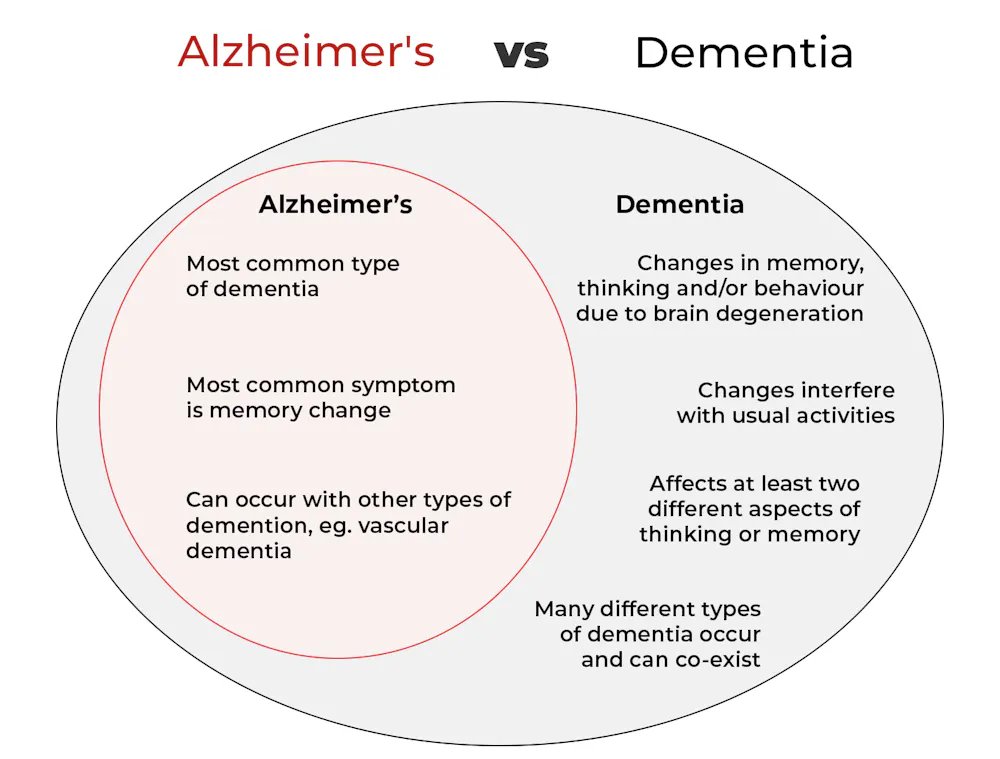
Dementia is an umbrella term used to describe a range of syndromes that result in changes in memory, thinking and/or behaviour due to degeneration in the brain.

To meet the criteria for dementia these changes must be sufficiently pronounced to interfere with usual activities and are present in at least two different aspects of thinking or memory.

For example, someone might have trouble remembering to pay bills and become lost in previously familiar areas.

It's less-well known that dementia can also occur in children. This is due to progressive brain damage associated with more than 100 rare genetic disorders. This can result in similar cognitive changes as we see in adults.

So what's Alzheimer's then?

Alzheimer's is the most common type of dementia, accounting for about 60-80% of cases.

So it's not surprising many people use the terms dementia and Alzheimer's interchangeably.

Changes in memory are the most common sign of Alzheimer's and it's what the public most often associates with it. For instance, someone with Alzheimer's may have trouble recalling recent events or keeping track of what day or month it is.

We still don't know exactly what causes Alzheimer's. However, we do know it is associated with a build-up in the brain of two types of protein called amyloid-β and tau.

While we all have some amyloid-β, when too much builds up in the brain it clumps together, forming plaques in the spaces between cells. These plaques cause damage (inflammation) to surrounding brain cells and leads to disruption in tau.

Tau forms part of the structure of brain cells but in Alzheimer's tau proteins become "tangled". This is toxic to the cells, causing them to die. A feedback loop is then thought to occur, triggering production of more amyloid-β and more abnormal tau, perpetuating damage to brain cells.

Alzheimer's can also occur with other forms of dementia, such as vascular dementia. This combination is the most common example of a mixed dementia.

Vascular dementia

The second most common type of dementia is vascular dementia. This results from disrupted blood flow to the brain.

Because the changes in blood flow can occur throughout the brain, signs of vascular dementia can be more varied than the memory changes typically seen in Alzheimer's.

For example, vascular dementia may present as general confusion, slowed thinking, or difficulty organising thoughts and actions.

Your risk of vascular dementia is greater if you have heart disease or high blood pressure.

Frontotemporal dementia

Some people may not realise that dementia can also affect behaviour and/or language. We see this in different forms of frontotemporal dementia.

The behavioural variant of frontotemporal dementia is the second most common form (after Alzheimer's disease) of younger onset dementia (dementia in people under 65).

People living with this may have difficulties in interpreting and appropriately responding to social situations. For example, they may make uncharacteristically rude or offensive comments or invade people's personal space.

Semantic dementia is also a type of frontotemporal dementia and results in difficulty with understanding the meaning of words and naming everyday objects.

Dementia with Lewy bodies

Dementia with Lewy bodies results from dysregulation of a different type of protein known as α-synuclein. We often see this in people with Parkinson's disease.

So people with this type of dementia may have altered movement, such as a stooped posture, shuffling walk, and changes in handwriting. Other symptoms include changes in alertness, visual hallucinations and significant disruption to sleep.

Do I have dementia and if so, which type?

If you or someone close to you is concerned, the first thing to do is to speak to your GP. They will likely ask you some questions about your medical history and what changes you have noticed.

Sometimes it might not be clear if you have dementia when you first speak to your doctor. They may suggest you watch for changes or they may refer you to a specialist for further tests.

There is no single test to clearly show if you have dementia, or the type of dementia. A diagnosis comes after multiple tests, including brain scans, tests of memory and thinking, and consideration of how these changes impact your daily life.

Not knowing what is happening can be a challenging time so it is important to speak to someone about how you are feeling or to reach out to support services.

Dementia is diverse

As well as the different forms of dementia, everyone experiences dementia in different ways. For example, the speed dementia progresses varies a lot from person to person. Some people will continue to live well with dementia for some time while others may decline more quickly.

There is still significant stigma surrounding dementia. So by learning more about the various types of dementia and understanding differences in how dementia progresses we can all do our part to create a more dementia-friendly community.

Full Article & Source:
Alzheimer's Isn't The Only Form of Dementia. An Expert Explains The Differences.

Tuesday, June 4, 2024

Ohio nursing home faces lawsuit after resident dies following violent attack

by News Release

CINCINNATI, Ohio — An Ohio family has filed a lawsuit against a Cincinnati nursing home, alleging negligence and wrongful death following the death of their loved one, Dolores Niederhelman, allegedly as a result of an attack by another resident.

According to the law firm representing the family, Dolores Niederhelman died four days after allegedly being attacked, with both of her shoulders broken, by another resident at the nursing home. The lawsuit claims that the nursing home failed to send her to the hospital after the attack and that she declined over the following days until she was comatose, eventually dying shortly after being finally sent to the hospital.

The physical assault was reportedly captured on the facility’s surveillance camera, which was placed in Ms. Niederhelman’s room. The lawsuit alleges that the facility not only failed to properly examine Dolores following the attack but also did not inform her family members about what occurred.

The lawsuit, pursued by Michael Hill Trial Law on behalf of Dolores Niederhelman’s family, targets the Three Rivers Healthcare Center, part of the Communicare Family of Companies, one of the largest nursing home chains in Ohio and the United States.

According to the lawsuit, Ms. Niederhelman, who had a history of Alzheimer’s dementia, hypertension, hyperlipidemia, and hypothyroidism, became a resident of Three Rivers Healthcare Center on March 5, 2021. She was placed in a secured unit for behaviors on September 16, 2021, due to her vulnerability and cognitive impairment.

The lawsuit details the events of January 26, 2023, when the video monitoring system recorded a female resident allegedly attacking Ms. Niederhelman in her room, leaving her on the floor distressed. The lawsuit claims that the nursing staff failed to adequately respond to the situation, including failing to contact Ms. Niederhelman’s family members until twelve hours after the assault, failing to accurately describe the incident to authorities, and failing to provide proper medical treatment to Ms. Niederhelman.

Ms. Niederhelman was eventually sent to the hospital, where it was revealed that both of her shoulders were fractured as a result of the attack. However, she continued to decline due to complications from the fractures and developed infections, ultimately succumbing to her injuries on January 30, 2023.

The lawsuit alleges negligence, wrongful death, and violations of nursing home resident rights laws against Three Rivers Healthcare Center, citing chronic understaffing and systemic failures in providing proper care and treatment to residents.

“Our firm is deeply committed to seeking justice for the family of Dolores Niederhelman. The nursing home’s failure to protect its residents and their subsequent mishandling of the situation, from not evaluating the victim after the attack to misleading the family about the nature of her injuries, is utterly unacceptable. This kind of negligence not only violates the trust families place in these facilities but also endangers the lives of the most vulnerable members of our society. We will continue to pursue accountability for these egregious actions to ensure something like this does not happen again,” says trial attorney Michael Hill.

Full Article & Source:
Ohio nursing home faces lawsuit after resident dies following violent attack

Sunday, May 12, 2024

Elder Care Law Is Not Designed for Working Mothers in the Sandwich Generation

Court-appointed guardianship locked me in a soundproof closet with other adult daughters navigating a world not designed for women.

(Maskot / Getty Images)

Britney Spears’ autobiography revealed details of her father’s abuse of power through a court-ordered conservatorship that lasted from 2008 to 2021. Her father had reproductive control over her body and even what she ate. 

My experience with a court-ordered legal guardianship didn’t last 13 years, but I am an adult daughter who experienced abuse by a father. The difference is Britney’s dad was the conservator of her, and I was the guardian of my dad. 

Before retiring, my dad owned a small concrete business in our rural Kentucky hometown. He rode a Harley Davidson and went to church on Sundays, except when the weather was nice. He planned meticulously for his end of life like a fantasy. He initiated durable power of attorney (POA) and healthcare surrogate documentation for me to protect his interests in the future. For 20 years, he trained me relentlessly so I would know exactly how to execute his final wishes. 

What he didn’t plan for was dementia. 

My dad was born during the Silent Generation. He served in the U.S. Army Reserves. He wanted a son but got a daughter. Fathers should be grateful to have a daughter, since research proves we provide twice as much caregiving for senior parents than sons do.

My dad also didn’t plan for his health to decline when I was part of the 71 percent of working mothers in America. 

Working mothers and adult daughters who make up the majority of the sandwich generation need the ability to also care for their own mental and physical well-being to avoid burnout. 

Why did I pursue court-appointed legal guardianship for my father? Because POA failed me when he needed it most. My dad was on a path to wreck himself financially. Before his second traumatic hospital stay, where he received the Alzheimer’s diagnosis, he opened three new checking accounts, closed two other bank accounts, opened credit cards at different retail stores he did not frequent, bought a dog, and canceled his Medicare Advantage insurance. A blizzard of yellow post-it notes with his Social Security number and other account log-in information were scattered around his house. Leeches and predators tried to gain access to his life and also harassed and threatened me. 

Alzheimer’s made my dad physically aggressive. He lived with my family for six weeks. As a mother, I could not have this behavior in my home around my children. 

While my POA indicated I was my dad’s chosen healthcare surrogate and could make decisions when he was incapacitated, every time I called to “fix” something he had broken, I was asked to put him on the phone for his approval—even after I explained he was incapacitated with Alzheimer’s. To complicate matters, his Alzheimer’s diagnosis came during the worldwide pandemic in 2020. He lived 800 miles away from me. 

Trying to undo damage my dad did to his Medicare health insurance while denied rights as POA was a nightmare. Alzheimer’s care isn’t cheap. His long-term memory care cost up to $9,000 per month, and it was not easy to secure during the pandemic with a healthcare professional shortage.

Achieving court-appointed guardianship was a different nightmare. Eleven months and thousands of dollars later, I was appointed and bonded as his legal guardian (of the person and of the estate) in Texas. But, court-appointed guardianship locked me in a soundproof closet with other adult daughters navigating a world not designed for women. 

Why wasn’t the court order enough? Because a woman with legal power isn’t enough. 

Banks, health Insurance companies, and other businesses serving seniors do not understand Alzheimer’s disease. Most businesses have standard legalize for POA situations; however, guardianship overrides pre-existing POA.

This does no good when businesses are unaware of the differences between POA and guardianship.

  • POA is meant to help someone temporarily incapacitated due to health or advanced age.
  • Guardianship is when someone is not of sound mind, cannot make safe or logical decisions, and their situation is not expected to resolve itself for the long term.

Why do businesses expect a senior citizen diagnosed with an irreversible disease of the mind to make financial or health decisions? Why wasn’t the court order enough? Because a woman with legal power isn’t enough. 

Being a working mom of children doing virtual school during the pandemic, also in the middle of a graduate degree, and suddenly caring for a delusional and aggressive senior parent while being forced to educate every single business on what guardianship legally appointed me to do was overwhelming.

Guardianship paperwork is thick. Do you know how many businesses asked if I had a fax machine? What end consumer in the age of AI and self-driving cars has a fax machine at home or can get to one easily during a pandemic? Why pay a dollar per page to fax information in the age of Alexa, Google and smartphones when I should be able to email or upload a file? 

The most dehumanizing part of legal guardianship was being a woman. 

I was constantly put in my societal place. Businesses repeatedly denied my rights. One financial institution denied my right to close an account. They demanded a court order. Their ignorance was that my court-appointed legal guardianship is a court order. The experience of trying to advocate for my incapacitated father and my rights as his guardian involved ghosting, gaslighting and blurred interpretations of legal rights.  

My dad died three months later. 

Now it’s eight months later, and I’m still waiting—only now, I’m stuck in this legal guardianship and can’t get out. It is a ridiculously desensitized process void of human compassion that prevents adult daughters from properly grieving and processing trauma.

I’m an only child of divorce. There was no village of support.

Alzheimer’s disease was not the worst part of my dad’s end of life. It was the stress, isolation and trauma from the elder law experience. 

It would’ve been different if I had been a son.   

Facts. Caregiving falls to women. Alzheimer’s disease is on track to collapse the U.S. healthcare system with people living longer. Working mothers and adult daughters who make up the majority of the sandwich generation need the ability to also care for their own mental and physical well-being to avoid burnout

The Road to Elder Law Reform

Elder law reform can be improved with four action items.

First, POA must define incapacitation and quantify “temporary,” federally, for all states, in clear and detailed terms. Dumb it down. It is currently too broad, too big, and open to interpretation.

Second, when adult daughters live in another state away from her senior parent, POA documentation should be state-mobile so she can continue working and caring for her children and senior parent.

Third, the federal government should require specialized training for banks, insurance companies, and other business legal departments so they communicate with POAs accurately and legally.

Fourth, when adult children provide legitimate documentation from licensed medical physicians who have diagnosed a senior citizen with Alzheimer’s (translation: incapacitated), elder law attorneys need to make the legal language clear that POA exists for a time such as this. Otherwise, the United States risks working mothers leaving their jobs when there aren’t enough workers and ruining her own health—which will ironically further strain our healthcare system.  

Full Article & Source:
Elder Care Law Is Not Designed for Working Mothers in the Sandwich Generation