Showing posts with label Dementia-Friendly. Show all posts

Tuesday, January 3, 2023

Making the care environment more dementia-friendly

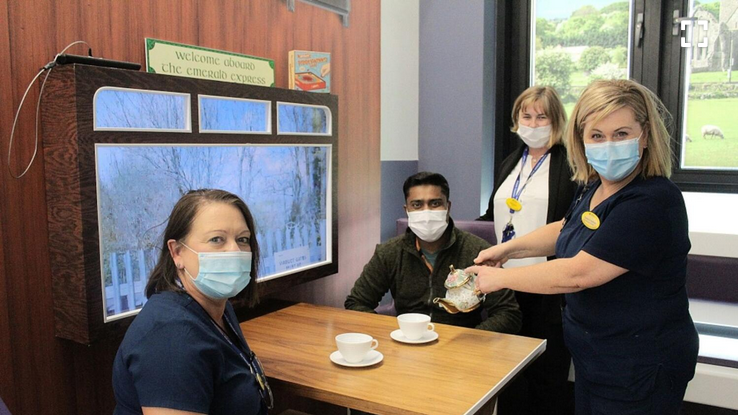
Pictured on a simulated train journey on Medical Ward 1 in Nenagh Hospital were Siobhan Toomey, CNS Patient Flow, Nenagh Hospital; Vimal Mathai, CNS ICPOP, Thurles; Celia Dwan, ADON, Nenagh Hospital, and Elaine O’Sullivan, CNM2 Medical Ward 1, Nenagh Hospital. This quality improvement project for people uses reminiscence therapy to improve the experience of patients with dementia in Nenagh.

Nenagh Hospital's innovative train project

A project focused on the needs of people with dementia is improving the patient experience at Nenagh Hospital.

Patients are invited to take a simulated train journey through the interactive RemPods platform, which has been in use in care homes and hospitals in the UK for a number of years.

An LCD screen displays footage of rolling countryside, pulls through tunnels and into stations along the journey, facilitating reminiscence to reduce anxiety and stimulate positive memories in older patients with cognitive impairment.

Vimal John Mathai, Clinical Nurse Specialist in the Integrated Care Programme for Older Persons in Thurles, said this quality improvement project for Nenagh met a need where acute hospital environments were not as well set up for persons with dementia as care homes.

Mr Mathai has a specialist interest in dementia and has led out on the RemPods/ Reminscence Therapy project in Nenagh.

“A quarter of all patients admitted to Nenagh Hospital have dementia. I have worked in Nenagh myself and all the team there are focused on what we can do to improve things for this older group of patients. It’s fair to say that the clinical environment in an acute hospital is not as dementia-friendly as in a nursing home, for example.

“Admission to an acute hospital can be confusing and frightening for a person with dementia. Even though they need to be in hospital, the stay might also have a negative impact on their physical, mental and cognitive abilities. How acute hospitals are designed very often doesn’t meet the needs of people with dementia. Signage can be confusing; lighting can be poor; the environment can be cluttered with inadequate space for visiting,” Mr Mathai said.

TRAIN PROJECT

The train project in Nenagh, which has now opened on Medical Ward 1, focuses in particular on the different care needs of people with dementia. The initiative has been supported by management and ward staff, including ward manager, Elaine O’Sullivan.

Patients will board the train while having a meal, while welcoming a visitor for hospital or while waiting to be transferred or discharged. Feedback has been very positive from patients, families and staff to date, Mr Mathai said.

Through the RemPods platform, patients are encouraged to share their life experiences, memories and stories from the past. This is known as reminiscence therapy.

“Typically, a person with dementia is more able to recall things from many years ago than recent memories, so reminiscence draws on this strength. In many cases, recent memories deteriorate first for people with Alzheimer's and other forms of dementia. By sharing memories from the past through reminiscence therapy, people with dementia can develop more positive feelings while reducing stress and agitation,” explained Mr Mathai.

“Reminiscence therapy encourages discussion of memories that have been stored away. It helps stimulate those memories through sensory organs. This causes the brain to react differently than usual. Those reactions can impact emotions or behaviour. Studies have shown that reminiscence therapy can help older adults become more engaged.”

Commenting on the new project, Prof Michael Watts, Consultant Physician, UL Hospitals Group, said: “This is yet another example of Nenagh Hospital adapting to the challenges of providing care for the patients of UL Hospitals Group. Congratulations to Elaine, the staff on Medical 1 and to Vimal for all of their work.”

Full Article & Source:
Making the care environment more dementia-friendly

Monday, November 21, 2022

Making Thanksgiving Dementia-Friendly

Seven Tips from the Alzheimer’s Foundation of America

(November 15, 2022)— With Thanksgiving approaching, the Alzheimer’s Foundation of America (AFA) is offering seven tips to help families affected by Alzheimer’s disease and other dementia-related illnesses ensure their Thanksgiving celebration is dementia-friendly.

“Families caring for a loved one with a dementia-related illness deserve to join together and celebrate Thanksgiving, and there a few simple steps they can take to make that celebration as joyful as possible,” said Charles J. Fuschillo, Jr., AFA’s President & CEO. “Being proactive and prepared are the best tools caregivers can use to give their loved one a Happy Thanksgiving.”

AFA offers the following tips to help make a Thanksgiving celebration dementia-friendly:

Prepare your loved one. Try to familiarize them with the guests beforehand by showing photos, sharing stories, or arranging a phone or Facetime chat prior to the celebration. You could also make an invitation to the event to share with your loved one so they know details and that it will be happening.

Prepare your guests. Consider sharing beneficial information with guests about your loved one—such as ways to communicate with the person, what they respond well to, and what may cause distress—especially if they have not seen the person recently. This will help facilitate positive interactions and engagement.

Factor the person’s routine into the scheduling. Changes in daily routine can be challenging for someone living with dementia, so to the greatest extent possible, plan the celebration around that routine. For example, if the person usually takes an afternoon walk, build in time for that.

Hold the celebration early. Individuals living with dementia are prone to “sundowning,” a syndrome which can cause agitation and confusion in the late afternoon-early evening as the sun sets. This can be compounded when adding a celebration with a house full of guests. Consider holding the celebration earlier in the day so your loved one feels more comfortable.

Plan for help. Preparing and holding a holiday gathering can be stressful even without the additional responsibilities of caring for a loved one with dementia. Relatives and friends are often eager to help, but may not know how. Don’t be afraid to let them know what you need, whether it’s asking them to bring a dish, help with cooking, shopping, or decorating, or spending time with your loved one while you are preparing for the celebration.

Keep your loved one involved.  Make adaptations that enable your loved one to participate in the celebration by focusing on what they can do, rather than what they cannot. Invite them to help by preparing ingredients for a simple dish, setting the table, decorating, and other activities. Playing familiar music or going through old photos are great forms of reminiscence that can bring joy and foster positivity during the celebration. For intergenerational activities, try singing familiar songs together, doing art activities, and having a snack together.

Have a quiet space available. Prepare a quiet place away from the crowd where the person with dementia can go if the celebration becomes too much for them. Have familiar comfort items available (i.e., favorite blanket, sweater, stuffed animal) that will help them feel safe and comfortable. Try to control the flow of visitors when possible; those in early stages are better able to interact than those in later stages.

Families who have questions about creating a dementia-friendly Thanksgiving celebration or any other question relating to dementia or caregiving can contact the Alzheimer’s Foundation of America’s Helpline, seven days a week, by phone (866-232-8484), text message (646-586-5283), or web chat (click the blue and white chat icon in the lower corner of the page).

Full Article & Source:
Making Thanksgiving Dementia-Friendly