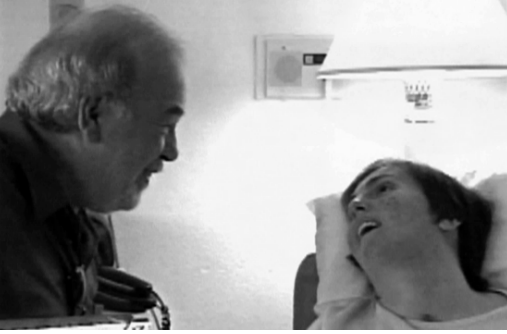
A judge has ruled
that Court permission will not be needed to remove food and fluids from
severely brain damaged patients, a move which has caused concern among
opponents of euthanasia.
Legal safeguard
Unlike other forms of medical care, the decision to withdraw food and
fluids from patients in a “permanent vegetative state” (the term
“unresponsive wakefulness syndrome” is now generally preferred) has
until now been referred to the Court of Protection, even if doctors and
relatives are in agreement.
Landmark ruling
Now, the decision by Mr Justice Jackson means those cases will no
longer have to come to court. He made his ruling in a case concerning a
50-year-old woman who suffered from a degenerative illness for 14 years.
The patient, known in court as M, had Huntington’s disease and was
bed-ridden in hospital and fed by a tube. The Court heard that she had
shown no sign of awareness for 18 months.
Mr Justice Jackson agreed with her family and doctors that
withdrawing nutrition from her would be in her best interests. The tube
was removed and she died in August. Mr Justice Jackson said in his view
the case should not have come to court.
Passive euthanasia
The ruling was welcomed by pro-euthanasia group Dignity in Dying.
Chief Executive Sarah Wootton said the ruling was “a helpful step
towards a clearer, more person-centred view of end-of-life care”.
“When all parties – family, the hospital and treating doctors – are
agreed on what someone would have wanted for their care, it seems absurd
to require a costly court process to confirm this.”
Dangerous precedent
However, the news has been greeted with great concern by patients
rights groups. Dr Peter Saunders of the Care Not Killing Alliance said:
“This court decision sets a dangerous precedent and should be appealed.
Taking these decisions away from the court of protection removes an
important layer of legislative scrutiny and accountability and
effectively weakens the law.
“It will now be more likely that severely brain damaged patients will
be starved or dehydrated to death in their supposed best interests and
that these decisions will be more influenced by those who have
ideological or financial vested interests in this course of action.”
The official solicitor, appointed by the state to act for such patients, is likely to appeal against the ruling.
Recently, a British doctor wrote on his findings that many patients in a “vegetative” state, are in fact aware and can be communicated with.
LifeNews Note: Courtesy of SPUC. The Society for the Protection of Unborn Children is a leading pro-life organization in the United Kingdom.
Full Article & Source:
Judge Rules Doctors Can Starve Disabled Patients to Death Without a Court Order
Showing posts with label PVS. Show all posts
Sunday, September 24, 2017
Wednesday, January 14, 2015
Man awakens from 12 years in 'vegetative state'
![]() |
| Martin Pistorius |
He found himself locked inside his own body – unable to speak, make eye contact or even move his own limbs.
Martin’s doctors told his parents, Rodney and Joan Pistorius, that the boy had cryptococci meningitis. They said Martin should be taken home to die in peace.
But Martin would live 12 years in that vegetative state.
Joan said, “Martin just kept going, just kept going.”
According to NPR, Martin’s father would wake up every day at 5 a.m., dress the boy, put him in the car and drive him to a special care center.
“Eight hours later, I’d pick him up, bathe him, feed him, put him in bed, set my alarm for two hours so that I’d wake up to turn him so that he didn’t get bedsores,” Rodney recalled.
And during those 12 years, according to the Pistorius family, there was never any indication that Martin’s condition was improving.
One day, Joan, in a state of hopelessness, told her son, “I hope you die.”
She never imagined that Martin would have understood those dreadful words.
Full Article & Source:
Man awakens from 12 years in 'vegetative state'
Friday, January 9, 2015
2 Years After Car Crash, Man in 'Minimally Conscious State' Suddenly Speaks
A man in Italy who was in what
doctors call a "minimally conscious state" for nearly two years
unexpectedly regained full consciousness and the ability to talk,
according to a new report of his case.
The man woke
up after he was given a drug normally used as a sedative before surgery
and other medical procedures, the case report showed.
The 43-year-old man was admitted to a hospital after a car accident, and was in a coma for 40 days. People who are comatose are completely unconscious — they have no sleep/wake cycles, and do not respond to their surroundings in any way.
When he was discharged from the hospital 10 months later, he still did not talk or communicate with other people, nor did he respond to simple commands asking him to, for instance, close his eyes.
Over the next year, the man's cognitive ability started to decline; his movements became abnormally slow; and he began to engage in aimless, repetitive behaviors, such as clapping.
But then, about two years after the accident, the man's doctors wanted to examine his brain using a CT scan. To do the scan, they gave the man a mild sedative called midazolam. [7 Mind-Bending Facts About Dreams]
A few minutes later, the man began to talk and interact with others.
"He talked by cellphone with his aunt and congratulated his brother when he was informed of his graduation; he recognized the road leading to his home," the researchers who treated the man wrote in the case report. However, the man did not remember the accident, and he was not aware of the way it had affected his health, they wrote.
This is the first report of midazolam having an "awakening" effect, the researchers said.
However, the effect wore off after about two hours, and the man returned to his previous state, unresponsive to the environment, according to the study.
To see whether it was indeed the drug that caused the brief improvement in the man's condition, the researchers gave the man midazolam again. Several minutes following the administration, the patient began to interact with his brother and answered questions the researchers asked him. He was also able to calculate simple math problems, such as 100 minus 7, as well as read and understand simple sentences, such as "Close your eyes."
This time around, the researchers scanned the man's brain before, during and after the administration of midazolam, and identified the locations within the brain that were affected by the drug. They found that those regions previously had been linked to the symptoms of catatonia, which is a state of unresponsiveness to stimuli that is often associated with schizophrenia.
Moreover, the researchers noted, patients with catatonia have been reported to respond to midazolam in the past. The symptoms of the man in this report were similar to those of catatonic patients, which may mean that he was indeed catatonic and therefore responded to the drug, according to the study.
However, it is not completely clear whether the patient did indeed suffer from catatonia or whether his condition merely included certain catatonic symptoms, the researchers wrote.
Although midazolam was effective as a short-term method of treating the man's symptoms, the researchers said they could not keep giving it to him. Usually, the drug is given only to people in intensive-care units, where they can be monitored continuously, said Dr. Maria Chiara Carboncini, medical director of the Brain Injury Unit in the University Hospital of Pisa's Department of Neuroscience in Italy, who treated the patient and was a co-author of the report.
The researchers tried treating the man with another drug called
lorazepam, which belongs to the same class of drugs as midazolam but can
be administered more easily, as the patient does not have to be
monitored continuously, Carboncini told Live Science.
However, after several days of therapy with lorazepam, the man became
agitated and aggressive. His doctors switched him to carbamazepine, a
drug used to treat people with epilepsy. This drug allowed the man to
"maintain the improvement of his ability to interact and communicate
with people," Carboncini said.
The study was published in the November issue of the journal Restorative Neurology and Neuroscience.
Full Article & Source:
2 Years After Car Crash, Man in 'Minimally Conscious State' Suddenly Speaks
Labels:
Coma,
International,
PVS
Sunday, September 28, 2014
New Study Shows Some 'Vegetative' Patients are Mentally Active
Patients in what doctors call a “persistent vegetative state” may be much more aware of their surroundings than previously believed, according to a new study from the University of Western Ontario.
The study’s authors, neuroscientists Lorina Naci and Adrian Owen, put 12 healthy volunteers in an fMRI machine and showed them an 8-minute condensed version of a 1961 Alfred Hitchcock Presents episode called “Bang! You’re Dead!” while scanning their brains for reactions. The suspenseful plot depicts a little boy carrying a partially loaded gun – which he believes is just a toy – walking around his neighborhood pointing the weapon at people and pulling the trigger.
Naci and Owen found that in healthy participants, the frontal parietal brain regions – which control attention – became more active during tense moments, and that the activity built in intensity until the episode’s climax, when the boy almost hits the family maid with a real bullet. The brain activity tracked closely with the way the healthy subjects reported feeling as they watched the film, indicating a strong connection between their brain’s reaction and their emotional response.
Next, the pair put a 35-year-old man who had been unresponsive since age 17 into the machine and showed him the same film. Although he could not tell the researchers how he was feeling, the fMRI revealed nearly identical responses in his frontal parietal brain region, indicating that he was not only aware of the video, but able to follow the plot.
“The patient's brain response to the movie suggested that his conscious experience was highly similar to that of each and every healthy participant, including his moment-to-moment perception of the movie content, as well as his executive engagement with its plot," the scientists wrote.
Full Article and Source:
New Study Shows Some Vegetative Patients are Mentally Active
See Also:
Read "A Common Neural Code for Similar Conscious Experiences in Different Individuals"
The study’s authors, neuroscientists Lorina Naci and Adrian Owen, put 12 healthy volunteers in an fMRI machine and showed them an 8-minute condensed version of a 1961 Alfred Hitchcock Presents episode called “Bang! You’re Dead!” while scanning their brains for reactions. The suspenseful plot depicts a little boy carrying a partially loaded gun – which he believes is just a toy – walking around his neighborhood pointing the weapon at people and pulling the trigger.
Naci and Owen found that in healthy participants, the frontal parietal brain regions – which control attention – became more active during tense moments, and that the activity built in intensity until the episode’s climax, when the boy almost hits the family maid with a real bullet. The brain activity tracked closely with the way the healthy subjects reported feeling as they watched the film, indicating a strong connection between their brain’s reaction and their emotional response.
Next, the pair put a 35-year-old man who had been unresponsive since age 17 into the machine and showed him the same film. Although he could not tell the researchers how he was feeling, the fMRI revealed nearly identical responses in his frontal parietal brain region, indicating that he was not only aware of the video, but able to follow the plot.
“The patient's brain response to the movie suggested that his conscious experience was highly similar to that of each and every healthy participant, including his moment-to-moment perception of the movie content, as well as his executive engagement with its plot," the scientists wrote.
Full Article and Source:
New Study Shows Some Vegetative Patients are Mentally Active
See Also:
Read "A Common Neural Code for Similar Conscious Experiences in Different Individuals"
Friday, April 25, 2014
From Private Ordeal to National Fight: The Case of Terri Schiavo
Her
surname in Italian means “slave,” and is pronounced skee-AH-vo. Grim as
it may be, the word could apply to Theresa Marie Schiavo, even with its
Americanized pronunciation: SHY-vo. For 15 years, Terri Schiavo was
effectively a slave — slave to an atrophied brain that made her a
prisoner in her body, slave to bitter fighting between factions of her
family, slave to seemingly endless rounds of court hearings, slave to
politicians who injected themselves into her tragedy and turned her
ordeal into a national morality play.
To
this day, the name Schiavo is virtually a synonym for epic questions
about when life ends and who gets to make that determination. It would
be nice to believe that since Ms. Schiavo’s death nine years ago, America has found clear answers. Of course it has not, as is evident in Retro Report's
exploration of the Schiavo case, the latest video documentary in a
weekly series that examines major news stories from the past and their
aftermath.
Ms.
Schiavo, a married woman living in St. Petersburg, Fla., was 26 years
old when she collapsed on Feb. 25, 1990. While her potassium level was
later found to be abnormally low, an autopsy drew no conclusion as to
why she had lost consciousness. Whatever the cause, her brain was
deprived of oxygen long enough to leave her in a “persistent vegetative
state,” a condition that is not to be confused with brain death. She
could breathe without mechanical assistance. But doctors concluded that
she was incapable of thought or emotion. After her death on March 31,
2005, an autopsy determined that the brain damage was irreversible.
Between
her collapse — when she “departed this earth,” as her grave marker puts
it — and her death — when she became “at peace” — the nation bore
witness to an increasingly acrimonious battle between her husband,
Michael Schiavo, and her parents, Robert
and Mary Schindler. Mr. Schiavo wanted to detach the feeding tube that
gave her nourishment. Terri never would have wanted to be kept alive
that way, he said. The Schindlers insisted that the tube be kept in
place. That, they said, is what their daughter would have wanted. To Mr.
Schiavo, the woman he had married was gone. To the Schindlers, a
sentient human was still in that body.
Full Article & Source:
From Private Ordeal to National Fight: The Case of Terri Schiavo
Thursday, April 24, 2014
Saying Patients are PVS Allows Courts to Starve Them to Death, What if the Diagnosis is Wrong?
I have written time and time again about the dangerous and dehumanizing persistent vegetative state (PVS) diagnosis. Actually, we saw in my family’s battle to save my sister, Terri Schiavo, from death by dehydration, that a tremendous amount of debate raged over whether or not she was in this condition.
In fact, this diagnosis is what allowed the court to order the removal of Terri’s food and water. Yet despite continuing research validating that the PVS diagnosis is growing in its inaccuracy, the medical community uses this diagnosis to end countless lives of our medically vulnerable patients who are allegedly in this condition.
This latest finding is one of a continuous stream of reports that have been issued on the inaccuracy of the PVS diagnosis. From the Report, Brain Scans Show Vegetative Patients May Actually Recover:
The Journal’s report, released on
Feb. 3, revealed that some patients who were believed to be in a PVS
were actually able to understand and communicate. Through the use of
functional magnetic resonance scanning (fMRI), researchers in the United
Kingdom estimated that a percentage of those patients suffering from
profound brain injuries possessed the capacity to comprehend and
communicate in limited ways.
Furthermore, not only can the PVS diagnosis be used as an actual death sentence for a patient, but as a death sentence figuratively speaking, as well. And it seems both are supported under the pretext to save health care costs. You see, the PVS can also be used to cut off funds for a person in need of vital rehabilitation. Because once insurance providers receive the PVS diagnosis in regards to the patient’s condition, no longer are they willing to pay for any rehabilitative services.
Full Article & Source:
Saying Patients are PVS Allows Courts to Starve Them to Death, What if the Diagnosis is Wrong?
Thursday, January 2, 2014
First Of Its Kind Experiment on Persons Diagnosed With PVS Reveals They Might be More Aware Than Previously Thought
Research about patients thought to be in vegetative states with questionable levels of consciousness has been finding that they might be more aware than previously thought. A new study from Tel Aviv University is no different.
Researchers from the university and Loewenstein Hospital evaluated patients in vegetative states who were awake but exhibited “no signs of awareness.”
The team showed four patients in such a state — compared to 13 people who were healthy controls — pictures of people they knew and others who were strangers. They also verbally asked them to imagine someone they knew.
Monitoring their brain activity, the researchers found those in a vegetative state showed emotional processing in the brain, “suggesting the ability for covert emotional awareness of self and the environment in VS patients,” the study publishes in the journal PLOS One earlier this year stated.
Two patients in a vegetative state eventually recovered, according to the journal, and in the study had showed the strongest connectivity between recognition and the emotional side of the brain.
“This experiment, a first of its kind, demonstrates that some vegetative patients may not only possess emotional awareness of the environment but also experience emotional awareness driven by internal processes, such as images,” Sharon said.
Thursday, November 14, 2013
Patient in So-Called “Vegetative State” Knew Doctors Were Dehydrating Him to Death
We dehydrate to death helpless people in this country because they have a catastrophic cognitive impairment. Advocates for dehydration say it is just medical ethics, the withdrawal of the medical treatment of tube feeding. (Now, there is even a lawsuit to compel starvation by withholding spoon feeding–not a medical treatment!)
Dehydrating helpless people to death was once unthinkable. Then, in the 80s, bioethicists began advocating withdrawing tube-supplied food and fluids. And so it came to pass.
Advocates for dehydration started by claiming it should be reserved strictly for those who are unconscious. They have, of course, broadened the dehydration caste since. But recent scientific studies have now also shown that many supposedly unconscious patients aren’t unaware at all.
And now we learn some are paying attention to their surroundings! From the Cambridge University report:
A patient in a seemingly vegetative state, unable to move or speak, showed signs of attentive awareness that had not been detected before, a new study reveals. This patient was able to focus on words signalled by the experimenters as auditory targets as successfully as healthy individuals. If this ability can be developed consistently in certain patients who are vegetative, it could open the door to specialised devices in the future and enable them to interact with the outside world.And get this:
These findings suggest that some patients in a vegetative or minimally conscious state might in fact be able to direct attention to the sounds in the world around them.If this is true of other patients, imagine the horror of hearing doctors and family discussing removing your food and water. Imagine the pain of the actual event!
Actually, we know what that is like. Kate Adamson, thought mistakenly to be unconscious after a brain stem stroke, underwent abdominal surgery with inadequate anesthesia. She was then left unfed (but hydrated via drip) during the healing process–and it was more painful than the sensation of being cut open!
Full Article and Source:
Patient in So-Called “Vegetative State” Knew Doctors Were Dehydrating Him to Death
Monday, August 19, 2013
Study Shows People in “Vegetative” State Were Incorrectly Diagnosed
There is more encouraging news coming out of Canada regarding the very unscientific persistent vegetative state (PVS) diagnosis. Once again there has been a study regarding three people who were incorrectly thought to be in a PVS.
Why is this so important? One reason is that the PVS diagnosis can be used as a motive to kill a person with a brain injury, as it was in my sister, Terri Schiavo’s case. This is not the first time this type of testing has taken place with similar types of results.
From the story, “Brain scans reveal which ‘vegetative’ patients are alert, trapped in bodies”:
A man who had appeared to have been in a vegetative state for 12 years knew his name and knew where he was, Canadian researchers report in a study showing it’s possible to use MRI brain scans to establish communication with people who seem completely unconscious. Three people tested using a special form of MRI called functional magnetic resonance imaging were able to answer simple “yes” or “no” questions, the team at Western University in London, Ontario report.
And once again, just like most of these reports where they find people have been wrongly diagnosed as being in a PVS, they felt it necessary to point out that there is no way possible that they were wrong when Terri Schiavo was diagnosed as being in PVS and then subsequently killed because of it.
In fact, they often say, as in this report, the autopsy proved it. To help strengthen their claim, they bring in the “experts” like the “omniscient” bioethicist, Art Caplan who believes it was okay to deny Terri the same tests he seems to approve for others in similar conditions:
Full Article and Source:
Study Shows People in “Vegetative” State Were Incorrectly Diagnosed
Why is this so important? One reason is that the PVS diagnosis can be used as a motive to kill a person with a brain injury, as it was in my sister, Terri Schiavo’s case. This is not the first time this type of testing has taken place with similar types of results.
From the story, “Brain scans reveal which ‘vegetative’ patients are alert, trapped in bodies”:
A man who had appeared to have been in a vegetative state for 12 years knew his name and knew where he was, Canadian researchers report in a study showing it’s possible to use MRI brain scans to establish communication with people who seem completely unconscious. Three people tested using a special form of MRI called functional magnetic resonance imaging were able to answer simple “yes” or “no” questions, the team at Western University in London, Ontario report.
In fact, they often say, as in this report, the autopsy proved it. To help strengthen their claim, they bring in the “experts” like the “omniscient” bioethicist, Art Caplan who believes it was okay to deny Terri the same tests he seems to approve for others in similar conditions:
Full Article and Source:
Study Shows People in “Vegetative” State Were Incorrectly Diagnosed
Thursday, December 1, 2011
Scan Reveal PVS Patients are Aware
Scientists have used a portable device that tracks changes in brain waves to communicate with people in a vegetative state, some of whom have been locked in their bodies for more than a year. In a study published last year in the New England Journal of Medicine, researchers showed it was possible to communicate with and detect awareness in people in a vegetative state using functional magnetic resonance imaging or fMRI.
The researchers instructed 16 people in a vegetative state to imagine they were making a fist with their right hand or wiggling their toes, and then measured brain activity while electrodes were attached to their scalp.
"It was possible to detect that these patients were actually aware" despite being diagnosed as being "entirely unconscious" using standard clinical assessments, said Professor Adrian Owen of the Center for Brain and Mind at the University of Western Ontario. Findings from the newer study were published in the British journal Lancet on Wednesday.
Patients in a persistent vegetative state have periods of wakefulness, but they are completely unresponsive and are thought to be unaware.
"We don't actually know how many vegetative patients there are. It's now possible to find that out," said Dr. Damian Cruse of the University of Western Ontario, who led the study.
Full Article and Source:
Scans Reveal Vegetative Patients Are Aware
Subscribe to:
Posts (Atom)