Thirteen defendants from the Colonial Heights Rehabilitation and Nursing Center appeared before a judge Wednesday, facing charges related to an investigation of elder abuse.
Lawyers for Colonial Heights Rehabilitation and Nursing Center, where more than a dozen employees have been charged in an elder abuse investigation, are weighing in on the criminal case.
CLEVELAND,
Ohio – A Cuyahoga County grand jury is expected to hear the case of an
84-year-old woman who died Christmas Eve at a Warrensville nursing home.
Amber
Henderson, 31, of Willoughby Hills was charged in Bedford Municipal
Court with involuntary manslaughter, gross neglect of a patient and
tampering with records in the death of Alvera Meuti. Her case was bound
over Thursday to a county grand jury.
“This is infuriating,” said Paula Mueller, the founder and executive
director of Elderly Advocates, a Parma nonprofit that pushes for greater
care in long-term facilities. “Someone died who shouldn’t have. I just
can’t imagine how she died.”
WKYC, a news partner of cleveland.com and The Plain Dealer, reported
that Henderson has been charged in Meuti’s death at the Avenue at
Warrensville Care and Rehabilitation Center in Warrensville Heights. The
station reported that she died of hypothermia.
Meuti was found outside the facility on a patio porch. She had been
missing for 10 hours, the news station reported. The station reported
that a nurse had checked on Meuti about 8:40 p.m. Dec. 23, and she was
sitting in her wheelchair inside the building.
The
station reported that Henderson checked on Meuti about an hour later
but could not find her. About 6:30 a.m., the facility realized Meuti was
gone and notified police. Officers found her outside.
Cleveland.com and The Plain Dealer reached out to Justin Weatherly, Henderson’s attorney, seeking comment.
WARRENSVILLE HEIGHTS, Ohio (WJW) — Warrensville Heights
police are investigating the death of an elderly woman after she was
found unresponsive outside of the Avenue Warrensville Care and
Rehabilitation Center on Christmas Eve.
The FOX 8 I-Team
obtained a copy of the Warrensville Heights police report that states
the 84-year-old woman was last seen by a nurse at 8:40 p.m. Dec. 23.
The report further notes that another nurse went to check on the woman
at 9:30 p.m. and she was not in the room. The nurse told officers that
she “assumed” the woman left the hospital with her brother. She then
said she checked the logs and found that no visitors were at the
hospital on Dec. 23. The nurse said she then tried calling the woman’s
brother but he didn’t answer.
The nurse then told the officer “multiple times that she is a new
nurse and was not sure what to do after that,” the report states.
According to the report, about nine hours later the nurse told a
coworker about the woman’s disappearance. A few minutes after alerting
her coworker a “Code Purple” was issued and the officials searched the
facility for the woman. At 7:30 a.m. police were called and sent to the
facility.
A short time after police arrived the woman was found outside in a
corner of the patio. She was unresponsive. She was taken to the
hospital, where she later died.
The report states the officer asked officials for security video from
inside the facility. Officials , however, told police the cameras only
have views of the common areas and none of the footage showed the
woman’s direction of travel, the report stated.
The woman was sent to the facility Dec. 18 for physical therapy. The
report noted that she could not walk and was in a wheelchair. Her
brother told officers he had talked to her earlier and she said she
wanted to leave the facility.
No arrests have been made.
We reached out to officials at Avenue Warrensville Care and
Rehabilitation Center to discus the matter and received the following
statement:
“We are sorry for death of the resident and have expressed our
condolences to the family. This continues to be an active investigation
and therefore we are unable to comment further at this time.”
COLONIAL HEIGHTS – The night nurse who prosecutors said was “the last hands” on a nursing-home patient before she became ill and died
was granted bond Tuesday morning and told to stay away completely from
nursing care, the nursing home or any of the other 17 defendants in the
case.
Shakima Freeman Brewer, of Richmond, is
one of four defendants jailed on the most serious of all charges, abuse
of a vulnerable adult resulting in death, and the second of them to be
granted bond. General District Judge Matthew Nelson set the unsecured
bond at $5,000 and ordered Brewer to take part in pre-trial services
including alcohol and drug screening.
As of
publication time, online court records indicated Brewer had not yet been
released from Riverside Regional Jail in Prince George County. She was
not physically in court but took part in the hearing via teleconference
from the jail.
The victim was a 74-year-old resident of Colonial Heights Rehabilitation
& Nursing Center who suffered from cerebral palsy and diabetes. In
late September, she was taken to Bon Secours Southside Medical Center in
Petersburg with necrotic pressure ulcers – also known as bedsores –
around her vaginal area that doctors determined were caused by prolonged
exposure to urine and feces that the center staff failed to clean. In
October, she died of sepsis due to the bedsores.
After an investigation, Colonial Heights Police,
joined by the state’s Elder Abuse Task Force, raided the Ellerslie
Avenue facility on Dec. 18. Eighteen people, including the center’s
director, the head of nursing and another care provider, were arrested
on various charges of abuse, neglect, falsifying records and obstructing
the legal process.
Prosecutor: Brewer covered up condition
In
court Tuesday morning, deputy commonwealth’s attorney Noelle Nochisaki
told the judge that Brewer was the last nurse to tend to the victim
before she was taken to the hospital. “She was the last hands on the
case,” she said.
That night, the victim was unresponsive and
lethargic, yet Brewer told the nurse who relieved her that “she is doing
great,” and there were no issues.
“Then the
day nurse came in and saw something was wrong,” Nochisaki said. At that
point, the woman was taken to SMC where the bedsores were detected. She
later underwent surgery to remove most of her vagina.
Nochisaki said the victim’s wounds were so
grotesque that “doctors first thought it was violent sexual assault due
to the trauma and bruising of the area.”
Nochisaki
said that because of her cerebral palsy, the victim was unable to move
herself and was supposed to be lifted from her bed to a chair by a
special machine. However, an investigation found that the machine was
never used, and the only time the victim was removed from her bed, it
was done by two orderlies who broke her foot in the process.
After the surgery, the victim was put into
home-hospice care, something Nochisaki said would not have been needed
“had it not been for these wounds.”
In
addition to the abuse – a felony – Brewer was charged with five counts
of falsifying patient records. Nochisaki said those records were
falsified to cover up the repeated neglect.
“She ignored it,” Nochisaki told Nelson, adding
that the stench from the affected area was “overwhelming” and easily
recognized.
A previous felony conviction
In
making the case for her bond, defense attorney Edward Nickel noted that
Brewer had a previous felony conviction on her record – driving under
the influence in 2016 – but she adhered to all conditions surrounding
that conviction and had not been arrested until Dec. 18 at the nursing
home.
Nickel also said there was “some dispute
over what her specific role was” in the care of the victim. Since
overnight staff is smaller than a regular day shift, Brewer was often
responsible for as many as 60 patients at a time.
The
defense counsel did not question the severity of the allegations. But
Nickel said circumstances in this case were different because “they did
not reflect any specific violence.”
Nickel
said Brewer was not a flight risk and added she intended to remain at
her Richmond home with her two sons, ages 22 and 14.
Brewer’s mother, father, and oldest son sat silently in the courtroom during the 20-minute hearing.
Two more remain jailed
When
Brewer is released, that will make Shawanda Jeter, the center’s
director, and Danielle Cline Harris, another nurse at the center, the
only two defendants remaining in custody. Kamesha Michelle Kittrell, a
nursing supervisor at the center, was granted bond Dec. 30.
The
remaining 14 defendants were all released on bond or recognizance on
charges of either falsifying records or obstructing the legal process.
Every defendant is due back in court March 26 for preliminary hearings.
Court
records indicate Kamesha Michelle Kittrell, of Richmond, was granted a
$2,500 bond at a hearing Monday in Colonial Heights General District
Court. She is facing two counts of abuse of a vulnerable adult resulting
in death and one count of abuse involving injury.
Kittrell,
the head of nursing at Colonial Heights Rehabilitation & Nursing
Center, was among 18 employees arrested Dec. 18 on various charges
surrounding the death of a 74-year-old woman whose family said she had
been abused and neglected during her stay at the center. Kittrell and
three others, including the nursing home’s director, faced the most
serious of all the charges.
Shawanda Jeter, 46, of Richmond, the center’s director, Stephanie Cline
Davis, 53, of Disputanta, and Shakima Freeman Brewer, of Richmond, were
the other employees jailed. Court records indicate they remain in
custody at Riverside Regional Jail in Prince George County.
As part of her bond, Kittrell is not allowed to
return to the Ellerslie Avenue facility, work in the medical field or
have any contact with the other defendants until her case is
adjudicated.
Prosecutors contend that while
Kittrell did not have direct contact with the victim – who they claim
died of sepsis last October due to the lack of attention received – she
is culpable for the death due to her nursing-head duties for oversight
of staff and proper medical care.
Kittrell, Jeter and Davis are all due back in court March 26 for
preliminary hearings on the charges. Brewer is set for a bond hearing
Jan. 7.
The remaining 14 suspects were all granted bond at the time of their
arrests. Most of those charges involved falsifying patient records.
The arrests happened Dec. 18 when Colonial Heights
Police, the state Department of Health and the Virginia attorney
general’s Elder Abuse Task Force raided the center.
In a statement Dec. 19
to The Progress-Index, Colonial Heights Rehab management said it was
“cooperating fully” with the investigation. No other statements have
been released since.
COLONIAL HEIGHTS, Va. — Four days before Colonial Heights Police
received a complaint about possible elder abuse and neglect at Colonial
Heights Rehabilitation and Nursing Center, the Virginia Department of
Health found the facility was in full compliance after finding several
deficiencies during an inspection in early August.
The VDH
inspector found staff at the facility failed to administer scheduled
medications, lacked necessary supplies, and failed to provide
incontenience care to a resident which caused them to get a severe rash
on their buttocks.
The inspection report is dated Aug. 6, 2024 and details what an inspector
found over several days in late July and early August after receiving
nine complaints about the facility.
That’s just two months before
Colonial Heights Police received a complaint of possible elder abuse and
neglect from Adult Protective Services regarding a 74-year-old resident
at the facility who prosecutors said died from Sepsis from wounds on
her back and in her genital area.
Prosecutors said the woman was left in her bed for days in her own
urine and feces, and her wounds from the poor care were so bad APS
originally thought she might have been a victim of sexual assault.
The inspector reviewed the records of 23 out of 178 residents during the unannounced inspection.
They found one resident had a severe yeast rash on their buttocks.
The
inspector said the staff failed to provide incontinence care to meet
the needs of the resident and noted the facility’s nurses made no
documentation of the rash prior to, or even after, a Nurse Practioner
pointed it out to them.
The NP wrote in her notes “Patient has had
this in the past…will be worse if she continues to lay in waste for
hours. Instructed patient to advocate for herself by talking to the
Director of Nursing regarding how long she is laying in waste.”
The inspector also noted staff:
Failed to give a diabetes medication to one resident three Saturdays in a row
Did
not have self-catheterization supplies available to a resident so he
was uncomfortable after not being able to empty his urine since the
morning prior
Failed to consult with a resident’s doctor and
resident staff representative and failed to implement its abuse policy
after the resident, who was classified as having severe cognitive
impairment, was found engaging in sexual activity with another resident
on two occasions. According to policy, any suspected or witnessed
incidents of patient on patient abuse or exploitation brought to the
attention of the administration will result in an internal investigation
and reporting to the state survey agency. Failure by an employee to
report any witnessed incident or mistreatment, abuse, neglect, theft or
exploitation or reasonable suspected crime against a patient will result
in corrective action.
The facility needed to correct the deficiencies found by the inspector by Sept. 18. We
asked VDH if they went back to check if the facility made the changes
and a spokesperson said they conducted an “off-site” revisit on Oct. 1
to ensure compliance.
That was just four days prior to the APS complaint to police about the potential elder abuse and neglect at the facility.
The
VDH spokeswoman said not all revisits are conducted on-site, and the
severity of the citations determine if an on-site revisit is required.
We asked her what an “off-site revisit” entails and received the following information:
“An
off-site revisit is a desk review of a health care provider’s plan of
correction that includes examining credible evidence supplied by the
provider. VDH carries out this review off-site.”
COLONIAL HEIGHTS, Va. — Colonial Heights police arrested multiple
employees at the Colonial Heights Rehabilitation and Nursing Center
Wednesday morning, charging them with crimes ranging from abuse and
neglect of vulnerable adults to falsifying patient records. The arrests
came after a complaint was made in October. Police say a 74-year-old
patient was hospitalized and ultimately died due to inadequate care
received at the facility.
Eighteen staff members have warrants
issued against them, including Shawonda Jeter, 46, the administrator of
the center and Danielle Harris, 53, who is a nurse. Both women are
currently in custody without bond.
"We have secured warrants on 18 individuals who are staff members at
Colonial Heights Rehabilitation and Nursing Center," Major Rob Ruxer, of
the Colonial Heights Police, said.
More charges could be forthcoming as the investigation continues.
The
series of arrests followed an investigation launched by the police in
October after Adult Protective Services reported a potential elder abuse
case.
Multiple local and state agencies, including the State
Attorney General’s Elder Abuse Task Force, are involved in the ongoing
investigation and were present during the arrests.
According to police, charges include both felony and misdemeanor
counts, including the abuse of vulnerable adults, falsifying patient
records, and obstruction of justice.
CBS 6 cameras captured evidence bags being removed from the facility.
"During
the investigation, our investigators, as well as individuals with the
Elder Abuse Task Force, have secured and served multiple search warrants
on the facility in order to obtain medical records,” Ruxer said.
One nurse has been charged with five counts of misdemeanor falsifying patient records.
"The
Virginia Department of Health has staff on the ground to ensure that
all residents are receiving proper care and will remain involved to
ensure that the proper individuals are placed in leadership positions
moving forward," Delegate Mike Cherry told CBS 6 in a statement.
Colonial Heights police are still working to apprehend all 18 individuals and are requesting assistance from the public.
They are urging family and friends in the community to report any similar situations at the facility to the police department.
CBS 6 previously reported about Colonial Heights facility in July
when the Virginia Department of Health's Office of Licensure and
Certification looked into the nursing home following a CBS 6
investigation. The investigation uncovered four instances where the
facility violated federal rules.
A PR firm sent us the following statement:
"We are aware of the events that happened today and are cooperating fully with law enforcement.”
EVANSVILLE, Ind. — On Jan. 4, 2020, a home health
aide in Evansville dialed 911 to report that her special needs client
may have stopped breathing. When the Evansville Fire Department arrived,
technicians determined that 28-year-old Robin Phillips was dead.
Prosecutors
this week charged three Evansville women in connection with
Phillips' death. Latavia M. Booker, 20; Victoria D. Brown, 32; and
Glenda R. Fields, 38, all face two counts of neglecting a dependent
resulting in catastrophic injury.
Brown and Fields were booked into the Vanderburgh County jail on Wednesday. Booker was arrested Tuesday.
The
three women worked for Compass Residential, a company that provides
services to individuals with intellectual or developmental disabilities.
According to court records, Evansville police
spoke to Booker at the scene of Phillips' death. Booker told police she
heard a "thump," and the sound prompted her to check on Phillips. After
placing a protective helmet on her, she returned Phillips to the
bedroom.
When Booker later checked on her client, she told police she found her unresponsive and dialed 911.
A
day before Phillips' death, her care team at Compass Residential held a
meeting to discuss changes in Phillips' condition, according to court
records.
Brown told police that protocol dictated Phillips
be taken to the emergency room for treatment. After the meeting, Brown
said she directed Booker and Fields, who worked the 3 p.m. shift with
Phillips that day, to take Phillips to the emergency room.
Megan
Conner, who works for Indiana's Bureau of Developmental Disabilities
Services, told police she attended part of the meeting with Phillips'
care team. She told police that Brown assured her Phillips would be
taken to the emergency room.
According to court documents, that never happened.
After
Phillips' death, Conner received a report from Compass that showed
staff did not take Phillips to the emergency room despite being
instructed to do so.
Lakesha Watt, who was working with Phillips prior to the arrival of
Booker and Fields on Jan. 3, 2020, later told police that Fields said
"it was not her f-----g job" to take Phillips to the emergency room,
according to a sworn affidavit filed against Fields.
Fields told police she said "it was not her job"
to take Phillips to the hospital because she "did not get paid extra,"
according to the affidavit.
Compass Residential conducted its own internal review after Phillips' death.
Lee
Vanhorn, a director at Compass, told police "there were a lot of
documents just missing" from Phillip's medical records — specifically
her Medication Administration Record.
According
to court records, the Compass employee manual states that all direct
support staff are required to "transport consumers during their shift,"
and also specifies how employees can receive compensation for the use of
a personal vehicle.
The same manual also
defines "neglect" as the "failure to provide supervision, training,
appropriate care, food, medical care, or medical supervision to an
individual."
The Vanderburgh County Coroner's
Office eventually determined Phillip died as the result of
chlorpromazine intoxication and caretaker malfeasance of a special needs
patient. Chlorpromazine is a widely used antipsychotic medication, and
the drug was legally prescribed to Phillips.
All three women charged in connection with Phillips' death are being held on $150,000 bond in the Vanderburgh County jail.
In
Phillips' obituary, her family wrote, "Robin loved to swim and enjoyed
listening to music. She also enjoyed long rides in the car."
A registered nurse is facing charges alleging neglect and abuse of a 69-year-old female resident, according to a Feb. 17 news release from California Attorney General Xavier Becerra.
Emily Jones, RN, a caregiver with Miami-based Vitas Healthcare, was
providing care for a resident at a Riverside, Calif.-based nursing home.
She allegedly failed to record the discovery of an open ulcer on the
resident. She also is accused of failing to notify a physician and the
resident's family of the resident's deteriorating condition. The ulcer
worsened into a wound that required the resident to undergo emergency
surgery to her right foot, which had become septic and gangrenous. After
the surgery, the resident's health continued to decline, and she
eventually died.
Ms. Jones was arraigned Feb. 17 on one count of felony elder abuse.
"Elder abuse does not always come in the form of a physical attack.
It can result from utter neglect and lack of proper care, as we allege
in the case of Emily Jones," said Mr. Becerra. "Jones, a registered
nurse, owed her patients due care. Assisted living residents are a
vulnerable population all too often victimized by acts of neglect and
improper care. We must hold our medical professionals accountable for
their actions."
The letter was heartbreaking as it recounted the death of an
88-year-old woman in a New York nursing home. But it was also angry and
accurate about a strange New York policy that is fatally wrongheaded.
“I am wondering who will hold Gov. Cuomo accountable for the deaths
of so many older people due to his reckless decision to place covid19
patients in nursing and rehabilitation homes,” the letter began. “I am
writing as a daughter who lost her beautiful 88 year old mother who was
receiving physical therapy at one such facility.”
The writer, Arlene Mullin, went on to recount examples of the
governor promising to protect the elderly because of their known
vulnerability. She noted that he named his stay-at-home order after his
own mother, Matilda Cuomo, and talked several times about protecting
her.
“My mother is not expendable and your mother is not expendable and
our brothers and sisters are not expendable,” Cuomo said a month ago.
Mullin had another complaint, too — that the media never asked the
governor about an order mandating that nursing homes admit and readmit
patients who tested positive for the coronavirus, despite the
extraordinary number of deaths among the elderly.
“That’s a good question. I don’t know,” the governor said.
He turned to Howard Zucker, the state health commissioner, who
confirmed the policy, saying “if you are positive, you should be
admitted back to a nursing home. The necessary precautions will be taken
to protect the other residents there.”
The second part of Zucker’s answer is debatable, the first part is not. The disastrous results speak for themselves.
Diana Mongiello (center) with daughter Arlene Mullin (right) and granddaughter Laura Brereton.
The state concedes that 3,448 residents of nursing homes or
adult-care facilities are known to have died from the coronavirus, or
nearly 25 percent of all deaths in New York. More than 2,000 of the
total are in the five boroughs, and officials acknowledge that the real
numbers are almost certainly higher.
The New York policy is especially odd given that the first large
outbreak of the virus in the United States took place in a nursing home.
The Life Care Center in Kirkland, Wash.,
attributed 13 deaths to the virus before March 11, and at the time, the
number represented 60 percent of all the fatalities in the nation.
Since then, at least 24 others have died there.
That same week, Dr. Anthony Fauci, director of the National
Institutes of Health’s National Institute of Allergy and Infectious
Diseases, urged that special attention be given to seniors. “It’s so
clear that the overwhelming weight of serious disease and mortality is
on those who are elderly and those with a serious comorbidity: heart
disease, chronic lung disease, diabetes, obesity, respiratory
difficulties,” Fauci told the American Medical Association. He said
there would always be exceptions but that “if you look at the weight of
the data, the risk group is very, very clear.”
Indeed, early reports from around the world showed that death rates
from the virus soared with age. Among those who also had other major
health issues, the rates were off the charts.
For example, a study released in Italy on March 17 found that more
than 99 percent of 355 coronavirus fatalities there suffered from other
health issues. The average age of those who died was 79.5 years.
Thus, it was well known that the elderly were easy targets for the
coronavirus before New York adopted its Health Department directive on
March 25 requiring nursing homes to accept those with the disease.
Zucker’s Monday defense included his claim that the state is working
with such facilities to protect other residents and health care workers
by providing equipment and monitoring.
Assemblyman Ron Kim, a Queens Democrat, harshly dismissed the claim as false.
“It’s either he’s lying or they have absolutely no idea what’s going on on the ground,” Kim told The Post.
For her part, Arlene Mullin is not satisfied. In an interview
Tuesday, the Long Island educator said she has sent four emails to
Cuomo’s office on the issue but has never received a response.
“I get it, it’s a crisis,” she said of the pandemic. “But I really
want to know why the governor would put that population at such risk.”
Her mom, Diana Mongiello, a great-grandmother, was in a rehab center
that had accepted coronavirus patients when she developed a fever on
April 5. At 8 a.m. the next day, a nursed called to say Mongiello tested
positive. Five hours later, she was pronounced dead.
When I told Mullin of Cuomo’s answer — that he didn’t know about the policy — she was silent, then wondered:
RICHMOND, Va. -- The Virginia Department of Health has launched an
investigation into the brutal death of a patient at a Richmond nursing
home and rehabilitation center.
Kim Beazley, deputy director of VDH’s Office of Licensure and Certification, said that her office is handling the probe.
Richmond police have arrested Lynwood Lee Main, 65, and charged him with the murder of the 86-year-old.
Main was Willoughby’s roommate.
“Reportedly, the residents
were arguing and one resident fatally stabbed the other with a
pocketknife,” a spokesperson for the Centers of Medicare and Medicaid
Services in Philadelphia said. CMS officials are monitoring the
situation and have been in contact with Virginia officials, they wrote
in an email
A timeline for the state investigation is unknown.
Within 10 days of its completion, VDH must submit a report to CMS,
according to Washington
Willoughby’s death sent shock waves from Richmond to western Virginia, where he was born and raised.
“It’s
been tough, that’s the best I can say,” said Randy Harris, Willoughby’s
nephew. “It shouldn’t have happened the way it did.”
Family members say Willoughby – a veteran of the Korean War – was a man who always put his family first.
“Robert was there for me, supported me,” Harris said. “I’ll never forget him for it.”
Sources tell CBS 6 that Willoughby’s throat was slashed.
“No one ever wants to lose a loved one, but this was a particularly bad way to go,” he said.
According to court records, Main has a long history of
criminal activity and mental illness. In the past, he has been
hospitalized at Central State Hospital, which houses some of Virginia’s
most violent psychiatric patients.
So how did he end up sharing a room with the elderly Willoughby?
“I’ve
been taught all my life that you don’t make decisions until you have
all the information, but I will say that it’s concerning,” Harris said.
When
CBS 6 reached out to the company that runs ManorCare, a spokesperson
wouldn't go into details, but said that they monitor patients for
behavior issues, and address those with a "care plan."
But a nurse
who works at the Imperial location tells CBS 6 that staff knew that
there had been confrontations between Main and Willoughby, and that they
should been moved to separate rooms. But the nurse claims that did not
happen because the facility is "short staffed."
In mid-January,
the official Medicare website showed that ManorCare Health
Services-Imperial had just a one out of five stars overall rating, which
is described as "much below average."
Last week, that rating was upgraded to two stars, or "below average."
Specifically regarding staffing, the facility currently has a "below
average" rating. Per the Medicare site, the total number of licensed
nurse staff hours per resident per day at ManorCare Imperial is 1 hour
and 31 minutes, which is below the state and national average.
During
the most recent health inspection, the facility received 24 citations,
double the statewide average, and triple the national number.
Willoughby's
family said they are glad that the state is investigating his death
because they want to know how this tragedy occurred, and if it could
have been prevented.
In the meantime, their thoughts are not just with their lost loved one, but also his accused killer.
"We’re gonna pray for him, and we hope that God will forgive him," Harris said.
"Hopefully one day we’ll find the strength to do the same."
Surveillance video captured the deadly blow to the head of 91-year-old
James “Milt” Ferguson Sr. Specialists say it could have been prevented.
USA TODAY
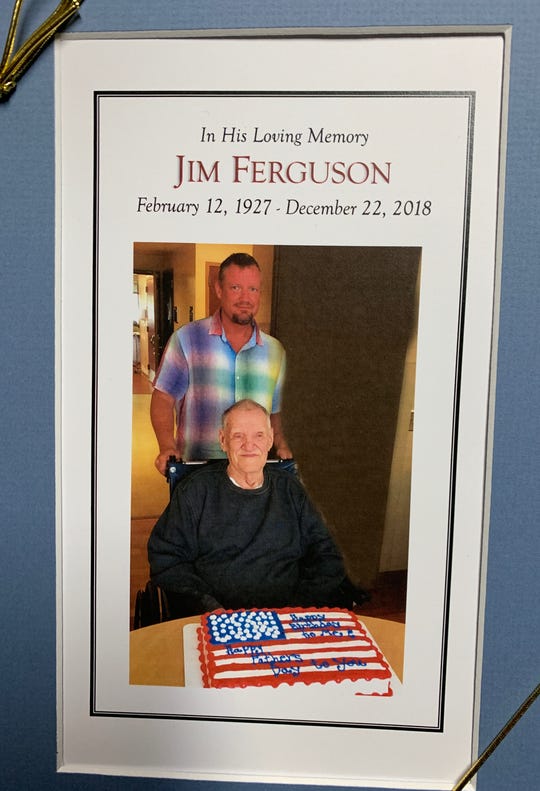
Jim Ferguson wanted answers.
How
was his 91-year-old father, who served in the U.S. Navy in World War
II, fatally injuredin a Veterans Affairs nursing home, the institution
Ferguson had entrusted to care for him?
Huddled
around a computer monitor with managers at the VA in Des Moines, Iowa,
Ferguson watched a hallway surveillance video that depicted a chilling
blow to his father's head.
“I lost it,” Ferguson told USA TODAY. “I broke down.”
In
the video, James “Milt” Ferguson Sr., who had dementia and was legally
blind, appears confused. He opens a hallway door, rolls his wheelchair
into another resident’s room, then wheels back out. No staff members are
visible. He circles around and heads back into the room.
Halfway through the door, his chair flips over backwards. Milt Ferguson crashes
to the floor, landing on the back of his head. Ferguson said he was
told the chair was pushed over by the resident in the room, who can't be
seen in the video. As staff members rush to assist him, Ferguson is
able to turn over and sit up, but the impact causes a massive brain
bleed that will kill him within days.
What later
would turn the son’s despair into outrage was what he learned about
events leading up to his father wheeling around unsupervised last
December, and what happened after he smashed into the floor.
“It’s like my dad died at their hands,” Ferguson said.
A surveillance camera captured footage of James Ferguson Sr.’s fatal
injury at a Veterans Affairs nursing home. Caution: footage may be
disturbing.
USA TODAY
Serious
problems with resident care have occurred in many VA nursing homes
across the nation, including the one where Ferguson was being cared for.
USA TODAY reported in March that inspections by a private contractor hired by the VA found deficiencies that caused "actual harm" to veterans at
more than half of the 99 VA nursing homes reviewed. The inspections
found inadequate supervision or hazardous conditions at 53 of them.
James “Milt” Ferguson Sr. remembrance. (Photo: Family Photo)
In
Des Moines – which received the lowest one star out of five in the VA's
own ratings, based on surprise inspections – inspectors found managers
did not ensure staff treated residents with dignity or followed
basic infection-control and prevention measures.
The
story of what happened to James Ferguson in Des Moines provides a
deeper picture of the care one elderly veteran received. Medical records
provided to USA TODAY by his son and legal guardian outline what
specialists say was a concerning series of decisions by VA staff, before
and after his deadly head injury.
Nine
days before, VA caregivers determined Ferguson was a danger to himself
and others because his dementia caused him to wander around, agitated.
They had him on continuous one-on-one observation with an aide, but took
him off the strict monitoring when he entered the VA nursing home.
There, staff didn't reinstate the heightened observation, despite his
repeatedly straying dangerously into other residents' rooms.
After
his injury, staff put him back in his wheelchair but did not report the
incident to a supervisor for 40 minutes, the records and surveillance
video indicate. Ferguson wasn't transported to an emergency room for two
hours after that. Then, it took 2½ hours more to send him to a trauma
hospital. The time stamp on the video showed the fall occurred at
3:49 p.m. and it wasn't until just before 9 p.m. that Ferguson was
transported to the trauma facility.
'A disaster waiting to happen'
Specialists who reviewed Ferguson's medical records at the request of USA TODAY expressed concern about the quality of his care.
"It
was definitely a disaster waiting to happen, and it did," said Robyn
Grant, director of public policy and advocacy at The National Consumer
Voice for Quality Long-Term Care, a Washington-based nonprofit advocacy
organization.
"I just am really struck by the
predictability with his repeated episodes of going into other people's
rooms," she said. "They should have had some intervention so they could
provide him with adequate supervision and address the wandering."
Grant
said the length of time it took afterward to adequately evaluate and
diagnose the severity of his injury and get him to a trauma
facility also raises questions. "What was happening there, in terms of
those delays?" she said.
Richard Mollot, executive director since 2005 of the
Long Term Care Community Coalition, a New York City-based nonprofit
advocate of nursing home care improvement, said the shortfalls indicate
there was "very likely" a lack of skilled or adequately trained staff to
meet his needs.
"The point of being in that environment is that you have skilled nursing care and monitoring," he said.
Mollot
said the reporting delay is particularly concerning. "How often does
this happen that no one's looking at? That's what is so upsetting."
'All staff acted properly'
A
spokesman for the Des Moines VA, Timothy Hippen, said in a statement
that a review after the "untimely death" concluded "all staff acted
properly."
"Any time an unexpected death occurs, VA
Central Iowa Health Care System reviews its policies and procedures to
see if changes are warranted," he said. "We did that here, finding that
all staff acted properly."
In
response to questions about the case, national VA spokesman Curt
Cashour accused USA TODAY of focusing on "isolated complaints" and
"cherry-picking the experiences of a handful of veterans to create the
impression of a broad problem."
Cashour maintained
that, overall, VA nursing homes "compare closely" with non-VA
facilities. More than 40,000 veterans rely on care at the agency’s 134
nursing facilities each year.
Hippen declined to respond to detailed questions about Ferguson's case.
"We
will not be addressing the specifics of this case publicly, but we have
been in direct contact with the veteran’s family to discuss their
concerns," he said.
Jim Ferguson said he remains
upset even though VA officials shared the surveillance video with him
and said they were sorry about what happened to his father.
He wants VA staff held accountable. He wants to make sure policies are in place so it doesn't happen to anyone else.
“No
one should live their life like that and have what happened to him in
the end,” he said. “I want this to be the last person this happens
to.”
A gambler called ‘booger’
Even as his dementia worsened, Milt Ferguson flashed glimmers of his younger self.
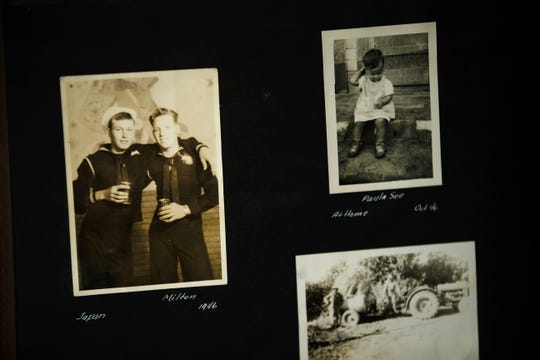
The former deckhand on the heavy cruiserU.S.S.
Pensacola was affectionately known as “booger” at the Des Moines
Register, where he worked bundling newspapers for 23 years before
retiring in 1995. He loved to play the slots and the horses.
A family album shows a photo of James "Milt" Ferguson Sr., second from right, during his days in the Navy. (Photo: Brian Powers, USA TODAY Network)
On
a note in his medical record, a nurse practitioner wrote: “Patient
laughs when his nickname is mentioned.” Jim Ferguson had come for a
visit that day, as he did most days. “He was smiling and appeared to be
enjoying his son’s company,” the medical record said.
The
decision to place him in a nursing home had been a gut-wrenching one,
Ferguson said. He had moved in with his parents and cared for them for
three years. But in April 2018 his mother died. He said a VA social
worker told him his father needed more intensive, round-the-clock care
and supervision.
“They made it sound like, well, if
he got hurt, I could be charged with a crime,” Ferguson said. “So
that’s when I decided to place him in a nursing home.”
‘His dementia was acting up’
Ferguson
moved his father to Bishop Drumm Retirement Center, a private facility
just outside Des Moines, where his mother worked as a nursing assistant
in the Alzheimer’s unit for more than 20 years before retiring.
The center took in Milt Ferguson last August. But three months later, his condition worsened.
"The day before Thanksgiving, I got a call from Bishop Drumm – his dementia was acting up," his son said.
He
hit two staff members, was “agitated all day” and was “wandering into
other residents room(s), causing distress,” a nurse later noted in
his medical record. “He is generally ‘sweet’ so this is a departure from
his usual behavior.”
Ferguson was taken by
ambulance to the Des Moines VA Medical Center, where he was admitted to
the acute psychiatry ward. He was put on one-on-one observation with a
sitter – an aide tasked with intervening if he lashed out or tried to
stray into other patients’ rooms.
They adjusted his
medications, and, after a few aggressive outbursts, he appeared calm
enough after three weeks to transfer into the VA nursing home on the
medical center’s campus.
But there was a catch, a psychiatric nurse wrote in his record: "Veterans are not put on sitter status over there."
‘Help me, help me’
After a 22-hour trial period without a sitter, Milt Ferguson moved in to the VA nursing home.
Problems began within hours.
He
hardly slept, he hallucinated, he called out "help me, help me" over
and over again. He was agitated and again, he "wandered into and out of
peers rooms" day after day, nursing staff wrote in his record.
They gave him medication. Sometimes he calmed down. Sometimes he didn’t.
A
psychiatrist was managing his case remotely. According to public
records, the doctor worked at a VA facility a few hours away in Lincoln,
Nebraska. Through virtual appointments, the psychiatrist advised
changes to Ferguson's medication.
On December 19, a
week after Ferguson moved in, nursing home staff noted he was still
restless and anxious, pacing and screaming and yelling. His care team –
psychiatrist, primary care doctor, nursing staff and social workers –
met to discuss the case.
The psychiatrist said a
review of his records showed "increased confusion with wandering" during
the past week. The doctor prescribed higher dosages of a
mood-stabilizing drug and a sedative. There was no discussion of closer
supervision or reinstatement of one-on-one observation, the records
show.
“Will ask RN to contact this MD in one week with update,” the psychiatrist wrote.
By then, Ferguson would be dead.
‘A golf ball-sized lump’
On
December 20, when two aides rushed to help Milt Ferguson, his head on
the floor and legs crumpled to the side, the time stamp on the hallway
surveillance video reads 3:49 p.m. But in a report filled out an hour
later, a nurse recorded the time of the accident as 4:30 p.m.
His
records do not indicate what the staff did with Ferguson during the
41 minutes in between, aside from putting him back in his wheelchair.
By
that time, he had a “golf ball-sized lump on the back of his head.” The
nurse notified the manager on duty, a nurse practitioner, who wrote at
5:06 p.m. that hehad ordered an immediate CT scan of his head.
That
didn’t happen until about 6:30 p.m., when Ferguson arrived in the
emergency department of the medical center on the Des Moines VA campus,
on a bed wheeled by a nursing home aide. The aide said Ferguson had
earlier been taken for a CT scan but was uncooperative.
An
emergency room doctor quickly had a sedative administered and the scan
was completed. By that point, the World War II veteran had a “large
bleed” in the back right side of his brain that was so acute, the CT
report says his brain had shifted to the left inside his skull.
Sent 'to scanning’
The
doctor notified MercyOne Des Moines Medical Center, a trauma hospital,
at 7 p.m. For nearly two hours, the doctor tried to keep Ferguson
comfortable and his blood pressure under control until an ambulance
arrived and took Ferguson to Mercy at 8:55 p.m.
The doctor also kept calling Ferguson’s son, leaving voicemails.
But
Jim Ferguson had himself been admitted to a hospital and had provided
the VA nursing home with a consent form authorizing staff to contact a
close friend if anything happened to his father. That form had been sent
"to scanning” that morning.
When Jim Ferguson retrieved all the voicemails, he rushed to Mercy the next morning.
"He
was not responsive. He was laying on his bed, making this horrible
noise as they sucked saliva out of his mouth," he said. "I never even
got to say any last words to my dad."
He died the next day.
Specialists
who reviewed the case at the request of USA TODAY singled out multiple
shortfalls in his care at the VA that may have affected the outcome.
Grant,
the policy director at The National Consumer Voice for Quality
Long-Term Care, said the 22-hour trial of having no sitter was "not
enough time to establish how he was doing."
When
he then acted out day after day, in agitation and confusion, they
should not have allowed him to wander into other residents' rooms, she
said. Such situations can cause the other residents to lash out in fear
or distress and "lead to an altercation or violence or striking out."
"One
would argue that could have been prevented," she said. "There should
have been somebody, somewhere who could have seen that this happened and
– particularly when he wheeled himself – to have gone in and
intervened, 'Let me help you, let's go to your room.'"
Mollot,
the executive director at the Long Term Care Community Coalition, said
meeting the standards of care means staff identifies risks and needs and
ways to meet them and mitigate them and then does so consistently.
"This is exactly the kind of thing that happens when those standards are not followed," he said.
'A safe place'
The
spokesman for the Des Moines VA, while declining to answer detailed
questions about what happened, said that in general, "caring for nursing
home residents involves balancing patients’ independence with the need
for supervision, as appropriate."
"While tight
scrutiny and strict limits on residents’ activities and freedom of
movement could possibly lower the risk for adverse events, it would also
severely degrade patients’ quality of life, which is precisely what we
are trying to preserve for as long as possible," he said.
Jim
Ferguson still has his father’s wheelchair in the garage. He keeps the
sweatshirt his father was wearing when he last used the chair.Ferguson has retained a lawyer, Brad Biren, to help him figure out next steps and how to hold the VA accountable.
“Somebody didn’t watch my dad and let him die,” he said. “It’s supposed to be a safe place.”
First a Long Island nursing home killed an elderly man — and now it’s suing his family over his outstanding bill.
A jury awarded $1 million to the family of ailing wheelchair-bound
Salvatore Niosi because a nurse at the Woodhaven Care Center forgot to
put in his dentures and fed him a sandwich, leading him to choke to
death.
“Suffocating to death, even if for a short period of time, is a
terrible way to die,” said Clifford Argintar, the lawyer for the family
of the 82-year-old grandpa.
But the nursing home is still counter-suing Niosi’s kin, claiming the
family owes it money over his stay there, thanks to an alleged clerical
error with his Medicaid application.
The lawyer for the victim’s estate, Michael Regan, balked.
“My position is that the nursing home shouldn’t financially benefit from killing this guy,’’ he said.
Niosi had been at the facility for six years after suffering multiple
strokes that left him immobile and unable to speak or even swallow
properly, Argintar said.
The elderly man’s medical chart specified pureed food only.
But Dec. 13, 2013, a Woodhaven Care nurse fed him a sandwich without
reading his chart or even putting in his dentures, and he choked to
death within 3 minutes, relatives said.
The staff took a half-hour to even call 911, their lawyer said.
An autopsy report later listed Niosi’s cause of death as choking and included the note, “food material in airway.”
Niosi’s daughter, Silvia Teixiera, filed a wrongful-death lawsuit against the nursing home in June 2015.
The nursing home admitted its error on the eve of trial, and a jury
was charged only with deciding a monetary verdict for Niosi’s suffering —
which they reached last week after a four-day trial in Suffolk County.
Teixiera said her father died 10 months before the birth of her daughter.
“It would have been nice for him to know he had another grandchild,’’ the mother of four told The Post.
“It’s sad that he had to go in that way and that he had to have panic
in his face and that I wasn’t there with him,” the 41-year-old Miller
Place woman added.
Neither Woodhaven nor its lawyer returned requests for comment.
BOSTON (WWLP) - After a multi-year investigation, Attorney General
Maura Healey found 7 nursing homes in Massachusetts that were
responsible for patient negligence or death.
In a report released
by the Attorney General's office Wednesday, seven Massachusetts nursing
homes reached a $500,000 settlement, $85,000 of that settlement will be
paid by JGS LifeCare of Longmeadow after a patient got caught in bed rails and died.
Others had similar tragic stories.
"Our
mother Betty Ford Crane, affectionately called Betsy would not want
anyone to die in the manner that she did," Candi Hitchcock said.
Two
sisters, Sammy and Candy shared the story of their mother who did not
receive the care she needed during a staffing change, which resulted in
her death.
"Long-term care facilities must be accountable to the
public and to the commitments made to residents and family members," AG
Healey said.
With more than 76,000 baby boomers living and
growing older in Massachusetts, the Attorney General's teaming up with
the Department of Public Health to prevent future instances of abuse.
The nursing home settlement money will go into a fund to implement strict policy changes.
The
Attorney General said that funding and staffing problems were factors
of the negligence, but corners were also cut which, in many cases,
resulted in death.
ROSEVILLE, Calif — Gene Rogers, 83, had dementia and was unable to get
around on his own. His round-the-clock care became too much for his
wife, Kathryn, to handle by herself. So, the couple’s children sold
their parents’ home in Carlsbad, Calif., and placed Gene in Meadow Oaks
of Roseville, a senior living community, on Dec 30, 2017.
Gene was a Marine and a veteran of the Korean War. He loved golfing
and stock car racing. He spent decades working for AT&T while
supporting a family of five. His family says while his dementia affected
his ability to get around, he was still smart and enjoyed life.
Their
son, Jeff, says the family expected his father’s care to be long term.
They chose Meadow Oaks because they were impressed by what they saw when
they went to visit. They were also happy the price was well below the
$10,000-a-month price tags they saw in the San Diego area. At first, the
family was very satisfied. However, Jeff says things quickly changed.
“I
noticed his care would start going downhill,” Jeff explained. “You
could see he had food stains on his clothes. We'd go there a few times
on the weekends and he would be outside on the patio. It was warm. He'd
seem groggy and he was slurring his speech a little bit.”
Jeff says the family repeatedly asked the facility not to leave Gene outside unattended, but it kept happening.
“His
nephew came in from Oklahoma,” Jeff said. “We found him, again, outside
on the patio. Again, he seemed like he was a little bit groggy. We
brought him back in and again asked the staff, ‘Hey, you know, I think
you guys are leaving him out here too long.'”
ABC10 reached out to
Westmont Living, the La Jolla-based company that operates Meadow Oaks.
They issued a statement saying, "This case is in litigation, and it is
neither fair nor proper to respond to allegations during this process.
We understand that some counsel may want to litigate this matter in the
press, or in the court of public opinion, but we believe this is an
improper attempt to pre-dispose a potential jury pool."
The next week, Rogers was left outside for an uncertain amount of time
and had to be rushed to the hospital. He would not return home.
Jeff said on June 30, 2018, he received a calm call from Meadow Oaks
letting him know his father was being taken to the hospital to get
checked out. He says there was no urgency in the caller’s voice, so he
didn’t worry about it. Then a second call came from the hospital.
“They
said, 'Hey, your dad came here almost dead. He was in critical
condition. His skin temperature was almost 104 degrees. They had to
start life-saving procedures immediately'," Jeff recalled.
Rogers’
family raced to the hospital. They were horrified at what they saw.
They say Gene’s arms blackened as if he was lacking circulation.
“We
were looking at his legs and his legs were beet red because he had his
shorts on and he actually had blisters from being in the sun,” Jeff
explained.
The family was told there was little hope for Gene. He had lost
his ability to swallow and his condition deteriorated. The hospital
advised he spend his remaining days in hospice. Gene died 14 days later.
The
Rogers family reached out to Carole Herman for help. Herman runs the
Sacramento-based non-profit Foundation Aiding the Elderly (FATE). Herman
filed a complaint with the California Department of Social Services
Community Care Licensing Division, who conducted an investigation.
The California Department of Social Services investigation report
states "staff failed to provide adequate care and supervision…which
posed an immediate health and safety risk to resident in care." It also
says "R1 (Gene) had been sitting outside for 1 hours, 45 minutes or
longer when temperatures were increasing and reached 93 [degrees] by 12
p.m. when emergency services were called."
The department
substantiated the complaint and planned to assess a penalty of $500, but
increased it instead to $1,000 because the facility was cited for
having repeated the same violation within 12 months.
The Rogers family hopes its position is bolstered by the ambulance
report from June 30, 2018. The report reads: "Per staff PT (patient) was
placed outside in wheelchair for a few hours. SNF (skilled nursing
facility) forgot about PT."
Jeff says when he tried to get information on what exactly happened
that day, he was given an explanation that doesn’t make sense.
“I
met with the director there,” Jeff said. “I said, ‘OK, tell me what
happened.’ She was like reading from a script. 'Your father got himself
outside like he often did.' And now I'm thinking alright, number one,
that's not accurate. 'We offered him water and ice at regular intervals
and then he got himself back inside and then he was found unresponsive.'
And I'm like, 'OK, you can't get yourself back inside because the doors
are locked.' And that’s when things were just not lining up.”
The
California Department of Social Services investigation report also
details interviews it conducted with employees at Meadow Oaks. Those say
Gene was given water at regular intervals. The report states, "Time
cards shows S2 (employee) was responsible for monitoring R1 (Gene) on
6/30/18. She stated in an interview that she (S2) gave R1 water to avoid
dehydration several times."
The Rogers family insists Gene was
unable to get anywhere on his own. They say he wasn’t even able to
manipulate the wheels on his wheelchair. They say that this makes a
response issued by the defendants in the lawsuit particularly upsetting.
"Plaintiff
Claude (Gene) Rogers failed to exercise ordinary care on his own behalf
for his own safety," the plaintiff's response says. "That negligence
caused the injury and damages alleged in plaintiffs’ Complaint."
“We know he couldn't care for himself,” Jeff said. “That's why we
placed you in his care [sic]. That's why we paid you almost $6,000 a
month, because he couldn't care for himself. I don't know how they can
put the fault back on him. It's insulting.”
The Rogers family continues to mourn for Gene. They say his shoes will be hard to fill.
"My
dad was the patriarch,” explained Jeff. “He was the one that really
looked after everything for many many years. He and my mom were married
over 60 years, so you know when you have something like that yanked out
of your life all of a sudden, there's going to be a lot of getting used
to for a long time.”
FAYETTEVILLE, N.C. (WTVD) -- A Cumberland
County woman is in search of answers after she said her mother's death
at a rehabilitation center could have been prevented.
In early
January, Susan Bullock's 70-year-old mother, Elizabeth Cook, was
admitted to Carolina Rehab Center of Cumberland in Fayetteville to "get
her health back up."
Bullock, however, had no idea just nine days later her mother would be dead.
According to Bullock, the facility waited too long to notify her that her mother fell out of the bed.
"She
would still be here today had they contacted us," Bullock said. "I just
don't understand how somebody makes a fall out of the bed ... and ends
up like that."
Bullock's claims led to an investigation by the
North Carolina Department of Health & Human Services. The agency's
findings show Carolina Rehab failed to notify Bullock or other family
members of Cook's fall in a timely manner.
It took staffers more than two hours to contact Bullock.
"They did not treat her," Bullock said. "I asked for all kinds of tests."
Bullock
alleged that the center failed to provide adequate care by way of
neglect and abuse. The state investigation determined those claims were
unfounded.
"I asked (the facility) is this how you guys treat
every elderly person in here," Bullock told ABC11. "Their excuse was
that they've had several people quit."
The investigation also detailed that the center addressed or planned to address inadequacies brought forth by the state.
"She was my best friend," Bullock said of her mother.
The
official cause of death as listed on Cook's death certificate lists
"healthcare-associated pneumonia" and "COPD." Bullock said before her
mother's admittance into the facility, doctors gave Cook a "clean bill
of health."
In a statement to ABC11, Carolina Rehab Center of
Cumberland wrote, "Privacy laws prohibit us from addressing the specific
allegations. We do think it is important to separate opinions from
facts. We fully investigate concerns when they are brought to our
attention. We stand by our commitment to our patients and take great
pride in the care we provide."