Showing posts with label COVID-19. Show all posts

Tuesday, September 27, 2022

‘They’ve been an afterthought’: millions of elderly Americans still vulnerable as pandemic caution wanes

For older people, loneliness and the stress of weighing risk of ordinary activities have taken an additional toll
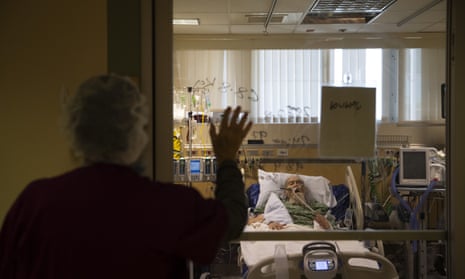
A woman holds up her hand to a window in greeting. On the other side of the window is an elderly man in a hospital bed who has been hooked up to monitoring equipment.
Susan Morales waves to David Feinour, 71, who has Covid, at St Jude Medical Center in Fullerton, California, on 10 July 2020. Photograph: Jae C Hong/AP
by Melody Schreiber

It was Mother’s Day in May 2020, and an elderly woman lay dying in a Rhode Island nursing home. Her children couldn’t visit because of Covid, and as much as Adelina Ramos, her certified nursing assistant, longed to provide comfort from her bedside, she had to leave, even though she could see the woman was slipping away.

She had 25 other patients to care for that day.

It “really broke my heart,” Ramos said. “Families trust us to care for their loved ones. I can’t describe how painful it feels when we are forced to make those kinds of choices.”

She recounted the devastation wrought by the pandemic in a hearing on Wednesday before the House subcommittee on the coronavirus crisis.

Although Covid causes less panic now, particularly given the protection offered by updated vaccines and treatments, older Americans are still seeing their lives upended – and, tragically, ended entirely – by new outbreaks.

As the rest of the country seeks a new normal, millions of vulnerable Americans still remain at risk and in limbo. They’re now navigating a world ruptured by continued virus surges, shortages in the staff who care for them, and grief over more than a million people lost in two years.

Even so, the US Centers for Disease Control and Prevention (CDC) on Friday dropped its mask recommendations for hospitals and nursing homes, except during times of high transmission or while providers are caring for moderately and severely immune-compromised patients.

The move could make it even more difficult for those at risk, especially elderly people, to navigate health care settings and long-term care facilities safely.

Prioritizing older Americans during this time is “paramount”, said David Grabowski, a professor of health care policy at Harvard Medical School. “It’s the group overall during the pandemic that’s been hit the hardest, and yet in many ways … they’ve been an afterthought.”

People over the age of 50 account for more than 93% of Covid deaths in the US.

“We still are seeing hundreds of deaths a day, and they’re occurring disproportionately among older Americans,” said Theresa Andrasfay, a postdoctoral scholar of gerontology at the University of Southern California.
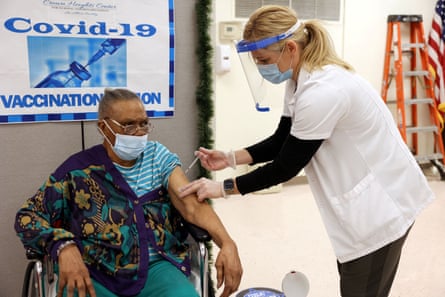
A female medical worker gives a vaccine to an elderly woman in a wheelchair.
Coronavirus has dropped life expectancy rates for all Americans, but changes are greater among people of color. Photograph: Yuki Iwamura/Reuters

Life expectancy has dropped for all Americans, but changes are greater among communities of color, Andrasfay said. “The Native American population had by far the largest decline in life expectancy, followed by the Latino population and then the Black population.”

In February 2021, older Americans who caught Covid were 1,000 times more likely to die than teenagers, according to a McKinsey report that predicted the “arrival of safe, effective vaccines makes the pain of that isolation a time-bound problem”.

Yet for many, isolation and stress from the pandemic persist, especially as the protection offered by vaccines wanes without boosters and as new variants emerge.

Relatively high rates of vaccinations among older people helped mortality rates drop slightly in this age group from 2020 to 2021. But the Omicron variant, which is more transmissible and better at evading immunity, brought near-record surges in elderly mortality.

A total of 95% of Americans above the age of 65 have gotten at least one Covid shot. But from there, the coverage begins to drop precipitously. Among those who were fully vaccinated in this age group, 70.8% got their first boosters. But only 40% of that group went on to get second boosters.

That means a total of 14.9 million older Americans are up-to-date on vaccinations, compared with the 57.5 million who were willing to get the first shot. Booster rates are even lower among Americans aged 50 to 64.

This could have dire implications for their safety moving forward, even as remaining precautions disappear across the country.

In nursing homes, only 57% of residents and 43% of staff are up to date on their vaccines. Rates are lowest in Arizona, Florida, Nevada and Texas.
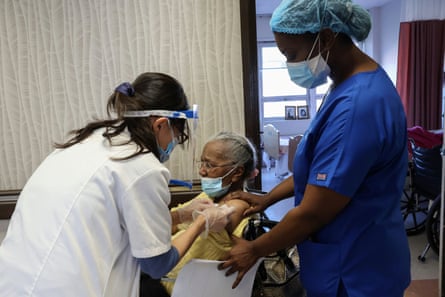
Two medical workers administer care to an elderly woman in a wheelchair.
In nursing homes, 57% of residents and 43% of staff are up to date on their vaccines. Photograph: Yuki Iwamura/Reuters

Fewer than 1% of Americans live in long-term care facilities, yet about one-fifth of all deaths from Covid-19 are related to nursing homes, with more than 200,000 residents and workers dying from the coronavirus since the start of the pandemic.

“Residents, their families and their caregivers have long known that US nursing home care is broken, yet this issue has gone largely unnoticed in the broader population. Covid changed this,” Grabowski testified at the hearing.

The House coronavirus subcommittee outlined the “dire” conditions of for-profit nursing homes during the early months of the pandemic, revealing widespread neglect that led to health deterioration and death.

Nurses and nursing aides cared for as many as 38 patients during their shifts. In April 2020, when only one nurse was covering two entire floors at a facility in Nevada, one resident waited four hours for a sip of water and another resident who vomited on herself was not cleaned for at least two days, according to the House report.

Yet at least 32 states have passed legislation making it harder for residents or their families to sue long-term care facilities for such treatment.

Some of the worker shortages were because of Covid cases among staff, which could have been prevented in part with better precautions. But one nursing home worker alleged that the corporations wanted to save money by not hiring additional workers despite the need for them.

Long-term care facilities were plagued with staffing shortages and low morale before the pandemic started, and Covid sharply amplified the cracks in how America cares for its senior population.

“Nursing homes are already understaffed, under-resourced. So when you’re putting a profit motive on nursing homes to squeeze out a couple extra dollars from these communities, it’s going to compromise care,” said Ashwin Kotwal, assistant professor of geriatrics at the University of California, San Francisco, School of Medicine.


But it’s not only nursing home residents who have been affected by Covid – and damage from the pandemic wasn’t limited to the virus itself.

The pandemic also caused stress and loneliness, which affects both mental and physical health. In 2019, about 1.6 million adults above the age of 70 were homebound, but that number more than doubled to 4.2 million in 2020. Being homebound increases the risks of sickness and death.

Age was the greatest risk factor for severe outcomes from Covid, but loneliness compounded poor health, according to a Commonwealth Fund survey conducted between March and June 2021. Pandemic disruptions limited and delayed health care, and it amplified “considerable” social and economic challenges.
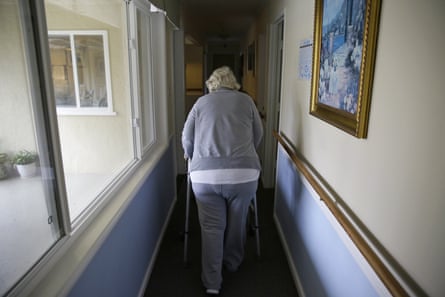
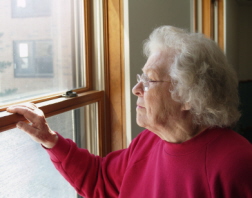
An elderly woman walks down a hallway.
The pandemic caused stress and loneliness, affecting mental and physical health. Photograph: Eric Risberg/AP

“Compared to their counterparts in the other survey countries, older adults in the US have suffered the most economically from the Covid-19 pandemic, with more losing a job or using up all or most of their savings,” the report said. Economic hardships for older Americans were four to six times greater than in other countries surveyed, and they were more likely among Latino and Black adults than among white adults in the US.

Disruption and isolation are likely to continue for those who need to continue taking Covid precautions.

“What’s concerning going forward, as there’s more focus on individual responsibility, is that it makes it more difficult for people who are vulnerable, either because of underlying conditions or because of their age, to feel safe taking part in necessary activities,” Andrasfay said.

Those activities can include taking public transportation, medical visits, returning to work or seeing family and friends.

Weighing these risks is a fraught and exhausting process, Kotwal said.

“It can make even the most simple of social activities something that people really stress over and think about a lot. I’ve seen a lot of anxiety around how people make these decisions to do what are really normal activities, like going to grab coffee with their child or hanging out with their grandchildren.”

Keeping up-to-date on vaccines is an important part of protecting those most at risk, he said. “We can bring this into a place of community – being responsible, trying to protect others – rather than only looking at this from the individual safety lens.”

Vaccination clinics and vaccine mandates in health systems and long-term care facilities were “really effective,” Grabowski said. About 87% of residents and staff in nursing homes were vaccinated because of the clinics and mandates – but those requirements have not been updated to include boosters.

An expanded federal mandate for staff to receive booster doses would help, he said. And more vaccine clinics for facilities, as well as campaigns to reach homebound adults and others facing access problems, could also increase booster rates and protect older adults this winter.

“This is too important,” Grabowski said. “By all means, let’s make this as easy as possible.”

Full Article & Source:
‘They’ve been an afterthought’: millions of elderly Americans still vulnerable as pandemic caution wanes

Friday, June 10, 2022

Charges dismissed against COVID patient who assaulted senior citizen in nursing home

By: Kimberly Craig

DETROIT (WXYZ) — "He shouldn't be in prison," Marty Hayden said about his son Jadon, now 22, who had been facing multiple charges including assault for the May 2020 beating of Norman Bledsoe inside a nursing home on Detroit's west side.

The charges against Jadon Hayden were dismissed after he was found incompetent. Hayden now resides in a psychiatric hospital in the Kalamazoo area where he cannot come and go. 

Marty Hayden said if his son had been convicted and sent to prison, it would have only worsened his mental health issues.

"So the system is going to fail him again. He's not going to be rehabilitated," Marty Hayden told 7 Action News Tuesday, adding that because of his son's mental health issues, he cannot understand the gravity of his actions.

Marty Hayden is hoping to find a lawyer to hold those responsible for placing his son in the nursing home, where he believes he was set up to fail and Bledsoe to become a victim.

"Why should you put him in a nursing home? All around elderly people," he said. 

Jadon Hayden videotaped himself repeatedly hitting Bledsoe as the Army veteran laid in his bed. The two men shared a room at the Westwood Nursing Center on Detroit's west side.

Jadon Hayden was in a group home in Washtenaw County when he called his father to say he was hearing voices and thought people were out to kill him.

"He was in crisis mode," Marty Hayden said about his son who had a known history of assaultive behavior.

In early May 2020, Jadon Hayden called 911 so that he could be sent to a hospital for treatment. His father said it was at the University of Michigan Hospital in Ann Arbor where Jadon was then diagnosed with COVID-19. He said that's when the 20-year-old who had dreams of becoming a boxer was sent to the nursing home to recover.

Gov. Gretchen Whitmer and state health officials have been criticized for allowing nursing homes to accept those recovering from COVID-19 for continued care. And nursing homes have been criticized as being motivated by money to participate in being a COVID-19 hub.

"They dropped the ball. Why would they put my my child in a nursing home," said Marty Hayden, adding that everyone involved in making the decision to send his son to the nursing home should have seen that he had assaultive behavior in his record as well as other issues stemming from his schizophrenia.

"They should have known," said Jadon Hayden's attorney Brian Berry. "I think the facility had an idea of who Jadon was and what type of treatment he needed. I think they knew, or had a history, that he was schizophrenic and it should have been handled differently."

Berry said while the charges were dismissed without prejudice, he thinks it's unlikely the case will be refiled.

"Jadon's condition is not going to change very much," he said. "Unfortunately, both the victim in this case and the defendant were both in put in a bad situation."

Bledsoe died in another nursing facility two months after the assault. His death was not ruled a homicide.

Bledsoe's family has retained attorney Geoffrey Fieger and a lawsuit has been filed against the nursing home.

Marty Hayden said he extends his condolences to Bledsoe's family. He said he also hopes those involved in placing his son in the nursing home will be held accountable. 

7 Action News contacted Westwood Nursing Center, but they have not responded.

Bledsoe's brother said he is hoping that one day, Jadon Hayden will be held accountable for his actions.


Full Article & Source:

Wednesday, June 9, 2021

95-year-olds who found love in the time of COVID-19 get married

Click to Watch Video
By Steve Hartman 

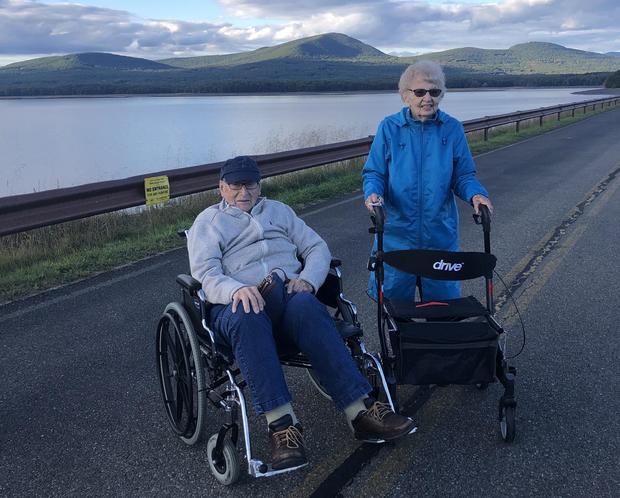
For 95-year-old John Shults, the best thing to come out of the COVID-19 pandemic is coming down the aisle. His bride, Joy Morrow-Nulton, is also 95. 

Together they're proving you're never too old to make a lifetime commitment. 

CBS News first met the couple in March, parked along the banks of the Hudson River in upstate New York. ("Parked" in the slang sense.)

Shults and Morrow-Nulton have both been widowed twice but were determined to find love again, which wasn't easy. Before they were vaccinated, they had to do most of their dating in a bubble. 

"She was worth it. It was a pain in the neck, though," Shults said of maintaining the relationship through the pandemic. 

Shults' son Pete said the two would call each other every day. "They'd find a way to get together. They did whatever it took."

What it took, they say, was a return to simple pleasures, like long drives to nowhere, batting balloons around the house and a lot of selflessness. 

"She's richer than I am, just so you know. She bought me a walker," Shults said. "$159, I think. I told you she had money. She did have it until she bought my walker." 

john-joy-reservoir-2.jpg
John Shults and Joy Morrow-Nulton, both 94, are engaged.  Handout

Not to be outdone, Shults bought her a little something, too. But he had to pop the question dozens of times before Morrow-Nulton said yes.  "Finally I said, OK," she said, adding that she finally accepted the proposal "when we had snow days and I didn't come up here, I missed him." 

They recently tied the knot in a small ceremony. 

john-joy-reservoir.jpg
John Shults and Joy Morrow-Nulton were determined to find love again.  Handout
 Full Article & Source:

Tuesday, April 13, 2021

Man in hospital with COVID-19 after receiving Johnson & Johnson vaccine

By Elizabeth Rosner
 
A New Jersey man is in the hospital with COVID-19 — just five weeks after being vaccinated.

Francisco Cosme, 52, was ecstatic when he booked an appointment for the one-dose Johnson & Johnson vaccine at the Javits Center on March 6.

After Cosme was vaccinated, he continued to wear a mask and follow social distancing guidelines but he became “very confused and began doing things that were not normal,” his daughter, Michelle Torres, told The Post.  

“April 1 was the very first day he started to have symptoms,” Torres said. “He had a cough, fever, chills, everything.”

The 31-year-old drove her father to a clinic where he tested positive for COVID-19 and he was instructed to quarantine for 10 days.

Francisco Cosme, the New Jersey man who was hospitalized with COVID-19 despite being fully vaccinated.
Michelle Torres
Last week, his condition worsened and Torres noticed he had trouble breathing and called 911 during a visit to his home in Edison, New Jersey.

After giving Cosme oxygen, the ambulance crew rushed him to John F. Kennedy Medical Center, where he is in critical condition and is also being treated for pneumonia.

“I’m trying to hold it together, every day you don’t know what is happening,” said a tearful Torres.

“The doctor said they did all they can do it and it’s up to him to fight and up to God.”

Torres told The Post her mother, husband and children ended up testing positive for COVID and are in quarantine until next Sunday.

“We survived the whole year without it [vaccine] doing all the things we are supposed to so do — social distancing, washing hands and masking up,” she explained.

“It’s crazy and we need answers,” Torres concluded.

The Post also reported that a Brooklyn woman who got the Johnson & Johnson vaccine at the Javits Center on March 10 contracted COVID-19.

Full Article & Source:

Monday, April 12, 2021

Embattled Cleveland Municipal Court Judge Pinkey Carr accused of more inappropriate behavior in new disciplinary complaint

 By Cory Shaffer

CLEVELAND, Ohio — A state disciplinary attorney issued a 118-page complaint against a Cleveland Municipal Court judge who, in spring 2020, ignored a directive to stop holding hearings because of the pandemic.

The new complaint filed Friday against Judge Pinkey Carr says she routinely flouted court rules and antagonized defendants, lawyers and court staff from the bench. It accuses the former city and county prosecutor of making inappropriate jokes about fictional strip clubs and says she issued arrest warrants for people who did not show up to court hearings that she scheduled without telling them.

Carr ran afoul of rules that require judges to conduct themselves fair and impartially, uphold the public’s confidence in the judiciary and maintain proper courtroom decorum.

The sweeping complaint comes as Carr is already facing disciplinary proceedings for violating an administrative order limiting court hearings due to the coronavirus. She also made false statements to a TV station and another judge denying that she issued warrants for people who did not show up for hearings after the court announced it was postponing them.

Other findings in the complaint say Carr:

  • Negotiated plea deals with defendants without a prosecutor or defense attorney present
  • Cracked jokes at the expense of defendants
  • Waived court costs and fines without asking whether they could afford to pay them and filing fictitious paperwork with the court
  • Presided over court hearings in workout clothes and no robe, prompting one defendant to ask court staff if a judge planned to attend the hearing

Assistant disciplinary counsel Michell Hall wrote that Carr’s conduct violated multiple rules of professional conduct. Hall requested that the Board of Professional Conduct and the Ohio Supreme Court sanction Carr.

Carr has until April 15 to file a response to the amended complaint.

A request for comment from Carr sent to court spokesman Ed “Flash” Ferenc was not immediately returned Friday evening.

Friday’s complaint says Carr conducted several improper hearings with defendants charged with low-level misdemeanor charges who appeared without an attorney. She quizzed them about the facts of their cases, the complaint says.

Many of the cases involved people charged with alcohol-related offenses. She mocked one man charged with violating open-container laws for drinking cheap beer and joked in the courtroom about how long it would take him to pay a $25 fine.

She also prevented defendants from leaving her courtroom so she could continue to joke about them with her staff, the complaint says. One man was accused of violating a protection order for texting a woman that a man she was with was a “f--k boy.” After he left, Carr joked with her bailiff about asking him what that term meant. She then directed someone from the court to get the man from the hallway and bring him back so she could ask him. When he returned, she asked him what it meant, then told him not to bother answering and told him to leave again. She then laughed with her staff and continued talking about the case while the next defendant waited for their hearing, the complaint said.

Carr also made jokes from the bench about P-Valley, the name of a Starz TV show about a strip-club in Mississipi, the complaint said. She joked about taking a court bailiff there and then asked about a female attorney who appeared in her courtroom who she referred to as “cute.”

The complaint also said that Carr once yelled at an assistant public defender when he told a man charged in connection with a shootout that he didn’t have to answer when Carr asked what the word “firefight” meant. Carr chastised the attorney and said she could ask any question she wanted to.

The attorney asked Carr to wear her mask if she was going to yell. The next day when the same attorney was in her courtroom, Carr wore her mask below her chin and asked her bailiff to use a tape measure to count the number of feet the attorney was away, then continuously mocked the attorney for his concern over the coronavirus.

She routinely berates defendants who call her “ma’am” by referring to them as “little boy” and “little girl.” One elderly defendant repeatedly answered Carr’s questions with “yes ma’am” and “no ma’am.” As the woman walked out of the courtroom, Carr muttered loud enough for people in the courtroom to hear about how she wanted to punch the woman in the face.

The complaint also criticizes Carr for abusing the capias process in cases where she ordered people to pay fines without going through the clerk of court’s office. She regularly orders defendants to pay fines by a specific date, then schedules a hearing on their ability to pay a few days later if they fail to meet the deadline. If the defendants don’t show up to the hearing, she issues an arrest warrant that also includes an order barring them from qualifying for programs that allow them to pay their fines through community service, guaranteeing their arrest, the complaint said. In at least one case, Carr never told the defendant that she set the hearing, the complaint said.

When he didn’t show up, she issued the warrant, and he spent a total of five days in jail because he didn’t pay a fine for a misdemeanor traffic case, the complaint said.

Friday’s complaint is in addition to disciplinary counsel Joseph Caligiuri’s complaint recommending Carr be disciplined for violating six rules of judicial and professional conduct. Among other things, those rules require judges to promote public confidence in the judiciary and bar attorneys from engaging in “conduct involving dishonesty, fraud, deceit or misrepresentation.”

Cleveland.com reported last March that Carr held court hearings in violation of the order that Administrative Judge Michelle Earley issued order postponing all court hearings for defendants who were not already in jail to prevent the spread of COVID-19. The March 13 order was posted on the court’s website and distributed to media outlets, who reported that the court hearings had been closed.

Cleveland.com reported on March 17 that Carr had held hearings that did not follow Earley’s order on the previous two days and issued capiases -- or arrest warrants -- for people who did not show up.

Carr, who did not return requests for comment from cleveland.com at the time, granted an interview to WJW Channel 8 reporter Peggy Gallek and said while on the bench in her courtroom that cleveland.com’s report was false and that she worried it would make people think they had to come to court or else she would issue arrest warrants for them.

After the interview concluded, courtroom video obtained by cleveland.com showed Carr went on to issue arrest warrants for 17 people who did not show up to her courtroom and issuing bonds for their eventual arrest. The video also showed Carr mocked an assistant public defender who had asked if he could tell his clients they didn’t need to come to court the next day in keeping with Earley’s order. Carr rejected his requested, and after the lawyer left the room, Carr turned to a member of her staff and referred to him as “little idiot.”

Cleveland.com later reported on the videos, and Carr, who again did not return cleveland.com’s requests for comments, told WJW Channel 8 that she did not know that when she marked a defendant’s failure to appear that a warrant would be issued for that person’s arrest.

Caligiuri’s complaint also included a text message exchange between Carr and Earley later that day. Carr again called cleveland.com’s reporting “reckless” and “inaccurate.” Earley asked Carr if she issued arrest warrants, and Carr responded that her journal entries clearly stated “no warrant to issue,” according to the complaint.

Full Article & Source:
Embattled Cleveland Municipal Court Judge Pinkey Carr accused of more inappropriate behavior in new disciplinary complaint 

Sunday, April 11, 2021

Many long-term care staffers refused the vaccine. Now they have more infections than residents.

By Cindy Krischer Goodman, Kate Santich and Adelaide Chen

Nurse Eva Diaz administers the Pfizer vaccine to Pam Peters a nurse practitioner at John Knox Village, Wednesday, Dec. 16, 2020, in Pompano Beach, Fla. Many long term care workers have declined the COVID vaccine. (Marta Lavandier/AP)

At Florida’s long-term care facilities, more workers are now infected with COVID-19 than elderly residents, a dramatic shift from earlier in the pandemic.

Despite state and federal attempts to offer vaccinations at all nursing homes and assisted-living centers in the state, 62% of staffers have declined — posing the single biggest threat to the more than 25,000 elderly people in those facilities who are also unvaccinated.

“These are the folks from the beginning that were bringing it in,” said Mary Daniel of Jacksonville, a caregiver and advocate for families of residents. “It’s frustrating. Staff members are choosing not to get the vaccine and it’s the residents who are getting punished because their families are getting locked out again.”

As of April 9, 344 of Florida’s long-term care workers tested positive for COVID, compared to 276 residents. The good news is overall cases are down — only a tenth of what they were in January, according to state data.

But while infections in residents continue to decline, cases among workers have plateaued, or in some instances, begun to tick upward in recent days. These are mostly low-paid workers who are in close contact with elderly residents.

Nursing homes are mandated to test their workers regularly for COVID-19 but assisted living facilities are not. So it’s possible not all cases are reported. Most homes continue to require masks and check the temperatures of staff daily to spot symptomatic workers with COVID before they expose others.

But mandating vaccination is highly controversial.

“Some workers are totally against it,” said Pascal Bergeron, chairman of North Lake Assisted Living in Hollywood and CEO of ALF BOSS, an assisting living resource agency. “They are scared to death of it, and forcing it on them would probably cause some to quit.”

The low vaccination rate is worrisome in workers who care for the group most vulnerable to COVID-19, particularly when some residents did not get vaccinated either. The Agency for Health Care Administration reports that 82% of residents are vaccinated.

Kristen Knapp, communications director for the Florida Health Care Association, which represents nursing homes, said a combination of factors exists for why some of these vulnerable residents still aren’t fully vaccinated: Some are new admissions, others declined as a personal choice or their family declined for them. And some have underlying conditions that put them at risk.

But the effort to inoculate both residents and staff isn’t over, Knapp said. (Click to continue reading)

Full Article & Source:

Friday, April 9, 2021

Florida long-term care residents can enjoy family visits, complete with hugs

Federal and state restrictions loosened this month to allow more normal visitation after more than a year of pandemic-induced lockdowns  

On July 17, 2020, Margaret Choinacki, 87, who has no other family members left because her husband and daughter have died, blows kisses to her friend Frances Reaves during a drive-by visit at Miami Jewish Health in Miami. [ WILFREDO LEE | AP ]
By Bailey LeFever

The state Agency for Health Care Administration announced on Tuesday that it was removing restrictions on residents of long-term care who want to visit with their loved ones.

The move came more than a year after the coronavirus pandemic forced nursing homes and assisted-living facilities to close their doors to the outside world. The state restrictions were put in place in March 2020, with the goal of keeping the disease out of care centers, and were loosened later in the year to allow socially distant visits from loved ones.

For many residents and their families, this news means everything, said Louise Merrick, administrator of Gulf Shore Care Center, a nursing home in Pinellas Park. Residents had been making the best of the pandemic-induced lockdown with window visits, phone calls and FaceTime.

“None of that is the same as holding the hand of your loved one,” Merrick said.

Limiting visitation has helped keep residents safe, but isolation has left its toll on residents and their families, the state health care agency said in the release. “Moving forward, all long-term care facilities should strive to help alleviate the burden caused by separation of residents from their loved ones.”

Nursing homes must adhere to revised federal visitation guidelines and “core principles of infection prevention,” according to the release. Other long-term care centers must follow state and federal recommendations and “industry best practices for visitation, infection prevention and the screening and triage of everyone entering a facility for signs and symptoms of COVID-19.”

This week’s changes follow guidance issued March 10 by the U.S. Centers for Medicare and Medicaid Services that nursing homes should permit “responsible indoor visitation at all times for all residents,” the Tampa Bay Times previously reported. The move comes after millions of coronavirus vaccines have been administered to residents and staff of these facilities.

The federal guidance still limits visitation for the following nursing home residents: those who are unvaccinated and live in a county with a coronavirus positivity rate greater than 10 percent or in a home where less than 70 percent of residents are fully vaccinated; those who are infected with COVID-19, regardless of vaccination status; and those who are in quarantine, regardless of vaccination status.

The guidance also states that “compassionate care” visits for those whose health has declined should always be allowed, regardless of vaccination status.

The state Agency for Health Care Administration cited a 90 percent decline in coronavirus cases among residents and staff in the past 60 days. In addition, “current COVID-19 long-term care cases represent less than 1 percent of residents and staff,” according to the release.

Coronavirus cases have dropped in Florida’s long-term care centers since a peak in January, with 358 resident cases out of 138,806 residents as of March 23, down from 3,651 cases on Jan. 17, according to the Florida Department of Health.

Florida’s long-term care centers have been waiting to welcome residents’ families and friends back into facilities, said Kristen Knapp, spokeswoman for the Florida Health Care Association, an industry group representing nursing homes.

Rolling back visitation restrictions is a large step toward normalcy for facilities, said Brian Lee, director of Families for Better Care, which advocates for long-term care residents.

Full Article & Source:

Monday, April 5, 2021

Varying visitation rules at long-term care facilities frustrate families

‘It’s hard emotionally’ one woman says of efforts to see her mother


by Marilyn Parker

JACKSONVILLE, Fla. – Not every long-term care facility immediately opened its doors after Gov. Ron DeSantis lifted visitation restrictions in Florida.

Families say that makes it difficult because not everyone is playing by the same rules, despite the governor telling them to open the doors.

Some of those families told News4Jax they need all the time they can get with their loved ones because moments are precious when their loved ones are slipping away.

Carrie Farmer and her mother have one 15- to 30-minute scheduled visit a week, and during the visit they’re kept apart and dressed in PPE.

“She keeps asking when can she come home for a visit for a few hours,” Farmer said. “It’s frustrating and it’s hard emotionally because some people are able to get in and see their love ones and be there for them fully.”

Terri Alderfer’s mother, like Farmer’s, suffers from dementia and struggles with isolation. Alderfer recently got to pick her up from the facility.

“I got to take her out. She got to walk outside those doors for the first time in 14 months,” Alderfer said. “It’s just been a long time. But it’s better now. And we’re going to be thankful for what we have.”

DeSantis’ administration lifted visitation restrictions late last month, but not all facilities immediately followed the updated guidelines.

One woman told us a facility in Orange Park suspended visits dues to positive COVID cases. Others say they got emails the same week, saying their facility no longer required appointments or time limits for visits.

Every facility is different, and it’s best to contact them directly for their current rules.

The Agency for Health Care Administration said according to the governor’s order, residents can leave without time restrictions, vaccinations are not required for residents or visitors but are encouraged, physical contact is allowed, and there are no restrictions on the number of visits unless the facility says otherwise.

The facilities still follow CDC guidance and loved ones are encouraged to reach out to AHCA with questions.

Full Article & Source:

Family reunions in one senior assisted living facility


Source: 

Sunday, April 4, 2021

MDH: Minnesotans Can Leave Long-Term Care Facilities for Easter, Other Celebrations


(FOX 9) – Minnesota long-term care facility residents can now leave their facilities for less than 24 hours without having to quarantine when they return, giving many Minnesotans the opportunity to visit family and friends ahead of the Easter holiday weekend.

The Department of Health announced the updated guidance Thursday, allowing for one-day outings for holidays such as Easter, Passover, and other celebrations.

Regardless of their vaccination status, in almost all circumstances, Minnesota’s long-term care residents can leave their facilities for fewer than 24 hours and return without having to quarantine as long as they do not come into close contact with someone who has COVID-19.

Minnesota Health Commissioner Jan Malcolm said, however, that residents and their companions should still follow recommendations like wearing masks and social distancing.

Residents that are gone more than 24 hours will be treated as new admissions or readmissions and will have to quarantine, health officials say.

Recommendations related to outings:

  • Residents who are fully vaccinated do not have to quarantine after non-medically necessary outings unless they spend 15 minutes or more in a 24-hour period within 6 feet of someone who can spread COVID-19.
  • Residents who are fully vaccinated may gather indoors or outdoors with other people who are fully vaccinated.
  • Residents who are fully vaccinated can visit indoors or outdoors with unvaccinated people from a single household who are at low risk for severe COVID-19 infection.
  • If the resident is fully vaccinated, they can choose to have close contact (including touch) with the people they are visiting.
  • If a resident who is fully vaccinated chooses to attend a place of worship or other group events, or to shop or eat in public establishments, the resident should follow the core principles of COVID-19 infection prevention. MDH strongly encourages attending places of worship or other group events only when the 14-day county percent positivity rate is below 5%.
  • Unvaccinated residents who leave the building to gather with others may be required to quarantine when they return. At this time, quarantine recommendations remain unchanged for an unvaccinated resident, regardless of the vaccination status of those with whom they gather. 

Recommendations related to facility visits:

Residents should be able to have private visits.

  • If a resident is fully vaccinated, they can choose to have close contact (including touch) with their visitor while wearing a well-fitted face mask (if tolerated) and performing hand hygiene before and after.
  • While taking a person-centered approach, outdoor visitation is preferred even when the resident and visitor are fully vaccinated against COVID-19, because outdoor visits generally pose a lower risk of spreading the disease. Visits should be held outdoors whenever feasible. 
  • Compassionate care visits, essential caregivers, and visits required under state and federal disability rights laws should be allowed at all times, regardless of a resident’s vaccination status, the county’s COVID-19 positivity rate, or an outbreak.
  • Facilities in medium or high positivity counties are encouraged to offer testing to visitors as feasible. Visitors should also be encouraged to get vaccinated when they have the opportunity. While visitor testing and vaccination can help prevent the spread of COVID-19, neither testing nor vaccination should be required of visitors as a condition of visitation, nor should proof of such be requested.
  • Screening questions must now include whether the visitor has had close contact in the prior 14 days with someone who is infected with COVID-19 (regardless of whether the visitor is vaccinated). If the visitor answers yes, the visitor should not be allowed to enter.

For more information on guidance, click here.

Full Article & Source:

Friday, April 2, 2021

A Photographer Captured The Moment A 98-Year-Old Got To See Her Family After A Year Apart

COVID-19 vaccines mean some nursing homes are now reopening, so residents can finally hug loved ones. A series of viral photos captured Yoshia Uomoto's surprise reunion.

 
by David Mack

Staffer Laura Iijima-Schergen guides Yoshia Uomoto, 98, back to her room at Nikkei Manor in Seattle on Tuesday.
Lindsey Wasson / Reuters

It's been a long year for the Uomoto family.

As the coronavirus pandemic raged, nursing homes and assisted living facilities around the world shut themselves off to visitors in order to protect their vulnerable residents.

That meant that for over a year, Mark Uomoto couldn't see his 98-year-old mom, Yoshia, in person at her Seattle facility except through a window.

"It was hard. She was kind of isolated," Mark told BuzzFeed News. "When I saw her through the window, she was just happy to see me and I was happy to see her, but with her being hard of hearing, it was hard to talk."

Yoshia lives at Nikkei Manor, an assisted living facility primarily designed for Japanese Americans. It shut its doors to visitors on March 23, 2020. The tight restrictions helped ensure no residents contracted COVID-19, according to executive director Theresa McLaughlin, but it's still been tough.

"The pandemic has taken an enormous toll on our staff and residents,” McLaughlin said in a statement to BuzzFeed News.

Residents there have now all been fully vaccinated — so as of Monday, staff have been allowing families to visit with their loved ones, as long as they still wear masks as a precaution.

Mark, who is also fully vaccinated, said he was surprised on Tuesday when he was informed he'd finally be able to visit his mom in person. "I said, 'Yeah! Let's do it!'" he recalled.

When he arrived, he was told that Lindsey Wasson, a photographer with Reuters, would be on hand to capture their reunion.

Meanwhile, a staff member escorted Yoshia back to her room and told her to prepare for a surprise.

Lindsey Wasson / Reuters

 Yoshia closed her eyes, as she was told...

Lindsey Wasson / Reuters

And Mark and Yoshia's niece, Gail Yamada, made their way into the room, which Yoshia had decorated with pictures of the family members she hadn't seen for so long.

"The sense of anticipation was really fun," Wasson, the photographer, told BuzzFeed News.

Lindsey Wasson / Reuters

Then came the moment of surprise.

Yoshia's face said it all.

Lindsey Wasson / Reuters

She truly was surprised.

Lindsey Wasson / Reuters

"It was wonderful," Mark said. "Her expression was just seared in my memory — how happy she was."

Photos of the reunion went viral after they were published by Reuters, then shared by NBC News on Twitter on Wednesday.

Mark said he thinks his mom will get a kick out of going viral at 98: "She'll probably laugh and think, Oh, not me!"

Lindsey Wasson / Reuters

Wasson has memories of visiting her own grandmother, June Takeshita, when she lived at Nikkei Manor prior to her 2011 death.

"It was definitely nostalgic to be back there for the first time in many years and definitely brings up a lot of feelings of relief for the families," Wasson said. "We are still a long way from the end of the pandemic, but I think it represents a hopeful step towards that direction."

Lindsey Wasson / Reuters

Born in Woodinville, Washington, Yoshia raised two sons with her husband. She was widowed in 1982 but still found happiness with her sister and friends at her church. Mark said she's also been well taken care of at Nikkei Manor since she moved in about a decade ago.

Mark hopes that life continues to normalize for his family and others. He knows how lucky he is to have had the chance to see his mom in person again. The mother of a colleague of his died in a nursing home several months ago before the facilities opened back up. For now, he's counting his blessings — and hugging his mom.

"It felt wonderful. I haven't felt that in over a year," he said. "Knowing I could feel Mom and see Mom, see her smile — it's been a long while."
 
Full Article & Source:

Thursday, April 1, 2021

Some Arkansas long-term care residents leave facilities for first time in year

by Mills Hayes

Some long-term care facility residents haven’t been able to leave the facility or visit family in-person since the pandemic began. Governor Asa Hutchinson announced on Friday that the COVID-19 directives would now be guidelines, not directives

“I love to be around people. I don’t want to be by myself I never have,” Charlie Payne said.

Payne, who is 95-years-old, plays golf almost every. He moved out of the Plaza assisted living in Arkadelphia three months after the COVID-19 restrictions essentially shut down assisted living facilities. Previously, he had lived there for seven years with his wife before she passed away.

“I’m still active and I like to do outdoor things,” Payne said.

When Hutchinson lifted restrictions on some long-term care facilities he decided to move back in on Monday.

“I wouldn’t have come back unless I could come and go as I want,” Payne said.

Emily Talley lives in an assisted living center in Arkadelphia. She was only allowed to leave the facility to go to the doctor. Monday Talley was able to go with her daughter for the first time since the pandemic. They spent the time shopping and getting their nails done. (Photo by KATV)

Rachel Bunch is the executive director for the Arkansas Healthcare Association. She said the new guidelines can be confusing.

“The governor's announcement on Friday that changes those directives to guidance it affects most the assisted living facilities and the residential care facilities giving them the opportunity and the option to open up more for visitation,” Bunch said.

Nursing homes, however, fall under federal control, meaning how much they open up is dependent on the COVID-19 positivity rate in the county and the number of cases in the facility for the last 14 days.

“In the last 14 days we only have 7 long-term care facilities in Arkansas that have five are more cases,” Bunch said.

Bunch said that at present out of the nearly 40,000 residents and healthcare workers in long-term care facilities, 70 residents are positive for COVID-19 and 61 healthcare workers are positive. She said it’s a far cry from the high number of cases they were seeing at the beginning of the year.

Tamara Rocole is the administrator of the Plaza at Twin Rivers and she said that 99% of her residents received both of the COVID-19 vaccines.

“Well, it has been testing my patience,” Plaza resident Joyce Morehead said about the restrictions. She said she felt safe and taken care of inside the living facility, but is thankful to be able to eat dinner with other residents now instead of by herself.

Morehead finally got to leave the facility for the first time in a year this week. Previously, she had seen her daughters through the window in her room.

“I was overjoyed and it was so nice to once again touch a person and see them face to face,” Morehead said.

Bunch said the association is still working with the department of health and DHS to clarify the rules on certain facilities. She said if you're unsure if your loved ones facility’s guidelines have changed it’s best to call up to the administration.

Full Article & Source:

Tuesday, March 30, 2021

New Jersey Nursing Homes Operator Counting on Protocol to Dismiss Lawsuit

By Jane Mundy
 

New Jersey nursing home operator is counting on protocol to dismiss a proposed class action lawsuit claiming poor treatment of residents before and during the COVID-19 pandemic.


Lafayette, NJThe Andover nursing homes operator is facing a proposed class action lawsuit claiming poor treatment of residents before and during the COVID-19 pandemic. He argued in federal court to dismiss the nursing home abuse complaint based on state and federal law virus protocol.

Andover Nursing Home Operators


The Andover Subacute Rehabilitation Center I and II are co-owned by Chaim "Mutty" Scheinbaum and Louis Schwartz, according to federal records. NBC News reported (April 2020) that 17 bodies were found in the Andover Subacute Facility I and II morgue. Scheinbaum said the facility was grappling with the pandemic.

In a statement, Scheinbaum said "The owners, administrators and our heroic healthcare staff of nurses and nurse aides have been working relentlessly to contain the virus and safeguard our residents and staff…The health and safety of our residents and staff is our utmost priority and responsibility.“ But Schwartz’s murky history indicates otherwise. He was vice president at Skyline Healthcare, a defunct nursing home chain plagued by allegations of neglect and mismanagement and now involved in at least 12 lawsuits. As well, former employees filed lawsuits accusing the company's owners of stealing their insurance premiums.

Scheinbaum co-owns four facilities that were cited over 25 times for health-related deficiencies during inspections in 2019 and 2020. According to Asbury Park Press, the Andover facilities received average and low marks from federal health care rankings published by the U.S. Centers for Medicare & Medicaid Services.

"Government must limit ownership and management of nursing homes to only those people that demonstrate commitment and capacity to provide the best care possible to residents,” Toby Edelman, senior policy attorney with the nonprofit Center for Medicare Advocacy, told the newspaper.

Proposed Nursing Home Abuse Class Action


Last December Michael Emerson, a resident of Andover since 2019, along with relatives of Albert C. Roberts and Michele Desbiens, filed a willful misconduct complaint against the Andover Subacute Rehabilitation Center I and Andover Subacute Rehabilitation Center II, claiming patients were treated with "a lack of dignity and respect."

Emerson claims he was subjected to "repeated physical and mental abuse." He contracted the coronavirus in March 2020 and says the defendants denied numerous requests by his guardian/attorney-in-fact for his medical records.

Michele Desbiens had been an Andover II resident since 2016. Her son, Paul Desbiens said the facility refused his repeated requests to get his mother treatment for skin cancer in her arm and to have a ureteral stent removed. She contracted the coronavirus in March and died in May, according to the complaint.

Roberts was also an Andover II resident, until he died one month after contracting COVID-19 in April 2020. Brian Roberts, his nephew and administrator of his estate, claimed he only learned of his uncle's death several weeks later, after numerous unsuccessful attempts to reach anyone at the facility for an update, reported Law360.

The plaintiffs pointed out that inspections—since 2015— by Centers for Medicaid & Medicare Services "repeatedly found each of the facilities to be grossly deficient in many aspects" regarding their duty to residents. The CMS' assessment ratings for the facilities are three stars, which is classified as "average," for Andover I, and one star, the lowest possible rating, for Andover II. And in April 2020, a CMS inspection report from April investigating the coronavirus outbreak at Andover II in late March 2020 concluded “the facility was not following infection control safety practices and guidance recommended by CMS and CDC during a COVID-19 pandemic.”

Defendants Relying on COVID-19 Protocol


The Defendants are counting on the Public Readiness and Emergency Preparedness Act  (PREP Act) and the New Jersey COVID-19 immunity law to toss the class action.
 
In a February 10, 2021 ruling (the “Garcia Ruling”) the Central District of California Court held that the PREP Act provides senior living facilities with an exemption from civil liability for actions taken by such facilities to protect facility residents from COVID-19.

According to the National Law Review, “In the Garcia Ruling, the CDCA Court considered whether the PREP Act’s liability immunity extended to, and completely insulates, senior living facilities/communities for imperfect countermeasures taken by such facilities in response to COVID-19. In evaluating the impact of its decision, the CDCA Court noted that the presumption of complete immunity for providers under the PREP Act is a tough one to overcome once a federal court decides to weigh in on the issue.”

The case is Michael Emerson et al. v. Andover Subacute Rehabilitation Center I et al., case number 2:20-cv-20066 in the U.S. District Court for the District of New Jersey.
 
Full Article & Source:

Thursday, March 25, 2021

“Heartbreaking”: Elder abuse and neglect reports filed in every corner of Wisconsin

Click to Watch Video

By Sarah Thomsen

GREEN BAY, Wis. (WBAY) - Heartbreaking--that’s the word local health officials use to describe the crisis in many long-term care facilities charged with taking care of our elders.

These officials are investigating thousands of reports of abuse and neglect. They say it’s unlike anything they’ve seen. They worry about what they’ll find as restrictions are lifted and families visit their loved ones again.

It’s a concern for many people as our population ages, impacting 1.2 million people in the United States.

Wisconsin officials tell First Alert Investigation it’s become common to respond to complaint and find people neglected, alone, lying on the floor for a long time without anyone knowing about it.

DEPLORABLE CONDITIONS

“You’re assuming that your parents, or whoever, is getting really good care and often times, they’re not,” says Gena Schupp, Brown County Adult Protective Services.

Schupp and her APS team are on the frontlines, called to investigate allegations of abuse or neglect in Assisted Living, Nursing, Adult Family Homes, and private residences.

“The people that we’re seeing are so bad now they’re ending up in the hospital,” says Schupp. “We’ve had several people where we’ve gone into their home and they’ve been in very, very poor shape. Some people have passed away.”

Some people are living in deplorable conditions in their own homes and not able to care for themselves.

“A lot of people with rodents, mice, they have animals that they’re not able to take care of,” says Schupp. “Again, if you think about someone who’s not seen for a long time and they’re not able to even get up to go to the bathroom, what kind of condition they’re in.”

There’s always been concern, but Schupp says it’s reaching a level never seen, all because vulnerable people are doing what they’re told and following COVID-19 pandemic guidelines.

“They’re not being seen by people, so no one’s making those reports to us,” says Schupp.

Doreen A. Goetsch is the Adult Protective Services Coordinator for the Wisconsin Bureau of Aging and Disability Resources. “Out of sight, out of mind and we don’t know what’s happening,” she says.

As we started researching and talking with local and state health investigators, we discovered elder abuse or neglect reports in every corner of the state.

“The cases have always been there but they’re more severe,” says Alice Page, Adult Protective Services and Systems Developer, Wisconsin Bureau of Aging and Disability Resources.

First Alert Investigation requested data from the Wisconsin Department of Health Services in February. We asked how many complaints the agency received involving nursing or assisted living facilities during the pandemic.

The agency says it has an antiquated reporting system, but recorded 10,018 reports for older adults in 2019. That’s the most recent data DHS could provide.

The agency did say complaints and concerns have increased since the start of the pandemic.

WHAT WE FOUND

First Alert Investigation was told to search thousands of records in the state’s online database. We searched them one-by-one. We started with Assisted Living and Adult Family Homes--the ones the state says are sources of most problems. We looked at 175 facilities in Brown County and found 16 cited for neglect or abuse in the last year. Most of those facilities were fined thousands of dollars by the state’s regulatory agency.

Reports revealed injuries and deaths for people living in long-term care facilities.

Some of the deaths were from COVID-19. One home recorded eight deaths attributed to the virus.

Another facility reported deaths of two residents.

We found cases of staff not wearing Personal Protective Equipment, also known as PPE.

One case involved employees testing positive for COVID-19 and still coming in to work.

We found more incidents of neglect and abuse not related to the coronavirus. That includes multiple facilities that failed to giving residents their medication.

At one facility, two people missed 164 doses of needed prescription medications over three months.

We discovered findings of “inappropriate care.” A resident broke a leg when staff “pulled on their clothing and they fell out of their wheelchair.”

There’s one common factor in multiple complaints. “That they don’t have enough staff,” says Schupp. “Under trained, underpaid... often times they’re required to work double shifts.”

Last summer, police were called to a facility when the staff walked out in the middle of the night. They left 36 residents with one unqualified staff member to care for them.

“People are not getting taken to the bathroom. They’re not getting showers,” says Schupp. “Not getting their three meals a day because their facility basically does not have the staff.”

Goetsch of the Wisconsin Bureau of Aging and Disability Resources says, “We’ve gotten some really tough cases like that and it’s all due to the pandemic and lack of workforce.”

FINANCIAL EXPLOITATION

For the first time, the state is tracking another form of abuse--financial exploitation.

Between scams and thefts by family members, $25,867,537 was stolen from seniors in 2020. That’s with 45 of 72 counties reporting.

“I can’t imagine what the number is going to be when we have all 72 counties reporting. I was shocked,” Goetsch says.

In the cases we found--neglect, physical and financial abuse--facilities were cited and most face large fines. No criminal charges have been filed.

State officials describe it as a huge problem.

“It isn’t happening nearly as much as it should. Let’s put it that way: APS for many, many years, has been very frustrated with their ability to get law enforcement to pay attention to some of these cases, because LEO would say these are family matters. This isn’t for us, and that’s not true,” says Page.

Officials blame age and memory, saying it those attributes are unfairly used against the elderly.

In financial crimes, victims don’t always want to turn on family members who are stealing from them.

“Those are cases that are tough to prosecute because you don’t have real stellar witnesses. Doesn’t mean you don’t have a crime and don’t have a victim. It’s just a case that’s going to be difficult to win in court,” says Schupp.

WHAT YOU CAN DO

Wisconsin’s Bureau of Aging says the agency was working on training programs to get these cases in the hands of police and prosecutors. The COVID-19 pandemic stalled that effort.

Wisconsin has developed a hotline to report abuse. You do not need proof. If you have an instinct, report it and they’ll take it from there.

Ask a lot of question of your loved ones. Ask them how they’re eating, ask them about medications, ask them about behavior. Try to see them whether it be in person, a window visit, or virtual.

Full Article & Source: