Showing posts with label report. Show all posts

Sunday, May 11, 2025

A new report shows that rates of elder abuse in Ireland have doubled since the COVID-19 pandemic.


by Aoife Daly

The HSE report estimates that cases of elder abuse have increased to more than 7,500 in recent years.

It comes following a delay in Government legislation to implement safeguarding measures to protect older people.

CEO of Alone Seán Moynihan told The Pat Kenny Show that the actual number could be much higher, as this report only tracks reported cases.

“Elder abuse, unfortunately, is usually concerning somebody that’s a relative, a neighbour, or a friend or trusted confidant, or someone that somebody has become dependent on,” he said.

“This means that it has always been under reported.

“Hopefully, there is more confidence in reporting, but I also think maybe post-pandemic, obviously it’s been a huge societal change.

“More people have been slightly dependent, more people have been hidden, and more people are struggling with loneliness.”

Mr Moynihan said that, depending on the severity of the situation, these cases sometimes necessitate statutory and social working intervention.

“Ultimately, [complaints] go to the likes of the safeguarding teams,” he said.

“People like ourselves support the older person, ultimately help people get through the system, because sometimes these are difficult journeys for people.

“Then, ultimately, they can approach the abusers, they can create a solution.

“Sometimes the older person, just by having the confidence and having been able to take advice and ultimately seeing and reestablishing what their rights are, are actually in a position to deal with it and push back themselves.”

According to Moynihan, many of these situations stem from ageist attitudes where a person in a caring role feels they are entitled to an inappropriate level of control over their elderly charge.

If you are concerned about a suspected case of elder abuse you can call call the HSE helpline on 1800 700 700.

Full Article & Source:
A new report shows that rates of elder abuse in Ireland have doubled since the COVID-19 pandemic.

Friday, March 24, 2023

Mission Point Care facility responds to report

By DREYMA BERONJA

ISHPEMING — The Michigan Department of Licensing and Regulatory Affairs released a 179-page report citing Michigan Point Nursing & Physical Rehabilitation Center of Ishpeming for abuse and neglect earlier this month.

According to the report, all 48 residents of the facility were impacted by insufficient practices that led to the potential for abuse and neglect.

The state also found that out of 17 allegations of abuse and neglect, the facility failed to report eight of them.

LARA said Mission Point did not meet 29 requirements including treating residents with respect; keeping residents safe from abuse, neglect and exploitation; reporting alleged violations; and providing basic life support to residents, which may have led to one resident’s death.

Mission Point of Ishpeming released the following statement on Facebook.

“Upon receiving the report and further internal investigation, we immediately removed three administrative staff members and prioritized Mission Point of Ishpeming with heavy support from our regional care team,” Mission Point’s post said.

A firm representing the Mission Point said the company had no further comment.

LARA said its report was based on observation, interview and record review. It said in part that Mission Point failed to immediately initiate CPR and call 911 in one case, which likely caused serious injury, harm and death to a resident.

The resident referred to in the report as Resident #12 was found half on the floor and the upper body on the bed without a pulse or respiration.

“We have since hired replacements for the key administrative roles,” it said. “While our regional leadership continues to spend a great deal of time with the new administrative team members and on site at the facility to ensure a smooth transition, we have received overwhelmingly positive feedback from our residents, families and staff on the changes. Also, we are aggressively developing our plan of correction and have submitted it to LARA for approval.”

LARA also said the facility failed to allow residents the right to be treated with respect and dignity, including the right to retain and use personal possessions.

For example, Resident #7 was interviewed about the respect and dignity requirement. LARA found this practice resulted in psychosocial harm, fear, increased anxiety, increased insomnia, feelings of insecurity and exacerbation of the resident’s post-traumatic stress disorder.

“A (certified nursing assistant) decided to change things up in my room. She came into my room at night and rearranged my whole room. She threw out a lot of my stuff,” Resident #7 said. “My safety and security has all been shot to hell.”

Resident #7 said the change in her room made her feel violated in some way.

“When I came back, and everything had been changed … I have never had my home invaded. I have to move forward,” Resident #7 said. “I don’t feel safe anymore. I don’t feel as secure as I did before.”

The state also said residents’ right to be free from abuse, neglect and exploitation was not met. Mission Point failed to provide necessary care and services for six residents out of 15 sampled for abuse and neglect.

The report said this resulting in a finding of staff inaction resulted in residents being left saturated in urine and feces. Inadequate nurse staffing resulted in a lack of consistently scheduled showers for residents, delayed medication administration and failure to ensure residents were dressed, groomed and able to get out of bed.

In a phone interview with a guardian of one resident at Mission Point, the guardian said the facility doesn’t have enough staff to take care of everyone.

“I don’t want this facility shut down because then it would just be worse for me, I don’t know what to say,” the guardian said.

When the state asked if the guardian found the resident saturated with urine all the way down to his shoes and soiled with dried feces, she confirmed that was the case.

“We take very seriously our responsibility for and commitment to the health, welfare and safety of our residents. That care starts and ends with strong onsite leadership,” Mission Point said. “Moving forward Mission Point Healthcare Service’s leadership and facility leadership will continue to monitor the plan of correction to ensure substantial compliance.”

To read the full report, visit val.apps.lara.state.mi.us/Files/ViewDocument/58133.

Full Article & Source:
Mission Point Care facility responds to report

Thursday, April 14, 2022

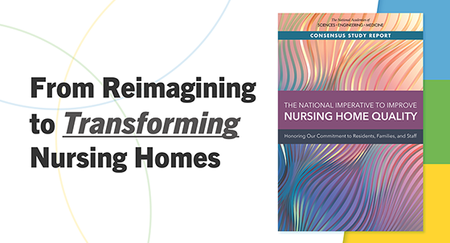
Long-Awaited NASEM Report Provides Blueprint to Transform Nursing Homes

The National Academies of Sciences, Engineering, and Medicine (NASEM) released much-anticipated nursing home recommendations in The National Imperative to Improve Nursing Home Quality: Honoring Our Commitment to Residents, Families, and Staff. The evidence-based recommendations underscore the need for critical changes to the way America finances, delivers and regulates care in nursing homes.

With major sponsorship from JAHF, the report from the Committee on the Quality of Care in Nursing Homes identifies seven goals, which provide the overarching framework for a comprehensive approach to improving the quality of care in nursing homes. The committee presents an interrelated set of recommendations to achieve each of these goals, including by:

Bolstering nursing home staff

  • Residents of nursing homes need better care—and the people caring for them do, as well. The committee report is clear that good-quality resident care will not be realized until investments are made in bedside staff. A well-paid, well-trained, empowered workforce is required.

Ensuring equitable, person-centered care

  • All nursing home residents deserve access to physical, behavioral, social and culturally appropriate care that prioritizes what matters most to them. This means ensuring adequate resources are allocated by federal and state governments, along with investments by nursing home operators, to ensure person-centered care is offered to all residents.

Redesign quality measures

  • Nursing home residents and their families require transparent, up-to-date, accurate data on nursing home quality and performance. This includes measuring the implementation of residents’ care plans and ensuring they align with what matters to them. Data on palliative care and end-of-life care, staff well-being and satisfaction, and resident demographics that track any disparities in care are also needed.

The report makes clear: the time for planning is over. The NASEM recommendations can help move society from reimagining to transforming nursing homes.

All stakeholders, including legislators, regulators, nursing home owners and operators, experts, advocates and community-based organizations, must use this report to create nursing homes of the future that protect residents and staff.

To learn more:

Full Article & Source:

Friday, January 3, 2020

Two residents at separate central Pa. nursing homes die from traumatic neck injuries

By Jana Benscoter

Two residents died at separate Lancaster County nursing homes in 2019 as a result of workers not complying with patient transfer policies, according to a media report.

The coroner determined both residents suffered from traumatic neck injuries after falling while being transferred by one worker instead of the required two, Lancaster Online reported.

In its report, the Pennsylvania Department of Health did not name the residents or employees. The incidents happened on Aug. 1 at Lancashire Hall and Sept. 8 at Mennonite Home Communities.
The reports detail what happened. 

During the Lancashire Hall incident, Lancaster Online reported that the "nurse aid transferring the resident committed another violation by not notifying a nurse of the incident. The report says the nurse aid instead claimed the resident was found in bed bleeding from the forehead.”

Since that incident, the department of health noted in its report that “numerous meetings to re-educate staff held as part of the plan of correction, along with reviews extending one month before and six months after the incident,” Lancaster Online reported.

The other incident occurred at Mennonite Home, which released the following statement to LNP: “an unfortunate and isolated incident due to the conduct of an employee who was terminated following a thorough investigation.”

"The entire Mennonite Home team is deeply saddened by this event, and we have expressed our sincere remorse to the resident’s family,” the statement said. “Mennonite Home Communities has a long and cherished history of providing outstanding care and we are committed to ensuring the safety and wellbeing of our residents and team members.”

A follow-up survey the department conducted Dec. 19 "validated that Mennonite Home successfully implemented the approved plan of correction,” which included education and audits, according to the statement.

Full Article & Source:
Two residents at separate central Pa. nursing homes die from traumatic neck injuries

Thursday, October 10, 2019

Federal study finds assisted suicide laws rife with dangers to people with disabilities

The National Council on Disability (NCD) has issued the second in a series of reports on Bioethics and Disability. NCD’s release on the report today focuses on “a federal examination of the country’s assisted suicide laws and their effect on people with disabilities, finding the laws’ safeguards are ineffective and oversight of abuses and mistakes is absent.”

The Disability Rights Education & Defense Fund (DREDF), which worked in partnership with NCD on the series of reports, summarizes this groundbreaking work:

Despite the growing consensus that disability is a normal part of the human experience, the lives of people with disabilities are routinely devalued in medical decision-making. Negative biases and inaccurate assumptions about disabled people persist. In medical situations, these biases can have serious and even deadly consequences.

Beginning on September 25, the National Council on Disability (NCD) is releasing a series of reports on bioethics and disability. The five reports were developed through a cooperative agreement with the Disability Rights Education & Defense Fund (DREDF), which appreciates and acknowledges the valued work of our partners, the Autistic Self Advocacy Network, the Bazelon Center for Mental Health Law and Not Dead Yet, in creating the series.

Each report examines the status and future of how a variety of key issue areas – including organ donation, assisted suicide laws, genetic testing, systems such as Quality Adjusted Life Years, and assumptions about medical futility – are developing due to technological and scientific advances as well as legal changes and healthcare delivery. A combination of original research, stakeholder and scholar interviews, literature reviews, reviews of media reports, and legal analysis is used to examine each topic. Each report includes findings and makes recommendations to lawmakers and policymakers that we hope will ensure that the lives of people with disabilities are valued on an equal and nondiscriminatory basis with all others.

Not Dead Yet specifically consulted on the topics of organ donation, assisted suicide and medical futility.

NCD’s release on today’s assisted suicide report includes the following details, and an example of a seriously mistaken cancer prognosis personally experienced by the NCD Chairman, Neil Romano:

Despite the belief that pain relief is the primary motivation for seeking assisted suicide, in Assisted Suicide Laws and their Danger to People with DisabilitiesNCD found that the most prevalent reasons offered by someone requesting assisted suicide are directly related to unmet service and support needs, which NCD urges policy makers respond to through legislative changes and funding.

“Assisted suicide laws are premised on the notion of additional choice for people at the end of their lives, however in practice, they often remove choices when the low-cost option is ending one’s life versus providing treatments to lengthen it or services and supports to improve it,” said NCD Chairman Neil Romano.

Closely examining the experience in Oregon, where the practice has been legal for 20 years, NCD found that the list of conditions eligible for assisted suicide has expanded considerably over time, including many disabilities that, when properly treated, do not result in death, including arthritis, diabetes, and kidney failure.

Assisted Suicide Laws and their Danger to People with Disabilities also notes suicide contagion in states where assisted suicide is legal; as well as a loosening of existing safeguards both in states with legalized assisted suicide and states considering bills to legalize.

In the report, NCD details limitations of purported safeguards of assisted suicide laws, finding:
  • Insurers have denied expensive, life-sustaining medical treatment, but offered to subsidize lethal drugs, potentially leading patients to hasten their own deaths;
  • Misdiagnoses of terminal disease can cause frightened patients to hasten their deaths;
  • Though fear and depression often drive requests for assisted suicide, referral for psychological evaluation is extremely rare prior to doctors writing lethal prescriptions;
  • Financial and emotional pressures can distort patient choice;
  • Patients may “doctor shop” limitlessly to find a physician who will obtain a colleague’s concurrence and prescribe a lethal dose
“As someone who has battled cancer and been given weeks to live and am still thriving years later, I know firsthand that well-intending doctors are often wrong,” said Mr. Romano. “If assisted suicide is legal, lives will be lost due to mistakes, abuse, lack of information, or a lack of better options; no current or proposed safeguards can change that.”

NCD concludes its research with recommendations, including highlighting the need for:
  • Federal research on disability-related risk factors in suicide prevention, as well as on people with disabilities who request assisted suicide and euthanasia;
  • Federal regulation requiring non-discrimination in suicide prevention services; and
  • Greater federal investment in long-term services and supports.
The NCD report is online at The Danger of Assisted Suicide LawsThe release dates for the other reports in the series are here, with links to the full reports as they become available.

Full Article & Source:
Federal study finds assisted suicide laws rife with dangers to people with disabilities

Thursday, April 25, 2019

Cases of Elder Abuse Increasing Due to a Couple of Factors


According to a recent report released by the Department of Social Services in Connecticut, the number of reported cases of abuse against elderly individuals throughout the state jumped dramatically between 2011 and 2017. 
 
According to this report, there were 3,529 reported cases of elder abuse in 2011 and 11,123 in 2017. It was determined by the Department of Social Services that 7,196 reported cases warranted an investigation. However, it is important to understand many of these reported cases of elder abuse also involved self-neglect, where an aging senior was unable to provide support for their own basic care, not necessarily the result of a family member, friend, or even home health care services abusing them. 

In fact, 30 percent of the elder abuse cases reported to the Department of Social Services involved self-neglect. Some of the other cases of elder abuse included financial exploitation, neglect by others, physical abuse, sexual abuse, emotional abuse, and abandonment. 

As noted by the CT Post blog, Elder abuse cases rapidly rising in CT, written by Kate Farrish: 
The Justice Department estimates that 1 in 10 American seniors are abused, and state officials say the problem is likely to grow as the population in Connecticut — already the sixth oldest state — rapidly continues to age. 
Complaints about abuse in Connecticut nursing homes, residential care homes and assisted living facilities rose by nearly 15 percent between 2015 and 2017, said Mairead Painter, the state Long Term Care Ombudsman. 
Experts say the numbers of elder abuse complaints may be rising due, in part, to greater awareness, but still, many cases are never reported. 
“Sometimes individuals are too embarrassed to report it,” Painter said. “Sometimes people are fearful that if they report abuse, they may have to stay longer at a nursing home.” 
This information highlights that the trend in elder abuse cases is increasing. In one case, an elderly woman over 90 stopped receiving in-home care support because her niece had spent the victims money on her own household and didn’t pay the home care provider. In another case, an 87-year-old victim had his utilities shut off when his son spent all the victim’s money on himself rather than paying the bills. 

Elder abuse is a serious problem and while these numbers are staggering, especially in regard to the number of cases reported, a greater awareness and ease of reporting may also be contributing to the increase in numbers of reported elder abuse cases.

Full Article & Source:
Cases of Elder Abuse Increasing Due to a Couple of Factors

Thursday, March 22, 2018

Alzheimers hitting New Mexicans like 'tsunami-like wave'

ALBUQUERQUE, N.M. - The number of New Mexicans living with Alzheimer's disease has jumped up again. The Alzheimer’s Association released its latest report on Tuesday. It shows 5.7 million Americans are living with the disease. From 2000 to 2015, deaths from Alzheimer’s went up 123 percent in the U.S. New Mexico numbers are among the worst.

"It is growing faster in New Mexico than it is in other parts of the country," said Gary Giron, Executive Director of the New Mexico Chapter of the Alzheimer’s Association.

The 2018 report says 39,000 New Mexicans who are 65 and older are living with Alzheimer’s. That is up 1,000 from 2017, and researchers predict it will increase to 53,000 by 2025.

Alzheimers hitting New Mexicans like 'tsunami-like wave'

"It is a tsunami-like wave that is hitting New Mexico and affecting more and more families," said Giron.

Alzheimer’s often has a painful, draining impact on family members and caregivers. Giron says it can lead to financial burdens for the family and even health problems for the caregiver.

"The person with the disease exits the workforce, and then you still have the caregiver continuing to be able to run that family,” said Giron. “But over time, the burden of the disease takes more and more time from that caregiver and makes their job harder and harder, so what starts as a five hour job a week, turns to be a 40 hour job, a 50 hour job, a 60 hour job where they're not getting sleep, they're not taking care of themselves and it's hard for them to make ends meet.”

New research ties significant cost savings to an earlier diagnosis. Giron says for that to happen, the nation and the state need to start talking about Alzheimer’s as a public health crisis.

"We need to train our physicians to be able to be comfortable to make an early diagnosis, to be able to make referrals to the right kind of supportive services, to be able to get folks involved with all of our free services here at the Alzheimer's Association, to get a care consultation so that they can be able to navigate their way through this disease,” said Giron.

The Alzheimer’s Association is always hosting events and fundraisers so they can continue offering free support as families try to navigate their way through a deadly, costly disease with no proven treatment or cure.

"It really is a crisis in New Mexico that we have to deal with.

Full Article & Source:
Alzheimers hitting New Mexicans like 'tsunami-like wave'

Tuesday, February 6, 2018

US care homes over-prescribing drugs for residents with dementia, report finds

Nursing homes in the US are inappropriately medicating an estimated 179,000 residents with dementia each week, in what amounts to use of “chemical restraints”, according to a new Human Rights Watch report.

The 157-page report, titled ‘They Want Docile’ claims thousands of long-term nursing-home patients with dementia are inappropriately given antipsychotic drugs not designed for them. In many cases, the report states, antipsychotics are prescribed because of their sedating effects, making dementia patients easier for staff to handle.

Antipsychotic drugs carry a serious warning from the US Food and Drug Administration called a “black box” because the drugs increase dementia patients’ risk of death. The drugs were developed to treat psychiatric conditions such as schizophrenia.

Hannah Flamm, an NYU law school fellow at Human Rights Watch: “People with dementia are often sedated to make life easier for overworked nursing home staff, and the government does little to protect vulnerable residents from such abuse.

“All too often, staff justify using antipsychotic drugs on people with dementia because they interpret urgent expressions of pain or distress as disruptive behavior that needs to be suppressed.”

The report comes as lawmakers and researchers are warning of a wave of aging baby boomers. Currently, more than 5 million Americans have Alzheimer’s, and one in three seniors dies with Alzheimer’s or another dementia. The number of people with Alzheimer’s could triple by 2050.

Researchers with Human Rights Watch interviewed 323 people and visited 109 nursing homes in California, Florida, Illinois, Kansas, New York and Texas between October 2016 and March 2017. They used federal data to estimate the percentage of patients nationally who inappropriately receive such drugs.

Researchers found instances where patients or their proxies (such as family members) were not told of the risks of antipsychotic drugs, or felt their loved ones would be removed from a facility if they were taken off the drugs.

“[It] knocks you out,” a 62-year-old woman from a nursing facility in Texas told HRW. She said she was given Seroquel, an antipsychotic drug, without her knowledge. “It’s a powerful, powerful drug. I sleep all the time. I have to ask people what the day is.”

In another instance, the director of a nursing facility in Kansas told HRW that, “antipsychotics are a go-to thing”.

Rates of nursing home residents on antipsychotic drugs have declined in recent years, but government reports have said there is more work to do.

The HRW report chimes with others, including a recent government report, which found high rates of antipsychotic drug use in US nursing homes.

For example, a federal government report found that in 2012, 33% of older adults with dementia who lived in nursing homes were prescribed antipsychotics, versus 14% who lived outside nursing homes.

The most common antipsychotics address conditions such as schizophrenia and bipolar disorder. However, the FDA has found the drugs are commonly prescribed for “off-label” disorders.

“The trend now is to reduce the use of antipsychotic medication, and to monitor and to use them as appropriate,” said a spokeswoman for LeadingAge, a lobbying group for nursing facilities.

The report follows the Trump administration relaxing regulations on nursing homes, which discouraged regulators from levying fines on violators.

HRW called on the government to step up efforts against antipsychotics use in nursing homes.The federal government pays for the majority of nursing home residents’ care through the public health program Medicaid.

Full Article & Source:
US care homes over-prescribing drugs for residents with dementia, report finds

Wednesday, January 31, 2018

Fixing Minnesota elder abuse failures is new commissioner's first job

 ST. PAUL—A Minnesota woman is back for her second stint as state health commissioner with instructions to fix the state's failed nursing home abuse investigation process.

Gov. Mark Dayton on Tuesday, Jan. 30, appointed Jan Malcolm to lead the Health Department as it struggles to get through a backlog of complaints about mistreatment of Minnesota elderly in nursing homes and assisted living facilities.

Malcolm, who served in the job about 19 years ago for then-Gov. Jesse Ventura, said her first duty is to "learn more about the root causes" of the backlog, but promised to catch up on long-ignored complaints.

A report released by AARP says that complaints of elder maltreatment soared 600 percent since 2010, but the department only investigated 1 percent of 20,791 reports from health care providers and just 10 percent of 3,491 complaints from individuals.

Malcolm said the good news is that the department has triaged the complaints and that about 1,000 still "need more work." She said she is committed to investigating all backed-up cases by end end of 2018.

The cases began to pile up while Dr. Ed Ehlinger was commissioner; he resigned late last year.

While the Health Department should have done better, Dayton said, the initial care authority lies elsewhere. "The responsibility first and foremost begins with those facilities."

After the elder abuse topic arose last year, Dayton asked AARP to convene a working group to investigate. It released its report late Monday. The governor also brought in the state Human Services Department to help the Health Department fix its problems.

The report called for "far-reaching policy and agency practice changes to prevent and deter abuse. The recommendations reflect the experiences of our organizations and a belief that older and vulnerable adults and their families should be at the center of any reform."

The report indicates that it is important to fix the problem now because the elderly population will continue to grow.

Among the working group's recommendations are:

• Expand the rights of elderly and vulnerable adults and their families.

• Senior citizens and their families should have more access to abuse reports.

• Stronger laws against nursing home and assisted living retaliation against people who report abuse.

• More legal penalties against elderly abuse.

• State licenses should be required for assisted living and dementia care facilities, like many other states already do.

• Existing laws and rules need to be better enforced, including the use of fines.

"Minnesotans deserve a system that provides optimal care and services, and maximum protection against abuse," the report says. "Elder abuse is not an inevitable consequence of the system."

Malcolm said the state is developing a better program to deal with abuse complaints, one that will prevent a backlog such as was discovered last year.

Malcolm, who has been a nonprofit health care executive, also promised that the state would do a better job of communicating with families.

The Minneapolis-based Star Tribune reported last fall that hundreds of residents at elderly care facilities in all areas of the state are beaten, sexually abused or robbed every year. Even when reports were filed with the state, investigations often were not started.

"First and foremost, I am so sorry for the pain and trauma and difficulties that have been caused," Malcolm said Tuesday.

Sen. Karin Housley, the Minnesota Senate aging committee chairwoman, said she will introduce legislation to help fix the problem after the Legislature convenes Feb. 20. "My priority will be on creating a more transparent, accountable process for facility complaints, providing better access to data sharing for families and caregivers and working to change the culture of neglect and intimidation within the state bureaucracy."

Full Article & Source:
Fixing Minnesota elder abuse failures is new commissioner's first job