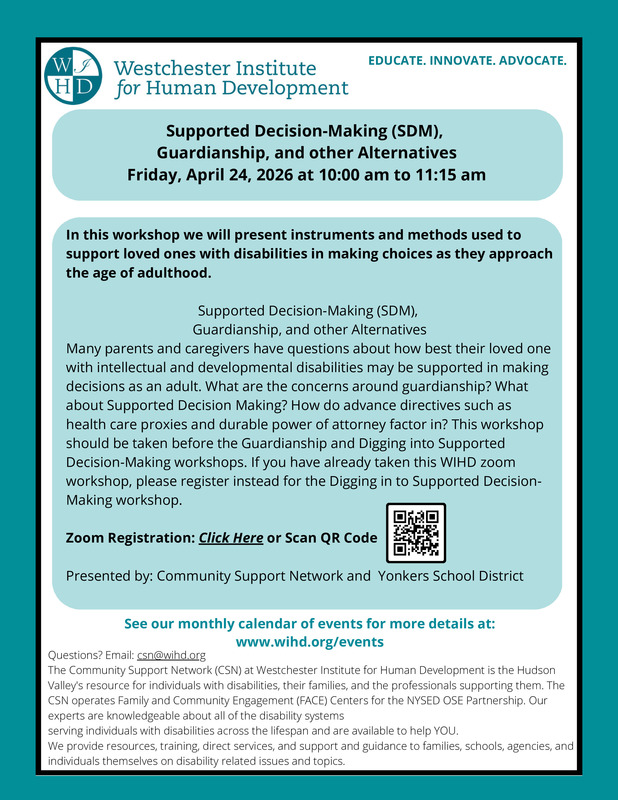
Parents
and caregivers of students with disabilities are invited to attend an
important virtual workshop focused on decision-making as students
approach adulthood. This session will explore Supported Decision-Making (SDM), guardianship,
and other legal and practical alternatives that help young adults with
intellectual and developmental disabilities make informed choices about
their lives.
The workshop will also discuss advance planning tools such as health care proxies and durable power of attorney,
and help families better understand the benefits and concerns
associated with each option. This session is recommended for families
beginning to plan for the transition to adulthood.
Date: Friday, April 24, 2026
Time: 10:00–11:15 AM
Format: Zoom (virtual)
Presented by: Community Support Network in partnership with the Yonkers School District
Registration: Click the Zoom registration link or scan the QR code on the flyer
This
workshop is presented by the Community Support Network at the
Westchester Institute for Human Development, a trusted regional resource
supporting individuals with disabilities and their families across the
lifespan.
Geisinger College hosts Elder Law Seminar August 20
SCRANTON – Community members are invited to a free
event to empower older adults and their families with essential
information on legal guardianship and available alternatives.
The seminar, “Needing Help Later in Life: Guardianship and Alternatives to Guardianship,” will take place Wednesday, Aug. 20, at 5 p.m. at the Geisinger School of Medicine, 525 Pine St. in Scranton.
Topics: •Understand the court process – Learn how guardianship works and what rights older adults have in legal proceedings •Alternatives to guardianship – How to plan to preserve independence and decision-making power •Connect with trusted resources – Hear from experts about programs and protections for older people
Speakers: •Secretary Jason Kavulich, Pennsylvania Department of Aging,
who brings 24 years of human services experience and a commitment to
empowering Pennsylvania’s older adults to age with dignity and
independence. •Keith Hinkel Jr., assistant director, Office of Elder Justice in the Courts, who supports statewide initiatives on guardianship and elder justice. •Judge Frank J. Ruggiero, Lackawanna County Court of Common Pleas, who brings deep insight and expertise from his years in public service and legal practice.
Media interviews can be arranged with featured speakers after the presentation.
This presentation is supported by the Administration for Community
Living (ACL), U.S. Department of Health and Human Services (HHS) as part
of a financial assistance award totaling $2,121,598.64 with 75% funded
by ACL/HHS and $530,399.66, and 25% funded by non-government source(s).
The contents are those of the author(s) and do not necessarily represent
the official views of, nor an endorsement, by ACL/HHS, or the U.S.
Government.
OKLAHOMA CITY (July 3, 2025)
– Oklahoma Human Services recently debuted a new website — Guardianship
and Alternative Options, to equip Oklahoma families, people with
disabilities, and professionals in the caregiving field with essential
information about caregiving options that promote independence and
self-determination. This site was constructed with support from a
Bridging Aging and DD Networks grant awarded through the National
Association for Councils on Developmental Disabilities (NACDD). The
Oklahoma State Alliance Team, which is comprised of many organizations
and individuals from across the state, also officered support for this
project.
“People are living longer and healthier lives because of better
healthcare and technology,” said Executive Director of the Developmental
Disabilities Council of Oklahoma, Jenifer Randle. “We need to think
carefully about how to best support our loved ones when they may need
assistance with decision making.”
Randle said that while many families think that guardianship is the
only path to support their loved one, it can be a costly and complex
option for families. The wishes and needs of a person with disabilities
or someone who is aging can be supported through a variety of plans that
are both simple and less restrictive.
While Guardianship and Alternative Options is not legal advice, it
does provide caregivers with clear definitions of the kinds of supports
they can secure for their loved ones, demystifying complex legal
concepts and highlighting pathways that maintain a person’s autonomy
whenever possible.
The site provides information on supported decision making,
representative payees, advanced directives, power of attorney, limited
guardianship and general guardianship, while urging caregivers to
consider a person’s strengths and limitations before choosing which type
of care may be best for their loved one.
"It is integral that this community – people with intellectual and
developmental disabilities, their caregivers, and loved ones – is aware
that they can curate a legal plan tailored to the strengths and
limitations of the aging individual without stripping them of all legal
rights with a general guardianship,” said Director of Legal Empowerment
for the Oklahoma Access to Justice Foundation, Tiffani Armendariz. “It
is also imperative that they are informed of their legal rights and
options in plain language and have timely, verified, and vetted
resources readily available.”
Guardianship and Alternative Options serves as a landing page for any
Oklahoman seeking to learn how they can best support and care for their
loved one. The site offers additional resources from organizations
dedicated to empowering caregivers including The Arc of Oklahoma,
Oklahoma Insurance Department, and the National Resource Center for
Supported Decision Making.
"This partnership is a critical lifeline,” said Oklahoma Human
Services Programs Administrator, Talena Ford. “Together, we are
enhancing access to services across the lifespan for people and their
dedicated caregivers."
Families and professionals in the field of caregiving are encouraged to visit https://okcares.org/guardianship/ to explore the new resources and learn more about alternatives to guardianship.
U.S. Senator Bob Casey (D-PA), Chairman of the U.S. Senate Special
Committee on Aging, recently introduced the Alternatives to Guardianship
Education Act. The proposed legislation aims to safeguard older adults
and individuals with disabilities by promoting awareness of alternatives
to guardianship among educators, healthcare providers, court workers,
and family members. Guardianships, which are established when a court
determines a person is unable to make significant decisions
independently, have sometimes led to the loss of autonomy and abuse. The
bill emphasizes education on alternatives like supported
decision-making and advance directives to potentially reduce abuse.
Senator Casey highlighted that while high-profile cases have
increased visibility of the issues within guardianships, there is a
significant need for public education on the alternatives that uphold
civil rights and provide necessary support. The bill proposes a public
education campaign to further these goals.
This initiative is part of Senator Casey’s broader efforts to address
issues in guardianships. Previous actions include collaborating with
Senator Elizabeth Warren (D-MA) in July 2021 to inquire about
guardianship data and promoting alternatives with the Health and Human
Services Secretary. In October 2021, Casey introduced the Guardianship
Accountability Act to enhance oversight and training to detect abuse in
guardianships. He also raised public awareness through an Op-Ed
discussing the implications of Britney Spears’ conservatorship case.
In 2023, Casey conducted a hearing titled “Guardianship and
Alternatives: Protection and Empowerment,” where he introduced the
Guardianship Bill of Rights Act, aiming to establish alternative
arrangements and standards to protect the civil rights of those under
guardianships.
Elder
financial abuse happens when someone takes advantage of a senior for
their money. It can happen if you’re planning to pass down an estate of
millions, or if the only money you have is your monthly Social Security
check.
While financial abuse can look like a scam or someone attempting to
alter your will, it can also be a nursing home or other medical
institution inappropriately increasing your payments.
It can be your caretaker doling you an “allowance” from your own bank
account, refusing to allow you to access the rest of the funds.
It could even be a family member who is constantly “borrowing” money with no intention of paying you back.
There are ways to insulate yourself against elder financial abuse,
and a few action steps you can take if you ever find yourself the
victim.
Here’s how to be proactive in protecting your finances as you age.
Learn Who Typically Inflicts Elder Financial Abuse
RealPeopleStudio / Shutterstock.com
Financial abuse is typically committed by the people closest to the victim.
With elder financial abuse, it can be and often is the people you
have emotional attachments with — like friends and family — but it can
also be the people or institutions who are providing your care.
Financial abuse is tricky, as the initial warning signs aren’t always associated with your bank account.
You’ll want to look out for relationships that are controlling or
possessive, people who lovebomb you (even if the relationship isn’t romantic), and those who oscillate between the two.
Unfortunately, people are particularly apt to prey on the elderly
because in a dark way, they’re looking at your estate. They either want
to liquidate it or inherit it with their own interests in mind.
Because con artists prey on the elderly, it’s not just established
relationships you’ll want to watch – you’ll also want to be wary of new
people that come into your life and want to get too close too quickly.
Protect Yourself From Guardianship
Gines Romero / Shutterstock.com
Nichelle Nichols. Britney Spears. Michael Oher. These are all people
who have been victims of guardianships — or conservatorships, depending
on the state. Unfortunately, even in the world of non-celebrities, these
examples are the rule rather than exceptions.
“Because of your disability, your voice has been given to someone
else. Your decisions, your liberty is taken. The guardian could decide
on where you live, how you live, or even what you do daily.”
Some people will attempt to put you under guardianship simply because
it’s easier to do to an older person. The courts have implicit biases
that would lead them to believe you’re less capable, as erroneous as
those biases may be.
Because anyone can pursue guardianship at any time in an attempt to
commandeer your finances, it might not be a bad idea to have a lawyer’s
phone number at the ready.
If you go into the process unprepared and the conservatorship or
guardianship is awarded, you’ll likely never get out of it — even with
legal representation.
Discuss the Pitfalls of Guardianship With Your Family Members Now
GBALLGIGGSPHOTO / Shutterstock.com
Some family members may want to put you under guardianship with
genuinely good intentions. This is typically due to a lack of education
on the topic.
Here are some potential outcomes your well-meaning family members may not be aware of yet:
Establishing guardianship doesn’t mean it can’t be contested. If
there’s a shadow of a chance that there’s a sibling or even a distant
family member who has nefarious intentions, guardianships often open up a
window for them to swoop in. They may try to take away guardianship
from the well-meaning family member, and they may be successful.
If the guardianship is contested, it’s not uncommon for the courts
to remove family members or friends altogether. Then you’d get a
court-appointed guardian who might meet with you once per year, if that.
They don’t know you, but they’d be making all the decisions about every
aspect of your life — or neglecting to make those decisions at all,
leaving you in perpetual limbo.
Guardianship is often used as a state-sanctioned tool for financial
abuse, so it actually makes it harder for you to escape an abusive
situation. If your family member really wants to protect you, the best
way to insulate you from this type of abuse is to give you more freedom
to make your own choices — not less.
Alternatives to Guardianship
fizkes / Shutterstock.com
There may be practical reasons you want to give someone else the ability to execute some things on your behalf.
Maybe you have an immunodeficiency and don’t yet feel comfortable in
indoor public spaces, but you still need to complete in-person financial
transactions inside a bank.
Maybe you’re in the early stages of Alzheimer’s, and you’ve already
discussed with someone you trust how you’d like them to arrange your
care.
In these cases, some disability advocates might recommend supported decision making,
which is essentially a series of power of attorneys that gives someone
the ability to sign documents and make certain, limited decisions on
your behalf.
Unlike a guardianship, a power of attorney can be revoked at any
time. So if you’re unhappy with how someone is acting on your behalf,
you retain the ability to take that power away from them.
What To Know About Supported Decision-Making
Syda Productions / Shutterstock.com
A power of attorney can be extremely limited in scope. You can get
things like a medical power of attorney or a financial power of
attorney.
But it can get even more granular than that. It could be for a
one-time decision or signature, or it could be specific to only one
aspect of your care.
Regardless of how narrow you want the power of attorney to be, this
is something you should absolutely draft with your own attorney — not
someone who has ever represented the other party.
You also don’t want to search for free templates online. If you pursue this document, it’s too important to not get it right.
For Brooks, even supported decision-making goes too far.
“It’s not great,” he said. “Because still, the other individual has the power to make decisions about your financial needs.”
Familiarize Yourself With Current Financial Scams
Grusho Anna / Shutterstock.com
Scams
are another type of financial abuse you’re likely to come up against.
It’s not all just people calling you up for donations to a fake charity
like in HBO’s “Telemarketers,” either. (Though that does happen with
frequency.)
Currently, the most prolific scams are romance scams, and seniors are particularly vulnerable.
If you’re doing online dating, make sure to be wary of people who
live far away, try to get too emotionally close to you too quickly, or
ask you to send them money or a gift card for any reason — no matter how
sad a story they may tell, or how quickly they “promise” they’ll pay
you back.
Odds are, they’re not a real person, and they’re exploiting what they see to be a vulnerable or lonely state due to your age.
They’re repurposing the old Nigerian prince scam into new, emotionally manipulative packaging to match the times.
Build a Strong Social Network
Rawpixel.com / Shutterstock.com
A lot of times as we age, our social networks get smaller. If this
happens to you, know that it’s not your fault. Our society is structured
to isolate our elders.
It happens so naturally that it’s something you have to actively
combat, or rebuild again after your social network experiences a period
of contraction. You can get started by exploring free and cheap
activities for seniors.
A strong social network can help insulate you against financial abuse.
When you have people you regularly interact with and trust –
especially outside of your caretakers – it makes it harder for other
people to take advantage of you.
Seek Services From State Agencies With Your Eyes Wide Open
wavebreakmedia / Shutterstock.com
When you encounter financial abuse, there are state resources that
can help, but it’s important to go into the process with your eyes wide
open.
For example, one of the agencies — Adult Protective Services — not
only provides support for financial abuse, but it also can enforce
involuntary institutionalizations.
That means that you could theoretically end up in a situation where
your abuser convinces the agency to force you into a communal care
setting if the agency doesn’t side with you.
“It can go either way,” Brooks said. “You do not know what the
outcome will be. Because it’s your word against the other people’s
words.”
Key Tips for Reporting Concerns
fizkes / Shutterstock.com
Another important point that Brooks brought up was that if a
concerned friend or family member reports to a state agency, often that
isn’t enough.
“They might say, ‘Yes, we’ll investigate and do a welfare check,'” he explains.
“But when they are doing this welfare check, and the individual is
there with their abuser, the abused individual may be afraid to speak
up. This then creates the notion that the individual is okay — even
though they’re not.”
One way he suggests avoiding this situation is setting up a 1:1
casual discussion between the case worker and the person being abused —
no caretakers or anyone else present. This can create a safer
environment for the victim to self-advocate.
Speaking up comes with risks you should be aware of, but Brooks says it’s still far and away preferable to staying silent.
“When you’re quiet, nothing is being heard. Nobody knows what is going on. It is best to speak up rather than be a bystander.”
Lean Into State Resources for Elder Financial Abuse
LightField Studios / Shutterstock.com
Here are the governmental agencies and services where you can report elder financial abuse:
Adult Protective Services, a different office for every state.
We all make tons of decisions - every day! Some of them are small decisions, like whether or not you should buy that cool new video game - or order pizza. Others are bigger. Like deciding what kind of career you want, where you want to live or who to vote for in an election. Everyone has the right to make decisions. Sometimes we need help with those decisions.
If you're a young person or an older adult with a disability, your family, medical service provider, or someone else may ask a judge if they can become your guardian and make all of your decisions for you. This is a legal arrangement called, "Full Guardianship." Your parent or guardian might think they have to get guardianship to do things like attend IEP meetings or help you make financial decisions, but that's not true. There are other ways that people can help you make choices. For example, a Healthcare Proxy only helps make healthcare choices. and a Social Security Representative Payee only helps with some financial choices.
But another option that lets you keep control of your choices is called, "Supported Decision-Making." A supported decision-making agreement lays out a plan for you to meet with a person or group of people you trust. These people can be family members, friends, co-workers, or others who can help you make decisions. You pick the decisions you might need help with, who can help, and how. Your group of supporters might look through information with you and talk through the pros and cons of different choices. They might talk with you about eating healthy foods, or ways to keep track of appointments.
Want to choose a college, vote in elections, or change jobs? What about date, get married, or start a family? With Supported Decision-Making, you are the decision maker. With Guardianship, the guardian is the decision maker and makes all the final decisions. Some decisions are big, some are small, and all of them are important. Making your own choices can help you lead a happier, healthier life. If you are a person with a disability and feel like you need help making decisions, know that you have options. You have the right to decide.
Learn more about Guardianship on iDecideFl.org
Disability Rights Florida Contact Information:
Visit our website at www.DisabilityRightsFlorida.org
LAWRENCE — Without alternatives to guardianship, people with
disabilities and older adults and their families can encounter negative
outcomes, according to a University of Kansas expert who has spent 20
years studying the self-determination of people with disabilities.
Karrie
Shogren, Ross and Marianna Beach Distinguished Professor of Special
Education and director of the KU Center on Developmental Disabilities,
part of the KU Life Span Institute, offered testimony
March 30 before the U.S. Senate Special Committee on Aging. U.S. Sen.
Robert Casey Jr. (D-Pa.) introduced legislation that would expand access
to less restrictive alternatives to guardianships and enhance
protections.
“Defaulting to guardianship without considering alternatives sustains
societal and institutional barriers rooted in prejudice and antiquated
attitudes about the lack of decision-making capacities of people with
disabilities that are not supported by research, advocacy or lived
experience,” Shogren said.
Shogren is available to speak with reporters about proposed reforms
to guardianship — sometimes called conservatorship — and how supported
decision-making can serve as an alternative. She has published extensive research in disability rights, self-determination and related topics.
Guardianships can take away a person’s rights to decide to marry,
make contracts, consent to medical treatment, and establish a residence.
Conservatorships allow the appointee to manage the ward’s finances and
assets, buy and sell property, and enter into business and commercial
transactions. Both the guardianship and conservatorship can also take
away a person’s right to bring and defend actions in court. There are
several other, less intrusive ways to act on behalf of someone with
diminished mental or physical capacity. One or more of the following
alternatives may serve the needs of an incapacitated adult without
unnecessarily limiting his or her rights and freedoms.
A petition for a temporary medical consent guardian is one option to a
traditional guardianship. If, based upon the facts presented in the
petition, the court determines that there is probable cause to believe
that the proposed medical consent ward is in need of a temporary medical
consent guardian immediately, and after all of the preliminary steps
have been completed including holding a hearing, the court may appoint a
temporary medical consent guardian. The temporary medical consent
guardianship shall terminate on the earliest of the court’s removal of
the temporary medical consent guardian, the effective date of the
appointment of a permanent guardian, the duration of the current
hospitalization of the medical consent ward or a substantially
continuous stay in another health care facility, or sixty (60) days from
the date of appointment of the temporary medical consent guardian.
A Durable Power of Attorney (“DPA”) is another option that allows a
competent individual to grant someone else the authority to make
decisions regarding their finances and/or other issues pertaining to
their personal affairs. It not only contains certain instructions, but
also names an agent to make health care decisions in accordance with the
instructions, and to enforce the person’s stated intentions. A DPA is
broader in scope than a living will and applies any time a person
becomes incapable of making or communicating health care decisions.
Georgia Advance Directives for Health Care combine a living will and
Health Care Power of Attorney into one document. This document includes
treatment preferences of the person signing the Directive and provides a
clear understanding of how medical decisions should be made by the
person to be appointed as guardian. This directive is executed in
advance of incapacitation to be used when a person can no longer
communicate their own wishes.
Georgia law regarding persons authorized to consent to surgical or
medical procedures allow physicians to treat individuals who do not have
the ability to consent. Inability of any adult to consent means a
determination in the medical record by a licensed physician, after the
physician has personally examined the adult, that the adult lacks
sufficient understanding or capacity to make significant responsible
decisions regarding his or her medical treatment, or the ability to
communicate their decisions by any other means. After an individual’s
inability to consent has been determined, the law allows for the next of
kin to make important medical decisions without a guardianship.
A special needs trust is a particular kind of trust that can be
established for the benefit of a person with a disability. The assets in
this kind of trust can only be used in restricted ways, but they allow a
person with a disability to have access to funds that might otherwise
disqualify them from a variety of benefits programs. Because it allows
for significantly more flexibility than a conservatorship, this option
should be considered as well.
The information included herein is only intended to address some of
the alternatives to guardianship and conservatorship and provide a basic
understanding of the same. This information is not all inclusive, and
should not be used as or considered to be legal advice.
This comment provides a brief and incomplete educational introduction
to legal alternatives to a court ordered and supervised guardianship
for an elderly incapacitated individual. Always consult experienced
legal, estate planning, medical, financial, and tax professionals in
specific situations.
There are a number of well-known and easily
created documents that a competent individual should consider preparing
well in advance of incapacity. A current will is fundamental. Other
items include a medical power of attorney, durable power of attorney,
joint accounts with survivorship, joint ownership generally, and a
variety of trust funds. Of course, review how trusted individuals will
access safety deposit boxes, storage facilities, and passwords for
computers, cellphones, and accounts generally. One should not hide
coins, jewelry, and money so that heirs are either completely unaware of
their existence or must conduct a "treasure hunt." Utilize a safety
deposit box. All of this should be discussed with an experienced
professional.
Somewhat like a power of attorney, many statutes
allow the creation of a "Supported Decision-Making Agreement" in which
an adult with disabilities, but not incapacitated, agrees with a
"supporter" to assist her or him in understanding, making, and
carrying-out a variety of life decisions.
It is also possible to
designate a "Geriatric Care Manager" that may conduct assessments and
coordinate services.
Some states allow the deposit of money in a "Court's Registry" with the
money then placed in an interest-bearing account. However, there are
statutory fees associated with this service. Under a
"Mini-Administration," specified individuals are allowed to withdraw
funds, under bond, to be expended for the benefit of the incapacitated
person. After a final accounting is approved by the court, the bond may
be released.
If an incapacitated individual owns a business, a
court may be required to appoint a receiver to conduct or liquidate the
business. Again, statutory fees may be involved. Receivership is best
avoided by a well-prepared succession plan, typically triggered when a
business founder or proprietor anticipates retirement. Right of first
refusal and buy-sell agreements with business partners are desirable.
The
Social Security Administration and Department of Veteran's Affairs
allow the appointment of a person to manage benefits without the court
appointment of a guardian. There are also a variety of state and federal
agency services especially designed for the disabled or elderly. All of
these should be researched.
State statutes allow surrogate
medical decision making in the absence of documents designating a
decision maker. There is a statutory hierarchy of potential decision
makers beginning with the individual's spouse and then flowing to adult
children, and parents. However, there may be limitations on the types of
decisions that may be made by the undocumented statutory surrogate. A
well prepared advance medical power of attorney and related directives
are best.
Many states allow a concerned physician or other
individual to report a potentially dangerous elderly driver (often above
age 80 or 85) for possible retesting. There is also a "Family Driving
Agreement" under which an individual designates in writing someone to
advise her or him when to stop driving.
If there is a dispute among family members concerning the need for a
guardianship, mediation and a "Family Settlement Agreement" may be
possible. These typically require court approval to be enforceable but
may establish less demanding provisions than a traditional guardianship
for the disabled or incapacitated person. It may be possible to create
safekeeping or "freeze" agreements with financial institutions.
If concerned individuals fear that an individual is being isolated and
held against her or his will, or subjected to abuse and undue influence,
it may be possible to petition a court to issue a Writ of Habeas
Corpus, demanding that the individual in question be produced in open
court and that the total circumstances be opened to inquiry. These
situations easily produce family divisions and might in part be
prevented by the individual, while clearly competent, preparing a
statement of her or his wishes for the future, from living arrangements
through funeral planning. Expressions of desired future living
arrangements might be coordinated with the individuals named in advance
planning documents and joint accounts, etc.
State statutes and
judicial decisions frequently have somewhat differing legal standards
for determining if an individual has the legal capacity to create a
will, to enter into a binding contract, or to require a guardian. To
create a will, the traditional standard is to be of "sound mind" that
involves understanding the general nature and extent of one's property
and being able to formulate a plan for its disposition upon death. To
create a contract, one typically must, at the time of contracting,
appreciate the effect of what she or he was doing and understand the
nature and consequences of her or his acts and the business she or he
was transacting. To require a guardian, one must be "substantially
unable" to care for herself or himself. These standards are often
understood to mean that it is easiest to have the capacity to make a
will and hardest to prove the necessity for a guardianship, with
contractual capacity somewhat between the two. Proof of these standards
requires both factual testimony and frequently professional medical or
psychological evaluation. The legal presumption is that an individual
has legal capacity with the burden of proof being on one who disputes
capacity.
A contract entered into with an incapacitated individual
is voidable at the option of that person only but not the other party
to the contract. Steps must be taken by the incapacitated person or her
or his representative to disaffirm the contract. Otherwise, the contract
is valid and enforceable. However, if an individual is declared
mentally incompetent by judicial action, subsequent contracts are void
and unenforceable without any intermediate steps being taken.
Incapacity
short of permanent incompetency, as is well known, may come and go
depending upon the day, situation, and overall circumstances. A variety
of disorders, conditions, diseases, and sometimes medication
interactions may produce temporary or reversible incapacity. Legally,
the attempt is to determine capacity at the moment the will or contract
was signed. For this reason, many commentators suggest that the will
signing (execution) be recorded on video with some conversation before
and after the signing.
Undue influence compromises an otherwise capable individual's free will.
An individual may be found to be legally susceptible to undue influence
due to bad health, dependency, or depression, for example. Common
situations involve isolation, excessive-persuasion, or flattery. If
undue influence exists, agreements such as contracts or wills may be
invalidated. A finding of undue influence is very dependent on the total
circumstances. Has the individual acted "out of character" or rejected
the "natural objects of her or his bounty?"
Many states have created an "Elder Bill of Rights" relevant to persons
who are legal residents of the particular state and are age 60 or 65 and
older. It is somewhat a confirmation of personal autonomy and basic
freedom of choice. Note that "visitors" or "non-residents" may not be
included under this legislation or be legally able to assert its rights.
It is essential that the elderly individual clearly establish a state
of residency. Sometimes a person with diminished capacity is moved to
another state to live with a relative but her or his driver's license,
voting registration, bank accounts, and home remain in the original
state. Lack of clarity concerning residency may create problems such as
eligibility for state programs designed for "residents" and
jurisdictional issues if a guardianship is required or contested.
An
Elder Bill of Rights may place duties on caretakers and nursing homes
and limit transfers and discharges. It may also impose an affirmative
duty to report abuse, neglect, or exploitation. These requirements
coordinate with state criminal code provisions related to injury to an
elderly or disabled person, theft, misappropriation of fiduciary
property, securing the execution (signing) of documents by deception,
and exploitation of a child, elderly individual or disabled individual.
Be
aware of the increasing use of contractual arbitration clauses and
related provisions limiting the right to sue or limiting damages. Juries
are frequently very sympathetic to an elderly plaintiff. These
provisions exclude jury trials. They appear in agreements prepared by
nursing homes, physicians, and care facilities. They tend to be upheld
by courts. (Continue Reading)














 Karrie
Shogren, Ross and Marianna Beach Distinguished Professor of Special
Education and director of the KU Center on Developmental Disabilities,
part of the KU Life Span Institute,

