Tuesday, March 30, 2021

New Jersey Nursing Homes Operator Counting on Protocol to Dismiss Lawsuit

By Jane Mundy
 

New Jersey nursing home operator is counting on protocol to dismiss a proposed class action lawsuit claiming poor treatment of residents before and during the COVID-19 pandemic.


Lafayette, NJThe Andover nursing homes operator is facing a proposed class action lawsuit claiming poor treatment of residents before and during the COVID-19 pandemic. He argued in federal court to dismiss the nursing home abuse complaint based on state and federal law virus protocol.

Andover Nursing Home Operators


The Andover Subacute Rehabilitation Center I and II are co-owned by Chaim "Mutty" Scheinbaum and Louis Schwartz, according to federal records. NBC News reported (April 2020) that 17 bodies were found in the Andover Subacute Facility I and II morgue. Scheinbaum said the facility was grappling with the pandemic.

In a statement, Scheinbaum said "The owners, administrators and our heroic healthcare staff of nurses and nurse aides have been working relentlessly to contain the virus and safeguard our residents and staff…The health and safety of our residents and staff is our utmost priority and responsibility.“ But Schwartz’s murky history indicates otherwise. He was vice president at Skyline Healthcare, a defunct nursing home chain plagued by allegations of neglect and mismanagement and now involved in at least 12 lawsuits. As well, former employees filed lawsuits accusing the company's owners of stealing their insurance premiums.

Scheinbaum co-owns four facilities that were cited over 25 times for health-related deficiencies during inspections in 2019 and 2020. According to Asbury Park Press, the Andover facilities received average and low marks from federal health care rankings published by the U.S. Centers for Medicare & Medicaid Services.

"Government must limit ownership and management of nursing homes to only those people that demonstrate commitment and capacity to provide the best care possible to residents,” Toby Edelman, senior policy attorney with the nonprofit Center for Medicare Advocacy, told the newspaper.

Proposed Nursing Home Abuse Class Action


Last December Michael Emerson, a resident of Andover since 2019, along with relatives of Albert C. Roberts and Michele Desbiens, filed a willful misconduct complaint against the Andover Subacute Rehabilitation Center I and Andover Subacute Rehabilitation Center II, claiming patients were treated with "a lack of dignity and respect."

Emerson claims he was subjected to "repeated physical and mental abuse." He contracted the coronavirus in March 2020 and says the defendants denied numerous requests by his guardian/attorney-in-fact for his medical records.

Michele Desbiens had been an Andover II resident since 2016. Her son, Paul Desbiens said the facility refused his repeated requests to get his mother treatment for skin cancer in her arm and to have a ureteral stent removed. She contracted the coronavirus in March and died in May, according to the complaint.

Roberts was also an Andover II resident, until he died one month after contracting COVID-19 in April 2020. Brian Roberts, his nephew and administrator of his estate, claimed he only learned of his uncle's death several weeks later, after numerous unsuccessful attempts to reach anyone at the facility for an update, reported Law360.

The plaintiffs pointed out that inspections—since 2015— by Centers for Medicaid & Medicare Services "repeatedly found each of the facilities to be grossly deficient in many aspects" regarding their duty to residents. The CMS' assessment ratings for the facilities are three stars, which is classified as "average," for Andover I, and one star, the lowest possible rating, for Andover II. And in April 2020, a CMS inspection report from April investigating the coronavirus outbreak at Andover II in late March 2020 concluded “the facility was not following infection control safety practices and guidance recommended by CMS and CDC during a COVID-19 pandemic.”

Defendants Relying on COVID-19 Protocol


The Defendants are counting on the Public Readiness and Emergency Preparedness Act  (PREP Act) and the New Jersey COVID-19 immunity law to toss the class action.
 
In a February 10, 2021 ruling (the “Garcia Ruling”) the Central District of California Court held that the PREP Act provides senior living facilities with an exemption from civil liability for actions taken by such facilities to protect facility residents from COVID-19.

According to the National Law Review, “In the Garcia Ruling, the CDCA Court considered whether the PREP Act’s liability immunity extended to, and completely insulates, senior living facilities/communities for imperfect countermeasures taken by such facilities in response to COVID-19. In evaluating the impact of its decision, the CDCA Court noted that the presumption of complete immunity for providers under the PREP Act is a tough one to overcome once a federal court decides to weigh in on the issue.”

The case is Michael Emerson et al. v. Andover Subacute Rehabilitation Center I et al., case number 2:20-cv-20066 in the U.S. District Court for the District of New Jersey.
 
Full Article & Source:

New rules from state for indoor long-term care visits

Families with loved ones in long-term care facilities cheered to hear NJ had adopted new rules that permit visits at all times with few exceptions, but implementing those regulations will take time and many questions remain.
 

Source:

Neighbor cell phone video captured assault at Portage adult foster care facility

by Michael Krafcik

Portage Police said the owner of Aina Acres AFC LLC. assaulted a 71 year old resident Mar. 29 (WWMT/Manny Revilla)

The Michigan Department of Licensing and Regulatory Affairs suspended the license of a Portage adult foster care facility after police said a neighbor witnessed the facility's owner abusing a resident.

Portage Department of Public Safety Senior Deputy Chief John Blue said a neighbor captured cell phone video of the March 19, 2021, incident at Aina Acres AFC LLC., on Mount Vernon Avenue that led detectives to an arrest. People who had seen the video said it was shocking.

Blue said the owner, Adebiyi Aina, was arrested.

Aina said he did nothing wrong.

"The truth is going to come out. You can’t attribute anything to the injuries," Aina said.

State investigators said on March 19, a neighbor spotted Aina forcefully pulling a 71-year-old foster care resident out of his van and into this wheelchair in a violent manner.

As he pushed the resident in his wheelchair to the front entrance, investigators said Aina hit him three times on his back with his knee while he sat in the wheelchair and then hit him in the back of the head.

The report indicated each time he was struck, the resident yelled, "ouch" or "stop it."

"I was trying to get him out the van, it wasn’t anything malicious and I was trying to get him in the house as quickly and safely as possible," Aina said. 

Blue said the elderly resident was taken to the hospital hours after police responded.

He said the man was eventually released but investigators were trying to determine if the man's injuries resulted from underlining medical issues.

Investigators said the man was treated for a golf-ball size lump on his forehead and had a mark and bruise on the left side of his face.

Blue said prosecutors were waiting on additional medical records to determine how the caretaker would be charged.

"We were either looking at a domestic violence standpoint or from the vulnerable adult standpoint," Blue said.

Aina Acres AFC Summary Suspension by WWMT on Scribd


Sally Pung, director of Michigan's Long-Term Care Ombudsmen Program, said all too often most abuse cases in adult foster care homes don't get reported.

The Michigan Department of Licensing and Regulatory Affairs, or LARA, suspended the facility's license on March 26.

LARA said the suspension was an emergency action taken to protect residents' health and safety. The agency said the facility violated the Adult Foster Care Facility Licensing Act, as well as rules related to mistreatment and physical abuse of a resident.

The facility was prohibited from operating due to the suspension, and could not accept new residents.

The facility, which opened in 2010, was licensed to house up to five residents. LARA records showed the facility was determined to be in compliance with its adult foster care license, according to a October 2020 licensing study report.

David Harns, spokesperson for the Michigan Department of Regulatory Affairs, said Aina AFC LLC was the first adult foster care facility to have its license suspended in Michigan in 2021.

Harns said three adult foster care facilities had their licenses suspended in 2020. Harns said the agency didn't track, which suspensions were as a result of abuse allegations.


Full Article & Source:

Monday, March 29, 2021

Conservatorship process has created ‘hotspots for abuse,’ experts tell Pennsylvania lawmakers

General Assembly Democrats weigh changes to law meant to fight blight, following PublicSource reporting.

 
by Rich Lord

Pennsylvania Sen. Katie Muth led a hearing, conducted virtually, on the state's conservatorship law on March 26, 2021. (Screenshot)

Pennsylvania’s anti-blight conservatorship law, which has become a tool of aggressive developers, should be amended to stop uses that some neighborhood development pros have characterized as abusive, according to testimony at a Friday hearing of Democratic state lawmakers.

The General Assembly created the conservatorship process in 2008 as a way to allow for the court-monitored takeover of abandoned buildings by responsible owners. While conservatorship is technically stewardship of the property, it can lead to ownership. Nonprofit organizations like East Liberty Development Inc. have used the mechanism to fight blight.

But the law “has also been criticized for taking away the due process of property owners, allowing land developers to obtain properties cheaply, making a profit and gentrifying neighborhoods in the process,” said Sen. Katie Muth, D-Chester, Montgomery and Berks counties.

The Legislature should take another look at the law and explore “maybe where it’s veered from its original course and intent of helping communities to take more democratic control over the development and progress of their neighborhoods,” said state Rep. Sara Innamorato, D-Lawrenceville, who joined the Senate Democratic Policy Committee, which hosted the hearing she requested.

Ernie Hogan, executive director of the Pittsburgh Community Reinvestment Group, told the lawmakers that the neighborhood organizations in his umbrella group “have told us loud and clear that they have seen unscrupulous investors surface,” and take advantage of the loose definition of conservatorship in the interest of profit. “Neighborhoods on the move seem to be the hotspots for abuse.”

Duquesne University Law Professor Joseph Sabino Mistick said "predatory nonprofits" have emerged that file conservatorship petitions, which force longtime owners to "defend their own property" at significant cost.

They joined a panel of experts that cited several shortcomings in the conservatorship act, which was last amended in 2014. The law now:

  • allows anyone who owns property or operates a business within 2,000 feet of an abandoned property to file a petition to be a conservator
  • imposes fewer limits on nonprofits desirous of being conservators, but does not require that those nonprofits meet specific standards
  • does not prevent a nonprofit conservator from transferring subject property into the hands of one of its board members, who may then make money from it
  • allows judges to put the conservator's interests ahead of taxing bodies with liens on the subject properties
  • lets would-be owners seek control over property on the eve of sheriff's sale, circumventing that public process
  • does not rule out single filings that seek control of many properties with multiple owners.

The panelists suggested a variety of fixes to close those loopholes.

Innamorato added that conservatorship “could be used as a tool to preserve naturally affordable housing that exists” if the law is “modified to help address this specific need.”

Pennsylvania Rep. Sara Innamorato, who initiated the March 26, 2021 hearing on conservancy, said she believes the law can be improved to help to encourage more affordable housing. (Screenshot)

After the hearing, Innamorato wrote to PublicSource that she "heard very concrete actions" that the General Assembly can take to improve conservatorship and other anti-blight laws. "My next steps are taking these ideas back to our team and fellow legislators, [and to] draft legislation and begin the community-input process."

In a December story, PublicSource reported that conservatorship has become a tool for ambitious developers. Entities associated with Trafford-based landlord and property buyer and seller Aaron Chaney had filed 63 conservatorship petitions. Attorney Marc Taiani and companies with which he is associated filed nine, including an effort to take control of a Wilkinsburg house owned by 77-year-old Kathleen Wilson — a case which was subsequently settled.

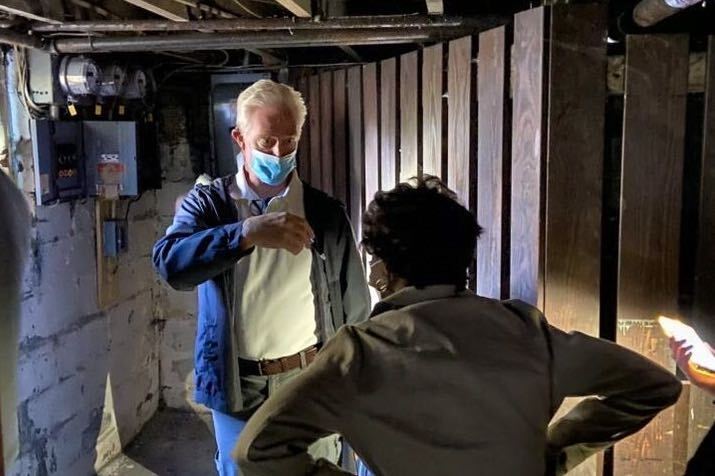
Kathleen Wilson faces Bill Martin, in the basement of a four-unit house she owns in Wilkinsburg. Martin was hired by attorney Marc Taiani to inspect the home. One of his companies has petitioned to become the building's conservator. (Photo by Rich Lord/PublicSource)
Kathleen Wilson faces Bill Martin, in the basement of a four-unit house she owns in Wilkinsburg. Martin was hired by attorney Marc Taiani to inspect the home. One of his companies petitioned to become the building's conservator. (Photo by Rich Lord/PublicSource)

Taiani contended last year that he was trying to convert ill-maintained, empty properties into active, rental homes.

Following publication of that story, Innamorato and state Sen. Wayne Fontana, D-Brookline, pledged to hold a hearing.

Since then, the use of conservatorship by developers has continued.

On March 5, October Development & Construction Company filed a petition seeking to be named conservator of 97 properties throughout the North Side, and naming 85 owners or holders of interests in the properties as respondents.

The petition, filed by attorney Daniel Friedson, indicates that October Development plans to “systematically secure and weatherize” the properties, clear debris, address structural problems, then “raze and renovate,” followed by “new development.”

Attorneys for some of the respondents have filed answers or preliminary objections, but no hearing has yet been scheduled.

That followed a January conservatorship petition by Penn Pioneer Enterprises, a firm controlled by Chaney and represented by attorney Wayne Cobb, seeking conservatorship of 12 properties on Bates Street and Coltart Avenue in Oakland. The land and buildings there are owned by Oakland Gateway Ventures, and an attorney representing that company has entered an appearance in the case, but there have as yet been no responsive filings or hearings.

Neither Friedson nor Cobb could be immediately reached for comment Friday.

Full Article & Source:
 
See Also: 
 

2 Charged With Caretaker Neglect After Maggots, Old Food Trays Found Inside Resident Room

Click to Watch Video

 JENKS, Okla. -

Police say two former employees at the Grace Living Center in Jenks have been charged with neglect after maggots were found in a room in 2018.

An affidavit says a family friend visited a resident and found flies, old food trays, maggots, and soiled sheets in the room. Melissa Moore, the certified nurse's assistant on duty at the time, and her former supervisor, Troy Rappe, each face one count of Caretaker Neglect.

It says the friend took photos after the room was cleaned, and when they went back the next day, they found two more food trays and a stray pill. The affidavit says Grace Living Center conducted an internal investigation and found Moore had been neglecting her responsibilities her duties and was fired.

Rappe has been arrested for his connection to the case.

Full Article & Source:

How to Have Patience With Elderly Parents

The Caring Generation Show

 Video Clip: Click to Watch

CONTACT: Pamela D. Wilson 303-810-1816

Email:   Inquiry_For_Pamela@pameladwilson.com

Golden, Colorado – March 27, 2021

The Caring Generation® How to Have Patience with Elderly Parents

Golden CO- Caregiving expert Pamela D. Wilson hosts The Caring Generation® podcast show for caregivers and aging adults. This coming Wednesday, March 31, 2021, the topic is How to Have Patience with Elderly Parents

Wilson releases a new podcast in The Caring Generation series every Wednesday, sharing tips and conversations about aging, caregiving, and family relationships to help caregiving families plan for what's ahead. The podcasts are available on Wilson's website and all major podcast sites.

How to Have Patience with Elderly Parents

Wilson empathizes with elderly parents who may feel like a burden to adult children caregivers who provide support. Adult children who juggle work, caregiving and family life often express concerns about being impatient with elderly parents. Many caregivers feel guilty about not being able to do enough and balance life responsibilities.

Insights are offered for family caregivers who may not realize the significant changes that elders experience physically, mentally, and emotionally with age and an increasing number of medical diagnoses. Patience in all life experiences is discussed from various perspectives that include daily nuisances, interpersonal relationship challenges, and life-changing events like a chronic disease diagnosis.

Learning patience poses many benefits, including better decision-making about care for parents, taking the initiative to learn new things, and improved stress management. The realization that impatience may improve by investing in time-saving or planning activities can benefit caregivers and care receivers who may experience impatience working together or with the healthcare system.

Interview with Dr. Joan Monin Yale School of Public Health 

Joan Monin is an Associate Professor in the Social and Behavioral Sciences Department at Yale School of Public Health with expertise in research on emotion and relationship processes in caregiving and developing psychosocial interventions for caregivers and older adult care recipients. She joins Wilson to share research about caregiver – care receiver relationships and perceptions about distress and suffering.

Broadly, Monin's research examines how social relationships influence health in older adulthood, emphasizing the needs of family caregivers for older adults with chronic conditions, disability, and dementia. She has had continuous funding from the NIA for more than ten years, with projects examining how gender, stress, emotion, and support-related processes influence cognitive, psychological, and physical health in the context of older adult family caregiving. Monin has published findings in prominent journals (Annals of Behavioral Medicine, Journal of the American Geriatric Society, Health Psychology). 

Wilson works with caregiving organizations and corporations worldwide to educate about the role strain that caregivers experience and how to be proactive to plan ahead for health and aging issues. More about Wilson's online courses for elderly care: How to Get Guardianship of a Parent and Taking Care of Elderly Parents, caregiver support, webinars, and speaking engagements is on her website www.pameladwilson.com. Pamela may also be contacted at 303-810-1816 or through the Contact Me page on her website.

Full Article & Source:

Sunday, March 28, 2021

Dougherty County Probate Court Judge charged for allegedly threatening county employee

by Kyle Proctor

Dougherty County Probate Judge Leisa Blount / Photo: Dougherty County Sheriff's Office

Dougherty County Probate Judge Leisa Blount is facing two charges after an investigation by the Georgia Bureau of Investigation.

According to the the GBI, they were requested on March 15 to investigate by Dougherty County Sheriff Kevin Sproul following allegations that the 56-year-old Blount threatened a Dougherty County employee.

The GBI says that Blount allegedly made the threat of verbal violence in front of witnesses.

Blount turned herself in to the Dougherty County Jail on March 22 according to mugshots and is out on bond according to Dougherty County Jail officials.

Stay connected to WFXL.com as the story develops.

Full Article & Source:

How to Safeguard Your Loved Ones Against Scams

Elderly family members, or those with cognitive impairments, are especially vulnerable to financial abuse.

More and more, investigators are seeing individuals who have worked their whole lives, paid off their home and built up a healthy nest egg only to have one phone call or email impact those decades of hard work.

This sounds like something that would never happen to your family, right? Sadly, things like this happen every single day. Folks like your aging parents and grandparents are at a much higher risk of being scammed or defrauded out of their money.

What are we seeing? Everything from coronavirus stimulus check scams, stolen tax refunds, health care fraud, grandparents scam in which a grandchild is supposedly in deep trouble, government imposters posing as representatives from Medicare or Social Security, paying for a phantom debt with gift cards, pre-paid cards or wire transfer (e.g. utility bills, arrest warrant, IRS, etc.), lottery sweepstakes, online pet purchases, mail, email and phone fraud.

Talking about elder fraud and scams with your loved ones is very important. It's not fun. But, it is a way to show them you care.

Losing money or possessions to scams, fraud, and exploitation can be especially devastating to older adults, who may be not be able to earn back what they’ve lost. Protect your loved ones by talking through these strategies:

  • A good way to start is with you own experience of sidestepping a fraudulent call or email, noting that people of all ages are targeted by scammers. Bring attention to technology and how it has opened doors for new kinds of scams 
     
  • Remind your family members of what they taught you years ago - don't trust strangers, especially those seeking personal information and money
     
  • A good rule of thumb is never give anyone personal information over the phone, email or in the mail. It’s that simple!
  • You cannot win a contest/sweepstakes you did not enter - period
  • No reputable agency will call asking for personal information or to have a bill paid using gift card
  • One of the very best ways to prevent tax identity theft is to file your taxes as early as possible. Encourage - or even help - your older loved ones to file
  • Offer to be an extra set of eyes. Consider setting up online access to your family member's bank and credit card accounts. Keep a close eye on insurance claims and medical bills. Doing so will allow you to watch over finances from afar and look for unusual charges - big or small. Work across generations to plan for diminished capacity, while allowing elderly family members to maintain their dignity and independence
  • Set up safeguards, such as un-list your family member's phone number, sign up for opt-out lists, sign up for security tools that notify account users of log-in activity, unusual spending, unpaid bills and low balances
  • Don't feel ashamed if you have fallen victim to a con, scam or fraud scheme. Financial fraud is more common than you think. But, don't make the situation get worse by letting it go unaddressed. Instead, reach out to a trusted family member and/or law enforcement immediately
Full Article & Source:

Exploitation, theft charges for Wilmington man who allegedly killed his father

by Allison Ballard

Flynn Thomas Gruidl
As of Wednesday, a Wilmington man who is accused of killing his father is facing two more felony charges. 

Flynn Thomas Gruidl, 45, was served warrants relating to obtaining property by false pretenses and the exploitation of a disabled or elderly adult, according to the New Hanover County Sheriff's Office. 

The warrants allege in May 2020, Gruidl transferred $134,000 from his parents’ account without his mother’s authorization to a joint account that he shared with her and then spent the money.  

In November, Gruidl was arrested and charged with first-degree murder after his father died as a result of blunt force trauma wounds, according to the New Hanover County Sheriff's Office. 

Gruidl remains at the New Hanover County Jail on a $2 million bond. 

Full Article & Source: