SENECA, S.C. — A woman
has been arrested years after scamming thousands of dollars from a bank
in Seneca, South Carolina, according to the Seneca Police Department.
According to Seneca PD, they received a report about missing money from a bank account held at Bank of America in Seneca.
Seneca PD says the victim reported that he was missing around $30,000
and also reported it to the Customer Service department by phone.
Seneca
PD investigators worked with the Bank of America investigators for the
next several weeks after the crime and determined that an employee who
had been suspended and terminated, stole money from multiple individuals
who lived in Oconee County.
According to Seneca PD, the victims
would use the Bank of America in Seneca as their primary bank and used
Bobbi Cortese as their personal banker.
Seneca PD investigators,
along with the United States Secret Service, then spent the next several
years conducting further interviews and gave the Bank of America time
to complete its internal investigation.
Seneca PD says they discovered Cortese stole nearly $300,000 from four people using her position at the bank.
Some of the victims had money in the bank for life insurance payouts
pursuant to the deaths of their spouses and others had a lifetime of
earnings that would be used to fund their retirement, according to
Seneca PD.
Cortese opened accounts under her victim's name without
their knowledge or approval and did what officers call a “shell game”
where she used the funds from one victim to replace funds that she had
taken from another victim.
Seneca PD says after further
investigation, they discovered that Cortese forged several documents and
issued those documents to the victims to conceal the theft.
Cortese was committing these acts for around four years while she was employed at the Bank of America, according to Seneca PD.
According to Seneca PD, Cortese was charged with four counts of breach of trust and two counts of forgery.
Consider Jackson attorney Harry Rosenthal as the king of conservatorships.
By his own estimate, he has been a conservator for more than 100
vulnerable individuals. Hinds County Chancery Court records show he’s
continuing to handle a dozen conservatorships.
Though it’s not known how much the attorney receives in each case, in
Hinds County alone, Rosenthal’s income from being a conservator could
be substantial.
The average salary for a non-family member conservator is
$51,214 per year in Mississippi, according to the research blog
salary.com. ZipRecruiter,
which says it gets its salary estimates from employer job postings and
third party data sources, puts the average salary in Mississippi at
$47,787.
State Supreme Court Justice Dawn Beam, who helped craft changes to
the conservatorship law, said most appointed conservators are family
members, and they aren’t paid a lot of money.
The law allows a family member to be paid fees set by a judge for their service.
Professional conservators are entitled to reasonable fees, but
the judge decides what is reasonable and must approve the amount before
the conservator can be paid. Money for the conservator comes from the
account of the person under a conservatorship. If a person under a
conservator has little or no financial assets, the judge can appoint a
public guardian/conservator who is paid from public funds.
Some attorneys say the new law makes it difficult for ordinary
citizens to file conservatorship petitions without the assistance of
attorneys.
Elder law experts say the cost of obtaining a conservatorship over
someone can be expensive with the hiring of attorneys or attorneys to
represent the individual, family members and interested parties. There
are also court and other fees involved with a conservatorship petition.
Rosenthal told the Mississippi Center for Investigative Reporting, a
part of Mississippi Today, that most of the wards for whom he has served
as conservator were once clients in criminal cases.
More than 30 years ago, the attorney provided $12,000 in bail money
to try to help white supremacist Byron De La Beckwith get out of jail
after he was indicted and arrested for the third time in the
assassination of Mississippi NAACP leader Medgar Evers.
Although Jewish, a group of people Beckwith disparaged, Rosenthal,
82, has said he provided the money to Beckwith because he believed his
speedy trial rights were being violated after two previous trials in
1964 ended in hung juries.
In 1994, 30 years after his previous trials, Beckwith was convicted
in Hinds County Circuit Court of Evers’ murder and sentenced to life in
prison. Beckwith died in 2001 in custody.
Thirty-four years ago, Rosenthal filed the petition to become conservator for Gary Gordineer in Hinds County Chancery Court.
“I’ve had him for more than 30 years and I still have him,” Rosenthal
said recently. In February, Rosenthal filed an annual accounting report
of Gordineer’s assets, a court docket report shows.
Rosenthal said he knew Gordineer, Gordineer’s father and other family
members. He said the younger Gordineer had been a criminal client.
Rosenthal said he once had Gordineer, who is a veteran, in a home with
his mother but now has him in a nursing home.
No family member of Gordineer could be reached for comment.
Rosenthal is also listed as conservator in another case, dating to 1989 involving Howard Ruffin Jr.
Ruffin’s niece, Erica Porter, said she has been his caregiver for the
100% disabled veteran the last four years. Other than her, Ruffin has
little or no family alive, she said. “I’m all he has.”
In her four years of caring for Ruffin, she said she had never heard
from Rosenthal until recently when she went to his office to request
more money than the $700 a month she receives for Ruffin’s care.
Porter said Rosenthal denied her request.
“My first time talking to him was actually last week,” Porter
said recently of Rosenthal. “We haven’t heard from him or nothing.”
Rosenthal said everyone wants to spend a ward’s money.
“If you are a conservator or guardian, the money belongs to the
person you are trying to protect, and the laws of the state of
Mississippi say you are supposed to conserve and build upon the money,
if possible,” he said.
Most of Rosenthal’s conservatorship cases in Hinds County occurred before an updated law went into effect three years ago.
About 2,500 conservatorship cases have been filed in Mississippi since then.
The updated law, known as the Mississippi Guard and Protect Act,
seeks to protect the rights of those unable to take care of themselves,
said Beam, who co-chaired the 26-member committee that came up with the
recommendations. It was the first update of the guardian and
conservatorship law in 30 years.
The law distinguishes guardianship of the person from conservator of
the estate, clarifies the role of a guardian/conservator in a ward’s
life, specifies the basis for appointing a guardian/conservator through
improved medical evaluation forms, encourages individualized planning
and use of the least restrictive alternative. It also creates
accountability between the guardian/conservator and the courts to
prevent fraud and abuse.
The law also mandates wellbeing reports.
The updated law applies to cases filed after Jan. 1, 2020, but a
judge has the authority to apply the new law to older cases if no rights
are violated.
In a 2021 state Supreme Court appeal, Hattiesburg attorney Carol
Bustin said that, for decades, courts have treated conservatorships as
mere ministerial actions and the imposition of conservatorships as
matters of petitioners’ rights.
Unless someone is a party in a conservatorship case, court records in
cases like those of Gordineer and Ruffin are sealed, except for the
brief descriptions placed on the court docket.
Rosenthal said some things in the new law look good on paper, but accountability isn’t being strictly enforced.
The sister of one of Rosenthal’s wards questions the lawyer’s accountability.
“I think the rule, or unofficial rule, should be to talk to
family members before they put people into a court-appointed
conservatorship to make sure there is no one who can take over the
responsibility,” said Linda Taylor of Memphis, whose brother, Edward
Redmond, was one of Rosenthal’s wards.
At one point, Rosenthal had Redmond living in a facility in south Mississippi, according to Taylor.
But Rosenthal was forced by court order to move Redmond to Jackson to be closer to family.
Taylor said her brother initially was able to spend time with family.
“In August 2019, however, Rosenthal forbade us to take him away
from his assisted living residence to spend time with him. He even
claimed he had a warrant out for my brother Robert’s arrest because he
had violated that order and picked Edward up once, anyway.”
Redmond, a Marine veteran, was diagnosed as paranoid schizophrenic in
the 1980s and became addicted to drugs. He was determined to be 100%
disabled by the VA hospital. Redmond’s parents became guardians over his
military and Social Security benefits.
In 1994, Redmond’s parents agreed to let Rosenthal become his
guardian without fully understanding what they were consenting to,
according to Taylor. She said she and another sister in Texas didn’t
know anything about what was going on with their brother until after
Rosenthal had already been court appointed guardian/conservator.
At one point, Redmond was allowed to live with Taylor and her husband
in Memphis on a trial basis. During that time, Redmond overcame his
addiction for a while. He had a great testimony about his victory over
drugs. Rosenthal forced Redmond to move back to Jackson for unexplained
reasons.
Taylor said her brother was moved over the years to different
locations throughout the state of Mississippi, and that all of those
places Rosenthal chose were not approved by the Department of Veterans
Affairs.
Rosenthal said he won’t apologize for the care Redmond received in
Jackson. Taylor wanted too much money for keeping Redmond, he said. “I’m
not ashamed of what happened. I had a tremendous problem with her
trying to get his money.”
Taylor said the family requested to have guardianship over Edward
while allowing Rosenthal to continue being conservator over his money.
“Rosenthal refused,” she said. “The record speaks for itself.”
This project was produced by the Mississippi Center for
Investigative Reporting, now part of Mississippi Today, in partnership
with the Fund for Investigative Journalism.
1.3 million people in the United States are living under a legal system
that allows someone else, often unrelated, to make personal, financial
and medical decisions for them.
by Jimmie E. Gates
Opal Smith of Columbia, Mississippi, is picturing enjoying a glass of wine prior to being put under a conservatorship in 2013. Credit: Photo courtesy of Nancy DeVoe
Opal K. Smith celebrated her 93rd birthday in March under a
conservatorship that for the past eight years has left her with no
control over her finances or where she lives.
She is one of the 1.3 million people in the United States living
under a legal system that allows someone else, often unrelated, to make
personal, financial and medical decisions for them.
Her conservator has her living in an assisted living facility in Hattiesburg, about 35 miles from her home of Columbia.
When reached via phone, Opal wouldn’t comment on the matter.
However, in a court affidavit, she said: “I want out of this
conservatorship now and into a home of my own in or near Columbia,
Mississippi.”
Opal wants to go home and live with a sitter, and so do some family
members, including her daughter, Nancy DeVoe, and Nancy’s husband, John.
But Smith’s two other daughters filed the initial conservatorship
petition in 2015 after her husband died, saying Smith was experiencing
memory decline.
The fight over her conservatorship stretches from Mississippi to England.
In their petition to create a conservatorship over Opal, Nancy’s
two sisters — Jill Kendrick Weber, then of Columbia, and Elizabeth
Houser of Little Rock — blamed her for initiating the conservatorship.
Neither could be reached for comment.
But their 2015 conservatorship petition said that, for approximately
the last five years of their father’s life, Weber provided assistance
and care for her parents as needed, and was motivated by their best
interest.
Subsequent to their father’s death, the sisters said Nancy traveled
to Mississippi from her residence in the United Kingdom in an attempt to
control Opal and her assets.
They alleged Nancy engaged Opal in conduct and activities out of
character for her and not in her best interest. They said Nancy procured
a debit card in Opal’s name and compelled her to execute contracts and
documents she was not capable of understanding.
Further, they said a physician had indicated Opal was unable to make
informed decisions regarding her personal finances, health care, or
other serious decisions pertaining to herself or her family.
“Accordingly, the petitioners contend that the Ward, Opal K. Smith,
by reason of mental weakness, is incapable of managing her own estate,”
the petition said.
Nancy said she never attempted to control her mother or her assets,
nor did she engage her mother in any activities or conduct that a
reasonable person could contend were out of character for her or not in
her best interest. She also said she didn’t compel her mother to execute
any contracts or documents.
John and Nancy DeVoe said the constitution mandates no one be
deprived of liberty or property without due process of law. A
conservatorship decree, they said, always deprives the individual of
property and, in many cases, of liberty.
“Opal never had a chance to testify, present evidence, confront her
accusers, or call witnesses,” they said in court papers opposing the
ongoing conservatorship.
Conservatorships are responsible for $50 billion in assets, according to a 2018 report by the National Council on Disability.
The Mississippi Administrative Office of Courts reports that 2,481
conservatorship petitions were filed between January 2019 and this past
February. The figures include conservatorship petitions for both minors
and adults.
In Mississippi, some court records appear to show prior to a 2020
update in guardian and conservatorship laws, that some judges didn’t
expend much effort investigating conservatorship cases before approving
petitions.
The Mississippi Center for Investigative Reporting viewed court
dockets from multiple counties, and records show in some cases,
conservatorship petitions were approved the same day they were filed.
Attorney George Dickerman,
an elder law expert and author in Riverside, California, said
conservatorships should be a last resort, only when no reasonable
alternatives are available.
Dickerman said sometimes an older person will need assistance but
will not voluntarily agree to accept it. He said a conservatorship can
be necessary when a perpetrator manipulates an older person and
wrongfully takes money or property.
But Dickerman also said some unscrupulous individuals will use conservatorships as a license to steal.
Across the country, there is a hodgepodge of state laws when it comes
to conservatorships, and often there are no requirements to record all
financial transactions through a state’s software application. And there
is no national database tracking the number of conservatorships in the
country.
The data available on conservatorships and the conditions them varies
from state to state. And there is no mandate on a state or federal
level for standardized requirements to become a conservator.
Mississippi Supreme Court Justice Dawn Beam, a former chancery judge,
played an integral role in updating the state guardian and
conservatorship law that took effect Jan. 1, 2020.
Beam told the Mississippi Center for Investigative Reporting there
was a time when conservators — often family members of the person under
conservatorship — would seek court approval to spend money on such
things as swimming pools, four-wheelers and lavish vacations.
She said the goal of the updated law is to protect people with large
estates as well as those with only Social Security benefits. It covers
minors, older people and other adults unable to care for themselves.
There is a computer system now that allows courts to better manage cases, she said.
“It’s a lot easier to control money going out than trying to claw it back.”
The FBI elder fraud report
for 2022 said total losses reported by those 60 and older were $3.1
billion, an increase of 84% from 2021. Although the average loss per
victim was $35,101, more than 5,400 victims each lost more than
$100,000.
“Our oath is to administer justice regardless of rich or poor,” Beam
said. “We want to make sure we administer justice. We are doing what we
have to do to protect an individual’s assets. We used to just focus on
assets. We now have a wellness report that the court can require for the
elderly.”
In most states, a judge decides whether to establish a
conservatorship after a petition is filed stating why a person can’t
manage his or her financial affairs or make appropriate decisions
concerning personal care.
The Family Caregivers Alliance
says a conservatorship is supposed to provide a higher degree of
protection than alternatives, such as powers of attorneys, trusts and
health care directives, due to court oversight.
Government agencies and human rights organizations report older
people are more likely to experience neglect, both mental and physical,
and more likely to have their assets broken up and sold off piece by
piece.
In Mississippi, the Department of Human Service reported 4,252 cases
to its adult protective services. Of those, it initiated 4,110
investigations in 2022. August had the highest number — 407.
Opal Smith on her 93rd birthday in March at the facility in Hattiesburg where she is assigned as part of her conservatorship. Credit: Photo courtesy of Nancy DeVoe
In
September 2015, when Smith was put under a conservatorship, all three
sisters were in town to see their father before he died. After his
death, Nancy and her sisters disagreed about what to do about their
mother. Nancy said any discussion should include their mother and
opposed the conservatorship.
Her sisters initially were appointed co-conservators for their
mother. However, a Lamar County chancery judge later replaced them with a
third-party conservator because of a dispute.
Smith’s conservator has changed three more times, and, since 2015,
the fees drawn from her account to pay conservators total more than
$160,000, according to the DeVoes. In court records, Smith’s estate was
valued at almost $900,000 in 2021.
The DeVoes’ opposition to the conservatorship has led to a
contentious court fight that could almost mirror that of Brittany
Spears, who was under a conservatorship from 2008 until 2021.
In 2016, John and Nancy were ordered to post $10,000 bonds each
before they could file any additional opposition to the conservatorship.
On. Jan. 30, Lamar County Chancery Judge Chad Smith, no relation to
Opal Smith, ordered John DeVoe to pay $8,397.43 into Opal’s
conservatorship account, fined Nancy $10,000 for contempt, and fired
Opal’s lawyer because he said it was a conflict for the lawyer to
represent both Nancy and Opal.
Nancy DeVoe had opposed the approval of $43,747,82 from Opal’s
account to her conservator and ex-conservator in a January order. Chad
Smith said in court papers that he had ordered and reiterated she was
prohibited from seeking relief until she had posted the bond, which led
to her being fined for contempt “due to her contemptuous conduct,” Judge
Smith wrote in the Jan. 30 order.
“Nancy shall reimburse the conservatorship $10,000 in attorney’s
fees. The amount represents the fees expended by the conservator
litigating meritless opposition by Nancy during the time period
requested,” he wrote.
Chad Smith warned that any future unsuccessful legal challenge
resulting in the conservator incurring legal fees will result in the
fees and expenses being imposed against those presenting an unsuccessful
challenge.
The DeVoes, who live in England, have filed a court motion seeking to remove Chad Smith from Opal Smith’s case.
Chad Smith is the second judge to handle Opal Smith’s conservatorship
case. The previous judge, M. Ronald Doleac, retired in 2018 after not
seeking reelection.
The DeVoes maintain in court papers that Doleac granted a
conservatorship petition on Smith despite insufficient process and
without notice, evidence, or opportunity to defend. And they said the
conservatorship letter was issued the same day, naming Opal’s daughters,
Houser and Weber, co-conservators, which they say was a violation of
the law.
A typical docket report of a successful Mississippi conservatorship
case should show, before the judgment or decree is filed: a sworn
petition, summons issued to the target of the conservatorship and a
relative, two sworn certificates from licensed physicians or a physician
and a licensed psychologist and an entry showing a hearing was held at
least seven days after the petition.
After the decree, the docket report should show the letters of
conservatorship were issued and entry of a bond securing the performance
of the fiduciary duties owed by the conservator to the target and an
inventory of the newly created conservatorship estate, to be filed once
each year during the term of the conservatorship.
Most conservatorship records in Mississippi are sealed from viewing
for anyone not a party to the case. A judge has the discretion whether
to make public any documents in a case.
According to a transcript from a July 2022 hearing in Opal’s case,
attorney Carol Bustin of Hattiesburg, representing Nancy and Opal,
argued that “due process requires fairness. It requires that everybody
have their day in court, and Opal Smith never had her day in court.
There was never any testimony. She never testified as to whether she
wanted this conservatorship or whether she agreed with it, or why she
didn’t agree with it.”
Attorney Larry Buffington of Collins, a former chancery judge,
represented Opal’s other two daughters. Buffington said at the July
hearing, “Maybe I did it wrong for 20 years, but I don’t know that I
ever conducted a hearing unless there was a request from somebody on a
conservatorship. Most of those actually were done in chambers.”
In a court order, Chad Smith said Doleac initially set the matter for
a hearing on Aug. 10, 2015, but continued it until Sept. 15, 2015.
Doleac then scheduled a trial for Nov. 3, 2015.
What occurred isn’t documented. Chad Smith said state law doesn’t
require a record to be made of the trial and that a judge has the
discretion to decide what evidence to hear.
In August 2016, Doleac replaced the daughters, without their
opposition, as conservators, replacing them with attorney Derek
Arrington. Seven months later, Doleac appointed Arrington’s law partner,
G. Neil Rogers, as substitute conservator.
Judge Smith, who took over the case in 2019, granted Rogers’ request
in 2021 to withdraw as conservator and appointed attorney William
Andrews III as his substitute. He also named Andrews to serve as
Opal’s guardian, meaning he was given responsibility for Smith’s care
and wellbeing as well as control of her finances.
Doleac wouldn’t address the Opal Smith case specifically but said
there is a process for the DeVoes to appeal the case, which they did in
2021. A three-judge panel of the state high court denied the request in
January 2022 without comment.
John DeVoe said that with them being in England, it has been
difficult to find a lawyer to handle their appeal. He said some lawyers
they contacted expressed reservations about taking the case since it
would be going against a judge.
The DeVoes filed the paperwork themselves seeking Smith’s removal
from the case to the state Supreme Court. The motion was filed with the
court April 18. It has yet to be decided.
“You can’t be on the bench and not be criticized,” Doleac said in a
phone interview. “We have an excellent judiciary in the state. I have
never seen anyone take a shortcut.”
This project was produced by the Mississippi Center for
Investigative Reporting, now part of Mississippi Today, in partnership
with the Fund for Investigative Journalism.
We’ve been telling you about the financial horrors that happen when courts allow total strangers to take control of another person’s life. We’ve seen it happen to the disabled, the elderly and even celebrities.
Nowhere are the cries for help louder than in Orange County, California.
And the call for help came to Dolcefino Consulting.
COBB COUNTY, Ga. — A woman is accused of working as a nurse in Cobb County, even though she wasn’t licensed.
For
a number of months, Corissa Laws cared for eight different people with
developmental disabilities who all needed around the clock care from a
licensed nurse.
But police said Laws used someone’s nursing license from Florida to get the job.
The
warrant stated that Walton Community Services hired laws as a nurse.
Laws used the victim’s nursing license and number to get hired, even
though the license can only be used in one state.
Newell
stopped by the house that Laws worked at, but no on answered. Newell
called Walton County Services, but the person who answered hung up. When
Newell stopped by the office, the door was locked and no one answered.
Laws is
charged with practicing nursing without a license and aggravated
identity fraud. It unclear how Laws gained access to the victim’s
nursing license, but Newell spoke with Georgia Security State about how
to protect yourself from identity fraud.
“Many
of the credit reporting agencies really have notifications you can get
so you can sign up for that,” Secretary Brad Raffensperger.
And when it comes to protecting your employment information:
“We
haven’t heard this particular type of fraud recently but it can happen
and we want to make sure people are aware to always guide your identity
and any employer when people do present their license you can go to sos.ga.gov
that they are re lawfully registered and that shows up on our official
Secretary of State web page,” Raffensperger said. “We do robust checks
but obviously there’s always people bad actors that are looking to gain
the system or fraud entry use someone’s out of state license but you
want to make sure that someone is actually licensed here in the state of
Georgia.”
As
for the nurse in Florida whose employment information was stolen, she
told Newell that she is glad an arrest was made, but did not want to
talk about happened to her. Police haven’t released additional details
at this time.
A woman has been arrested for the second time for allegedly participating in an identity theft scheme, stealing more than $350,000 from victims, authorities said.
Ela Avila, a 90-year-old retired uniform maker on food stamps, is in the second year of her fight against a court-appointed guardian who controls Avila’s money, housing decisions and medical care.
It’s a battle over small decisions — like when Avila says she can’t get enough cash to visit a hair stylist. And big ones — like when the guardian, Zaidis Alvarez, listed Avila’s Little Havana home for sale last year against her wishes.
“I don’t want her,” Avila said in Spanish during a recent interview with the Miami Herald in her home of 35 years. “I get sick every time she comes here.”
While Avila doesn’t want a guardian, she may end up paying for one. In March, Alvarez asked for court permission to use the divorced grandmother’s assets to pay a $21,000 legal bill from Alex Cuello, a lawyer charging $525 an hour to work for Alvarez in the guardianship case.
Ela Avila outside the Little Havana house where she has lived for nearly 40 years. She’s 90 and under the authority of a court-appointed guardian after a judge decided Avila had lost the mental capacity to make decisions for herself. Pedro Portal pportal@miamiherald.com
Probate lawyers and advocates for elders’ rights say Avila’s case is an example of the high-stakes consequences that can be lurking for an elderly person facing allegations of losing cognitive abilities even while they’re living at home, attending to everyday tasks and remaining well aware of their circumstances.
“One of the things I preach is guardianship avoidance,” said Collett Small, an elder-law attorney in the Pembroke Pines office of the Slater and Small law firm. “It can be a very scary process. Imagine someone knocks on your door and says, ‘I am here to evaluate you.’”
The case started in 2021 when Avila’s daughter, Rosa Hernandez, asked a court to name her guardian of her mother’s assets. A judge briefly approved that arrangement, then shifted to the appointment of an independent, professional guardian in 2022 after Avila’s son, Rogelio Hernandez, objected to his sister filling the role.
Alvarez is registered with the state Elder Affairs Department to serve as a court-appointed guardian for people deemed mentally incapacitated and unable to make decisions on their own. To become guardians, applicants must pass criminal history and credit checks and a state exam after completing a 40-hour course.
Alvarez and Cuello have not responded to requests for comment.
Under guardianship, Avila, a Cuban immigrant, has lost her right to vote, travel, accept medical treatment, make decisions on where she lives or sign contracts, according to an April 7, 2022 court order obtained by the Miami Herald.
The judge in the Miami-Dade Circuit Court case, Bertila Soto, appointed Alvarez on March 8, 2022, and instructed her to take charge of Avila’s money. Alvarez must submit budgets to Soto and get court approval for any big changes in Avila’s affairs.
Once fighting each other in court, both of Avila’s children now are united in asking Soto to restore their mother’s independence. Last month, they filed a joint motion asking Soto to end a guardianship they say is sapping the family’s cash.
“My mom used to have a lawyer. When the turmoil started getting bad, he wanted more money. We couldn’t pay him,” Rosa Hernandez said. “My brother and I are trying to do our best.”
A court fight for independence
While lacking a lawyer of her own, Avila is being asked to pay for the one behind the guardianship that has her an involuntary “ward” in the Miami-Dade case. On March 13, Alvarez filed a notice with the court saying she approved Cuello’s $21,054 legal bill for services he provided for the prior 12 months. The bill is to be paid “from the Ward’s assets,” according to the form, if a judge agrees to the fees.
The court records don’t show an order related to the fees, suggesting they remain unpaid. The Cuello bill shows a string of tasks the lawyer preformed for Alvarez, including attending hearings, reviewing court filings and communicating with lenders on a possible reverse mortgage.
Florida law requires three professionals, including at least one doctor, examine a person for mental capacity before a judge can declare them incapacitated and needing a guardian’s authority. Florida law dictates many guardianship documents remain off-limits to the public. Court clerks haven’t publicly released most filings in the Avila case, including the basis for her guardianship and medical reports. Avila and her family say they don’t have those reports.
Though Avila is described as an “incapacitated person” in court papers, at least two medical professionals weighed in positively on her mental state.
In December, a nurse practitioner filled out a court form saying Avila had the “full capacity to live independently.”
Last year, a nurse working in the elder-abuse unit for Miami-Dade prosecutors went to Avila’s house after she and her son called asking for help, according to a summary provided by the State Attorney’s Office. The nurse, Carmen Duran, “did a quick assessment on Ms. Avila requesting her to answer basic orientation questions. Ms. Avila responded to all questions correctly and clearly,” according to the summary of the May 17, 2022, meeting.
Alvarez and Cuello also attended the meeting. Duran said she asked about Avila’s mental examinations and “was informed that Ms. Avila had not been diagnosed with dementia or Alzheimer’s.”
In a prior conversation with Avila, Duran said it was clear Avila felt the court was ignoring her ability to live independently and that Avila wanted nothing to do with an assisted living facility or any other option forcing her to move.
“Ms. Avila also expressed frustration that she maintained a standard of self-care and grooming and yet was being denied her own money to maintain her hairdresser appointments and social schedule,” the summary said.
Rosa Hernandez said her mother initially agreed to have her become guardian as a way to stabilize a rocky financial situation amid trouble with tenants who were then living in the flat attached to Avila’s house and paying enough rent to cover the mortgage. The $1,500 rent payments stopped altogether in the summer of 2021, according to court records from an eviction proceeding, leading to a financial slide that now has Avila facing foreclosure because she’s behind on mortgage payments.
Avila signed documents saying she wants to put a reverse mortgage on the house, a financial arrangement that can let an older person remain in their home indefinitely but often leaves no equity for heirs as unpaid interest compounds and eats away at the value of the house. Rogelio Hernandez said he’s been pushing Alvarez to help secure a reverse mortgage, but the guardian won’t cooperate.
“Look at her. She’s fine. She’s well,” Rogelio said in an interview at the kitchen table. He lives in the house with his mother and a caretaker he says he pays $400 a week after Alvarez raised concerns about Avila being left alone while he works overnight shifts as a forklift operator at Miami International Airport. “I don’t want her to live in a home.”
Tidy bedroom, Cuban coffee in kitchen
Born in Cuba, Avila came to the United States in the 1960s, married, had two children and worked for a Miami uniform maker that clothed local police officers and firefighters.
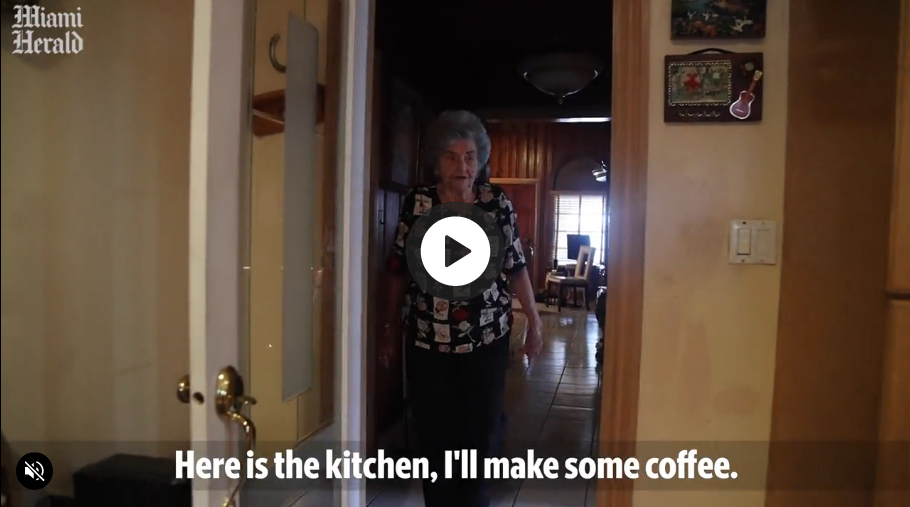
In a tour of her home as Spanish-language morning news played in the background, Avila brought out a wind chime with a porcelain officer, gun and police dog she said was given to her as a retirement gift. When a charcoal portrait of a woman in pearls and a blouse caught a visitor’s attention, Avila explained a cousin drew that of her mother.
Then she walked into her bedroom, pointing out another portrait by the cousin: a framed rendering of Jesus hanging over the tidy bed that Avila said she makes each morning.
“And I wash the dishes,” she said.
She still has two sewing machines in her kitchen, where she offers to make Cuban coffee for visitors on a recent weekday. “Amargo o dulce?” she asked in Spanish as she set up the pot on the electric stove’s burner.
Guardianship laws are designed to give court protection and supervision to people who lose the mental capacity to make decisions for themselves.
Probate lawyers call it a legal last resort and often the result of a person waiting too long to make arrangements for how they want their affairs managed if they lose mental capacity during a medical crisis or due to old age.
Without setting up a legal pathway for long-term care decisions and finances, a person can be the victim of the high costs of having a judge make those decisions in a contested guardianship proceeding where family members are fighting over an older relative’s next steps.
“It’s a very expensive and invasive way to resolve family disagreements,” said Heather Samuels, an elder-law attorney with Samuels Wood in Boca Raton. “The really experienced litigators are getting $450 and $500 an hour. That devastates people’s nest eggs.”
Billing records Alvarez submitted to the court show her contacting Avila’s bank, lender and healthcare providers as she worked to modify the home’s mortgage to prevent foreclosure and manage both the guardianship case and Avila’s needs. That included multiple calls with Avila, and coordinating with a real estate agent when Alvarez was preparing to list Avila’s house for sale in the spring of 2022.
Alvarez’s bill for a year’s work was $8,488, on top of the $21,000 billed by Cuello, Alvarez’s lawyer. The Alvarez bill also is charged against Avila’s assets, another obligation that could reduce money available to her after a home sale or refinancing through a reverse mortgage.
Avila’s case isn’t related to the Guardianship Program of Dade County, a nonprofit that handles thousands of guardianship cases but does not charge people for legal services. Instead, it pays its lawyers and staff with about $6 million a year from Florida and Miami-Dade County funding. The nonprofit came under scrutiny after WLRN raised questions about some of its home sales on behalf of incapacitated people.
Precarious finances and foreclosure threat
On April 27, 2022, Avila signed a motion prepared by a family friend with legal experience asking a judge to order a doctor’s evaluation of her mental state in order to end the “frivolous” guardianship proceedings. The motion said Avila was representing herself, with no lawyer in her corner.
Avila said she wanted the right to decide on putting a reverse mortgage on the home she’s owned since 1988. “The reverse mortgage on my own home,” the typed motion read, “is no one’s decision other than my own.”
A reverse mortgage is a financing arrangement that generally allows an older homeowner to borrow against a property’s value while continuing to live at home without making loan payments. The borrower cashes out equity in the house and typically receives a monthly payment from the lender. Property taxes, insurance bills and maintenance still come out of the homeowner’s pocket, though the monthly income from the mortgage can cover those bills.
While the borrower isn’t paying anything to the lender, interest is being charged and the loan amount continues to grow. When the person dies or must move to long-term care, the balance of the loan comes due and heirs can pay it off, sell the house or turn over the property to the lender.
“It will pay off her existing loan that’s in foreclosure,” said Joshua Orlan, the mortgage broker trying to close the reverse mortgage for Avila. He said he hasn’t received the needed court approval for the transaction. “She’ll be able to stay in her house. And she never has to make a mortgage payment.”
When Avila asked for a reverse mortgage last year, Alvarez instead secured court permission to put the house up for sale.
“When making this decision, the Court considered, not only the recommendation from the Guardian, but also, the fact that the mortgage owed for said property is $106,000, it has not been paid for more than a year, is more than $30,000 in arrears and could be foreclosed upon at any time,” Soto wrote in the May 9, 2022, ruling.
“The Court is concerned that if the house is not sold immediately, the Ward’s sole asset will be wasted further.”
Soto laid out Avila’s tight budget: $838 a month in Social Security income, about $200 in food stamps for groceries and the $1,500 her son is being charged for rent.
Short-sighted financial decisions aren’t enough to impose a guardianship on somebody, lawyers said. Instead, the laws are designed to take over financial decisions for someone once it’s proven he or she no longer has the ability to make decisions for themselves.
“I make bad decisions all the time. We all do,” said Jim Berchtold, senior staff attorney with Justice in Aging, a national organization that advocates for older people in the court system. “The question really is does she [Avila] have the capacity to decide this issue. If she understands what a reverse mortgage is — and understands the ramifications of it — why shouldn’t she be able to make a decision about it?”
In conversations with Duran, the nurse from the State Attorney’s Office, Avila said it wasn’t fair for her to have no control over the legal bills accumulating in her name and no say in signing the loan needed to stabilize her finances.
“Ms. Avila expressed dismay that she was behind in mortgage payments and yet her assets were being used to pay the fees for both the guardian and the guardian’s attorney,” according to the Duran account in the summary.
While online real estate records show Avila’s house was listed for $650,000 in 2022, the property never sold or went under contract. The sale stalled after Duran’s intervention, according to records and interviews. Duran asked Soto to consider the reverse-mortgage alternative and the judge agreed, according to the summary from the State Attorney. But the reverse mortgage still hasn’t happened a year later.
“I just haven’t gotten anywhere with the guardian,” said Orlan, the mortgage broker.
At issue is Avila’s mental. state. Her son provided a copy of a Miami-Dade Circuit Court form filled out by Yeneysi Notario, a nurse practitioner, who on Dec. 19 wrote of Avila: “Patient Independent” and “alert and oriented ... with full capacity to live independently.”
In a section asking for a physician’s opinion on whether the patient requires court supervision, Notario checked the box stating Avila “does not continue to need the assistance of a guardian.”
The form does not have markings showing it was filed in Avila’s case, and the public court docket doesn’t indicate whether it was submitted to Soto. Horacio Sosa, the lawyer representing Avila’s children in the request to lift their mother’s guardianship, did not respond to questions.
While the actual documents remain confidential, the court docket and Cuello’s billing records show the case has been contentious.
On May 10, 2022, a Cuello paralegal billed an hour for preparing an emergency motion to “remove” Rogelio Hernandez from the property. The docket shows Soto issued an order six days later that didn’t bar Hernandez from his mother’s home but stated he couldn’t interfere with visitation by Alvarez.
Alvarez makes regular visits to Avila’s house and there have been signs of friction.
“GM Roger how are you? [How] is your mom doing?” Alvarez wrote to Rogelio Hernandez in an August 2022 text exchange he provided to the Herald. “Do you have the rest of the rent for this month?” In an undated exchange, Alvarez said she plans to swing by the next day to visit with Avila. “My mom doesn’t want to see you,” Hernandez responded. “She gets agitated.”
At one point, Alvarez responded: “I have to see her and don’t understand why she gets agitated when the only thing I’m doing is trying to help and save her home.”
Hernandez said he stopped paying rent several months ago because he couldn’t afford it after his hours were reduced at work.
“It was too much,” he said. “I’m already paying $1,600 a month for the caretaker.”
While Avila’s motion last year didn’t end her guardianship, her children may be making more progress. After filing their motion to lift the guardianship in late April, Soto on May 11 signed an order instructing a doctor to examine Avila and file a report on her mental state within 20 days.
A hearing on the possibility of ending the guardianship is scheduled for July 11.
The nursing home inspections system is underfunded and understaffed
and needs federal assistance for alleviating inspection backlogs, or
residents will remain in peril, experts and legislators said at a U.S.
Senate hearing on Thursday.
Officials from the long-term care ombudsman program as well as
leaders from state inspections and regulatory bodies were among those
who testified before the U.S. Senate Special Committee on Aging,
following the release of its investigative report.
“The report paints a picture of a system in crisis,” said Sen. Bob
Casey (D-Penn), who blamed a shortage of inspectors and low funding as
factors that are jeopardizing the annual nursing home inspections
process. “The result is that nursing home residents are being put at
risk because of this problem … My fear is that the trail is going cold
for too many residents before nursing home inspectors can arrive on the
scene.”
The report
titled, “Uninspected and Neglected,” was commissioned by Sen. Casey to
investigate the efficacy of state inspection agencies across the nation.
“My investigation reveals unacceptable rates of vacancies at state
survey agencies, threatening the safety and health of nursing home
residents as their complaints collect dust while inspectors struggle to
meet the demand,” Casey said.
Inspection backlogs
As a result of fewer inspectors, most states have nursing home inspection backlogs.
The report found 31 states and the District of Columbia had
inspection staff vacancy rates above 20% on average, and nine were
short-staffed by 50% or more. Meanwhile, the highest vacancy rates were
in Kentucky at 83%, Alabama at 80% and Idaho at 71%.
Severe staffing shortages and high turnover rates driven by
inadequate salary compensation for state inspectors hampered the annual
survey process and prompt reporting of complaints, the report found.
Given this scenario, the report called into question the timeliness and
accuracy of the Care Compare tool used by prospective residents to
evaluate nursing homes.
Since inspectors are registered nurses, pharmacists, social workers
and dieticians, competition with jobs in the private sector impacts
their recruitment and retention rates.
Meanwhile, much of the funding for inspections is aided by federal
dollars, and while the last three administrations have requested this
funding, it has yet to be approved by Congress.
“Survey agencies have not received a meaningful increase in federal
funding to complete these critical oversight responsibilities since
2015, yet the cost to recruit and retain survey staff, the volume of
work and additional work expected of survey agencies has significantly
increased,” said Shelly Williamson, president of the board of directors
for the Association of Health Facility Survey Agencies (AHFSA). “These
factors have resulted in many survey agencies being unable to complete
recertification and complaint surveys timely, leaving nursing home
residents at risk of substandard care.”
Williamson is also administrator of the Section for Long-Term Care
Regulation at Missouri Department of Health and Senior Services.
Since 2015, Congress increased that spending by a meager 2.5%, while
the budget for inspections will need to be increased 30% to keep up with
inflation.
Williamson said that since states have recently increased their
budgets to fund surveys and salary increases for inspectors, the federal
government will need to step up funding for these endeavors.
The Senate report also suggests that the Biden administration’s
proposed nursing home regulations might not succeed unless the problems
in the inspections process are addressed.
Greater visibility of staffing roles, numbers
During the hearing, staffing shortages at nursing homes were also
cited by experts as being important for better health outcomes,
especially as they relate to mental health concerns of residents.
“I think one of the things that we continually need to address are
the nursing home staffing shortages, so that we can get back to those
[social] activities … The ombudsmen have seen firsthand that the
activities are still lacking and are not quite what they should be,”
said Leah McMahon, director at Colorado State Long-Term Care Ombudsman
Program in Denver. Ombudsmen are authorized by federal and state law to
settle disputes and resolve resident problems.
To improve the process of choosing a nursing home, McMahon said it
was important to enforce more transparency on quality of staffing.
“We’re talking about potentially wanting to know staffing levels. How
many nurses are in the building at any given time? Who is the medical
director that is overseeing and coordinating the overall care, and maybe
any instances of abuse and neglect that have happened?” McMahon said.
“I think those are really important things to know.”
Improving the visibility of the activities of the medical director,
and perhaps putting limits on how many residents can be overseen by each
medical director should be an important goal, McMahon said.
“I do believe that requiring nursing homes to report their medical
directors to CMS and state survey agencies could increase quality of
care in nursing homes,” McMahon said.
Sometimes medical directors are spread too thinly as they oversee several nursing homes within a chain, she said.
“Often medical directors are absent from the nursing home for long
periods of time. It is rare that you will see a medical director
physically in a nursing home,” she said. “By increasing accountability
for medical directors, it could ensure they’re fulfilling their critical
obligations under the regulations. And when that doesn’t happen,
ombudsmen have another tool to take to the survey agency as a concern.”
Other experts who testified at the Senate hearing sought to improve
the pool of inspectors by increasing training and recruitment efforts at
colleges.
Advocates’ push against staffing mandate
Advocacy groups for nursing homes said the Senate committee’s work
underlines a widespread staffing crisis within the sector. They renewed
calls to resist the forthcoming proposed minimum staffing mandate and
improve funding.
“We appreciate the Senate Committee on Aging’s focus on this
important issue and share concerns surrounding the backlog of nursing
home surveys. Conducting timely surveys of nursing homes is important
for consistency in the regulatory process,” said Holly Harmon, senior
vice president of Quality, Regulatory, and Clinical Services at
AHCA/NCAL, in a statement. However, Harmon also said, “The shortage of
state surveyors is indicative of a larger workforce crisis facing the
entire long term care profession. As the committee’s report signals,
addressing this labor crisis requires significant investments, not
mandates. We need a concerted, supportive effort to help recruit more
individuals to serve our nation’s seniors.”
Moreover, Harmon said the oversight process needs to be more resident-driven.
“We need to focus on the science of quality improvement by
recognizing good faith efforts, leveraging continuous learning, and
effectively remedying identified issues,” Harmon said. “Enforcement
alone will not transform America’s nursing homes.”
Need for consensus
In closing, Sen. Casey compared the current findings to work of the
Senate committee on nursing home oversight almost four decades ago, and
said, “We heard similar warnings today and these warnings must not be
ignored.”
Aside from more funding, Casey recommended adding more transparency
to the survey process and scrutiny of independent contractors as well as
boosting the health care workforce.
“The [Senate] Aging committee’s oversight in the 1980s paved the way
for landmark nursing home reforms that President Reagan signed into law.
Today’s hearing and the committee’s investigation provide another
opportunity to find common ground to make sure nursing home residents
are kept safe and receive the care that they and their families deserve
and have a right to expect,” Casey said.