Showing posts with label pandemic. Show all posts

Tuesday, September 28, 2021

The Push For Nursing Home Reform In The Middle Of A Pandemic

Most Americans prefer to age at home, according to a 2018 AARP survey. But the need for facility-based care is not going away.

Hugh Hastings/Getty Images

According to AARP, at least 186,000 nursing home residents and staff have died from COVID-19.

For many, the pandemic has exposed cracks in our long-term care system — such as staffing shortages and unenforced rules. Some have seen those cracks for much longer.

The New England Journal of Medicine reports long-term care in the United States has been marginalized for decades. Aging adults who can no longer care for themselves at home are left reliant on poorly funded and insufficiently monitored institutions. Even though regulatory policies have been enacted, including the Federal Nursing Home Reform Act of 1987, Covid-19 has highlighted the fact that better monitoring is not enough to deal with the deficiencies in care quality.

Most Americans prefer to age at home, according to a 2018 AARP survey. But the need for facility-based care is not going away, especially for those who can't afford another option.

Jeanette Sullivan-Martinez, Richard Mollot, Susan Jaffe, and Mark Parkinson join us for the conversation.

Full Article & Source:

Wednesday, June 9, 2021

95-year-olds who found love in the time of COVID-19 get married

Click to Watch Video
By Steve Hartman 

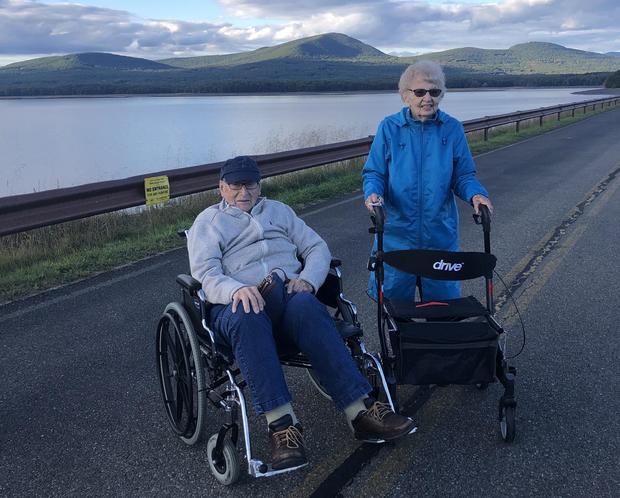
For 95-year-old John Shults, the best thing to come out of the COVID-19 pandemic is coming down the aisle. His bride, Joy Morrow-Nulton, is also 95. 

Together they're proving you're never too old to make a lifetime commitment. 

CBS News first met the couple in March, parked along the banks of the Hudson River in upstate New York. ("Parked" in the slang sense.)

Shults and Morrow-Nulton have both been widowed twice but were determined to find love again, which wasn't easy. Before they were vaccinated, they had to do most of their dating in a bubble. 

"She was worth it. It was a pain in the neck, though," Shults said of maintaining the relationship through the pandemic. 

Shults' son Pete said the two would call each other every day. "They'd find a way to get together. They did whatever it took."

What it took, they say, was a return to simple pleasures, like long drives to nowhere, batting balloons around the house and a lot of selflessness. 

"She's richer than I am, just so you know. She bought me a walker," Shults said. "$159, I think. I told you she had money. She did have it until she bought my walker." 

john-joy-reservoir-2.jpg
John Shults and Joy Morrow-Nulton, both 94, are engaged.  Handout

Not to be outdone, Shults bought her a little something, too. But he had to pop the question dozens of times before Morrow-Nulton said yes.  "Finally I said, OK," she said, adding that she finally accepted the proposal "when we had snow days and I didn't come up here, I missed him." 

They recently tied the knot in a small ceremony. 

john-joy-reservoir.jpg
John Shults and Joy Morrow-Nulton were determined to find love again.  Handout
 Full Article & Source:

Saturday, May 22, 2021

Online scams rose 25 percent during pandemic


by Paul Bischoff

In 2019, over 3.8 million Americans were victims of fraud and scams. Fast-forward to 2020 and the global pandemic and these figures have risen by over 25 percent with 4.77 million Americans being victims of fraud and scams in 2020 alone.

Of the figures that are reported, we also know that $5.1 million was lost to these scams in 2019, before increasing by 37 percent to $7 million in 2020. But with a large chunk of scams not having a $ figure attached to them, and scams being vastly underreported, these figures are likely much higher.

What’s also interesting is how the types of frauds and scams taking place changed from 2019 to 2020.

Our team of researchers explored data from the Internet Crime Complaint Center (IC3), the Federal Trade Commission (FTC), the Better Business Bureau (BBB), and the Finance Crimes Enforcement Network (FinCEN) to find out just how the pandemic has altered fraud and scams across America.

Key findings:

– 2,523,800 Americans lost $5,142,248,313 to fraud and scams in 2019

– A further 1,282,531 Suspicious Activity Reports were filed to FinCEN for “cyber events” or “scams” in 2019 = 3,860,331 victims of fraud and scams in 2019

– 3,355,555 Americans lost $7,017,577,961 to fraud and scams in 2020

– A further 1,416,005 Suspicious Activity Reports were filed to FinCEN for “cyber events” or “scams” in 2020 = 4,771,560 victims of fraud and scams in 2019

– This is a 25 percent year-on-year increase in victims and a 36.5 percent year-on-year increase in $ amounts lost

– Identity theft, online shopping, healthcare, and employment/business-related scams saw some of the biggest increases from 2019 to 2020

Due to FinCEN not providing figures on the $ amounts lost to Suspicious Activity Reports (SARs), these figures have been omitted from our overall totals when comparing dollar amounts lost. But they have been included in our victim counts.

However, in one report regarding SARs related to elder financial exploitation, it was stated that the average loss across all reports was $16,700. While only 80 percent of elder financial exploitation cases resulted in a loss, this still suggests an astronomical loss across these SARs. For example, if we base the losses on the aforementioned 80% of cases resulting in a loss of $16,700, that would put the loss to SARs at $17.1 billion in 2019 and $18.9 billion in 2020.

Read the full report here: https://www.comparitech.com/blog/vpn-privacy/us-internet-scams/

Full Article & Source:

Friday, April 2, 2021

A Photographer Captured The Moment A 98-Year-Old Got To See Her Family After A Year Apart

COVID-19 vaccines mean some nursing homes are now reopening, so residents can finally hug loved ones. A series of viral photos captured Yoshia Uomoto's surprise reunion.

 
by David Mack

Staffer Laura Iijima-Schergen guides Yoshia Uomoto, 98, back to her room at Nikkei Manor in Seattle on Tuesday.
Lindsey Wasson / Reuters

It's been a long year for the Uomoto family.

As the coronavirus pandemic raged, nursing homes and assisted living facilities around the world shut themselves off to visitors in order to protect their vulnerable residents.

That meant that for over a year, Mark Uomoto couldn't see his 98-year-old mom, Yoshia, in person at her Seattle facility except through a window.

"It was hard. She was kind of isolated," Mark told BuzzFeed News. "When I saw her through the window, she was just happy to see me and I was happy to see her, but with her being hard of hearing, it was hard to talk."

Yoshia lives at Nikkei Manor, an assisted living facility primarily designed for Japanese Americans. It shut its doors to visitors on March 23, 2020. The tight restrictions helped ensure no residents contracted COVID-19, according to executive director Theresa McLaughlin, but it's still been tough.

"The pandemic has taken an enormous toll on our staff and residents,” McLaughlin said in a statement to BuzzFeed News.

Residents there have now all been fully vaccinated — so as of Monday, staff have been allowing families to visit with their loved ones, as long as they still wear masks as a precaution.

Mark, who is also fully vaccinated, said he was surprised on Tuesday when he was informed he'd finally be able to visit his mom in person. "I said, 'Yeah! Let's do it!'" he recalled.

When he arrived, he was told that Lindsey Wasson, a photographer with Reuters, would be on hand to capture their reunion.

Meanwhile, a staff member escorted Yoshia back to her room and told her to prepare for a surprise.

Lindsey Wasson / Reuters

 Yoshia closed her eyes, as she was told...

Lindsey Wasson / Reuters

And Mark and Yoshia's niece, Gail Yamada, made their way into the room, which Yoshia had decorated with pictures of the family members she hadn't seen for so long.

"The sense of anticipation was really fun," Wasson, the photographer, told BuzzFeed News.

Lindsey Wasson / Reuters

Then came the moment of surprise.

Yoshia's face said it all.

Lindsey Wasson / Reuters

She truly was surprised.

Lindsey Wasson / Reuters

"It was wonderful," Mark said. "Her expression was just seared in my memory — how happy she was."

Photos of the reunion went viral after they were published by Reuters, then shared by NBC News on Twitter on Wednesday.

Mark said he thinks his mom will get a kick out of going viral at 98: "She'll probably laugh and think, Oh, not me!"

Lindsey Wasson / Reuters

Wasson has memories of visiting her own grandmother, June Takeshita, when she lived at Nikkei Manor prior to her 2011 death.

"It was definitely nostalgic to be back there for the first time in many years and definitely brings up a lot of feelings of relief for the families," Wasson said. "We are still a long way from the end of the pandemic, but I think it represents a hopeful step towards that direction."

Lindsey Wasson / Reuters

Born in Woodinville, Washington, Yoshia raised two sons with her husband. She was widowed in 1982 but still found happiness with her sister and friends at her church. Mark said she's also been well taken care of at Nikkei Manor since she moved in about a decade ago.

Mark hopes that life continues to normalize for his family and others. He knows how lucky he is to have had the chance to see his mom in person again. The mother of a colleague of his died in a nursing home several months ago before the facilities opened back up. For now, he's counting his blessings — and hugging his mom.

"It felt wonderful. I haven't felt that in over a year," he said. "Knowing I could feel Mom and see Mom, see her smile — it's been a long while."
 
Full Article & Source:

Thursday, April 1, 2021

Some Arkansas long-term care residents leave facilities for first time in year

by Mills Hayes

Some long-term care facility residents haven’t been able to leave the facility or visit family in-person since the pandemic began. Governor Asa Hutchinson announced on Friday that the COVID-19 directives would now be guidelines, not directives

“I love to be around people. I don’t want to be by myself I never have,” Charlie Payne said.

Payne, who is 95-years-old, plays golf almost every. He moved out of the Plaza assisted living in Arkadelphia three months after the COVID-19 restrictions essentially shut down assisted living facilities. Previously, he had lived there for seven years with his wife before she passed away.

“I’m still active and I like to do outdoor things,” Payne said.

When Hutchinson lifted restrictions on some long-term care facilities he decided to move back in on Monday.

“I wouldn’t have come back unless I could come and go as I want,” Payne said.

Emily Talley lives in an assisted living center in Arkadelphia. She was only allowed to leave the facility to go to the doctor. Monday Talley was able to go with her daughter for the first time since the pandemic. They spent the time shopping and getting their nails done. (Photo by KATV)

Rachel Bunch is the executive director for the Arkansas Healthcare Association. She said the new guidelines can be confusing.

“The governor's announcement on Friday that changes those directives to guidance it affects most the assisted living facilities and the residential care facilities giving them the opportunity and the option to open up more for visitation,” Bunch said.

Nursing homes, however, fall under federal control, meaning how much they open up is dependent on the COVID-19 positivity rate in the county and the number of cases in the facility for the last 14 days.

“In the last 14 days we only have 7 long-term care facilities in Arkansas that have five are more cases,” Bunch said.

Bunch said that at present out of the nearly 40,000 residents and healthcare workers in long-term care facilities, 70 residents are positive for COVID-19 and 61 healthcare workers are positive. She said it’s a far cry from the high number of cases they were seeing at the beginning of the year.

Tamara Rocole is the administrator of the Plaza at Twin Rivers and she said that 99% of her residents received both of the COVID-19 vaccines.

“Well, it has been testing my patience,” Plaza resident Joyce Morehead said about the restrictions. She said she felt safe and taken care of inside the living facility, but is thankful to be able to eat dinner with other residents now instead of by herself.

Morehead finally got to leave the facility for the first time in a year this week. Previously, she had seen her daughters through the window in her room.

“I was overjoyed and it was so nice to once again touch a person and see them face to face,” Morehead said.

Bunch said the association is still working with the department of health and DHS to clarify the rules on certain facilities. She said if you're unsure if your loved ones facility’s guidelines have changed it’s best to call up to the administration.

Full Article & Source:

Saturday, March 13, 2021

About 40% of Frederick DSS staff opt to get COVID-19 vaccine

WINCHESTER — About 40% of the roughly 80 employees in the Frederick County Department of Social Services have received the COVID-19 vaccine, despite it being offered to all of them.

Those who didn’t get vaccinated weren’t asked why, though some expressed concern about the safety of the vaccine while others cited pre-existing medical conditions, DSS Director Tamara Green said following Tuesday’s Frederick County Social Services Board meeting.

Green told the board that the department continues to make safety a priority.

Some employees have been teleworking as many as four days a week as a precaution during the ongoing pandemic, she said. But the department hopes to soon return to a full A/B schedule, where half of the staff works in the office one day and the other half another day. This could happen if public schools expand in-person learning or at the start of the summer. She said staff are being encouraged to start thinking about child care arrangements now, as day care centers have limited slots available.

“One of our concerns for staff that we continue to discuss is there’s going to be limited child care,” Green said. “... It is a concern, we continue to try to be flexible and adaptable. Telework has been working so far and when issues do arise we address them, but so far we have been able to meet all of our mandates, and we’ve been successful with keeping people out of the office. So when you walk through you’ll notice there’s about anywhere from 40% to 50% of the staff here. We are just waiting to get back to normal. I think we all have a bit of Zoom and WebEx fatigue.”

Also at the meeting, Susan Hockensmith, the department’s supervisor for Adult Protective Services, said in normal years there’s usually an increase around January in the number of adults referred for protective services.

“This year with COVID, we didn’t really have the January slam, as we call it,” Hockensmith said. “We’ve just been busy all along.”

The county’s APS investigates reports of abuse, neglect and exploitation of adults age 60 and over and incapacitated adults over age 18, then provides services if deemed necessary. According to the county website, the goal of APS is to protect a vulnerable adult’s life, health and property without a loss of liberty.

There were 47 APS reports in November, 30 in December, 38 in January and 36 in February.

Hockensmith said self-neglect continues to be the biggest problem among adults the department is helping, while there has been a “significant dip” in financial exploitation cases.

“With COVID, the last four months or so, we’ve seen a real dip in the referrals coming in for financial exploitation, which is concerning because we know it hasn’t stopped,” she said.

As a result of the pandemic, she said it continues to be difficult to secure Medicaid waiver providers to provide in-home care to elderly/disabled adults who are Medicaid eligible. Most providers have waiting lists. She said the department is seeing delays of weeks and months to get providers into homes, which means those adults are at a higher risk of abuse and neglect for longer periods of time.

The lack of available home care has led to hospitalizations and resulted in some clients entering nursing facilities for long-term care sooner than they may have under normal conditions. She added that nursing facility placements continue to be difficult to secure during the pandemic.

Full Article & Source:

Thursday, February 25, 2021

Is Nursing Board Discipline Getting More Aggressive?

— Texas Board epitomizes national trend, with nurses seeing campaign of intimidation

 
by Ryan Basen

Joe Flores, NP, JD, has been defending nurses against investigations by the Texas Board of Nursing for several years. Flores, a Corpus Christie attorney and part-time hospice care nurse practitioner, rarely turns away these clients. He feels it's important they have representation if they have a case.

But since the pandemic started, Flores has had to turn away many cases. Demand for his services is up, he says, as nurses are being investigated by the Board even as they struggle to perform their jobs with the added stress of the pandemic.

The nature of the complaints is also different: "I have never had [board] reports regarding masks, gowns; this is new, this is particular to the pandemic," said Flores, who is now representing a dozen nurses facing potential discipline. "They are overworked, understaffed." But, he added, patients and management "just report them" and the board opens cases against many of them -- as a nursing board did recently against a Minnesota nurse.

These actions aren't unique to Texas or to the pandemic, nursing advocates say. In their view, boards nationwide have aggressively pursued complaints against nurses and intimidated them for years. Boards have stripped nurses of their licenses and taken other disciplinary actions against them for engaging in personality conflicts with managers or reporting safety issues publicly; even for offenses unrelated to their work, such as missing child support payments.

"When I started digging, I was horrified, really," said Aurora Kim Paradisis, EdD, RN, a law student whose 2018 doctoral dissertation was subtitled, "The Lived Experience of Unjust Discipline Among Registered Nurses."

"It's really retaliatory," she told MedPage Today. "People are scared because it's their livelihood and they don't want to get to the point where it gets to nursing boards because once they get you, they don't let you go."

Board staff and their advocates disagree. They defend disciplinary actions by pointing to their overarching mission: to ensure public safety by keeping nurses accountable.

"To my knowledge they're doing an excellent job. I know they are extraordinarily conscientious about their mission and their role," said Maryann Alexander, PhD, chief officer of nursing regulation with the National Council of State Boards of Nursing (NCSBN).

But nursing advocates cited several states for egregious actions over several years, including California, Arizona, and Missouri.

The Texas board especially stood out in news reports and conversations with MedPage Today.

"There's a problem here," said Darlene Nelson, RN, a long-time nurse who runs a Texas consultancy to assist nurses facing board reviews. "We have helped nurses in many states, and it's the same everywhere."

Board Allegiance, Nursing Experience Questioned

The Texas board is structured like the majority of nursing boards. The state's governor appoints members, and the governor and legislature have authority over the board. Staff handle everyday tasks including triaging complaints, conducting investigations, and arguing the board's position at hearings. Board members make ultimate decisions about sanctions at hearings.

The Texas board has 13 members: nine nursing representatives and four representing consumers.

MedPage Today conducted online backgrounding of board members and top executives as of the start of this year -- finding that of the nine nursing reps, just three reported being active nurses. Four worked in healthcare management, according to official bios, LinkedIn pages, and other reports.

Even some of the consumer representatives have been involved in healthcare. Mazie Mathews Jamison is a former healthcare executive. David Saucedo II is vice president of a lock company, and he invests in the Borderplex Alliance, an El Paso advisory and community group that has partnered with HCA Healthcare, CardinalHealth, and other healthcare organizations, according to its website.

Similarly, full-time staff -- including executives -- have more administrative than nursing experience. Katherine Thomas, MSN, worked for 6 years as a nurse practitioner, but has been the organization's executive director since 1995.

Enforcement director Tony Diggs, general counsel Dusty Johnston, and operations chief Mark Majek don't report any nursing experience in their public profiles. Diggs oversees some 50 staff in the enforcement division. Along with Thomas, they have all been in their roles for more than 20 years.

"They're not nurses. They can't possibly understand what a nurse is trying to explain" during investigations, said Lolly Lockhart, PhD, RN, a long-time nursing consultant and Texas Nurses Association member.

Board members and staff take their role seriously and are trained to handle their responsibilities, Johnston said, adding he has never seen a member use the board for personal or political gain.

"If you don't want experienced nurses reviewing the competency of nursing practice, that doesn't sound quite right," he said, discounting that many board nursing reps have not been practitioners in years. "I guarantee you we are not evaluating the standard of care today based on standards of care that may have been in place in 1983," he said, alluding to the last year Thomas was a practicing nurse.

Alexander, the NCSBN official, praised the blend of state boards' composition in general, including in Texas: "It's what we would probably call a well-balanced board because you want a mix of public [members] who ensure the board members who are representing the profession are doing their job, and you want the expertise of members of the profession."

More Investigations, Sanctions

National and state data show increases in several disciplinary categories at nursing boards over the last two decades, particularly from 2005 to 2016.

Nationally, adverse actions reported against registered nurses (RNs) more than doubled from 2001 to 2011, according to the National Practitioner Data Bank (NPDB), and increased steadily from 14,092 in 2012 to 16,190 in 2016. These actions fell slightly from 2016 to 2019, the last year for which complete data were available.

Similarly, actions against advanced practice nurses (APNs) surged more than five-fold from 2001 to 2014, according to NPDB data.

NPDB data for Texas show that adverse actions against RNs and other nurses more than doubled from 2008 until 2012. The number of actions against Texas APNs in 2016 was nine times the 2013 number.

The Texas board's own data show the total number of actions taken against all nurses increased sharply in the first decade of this century, which Johnston said is due to a change in policy: criminal background checks were mandated in 2005. Nurses with criminal histories were found to be in violation, thus forcing actions against many nurses. (An NPDB official said the data don't match exactly, in large part because not all state board actions are reportable.)

Texas board data also show that the number of investigations involving RNs nearly tripled from 2006 to 2013, and sanctions against their licenses rose 70% from 2010 to 2013. Published numbers show subsequent declines, but MedPage Today found significant data were missing, particularly from 2018 and on.

While the number of complaints has also risen over time, the percentage of complaints leading to discipline has increased as well -- notably in the first half of the last decade for RNs, rising from 18.1% in 2010 to 22.7% in 2012, for example.

In addition to practice violations, nurses can be disciplined for actions in their personal lives. The Texas board, for example, is required by state law to discipline nurses found by the attorney general's office to have neglected child support payments, Johnston confirmed, and the board has taken action for violations as trivial as accepting gifts from former patients.

"Attorneys agreed the nursing board had an aggressive approach to off-duty behavior, though it wasn't unique" among state boards, according to a 2013 report by the Austin American-Statesman.

'Presumed Guilty'

Darlene Nelson and Maggie Ortiz run Expert Nurse Consultants, a San Antonio-based organization that assists nurses. Nelson was disciplined by the board in 2019, while Ortiz said she worked for the board for 6 months before quitting over moral objections.

Along with two other nursing consultants, Joe Flores and Texas attorney Mark Weitz, they depicted a board that unjustly penalized nurses in an overzealous and apparently retaliatory fashion for years, while deliberately minimizing communication during reviews.

"They delay because they try to railroad you, they try to scare you," said Nelson, a three-decade emergency department trauma nurse veteran. In a typical year, more than 80% of complaints are resolved within 6 months, Johnston said. But among reviews, about half take longer -- and at least one-quarter exceed a year.

Ortiz left her emergency department job in November 2013 to join the board as an investigator. She opened new reviews weekly as others that were a couple of years old sat untouched.

"I was told any nurses reported to the board were all guilty, so why are you wasting your time reading their response [to the initial board letter]?" she said. "That is the culture of the board." Ortiz quit early in 2014.

Another problem is the board follows administrative law, which lacks sufficient due process protections, several sources said. For instance, the board can overrule recommendations about sanctions made by the administrative judge who oversees hearings. One client of Expert Nurse Consultants remained under investigation even after her former employer stated she had not committed any violations.

During the pandemic, nurses have been investigated after speaking to managers and/or publicly about pandemic-era PPE problems and staffing shortages, Flores said.

Tonya Randolph, RN, said she was fired by Lake Granbury Medical Center in March for wearing a mask after management asked nurses not to wear one "because it scared their patients," according to a Texas Public Radio report. She was reported and the board is now reviewing her case, according to a source who asked to remain anonymous, citing client confidentiality. (Randolph could not be reached through her employer, TravelMed USA.)

Such behavior follows a longstanding board pattern, sources said.

"[Nurses] are prohibited from reporting or even raising concerns and, in too many instances, are intimidated and even fired for raising concerns. In retaliation, they are often over scrutinized [sic] and blamed for some problem and reported to the Board of Nursing," Lockhart, the nurse consultant, wrote in a January 2014 letter to the board. "When nurses are wrongfully terminated they often cannot find employment in other facilities close by, and their nursing careers come to an end."

In general, state boards tend to over-discipline because "boards of nursing, especially in Texas, are so terrified of making a mistake" and letting a guilty nurse off, Lockhart told MedPage Today. "They don't have bad intentions."

"The issues are structurally how this nursing board functions," Weitz said. A review is "just such an arduous process."

Weitz has represented nurses in some cases that had been open for so long, "it's like the staff attorney has never seen the file because they probably haven't looked at it in a year."

Weitz has an ongoing case in which a nurse is accused of a medication error involving a male patient. A board witness had not worked on men in 25 years and did not know anything about the patient's procedure.

Physicians are usually affluent enough to resist strongly when accused of wrongdoing. Many nurses, however, "don't have the financial wherewithal to fight the kind of fight that a doctor can."

"Once you get in the system, it sucks," he added. "It breaks my heart sometimes because a lot of women I get have never had a complaint."

Afraid to Practice Nursing

Johnston, the Texas board's general counsel, denied that the board acts aggressively or overzealously. "I would not be surprised if there are cases when we have over 12,000 matters being investigated that these attorneys wouldn't be complimentary of how their particular case is being handled," he said. "But I'm satisfied with our efficiencies, but we are always working on that; it's something we need to improve."

A recent 5% state-mandated budget cut means the board cannot add any staff, Johnston said, although it has been permitted to fill a few open investigative positions.

Johnston also denied the accusation that the board doesn't provide due process: "The board is required to follow the due process provisions outlined in the Texas Administrative Procedures Act ... and in the Texas Nursing Practice Act."

The Texas board is "one of the most respected" nationally, NCSBN's Alexander said, with a "highly regarded" staff.

Nursing advocates feel differently, and not just about the Texas board.

While the NCSBN publicly catalogues violations on a national database called Nursys, Alexander confirmed that no national guidelines exist concerning discipline. "It would be too difficult," she said. "There are a number of different reasons why a nurse can be disciplined."

The NCSBN has not weighed in on how its own members could handle issues during the pandemic, including nurse discipline, other than recommending they allow previously disciplined nurses to temporarily return to work.

Investigators are also motivated to at least sometimes build cases finding nurses at fault, Paradisis and others said, to demonstrate they are doing their jobs.

Paradisis, who was disciplined by New Jersey's nursing board stemming from a 2012 complaint, noted that the boards are not conducting research on administrative intimidation of healthcare workers, particularly during the pandemic.

Nor does the NCSBN study the effectiveness of nurse discipline. MedPage Today found little research on the topic, save for a 2019 review that concluded, "More systematic research is needed, together with clear definitions of disciplinary procedures."

"It's a topic that people don't want to take on," said Paradisis, who spent most of her 20-year nursing career in management. "These are giants in our society. These are entire institutional structures and they are not going away."

Nelson said that because of nursing boards' behavior, "nurses operate in a culture of fear."

Said Lockhart: "Nurses can't be afraid of practicing nursing, which is what's going on now."

Last Updated February 23, 2021
 
Full Article & Source:

Monday, February 15, 2021

‘Hero’ Service Dog Gets Send-Off Party After Comforting Hospital Staff During Pandemic

By Naledi Ushe


Soon-to-be service dog Wynn got a sweet farewell from emergency room staff at Rose Medical Center in Denver.

The animal was credited for emotionally supporting the health care heroes throughout the COVID-19 pandemic.

Wynn was with the hospital for two years where emergency physician, Dr. Susan Ryan, volunteered to be her puppy raiser for Canine Companions for Independence – a company that provides assistance dogs to people in need.  

"In the beginning it was really overwhelming. There was a palpable sense of fear and we didn't know what we were going to see," Dr. Ryan told KDVR of the start of the pandemic. 

She added, "We all witnessed a lot this year. We had incredible camaraderie, we were the best team I ever imagined being around and she was part of our team — she saw us through."

Credit: fox31

The ER staff held the send-off party on Thursday and made signs for Wynn calling her a "hero."

"People would just pet her and break out into a smile when it was just the hardest day," Dr. Ryan continued.

Wynn will go on to receive more vigorous training to determine what kind of service dog she'll be. The dog could help anyone from veterans suffering PTSD to children with special needs or even become a faculty dog helping patients in hospitals. 

"It's a proud moment and it's a sad moment. She taught me how to stay present in the worst year of our lives and that's a pretty big lesson," Dr. Ryan said.

Credit: fox31

In March last year, Wynn went viral after the hospital shared the positive impact she had on the staff during the stressful rise of COVID-19.

"She's a calm presence, she grounds us. Everybody goes and seeks her out when they need just an extra bit of a minute to pet her, snuggle or kiss her," Dr. Ryan told KDVR of Wynn at the time.

The emergency physician then touched on why an emotional support animal is beneficial to some especially during the pandemic.  

"The data behind what a dog and human bond can do, to break down the walls of isolation, which is really important in this time when people are physically distancing. They don't have to be socially or emotionally distant," she said. 

Full Article & Source:

Covid-19 cases have declined sharply. Experts say these factors will determine how the pandemic unfolds

By Christina Maxouris and Dakin Andone


(CNN)A grim new forecast confirms what experts have been warning amid declining Covid-19 cases and hospitalizations: when it comes to the pandemic, the United States is not yet out of the woods.

Another 130,000 Americans are projected to die of the virus over the next three and a half months, according to the latest model from the University of Washington's Institute for Health Metrics and Evaluation. 
 
And while Covid-19 numbers may be trending in the right direction now, there are four key factors that will determine how the next few months unfold, the institute said in a briefing accompanying its model.
 
The first two will likely help the pandemic numbers continue a downward trajectory: increasing vaccinations and declining seasonality -- the pattern of lower transmission that's likely in the US during the spring and summer months.
 
"Two factors, however, can slow or even reverse the declines that have begun," the IHME team said. 
 
One of those factors is the spread of the B.1.1.7 variant, which was first identified in the United Kingdom and experts warned could become the dominant strain in the US by spring. Data from the US Centers for Disease Control and Prevention released Sunday shows more than 1,173 cases of the variant have so far been detected across 39 states. 
 
Another key factor, according to the IHME team, is "increased behaviors that favor Covid-19 transmission."
 
"Transmission has been contained over the winter through mask wearing, decreased mobility, and avoidance of high-risk settings such as indoor dining," the team said. "As daily case counts decline and vaccination increases, behaviors are likely to change towards increased risk of transmission."
 
That's why experts say now is not the time for the US to let down its guard, even as a growing list of governors loosen Covid-19 restrictions. 
 
CNN Medical Analyst Dr. Leana Wen said Sunday that declining numbers were good news. "But I'm also very worried about these variants, because we have seen in other countries what happens when there is explosive spread of these more contagious variants," Wen said on CNN's "Inside Politics."
 
"I think it's really critical for us to ramp up vaccinations as much as we can, and in the meantime, do our best to continue with masking, physical distancing -- these other measures that we know to be really important in controlling the spread of infection." 
 
In addition to the B.1.1.7 variant, the CDC said Sunday 17 cases of the B.1.351 Covid strain initially seen in South Africa have been found across seven states and in Washington, DC. There are also two cases of the P.1 strain first linked to Brazil -- one in Minnesota and one in Oklahoma -- it said.
 
The agency said the data did not represent the total number of such cases circulating in the US but just those that have been found by analyzing positive samples. 
 
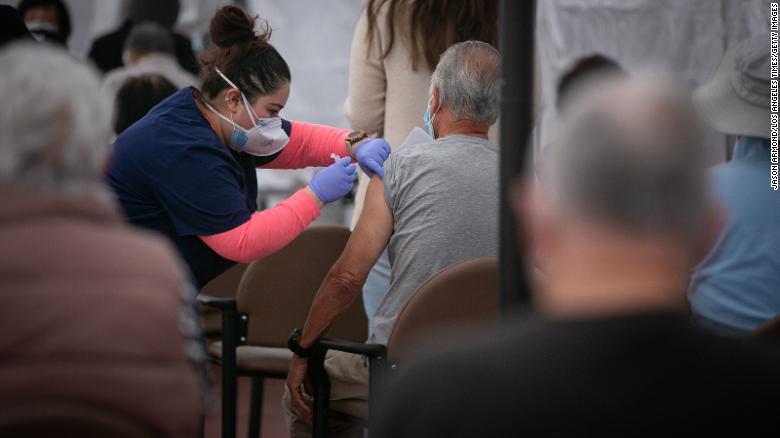
A nurse administers  a Covid-19 vaccine at Kedren Health on Thursday in Los Angeles.
A nurse administers a Covid-19 vaccine at Kedren Health on Thursday in Los Angeles.
 

Debate continues over school reopenings

 
Nearly a year on, the debate over how to safely return students to the classroom persists, even after the CDC released long-awaited guidance last Friday outlining five key strategies, including universal mask wearing.
 
On CNN's "State of the Union" on Sunday, CDC Director Dr. Rochelle Walensky emphasized the need for masks and other mitigation measures to safely reopen school. She said "mask breaching" was the main reason behind the spread of coronavirus in schools, though transmission in schools is mostly associated with spread in the surrounding community
 
The CDC guidance includes a color-coded chart to describe the levels of transmission, from blue to red, with the latter representing high transmission. About 99% of the US population under the age of 18 -- 73 million minors -- live in a so-called "red" zone, according to a CNN analysis of federal data. 
 
Walensky acknowledged "many" counties remain in a red zone. Schools in red zones should pursue a hybrid model if they're an elementary school, she said, while middle and high schools either continue virtual learning or a hybrid model if they're able to adhere to strict physical distancing. 
 
Meantime, Dr. Wen said she found the CDC's guidance both "good and problematic." 
 
She liked that the guidelines specifically defined levels of transmission for certain mitigation measures to go into place. But she took issue with other aspects, including the fact vaccinations are not listed as a "key" strategy for reopening schools. She didn't understand why the subject was up for debate. 
 
"If we want students to be in school for in-person learning, the least that we can do is to protect the health and well-being of our teachers," Wen said, "especially as in so may parts of the country, teachers are already being made to go back to school in poorly-ventilated, cramped areas with many students who may not always be masking and practicing physical distancing." 
 
Walensky noted Sunday the guidance from the CDC's vaccine advisory committee puts teachers in the Phase 1B category for vaccinations. 
 
"I'm a strong advocate of teachers receiving their vaccinations," she said, "but we don't believe it's a prerequisite for schools to reopen."
 

'One step closer to winning the war'

 
Despite lingering concerns, officials are hopeful the continued ramping up of vaccinations is beginning to shift the pandemic's course in a positive direction. 
 
So far, just over 38 million people have received their first dose of the two-dose vaccines available to the US market, according to CDC data released Sunday, and about 14 million people have been fully vaccinated. In all, nearly 53 million doses have been administered -- about 72% of all doses that have been distributed.
 
The IHME expects 145 million adults to be vaccinated by June 1, it said in a statement, which would prevent 114,000 deaths.
 
"Our vaccine supply is going up, the positivity rate is going down and we're getting one step closer to winning the war against COVID each day," New York Gov. Andrew Cuomo said in a statement Saturday, referring to New York's vaccinations.
 
By Sunday, the state had administered 89% of the first dose vaccines it had received from the federal government and 83% of first and second doses, the governor's office said. 
 
In California, officials announced millions of people will be added to the vaccination priority list, including residents "at high risk with developmental and other disabilities" and residents with serious underlying health conditions. The plan, which will begin in mid-March, broadens the ages of eligible individuals from 65 and older to ages 16 through 64 who are in those categories. 
 
Still, the state continues to face a "scarcity of vaccine," according to California Health and Human Services Agency Secretary Dr. Mark Ghaly. The supply shortage has forced several Los Angeles mass vaccination centers to temporarily close. 
 

A new challenge over the weekend

 
Some parts of the US this weekend are facing another challenge that's slowing down vaccinations: winter weather. 
 
Federal officials expect Covid-19 vaccine shipments to Texas will be delayed this week because of a powerful winter storm, Texas Division of Emergency Management Chief W. Nim Kidd said. 
 
"Our vaccines that are set to arrive on Sunday, Monday will probably not arrive until Wednesday, Thursday," Kidd said Saturday, "so we will see delays in vaccine coming into the state." 
 
Some local outdoor vaccination facilities also shut down ahead of the storm, Kidd added, though indoor vaccination administration will continue "as long as it is still safe to drive there." 
 
Alabama Gov. Kay Ivey declared a state of emergency Sunday ahead of anticipated winter weather. The state of emergency will include 28 counties, according to a press release from Ivey's office.
"If weather permits and roadways remain safe, Alabamians who have plans to receive their Covid-19 vaccine should still do so," the press release said.
 
In Portland, Oregon, where rain and snow have caused widespread power outages, the mass Covid-19 vaccination site at the Oregon Convention Center is closed Sunday due to weather, according to a tweet from Kaiser Permanente NW. Those who had appointments will be contacted to reschedule.
 
Washington state's Department of Health said it was also expecting a delayed delivery of vaccine doses due to the weather, in addition to announcing it would prioritize the administration of second doses this week, limiting the available number of appointments for first doses.
 
Vaccine providers in the state had requested about 170,000 doses this week, but the state was only allocated about 92,000, the department said in a news release. The difference was likely because last month some providers had used vaccines doses as initial doses when they were intended to be second doses. 
 
That unfortunately means a portion of this week's available first doses will instead need to be used to complete the two-dose regimen for those individuals.

Thursday, February 4, 2021

‘It’s almost like he slept through the whole pandemic’: Teen in coma for 10 months wakes up

NEXSTAR) – A British teenager who has been in a coma for the past ten months has just woken up, according to local reporting from the United Kingdom. 

Joseph Flavill, 19, was in a serious car accident that left him with a traumatic brain injury on March 1 of last year — before much of the world locked down to the COVID-19 pandemic, Staffordshire Live first reported. When Flavill awoke nearly 11 months later, the teen had no knowledge of the pandemic.

“It’s almost like he slept through the whole pandemic,” his aunt, Sally Flavill-Smith, told Staffordshire Live.

Flavill caught COVID twice while in the hospital, once while in a coma and a second time while awake, though he recovered each time. 

“When he comes out of this, life will not be as he knows it at all,” another aunt, Kate Yarbo, told CNN. “How do you describe it? I think it’s going to be a shock. We’re all still processing it — I’m not sure you can actually ever describe how this pandemic feels.”

Since awaking, Flavill’s “progress has been rapid,” according to CNN. Though he can’t yet speak clearly, he’s beginning to gain control of his limbs and is starting to laugh at jokes.

“We are also very excited to report that Joseph has started to emerge slowly from his stage-two coma, and is beginning to respond to simple commands and stimulation,” the family wrote on the teen’s recovery website, Joseph’s Journey.

They have raised nearly $40,000 to help with costs associated with Flavill’s care after he leaves the hospital.

Full Article & Source:

Sunday, January 3, 2021

Santa Fe man gets legal victory in fight to visit wife in hospice care

By Phaedra Haywood

Gary Hein and his wife, Ann Severine, who lives in the memory care unit of the El Castillo retirement community.

Two Santa Fe men who sued for the right to visit relatives in hospice care during the state’s pandemic-related restrictions won one battle this week when a judge ruled an order authorizing nursing homes to create their own criteria for banning visitors was unconstitutional.

State District Judge Matthew Wilson on Monday ordered the secretary of the New Mexico Department of Health to strike the provision from the public health order and to revisit the order’s language with consideration for the constitutional rights of nursing home residents and their families.

“Loss of familial association for even minimal amounts of time constitutes irreparable injury,” Wilson wrote in his ruling. “Nothing, such as video conferencing, is a substitute for in-person, physical contact with a loved one.”

The ruling is a legal victory for Gary Hein and his lawyer, Pierre Levy, who both fought to be allowed to visit family members with dementia in the memory care unit at the El Castillo retirement community in downtown Santa Fe.

The win is symbolic for Levy — his mother died in September, just weeks after he filed a petition challenging the order.

But it may clear the way for Hein, 78, to visit his wife, 80-year-old Ann Severine, who Hein said is fading at El Castillo without the care and attention he had provided during daily visits before the pandemic struck.

“The harm that Mr. Hein and Ms. Severine are suffering by being denied their right to association outweighs any burden on the Secretary to make sure that the Constitution is taken into account when executive orders are issued,” Wilson ruled.

He granted Hein’s request for a preliminary injunction and directed the health secretary to provide a report within 21 days detailing changes to address the portion of the order identified as unconstitutional.

It’s still unclear, however, when or if Hein will be allowed to see his wife.

A spokeswoman for the Department of Health declined to comment on the case Tuesday.

Former Health Secretary Kathy Kunkel, who retired from the position earlier this year, is named as a defendant in the lawsuit, but Secretary-designate Dr. Tracie Collins is now subject to the order.

El Castillo CEO Al Jahner referred questions to attorney Carol Clifford, who said the facility would incorporate any changes to the state’s public health order into its visitation policy.

Clifford said privacy issues prevented her from commenting on whether Hein would be allowed to visit his wife.

Levy filed a complaint against the Department of Health on Sept. 3 seeking both a preliminary and permanent injunction. He argued the health order issued in March, which directed nursing facilities to limit visitations with patients receiving “end of life care” and authorized them to create criteria for restrictions, was arbitrary, capacious and unconstitutional.

Levy also argued the order was vague about the definition of end-of-life care and discriminated against patients and family members by barring them from visits while placing no restrictions on staff members.

Levy lost standing in the case when his mother died Sept. 12, according to court records.

“As with a lot of situations involving COVID, it’s been an extremely painful experience,” Levy said in an interview Tuesday.

But he didn’t give up.

After his mother’s death, he filed an amended complaint on behalf of Hein. The two had crossed paths in El Castillo’s memory care unit over the years.

“He was frequently there and we became acquainted because he was devoted to his wife and I was devoted to my mother,” Levy said. “And both he and I wanted to make sure our respective family members had love, guidance and support.”

Hein told the court at a recent hearing he and his wife had met in 1987, married in 1999 and moved to El Castillo from Eldorado in 2014.

She was moved to the memory unit in 2016, he said, adding he visited her daily to give her the individual attention and loving care staff didn’t have time to provide.

He brushed her hair and sometimes her teeth “because good dental care was important to both of us,” he said. He also picked out her clothes and took her to get her hair and nails done.

Sometimes they took walks together.

“We were active people before we came to El Castillo,” Hein said on the stand, “and I tried to make her retain some of that activity. It kept her alert and from being just a blob, a vegetable.”

Hein said his wife “enjoyed being in the wild,” so sometimes they would take a drive to the Santa Fe ski basin. Other times, he said, he would sit with his arm around her while they watched television together.

“I was trying to make an abnormal situation more normal,” Hein said.

But since the lockdown in March, Hein told the judge, he’d only been allowed to see Severine a handful of times — twice during socially distanced visits and several times during “window visits,” in which a nurse would push his wife’s wheelchair up to a window so they could see each other.

During the first socially distanced visit, Hein said, he touched his wife’s leg and was warned by a nurse that if he did it again he would no longer be allowed to see her in person.

Hein said he stopped the window visits because they seemed to upset his wife.

“She seemed confused,” he said. “She seemed bewildered that I was there, but not.”

Hein said he’s had in-person contact with his wife once since the lockdown, when he took her to a dentist to address a lost crown. After they were able to touch and be together, he said, his wife became more verbal.

Now he said, he visits her via video once a week and sends her notes and photographs through staff.

But her condition has deteriorated, he said, and so has his.

“Prior to the lockdown, she was conversant and we could talk to each other,” Hein told the judge. “Now, we don’t.”

Before the lockdown, Hein said, his wife was still an active person. “Today, he told the court, she inhabits a body … [but] a lot of the personality and life is leaving.”

“I guess I’m turning inward, too, in a way,” Hein said at the hearing. “I don’t go out of the apartment much. I go to the grocery store. But I am isolating because I don’t want to risk being a liability to her should I get to visit her again.”

Wilson noted in his ruling that while several employees of El Castillo had tested positive for the virus, Hein had tested negative nearly a dozen times.

Levy cited a recent U.S. Supreme Court ruling in his motions, quoting passages that stated “even in a pandemic, the Constitution cannot be put away and forgotten,” and “even if the Constitution has taken a holiday during this pandemic, it cannot become a sabbatical.”

“There is no dispute that the pandemic is dire and that we are living through the worst public health crisis in over one hundred years,” Levy wrote. “There is no dispute that the Secretary is, in the first instance, tasked with safeguarding public health and has the expertise and resources to bear to carry out this task. Rather, the issue presented is whether, despite these critical times, the Secretary can disregard or ignore the United States and New Mexico Constitutions. The law is clear that she cannot.”

Levy argued that while public officials have some leeway in issuing emergency orders in times of crisis, officials must ensure the restrictions are “the most narrowly tailored means available to satisfy a compelling state interest.”

The Department of Health failed to do that, he said, by failing to review the restrictions and by allowing nursing facilities carte blanche to come up with their own criteria regarding who could visit and who could not.

“We’re hopeful he’ll be able to have in-person visits with his wife soon,” Levy said of Hein.

Full Article & Source: