Arkansans with valid advance healthcare directives generally retain those protections if they later become wards under guardianship or are admitted to the Arkansas State Hospital, according to Attorney General Tim Griffin.
This came on Wednesday, September 9th, in response to questions from State Representative Steve Unger about whether an existing advance directive remains enforceable after a person becomes a ward and is admitted to the State Hospital.
The Attorney General concluded that neither the appointment of a guardian nor admission to the Arkansas State Hospital automatically invalidates a valid advance directive.
Under Griffin’s interpretation of Arkansas law, the state and a ward’s guardian generally must honor the directive. However, the opinion recognizes exceptions when a controlling court order or a provision of state law applies to a particular healthcare decision.
Advance directives allow people to establish instructions concerning future healthcare decisions before circumstances arise in which they may no longer be able to make or communicate those decisions themselves.
Griffin addresses what happens to those previously established instructions when an Arkansan later comes under guardianship. Griffin concluded that becoming a ward does not, by itself, erase an otherwise valid directive.
The same principle generally applies when a ward is admitted to the Arkansas State Hospital. Admission alone does not invalidate the directive or eliminate the state’s obligation to honor it, according to the opinion.
The conclusion is not absolute. A court could issue an order controlling a particular healthcare decision, and state law contains exceptions that may apply depending on the circumstances of an individual case.
Unger asked whether the directive remains enforceable after both guardianship and admission to the State Hospital and whether the state is required to honor the directive. Griffin answered both questions generally in the affirmative.
The publicly released opinion does not identify a particular patient or case that prompted Unger’s request.
It also remains unclear whether the opinion will result in changes to existing procedures used by the Arkansas Department of Human Services, the Arkansas State Hospital or the state’s guardianship system.
An out-of-state man was sentenced to
prison following his conviction in a financial scam that targeted an
elderly Ashley County resident, authorities said.
On Jan. 8, 2026, a jury found Portier
Guytan guilty of charges stemming from a lottery scam involving a
76-year-old Crossett victim. Guytan was sentenced to 10 years in the
Arkansas Department of Correction and fined $10,000 after Circuit Judge
Robert Gibson III accepted the jury’s recommendation.
According to court testimony, the
case began May 15, 2025, when Ashley County Sheriff Tommy Sturgeon
learned the victim had been contacted by individuals claiming he had won
an $11 million Jamaican lottery. The callers instructed the victim to
send $50,000 to collect the winnings.
Before law enforcement intervened,
the victim had already sent approximately $30,000 and was preparing to
deliver the remaining funds during a scheduled exchange at Brookshire’s
in Crossett. Deputies set up surveillance on May 16, 2025, and observed
Guytan accept a bag containing $27,000 in cash from the victim in
exchange for a briefcase purported to contain the lottery proceeds.
Deputies intercepted Guytan
immediately after the exchange. Investigators later determined the
briefcase contained only printer paper.
Guytan told authorities he was
originally from Trinidad and had been living in Massachusetts when he
was paid $3,000 to transport money and deliver it to Jamaica. He
admitted placing the paper inside the briefcase and acknowledged
involvement in a prior exchange, but testified he could not identify the
individual he claimed to be working for.
Deputy Prosecuting Attorney Sandra
Bradshaw thanked the jury following the verdict, saying the outcome sent
a clear message that financial crimes will not be tolerated in Ashley
County.
“This conviction underscores that criminals who exploit vulnerable citizens will be held accountable,” Bradshaw said.
Officials said the case highlights
the ongoing efforts of the 10th Judicial District Prosecuting Attorney’s
Office and the Ashley County Sheriff’s Office to combat elder fraud.
Sheriff Sturgeon noted that lottery and sweepstakes scams are common and
difficult to investigate due to their international nature. He added
that many victims fail to report the crimes out of embarrassment.
Prosecuting Attorney Frank Spain said similar scams have plagued the United States for more than a decade.
“The Jamaican Lottery or
Sweepstakes Scam has targeted vulnerable individuals for over 15 years,”
Spain said. “The Federal Trade Commission issued warnings about this
type of fraud as early as 2009. This conviction sends a strong message
that this exploitation will not be tolerated.”
Spain urged residents to be cautious of unsolicited offers promising large payouts in exchange for fees or taxes, noting such demands typically continue until the victim’s funds are exhausted.
Authorities also warned of other
common elder fraud schemes identified by the FBI, including romance
scams, tech support scams, grandparent scams, government impersonation
scams, home repair scams, and caregiver exploitation.
More information on elder fraud and how to avoid scams can be found on the FBI’s website at fbi.gov.
The warrant said Hamby allegedly came up with the idea to have her
daughter "kidnapped" as a scare tactic due to her talking to strangers
online.
Author: Spencer Bailey
CRAWFORD COUNTY, ARKANSAS, Ark. — Four people, including a former
Crawford County official, have been arrested in an alleged kidnapping
plot.
Tamara "Tammi" Hamby, who once served on the Crawford County Library
Board, turned herself in on Dec. 3 after allegedly enlisting three other
people to kidnap her disabled daughter in what she said was an effort
to teach her a lesson.
David Qbao, Nico Austria, and Shannon Yazmin Yvonne Childers have all been arrested in connection to the allegations.
An arrest warrant for Hamby said that on Nov. 17, a deputy with the
Crawford County Sheriff's Office (CCSO) responded to a possible
kidnapping involving Hamby's 22-year-old daughter, who according to
guardianship court records has physical and intellectual disabilities.
The warrant said Hamby allegedly came up with the idea to have her
daughter "kidnapped" as a scare tactic due to her talking to strangers
online, including someone reportedly claiming to be country singer Luke
Bryan.
Childers, the in-home nursing assistant that helps care for Hamby's
daughter, was contacted by Hamby about the plan for a staged kidnapping,
the warrant said.
Arrest documents said the plan was to have someone pretend to be
associated with Luke Bryan and communicate with Hamby's daughter to
coordinate a meet up.
The plan was then to have the person pick Hamby's daughter up, take
her to a field up the road, and demand money before tying her to a tree.
The warrant says then, Hamby was set to show up and "rescue her."
According
to the warrant, Childers then recruited Quach and Austria to assist,
and they showed up to the Hamby residence wearing ski masks and took
Hamby's daughter.
Austria reportedly took a wrong turn and ended up in the wrong field,
the warrant said. Hamby's daughter was zip tied and tied to a tree.
Hamby's daughter eventually broke free and attempted to run away but
was tackled by Austria and Quach, who threatened to hurt her and retied
her to the tree, the warrant said. Hamby was reportedly watching the
entire time.
The warrant claimed Hamby's daughter escaped on her own and was able to contact 911.
"[Hamby's daughter] was in fear for her life and clung tightly to a
teddy bear the entirety of me speaking with her during her interview,"
the CCSO deputy said in a narrative.
Guardianship court records filed in the past week, which are no
longer publicly available, showed the Arkansas Department of Human
Services (DHS) had filed an emergency petition for custody of Hamby's
daughter.
The Crawford County Circuit Clerk's office confirmed to 5NEWS that the case was sealed by a court order.
Before they were sealed, 5NEWS obtained documents where Gentry
Wahlmeier, an attorney running for Crawford County prosecutor, filed a
motion to intervene on the Hambys' behalf.
Current county prosecutor Kevin Holmes spoke to 5NEWS about the
allegations on the day of Hamby's arrest, explaining that the decisions
the four suspects made were "horrible."
“Listen,
these aren't hardened criminals. These aren't people that have a have
any criminal record whatsoever. But I mean, they made horrible
decisions, and those decisions have consequences," Holmes said.
Hamby submitted her resignation as a library board member on Nov. 24,
effective immediately. Her reasoning for her resignation was that she
was moving out of the Van Buren district.
Hamby is expected in court on Dec. 10. The family has a hearing in their DHS guardianship case on Dec. 16.
Two
people were arrested in May 2025 for allegedly raping an incapacitated
person, according to an investigation by the Sebastian County Sheriff's
Department (SCSD).
In
an affidavit filed, investigators accuse Ricky Hamby of Hackett and
Janette Honeycutt of Fort Smith of raping someone who was "incapable of
consent" because they were "physically helpless or mentally
incapacitated."
Officials
state that around Sept. 11, 2024, the victim met with the suspects to
do an "odd job" as they usually did, according to officials. The
affidavit states the alleged victim would often do odd jobs for Hamby
and Honeycutt, such as picking up items in their yard. It states that
this time the victim was going to move some furniture to earn cash to
buy a birthday present.
At
around 2 p.m. that day, the affidavit said that when the victim arrived
to the home, there was no furniture to move. Instead, the suspects
offered the victim apple pie moonshine. They allegedly invited the
suspect to stay and "chill," and drank alcohol until around 5 p.m.
The
victim needed to go to their home and feed pets, according to the
affidavit. Officials said when the victim returned home, their family
members noticed they had drank alcohol because they were "staggering" as
they got out of their vehicle.
The
affidavit states that the victim went back to the suspects' home and
began to "feel the effects of the alcohol," then "felt weird and lost
consciousness." The affidavit redacted portions describing what occurred
before the victim regained consciousness and did not include specific
details.
According
to investigators, the victim "could not speak and could not move," woke
up in a different room, and lost consciousness a few times while the
crime took place.
The
victim then reportedly woke up at around 5 a.m. the next day and
vomited in the bathroom. Soon after, the suspects drove the victim home
mid-morning and allegedly said, "If you ever want to come back down here
and drink, we will take advantage of you again," Hamby said. "We took
advantage of you when you got messed up drinking and we had fun."
On Sept. 13, the victim went to the Baptist Emergency Room, where they were referred to the Women's Crisis Center.
Authorities
then contacted Hamby and Honeycutt regarding the rape allegations and
interviewed them. Officials also obtained a search warrant to search
their phones. Officials state they found videos of the victim speaking
incoherently and the suspects mocking the victim's mental state.
Additionally,
the affidavit states that the Arkansas State Crime Lab confirmed
Hamby's DNA was involved in the crime. Due to the document being heavily
redacted, it's unclear how investigators were able to use DNA evidence
in the investigation.
A jury trial has been scheduled for September 22, 2025.
Attorney General Tim Griffin today issued the following statement announcing the conviction of Ja’Layia McClendon, 28, of North Little Rock after she pleaded guilty in Pulaski County Circuit Court to the charge of Abuse of an Endangered or Impaired Adult, a Class D Felony:
“Protecting seniors from abuse will continue to be a priority for my office. I congratulate my Medicaid Fraud Control Unit for their diligence in securing this conviction, especially Special Agent Heath Nelson and Assistant Attorney General Gabrielle Davis-Jones. I also thank Sixth Judicial District Prosecutor Will Jones for the assistance of his office in this case.”
McClendon worked as a caregiver at Woodland Heights Senior Living, a Little Rock long-term care facility. She surrendered herself to law enforcement on October 31, 2024. McClendon struck an 82-year-old female resident who was diagnosed with dementia and Alzheimer’s disease, leaving bruises on the resident’s face and forearm.
McClendon was sentenced to five years of probation and a $1,000 fine.
Three people were arrested in Arkansas on charges
of Medicaid fraud and elder abuse in separate cases, including one
instance in which an employee at an assisted living facility was seen
striking an elderly woman with Alzheimer's Disease, prosecutors say.
All three suspects in the different cases were arrested or surrendered themselves into custody on Oct. 31.
North
Little Rock resident Ja’Layia J. McClendon, 28, was arrested on a
charge of abusing an endangered or impaired person after prosecutors say
witnesses saw her hitting 82-year-old woman with Alzheimer's Disease
living at a Little Rock assisted living facility. Prosecutors say the
woman was left with bruises on her face and forearm.
Trey Franks, 28, was arrested in Little Rock on Oct. 31 on a warrant for
the same charge after prosecutors say more than $1,000 was sent to his
credit card from the bank account of a woman living in a long-term care
facility in Cabot, Arkansas, in five separate transfers from September
to October 2023.
The third arrest was that of Hannah Christmas, a
34-year-old Hamburg, Arkansas, resident, who is facing a charge of
Medicaid fraud. She's accused of billing the Dermott, Hamburg and
Lakeside school districts $5,500 for physical therapy services that were
never rendered from August 2023 to April 2024.
USA TODAY attempted to contact attorneys for all three people and either could not identify one or did not hear back from them.
Elder abuse can take on many forms, including physical, psychological or
sexual abuse, financial exploitation, or neglect and abandonment. The
Justice Department estimates that more than 10% of people over the age of 65 suffer from some form of elder abuse each year.
A couple years ago, Christy Conrad saw a man named Bill out walking and offered him a ride. She learned he was legally blind and had to walk hours for his daily commute. Steve Hartman goes "On the Road" to a small southern town where the simple act of giving someone a lift turned into something much more.
"CBS Evening News with Norah O'Donnell" delivers the latest news and original reporting, and goes beyond the headlines with context and depth. Catch the CBS Evening News every weekday night at 6:30 p.m. ET on the CBS Television Network and at 12 a.m. ET on the CBS News app.
An Ozark County woman has been arrested for financially exploiting two
elderly women she was caring for. Fifty-seven-year-old Patricia Santos
Duvalier of Dora is facing two charges in the case and is also facing
charges for physically abusing another client in her care this year that
is mentally handicapped.
According to court documents in the most recent case, an investigator
with the Missouri Department of Health and Senior Services, Office of
Special Investigations received a report from the Ozark County Sheriff’s
Department regarding a death investigation of a woman from Tecumseh.
Duvalier was a caregiver for the woman.
The woman had given Duvalier her debit card to withdraw her $1,000
per month salary, but when the woman went into a nursing home prior to
her death, Duvalier continued to withdraw the money.
A second victim who is bedridden in the home and cared for by
Duvalier, was found by deputies in a bed that was soaked with urine and
feces and had roaches crawling on the bed.
The victim was taken to Ozarks Health in West Plains and treated for
numerous bedsores the affidavit says were caused by Duvalier’s neglect.
The second victim told investigators she paid Duvalier between $860
and $900 per month to take care of her and another $1,000 to take care
of the other woman who was handicapped. She also says Duvalier would not
agree to take care of the two women unless she added her name to the
deed of their house and land. The woman said she agreed to this because
she feared she would have not have anyone to take care of them.
When investigators asked the second victim how many hours Duvalier
worked each day, she said Duvalier would work from 9-2, leaving her in
her bed and the other woman locked in her bedroom until she arrived
again the next day.
Duvalier is facing two felony counts of financial exploitation of
elderly or disabled and one misdemeanor count of elder abuse. She is
being held without bond in the Ozark County Jail.
Duvalier was arrested earlier this fall after a mentally handicapped female in her care was injured.
According to the probable cause affidavit in that case, the victim,
who also lives in Tecumseh, was brought to the emergency room at Ozarks
Health and told by Duvalier, her paid caregiver, that she had suffered a
fall.
Hospital staff noted the 37-year-old had lost nearly 50 pounds in a
short amount of time, had numerous bruises indicating abuse, tissue was
missing from her upper lip indicating a blow to the face and she had a
broken nose.
Hospital staff told investigators the victim was very scared and kept repeating “help me.”
In that case, Duvalier is facing felony counts of assault in the first degree and abuse of a mentally disabled person.
A Garland County woman was sentenced Monday, Dec. 4 to 15
years in prison and ordered to pay $125,000 in restitution to her victim
after she pleaded guilty in August for Abuse of Adults Exploitation, a
Class B felony, and Medicaid Fraud, a Class A misdemeanor.
Charlene Root Davila, 56, a caregiver and tax preparer, will serve
five years in prison, with 10 years of the sentence suspended, Arkansas
Attorney General Tim Griffin said in a statement. The attorney general's
office prosecuted the case in Garland County Circuit Court.
Root Davila lived in a trailer park at 5600 Albert Pike Road, and was also a neighbor of the victim.
“Cases like these don’t often result in prison time for the
perpetrators, which underscores just how brazen and cruel this crime
was.
“Davila made a calculated effort to secure access to her victim’s
funds after the victim’s husband passed away. The victim has no local
family and was left with little support network following her husband’s
death.
“Davila, a local tax preparer and neighbor of the victim’s, forged
documents to get power of attorney on the victim’s bank accounts and
took approximately $150,000 within just a few days of gaining access to
the accounts.
“She also attempted to obtain guardianship over the victim so that
the victim’s home could be sold with the proceeds going to Davila. The
court noted in its ruling how ‘disturbing’ this case was and how Davila
took advantage of the victim’s vulnerabilities.
“I am grateful to Senior Assistant Attorney General Sharon Strong,
who prosecuted this case in cooperation with Special Prosecuting
Attorney Emily White. I also appreciate the great work done by Special
Agent Dane Pederson of my office’s Medicaid Fraud Control Unit, who
worked in cooperation with the Hot Springs Police Department to
investigate this case.”
On Tuesday afternoon, Davila was in Garland County jail, awaiting transfer to the state prison system.
Following a guilty plea entered by
Celia Fuller, 53, of Mayflower in Pulaski County Circuit Court on Oct.
23, Attorney General Tim Griffin issued the following statement:
“Earlier
this week the prosecution of Celia Fuller for exploitation of an
impaired person, a class B felony, was finalized. I take the protection
of Arkansas seniors seriously and will use all the resources of my
office to prosecute those who would exploit our vulnerable elders.
“I
am proud of the work done by my office’s Medicaid Fraud Control Unit in
this case, particularly investigator Dane Pederson and Assistant
Attorney General Gabby Davis-Jones.”
Fuller pleaded guilty to this
charge on Oct. 23, admitting that she had stolen money from Bobby
Sandage while working for him as a personal care aide. She stole money
from Sandage by writing checks to herself using Sandage’s personal
checkbook, including writing checks after Sandage passed away last year.
Fuller was sentenced to five years of probation, a $100 fine plus court costs and $10,900 in restitution.
JONESBORO, Ark. — A 77-year-old man with
dementia was allegedly scammed out of $18,000, according to a report
filed with the Jonesboro Police Department between August 1 and August
25.
The daughter of the victim filed the
report, indicating that her father had been used to withdraw money from
the bank by suspects who then stole it. A 38-year-old white male and a
black female of unknown age are listed as suspects in the report.
The case is currently under investigation
for a potential felony charge of abuse of adults/exploits with property
value more than $2,500.
The incident highlights the heightened
vulnerability of elderly individuals, particularly those with cognitive
impairments, to financial exploitation. The case also raises questions
about what measures can be taken to better protect this demographic.
In Arkansas, the Guardian reported on
a disabled Medicaid recipient who depleted his savings to pay for a
smartphone for his Medicaid-covered caregiver—and then had to pay even
more to cover caregiver wages that were withheld due to technical
glitches. In Ohio, the Mighty reported
on someone who placed the electronic device meant to certify his
caregiver’s activities in the refrigerator when not in use because he
was concerned about privacy. And throughout the U.S., other outlets have
reported on disabled people who have been forced to share photographs and biometric data with third-party apps if they want to continue receiving government support to pay for their in-home care.
All
of this is thanks to a program known as electronic visit verification,
or EVV. EVV ostensibly aims to reduce waste, fraud, and abuse in the
Medicaid system by requiring that caregivers of disabled people “prove”
that the covered individual is actually receiving their approved care.
Under federal law, all states must require that health and home care
providers utilize some form of electronic visit verification; if they do
not, they risk a reduction in funding for their Medicaid programs.
Medicaid-funded
in-home care helps to make life more accessible for many Americans with
disabilities, and has done so for decades. However, EVV creates
barriers to accessing that care, and in doing so contravenes the intent
of anti-discrimination statutes like the Americans with Disabilities
Act. When the ADA was signed into law on July 26, 1990, it marked a
critical turning point in the modern disability rights movement. The ADA
had the noble intention of eliminating discrimination against people
with disabilities, partially by providing for accessibility in all
arenas of American life. But 33 years later, the law has been unable to
entirely fulfill its ideals—and in many cases, the rapid proliferation
of technology can serve as a barrier, not only to the mission of
advancing accessibility, but also to reducing discrimination against
disabled people more generally. Electronic visit verification
illustrates what discrimination can look like for people with
disabilities in a digital age, and serves as a reminder that
successfully combating disability discrimination requires looking beyond
accessibility.
Technology
can intersect with disability in unique and devastating ways. For
example, algorithmic bias—which shows up in employment via the use of algorithm-driven hiring tools and tests—can harm people with disabilities
by unfairly screening them out of jobs. Because a significant amount of
their health-related data may be stored on devices or apps, disabled
people are also especially at risk when it comes to issues of data
privacy—which have become even more important in the wake of the 2022 Dobbs decision. The use of surveillance technology in schools, like student activity–monitoring software and student threat assessment software, can lead to adverse consequences for disabled students, including a disproportionate chilling effect
on speech both in and outside of school. As is the case with electronic
visit verification, many of these concerns—data privacy, surveillance,
and personal privacy—often manifest simultaneously, thus amplifying
their effects.
In
practice, EVV can look different depending on the state—for example,
some states use mobile apps that require Medicaid-funded home-care
workers to submit photographs of the disabled person to whom they are
providing care periodically throughout the day. At times, those
photographs must pass through facial recognition procedures
to verify that the individual receiving care is actually who the worker
says they are. A worker’s ability to be paid hinges upon successfully
capturing, uploading, and verifying these photographs, regardless of
whether the service recipient objects to the photography or facial
recognition process. Many EVV schemes also use GPS to track caregivers’
locations, and by extension, the location data of the disabled people
they work with. Often, the caregiver and care recipient both must prove
they’re at the recipient’s home to properly verify the visit, which can
limit the disabled person’s ability to leave home and engage in
community activities.
While EVV was initially required as an alleged attempt to prevent public
benefits fraud, whatever preventative benefit it may provide (most of
which seems, at this point, to still be largely speculative) is largely
outweighed by its detriments. On the financial front, according to the Guardian,
the state of Arkansas secured only three convictions for personal
care-services fraud in 2020, recovering a total of $1,930; as of
mid-2021, EVV had cost the state $5.7 million to implement. Outside of
this, EVV creates a system in which disabled people who require
Medicaid-funded in-home services are frequently surveilled by the
government; their photographs or location data are uploaded to apps via
their caregivers’ personal devices; the services they need and are
entitled to are disrupted; and their independence, freedom to leave
their homes, and legally protected right to participate fully in their
communities is hindered. Disabled travel blogger and professional editor
Karin Willison has written
that “Electronic visit verification is the equivalent of putting an
ankle monitor on people with disabilities and telling us where we can
and can’t go. It turns having a disability into a crime.”
The harms that disabled people already experience as a result of EVV
would only be amplified in the case of a data breach or cyberattack. A
breach that impacted apps used for EVV could result in unauthorized
disclosure of a disabled person’s extremely sensitive data—which, again,
they likely didn’t wish to share in the first place. And the harms
stemming from EVV, like many other issues that exist at the intersection
of disability and technology, not only disproportionately affect
disabled people, but particularly those who are multiply marginalized:
in this case, disabled and low-income individuals who qualify for
Medicaid, many of whom are Black and brown. Furthermore, disabled people
are affected on both sides of this issue, as care workers are often
disabled themselves, as well.
The
solution lies largely in the hands of policymakers. Congress could
choose to reverse or reduce EVV requirements. It could also pass federal
privacy legislation, which might then compel certain states to revise
their EVV policies to better protect privacy. Even without federal
policymaking action, because there is some leeway in the existing law,
states could choose to implement a form of EVV that requires and
collects as little data as possible—for example, rather than collecting
location data and requiring real-time photos of caregivers and those
receiving care, a state could choose to have a form of EVV that requires
only that a caregiver call in, perhaps using a landline instead of a
smartphone (although landlines are being phased out, which limits the
pragmatism of a solution such as this one). Limiting data collection to
only what is absolutely and directly relevant and required to accomplish
a particular purpose—a practice known as data minimization—can help to mitigate at least some of the data privacy and security concerns that disabled people currently face.
While
electronic visit verification is but one of a number of issues within
the tech policy world that implicates the civil rights and liberties of
disabled people, relatively little conversation in that world centers centers disability,
or even considers disabled people. It is only by prioritizing the needs
of disabled people in all aspects of technology policy that the noble
intention of the ADA—equality for disabled people, in all arenas of
American life—can fully be realized.
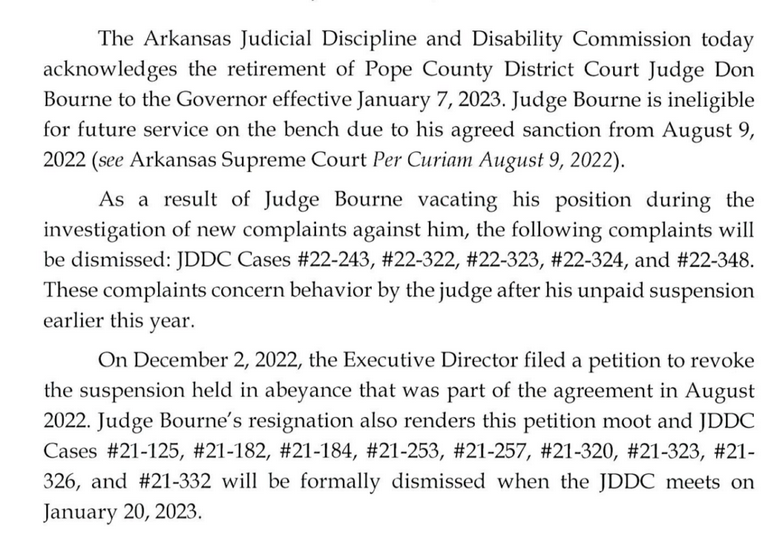
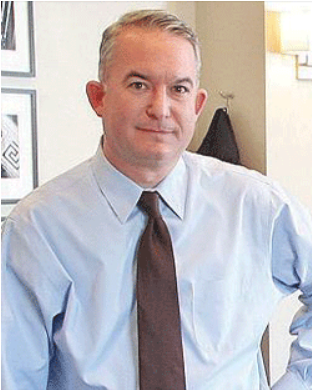
Details are lacking, but this news release suggests that Pope County District Judge Don Bourne, suspended without pay for two weeks for ethical infractions last year, didn’t learn his lesson.
In August,
the Arkansas Judicial Discipline and Disability Commission recommended
that the Arkansas Supreme Court suspend Bourne without pay for 90 days,
with 75 days held in abeyance if his behavior improved. He also accepted
a censure. The deal meant that, with good behavior, he could hold his
office until the end of his term on Dec. 31, 2024.
The disciplinary body moved to revoke the suspension held in abeyance
on Dec. 2, following five more complaints about the judge’s conduct.
Bourne, who had 20 years as a judge and 20 years as a city attorney
and deputy prosecutor, had a sketchy record dating back a long while. As
we wrote in August:
One count of the complaint said he made demeaning
comments to defendants — such as telling Spanish speakers they should
learn English and making negative comments about people who were not
from Pope County.
Another count said he had mishandled indigence requests. Requests for
indigent status were rarely approved and records weren’t kept. In some
misdemeanor cases, he told defendants he wouldn’t appoint an attorney,
telling them instead “Get a job.” The count cites extensive reporting by
KARK on Bourne’s court.
Bourne had been disciplined before for making a campaign contribution in a partisan political race.
The finding said Bourne lacked “humility and compassion” and he did
not attempt to make court fair to the powerless and vulnerable.
It said Bourne’s actions were part of an extended pattern of conduct
and he didn’t appear to see the problem and begin to change his behavior
until advice from legal counsel.
The Supreme Court followed the disciplinary recommendation. He agreed to several remedial measures.
*Observing and reflecting on the conduct of other judges.
*Record proceedings in his court.
*Allow commission courtroom monitors
*Attend a judicial ethics class.
*Read about and take training about bullying and harassment.
I’m attempting to learn more about the nature of new allegations that prompted his early departure from the bench.
UPDATE: David Sachar, executive director of the commission, said days
after Bourne was back on the bench he continued making discourteous
comments about people in court — about their weight, where they lived
and how they earned a living. The disciplinary staff was able to confirm
complaints received about Bourne because of the recording devices
installed in the courtroom as part of the previous discipline.
Sachar added:
The public should be treated with dignity,
patience, and courtesy when they appear in front of a judge. This
increases the public’s confidence in the justice system. Proper judicial
demeanor is not an afterthought – it is a necessary quality for a judge
to fulfill their oath to the people of the State of Arkansas.
Allegations of systemic mistreatment of
people who appear in court are taken seriously. Judges hold incredible
power. The vast majority of them wield that power effectively while also
being as courteous as possible. I am thankful for the judges that
uphold their oath while treating everyone with dignity.
Judge Bourne agreed to leave the bench
after we filed a motion to petition the Supreme Court to instate his
remaining unpaid suspension. We had new complaints – some literally from
just days after he returned to the bench – and those were being
investigated as well. Now all his complaints will be closed as he will
no longer be a judge.
A Melbourne woman faces multiple counts of fraud after investigators say she bilked thousands from an elderly woman.(Izard Co. Sheriff's Office)
By Region 8 Newsdesk
MELBOURNE, Ark. (KAIT) - A Melbourne
woman faces multiple counts of fraud after investigators say she bilked
thousands from an elderly woman.
Brenda
Gayle Axtell is charged with 25 counts of fraudulent use of a credit or
debit card, 2 counts of forgery, and 1 count of abuse of an endangered
or impaired person.
According to a news release from the Izard County Sheriff’s Office,
the victim said she was staying at a local bed and breakfast after her
home burned when Axtell, who was working with the Meals on Wheels
program, befriended her.
The
83-year-old victim reportedly told investigators Axtell and her husband,
Steve Doran, allowed her to put a new camping trailer on their
property.
When the victim was hospitalized in July, she gave Axtell her credit card to replace a phone she had lost.
The
day after she was admitted to the hospital, investigators said Axtell
obtained a hand-written Power of Attorney and began making withdrawals
from the victim’s account.
“Withdrawals
were made from various banks in Melbourne, Mountain View, and
Batesville, along with purchases at Walmart, Tractor Supply Company, and
Home Depot,” the release stated.
According
to the affidavit, the cumulative amount of withdrawals and
point-of-sale transactions Axtell made on the victim’s card totaled
$10,645.87.
The victim “adamantly denied” ever giving Axtell consent to use her credit cards in that manner.
After reviewing the case, Judge David E. Miller found probable cause to arrest Axtell and set her bond at $100,000.
The bond was later reduced, and Axtell was released on a $25,000 bond with the condition she surrenders her passport.
JUDGE ROBIN CARROLL:
Suspension recommended.
(South Arkansas Community
College photo.)
The state Judicial Discipline and Disability Commission has recommended that Circuit Judge Robin Carroll of El Dorado be suspended without pay for 60 days for multiple instances of ethical misconduct.
He has agreed to the recommended sanction, which is up to the Arkansas Supreme Court, rather than contest it.
The 18-page report from David Sachar,
director of the commission, includes a finding of bias in handling
cases involving a deputy sheriff that he told the sheriff should be
fired. He announced in court he’d dismiss cases involving the deputy.
Another finding concerns Carroll’s attempt to exert improper
influence over Game and Fish Commission cases. He tried to get cases
dismissed that were filed against people he knew in other courts.
He also was faulted for lack of “competence and diligence” for
unclear docket entries. He also canceled court without proper notice,
creating hardships for attorneys and defendants, sometimes brought by
sheriffs from other counties.
The complaint lists a number of rule violations, with a particular
discussion of his participation in cases from which he should have
recused and abuse of office in attempting to influence the Game and Fish
cases.
The report concludes Carroll had demonstrated a pattern of poor
conduct and didn’t appear to acknowledge it until several months into
the investigation. It said Carroll, with advice from his attorney,
appears to have improved his conduct, including by recusing from the
deputy’s cases.
Carroll was a private attorney for 10 years, a prosecuting attorney
for six and \ a judge for nearly 10 years. The discipline agency said,
by way of mitigation of penalties, that Carroll had acknowledged errors
and that he also had faced health issues and family deaths in the last
year. He has given up a criminal docket to avoid cases involving the
deputy and taken on more civil cases. He has agreed to remedial
measures, the complaint says.
The recommendation was for 90 days suspension, but with 30 days in
abeyance if conditions are met. The punishment is worse than a censure
but less than removal from office.
The judge is restricted in what he may say about the case, he will be
subject to attendance checks and he must attend classes on ethics and
court management.
The judge’s circuit covers Calhoun, Cleveland, Columbia, Dallas,
Ouachita and Union counties. He was re-elected to a six-year term in
2020.
In December, Governor Asa Hutchinson
announced a plan to bring relief to thousands of families stuck on a
waiting list for Medicaid-funded services for people with intellectual
and developmental disabilities.
Under
the governor’s plan, Arkansas will spend an additional $37.6 million
each year to expand a program that pays for direct care workers and
other services that help developmentally disabled people stay in their
homes or in a community-based setting, as an alternative to
institutionalization. These home and community-based services are
sometimes called “waiver” services because they are funded through a
waiver agreement between federal Medicaid authorities and the state.
About 5,000 clients are now on the Arkansas waiver program.
The
governor has said all of the roughly 3,200 families now on the waitlist
– some of whom have been waiting for more than a decade – should be
served by June 2025. Yet the plan may run into a problem. Arkansas, like
many states, is facing a shortage of direct care workers, the frontline
staff who help disabled, elderly and other clients with daily
activities like eating, bathing, getting dressed and using the bathroom.
Teresa Dodson, 49, is the primary
caregiver for her 22-year-old son, Nathan, who has autism and requires
around-the-clock supervision.
“The
governor has been releasing more of the waitlist people to start
receiving coverage services,” she said. “That’s fabulous. It’s not going
to help us families if they can’t find staff. And the more people we
release off of that waiver waiting list, the more people that need
staff.”
From 2017 to 2020, the
number of nursing assistants, home health aides and personal care aides
in Arkansas dropped slightly, from about 41,000 to about 39,000,
according to PHI, a national nonprofit that advocates for direct care
workers. The workforce likely decreased further over the past two years,
fueled by the COVID-19 pandemic and high demand for low-wage workers in
other sectors.
Direct care
workers are typically paid minimum wage – or close to it – to perform
physically and emotionally demanding work. Arkansas’s minimum wage is
$11 an hour.
Leaders of home
and community-based service providers say finding workers has become
much harder over the last year and a half. In January 2021, Easterseals
Arkansas had about 14 openings for direct care workers, according to Ron
Ekstrand, the CEO of the Little Rock-based provider. By April of this
year, it had 52 openings. (Easterseals employs about 250 direct care
workers total.)
“There’s something wrong with a system in which we can’t find enough people,” Ekstrand said.
Some
help is on the way. In February, the Arkansas Department of Human
Services (DHS) announced a $112 million “workforce stabilization
incentive” for providers of home and community-based services.
Organizations serving developmentally disabled Arkansans will receive
about $52 million for worker retention and recruitment, according to DHS
spokesman Gavin Lesnick. The remaining $60 million has gone to
providers that serve elderly people.
The
funding is part of the American Rescue Plan, the federal pandemic
relief package signed by President Biden in 2021. The bill provides
another $12 million for technology initiatives and $27 million for
renovation and construction projects for both groups of Arkansas
providers, to be disbursed later this year.
Providers say the one-time
money is desperately needed, but it won’t solve their long-term
workforce problems. And with the state opening up new waiver slots,
families who have been waitlisted for years may still find themselves
waiting for services.
Syard
Evans is the CEO of Arkansas Support Network, a provider with offices in
Springdale, Fort Smith, Camden and Jonesboro. Currently, the
organization “does not have the necessary resources to support the
clearing of the waiver waiting list,” she said.
As
of mid-May, Evans said, almost 40 individuals who had been referred to
Arkansas Support Network for services were facing delays in receiving
help due to the staffing shortage.
Low wages, tough jobs
Before
the pandemic, Evans said, Arkansas Support Network typically had
between 85 and 100 job openings a month and about 120 applications. The
numbers began to worsen in early 2021. By April of this year, the
organization had 182 open positions and just 90 applications.
When
employers in other sectors struggle to find workers, they typically
increase their starting pay. Providers of home and community-based
services don’t have that option.
“Fast food can add 50 cents
to every combo meal and generate additional revenue to raise their
minimum wages to $15, $16, $17 an hour – we cannot. We’re locked into
state Medicaid reimbursements,” Evans said. “We do not have the ability
to adjust our pricing or what we’re being paid or what we’re able to
bill.”
Starting pay for a
direct care worker at Arkansas Support Network is $12 an hour but
increases based on education and experience. On average, the direct care
workers she hires make $14 an hour, Evans said.
The problem of recruitment predates the pandemic, she said.
“It is a field that has
been underfunded and under-resourced from the beginning,” Evans said.
“In the mid-’90s, there were organizations that were putting out reports
talking about the collapse of the industry if we cannot find a
sufficient workforce.” The labor shortage created by the pandemic “looks
like it potentially could be the straw that breaks the camel’s back.”
Ekstrand
said Easterseals participates in an employee retention credit program
from the federal government that allows it to pay direct care workers
$15 an hour and provide some paid time off and benefits. But the federal
program is temporary, and it’s not clear Easterseals can keep paying
$15 an hour when it goes away.
“We can’t keep doing it if [Medicaid] reimbursement rates don’t go up,” Ekstrand said.
Ekstrand said he believes many people would enjoy direct care work if they could make a decent living doing it.
“There
are people who are wired in a way that they are caregivers by nature,”
he said. “But they look at that starting pay and the benefits, and they
see these other competitive offers, and they’re like, ‘I’ve got to put
food on my table. I gotta pay my rent.’ And so, we’ve got to become more
competitive with what we’re offering.”
Low pay, and the high turnover that comes with it, can also mean a lower quality of care for families.
For the past four years, Teresa Dodson
has been Nathan’s only caregiver – a decision she made in an attempt to
address behavioral problems her son had developed at school, Dodson
said. Nathan’s behavior has since improved, and Dodson recently started
bringing a direct care worker into their home for a few hours each week.
But she worries that the worker will leave just as Nathan grows to
trust her.
“This [direct care
worker] has been hired to come work with [Nathan for] $11 an hour. She
can’t survive on $11 an hour. So about the time that my son gets used to
her … I have absolutely no doubt she’s going to go find a better-paying
job,” Dodson said.
Dodson, who lives in Hot
Springs, is a paid caregiver herself. Like many parents of adults with
developmental disabilities, Dodson gave up guardianship of her son when
Nathan turned 18 so that she could be compensated by Medicaid through a
provider organization. (Her husband remains Nathan’s legal guardian.)
Although Nathan requires around-the-clock care, she said, the provider
can only pay her for up to 60 hours per week.
Dodson’s
new direct care worker is now in the home for about 8 hours weekly. “I
had to reduce the hours that I’m getting paid by the amount of hours
that she is working. So if she works 10 hours a week, I’m only allowed
to bill for 50 hours a week,” she said. The worker’s hours are also
constrained, Dodson said, because she has three clients but is not
allowed to work more than 40 hours total each week.
Dodson
said the situation was “ludicrous,” considering Nathan requires 24/7
care. “It’s just very frustrating that, because of how little [the
provider] is getting paid, they can’t pay me for what my son actually
needs,” she said. Her emotional health has suffered under the stress,
she said, but she can’t find time for therapy because she has to stay
home with Nathan. (Click to continue reading)
BENTONVILLE, Ark. (KNWA/KFTA)
—On January 21, the Arkansas Judicial Discipline and Disability
Commission (JDDC) announced that a Letter of Censure has been issued to
Judge Brad Karren of the 19th West Judicial Circuit, Division 2.
The letter explains that the confrontation involved Judge
Karren and three other individuals, and arose after one of them parked
in a spot reserved for the judge. In the document from the commission,
Karren’s actions at the time are described as inappropriate and
avoidable.
A man involved in the encounter described Judge Karren as “rabid” in a
social media post, and explained that he saw “a very angry man with a
gun on his hip and a cane berating my son and wife.”
The letter explains that Judge Karren was accompanied by a bailiff
and that “at one point the judge throws his cane as if to clear his
hands and adopts an aggressive stance.”
He resigned as the Benton County judge administrator after the
incident. He is still a Benton County judge and is presiding over
multiple high-profile cases, including one involving the killing of a Pea Ridge police officer.
In a response letter, Judge Karren accepted full responsibility for the incident.
Without question, I accept full
responsibility and public censure today. I know that integrity,
independence, and impartiality are key prerequisites for an effective
and functional judiciary and judicial system.
Judge Brad Karren
Multiple attorneys co-signed Judge Karren’s response letter and
attested to his remorse and regret regarding the encounter, as well as
his fairness in the courtroom.
An agreement between Judge Karen and the JDDC included several remedial measures:
Judge Karren “proactively enrolled and attended the class on
‘Mindfulness for Judges’ through the National Judicial College. This was
a four day, recommended class.
The judge submitted proof of
participation in professional counseling offered through the Judges and
Lawyers Assistance Program and agreed to continue meetings until he and
the counselor both agree the sessions are no longer needed.
Judge
Karren read and reviewed a report on bullying and sexual harrassment,
and is expected to understand the “issues, standards and examples of
bullying in the legal profession.”
An agreement by the judge to
have no more complaints resulting in a finding of probable cause leading
to public charges or discipline.
Officially reiterating his apology to those involved and to the public for his actions that “reflected poorly on the judiciary.”
Judge Karren was previously sanctioned in 2012 after speaking to the
parents of a juvenile in custody without having a prosecutor present and
without notifying the prosecutor’s office. He issued the parents a
visitation order that he admitted “did not follow the standard juvenile
detention policy.”
He told a witness that all he was trying to do was “help the mother
out.” The juvenile refused to meet with his family and the visitation
did not occur that day.
Judge Karren was elected to his position in 2012 and re-elected in
2014 and 2020. His current term is set to expire on December 31, 2026.
Joseph
Schwartz oversaw the care of more than 7,000 older Americans through
his company, Skyline Healthcare, which, at its peak, owned or ran more
than 100 facilities in 11 states. Then the nursing home chain collapsed.Ace Reporters; Google Maps
by Laura Strickler
The former owner of a national nursing home chain that collapsed
amid widespread allegations of neglect and financial mismanagement
detailed in a previous NBC News investigation has been charged by the
Arkansas attorney general with eight counts of Medicaid fraud and two
tax fraud counts.
The man, Joseph Schwartz, who lives in
Brooklyn, New York, is expected to turn himself in to Arkansas
authorities in early January, said his Arkansas attorney, Bill James.
All 10 of the counts are felonies.
Arkansas
is working with a group of other state attorneys general who are also
considering possible civil action against Schwartz, said a person
familiar with their discussions.
At one time, Schwartz
oversaw the care of more than 7,000 older Americans through his company,
Skyline Healthcare, which at its peak owned or ran more than 100
facilities in 11 states. With a handful of staff members, Schwartz
managed them from a tiny office over a New Jersey pizzeria.
Joseph
Schwartz speaking to lawyers during a sworn deposition in June 2017 in a
neglect case he settled. He told the lawyers: "All our facilities are
very, very, very, very compliant with all clients. They all have every
program that's necessary for patient care."Ace Reporters
From
2017 to 2019, the chain crumbled, and more than a dozen
Skyline-operated nursing homes shut their doors, throwing residents,
vendors, employees and state regulators into chaos, according to court
filings, state officials and former employees.
Arkansas
Attorney General Leslie Rutledge alleges that as it declined, the
company did not just fail to pay bills but that it also committed fraud.
"These
charges come after a 44-month-long investigation into Skyline's
wrongdoings, and I will not sit idly by while anyone defrauds the State
and Federal government out of millions of dollars to line their own
pockets," Rutledge said. "It's important for Arkansans to know if they
suspect Medicaid fraud, they should immediately contact my office."
The
charges allege that Schwartz made false statements in Skyline's monthly
Medicaid cost reports to the state, causing the state to overpay the
companies controlled by Schwartz by more than $3 million, a person close
to the investigation said.
The tax charges are related
to allegations that Schwartz did not pay the state funds that were
withheld from his employees' paychecks and also did not pay state income
taxes.
Schwartz received tens of millions of dollars in
gross income from his Arkansas facilities in 2018 and 2019 but failed to
file an Arkansas tax return as required by law, Rutledge said.
Joseph
Schwartz listed a tiny office above this pizzeria in Wood Ridge, N.J.,
as the location where he ran over 100 nursing homes nationwide.NBC News
James
said Schwartz will aggressively fight the charges and plans to plead
not guilty. "I have not heard or seen anything to believe these
allegations are true," James said.
Schwartz went from
owning no nursing homes to owning more than 100 in a short span. In a
sworn deposition in September, newly obtained by NBC News, Schwartz said
that before he owned them, he had no work experience involving nursing
homes other than selling them liability insurance. The deposition was
taken by lawyers representing a plaintiff alleging a wrongful death.
The
company left a wake of documented cases of extreme neglect. In
Arkansas, maggots were found in a resident's catheter, according to
documents when the state attorney general issued fines.
In
2017, Skyline had taken over Ashton Place, a nursing home in Memphis,
Tennessee. Less than two months later, a resident whose leg had recently
been amputated was taken from the nursing home, where he was found
lying in feces, to a hospital, where nurses discovered maggots and
gangrene in his leg, according to the police report obtained by NBC
affiliate WMC.
His death two days later prompted a state
investigation, which revealed that the man's dressing had not been
changed for two days. Staff members told investigators that problems
arose in part when Skyline told nurses to abandon electronic medical
records and go back to paper record-keeping.
A month after the death, the Centers for Medicare and
Medicaid Services, the federal agency that oversees the nursing home
industry, terminated Medicare certification for the facility and another
Skyline property in Tennessee. It terminated a third in the state in
2018.
During the investigation, the company's medical director told inspectors, "I have no support, no direction."
In the deposition from September, which was in relation to a
wrongful death suit filed last year in Arkansas on behalf of a resident
named Lois Rack, Schwartz insisted that Skyline delivered high-caliber
long-term care. An attorney for the plaintiffs, Blake Fromang, asked
him, "Did you monitor the quality of care your facilities were
providing?" He responded, "I did not monitor but I did make [staff]
aware that that is what I want."
Fromang
also asked, "Did you have a system in place to make sure [residents]
were getting quality care?" Schwartz responded, "I'm sure." Fromang
followed up, "Do you remember what it was?" Schwartz answered, "No."
Former
employees alleged in an ongoing lawsuit that they discovered that the
company had stopped paying health care premiums, leaving them to
discover that they were uninsured, and they sued Skyline. Schwartz
denied the allegations in court.
The Massachusetts attorney general cited Schwartz for failing to pay hundreds of employees their wages.
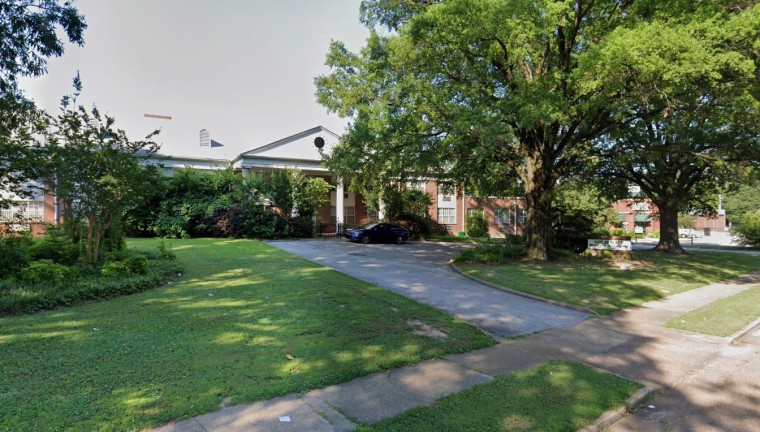
Ashton Place Rehabilitation and Care Center in Memphis, Tenn.Google Maps
In
another sworn deposition in the Arkansas wrongful death case, newly
obtained by NBC News, Skyline's chief financial officer told an attorney
that he would not put his own mother in a Skyline nursing home.
In
several lawsuits against Schwartz, including the Rack case, lawyers for
the plaintiffs asserted that Schwartz and his wife, Rosie, took cash
out of the nursing homes as the company was collapsing, leaving little
or no money to pay for pharmaceuticals, food and liability insurance.
Schwartz's lawyers denied the allegations.
Schwartz
controlled the nursing homes through an intricate web of more than 100
shell companies, according to state business records and federal nursing
home ownership documents.
According to state officials,
the ultimate collapse of the company led to the introduction and passage
of legislation and regulations in at least three states, Ohio, Kansas
and Arkansas, to require increased vetting of new nursing home owners
before they obtain licenses.
Despite
the well-documented implosion of Skyline, Schwartz continues to own at
least four nursing homes, according to federal ownership records.
Schwartz also confirmed in the sworn August deposition that even after
he sold the facilities he owned in Arkansas, he had a profit-sharing
agreement that allowed him to continue to earn money from them. A month
later, when he was asked about the profit-sharing arrangement, Schwartz
said he is using the profits to pay off debts, not for his personal
gain.
Schwartz's son Louis Schwartz, a former vice
president of Skyline, also continues to own nursing homes, such as the
facility in Andover, New Jersey, once known as Andover Subacute II,
which has been renamed Woodland Behavioral and Nursing Center.
The
facility is now part of a state attorney general's investigation into
"facilities with high numbers of Covid-related deaths and below-average
track records for health inspections, staffing, and quality of care."
Kyle Wilson, a police officer in Andover Township, toured the facility a few days before residents began dying in large numbers.
Wilson
wrote in a memo to his sheriff that there was no Covid testing at the
facility and that the staff had not segregated the patients suspected of
having Covid-19. He wrote: "It is my opinion that the acquisition of
[personal protective equipment] alone will not resolve the rate of
spread at this facility. ... [S]taff are undoubtedly contaminated
throughout their shift. While the staff are tangibly scared, a culture
of safety is not present in this facility. They have not been educated.
They do not even know what they do not know."
Following
national coverage and payment of a $221,000 fine for an "immediate
jeopardy" violation, as well as a pause in accepting new residents, the
owners of Andover Subacute changed the name to Woodland Behavioral and
began accepting new residents.