Showing posts with label Life Support. Show all posts

Tuesday, May 21, 2024

Many families take patients off life support too soon after traumatic brain injuries: study

By Melissa Rudy

Many patients who died after traumatic brain injuries may have survived and recovered if their families had waited to take them off life support, a new study has found. (iStock)

Many patients who died after traumatic brain injuries may have survived and recovered if their families had waited to take them off life support, a new study found.

Researchers from Massachusetts General Hospital, Harvard Medical School and other universities analyzed "potential clinical outcomes" for patients with traumatic brain injury (TBI) who were removed from life support, according to a press release.

The study included 1,392 patients who were treated in 18 trauma centers across the U.S. over a 7½-year period.

Using a mathematical model, the researchers compared patients for whom life support was withdrawn to similar patients who were kept on life support.

Among the group for whom life support was not withdrawn, more than 40% recovered at least some independence, according to a press release.

The researchers also discovered that the notion of remaining in a vegetative state was an "unlikely outcome" six months after injury.

When designing the study, the team didn’t know what to expect, according to study author Yelena Bodien, PhD, of the Department of Neurology’s Center for neurotechnology and neurorecovery at Massachusetts General Hospital. 

"Our anecdotal experience was that some families are told their loved ones had no chance for recovery, they would never walk, talk, work or have a meaningful relationship again — yet they chose not to discontinue life support and their loved one made a remarkable recovery," she told Fox News Digital.

"On the other hand, clinicians are under a lot of pressure to make early prognoses and do not want to commit someone to a life that would never be acceptable to them, so it could be that those patients who died after life support was withdrawn would have had very significant impairments otherwise."

"I think there are two stories here," said Bodien. 

"One is that some patients with traumatic brain injury who died because life support was withdrawn may have recovered, but the other is that many would have died even if life support was continued."

A patient’s prognosis after severe traumatic brain injury is highly uncertain, she noted. "Sometimes patients with the most devastating injuries survive and make meaningful recoveries."

"Families can advocate for delaying a decision to discontinue life support if this is aligned with what they believe their loved one would want."

The problem, Bodien said, is that health care providers lack the tools required to determine which patients with devastating injuries will recover, to what extent they will recover — and how long that will take.

‘Very important’ study

Dr. Marc Siegel, clinical professor of medicine at NYU Langone Medical Center and a Fox News medical contributor, was not involved in the research but said it was a "very important" study.

"Previous research shows a high-level recovery from mild TBI and a significant recovery percentage even with moderate to severe injury," Siegel told Fox News Digital.

"After head trauma, the brain may swell, and the use of mannitol and steroids and even sometimes surgery — where the top of the skull is removed — can be used to decrease pressure on the brain and increase chance of a full recovery," he continued. 

Rehabilitation is also crucial, Siegel added.

"All of these tools should be given a chance to work in most cases."

Based on the study findings, Bodien recommended that clinicians should be "very cautious" with "irreversible decisions" like withdrawing life support in the days following traumatic brain injury

"Families should also be aware of our results so that they can advocate for delaying a decision to discontinue life support if this is aligned with what they believe their loved one would want," she added. 

Limitations of the research

There were some limitations to the study, Bodien said.

"The sample size of the study was small, which made it difficult to find an adequate number of participants who did not have life support discontinued and were clinically similar, or ‘matched,’ to those who had life support discontinued," she told Fox News Digital.

Among the participants who did not have life support discontinued, the researchers were not able to follow all of them for a six-month period.

 Another limitation is that the researchers used clinical variables that were available on the day of, or the day after, hospitalization — but sometimes decisions to discontinue life support are made several days later.

"There are many considerations that may lead to a decision to discontinue life support after traumatic brain injury that we were unable to factor into our analyses," she continued. 

"For example, personal beliefs, religion and advanced directives could all affect decision-making but were not captured in our study."

Bodien also noted that the Harvard study was focused on traumatic brain injury and cannot be generalized to other injuries and illnesses.

Full Article & Source:
Many families take patients off life support too soon after traumatic brain injuries: study

Wednesday, January 10, 2018

Medical Murder? Massachusetts Woman Medically Kidnapped from Her Home Dies After Being Denied Medical Intervention


Beverly_Finnegan-768x576-e1513710621499
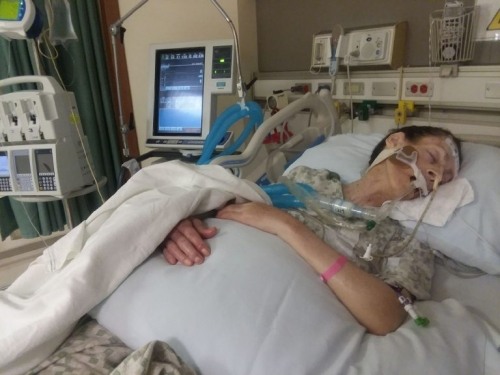
Lawyers and guardians denied Beverley Finnegan the life-saving treatment her sister wanted her to have. The guardianship cost her life. Photo source.

by Health Impact News/MedicalKidnap.com Staff

As the icy blast of the historic “bomb cyclone” chilled the heart of Boston and flooded her streets, an even more chilling battle was taking place over the life of 69 year old Beverley Finnegan.

The fight to get court-appointed guardians and attorneys to allow her to receive life-saving medical treatment has ended with her death just before noon on Friday, January 5, 2018.

See Beverley’s story here:

Active Senior Medically Kidnapped from her Home and Forced onto Drugs in Nursing Home Now Near Death 

UPDATE: Family Fights for the Life of Senior Medically Kidnapped from her Home and Forced onto Drugs


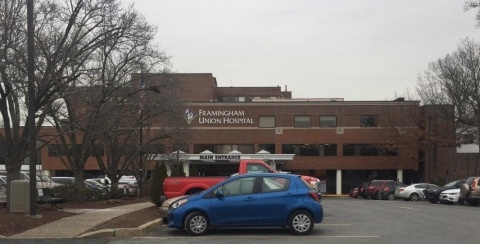
Her tragic death follows the one day that her sister and advocate Janet Pidge were not able to be by her side at Framington Union Hospital. The brutal snowstorm kept Janet, as well as many other residents in the greater Boston area, home and off the streets on Thursday.

“A Turn for the Worse” – During a Crippling Snowstorm

Beverley’s condition was largely unchanged during the last several weeks, so the Friday morning phone call came as a shock.

Gary Zalkin, attorney for Framington Union Hospital, left a voicemail at 8:30 a.m. saying that that she had taken “a turn for the worse” and would likely pass within the next hour or so.

Janet was already en route to the hospital to be by her sister’s side. Advocate and journalist David Arnold told Health Impact News that he joined Janet in Beverley’s hospital room. He reports that her heart stopped several times, while doctors kept saying that her brain had shut down. Finally, her heart stopped beating for the last time, and she was pronounced dead at 11:48 a.m.

Janet’s attorney Lisa Belanger calls it “euthanasia” – the hastening of Beverley Finnegan’s death. Belanger attempted to file a criminal complaint on Saturday, since euthanasia is illegal in Massachusetts. However, the police denied her request, telling her to file medical malpractice instead. She told Health Impact News:
This is worse than the Twilight Zone.

Kidnapped and Denied Civil Rights over Medical Disagreement

For months, Beverley Finnegan and her sister Janet Pidge have been battling the state of Massachusetts to bring her home. The sisters owned a condo together, and they relied on each other. Several years ago Ms. Finnegan named her sister as her proxy if ever she needed someone to make decisions for her. Her wishes were completely ignored.

A doctor diagnosed her with an illness that, in hindsight, she may never have had. Dr. Anne McKinley said that she had a lung infection called Mycobacterium kansasii and that she would die without treatment. When Ms. Finnegan chose not to go back to that particular doctor, Dr. McKinley filed a protective order with the courts.

Police and social workers broke into the condo and seized her. Because she fought against her kidnappers, she was deemed mentally ill and violent. She was bodily seized and forced against her will into a nursing home and forced onto psychotropic drugs.

Door_Frame_w
The door frame was broken during Beverley Finnegan’s state-sanctioned abduction, yet she was labeled “paranoid.” Photo source: Boston Broadside.

For months, she begged and pleaded to go home, saying that they were going to kill her. The presumably imaginary infection that was used as a pretense to deprive her of her liberty was never addressed – not once.

Stranger Named as Her Guardian, While Sister Fights Back

Lawyers petitioned for, and won, the ability to override Ms. Finnegan’s wishes, and a judge appointed a guardian with Jewish Family and Children’s Services. Under a draconian legal construct known as “guardianship,” Marissa Levenson was granted the authority to make life-altering decisions for a woman she had never before met.

Marissa_Levenson__w
Marissa Levenson, guardian with Jewish Family and Children’s Services, was given authority to place Ms. Finnegan into a nursing home against her will. Photo source: Boston Broadside.

According to Lonnie Brennan of the Boston Broadside, who met with Janet Pidge and has attended some of the court hearings:
Beverly’s sister, Janet, is hysterically desperate: she’s fighting daily to get anyone to help. Janet can’t stop talking about her sister, non-stop. She’s anxious, desperate, and determined to get someone to listen. She’s spent her savings, she’s knocked on seemingly every door of every lawyer or politician she could find.
She’s been lied to along the way in the same way her sister was lied to. She is called delusional and paranoid for not believing the state.
She can’t stop. She fights on. She’s determined and gets into rants about the shock of the taking of her sister, long-term problems at her condo with certain neighbors, and the tragic history of her family (for which a movie should be set).
Her money is gone and she’s stuck asking for rides daily or help to pay for the trains to take her from Newton to Framingham each day where she prays at her sister’s side.

Life-Saving Medical Measures Denied

Lisa Belanger says that the decline in Ms. Finnegan’s health was directly related to fact that the state placed her under guardianship. Under that guardianship, she was forced into a nursing home that did not properly care for her. Due to their alleged neglect and possibly actively harmful practices, Ms. Finnegan wound up in a coma on November 30, and doctors have neglected basic medical care that could have saved her life.

On December 18 and again on December 22, Belanger went head to head in court with a gaggle of attorneys and guardians who were determined to pull the plug and end Beverley Finnegan’s life, against the adamant wishes of her sister.

On one side were the guardian and attorneys for Framington Union Hospital, Jewish Family and Children’s Services, and Springwell – a non-profit organization utilized by the state of Massachusetts to implement Adult Protective Services policies.

They all argued that it would be more compassionate to pull the plug than allow her to live life under the current circumstances.

Lisa Belanger argued for Ms. Finnegan’s basic Constitutional right to life. She presented an affidavit from renowned medical expert Dr. Paul Byrne dated December 22, in which he stated that she did “not fulfill any set of ‘brain death’ criteria.”

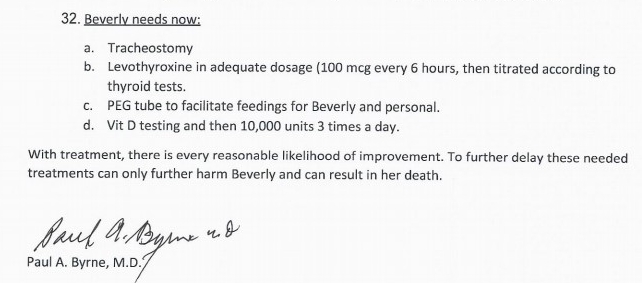
Dr. Byrne laid out specific medical protocols that should have been taken already but hadn’t. He said that if they would initiate such treatment immediately, Beverley’s health should improve.

Belanger Dr Byrne recommendations

Since that time, Lisa Belanger engaged in a life and death struggle to get the hospital to do the basic medical treatments that could have saved Ms. Finnegan’s life. She sent numerous requests to the newly appointed Guardian ad Litem Joanne Moses and to the various attorneys involved, including the hospital’s attorney Gary Zalkin.

Her every attempt was rebuffed.

_MG_9645
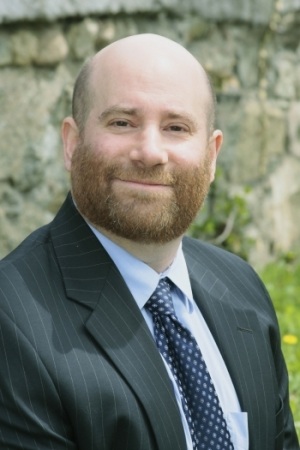
Counsel for Framington Union Hospital, Gary Zalkin. Photo source.

Even though Beverley’s sister and her attorney were clear that they wanted such measures being taken, Zalkin reportedly said that they would have wait until the new Guardian ad Litem approved of the tracheostomy and they were all able to go before the judge again for approval.
Lisa Belanger countered with:
EVERY SECOND THAT GOES BY YOU AND YOUR CLIENT ARE OVERTLY DEPRIVING MY CLIENT’S SISTER OF WHATEVER RECOVERY IS POSSIBLE.
To confirm, Judge Monks expressly stated that Metro West HAS AUTHORITY to perform emergency necessitated procedures–that such procedures do not require a court order.  Again, the emergency procedures are laid out by Dr. Byrne in his provided affidavits that you have received.
As already substantiated from the documentation I provided you, you and your client’s FAILURE TO ACT continues to be knowingly and deliberately causing overt harm to my client’s sister, Beverley Finnegan.
None of the life-saving procedures were initiated. On the day that Beverley’s sister could not be with her at the hospital due to the massive snowstorm, her health suddenly declined. By the time Janet Pidge and Lisa Belanger got word of her demise, all of the government offices to which they could have turned were closed due to the storm.

They were completely helpless to stop what they see as Ms. Finnegan’s needless death. Because of the guardianship, Beverley’s trusted loved one was powerless to intervene to save her life.
This woman who was functional, in full control of her mind, and able to walk and care for herself on her own just a few months ago is gone – another victim of guardianship.

David Arnold has written several articles on the dangers of guardianship. He told Health Impact News:
Guardianship is a form of slavery, but it is actually far worse than slavery. It needs to be abolished.
With guardianship, they want to rob them and kill them.

Conflicts of Interest: Psychotherapist, Jewish Family and Child Services All Complicit in Death

Even though the sisters lived in a large metropolitan area, the small group of players involved in their case have worked together in a number of similar guardianship cases, according to public records.

Jewish Family and Child Services seems to be a major player in the region. They played a significant role in the decisions leading to the rapid decline of Beverley Finnegan’s health.

Attorneys Gary Zalkin,  Lawrence K. Glick, and Wendy K. Crenshaw each appear on the dockets of many guardianship cases in various roles – alternately as counsel for the ward, counsel for the petitioner for guardianship, the petitioner, or guardian.

There are cases where the same attorney’s name shows up in the record in more than one role. In a case from 2016, Case #BR16P0649GD, Gary Zalkin is listed as the attorney for the ward, the petitioner on behalf of the facility wanting to place the ward under guardianship, and as the guardian himself. That is three conflicting roles – all represented by the same attorney.

Zalkin practiced for 14 years as a psychotherapist (Source) before attending law school. He has lectured and written on the practice of guardianship, and has apparently found his niche. According to his website:
Attorney Gary Zalkin wrote the chapter in the Mental Health volume of the Massachusetts Practice Series that explains the new guardianship and conservatorship laws. He has additionally pioneered the affirmation of health care proxies for mental health issues in Massachusetts. He has served as chair of the Riverside Community Care Human Rights Committee and as president of the Board of the National Alliance for the Mentally Ill of Massachusetts, MetroWest affiliate.
In 2005 Attorney Zalkin was honored by Massachusetts Lawyers Weekly as one of fifteen “rising stars – Massachusetts lawyers who have been members of the bar 10 years or less, but who have already distinguished themselves in some manner and appear poised for even greater things.”
Attorney Gary Zalkin received his B.A. in psychology from Brandeis University in 1989 and his M.S.W. from Simmons College School of Social Work in 1992.

Gary Zalkin is also “a member of the Harvard Medical School’s Program in Psychiatry and the Law.” (Source).

Cover-up of Medical Malpractice?

How is it that a person can lose every Constitutional and human right, including the rights to make personal and medical decisions, refuse medical treatment, live in her own home, be autonomous, and choose to live – based on a letter from a doctor not backed up with evidence?

Belanger Framington Hospital

Framington Union Hospital. Photo taken by an advocate, name withheld by request.

What really happened to Beverley Finnegan – both in the nursing home before her hospitalization and in the hospital during the snowstorm, during the time that her sister could not watch over her and try to protect her?

Is there a cover-up happening of medical malpractice?

What kind of benefit is there to those parties networked together? Why are there so many entities and individuals working to take away the basic human rights of senior citizens?

How can citizens protect themselves from the tyrannical overreach of people operating under the color of law to take all their worldly goods as well as their very liberty? Is anyone safe?

Beverley Finnegan’s voice has been silenced. Will her death go unnoticed, or will it mean something? Who will speak out for justice for her and for countless others whose lives are being stolen?

Full Article & Source:
Medical Murder? Massachusetts Woman Medically Kidnapped from Her Home Dies After Being Denied Medical Intervention

See Also:
UPDATE: Family Fights for the Life of Senior Medically Kidnapped from her Home and Forced onto Drugs

Friday, December 29, 2017

UPDATE: Family Fights for the Life of Senior Medically Kidnapped from her Home and Forced onto Drugs

Beverly_Finnegan-768x576-e1513710621499
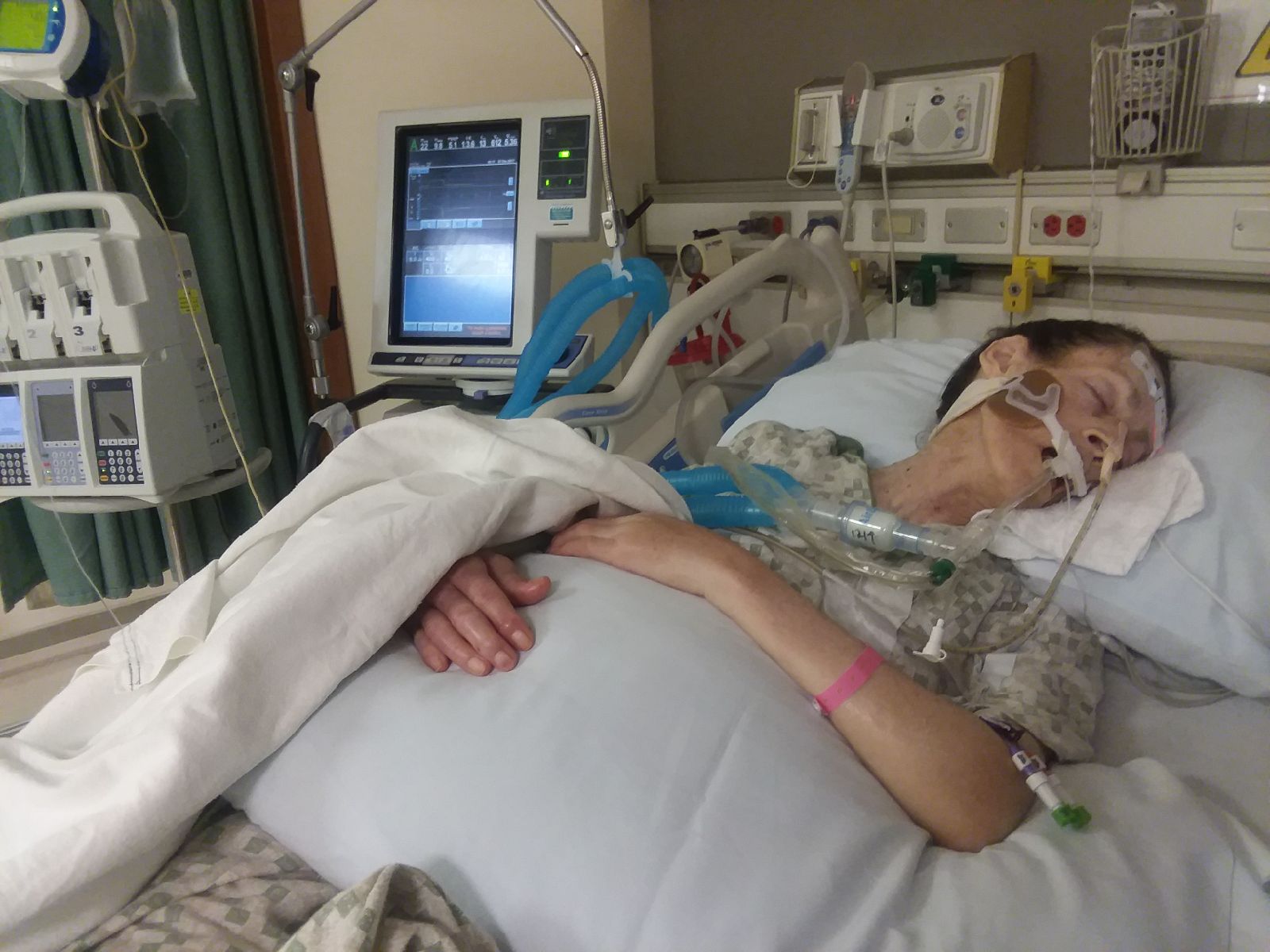
Beverley Finnegan is on life support, but a medical expert says that she is likely to improve 
if proper medical treatment were initiated. Photo taken December 2017. Source.

by Health Impact News/MedicalKidnap.com Staff

The fate of 69 year old Beverley Finnegan of Massachusetts remains up in the air for now. Attorneys met on the Friday before Christmas to argue for and against pulling the plug on the medically kidnapped senior citizen.

After several hours in court, attorney Lisa Belanger told Health Impact News that they had expected Judge Mareen Monks to rule by the end of the day on Friday, December 23, 2017.

That didn’t happen. The verdict was not handed down until after Monday’s Christmas holiday.

The ruling is a temporary victory for Beverley’s life. The court requires additional information and will appoint a Guardian ad litem to gather information on the motions submitted by both sides. The next court hearing will be on January 29, 2018.

While attorneys and guardians argued in court Friday that Beverley Finnegan should be put to death by “pulling the plug,” attorney Lisa Belanger fought valiantly to save the life of a woman that Dr. Paul Byrne, a medical expert on brain death, says is reasonably likely to improve if she were to have proper treatment:
Beverly has a functioning brain. Beverly Finnegan does not fulfill any set of “brain death” criteria.
In Dr. Byrne’s medical affidavit, he states that proper medical treatment of her condition did not occur and still has not occurred. He asserts that if she were to receive the proper treatment, there is a “reasonable likelihood of improvement” of her condition.

See Beverley’s story here:

Active Senior Medically Kidnapped from her Home and Forced onto Drugs in Nursing Home Now Near Death


Medical Expert Testimony Downplayed at Court


As a result of the previous court hearing on Monday, December 18, Beverley’s attorney and sister Janet Pidge were given until Friday, December 22, to secure a second opinion by another medical examiner. It was also ordered that MetroWest Medical Center provide access to Beverley’s medical records to Janet Pidge and Lisa Belanger.

About the time that the family’s previous article was published on Health Impact News on Wednesday, December 20, attorney Lisa Belanger was finally given her client’s medical records.

She was horrified at what she found.

Both Beverley, before her heart attack, and her sister have stated numerous times that Beverley was not being given proper treatment and that she was being abused under guardianship care. For months Beverley has cried and pleaded to be released from the nursing home that she was forced into against her will.

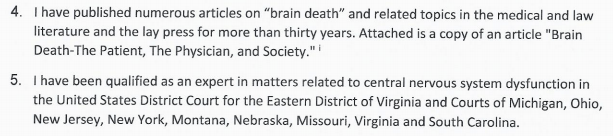
Belanger got in touch with Dr. Paul A. Byrne, M.D., a medical expert with an impressive resume spanning several decades. He has spoken at numerous conferences, published many journal articles, and published a half dozen books on brain death and end of life issues.

According to an affidavit by Dr. Byrne:
Dr. Byrne CV ss

Lawrence Glick is an attorney for Springwell, Inc., an Elder Protective Service agency appointed by the state of Massachusetts. Springwell is the agency that originally petitioned the court for a guardian for Beverley Finnegan almost a year ago. The guardian, Marissa Levinson, representing Jewish Family and Children Services, and Glick are among those who are arguing for Ms. Finnegan’s death.
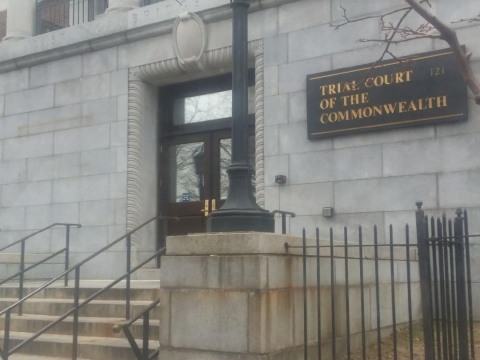
Belanger court
Massachusetts Probate Court. Photo provided by Lisa Belanger.

Ms. Belanger reports that Glick spoke to her about Dr. Byrne:
Wow! I’m impressed. How’d ya find somebody like him on such short notice?
Nonetheless, despite Dr. Paul Byrne’s remarkable qualifications to evaluate Beverley Finnegan’s medical condition, the court balked at his medical affidavit amid claims by attorneys that he was “unqualified” because he is board certified as a pediatrician. Ultimately, however, the document was submitted into evidence.

There were 3 other medical affidavits submitted by the other side, all of which essentially said the same thing, that Beverley was brain dead and had no hope of any recovery. Their statements each look like fill-in-the-blank copies of each other. These were readily accepted as evidence.

Lisa Belanger has learned that one of the doctors, Dr. Elman Urbina Meneses, is actually an intern.

 When she called the Massachusetts Medical Board, they told her that his medical license limits him to practice only at Framingham Union Hospital for training purposes. He is not licensed to practice anywhere else. However, she says that Dr. Meneses certified to the court that he is fully licensed to practice in Massachusetts. (For more on this, see Boston Broadside.)

Another doctor whose affidavit the court accepted was Dr. Aba Somers, who got his medical degree from a school in Johannesburg, South Africa.

Yet, the testimony of these doctors were given preferential treatment over that of the renowned medical expert Dr. Paul Byrne.

Medical Treatment Needed, Says Expert


In Dr. Byrne’s report, he lays out specific medical treatments that need to be initiated immediately:
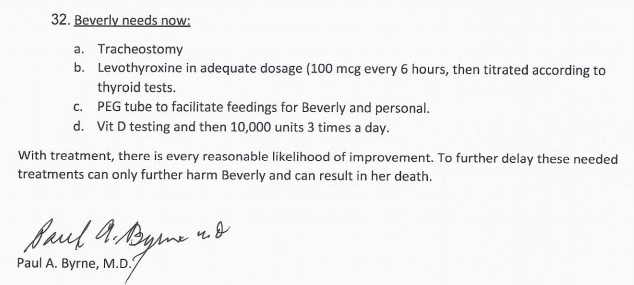
Belanger Dr Byrne recommendations

Other points in Dr. Byrne’s report include:
25. Beverly Finnegan is a living person. Beverly’s heart is beating about 100,000 times a day without stimulation from an electronic pacemaker or medication, blood pressure, respiration, i.e., exchange gases between lungs and blood, the blood and the tissues albeit with the use of a ventilator to push air into Beverly, but with the living Beverly causing the exhalation of carbon dioxide. Beverly is maintaining her temperature at 95-96 indicative of someone who is alive.
26. Beverly is anemic. Her hemoglobin is 7.8 and hematocrit is 26.4. Beverly needs a blood transfusion.
27. Beverly has been on ventilator for about 3 weeks. Tracheostomy is indicated. Ventilator can then be continued until her malnutrition and hypothyroidism are adequately treated.
28. Beverly is very likely deficient in Vit D. This needs to be tested and treated.
29. With adequate thyroid hormone, vitamins including Vitamin D, riboflavin, Vitamin B6, Folic acid, Vitamin B 12, arginine, taurine, omega 3 fatty acids, melatonin, and sufficient protein, being provided as treatment, there is a reasonable likelihood of improvement in Beverly Finnegan’s condition. None of these measures have been initiated to my knowledge.
30. Beverly is malnourished, hypothyroid and on a ventilator. Tracheostomy, feeding tube (PEG tube), thyroid medication and adequate nutrition can help Beverly. To remove the ET tube from Betty with or without the ventilator will do harm and might impose death on Beverly Finnegan. There is little risk of harm to Beverly to attempt such treatment measures, and the prospect of recovery outweighs the limited costs of treatment.
31. A severely sick and damaged brain leads to a sick thyroid gland that worsens brain sickness. At this time Beverly Finnegan is in “global ischemic penumbra” and declared to be in a “vegetative state.” Beverly Finnegan needs treatment, not harm and death imposed on her. With treatment there is every reasonable likelihood of improvement.[emphasis added]
One of the motions filed by the hospital and elder care attorneys was for the use of a PEG feeding tube and a tracheostomy, or breathing tube, to be surgically inserted. It was the one thing that both sides initially agreed upon. However, the guardian and the hospital attorneys reportedly tried to withdraw that motion by the time of court on Friday.

Jewish Family and Children Services, the court-appointed guardian service for Beverley Finnegan, represented by attorneys Wendy Crenshaw and David Schwarz, petitioned the court for authority to authorize removal of the ventilator, initiate a “Do Not Rescuscitate” order, and approval of comfort measures only.

Janet Pidge, Ms. Finnegan’s sister, opposes such efforts by the guardian. She wants her sister to be treated and for her to be given the opportunity to live. Beverley appointed her sister as her medical proxy in 2012, long before she had any medical issues. However, her decision was ignored when the court appointed Jewish Family and Children Services last year to make the decisions for her.

Sister Prevented from Testifying


During the entire hearing, they reportedly argued that it would be more merciful for her to be dead – an assessment that Beverley’s sister vehemently denies.

Janet Pidge was not permitted to testify in court, due to haggling over technicalities, while the very life of her beloved sister was at stake.
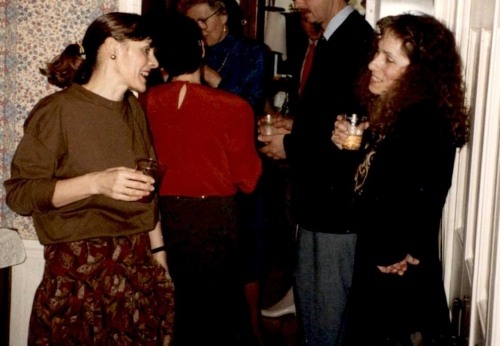
Beverly-Finnegan-Christmas-party
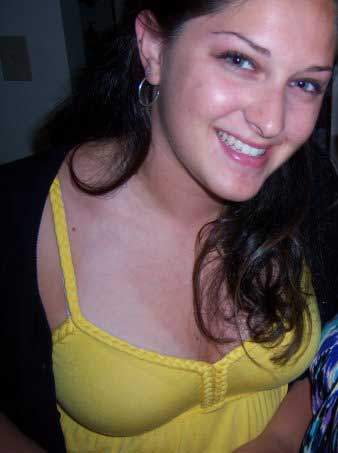
Janet left) with her sister Beverley at a Christmas party in their younger days. Photo provided by family

Janet was initially afraid to leave Beverley’s side to come to court, fearful that the hospital would take her sister off of life support in her absence. She attempted to testify by phone, but she was unable to hear on the hospital phone. When Janet handed the phone to a hospital staff member, the staffer reportedly communicated to the court that she was unwilling to talk.

Shortly after, Janet spoke with her attorney to explain what happened, and said that she wanted to go to court. A supporter drove to the hospital to pick her up so that she could testify in person.

When she arrived at court, her attorney was told that the court had given Janet an opportunity to testify by phone. Since she didn’t do that, because she was coming to court physically, the judge told her that it was too late.

Lisa Belanger attempted to file a hand-written motion to allow her to testify, but she said that when she tried to hand it to the court clerk, he refused to take it and handed it back to her. She and the clerk argued over this in the presence of the judge, who picked up her things and walked away.

Janet Pidge was devastated that she was unable to testify on behalf of her sister.

Past History of Guardianship Battles – Over Their Mother


The entire nightmare scenario feels like a repeat to her of what she and Beverley went through several years ago with their mother.

The sisters fought, unsuccessfully, to save their mother from a similar fate. The state of Massachusetts seized custody of their mother, appointed a guardian, and forced her into a nursing home against her will.

Janet told Health Impact News that they fought for their mother, who was abused and neglected by the guardian and nursing home. She died at age 102, but Janet says that she should have lived longer had she not been taken away.

She believes that at least some of what she is facing with her sister is retaliation for their battle for their mother, during which they filed several lawsuits and took on some very influential people. Some of the players involved with Beverley’s case were allegedly involved with their mother. Janet says that the corruption runs deep in the guardianship/elder protection world in Massachusetts.
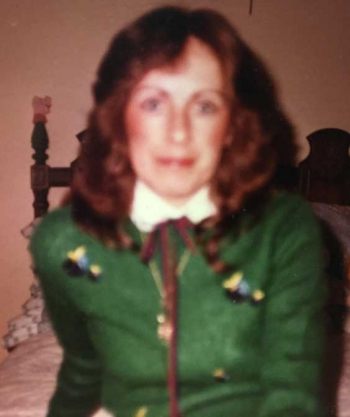
Beverly_Finnegan_prior_w-e1513723676105
After seeing what their mother went through, Beverley chose to name her sister as her medical proxy. Her wishes were ignored. Photo provided by family.

Lawyers Haggle over Medical Recommendations


Since the post-Christmas ruling on December 26, attorney Lisa Belanger has been attempting to get the hospital and attorneys to follow the recommendations of Dr. Paul Byrne, but has been met with resistance and semantical games.

She wrote Wednesday morning to the attorneys involved:
You are hereby formally notified that you have been provided the NECESSARY MEDICAL TREATMENT as set forth in Dr. Byrne’s affidavit that Beverly Finnegan needs IMMEDIATELY. The attached info and upon my consultation with expert medical professionals a PEG is a COMMON PLACE PROCEDURE that is capable of being done in a local hospital.
Also,you ALL are put on notice that the hospital is medically falling below the reasonable care of duty in failing to perform the PEG IMMEDIATELY and for failure to provide Beverly Finnegan the proper dosages of medication as set forth in Dr. Byrnes’s attached affidavit.
There is no ambiguity in Dr. Byrne’s recommendations. Belanger is clear that she and Janet Pidge want the necessary medical treatment to be done.

Yet, attorneys wrote back and forth all day Wednesday, apparently much more concerned about a hearing on Thursday to find out if the judge meant to extend a conservatorship as well as guardianship for Beverley Finnegan than caring about whether or not she gets life-saving medical treatment.

In her ruling on Tuesday, the judge did not specify that the conservatorship was to be extended, so there is a hearing to clarify whether that was an oversight or not.

While the other attorneys try to figure out who is coming, Belanger has been trying to communicate the imperative nature of following Dr. Byrne’s medical recommendations.

After a full day of haggling over what Janet wants for her sister, and questions as to whether or not Janet objects to the tracheostomy and PEG feeding tube [she doesn’t], Belanger emailed the attorneys, including MetroWest Medical Center attorney Gary Zalkin:
I am quite puzzled as to how counsel for a “hospital” does not understand what “emergency” or “immediate” means.  As I emailed you yesterday, Wednesday, December 27, 2017 at 7:50 pm, I have not received any communications whatsoever that you have implemented the necessary LIFE-SAVING measures required.
Therefore, due to your evident and continuing reckless disregard for Beverley Finnegan’s life, please be advised that I will be seeking legal recourse FORTHWITH.
It is now 7:25 am.  EVERY SECOND COUNTS. And every second that elapses you and your client, Metro West, and the other aiders & abettors are compounding your culpability exponentially.
Health Impact Newsattempted to reach Zalkin for comment but was unsuccessful.

How You Can Help


Beverley Finnegan’s life is on the line, and Janet Pidge and attorney Lisa Belanger are asking for all the help they can get to save her life. They ask for people to contact media, the governor, and legislators.

Massachusetts Governor Charlie Baker may be reached at 617-725-4005 or contacted here. His Facebook is here.  His Twitter is here.

State Representative Kay Khan may be reached at 617-722-2011 or contacted here. Her Facebook is here, and her Twitter is here.

State Senator Cynthia Creem may be reached at 617-722-1639 or contacted here.  She is on Facebook here.  Her Twitter is here.

The U.S. Senators for Massachusetts are Ted Markey and Elizabeth Warren.

Senator Ted Markey may be reached at 202 224 2742, or contacted here.

Senator Elizabeth Warren may be reached at 202 224 4543, or contacted here.

Attorney Lisa Siegel Belanger’s website is here. She has a great deal of information on her website about guardianship issues. Her Twitter is here.

Full Article & Source:
UPDATE: Family Fights for the Life of Senior Medically Kidnapped from her Home and Forced onto Drugs

See Also:
68 Year Old Beverly Finnegan – Snatched from Condo by Court Order, Tossed in Nursing Home – Struggled to Get Released – Now on Life Support

Saturday, December 16, 2017

68 Year Old Beverly Finnegan – Snatched from Condo by Court Order, Tossed in Nursing Home – Struggled to Get Released – Now on Life Support

A few names/agencies to remember:

Lawyer: Wendy K. Crawshaw, Framingham, Mass.
Lawyer: Lawrence K. Glick, Needham, Mass.
Judge: Maureen H. Monks, Middlesex County Probate and Family Court
Agency: Jewish Family and Children’s Services, Waltham, Mass.
Agency: Springwell, Inc., Waltham, Mass.

If you see any of their names, on any documents related to your loved ones, run. Run as fast as you can. That’s the hard lesson Janet Pidge says she has learned. Janet is the sister of Beverly Finnegan. Earlier this year, Janet and Beverly shared a condo unit in upscale Newton, Mass. All that changed when key individuals involved with Springwell, Inc., the Kathleen Daniel Nursing and Rehabilitation facility (Framingham), Jewish Family and Children’s Service, and others stepped into their lives.

Beverly Finnegan now “faces imminent death,” according to one court filing.

When Beverly was taken under force from her home –  on an order of Middlesex County Probate and Family Court Judge Maureen H. Monks – Beverly could walk, talk, converse, argue, read newspapers, magazines, pay her bills, handle the sisters’ finances, and was able for months to plead for her release from involuntary commitment to a nursing home.

Flash forward five months and Beverly now clings onto her life. I spent hours in the Framingham hospital where Beverly is in the intensive care unit. She’s gone from one lock-down to another – locked doors again. To get in, you have to press a buzzer outside of wire-reinforced security windows on hard steel doors.

Beverly is now on life support, assisted breathing, and a feeding tube. She’s paper-thin. A photograph of her, provided by a friend from at the hospital is shown below:


[Now 69-year old Beverly Finnegan – December 2017.  In September, she was begging for newspapers and magazines.]

How did Beverly become so emaciated? What drugs was she administered (hint: antipsychotics!)? Why was she taken, and what treatment did she receive or not receive?

We’re compiling court documents, filings, and statements from many individuals associated with Beverly. What we’ve discovered thus far is that Dr. Anne McKinley, a primary care physician filed a protective order with Springwell to force the taking of Beverly from her Newton condo. Why? Because McKinley wrote that Beverly had Mycrobocterium kansasii, a lung infection which required immediate and prolonged attention to cure, and that Beverly was refusing treatment.

That was October of 2016. Right, more than 13 months ago. Why is that significant? Because that ‘taking’ and the subsequent involuntary lockdown in a nursing home by a court-appointed guardian was based on Beverly refusing medical treatment. In short, Judge Monks supported the position that Beverly was obviously a mentally incapacitated person who wouldn’t help herself to a cure from the lung infection, and needed government protection.

Hey Doc: How About a Second Opinion?

It is now more than 13 months since that diagnosis. However, according to court filings, as of the day they placed Beverly on a feeding tube and life support approximately a week ago, she had never, ever, ever been treated for the mysterious lung infection.

You did read that, right? Beverly was assigned a court-appointed guardian, her finances locked down,  her freedom eliminated, her health apparently destroyed, because she refused treatment for an infection which the State said she had, and for which they never, ever treated her.

Are We in the Twilight Zone?

Beverly’s sister, Janet Pidge is hysterically desperate: she’s fighting daily to get anyone to help. She’s spent her savings, she and Beverly have both lost their jobs. She’s knocked on every door, every lawyer, politician, every resource she could find. She said she’s been lied to along the way the same way her sister was lied to, she says. She’s called delusional and paranoid for not believing the State. Her money is gone, and she’s stuck asking for rides daily or help to pay for the trains to take her from Newton to Framingham each day where she prays at her sister’s side.

According to the first couple of hundred pages of court filings we’ve secured and reviewed (before they disappear mysteriously like others in Middlesex Probate Court – see Mary Frank article), we’ve noted a clear, delineated path where the powers-that-be managed to keep Beverly locked up on a section 12: mental order, claiming that she was “paranoid” and not trusting of the medical providers and others. Hmm, they tell her she has an ailment which they don’t treat her for, and she’s the paranoid one?

Beverly’s sister is fighting to keep Beverly alive, but her efforts may not succeed: apparently, while under the care of the nursing home she suffered a cardiac arrest, and apparently suffered from deprivation of oxygen, as noted by Dr. Aba Somers of Framingham hospital. On December 8, 2017, Dr. Somers wrote “The patient has severe brain injury. ICT brain shows swelling of the brain. EEG shows no cortical brain activity. Physical exam shows minimal brain stem reflexes. She has been off sedation for more than a week. She will require a tracheotomy by the end of next week.”

Dr. Somer’s notes conflict with Janet Pidge’s statements that just two weeks ago, that her sister was responding to stimuli, and squeezing her hand, apparently before sedation was heavy. Janet didn’t trust the diagnosis of a lung infection, and now she questions if this is true.

Full Article & Source:
68 Year Old Beverly Finnegan – Snatched from Condo by Court Order, Tossed in Nursing Home – Struggled to Get Released – Now on Life Support

Friday, October 24, 2014

Mother in Coma Heard Everything, Was Scared They’d Turn Off Her Life Support


Kate Allat suffered a stroke at the age of 39 and the mother spent 10 days in a coma afterwards. Now that she is past that frightful ordeal, Allat reveals in a new interview that she heard everything going on around her in her hospital room and she was fearful her life support would be turned off.

Kate Allat
Allat indicates that her mind was functioning normally during her coma but everyone around her thought she was brain-dead as she laid in her hospital bed paralyzed and unable to speak or breathe on her own. She listened in fright as medical staff discussed switching off her life support with her family.

It took two weeks before she was able to communicate with anyone, according to news reports.
LifeNews has focused on these kinds of cases before, where patients heard everything going on around them despite their comatose state. It’s another reason to oppose euthanasia and another reason why doctors and families should take their time before determining someone is “too far gone.”

“They thought I was in a vegetative state. I couldn’t move a muscle. There was no signal I was in there,” She said.

“I was on life support and they might have turned it off.”

“I couldn’t breathe for myself but I could hear conversations that I didn’t want to hear.”

Lucky for Kate, she made a full recovery, and she is urging people to remain aware of the syndrome and strokes.

She also discusses the embarrassment of being in the state.


“There were nurses that spoke over me. They lowered their expectations of me,” she told The Daily Mail.

“It’s fair to call me a control freak so to be in that situation is awful.”

“I’d be left on my shower seat for 20 minutes after a shower, naked.”
 
Full Article & Source:
Mother in Coma Heard Everything, Was Scared They’d Turn Off Her Life Support

Thursday, March 27, 2014

TX Parents Win Guardianship of Adult Son on Life-Support

The parents of 43-year-old Terry Mace won temporary guardianship of their son Thursday after Mace’s wife moved to have his life support removed amid protests from his parents and friends.

Mace’s wife, Yvonne, did not show up for the court hearing.

Mace suffered a massive heart attack March 6 that landed him on life support at Seton Medical Center Williamson.

Two of his friends were with him when he collapsed. One of them, Sgt. Rudy Salinas, performed CPR immediately. Salinas had just finished 10 years in the military, including three tours in Iraq. Mace was working as a defense contractor at Ft. Hood, friends said.

Yvonne flew in from Colorado after hearing about her husband’s condition. She directed doctors on March 22 to remove him from life support.

But because the Maces are in the midst of a bitter divorce, and because Yvonne stood to inherit Mace’s money upon his death, Mace’s parents and friends had concerns about her making his life changing decisions.

“We were disgusted with the decision,” said Salinas. “It was two weeks he had been in the hospital and no one gave him a chance. Especially the woman he was married to for 20 plus years. You would think three children and a marriage would give you inclination to care for the man.”

Full Article and Source:
Parents Win Guardianship of Adult Son on Life Support

Sunday, January 5, 2014

When 'life support' is really 'death support'


(CNN) -- Two young females, both brain dead without warning, remain on ventilators while their devastated families challenge the judgments of their hospitals.

In one situation, the family believes a miracle is possible, and wants to prolong the patient's biological functioning. In the other case, the family wants to disconnect the patient to honor her wishes. But both families are facing obstacles.
 
The way we talk about neurological death has created a misperception, ethicists say: that "brain death" is somehow not as final as cardiac death, even though, by definition, it is.
 
The term "life support" exacerbates the problem, too, because those who are brain dead do not have a life to sustain, said Arthur Caplan, director of the Division of Medical Ethics at NYU Langone Medical Center. This seems to be a fundamental problem in both cases that have entered the national spotlight, he said.
 
"I think these cases have been botched, horribly," he said. "They're giving the impression that dead people can come back to life."

Full Article and Source:
When 'life support' is really 'death support'