Showing posts with label Parkinson's. Show all posts

Tuesday, February 27, 2024

Texas advocate warns about the signs of elder abuse, after Port Neches man kills his 69-year-old father

According to Port Neches Police, Birdsong said he had struck his father before out of frustration from dealing with his father's struggle with Parkinson's.

Brett Strahan, Kyle Orr  

PORT NECHES, Texas — 25-year-old Logan Birdsong was arrested and charged with murder Thursday. He admitted to hitting his father three times resulting in the death of 69-year-old Roy Allen Birdsong.  

According to Port Neches Police, Birdsong said he had struck his father before out of frustration from dealing with his father's struggle with Parkinson's. Which is something Media Relations Director of the Department of Family and Protective Services, Melissa Gonzales says happens all too often.  

"People can see the physical signs of what's been happening, so bruises, cuts or scratches or maybe they're afraid, or they're agitated or anxious when they're around a certain person. There is stress added to meeting another person's daily needs," Gonzales told 12News. 

Gonzales says that elderly abuse isn't only restricted to physical violence. It's often neglect that is the most common form of elder mistreatment. 

"Neglect is a lack of necessities they need. Food, clean water, safe shelter, clean clothing. Signs of neglect can be the adult not having the appropriate medication, if their living area is extremely dirty, if their hygiene is very poor or they appear to be losing weight or are very underweight," Gonzales said. 

Financial exploitation is also a common danger in cases such as these. 

"that can look like sudden, unexplained large expenses, or changes to banking habits that are unusual." said Gonzales 

Gonzales says it is important to recognize these signs and know when to get help. 

"You report your suspicions to the Texas abuse hotline and you can reach it 24 hours a day. we don't recommend not taking action because of the what-if's." 


Full Article & Source:
Texas advocate warns about the signs of elder abuse, after Port Neches man kills his 69-year-old father

Friday, September 22, 2017

The Horrors of Court-Appointed Guardianship – Gretchen’s Shortened Life

Someone I loved very deeply was the victim of abuse by the Probate Court, which destroyed her whole life and precipitated her premature death.

The judge has sole control of guardianship. Guardianship is a dictatorship.

I met Gretchen in the mid 1980s. We started dating in 1998. Around 2000 she developed Parkinson’s disease. By the end of 2008 she also had dementia. I took care of her at home so she would not have to go into a nursing home.

I filed a petition for guardianship in 2011. Since it was a contested case, the court appointed a Guardian ad Litem (GAL) and temporary professional guardian as “disinterested” parties.

My first attorney negotiated a temporary agreement signed by all parties under which I would continue to manage Gretchen’s daily care and finances.

All of Gretchen’s doctors said she should stay at home under my care. In July 2012 the guardian put Gretchen into a nursing home while I was away on vacation, without prior notice.

I should explain: I was planning on going to dance camp with Gretchen as we had done every year for many years. The professional guardian refused to allow Gretchen to go, on the grounds that it would not be safe because of her Parkinson’s and the rustic nature of the camp. She demanded that I go by myself. I have a letter from the camp manager saying that the camp is handicapped accessible. People no longer able to dance are welcome to come to be with their long-time friends.


Gretchen’s daughter had wanted to put Gretchen into a nursing home so she could live in her house. That was what triggered the petition for guardianship. Gretchen did not have a lawyer at the time.

Gretchen’s son did not want her in a nursing home. However, he supported the plan to put Gretchen into a nursing home “temporarily” so I could be removed from Gretchen’s house with a restraining order. That’s what happended while I was away. Then the guardian double crossed Gretchen’s son by keeping her in the nursing home permanently.

When I returned from vacation, the GAL and professional guardian got a restraining order preventing me from visiting Gretchen in the nursing home. Without court authority, the guardian removed Gretchen from my care.

At the hearing on the restraining order I testified that none of the complaints in the affidavit for the restraining order were correct. The judge allowed the restraining order that was based entirely on hearsay and double hearsay.

In the nursing home Gretchen was required to sit in a chair all day. This went directly against the advice of Gretchen’s neurologists who said she needed to stay as physically and socially active as possible or she would go downhill.

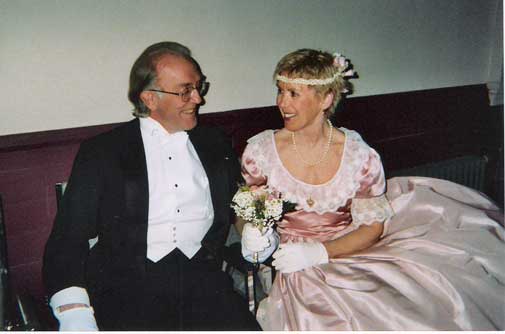
Despite her Parkinson’s, Gretchen was very physically active. She loved all kinds of dancing. The picture on page one is from a vintage dance.

We went ballroom dancing a few nights a week. Gretchen went for daily walks (weather permitting), especially around the lake near her house. She went to the movies, visited with friends and relatives, worked out at the health club, went to dance events and dance camps. Her doctors said her condition was approximately stable.

Within weeks after being placed in the nursing home, Gretchen had lost the ability to walk on her own. Gretchen’s son and his wife filed strong complaints with the guardian regarding Gretchen’s inactivity and rapid decline. The guardian hired an attorney (paid for out of Gretchen’s estate) and instructed them not to communicate with her except through her attorney.

My first attorney was being treated for cancer and unable to continue on the case. I hired a high-level Elder Law attorney. I asked him to file a complaint with the court regarding Gretchen’s lack of proper care. He told me we had to work through the GAL and the temporary professional guardian. The guardian ignored the complaints by my attorney.

Gretchen’s daughter-in-law (Reference 1) says Gretchen was being drugged in the nursing home. This was unnecessary, harmful, and can be fatal. Gretchen’s condition continued to deteriorate. In December 2012, Gretchen’s son and his wife filed a blistering complaint with the court asking for the removal of the guardian. The judge did nothing.

In late December 2012 Gretchen suffered an unexplained incident in the nursing home. Her left wrist and left angle were swollen. Gretchen’s doctor at Lahey Clinic recommended physical therapy for her ankle. The guardian denied treatment, citing the DNR [Do Not Resuscitate] and other statements in Gretchen’s HCP [Health Care Proxy].

The swelling in her wrist healed fairly quickly. The ankle never healed. Gretchen spent the rest of her life in a wheelchair. The total lack of activity accelerated her decline.

By the time of the trial in February 2013, Gretchen was terminal. At a special session during the trial I testified that there was no valid evidence in the affidavit for the restraining order. The GAL and guardian offered no evidence to support the restraining order. The judge ordered the records of the restraining order sealed to protect my reputation.

The judge did nothing about the misconduct by the GAL and professional guardian. The guardian put Gretchen on hospice care about a week after the trial without notice to the parties. Gretchen died a few months after the trial.

I requested recordings of all the hearings in order to file a complaint. My testimony regarding the false restraining order and misconduct by the GAL and guardian was missing. According to the Office of the Chief Justice of the Probate Court, there is no evidence this testimony was ever given.

Reference 1.

http://www.blogtalkradio.com/marti-oakley/2017/06/13/professional-predatory-guardians-the-perfect-job-for-psychopaths

PENDING BILL BEFORE THE
MASS. LEGISLATURE

The Office of the Chief Justice told me there is a bill (S.1177/H.3027) before the Massachusetts Legislature proposed by advocates for the elderly. The purpose of the bill is to provide guardianship services to “unbefriended” people.

Unbefriended people are very vulnerable. They have no one to complain to if they are subjected to abuse. Any system for providing guardianship services to the unbefriended needs to have ironclad protections against abuse.

This bill gives immunity to guardians. Guardians are already given immunity by judges of the Probate Court. Regardless of the intent of immunity, the result has been to create a system of legalized crime where guardians commit crimes with impunity.

Other health care providers have to carry liability insurance. Conservators have to be bonded. Guardians should have liability insurance, not immunity.

A careful reading of the bill shows that the Executive Director of the Office of the Adult Guardianship and Decisional Support Services is the only entity given any authority. It is a dictatorship.

 I have attempted to rewrite the bill in a way that makes maximum use of the principles of democracy such as separation of powers (no one has sole control), checks and balances, accountability (no immunity), avoiding conflict of interest by putting authority in the hands of disinterested parties, etc., to prevent the abuse of power (Reference 2).

Reference 2.

https://ppjg.me/2017/08/09/massachusetts-legislature-poised-to-give-immunity-to-guardians/

MESSAGE FROM
GRETCHEN’S
DAUGHTER-IN-LAW

by Patti Burke Plante

Gretchen was definitely drugged at the nursing home immediately.

This experience was terrible and made our family lose trust in the system. It was unbelievable what the courts get away with. They make you feel guilty for fighting for your loved one’s care.

They “say” they are here to help, but feed on the family that are not getting along and pit family members against each other.

The guardian in our case was terrible and there was no recourse. When we complained or brought up concerns about Gretchen’s care, she got her own lawyer (paid for by Gretchen’s estate) and we could only communicate with the guardian through her lawyer.

This was a long battle and at the last day of court we were told that it was not about Gretchen’s best interest, it was about the law.

 I could go on and on, but the bottom line is that this system is definitely broken and something needs to be done.

A bill or act to give these people more power is just ridiculous!

Full Article & Source:
The Horrors of Court-Appointed Guardianship – Gretchen’s Shortened Life

Saturday, November 5, 2016

Secrets To Helping Your Brain Repair Itself

True or false? “By the time you reach 18 or 20 your brain is fully grown and fixed for life. It’s all downhill after that.”

For 400 years this was what “experts” believed. But it’s a view that wasn’t just wrong, it was “spectacularly wrong,” according to Dr. Norman Doidge, psychiatrist and author of The Brain That Changes Itself.

Here’s the real scoop – and it can change your life if you take advantage of the new discoveries. . .

Because doctors believed the brain can’t repair itself or grow new parts, treatment for many brain conditions was considered unjustified or not even possible.

Since early in the new millennium this perspective has completely changed. The new science of neuroplasticity demonstrates that the brain can, with the right stimuli, adapt, repair itself and restore lost function. (In this context, “plastic” means “capable of being formed or molded.”)

Energy + Thought = Brain Healing


The fact that the stuff between your ears can grow and change means that many learning and health deficits associated with the brain are no longer considered irreversible. They can be improved and sometimes cured.

The ideal interventions to heal the brain don’t involve surgery or drugs. They are natural and non-invasive, mainly different forms of energy such as sound, vibration, light, electricity and motion.
You can use these avenues into your brain to awaken its healing capabilities by modifying patterns of electrical signals. These in turn promote structural changes.

By taking advantage of these therapies. . .
  • Autism has been successfully treated with certain sounds.
  • Attention deficit disorder has been cured through vibrations to the back of the head.
  • Stroke has been healed and symptoms of multiple sclerosis reversed by gentle electrical stimulation on the tongue.
  • Stroke has been healed and symptoms of multiple sclerosis reversed by gentle electrical stimulation on the tongue.
  • Cognitive problems have been resolved with a light touch of the hand over the body (Gastro-Esophageal Reflux Disease), aka heartburn

Eastern Medicine Has Long Known What The West is Now Discovering


Brain circuits that have become idle can be stimulated and stirred back into life with these “energy medicine” techniques. When combined with mental awareness and training, the results are even better.

This combination of energy and thought is central to Eastern traditions of healing. It encompasses activities such as yoga, tai chi, meditation and visualization.

Long dismissed by Western medicine, scientists engaged in neuroplasticity research now appreciate the wisdom of these traditions and the belief that the mind can alter the brain.

Apart from taking up these activities, there are some very simple things you can do to preserve brain functioning and increase the number of neurons and the connections among them.

As we’ve often noted in these pages, one of the best things you can do is take up a new pursuit.

Dr. Doidge explains, “Anything that involves unvaried repetition – our careers, cultural activities, skills repeated, and neuroses – can lead to rigidity.”

The flexibility of thinking and acting in new ways can grow the brain.

The Brain Power That Comes From Walking


Walking is another simple way to improve the health of your brain.

Walking was the key component of a 30-year study that included 2,235 men aged 45 – 59. (The other components were eating at least three servings of fruit and vegetables a day, maintaining a normal weight, keeping alcohol intake low and not smoking).

Those who walked two miles a day (or cycled ten miles a day) reaped the benefit of a 60% reduced risk of both cognitive impairment and dementia.

Walking has also been shown to enlarge the hippocampus, the brain structure that turns short term memories into long term memories. And cognitive functioning was shown to improve with 2½ hours of aerobic exercise a week.

The power of walking is most strikingly demonstrated by John Pepper from South Africa.

Diagnosed with Parkinson’s disease more than 20 years ago, he has reversed all major symptoms by walking 15 miles a week. That, combined with a type of mental concentration technique, allows him to live a full life with none of the classic symptoms of the disease.

The brain is not a machine. It does not inevitably wear out with age. You can increase the neuroplasticity of your brain and be mentally sharp throughout life. All it takes is a little effort.

Full Article & Source:
Secrets To Helping Your Brain Repair Itself

Monday, July 4, 2016

7 Home Safety Tips for People with Parkinson's Disease


After a Parkinson's disease diagnosis, adjustments and renovations both small and large can help make your home more comfortable and safer for yourself or a loved one with Parkinson's disease, especially if gait, balance and fatigue symptoms are an issue.

Our community shared changes they made around the home that helped them. You can also find our guide to assistance products for Parkinson's disease such as utensils with a padded, ribbed handle and non-slip shoes, which can also help make life at home with Parkinson's disease more comfortable.

Not all of these recommendations may be the right fit for you or your loved one. Connect with occupational therapist for personalized advice on making changes around your home. An OT can also help you plan for how to make further adjustments as the disease progresses.

1. Start with small changes, like getting rid of potential obstacles on the floor such as throw rugs and extension cords. Leave plenty of space between pieces of furniture, and create a clear path through your home.


2. Tackle the bathroom. Start by getting rid of bath mats that may slip, and add a non-slip mat to the shower or bath tub. Several commenters recommended getting an elevated toilet seat, which can help make it easier to stand back up. Be careful not to use a towel rack or toilet paper dispenser for help getting up รข€” if possible, install safety rails instead.


3. Add more lights around the house. Light makes navigation easier and can also boost mood, one commenter noted. Touch lights and lights that respond to sound also help.


4. If it's in your budget, install railings along walls and hallways to help with balance and prevent falls.


5. Invest in chairs that are easier to get out of, such as adjustable recliners or chairs with straight backs, firm seats and arm rests. Firm cushions can add height and help with standing, as well.


6. Consider making more significant renovations, if your budget allows, such as building ramps, stair lifts and wider doorways. Medicare covers different types of portable medical equipment, but not permanent installations.


7.   Besides practicality, also make adjustments for comfort. One commenter even found a way to help her two Yorkies sleep better, too, after her husband started acting out his dreams.


Full Article & Source:
7 Home Safety Tips for People with Parkinson's Disease