Showing posts with label assisted living facilities. Show all posts

Monday, March 9, 2026

Jury awards $110M in death of 100-year-old at Sacramento assisted living facility

The family said the verdict cannot bring their mother back, but they hope it will lead to stronger protections for seniors living in assisted living facilities.

Author: Staff (ABC10) 

SACRAMENTO, Calif. — A jury has awarded the family of Mildred Hernandez $110 million after finding an assisted living facility in Sacramento responsible for her death.

Jurors determined that Greenhaven Estates in Sacramento was responsible for the death of Hernandez, who was 100 years old and living at the facility with Alzheimer’s disease. She was known to be at risk of wandering.

In February 2019, Hernandez left the facility during the early morning hours and was later found unresponsive outside in about 38-degree weather. She died from hypothermia.

Attorneys for the Hernandez family argued the companies responsible for the facility prioritized profits over safety, which they said led to understaffing and inadequate protections for vulnerable residents.

The family said the verdict cannot bring their mother back, but they hope it will lead to stronger protections for seniors living in assisted living facilities.

ABC10 reached out to Greenhaven Estates for comment on the verdict but did not receive a response. 

Full Article & Source:
Jury awards $110M in death of 100-year-old at Sacramento assisted living facility 

Tuesday, January 21, 2025

Vulnerable people quietly kicked out of Clark County’s adult family homes and assisted living facilities

Washington long-term care ombuds: ‘This is a statewide problem, and it seems to be increasing’

By Alexis Weisend


The state of Washington prohibits nursing homes from kicking out residents without letting anyone know.

But legislators have failed to extend the same protections to residents of adult family homes and assisted living facilities, which generally provide a lower level of care but still house some of the state’s most vulnerable people.

“We can’t just leave people out,” said state Sen. Paul Harris, R-Vancouver, whose bill aimed at solving the issue died last session in the House, where he was serving at the time.

Attorneys and ombuds say the result is an undocumented surge of displaced residents that’s fueled by a boom in adult family homes, an aging population, and the state’s mental health and addiction crises.

Friday, February 2, 2024

‘We need to tell our story much better’

by Lois A. Bowers

Lois A. Bowers
“From our perspective, we need to tell our story much better.”

That’s what Julie Simpkins, co-president and chief operating officer of Gardant Management Solutions, told the US Senate Special Committee on Aging on Thursday. She was one of four witnesses at a committee hearing titled  “Assisted Living Facilities: Understanding Long-Term Care Options for Older Adults.”

Telling stories may be one of the assisted living industry’s best bets to ward off a threat of federal regulation that several senators brought up in the wake of unflattering articles published in The Washington Post and the New York Times and KFF Health News about resident elopements, workforce challenges, the industry pricing structure and more.

Gardant, Simpkins told committee members, focuses on providing affordable assisted living to low-income older adults via home- and community-based Medicaid waiver programs.

“There are really good stories to tell from the state perspective and our home- and community-based services, and we need to do a better job of talking about those stories and the things that are going on within the states,” she said.

Part of the story is the close working relationships that providers can establish with state and local lawmakers and regulators to help ensure that they understand industry and resident needs and how various actions could affect them, Simpkins said. 

“The innovation that has happened, the times providers have been asked to sit at a table before there’s a rule change,” she said, “and not just ask for comment, but to sit face-to-face with somebody and say, ‘If this rule changes, how does it impact the resident that you’re caring for and your workforce who is caring for that resident?’” 

Hearing witnesses faced questions about the workforce, training, staff levels, affordability and other issues. But those issues are better addressed at the state level, Simpkins said, where regulations can “appropriately recognize the diversity within assisted living while holding our profession accountable.”

Industry trade associations frequently recommend that providers invite their legislators to their senior living communities to show them quality in action as well as help them understand the challenges faced by providers. Now is the time to start or continue such conversations and other efforts to help lawmakers and others become more familiar with the positive aspects of assisted living and what operators are doing for older adults of various income levels, as well as understand any assistance providers may need.

“Assisted living is a critical aspect of the long term care continuum, dedicated to delivering person-centered care to our nation’s seniors. We need collaborative, comprehensive solutions that help ensure our ability, as assisted living communities, to continue doing what we do best: providing safe, quality care to our residents,” Simpkins told senators. “From expanding more affordable long-term care options, to workforce programs to address the growing caregiver shortage, these efforts could make a real difference. We must all work together to ensure every current and future assisted living resident is seen, safe and served to enjoy the highest quality of life possible.”

You can watch a recording of the hearing and read the prepared statements of Sen. Bob Casey (D-PA), committee chair; Sen. Mike Braun (R-IN), ranking member; and the four hearing witnesses on the committee website. And if you know of any consumers who would like to share their experiences with the Aging Committee, they can use the form on the committee website or send a message to this email address: assistedlivingbills@aging.senate.gov.

Full Article & Source:
‘We need to tell our story much better’

Tuesday, May 2, 2023

16 Investigates: Elder abuse in Michiana nursing homes, assisted living facilities


By Monica Murphy

SOUTH BEND, Ind. (WNDU) - According to the Centers for Disease Control and Prevention (CDC), elder abuse is a big problem in the United States.

It is defined as an intentional act or a failure to act that causes harm.

This then begs the question: Are abuse and neglect happening in nursing homes and licensed assisted living facilities across Michiana?

And if so, what is being done to combat the issue?

Karla Fales is the President and CEO of REAL Services in South Bend. The organization helps to meet the needs of older adults in St. Joseph County. Fales said she believes staffing has an impact on resident outcomes.

“And I would say the staffing is one of the predominant things that drives the abuse and neglect because of the fact that they do not have enough. They may not have adequate training and just the heavy load that they are carrying,” Fales said.

Lynn Clough, the director of the State’s Long-Term Care Ombudsman program, agrees.

“They are considering putting a minimum staffing standard in place for nursing homes,” Clough said.

Under Federal Nursing Home Regulations, residents have the right to be free from abuse, neglect, and exploitation.

According to the Family and Social Services Administration’s adult protective services division:

  • Abuse includes touching another person in a rude manner.
  • Neglect is defined as failure to provide adequate food, clothing, shelter, or medical care.
  • Exploitation includes unauthorized uses of personal services or property.

“Neglect may or may not be intentional,” Clough added. She also said a Certified Nursing Assistant (CNA) who is poorly trained may not know how to provide proper care.

Clough then gave some examples of neglect, including:

  • Incorrect body positioning.
  • Lack of toileting or changing of disposable briefs, which causes incontinence and can result in residents sitting in urine or feces.
  • A lack of assistance with eating and drinking, which can lead to malnutrition and dehydration.
  • Ignoring call lights or cries for help.

“I dealt with the bad nursing homes. I am sure there’s plenty of good nursing homes out there,” Mark Shroyer said.

Shroyer said his dad, Glenn Shroyer, moved into a local nursing home in 2022 and claimed Glenn experienced several issues during his stay.

“Went into his room, he had feces, and he had urine on him... My dad would ask to go to the bathroom. They wouldn’t come. I had, many times, said, ‘Hey, my dad needs to go to the restroom.’ ‘We will be there in a little while’... Patients just wandering. I mean you saw it every day,” Shroyer recalled.

Fales said abuse and neglect cases are not always so cut and dry. She said the examples Shroyer mentioned could be considered neglect, if it is continual and if residents are exposed to unsafe conditions.

Shroyer said he never filed a formal complaint with any government agency because he did not think about it at the time but notified staff members.

A month went by, and after having surgery in Chicago, Glenn was transferred to another nearby nursing home.

“Somebody will be there. They’ll help him. They’ll do his rehab. And it didn’t turn out that way at all. There was nobody there for him, so that hurts,” Shroyer said.

Shroyer said his dad experienced similar issues as before.

For example, he said Glenn’s “clothes and teeth were missing.” He was “left in his feces.” And “his catheter bag would leak, and he would be lying in urine.”

Shroyer said he notified staff members.

“If you’re taking on the responsibility of having one of our elderly come into your place of business, and you are promising to take care of them, then you should be able to take care of them. If you don’t have the staff to do it, then we need to find another way,” he told 16 News Now.

Shroyer said this time, he did file a formal complaint with the department’s Long-Term Care Division.

16 News Now asked for a copy of the complaint, but Shroyer says he completed it online.

When Shroyer received a copy of the health department’s findings, he said it mentioned nothing about his dad.

While the health department declined an on-camera or Zoom interview, and declined to comment on specific cases, they said they received a total of 3,822 complaints in 2022, which included 941 allegations of abuse or neglect.

Complaints are confidential under state and federal law. After investigating, a survey report is written, and then, if needed, facilities are required to submit a plan of correction.

The department says it then follows up to make sure the correction has been implemented. It also does annual inspections and writes report cards based on survey findings.

Facility report card scores were not updated for a period of time due to changes in the survey process during the ongoing COVID-19 pandemic but have since resumed.

While the health department is looking to see if regulations are being upheld, the Ombudsman program takes a different approach.

“State ombudsmen have a different perspective and we work for the residents. Our job is to help resolve resident issues or complaints...And I think a good way to put this is that surveyors want to know if the call-light system is working. Family and ombudsmen want to know if somebody is going to be there to answer the call light when the resident pushes it,” Clough said.

The program helps “advocate for residents of long-term care facilities, which includes nursing facilities and licensed assisted living facilities.”

“You know, people who live in a nursing home are entitled to the same level of dignity that we are living in our own homes. And so, they help ensure that they can advocate for them on that,” Fales said.

REAL Services hires ombudsmen.

“And so, they are employed by REAL Services. We have two of them, but they actually report in terms of their authority and their discretion directly to the state ombudsman, which every state has one,” says Fales.

Shroyer said he never knew about the program until our interview.

Glenn eventually passed away on October 22, 2022.

Though difficult, Glenn’s memory carries on. Shroyer said Glenn was a family man, a pet lover, and a guy with an amazing spirit.

“Even at his sickest time, someone would walk in, and he would try to make a joke to make them smile...It makes me sad because he didn’t have to suffer like that. He really didn’t,” Shroyer recalled.

“We’re hoping to bring forward through the legislature, and through others, to say there needs to be standards within the industry. That better equips the nursing home facilities to do what they are supposed to be doing,” Fales said.

Tune in Friday at 6 p.m. as 16 News Now continues investigating potential abuse and neglect happening in nursing homes and licensed assisted living facilities across Michiana.

Full Article & Source:
16 Investigates: Elder abuse in Michiana nursing homes, assisted living facilities

Thursday, April 6, 2023

Elder Abuse & Neglect in Assisted Living Facilities

As people age, it is important for them to consider both their lifespan and their healthspan in order to live an enjoyable and fulfilling life. Lifespan refers to the length of time that a person lives, whereas healthspan refers to the amount of time that a person lives in good health. While people may not have complete control over their lifespan, there are steps they can take to improve their health span and maintain a healthy lifestyle as they age. Such actions include performing exercise, eating healthy, and getting proper rest. As the elderly population grows from the increase in quality of life, it is also important for everyone to recognize and be aware of the risks of elder abuse. Elder abuse can take many forms, including financial exploitation, physical abuse, emotional abuse, and sexual abuse. By focusing on lifespan, health span, and the dangers of elder abuse, people can work towards living an enjoyable and fulfilling life at all ages, especially when growing older.

Assisted living abuse is estimated to be severely underreported, for every reported case of elder abuse, at least five cases go unnoticed. In the United States, there are approximately five million elders over the age of 60 who became a victim of elder abuse. Repercussions of elder abuse are serious, as it has been noted that victims of elder abuse are 300 greater at risk of death.

What is Assisted Living Abuse?

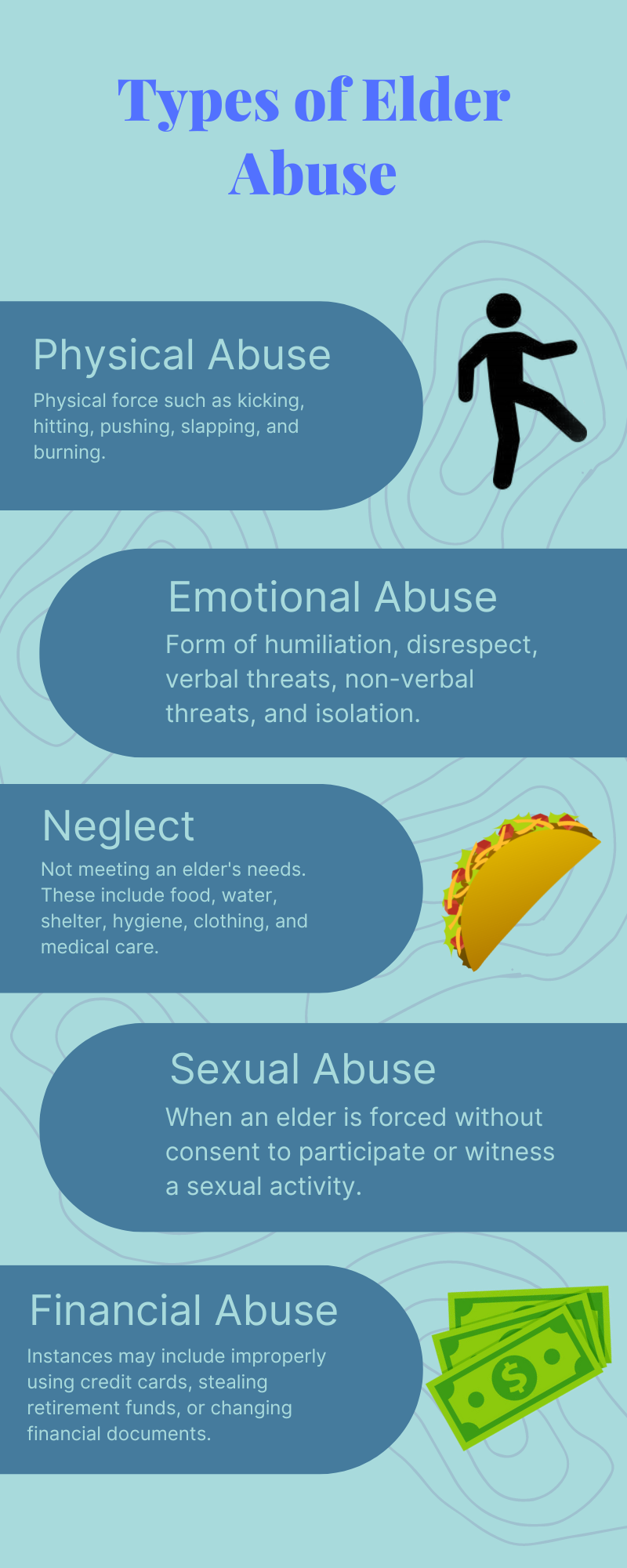
According to the Centers for Disease Control and Prevention, assisted living abuse, otherwise known as elder abuse, is 'an intentional act or failure to act that causes or creates a risk of harm to an older adult'. From the National Institute of Aging, elder abuse and neglect can be described as one of these following categories:

  1. Physical abuse - When an elder experiences pain that can come from intentional use of physical force such as hitting, kicking, pushing, slapping, or burning. This may result in functional impairment, illness, or death..
  2. Emotional abuse - Also known as psychological abuse, it can be seen in the form of humiliation, disrespect, verbal threats, non-verbal threats, and isolation.
  3. Neglect - When a caretaker refuses or does not meet the older adult's basic needs. These needs include food, water, shelter, hygiene, clothing, and medical care.
  4. Sexual abuse - This type of abuse occurs when an elder is forced without their consent to participate in a sexual activity or has to witness a sexual activity.
  5. Financial abuse - When a person illegally or improperly uses the victim's assets. Examples of this include using credit cards without permission, stealing retirement funds, or even changing important financial documents.

Elder Abuse Risks

Before admitting an elder into an assisted living facility, it is always important to diligently conduct a background check. There have been several research studies that show that the probability of abuse and neglect increase when there isn't enough staff to take care of the assisted living home residents. Several other factors to consider include: number of nurses, number of nurse aides, rate of staff turnover, number of beds at a facility, and total incidents involving patient mistreatment. Once an elder is admitted into a selected facility, it is still important to perform regular check-ups. While visiting, be on the lookout for signs of nursing home abuse.

Signs and Symptoms of Assisted Living Abuse and Neglect

There are many instances of financial exploitation of family members. According to the National Council On Aging, 'up to five million older Americans are abused every year, and the annual loss by victims of financial abuse is estimated to be at least $36.5 billion.' Additionally, in a study conducted by the National Ageing Research Institute, it was noted that over 90% of elder abuse perpetrators were relatives of the elderly.

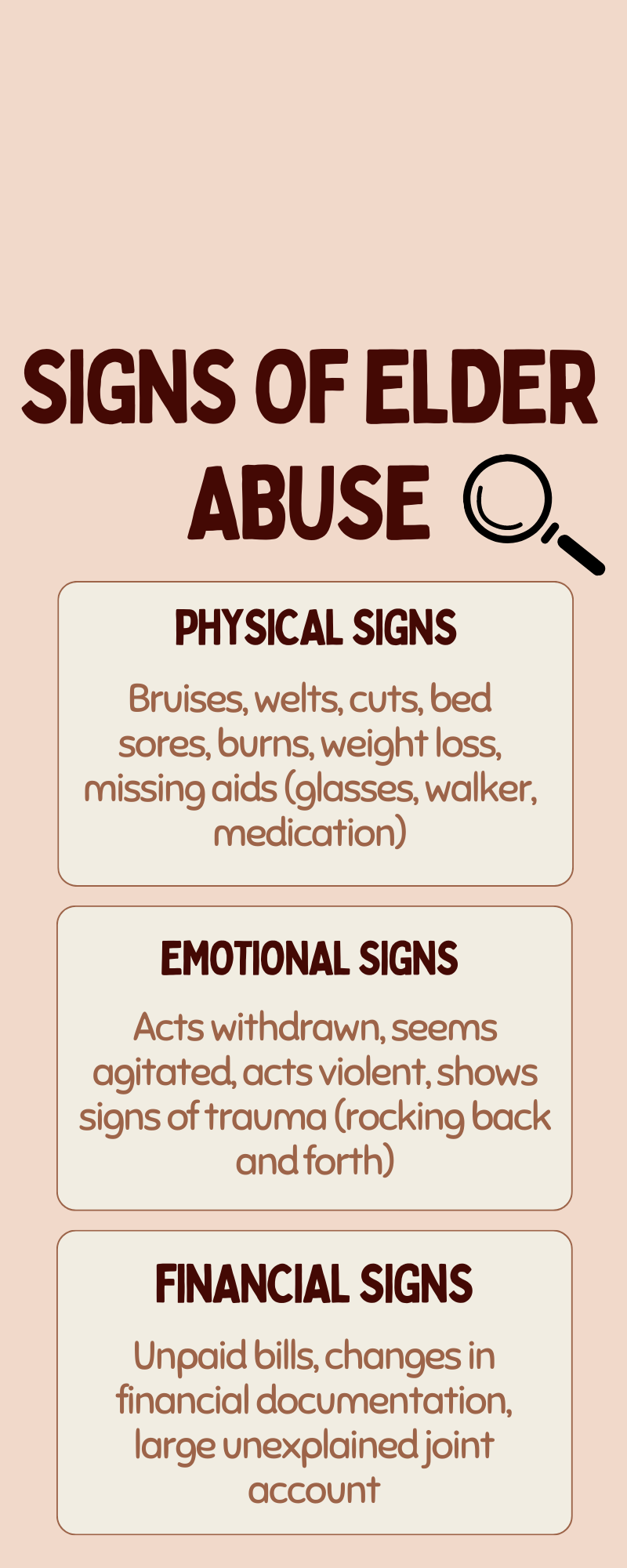
Given that elder abuse offenders can be anyone, sometimes the ones least suspect, it is important to be aware of the signs of assisted living abuse and neglect. Here is a list compiled from the National Center on Elder Abuse and National Institute on Aging detailing some examples of the types of elder abuse. Keep in mind that several of the signs can be attributed to multiple types of abuse, not just one.

  1. Physical signs

    1. Broken bones, bruises, welts, cuts, sores, or burns - bed sores in particular are very common
    2. Torn, stained, or bloody underclothing
    3. Poor nutrition, loss of weight, or dehydration
    4. Poor living conditions - hazardous, unclean, or unsafe environments
    5. Missing daily living aids [glasses, walker, and medications] or glasses may be broken
    6. Sexually transmitted diseases without a clear explanation

  2. Emotional signs

    1. Changes in behavior such as sleep
    2. Doesn't participate in activities s/he used to enjoy
    3. Acts withdrawn, agitated, or violent
    4. Shows signs of trauma, like rocking back and forth
    5. Displays distress or anger frequently

  3. Financial signs

    1. Unexpected changes to bank account - new unexplained joint account, large withdrawals from an inactive account
    2. Unusual changes in money management, will, or other monetary documents
    3. Fake signatures on financial documents
    4. Unpaid bills, such as for unpaid rent
    5. ATM withdrawals by an elder who never used a debit or credit card

Prevention of Elder Abuse

According to the NCEA, there are five things that everyone can do to prevent elder abuse.

  1. Learn the signs of elder abuse - consider teaching older adults to be diligent with any phone, internet, or email financial offers
  2. Call or visit the elderly on a regular basis to perform check ups - seniors will be less lonely, which will decrease their risk of taking advantage of
  3. Spread the message on elder abuse - talk to friends and family members. Teach them what you have learned about elder abuse and how to avoid future instances with law enforcement, community centers, and public transportation
  4. Spread the message on a broader scale - ask the radio or TV station suggesting they can cover World Elder Abuse Awareness Day or Grandparents Day in September
  5. Sign up to be a friendly visitor to an older person in your community

Reporting Elder Abuse

If you see elder abuse occurring real time, and the situation is extremely dangerous, you should call 911 immediately. Besides 911, here are a couple of other organization hotlines you can access to contact and report instances of elder abuse:

1-833-FRAUD-11

(or 833-372-8311)

10AM - 6PM Eastern Time

Monday - Friday

1-800-677-116

8AM - 9 PM Eastern Time

Monday - Friday

Taking Legal Action

After reporting the instance of elder abuse, one should consider taking legal action. This can help prevent future instances of elder abuse happening. Upon taking legal action, the victim of elder abuse could receive compensation from medical bills they've acquired while treating their injuries. In some cases, the damages may be so severe that a significant amount of money can be awarded to punish and deter such behavior from the at-fault party.

Works Cited

Centers for Disease Control and Prevention. 'Fast Facts: Preventing Elder Abuse |Violence Prevention|Injury Center.' CDC, https://www.cdc.gov/violenceprevention/elderabuse/fastfact.html. Accessed 29 December 2022.

'Elder Abuse in Residential Long-Term Care Settings: What Is Known and What Information Is Needed?' Elder Mistreatment: Abuse, Neglect, and Exploitation in an Aging America, by Committee on Law and Justice, et al., edited by Richard J. Bonnie and Robert B. Wallace, National Academies Press, 2003. National Library of Medicine, https://www.ncbi.nlm.nih.gov/books/NBK98786/. Accessed 29 December 2022.

National Ageing Research Institute. 'Profile of elder abuse in Victoria Analysis of data about people seeking help from Seniors Rights Victoria SUMMARY REPORT.' Accessible CMS, June 2015, https://media.accessiblecms.com.au/uploads/seniors-rights-service/2020/08/Summary-Report_Profile-of-Elder-Abuse-in-Victoria_Final.pdf. Accessed 29 December 2022.

National Center on Elder Abuse. 'Signs of Elder Abuse.' National Center on Elder Abuse, 25 October 2021, https://ncea.acl.gov/NCEA/media/Publication/NCEA_SignsEA.pdf. Accessed 29 December 2022.

National Council on Aging. 'Get the Facts on Elder Abuse.' National Council on Aging, 23 February 2021, https://www.ncoa.org/article/get-the-facts-on-elder-abuse. Accessed 29 December 2022.

National Institute on Aging. 'Elder Abuse | National Institute on Aging.' National Institute on Aging, 22 December 2022, https://www.nia.nih.gov/health/elder-abuse. Accessed 29 December 2022.

National Institute on Aging. 'Elder Abuse | National Institute on Aging.' National Institute on Aging, 29 July 2020, https://www.nia.nih.gov/health/elder-abuse#types. Accessed 29 December 2022.

NCEA. 'NCEA: 5 Things Everyone Can Do to Prevent Elder Abuse.' National Center on Elder Abuse, https://ncea.acl.gov/NCEA/media/Publication/NCEA_5thingsToPrevent.pdf. Accessed 29 December 2022.

Full Article & Source:
Elder Abuse & Neglect in Assisted Living Facilities

Sunday, February 26, 2023

Nursing home employees arrested in large-scale fraud scheme involving the elderly: Sheriff

by Skyler Shepard

The sheriff's office said there were multiple texts between (from left to right) Angella Jackson, Lashantia Brown and two other people — 20-year-old Janorris Johnson and 33-year-old Kanisha Altidor. All four of them were benefitting from the fraudulent charges. (Pinellas County Sheriff's Office)

PINELLAS COUNTY, Fla. (CBS12) — Four nursing home employees were arrested after detectives said a large-scale fraud scheme that involved 14 elderly victims and at three different Assisted Living Facility (ALF) locations.

The Pinellas County Sheriff's Office said the investigation began on June 30, 2022, after receiving a report of fraudulent use of a credit card from a victim living in an ALF. 

As the investigation continued, detectives said they were able to identify two suspects, 43-year-old Angella Jackson and her daughter, 28-year-old Lashantia Brown. The two were employees at three different ALFs over a period of several months.  

As the investigation continued, detectives said they were able to identify two suspects, 43-year-old Angella Jackson (left) and her daughter, 28-year-old Lashantia Brown (right). The two were employees at three different ALFs over a period of several months. (Pinellas County Sheriff;s Office)

Detectives said the mother-daughter duo would take photos of the victims’ debit cards and credit cards and then share the information through text with each other. Photos of a driver’s license belonging to two elderly victims were in Brown’s phone.

Another discovery revealed two others involved in the scheme.

The sheriff's office said there were multiple texts between Brown, Jackson and two other people — 33-year-old Kanisha Altidor and 20-year-old Janorris Johnson. All four of them were benefitting from the fraudulent charges. 

The sheriff's office said there were multiple texts between Jackson, Brown and two other people — 33-year-old Kanisha Altidor (right) and 20-year-old Janorris Johnson (left). All four of them were benefitting from the fraudulent charges. (Pinellas County Sheriff's Office)

Detectives said the group made multiple fraudulent purchases at Adventure Island, T-Mobile, an online shoe retailer and created a Spectrum (Charter Communications) account for a residence with the stolen information. The total loss was approximately $14,000 after Jackson stole stole $4,000 in cash from an elderly victim.

On Thursday, Feb. 23, were taken into custody and transported to the Pinellas County Jail. Charges include fraudulent use of a credit card, exploitation of the elderly, scheme to defraud, grand theft and more.

Full Article & Source:
Nursing home employees arrested in large-scale fraud scheme involving the elderly: Sheriff

Sunday, August 15, 2021

'Lives will be saved': New protections for Minnesota seniors in assisted living go into effect

Nearly 55,000 seniors in assisted living gain sweeping protections. 
 
By Chris Serres
 
David Joles - Star Tribune

Residents at the Jones-Harrison Senior Living complex participated in Chaplain Chat, a three-times-a month gathering with Chaplain Monica Powers where Powers leads group members on discussions about religious as well as other topics. Here, Jones-Harrison Senior Living complex residents Colleen Jackson, right to left, and Anne Klein, were eager to get started in July.

Tracy Lussier and Shelly Gelhar had a modest wish list when they moved their 68-year-old mother, who suffered from a degenerative brain disease, into an assisted-living home in Apple Valley. They expected staff to keep her clean, comfortable and safe, so loved ones could focus on her emotional well-being.

Yet within weeks, the sisters noticed alarming signs of neglect. On regular visits, they found their mother was left unbathed and lying in soiled sheets for days at a time. When she fell from her bedroom chair, the sisters had to plead with facility staff to call for medical help. The next day, X-rays showed she had fractured her hip — an injury that would leave her bedridden and in agony for the last few months of her life.

"From day one, it was apparent they didn't care about our mother," said Gelhar, of Rosemount. "She was just another body to fill a bed."

Their experience highlights the extreme lack of oversight of Minnesota's assisted-living industry, a shortfall that has potentially endangered thousands of seniors who entrusted their care with these supportive housing communities.

But now, years of grassroots lobbying by victims of abuse and neglect in these facilities have resulted in the broadest expansion of state supervision of long-term care in generations. A sweeping new state law goes into effect Sunday that establishes minimum levels of care and basic consumer protections for the fast-growing assisted-living industry, which is home to nearly 55,000 Minnesotans.

For the first time, facilities will be licensed and subject to more regular inspections, and residents will have statutory protections against arbitrary evictions and retaliation for reporting maltreatment.

"People's lives will be saved by this law — and hopefully the conditions of those lives will be improved," said Kristine Sundberg, executive director of Elder Voice Family Advocates, a coalition of relatives of elder abuse victims that pushed for changes.

Those families say the dozens of new regulations are long overdue and needed to keep up with the evolving nature of senior care.

When assisted living first gained popularity in the 1980s, the facilities were thought to need less regulation because their residents typically were younger and required less care than people in federally regulated nursing homes. Over the years, however, the distinctions have blurred.

Assisted-living communities have mushroomed in size and have begun catering to older residents and those with more acute health needs. Many have opened specialized "memory care" units for people with dementia and buildings that resemble skilled nursing homes. Nationally, nearly 60% of people living in these homes are older than 85 and about 40% suffer from dementia.

But until now, Minnesota stood alone as the only state that did not license assisted-living facilities, which meant it was hamstrung in enforcing basic standards of care.

Major change for Minnesota

The new law marks a significant shift by expressly recognizing the vulnerability and complex medical needs of assisted-living's changing population.

For the first time, facilities will be required to evaluate the physical and cognitive needs of every newly admitted resident and provide access to a registered nurse 24 hours a day, seven days a week. On-site inspections will be every two years, compared with the previous three-year cycle. And training requirements have been strengthened for staff who care for people with dementia.

The law also effectively bans the practice of sudden and arbitrary evictions in assisted living.

For decades, these homes faced almost no repercussions for forcing out residents who became difficult to manage. Now, if a provider wants to terminate a resident's contract, they must first ensure the resident has a safe place to go and provide them with at least 30 days' written notice before they are discharged — similar to protections that already exist for nursing home residents.

"This should have happened years ago," said Eilon Caspi, a gerontologist and health researcher who is on the board of Elder Voice.

Were it not for a relentless effort to call attention to unsafe conditions in these homes, the new consumer safeguards might never have arisen.

Starting in 2016, the daughters, sons, spouses and other relatives of maltreatment victims began coming forward with harrowing stories of their loved ones suffering from preventable deaths and abuse in assisted-living homes.

The family members, organized as Elder Voice Family Advocates, inundated lawmakers with stories of loss and anguish, including incidents in which loved ones had died, been maimed or traumatized as a result of maltreatment.

In emotional testimony and research reports, they described incidents in which elders were left for hours on the floor after falling, or suffered painful deaths because facilities failed to treat routine health problems, such as hernias, dehydration and diarrhea. Others died because wellness checks were not completed as prescribed and medications were not given or were given incorrectly, they found.

These were far from rare incidents.

A 2017 Star Tribune investigation found the state was receiving more than 20,000 allegations a year of neglect, physical abuse, unexplained serious injuries, and thefts in homes for seniors and people with disabilities. Only a fraction of those complaints — approximately 3% — were investigated on-site by the state.

What's more, some family members who spoke out about the maltreatment, or who attempted to install cameras in their loved ones' rooms to monitor care, were harassed or threatened with eviction, the investigation found.

Uncovering abuse

Sisters Jean Peters and Kay Bromelkamp were among the first to call for changes after uncovering verbal abuse and neglect of their 85-year-old mother on video at an Edina assisted-living home.

Using a tiny camera, they caught aides repeatedly chastising their mother as well as sleeping in chairs without providing daily care, regular safety checks or taking their mother to meals. After their mother died, the sisters helped dozens of families install cameras in senior homes — a right that in 2019 became enshrined in state law.

"We got this done for the sake of humanity," said Peters, a registered nurse and president of Elder Voice. "For decades, the industry and the regulators had let things slide, and they needed to be woken up."

Some wondered if licensing would ever become a reality.

In 2018, a broad-based effort to reform Minnesota's system for protecting seniors foundered amid partisan divisions and opposition from the senior care industry.

Then last spring, the Minnesota Department of Health, the state agency that oversees long-term care, became swept up in efforts to combat the worsening coronavirus pandemic. As a result, agency officials pushed back licensing a year later than planned, asserting that senior homes needed to stay focused on preventing the spread of the fast-moving virus, which had already killed hundreds of Minnesotans in long-term care facilities.

The delay frustrated elder care advocates who pointed to the staggering death toll in senior homes as further evidence of why more regulatory oversight was needed.

Yet, despite a winter surge in COVID-19 cases, the Department of Health forged ahead and this spring completed the monumental task of drawing up the new rules with public input and educating providers on the new licensing system.

The response was stronger than many expected. By June, the agency had received more than 2,000 license applications from assisted-living and dementia care providers across the state. To enforce the new regulations, the agency expects it will need another 56 staff.

"I am really proud of the work we have done to stand this up at a time that we also had a COVID-19 pandemic," said Lindsey Krueger, director of the Department of Health's Office of Health Facility Complaints.

Connie Billmeier of Minnetonka is among those who wishes the new law had been enacted years earlier.

In fall 2018, her 58-year-old brother with cognitive disabilities was found slouched in his wheelchair with unusually high blood pressure at an assisted-living home in northern Minnesota. Instead of calling for medical help, unlicensed staff gave him aspirin and put him back to bed. Later, he was airlifted to a hospital where doctors discovered internal brain bleeding that likely caused his death, she said.

"Perhaps if a [registered nurse] had been on duty, he or she would have recognized that my brother was failing sooner," she said. "It makes you wonder how many lives were lost because we didn't have these protections sooner."

Full Article & Source:

Friday, July 16, 2021

Attorney General Bonta Announces Sentencing of Caretaker on Charges of Financial Elder Abuse at Assisted Living Facilities in San Diego County

Attorney General Bonta Announces Sentencing of Caretaker on …
Wednesday, July 14, 2021 - Contact: (916) 210-6000, agpressoffice@doj.ca.gov
 

The chain of thefts committed against seven elderly victims resulted in a total loss of approximately $18,000 

OAKLAND – California Attorney General Rob Bonta announced the sentencing of Nema Mohamed for committing elder abuse against seven victims while working as a caregiver at two separate assisted living facilities in San Diego County. Mohamed was sentenced in the San Diego County Superior Court. The Court denied Mohamed's request for probation and sentenced her to four years of local county prison. This is Mohamed’s third conviction for financial elder abuse and related crimes. In her previous convictions, she was sentenced to a five-year term of probation, which barred her from working with the elderly. Through coercion, Mohamed used her sister's identity in order to again obtain employment working with senior citizens. Once hired, Mohamed used her position as a caregiver to enter into victims' rooms and steal their IDs, credit cards, and cash. On May 26, 2021, Mohamed pleaded guilty to four felonies, including financial elder abuse, fraudulent use of access card information, grand theft, and theft of identifying information with a prior conviction. 

“Stealing from senior citizens doesn’t only rob them of their cash, it robs them of their independence and endangers their overall financial health,” said Attorney General Bonta. “This sentencing is a step towards justice for those whose money and belongings were stolen from them. At the California Department of Justice, we will continue to protect our elders, and all other vulnerable communities, against financial exploitation.” 

Between 2018 and 2019, the California Department of Justice (DOJ) received multiple referrals from the San Diego County Sheriff’s Department regarding several residents living at La Vida Del Mar in Solana Beach, and Wesley Palms Senior Living in San Diego who reported having money and checks stolen from their rooms. A 20-month investigation confirmed that Mohamed was employed at the assisted living facilities during the time of each reported crime, and was responsible for the thefts. During her employment at the two assisted living facilities, Mohamed stole cash, checks, and multiple credit cards, using them to buy merchandise from numerous retail stores. The stolen checks were fraudulently cashed. Mohamed was eventually arrested on a $200,000 warrant and remained in custody up to her sentencing hearing.

The criminal investigation into Mohamed was conducted by DOJ's Division of Medi-Cal Fraud and Elder Abuse (DMFEA) in collaboration with DOJ’s Bureau of Gambling Control, the San Diego County Sheriff’s Office, the San Diego County District Attorney’s Office, and the San Diego Police Department. Through DMFEA, the Attorney General’s Office works to protect Californians by investigating and prosecuting those who perpetrate fraud on the Medi-Cal program. DMFEA also investigates and prosecutes those responsible for abuse, neglect, and fraud committed against elderly and dependent adults across the state. DMFEA regularly works with whistleblowers, the California Department of Health Care Services, and local law enforcement agencies in its investigations and prosecutions.  

A copy of the complaint is available here

DMFEA receives 75% of its funding from the U.S. Department of Health and Human Services under a grant award totaling $41,264,032 for federal fiscal year 2020-2021. The remaining 25%, totaling $13,754,675 for fiscal year 2020-2021, is funded by the State of California. The federal fiscal year is defined as October 1, 2020 through September 30, 2021.

# # #
 
State of California Department of Justice - Office of the Attorney General
Full Article & Source:

Tuesday, March 23, 2021

Group creates Easter baskets for those in assisted living, long-term care facilities

A mountain community is getting ready for Easter -- with plenty of baskets!

A group gathered at the Rutherfordton Clubhouse Sunday morning to assemble 600 of them.

All the Easter baskets are going to people in assisted living and long-term care facilities.

A special thanks was offered today to the woman who organized this special event.  

March 21, 2021 - A group gathered at the Rutherfordton Clubhouse Sunday morning to assemble 600 Easter baskets which will go to people in assisted living and long-term care facilities -- those especially impacted by pandemic shutdowns over the last year. (Photo credit: WLOS Staff)

"I think this past year has been rough on everybody but I think the residents have had a really hard time not getting to see their family members," said Donna Bennett-Cobb, Rutherfordton resident. "As a community, it's good fellowship for us, too, and we've had a good time doing it and just spending some time together. Something good, nothing negative at all."

The group said that Bennett-Cobb did something similar on Valentine's Day, reaching out to pandemic-bound people in Rutherford County.

Full Article & Source:

Wednesday, October 7, 2020

Nursing homes and assisted living facilities: Federal scrutiny expected to continue

Attorneys Margaret E. Daum, Kristina Arianina and Callan Smith
While COVID-19 infections are widespread, the virus disproportionately affects the nation’s most vulnerable populations, including seniors. According to an updated estimate from two healthcare experts, 45% of U.S. COVID-19 deaths have occurred in nursing homes and assisted living facilities. 

Congress and the Trump administration have already provided funding and resources to nursing homes and long-term care facilities throughout the crisis, notably through the Coronavirus Aid, Relief, and Economic Security (CARES) Act [P.L. 116-136]. Given the disproportionate impact of the virus on the residents and staff of nursing homes and assisted living facilities, nursing homes and assisted living facilities should expect federal legislative and oversight activity to continue to be a priority throughout the remainder of this year and the next.

Ongoing federal legislative activity

Members on both sides of the aisle and in both chambers of Congress have introduced legislation focused on COVID-19 testing, transparency requirements, and reporting related to nursing homes and assisted living facilities.

For example, H.R. 6800, the Health and Economic Recovery Omnibus Emergency Solutions (HEROES) Act — that passed the House of Representatives on May 15, 2020 — would provide $150 million for CMS to establish and implement Nursing Strike Teams. The funding would be allocated to states, and Nursing Strike Teams would deploy to SNFs and nursing facilities (NFs) within 72 hours of three residents or employees being diagnosed with or suspected of having COVID-19. 

S. 3758, the Nursing Home COVID-19 Protection and Prevention Act of 2020, introduced by Sen. Robert Casey (D-PA), has received bipartisan support. The bill would provide funds for states to support grouping individuals based on COVID-19 status. The bill would also require CMS to issue related guidance to outline which facilities would be permitted to group individuals and strategies for effective implementation, and provide detailed information regarding cases to residents, families, and specified government agencies. The House companion, H.R. 6972, was introduced by House Committee on Energy and Commerce Subcommittee on Health Chair Anna Eshoo (D-CA). 

H.R. 6998, Quality Care for Nursing Home Residents and Workers During COVID-19 Act of 2020, introduced by Janice Schakowsky (D-IL), has also received strong support. The bill would modify several requirements related to quality of care, worker safety, and transparency for SNFs and NFs during the public health emergency. The bill would also require CMS to distribute funds to allow states to establish strike teams that may be deployed to SNFs and NFs within 72 hours of three or more COVID-19 diagnoses. The Senate companion, S. 3644, was introduced by Sen. Cory Booker (D-NJ). 

Senate Finance Committee Chairman Charles Grassley (R-IA) also introduced a bill to support nursing homes during the public health emergency titled S. 4182, the Emergency Support for Nursing Homes and Elder Justice Reform Act of 2020. The bill would provide nursing homes with resources to respond to the COVID-19 emergency to protect the health and safety of residents and workers, and it would reauthorize funding for programs under the Elder Justice Act of 2009. 

Ongoing oversight and investigations

In addition to funding and legislation, members of Congress are conducting oversight of nursing homes and assisted living facilities. These activities are joined by new reviews initiated by the Department of Justice (DOJ) and the Department of Health & Human Services (HHS) Office of Inspector General (OIG).  These efforts include:

  • The House Committee on Ways and Means, House Committee on Energy and Commerce, Senate Committee on Finance, and Senate Special Committee on Aging have questioned how actions taken by the Administration and the facilities themselves have caused the deaths of nursing home residents and staff.   
  • Senate Committee on Finance Chairman Chuck Grassley (R-IA) and House Committee on Energy and Commerce Ranking Member Greg Walden (R-OR) sent a letter in June to the HHS OIG requesting an investigation into whether five states—California, Michigan, New Jersey, New York and Pennsylvania—violated federal guidance and pressured nursing homes to accept patients who tested positive for COVID-19. 
  • Senators Chuck Grassley (R-IA) and Ron Wyden (D-OR) wrote to the HHS OIG in June requesting that the OIG look into reports that nursing home residents across the country were instructed to hand over their Economic Impact Payments (EIPs) to the nursing home or assisted living facility in which they reside. House Committee on Energy and Commerce Chairman Frank Pallone (D-NJ) and House Committee on Ways and Means Chairman Richard Neal have also raised concerns in June about nursing homes seizing residents’ EIPs. 
  • In June, the Select Subcommittee on the Coronavirus Crisis sent letters to CMS and to the nation’s five largest for-profit nursing home companies, asking for detailed information regarding expenditures of coronavirus relief funds. After learning that one recipient, Ensign Group, had not spent the more than $100 million they received, Subcommittee Chairman Clyburn urged Ensign Group to spend the money for lawful purposes or return it. On August 5, Ensign Group reported that it had returned the funds.
  • In July, Senator Elizabeth Warren (D-MA) and three other senators wrote a letter to CDC Director Redfield and CMS Administrator Verma, urging them to begin collecting and releasing demographic data on residents and workers of nursing homes who are diagnosed with COVID-19.

Democrats in Congress have also used the nursing home crisis to highlight the perceived mistakes of the Trump Administration. Sens. Bob Casey (D-PA), Gary Peters (D-MI), and Ron Wyden (D-OR) released a report detailing how the Trump Administration’s response to the COVID-19 pandemic contributed to the spread of the virus in nursing homes. Additionally, Sens. Elizabeth Warren (D-MA), Ed Markey (D-MA), and House Committee on Oversight and Reform Chairwoman Carolyn Maloney (D-NY) released a report on COVID-19 in Assisted Living Facilities, which found that assisted living facilities have many of the same problems as nursing homes in regards to COVID-19, but are receiving no help from the federal government. 

Additionally, in March, DOJ launched a National Nursing Home Initiative to pursue civil and criminal actions against nursing homes that provide grossly substandard care to their residents. By March, DOJ had initiated investigations into approximately 30 nursing facilities as part of this effort. In August, DOJ requested COVID-19 data from the governors of New York, New Jersey, Pennsylvania, and Michigan, citing orders that required nursing homes to admit COVID-19 patients. 

The HHS OIG has announced multiple oversight activities related to nursing homes, including: (1) an audit of selected nursing homes to determine whether they have sufficient programs for infection prevention and control and emergency preparedness; (2) an audit of nursing homes’ reporting of information related to COVID-19; (3) a nation-wide, two part study to examine how nursing homes have met the challenges of COVID-19; and (4) a review of oversight by State Survey Agencies and the federal government during the pandemic.

Looking ahead

With the election nearly two months away and a potential second wave of the virus coming soon, it is likely the spotlight will remain on nursing homes and how they are faring during the pandemic. Both parties will continue to advocate for increased nursing home oversight, transparency, testing, and reporting, and oversight activities and legislation focused on these issues will likely continue to be a priority in the 117th Congress. 

 
Full Article & Source:

Saturday, July 18, 2020

In Minnesota, the pandemic doesn’t prevent seniors from being forced to leave assisted living facilities

While Gov. Tim Walz has instituted a temporary ban on most evictions in Minnesota, current law provides no way to appeal terminations of medical services at assisted living facilities, which can force people from their homes.

By Walker Orenstein

In 2019, the Legislature approved new protections from service terminations for residents of assisted living facilities, including several protections that were already afforded to people in nursing homes and group homes.
Photo by james williams on Unsplash
In mid-June, Lisa Layman’s mother was in hospice, suffering from Alzheimer’s and nursing a fractured pelvis from a fall. Then she got an eviction notice.

Her lease would be canceled and her medical service ended within days. Layman’s family suspected they were being punished after clashing with leadership at New Perspective Senior Living, an assisted living facility in Mahtomedi, over the quality of their mother’s care. New Perspective said Layman’s mother needed a higher level of medical help.

Yet there was little the family could do but look for new housing for their mother. The search was “horrifying,” Layman said, and complicated by a pandemic that had killed dozens of Minnesota seniors every week. “It has been as traumatic as we expected,” she added.

While Gov. Tim Walz has instituted a temporary ban on most evictions in Minnesota, current law provides no way to appeal terminations of medical services at assisted living facilities, which can force people from their homes. “There is no right to due process,” said Cheryl Hennen, Minnesota’s ombudsman for long-term care.

And though state lawmakers passed a new set of protections in 2019 for seniors who face a suspension of medical care, many of the rules are not scheduled to be implemented until August 2021.

Stories like Layman’s have spurred legislators to propose a bill that would speed up the start date for new regulations. But that effort has met resistance from the industry, and it is just one of many issues lawmakers are addressing during a brief special session. 

In the meantime, senior advocates say the elderly remain unusually vulnerable to losing housing during an outbreak that puts older Minnesotans at the highest risk of death.

A fractured relationship, then an eviction


Layman’s mother, 77, first arrived at New Perspective in April 2019. She had moved into memory care about three years ago, and left her first assisted living home after staff at the facility made medical mistakes and was not providing adequate services, Layman said. 

At New Perspective, staff assured the family that the experience would be different. But the situation soon turned sour. Layman said New Perspective took her mother — an affable former salesperson with a penchant for travel — on fewer excursions outside the facility than expected, and failed to deliver on promised activities such as video calls with family. But, more important, Layman’s family said New Perspective made errors in giving medication, was understaffed, undertrained and resisted family efforts to put a camera in their mother’s room. (State law authorizes cameras.)

Then, in early June, Layman’s mom fell and fractured her pelvis. A visiting doctor recommended the family consider moving her into a nursing home, though Layman said they felt the doctor was making a suggestion rather than an urgent directive.

On June 15, the family received letters from the facility giving notice of eviction on June 23 along with a notice of a termination of medical services on June 19. The letter cited “recent change” in the condition of Layman’s mother “resulting in the need for services that exceed the current service plan and that cannot be safely met by the community.”

Layman contends her mother’s health could have been managed by the facility, and said New Perspective failed to actually detail why they believed her mother could not be cared for there. She sought help from attorneys and state officials, and believes the service termination was pursued in retaliation after the clashes over the camera and standards of care. 

In a prepared statement, New Perspective’s vice president of marketing and communication, Doug Anderson, said the facility “has not and will not terminate its services to a resident out of retaliation.”

Despite the turbulent experience at New Perspective, Layman felt the prospect of moving her mother, who had weeks to live, seemed worse than trying to improve relations. “To be told we’re looking at weeks — it just seems really cruel to evict her and cruel to try and do a move,” Layman said.

Layman could have tried to fight the eviction under the provisions of Walz’s moratorium. But there is little that can be done under Minnesota law to contest the suspension of medical care at an assisted living facility, which can effectively serve as an eviction. Without care, Layman said her mother would have no help bathing, eating, or receiving medications. “This would just be leaving mom in a room,” she said.

While Anderson declined to give any specific information related to Layman’s mother, citing federal and state privacy laws, he said residents sometimes develop “needs that warrant a higher level of care than the services we can offer within an assisted living setting.” That higher level of care may include a nursing home, Anderson said, “which provides for around the clock onsite nursing care.”

When a resident does need more care, Anderson said, the facility works with doctors, health care providers, a resident’s legal representative and more “in supporting any transition to another setting.” (Layman says that New Perspective offered no help in finding new care for her mother.)

“We continually focus on everything we can do to promote the health, safety, dignity, rights and best interests of each of our residents,” Anderson said.

New regulations coming. In 2021.


Layman’s story is not unique. In 2019, the Legislature approved new protections from service terminations for residents of assisted living facilities, including several protections that were already afforded to people in nursing homes and group homes. The legislation also defined and prohibited retaliation, and notably provides a right to appeal a termination of medical services to an administrative law judge.

The measures came as part of a sweeping set of new regulations that created a licensing system for assisted living facilities after a series of stories by the Star Tribune detailed widespread elder abuse in Minnesota’s long-term care industry. Ron Elwood, an attorney for Legal Aid, said Minnesota was the last state in the country to license assisted living.

Still, much of the 2019 law, including the right to appeal, does not go into effect until August 2021.

The gap was intentional. It was meant to allow the state and assisted living providers to piece together the complex new licensing system. But lawmakers had not anticipated a deadly pandemic surfacing.

Hennen, Minnesota’s long-term care ombudsman, said complaints of evictions and service terminations at assisted living facilities and nursing homes have continued during the COVID-19 outbreak. Between March 1 and June 26, their office opened 79 cases in response to complaints of violations of resident rights in assisted living facilities, and 71 cases in nursing homes.

Hennen said her office, along with the state Attorney General and other senior advocates, have prevented some evictions at long-term care facilities, though some people likely slip through the cracks if they don’t know their rights. She urges people to contact the office if they have questions or concerns about transfers or discharges from an assisted living facility or nursing home. 

Even so, she said there is little her office can do to help someone contest an arbitrary service termination. 

Suzanne Scheller, an attorney for Layman and legal adviser for Elder Voice Family Advocates, which helped write the 2019 law, said any service termination “appears to be more egregious because of the time we’re living in.”

In some instances, Scheller and Hennen said a senior who can’t find proper help and housing after their medical care is suspended sometimes must move to a hospital or a homeless shelter.

Closing ‘back door’ evictions


In light of the pandemic, a group of state lawmakers are hoping to speed up implementation of parts of the 2019 law.

State Rep. Ginny Klevorn, DFL-Plymouth, and Sen. Scott Dibble, DFL-Minneapolis, introduced a bill this week that would give residents of assisted living facilities the right to appeal to an administrative law judge starting in August, among other measures aimed at limiting service terminations and making them less difficult for residents.

“In cases where families or individuals are having their services terminated it’s not an eviction,” Klevorn said. “But if they can’t get the services they need they have to leave. It’s a way to look at this back door and make sure that it’s closed.”

The Legislature is currently in its second special session of 2020, and lawmakers are focused primarily on negotiating a bonding bill of construction projects, tax measures, and police reforms in the wake of Minneapolis police killing George Floyd.

Klevorn’s measure also faces opposition from some senior care businesses.

Patti Cullen, president and CEO of Care Providers of Minnesota, a trade association that represents long-term care providers, said they supported the 2019 law after lengthy negotiations. Some provisions could be implemented faster, Cullen said, such as a measure to require in-person meetings with residents before services are terminated.

But she said putting new rules onto assisted living facilities that are laser focused on COVID-19 prevention could prove burdensome. In April, the Minnesota Department of Health, which would regulate the assisted living industry, proposed delaying licensing under the 2019 law for another year because the agency has been fixated on other aspects of pandemic response. (The agency did not comment on Klevorn’s legislation.)

Cullen said Care Providers support a delay, and said Klevorn’s bill “can’t be operationalized because it’s applying a new system to a license that doesn’t exist yet.”

“We’ve been kind of struggling with how that language would actually work, just to be blunt,” she said.

Cullen also defended medical service terminations. The vast majority, she said, are because a resident does need a higher level of care than a facility can provide. Some are because a resident is a violent risk to themselves or others. And others are because a resident can’t pay for services. Plus, eviction protections remain in law the same as they are for any renter, Cullen said.

Sen. Karin Housley, a St. Mary’s Point Republican who chairs the Senate’s Family Care and Aging Committee, said she supported consumer protections for residents of assisted living facilities but also had concerns about the burden on care providers. She said a version of Klevorn’s bill circulated by Elder Voice was “overly broad” and she opposed parts unrelated to the service terminations.

Housley said senior advocates and the long-term care industry would need to reach a compromise in ongoing private negotiations to pass anything during the special session in Minnesota’s politically divided Legislature. The GOP has a majority in the Senate, while Democrats have a majority in the House.

A plea for action


Layman also waded into the political debate, saying she hopes new regulations would help people in her family’s situation in the future. She still believes, however, that problems with the assisted living industry run deep, and that New Perspective tried to run afoul of Walz’s existing eviction protections.

“The only reason we had her live there was all of our research and all of the people we talked to said it would be a good place,” Layman said. “And then it wasn’t. Who is to say the next place would be any better?”

Her mom did eventually relocate to a St. Paul nursing facility. But the move was painful, Layman said, and her mother has declined further. She now has days to live. 

“I would just implore whoever the decision makers are in this to expedite the rules,” Layman said.

Full Article & Source:
In Minnesota, the pandemic doesn’t prevent seniors from being forced to leave assisted living facilities