Showing posts with label attorneys. Show all posts

Sunday, November 6, 2022

AG Nessel Intervenes in Wayne County Guardianship Case, Reminding Attorneys and Professional Guardians of Their Responsibility to Safeguard Vulnerable Adults


LANSING – Attorney General Dana Nessel filed a notice to intervene on behalf of the people of the State of Michigan in a Wayne County guardianship case. This action comes three years after the first intervention in a Macomb County guardianship case

In October 2021, Patricia Dudek was appointed guardian and conservator for an individual with a $30,000 yearly income who also received an inheritance of about $42,000.

Dudek’s own accounting illustrates that between October 2021 and June 2022 she billed the protected person about $79,000 for less than a year’s work. Within about five weeks of receiving the protected individual’s $42,000 inheritance and before any assets were filed with the probate court, Dudek paid herself more than the protected individual’s entire inheritance, including charging for work she had not yet performed.  

A fiduciary is an individual or organization who has a legal duty to act in the best interest of someone else with a duty to act with the highest degree of honesty and loyalty toward the protected person, including the duties of undivided loyalty, care and prudence in actions. Dudek charged her legal hourly rate of $350 for guardianship and conservator services and billed the protected person with more than 630 pages of text via emails. Dudekisaccused of breaching her duty as follows:

  • Charging excessive and duplicative fees.
  • Billing for services she represented would be free.
  • Failing to guide the protected person to services he could afford.
  • Failing to submit a bond as required by the court for her conservator work.
  • Paying herself before services were provided. 
  • Failing to send the protected person or any other interested person (e.g., the protected person’s wife or his niece) information related to her services, billing practices, or copies of monthly bills. 
  • Failing to provide the protected person and the probate court with bills consistent with the court rules that require a “brief description of the services.”

These allegations follow a 2020 suspension for 90 days of Ms. Dudek’s license to practice law for among other things, charging a client an excessive fee.

“While most guardians and conservators work tirelessly for modest pay to ensure those under their supervision are well cared for, this case serves as additional notice that my office will not hesitate to challenge anyone who breaches their duty of loyalty to the most vulnerable among us,” said Nessel. “My continued thanks to Lakeshore Legal Aid who brought this case to our attention and all those working with the Elder Abuse Task Force to improve Michigan’s guardianship and conservatorship system.”

Any individual who believes they or a loved one have been taken advantage of by an attorney serving as a guardian or a conservator may file a grievance with the Attorney Grievance Commission.

If the guardian or conservator is not an attorney and the file is still open with the probate court, the complaint should be directed to the probate court where the guardian or conservator is serving.

The Attorney General’s Notice of Intervention and Objections to Dudek’s Amended Final Account of Fiduciary can be read here.

Source:
AG Nessel Intervenes in Wayne County Guardianship Case, Reminding Attorneys and Professional Guardians of Their Responsibility to Safeguard Vulnerable Adults

Saturday, November 5, 2022

November 1, 2022 Disciplinary Actions

The Florida Supreme Court in recent court orders disciplined 12 attorneys, suspending five, reprimanding one, revoking the licenses of five, and admonishing one. There are three reciprocal orders and one discipline order from prior to September 26 included.

Timmy W. Cox, Sr., 7401 SW 16th St., Plantation, suspended until further order of the Court effective immediately following an October 11 court order. (Admitted to practice: 2014) Cox failed to respond to The Florida Bar File No. 2022-50,604(17C). The Florida Bar filed its Petition for Contempt and Order to Show Cause on August 16, 2022, and the Florida Supreme Court order Cox to show cause by September 1, 2022. Cox failed to file a response to the Court’s Order to Show Cause. (Case No: SC22-1063)

Calvin Carl Curtis, 1135 E. South Temple, Salt Lake City, UT, disciplinary revocation with leave to seek readmission effective immediately following a September 1 court order. (Admitted to practice: 2012) In the United States District Court, District of Utah, Case Number 2:21-cr-00464, Curtis plead guilty to one count of wire fraud, a felony violation of 18 U.S.C. §1343; and one count of money laundering, a felony violation of 18 U.S.C. §1957. (Case No: SC22-697)

Steven Konstantinos Dimopoulos, 6671 Las Vegas Blvd. S., Unit D-275, Las Vegas, NV, admonishment for minor misconduct. (Admitted to practice: 2011) This is a reciprocal discipline action, based on Dimopoulos’ notice to The Florida Bar of a Letter of Reprimand dated November 20, 2020, by the Southern Nevada Disciplinary Board. While representing a client in a personal injury matter, Dimopoulos failed to adequately supervise his staff. Dimopoulos’ nonlawyer staff members exchanged emails with the insurance company’s adjuster without copying the associate attorney assigned to the matter. Therefore, it appeared that the nonlawyers were negotiating the client’s settlement. (Case No: SC22-162)

Vegina Trimetrice Hawkins, 4824 S.W. 24th St., West Park, suspended for 90 days with automatic reinstatement pending a Florida Lawyers Assistance, Inc., evaluation, effective immediately following an October 6 court order. (Admitted to practice: 2004) While a circuit judge in 2019, Hawkins placed her hands near or on a court employee’s neck and made back and forth shaking motions for less than two seconds. The Judicial Qualifications Commission filed charges and suspended Hawkins during the investigation. Ultimately, Hawkins resigned from the bench. (Case No: SC22-590)

Brian Alfred Mangines, 1515 N. Federal Hwy., Suite. 300, Boca Raton, suspended for two years, nunc pro tunc, effective August 24, 2022, per the October 13 court order. (Admitted to practice: 1997) Mangines pled guilty to one count of Patient Brokering, a third degree felony, and was sentenced to 24 months of probation, which included a condition that he could not engage in the practice of law during probation. The Florida Supreme Court suspended Mangines on August 24, 2022, after the Bar filed a Notice of Determination or Judgment of Guilt following his guilty plea. The court then suspended Mangines for two years after he entered into a consent judgment with the bar. (Case No: SC22-1110)

Scott Leonard Newman, 16 Sutton Ter., Jericho, NY, suspended for one year effective 30 days following a September 1 court order. (Admitted to practice: 1998) This is a reciprocal discipline action, based on a New York Opinion and Order dated March 3, 2021, which imposed a one-year suspension. Newman submitted an affidavit in the New York matter in which he conditionally admitted that he (1) misappropriated funds entrusted to him as a fiduciary incident to his practice of law; (2) commingled personal funds with funds entrusted to him as a fiduciary, incident to his practice of law; (3) failed to make or maintain required bookkeeping records for his escrow account; and (4) engaged in conduct that adversely reflects on his fitness as a lawyer. Newman failed to participate in The Florida Bar’s disciplinary proceeding. Newman had no prior discipline, and he made restitution prior to the bar’s involvement. Rules violated: 1.15(a) and (d), and 8.4(h) of the Rules of Professional Conduct (22 NYCRR 1200.0). By operation of Rule 3-4.6, Rules Regulating The Florida Bar, the Opinion and Order of the Supreme Court of The State of New York Appellate Division, Second Judicial Department was conclusive proof of such misconduct in this disciplinary proceeding. (Case No: SC22-148)

Gordon Thomas Nicol, 8845 Chambore Dr., Jacksonville, disciplinary revocation with leave to seek readmission effective 30 days following a September 29 court order. (Admitted to practice: 1989) Nicol’s law firm failed to handle multiple client matters in a proper manner. Nicol failed to properly supervise non-lawyer staff and associates who were assigned to these cases. Nicol had no prior disciplinary history. (Case No: SC22-981)

Robert Laurence Pelletier, 233 E. Bay St., Suite 1020, Jacksonville, public reprimand and attendance at ethics school within six months of a September 1 court order. (Admitted to practice: 2012) Pelletier was hired to represent a client in a criminal matter. He was hired to represent the client by a co-defendant to the criminal charges pending against the client he was hired to represent. Pelletier did not obtain a waiver from the parties involved related to the potential conflict. Pelletier failed to diligently pursue his client’s criminal cases and failed to adequately communicate with the client. Pelletier also failed to timely respond to the Bar’s inquiries. (Case No: SC22-397)

Nah-Deh E. W. Simmons, P.O. Box 41083, Jacksonville, suspended for 90 days, attendance at ethics school, DDCS, FLA, Inc., evaluation and payment of disciplinary costs effective 30 days following an October 20 court order. (Admitted to practice: 2007) Simmons engaged in multiple cases of neglect, inadequate communication, failure to respond to orders to show cause issued by appellate courts, failure to appear for hearings, and lack of candor to the court in two separate cases. Simmons had significant mitigation. (Case No: SC21-21 and SC21-1762)

Thomas Edward Stone, P.O. Box 292, Madison, disciplinary revocation with leave to seek readmission effective 30 days following a September 29 court order. (Admitted to practice: 1976) Stone, an assistant public defender, was assigned to represent a defendant in several criminal matters that included felonies. The client violated probation related to her plea of the criminal matters. Stone was again appointed to represent the client in the violation of probation matters. Thereafter, Stone admitted that he engaged in a sexual relationship with the client who he still represented at the time. The client reported she felt pressured to engage in the inappropriate relationship because Stone was handling the client’s criminal matters.  (Case No: SC22-945)

Thomas Edmondson Whigham Jr., 4310 W. Spruce St., Unit 238, Tampa, disciplinary revocation with leave to seek readmission effective 30 days following a September 29 court order. (Admitted to practice: 2013) Whigham was previously suspended for 30 days and placed on probation conditioned on his compliance with a Florida Lawyer’s Assistance, Inc., rehabilitation contract. Thereafter, Whigham is alleged to have failed to comply with the terms of his FLA, Inc., contract. During the Bar’s investigation of Whigham’s non-compliance, he filed a Petition for Disciplinary Revocation with Leave to Seek Readmission. (Case No: SC22-979)

James Santos Wilkie, 1333 S. Ocean Blvd., Ste. 1323, Pompano Beach, disciplinary revocation with leave to seek readmission after five years following an October 27 court order. (Admitted to practice: 2013) Wilkie agreed to a disciplinary revocation concerning the misuse of client funds. (Case No: SC22-1009)

The Florida Supreme Court, The Florida Bar and its Department of Lawyer Regulation are charged with administering a statewide disciplinary system to enforce Supreme Court rules of professional conduct for the more than 110,000 members of The Florida Bar. Key discipline case files that are public record are posted to attorneys’ individual online Florida Bar profiles. To view discipline documents, follow these steps. Information on the discipline system and how to file a complaint are available at www.floridabar.org/attorneydiscipline.

Court orders are not final until time expires to file a rehearing motion and, if filed, determined. The filing of such a motion does not alter the effective date of the discipline. Disbarred lawyers may not re-apply for admission for five years. They are required to go through an extensive process that includes a rigorous background check and retaking the Bar exam. Attorneys suspended for periods of 91 days and longer must undergo a rigorous process to regain their law licenses including proving rehabilitation. Disciplinary revocation is tantamount to disbarment.

Full Article & Source:
November 1, 2022 Disciplinary Actions

Friday, December 27, 2019

Year in Review: Several attorneys’ lawlessness, recklessness gave lawyers a bad name in past year

Most Hoosier attorneys will never face a formal disciplinary complaint for misconduct. But in 2019, the bad behavior of a few lawyers resulted in professional sanctions or criminal charges. Here is a look back at some of the most egregious professional lowlights from the past year.

Schererville attorney Raymond Gupta was suspended in an emergency order in June, after which he was indicted in federal court for tax evasion and failing to file tax returns. The Internal Revenue Service alleges Gupta owes more than $2 million.

Gupta also is accused of paying personal expenses from his law firm’s bank accounts. The expenses include the purchase of vehicles, rent for a downtown Chicago apartment, furnishings for two homes, monthly mortgage payments, a $150,000 payment for an option to buy a personal residence and the purchase of a personal residence for nearly $1.1 million.

Gupta faces 22 disciplinary counts, including failing to maintain trust account records, commingling his funds with those of his clients, failing to promptly deliver client funds, charging and/or collecting unreasonable fees or expenses, and failing to explain to clients their options when an associate attorney left his firm.

Suspended South Bend attorney Sven Eric Marshall was arrested in Florida in January after the FBI launched a nationwide manhunt. Marshall was accused of defrauding elderly investors of more than $2.5 million.

Marshall abruptly closed his office – where he ran an enterprise called Trust & Advisory Services of Indiana – in 2017 and stopped communicating with clients. He was believed to be living in South Carolina.

After his return to federal district court in northern Indiana, Marshall pleaded guilty this spring to charges of mail fraud, securities fraud and bank fraud. He is still awaiting sentencing, according to online court records.

Suspended Indianapolis attorney Raymond Fairchild made news in recent years when he was disciplined for exposing himself while driving alongside a bus carrying members of a girls high school basketball team. After pleading guilty to public indecency in 2018, Fairchild was charged this year with Level 5 felony theft, accused of stealing more than $50,000 from the proceeds of a client’s settlement in a wrongful death case.

Fairchild resigned from the bar a little more than a month after his latest criminal charge. His trial on the felony theft charge is currently scheduled to begin in February.

Warsaw attorney Scott Joseph Lennox was suspended in November for noncooperation with an Indiana Supreme Court Disciplinary Commission investigation. While the contents of the four grievances against Lennox were not disclosed, the former partner in the Warsaw firm of Lennox, Sobek & Buehler LLC was charged in April with six counts of Level 6 felony theft and two counts of Level 5 felony fraud on a financial institution.

Lennox is accused of stealing thousands from his law firm’s trust and operating accounts. He is awaiting trial in neighboring Marshall County.

Suspended Greenwood attorney Kenneth Shane Service, who was initially charged three years ago in Lawrence County with stealing from his former special-needs trusts clients, is now charged in four counties, three of which have issued warrants for his arrest after he failed to appear for court hearings.

Service has yet to stand trial on felony theft charges he faces in Delaware, Franklin, Lawrence and Marion counties. He is criminally charged with stealing hundreds of thousands of dollars from disabled former clients around the state. Coupled with civil complaints on behalf of other former clients whose special-needs trusts he administered, Service is suspected of taking a total of more than $300,000.

Former Brownsburg attorney Scott C. Cole was sentenced in September to 2½ years in prison after he pleaded guilty to federal charges of income tax evasion.

The Internal Revenue Service charged Cole, who resigned from the Indiana bar in 2014, with failing to report more than $1.5 million in income for the 2001 and 2002 tax years. From 2012 through 2017, when the IRS sought to collect the money, he took extensive steps to evade paying, according to Cole’s plea agreement.

Indianapolis attorney Brent Welke was suspended from the practice of law for three years after he hired a convicted killer in 2010 to persuade a defendant charged with murder to ditch his public defender and instead hire Welke to represent him. The client’s family paid Welke $6,000, but the Indiana Supreme Court found that Welke was unprepared for trial and never provided an interpreter for his client, who had a language barrier.

The client eventually accepted a plea deal and was sentenced to 45 years in prison, but after his plea was vacated on post-conviction relief, he was convicted at retrial and sentenced to 55 years.

The Indiana Supreme Court concluded in a September disciplinary order that Welke had provided a “woefully inadequate” defense. Justice Steven David dissented from the three-year suspension and instead would have disbarred Welke.

Former Johnson County Prosecutor Bradley Cooper was suspended from the practice of law in August after he pleaded guilty in a domestic violence case and was sentenced in July. Cooper confessed at sentencing to allegations he struck his fiancee, confined her and pretended to be her in text messages. (More here.)•


Full Article & Source:
Year in Review: Several attorneys’ lawlessness, recklessness gave lawyers a bad name in past year

Friday, June 14, 2019

Boston Broadside Cited in Yet Another Court Action: Broadside Reveals Certain Lawyers vs. John Savanovich


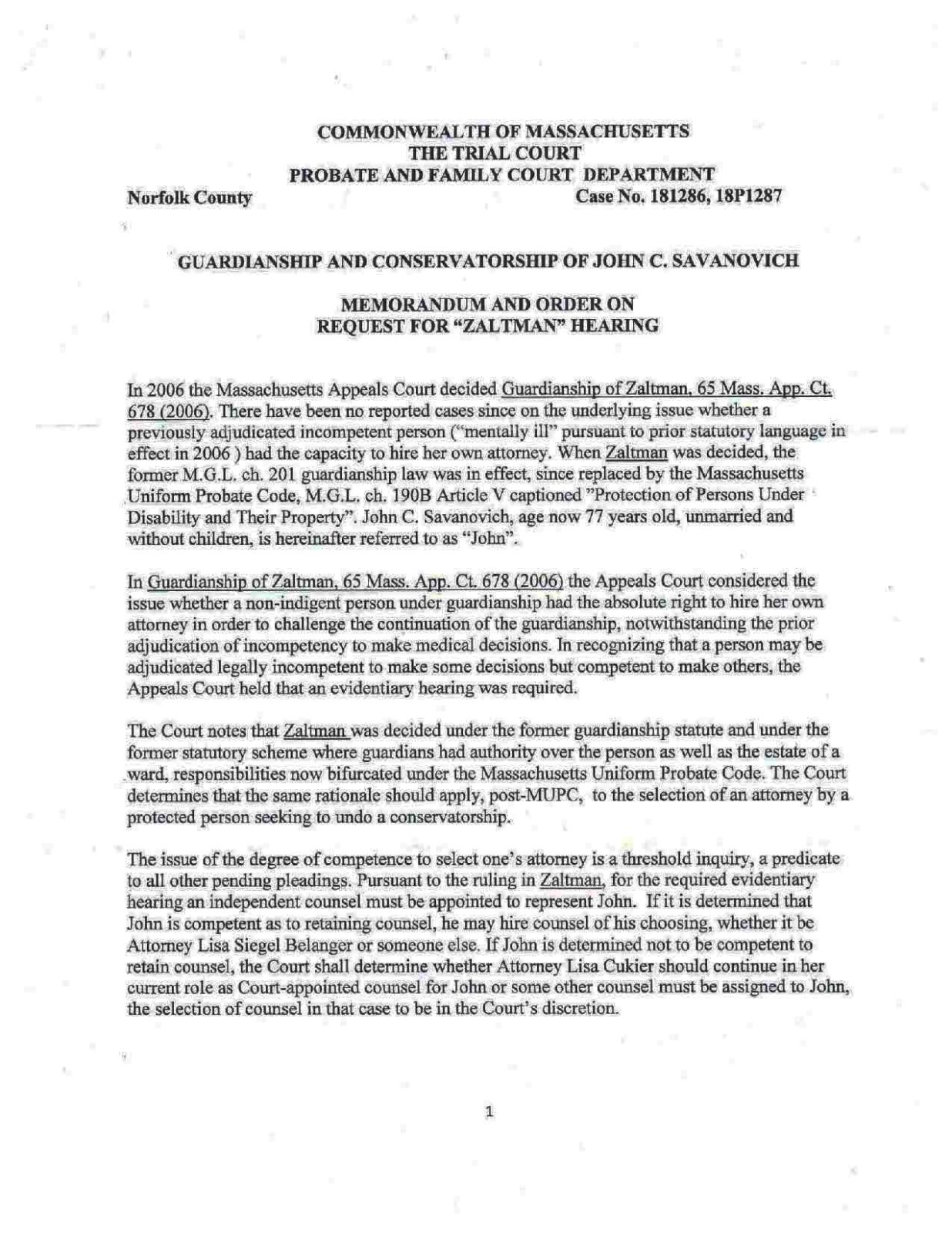
You couldn’t find John Savanovich’s case file online. You couldn’t find any reference to it in the regular electronic court postings. He charged that his case was being handled in virtual secrecy and that certain lawyers tricked him into signing over millions of dollars worth of property, as well as his bank holdings, and then stuck him in assisted living, taking away all his freedoms, when all he asked for was some help to get his properties fixed up and sold.

We pledged to John that we would review his case and whatever documentation we could obtain. John spoke clearly, coherently, and in great detail, as he has in multiple conversations.

Fast forward a bit: Well, The Boston Broadside has been cited once again in probate court, this time attacked for printing portions of John’s impounded court record, with his permission.

Judge Saddles John with ‘Connected Lawyer’

Norfolk Probate and Family Court Judge George F. Phelan has thus far refused to allow John to pick his own lawyer – instead John is saddled with one appointed by and with close working relations to the judge, John’s would-be choice of attorney charges.

At a recent hearing, the judge refused to allow John to speak in court, and refused to allow John to have Attorney Lisa Belanger, whom John reached out to after reading of her case in the Broadside, speak on his behalf. Atty. Belanger filed a motion against the judge, exposing multiple areas of conflict of interest between the judge and the lawyer he saddled John with, and asked the judge to recuse himself from further action in the case. That didn’t go well, and we’ll report more on it in an upcoming edition.

Silencing John

Now that we’ve exposed the court’s actions, things are heating up to totally silence John.

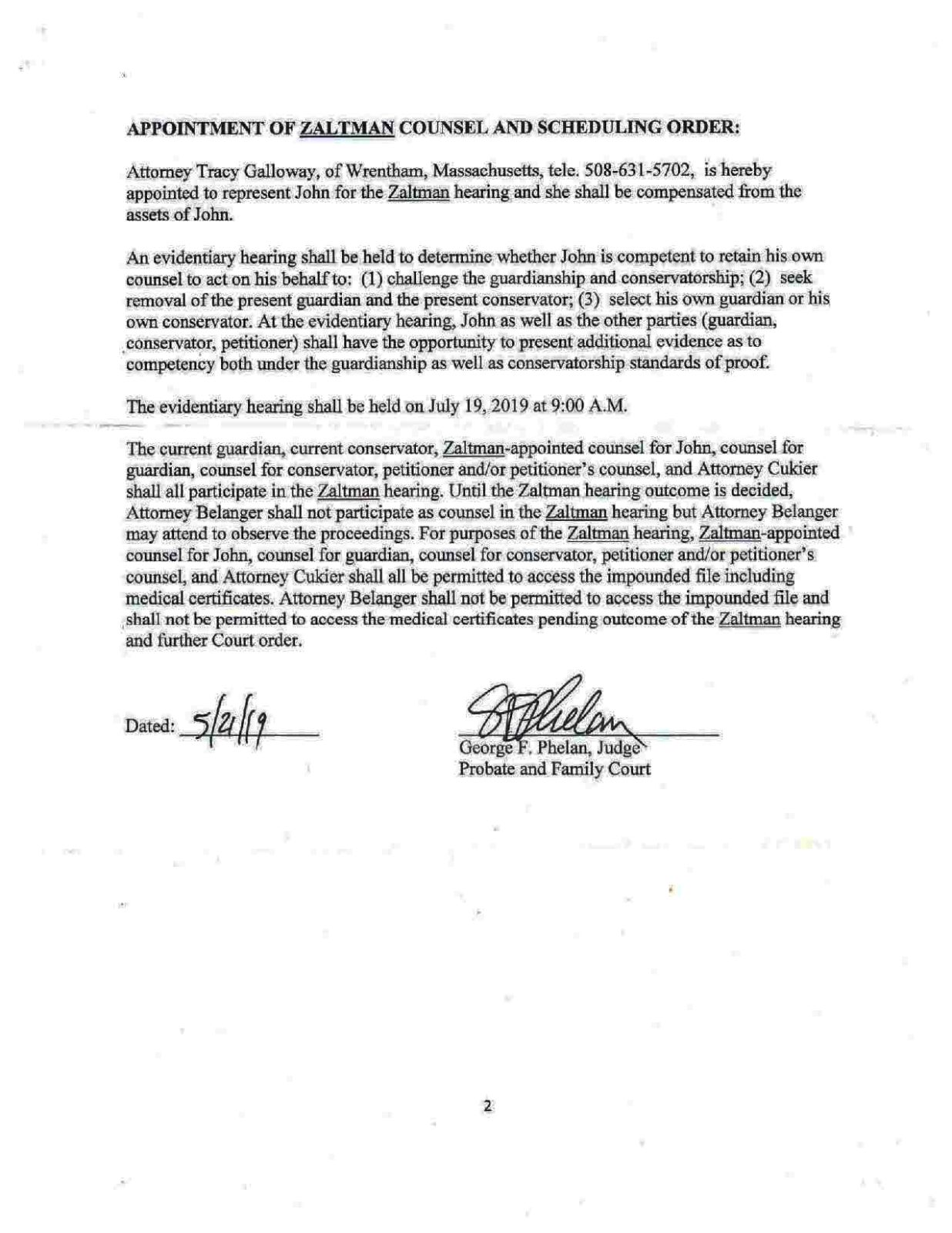
On May 21, 2019, Judge Phelan placed his signature on a two-page document that calls for a court-ordered evidentiary hearing to be held on July 19, 2019 at 9:00 a.m. in his court, the purpose of which is to declare John nuts – a competency hearing.

The judge has prohibited John from hiring any attorney other than that assigned by the judge, and the judge has locked down all further actions from any public scrutiny.

In essence, John has been isolated: He’s allowed to be present for a “Zaltman” hearing, but he’s represented only by court-appointed folks who are billing against John’s accounts, without John’s permission, saying that John is nuts.

We’ll be printing a lot more on this case (file no. 181286, 18P1287) in an upcoming edition.

Stay tuned. We’ve only just begun.  ♦

NOTE:  Judge’s Order is below.  You’ll note, he’s saddled John with ANOTHER lawyer – not of JOHN’s choosing – and JOHN HAS TO PAY FOR THE LAWYER (or rather, the lawyers appointed by the judge pay the other lawyers with John’s money, against John’s wishes, and also pay themselves to talk to one another about this, to view accounts, have checks written, have e-mail communications, write reports, etc….basically, they’re sucking away at John’s accounts….oh, all to “help” John.) OH, and you’ll note the judge specifically lets his lawyers have full access to anything of John’s (files, etc.), but specifically PROHIBITS Attorney Belanger – John’s choice – from having any view of anything.   Message to Attorney Belanger:  ANYTHING JOHN HAS SHARED WITH THE BOSTON BROADSIDE, WE WILL FULFILL OUR COMMITMENT TO HIM TO GET HIS MESSAGE OUT – TO LET OTHER SENIORS KNOW WHAT IS HAPPENING, and we will share anything with you that he has, is, or will share with us in the future.   Stay tuned. We’ll have more to post.

Note: Subsequent to the above directive, the Judge issued a “Mueller-like” extensive NEW directive – hired a lawyer to videotape John in isolation, without any aid of counsel (except those which may be directed by the judge). The lawyer is also to pursue all kinds of things, basically trying to find out how John got his information out when the judge had locked down everything about John.   John’s a lot smarter guy than he may perhaps appear to the judge? Because while John might not be perfect (who of us is), John has repeatedly from the start attempted to file complaints – in writing – against what the court and lawyers are doing to him, and, our pledge to give ‘voice to the voiceless’ continues.

 
Full Article & Source:

Monday, June 25, 2018

Democracy vs. Oligarchy

by David Arnold

This is the third in a series of articles on democracy in the United States. The first was “The death of democracy in the Probate Court,” posted at http://tinyurl.com/yc5c3lom.

The second was “We the people and accountability of lawyers,” posted at http://tinyurl.com/ybg8llwm.

We have all been taught since childhood that the United States is a democracy. I used to just accept that without questioning it. However, democracy is not automatic. It is a constant struggle to make sure no individual or entity takes control of the whole government.

The United Stated has the structure of a democracy with three different branches of government. There are supposed to be checks and balances between the three branches to prevent abuse of power by any one of the three branches of government.

The tripartite system of government is commonly ascribed to the French political philosopher Baron de Montesquieu. Having three branches of government is a necessary but not sufficient condition to insure a democracy. Montesquieu pointed out an additional requirement. The personnel of the three branches must not coincide. If a single person or entity controls all three branches, this destroys the checks and balances. The government ends up being an oligarchy.

The website http://tinyurl.com/y7fu3eak claims that this has, in fact, happened in the United States. This article, entitled “America is now an oligarchy,” states:
  1. An oligarchy (Greek oligocracy) is a form of government in which power effectively rests with a small elite segment of society.
  2. Lawyers currently make up approximately only one third of one percent of the population of the United States.
  3. Lawyers currently control over 85% of all local, state and federal government, including the legislative, judiciary, and executive branches. The remaining 15% all use lawyers as policy advisers and authors of any new laws.
The Judicial Branch is obviously controlled entirely by lawyers. You don’t have to look at very many biographies of legislators to realize that the majority of legislators are lawyers. The legislature is supposed to represent a cross section of the general public. It is clear that two of the three branches of government are controlled by lawyers. A disproportionate number of governors and presidents are lawyers. The office of the district attorney in the executive branch is controlled by lawyers.

A government controlled by a profession that constitutes only a third of one percent of the population is not a government “of the people, by the people, for the people.”

The danger that the United States could end up being controlled by an oligarchy was recognized very early in the history of our country. The article starts with the quote, “It is a very dangerous doctrine to consider the judges as the ultimate arbiters of all constitutional questions. It is one which would place us under the despotism of an oligarchy.” – Thomas Jefferson, letter to W. C. Jarvis, 1820.

The legal profession is entirely self-policing. This violates the principle that no entity can be its own judge. In my article on “We the people and accountability of lawyers,” I pointed out that the Constitution does not deal with the special case of lawyers. Although the original Constitution does not deal with this issue, archival research expert David M. Dodge claims that the “missing” 13th amendment of the Constitution was intended to prevent lawyers from serving in government.

On the website http://tinyurl.com/y7wvtb8d, David M. Dodge states the following:

“If the evidence is correct and no logical errors have been made, a 13th Amendment restricting lawyers from serving in government was ratified in 1819 and removed from the US Constitution during the tumult of the Civil War. Since the Amendment was never lawfully repealed, it is still the Law today. The implications are enormous.”

The amendment is also called the “Titles of nobility amendment.” The Wikipedia article on the amendment is posted at https://en.wikipedia.org/wiki/Titles_of_Nobility_Amendment.

The amendment was passed on a vote of 19-5 by the Senate on April 27, 1810 and on a vote of 87-3 in the House of Representatives on May 1, 1810. The Wikipedia article disagrees with the interpretation by David Dodge that the intent was to prevent lawyers from serving in government. By December 9, 1812 the amendment was ratified by 12 of the 13 states needed for ratification. The Wikipedia article says that the amendment was never ratified by the required number of states. However, David Dodge has shown that the proposed 13th amendment was printed in copies of the Constitution up until the Civil War when it was replaced by the current 13th amendment prohibiting slavery.

The controversy over the meaning of the amendment and whether it was ever fully ratified may never be resolved. However, if lawyers had been prevented from serving in government, we would not now be living in an oligarchy ruled by a single profession that does not represent the population as a whole.

Full Article & Source:
Democracy vs. Oligarchy

Saturday, May 12, 2018

Lawyers face higher risk of mental illness and the Fla. Bar Assoc. wants to help

If you need a lawyer chances are you’ve got a problem. Maybe a big one.

But the lawyer you’re depending on might have an even bigger problems. So who’s looking out for you?

Jack Schwartz runs a family business built on honesty, and the Better Business Bureau gives it an “A+” rating. When a business deal went bad in 2013 he got referrals and hired a lawyer.

Schwartz said the attorney that was supposed to protect him, J. Patrick Buckley, started taking money from him.

Within a year Buckley was suspended by the Florida Bar Association and disbarred.

“He took money from me after his license was suspended,” Schwartz said, wondering when it would end “…And he never stopped until he was arrested.”

DOCUMENT: Petition for Buckley’s Emergency Suspension

Buckley is serving prison time after pleading no contest to felony charges related to other clients, and for practicing law without a license.

Schwartz trusted recommendations, “He was referred to me by good local business people. So I would assume at some point he was a good lawyer, but something happened, something in his personal life.”

Buckley’s former attorney representing him said Buckley blamed his problems on alcohol and personal issues.

Michael Higer is the president of the Florida Bar and acknowledges the problems lawyers face, and he wants to get out in front of a staggering problem.

“33 percent of lawyers have been diagnosed with some kind of mental disorder,” Higer said.

Anything from mild anxiety to something more serious.

Higer added that 19 percent of lawyers have been treated for some kind of high anxiety disorder. 18 percent, or nearly 1 out of every 5, attorneys have an alcohol problem, which is double the general population.

Higer thinks getting lawyers to talk about issues like this can help, “If you don’t start having a conversation … If you don’t elevate the conversation … You’re not going to address the issue in a real, meaningful way.”

The Bar is starting a 24/7 hotline for lawyers and creating other ways they can more easily seek help in a system where showing weakness can be career ending.

“You want to give off this image that we’re invincible. Our clients want us to go to battle for them. To be that warrior.” Higer said.

He hopes it will help stop some issues before they get as big as Buckley’s.

How do you find a good lawyer, especially if you need one quickly?

Referrals are a good start.

The Florida Bar lets you search a lawyer’s education and discipline history. And if something doesn’t feel right at any point, you can start your research over.

There are links on the Florida Bar’s website that can help.


Full Article & Source:
Lawyers face higher risk of mental illness and the Fla. Bar Assoc. wants to help

Friday, September 8, 2017

Question raised about conflict of interest for lawyers

ALBUQUERQUE, N.M. — Should New Mexico attorneys petition the court for people seeking professional guardians or conservators when they also represent the prospective guardian or conservator company in other matters?

That’s among the sticky ethical questions that guardianship commission Chairwoman Wendy York has posed to the state’s chief disciplinary counsel, William Slease, for an opinion.

York announced at a Friday commission meeting in Albuquerque that her research on guardianship issues has raised questions about potential conflicts of interest and other ethical issues that can arise in cases involving third-party corporate guardians and conservators.

“I wanted to know whether our current rules address this issue,” York said.

Attorneys play a major role in guardianship/conservator cases, which are cloaked in secrecy under state law. All records, except for a brief court docket sheet summarizing actions in the case, are sealed. All hearings in the case are sequestered.

To file a guardianship request, a petitioner, often a family member, typically needs an attorney. Judges often rely on the petitioner and his or her attorney to recommend a guardian or conservator for appointment.

At times, those companies’ attorneys also represent the petitioner.

A petitioner’s attorney, for example, might be reticent to challenge or try to remove a guardian or conservator on behalf of a client if that same lawyer also represents the guardianship company in other cases. Sometimes clients aren’t told about such potential conflicts beforehand and find themselves having to hire a new attorney.

Adds York, now a private mediator, “I think the guidance (from the chief disciplinary counsel) might be helpful.”

Full Article & Source:
Question raised about conflict of interest for lawyers

Friday, August 25, 2017

Anatomy Of A Scam: How Lawyers Hurt Clients And Crush Nursing Homes

Nellie Keffer won an $80,000 award from a nursing home she claims had brutally abused her husband. Weeks later, her lawyers sent her a bill for $71,000.

There is no shortage of aggrieved nursing home negligence or medical malpractice plaintiffs who express serious misgivings about the quality of their representation, and the fees lawyers assess against them after securing awards. One such attorney is Michael Fuller of McHugh Fuller, a Mississippi-based firm specializing in nursing home litigation.

A Daily Caller News Foundation investigation suggests that McHugh Fuller and its allies bankroll a nonprofit that promotes litigation in the states where they practice. The firms then collect a huge percentage of the awards they secure, while quality long term care is compromised by their tactics.

Fuller‘s former clients describe an attorney who is elusive and inattentive, but all too eager to collect large percentages of the awards he secures. His firm also evidences a history of misleading advertising that has resulted in sanctions from state courts. What’s more, his law partner, James McHugh, is intimately connected to a Pennsylvania-based law practice that bankrolled a nursing home oversight group called Families for Better Care, which tax records suggests may be a front to provoke litigation in jurisdictions where the firm frequently practices.

As a result of relentless litigation in certain jurisdictions of the sort practiced by these firms, quality longterm care has all but withdrawn from states like Ohio, Pennsylvania, Kentucky, and West Virginia.

McHugh Fuller declined comment for this story.

Big Awards, Bigger Fees

Fuller represented Mrs. Keffer in litigation she brought against a West Virginia nursing home she claims abused her late husband, Ralph Keffer, while he was in their care. Mr. Keffer subsequently died while in the care of a separate facility. After a lengthy mediation process, the nursing home agreed to settle for $80,000. Mrs. Keffer recovered $50,000 of that award.

Per an initial settlement agreement reviewed by The Daily Caller News Foundation, Medicare and Medicaid were entitled to collect a $25,000 lien from the award, and McHugh Fuller kept $5,000 in attorneys fees. However, Medicare and Medicaid declined to collect the lien, so Fuller kept the $25,000.

“He didn’t ask me if he could take it or anything like that, he just took that amount,” Mrs. Keffer told TheDCNF. Thereafter, she attempted to contact him repeatedly over a period of several months.

“Every time I called him he would be out of the office, he would never call me back,” she said. “He just wouldn’t talk to me.”

After settling the case, Keffer received an itemized bill from McHugh Fuller for $71,000. TheDCNF obtained a copy of the statement. Ultimately, she was not made to pay out any of the charges.

In the early going, Keffer says Fuller was diligent in his supervision of the case and in communicating with her on a regular basis. As the litigation progressed over time, however, he became less and less interested.

“In the beginning, he cared about my case, but then as time went on … he didn’t want anything to do with [it],” she told TheDCNF. She further said she regrets her decision to settle the case, especially after learning of the full extent of the abuse to which her late husband may have been subject.

“He treated me very unfairly in the end,” she said of Fuller.

Keffer ultimately lodged a complaint against Fuller with the West Virginia Bar Association, which dismissed the claim. According to documents reviewed by TheDCNF, Fuller said he guaranteed the Keffer estate a $50,000 award. He further claimed that he told Mrs. Keffer any reduction in the Medicare/Medicaid lien would be retained by the firm.

“The remaining allegation in this complaint is a fee dispute,” the Bar Association’s ruling read. “The Lawyer Disciplinary Board will not resolve such disputes unless the fee charged is in violation of law or grossly excessive on its face and that does not appear to be the case here.”

Complaints about Fuller‘s fees have been voiced by other clients. McHugh Fuller represented another litigant, Lora Jarrell, in a wrongful death action she brought against the nursing home where her mother, Ursula Gerencir, died in 2009. Fuller secured a $250,000 award for her and her brother — and kept $150,000 of it.

“I never understood why they needed $150,000 for expenses, but I didn’t argue,” she told TheDCNF.

“They’re taking more of their share of the money than they’re supposed to,” she added.

Like Keffer, Jarrell also claims she did not confer often with Fuller. Neither Fuller nor his law partner came to the case’s final proceedings.

“I wasn’t happy about that,” she said. “But they took all the money.”

Jarrell was unable to produce an itemized bill from the firm for TheDCNF. She also said that she was pleased McHugh Fuller was able to secure an award against the nursing home.

Misleading Advertising


Some nursing homes around the country have accused the firm of deceptive, misleading, or false advertising. An Ohio nursing home, Heartland of Urbana OH, LLC, brought a suit against McHugh Fuller late in 2014 for violations of the Deceptive Trade Practices Act and defamation. The firm bought full page ads in a local paper indicating the nursing home had been sanctioned by the federal government for “failing to provide necessary care and service to maintain the highest well-being of each resident.” The ad specifically solicited contacts from individuals whose loved ones may have suffered “bedsores, broken bones, unexplained injuries, or death” in Heartland’s care.

Heartland argues the ad falsely left readers with the impression the facility had been cited recently. In point of fact, the nursing home had not been cited for concerns even remotely similar to those expressed in the advertisement since 2010.

Nursing home citations are assessed across a spectrum of “A” to “L,” with “L” being the most severe. Heartland received an “E” level violation in 2010 because of three instances court documents describe as “relatively minor.” They include failure to document and administer a laxative prescribed for constipation, failure to reassess abdominal pain within 18 hours, and failure to administer an antibiotic. In these cases, no serious harm befell any of the residents, and no person in the nursing home’s care suffered the sorts of injuries referenced in the ad because of staff negligence or poor quality of care.

The facility was also cited for violations in 2012, though they were less severe than the 2010 citation. U.S. News awarded the facility a three out of five star rating, matching or exceeding three of the nearest four nursing homes.

An Ohio appeals court found that McHugh Fuller‘s ad was “literally false” by necessary implication in Sept. 2016. Though the fact, it concluded, of Heartland’s citation was literally true, “the words ‘considered in context necessarily imply a false message.'” A lower court initially sided with McHugh Fuller in the dispute.

A Front Group For Litigation?

McHugh Fuller partner James McHugh practiced law at a Pennsylvania-based firm called Wilkes McHugh for 17 years before joining his current firm. Wilkes McHugh is a multi-service outfit representing clients in appeals proceedings, bankruptcy court, and a wide range of personal injury areas, including nursing home negligence.

Tax records show Wilkes McHugh was the primary financier of an advocacy group called Families for Better Care (FFBC), a nursing home watchdog frequently cited as an authority on quality of care. The group’s director, Brian Lee, was cited in a newspaper report as recently as March 3. Lee previously served in Florida state government as an ombudsman for the Department of Elder Affairs, but was ousted from government service in 2011. He claims the administration of Florida Gov. Rick Scott forced him from office under pressure from the nursing home lobby.

The group frequently publishes a national report card ranking the quality of nursing homes in each state and the District of Columbia. The states in which both Wilkes McHugh and McHugh Fuller are active, including Pennsylvania, West Virginia, Mississippi, Ohio, and Kentucky perform dismally in the reviews.

A review of the organization’s tax records from 2011 to 2014 show that Wilkes McHugh essentially bankrolled the group. For example, FFBC reported $69,400 in revenue on their 2011 990. The same record shows the entirety of that amount came from a donation given by Wilkes McHugh. The following year, the group reported $130,000 in revenue, all of which came from a donation from the firm, as in the previous year. The pattern follows for 2013 and 2014. The firm was the group’s sole benefactor in three of the four years during this period.

“Families for Better Care has a diversity of supporters, that in the past, we can proudly state included Wilkes and McHugh,” the group told TheDCNF in response to an inquiry about their relationship to the firm.

Wilkes McHugh partner James Wilkes II denied that his firm directs the organization in any way in an interview with TheDCNF. He said his firm’s motives were entirely philanthropic.

“I don’t think we are the primary benefactor,” Wilkes told TheDCNF. “We got involved when Brian Lee resigned as ombudsman.” Wilkes claims their professional relationship began when he read accounts of Lee’s dismissal in Florida newspapers.

Wilkes claimed he could not recall if he has ever met Lee. He further claims the cumulative total of their conversations runs less than 30 minutes.

In a separate 2014 interview with local media, Lee went even further than Wilkes, claiming he has never spoken with anyone from Wilkes McHugh.

Wilkes has a five-star AV Preeminent rating from Martindale-Hubbell for high ethical standing, and has won several awards for his work litigating around longterm care issues. He is a previous nominee for the AARP’s National Aging and Law Award.

FFBC also disputed that their advocacy was meant to promote business for the firm.

“In regard to our nursing home annual report, our methodology is included on the report card’s website, which shows it’s based on federal data,” Lee told TheDCNF. “Finally, we are proud of our determined advocacy on behalf of residents and their rights, to ensure they receive the best care possible.”

Lee’s activities raise questions about the tax-status of the group, which is a registered 501(c)3 group. The IRS requires nonprofits to disclose any and all lobbying activity and lobbying-related expenses on government forms. Lee has written in the Florida press about matters pending in the state legislature, identified as a “lobbyist” in applying for other positions according to court documents reviewed by TheDCNF, and describes himself as an “advocate for changes in laws and regulations” on his LinkedIn page. Despite this, the organization did not disclose any lobbying on its tax forms.

What’s more, Wilkes McHugh’s lobbying and media firm, Vancore Jones, is intimately connected to FFBC. The firm’s two principals, Steve Vancore and Andrew Jones, registered as officers of FFBC.

 Both previously registered as lobbyists for Wilkes McHugh in Florida, according to state records. The registrant-contact for FFBC’s domain name is also an employee of Vancore Jones.

All told, FFBC appears more closely connected to Wilkes McHugh than its principals contend.
In addition to client complaints, court sanctions, and its connection to FFBC, McHugh Fuller attracted notoriety for its involvement in the purchase of a private jet from a judge they had occasion to argue before, and for a bevy of campaign donations to the same judge that campaign finance experts say resembles an illegal straw-donor scheme.

Full Article & Source:
Anatomy Of A Scam: How Lawyers Hurt Clients And Crush Nursing Homes

Monday, March 30, 2015

FOX 4 investigation yields bill seeking to protect elderly


Guardians and attorneys who represent some of Texas’ most vulnerable may be required to start disclosing exactly what they are charging for their services.

Source:
FOX 4 investigation yields bill seeking to protect elderly