Showing posts with label guardians. Show all posts

Wednesday, June 28, 2023

Mistreatment and Abuse by Guardians and Other Fiduciaries


What is abuse by guardians?

While courts make efforts to ensure that guardians are trustworthy, some guardians have taken advantage of people in their care.  The mistreatment could be financial, physical, emotional/psychological or any other type of abuse of an older person or person with a disability.  Guardians also may neglect the people for whom they have a responsibility to provide care.  These perpetrators of abuse can be anyone serving as a guardian (family members, trusted others, non-profits, professional guardians, agencies).

There is currently limited information on the number of guardianship cases involving abuse. The US Senate Special Committee on Aging and the US Government Accountability Office have highlighted the problem and cited anecdotal information. The National Center for State Courts has found that most reports on the problem of exploitation by guardians lack empirical data.  Reports of fraud or other malfeasance by guardians have most often involved financial exploitation, but other types of mistreatment are also reported.  Abusive acts by guardians may meet the definitions for various state and federal crimes, depending on the facts of the case.  Guardians might be charged with such crimes as elder abuse, embezzlement, larceny, money laundering, theft, and neglect.

For an explanation of how guardianship can be a vehicle for abuse as well as a remedy, see the National Center on Elder Abuse issue brief, Guardianship: Remedy vs. Enabler of Elder Abuse.

To learn about how to spot mistreatment by a guardian and what to do about it, see the National Center on Elder Abuse flyer, What if Your Guardian is Not Doing What They Should?


How can the courts with jurisdiction over guardianship cases respond to abuse?

A court with jurisdiction over a guardianship case might uncover evidence of abuse through monitoring, or a person or government agency might need to file a complaint or petition the court to respond to the mistreatment.  These courts can take the following types of actions:

  • Freeze assets and/or restrict accounts – Courts may take these actions to limit a guardian’s access to money and property while investigating a case or preparing to take another protective step.
  • Investigate allegations of malfeasance – Once allegations of abuse have been made, courts can appoint a guardian ad litem, investigator or visitor to investigate.  A court can also audit an individual’s assets or order an accounting by an external entity such as a certified public accountant.
  • Order repayment for lost assets or property – Such orders might restore lost assets but, in many cases, the only way to recover funds is through a bond that the guardian obtained upon appointment. Sometimes courts do not require bonding when the guardian is appointed, making it more difficult to obtain repayment for losses at the hands of the guardian.
  • Enforce statutory rights to communication and visitation When abusive guardians use isolation tactics, family members and others may be able to seek orders enforcing state laws that define the rights of people subject to guardianship to interact with others of their choosing.
  • Appoint a co-guardian or limit the powers of the guardianThis strategy may help deter or stop mistreatment by a guardian.
  • Remove the guardian Removal may be the best way to stop guardian malfeasance, and petitioners might suggest a willing and suitable replacement.
  • Terminate the guardianship Less restrictive options or changed circumstances might lead a court to terminate the guardianship entirely.
     

Besides courts with guardianship jurisdiction, who can address abuse by guardians?

Numerous federal, state, and local government entities and non-profit agencies can respond and provide services when someone suspects that a guardian is mistreating an individual.  Although the court has the sole power to impose certain orders such as removing the guardian or surcharging bonds, other entities can get involved and assist victims.  These include:

  • Adult protective services – Anyone suspecting mistreatment by a guardian should report to adult protective services.  Find your state or local adult protective services agency through the Eldercare Locator.  Most states have laws making certain categories of people mandatory reporters of elder or vulnerable adult abuse.
  • Protection and advocacy systems – Protection and Advocacy Systems are federally-mandated state-based organizations that work to protect the rights of people with disabilities, including guarding against abuse. Find your protection and advocacy agency here.
  • Long-term care ombudsmen – If the individual resides in a nursing home (or, in some states, receives home- and community-based services), the long-term care ombudsman can investigate and resolve complaints about abuse, neglect, and exploitation, including complaints about guardians. Anyone can file a complaint, but the resident (or an appropriate representative) must consent in order for the ombudsman to investigate and share information. Learn about the ombudsman program here and find your local ombudsman.
  • Law enforcement – A guardian’s breach of duty may violate criminal laws and warrant investigation and prosecution.  In addition to reporting to Adult Protective Services, individuals suspecting guardian abuse should report it to law enforcement.  Contact your local law enforcement agency, your state attorney general, or call 911.  Some recent examples of guardianship fraud cases pursued by the United States Department of Justice include cases in Pennsylvania and Florida.
  • Attorneys – Separate from the guardianship system, there are various civil actions that may apply to abuse by guardians.  Depending on state law, civil attorneys might bring cases alleging breach of fiduciary duty, breach of contract, fraud, undue influence or a private right of action for elder abuse.  Remedies might include restitution (repaying money lost), voiding documents including deeds, or other monetary awards of damages.
  • Federal agencies – If the guardian also serves as a Social Security representative payee or VA fiduciary and is misusing public benefits, individuals may report to the Social Security Administration Office of the Inspector General or the VA Office of the Inspector General.
  • Professional licensing boards – In some states, professional guardians may be certified, licensed or registered.  State boards can investigate and may revoke a license or certification.  If the guardian is a lawyer, the state has a committee that takes disciplinary action when a lawyer violates professional responsibilities.
     

What is power of attorney abuse?

Powers of attorney give a trusted person (the agent) a great deal of authority and access to money and property, without regular oversight.  Power of attorney abuse can take many forms.  The agent might spend the individual’s money on items for his or her own use rather than for the individual’s needs. The agent might do things that the document doesn’t allow, such as making gifts when that power hasn’t been granted.  The power of attorney document itself might be forged or fraudulent in some other way.

State laws may help to prevent or limit power of attorney abuse.  For example, the Uniform Power of Attorney Act, adopted in over half the states, permits a third party such as a bank to refuse to honor a POA when the abuse is suspected and the third party reports it to an adult protective services agency. 


What are the remedies to address power of attorney abuse after it occurs?

Lawyers may help people to stop power of attorney abuse and to get money back that has been improperly taken by the agent.  For example, a lawyer could:

  • Draft a document to revoke (cancel) the POA
  • Ask a court to require the agent to file an accounting to see how the agent has spent the money
  • File a civil action to cancel contracts or deeds that the agent should not have made
  • File a civil action to recoup money
  • Petition a court to appoint a guardian who can manage the finances if the individual is unable to manage money independently

In addition, agents under a POA may be prosecuted for abusing a power of attorney.  Depending on state criminal law, power of attorney abuse might be theft, fraud, embezzlement, money laundering, exploitation or another financial crime.  Through the criminal court process, a prosecutor could ask the court to freeze the individual assets to prevent further abuse, and could also seek restitution (repayment of money taken).


What do we know about abuse by government fiduciaries?

Reports from the Social Security Advisory Board, the Office of the Inspector General for the Social Security Administration, the Government Accountability Office, the National Academy of Sciences and other government and quasi-governmental entities over the past fifteen years have documented abuse by both individual and organizational representative payees. These incidents have prompted removal of payees from the program and, in some cases, criminal prosecution.  The Office of the Inspector General for the Department of Veterans Affairs also has investigated and substantiated allegations of abuse by VA fiduciaries.
 

Licensed material is being used for illustrative purposes only. Any person depicted in the licensed material is a model.

Source:
Mistreatment and Abuse by Guardians and Other Fiduciaries

Wednesday, December 28, 2022

‘It makes you think how lucky you are.’ The painstaking mission to find guardians for hospital patients in legal limbo.

By Kay Lazar

Sturdy Memorial Hospital’s Deb Hansen is director of case management and works with a team of nurses who try to find friends or family for patients who have no legal guardians. She spoke with a team member, David Field.John Tlumacki/Globe Staff

They are the patients who have no family members, no friends, no one able to step up and speak for them. Scores of people, young and old, who are unable to make decisions for themselves are stuck in legal limbo, medically ready to be discharged from Massachusetts hospitals. But they lack a guardian to sign off on discharging them to a nursing home or rehab center.

The odyssey that follows is cited by hospital leaders as one of the most challenging they face in the ongoing health care crisis in Massachusetts, with hospitals filled to capacity and new patients waiting for hours in emergency rooms for available beds.

The guardianship process, say those on the front lines, is also one of the most soul-wrenching tasks they encounter.

“It pulls at your heartstrings, and it makes you think how lucky you are that you have a family who is supportive of each other,” said Deb Hansen, a registered nurse and director of case management at Sturdy Memorial Hospital in Attleboro.

“Your heart goes out,” Hansen said, “because they don’t have that support except for us to be holding their hand and talk to them.”

At least 958 patients statewide were awaiting discharge in November, many for more than a month, to a nursing home or other post-acute facility, according to the most recent monthly survey from the Massachusetts Health & Hospital Association. Exactly how many of these patients are mired in legal issues related to guardianship is unclear, but the association estimates that more than 100 patients are languishing in this state.

Hospital leaders in the recent survey listed guardianship problems as the second most challenging issue they faced when trying to discharge patients, right behind dealing with insurance company delays in authorizing coverage.

Hospital administrators say too often patients, before they are hospitalized, fail to complete a health care proxy form, a simple document that designates a representative to make health care decisions for the patient if he or she is incapacitated.

“It’s such a simple document, anybody can pull it off online to do this,” said Joan Smith, director of social work services at Tufts Medical Center. “You don’t have to be in the hospital to do it.”

Without that form, incapacitated patients, most often older people with dementia, or younger patients who’ve had a brain injury, get stuck in the hospital as administrators embark on a legal maze seeking a court-appointed guardian. That guardian will have the authority to sign off on transferring the patient to more appropriate post-acute care.

The legal part of the process, administrators say, usually takes about a month. But there are cases that drag on much longer.

Earlier in the pandemic, Sturdy Memorial cared for a young man in his 20s who was with them for a year. His medical care was completed in a couple of months, but the courts, backlogged by the pandemic, took a few more months to appoint a social worker as guardian. By then, the man’s family had stopped visiting, and it became clear they were not going to take care of him when he was discharged.

The young man’s cognition level was high enough that staffers could hold a conversation with him, and to know he was desperately seeking friends, but it was not enough to live alone or take care of himself.

“There was a vulnerability about him and we understood that he felt abandoned by his family,” said Robin Morris, the hospital’s senior vice president of clinical operations.

More months went by as the guardian struggled to find an appropriate place. The patient celebrated a birthday, with staff bringing him a cake.

“He wanted a life outside of the hospital; he wanted someone to care about him,” Morris said.

More months dragged by.

“He became part of the family here,” Morris said. “Staff came in with their families so he wouldn’t be alone on Christmas.”

While the Sturdy case stretched longer than most, the painstaking steps that staff at most hospitals take are similar as they try to find someone to speak for a patient so their case doesn’t end up in the courts.

“We start by trying to track down anyone we can,” said Dr. Rachel Kester, medical director of inpatient geriatric services at Cambridge Health Alliance.

“Usually, we can get in touch with a neighbor,” Kester said. “We usually find someone who knows them, at least a little bit.” A friend or neighbor could file with the state’s Probate and Family Court to become a legal guardian. But Kester said friends and neighbors are not often willing or able to do that.

Hospital case workers say they scour patients’ medical records, going back years, searching for a health care proxy. Failing that, they may reach out to social service agencies from the patient’s community, as well as local senior service offices, in case they have records of a family contact who may be willing to be appointed as a legal guardian.

Seeking a court-appointed guardian, they say, is a last resort.

“One thing that makes me feel very sad is that our [guardianship] patients have to wait so long in the hospital before they can move on,” Kester said. “No one should have to live in a hospital.”

The Massachusetts Health & Hospital Association said it has made recommendations to the state’s court system to try and streamline the guardianship process. For instance, it suggests family and probate courts reserve blocks of time each week, in each county, devoted to these cases.

“We are aware of three counties that have implemented the dedicated block days within the courts,” the association said in a statement. “We are grateful for those and hope to ... see that grow.”

Jennifer Donahue, a trial court spokeswoman, said in a statement that Suffolk County, where many hospitals are located, is among those instituting the dedicated weeks.

And, she said, the Probate and Family Court has expanded electronic-filing options in every county for conservatorships. That’s when a court appoints a person to manage the financial and personal affairs of a minor or incapacitated person. A conservator may also serve as a guardian.

The electronic filing can save lawyers time and shorten the process a bit, but she said there is a good reason that cases can take a long time.

“Massachusetts guardianship law is complex and filled with procedural safeguards to protect the rights of persons alleged to be incapacitated,” Donahue said.

But as the cases drag on, patients can grow despondent, hospital case workers said. And many patients are not getting the level of rehabilitation they would receive in post-acute care.

Some patients may not have the mental capacity to understand why they have been stuck in a hospital so long. But others, like the young man at Sturdy Memorial, was keenly aware.

Finally, a year after he entered Sturdy, his court-appointed guardian found an adult-care foster family who stepped forward, and he went to live with them.

Shortly after, the family sent the hospital staff a picture of the young man from a trip they took him on to the beach.

He was smiling.

Full Article & Source:
‘It makes you think how lucky you are.’ The painstaking mission to find guardians for hospital patients in legal limbo.

Thursday, September 22, 2022

In Trust: How One Osage Man Took On His Guardians

Photographer: Photoillustration by Jaci Lubliner Kessler. Photos: Courtesy The Oklahoma Historical Society/The Paul Comstock Collection (2), Courtesy The Frederick and Addie Drummond House

Orphaned as a boy, Myron Bangs Jr. was under the guardianship of Drummond brothers for more than a decade. In episode four, hear about the alarms he raised to the US government and the paper trail he left behind.

Listen to In Trust on iHeartApple PodcastSpotify

In Trust, an investigative podcast from Bloomberg News and iHeartMedia, is a story about family, oil and a system that moved wealth over decades — dollar by dollar, acre by acre — and shapes this land to this day. This is the fourth episode and we encourage you to listen to the story from the beginning. Find previous episodes here. A transcript of this episode is available.

The Hominy Trading Company wasn’t the only way the Drummond brothers profited off Osage wealth. The US government had deemed Osages and other Native Americans incompetent, which meant they needed “guardians” to be put in charge of their financial affairs. 

Listen to the podcast here.

This system was billed as a way to protect Native American wealth from being swindled or squandered. But many times, guardians were in on the very schemes they were supposed to prevent. In the 1920s, the US government brought at least 20 lawsuits on behalf of Osage wards, alleging misdeeds by their guardians; these cases were settled without trial. Guardianship files in the local courthouse are kept under seal.

But one Osage man left behind a vivid look into the practice, thanks to the years he spent raising alarms about how his land and money were being managed. His name was Myron Bangs Jr. His guardians were Drummonds. 

Central figures

Photos: Courtesy OK Historical and Western Archives, Alamy, Courtesy FBI, Getty Images (2), Courtesy A.A. Jack Drummond Collection/University of Central Oklahoma Archives and Special Collections, Courtesy The Oklahoma Historical Society (2), Courtesy The Frederick and Addie Drummond House

Bangs was educated. He could fly an airplane and write searing letters to US officials. But in the eyes of the law he was incompetent, simply for being Osage. For more than 15 years starting in 1918, his finances were controlled by his guardians — first, Cecil Drummond, and later, Fred Gentner Drummond. 

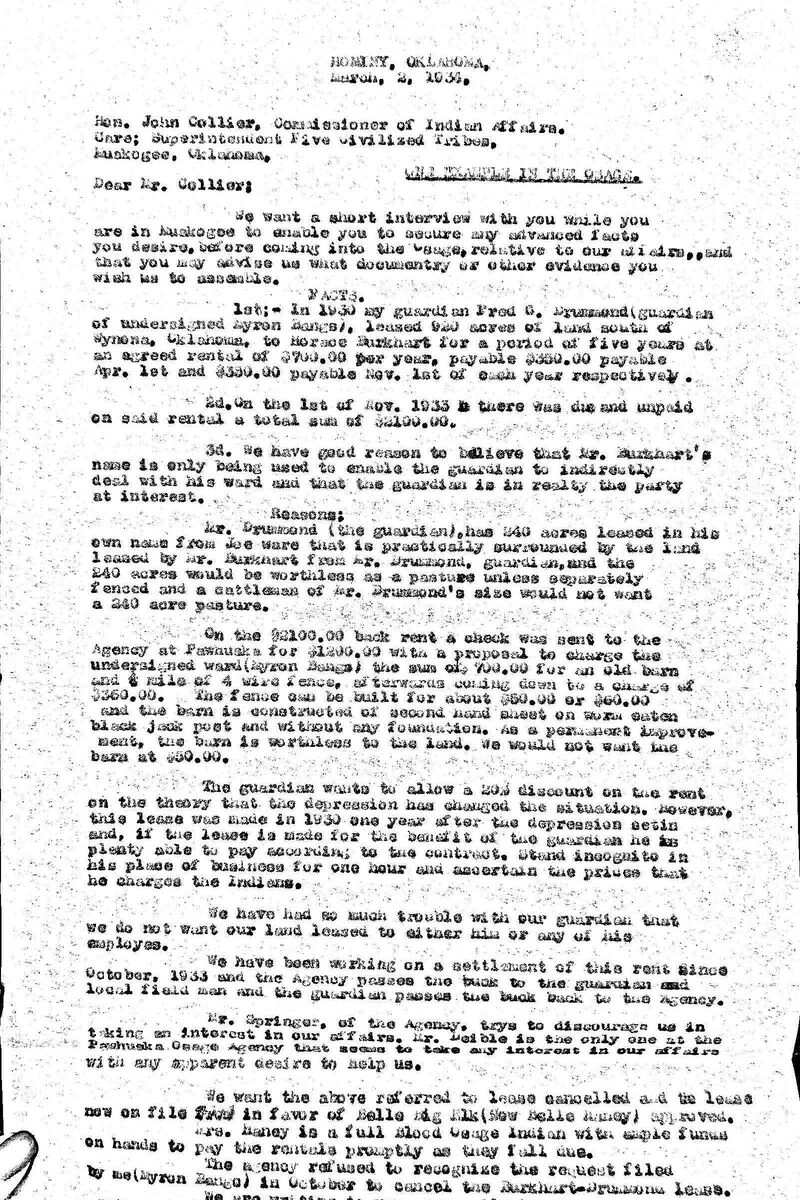
Bangs didn’t trust his guardians. At one point, he even wrote the commissioner of Indian Affairs. “We are writing to you personally because we cannot get action elsewhere,” he said in a 1934 letter.

relates to In Trust: How One Osage Man Took On His Guardians
Bangs’s 1934 letter to the commissioner of Indian Affairs.
Photograph: Courtesy The Oklahoma Historical Society/The Paul Comstock Collection

Years under guardianship


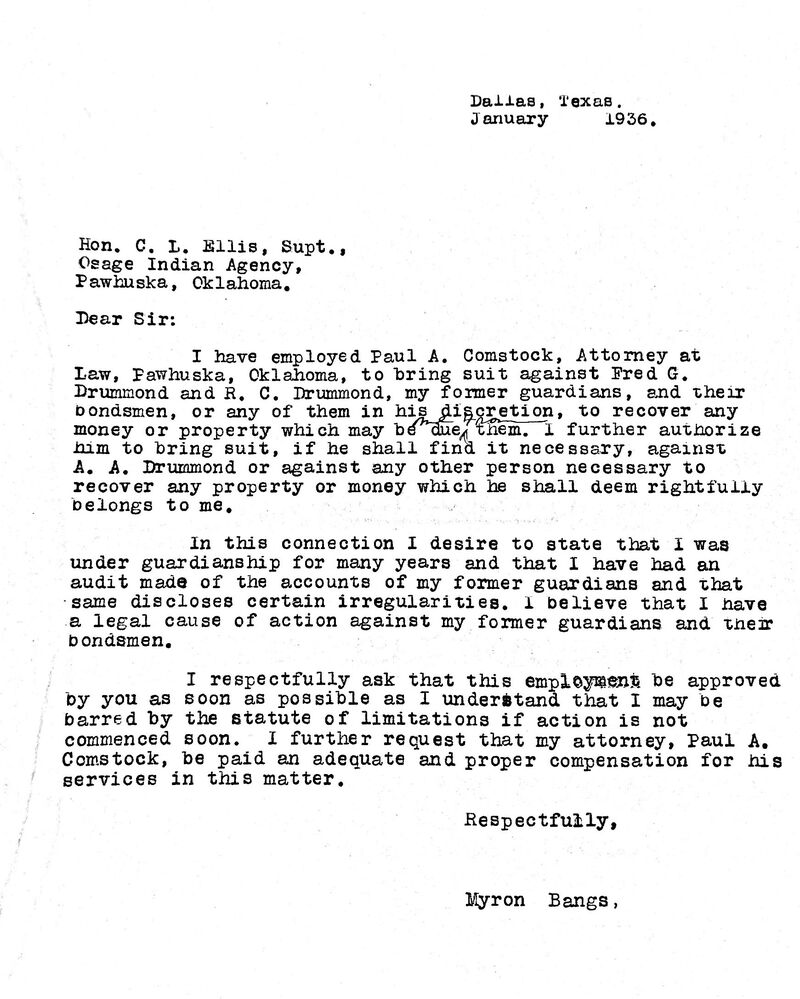
Later that year, he took matters into his own hands. He hired a lawyer named Paul Comstock and enlisted a team of accountants to audit his affairs. They came back with a five-page report, full of inconsistencies they encountered when combing through his finances. In 1935, Fred Gentner resigned. 

relates to In Trust: How One Osage Man Took On His Guardians
A letter written by Bangs asking the superintendent of the US government's Osage Agency to allow him to hire a lawyer to bring suit against his guardians.
Photograph: Courtesy The Oklahoma Historical Society/The Paul Comstock Collection

relates to In Trust: How One Osage Man Took On His Guardians
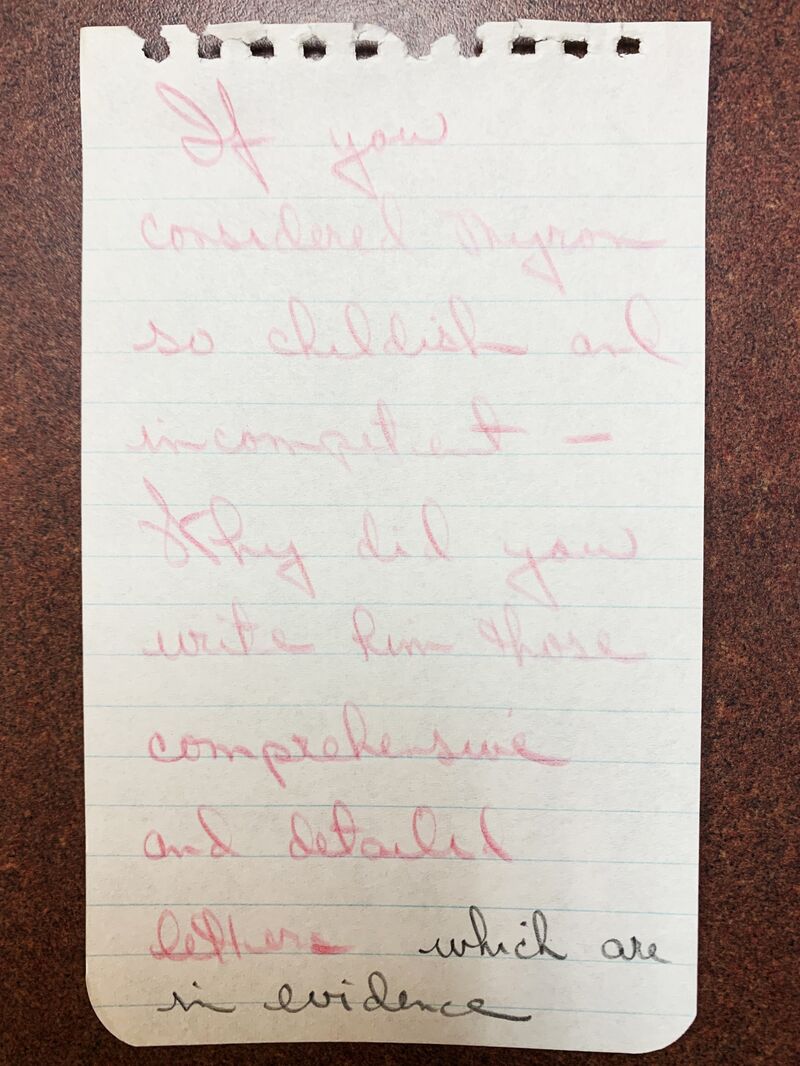
A note from the collection of Bangs’s lawyer, Paul Comstock.
Photograph: Courtesy The Oklahoma Historical Society/The Paul Comstock Collection

relates to In Trust: How One Osage Man Took On His Guardians
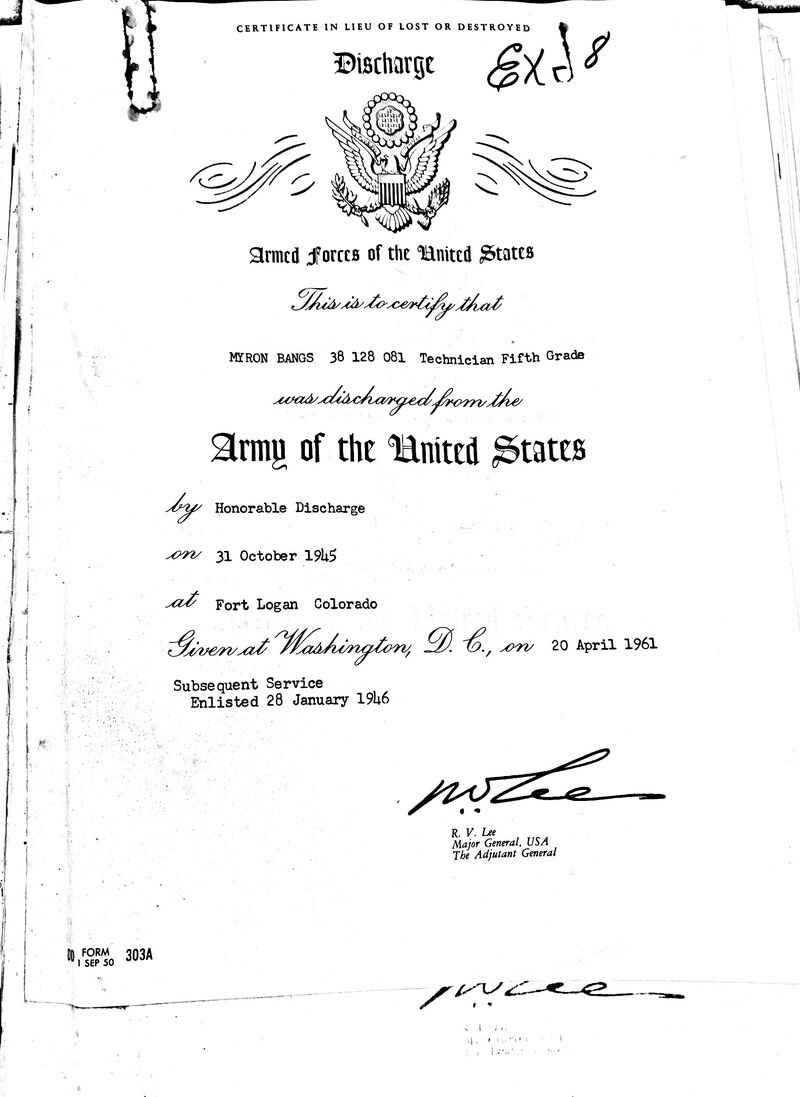
A letter certifying Bangs’s honorable discharge from the Army.
Photograph: Courtesy The Oklahoma Historical Society/The Paul Comstock Collection
 

But the matter didn’t drop. Six years later, the US brought a case against Fred Gentner Drummond and his two brothers, accusing them of defrauding Bangs while they were supposed to be protecting his financial interests.

Present-day Osage County, Oklahoma

Sources: Parcel data on actdatascout.com and geospatial files made available by the Osage County's Assessor's Office; Oklahoma Secretary of State, Osage County Courthouse

What a federal judge found, though, was something else entirely. The judge said the Drummond brothers were actually working to help Bangs  after he was orphaned at a young age, using the guardianship to shield his family’s land from the man who married his mother just months before she died. 

relates to In Trust: How One Osage Man Took On His Guardians
A 1960 telegram from Bangs, relaying news of his wedding and dealings with a later guardian, with the signoff: “I’m just a poor Osage.”
Photograph: Courtesy The Oklahoma Historical Society/The Paul Comstock Collection

relates to In Trust: How One Osage Man Took On His Guardians
Myron Bangs Jr. in Santa Monica in an undated photograph. 
Photograph: Courtesy The Oklahoma Historical Society/The Paul Comstock Collection

In episode four, a relative recalls Bangs and his fight against an unfair system. And Gentner Drummond, the Republican candidate for Oklahoma attorney general, discusses his support for tribal sovereignty and his family’s long history in Osage County, where he says they were respected members of the community and helped their Osage neighbors in the ways that were available at the time. 

— With assistance by Allison Herrera

Source:

Monday, April 25, 2022

Guardian Advocates work to prevent abuse, neglect of seniors, others

by Ken de la Bastide

ANDERSON — For the past four years, a group of local volunteers has provided services to protect seniors and the at-risk population.

Local attorney John Longnaker formed Guardian Advocates in 2018 after being asked by three senior citizens to become their legal guardians.

“It got to the point where we couldn’t care for more seniors,” he said. “That’s when we decided to start the organization.”

The state started a pilot program a decade ago, and now there are 20 organizations providing services in 50 Indiana counties, he said.

“We’re there to prevent exploitation, abuse and neglect of senior citizens or adults that are at risk,” Longnaker said.

The guardianships are established by a local judge, and quarterly reports are required at the county and state level about the number of clients being provided with services.

This Thursday, April 21, Guardian Advocates is hosting an open house from 4 p.m. to 6:30 p.m. at the Anderson Public Library to encourage people to volunteer.

The library’s at 111 E. 12th St.

“We’re providing services for folks that don’t have anyone to look out for their interests,” Longnaker said. “In some cases, there is no family members or family residing in Indiana that can help with medical care and fiscal matters.”

He explained volunteers are matched with a client and are expected to visit at least once monthly.

“The program is modeled after the CASA (Court Appointed Special Advocates) program, where one volunteer is matched to one person in need of services.”

Guardian Advocates recently expanded from Madison County to provide services in Delaware and Grant counties.

“We get referrals from Adult Protective Services or from hospitals that are discharging patients,” he said.

The first step is a local advisory group has to approve the application through the courts for a legal guardian to be appointed.

Longnaker said the advisory group considers medical, financial and legal issues before accepting a client into the program.

Each volunteer is required to fill out a monthly visit report that includes any change in medications or emergency calls.

Barb Marshall, client care coordinator, said there is a need for volunteers, donations and referrals of people in need.

Marshall said COVID-19 had an effect on the number of people who were volunteering, but that the numbers have been increasing recently.

There are 18 current volunteers, and 26 clients are expected by the end of May.

Longnaker said the Guardian Advocates has received a $56,000 grant from the state and has matching funds of $26,000.

Full Article & Source:

Tuesday, January 4, 2022

Guardianship system in N.M. remains in crisis


Despite what the New Mexico judiciary and the Developmental Disabilities Council’s Office of Guardianship have reported to the Legislative Health and Human Services Interim Committee, the guardianship system in New Mexico continues to be in crisis.

Abusive guardianships continue to occur, sponsored by predatory attorneys and sanctioned by District Court judges. The guardianship law, 45-5-101 through 45-5-617, was established in 2012 to protect and preserve the well-being and assets of the incapacitated person. However, this is not what we believe is happening.

Unethical professionals continue to abuse the system. The individuals who control the outcome of the guardianship case are the petitioning attorney and the District Court judge. The judge grants the power to the appointed guardian and conservator who control every aspect of the “protected person’s” life, including where the individual lives, what medication is prescribed and is to be taken, what doctors the person may visit, who can visit and speak to the individual, and, of course — their money and assets.

Additionally, some New Mexico courts have disregarded the legitimate written directives, wills and trusts that have been prepared. For true guardianship reform to occur, judges must appoint guardians and conservators who understand, respect and advocate for the wishes and best interests of the “protected person.”

This is exactly why family members and guardianship advocate groups must be recognized as the experts when it comes to hearing and understanding our loved ones. Family members must also have an “equal voice” at the decision-making table. We are the eyes and ears on the ground. We have the day-to-day experiences with our loved ones. We know the individual, his/her likes, dislikes, triggers, medical history, hopes and dreams.

A corporate guardian and conservator are complete strangers who are involved for profit. Our state leaders must address these injustices to ensure our most vulnerable population’s human rights, civil rights and protection of their financial assets are respected and protected. The media must continue to report on these concerns — the public has a right to know.

Full Article & Source:

Monday, August 9, 2021

New Cleveland team name 'Guardians' glorifies abusers of the disabled, by Mike Ervin

The owners of the Major League Baseball team in Cleveland, Ohio, have announced that the name of the team will be changed from the Indians to the Guardians, beginning next season.

The stated reason for choosing that name is that it’s a tribute to the iconic, 43-foot tall “Guardians of Traffic” statues on Cleveland’s Hope Memorial Bridge.

But I feel the name is also appealing to the owners because they’re punch-drunk from protests and thus are looking for something completely uncontroversial. And maybe they figured that no one could possibly have a beef with the name “Guardians.” Everybody agrees that guardians are steadfastly benevolent forces that watch over and protect us all, like guardian angels. Guardians always have everyone’s best interest at heart. You can always trust a guardian.

But I think that the name Guardians presents an interesting opportunity for disabled folks like me to protest. To us, the word guardian has been dubious for decades because many of us have been screwed over badly by guardians. In every state, there are laws where a judge can declare disabled people incapable of making their own decisions and appoint a guardian to run their lives.

This essentially means that some disabled people have their freedom taken away, maybe even for their whole lives. They can’t spend money, move into different housing, or do much of anything else in life without their overseer signing off on it. And there have been all kinds of horror stories of disabled people being bullied around by their guardians as a result.

All of the attention that has been generated by Britney Spears’s legal battle to be freed from her oppressive conservatorship has illuminated how horrendously abusive this arrangement can often be. People are protesting on her behalf, demanding that she be set free.

But her plight is neither new nor unique. The website of the National Association to Stop Guardian Abuse contains many hair-raising accounts by people who aren’t famous but allege they have been similarly exploited and dominated by their guardians. One of the association’s stated goals is to “protect the civil/human rights — life, liberty and property — of adults described as ‘incompetent’ and made wards of the state in unlawful and abusive guardianships and conservatorship.”

When Spears’s case is resolved, for better or worse, will the protesters cross out her name on their “Free Britney” signs, write in the name of another victim and get back out there?

I’m guessing that won’t happen. The outrage will probably wane. Something else will have to be done to keep this important issue hot. Maybe picketing the Guardians’ games beginning next season to blow the whistle on the false glorification of guardians will do the trick.

So thank you to the owners of the Cleveland baseball franchise for opening up this new front for potential protests. The timing is perfect.

Full Article & Source:

Tuesday, February 9, 2021

Bill giving adult guardians authority over final dispositions advances, but with concerns

by Olivia Covington
A bill that would give adult guardians a say in the final disposition of their wards is headed to the full Senate, but a narrow vote in committee likely means the legislation will see further amendments.

Senate Bill 276 is scheduled for second reading in the Indiana Senate on Monday. The Senate Judiciary Committee on Feb. 3 advanced the legislation — authored by Sen. Tim Lanane, D-Anderson — on a 6-5 vote.

SB 276 came to the Judiciary Committee from the Probate Code Study Commission. The commission heard testimony this fall about an issue guardians say has become more pronounced during COVID: When a ward dies, guardians’ duties terminate immediately.

According to Rebecca Pryor, a practicing adult guardian and guardianship advocate, that termination presents a problem in situations where an incapacitated adult has no other family or representatives to carry out their final wishes. In those cases, Pryor previously told Indiana Lawyer, guardians must search for family members who may not have been involved in the deceased’s life but who would have the legal right to make decisions regarding final disposition.

To remedy that issue, Lanane’s legislation would amend Chapter 29 of the Indiana Code to give court-appointed adult guardians high priority to make decisions regarding the disposition of the body, as well as funeral and ceremonial arrangements. Specifically, I.C. 29-2-19-7 would place adult guardians second on the priority list, behind only a person given authority in a funeral planning declaration or a Department of Defense form if the decedent died while serving in the Armed Forces.

Under an amendment approved by the committee, additional statutes in Chapter 29 and Chapter 23 would give guardians second-place priority to make decisions regarding other issues such as anatomical gifts and requesting an autopsy.

The Probate Code Study Commission ultimately did not make a recommendation on the issue, which was brought by Pryor on behalf of the Working Interdisciplinary Networks of Guardianship Stakeholders — or WINGS — Indiana Adult Guardianship State Task Force. In addition to WINGS, the legislation received support in the Judiciary Committee from the Indiana Funeral Directors Association, Indiana AARP and the Indiana Association of Area Agencies on Aging, as well as from Anne Poindexter, a probate lawyer with Altman, Poindexter & Wyatt in Carmel.

Sen. Sue Glick, R-LaGrange, was added as an author on the bill with Lanane. However, several of her Republican colleagues raised concerns about SB 276 and ultimately voted against it.

Among them was Sen. Aaron Freeman, the Indianapolis Republican who chaired the Probate Code Study Commission. He called the legislation a “fundamental” change to the general premise that an adult guardianship terminates at the time of a ward’s death.

The most frequent concern raised during both commission hearings and in committee was the placement of guardians above surviving spouses on the statutory priority lists. The proposed amendments to the probate code would place spouses fourth on the list, behind those with powers of attorney.

Lanane told committee members that if a court has determined a guardian is necessary, any surviving spouse likely has been determined to not have the capability to advocate for their spouse’s best interests. Sen. Lonnie Randolph, however, voted against the legislation based on that issue.

“I have been married 27 years, and I’m not going to put a guardian above my wife,” Randolph said during the committee vote. “I cannot see a mother being second fiddle to a guardian of an unmarried single son.

“I see the objective,” Randolph continued, “but at this point I can’t support this.”

Freeman and Sen. Mike Young, also an Indianapolis Republican, both raised a related issue: the role of out-of-state family in making final decisions in cases where a guardian has been appointed.

Young presented two scenarios: first, a guardian choosing to spend an excessive amount of money on a funeral, and second, a guardian going against a ward’s religious or personal beliefs on issues such as organ donation. If either of those situations were present, what redress would family members have?

Pryor sought to assuage those concerns by telling Young that generally, if a guardian is appointed and family members have a relationship with the ward, the guardian will work with both the ward and the family on end-of-life decisions. That would include the pre-planning of funeral arrangements and making decisions on issues such as whether the ward wishes to be an organ donor.

Young, however, ultimately did not support SB 276 in committee.

“I think most of them, if they’re good guardians, will try to work these issues out ahead of time,” he said. “But they’re not required to be worked out ahead of time, and I don’t know if I have standing” to challenge the guardian’s decisions as a family member.

In a similar vein, Freeman presented a scenario from his own experience: his grandparents recently died, and while he was not their guardian, he is now serving as the executor of their affairs in Ohio. Under SB 276, Freeman said, his voice in final decision-making would be behind that of a guardian, if one had been appointed for his grandparents.

“You’re not going to get me to sign up for that,” he said.

The Probate, Trust & Real Property Section of the Indiana State Bar Association, represented by Indianapolis probate lawyer Jeff Dible, took a neutral position on SB 276. Dible, counsel at Frost Brown Todd in Indianapolis, said the bar had “technical” concerns about the legislation.

Specifically, Dible raised the issue of SB 276 conflicting with statutes governing health care powers of attorney. It’s not controversial to add guardians to the priority list, he said, but reasonable minds differ over whether guardians should be above POAs on those lists. SB 276 would place POAs third on the list, behind guardians.

Other statutes concerning POAs specifically provide that in situations where both a POA and a guardian are in place, the guardian cannot perform any task under the authority of the attorney in fact without a court order, Dible said. Thus, amending the statutes at issue in SB 276 to give guardianships priority over POAs could create inconsistencies, he said.

The leading case dealing with that issue, Dible said, is Guardianship of Morris, 56 N.E.3rd 719 (Ind. Ct. App. 2016).

Dible also noted that House Bill 1252 addresses the same statute as SB 276, so he cautioned the General Assembly against writing each bill in such a way that would create a conflict. Similarly, Sen. Liz Brown, the Fort Wayne Republican who chairs the Judiciary Committee, noted that SB 276 would need to be harmonized with Senate Bill 204, which deals with health care advance directives.

Some Republicans on the committee urged Brown to hold the bill for additional committee amendment, while Lanane offered to amend his bill on the Senate floor. Brown ultimately called for a vote, telling committee members that she was confident Lanane would keep his word to continue working on the bill. Glick, too, told committee members who opposed the measure that they were “overthinking” its impact.

Those opposing SB 276 in committee were Randolph, Young, Freeman and Republican Sens. Eric Koch of Bedford and Mike Gaskill of Pendleton.

The Feb. 3 committee hearing can be viewed online.

Full Article & Source:

Tuesday, July 7, 2020

Editorial: Who guards the guardians?

Sunday, July 5th, 2020 at 12:02am

Much has changed for the better since the Journal published an investigative series in November and December of 2017 titled “Who Guards the Guardians.”
Those stories by reporter Diane Dimond detailed complaints about a secretive system. Critics, most often family members of incapacitated people, complained about having little recourse to abuses that ranged from overspending and mishandling of assets to virtual carte blanche authority by court-appointed guardians and conservators to ignore and override the wishes of families when it came to concerns for their loved ones.
Despite heated denials by many within the system that anything was wrong, Journal Investigative Reporter Colleen Heild continued to probe complaints of abuse and misconduct. Meanwhile, the state Supreme Court took notice and along with other reforms established a process that has led to more transparency and created an avenue in which family members and others can petition the courts to address their grievances.
Justices Charles Daniels, who passed away in 2019 after retiring from the court, and Judith Nakamura were instrumental in advancing reforms. So were retired District Judge Wendy York of Albuqueque, who headed a Supreme Court-appointed commission to study the issue, and District Judge Shannon Bacon of Albuquerque, who is now a Supreme Court justice.
So it was fitting that Bacon announced last week that the New Mexico State Auditor’s Office will now have a permanent watchdog function over the nearly 6,000 cases in which state district courts have appointed guardians and conservators to manage the affairs of those deemed incapacitated.
The announcement followed a one-year pilot project undertaken by State Auditor Brian Colón, whose auditors found 194 “risk factors” in annual reports filed among more than 300 conservator cases sampled. The factors included lack of supporting documentation, conflicting information, and the fact that assets of the protected person being were understated or unaccounted for. Auditors also found instances of checks written directly to conservators. Or conservators charging large fees for services or reimbursements of expenses. The auditors sent more than 40 letters to judges in the cases laying out the concerns.
This kind of outside oversight is unprecedented.
With a green light from the judiciary, Colón’s office will now have oversight and involvement in what had traditionally been a closed system that sometimes excluded even family members of the incapacitated person. Colón appeared with Bacon on a Zoom video conference to make the announcement.
“We have an opportunity to step up oversight …” Colón said. “We’ve got to fill in the cracks (in the system) so we know those most vulnerable don’t fall through.”
Bacon said the courts and Legislature have already added more transparency to the system and enhanced reporting requirements. Now, she said, the courts plan to implement measures “to give auditors open access to guardianship and conservatorship cases.” Bacon said the auditors have been granted special access to online reports that typically aren’t public.
On the issue of reporting, though, Colón’s auditors recommended guardians and conservators provide supporting documentation instead of simply listing the amounts of assets and expenditures on standardized forms filed with the district courts.
The Supreme Court can make that happen by adopting a rule requiring it.
The auditor’s report also recommended “increased focus on review of financial affairs of protected persons with substantial assets.” That makes sense.
The state auditor also said the recent criminal sentences of two of four defendants in the now-defunct Ayudando Guardians Inc. underscored the need for more oversight in New Mexico. The company’s top officials stole millions of dollars from clients to finance a lavish lifestyle in a nearly decade-long scheme.
In contrast with a closed system that appeared to stonewall complaints, Bacon and Colón urged people with concerns to fill out a grievance form found on the state Supreme Court website. The forms are to be submitted to the district court where the case is filed. Colón said a copy also can be sent to his office.
In another major step forward, Bacon said the judiciary wants Colón’s office to be able to do random audits and go to banking institutions to review records, if needed. The details are still to be worked out with the courts.
“This ongoing process and partnership,” Bacon said, “is how we increase the sunshine and avoid the abuses of the past.”
The judiciary, lawmakers and the auditor all deserve credit for the work they’ve done. Now is the time to push ahead on the rest of the reform items to prevent the exploitation of incapacitated New Mexicans and give a voice to their loved ones.
This editorial first appeared in the Albuquerque Journal. It was written by members of the editorial board and is unsigned as it represents the opinion of the newspaper rather than the writers.

Full Article & Source:
Editorial: Who guards the guardians?

Tuesday, June 30, 2020

New Mexico State Auditor And Supreme Court Justice Issue Statement On Guardianship And Conservatorship Report

State Auditor Brian S. Colón
ALBUQUERQUE — State Auditor Brian S. Colón with Supreme Court Justice Shannon Bacon, Thursday, shared the results of the pilot project for review of guardianship and conservatorship cases filed in District Courts. 

The report comes as a result of an agreement entered into between the Office of the State Auditor and the Administrative Office of the Courts for audit, review, and compliance of guardians and conservators.

The Office of the State Auditor was engaged to independently identify risk factors and provide recommendations pertaining to guardianship and conservatorship of protected persons. 

Tasked with safeguarding New Mexico’s taxpayers, the Office of the State Auditor, through the Guardianship and Conservatorship Division, is a mechanism for greater protections through accountability and transparency for guardians and conservators who have duties to some of New Mexico’s most vulnerable populations. 

“For New Mexico’s protected persons, whose needs cross multiple systems, this work will lead to an avalanche of positive change for our most vulnerable citizens,” Auditor Colón said. “Our work identified risks that will allow state officials and the legislature to act on opportunities for increased support in providing more coordinated care and services to New Mexicans.” 

The primary goal for the Administrative Office of the Courts is to create a robust, in-depth examination of guardianships and conservatorships through partnership with Office of the State Auditor.

“After a herculean effort to draft court rules and forms, the Court’s efforts are now returning to robust education of the parties and public regarding the resources available to them,” Justice Bacon said. 

Part of that education is releasing 10 training videos for the public on everything from filing a grievance to submitting annual reports, and continuing to train employees and judges on new rules of the law. 

“Today I am filled with hope about adult guardian and conservatorship cases and that we will do right by all New Mexicans in protecting the most vulnerable members of our community.” Justice Bacon said.

Full Article & Source:
New Mexico State Auditor And Supreme Court Justice Issue Statement On Guardianship And Conservatorship Report

See Also:
New Mexico guardians get a new watchdog

Saturday, June 27, 2020

New Mexico guardians get a new watchdog

State Auditor Brian Colón
By Colleen Heild

The New Mexico State Auditor’s Office now has a permanent watchdog function over the nearly 6,000 cases in which state district courts have appointed guardians and conservators to manage the affairs of those who are deemed incapacitated.

The announcement Thursday comes on the heels of a one-year pilot project undertaken by State Auditor Brian Colón, whose auditors found 194 “risk factors” in annual reports filed among more than 300 conservator cases sampled.

Among the risk factors cited by auditors: lack of supporting documentation, conflicting information, and assets of the protected person being understated or unaccounted for. Auditors also found instances of checks written directly to conservators or conservators charging large fees for services or reimbursement of expenses.

More than 40 letters were written to notify the judges who appointed the conservators of the “increased risks factors” discovered.

With recurring legislative funding, coupled with a green light from the judiciary, Colón’s office will now have oversight and involvement in what had traditionally been a closed system that sometimes excluded even family members of the incapacitated person.

Colón appeared with state Supreme Court Justice Shannon Bacon, a judicial leader in the state’s move to reform the guardianship system, at an Albuquerque news conference broadcast via Zoom.

“We have an opportunity to step up oversight, not just requiring that documentation, but the timeliness of the reports is critical to accountability,” Colón said. “We’ve got to fill in the cracks (in the system) so we know those most vulnerable don’t fall through.”

Conservators are appointed to make financial decisions for an incapacitated person, often times those with dementia or other impairments. Guardians are appointed to make health care and personal decisions.

Bacon said in recent years the state Legislature and the judiciary have added more transparency to the system and enhanced reporting requirements of guardians and conservators.

Now, she said, the courts plan to implement measures “to give auditors open access to guardianship and conservatorship cases.” Bacon said the state Administrative Office of the Courts has permitted the auditors special access to reports within the online court case system. Typically those reports are not public.

Judge Shannon Bacon
“We want them to be able to do random audits and go to banking institutions to review records,” Bacon said. “This ongoing process and partnership is how we increase the sunshine and avoid the abuses of the past.”

The auditor’s pilot project found a need for guardians and conservators to provide supporting documentation, instead of simply listing the amounts of assets and expenditures on standarized forms filed annually or after 90 days of appointment by a judge.

The auditor’s report also recommended “increased focus on review of financial affairs of protected persons with substantial assets.”

Critics of the system, most often family members, have complained about having little recourse if they suspect conservators are overspending and otherwise mishandling assets of an incapacitated person. Bacon and Colón urged anyone with a complaint to fill out a grievance form found on the state Supreme Court’s website.

Colón said the recent criminal sentences of two of four defendants in the now-defunct Ayudando Guardians Inc., highlight the need for more oversight in New Mexico. A federal investigation, triggered by employees coming forward, exposed a near-decade long scheme in which top officials stole $11 million from vulnerable clients who received guardian, conservator or other financial services.

“Le estoy ayudando,” Colón said Thursday. “I want to be able to say ‘I am helping.'”

Full Article & Source:
New Mexico guardians get a new watchdog

Sunday, April 12, 2020

Guardianship gap: Give people a right to counsel for proceedings


It’s hard to imagine being stripped by a court of the right to make decisions about finances, medical care and other matters. It’s even harder to imagine that happening without representation or advice from a lawyer.

Yet that’s exactly what can happen in Pennsylvania if a person is deemed unable to conduct his or her own affairs. A court then appoints a guardian who can make life decisions and manage finances for the person.

There is no right to have an attorney during this process. And that is wrong. People who face losing control of the right to manage their lives should have the advice of an attorney and have representation should they wish to fight against a claim that they are incompetent.

About 18,400 adults in the state, more than half over age 60, are under guardianship, according to Spotlight PA, an independent, nonpartisan newsroom of which the Pittsburgh Post-Gazette is a partner.

Problems with the guardianship process in Pennsylvania were clear, and the state Supreme Court took action by creating an Elder Law Task Force to make recommendations on guardianship and other reforms. The task force issued a report calling for reforms in 2014. While some reforms happened, a recommendation to require appointed counsel never was implemented.

The weird thing is that officially, the goal of providing legal counsel is marked as accomplished. It depends on the definition of accomplished. For the state’s Office of Elder Justice, charged with putting the recommendations into force, accomplished means the idea was considered but rejected. Noah Webster would not be pleased.

Several members of the task force rightly expressed dismay that a right to legal counsel remains undone. A few judges appoint counsel in guardianship cases because they think it’s the right thing to do — they deserve commendation. The law should require all judges to follow suit.

And guardians aren’t subject to sufficient oversight. An improvement was made in 2018 when new software was made available for guardians to submit annual reports. The software identifies possible problems in the guardian’s handling of financial affairs. That doesn’t prove wrongdoing. The trouble is some jurisdictions are overwhelmed because of alerts about possible problems, and they don’t have the manpower to follow up.

Another weakness in the reporting system is that guardians are not required to submit bank statements, receipts and other documentation to verify their reports.

First require appointed counsel. Then legislators have more work to do to protect residents of the commonwealth under guardianship.

Full Article & Source:
Guardianship gap: Give people a right to counsel for proceedings