The lead defendant in the prosecution of a
national elder fraud ring to scam around $65 million from victims
across the country pleaded guilty Tuesday in San Diego federal court.
Prosecutors say the scheme involved
conspirators posing as tech support, government officials or bank
employees who instructed victims to withdraw money in cash, then send it
in packages to locations provided by members of the fraud ring.
The addresses where victims mailed their
packages were short-term rentals, which prosecutors say allowed
conspirators to quickly relocate and continue the scheme at new
properties.
According to the U.S. Attorney’s Office,
a law enforcement investigation into the scheme began after a victim
reported mailing thousands of dollars in packages that were addressed to
a San Diego-area short-term rental.
Law enforcement was also aided by YouTube
content creators who posted videos online exposing members of the
scheme, prosecutors said. In sting operations, the creators, “Pierogi”
of “Scammer Payback,” and two others from “Trilogy Media,” lured members
of the conspiracy, then exposed them in videos.
The U.S. Attorney’s Office said the posts helped law enforcement identify members of the fraud organization.
Hua Wang, 48, of Flushing, New York, was
responsible for the collection of more than 2,000 cash packages that
elderly victims sent to to the rental units. He pleaded guilty to
conspiracy counts related to wire and mail fraud, as well as money
laundering.
Eleven others in the case have pleaded
guilty over the past two months, while two others are slated to enter
guilty pleas later this month, according to the U.S. Attorney’s Office.
More than 30 defendants, who range in age from 23 to 48, have been
charged. Federal agents coordinated last summer to make arrests in
Southern California, Texas, Michigan and New York.
Sentencings are set to begin July 7. Wang’s is set for Sept. 18.
Across the U.S., FBI internet crime data
show elders were bilked out of $16.6 billion by fraudsters in 2024 — a
33% increase from the previous year. The reported losses are likely
higher, says the FBI, because “older Americans are less likely to report
fraud because they either don’t know how to report it, are embarrassed,
or don’t know they’ve been scammed.”
Fraudsters know seniors may
have savings, can be trusting, a little naive, and, in some cases, even
be in the throes of dementia. That's the case in the new Utah film
called “Sweepstakes.” The plot was inspired by real-life events.
“My
stepmother was scammed for a period of about 10 years, and she was
suffering from dementia, but was undiagnosed,” said writer, director and
producer Stephen Williams, a Salt Lake Community College
film instructor. “We had no idea what was going on. She was sending
gobs and gobs of money away every week to sweepstakes scams.”
When his family found out and confronted his stepmother, she was
irate and refused to stop sending money to the scammers, not knowing
fact from fiction.
“We didn’t know what to do,” Williams said. “My father was beside himself.”
His stepmother passed away at age 96 in 2022, but not before being defrauded of thousands of dollars.
The film that emerged started as a two-part series, but Williams has now produced a feature film, garnering interest from the AARP Utah and the FBI.
Williams said representatives attended screenings and held panel
discussions — shedding light on scammers who prey on the elderly, become
friends with them and pretend to have their best interests at heart.
This interview has been edited for length and clarity.
Pamela McCall: How does your film bring the sad reality of elder scams to life?
Stephen Williams: The main character, 88-year-old Joanne, played by Anne Culimore Decker,
is sliding into dementia. She’s enraged because she thinks her adult
children are trying to control her when they start to realize her
money’s disappearing. In turn, the scammer convinces her that he’s the
only one that can be trusted.
PM: Joanne’s daughter discovers
$9,000 missing from her mother’s account. Her brother tries to give his
mom the benefit of the doubt. Is it hard for people to believe this can
happen in their own family?
SW: Who wants to find out that
a parent is being scammed, or that they have dementia? People might
initially fight against it and write their loved one’s behavior off as
normal memory decline that comes with aging. Meanwhile, the unscrupulous
scammer is getting her to send him money. In the film, it totals
$80,000.
PM: What can be done to protect against this kind of fraud?
SW:
No matter who they think is calling, personal information shouldn’t
ever be given out over the phone. Scammers can use caller ID to make it
look like it’s someone the elderly person knows. Artificial Intelligence
is particularly terrifying. A snippet of a family member’s voice and
image can be gleaned from the internet and manipulated through AI to ask
for money. It could be a Zoom call saying, “Grandma, I’m in prison in
Ireland and need $15,000 right now,” when in fact, it’s a scammer.
PM: What will people take away from your film when it comes to elder scams?
SW:
The film really is about reconciliation of the family, and ultimately,
that's what matters. The money might be gone, but eyes are opened. The
brother and sister judged their mother pretty harshly initially, but
once they fully understood what happened, their hearts open, and there’s
compassion.
America’s grandparents are increasingly online.
They’re connecting with relatives digitally, shopping in the web’s
endless aisles, and even finding online love in their golden years.
However,
with that wifi connection comes a darker side. Specifically, the danger
of scams targeting the elderly population and their substantial life
savings.
The Federal Bureau of Investigation (FBI)
has raised the flag on the precipitous rise in elder fraud scams in
recent years. According to their 2021 Internet Crime Complaint Center
(IC3) report, there were over 92,000 victims who lost $1.7 billion to
elder fraud scams. The losses were a 74 percent increase over 2020’s.
"Elder fraud is simply financial fraud that targets any individual,
any citizen in the United States over the age of 60 years old," FBI
Deputy Assistant Director of the Criminal Investigation Division Aaron
Tapp told Fox News. "… It could be romance based. It could be technology
based. But any type of fraud scheme that’s targeting our elderly
population."
Tapp said the technological divide that separates
sexagenarians from younger generations is at the heart of the rise in
elder fraud. Scammers key in on individuals who are not digitally savvy
to bilk them out of thousands of dollars.
"The technology is just a modality for these scammers to commit
fraud," he said. "And so as the technology develops, they’ll use that
modality in any way they can to prey upon the elderly population."
On
average, victims lost over $18,000 and more than 3,000 victims lost
over $100,000. The total among of money taken from victims has
skyrocketed since 2017, when the FBI claims there was less than $400
million in total losses. The most common types of fraud in the report
are tech support, non-payment/non-delivery, identity theft and romance
scams.
One such victim of a romance scam was the late Donald Griffith, whose
daughter Angie Kennard shared his story with Fox News in hopes of
warning other families of the dangers of fraudulent online romances.
Grifftih ran a construction business in the Washington D.C. area and helped build the regions metro transportation system.
"I
think, you know, just being lonely, he turned to the internet and
started looking around on dating sites and, you know, built a
relationship with this person, Mary, online," Kennard told Fox News.
Kennard said this woman claimed she was working abroad in Europe and
wound up trapped overseas. The scammers knew enough about her father to
make "Mary" seem like she was keyed into Griffith’s interests and
background as an owner of a construction firm.
"They’re very
manipulative," she said. "They just really fed into my father’s
background and who he was. And they made him fall in love. … It got to a
point where they basically started turning my father against me,
against my uncle, against his own family, saying that we just wanted his
money."
he scammers targeted Griffith on a dating site and used his
loneliness in his golden years against him. They started small and
eventually drove him into debt after draining his life savings.
"Over
time, she started asking him for money, and it started in small
increments and then eventually, you know, worked its way up to … $40,000
at a time," Kennard said. "From what I can add up and find in terms of
receipts and notes and statements, it looks like [he sent] about
$750,000."
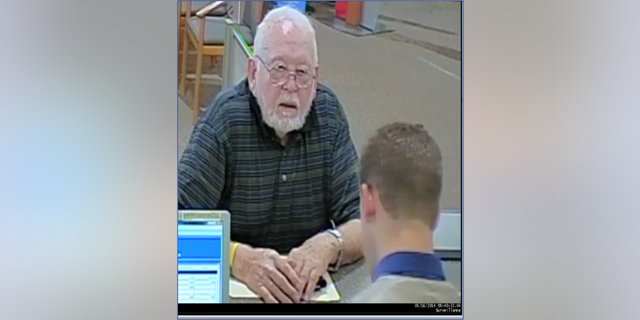
Donald Griffith depositing money to send to the scammers at a bank teller window.
(FBI)
Kennard
said the relationship her father had with Mary occurred entirely over
text messages and emails, they never once spoke on the phone. Right
away, she was concerned he was being scammed. But her concerns were met
with resistance and even distance from Griffith, who taught her to be
financially responsible in her youth. She said those lessons are why she
was so shocked when she discovered the scam.
"It was finally
when I went to go visit I ended up sneaking through his laptop and I
went through his emails and financial statements and I saw the magnitude
of what happened," Kennard said. "That’s when I contacted the FBI."
The agent who investigated Griffith’s case told Fox News that the people who targeted him were part of a Nigerian ring of scammers who defrauded hundreds of other victims out of upwards of $20 million in losses.
"We
identified at least $22 million worth of money that flowed through all
the financial accounts that we looked at," Special Supervisory Agent
Keith Custer told Fox News. "So, hundreds of victims, hundreds of bank
accounts and well over $20 million in losses."
Custer said elderly
fraud is an international problem, with highly sophisticated and
organized groups of scammers targeting America’s retirees from a number
of foreign countries. He specifically named Ghana and Nigeria as hubs
for high-tech swindles. The Nigerian ring that targeted Griffith was
eventually tracked down and mostly apprehended.
"We indicted ten
people in the initial round of indictments," Custer said. "So nine of
those were guilty either at trial or through a plea bargain. One remains
at large in Nigeria." (Continue reading)
DEERFIELD, Mass. —
Police said that two elderly Massachusetts residents were scammed out of
a total of $44,000 recently in separate incidents involving random
telephone callers saying they needed money to bail their grandchildren
out of jail.
The two incidents,
one resulting in the loss of $14,000 and the other of $30,000, are the
latest in ongoing scams where telephone callers target the elderly, said
Deerfield (Mass.) Police detective Adam Sokoloski.
The
callers pretend to be the lawyer or legal representative for a
grandchild who has been arrested, and they need money for bail or to pay
for legal representation.
The
department gets calls daily from people reporting getting a strange
call from someone asking for money. In most instances, the people
receiving the call do not give any money, he said. But there are cases
when the people getting the call agree to send money to the caller.
“We get calls all the time and it’s heartbreaking when people lose money,” he said.
He
said there have been four or five cases just this year in Deerfield
where people have given large amounts of money to scammers.
Police
would rather hear about it before any money is exchanged than
afterward. Because once payment is made, the money is basically gone and
there’s very little chance of getting it back.
In
the two recent incidents, money in one instance was sent by FedEx to an
address in Florida where it disappeared. In the other, $30,000 was
wired to Wells Fargo Bank, and once it was received, the account was
closed out.
HOLLAND, MA (WGGB/WSHM) - With tax season already underway, the
Holland Police Department are warning residents to be aware of financial
scams that aim to exploit residents of their finances.
This warning comes after an elderly couple was scammed out of close to $3,000.
Tolland
Police officials tell us that a couple in their eighties told police
they were contacted by someone pretending to be a representative of
Publishers Clearing House, saying that they had won a large amount of
money, however.
In order to receive the money, the couple was asked to
mail them cash in installments to addresses located in New Hampshire and
Pennsylvania in order to cover alleged interstate tax fees.
It was not until after the couple had mailed the money that they realized that this may possibly have been a scam.
The
day after they had mailed the scammers a second installment of $400 to
an address in Portsmouth, New Hampshire, the couple contacted the
Holland Police Department, informing them of their situation.
An
investigation was then opened, and officials managed to intercept the
parcel with assistance from the United States Postal Inspection Service.
The parcel containing the $400 was immediately returned to the elderly couple.
The
Holland Police Department is urging the public to be mindful when
making a financial transaction with any organization, and to make sure
that that organization is legitimate.
Officials also state that
residents should be leery of sending cash through the mail, and add
that, due to the $3,000 that was lost, the elderly couple might not be
able to pay their taxes by the February 1 deadline.
Holland officials reached out to the town's Outreach coordinator, Jennifer Mott, for assistance.
According
to state law, financial exploitation is not only considered illegal,
but if the victim or victims is/are over the age of sixty-five, it is
considered elderly abuse.
Mott is also the treasurer of a local non-profit, Stop Abuse Today, which provides insight into and support for elderly abuse.
Holland
Police officials report that the organization took swift action, and
covered the remaining balance on the couples' tax bill.
This
incident remains under investigation by the Holland Police Department,
and officials are urging the public to contact the Holland Police
Department if they believe they have been contacted by or have sent
funds to a scammer.
Zelma
Haskell, 85, at a rehabilitation center on Staten Island. She was
swindled by a waitress and lost her Brooklyn home of 46 years.Credit Sam Hodgson for The New York Times
Zelma Haskell had been married to her husband, Irwin, for more than 50 years, and when he died in 2003, she was lost.
“He
was everything to me,” she said in a recent interview, looking back
over the years that followed his death — years of practically
unfathomable loss and theft hidden behind the smile of a friend — to the
place where it all began.
She was 71 years old, a lunchtime regular at the Arch Diner
near her home in Canarsie, Brooklyn. The Ralph Avenue eatery was a
throwback classic of the form, shot through with neon piping above the
counter. She had gone with her husband, and later she often ate alone.
Around
the time she became a widow, she met a waitress there named Alicia
Legall. They hit it off right away, and Ms. Haskell began seeking her
out when she went to the diner so she could sit at one of her tables.
“Pretty, and so sweet,” Ms. Haskell, now 85, recalled. “I liked her immediately.”
Ms.
Haskell had two children, a son in New Jersey and a daughter on Staten
Island. Her daughter was mentally disabled and required regular care and
financial support.
“What I wanted to
do with my real daughter was difficult,” she said. Ms. Legall, in her
30s, was just a little younger than her own children. “I was so happy. I
had a new daughter,” she said. “She started to call me ‘Mommy.’”
Ms. Legall, from Trinidad and Tobago,
had been a waitress since she was 13, she wrote on her LinkedIn page. “I
love making people especially young children and elderly happy with
food and a smile!” she wrote.
The two
women spent more and more time together outside the diner. “She started
taking me food shopping and different places,” Ms. Haskell said. “I
ended up buying her a car, a very nice used car.”
Ms. Legall became a guest at family events, bringing her own young
children along, and pictures of her family hung in Ms. Haskell’s home.
“At first, she brought a lot of joy into my life,” Ms. Haskell said.
But
she also took. The women had visited Ms. Haskell’s HSBC Bank branch on
Ralph several times, and Ms. Legall had access to Ms. Haskell’s account
information. At some point several years ago, she told Ms. Haskell that
she had taken money that had been in a savings account that had belonged
to Mr. Haskell. She needed it to pay a debt, she said.
“It sounded like maybe she’d give it back to me,” Ms. Haskell said. “I was so naïve.”
The
incident had no impact on their bond. “I’m still ‘Mommy,’” Ms. Haskell
said. “I saw her a lot.” The two visited nearby restaurants and took
selfies that Ms. Legall posted online.
In
2013, Ms. Haskell’s last surviving sister, Marcy, died in Florida. Ms.
Legall traveled with her for the funeral. “She helped me on the
airplane,” Ms. Haskell recalled. “It was like a little vacation for
her.”
Four more years passed this
way. Then Ms. Haskell’s son, Lloyd, a physician, received a certified
letter that stunned him. A bank was going to foreclose on his mother’s
home because she was not paying fees related to a reverse mortgage for
$424,000.
Reverse mortgage? His
mother lived comfortably within her means. She didn’t travel or buy
expensive clothes. A splurge for her was adding to her extensive
collection of dolls. What did she need $400,000 for?
He
asked her. She said she had taken out the money for Ms. Legall, who
needed it to pay another debt. Mr. Haskell, mad at himself for believing
Ms. Legall was looking after his mother, went to the police and was
referred to financial-crimes detectives. They opened a case and
discovered the scope of the fraud and loss.
The theft began immediately after the women met, the police said.
Ms.
Legall forged and cashed 75 checks totaling more than $200,000. She
opened several credit cards and ran up an eclectic range of charges to
Apple, JetBlue, Victoria’s Secret, and clubs and restaurants in Miami.
In
addition, Ms. Legall bet heavily on horse races. She racked up expenses
in New York Racing Association buffets and bars, at Belmont Park, and
online at betting sites like TwinSpires at Churchill Downs.
“It appears she had a gambling issue,” Detective Jackson Todd said in an interview. “She bet on horses a lot.”
Detectives arrested
Ms. Legall on Oct. 17 at her home on East 55th Street in Flatlands,
Brooklyn. She denied any wrongdoing, telling the police that Ms. Haskell
gave her a credit card for errands and shopping, and that she repaid
her for any personal purchases, according to a summary of her statements
to the police.
She said the reverse
mortgage had been Ms. Haskell’s idea. “She wanted to give Alicia and her
family money,” the police said Ms. Legall told detectives. She said she
was expecting a $700,000 settlement from a civil matter and $60,000 on a
“race horse transaction.”
Ms. Legall
was indicted in Brooklyn on charges of grand larceny and forgery. The
indictment accused her of stealing more than $470,000 from Ms. Haskell.
“Over
the course of several years, Legall became a trusted confident and
gained access to the woman’s personal information, including her date of
birth, Brooklyn residential address, Social Security number and bank
and credit card information,” the indictment states.
On
April 25, Ms. Legall pleaded guilty to grand larceny. She was sentenced
this month to three to nine years in prison. She lived in the house in
Flatlands with a man and two of her teenage children; they declined to
comment, as did her lawyer.
The news
came as a shock to her colleagues at the Arch Diner. “She was a good
waitress,” said Louie Leonidou, an owner. He remembered the two women
together. “Even after she quit as a waitress, she would come in as a
customer, with her,” he said.
In the
fallout of the reverse mortgage, Ms. Haskell lost her home of 46 years.
Her family is fighting in the courts to get it back, but her future
there is far from certain. She is crippled by arthritis and could not
climb her own front steps. She has lived in a cramped room at a Staten
Island rehabilitation center for about a year.
“My house was all paid for,” she said. “I was a mess.”
She
was asked if she had a photo someplace of her and Ms. Legall together.
She reached for her purse and pulled out a snapshot, wrinkled and worn,
of the two women smiling at the camera. After everything that happened,
why would she still carry this picture around?
She sighed and answered with a shrug: “The memories.”
Marjorie Jones trusted the man who called to tell her she’d won a
sweepstakes prize, saying she could collect the winnings once she paid
the taxes and fees. After she wired the first payment, he and other
callers kept adding conditions to convince her to send more money.
As
the scheme progressed, Jones, who was legally blind and lived alone in a
two-story house in Moss Bluff, Louisiana, depleted her savings, took
out a reverse mortgage and cashed in a life insurance policy. She didn’t
tell her family, not even the sister who lived next door.
Scammers
often push victims to keep promised winnings a secret, says an
investigator who helped unravel this sinister effort to exploit an
82-year-old woman.
Her family didn’t realize something was wrong
until she started asking to borrow money, a first for a woman they
admired for her financial independence. But by then it was too late,
says Angela Stancik, one of Jones’s granddaughters. Jones had lost all
of her life savings — hundreds of thousands of dollars.
About one week after calling Stancik at the family business in Ganado, Texas, to borrow $6,000, Jones committed suicide.
That
was May 4, 2010. When family members went to her home, they found a
caller-ID filled with numbers they didn’t recognize and three bags of
wire transfer receipts in her closet. Jones had $69 left in her bank
account.
Some 5 million older Americans are financially exploited
every year by scammers like the ones who targeted Jones. The elderly are
also suffering at the hands of greedy, desperate or drug addicted
relatives and friends, among others.
The total number of victims is increasing as baby boomers retire and
their ability to manage trillions of dollars in personal assets
diminishes. One financial services firm estimates seniors lose as much
as $36.5 billion a year. But assessments like that are “grossly
underestimated,” according to a 2016 study by New York State’s Office of
Children and Family Services. For every case reported to authorities,
as many as 44 are not. The study found losses in New York alone could be
as high as $1.5 billion.
The CDC drew attention to elder
exploitation as a public health problem in a 2016 report, citing
groundbreaking research two decades earlier by Mark Lachs. Now co-chief
of the Division of Geriatrics and Palliative Medicine at Weill Cornell
Medicine and New York-Presbyterian Hospital, Lachs says elder abuse
victims — including those who suffer financial exploitation — die at a
rate three times faster than those who haven’t been abused. It’s a
“public health crisis,” he warns.
“I knew these crimes were
killing people,” says Elizabeth Loewy, who directed the elder abuse unit
at the Manhattan District Attorney’s Office. As her exploitation cases
steadily rose to hundreds per year, she says, “so many family members
told me, ‘I can’t prove it, but this killed him.’” (Click to Continue)
NEW YORK (CBSNewYork) — A waitress who befriended a widow has gone from server to suspect – now standing accused of heartlessly taking the elderly woman for pretty much every penny she had.
As CBS2’s Tony Aiello reported Tuesday, Alicia Legall, 46, posted images of fur coats and a fistful of cash to Facebook. She is accused of living the high life after allegedly bilking an 84-year-old Brooklyn widow out of almost $500,000.
“What happened here is an outrage,” said Acting Brooklyn District Attorney Eric Gonzalez. “(S)he stole her life savings, opened lines of credit — really took advantage of this widow.”
Gonzalez said it started in 2004, when Legall worked at the Arch Diner as a waitress.
She allegedly met the recently-widowed victim and spent years building trust, eventually gaining access to her money.
According to the indictment, Legall forged the victim’s signature to cash 75 checks totaling $200,000, and used her credit cards on a $270,000 spending spree.
Some of the proceeds were allegedly sent to racetracks, where Legall bet heavily.
“Very scary; terrible,” one woman said. “Have to be very careful and protect ourselves.”
“No one should be treated like that,” said the victim’s neighbor Joey Karr. “Honestly, I would go after who would ever do that to my family.”
DA Gonzalez said it is vital to stay in touch with older relatives and monitor who has access to their assets.
“Too often, we see victims who come forward who are being isolated and are turning to somebody who they befriended, and the person starts stealing from them,” Gonzalez said.
An interesting thing happened at Legall’s arraignment, Aiello reported. The DA asked for $1 million bail, but the judge set it at $2.5 million — apparently concerned she is a flight risk who’s been living recently with a much older widower.
VOLUSIA COUNTY, Fla. - A man who is accused of targeting senior victims and overcharging them for construction costs has been arrested, Volusia County deputies said.
Gary Mitchell, 29, was arrested Thursday in Broward County and taken to the Volusia County Jail.
Deputies said Mitchell specifically targets older residents.
Mitchell is accused of going to a 90-year-old DeBary woman’s home and telling her that she needed her driveway resurfaced, deputies said.
The woman initially declined, but later let the man fix her driveway for $3,000, investigators said.
The woman told deputies that she thought that was too much, but did it anyway. She said she tried to have the bank cancel the check, but Mitchell had already cashed the check, investigators said.
Detectives later learned that Mitchell didn’t resurface the woman’s driveway, but painted over it with a watered-down concrete mix, deputies said.
Deputies said Mitchell also tried to get $3,200 from an 88-year-old DeBary man for work on his driveway, but, accepted $40 after the man complained to Mitchell that the price was too high.
Mitchell was previously convicted in Arizona of financial exploitation of a vulnerable adult, deputies said.
Mitchell is charged with elderly exploitation and scheme to defraud.
The
man on the other end of the line made promises of a big payoff:
millions of dollars in prize money. But first the IRS needed $1,500 in
taxes, he insisted, then the jackpot would arrive at the family home, a
camera crew ready to capture the excitement.
The calls came a couple of times a day; other times, nearly 50.
Mr. Albert, we need the money to be sent today ...
Don't hang up the phone, Mr. Albert ...
Mr. Albert, don't tell your wife about this ...
Albert
Poland Jr. had worked 45 years for the Burlington hosiery factory in
Harriman, Tennessee, starting off as a mechanic before rising to become a
quality control manager.
He and his wife, Virginia, were
living a humble life in the Appalachian foothills near Knoxville,
having raised a son and daughter in their 62 years of marriage. The
family patriarch was known simply as Daddy.
At age 81,
his mind was faltering. He suffered from Alzheimer's and dementia. And
the caller -- a man in Jamaica -- preyed on that vulnerability.
Poland's
lucidity fluctuated. In February, he went to the local police station
and asked if they could make the phone calls from the 876 area code
stop. Another time, he went to the post office to send money to his
caller. The teller stopped him, talked with him and handed him a
brochure on Jamaican lottery scams. He thanked her.
His family tried to intervene numerous times. On one of his good days, he told his wife simply, "I'm in too deep."
On
March 21, the caller asked for $1,500. Poland withdrew the maximum $400
from his ATM and sent it via Western Union. He was sure he was going to
win more than $2 million. He hoped to pay off his son's mortgage and
help his family for years to come.
His son, Chris Poland,
was livid when his mother told him his father was talking with the
caller again. Chris, 53, had had the same conversation for months with
his dad; his father had sent more than $5,000 to the caller. Chris spoke
with his father like most any son would. "Daddy, you taught me the
value of the dollar. Why are you giving money away?"
As father and son talked by cell phone, the Jamaican called back on Poland's land line.
Mr. Albert ...
The next morning, a Sunday, was like a repeat record. More calls and another tense phone conversation between father and son.
Virginia got dressed for church. Her husband decided to stay home.
It
was a beautiful spring morning, with temperatures hovering around 60
degrees and the trees a lush green. Poland strolled around his yard. A
neighbor waved: "Looks like we're gonna have to start mowing soon."
"Yeah, looks like it," Poland said.
He walked to the basement of the family home. He carried with him a snub-nose .38 revolver.
In
his suicide note, Poland told his family not to spend much on his
funeral and said he hoped when more than $2 million arrived tomorrow, it
would vindicate him.
'Truly heartbreaking'
Albert
Poland was in the grips of a Jamaican lottery scammer -- part of a
cottage industry that targets nearly 300,000 Americans a year, most of
them elderly, and has enticed them to send an estimated $300 million
annually to the Caribbean island nation.
AARP has run
campaigns warning about the scams originating from the Jamaican 876 area
code. The U.S. Postal Service has published pamphlets and distributed
them around the country. The Senate Special Committee on Aging held
hearings two years ago about the magnitude of the problem and urged U.S.
and Jamaican authorities to do more.
"The Jamaican
lottery scam is a cruel, persistent and sophisticated scam that has
victimized seniors throughout the nation," says Sen. Susan Collins of
Maine, the committee's chairwoman. "It is truly heartbreaking that this
scam has robbed seniors of hundreds of millions of dollars."
It's
such a huge problem in Jamaica that the scams have been dubbed the
highest level Tier 1 threat -- a "clear and present danger" to national
security, says Peter Bunting, Jamaica's national security minister.
From
children to the nation's most tech savvy 20-somethings, from a former
deputy mayor of Montego Bay to the most vicious gang members, lottery
scams have left few segments of the island nation untouched.
"It
is extremely corrosive to the fabric of society," Bunting says. "We
have seen where it has corrupted police officers. It has corrupted
legitimate business persons who end up playing some role in laundering
money."
The Poland family first spoke to CNN in April.
Investigators are looking into Albert Poland's case and hope to provide
some solace to the family soon; for now, his scammer remains at large.
From
there, CNN followed the money, traveling to ground zero of the scams,
Montego Bay, where we witnessed a police raid of a suspect's house. (Continue Reading)
I would like to address your article about phone and email scams
targeting Santa Monicans by Nicholas Salazar. Although the article was
written as a public awareness article, I feel the police department is
not doing enough to go after telephone scammers who target the elder-
ly. If the victim in the story, Ms. Bloem had been mugged and $1500
dollars had been taken out of her purse, I think that felony would have
been taken more seriously. And yet someone committing fraud by
impersonating a federal agent to take $1500 away from Ms. Bloem is seen
as something the elderly need to be “aware of”. What if the next victim
has a heart attack and dies because of the verbal abuse the caller
places upon the victim. Would the police view this as murder or just
another scammer people need to be “aware of.”
My Grandparents have been recently victimized. My grandparents were
told that the US Treasury Department had money for them from an old bank
account. To claim the money they had to wire some funds so the check
could be sent Fedex. They were suspi- cious so they asked that info
about the check be emailed to them, but instead they sent a virus that
erased all their emails and wrecked havoc on their computer.
The police need to be more active and vigilant and not solely place
responsibility on the victim. These are not victimless crimes. The
police should provide caller ID to seniors who do not have it in order
to get the phone number of those who call trying to scam them. If the
number is unrecognizable then they should not answer it. I find that
people who use caller ID are able to better avoid these scams. Reverse
dial up will often reveal their actual location, which sometimes is in a
local area.
Telling the caller that they will be reported to the FBI for
impersonating a governmen- tal agency often works as well. Then when
people do call the FBI fraud division and lodge a formal complaint with
the caller’s phone number attached it helps decrees the number of these
types of crimes committed. The Criminals need to be made “aware of” that
someone will come after them.
Greater efforts need to be put in place to safeguard those who are most vulnerable and targeted in our society.
A man has been sentenced to 20 years
in prison for his part in a scam in which thousands of dollars were
stolen from the elderly.
Joseph Dada Akintoye, 34, of Nigeria, was
convicted Wednesday in Cobb County Superior Court of 15 charges,
including racketeering, money laundering, theft by taking, theft by
deception and exploitation of elder persons.
An international
organization Akintoye belonged to called elderly people or contacted
them online and convinced them to wire money into accounts he
controlled, Kim Isaza, the spokeswoman for Cobb District Attorney Vic
Reynolds, said in an emailed statement.
According to that
statement, some victims were led to believe that the person calling them
was a grandchild who was in jail in another state and needed the money
for bail. Another victim was contacted by a man on Match.com and led to
think she was helping with a foreign financial deal.
Three
victims, none of them in Georgia, wired nearly $50,000 into an account
held by a Marietta woman who was an associate of Akintoye, Isaza said.
He told her how to launder the funds and how to shift them between
various accounts.
Hundreds of thousands of dollars from other
unidentified victims moved through the accounts of the Marietta woman,
Isaza said. Some of the money was sent to Akintoye’s own account in
Jacksonville, Fla., while most of it went to Nigeria and Malaysia.
“This
is absolutely racketeering,” Cobb Superior Court Judge Adele Grubbs
said before sentencing Akintoye. “He’s one of the kingpins, and he
should pay. He’s come in this country, and he’s used this country. He’s
contributed nothing.”
The last three years of Akintoye’s sentence
will be suspended if he pays $35,000 restitution within one year. He was
also fined $50,000.