Showing posts with label elder fraud. Show all posts

Wednesday, November 12, 2025

Grandparents to C-Suite: Elder Fraud Reveals Gaps in Human-Centered Cybersecurity

Cybercriminals are weaponizing AI voice cloning and publicly available data to craft social engineering scams that emotionally manipulate senior citizens—and drain billions from their savings.

by Joan Goodchild


A retiree answers the phone one afternoon and hears what sounds unmistakably like her grandson's voice. He says he's been in an accident and needs money right away. The caller knows her name, her town, and details about the family. Panicked, she sends the funds — only later learning that the voice was generated by artificial intelligence and the personal information came from publicly available data online.

Such scenarios have become increasingly common. According to the Federal Bureau of Investigation's 2024 Internet Crime Report, Americans over the age of 60 lost nearly $4.9 billion to cybercrime last year, a 43% increase from 2023. And recent analysis by privacy firm Incogni found that in 72% of these elder fraud cases, attackers relied on personal data available online — addresses, relatives' names, phone numbers, even job history — to tailor their scams.

"Fraudsters don't need to hack anyone when the Internet hands them a dossier," says Chris Olson, founder and CEO of digital safety company Proxyware. "They can sound authentic, look authentic, and automate the next attack within minutes."

Olson notes that the same digital profiling systems built to personalize ads and recommend content now give cybercriminals the same precision marketers enjoy. By exploiting the vast data trails people leave online, attackers can craft scams that feel personal, timely, and credible—especially for older adults whose information is widely available through data brokers and "people search" sites. "The same behavioral profiling that serves ads also guides criminals," he says. 

According to Incogni's analysis of FBI data, investment scams topped the losses in 2024—more than $1.8 billion in total, averaging nearly $194,000 per complaint—but phishing and spoofing grew fastest, surging 700% year over year. In Texas, Georgia, and California—the states with the highest losses per victim—seniors lost an average of more than $46,000 per incident. Experts say the real toll is likely higher, since many victims never report crimes out of fear or shame.

AI Supercharges the Elder Fraud Con

The generative-AI boom has made impersonation scams almost frictionless. Voices cloned from a few seconds of audio can now plead for help in a loved one's tone. Photos and social-media snippets feed large language models that compose believable messages in seconds. 

Olson says the underlying problem is the surveillance economy itself. When an algorithm knows you're a 75-year-old widow who likes gardening, it's easy to craft a lure that feels personal.

To understand the pervasiveness of these lures, Proxyware conducted a pilot program in nine senior communities in Virginia last year. By deploying decoy "personas" that mimicked the residents' typical online activities, the system recorded nearly 16 million attack attempts over a 12-month period. When the decoy identity appeared to be a senior citizen, roughly 1.5% of all webpages rendered included some form of scam or malicious code—double the baseline for other personas.

"It's like shooting fish in a barrel," Olson said. "The moment the Internet recognizes a user as an older adult, the attack rate spikes."

The pilot was conducted in collaboration with LeadingAge Virginia, a nonprofit organization representing aging services providers across the state. Its president and CEO, Melissa Andrews, says digital safety has become inseparable from overall well-being.

"Residents depend on technology for everything—from connecting with family to managing health records and finances," says Andrews. "But that same reliance opens doors for exploitation. We see phishing, fake tech-support calls, romance scams, and even AI-generated impersonations. Some residents are embarrassed to report what happened, which only increases the damage."

Education Isn't Enough; Policy is Needed 

LeadingAge's members now incorporate cyber awareness into their wellness programming, offering regular workshops, open discussions with families, and “gentle vigilance" that encourages seniors to ask for help without fear of stigma. Still, Andrews admits education alone can't keep up with automated deception. 

"Even our most tech-savvy staff sometimes struggle to tell what's real," she says.

That mirrors a broader problem in cybersecurity, Olson argued. 

"Traditional defenses protect machines and networks. They don't protect people," he says. "The industry's blind spot is social engineering—the human layer where most modern fraud begins."

Lawmakers are starting to pay attention. A bipartisan Financial Exploitation Prevention Act would grant financial institutions greater authority to delay suspicious transactions and require the Securities and Exchange Commission to study ways to curb financial exploitation targeting the elderly. The bill, introduced in the U.S. House of Representatives in March, remains in the Committee on Financial Services, and there is no indication of when it will be considered. The bill was introduced after years of escalating losses. A recent AARP study estimated that older Americans lose $28.3 billion annually to financial exploitation—most often at the hands of someone they know. However, according to Olson, that balance has shifted significantly: five years ago, roughly 80% of elder fraud began with caregivers or family members; today, he says, about 80% originates online.

What Security Practitioners Can Learn

For security professionals, experts say, the elder-fraud epidemic exposes the limits of conventional perimeter defense. Every deepfake plea or personalized phishing lure is also a proof of concept for corporate compromise. 

"Employees of corporations are targeted just like grandmothers," Olson says. He notes that the same digital-targeting ecosystem used to deceive individuals can also breach enterprises when it triggers the right emotional response.

Jonelle Gardiner, a certified fraud examiner who works with financial institutions, says she has begun teaching her own parents to pause before reacting to urgent digital requests. 

"Scammers rely on panic and emergency situations, because even the best of us can be flustered hearing our child has been arrested or kidnapped," she says. "All logic is lost. In short, pause and think — those short five seconds can be the difference between keeping or losing access to your pension."

Protecting seniors—and everyone else—will require a combination of stronger privacy regulations, improved consumer education, and industry-wide cooperation to dismantle criminal infrastructure more effectively.

"We have to look at this as protecting people," Olson said. "It's not just about fixing the Internet—it's about preventing harm before it happens." 

Full Article & Source:
Grandparents to C-Suite: Elder Fraud Reveals Gaps in Human-Centered Cybersecurity 

Saturday, November 30, 2024

Saturday, June 29, 2024

St. Louis County Man Sentenced to 87 Months in Prison, Ordered to Pay More Than $1 Million for Elder Fraud and Disability Fraud


For Immediate Release
U.S. Attorney's Office, Eastern District of Missouri

ST. LOUIS – U.S. District Judge Stephen R. Clark on Thursday sentenced a St. Louis County, Missouri man who financially exploited two elderly women while committing disability fraud to 87 months in prison and ordered him to repay more than $1.1 million. 

Gino Rives, 36, of Edmundson, also agreed to return a house to one of the victims and will be ordered to return a total of six vehicles that he obtained from his two elderly victims. Judge Clark fined him $100,000.

Rives pleaded guilty in U.S. District Court in St. Louis in January to five counts of theft of government funds in the disability fraud case. He pleaded guilty in October in the elder fraud case to one count of access device fraud and one count of fraudulently effecting transactions.

Rives admitted fraudulently receiving payments from the Social Security Administration’s (SSA) Supplemental Security Income Program. Rives applied in 2010, claiming to have a mental health disorder. He repeatedly pretended to be incapable of answering basic questions during interviews and evaluations. He falsely claimed to have memory problems and difficulty concentrating, following instructions and completing tasks. He claimed he had never been employed, could not drive, was unable to handle his financial affairs and had no assets. 

Rives admitted concealing his employment in the construction and tree trimming industries, his 
participation in competitive mixed martial arts, his ownership of houses and vehicles, and his receipt of more than $721,692 since 2021. He now must pay the SSA $120,260.

Rives has also admitted financially exploiting two elderly women. He obtained four vehicles and checks totaling more than $855,000 from one woman for construction work on her house, most of which was never done. He also used her debit card for personal purchases for himself and his family. He executed a quit claim deed and transferred a house belonging to the other victim into his name. He moved her from her home and into a nursing home and permitted his mother to move into the home.

A nursing home administrator testified during the sentencing hearing that the victim was left at the facility with two sets of pajamas, two dresses, a pair of slippers, and a couple of sets of underwear. The victim received additional clothing purchased by the administrator and through donations obtained at the nursing home. The victim was left without “a single memento from her childhood or the international trips she made with her late husband,” a sentencing memo filed by Assistant U.S. Attorney Tracy Berry says. The memo says Rives was convicted in 2009 of another case involving the financial exploitation of the elderly and accused in a similar case in 2014.

Judge Clark ordered Rives to pay restitution of $1,042,848 in the elder fraud case.

Zella Rives, 57, admitted helping her son with the disability fraud. Austin James, a Jefferson County contractor, has also pleaded guilty and admitted aiding Rives with defrauding one of the victims. They have not yet been sentenced.

The Social Security Administration Office of Inspector General and the U.S. Secret Service investigated the case. Assistant U.S. Attorney Tracy Berry is prosecuting the case.

Anyone with information about disability fraud is asked to contact the SSA Office of Inspector General fraud hotline at 1-800-269-0271 or submit a report online at oig.ssa.gov/ report. Concerns about suspected abuse or neglect of the elderly or disabled should be directed to Missouri’s Adult Abuse and Neglect Hotline at 800-392-0210 or online at health.mo.gov/safety/abuse/.

Contact

Robert Patrick, Public Affairs Officer, robert.patrick@usdoj.gov.

Source:
St. Louis County Man Sentenced to 87 Months in Prison, Ordered to Pay More Than $1 Million for Elder Fraud and Disability Fraud

Thursday, June 20, 2024

A California senior lost $700K to scammers. Now she’s asking the state to slow bank transfers

by Ryan Sabalow

A bill by Napa Democratic Sen. Bill Dodd aims to keep seniors from being scammed.

In summary

A California bill would temporarily halt large transactions if a financial institution suspects elder fraud. Will the bill prevent seniors from accessing their bank accounts for legitimate expenses?

Lea esta historia en EspaƱol

Alice Lin’s husband died, and she found herself alone and caring for a disabled son. Then two years ago, the 81-year-old Alhambra woman said she started getting texts from a stranger on a messaging app.

Over the course of a series of friendly chats, he convinced her to wire $720,000 — her entire life savings — to a cryptocurrency app.

So she did – in seven separate in-person transactions at her local bank over three weeks. Her life savings disappeared, along with the man who scammed her. For a time, she said she contemplated suicide. But then she got angry – at her bank.

“Despite many red, red flags, my bank failed to consider that I might be a victim of elder fraud,” Lin told the California Assembly’s Banking and Finance Committee this week. “And they did not even contact my daughter, who is the joint account holder on the account.”

In the months since, Lin started working with Consumer Attorneys of California to sponsor Senate Bill 278, a measure aimed at preventing elder fraud scams like the one that drained Lin’s investment accounts.  

The bill, by Napa Democratic Sen. Bill Dodd, would require that financial institutions delay transactions of more than $5,000 by at least three days if they “reasonably” suspect an elderly person is a victim of fraud. Banks would be required to train their employees to spot red flags, such as an unusually large and sudden transaction. Banks would also have to take steps to inform an elderly customer’s designated “emergency financial contact” or joint account holder – someone like Lin’s daughter – of a suspected fraudulent transaction.

“Elder financial abuse is everywhere,” Dodd told the banking committee. “Losses exceed $23 billion annually. Once a senior falls prey to financial fraud, they may never recover.”

Dodd’s bill passed the Senate this spring with support from every prominent senior advocacy group in California, including the AARP. The measure originally faced intense opposition from the state’s banking and business lobbies, though they’ve since softened their stance after the bill was recently amended. 

The financial institutions cite worries that they’d be forced into defacto conservatorships that would give them too much control over an elderly customer’s finances. The restrictions would also limit how quickly customers get their cash for legitimate expenses.

It was a concern shared by Roseville Republican Sen. Roger Niello who cast the lone “no” vote when the bill was before the Senate’s judiciary committee last month.

“As the bill exists now, it seems to me we run the risk of more conflict between seniors and their financial institutions than we do limiting elder abuse,” said Niello, who used the opportunity to give Dodd, 68, a good-natured ribbing about his age.

“I want you to know you don’t look a day over 90,” said Niello, who is 76 and the third-oldest member of the Legislature.

Dodd told the Assembly committee that the bill has been amended to limit the liability banks could face “when they do the right thing to protect elderly people, their customers.”

State Sen. Bill Dodd speaks during the first day of session at the state Capitol in Sacramento on Jan. 3, 2024. Photo by Fred Greaves for CalMatters

That eased some of the concerns from the 13 financial and business groups, including the California Chamber of Commerce, that are listed as opponents to Dodd’s bill.

“We think what’s in front of us right now, while it’s going to be a heavy lift for credit unions, the good outweighs the work that’s going to go in there,” Robert Wilson, a lobbyist with the California Credit Union League, told the banking committee this week. “This is going to protect seniors.”

Wilson and other bankers remain leery of how Dodd’s measure would be enforced – a matter that Dodd says will get cleared up by the time the bill reaches the Assembly Judiciary Committee next week.

Full Article & Source:
A California senior lost $700K to scammers. Now she’s asking the state to slow bank transfers

Wednesday, May 1, 2024

Elder fraud tops $3.4 billion as schemes targeting people over 60 rise

By Holmes Lybrand


(CNN) —
People over the age of 60 in the US reportedly lost more than $3.4 billion in fraud schemes in 2023, a nearly 11% increase from the year before, according to a report from the FBI released Tuesday.

The Elder Fraud Report details the type of schemes people over the age of 60 fall victim to, from individuals falsely acting as tech support to fake investments and romance schemes as well as extortion, data breaches and identity theft.

“Combatting the financial exploitation of those over 60 years of age continues to be a priority of the FBI,” Michael Nordwall, the FBI’s assistant director at the criminal investigative division, said in a statement with the report.

“Along with our partners, we continually work to aid victims and to identify and investigate the individuals and criminal organizations that perpetrate these schemes and target the elderly,” Nordwall said.

According to the report, the average amount lost in 2023 in reported fraud of more than 100,000 elderly victims was $33,915, with nearly 6,000 victims losing more than $100,000 each.

It’s not just elderly Americans who fall victim to fraud. The FBI’s report says that, in 2023, more than 300,000 individuals under the age of 60 reported being the victim of fraud as well.

One way the FBI works to stop fraud is through the Recovery Asset Team, which can initiate a “kill chain” and communicate to financial institutions to freeze funds.

In 2023, according to the report, the Recovery Asset Team was able to freeze more than $32 million of the funds associated with 626 fraud complaints filed by individuals over 60.

Full Article & Source:
Elder fraud tops $3.4 billion as schemes targeting people over 60 rise

Sunday, January 22, 2023

Serial Fraudster Sentenced to Nine Years in Federal Prison for Participating in Elder Fraud “Grandparent” Scheme and a COVID-19 CARES Act Unemployment Benefit Scheme

Department of Justice
U.S. Attorney’s Office
District of Maryland

FOR IMMEDIATE RELEASE
Thursday, January 19, 2023

Serial Fraudster Sentenced to Nine Years in Federal Prison for Participating in Elder Fraud “Grandparent” Scheme and a COVID-19 CARES Act Unemployment Benefit Scheme

The Defendant and His Co-Conspirators Submitted at least 143 Fraudulent Unemployment Applications in the Names of Identity Theft Victims and Defrauded at least 83 Elderly Victims Resulting in a Combined Loss of More than $3 Million

Baltimore, Maryland – U.S. District Judge Richard D. Bennett sentenced Medard Ulysse, age 38, most recently of Miami, Florida, today to nine years in federal prison, followed by three years of supervised release, for wire fraud and conspiracy to commit mail fraud in relation to multiple fraud schemes, including an elder fraud “grandparent” scam and a COVID-19 CARES Act fraud related to unemployment benefits.  Judge Bennett also ordered Ulysse to pay restitution totaling $2,485,512.  Of that amount $1,866,745 is for the elder fraud scam and $618,767 is for the unemployment benefits scheme.

The sentence was announced by United States Attorney for the District of Maryland Erek L. Barron; Special Agent in Charge Thomas J. Sobocinski of the Federal Bureau of Investigation, Baltimore Field Office; and Acting Special Agent in Charge Troy W. Springer, of the National Capital Region, U.S. Department of Labor, Office of Inspector General.

“This is a despicable crime causing fear and emotional turmoil for some of the most vulnerable members of our society,” said Special Agent in Charge Thomas J. Sobocinski of the FBI's Baltimore field office.  “Ulysse used fraud and deceit to prey upon grandparents’ trust and love.  The FBI is committed to combatting elder fraud and financial exploitation and ensuring our seniors are protected.”

“As a part of multiple fraud schemes, Medard Ulysse conspired with others to use stolen identities to defraud pandemic Unemployment Insurance programs established under the CARES Act to unlawfully obtain over $618,000, which deprived those who were truly in need of assistance during the pandemic,” said Troy W. Springer, Acting Special Agent in Charge, National Capital Region, U.S. Department of Labor, Office of Inspector General. “I am grateful for the strong partnerships with the U.S. Attorney’s Office for the District of Maryland, the FBI, and our state workforce agency partners, as we continue focused efforts to hold accountable those who undermine the integrity of unemployment assistance programs.”

According to his guilty plea, from January 2018 to November 2019, Ulysse and others executed an elder fraud scam, called a “grandparent scam,” in which they persuaded elderly victims to send thousands of dollars in cash by posing as a police officer, lawyer, or other person in law enforcement and convincing victims that their grandchild needed money for bail or legal fees.  If the victims sent money, conspirators asked for more cash claiming that additional funds were needed for legal expenses, fines, or damages.  Conspirators called the elderly victim pretending to be the victim’s grandchild or other troubled relative to convince the victims to send cash.  To conceal the scheme, the conspirators told the victims that a gag order had been placed on the case or that the situation was embarrassing for the grandchild, and that the victim should not share the information with others. 

The victims were directed to send cash to residential addresses, that were either vacant or for sale, so no one would be at those locations at the time of the deliveries.  Ulysse recruited people to assist in retrieving the packages.  Co-conspirators opened the packages, counted the cash inside and sent Ulysse video recordings of the packages being opened and counted, then delivered the fraud proceeds to Ulysse and to other people involved in the scheme.  Ulysse distributed, and directed co-conspirators to distribute, cash payments to other members of the conspiracy for their participation in the scheme. 

As a result of the execution of the elder fraud scheme, Ulysse and his co-conspirators convinced at least 83 different victims to send a total of at least $2,420,280.  Ulysse’s criminal actions resulted in substantial financial hardship to at least five victims.        

From April 2020 to November 2020, Ulysse conducted an COVID-19 CARES Act unemployment benefit scheme to fraudulently obtain unemployment funds, including Federal Pandemic Unemployment Compensation (FPUC) and Pandemic Unemployment Assistance (PUA) established under the Coronavirus Aid, Relief, and Economic Security (“CARES”) Act.  As part of the scheme, Ulysse and his conspirators used the identities of numerous victims to submit fraudulent unemployment claims to multiple state workforce agencies, including the Maryland Department of Labor and the California Employment Development Department.  The fraudulent applications listed individual victims’ names, social security numbers, and dates of birth.  The Maryland Department of Labor and other state workforce agencies disbursed benefits through debit cards issued in the names of the applicants and mailed to addresses provided in the applications, which were locations accessible to Ulysse and other members of the conspiracy.  Once conspiracy members obtained the funds on state issued debit cards, they used the funds for their personal benefit. 

In total, between April 2020 and November 2020, Ulysse and his co-conspirators submitted at least 143 fraudulent applications in the names of identity theft victims and obtained approximately $618,767 in fraudulent funds. 

On May 17, 2021, the Attorney General established the COVID-19 Fraud Enforcement Task Force to marshal the resources of the Department of Justice in partnership with agencies across government to enhance efforts to combat and prevent pandemic-related fraud.  The Task Force bolsters efforts to investigate and prosecute the most culpable domestic and international criminal actors and assists agencies tasked with administering relief programs to prevent fraud by, among other methods, augmenting and incorporating existing coordination mechanisms, identifying resources and techniques to uncover fraudulent actors and their schemes, and sharing and harnessing information and insights gained from prior enforcement efforts.  For more information on the Department’s response to the pandemic, please visit https://www.justice.gov/coronavirus.

United States Attorney Erek L. Barron commended the FBI and the DOL-OIG for their work in the investigation, and thanked the Lowndes County Sheriff’s Department for its assistance.  Mr. Barron thanked Assistant U.S. Attorneys Sean R. Delaney and Christine Goo, who prosecuted the case.

For more information on the Maryland U.S. Attorney’s Office, its priorities, and resources available to help the community, please visit www.justice.gov/usao-md and https://www.justice.gov/usao-md/elder-justice-initiative.

Source:
Serial Fraudster Sentenced to Nine Years in Federal Prison for Participating in Elder Fraud “Grandparent” Scheme and a COVID-19 CARES Act Unemployment Benefit Scheme

Tuesday, October 11, 2022

FBI raises flag on elder fraud after thousands of retirees are scammed out of $1.7 billion

By Andrew Keiper

America’s grandparents are increasingly online. They’re connecting with relatives digitally, shopping in the web’s endless aisles, and even finding online love in their golden years. 

However, with that wifi connection comes a darker side. Specifically, the danger of scams targeting the elderly population and their substantial life savings. 

The Federal Bureau of Investigation (FBI) has raised the flag on the precipitous rise in elder fraud scams in recent years. According to their 2021 Internet Crime Complaint Center (IC3) report, there were over 92,000 victims who lost $1.7 billion to elder fraud scams. The losses were a 74 percent increase over 2020’s. 

"Elder fraud is simply financial fraud that targets any individual, any citizen in the United States over the age of 60 years old," FBI Deputy Assistant Director of the Criminal Investigation Division Aaron Tapp told Fox News. "… It could be romance based. It could be technology based. But any type of fraud scheme that’s targeting our elderly population."

Tapp said the technological divide that separates sexagenarians from younger generations is at the heart of the rise in elder fraud. Scammers key in on individuals who are not digitally savvy to bilk them out of thousands of dollars. 

"The technology is just a modality for these scammers to commit fraud," he said. "And so as the technology develops, they’ll use that modality in any way they can to prey upon the elderly population." 

On average, victims lost over $18,000 and more than 3,000 victims lost over $100,000. The total among of money taken from victims has skyrocketed since 2017, when the FBI claims there was less than $400 million in total losses. The most common types of fraud in the report are tech support, non-payment/non-delivery, identity theft and romance scams.  

One such victim of a romance scam was the late Donald Griffith, whose daughter Angie Kennard shared his story with Fox News in hopes of warning other families of the dangers of fraudulent online romances. Grifftih ran a construction business in the Washington D.C. area and helped build the regions metro transportation system.

"I think, you know, just being lonely, he turned to the internet and started looking around on dating sites and, you know, built a relationship with this person, Mary, online," Kennard told Fox News. 

Kennard said this woman claimed she was working abroad in Europe and wound up trapped overseas. The scammers knew enough about her father to make "Mary" seem like she was keyed into Griffith’s interests and background as an owner of a construction firm. 

"They’re very manipulative," she said. "They just really fed into my father’s background and who he was. And they made him fall in love. … It got to a point where they basically started turning my father against me, against my uncle, against his own family, saying that we just wanted his money." 

he scammers targeted Griffith on a dating site and used his loneliness in his golden years against him. They started small and eventually drove him into debt after draining his life savings. 

"Over time, she started asking him for money, and it started in small increments and then eventually, you know, worked its way up to … $40,000 at a time," Kennard said. "From what I can add up and find in terms of receipts and notes and statements, it looks like [he sent] about $750,000." 

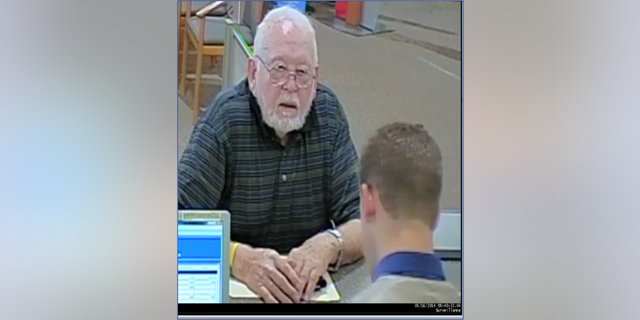
Donald Griffith depositing money to send to the scammers at a bank teller window. 
Donald Griffith depositing money to send to the scammers at a bank teller window.  (FBI)

Kennard said the relationship her father had with Mary occurred entirely over text messages and emails, they never once spoke on the phone. Right away, she was concerned he was being scammed. But her concerns were met with resistance and even distance from Griffith, who taught her to be financially responsible in her youth. She said those lessons are why she was so shocked when she discovered the scam. 

"It was finally when I went to go visit I ended up sneaking through his laptop and I went through his emails and financial statements and I saw the magnitude of what happened," Kennard said. "That’s when I contacted the FBI." 

The agent who investigated Griffith’s case told Fox News that the people who targeted him were part of a Nigerian ring of scammers who defrauded hundreds of other victims out of upwards of $20 million in losses. 

"We identified at least $22 million worth of money that flowed through all the financial accounts that we looked at," Special Supervisory Agent Keith Custer told Fox News. "So, hundreds of victims, hundreds of bank accounts and well over $20 million in losses."

Custer said elderly fraud is an international problem, with highly sophisticated and organized groups of scammers targeting America’s retirees from a number of foreign countries. He specifically named Ghana and Nigeria as hubs for high-tech swindles. The Nigerian ring that targeted Griffith was eventually tracked down and mostly apprehended. 

"We indicted ten people in the initial round of indictments," Custer said. "So nine of those were guilty either at trial or through a plea bargain. One remains at large in Nigeria."  (Continue reading)

Full Article & Source:
FBI raises flag on elder fraud after thousands of retirees are scammed out of $1.7 billion

Friday, December 28, 2018

New Ohio law targets elder fraud as cases on the rise: Here’s how it works

A new state law is aimed at reducing how often older Ohioans are defrauded and increasing financial penalties for those who exploit the elderly.

The bill, recently signed into law by Ohio Gov. John Kasich, increases financial penalties for theft from an elderly person, defined in state law as someone older than 65. It mandates someone convicted of defrauding an elderly person to pay full restitution, plus a fine of up to $50,000. The fine will go to county agencies tasked with investigating elder abuse.

More than 3,630 cases of elder exploitation were reported across Ohio in fiscal year 2018, according to Ohio Department of Job and Family Services data. That includes 277 cases in Montgomery County, 191 in Butler County and 79 in Clark County.

The bill was sponsored by state Sen. Steve Wilson, R-Maineville, who is a retired CEO of LCNB National Bank.

“Day after day we saw our seniors being ripped off,” Wilson said of his years working at the bank. “It is really an epidemic of people going after our most frail and fragile citizens. They can convince them they won the lottery and they haven’t bought a ticket.”

The new law also adds certain financial workers to the list of people mandated to tell authorities if they have reasonable cause to believe an adult has been abused, neglected or exploited.

And it requires the Ohio Attorney General to distribute at lease six public awareness publications every year informing the public of warning signs that exploitation might be occurring, how to report suspected elder fraud, and resources available to prevent or remedy elder fraud or financial exploitation.

Bank employees notice when a regular customer who comes in once a week to make a modest withdrawal suddenly takes out massive sums of money, Wilson said. Often the withdrawals follow suspicious information the senior received from a family member or friend.

The new law gives those financial workers requires them to notify authorities if they fear fraud is occurring. It also gives those workers information about resources for victims.

Nationwide seniors lose about $2.9 billion a year to fraud, Wilson said, with only 44 out of every 1,000 cases being reported to authorities.

The law is designed to pay for itself, he said. The hope is that more cases will be reported, and the increased investigations will be paid for with the stiffer financial penalties.

“We’re not going to stop elder fraud, but we are absolutely going to put a dent in it with this bill,” Wilson said.

Many types of elderly fraud exist. One common scheme involves fraudsters calling seniors and pretending to be relatives in need of emergency financial assistance. Home repair scams also often target the elderly.

Earlier this year, an area man was charged with targeting seniors in a scheme that falsely claimed ownership of their homes with fake property deeds. He then tried to sell the properties to unsuspecting buyers, prosecutors allege.

Elder abuse, neglect and exploitation is on the rise across Ohio, according to a survey Ohio Job and Family Services Directors’ Association Executive Director Joel Potts cited in support of Wilson’s bill last year.

Potts said his agency surveyed JFS offices across the state and 84 percent of respondents reported an increase in elder abuse cases in the prior two years. More than half reported an increase in just the prior six months.

Dustin Holfinger, vice president of state government relations for the Ohio Bankers League, also spoke in support of the bill. He said the elderly are vulnerable to fraud because of factors such as isolation, cognitive decline, physical disability and health issues.

“Elder financial exploitation … has emerged as one of the most prevalent forms of fraud in our state,” he said. “Despite its growing prominence, however, only a small fraction of incidents are detected and reported.”

Full Article & Source:
New Ohio law targets elder fraud as cases on the rise: Here’s how it works

Friday, September 22, 2017

How to avoid and detect Elder Fraud: A guide for older people, carers and relatives

Elder abuse is a problem in western cultures world-wide. There are many forms of abuse ranging from neglect to physical abuse, and within that range is financial fraud. Elder fraud can take many forms and we’ll focus on the type of fraud that primarily uses the internet in this article.

Seniors are disproportionately targeted as victims for fraud. The AARP (formerly the American Association of Retired People) found that while only 35 percent of the American population is over 50 years old, fraud victims over 50 accounted for 57 percent of all fraud. 

It’s difficult to obtain numbers on how large a problem elder fraud is world-wide. Different organizations calculate numbers in different ways and also define fraud differently. All we can be sure of is that billions of dollars are lost each year to criminals preying on elder citizens.

Fraud and the internet: a backgrounder


Fraudsters play a numbers game. They know that most of their attempts to con people won’t work, but they also know that some will. To succeed, the con-man has to make as many tries as possible. Going door-to-door attempting to scam people has low odds because it takes a long time and it’s only possible to hit so many doors in a day. Also, once a scam succeeds, the con-man has to high-tail it out of town before getting caught. Then, find another town and start all over.

The internet removed all those problems for fraudsters. They can now sit in the comfort of their own home, possibly countries away, and through the use of spam email attempt to con thousands of people per day, every day.

Elder fraud is a specific type of fraud aimed at seniors. The most common way that seniors are targeted over the internet is through email. General phishing techniques are used against a large number of email addresses with content aimed at seniors. Content aimed at seniors usually falls into these categories:
  1. Medication
  2. Financial support with regards to home equity or retirement savings
  3. Friendship or camaraderie
From responses to that general attack, more targeted spear phishing can take place in an attempt to defraud specific individuals.

Why are elders targeted?


The problems that plague humanity are fairly steady throughout life. We all want to be safe, warm, fed, loved, and financially secure. Very few people have all of those things all the time, and in our elder years the absence of some of those things can converge into a pattern.

It’s easier to phish people if you know what their problems are. A general phishing attack may use low mortgage rates, as an example. At any given time there are millions of people looking for mortgages but there are billions who are not and don’t care about the mortgage email. Seniors, on the other hand, tend to have a smaller pool of things that are of greater concern. As a population, things like medication costs, proper health care coverage, financial security as retirement funds run out, and providing for loved ones left behind tend to get more attention. It’s therefore easier to craft phishing emails about a small number of subjects that a large percentage of a population is likely to be interested in.

Other reasons may include the fact that many seniors are isolated and therefore have nobody they can trust to run ideas by. Email did not become widely affordable to households until the 1990s in Canada and wasn’t a daily communications mechanism until after that. Anyone over about 30 today has memories of a world without internet and our seniors would have spent most of their lives without it. That can lead to confusion over how reliable email is, and how much trust to assign it.

It’s also not uncommon to experience some level of diminished mental capacity as we age. That can tax our decision-making abilities to the limit and lead to bad decisions.

Common types of elder fraud


A surprisingly sad statistic is that a good chunk of elder fraud is committed by family members or caregivers. The North American Securities Administrators Association reports that 23% of elder fraud causes in 2015 were committed by family members, trustees, or people with powers of attorney.
Generally, those types of fraud are not committed over the internet since the parties are already known to each other. However, that doesn’t mean other types of fraud don’t exist – this body shop owner has been charged with defrauding elderly clients for car restoration jobs. Some of the more common internet scams take the following forms:

Monetary scams

Monetary scams aimed at elders are attractive to criminals for two diametrically opposed reasons. On one hand, many seniors are living on fixed and inadequate incomes and could use more money to live on. On the other hand, many seniors have sizable nest eggs and large amounts of equity in their houses so they can get their hands on a lot of money. The most insidious scams play both angles.

Fraudulent investment or insurance schemes seek to bilk money out of people with the promise of some greater reward down the road. While it can be grisly to consider at the time, it is always important to think of how much time is left for an investment to mature. By and large, elder people would be looking at short-term investments and there are very few legitimate lucrative short-term investments. The insurance scam plays the other angle – there is no concept of pulling any money out of the insurance policy. Rather, heart strings are played upon to invest money for those left behind.

In some cases, the insurance agent actually is a legitimately licensed insurance agent, but is still trying to commit fraud against the elderly. David Pickett, as US-based insurance agent, has been arrested 3 times for fraud.

A sub-class of this type of fraud involves offers to lend money that seem too good to be true. These types of scams are usually complicated to figure out because it’s hard to believe someone can fraudulently give someone else money. A complex example of this is the reverse mortgage system that exists in some countries. In a reverse mortgage situation, elder homeowners with significant equity in their property can opt to take a chunk of money for the estimated value of their house at the time they pass on or willingly move. At that time, the lender takes possession of the house and the debt is paid. The danger lies in that the principal plus the interest over time can end up being more than the house is worth.

In some countries, such as Canada, only 55 percent of the value of the property can be reversed mortgaged. That is to hedge against the possibility of the loan exceeding the value of the property when the debt is repaid. Some mortgage bloggers state that the value of the loan is not allowed to exceed the value of the property, but neither the government of Canada site, nor the single authorized reverse mortgage lender in the country (HomEquity Bank) confirm that. It’s harder to find concrete information on reverse mortgages in other countries. In the U.S., for example, the borrower’s estate generally does not have to pay any excess of the balance over the property value, but legislation enforcing that isn’t readily available. Reverse mortgages are not inherently fraudulent, but if the industry is not tightly controlled in your country, be sure to obtain sound third-party financial and legal advice beforehand.

Lottery scams are targeted at people of all ages and elder people are no exception. The basic framework of a lottery or sweepstakes scam is to tell the victim they’ve won a large prize of some kind, but some smaller amount of money has to be paid in order to claim the prize. The money to be paid is usually attributed to non-existent things like “international transfer fees” or something equally silly. It is safe to say that if you’ve never entered a lottery, you can’t win it, so claims like this out of the blue are a red flag. Legitimate lotteries are tightly regulated to ensure there is no fraud. It is extremely unlikely that a real lottery organization would contact the winner by email to begin with.  (Click to Continue

Full Article & Source:
How to avoid and detect Elder Fraud: A guide for older people, carers and relatives

Wednesday, December 7, 2016

FSU criminology team tackles elder fraud issues

Dean Thomas Blomberg
Around the holidays people tend to be in the giving spirit, but there are also scammers well aware of such generosity. The U.S. Consumer Financial Protection Bureau reports that although fraud targeting seniors happens every day, scammers often increase their efforts during the holiday season.
 
Enter Florida State University’s College of Criminology and Criminal Justice. Researchers, including Dean Thomas Blomberg, doctoral student Julie Mestre Brancale and George Pesta, director of the Center for Criminology and Public Policy Research, recently completed a full report on elder fraud and how to combat it. 

“We needed to have better firsthand knowledge of how extensive the problem of elder financial fraud is in order to develop needed policies and practices that can effectively reduce this growing problem,” Blomberg said.

In 2011, the MetLife Market Institute reported that $2.9 billion was exploited from elderly victims — a 12 percent increase from 2008. The fastest growing segment of the U.S. population is 65 and older, so the occurrence and impact of elder financial fraud will likely continue to escalate.

Despite these alarming trends, there was little research on the facts, prevention and policies related to elder financial fraud. This lack of information led the College, in partnership with Merrill Lynch and Seniors vs. Crime, to begin a study on elder financial fraud in The Villages, one of the largest retirement communities in the nation.

The team addressed four questions through their research: One, what are the most common types of financial fraud perpetrated against the elderly? Two, what role do salient life events, such as retirement, death of a spouse and declining health have on the risk of elder financial fraud? Three, what are protective factors against elder financial exploitation? Four, what are the consequences of elder fraud victimization?

Combing through diverse data — including reported incident data, arrest statistics, national surveys, focus groups and interviews — researchers found that in The Villages between January 2010 and May 2015, there were 3,735 complaints of elder fraud victimization, but only 265 arrests. The average age of fraud victims was 72, and the average lost among the victims was $2,000 per claim. They also found the most common source of fraud was in home services, particularly unnecessary repairs. 

The researchers also examined other types of fraud The Villages residents were exposed to, including misleading sales and advertisements, investment fraud, embezzlement, sweepstakes scams, fraud by health professionals, identity theft and forgery crimes. The report also addresses the methods used to exploit elderly victims and what made them particularly vulnerable to each type of fraud.

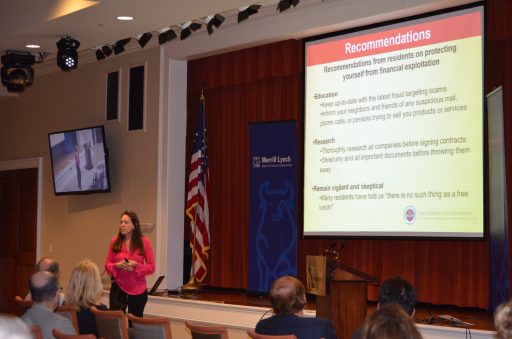
 Doctoral student Julie Mestre Brancale presents report recommendations to senior residents at Westminster Oaks Retirement Community.
Doctoral student Julie Mestre Brancale presents report recommendation 
to senior residents at Westminster Oaks Retirement Community.

Salient life events, or “turning points,” such as death or incapacitation of a spouse, a significant health diagnosis, moving and changing social support networks proved to be the most common precursors for financial exploitation. As a result of victimization, residents of The Villages suffered psychological and emotional distress, impact on their quality of life and health, and devastating consequences for their financial security.

“I was surprised at how prevalent this problem is and how deeply affected residents were,” Mestre Brancale said. “No matter if they lost $50 or they lost $100,000, this victimization changed their lives and they were drastically impacted.”

Researchers also discovered that retirement communities provided a false sense of security to residents, raising the likelihood of exploitation among residents. Further, they determined that elder fraud is significantly underreported because victims are embarrassed and/or unaware how to report victimization.

In the report, Blomberg, Mestre Brancale, and Pesta give recommendations to help reduce vulnerability when it comes to elder fraud. They note that protective factors, such as education, skepticism and strong support networks help to reduce incidents of fraud.

The researchers also recommended that community service centers providing comprehensive services at a single location for seniors could help reduce elderly victimization. Effective services within the community service centers would be hotlines, list of “endorsed” services, classroom education, media outreach, “shopping buddy” programs, support groups and referral services. 

Accordingly, community service centers that provide such services can act as a surrogate family or trusted friend, educating seniors to avoid exploitation and guiding them through the recovery process. The research team anticipates the recommendations, if applied and fostered, will reduce the prevalence of financial fraud. 

“This is just another example of how the college is working to bring research to life,” Blomberg said.

“Here, the college’s research provides real insight into problems confronting some of Florida’s most vulnerable citizens, the elderly, as well as recommendations for the prevention of elder financial exploitation.” 

Researchers said there is more they hope to learn in order to help combat the crime.

“We really want to go out to other retirement communities and see if what we found in The Villages, we find in other retirement communities,” Pesta said. “We ultimately want to pursue an institute for the study of elder fraud and abuse at Florida State University in the College of Criminology and Criminal Justice.”

Read the full report, “Elder Financial Exploitation in a Large Retirement Community,” here.

Full Article & Source:
FSU criminology team tackles elder fraud issues

Friday, July 1, 2016

Congress Is Getting Serious About Preventing Elder Fraud

Fraudsters could soon face tougher consequences for elder financial abuse.

Older Americans lose as much as $37 billion each year to financial fraud, but new legislation in the congressional pipeline would impose tougher penalties for these crimes in an effort to combat the rising rate of exploitation.

Senators Chuck Grassley (R-Iowa) and Richard Blumenthal (D-Conn.) announced in a hearing Wednesday that they are developing federal legislation that will introduce tougher penalties for scammers who target older consumers. The bill will also promote interagency coordination around elder abuse cases—including the improvement of investigation and prosecution—and enhancement of survivor assistance and data collection.

“We need to make sure that government at all levels is working to spread the word on financial exploitation, that individuals on the front lines receive proper training, and that those in the position to combat these crimes have the necessary tools and authority to do so,” Grassley said Wednesday. He added that he hopes to unveil the bill “soon.”

Fraud schemes targeting older Americans are estimated to rise, especially because the number of people over 65 is expected to more than double from 46 million now to 98 million by 2060, according to the 2016 Population Reference Bureau report. And while the total damage incurred through these schemes is in dispute, the emotional and financial turmoil of victims is very real. A 2015 report from True Link estimated seniors lose $36.5 billion each year to fraud and financial abuse. A similar 2015 report by the AARP found financial exploitation robs older Americans of $3 billion annually.

Older Americans may not be defrauded at higher rates than younger consumers, but certain types of scams are more likely to impact them, says Lois Greisman, who heads the Division of Marketing Practices for the Federal Trade Commission’s Bureau of Consumer Protection. The most common of these scams are around lotteries and prize promotions, as well as fraudsters posing as technical support to “fix” non-existent computer problems.

Early detection is the key to combat these schemes, Connecticut State Ombudsman Nancy Shaffer said in Wednesday’s hearing. “Giving law enforcement more tools, more preliminary kinds of assistance in how to identify it as it’s happening, is an important piece,” Shaffer said.

This is not the first time lawmakers have attempted to pass legislation that would address elder fraud.  Senator Amy Klobuchar (D-Minn.) introduced the Seniors Fraud Prevention Act last June. It aims to set up an advisory office within the Bureau of Consumer Protection of the Federal Trade Commission specifically to combat elder fraud. Another measure, the Senior$afe Act of 2015 introduced by Sen. Susan Collins (R-Maine) last October, would help financial professionals, including financial advisers, report elder financial fraud. But legislation tracking site Govtrack.com estimates Klobuchar’s bill has a 44% chance of being enacted, while Collins’ bill rated only a 7% chance.

“All too often the quiet, invisible, heartbreak of financial elder abuse fails to make the headlines, but it happens every day and it’s a scourge that needs to fought and conquered,” Blumenthal said Wednesday.

Full Article & Source:
Congress Is Getting Serious About Preventing Elder Fraud

Thursday, March 31, 2016

The Good News About Elder Fraud


While elder financial abuse is undoubtedly still a major problem — $3 billion stolen annually, by one estimate — older Americans are a little less likely to be victimized than in 2010, according to a new survey from the Investor Protection Trust (IPT), a nonprofit devoted to investor education.

More good news on the elder fraud front, especially if you have parents in their 70s, 80s or 90s: there are now a bunch of efforts underway to prevent these scams and aid victims. Federal and state government regulators are pitching in. So are AARP, IPT and some financial services firms. “Many times, the financial adviser is the first person to notice a problem,” said Cynthia Hutchins, director of gerontology at Bank of America Merrill Lynch.

Rampant, Expensive and Lethal

Older consumers will likely be especially glad that some banks are taking seriously elder financial abuse, a category of crime Kathleen Quinn, executive director of the National Adult Protective Services Association, has called “rampant, largely invisible, expensive and lethal.” A recent survey for the AARP BankSafe campaign found that 81% of bank customers 50 and older prefer to establish their accounts at banks that protect them from exploitation or provide an age-friendly service.

As for the “good” news in the IPT survey: Although the poll found that 17% of Americans age 65 and older have “been taken advantage of financially in terms of an inappropriate investment, unreasonably high fees for financial services, or outright fraud,” that’s down from 20% in 2010.

This is not a huge drop, but it’s a drop, nevertheless. (The 2016 survey, conducted by Public Policy Polling, interviewed 2,257 Americans 65 and older and 703 adults with parents 65 and older.)

Why Fewer Are Becoming Victims

IPT President and CEO Don Blandin said fewer older adults are becoming victims partly because scammers are getting “more sophisticated about who they target.” They’re taking a rifle approach, going where the big money is, rather than taking a shotgun approach and hoping to score random hits. As Consumer Financial Protection Bureau (CFPB) Director Richard Cordray said last week: “Older Americans make attractive targets for financial exploitation because many have accumulated some wealth in the form of retirement savings or home equity. They can be isolated and lonely, and some may have impaired physical or mental capacity that makes them especially vulnerable.”

IPT’s survey also pleasantly discovered that the percentage of older Americans exhibiting one or more of the warning signs of financial victimization fell from 50% in 2010 to 43% in 2016. The reason for the drop, said Public Policy Polling’s Jim Williams, is that just 5% now said they didn’t feel confident making big financial decisions alone, down from 16% in 2010. “There could be more of a support network and more vigilance out there,” said Williams.

And in what IPT calls a “major improvement,” 51% of people 65 and older correctly answered all the poll’s investment questions; in 2010, just 44% did.

However, 21% of the adult children surveyed said they think their parents would be ashamed to tell them if they thought they were being swindled and would hide this from them. Worse, 47% of the adult children think it’s not likely that they could figure out if their parent had been swindled if the parent didn’t disclose it; that’s up from 35% in 2010. So not everything is rosy on the elder fraud front.

How Doctors Are Helping

The IPT survey finding that surprised me most: A full 21% of the adult children said their parents’ health care providers mentioned concerns about how the parents were handling money; this was up sharply from just 5% in 2010.

Blandin gives some credit to IPT’s Elder Investment Fraud and Financial Exploitation (EIFFE) Prevention Program, encouraging doctors to spot and report signs of mild cognitive impairment (MCI), which can make older people more vulnerable to money swindles. More than 8,600 medical professionals have been trained and some physicians keep IPT’s “pocket guide” handy to help them ask key questions. “My doctor now has something on his intake form to see if patients have any financial issues,” said Blandin.

One problem: The IPT survey also found that 61% of adult children are not in touch with their parents’ health care providers.  (Continue Reading)

Full Article & Source:
The Good News About Elder Fraud