Hosted by Marti Oakley" Join us this evening as Mike Volpe and Sandra Grazzini talk about the latest developments in what has to be THE divorce case of the century here in Minnesota.
Dakota County, notoriously infamous for its blatant corruption continues its aggression against the defendant. Tune in for the latest in this extremely strange case. Just goes to show you....money talks and can buy you all sorts of things in the right places!
There is currently an act before the Massachusetts Legislature to establish the Office of Adult Guardianship and Decisional Support Services. (S.1177/H3027). The purpose of the bill is to provide guardianship services to “unbefriended” people who are unable to manage their affairs.
These people are the most vulnerable in society. They have no one to complain if they are subjected to abuse by a guardian. They are the perfect victims. Any system for providing guardianship services to the “unbefriended” has to have iron clad protections against abuse.
On the contrary, this bill gives immunity to guardians. Guardians are already given immunity by judges of the Probate Court. Regardless of the intent of this immunity the result has been to create a system of legalized crime where guardians commit crimes with impunity. Other health care providers (doctors, nursing homes, etc. ) have to carry liability insurance. Conservators have to be bonded. Guardians should have liability insurance, not immunity.
Democracy was invented to prevent abuse of authority by government. The best way to stop abuse of guardianship is to use principles of democracy such as separation of powers (no one has sole control), checks and balances, accountability (no immunity), avoiding conflict of interest by putting authority in the hands of disinterested parties, etc.
The current bill has none of these protections of democracy. The Governor’s Advisory Council has no authority. A careful reading of the bill shows that the Executive Director of the Office of the Adult Guardianship and Decisional Support Services is the only entity given any authority. The Office of Adult Guardianship has no authority as an entity. All its duties and powers are executed by the Executive Director.
I have attempted to rewrite the bill in a way that makes maximum use of the principles of democracy to prevent abuse of power.
All comments, corrections, suggestions, etc. are welcome.
Robin Giles felt like she was missing a joke. It was Christmas morning in 2012, and she and her husband, Joël, were going through familiar traditions in their apartment in London, Ont. Later they’d go out to visit friends and family, but for now, it was just the two of them and their cats.
They opened their stockings first, and Robin was becoming more puzzled with each object she pulled out: They were utterly random. Jo had always been a thoughtful gift-giver. One year for Christmas, he gave Robin a beautiful set of bound Paddington Bear books, a nod to her childhood favourite. He’d often come home from work with an album for her, or a treasure he found at a used bookstore. Today, though, her stocking was filled with CDs she already owned, and a used container of hand cream, as though Jo had bought a store tester. She kept thinking there was a punchline or a theme she wasn’t seeing.
“I remember being really upset that Christmas—not because of the material stuff, but because it just felt weird,” Robin says. “It felt really weird.”
Something was wrong. This wasn’t Jo.
That Christmas, Joël Aubin was 36 years old and already battling hard to work around an erosion process that was hard-wired into every cell of his body. He had dominantly inherited Alzheimer’s disease, the result of a genetic mutation that snakes through family trees. The disease itself is rare, and Jo is a nearly unheard-of aberration because of his age. He wouldn’t know he had the disease for another 18 months—but he’d seen it all before: His mother was 47 when she died of the same illness. Jo’s teenage world had been ripped from its frame then, but he had grown up with no idea that he had a 50/50 chance of inheriting the same fate. Alzheimer’s disease would fray his marriage before fundamentally changing it, shrink Jo’s world to the size of his neighbourhood and forge his friends and family into a tight support system. And it would lead Jo to resolve to avoid a long goodbye like his mother’s, and to choose when his story would end.
The dominantly inherited form of the disease is said to account for fewer than one per cent of Alzheimer’s cases—Jo’s specialist pegs it at much rarer than even that—and it’s caused by a mutation in one of three genes. While the more common type of Alzheimer’s carries a genetic risk component that means certain people are more likely to develop the disease, this genetic mutation is different: For an unlucky few like Jo, it’s a terrible guarantee. These people overproduce a protein called beta-amyloid, which accumulates in their brains as “plaques,” while another protein called tau twists itself into “tangles” inside the nerve cells. Together, they strangle neurons and eventually consume memory and ability as the brain withers.
CLEARWATER, Fla. - Professional guardian Fernando Gutierrez was
charged last month with financially exploiting seniors through power of
attorney or health care surrogate agreements.
He couldn't use the
money from his business bank accounts to pay bond, because prosecutors
thought that money may have come from victims.
The call for help Guitierrez made from jail made the judge suspicious as well.
Prosecutors
allege professional guardian Fernando Gutierrez stole hundreds of
thousands of dollars from vulnerable seniors he was supposed to protect.
“He used that money for various things like paying his kids' tuition, paying his mortgage,” said State’s Attorney Adam Ross.
And
because Gutierrez still had joint bank accounts with multiple clients,
the judge ordered him not to use any money from business accounts for
his $750,000 bond.
“You have to be able to show that the assets
that would be used to bail yourself out are not ill-gotten gain,” said
Judge Nancy Moate Ley during his first court appearance.
That same day, Gutierrez made a phone call from jail to his family.
“This call is from a corrections facility and is subject to monitoring and recording,” the recording of the jail call said.
“They want to see where the money's coming from,” Gutierrez told a family member during call.
He also instructed his daughter how to access his Wells Fargo Bank accounts through a computer.
“Ok, we're in,” she said, after putting in his account name and password.
“Ok, you'll see all those accounts,” Gutierrez said. “Try to limit your conversation as much as you can.”
“Ok. Yeah,” she replied.
He then walked her through how to move money for his bond into her own account.
“Maybe you should go to the bank and get cash and deposit it into your account,” he said.
“Which check you want me to use?” she asked.
“You know the one, not the business check, the other one. The other one. The other one,” he said. “And speak limited words.”
He also gives instructions to his wife.
“Just deposit it in the joint account, your account, ok? “ he said.
And to a niece to whom he sent money.
“Just hold onto it until I get to the hearing for my bond and I'll tell you how much to take out,” he told her.
“Yes. tell us how much you need and we'll deposit it to whoever's account or whatever,” she said.
“No, no, no, no, no. It'd have to come from your account,” he told her.
“Just hold it. Just hold everything for now,” he said.
At
his bond hearing, those same family members pledged money toward his
bond, but the judge wouldn't accept the funds as coming independently
from his accounts, sending Gutierrez back to jail for a week until
another family member pledged property.
When he was released, it was with new conditions.
He removes himself from all non-family joint accounts,” said Judge Nancy Moate Ley.
“If you bond out of jail and don't have the where with all to do this, we could put you back in jail,” she said.
Gutierrez has until august 14th to get his name off all his clients’ bank accounts.
At the time of his arrest, he was the guardian, power of attorney or health care surrogate for more than fifty people.
You can still catch a few glimpses of the old Molly Daley, from before
the dementia diagnosis two years ago, when she laughs for no reason,
when she hugs her son and tells him she loves him, or when she pretends
to box with her youngest grandson, wearing pink gloves and a padded
helmet.
That’s the Molly who enjoyed drinking a cold
beer with her dinner, going on road trips, and lending a hand to her
friends and neighbors.
But that Molly is now elusive, more often
replaced by a vacant gaze hiding the suffering as the disease slowly
takes over her brain.
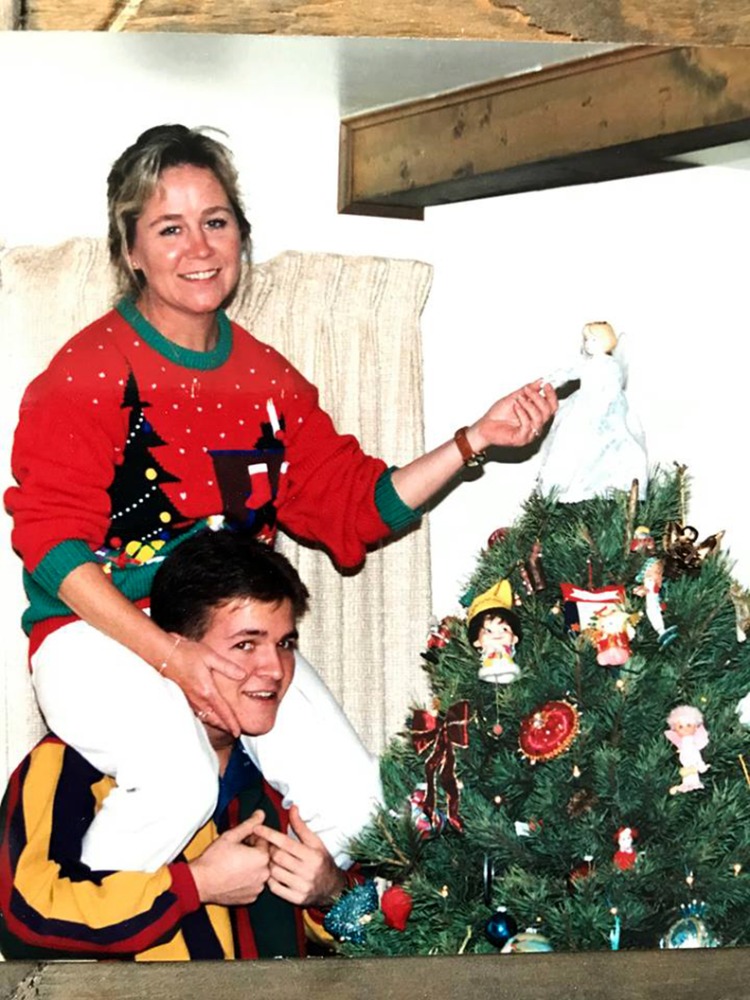
Molly and Joey Daley at Christmas in 1988. Courtesy Joey Daley
"That look of confusion, where she’s trying to
process what’s going on, it’s just like a blank stare and that gets
worse over time," her son, Joey Daley, told NBC News. "It’s like, just a
little bit, dementia has taken a little bit more of her away."
Molly, 66, was diagnosed in 2015, and Daley
found himself yearning for more information from other caregivers like
him about what to expect as the disease worsened.
When he found resources lacking, he decided to
put the spotlight on Molly and their own family’s struggle — reaching
the hearts of millions who have watched the videos around the world in
the process.
“Before these videos, you couldn’t explain it to people,” Daley
said, adding that he couldn’t watch his mother deteriorating without
giving the ordeal some purpose.
Now, after the ongoing series sprouted a grassroots network of caregivers and supporters called Molly’s Movement, Daley, 46, said the videos have been the most rewarding thing he’s ever done.
"I had no idea it would touch that many people," he said.
Dementia with Lewy bodies is the second most
common form of the disease in older adults after Alzheimer’s, affecting
more than 1.4 million Americans. Abnormal clumps of a protein building
up in brain cells cause the disease, which is characterized by a gradual
loss of cognitive functions.
Patients experience visual hallucinations,
REM disorders that cause them to physically act out dreams, and tremors
like those in Parkinson’s disease. But unlike Parkinson’s, Lewy body
dementia affects wider swaths of the brain, interfering with a person’s
everyday life and their ability to carry out typical activities or solve
problems.
About three years ago, basic tasks like paying bills, driving a car
or taking medication became challenges for Molly, who at the time was
living alone in Columbus, Ohio. Then, after an infection landed her in
the hospital, her children stepped in. She now lives closer to her
family in a nursing home in nearby Dublin, where her son and daughter
visit on alternate days, taking her out for shopping trips, the
occasional pedicure or haircut, and family dinners.
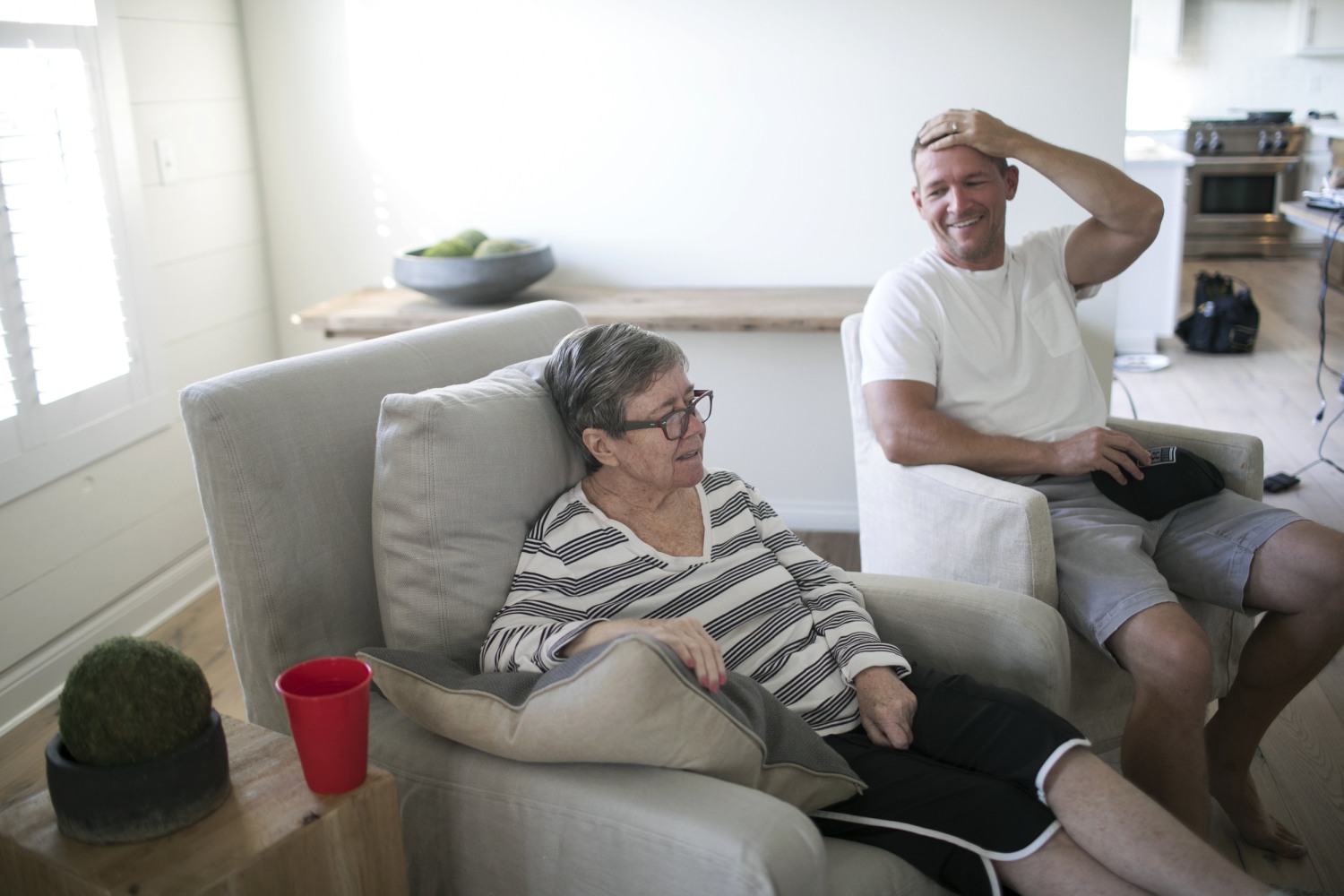
Daley sits with his mother at his home in Dublin, Ohio. Maddie McGarvey / for NBC News
Daley never knows what state of mind his mom
will be in on each visit. Sometimes she’ll welcome him with a smile and
small talk. Then there was the time he watched her using one toothbrush
to brush another, having seemingly forgotten how to brush her teeth. Or
the time she kept asking if the shower was a way out of the room.
But most often, he’ll find her crying,
distraught and shaken up by a bad dream she is convinced actually
occurred in real life, as she struggles to find the words to explain
what she thinks is wrong.
"Dementia’s like an onion. You peel off the layers of the memory on
the outer layers until you get to the core, where you’re just a child
again," Daley said. "It’s suffering to death."
There is currently no way to prevent dementia or
stop its advance. There is no "cure." And the only way to even get a
definite diagnosis is through autopsy after a patient's death.
About one-third of all Medicare beneficiaries
who die in a given year have been diagnosed with Alzheimer’s or another
form of dementia, according to 2014 Medicare claims data analyzed by the Alzheimer’s Association. And data from the Lewy Body Dementia Association suggest that the disease may account for up to 25 percent of cases of dementia.
"[Lewy body dementia] is probably the most
common disease you’ve never heard of," said Dr. James Galvin, an expert
in cognitive health, memory loss, Alzheimer’s disease, Lewy body
dementia, and related disorders.
Galvin said the disease is poorly understood and
under-studied in comparison to Alzheimer’s, which is due in part to the
difficulty in pinning down a diagnosis. A survey from the Lewy Body
Dementia Association shows that on average, it took physicians four
office visits to make the diagnosis. This lack of knowledge can isolate
caregivers further.
To help combat that, Daley created a Facebook group
that now has more than 31,000 members, many of whom are caregivers for
people with dementia. They use the platform to share stories, seek
advice and give out words of encouragement.
Daley helps his mother at his home in Dublin, Ohio. Maddie McGarvey / for NBC News
Periodically, Daley, who is an entrepreneur and
works from home, uses the money earned from Molly’s Movement t-shirt
sales or donations to organize giveaways for caregivers in the group.
The prize is a relaxing night out or, in the case of a 16-year-old girl
caring for her grandmother, a shopping trip.
"[The giveaway] is the type of thing my mom
would do," he said, adding that he gets about 100 messages every day
from people pouring their heart out to him or thanking him for his
eye-opening videos.
Any type of support that reduces the feeling of
isolation is essential, as caregivers can often forego their own needs
when helping dementia patients.
“A caregiver is the invisible patient,” said Dr. Galvin.
But Daley, like many others, shrugs off concern
for his own well-being. As his movement grows, so do the demands on his
time. The married father of three said he will have to do "more work
when everyone’s asleep."
His mother, who was a single parent of two while
working two jobs as he was growing up, is his inspiration. One video at
a time, he is building her legacy.
As his mother’s dementia gets worse, Daley
wonders how much longer he’ll be able to keep recording, especially once
she becomes unable to speak. He acknowledges that it will be a delicate
balance, something he never got to discuss with her before beginning
the series.
"I don’t want to stop early," he said. "I want people to understand how bad it gets."
Daley said the most exhausting part is going
over what he recorded at the end of each day, reliving painful moments
like the time she forgot he was her son — an event he thought would come
much later, perhaps at the end.
But for the many heartbreaking moments, there
are still the rare ones when the old Molly shines through, like when she
was asked whether she is proud of her son.
"If there wasn’t a Joey, there wouldn’t be me," she answered.
PORTLAND, Ore. -- To welcome us to Portland, Oregon, 67-year-old Steve Goodwin would like to play one of his songs for you.
You have no idea how much he would like to play one of his songs for you.
"It
made me almost hate the piano. But then I realized it's not the piano's
fault, it's this thing that's going on in my brain," he said.
Three
years ago, Steve was diagnosed with Alzheimer's disease. He had to give
up his job as a software designer, but his wife Joni says the cruelest
part is the toll it's taking on the music he composed.
Steve trying to remember songs at the piano
CBS News
"Losing the songs would be like losing him," she said.
Steve
and Joni have been married 47 years, and along the way, Steve composed
more than two dozen songs, mostly for her. He played them daily, and
they became the soundtrack of their lives.
Joni Goodwin
Unfortunately,
he never wrote down most of them. So when his memory started failing --
and the songs started fading -- there was no way to get them back.
Until a family friend, a professional pianist, offered to launch a
rescue mission.
And so, for the past two years, Naomi Laviolette has been reconstructing his compositions note by note.
"I said if he can at least play through it, even in pieces, I can learn it," Naomi said.
And of course they're recording the songs, never to be lost again.
"I realized there was a part of him that wasn't going to fade away," Joni said.
When Carol Marak was in her 30s, she asked
herself whose life she wanted: her brother's – the life of a successful
and well-traveled businessman – or his wife's – the life of a woman
whose career better accommodated raising three children.
The answer was a no-brainer: "My brother was in a position I wanted," says Marak, now a 64-year-old editor at SeniorCare.com
who lives in Waco, Texas. Although she had been married and divorced
earlier in life, at that point she had no kids and "made a very
conscious decision" to keep it that way, she says.
Plenty of Marak's peers did the same thing. According to a 2012 study
in The Gerontologist, about one-third of 45- to 63-year-olds are
single, most of whom never married or are divorced. That's a whopping 50
percent increase since 1980, the study found. What's more, about 15
percent of 40- to 44-year-old women had no children in 2012 – up from
about 10 percent in 1980, U.S. Census data shows. "My career was No. 1 in my life," says Marak, who worked in the technology industry for years.
But today, Marak and her single, childless
contemporaries are facing a repercussion of their decision that never
crossed their minds as 30-somethings: "How in the world will we take
care of ourselves?" she asks.
Dr. Maria Torroella Carney, chief of geriatrics
and palliative medicine at North Shore-LIJ Health System in New York,
is asking the same thing. In research
presented this year at The American Geriatric Society's annual meeting,
Carney and her colleagues found that nearly one-quarter of Americans
over age 65 are or may become physically or socially isolated and lack someone like a family member to care for them. Carney calls them "elder orphans."
"The risk of potentially finding yourself
without a support system – because the majority of care provided as we
get older is provided by family – may be increasing," she says.
The consequences are profound. According to
Carney's work, older adults who consider themselves lonely are more
likely to have trouble completing daily tasks, experience cognitive decline, develop coronary heart disease
and even die. Those who are socially isolated are also at risk for
medical complications, mental illness, mobility issues and health care
access problems.
"You could be at a hospital setting at a time
of crisis and could delay your treatment or care, and your wishes may
not be respected [if you can't communicate them]," says Carney, also an
associate professor at Hofstra North Shore-LIJ School of Medicine.
Take "Mr. HB," a 76-year-old New York man described in Carney's research as "a prototypical elder orphan." After attempting suicide, he arrived at a hospital with cuts on his wrist, bed sores, dehydration, malnutrition
and depression. He lived alone and hadn't been in contact with any
relatives in over a year. His treatment was complicated, the researchers
report, in part because he was too delirious to make clear decisions or
understand his options. He wound up at a nursing facility with plans to
eventually be placed in long-term care.
But growing older without kids or a partner doesn't mean you're doomed – just as aging with
kids and a partner doesn't mean all's clear. "We're all at risk for
becoming isolated and becoming elder orphans," Carney says. You could
outlive your spouse or even your children, find yourself living far from
your family or wind up in the caretaker role
yourself if a family member gets sick. Keep in mind that 69 percent of
Americans will need long-term care, even though only 37 percent think
they will, according to SeniorCare.com.
Plus, there's no way around the natural
physical and mental declines that come with age. "Everybody has to
prepare to live as independently as possible," Carney says. Here's how:
1. Speak up.
Marak wishes she had talked more with her
friends and colleagues about her decision not to become a mom early on.
That may have given her a jump-start on anticipating various problems
and developing solutions to growing older while childless. She advises
younger generations to discuss their options openly with
friends – married and single, men and women – before making a firm
decision.
"We discuss our psychological issues with
professionals. We discuss our money strategies with financial experts,"
Marak says. "Why not talk openly about family concerns and what it means
to have or not have children? So many of us go into it with blinders
on."
2. Act early.
How early you start planning for your future
health depends partly on your current condition – and your genes, says
Bert Rahl, director of mental health services at the Benjamin Rose Institute on Aging. "If your ancestry is that people die early, you have to plan sooner and faster," he says.
But whether you come from a family of supercentenarians or
people who have shorter life spans, it's never too soon to save for
long-term care, whether it's by investing in a home, putting aside a
stash for medical emergencies or "whatever you can do to have a nest
egg," Marak says. "Life is serious, especially when you get old. Don't
get to [a point] when you're 60 and now you're having to scramble to
catch up."
Still not motivated? "Everybody wants some
control in [their] life," Rahl says. "If you don't plan, what you're
choosing to do is cede that control to somebody else – and the
likelihood that they're going to have your best interests at heart is a
losing proposition."
3. Make new friends and keep the old.
Your social connections can help with practical
health care needs, like driving you to the doctor when you're unable.
But they also do something powerful: keep you alive, research suggests.
In a 2012 study of
over 2,100 adults age 50 and older, researchers found that the
loneliest older adults were nearly twice as likely to die within six
years than the least lonely – regardless of their health behaviors or
social status.
Connections can also help ward off depression, which affects nearly 20 percent of the 65-and-older population, according the National Alliance on Mental Illness.
"One of the things that keeps people from being depressed is to be
connected," Rahl says. "The more social activities you have, the more
friends, the more things you can do to keep your body and mind active –
that's the best protection you have against mental illness."
4. Appoint a proxy.
Who is your most trusted friend or relative?
"Identify somebody to help you if you're in a time of crisis, and
revisit that periodically over your life," Carney suggests. Make sure
that person knows your Social Security number, where you keep your
insurance card, which medications you take – "the whole list of things
somebody needs to know if they're going to help you," advises Dr. Robert
Kane, director of the University of Minnesota’s Center on Aging.
Before you start losing any cognitive capacities,
consider designating that person as your durable power of attorney for
health care, or the person who makes health care decisions for you when
you're no longer able.
If no one comes to mind, hire an attorney who specializes in elder care law
by asking around for recommendations or searching online for
highly rated professionals. Unlike your friends, they have a license to
defend and are well-versed in elder care issues. Most of the time,
Rahl's found, "they're trustworthy and will do a good job for you."
5. Consider moving.
Marak is on a mission: "to create my life where I'm not transportation-dependent," she says. She's looking to move to a more walkable city,
perhaps a college town where she's surrounded by young people and can
stay engaged with activities like mentoring. She also hopes her future
community is filled with other like-minded older adults who can look out
for one another. "I want to … set up my life where I'm not living alone
and isolated," she says.
Adjusting your living situation so that you can
stay connected to others and get to, say, the grocery store or doctor's
office is the right idea, says Carney, who cares for a group of nuns who
live communally and has seen other adults create communities
that act like "surrogate families," she says.
"Think: Where do you want
to live? What's most easy? How do you access things? How do you have a
support system?"
6. Live well.
Marak is lucky: She's always loved eating healthy foods
and walking – two ways to stay as healthy as possible at all ages.
"Some of the foods that we eat are really, really bad for the body," she
says. "That's one of the major causes of chronic conditions – and not
exercising."
Keeping your brain sharp
is also critical if you want to be able to make informed decisions
about your health care, Rahl says. He suggests doing activities that
challenge you – math problems if numbers trip you up, or crossword
puzzles if words aren't your forte. "The old adage, 'If you don't use
it, you lose it,' is 100 percent correct," he says.
SPRINGFIELD, Mo. –- Gov. Eric Greitens’ budget cuts take effect in Springfield nursing homes Tuesday, Aug. 1. The $251 million cut to Missouri’s budget translates to half a million dollars gone at just one of Springfield’s many nursing homes.
Keith Steenbergen, the administrator for Glendale Gardens Nursing and Rehab, expects to make tough budget calls day by day, with each harder than the previous.
"Today starts a very difficult period for our industry,” Steenbergen said.
It’s the day Gov. Greitens' budget cuts to Medicaid reimbursement take effect in Springfield, and all across the state. The building received a 3.5 percent cut to Medicaid reimbursement, which amounts to $5.37 gone per resident on Medicaid per day.
"It adds up pretty quick, that's anyone who receives Medicaid funds,” he said. “So for our facility itself, over a year, it's getting close to half a million dollars."
Most administrators, like Paige Wheeler at Life Care Services, agree that nurses should be the last to go.
"We have to try to look at what we can do to not compromise quality of care when our reimbursement rates are consistently less,” Wheeler said.
Steenbergen says it could happen.
"Unfortunately if it continues like it’s going right now, nursing will be affected as well,” he said.
Residents might also have to go. Along with the budget cuts come a harsher point system to determine who’s eligible for Medicaid. The lower your number, the healthier you are.
"Until now, residents needed a 21 on the scale to be admitted into a skilled nursing facility and receive Medicaid services in Missouri. Starting Tuesday, they'll have to be a 24 to be eligible, and in some cases as high as a 27.
"A 21, truly, in our scope, is someone who's needing 24-hour care,” Steenbergen said.
No residents should lose Medicaid services Tuesday, even with a score of 21. That would potentially happen the next time they’re assessed.
"Generally those assessments, I believe, take place on a six month basis,” Wheeler said.
For now, homes will have to choose what they and their residents can live without.
“Administrators are responsible for that,” Steenbergen said.
The Missouri legislature will be back in session in September to potentially override or veto the legislation. Steenbergen told KOLR10 he’s staying in touch with his state representative until then.
Al Katz, a Holocaust survivor now deceased, was a snowbird from Indiana who went to Florida one year as he always did -- only this time he never came home. On his profile on NASGA's Victims page, his daughter, Beverly Newman, stated,
Al Katz speaking to his guardian
"In Florida State guardianship, Dad was locked up, at 89 years old, in the dismal, isolated basement of a metropolitan hospital, with a no-contact order, separating him for weeks from his family and friends. He relived the Holocaust here in Manatee Memorial Hospital, with fierce, penetrating fears of abandonment and confinement, his worst fears come true. I, his daughter, just outside the thick metal doors, was ordered to leave the premises by the police guarding the poor old man from the touch he needed for comfort. Three weeks behind locked electronic, guarded doors, my Father relived, flashbacked to the Holocaust, when his adored parents and baby brother were murdered in mass killings of Jews. He could not help his own cherished family, and I could not help him 70 years later."
Al Katz passed in 2009, but his daughter now living in Florida, is still in litigation and the case is not settled. Beverly states, "they have said they will have me arrested here in Florida and shipped back to Indiana like a criminal, which is likely to cost me my life." She also states she is being retaliated against, intimidated, and the truth is being obscured.
Beverly asks for both help and prayers. And she asks that as many people as possible share her plea for help so hopefully an interested investigative reporter will step up and bring sunshine on her case. Beverly can be reached at HelpElders@gmail.com.