Ron Jeremy
is unable to make serious legal decisions on his own, so his sister is
stepping in, asking a judge to get him a conservator STAT.
Ron’s sister, Susan Billotte, filed a petition — obtained by TMZ — to appoint attorney Ellen Finkelberg
as his conservator, requesting Ellen be given authority to make
decisions regarding the former porn star’s finances and health care.
The docs state, Ron is “concurrently incarcerated at the
Twin Towers-Mens Central Jail. He has been found incompetent to stand
trial in a criminal case due to a diagnosis with symptoms of Lewy body
dementia and has a pending transfer to a state hospital.”
According to the docs, there is urgency to get a
conservator now so Jeremy can get to a “private secured perimeter
facility specializing in treatment of dementia.”
In other words, his sister says he’s in desperate need of a
conservator but is unable to make the call due to his deteriorating
health.
As you know, Ron was committed
to a state-run mental hospital in California ... after being deemed
unfit to stand trial, in which he was indicted for more than 30 sexual
assault counts for alleged incidents dating back more than 20 years.
A lot of
people take talking and being able to express themselves and their
feelings for granted. For those with dementia or Alzheimer’s, this can
become very challenging and sometimes impossible.
Jim Loane, of Las Vegas, has Lewy body dementia, and things as simple as communicating does not come easy for him.
Photo: YouTube/8 News
Although
everyday life for him can be hard at times, his wife, Linda, helps him
along the way. She always knows what he is trying to say and can help
put together the sentences for him to help others understand him.
The couple has been married for more than 40 years, and together they
have raised three children and grandchildren. They have always been
very happy, but life has become a struggle while dealing with Jim’s
dementia.
Jim began
going to the Lou Ruvo Center for Brain Health to help him through his
journey with dementia. He also began weekly music therapy, which has
helped him express himself better.
Jim knows that he wouldn’t make it through each day without Linda,
who is also his caregiver. He decided to thank her for all of her love
and support in a very special way.
“I was
sitting home one day and I thought about Linda and what she does for me
and I started writing words, not even thinking it would turn into a
song,” he told 8 News Now.
Jim practiced the song for months with his therapist, Becky Wellman, and eventually sang it to Linda on her birthday.
“This was
just the man that I married 46 years ago that really had that kind of
caring compassion that I know it’s in there, but I don’t always see it
and it was nice to see it. It was nice to have him back for that amount
of time,” she said.
PLYMOUTH, Minnesota — There’s been a 20% drop in complaints about
maltreatment in Minnesota’s Long Term Care facilities as families were
locked out during the COVID-19 crisis. But some families say it was only
because they weren’t there to see the neglect.
June Linnertz says she went to visit her dad Jim Gill on March 19th
at Cherrywood Pointe of Plymouth. A photo from that day shows him
outside, neatly dressed and smiling as he stood next to a bird feeder.
“He was still in good spirits, obviously always enjoyed a family visit,” Linnertz recalled.
Credit: Linnertz family
A family photo shows Jim Gill standing, neatly dressed and smiling in March.
Her dad was suffering from Lewy Body Dementia and although he needed
assistance with many tasks, at the time he was still only considered a
Level 1 case, the highest functioning level, soon to move to Level 2 at
Linnertz’s request.
Linnertz visited regularly, helping with some of her dad’s care. But
that March day she says she was told to leave. The facility, like
others, was closing its doors to outsiders because of COVID 19.
“I got all the verbal assurances in the world, ‘Don’t worry, we got it’,” she said.
Linnertz says she could call her dad on his cell phone, but the staff
wouldn’t facilitate video chats. Her dad couldn’t do that on his own.
In phone calls, she says he didn’t understand why his kids hadn’t
come to visit and why he was confined to his room for so much of the
day.
“He was confused. He thought he maybe did something wrong,” she said.
Several months later she said she came by to try to see her dad through the window and was shocked by his appearance.
“He had lost a ton of weight, completely disheveled. He had grown
facial hair. Had crust on the corner of his lips,” she said of her once
neatly dressed dad. “I was nauseated. I was so sad”
On June 7th, Linnertz took a photo through the window. Her dad
slumped over in a wheelchair. His hair untrimmed and unkempt. His shirt
was dirty.
Credit: Linnertz family photo
This photo taken through a window in July shows Jim Gill's decline.
“He didn’t look well. He hardly had the strength to even try to bring his head up a little bit. Heavily soiled,” she remembered.
By this time, Jim Gill was receiving hospice care – and Linnertz wanted to bring him home.
But nothing prepared Linnertz, who works as a death investigator, for
what she says she saw when she finally had access to see him in person.
“My dad is lying face down in the mattress and pillow … he is shaking
and he is just saturated with perspiration,” she described to KARE 11.
Care notes from his hospice agency document the sweat soaked sheets.
Linnertz also found her dad bruised and in pain. Care notes show he’d
fallen unattended at least six times in less than two weeks. An aide
wrote “bruises from previous falls are now appearing.”
Linnertz says she and a hospice nurse tried to flip Jim over into a
more comfortable position. “He immediately started wailing out in pain.”
Credit: KARE 11
June Linnertz says she was shocked by her father's condition when she finally saw him.
Moments later, she would see why.
“They cut his diaper off and that’s when they called me over and said
you’ve got to see this,” Linnertz said. “His genitalia was bright red
and the skin was sloughing off already.”
A healthcare worker who saw the scene spoke with KARE 11 and
confirmed Linnertz’s account, describing Jim’s treatment as “severe
neglect”.
The Minnesota Department of Health is investigating.
Ebenezer, the company that owns Cherrywood Pointe, denies allegations of neglect. They sent the following statement to KARE 11:
We take suggestion of neglect very seriously and remain committed
to providing safe and compassionate care to every resident we serve.
Recent inspections by regulators found our facility in compliance with
applicable local, state and federal laws. While privacy laws prevent us
from commenting on specific cases or situations, all concerns brought to
our attention by staff or family members are immediately reviewed and
acted upon, if necessary. Our employees are required by law to report
issues involving substandard care or neglect. We constantly look for
ways to improve our procedures, and we take additional actions as
circumstances warrant.
So, what happened in that three months Linnertz was locked out?
“I think it comes down to the isolation, the loneliness and ultimately I figured out – the neglect,” she said.
Eilon Caspi – a gerontologist and researcher – says COVID didn’t create
problems in some poor performing long term care facilities. It exposed
them.
Credit: KARE 11
Gerontologist Eilon Caspi says suspending family visits because of COVID created other problems.
Coupled with health officials temporarily cutting back on site
inspections and families not there to keep an eye on things, it created a
recipe for disaster.
“It came from a goodwill of protecting residents. But then it spilled
over into people dying out of neglect, dying out of loneliness in
excruciating emotional and physical pain,” Caspi said.
KARE 11 reviewed data from the Minnesota Department of Health showing
a 20% decline over last year in maltreatment reports during the
long-term care lockdown.
But the ombudsman’s office was flooded with calls.
“We have seen significant weight loss and other decline in some people in long term care,” Deputy Ombudsman Aisha Elmquist said.
Health officials didn’t open up facilities for approved love ones to
visit until August – five months into the pandemic. As part of the
Essential Caregiver program, some families, friends and loved ones can
now visit in person with approval of the facility.
Leading Age, an industry group, says 68% of senior care residences
have implemented that Essential Caregiver program. But, so far, their
survey shows just 1 in 4 families is currently signed up.
“Our members are - join families about being concerned about the
impacts of prolonged social isolation,” said Kari Thurlow of Leading
Age.
Credit: KARE 11
Kari Thurlow says many families still haven't signed up for Essential Caregiver visits.
But some experts like Caspi say, though, concerns of spreading COVID
19 inside facilities were valid, Minnesota kept visitation restrictions
in place too long.
“The idea of outdoor visits should have been introduced much earlier,” Caspi said.
Thurlow agrees isolation is not a sustainable plan. But she says many
things need to happen before long term care facilities are open to all
families.
“We cannot go to business as usual with regard to visitation until
one of two things happens. Either we have widespread vaccine use which
we know is some time away from now. Or widespread access to accurate,
rapid testing which we also don’t have at this time,” she said.
“You cannot leave people abandoned,” Linnertz said. She fears what
fall will bring, with the pandemic still raging, cold weather making
outdoor visits more difficult and some facilities still locked down.
But she no longer worries for her dad. Jim Gill died at her home days after leaving Cherrywood Pointe.
“Do I think my dad would still be alive right now? Yes. Would he
still by declining because of the Lewy Body? Absolutely. But not
maltreatment. Because guess what I would have been in there. I was his
advocate,” she said.
The Minnesota Department of Health is now doing more onsite
investigations, especially in the most serious cases. Linnertz has not
heard back about their findings in her dad’s case.
You can still catch a few glimpses of the old Molly Daley, from before
the dementia diagnosis two years ago, when she laughs for no reason,
when she hugs her son and tells him she loves him, or when she pretends
to box with her youngest grandson, wearing pink gloves and a padded
helmet.
That’s the Molly who enjoyed drinking a cold
beer with her dinner, going on road trips, and lending a hand to her
friends and neighbors.
But that Molly is now elusive, more often
replaced by a vacant gaze hiding the suffering as the disease slowly
takes over her brain.
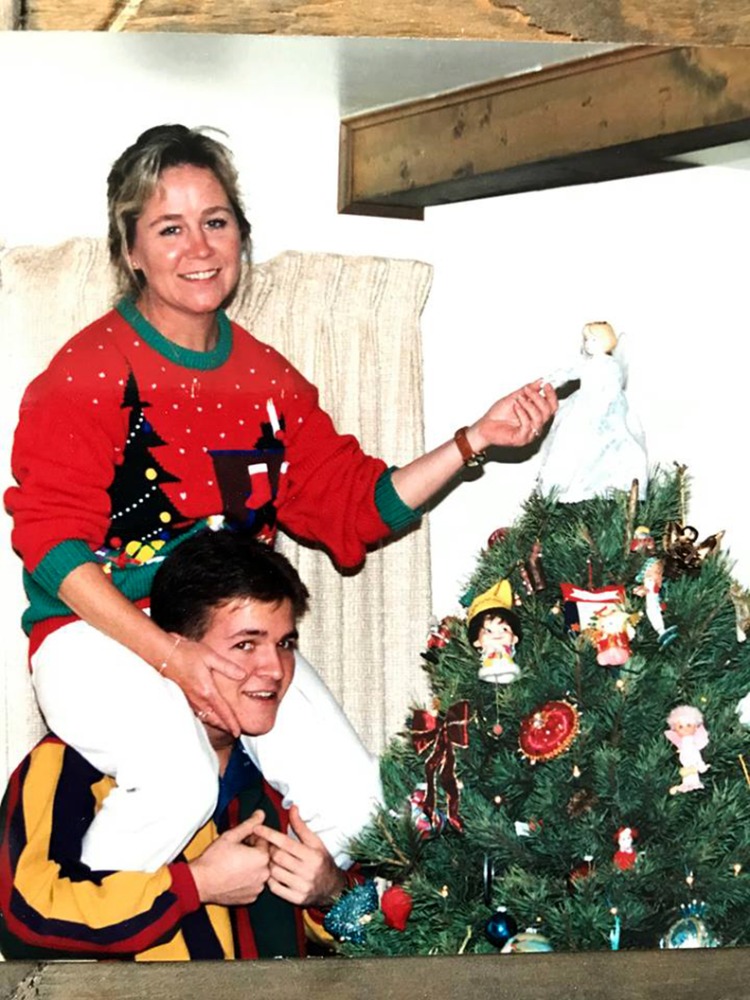
Molly and Joey Daley at Christmas in 1988. Courtesy Joey Daley
"That look of confusion, where she’s trying to
process what’s going on, it’s just like a blank stare and that gets
worse over time," her son, Joey Daley, told NBC News. "It’s like, just a
little bit, dementia has taken a little bit more of her away."
Molly, 66, was diagnosed in 2015, and Daley
found himself yearning for more information from other caregivers like
him about what to expect as the disease worsened.
When he found resources lacking, he decided to
put the spotlight on Molly and their own family’s struggle — reaching
the hearts of millions who have watched the videos around the world in
the process.
“Before these videos, you couldn’t explain it to people,” Daley
said, adding that he couldn’t watch his mother deteriorating without
giving the ordeal some purpose.
Now, after the ongoing series sprouted a grassroots network of caregivers and supporters called Molly’s Movement, Daley, 46, said the videos have been the most rewarding thing he’s ever done.
"I had no idea it would touch that many people," he said.
Dementia with Lewy bodies is the second most
common form of the disease in older adults after Alzheimer’s, affecting
more than 1.4 million Americans. Abnormal clumps of a protein building
up in brain cells cause the disease, which is characterized by a gradual
loss of cognitive functions.
Patients experience visual hallucinations,
REM disorders that cause them to physically act out dreams, and tremors
like those in Parkinson’s disease. But unlike Parkinson’s, Lewy body
dementia affects wider swaths of the brain, interfering with a person’s
everyday life and their ability to carry out typical activities or solve
problems.
About three years ago, basic tasks like paying bills, driving a car
or taking medication became challenges for Molly, who at the time was
living alone in Columbus, Ohio. Then, after an infection landed her in
the hospital, her children stepped in. She now lives closer to her
family in a nursing home in nearby Dublin, where her son and daughter
visit on alternate days, taking her out for shopping trips, the
occasional pedicure or haircut, and family dinners.
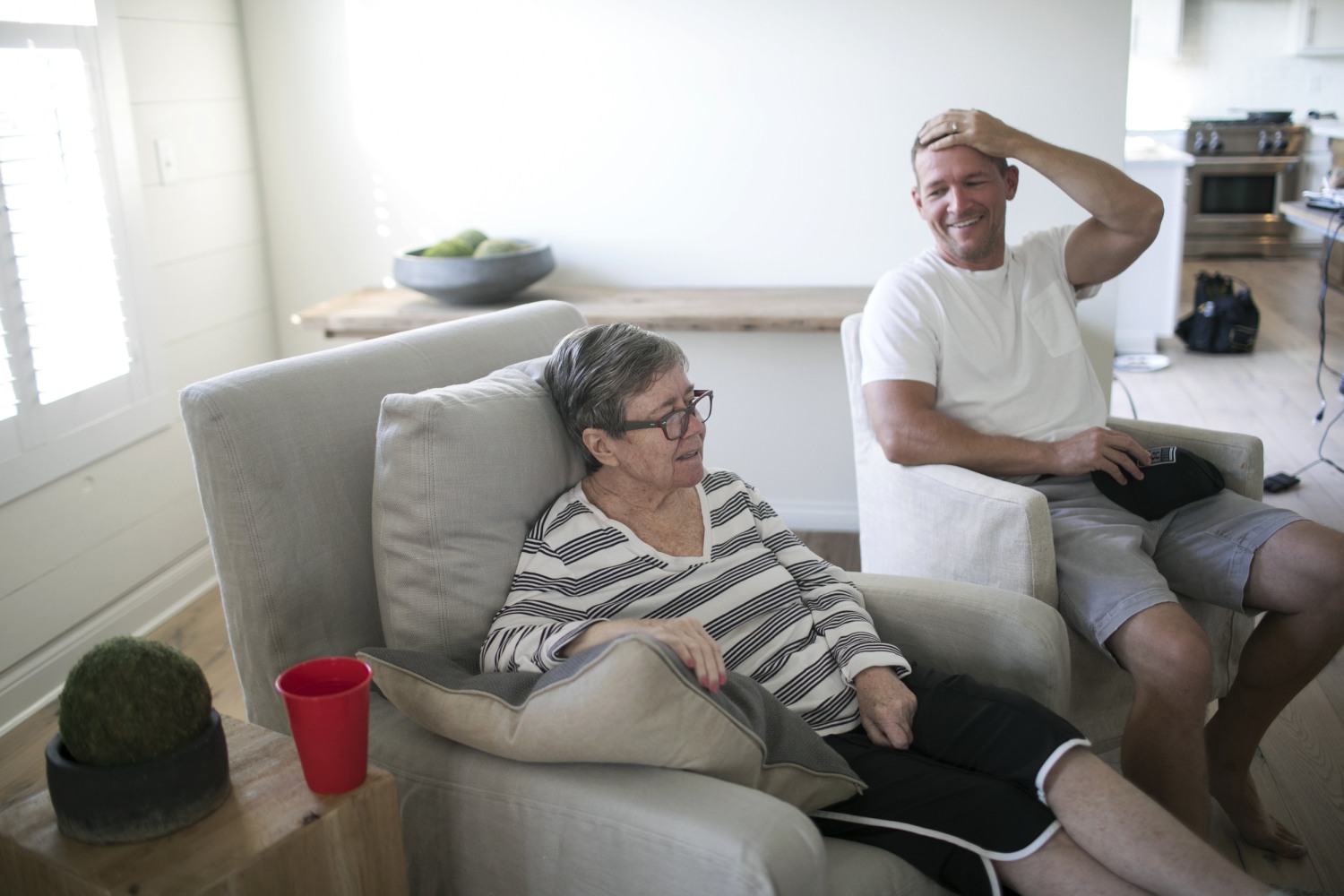
Daley sits with his mother at his home in Dublin, Ohio. Maddie McGarvey / for NBC News
Daley never knows what state of mind his mom
will be in on each visit. Sometimes she’ll welcome him with a smile and
small talk. Then there was the time he watched her using one toothbrush
to brush another, having seemingly forgotten how to brush her teeth. Or
the time she kept asking if the shower was a way out of the room.
But most often, he’ll find her crying,
distraught and shaken up by a bad dream she is convinced actually
occurred in real life, as she struggles to find the words to explain
what she thinks is wrong.
"Dementia’s like an onion. You peel off the layers of the memory on
the outer layers until you get to the core, where you’re just a child
again," Daley said. "It’s suffering to death."
There is currently no way to prevent dementia or
stop its advance. There is no "cure." And the only way to even get a
definite diagnosis is through autopsy after a patient's death.
About one-third of all Medicare beneficiaries
who die in a given year have been diagnosed with Alzheimer’s or another
form of dementia, according to 2014 Medicare claims data analyzed by the Alzheimer’s Association. And data from the Lewy Body Dementia Association suggest that the disease may account for up to 25 percent of cases of dementia.
"[Lewy body dementia] is probably the most
common disease you’ve never heard of," said Dr. James Galvin, an expert
in cognitive health, memory loss, Alzheimer’s disease, Lewy body
dementia, and related disorders.
Galvin said the disease is poorly understood and
under-studied in comparison to Alzheimer’s, which is due in part to the
difficulty in pinning down a diagnosis. A survey from the Lewy Body
Dementia Association shows that on average, it took physicians four
office visits to make the diagnosis. This lack of knowledge can isolate
caregivers further.
To help combat that, Daley created a Facebook group
that now has more than 31,000 members, many of whom are caregivers for
people with dementia. They use the platform to share stories, seek
advice and give out words of encouragement.
Daley helps his mother at his home in Dublin, Ohio. Maddie McGarvey / for NBC News
Periodically, Daley, who is an entrepreneur and
works from home, uses the money earned from Molly’s Movement t-shirt
sales or donations to organize giveaways for caregivers in the group.
The prize is a relaxing night out or, in the case of a 16-year-old girl
caring for her grandmother, a shopping trip.
"[The giveaway] is the type of thing my mom
would do," he said, adding that he gets about 100 messages every day
from people pouring their heart out to him or thanking him for his
eye-opening videos.
Any type of support that reduces the feeling of
isolation is essential, as caregivers can often forego their own needs
when helping dementia patients.
“A caregiver is the invisible patient,” said Dr. Galvin.
But Daley, like many others, shrugs off concern
for his own well-being. As his movement grows, so do the demands on his
time. The married father of three said he will have to do "more work
when everyone’s asleep."
His mother, who was a single parent of two while
working two jobs as he was growing up, is his inspiration. One video at
a time, he is building her legacy.
As his mother’s dementia gets worse, Daley
wonders how much longer he’ll be able to keep recording, especially once
she becomes unable to speak. He acknowledges that it will be a delicate
balance, something he never got to discuss with her before beginning
the series.
"I don’t want to stop early," he said. "I want people to understand how bad it gets."
Daley said the most exhausting part is going
over what he recorded at the end of each day, reliving painful moments
like the time she forgot he was her son — an event he thought would come
much later, perhaps at the end.
But for the many heartbreaking moments, there
are still the rare ones when the old Molly shines through, like when she
was asked whether she is proud of her son.
"If there wasn’t a Joey, there wouldn’t be me," she answered.
When you think back on the life of the late Robin Williams, you may remember him as being a brilliant comic, versatile actor, and generous humanitarian. You probably wouldn’t think of Williams, who tragically died at the age of 63 from an apparent suicide, as a dementia sufferer. Williams was struggling with a neurological condition known as Lewy body dementia (LBD), also called dementia with Lewy bodies (DLB), according to a coroner’s report.
As we age, dementia can cast a dark shadow on our lives. The reality is that dementia will somehow touch us all: You’ve probably met someone with dementia or have a family member who may be a dementia sufferer. A loved one may start having difficulty with short-term memory, losing things, forgetting to pay bills, refusing to bathe, forgetting to eat, getting easily agitated or confused, or developing faulty perceptions, all of which are common signs of dementia.
First, let’s describe dementia, and then take a look at LBD.
What Is Dementia?
Dementia is not a specific disease. Rather, dementia is “the name for a group of symptoms caused by disorders that affect the brain,” says the National Institutes of Health (NIH). Various diseases, infections, strokes, head injuries, drugs, and nutritional deficiencies are frequently cited as primary causes of dementia.
Alzheimer’s disease accounts for 60 to 80 percent of dementia cases. Vascular dementia is commonly thought of as the second most frequent type of dementia, followed by LBD. As a degenerative disease, dementia in most of its forms is irreversible, although prescription drugs on the market can slow its progression or minimize its symptoms.
What Is Lewy Body Dementia?
As a general term, LBD can be divided into two related forms: Parkinson’s disease dementia and dementia with Lewy bodies. Whereas early symptoms of these two conditions differ, the fundamental brain changes are the same. “Over time, people with both diagnoses will develop very similar cognitive, physical, sleep, and behavioral symptoms,” says the Lewy Body Dementia Association (LBDA).
Lewy bodies are abnormal deposits or clumps of protein that develop inside neurons (nerve cells) in specific regions of the brain. When deposits build up, they damage and eventually destroy brain cells, which can lead to problems with thinking, movement, behavior, and mood.
As with other types of dementia, no conclusive laboratory test for LBD exists. Currently a clinical diagnosis of LBD is made chiefly through a full dementia evaluation. Only a brain autopsy can confirm a diagnosis of LBD.
Robin Williams’ autopsy report showed the presence of diffuse Lewy body disease. An ABC News article stated: “Robin Williams had a common but difficult to diagnose condition known as Lewy Body Dementia and this may have contributed to his decision to commit suicide last August [2014], according to documents included in his autopsy report.”
What Are the Symptoms of Lewy Body Dementia?
LBD is characterized by a progressive decline in a person’s mental abilities. Mayo Clinic provides a comprehensive list of signs and symptoms of LBD, including visual hallucinations; cognitive issues, such as problems with confusion, alertness, thinking, and memory; movement problems, such as slowed movement, tremors, a shuffling walk, or falls; and depression, anxiety, and apathy.
In an ABC News interview, Susan Williams, Robin Williams’ widow, spoke movingly about her husband’s struggle with the devastating symptoms of LBD. Susan also talked about the difficulty and slowness in getting an accurate diagnosis of the disease. “Lewy body dementia is what killed Robin,” she said in the interview. “It’s what took his life, and that’s what I spent the last year trying to get to the bottom of, what took my husband’s life.”
What Are the Risk Factors for Lewy Body Dementia?
Known risk factors for LBD are gender (male) and advanced age, while a potential risk factor is a family history of dementia.
Research studies provide fresh insights into risk factors for LBD. In one study, researchers found that the interaction between genes and environmental factors may increase susceptibility to developing Lewy body pathology. Also, a case-control study concluded that depression and low caffeine intake may increase a person’s risk of developing dementia with Lewy bodies, among other factors.
Why Is It Important to Learn About Lewy Body Dementia?
As we’ve discovered, LBD is a common neurological condition, often misunderstood and misdiagnosed. LBD can have a significant impact not only on people with LBD but also on family members and caregivers, who often shoulder the burden of caring for LBD sufferers.
“It affects your core, it affects who you are as a person. In the case of DLB and some of these other related disorders it tends to a great extent [to] affect the frontal lobe, which is really what makes us human. It’s really unbelievably devastating.”
You can learn more about Lewy body dementia by visiting the Lewy Body Dementia Association (LBDA), the National Institute on Aging (NIA), and the Alzheimer’s Association.