Showing posts with label caregivers. Show all posts

Friday, July 10, 2026

PPL agrees to pay $162M to caregivers in historic NY class action settlement

by Liza Berger


A total of 200,000  personal assistants in New York’s beleaguered Consumer-Directed Personal Assistance Program (CDPAP) scored a major victory last week after a federal judge approved a proposed $162 million wage-and-hour class action settlement in the case involving Public Partnerships LLC (PPL), the controversial fiscal intermediary installed to oversee the program in 2025.

Under the terms of the settlement — believed to be the largest wage-and-hour class action settlement in New York to date and one of the largest nationally — each personal assistant will receive an average of $680 — more than a full week’s pay. Some 50,000 people will receive between $1,000 and $1,800 from the settlement. Also as part of the agreement, PPL agreed to end a health plan that failed to provide adequate coverage and was unnecessarily costly for workers, attorneys Michael Diller, of The Legal Aid Society, and Hugh Baran, of Katz Banks Kumin LLP, who represented the plaintiffs, told McKnight’s Home Care Daily Pulse on Wednesday.

“We’re just very proud of the overall results and, most importantly, just thrilled that personal assistants who provide such important work caring for some of the most vulnerable disabled and elderly New Yorkers across our state are going to be receiving a really significant benefit from the settlement once it’s approved,” Baran said.

In the case, Calderon v. Public Partnerships, LLC, the plaintiffs alleged that personal workers were not being paid on time when PPL began overseeing the program in 2025.

“One of our plaintiffs who helped us bring the case, Philip Calderon, for example, he didn’t receive any paycheck until around five weeks into the transition class,” Diller said.

Lawyers also brought claims under the New York Home Care Worker Wage Parity Law, which requires that home care workers receive both slightly higher cash minimum wage and a supplemental compensation component, which can be paid in either cash or benefits. PPL chose to fulfill the benefit supplement with a health plan.

“We alleged first that that plan provided little or no value to the personal assistants because it only covered the most basic of preventive healthcare and didn’t provide any coverage for things like illness or injury or hospitalization,” Diller said. “And then we also alleged that PPL was essentially overcharging personal assistants for that plan because it was allocating around 40 cents per hour compensation to that plan, which was a self-funded plan and we alleged cost PPL much less to actually provide.”

The class represented by the suit includes downstate personal assistants in New York City, and Westchester, Nassau and Suffolk counties — where the Wage Parity Law applies. A separate class-action suit is pending in other areas of the state.

PPL has been under fire since the state of New York chose it to replace hundreds of fiscal intermediaries overseeing the program. The federal government recently filed a lawsuit against the state, alleging that its process for choosing PPL was corrupt. Under CDPAP, a Medicaid program, older adults and people with disabilities can choose their own caregivers to administer care in their homes. 

Full Article & Source:
PPL agrees to pay $162M to caregivers in historic NY class action settlement 

Thursday, January 19, 2023

These photos show a dramatic role reversal millions of people have experienced


Photographs by Anna Rathkopf and Jordan Rathkopf
Story by Deblina Chakraborty, CNN
Published January 13, 2023

It was a small gesture — holding her mother’s hand — that opened photographer Anna Rathkopf’s eyes to the uncomfortable way in which her world was shifting.

The two women were at NYU Langone Hospital in Brooklyn, New York, where Rathkopf’s mom, Helena Světlá, was receiving treatment in 2021 after a stroke and subsequent colon cancer diagnosis days later.

Rathkopf had already taken charge, packing clothes for her mom and handling the medical paperwork. She spoke for Světlá as well: Both women are from the Czech Republic, and Rathkopf’s mother, who is now 69, does not speak much English. But when their hands were touching, Rathkopf realized how much her mom, and their relationship, had truly changed.

Holding her mother’s hands in the hospital reminded her of her grandfather, Rathkopf said. “Their hands are so similar, hands that had years of use in them from creating things with their hands.”

“Her hands actually started to remind me of my grandfather's hands. That was her father, with the veins and everything,” said Rathkopf, 43. “And I'm realizing that my mom is my grandfather, for me … that we are moving in the roles. And Jesse (Rathkopf’s son) is me. It's really weird in that way that you realize, OK, now I'm my mom. I'm the mom.”

She captured the moment as part of a deeply personal photo series documenting Světlá’s journey through surgery, treatment, and the ups and downs that followed. Taking pictures was a way to cope with the hard truths of their new reality, Rathkopf said, including finding herself in a caregiver role she wasn’t entirely sure she wanted.

“It's really hard to see your parents aging. It's not fun, because they're not supposed to age. They're supposed to be here for us,” she said. “Mom will cook for me, right? I'm not supposed to be the one that's supposed to do the dinners for everybody. … It sounds selfish and egotistical. But I guess that's how we are as kids.”
 
Rathkopf, right, prepares a meal in the kitchen with her mother, Světlá, and son, Jesse Rathkopf.

The number of people in Rathkopf’s position has been growing — about 53 million adults in the United States were unpaid family caregivers in 2020, up from 43.5 million in 2015, according to a report by the National Alliance for Caregiving and AARP. Around half of those were caring for a parental figure, said Scott Beach, a social psychologist at the University of Pittsburgh.

“A lot of folks don't really think it's going to touch them,” said Beach, director of the survey research program at the school’s University Center for Social and Urban Research. “All of us at some point are either going to need care or maybe help provide care or something.”

Rathkopf, who received a shocking diagnosis of her own in December 2016, has been on both sides of that dynamic.
/
“I rested often in bed with Jesse while going through chemotherapy treatments,” said Rathkopf, shown with her son. “At that time, Jesse started to crawl in the bed whenever I was laying down, and it was our time together. I noticed that he still does it whenever I don’t feel well.”

Light in the dark
 
Learning she had breast cancer fell on Rathkopf like a huge weight; it was also a catalyst. Her hopes of having a second child began to fade as she worried about how long she would be around to raise her first, Jesse, who was 2 at the time. The situation gave her the nudge she needed to leave her steady job and join her husband, Jordan Rathkopf, in doing freelance photography full time.

Their commercial work spans industries — including law, education and health care — but Anna Rathkopf said everything they do revolves around emotions and connecting with people.

“The emotions have to be there. And the feeling of realness,” she said. “Even if you do it with lights, even if you do a really big production … we’re always focused on the emotions between the subjects. And I think that's what pulls people in.” 

Světlá rests her hand on Rathkopf’s forehead during chemotherapy in 2017.

Rathkopf waits in a hospital bed for a lumpectomy to remove a breast cancer tumor in 2017.

That approach, of course, took on a different tenor when the photographers became their own subjects and a loved one’s health was the focus. Emotions — sadness, fear, love, anger — were abundant. But the scenes, shot by both Jordan and Anna, were also far from Instagram-perfect: They included hospital rooms and doctor’s offices, post-surgery pics and close-ups of an allergic reaction.

The moments captured were some of the toughest, both mentally and physically, of Rathkopf’s life so far. Rather than an intrusion, the camera at those times could be a welcome distraction for the family, another way of caring for one another. Often just the click of the shutter could lighten the mood, interrupting tears and bitter “Why me?” inner monologues, dragging them back to the present.

“In certain moments, (Jordan) would pull out the camera, and I would be crying, but it always made me laugh,” Rathkopf said. “And he also used it as kind of pulling me out of really dark moments. Because he would (joke) like, ‘Oh, you should cry more. This doesn't look big enough.’”

“I was looking at (my husband) Jordan after a moment of reflection on my cancer journey and very angry about everything I was going through and what (lay) ahead,” Rathkopf said, looking back at this 2017 photo. “I still struggle with this anger.”

Levity continued to be a lifeline when, not long after Rathkopf started feeling better, her mom fell ill. Světlá had been living with the family since Jesse was born and provided essential support — cooking, cleaning and taking care of her grandson — during Rathkopf’s illness. As they dived into navigating yet another treatment plan, visits to the doctor and hospital stays, taking the camera along was “like muscle memory,” Rathkopf said.

“She would start telling me ‘Oh, no, I can't believe you're taking pictures right now. I'm in the hospital,’” Rathkopf recalled. Ultimately, though, Světlá allowed a surprising level of access.

“I knew you let yourself be photographed, too, so I didn’t mind,” said Světlá, addressing Rathkopf in a video interview in which they were both present. CNN has translated Světlá’s responses from Czech.

Světlá showers in the hospital while recovering from a stroke in 2021. “My mom always spent a lot of time in the shower,” Rathkopf said. “She loves the water. It calms her mind.”

Family history
 
Even the bathroom wasn’t off-limits. Rathkopf’s uncle Pavel Hečko is a well-known Czech photographer, so her mom, who is a painter, was used to being in front of the lens. And her health problems left little headspace for other concerns. “I was so wrapped up in myself, I didn’t notice (being photographed),” Světlá said.

Still, Světlá laughed in disbelief when Rathkopf brought her camera into the hospital shower one day. Rathkopf said it was a strange moment for her, too, seeing her mom so vulnerable.

"I had to help her from the bed to walk to the shower. And like, basically help her taking off her clothing. I never did that before," Rathkopf recalled. "All these feelings are so weird. Because nobody prepares you for that."

Other images of Světlá — showing her slumped in the car or at a table with her head down — illustrate both the exhausting nature of the treatment process and the tension that often goes with the role reversal the women experienced.

Světlá and her grandson, Jesse, rest while on a trip to upstate New York. In these moments, Rathkopf said she sometimes felt the burden of being a caretaker for two people: her mother and her son.

That changing of places, and the awkwardness, frustration and loss that can accompany it, is apparent throughout the series. In a photo from 2017, Rathkopf lies in bed while her mom rests a hand on her head; in a later shot, her mom sits pensively on a bed after arguing with Rathkopf over whether Světlá was following doctors’ advice during her recovery.

“The dynamic is different because she's your mom,” Rathkopf said. “For me, I guess it's easier to receive help, because I'm the daughter, and I'm used to being held by that person. But she is not used to being held by me.”

Světlá recalls the anger during that fight, saying that being told what she could or could not do made her feel “completely incompetent.”

After being released from the hospital, Světlá struggled with extreme fatigue, a common symptom for stroke survivors.
In 2017, Rathkopf rests while experiencing exhaustion after her chemotherapy treatment.

“When our roles flipped, and suddenly (my daughter) started to take care of me, I was uncomfortable. I didn’t want to admit that I was sick,” Světlá said.

A few photos also highlight the parallels between the women’s journeys.

“You tend to compare, subconsciously, what happened to you to what's happening to the person that you love,” Rathkopf said. “That was interesting to see how actually the experience is universal.”

That shared experience is ultimately what Rathkopf comes back to when discussing her relationship with her mom — and how she wants to move forward.

Světlá enjoys a summer night in Brooklyn, New York, in 2018.

Sandwich generation
 
Before getting sick, Světlá — whom Rathkopf describes as “bohemian” — loved riding her scooter around with Jesse in tow; neighbors recognized her fire-red hair as the duo zoomed around Brooklyn. While both women are in cancer remission now, Světlá’s continuing stroke-related issues led Rathkopf to insist on an end to the scootering, resulting in another blowup. But time has, again, shifted her point of view.

Now, particularly when she looks back at photos of her mother’s illness, Rathkopf said the anger dissipates and all that’s left is empathy.

“Suddenly, she's being hit with this crazy feeling of her body betraying (her), and I knew that feeling,” Rathkopf said. “I’m more in the acceptance (phase) and trying not to be too forceful.”

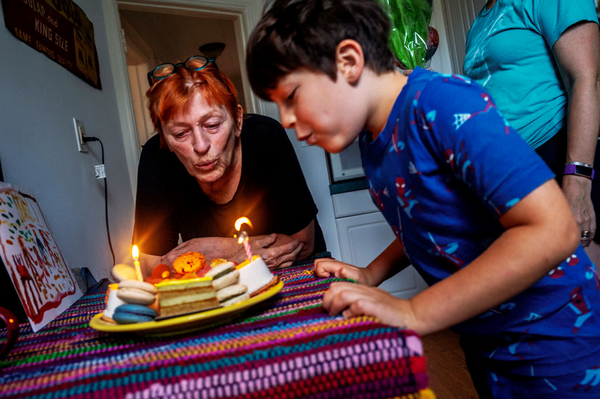
Světlá and her grandson, Jesse, blow out a candle on her 68th birthday.

Distance has helped provide a little relief for mother and daughter as well. Světlá traveled to the Czech Republic to visit family last summer and started having some back issues while there, but she plans to return to the US when she feels well enough to travel.

“I think this has passed now,” Světlá said, referring to the tension with her daughter.

Reflecting on past dynamics with her own mother, Světlá added, “Coming back to Prague helped a lot. If I didn’t have a place to go to, it would have been a lot worse. I also finally understood my own mom’s feelings, because when I was taking care of her, I too treated her like a child. The distance gave (my daughter and me) a good perspective. My mum wasn’t able to run away.”

The University of Pittsburgh’s Beach has studied sandwich generation caregivers — people such as Rathkopf who support both older family members and children — and said the tactic of stepping away, when a person is able, can be key to coping.

“That notion of respite, taking a break, just comes up constantly, because people feel like they're always on call,” he said.

"This was one of the moments, nearly nine months after her stroke, when my mom started to seem more like herself pre-stroke,” Rathkopf said. “Her energy, mobility and sense of joy were improving.”

In spite of the pain and strife, Rathkopf finds a lot of joy among her images as well. Photos that include Jesse and highlight the connective tissue between all the members of her household often spark that feeling.

“Even when the emotions are really raw, everybody feels like, OK, but we have this little guy,” she said.

But some less obvious moments stand out, too — including one when Rathkopf knew Světlá wanted to “be back”: After a particularly rough period in the hospital, Světlá asked for her signature red lipstick. Rathkopf’s image after its application reveals smiles on both mother and daughter, inching closer to the versions of themselves they once knew.

Full Article & Source:
These photos show a dramatic role reversal millions of people have experienced

Sunday, August 8, 2021

2 assisted living caregivers charged after abandoning resident on roadside, stealing identify

by Kimberly Bonvissuto

Two senior living caregivers have been charged with abuse and exploitation for allegedly stealing a resident’s identity and debit card and then abandoning the resident on the side of the road on a “particularly hot day” in 2019.

Florida Attorney General Ashley Moody announced the arrests and charges this week following an investigation by the state Medicaid Fraud Control Unit. According to Moody, Tavetta Lavetta Jones and Tekera Levine, employees of Whispering Pines Assisted Living in Pensacola, FL, were supposed to transfer the resident to sign bond paperwork. Instead, they are accused of abandoning the resident on the side of the road on Sept. 3, 2019, and stealing the resident’s identification and debit cards.

Kevin Wheatley, owner of Whispering Pines, said he is in “scramble mode” to keep his facility “running safely and smoothly,” adding that he only learned about the incident recently from the local news.

“There is a certain amount of trust you have to put in your staff,” Wheatley told McKnight’s Senior Living. “If that trust is broken, it’s obviously heartbreaking.”

Wheatley said Jones is no longer employed by the community and Levine, “who has a stellar reputation in the caretaking community,” is on administrative leave “until we can figure out what happened.” He said Levine maintains that she was not involved in the incident. 

Jones is charged with exploitation of an elderly person or disabled adult and criminal use of personal identification information. She faces up to 35 years in prison. Levine, a Whispering Pines manager, faces a charge of accessory after the fact and up to five years in prison. Both were arrested last weekend by the Escambia County Sheriff’s Office and released on a $5,000 bond each.

According to the attorney general, the resident identified Jones and Levine as the employees who orchestrated the scheme. The resident also identified a black Volkswagen as the vehicle that Jones was driving the day the resident was abandoned on the side of the road.

Levine “gave varying accounts” about the incident and Jones’ involvement. Phone records placed both employees in the county where the resident was abandoned near the time that law enforcement responded to a 911 call from people who found the older adult on the side of the road. Phone records also placed Jones in the vicinity of ATMs where the victim’s debit card and personal identification number were used to access a bank account in August and September 2019.

Full Article & Source:

Tuesday, February 16, 2021

Duties of a Guardian for the Elderly

Duties of a Guardian for the Elderly
 
Video Clip: Click to Watch

CONTACT: Pamela D. Wilson 303-810-1816

Email:   Inquiry_For_Pamela@pameladwilson.com

Golden, Colorado – February 13, 2021

The Caring Generation®

Golden CO- Caregiving expert Pamela D. Wilson hosts The Caring Generation® podcast show for caregivers and aging adults. This coming Wednesday, February 17, 2021, the topic is The Scary Truth About Guardianship and The Responsibilities of a Guardian for the Elderly.

During this podcast, Wilson shares experiences from her years as a guardian for the elderly and disabled so that adult children can avoid surprising situations. Wanting to do the right thing for an elderly parent can be a joyful experience when families get along. Challenging guardianship situations result when children disagree, or a history of potential abuse—financial or emotional—exists within a family.

The Scary Truth About Guardianship

Adult children who become a court-appointed guardian for an elderly parent may underestimate the seriousness and extent of their accepted responsibilities. Siblings may dislike the brother or sister appointed guardian because of disagreements about care for elderly parents or perceived favoritism. Brothers and sisters who hold grudges can make the life of the appointed guardian extremely difficult.

It's easy to empathize with friendships or work relationships that go bad when one person poisons a relationship that can't be repaired. Family relationships can be fractured when siblings misrepresent information to an elderly parent with dementia who cannot discern lies from the truth. In these situations, being the guardian for a parent can feel like a thankless responsibility.

The Responsibilities of a Guardian for the Elderly

The responsibilities of a guardian for the elderly include navigating difficult situations that may include:

  • Managing or supervising in-home care that brothers or sisters attempt to sabotage because they don't believe that mom or dad needs help
  • Moving a parent to a care community against their wishes and having the care staff side with your parent who believes that you are the evil guardian—that your brothers and sisters claim you to be
  • Advocating for care with the healthcare system who are uneducated or biased against care for the elderly diagnosed with dementia or Alzheimer's disease
  • Searching for a geriatric psychiatrist or a geriatrician willing to prescribe medications for behaviors—instead of telling you that there are too many side effects or warnings because they are worried about liability
  • Paying for mom and dad's care instead of saving their estate for the inheritance that your brother or sister expects to receive
  • Negotiating with nursing home staff who change your parent's medications without asking you and then call to report health emergencies resulting from discontinued medications

The emotional aspects of caring for elderly parents and navigating relationships with family members and care providers can overshadow the good work that a family guardian does for a parent. In this podcast, Wilson shares tips and recommendations for family guardians that offer hope for managing difficult family or care situations.

Wilson releases a new podcast in The Caring Generation series every Wednesday, sharing conversations about aging, caregiving, and family relationships. The podcasts are available on Wilson's website and all major podcast sites. More about Wilson's online courses for elderly care: How to Get Guardianship of a Parent and Taking Care of Elderly Parents, caregiver support, webinars, and speaking engagements is on her website www.pameladwilson.com. Pamela may also be contacted at 303-810-1816 or through the Contact Me page on her website.

 #

Check Out Podcast Replays of The Caring Generation® Radio Program for Caregivers and Aging Adults HERE

Pamela D. Wilson, MS, BS/BA, CG, CSA is a national caregiving expert, advocate, and speaker.  More than 20 years of experience as a direct service provider in the roles of a court-appointed guardian, power of attorney, and care manager led to programs supporting family caregivers and aging adults who want to be proactive about health, well-being, and caregiving. Wilson provides online and on-site education for consumer groups and corporations. She may be reached at 303-810-1816 or through her website.

Full Article & Source:

Duties of a Guardian for the Elderly

Tuesday, October 6, 2020

‘It Is Abuse:’ Indiana Caregivers Say Nursing Home Visitation Policies Don’t Put Residents First

By Brock E.W. Turner

Trilogy Health Services did not comment on what happened at its Delphi facility. The company cited privacy concerns. (Brock E.W. Turner, WFIU/WTIU News)

Trilogy Health Services did not comment on what happened at its Delphi facility. The company cited privacy concerns. (Brock E.W. Turner, WFIU/WTIU News)

For months, thousands of residents in Indiana nursing homes have been isolated. What began as an early-pandemic protection is now eroding their quality of life. 

Despite forming an essential and compassionate caregiver program, the Indiana State Department of Health (ISDH) has deferred much of the oversight and management to facilities themselves. Caregivers are caught in the middle and often left powerless.

Vickie Ayres fights back tears as she remembers her mother, Carolyn, who died just last month after a stay in at St. Elizabeth Healthcare Campus in Delphi.

“She loved to travel and eat out and we would take her out several times a week for outings, and when they locked down that was over,” Ayres said. “They wouldn’t even take them out in the facility bus for a drive around or anything. They took everybody and made their worlds that were small, even smaller.” 

Allegations Of Mistreatment At An Indiana Nursing Home

St. Elizabeth Healthcare Campus is owned by one of the Midwest’s largest nursing home operators—Trilogy Health Services. When the pandemic began, Ayres says she considered moving her mother out of the facility and to her home, but she was concerned because there wasn’t an accessible bathroom in her farmhouse. 

“I didn’t feel like I was set-up properly in my home to be able to have her here,” Ayres admits. “Six months later, knowing what I know, do I wish I had done that? Yes.”

Ayres's mother, Carolyn, emjoyed travel, eating out and attending worship services at her church. (Photo Provided)

The place where her mom’s bathroom would have been is still unfinished down the hall from her home office. Contractors have been hard to find, she said.

But Ayres believes caregivers shouldn’t have to make that decision—seeing a loved one or leaving them in a place where extra care can be provided.

The situation quickly spiraled. Ayres says staff at St. Elizabeth Healthcare kept her mom isolated in the facility’s COVID-19 wing for weeks—even after she tested negative. 

The company—which is one of the largest nursing home operators in the Midwest declined an interview, and refused comment on the facility’s polices in a provided statement.

“Out of respect for the privacy of our residents and their families, we cannot comment on specific details regarding those in our care,” the company wrote.

According to Ayres, it gets worse, she says her mother and other residents went months without receiving proper showers.  She alleges staff restricted visits—even window visits—from her and other caregivers because “they were too dangerous.”

 
Ayres says she made the decision to move her mom due to the lack of visitation and her declining health.  She would eventually test positive for COVID-19 leading Ayres believe her initial test was a false positive. 

The facility’s owner, Trilogy, wrote it will, “continue to work closely with the ISDH, pursue transparency, provide quality care, and put our residents and their families first, just as we always have.”

Carolyn died on August 26 at the age of 81 due to complications of COVID-19.

Guidence Shifts Power To Facilities Instead Of Caregivers

Andrea Smothers is the ombudsman who serves the area, she says nursing homes across Indiana have been forced to interpret vague guidance and that’s leading to significant visitation variation. 

“The guidance that they were given pretty much from our perspective as advocates gave a lot of control to those facilities on how or when, or under what circumstances they would allow visitors,” she said.

That visitation guidance from the Indiana State Department of Health (ISDH) was updated to reflect the latest federal recommendations from the Centers for Medicare & Medicaid Services.  It outlines clearer procedures, but sets a high bar for indoor visitation.

For example, a facility is not recommended to resume visitation unless it has had no new cases for 14 days, its county positivity rate remains low, and residents are notified.

Yet, multiple ombudsmen—who serve as advocates for caregivers and their loved ones—say facilities are doing a poor job communicating these visitation policies and updating caregivers on changes. 

Those changes and that lack of communication, I think build the distrust by the caregivers,” she said.

However, a state program designed to increase access to facilities is plagued with problems of its own.

senior center bus
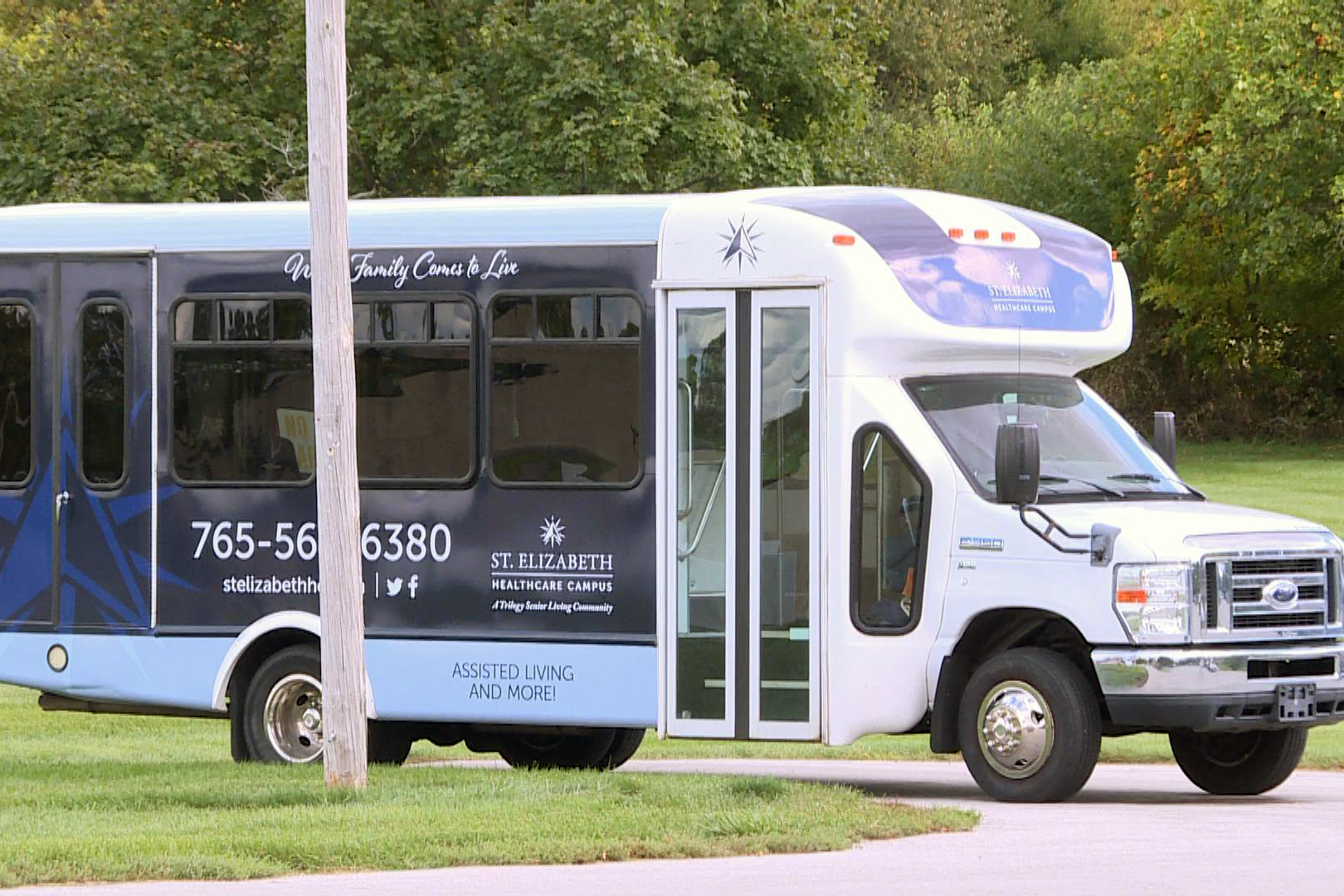
The bus at St. Elizabeth Healthcare Campus was parked earlier this week. Caregivers and advocates say the facility has denied window vistation. (Brock E.W. Turner, WFIU/WTIU News)

 Instead of creating uniform visitation protocols, Indiana’s essential and compassionate caregiver program has produced a patchwork of guidance that experts and caregivers say is poorly communicated, while also giving facilities too much discretion.

The department declined an interview, but provided a statement saying, in part, “Recognizing the importance of this [essential caregiver] role, we have encouraged this in facilities.”

 Experts say the difference between “encouraging” and requiring is important. Under the current language, ISDH effectively lacks enforcement or oversight.

“Applications are not required to be submitted to the state Department of Health, so we do not have any data on the number of applications accepted or denied,” the department wrote.

During the state’s weekly COVID-19 briefing, Dr. Lindsay Weaver, Chief Medical Officer for ISDH, said caregivers can still file a complaint with ISDH if they feel a facility has wrongly denied their application or isn’t meeting visitation requirements.

“Our infection preventionists work very closely with the long-term care associations we have biweekly phone calls work with them to really work through what does visitation look like and how we can do it safety,” she said the department works with facilities and trade groups to determine what is feasible.

“Of course, we always take family complaints or concerns and we’ll follow up on those,” Weaver said.

However, that process also favors facilities according Smothers.

“When I filed complaints on behalf of residents and their families who couldn’t get in, as an essential family caregiver, I got a very length, nice email from the surveyor saying, well, it’s up the facility, and there’s nothing more I can do.”

Misaligned Priorities

Families with loved ones in long-term care facilities know their time is limited. They’re tired how it is, and many don’t have the resources or time to file complaints with facilities or the state.

Nearly everyone interviewed, agrees tightening visitation at the beginning of the pandemic was the right decision, but few see the rationality six months later.

“What we’re doing is wrong,” Ayres said. “And it’s wrong to an extent that I don’t think many people are aware of.”

Smothers agrees.

“How do we justify that?  There may have been no on-on-one interaction that wasn’t supervised,” she said.

Mary Swinford, the Deputy Director of the state’s long-term care ombudsman program understands the initial hesitancy, but believes now is the time to find a solution.

“We do owe it to our seniors, our residents to continue to advocate for them to have these visits. These visits are vital to residents.”

Ayres has a hard time understanding why more people aren’t outraged a policy made out of necessity months ago remains in effect when rapid testing capacity is available for athletes, college students, and other populations.

“It is abuse,” she said. “At this point it is abuse because it is long-term. It isn’t the short-term health crisis solution to the pandemic.”

And that’s why she and others say they’re going to keep advocating for visitation.

“[Facilities and the state] could make it work, and it’s not that they can’t,” she said. “It’s that they won’t.  And that’s wrong,” Ayres said with tears in her eyes. “Even though my journey is over with my mom, I have to speak for those people that are left.”

Full Article & Source:

Friday, October 2, 2020

Caregivers relieved, but cautious about eased restrictions for care facilities

By Lucinda Breeding

Amber Reynolds
For the families of Texans living in nursing homes and long-term care facilities, Gov. Greg Abbott’s decision to lift restrictions on visitation came not a moment too soon.

“Certainly it’s been difficult, regardless of what the level is with your abilities,” said Mike Danks, president of the Denton State Supported Living Center Family Association.

Danks and his wife haven’t seen their adult daughter, whom they preferred not to name publicly, since the first week of March. She has severe autism, and the Danks found the private homes inadequate to care for her. Without proper supervision and a careful medication schedule, their daughter has a tendency to have violent outbursts. The Danks said they found DSSLC a better fit.

Like other Texas families with loved ones in care facilities, the Danks have had to make do with video chats. Their daughter will interact by phone for a short time, and is accustomed to video calls with her grandparents.

“If you’ve got family and you can’t visit them, it’s difficult,” Danks said. “It’s been difficult for us because we haven’t been able to visit her. And it’s difficult because we haven’t been able to see mom and dad, either. I think it’s tough across the board.”

As of Thursday, Abbott’s orders allowed families to designate up to two essential family caregivers to get the necessary training to safely go inside a facility for a scheduled visit. The order allows the designated caregivers to enter the resident’s room.

The order is the first to allow designated caregivers this degree of access “to help ensure their loved one’s physical, social, and emotional needs are being met” since the state-mandated lockdown in March.

Designated caregivers don’t have to practice physical distancing, but only one caregiver can visit a resident at a time.

Angela Biggs made sure she had a negative COVID-19 test, which is required along with personal protection equipment training, so she could see her daughter on Thursday. She wore safety glasses and a mask. She arrived at the center with flowers and cupcakes.

“She definitely knew it was me,” said Biggs, whose daughter, Amber Reynolds, 29, has lived since at the center since 2014. Amber suffered a brain injury at birth and, after years of seeking treatment, was diagnosed with severe mental retardation and severe bipolar disorder with psychosis.

“I used that moment. I looked at Amber and I said ‘Amber, look at me eye-to-eye. I thought about you and prayed for you every day.’ And I made her say ‘day.’ I told her ‘I couldn’t come in, Amber.’”

Biggs said she was careful not to mention the staff, whom she praises and says give her daughter love and care. She didn’t want to risk Amber getting angry at the men and women who have taken care of her throughout seven months of lockdown. In March, the center was hit hard by the coronavirus that causes COVID-19.

Biggs said she was able to give her daughter the flowers — Amber loves yellow, and grinned over the bright, mostly yellow bouquet. The staff had to inspect the cupcakes to comply with pandemic health and safety rules.

Biggs could only stay for an hour and a half. She spent the short time chatting with her daughter, trimming her nails and inspecting her room for clues about how Amber fared without consistent, face-to-face contact with her mother.

“She’s not sleeping in her bed,” Biggs said. “She’s been sleeping on her couch. She’s not keeping warm. I can just tell this has been hard on her.”

Olivia Lilley and her husband, Bryan, have been caring for Bryan’s 88-year-old mother, Marylin, since she was diagnosed with Alzheimer’s Disease years ago. Marilyn lived next door to her son just outside of Aubrey for years — until her disease progressed to the point when round-the-clock supervision was needed.

In 2012, the Lilleys moved Marilyn into Willowbend Assisted Living & Memory Care in Denton. Olivia said her mother is still in the assisted living portion of the facility, where she has her own room. Marilyn’s condition causes her to self-isolate, and her memory seems to last for less than a minute. Lilley said she and her husband visited almost daily before the pandemic. Bryan works for Fox Sports covering the NFL, and when he travels for work Olivia takes over her mother-in-law’s care.

Olivia said her family couldn’t do without the love and care of the staff and director of Willowbend.

“They’re doing absolutely everything they can,” Olivia said. “We know that. Their hands are tied by the governor’s orders. It’s just so frustrating, and back at the end of August Byran and I were at the end or our rope. We were thinking about breaking her out.”

The Lilleys had good reason to be alarmed. Willowbend decided to close its dining room to protect vulnerable residents. The residents suddenly had to stay in their rooms at all times.

Olivia was glad she and her husband had mounted a camera in the living area of her mother’s room. But what she saw was frightening. Marilyn didn’t seem to understand her meals were being brought to the room. She wasn’t eating, and eventually, she was sitting on her floor, playing solitaire from 7 p.m. to 7 a.m. She was losing weight and growing agitated.

“She called my husband and asked, ‘When are you coming to get me?’” Olivia said. “He was so heartbroken. You have to meet people with Alzheimer’s where they are, and he told her ‘I’m coming, mom.’ Then we watched her pack up entire room. She took pictures off the wall. She found the camera and took it down. She did that a few times. She packed up her whole room and waited for him to come pick her up.”

The Lilleys have taken advantage of the gradual easing of restrictions. They’ve done window visits and porch visits.

“Before COVID-19, I’d take her to get her hair done once a week. It was a chance for her to get a really good shampoo, and it was with a hairdresser who loves her and knows how to talk to her. Like, she knows to talk to her and not just ignore her and talk to me,” Olivia said. “I’m sorry to get emotional, but it’s been hard to hear middle aged women talking about needing to get their nails done. My mother-in-law hasn’t had a haircut in seven months. It breaks my husband’s heart to see her looking so unkempt.”

Olivia said her family is trying to decide whether to leave Marilyn in assisted living. With flu season approaching, the Lilleys worry that Marilyn will once again be shut in her room, where she can’t see or hug loved ones.

Caregivers live with competing feelings: They praise the staff and directors of the facilities for doing their best to care for resident and comply with the state. But they and the government can’t satisfy infuriating questions that keep loved ones from the routines they need.

“I just want someone to tell me, how long is a negative test good?” Biggs said. “You do everything in your power to keep your child safe. You can’t do everything.”

Danks said the rules aren’t a guarantee.

“The way I look at it, the negative test is good until I walk out the door of the place you got the test,” Danks said. “But the negative test is a little better than no test at all. There’s no perfect world.”

Olivia said Abbott simply can’t understand what caregivers are going through, and they don’t seem to imagine what the lockdown has done to Texas’ most vulnerable residents.

“What would Gov. Abbott do if he was locked in a room and his wheelchair was taken from him? I want to know,” she said. “Because that’s what our loved ones have been living. Everyone wants to protect this group of people. I totally get that. ‘This is the Greatest Generation,’ they say. ‘They must be protected at all costs.’ But what is the cost? Because this is prison. I’m sorry, but it just is. And what’s going to happen this winter? We can’t do another lockdown with my mother-in-law.”

Full Article & Source: 

Saturday, August 29, 2020

When Alzheimer's Disease came for my husband, I was left like a widow who cannot mourn

By Muriel Porter

At first my husband's Alzheimer's diagnosis just meant taking practical steps.(Illustration: Emma Machan (ABC))
I thought I knew how to grieve, how to say goodbye and move on. Until Alzheimer's Disease caught up with my husband.

Grief marked my life first at the age of five, when a beloved uncle died. But it was my mother's death when I was 13 that broke my heart. Then my father died just weeks before my wedding. I posted out "return thanks" cards for him in the same post I sent out my wedding invitations.

So I have always been confident that I knew how to manage grief and loss. Until now.

At first my husband's Alzheimer's diagnosis six years ago when he was 75, 41 years into our marriage, just meant taking practical steps.

A visit to the lawyer to ensure wills were up to date and get enduring powers of attorney drawn up. Organise guardianship documentation, advanced care directives. Ensure my name was on all the utility accounts. Buy some books to understand this insidious disease. Watch for changes in his health and behaviour.

And hope for the best.

I was watchful, careful, and often anxious. In the main, however, life continued on as normal. We travelled overseas, enjoyed local holidays, entertained friends and were entertained, went to restaurants, to films, and to church, went for long walks as we always had, and continued hosting the family Christmas.

But relentlessly, the disease took its toll. Anything that required sustained intellectual concentration became much harder for Brian. It was the first casualty.

Anything that required sustained intellectual concentration was the first casualty.(Illustration by Emma Machan (ABC))
Patterns of a lifetime started to vanish

Called on to preside at the Eucharist in the sudden absence of our vicar — Brian is an Anglican priest — became very tricky for him, though he was not actually aware of it.

He consecrated the bread and wine twice and mixed up the order of the liturgy. This from a man who had presided at the altar regularly for more than 40 years, sometimes multiple times a week in his main life's work as a school chaplain.

The words remained firmly fixed in his mind, the pattern had left him.

I swiftly stepped in on future occasions, producing a neat little word-for-word service booklet and standing beside him at the altar to guide him through. That continued to work well for quite a while, and most parishioners were quite unaware there was even a problem.

Presiding at weddings was not quite so simple. At weddings missteps cannot really be tolerated, and the priest's wife can't easily oversee the proceeding in the same way. So wedding requests had to be gently discouraged. So too did funeral ministry.

A straightforward funeral for an elderly friend not long after his diagnosis nearly turned into a disaster when he lost the service booklets and became alarmingly confused.

Day-to-day routines at home thankfully remained manageable for quite some time, though increasingly anything out of routine became problematic. Entertaining family or friends gradually had to be abandoned, as Brian became easily stressed by change.

Our walks got shorter and shorter and became a real concern. What if he could no longer make it around the block? Who would I call on to help get him home? Neighbours? Ambulance?

And falls increased, sometimes out of the blue. He seemed to just sink down to the ground. No broken bones or injuries resulted, but the falls distressed him. We ended up driving even very short distances.

I lost a partner and a confidante

Brian's growing incapacity resulted in boredom and frustration for him.

Over his lifetime he had regularly devoured several books a week, but now he became increasingly unable to read anything at depth. Books piled up unread, as did longer newspaper articles. Television programs he had once enjoyed, no longer entertained him. Even long-favourite foods no longer pleased.

My role as carer became more demanding.

I had immediately taken over all the financial management as soon as his diagnosis was made, and increasingly all aspects of household management as well. I had been used to a husband who happily shopped, occasionally cooked, and mostly did the washing up. That had all ended but none of that really concerned me.

I was aware of an enduring sadness at all he was losing, and all I was losing.(Illustration: Emma Machan (ABC))
Much worse was my increasing anxiety, never more so than when I was away from home.

My mobile phone always remained close in case he needed me, or in case the personal alarm I had arranged for him to wear messaged a fall. He remained steadfastly resistant to the idea of occasional carers coming in to give me an anxiety-free outing.

And because of his decreasing powers of judgement, I could no longer confide in him. I had always shared with him issues arising from my own close involvement in church life.

He had always offered wise advice, a sympathetic ear and unquestioning support. That was no longer possible — he could no longer fully understand what I was sharing, and I was fearful he might inappropriately speak to others of confidential matters.

I was disappointed to discover that, apart from the loving support of my daughter and dear friends, there was no significant external support.

Medical help was resolutely in silos — the psychiatrist, the geriatrician, the GP, were all good but were quite independent of each other. There was no overall medical management. And as for trying to access the Federal Government's much-vaunted home help when the situation was deteriorating — that was laughable.

With the rate of Alzheimer's increasing markedly in our society, it is surely time for each diagnosed case to be allocated a social worker or nurse to assist the primary carer navigate the complex systems to get the best outcome all round. It was such a difficult and lonely road.

With my caring role all consuming, there was little time for reflection at any depth. In the background, I was aware though of an enduring sadness — sadness at all he was losing, and all I was losing.

Rapid change as the pandemic bore down

A sudden acute medical episode that pushed the Alzheimer's into a rapid descent brought a huge change. Brian had to be admitted to residential aged care.

Initially there was no time to reflect on what this all meant. The first weeks of his move were overwhelming, as I grappled with the enormous task of not only trying to settle him in his new environment, but also to complete the necessary paperwork and handle the complex financial issues. I was appalled at what was required, and worried sick by the costs involved.

We had thought we were well set up for retirement; we used to delight in the amount of discretionary money we now had at our disposal — something we had never before experienced.

Now, the costs involved in high-quality aged care made a mockery of that. How was I to cope? Would I need to sell our loved family home and downsize? With all these decisions, I was run ragged.

I had no time to reflect on what was happening, and besides, it all happened during the first COVID-19 lockdown. I did not have ready access, except by phone, to financial advisors, or even my friends and colleagues.

I could not even physically go to church, let alone slip into a church building for quiet meditation.

Living without closure

My daughter is my salvation. Though so busy with her own professional life and young family, her support is steadfast, from home-cooked meals to helping manage the nursing home move and the continuing care of Brian once there. Hers is the shoulder I cry on as the continuing management of Brian's complex needs, even in residential care, frequently overwhelms me.

I am now fully aware I am alone after 47 years of married life. The cumulative grief of the past six years has now hit me powerfully. I find myself crying and crying and crying, particularly as I leave the sad nursing home visits, as I walk the paths and visit the places we have always shared.

I am experiencing full-blown grief, the grief of widowhood, yet I am not a widow.

My husband, the man I had married, the man who has shared my life for more than four decades, with whom I have children and grandchildren, has effectively gone.

Yet I have not been able to say goodbye or be comforted by the religious rituals and societal customs that give us closure. How I have always hated that over-used word, but now I can see its power. I have no closure, and without closure, no way of moving on.

I grieve like a widow

Brian is still part of my life. In Melbourne's stage 4 lockdown, I can visit him only infrequently, and then only because I have wrangled a "compassionate exemption" to their strict no-visitors rule. I am glad I am able to do so, but he is now, in many ways, someone else.

Our relationship is so utterly different. I care for him like a dependent child.

How on earth am I to live with this never-ending grief, this living death, in a future that now stretches before me as a grey muddle?

And my deep sadness is not just for myself, but for him.

His life is now so reduced, in so many ways. Reduced to the confines of an aged care room, with his daily needs managed by strangers. Where the prospect of fish and chips for Friday lunch, a short walk in the facility courtyard, and attending some of the centre's activities are the highlights of his week, surpassed only by occasional phone calls and longed-for visits.

Each time I leave him in anguish at the diminishment he has suffered and agonise afresh at what more I should or could do for him.

In short, I am a wife and partner still, but not as I have known it or could possibly want it. I live like a widow, I grieve like a widow, but cannot mourn.

Blessed are those who mourn, for they shall be comforted, as the Bible says in St Matthew's Gospel. But where is the comfort for those who grieve but cannot mourn?

Full Article & Source:
When Alzheimer's Disease came for my husband, I was left like a widow who cannot mourn

Sunday, August 16, 2020

Caregivers Are More Likely To Develop Alzheimer’s Due To Stress

By A. Stout

Watching a loved one’s cognitive capabilities deteriorate is a heart-wrenchingly painful process, rife with stress. My grandma has dementia, so I know that firsthand. You do what you can to help them, but when it comes down to it, there’s little you can do. You are forced to watch as they slowly slip away from you. And if you double as their caregiver, you may find yourself even more stressed due to the daily challenges the disorder poses.

Elderly Couple_1200x627

But science has found that this process is more than just stressful for caregivers; it’s also deadly.

Studies from John Hopkins University, Duke University, and Utah State University have found that caregivers of people with Alzheimer’s are six times more likely to develop the neurodegenerative disorder themselves. This may be the case for several reasons:  
  • Social isolation
  • Stress
  • Poor diet and lack of exercise (due to a lack of time or energy)
These things can lead to clinical depression, brain inflammation, and general poor health — factors that raise your risk of developing dementia.

So this just proves it: caregivers need to care for themselves, too.

If you are a caregiver, a big part of this involves getting help. You don’t have to — and shouldn’t have to — face the challenges of Alzheimer’s care alone. There are a wealth of resources to help you, like adult daycare centers and home care services. If you can’t or prefer not to turn to these services, ask family and friends for help. You can also join a support group for caregivers, where you can learn how to better help your loved one, as well as gain emotional support.

If the thought of asking for outside help makes you feel guilty, remember that your own physical, mental, and social health is critical — not just for yourself, but for your loved one, too; by meeting your own needs, you’re better able to meet theirs.


Full Article & Source:
Caregivers Are More Likely To Develop Alzheimer’s Due To Stress

Saturday, August 1, 2020

Glimpses of Isolation Part I


Virus restrictions have put long-term care facilities on lockdown. The isolation has devastating effects on those who are being "kept safe" from the virus. Find out how you can help by joining the Facebook group at facebook.com/groups/caregiversforcompromise.

Source:
Glimpses of Isolation Part I

Sunday, May 24, 2020

Families Caring For Dementia Patients See Critical Routines Upended By COVID

Terri Mulliken (r) and her wife Kelly (l) pose for a photo outside of their home in Andover, Mass., on May 10, 2020. Mulliken is the primary caregiver for her wife, who was diagnosed a year ago with early-onset dementia.
Meredith Nierman/WGBH News
By Chris Burrell

Family members caring for a parent or spouse with dementia are fighting new battles during the coronavirus pandemic as they try to enforce rules of hygiene and social distancing with loved ones who can’t always grasp how high the stakes are.

“The idea of telling someone with Alzheimer's disease that they need to quarantine in their room and stay in there is almost impossible,” said Nicole McGurin, the head of family services at the Massachusetts-New Hampshire chapter of the Alzheimer’s Association.

That organization estimates there are more than 300,000 people in Massachusetts caring for a family member at home with Alzheimer’s or another form of dementia.

Terri Mulliken is one of them. She’s the primary caregiver for her wife, Kelly, who was diagnosed a year ago with early-onset dementia.

Their old routines in Andover before the pandemic are now mostly gone: fewer walks and no more grocery shopping trips together or visits with friends. The fear of getting infected has replaced all that, said Mulliken.

“The biggest thing is the hygiene,” she said. “One time she felt she had something in her mouth, so with the dirty gloves on, she grabbed whatever was in her mouth. I'm like, ‘Kelly, no, no, no, don't do that.’ She just doesn't get it.”

Mulliken is worried that Kelly could get COVID-19 and that it could be what ends her life — at just 59. Mulliken is also worried about her own health and what would happen if she were the one to be infected.

Terri Mulliken (l) and her wife Kelly (r) hold hands while posing for a photo outside of their home in Andover, Mass., on May 10, 2020. Mulliken is the primary caregiver for her wife, who was diagnosed a year ago with early-onset dementia.
Meredith Nierman/WGBH News
“What would happen to Kelly, who would take care of her? We have no family in this state whatsoever,” she said.

A monthly support group for caregivers is now operating online, and Mulliken called it a lifeline, a connection to people who understand the pressure and anxiety she’s facing.

Elder advocates said the new burdens on caregivers from coronavirus are compounded by dwindling sources of respite and help. There’s been a steep decline in the demand for home health aides as caregivers are fearful of letting outsiders into their homes.

There’s also no back-up or relief from local senior centers and adult daycare programs. Most have been shut down since March.

“That's a huge change in the routine for their loved one, but also for the break that they used to get from their caregiving,” said McGurin, adding that the pandemic has upended carefully orchestrated strategies for both caregivers and their family members.

People with dementia need dependable routines to reduce their confusion, anxiety and agitation.

“The way they kept that routine was maybe going to Dunkin' Donuts once a day or going to the mall to walk,” McGurin said. “With social distancing, those kinds of options for routine and for engagement are very limited.”

And they are getting less exercise, which leads to greater health risks, especially for elders who are already losing muscle mass, said Dr. Sarah McGee, who teaches geriatric medicine at UMass Medical School in Worcester. People with dementia have a higher risk of risk of fall injuries like hip fractures, and “any loss of strength is going to increase their risk of falling,” said McGee.

Looking ahead, McGee said caregivers are going to be in a bind as the needs of their family members with Alzheimer’s and dementia increase.

Caregivers often decide to move a parent or spouse into a nursing facility when incontinence or immobility issues become unmanageable at home.

But long-term care facilities in the state have been hotbeds for COVID-19 infections among both residents and staff and have seen more than 2,500 deaths since March. Dementia patients in nursing facilities are also at a high risk for infection for the same reasons that cause caregivers like Mulliken so much stress: They wander and they don’t understand all the new rules of the pandemic.

“People are going to be very reluctant to think about a nursing facility for their loved one during this crisis and for some time,” McGee said.

Full Article & Source:
Families Caring For Dementia Patients See Critical Routines Upended By COVID

Sunday, November 3, 2019

Proposed changes to guardianship rules could backfire, caregiver says

By Fran Gonzalez

Belfast — Maine Department of Health and Human Services is proposing an amendment to the Section 21 waiver program that aids people with intellectual and developmental disabilities or autism spectrum disorders.

The federally funded Home and Community-Based Services waiver program gives people with IDD the option of receiving long-term care services and supports in their home or community, rather than in an institutional setting.

With the proposed changes, only biological family members would be allowed as "legal guardians," and be paid for their services. The measure must be approved by the Centers for Medicare and Medicaid Services.

The amendment reads, "...services provided directly or indirectly by the legal guardian will not be reimbursed unless the legal guardian is the participant's parent, sibling or other biological family member, and that this provision will not be avoided by adult adoption."

The Maine DHHS website says the reason for the amendment is to make the application consistent with MaineCare policy 21.06-8, which reads the same as the department's amendment.

One local service provider who spoke with The Journal said DHHS is "trying to prevent people from exploiting people who have disabilities by guardians adopting them to enable themselves to continue to be paid to care for the person."

Debbie Ogle is the legal guardian of David, a 62-year-old man with IDD. We are not using his last name to protect his privacy. Ogle feels the amendment will have the opposite effect of the one intended, because it will push people with guardians who are not biological family members into institutions. This, she said, would also ultimately cost taxpayers much more.

Ogle has battled DHHS in the past and come out on top. She said that after having David living in her house for a year, DHHS told her it wanted to pull him out, saying she was not biologically connected.

After three years of appeals, in a desperate effort, she camped out at the Statehouse, where she was surprised with an invitation to meet with Gov. Paul LePage.

"Miraculously, David had shared living in about three weeks," she said. David's mental retardation diagnosis was accepted by the state and he received a shared living situation on Verona Island.

Ogle feels she is being singled out for her persistent efforts to get services and because she has spoken up. After fighting the policy for years, she said, DHHS still has not answered her questions.

DHHS discriminates in its policy, she said, by allowing some to be paid as Section 21 Shared Living providers and others not. It also discriminates against those in the class who have a guardian who is not a blood relative, who are denied Medicaid Home and Community Based Services waiver benefits and services.

"DHHS workers will pick and choose which non-biological guardians they will allow to be Shared Living Providers," she said. "They allow some adoptive parents, and some foster parents. It depends on what the DHHS caseworker subjectively decides."

According to Ogle, DHHS receives two thirds of the cost of caring for people with IDD from the federal government. In exchange for federal assistance, Maine must abide by federal laws, which, she said, it is not doing.

Jackie Farwell, communications director at DHHS, said, "The department proposed a waiver amendment at the request of the U.S. Centers for Medicare and Medicaid Services, to make the waiver consistent with the MaineCare (Medicaid) rule regarding payments to legal guardians for providing Shared Living Services.

"Our policy is intended to support families in caring for their relatives while protecting individuals from situations in which an unrelated guardian is a paid provider who has authority to keep that individual in the person’s home. This policy is additionally in line with the Maine Probate Code, which prohibits unrelated guardians from being paid providers of services."

Full Article & Source:
Proposed changes to guardianship rules could backfire, caregiver says