Sunday, March 22, 2020

Bonnie Kraham: Even college students need estate planning

By Bonnie Kraham

Yes, even college students need estate planning, as strange as that sounds. Estate planning may sound like a task for old age or only the wealthy. On the contrary, estate planning includes signing advance directives, which are documents that name people who will make legal, business, financial and medical decisions in case of incapacity, which is for young and old, rich or poor.

Estate planning also includes signing documents such as wills and trusts that name people who receive assets on death, but it is the disability planning that is the concern for young people. Parents can make decisions for their children but at age 18 children are legal adults who may make their own decisions.

If your child at age 18 or older falls ill or is injured in an accident and can no longer make decisions or communicate with medical professionals, the risk is the need for a guardianship proceeding. The parent usually hires a lawyer to file a petition with the court asking the judge to appoint the parent as the child’s legal guardian. Guardianship proceedings are costly and time consuming and can be avoided if the child had signed advance directives consisting of Power of Attorney, Health Care Proxy and Living Will.

A Power of Attorney names people who will make legal, business and financial decisions for the young adult. For example, if the child was injured and incapacitated in an accident caused by negligence leading to a lawsuit, the parent as the agent under the child’s Power of Attorney can sign the legal documents as if the child was signing them. Without the Power of Attorney, the parent would most likely have to initiate the guardianship proceeding.

A Health Care Proxy names people who will make financial decisions for the child. If the young adult is incapacitated, the parent can speak with the doctor and direct the medical care for the child. Although New York’s Family Health Care Decisions Act allows the parent or other relatives to also act on behalf of the child for medical decisions, it is recommended to sign the Health Care Proxy.
A properly drafted Health Care Proxy and Power of Attorney also includes authorization under the Federal Health Insurance Portability and Accountability Act (HIPAA) allowing the parent as agent to have access to the child’s medical records and bills.

A Living Will expresses end of life decisions regarding resuscitation and other heroic means and extraordinary measures used to sustain life.

It may seem that college students are focused on classes, grades, romance and fun, but as we well know, unforeseen illnesses and accidents can happen to anyone. Signing advance directives avoids a guardianship proceeding and allows loved ones to take over in an emergency.

Full Article & Source:
Bonnie Kraham: Even college students need estate planning

Abuse of elders on the rise

They are physically and emotionally harassed by children eyeing their property. Some are taking help from the police and initiating legal action

by Nina C George

Cases of senior citizens being abused by their children and relatives have spiked by about 25 per cent since last year, according to the police.

The abuse could be physical or emotional in nature, says S Premkumar Raja, co-founder, Nightingales Medical Trust, which has launched the Elders’ Helpline (1090) in collaboration with the Bengaluru police.

“Property-related abuses top the list. The rise in numbers could be because real estate prices are high, and children want their parents to make a gift deed of their property to them. They promise to take care of their parents. But once the formalities are completed, they start ill-treating their parents,” Premkumar says.

As the population increases, more cases related to disputes within families are expected, but a 25 per cent rise is alarming.

“There have been cases where parents are denied food and medicines and access to television. Children sometimes isolate their parents and stop talking to them,” he says.

Senior citizens slip into depression and are forced to complain against their children, he says.

Swathi Bhandary, who works with the Elder’s Helpline, says an increasing number of senior citizens are now aware of the provisions of The Maintenance and Welfare of Parents and Senior Citizens (Amendment) Bill, 2019.

“They are coming out about their abusive children and registering complaints,” explains Swathi.

Parents can cancel the gift deed under the new law if they feel they are not being properly looked after. But cancellation comes with its own complications, Swathi explains.

“The tribunal finds it difficult to cancel the gift deed if children have taken a loan on the property. Loan brings in third party complications and eviction becomes a problem,” she says.

Sandhya G, project in-charge with Elders’ Helpline, says most of those abused are between 60 and 70 years.

“By this time their children are well settled and are looking for financial growth. This is when they seek their parent’s property,” she says.

Parents don’t complain immediately after a violent attack.

“We don’t have proof in terms of abusive marks on the body or scars. By the time they come and report the physical torture, the scars have healed and tension and fear has given way to anxiety,” says Sandhya.

What the law says 

According to the Maintenance and Welfare of Parents and Senior Citizens (Amendment) Bill, 2019, people intentionally abusing their parents or senior citizens under their care and protection or abandoning them may be sentenced to six months’ imprisonment or slapped with a fine of Rs 10,000 or both. The law provides for the establishment of a tribunal for senior citizens to file for maintenance and assistance. Applications from those above 80 have to be disposed of within 60 days.

Seek help

The Elders’ Helpline is 080 22943226 and the toll-free number is 1090.

Most recent cases

Sister harassed 

Sudha (name changed), 65, is one of four sisters. The elder sister died leaving a three bedroom house to Sudha. Since Sudha was financially sound she made a gift deed to give it away to her two surviving sisters. She also gave money and gold to them. However, after retirement, when she went to stay in one of the rooms in the house, the two sisters subjected her to verbal harassment and physical assaults.

Sudha complained to Elders’ Helpline and filed a case in a tribunal. The sisters did not attend the case initially. They appeared for the final hearing. The tribunal passed an order cancelling the gift deed. Sudha managed to get back a part of her property.

Friend cheats woman of Rs 2 lakh

Sixty-seven-year-old Rekha was cheated of Rs 2 lakh by a friend. She was hit and verbally abused by the friend, who had borrowed money from three people. After Rekha approached the helpline, the friend was called. The friend’s son, living abroad, was summoned. He understood that his mother was in trouble and offered to clear debts amounting to Rs 6 lakh. All this was done only after police intervention.

Daughters reject parents


Ramachandrappa , 87, distributed his property equally among his three daughters. While the second daughter took care of him and his crippled wife for 20 years, the first and the third daughters didn’t bother. The father gave the most money to the third daughter, hoping he could move in with her. The daughter turned him away. The police had to intervene and ensure Ramachandrappa was sheltered in his daughters’ places. They also got him an annual maintenance of Rs 7,000.

Full Article & Source:
Abuse of elders on the rise

Saturday, March 21, 2020

Woman helped elderly couple get food when they were too scared to go shopping during coronavirus outbreak

Click to Watch Video
By Caitlin O'Kane

As the coronavirus outbreak continues to spread throughout the globe, older Americans are among the most vulnerable. This poses a conundrum: Do they avoid crowded grocery stores or do they stock up on food?

One elderly couple from Oregon had recently driven to a Safeway in Bend, Oregon, but they were too scared to get out of their car.

After 45 minutes, the wife cracked her window and shouted out to a young woman, professional runner Rebecca Mehra. "She cracked her window open a bit more, and explained to me nearly in tears that they are afraid to go in the store," Mehra wrote on Twitter.

The couple is in their 80s and heard the coronavirus was disproportionately affecting older people, Mehra wrote. They told her they don't have family nearby that could help them. "Through the crack in the window she handed me a $100 bill and a grocery list, and asked if I would be willing to buy her groceries," Mehra wrote in a series of tweets.

"I bought the groceries and placed them in her trunk, and gave her back the change," she continued. "I know it's a time of hysteria and nerves, but offer to help anyone you can. Not everyone has people to turn to."
screen-shot-2020-03-13-at-2-29-54-pm.png

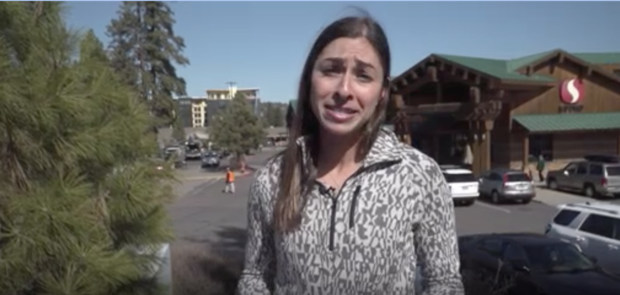
After her story went viral, Rebecca Mehra spoke to CBS affiliate KBNZ. "It was the first time I thought about how much this is really affecting my community," she said of the elderly couple who asked her to help them get groceries. KBNZ
Mehra's Twitter thread resonated. "Overwhelmed by the positive response to my tweet yesterday," Mehra wrote on Thursday, one day after posting the initial story. "Over 11 million of you have seen my story and counting. Thank you to everyone who has shared it."

"Frankly most people I know would have done the same thing I did. I was just in the right place at the right time," Mehra wrote.

She spoke to CBS affiliate KBNZ after her story gained widespread attention online.

"It was the first time I thought about how much this is really affecting my community," Mehra said, adding that she was just at the right place at right time and wishes she had gotten the couple's names.

"It just felt like a no brainer thing to do in the moment," she said. "It seems like it's inspired thousands of people hopefully to check in on their neighbors, check in on their grandparents, and their parents."

Many elderly Americans, as well as those with serious chronic medical conditions such as heart disease, diabetes or lung disease, are at a higher risk of contracting coronavirus – and some of them might not have the help they need.

High-risk individuals should make sure they have a supply of their regular medications on hand in case there's an outbreak that forces them to stay home, according to the CDC. They should also consider a mail-order service for medications.

The CDC also recommended stocking up on over-the-counter medicines, including those that relieve fevers, as well as medical supplies and household items, such as tissues. Food supply is also important.

All Americans should also be practicing social distancing and proper hand washing to help prevent the spread of the virus.

Full Article & Source:
Woman helped elderly couple get food when they were too scared to go shopping during coronavirus outbreak

Police: Health care worker allegedly hit elderly woman at assisted living facility


A health care worker is accused of attacking an elderly woman.

Police say Andrea Richards allegedly hit a 92-year-old woman in the face at an assisted living facility in East Garden City on Tuesday. They say the victim suffered a black eye and substantial pain.

Richards is facing several charges including assault and endangering an incompetent person.

Full Article & Source:
Police: Health care worker allegedly hit elderly woman at assisted living facility

Report: Britney Spears Conservatorship To Remain Unchanged For Now

by  Katie Jerkovich

The status of Britney Spears’ personal conservatorship will reportedly remain unchanged for now to allow the judge more time to decide what to do, despite rumors she may be loosening the current restrictions.

According to court documents obtained by the Blast, the 38-year-old singer will remain under a personal conservatorship for at least several more months to allow for a determination in the case as they decide what’s best for the pop singer, according to a report published Monday.

Spears and her parents have been in the news recently following reports that they had gone back to court to review the status of the court order that has been in place for more than 11 years.

TMZ reported that Britney’s mother, Lynne Spears reportedly wanted to be involved in the process, but her attorney’s stopped short of saying if she planned to ask the court to relieve Jamie Spears of his role as their daughter’s conservator.
Each year, rules of the probate court require a review of the status of the legally mandated conservatorship headed by her father, Jamie, compelling the parties involved to justify continuing the arrangement that for more than a decade has controlled every aspect of Britney’s business and personal life since her well-documented and very public breakdown in 2008.
Since 2008, the “Womanizer” hitmaker’s father, Jamie, has served as his daughter’s conservator after the singer went through a public spell of mental health issues. Her father was put in charge to help out with her finances and personal issues, per an earlier report by the outlet.

Full Article & Source:
Report: Britney Spears Conservatorship To Remain Unchanged For Now

Friday, March 20, 2020

‘I’m Really Isolated Now’: When Elders Have to Fight Coronavirus Alone

“I started crying when I told the seniors we were closing down,” said Judy Zangwill, executive director of Sunnyside Community Services, which closed its senior center except for pickup food service last Friday, ahead of instructions from the city. “I heard audible moans.”
It is a terrible irony of the virus: that for older adults, steps to prevent the spread of COVID-19 increase the risks of social isolation, which carries its own devastating health effects. A study by the AARP compared the effects of prolonged isolation to those of smoking 15 cigarettes a day.

Normally programs for elders aim to increase human contact. Now that contact is potentially deadly.

Nursing homes and assisted-living buildings, by order of the city’s health department, banned visitors — including, in many cases, residents’ private aides. Public libraries, houses of worship, neighborhood cafes — all social spots for elders — are also closed, pushing older people back into what are often lonely apartments: 30 percent of New Yorkers over 65, and 43 percent of those over 85, live alone, according to the Department for the Aging.

Sarah Arico, a regular at Sunnyside’s senior center, said the closing was “very hard to deal with emotionally.” She goes to the center for photography, for exercise classes, for the mental health group and “a good lunch.”

Last Friday, all of that came to a halt. “It is more isolating,” she said. Without the center, she was turning her attention to her dog and to phone calls with friends.
When she picked up food at the center, she said, the staff instructed everyone on line to stand six feet apart.

“Everybody was freaking out.”

But Ms. Arico said that she was making sure she walked outside, using physical activity to bolster her mental health.

“It’s a completely different way of living,” she said. “But I know we are going to get through this. I try to say, nothing is forever, not the good times, not the bad times. We all try to get through.”

As much as the activities and the hot meals, senior centers provide structure in lives that may not otherwise have it, said Ruth Finkelstein, executive director of the Brookdale Center for Healthy Aging at Hunter College. “The way we remember to do something is that it’s tied to something else,” Ms. Finkelstein said. “When that gets disrupted, it disrupts when we eat, which disrupts our sleep, which disrupts whether we take our medications.

“We see this with the way older people experience delirium in the hospital after just a few days of disruption. I’m not saying the current disruption will come to that, but once the disruption starts, it’s very difficult to dam it.”
At JASA’s Club 76 on Manhattan’s Upper West Side, run by the Jewish Association Serving the Aging, Stu Lahn said, “My family is being very hard on me because I’m not being as careful as they would want me to be.” Mr. Lahn said he was most disturbed by not knowing what would happen next. He could replace his social activities at the center using the telephone, but the uncertainty made him feel a loss of control, which in older people can be particularly damaging.

“What’s hard is thinking about how long it’s going to last,” he said. “Tomorrow and tomorrow and tomorrow — it’s the unknown that’s scary.”

Mr. Lanz, who is 79, normally runs the center’s Monday bingo program with an older woman who survived the Holocaust (she did not feel up to being interviewed for this article). Since the center closed last week, he has been checking up on her by telephone. “I’m wondering at times whether the Holocaust survivors are better prepared than we are for this,” he said. “I’ve never experienced anything like this.”

Stephanie Cacioppo, an assistant professor of psychiatry and behavioral neuroscience at the University of Chicago, who studies loneliness and social isolation, said that the sense of losing control in the pandemic was both harmful and treatable. Social distance need not lead to social isolation, she said. “You can train your brain like you train your body,” she said.

Caregivers and family members should try to help elders feel in control of the precautions they are being told to take, so that they feel involved rather than punished by the new rules, she said. She also recommended asking about public health crises they lived through in the past, including polio or tuberculosis, even SARS or the H1N1 flu.

Clear information helps; alarmist news programs, on the other hand, can make people feel helpless. In a nursing home or assisted-living building, rumors run wild. “Just having someone giving you an update every three hours, saying I’ll see you later, gives people a sense that there is a future,” Ms. Cacioppo said. “It makes seniors not feel abandoned. They see themselves not as objects, but as contributing.”
Lujira Cooper, 72, said she felt this control slipping away. She goes three or four days a week to the Edie Windsor SAGE Center in Midtown Manhattan, the first full-time senior center for LGBT older adults. The center’s closing was a reversal of the common aging experience: she was staying healthy but the social world around her was unraveling.

Also, she missed the arguing and the birthday celebrations — hers was scheduled for later this month.

“I can clean my house and work on a book I’m supposed to be writing,” she said, “but it’s the missing of talking to people in another setting. I don’t mind being by myself. I mind being forced to be by myself. You can’t go anywhere, you can’t be around people.”

She liked to eavesdrop on people in museums and restaurants — gone. She wondered whether, when the virus receded, people would hug again, or if the practice would disappear. She felt a loss of herself as much as other people, she said. “When you can’t be around people altogether, and people are afraid of catching something, it creates a self-imposed prison.”

Alex Vadukul contributed reporting.

Full Article & Source:
‘I’m Really Isolated Now’: When Elders Have to Fight Coronavirus Alone

92 Years Old, Scared and Pleading to Come Home

A family grapples with a wrenching coronavirus question: Do we leave our father in the nursing home?


By Dan Barry

His daughters were not at his bedside, holding his hand. His sons were not making him smile with wisecracks about the institutional setting. His grandchildren were not cheering him up with reports from the distant world of youth.

Joseph Trinity’s family members were there one day, and then they were not, for the same reason much of the world is trying to suppress the human desire to be with one another: the coronavirus.

Mr. Trinity had found himself in a New Jersey rehabilitation facility that, like most health care institutions across the country, had declared a no-visitor policy to stem contagion. But he is 92, and in fragile health; family sustains him.

Several times a day, he would call his daughter, Mary Trinity, to ask in a faint, slightly garbled voice where everyone was — and to beg her to please, please, get him out of there.

Mr. Trinity was caught in a moment. And he wasn’t alone.

The federal government and various health care associations have issued strongly restrictive guidelines to prohibit family members and other nonessential personnel from visiting nursing homes, rehab centers and other facilities with older, vulnerable residents.

“We know there have been challenging episodes with family members, vendors, state survey teams and even a few ombudsmen or postal carriers, not wanting to comply,” Mark Parkinson, the president of the American Health Care Association and the National Center for Assisted Living, wrote last week. As awareness of the coronavirus grows, he added, “hopefully those challenges will diminish.”

But Richard J. Mollot, the director of the Long Term Care Community Coalition, an advocacy group for people in institutional residential settings, said in an email that he was “deeply concerned about residents being cut off from their loved ones.”

While emphasizing the need for extensive precautions, Mr. Mollot said that banning family members, but not employees who come and go — some to second jobs as home-care aides — makes no sense. He also noted that families are more than friendly faces; they help with eating and drinking and with monitoring medications and treatment.

“What are residents going to do without them?” he asked.

Mr. Trinity’s own odyssey began at his home late last month, as he pushed his walker to the bathroom to brush his teeth before calling it a night. He fell beside the sink, fractured his hip and could not get up. His live-in caretaker alerted his family.

Soon an ambulance was taking him away from his home in Maplewood, N.J., in a blur of flashing red lights.

This was the house that Mr. Trinity and his wife, Mary, bought in 1959, the same year the couple, both public schoolteachers, married. This was the house where they raised five children on not a lot of money; brief summer vacations meant a motel pool and pizza as a special treat.

He taught drama and speech at Jonathan Dayton High School in nearby Springfield for 30 years. The photos of him in yearbooks stored in the basement mark time’s passage, progressing from military-style buzz cuts to blondish-gray hair touching the ears.

Mr. Trinity retired but sold real estate part-time. Children married. His Mary died at 62: irreplaceable. Grandchildren crawled, then walked, then invited him to high school and college and law school graduations.

Mobility declined, and some independence was forfeited, reluctantly. But there was a cocktail before dinner, and “Jeopardy” at 7, and family gatherings on Sundays and holidays — until it was all interrupted by a fall.

Mr. Trinity waited until five the next morning before receiving a bed at a hospital in Summit, six miles away. Two of his children stayed with him through the night and into the next day, when he underwent surgery. The three other children soon arrived, from western New Jersey and Boston and Washington, D.C., to hold hands, crack wise and just be there, as February gave way to March.

They took note of the bathroom signs recommending that they sing the ABCs while washing hands to scrub out the H.A.I.s, or hospital acquired infections. They made liberal use of the hand sanitizer dispensers at every entrance and exit.

Mr. Trinity barely caught his breath before being taken, again by ambulance, to a rehabilitation center, where he was to engage in physical and occupational therapies. But this was a 92-year-old man who had had trouble walking even before his hip fracture, and who was also navigating the disorienting sea of pain, medication and an institution that was not his home.

Then, at noon on March 13 — only a week ago — the facility barred visitors. No familiar faces. No jokes. No reassuring squeezes of his hand.

Mr. Trinity begged by telephone to be rescued, his words weak, anxious, sometimes disconnected. His children faced a heartbreaking dilemma.

Should their father remain in the care of professionals who were much better equipped to handle his myriad needs? Or was he at greater risk of contracting the virus by remaining in an institution?

And given the prevailing threat and the open-endedness of restrictions, was it possible they would never see him again?

On Saturday night, the five Trinity children talked it through by conference call. But they already knew there was really only one answer.

On Sunday, they divided assignments: calling the doctors and hospice services and the home health care agency; preparing the family home by moving the table out of the dining room and clearing clutter; ordering a bed; reassuring him when he called again.

And they arranged for an ambulance, which pulled up to the facility early Monday afternoon. Soon a wheeled-out Mr. Trinity was squinting in the daylight.

“I’m so happy,” he said from the gurney. “This is the second-happiest day of my life.”

Two emergency medical technicians locked him in place, closed the back doors and headed off for Maplewood. The ambulance wended its way through a landscape thoroughly altered from the one Mr. Trinity had left behind less than three weeks earlier.

Past the West Essex Y.M.C.A., closed, and the Livingston Public Library, closed. Past an electronic sign reminding people to wash hands, and a ShopRite so packed that the presence of a police car with blinking lights was required.

The ambulance passed through a suburban landscape that looked the same, yet was transformed somehow, as if existing in a state of suspension. Then it drove into his hometown, where the schools are closed and the playgrounds padlocked.

The ambulance turned right onto his street and passed the century-old houses he still identifies by the surnames of the families who lived there 30, 40, 50 years ago. Finally, it pulled up to his own home, where six family members were waiting.

“Welcome home!” someone called out.

“Thank you, thank you,” he said, failing not to cry.

The two E.M.T.s, wearing blue latex gloves, wheeled him up a ramp and gently placed him in the bed that now centered the dining room. Family photographs were displayed on a cabinet, along with a fresh bouquet of yellow roses.

“The flowers are beautiful,” said Joe Trinity, my father-in-law.

Full Article & Source: 
92 Years Old, Scared and Pleading to Come Home

Risk Factors for Financial Abuse in Nursing Homes

Financial Abuse and Scamming Nursing Home Residents of Their Money

Several research studies, including an analysis by the U.S. Consumer Financial Protection Bureau estimate that seniors in the U.S. are scammed out of anywhere from $3 billion to $37 billion a year. Those over age 70 lose an average of $10,000 to elder financial exploitation each year, and the losses are even higher when the scammer is a friend, trusted caregiver, or relative.
  • In 2018, the Office of Financial Protection for Older Americans received over 180,000 encounters of suspicious elder financial exploitation (EFE), involving a total of more than $6 billion since 2013.
  • Noted in a 2019 report published by the Office of Financial Protection for Older Americans, banks reported a total of $1.7 billion in suspicious activities in just 2017, including actual losses and attempts to steal the older adults’ funds.
    • When a filer lost money, the average loss per filer was $16,700.
    • One-third of the individuals who lost money were ages 80 and older.
    • Adults ages 70 to 79 had the highest average monetary loss ($45,300).
Officials say these occurrences likely represent only a tiny fraction of actual incidents of elder financial abuse. Family members or someone the victim may know, such as a nurse or care worker in a nursing home, are too often the guilty party in these cases.

Identifying Risk Factors for Financial Abuse in Nursing Homes


Financial abuse targeting nursing home residents can happen over time, making it one of the most difficult crimes to detect. The elderly have become more vulnerable to this type of abuse for several reasons, including having less access and comprehension of banking technology. Those living in nursing homes may be less capable, both physically and mentally, to check-in on savings, have access to their mail before others, and may rely on others to assist them. Some of the most common examples of financial abuse include:
  • Forging Resident’s Signature
  • Cashing Resident’s Checks without Authorization
  • Taking Money or Property
  • Using a Resident’s Bank Card or Checks
  • Deceit or Forcing Resident to Sign Over Money or Possessions
  • Improper Power of Attorney
Financial losses are almost always more significant when the older adult knows the suspect. This is because residents may be very trusting to their caregivers and family members. But when uncovered, there is legal recourse for those who have been taken advantage of financially. Any type of stealing or misappropriation of someone else’s’ money is not only immoral; it usually creates a trail of criminal behavior against everyone in the nursing home who is also being financially exploited.

Financial Abuse and Neglect Attorneys for Nursing Home Residents


Levin & Perconti is one of the most widely-known and respected elder abuse and neglect law firms in Illinois, achieving multiple million-dollar verdicts and settlements for individuals and families who have been impacted by all types of elder abuse, malpractice, or neglect. We can help if the personal finances of a loved one have been mismanaged by a nursing home or stolen by a care worker.

Full Article & Source:
Risk Factors for Financial Abuse in Nursing Homes

Thursday, March 19, 2020

John Scalzi, who cares for his 95-year-old mother, shares emotional impact of nursing home visitation ban

Click to Watch Video
By Noel Rehm

SARASOTA, Fla. (WWSB) - On Saturday, Gov. Ron Desantis announced that there would be a 30-day ban on visits to nursing homes as he acknowledged that the virus is spreading through some communities.

The recent visitation ban can make it lonely while staying at any assisted living facility, and it also impacts family members who are concerned about their loved ones.

I had the chance to sit down with John Scalzi and talk about his recent experience regarding not being able to visit his mother who is currently in a rehabilitation center.

Transcript for the interview below:

Noel - How has it been lately with the Coronavirus and trying to help out with your mom?

John - "It has so many ramifications. The first time that I experienced any kind of personal involuntary involvement with the Cornonavirus situation as supposed to voluntary, which is washing your hands and buying food stuff that you can control. The involuntary relationship began early Sunday morning when I went to visit my mom in a rehab center.

"My mom is 95-years old; she lives with us. We have been the primary caregivers for her for the last five years. Taking care of her wounds, making sure that she has clean clothes, cooking her food when necessary, cutting her food when necessary, taking care of all of her medications, everything really. And because of the new requirements for nursing homes, we were not allowed to visit. I was not allowed to visit my mom.

"So, this is the first time that she has been in a hospital environment which she has not had me there for the bulk of the day as her advocate, medical surrogate, general caretaker when nurses or CNAs where not around. It was a very very difficult thing for me. Initially, I was incredulous that it could be. When I went to the rehab center to get in, I did not know that this new regulation had come down from the Governor, so it caught me by surprise. Then following that there was that moment of anger. Then following that kind of the realization that it’s understandable that it would be case.

"There was also the understanding that the poor healthcare worker who had to stand on the other side of the glass tell loved ones that they couldn’t visit their spouses, their parents or husbands, wives. It must have just been horrific for that individual to have to be able to do that. So, that was a pretty large change in my relationship with the Coronavirus.

"As somebody’s legal medical surrogate you want to make sure that they have the best health care possible that’s number one and number two this was my mother so obviously I had that to deal with as well, not being able to see her. I understand what those regulations were about unfortunately I think that the definition of caregiver is still a rather vague one and I think everyone is coming to grips with that, and what that definition actually means.

"But you know you have to realize that we are all in this for the greater good for that population that is so highly at risk. So, we have to accept that and move on deal with it the best that we can.

"I think about when I was standing there watching a gentleman who was easily in his 80s, silver hair walking up to the door, impeccably dressed with a picture frame. And, that picture frame was a picture that span generations of family members. I’m sure. And they had been married for years; 50 years who knows. And he was told that he was there to see his wife and that and he was told that he could not do that. I can only imagine how that must have affected him and it must have been the first time in his life that he was not allowed to see his wife.

"You don’t know how many lives are affected. So, when you wash your hands, you may well be saving the life of a grandmother somewhere. It is wonderful to be able to connect in any way that you can. There are some facilities I understand which are purchasing tablets so that you can face time with your loved ones in the hospital. It’s a wonderful thing. It also helps to remind you how much you desperately want to be there. But for them, at least it’s an opportunity to connect with you and if you can do that, absolutely.”

You can also watch John’s interview on a special Suncoast View below:

Click to Watch Video

 Full Article & Source:
John Scalzi, who cares for his 95-year-old mother, shares emotional impact of nursing home visitation ban