Tuesday, September 27, 2022

‘They’ve been an afterthought’: millions of elderly Americans still vulnerable as pandemic caution wanes

For older people, loneliness and the stress of weighing risk of ordinary activities have taken an additional toll

A woman holds up her hand to a window in greeting. On the other side of the window is an elderly man in a hospital bed who has been hooked up to monitoring equipment.
Susan Morales waves to David Feinour, 71, who has Covid, at St Jude Medical Center in Fullerton, California, on 10 July 2020. Photograph: Jae C Hong/AP
by Melody Schreiber

It was Mother’s Day in May 2020, and an elderly woman lay dying in a Rhode Island nursing home. Her children couldn’t visit because of Covid, and as much as Adelina Ramos, her certified nursing assistant, longed to provide comfort from her bedside, she had to leave, even though she could see the woman was slipping away.

She had 25 other patients to care for that day.

It “really broke my heart,” Ramos said. “Families trust us to care for their loved ones. I can’t describe how painful it feels when we are forced to make those kinds of choices.”

She recounted the devastation wrought by the pandemic in a hearing on Wednesday before the House subcommittee on the coronavirus crisis.

Although Covid causes less panic now, particularly given the protection offered by updated vaccines and treatments, older Americans are still seeing their lives upended – and, tragically, ended entirely – by new outbreaks.

As the rest of the country seeks a new normal, millions of vulnerable Americans still remain at risk and in limbo. They’re now navigating a world ruptured by continued virus surges, shortages in the staff who care for them, and grief over more than a million people lost in two years.

Even so, the US Centers for Disease Control and Prevention (CDC) on Friday dropped its mask recommendations for hospitals and nursing homes, except during times of high transmission or while providers are caring for moderately and severely immune-compromised patients.

The move could make it even more difficult for those at risk, especially elderly people, to navigate health care settings and long-term care facilities safely.

Prioritizing older Americans during this time is “paramount”, said David Grabowski, a professor of health care policy at Harvard Medical School. “It’s the group overall during the pandemic that’s been hit the hardest, and yet in many ways … they’ve been an afterthought.”

People over the age of 50 account for more than 93% of Covid deaths in the US.

“We still are seeing hundreds of deaths a day, and they’re occurring disproportionately among older Americans,” said Theresa Andrasfay, a postdoctoral scholar of gerontology at the University of Southern California.
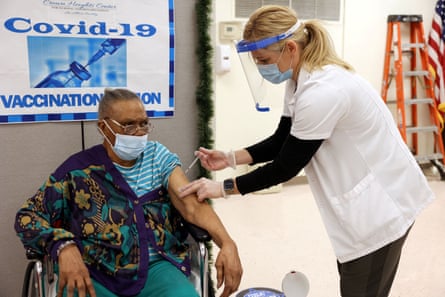
A female medical worker gives a vaccine to an elderly woman in a wheelchair.
Coronavirus has dropped life expectancy rates for all Americans, but changes are greater among people of color. Photograph: Yuki Iwamura/Reuters

Life expectancy has dropped for all Americans, but changes are greater among communities of color, Andrasfay said. “The Native American population had by far the largest decline in life expectancy, followed by the Latino population and then the Black population.”

In February 2021, older Americans who caught Covid were 1,000 times more likely to die than teenagers, according to a McKinsey report that predicted the “arrival of safe, effective vaccines makes the pain of that isolation a time-bound problem”.

Yet for many, isolation and stress from the pandemic persist, especially as the protection offered by vaccines wanes without boosters and as new variants emerge.

Relatively high rates of vaccinations among older people helped mortality rates drop slightly in this age group from 2020 to 2021. But the Omicron variant, which is more transmissible and better at evading immunity, brought near-record surges in elderly mortality.

A total of 95% of Americans above the age of 65 have gotten at least one Covid shot. But from there, the coverage begins to drop precipitously. Among those who were fully vaccinated in this age group, 70.8% got their first boosters. But only 40% of that group went on to get second boosters.

That means a total of 14.9 million older Americans are up-to-date on vaccinations, compared with the 57.5 million who were willing to get the first shot. Booster rates are even lower among Americans aged 50 to 64.

This could have dire implications for their safety moving forward, even as remaining precautions disappear across the country.

In nursing homes, only 57% of residents and 43% of staff are up to date on their vaccines. Rates are lowest in Arizona, Florida, Nevada and Texas.
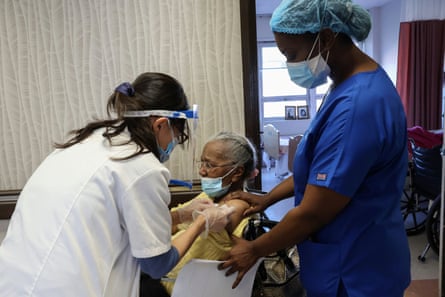
Two medical workers administer care to an elderly woman in a wheelchair.
In nursing homes, 57% of residents and 43% of staff are up to date on their vaccines. Photograph: Yuki Iwamura/Reuters

Fewer than 1% of Americans live in long-term care facilities, yet about one-fifth of all deaths from Covid-19 are related to nursing homes, with more than 200,000 residents and workers dying from the coronavirus since the start of the pandemic.

“Residents, their families and their caregivers have long known that US nursing home care is broken, yet this issue has gone largely unnoticed in the broader population. Covid changed this,” Grabowski testified at the hearing.

The House coronavirus subcommittee outlined the “dire” conditions of for-profit nursing homes during the early months of the pandemic, revealing widespread neglect that led to health deterioration and death.

Nurses and nursing aides cared for as many as 38 patients during their shifts. In April 2020, when only one nurse was covering two entire floors at a facility in Nevada, one resident waited four hours for a sip of water and another resident who vomited on herself was not cleaned for at least two days, according to the House report.

Yet at least 32 states have passed legislation making it harder for residents or their families to sue long-term care facilities for such treatment.

Some of the worker shortages were because of Covid cases among staff, which could have been prevented in part with better precautions. But one nursing home worker alleged that the corporations wanted to save money by not hiring additional workers despite the need for them.

Long-term care facilities were plagued with staffing shortages and low morale before the pandemic started, and Covid sharply amplified the cracks in how America cares for its senior population.

“Nursing homes are already understaffed, under-resourced. So when you’re putting a profit motive on nursing homes to squeeze out a couple extra dollars from these communities, it’s going to compromise care,” said Ashwin Kotwal, assistant professor of geriatrics at the University of California, San Francisco, School of Medicine.


But it’s not only nursing home residents who have been affected by Covid – and damage from the pandemic wasn’t limited to the virus itself.

The pandemic also caused stress and loneliness, which affects both mental and physical health. In 2019, about 1.6 million adults above the age of 70 were homebound, but that number more than doubled to 4.2 million in 2020. Being homebound increases the risks of sickness and death.

Age was the greatest risk factor for severe outcomes from Covid, but loneliness compounded poor health, according to a Commonwealth Fund survey conducted between March and June 2021. Pandemic disruptions limited and delayed health care, and it amplified “considerable” social and economic challenges.
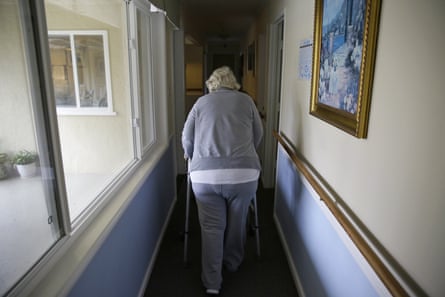
An elderly woman walks down a hallway.
The pandemic caused stress and loneliness, affecting mental and physical health. Photograph: Eric Risberg/AP

“Compared to their counterparts in the other survey countries, older adults in the US have suffered the most economically from the Covid-19 pandemic, with more losing a job or using up all or most of their savings,” the report said. Economic hardships for older Americans were four to six times greater than in other countries surveyed, and they were more likely among Latino and Black adults than among white adults in the US.

Disruption and isolation are likely to continue for those who need to continue taking Covid precautions.

“What’s concerning going forward, as there’s more focus on individual responsibility, is that it makes it more difficult for people who are vulnerable, either because of underlying conditions or because of their age, to feel safe taking part in necessary activities,” Andrasfay said.

Those activities can include taking public transportation, medical visits, returning to work or seeing family and friends.

Weighing these risks is a fraught and exhausting process, Kotwal said.

“It can make even the most simple of social activities something that people really stress over and think about a lot. I’ve seen a lot of anxiety around how people make these decisions to do what are really normal activities, like going to grab coffee with their child or hanging out with their grandchildren.”

Keeping up-to-date on vaccines is an important part of protecting those most at risk, he said. “We can bring this into a place of community – being responsible, trying to protect others – rather than only looking at this from the individual safety lens.”

Vaccination clinics and vaccine mandates in health systems and long-term care facilities were “really effective,” Grabowski said. About 87% of residents and staff in nursing homes were vaccinated because of the clinics and mandates – but those requirements have not been updated to include boosters.

An expanded federal mandate for staff to receive booster doses would help, he said. And more vaccine clinics for facilities, as well as campaigns to reach homebound adults and others facing access problems, could also increase booster rates and protect older adults this winter.

“This is too important,” Grabowski said. “By all means, let’s make this as easy as possible.”

Full Article & Source:
‘They’ve been an afterthought’: millions of elderly Americans still vulnerable as pandemic caution wanes

Monday, September 26, 2022

Green Bay woman charged with stealing over $10k from person she was the guardian for

Green Bay woman charged with stealing over $10k from person she was the guardian for

Source:

Former San Luis Valley District Attorney disbarred from practicing law in Colorado

By Dan Beedie

SAN LUIS VALLEY, Colo. (KRDO) -- Former 12th Judicial District Attorney Alonzo Payne is disbarred from practicing law in the state of Colorado. The order was approved by the Office of the Presiding Disciplinary Judge - a branch of the Colorado Supreme Court - on Wednesday.

According to the order, both the Office of Attorney Regulation Counsel and Payne agreed to the "Stipulation to Discipline" that was filed with the Presiding Disciplinary Judge on Monday. It's unclear why Payne would sign off on his own disbarment.

Payne's disbarment officially goes into effect on October 26. 

Alonzo Payne

The 12th Judicial District, located in the San Luis Valley, went without an official DA for weeks after Payne resigned from the position on July 13. Before stepping down, Payne had been at the center of a recall effort and an investigation by the Colorado Attorney General's Office.

After a seven-month investigation, the Colorado Attorney General found that Payne repeatedly violated the rights of crime victims.

"Not only have I not seen victims rights act violations of this magnitude, but in the entirety of the victims' rights act in Colorado history, we have never gotten to this point," Colorado Attorney General Phil Weiser said.

According to Wednesday's order obtained by 13 Investigates, Payne violated several of the Colorado Supreme Court's Rules of Professional Conduct for attorneys. Some of these violations include failing to provide competent representation to a client, failing to act with reasonable diligence and promptness in representing a client, and representing a client when that representation involves a conflict of interest.

The order goes on to accuse Payne of knowingly making a false statement regarding the facts or the law to the courts or a judge.  The order says Payne engaged in dishonest and deceitful conduct. 

In an email to 13 Investigates, a spokesperson for the Office of Attorney Regulation Counsel, who filed the stipulation, said that only Payne can answer the question as to why he agreed to the resolution.

"The alternative to a stipulation was that the Presiding Disciplinary Judge would convene a hearing board and hold formal proceedings, likely involving many days of testimony from many witnesses and incurring significant additional costs, in which the hearing board would have decided whether Mr. Payne should be disbarred," the spokesperson said via email when 13 Investigates asked if Payne possessed an alternative to disbarment.

Payne is required to comply with the order by “winding up” his affairs, which include informing current clients of his disbarment and providing notice to other jurisdictions where he is licensed or authorized to practice law. 

Payne has 14 days to file an affidavit with the Office of the Presiding Disciplinary Judge attesting to his compliance with the disbarment order. 

After weeks of being run by the state, Colorado Governor Jared Polis appointed Anne Kelly, a former Boulder County deputy district attorney, to take over the legal responsibilities in the San Luis Valley.

Kelly officially took over the responsibilities of the office late last month. The new DA told 13 Investigates that holding violent criminals accountable will be at the top of her list of priorities.

Full Article & Source:
Former San Luis Valley District Attorney disbarred from practicing law in Colorado

Raymond James Penalized $500K For Ex-Broker's Theft From Elderly Clients

by Jacqueline Sergeant 

Raymond James & Associates Inc. has agreed to pay a civil penalty of $500,000 for failing to supervise a former broker who stole more than $920,000 from two elderly clients, including a now-deceased 98-year-old World War II veteran, according to the Securities and Exchange Commission.

As part of the SEC order, the firm also was censured and cited for its poor communication within its supervisory and compliance rank regarding investigating potential external threats of financial exploitation of seniors. 

Frederick M. Stow, 66, of Franklin, Tenn., was sentenced in May 2021 to five years in prison. He was charged in June 2020 with securities fraud, wire fraud, and aggravated identity theft. He pleaded guilty in August 2020.

According to the SEC, from October 2015 to March 2019, Stow misappropriated $901,500 from an Individual Retirement Account (IRA) of a 98-year-old retired airline pilot and World War II veteran. The SEC said Stow forged wire transfer authorization letters and diverted the customer’s funds to his personal bank account. He also stole $22,400 from the account of an 86-year-old woman who lived in a memory-care facility.

Stow’s fraudulent behavior came to light in January 2018, when Raymond James named a new branch manager at its Cool Springs, Tenn., branch. Upon reviewing the branch’s senior citizens’ accounts, the manager became alarmed at what he cited, in several memoranda in June 2018 and discussions with his supervisors and compliance officer, as  “extremely high” amounts of money being wire transferred from the veteran’s account.

The branch manager was especially alarmed at the seemingly excessive living expenses of the customer, who had a full-time caregiver. The SEC noted that the branch manager had personal knowledge in this area because he had experience managing the finances of his parents, who also required full-time caregivers. The SEC said he also noticed that the wire transfers were frequent, at a rate of one to two wires per week at times, and that Stow, who was in arrears on a $361,000 from the firm and not earning much in commissions from the account, was footing the bill for the transfers. Further,  there was no trusted contact or power-of-attorney on file for the customer’s account.

In June 2018, the branch manager visited the customer. “Branch manager noted that customer was aware of the balance of his  account and that he ‘just sign[s] checks that are put in front of [him],’” the SEC said, adding that after the nearly hour-long meeting, the branch manager “determined that customer’s memory was impaired and that he could be vulnerable.”

The branch manager met with Stow after the meeting to discuss the customer’s account and other issues relating to business practice and “declining performance,” the SEC said. When asked about the wire transfer fees that he paid, Stow told the manager that he was “just trying to help the client out.”

The SEC said the branch manager also questioned Stow about the account of his 86-year-old client because she, too, did not have a power-of-attorney on file. But Stow explained that he thought he had a power-of-attorney for the son. The branch manager was concerned that Stow executed unauthorized trades in this customer’s account at the direction of the customer’s son.

The branch manager took his concerns about the clients’ accounts, as well as Stow’s “declining performance, to the firm's supervisors and compliance officer. The group met to discuss the situation and agreed to refer it to the firm’s Senior-and-at-Risk-Clients group (SARC), which was formed in 2017 to investigate potential external threats of financial exploitation of a senior customer. But the SEC said, “none of the group understood SARC’s process or the scope of SARC’s work in supporting supervisors.”

The SEC said SARC took “limited” steps to investigate the matter. “Aside from the branch manager’s notes and meeting summaries which were provided to SARC, neither the SARC analyst nor anyone else from SARC ever spoke to the customers, branch manager, or Stow,” the SEC said.

“Upon completing this limited investigation, on July 10, 2018, the SARC analyst replied to compliance officer’s initial email, stating that he did not see anything that would require SARC to take immediate action, such as Adult Protective Services notification or account restrictions,” the SEC said. The SEC further noted that “when SARC’s work was completed, Stow’s supervisors were not adequately informed that the review of Stow’s customers focused on external threats.”

The SEC said Stow’s performance continued to decline after the SARC review and in November he was placed on a performance improvement plan. But the SEC said from July 2018 to March 2019, when the war veteran died, Stow continued to steal monthly from his account. 

When that account was frozen, Stow dipped into the account of the elderly woman. He  confessed his scheme to his supervisor in May 2019 after being questioned repeatedly by the executor of customer’s estate about the missing money, the SEC said.

Stow entered the industry in 1979 and worked for Merrill Lynch for 10 years before moving to several firms including Suntrust Equitable Securities and Wells Fargo Advisors before joining Raymond James in 2013, according to BrokerCheck.

He was fired by Raymond James in May 2019 and barred by the Financial Industry Regulatory Authority in October 2019 for not cooperating with its investigation of the case. The SEC barred him in July 2021.

The SEC said as a part of the settlement offer, Raymond James has taken remedial steps to improve its SARC program. Among other things, it said the firm has enhanced “SARC’s communication with supervisors and control functions and provides “boots on the ground” engagement by supervisory personnel on senior exploitation issues.”

Raymond James did not respond to an inquiry for a comment.

Full Article & Source:
Raymond James Penalized $500K For Ex-Broker's Theft From Elderly Clients

Sunday, September 25, 2022

Second Poisoning Death Prompts Suit Against San Mateo Assisted Living Facility

Peter Schroder Jr.’s family has filed a lawsuit against Atria Park San Mateo, alleging negligence and elder abuse in his Sept. 7 death.

 
By Jaxon Van Derbeken and Jeremy Carroll

A second Atria Park resident in San Mateo, one of three who unknowingly drank cleaning fluid served to them as cranberry juice back in August, has died.

His family has filed a wrongful death lawsuit accusing the assisted living facility, Atria Park of San Mateo, of understaffing, elder abuse and negligence.

Peter Schroder Jr. celebrated his 93rd birthday in February at the Atria Park facility. Six months later, the retired U.S. Air Force chaplain had plans to spend the afternoon of Aug. 27 with his daughter, Susan.

“He was really looking forward to our outing,” she recalled. “He put on a really good-looking outfit in anticipation of us driving down to Los Altos, because he established a church there.”

But the outing never happened. That morning, Schroder, along with two other residents of Atria Park, was rushed to the hospital after drinking caustic alkaline cleaner served as cranberry juice.

“His lips were blistered and bleeding and his mouth looked like somebody had asked him to swallow a firecracker,” Susan Schroder said. “It was devastating to see him like that.”

Peter Schroder was in the hospital for a dozen days, barely able to speak. He was able to tell his daughter he loved her, but was enduring what doctors told Susan was increasing agony. “He was in so much discomfort – I was glad that they let me sleep in his room for the last two days, and I was with him when he passed.”

Susan Schroder remembered her father as an adventurous soul who studied chemistry but became a pastor instead. He founded Immanuel Lutheran church in Los Altos in 1954 before going on to become an Air Force chaplain, serving in Okinawa at the time of the Vietnam War.

“I feel like I was robbed,” Susan Schroder said. “No one knows how long they have to live…but he enjoyed life…and I just feel like that was all taken away.”

Schroder’s family has filed a lawsuit against Atria alleging negligence and elder abuse in his Sept. 7 death.

NBC Bay Area’s Investigative unit previously reported that a kitchen worker poured the bright red Ecolab-brand cleaner into a pitcher, for later use in cleaning. But the worker became distracted, according to investigators. The suit alleges the worker was called to deal with a disruption in the dining room.

“There were not enough caregivers to handle the ‘disruption,’” the suit states. After that, another worker unknowingly brought out the pitcher left behind and served the cleaning fluid as cranberry juice, investigators say. One of the residents who drank the fluid was 93-year-old Trudy Maxwell, who died within days.

Kathryn Stebner, the lawyer who filed the Schroder family’s suit and who has sued the Atria Park facility in the past, said that it has chronic problems with staffing.

“Atria understaffed so it can make more of a profit,” she said, adding what happened to Peter Schroder “is a good example of having a bunch of people, this many people with dementia, in one room and not enough people to keep them safe.”

Atria Senior Living issued a statement on Thursday, saying: “We continue working with authorities and the Department of Social Services to fully review and assess the incident. The safety and well-being of our residents remain our top priority at all times. Our hearts remain with the residents affected, their families, and loved ones.”

In an earlier statement after Trudy Maxwell’s death, Atria said employees involved had been suspended while it did its own probe. The company promised that following that assessment, “we will take additional actions as needed.”

San Mateo District Attorney Steve Wagstaffe said his office is now reviewing the completed police probe to determine whether to pursue elder abuse or other charges. “Because people died,” he said, “this case gives us a major concern about what's going on.”

The investigation is focused on the kitchen worker who allegedly poured the cleaner into the juice pitcher, he said, but others involved may also face scrutiny. “We're going to give it a very close look to make sure that what occurred there, to find out whether it involved criminal behavior -- if it did, we have no tolerance for that.”

Meanwhile, Susan Schroder said that she’s preparing to bury her father next to his wife, near Chaplains Hill at Arlington National Cemetery. 

A second Atria Park resident in San Mateo, one of three who unknowingly drank cleaning fluid served to them as cranberry juice back in August, has died, Jaxon Van Derbeken has more..


Full Article & Source:

Battle escalates over late actress Anne Heche's estate

The late actress Anne Heche left behind two children and an unknown amount of wealth
 
ByHaley Yamada 

The late actress Anne Heche left behind two children and an unknown amount of wealth after she died in a fiery car crash in early August.

Now, her 20-year-old son, Homer Laffoon, and her ex-boyfriend, actor James Tupper, who's also the father of her other son, 13-year-old Atlas Heche Tupper, are going head-to-head over who has control over her estate.

After Laffoon filed a petition in August, a court appointed him as "special administrator" of the estate on Sept. 15.

David Glass, a family law attorney and an ABC News contributor, defined what this means in the legal battle.

"A special administrator only has the power to keep the estate open and to start counting up the assets. The special administrator does not have the power to start transferring or selling assets," Glass said.

However, Tupper, who said he had a relationship with Heche from 2007 to 2018, claims in a court filing that he's the will's rightful executor and alleges he was copied on an email that Heche sent to lawyer Kevin York in 2011 indicating her wishes in case of death.

"My wishes are that all of my assets go to the control of Mr. James Tupper to be used to raise my children and then given to the children," Heche wrote, according to a copy of the email included in the court filing. According to Laffoon's petition, Heche ultimately died without signing a will.

Tupper is asking the court to name a third party fiduciary as the executor or in the alternative name his as executor. He also argued in the court filing that Laffoon is not "suitable" to represent Heche's estate or the interests of his younger brother -- citing his age and unemployment -- and argued that he was estranged from his mother when she died.

The document also claims that Laffoon changed the locks on his mother's home the day she died, preventing his half brother, Tupper's son, from retrieving his belongings.

"We prefer to see the estate administration play out in court and not in the media, as our legal documents speak for themselves," Laffoon's attorney, Bryan Phipps, told ABC News in a statement. "The court appointing Homer special administrator last week supports that decision."

Heche, an Emmy award-winning actress, suffered serious burns and a major brain injury when her car jumped a curb and crashed into the side of a Los Angeles home on Aug. 5. Nearly 60 firefighters worked to pull her from the wreckage. She was taken to a hospital in a coma and died a week later.

A hearing to decide whether Tupper, Laffoon or a third party should control the estate is set for Oct. 11.Glass said that these types of cases can take a while.

"They are usually not decided for at least six months to a year," Glass said. "Ultimately, if neither of them has a perfect case, the most likely result is that the court will appoint a neutral administrator, a professional fiduciary to go through the estate and distribute it."

Whistler woman found guilty of elder abuse, pivotal for “Shirley’s Law” advocate

This prompted the creation of “Shirley’s Law” which passed in March.


By Ariel Mallory

MOBILE, Ala. (WALA) - A jury found a Whistler woman guilty of financially exploiting the elderly Wednesday.

Veronica Wiggerfall is accused of stealing thousands of dollars from Shirley Smith back in 2017 while serving as her caretaker.

This prompted the creation of “Shirley’s Law” which passed in March.

Jo Holcombe, the daughter of Smith, says she was in the courtroom when she heard the guilty verdict and cried tears of joy.

She says she pushed so strongly for this law so that other families don’t have to experience this type of elder abuse.

“I immediately just burst into tears. I know they were tears of happiness but I also know it was just tears of relief,” Holcombe said.

After three days of testimony, Wiggerfall was found guilty of 1st-degree financial exploitation of the elderly.

Five years ago Wiggerfall was booked into Metro Jail after being accused of stealing from the woman she cared for, Shirley Smith.

Her children made the shocking discovery.

“She was financially exploited and that was uncovered on October 16th of 2017 when the bank called us,” Holcombe said. “My brother and I immediately took action.”

According to court documents, Wiggerfall stole more than $2,000 from Smith’s bank account through the use of her checkbooks.

Holcombe says she’s been fighting since 2017, not just because of the money lost, but much more.

“What Veronica stole from us that was the most valuable thing, not the money, but time,” Holcombe said. “Propelled me to help create a law was that as a result of the theft my mother was fundamentally changed.”

Holcombe says she advocated to create “Shirley’s Law” in honor of her mother.

This law creates a registry for nursing homes and other elder care agencies to check to see if a person has been convicted of elder abuse.

Governor Kay Ivey signed the law into effect in March.

Holcombe says there’s still more work to do.

“It needs to be national. Hopefully we will save some lives and certainly, some families from having to go through the pain and struggles that mine did,” she said.

Shirley Smith died in 2018.

Holcombe says this is the first elder abuse conviction since “Shirley’s Law” went into effect in Mobile County.  

She anticipates the database will go live on January 1. 

Full Article & Source:
Whistler woman found guilty of elder abuse, pivotal for “Shirley’s Law” advocate

Saturday, September 24, 2022

‘Truly a Miracle’: Dancer Overcomes Brain Injury, Shares Story of Hope


by Kerry Clawson
 
(Akron Beacon Journal) – With every step, turn and bravura lift that professional ballet dancer Brian Murphy executed at a rehearsal with a dance partner in Akron earlier this month, he was thankful to be alive.

After suffering a severe traumatic brain injury (TBI) in a bike accident in late June in Toledo and having lifesaving neurosurgery, he’s thrilled to be back dancing full-strength.

This weekend, he’ll be making his first public performance since his accident, as a guest dancer for Cleveland’s Dancing Wheels at the Big Umbrella Festival for neurodiverse audiences at the Lincoln Center in New York. Murphy has danced with Dancing Wheels, which integrates dancers of all abilities, for a year. CONTINUE

Full Article & Source:

Antipsychotics given to nearly 1 in 4 nursing home residents without diagnosis

The use of antipsychotic medications in long-term care homes spiked during COVID-19 lockdowns, newly obtained figures from the Canadian Institute for Health Information show, which says the drugs are being inappropriately prescribed to close to one in four residents.
 
Source: