Showing posts with label nursing home residents. Show all posts

Wednesday, February 4, 2026

KY nursing home residents could get ‘granny cams’ to watch for abuse under bill

By John Cheves


A Kentucky legislator has proposed a so-called “granny cam” law to allow nursing home residents to position video cameras in their rooms that could catch incidents of elder abuse. 

House Bill 491, filed by state Rep. DJ Johnson, R-Owensboro, would require nursing homes to allow residents and their families or other legal guardians to install video- and audio-recording equipment in the residents’ rooms. The recording equipment would not be hidden; in fact, a sign at the room’s entrance would announce its presence. For shared rooms, the resident’s roommate would have to agree to the surveillance, although the equipment would be pointed away from the roommate. 

Nursing home advocates say the cameras, already authorized in at least 20 states, could be an invaluable tool in protecting some of Kentucky’s most vulnerable citizens, by offering proof when they’re mistreated.

“It’s not a replacement for quality care. It’s not a replacement for family involvement. But I think that having some video monitoring available has been helpful in the past for family members and for residents who have not been believed about the quality of care they’ve been experiencing in the nursing home,” said Denise Wells, executive director of the Nursing Home Ombudsman Agency of the Bluegrass. 


Before the COVID-19 pandemic, Kentucky nursing homes had among the worst collective ratings in the country for health and safety quality, the Herald-Leader has reported. In 2018, 43 percent were rated “below average” or “much below average” by the U.S. Centers for Medicare and Medicaid Services. 

Since the pandemic, Kentucky state health officials have struggled with a massive backlog in their mandatory annual inspections of nursing homes, leaving some facilities largely unscrutinized for years, the Herald-Leader has reported. 

When family members ask questions about a loved one’s bruises or other injuries, they’re sometimes not taken seriously because they’re outside visitors, Wells said. Likewise, when an elderly resident says a staff member hurt them, it’s sometimes assumed they suffer from cognitive decline and imagine things, she said.

“Unfortunately — and this is in line with the fact that people with disabilities are much more likely to experience abuse — it’s typically because they are viewed by a perpetrator as somebody who is not a reliable witness, so to speak,” Wells said.

“We definitely work with residents, as ombudsmen, who have concerns about certain caregivers,” she said. “When they report something, that caregiver might get suspended for two days pending an investigation, but then they’re placed right back in that person’s room, because the allegation was not substantiated.” 

Johnson, the bill’s sponsor, said he doesn’t know if it will get a committee hearing during this legislative session, much less be signed into law. There might just be a discussion this year, he said. 

Families should “have a right to keep an eye on” their loved ones living in nursing homes, Johnson said. However, he said, he’s not only hearing from families interested in his bill, he’s also hearing from the nursing home industry, which has “general concerns.” 

“So the bill, I would say, is in flux,” Johnson said. 

“I don’t think we’ve seen a final version of it,” he said. “The whole point is to have these conversations so we can come up with what would be the best legislation doing anything at all.”

Esther “Mitzi” Piskor is tossed from a wheelchair onto a bed by a Cleveland, Ohio, nursing home employee on May 13, 2011. Piskor’s son, Steve, was suspicious about the treatment his mother received at the nursing home, so he hid a video camera in her room. A decade later, the state of Ohio passed Esther’s Law to authorize cameras in residents’ rooms. Steve Piskor/YouTube

The major lobbying group representing the nursing home industry in Frankfort, recently renamed the Kentucky Coalition for Aging Resources and Empowerment, did not respond to a request for comment for this story. 

Texas was the first state to authorize “granny cams” in nursing homes in 2001. 

Among the many states to follow Texas is Ohio, which enacted Esther’s Law in December 2021. 

Ohio’s law is named for dementia patient Esther “Mitzi” Piskor, a victim of elder abuse at a Cleveland nursing home. Her son, Steve, who was suspicious because of his mother’s bruises and withdrawn behavior, hid a camera in her room. It captured video of aides brutally tossing Esther into and out of her bed and a wheelchair. 

Several of the aides were fired and convicted of crimes following an investigation. 

Full Article & Source:
KY nursing home residents could get ‘granny cams’ to watch for abuse under bill 

Tuesday, April 8, 2025

Camera captures theft in Iowa nursing home, but legislation on the issue remains stalled

Based on video, a Des Moines care facility fired a worker suspected of theft

By Clark Kauffman

DES MOINES, Iowa (IOWA CAPITAL DISPATCH) - While legislation allowing all Iowa nursing home residents to have cameras in their rooms has failed to advance this session, the technology is being successfully used in one Iowa care facility.

State records show that unlike many Iowa nursing homes, Des Moines’ Greater Southside Health and Rehabilitation has a policy of allowing the use of resident-installed cameras so that family members can remotely monitor their loved ones.

The son of one elderly male resident of the home took advantage of that policy and had a camera installed in his father’s room at Greater Southside. Footage captured on Jan. 17, 2025, allegedly shows a certified nurse aide entering the man’s room at about 2 a.m., as the resident slept, and then accessing a locked drawer where the resident kept his money. It was later reported that $55 was missing from the drawer. Based on the video, the worker was fired.

The nurse aide was later interviewed by state inspectors and reportedly admitted entering the resident’s room but denied taking any money. She reportedly told inspectors that she was not aware the resident’s room was monitored by a camera installed by the man’s son.

The home’s administrator, Dirk Timm, told inspectors he watched the video on the son’s phone and it was evident to him that the nurse aide had unlocked the resident’s dresser drawer with a key, picked up something and placed the item in her pocket. He told inspectors the nurse aide informed him the resident had asked her to put his wallet in the drawer — a claim the resident denied.

The facility was subsequently fined $500 for failing to protect residents from abuse in the form of financial exploitation.

Timm told the Iowa Capital Dispatch the facility allows resident-installed cameras as long as they don’t intrude on the privacy of other residents and don’t capture bedside care in a manner that could violate a resident’s right to dignity. If a resident who wants an in-room camera has a roommate, the roommate and the facility must each agree to the use of such a device.

So far, Timm said, the policy of allowing cameras hasn’t caused any problems.

“There has been some suspicion of the cameras among some people, but I think that may be just paranoia,” he said. “But we do have information posted, as far as our policies go, and so if anyone does have an issue with the policy we just try to contact the resident’s family and let them know.”

After nine years, legislation remains stalled

A week after the incident at Greater Southside, legislation that would prohibit Iowa care facilities from barring the use of resident-installed cameras was introduced in the Iowa House and referred to a committee. Although it is backed by the state’s Office of Long-Term Care Ombudsman, it has failed to advance.

Similar legislation was introduced in the Iowa Senate last month, but it, too, has failed to advance.

Since 2017, similar legislation has repeatedly run into stiff opposition from the Iowa Health Care Association, the organization that lobbies the Iowa Legislature on behalf of many of the state’s nursing homes.

During the 2023 legislative session, IHCA lobbyist Merea Bentrott told Iowa’s nursing home owners she was “locked, loaded and ready to go” in opposing that year’s cameras-in-nursing-homes bill.

“This is something we’ve opposed for many, many years,” Bentrott told IHCA members on a call the association recorded and later uploaded to its website. She said she was able to persuade a committee chairman to spike the bill and prevent it from moving forward.

“I’m happy to say that yesterday we were able to kill that legislation,” Bentrott said in the call. “That is good news. That was on the House side of things. The bill never had legs in the Senate. We talked to them very early on and we were able to get them to a point where they agreed that camera legislation was not something that they would make an issue this year. So, we were confident we would be able to kill the bill in the Senate, but we didn’t even want it to get to a subcommittee in the House and we were successful in preventing that from happening. So that is a big win.”

During a subsequent call, Bentrott warned the IHCA members that the camera legislation was likely to come up again in the future. “This is something that will probably come up every single year,” she said. “Best case scenario is that we kill it before it even gets any legs.”

This year, the Iowa Health Care Association is not officially registered as lobbying lawmakers on either the House or Senate version of the camera-in-nursing-homes bill.

However, IHCA was never registered as opposing the 2023 bill, either — despite Bentrott’s admission that she had actively and successfully lobbied lawmakers in an effort to “kill” the legislation.

Full Article & Source:
Camera captures theft in Iowa nursing home, but legislation on the issue remains stalled

Tuesday, February 4, 2025

Florida bill would allow nursing home residents to install cameras in rooms

Arista Ramsey keeps her late mother, Beverly, as close to her heart as she can.

"She was my bestie. I got her cremated," Ramsey said, holding a heart-shaped necklace that contains her mother's ashes. "(She’s) always with me."

Despite all the good times they shared, Ramsey is still haunted by what happened to her mother at The Woodlands assisted living facility in Cape Coral.

"I regretted putting her here," Ramsey said. "The place was great when I first got here, but it just went downhill so fast."

A Facility in Decline

Ramsey, who volunteered to cut hair at the facility, captured some of the problems with her camera, including dark water stains on the ceiling in one of the hallways.

"It was horrible," Ramsey said. "The place was falling apart around us."

And not just that.

Ramsey said her mother, who suffered from dementia, was sexually assaulted by another resident. She eventually pulled her mother out of the facility.

Then, in November 2023, it was shut down by the state.

An emergency order against the facility reported that residents at The Woodlands were living with bed bugs, leaking pipes and, in some areas, no access to hot water.

The state also reported a resident wandering out of the facility, a resident falling through a glass window and a case of sexual assault.

Seniors had to be relocated to other facilities.

"I felt like, that the lives of the people that were left were saved," Ramsey said of the closure.

A Push for Change

Now, a new bill titled SB 64: Electronic Monitoring Devices in Long-term Care Facilities was introduced in the Florida legislature that aims to better protect seniors. It would allow them to install cameras in their rooms at nursing homes and assisted living facilities.

The proposed legislation is being pushed by Sen. Ileana Garcia. It would give a resident — or the representative of one — the right to record video, audio or both without resistance from the facility.

The resident and their family would have to pay for the camera, and rooms with another resident would require consent, among other conditions.

The bill still has a long way to go before becoming law.

"If a family member or a caregiver is managing care for a loved one and they're not geographically co-located, I imagine that could give someone a lot of peace of mind," Sarah Gualco told NBC2.

Gualco is with the Area Agency on Aging for Southwest Florida, which has a program that trains people on how to spot and prevent elder abuse.

While cameras could help address that problem, Gualco said it’s also important to look at why facilities cannot provide the kind of care that's expected.

"I think that there are a number of things that probably go into that," she said. "Some might be individual staff members themselves, as well as an overall lack of qualified care providers that I think we kind of feel within the whole network."

After all her mother went through, Ramsey is open to any changes that could help better protect vulnerable seniors.

"I think it's a great idea. I really do," she said of the legislation. "We do need to know what's going on. Because there's a lot of abuse in these places."

Uncertain Future for The Woodlands

State records show The Woodlands is still owned by the same company and they're working to re-open as 'Sunset Grove Assisted Living.' For now, their license is still suspended, and they are still closed.

A spokesperson for the state agency that oversees assisted living facilities said The Woodlands has to meet legal requirements and pay all fines in order to re-open.

What You Can Do

If you're concerned about the care you or a loved one is getting at a facility, you can call the Florida Abuse Hotline at 1-800-96-ABUSE or visit the Florida AHCA Complaint Reporting Page.

Full Article & Source:
Florida bill would allow nursing home residents to install cameras in rooms

Monday, December 9, 2024

Settlement offers nearly $9M to Louisiana nursing home residents kept in warehouse during hurricane

Associated Press


Some of the elderly residents of seven Louisiana nursing homes who were sent in 2021 to ride out Hurricane Ida in a crowded, ill-equipped warehouse are being offered shares of a nearly $9 million settlement after they sued.

Retired state judge William “Rusty” Knight told The Times-Picayune of New Orleans that all the 427 former residents who filed legal claims are being sent letters outlining the proposed settlement. Knight said amounts differ based on patients’ individual circumstances.

People who don’t contest the amount offered can expect to receive money within a few weeks. A hearing for those who want to fight the settlement will be held in January.

“It’s been a longer road getting here than we wanted it to be,” Knight said. “Nobody’s getting what they should. quite frankly, because there’s not enough money.”

Bob Dean Jr., 70, owned seven nursing homes in New Orleans and southeast Louisiana. As Ida approached, Dean moved hundreds of residents into a building in the town of Independence, roughly 70 miles (110 kilometers) northwest of New Orleans.

Authorities said conditions at the warehouse deteriorated rapidly after the powerful storm hit on Aug. 29, 2021. They found ill and elderly bedridden people on mattresses on the wet floor, some crying for help, some lying in their own waste. Civil suits against Dean’s corporation said the ceiling leaked and toilets overflowed at the sweltering warehouse, and there was too little food and water.

Within days after the storm hit, the state reported the deaths of seven of the evacuees, five of them classified as storm-related.

By the time Dean was arrested on state charges in June 2022, he had lost state licenses and federal funding for his nursing homes. Dean pleaded no contest to 15 criminal counts in July and was sentenced to three years of probation, paying $258,000 in restitution and more than $1 million as a penalty.

Last month, Dean agreed to pay $8.2 million to the federal government to settle allegations that he misused assets and income from four nursing homes whose loans were insured by the Federal Housing Administration. Prosecutors say he funneled nursing home money to his personal bank accounts, using the money to buy antiques, guns and cars.

But Dean also faced civil lawsuits or legal claims from 427 of the 843 patients who were taken to Independence, or their surviving relatives. Many of the plaintiffs and their lawyers have suggested Dean was hiding other assets.

Knight said he knows of 165 of Dean’s former residents who have died since the evacuation, and he said he expects to learn more people have died as responses to the settlement offer are returned.

Full Article & Source:

Settlement offers nearly $9M to Louisiana nursing home residents kept in warehouse during hurricane

Friday, October 6, 2023

How Fear of Retaliation Keeps Nursing Home Residents From Reporting Abuse

Richard Mollot

Richard J. Mollot, executive director of the Long Term Care Community Coalition

by Paige Cerulli

Elder abuse in nursing homes is a deeply troubling issue that poses a serious threat to the safety and well-being of residents. In June 2023, the Long Term Care Community Coalition (LTCCC) released a new report titled “They Make You Pay: How Fear of Retaliation Silences Residents in America’s Nursing Homes.” Using 100 government investigative reports on nursing homes nationwide, the report examines residents’ fear of retaliation by staff and offers valuable insights on the importance of creating a safe environment for senior care residents.

Here, we examine the report’s findings and discuss what nursing homes can do to create a safe environment where residents feel safe speaking up and reporting issues.

Creating the Report

The idea for the report was conceived by Professor Eilon Caspi, a researcher whom the LTCCC has worked closely with. Caspi also served as the principal researcher and previously served on the LTCCC board of directors. The report was released in honor of World Elder Abuse Awareness Day. “Empowering nursing home residents and their families is central to our mission,” says Richard J. Mollot, executive director of the Long Term Care Community Coalition, “so their ability to make their voices heard in their facilities has always been an important issue for us.”

Report Findings

According to the report, fear of staff retaliation “is a pervasive problem that results in emotional, psychological, and physical harm to vulnerable and frail individuals residing in U.S. nursing homes.” Fear of retaliation is also “a barrier for reporting, detecting, and investigating abuse and neglect in nursing homes.”

The 100 reports examined in the project detail threats of retaliation by staff and managers that were alleged and reported by residents. Types of threats included:

  • Threats to delay or not provide services and care
  • Threats of neglect and abuse to residents
  • Threats of physical violence against residents
  • Threats of retaliation if a resident reported sexual abuse
  • Threats to discharge residents.

The report also includes descriptions of perceived staff retaliation against residents in response to residents’ concerns, grievances and complaints about care and mistreatment. The perceived retaliation includes neglect, delayed provision of care, psychological abuse, physical abuse, and resident rights violations.

Actual staff or manager retaliation against residents that has been confirmed was also included. This retaliation includes verbal and psychological abuse, physical abuse, and threats of physical violence.

The report findings, particularly the descriptions of the specific types of retaliation reported by individual residents, are eye-opening and difficult to process. Alleged threats include an incident where a staff member told a resident’s family that if they called state regulatory services, “it will be worse for the residents.”

Perceived retaliation included an instance where residents were cursed at and bullied after they complained about the food quality. Another report detailed an incident where staff didn’t respond to or delayed responding to call lights after residents voiced concerns and made complaints. In an instance of confirmed staff retaliation, a staff member told a resident, “You’re a liar and you’re messy” after the resident reported lack of hygiene care.

“I was surprised and very saddened to read the accounts of residents who were afraid – too often petrified – to speak out about a basic need,” says Mollot. “The federal nursing home law and standards, around which I’ve centered my career, all focus on providing resident-centered care and honoring the resident as an individual. It is painful to see the pervasiveness of violations of their humanity.”

Mollot highlights the fact that since the report focuses on a selection of survey reports, it is not meant to quantify the number of instances of retaliation fears in the country. “However, since these survey reports all contain findings that have been substantiated by state inspectors, it is chilling to imagine the extent to which fear of retaliation and retaliation occur which are not identified and substantiated and written up by state surveyors (who are only in a facility a few days a year and tend not to focus on emotional or psycho-social harm),” he says.

Effects of Retaliation

The report identifies several effects that retaliation has on residents. Residents reported many negative emotional consequences, including fear, anxiety, frustration, anger, sadness, and helplessness. Many residents felt that they were treated as “less than a person,” and their feeling of dignity was impacted. Residents feared that they would not be taken care of if they spoke up, and one resident reported that she feared for her life.

Physical consequences of retaliation included physical pain caused by assault, physical restraint, sexual abuse, neglect, and more. Fear of staff retaliation prompted many residents to avoid making complaints or filing care concerns.

How Nursing Homes Can Ensure Residents Feel Safe Reporting Issues

Given the report’s findings, it’s evident that nursing homes need to take additional steps to ensure they establish a safe environment where residents feel comfortable discussing their concerns and complaints.

Nursing homes can foster a safe environment by establishing clear and confidential reporting mechanisms that protect residents’ anonymity, thereby alleviating fears of retaliation. Likewise, providing regular education to residents about their rights and the reporting process is a crucial step in creating an environment where residents feel empowered to come forward with any problems.

Staff members should also be educated and trained on responding to issues. Staff should be trained in recognizing the signs of abuse, the importance of reporting suspicions, and the proper procedures for reporting incidents.

“We strongly believe that having an environment in which residents, their families, and care staff can raise concerns and file complaints about poor care or conditions benefits the entire nursing home community, including the administration and operator,” explains Mollot.

Being proactive in addressing issues gives nursing homes the opportunity to address problems before they rise to the level of a citation or result in legal action, such as if the attorney general or a resident’s family were to file a lawsuit.

There are other benefits of being proactive to take into account. “Learning about and addressing concerns fundamentally makes for happier customers, which can increase future business,” says Mollot. “This is especially true in the age of social media. Making residents feel safe and heard would undoubtedly cut down on the negative reviews we often see for nursing homes online.”

Mollot hopes that the report will encourage providers to listen more and foster better relationships with residents, their families, LTC ombudsmen, and care staff. “I also hope that it will encourage regulators and policymakers to be more cognizant of the challenges that residents face,” he says.

Creating an environment where residents feel secure reporting abuse is critical for building trust, promoting accountability, and maintaining the overall safety and well-being of senior care residents. With the insights from this new report, nursing homes and other senior care facilities can take meaningful steps to improve the quality of care in their communities.

Full Article & Source:

How Fear of Retaliation Keeps Nursing Home Residents From Reporting Abuse

Saturday, September 24, 2022

Antipsychotics given to nearly 1 in 4 nursing home residents without diagnosis

The use of antipsychotic medications in long-term care homes spiked during COVID-19 lockdowns, newly obtained figures from the Canadian Institute for Health Information show, which says the drugs are being inappropriately prescribed to close to one in four residents.
 
Source:

Friday, May 13, 2022

Lawyer: 1 in 4 nursing home residents suffer or witness abuse. Camera law will help.

by Michael Brevda


In March, a new law went into effect in Ohio allowing families to install cameras in nursing home rooms to monitor their loved one’s well-being.

This legal change allowing cameras in nursing homes is an added layer of protection for Ohio’s most vulnerable patient population.

Lawmakers passed the legislation after a decade of advocacy by one Ohio man, Steve Piskor, on behalf of his mother, Esther. Legislators named the law in honor of her: “Esther’s Law.”

The law’s namesake, Esther Piskor, resided in a Cleveland-area nursing home. Her son, Steve, suspected that something was wrong with his mother, so he installed a hidden camera in her room. Unfortunately, the camera revealed numerous incidents of elder abuse, including aides pushing and yelling at Esther, shoving her face in a pillow, spraying liquids in her face, roughly repositioning her, and neglecting her basic needs for hours at a time.

Esther suffered from dementia, so she was unable to verbalize what was happening to her in the nursing home. Initially, the nursing home denied any abuse violations and the chart revealed perfect care provided to Mrs. Piskor.

However, the hidden camera allowed Steve to witness the abuse firsthand.

In the wake of the incident, the violent aide was sentenced to 10 years in prison and the nursing home was sued for negligence.

Esther’s saga is not unique. As nursing home abuse attorneys, we see this frequently. It is estimated that 1 in 4 nursing home residents suffer from, or have witnessed, abuse. The statistics are likely higher than the reported numbers, too.

The National Council on Aging estimates that only 1 in 24 cases of elder abuse are reported to the proper authorities. Elder abuse is said to affect one in 10 Americans over the age of 60, but the real numbers are likely higher still.

Tragically, sometimes it takes actual footage of the abuse to expose what is happening to a non-verbal patient.

Some nursing home corporations do not appropriately screen employees. Instead, they look for cheap labor. This means that violent predators can make their way onto the company’s payroll, gaining access to vulnerable victims that reside in the facility.

The issue of whether a family has a legal right to install a camera in their parent's nursing home room has been a sticky one.

Many states do not allow cameras in nursing home rooms because it might violate the privacy rights of nursing home staff and other residents.


Nursing homes argue that allowing cameras inside rooms raises privacy concerns due to HIPAA. However, nationally, there has been a growing trend to allow cameras in facility rooms.

Luckily, the Ohio legislature fell on the right side of this issue by passing Esther’s Law. The Ohio House and Senate unanimously passed the bill, after which Gov. Mike DeWine signed it into law.

 Families can now purchase ordinary nanny cams and place them in their loved one’s nursing home room. Families should discuss their intentions with nursing home management, so the proper notice is given to facility staff.

Even if you do not intend on watching it regularly, an unmonitored camera can have a deterrent effect on staff. When staff suspect they are being watched, inevitably, they will provide better care for the resident.

Every Ohioan with a loved one residing in a long-term care facility should take advantage of this new law allowing cameras inside resident rooms.

Through increased supervision and accountability, we can end the systemic cycle of abuse and neglect inside our nursing homes.

Full Article & Source:

Friday, December 3, 2021

New bill would put Florida nursing home residents at risk | Opinion

Michael Brevda
by Michael Brevda

A recently proposed bill would greatly reduce nursing care from Florida’s nursing homes. Crazy right? Removing the nursing out of nursing homes.

SB 804, proposed by Sen. Ben Albritton (R- Wauchula), would reduce the 3.6-hour nursing care requirement to one hour. In Florida’s nursing homes, nurses serve as the captain of the ship. Other staff members look to nurses for guidance and direction. Removing the most trained and highest educated member of the care team will have disastrous consequences. This is akin to removing the surgeon from the operating room.

SB 804 would further slash basic Certified Nursing Assistant care mandates. Instead of the minimal 2.5 hours of CNA care (which is already lower than other states), Albritton’s bill would allow nursing home facilities to provide what is called 2.5 hours of “direct care,” instead.

Glaringly, “direct care” can be provided by non-nursing employees, like the activities staff. This too is dangerous since non-clinical staff members qualify as “direct care” givers, yet they lack the training and experience needed to care for such a vulnerable patient population. A similar bill was proposed earlier this year which allowed “PCA’s” with a mere eight  hours of training to replace Certified Nursing Assistants.

Reducing nurse interaction with residents, and allowing untrained, non-clinical staff to replace care givers is a formula for disaster. If this bill becomes law, this state-sanctioned understaffing will lead to bed sores, falls, and medication mistakes.

Albritton’s proposed legislation also softens the punishment on facilities that do not have adequate staff numbers.

Currently, nursing homes that fail to meet the staffing requirements for two consecutive days are banned from accepting new residents. This makes sense, because if you do not have the staff needed to care for the existing residents, you should not be allowed to take in new residents.

The ban is only lifted once the nursing home can meet the bare minimum staffing requirements for a six-day period. If SB 804 is made law, understaffed nursing homes would still be allowed to admit new residents, if they pay a small fine.

The AARP has come out publicly against this dangerous deregulation on nursing home staff numbers. AARP Florida State Director Jeff Johnson told Florida Politics Wednesday the bill all but removes the “nursing” requirement from Florida’s nursing homes. The AARP has formally opposed the proposed reduction in care.

The for-profit sector of Florida nursing homes has historically been understaffed and focused on its profits, not patient care. By slashing staff requirements and softening penalties for bad behavior, we are encouraging an industry plagued by poor performance to continue to harm and neglect residents.

This is entirely unacceptable. We must demand better from the corporations that care for Florida’s aging seniors.

Full Article & Source:

Sunday, September 12, 2021

Class action lawsuit filed on behalf of families of nursing home residents placed in warehouse

A class-action lawsuit has been filed on behalf of families whose loved ones were evacuated to a warehouse in Tangipahoa Parish and left in deplorable conditions.

The lawsuit was filed Monday against Bob Dean, the owner of seven facilities at the center of an investigation.

The lawsuit was filed in Jefferson Parish by Nancy Anderson, on behalf of her mother-in-law, Mrs. Leona Anderson; Joy Manguno, on behalf of her husband, Joseph T. Manguno; Jayme Songy, as curator for Malvina Songy; and Janice Verdin, as a responsible party for Catherine Roussell, according to the lawsuit.

The seven nursing homes evacuated more than 800 residents to Waterbury Cos. warehouse in Tangipahoa Parish ahead of Hurricane Ida, and had their licenses revoked, the Louisiana Department of Health announced Tuesday. The facilities' Medicaid provider agreements have also been terminated, the agency said.

The seven nursing homes are:

  • River Palms Nursing and Rehab, Orleans Parish
  • South Lafourche Nursing and Rehab, Lafourche Parish
  • Maison Orleans Healthcare Center, Orleans Parish
  • Park Place Healthcare Nursing Home, Jefferson Parish
  • West Jefferson Health Care Center, Jefferson Parish
  • Maison De Ville Nursing Home, Terrebonne Parish
  • Maison Deville Nursing Home of Harvey, Jefferson Parish

The announcement comes after seven nursing homes residents taken to the Waterbury Cos. warehouse died. State health officials were turned away when they went to inspect the facility the day after the storm, having received reports that conditions inside had worsened.

The lawsuit alleges that Dean denied the defendants their dignity, accusing him of abuse.

The lawsuit seeks damages and a jury trial.

Full Article & Source:

Monday, September 6, 2021

Nursing home owner under investigation after 800 elderly residents are found packed inside a leaky warehouse during Ida — 4 tragically died

by Phil Shiver

Image Source: YouTube screenshot

State and local authorities in Louisiana are investigating after four nursing home residents have died and more than 800 others were found languishing inside of a mass shelter while riding out Hurricane Ida.

What are the details?

WWL-TV reported Thursday that residents from seven different area nursing homes had been transported to a large warehouse in Independence recently in preparation for the severe storm. The warehouse, however, was not suitable enough to provide care for the patients.

One nursing home worker who spoke with the outlet on the condition of anonymity said that inside the shelter, residents were forced to lie down on mattresses on the floor and were not given privacy from each other.


He said that while there was enough food and water for all the residents, there simply weren't enough staff to provide care. The worker admitted he wasn't "surprised" that four people died.

"The conditions weren't good enough," he said. "I knew they weren't going to be safe for the residents and for the workers. We did the best we could with what we had."

At one point, water started pouring into the warehouse and the facility started flooding. Residents had to be moved from that area to another part of the warehouse, making the packed conditions even tighter.

"It was intense," the worker said. "We didn't have privacy to take care of them. We were changing everybody right by everybody and with the COVID there just wasn't enough space. It was awful."
 

What else?

After being tipped off about the poor living conditions at the shelter, Louisiana Department of Health investigators reportedly attempted to investigate but initially were turned away by staff at the door.

The department, along with the Federal Emergency Management Administration (FEMA), has since taken control of the situation and moved all 843 of the residents to other nursing homes or special needs shelters, Louisiana Gov. John Bel Edwards (D) said Thursday.

The governor vowed an investigation into the owner of the seven nursing homes from which residents were evacuated. That individual is also the owner of the warehouse where they were moved.

"At a minimum, when the situation degrades to the point that happened fairly quickly starting on Monday, then the owner, the homes, have an obligation to either move those residents themselves to a better facility or to ask for help," Edwards said. "He did neither."

"In fact, what he did was try to prevent the Department of Health from coming in and ascertaining the condition of those residents earlier in the week," he continued.

Anything else?

 
Relatives of the residents told media outlets this week that they were blindsided after learning about the warehouse conditions. 
 
WWL reported that they "never got a call or any kind of message from the nursing homes, but instead had to find out on the news."
 
"If we'd known, I would've come and got her for sure," said one woman whose mother was in the warehouse.
 
"They could've made any kind of phone call," added another relative during an interview with CBS News.

WWL reported that three of the deceased residents were as a 59-year-old woman from Jefferson parish, a 52-year-old man from New Orleans and a 77-year-old man from Terrebonne Parish, according to the Louisiana Department of Health.

Full Article & Source:
Friday, February 26, 2021

Florida nursing home residents' health records found dumped on roadside

by Jackie Drees 

Protected health information and pharmacy records belonging to nursing home residents at HarborChase of Mandarin in Jacksonville, Fla., were recently discovered strewn along the roadside in northeast Florida, according to a Feb. 23 First Coast News report. 

The paper records, which were found miles away from the assisted living facility, included protected health information from Guardian pharmacy, which notified HarborChase of the breach upon learning of the incident. 

Individual protected health information exposed included names, birth dates, medication prescriptions and Social Security numbers, according to the report. HarborChase told First Coast News it is investigating the shredding company it hired to safely dispose of the records. 

"HarborChase contracts with a third-party vendor to dispose of materials containing sensitive resident and company data," a facility spokesperson said. "All materials recovered were items that were disposed of through the proper procedure and sent out for destruction through the third-party vendor." 

The facility said its investigation is ongoing and is working to determine how the breach occurred in order to prevent future instances.

Full Article & Source:

Sunday, January 10, 2021

Poor staffing, missed reforms, 3,100 COVID deaths: How Indiana failed nursing home residents

by Tim Evans, Emily Hopkins and Tony Cook

For more than nine months, Indiana officials reassured the public that nursing homes were receiving the help they needed to handle the pandemic and protect vulnerable residents.

But the state never really got it under control.

The weekly death toll inside nursing homes is as bad as it has ever been. In all, more than 3,100 nursing home residents have died from COVID-19. Many died alone, their families unable to offer comfort or even say goodbye.

It didn’t have to be that way.

An IndyStar investigation has found longstanding, systemic problems left thousands of Hoosiers in nursing homes that are among the most poorly staffed in the nation. In some, even the simplest aspects of care are too often ignored. Now, Indiana’s long-term care residents are dying of COVID-19 at a rate that is among the highest in the U.S.

We'll never know how many lives could have been saved if the nursing homes had been better staffed, but preliminary research suggests it could be in the hundreds.

For more than a decade, efforts to reform the system have been ignored or knocked down by state leaders who have benefited from millions of dollars in campaign contributions from the industry. Instead, state officials endorsed a loosely regulated program, shrouded in secrecy, where money meant for nursing home care is instead used to bankroll county hospitals that own more than 90% of the state’s nursing homes.

The state's failure to reform the system has left Indiana with bare-minimum staffing standards and limited home care options. Meanwhile, county hospitals collect millions of taxpayer dollars with virtually no ties to care or quality in their nursing homes.

“It was like a catastrophe waiting to happen already before we had this horrible epidemic,” said Erica Reichert with the Center for At-Risk Elders, a nonprofit that represents more than 100 elderly and disabled Hoosiers in nursing homes.

More than 3,100 Indiana nursing home residents have died from COVID-19. These Hoosiers have seen the pandemic's devastating effects firsthand.
Jenna Watson, jenna.watson@indystar.com
 
With the virus racing across Indiana, Gov. Eric Holcomb and other state leaders failed to take aggressive action to protect the population most vulnerable to the virus. Other states were quick to send in the National Guard, mandate testing and publicly disclose outbreaks. Holcomb’s administration was slow to take those critical steps, acting only after federal mandates and a second surge of cases and deaths this fall.

Holcomb has defended his administration’s response. He and his top health officials point to the deployment of strike teams to assist nursing homes with outbreaks. They also tapped into a network of retired health care workers to help fill nursing home staffing gaps, and in October announced a limited pilot program to speed up approvals for home care.

But the governor has never directly addressed the state’s reliance on federal nursing home money to help fund county hospitals, or whether that money should be used to improve staffing at nursing homes. He declined multiple interview requests from IndyStar since March.

“We know COVID-19 disproportionately affects older Hoosiers and even more so those with underlying health conditions,” Holcomb said in an August email response to questions about issues in the nursing homes. “Now more than ever Hoosiers should expect increased quality and value in nursing homes and more readily accessible options in home and community based settings.”

Four months later, amid a resurgence of the virus, many of the problems that plagued nursing homes before the pandemic remain. And the number of deaths continues to climb.

“We knew from public health experts that something was coming. It was an eventuality, whether it was COVID, or a really horrible flu or something. We knew that it would adversely impact our elderly population,” said Reichert, whose organization served as a legal advocate for 16 long-term care residents killed by the virus. 

“But we did virtually nothing to prepare for it.”

Poor staffing, then a pandemic

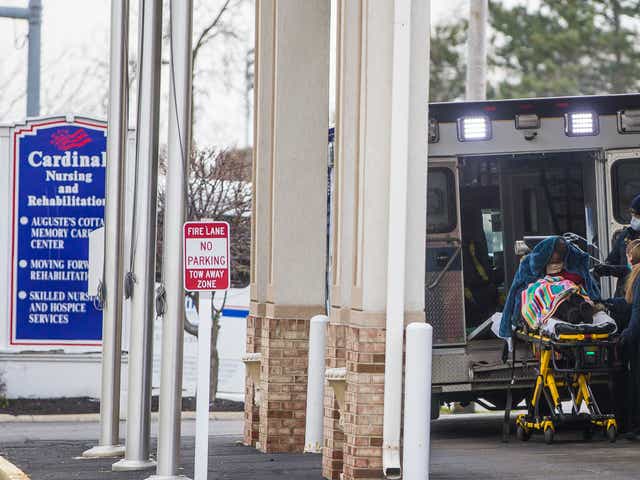
That lack of preparation was evident at Cardinal Nursing and Rehabilitation, a nursing home in South Bend owned by the Health & Hospital Corp. of Marion County. 

Like a majority of Indiana’s nursing homes, Cardinal ranked in the bottom third of all nursing homes in America for the amount of time nurses and aides spent with residents before the pandemic, according to data from the federal Centers for Medicare and Medicaid Services.

So when the virus hit Cardinal in early April, officials admitted they were basically helpless. A local hospital official who suspected an outbreak rushed 60 swabs and urged the facility to immediately test each resident, a state inspection report said.

But the home didn’t have enough staff to swab the residents and couldn’t isolate those who were infected, an official told inspectors. Nineteen Cardinal residents have died of COVID-19, according to state data.

A person is loaded into an ambulance outside Cardinal Nursing and Rehabilitation on Tuesday, April 14, 2020, in South Bend, Ind.
A person is loaded into an ambulance outside Cardinal Nursing and Rehabilitation on Tuesday, April 14, 2020, in South Bend, Ind. - Robert Franklin/South Bend Tribune via USA TODAY Network

A spokesman for Health & Hospital did not directly respond to questions about Cardinal, but defended the quality of the agency’s nursing homes, noting they are above average compared to other Indiana nursing homes. 

That's little comfort to Kristin Billings. She said she had to call the police to check on her mother because the staff was stretched so thin that they stopped responding to her calls. After her mother recovered from COVID-19, Billings moved her out of Cardinal.

“I was fighting like crazy for my mom,” she said. “Never again would I put anybody in that place.”

The tragedy at Cardinal highlights how Indiana’s nursing home system fails its vulnerable residents. HHC, which operates the Sidney & Lois Eskenazi Hospital in Indianapolis, is the state’s largest nursing home owner. In 2019 alone, the public agency received $182 million in extra federal funds for its 78 nursing homes. But the hospital spent $117 million on other uses instead of on improving care at the homes.

The same scenario has played out at hundreds of nursing homes owned by HHC and other county hospitals. More than $1 billion in nursing home money has been used to prop up hospital projects, such as the construction of the $754 million Eskenazi hospital.

The hospitals have defended the funding arrangement, arguing it benefits both nursing home residents and hospital patients. But as the pandemic has played out, it has become clear that Indiana’s nursing homes lacked the staff and resources to protect residents from COVID-19.

Indiana has had among the highest number of deaths per 1,000 nursing home residents. More than 20% of long-term care residents who have contracted COVID-19 in Indiana have died. The national rate is 13%.

About 39% of COVID-19 deaths across the country have been linked to long-term care facilities. In Indiana, long-term care residents account for more than 52% of the deaths, but less than 1% of the population.

And almost no facility has been spared: 484 of the 534 facilities in Indiana have had at least one case. More than 393 have had at least one COVID-19 death.

The pandemic further overwhelmed a workforce that was already among the thinnest in America. Going into the pandemic, Indiana ranked 48th for the amount of time nursing staff spent with residents after adjusting for their needs, according an IndyStar analysis of federal data.

Zach Cattell, president of the Indiana Health Care Association, which represents the nursing home industry, acknowledged the staffing issues in an emailed statement, but blamed them on "hiring challenges" outside of the industry's control. He did not, however, provide an explanation for how those hiring challenges are unique to Indiana or why 47 other states have done a better job of staffing positions.

A months-long IndyStar investigation published in March found scores of inspection reports and malpractice claims involving injuries or deaths that may have been prevented with adequate staffing: bed sores allowed to fester until limbs had to be amputated, repeated falls that left residents with broken bones or fatal head injuries, and violent attacks among unsupervised residents.

That was before the pandemic presented an unprecedented public health crisis. As signs touting “heroes work here” sprouted up in front of nursing home facilities, a workforce already stretched thin was pushed to the brink.

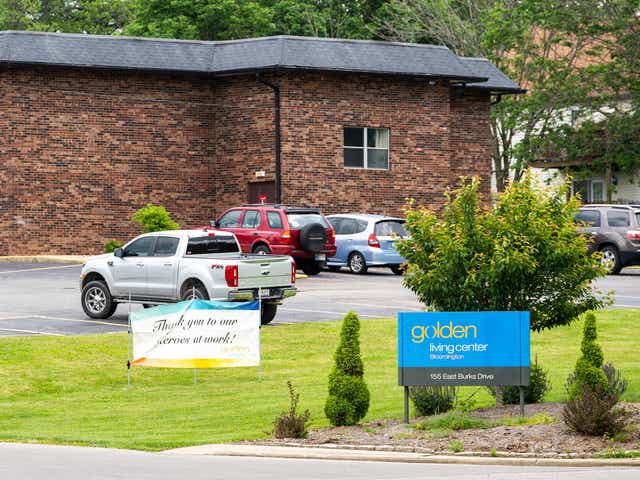
Golden Living Center in Bloomington, Ind., on Thursday, June 4, 2020.
Rich Janzaruk/Bloomington Herald Times via USA TODAY Network

Employees who spoke to IndyStar describe being pressured to work with symptoms or without proper protective equipment. They watched their teams shrink as staff became sick and were sent home, with little hope for reinforcements.

“We were short and overworked,” an aide told IndyStar of her experience working at Golden LivingCenter in Bloomington this spring. “We had nurses that sat at the desk and was in tears, crying because either one of their co-workers or another nurse had tested positive and had been sent home.”

Wesley Rogers, president of Golden LivingCenters, dismissed such complaints in a statement, saying they “inaccurately or incompletely report events.”

Carmela Canale, who had been a licensed practical nurse for 27 years, quit her job at another nursing home in March when the management company introduced new coronavirus measures but did not bring in additional staff.

Carmela Canale stands for a portrait at a park in Indianapolis on Sunday, Sept. 27, 2020. Canale had been a licensed practical nurse for 27 years, but quit her job in March when the management company introduced new coronavirus measures but did not hire additional staff. Canale, who has worked as an LPN in several states, said nurses are pulled in too many directions, underpaid, and facilities are chronically understaffed. "It breaks my heart because people are not getting the care they need," Canale said.
Jenna Watson/IndyStar

“I was already so overwhelmed by what needed to be done,” Canale said. When additional duties were added, such as changing protective equipment between residents, she said to herself: “I just can’t, I can’t do everything that you want and put something else on top.” 

Preliminary research has shown that facilities with poor staffing before the pandemic were more likely to have more coronavirus deaths.

While the presence of the virus in the community surrounding a nursing home was the most important factor, having more nurses and aides prior to the pandemic was associated with fewer deaths in facilities with outbreaks, according to a national study by Tamara Konetzka, a professor of public health sciences at the University of Chicago.

A handful of other studies focused on specific states have also found associations between higher nursing staff levels and fewer COVID-19 cases or deaths.

The human reality of those trends is documented in recent inspection reports. Even though the availability of testing, protective equipment and infection control training has improved since the early months of the pandemic, staffing shortages and the problems they cause have continued to put vulnerable nursing home residents in danger. 

At Countryside Manor in Anderson, where 14 residents have died, inspectors found employees caring for COVID-positive and negative residents alike in September, potentially exposing residents to the virus. An employee told inspectors the facility could have prevented a recent increase in falls if they’d had more staff. 

At Southwood Healthcare Center in Terre Haute, where six residents have died, inspectors found “a systemic failure” in infection control practices in October. “Residents were not closely monitored for symptoms of COVID-19 during the outbreak,” a report said, adding some with unknown COVID-19 status were observed smoking with healthy residents. “No staff were observed in the area to redirect residents to social distance at this time,” the inspection found. 

A sign informs passersby that Bethany Village Healthcare is hiring, seen on the south side of Indianapolis on Thursday, Aug. 6, 2020.
Jenna Watson/IndyStar

Southwood, owned by Hancock Regional Hospital, was also cited for insufficient staffing in August and again in September. Employees told inspectors “they did not feel there were enough staff to take care of the residents.” Call lights were not answered, residents were not groomed and some did not receive their medicines. One man was found on the ground calling out for help, having soiled his pants. Southwood was in the bottom 6% in the nation for total nursing staff hours as of Oct. 1.

A spokeswoman for Southwood acknowledged staffing has been challenging "given the high infection rates" in the area, and the facility has used temporary workers to care for residents during the pandemic.

How we got here

The lack of staffing is a product of the way Indiana funds nursing homes.

For years, county hospitals have been gaming the Medicaid system with the permission of state and federal officials. An arcane federal law allows government-owned nursing homes to draw extra funds. The intent was to provide extra financial assistance to homes that often serve as the last resort for poor and medically needy residents. 

But Indiana has exploited the program, effectively turning it into a major revenue stream for 22 county hospitals that have snatched up — at least on paper — more than 500 of the state’s nursing homes in recent years. Indiana now receives more of the extra money than any other state. More than California and New York — combined. The haul was more than $679 million last year alone. 

Much of it never reaches the nursing homes. County hospitals have diverted more than $1 billion to their own operations. Neither the state nor federal government require an accounting of how the money is spent. The loose oversight has allowed rampant fraud, with allegations of roughly $65 million in losses at just two county-owned systems since 2008.

As a result, Indiana has had one of the most expensive, least efficient nursing home systems in the nation. In sheer dollars, Indiana ranked fourth in 2019 for Medicaid spending on nursing home care. The price tag: A whopping $2.6 billion. That’s more per resident than every state but West Virginia. Yet staffing, widely regarded as the most important factor in quality care, has consistently been among the worst in America.

David Grabowski, a professor of healthcare policy at Harvard Medical School, compared Indiana hospitals to private equity firms that extract money with little concern about care outcomes or long term viability.

“This just really gives me pause,” he said. “I wonder how these county hospitals are viewing ownership of these nursing homes other than this is a way to pull down more money and not actually invest in patient care.”

The irresistible funding source has kept Indiana’s eldercare system skewed in favor of institutionalized care. As of 2016, the most recent data available, 48 other states devoted a larger share of their long-term care Medicaid funds to home and community-based care. That not only allows residents to age at home where they are more comfortable, but it is also less expensive for taxpayers. 

Nationally, states spend an average of about 57% of their long-term care funds on home and community-based care. Indiana spends just 32%. 

“Right now, if someone is hospitalized and they're about to be discharged from the hospital and they need care, the default in too many cases is institutional care,” said state Rep. Ed Clere, a New Albany Republican who is chairman of the House Ways & Means subcommittee on health and Medicaid. “They could have a high quality of life in their home. But that is not the way the system is designed.” 

The imbalance has become even more consequential amid the pandemic. If fewer Hoosiers were trapped in Indiana’s nursing homes where the virus can spread so easily, more may have survived.

Edward Nave, a General Motors retiree, was a Vietnam veteran and longtime deacon at Second Missionary Baptist Church in Anderson.
Photo provided by Hazel Nave

Edward Nave, a General Motors retiree, was a Vietnam veteran and longtime deacon at Second Missionary Baptist Church in Anderson.

Nave, 72, died April 6 at Bethany Pointe Health Campus in Anderson where he had gone in February for a 30-day rehab stint following surgery.

Nave was ready to leave Bethany Pointe and return home, but a home care assistant his wife hired needed proof he had been tested for COVID-19. His family frantically fought to get him tested, but said they got a runaround from county and state health departments and the nursing home.

"I talked to him Wednesday and he told me he was doing okay, but he was ready to come home. And I said, 'Ed, I'm getting you home.' I said, 'give me to Friday, and I'm going to come and get you,'" Nave's wife, Hazel, promised her husband five days before he died.

Reform efforts fall flat

The shortcomings of Indiana’s nursing home system have been well-known to state officials and lawmakers for years. They have repeatedly studied the problems, but proposals to improve the system have consistently failed.

A 2015 report by the state’s Family and Social Services Administration said a surplus of nursing home beds and low occupancy rates at Indiana nursing homes were expensive, inefficient and contributed to a decrease in the quality of care for thousands of vulnerable Hoosiers.

Indiana’s long-term care system “must transform, and soon,” the report warned.

But reforms have failed to materialize, in part due to pushback from the nursing home industry. Lawmakers instead cloaked the program in secrecy by granting county hospitals unusual exemptions to public records laws. 

Members of both parties have tried to establish minimum staffing requirements for Indiana nursing homes, which the industry has said won't help. Five bills have been filed since 2009. None of them even received a committee hearing.

Former state Rep. Clyde Kersey, a Democrat from Terre Haute who filed four of the bills, said the industry has a lot of clout at the Statehouse. “I couldn't get any traction,” he said. “I couldn't even get people from my own side to support it.”

Under then-Gov. Mike Pence, FSSA officials tried another approach. After years of negotiations, they reached a tentative deal with the nursing home industry that would have shifted more funds to home care, incentivized the closure of some nursing homes, and tied 25% of the extra nursing home funds to quality standards. The goal was to improve care for older Hoosiers, including those in nursing homes, while reducing costs.

But when Gov. Eric Holcomb took office, the deal was scrapped. Holcomb has not explained why. IHCA's Cattell said his organization supports "appropriate steps" to rebalance Indiana's long-term care sector, tie supplemental funds to quality and right-size nursing home capacity. He did not explain what happened to the deal with the state that would have done just that.

While reform efforts fell flat, lawmakers had no problem granting unparalleled levels of financial secrecy to the county hospitals that own the homes.

In 2006, they passed a law that allows county hospitals to keep “proprietary and competitive” information confidential. Most are now using the exemption to hide their deals with private management companies and the amount of nursing home money they divert to other uses.

Lawmakers again singled out county hospitals in 2016, allowing them to withhold employee pay information, including executive compensation. No other government agency in Indiana is granted such an exemption and even private hospitals must typically disclose the earnings of their highest paid employees. 

As a result, it’s impossible for the public to know how county hospitals have spent the more than $4.4 billion in extra Medicaid funds their nursing homes have generated since 2003.

Money and power

One reason Indiana’s broken nursing home system persists is because it is extremely profitable for those involved.

County hospitals now technically own most of Indiana’s nursing homes, but their former private owners have not gone away. Instead, they continue to run the nursing homes in exchange for lucrative management fees — and in turn, spend large amounts of money on state campaign contributions.

The arrangements helped make many of those operators wildly rich. Take, for example, American Senior Communities, which is owned by the Jackson family of Indianapolis. During the past 10 years, Marion County’s HHC has paid the company and related entities nearly $550 million in fees and lease payments. That doesn’t include millions more in revenue from other businesses, also owned by the Jacksons, that provide products and services to HHC’s nursing home system.

Flush with the extra cash, the nursing home industry has poured nearly $3 million into Indiana political campaigns since 2009, according to an IndyStar analysis of campaign finance data. 

The vast majority of the money — more than $2 million — can be traced to just five nursing home operators and their various homes, companies, and executives. At least $437,000 came from the Jacksons, their affiliated companies and ASC executives. 

The owner of Magnolia Health Systems, which operates about 30 homes, and his companies spent about $565,000. And it wasn’t just cash. Stuart Reed, who lives in a $4 million Zionsville mansion, also provided an additional $10,000 in event catering and travel services for Pence during his initial run for governor, campaign finance records show.

The case files of some clients that the Center for At-Risk Elders has lost due to COVID-19, seen on Tuesday, Oct. 13, 2020. The center represents more than 150 elderly and disabled Hoosiers through its adult guardianship program and had lost 16 clients to COVID-19 as of December 11, 2020.
Jenna Watson/IndyStar

The biggest beneficiaries include Pence’s campaigns for governor, which received $739,000, and Gov. Holcomb’s campaign committees, which received $250,000 from the industry. Another $458,000 went to the Republican House and Senate campaign committees.

Those sums give the operators and their trade group, the Indiana Health Care Association, tremendous sway at the Indiana Statehouse, according to former lawmakers and state officials.

The industry’s ties run even deeper. Many state officials have personal financial relationships with the industry. Some lawmakers find jobs at nursing home chains or owners while serving. Others worked in the industry before getting elected. One lawmaker, former Rep. Eric Turner, stepped down after privately lobbying against a measure that would have hurt his family’s nursing home investments.

The deep connections allow the industry to push back against perceived threats. In 2015, existing nursing home operators successfully lobbied for a three-year moratorium on new nursing home construction, effectively blocking potential competition. Pence, who was governor at the time, expressed reservations about the measure, but in a rare move allowed it to become law without his signature.

Five years later, and amid a pandemic, Indiana is barely any closer to fixing its nursing home troubles. During the pandemic, residents have died of the virus at a rate of one every two hours. Yet state officials routinely have chosen to defer to the industry — often keeping important information from the public.

'Immediate jeopardy'

Early in the pandemic, state health commissioner Dr. Kristina Box praised nursing home operator Magnolia for creating a dedicated COVID unit.

“What they're doing is amazing,” Box said on March 31. “These folks have stepped up, saying this is who I am and this is what I do, so that we can take good care of residents and their communities by simply doing the right thing.”

That’s not how things played out at Magnolia's Brooke Knoll Village in Avon. Just days after Box hailed Magnolia’s COVID-19 response, her own inspectors discovered staff at the facility didn’t have enough PPE and failed to isolate symptomatic residents. Instead, they would run a battery of tests to rule out everything but COVID-19 before taking precautions. State inspectors said the situation amounted to “immediate jeopardy” for failing to protect residents during a COVID-19 outbreak.

Staff at the facility hid information about the outbreak from families, according to Tammy Bowman, whose sister resided at Brooke Knoll. In interviews with IndyStar, Bowman said staff repeatedly claimed they had no coronavirus cases — even after her sister was taken to the hospital and tested positive.

“I'm just flabbergasted,” Bowman said. “I will never wrap my head around it.”

Abby Gray of Magnolia Health Systems, which operates Brooke Knoll on behalf of Daviess Community Hospital, said she could not specifically speak to Bowman’s situation because of privacy laws, but said proper notification had been made.

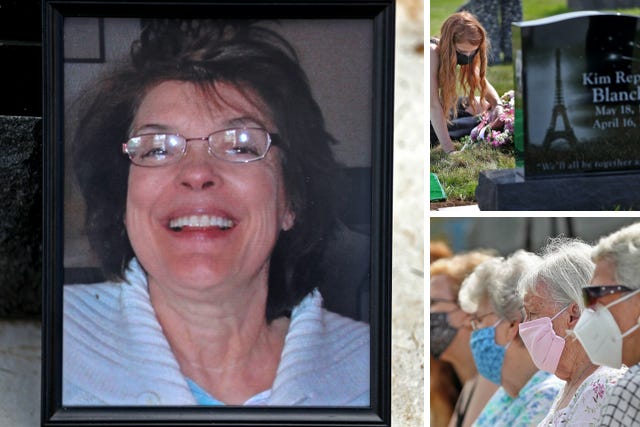
If the state had been more forthcoming about outbreaks, families like Bowman’s could have made life-saving decisions about whether to remove their loved ones. But they were never given that choice. Bowman’s sister, Kim Blanchar, died April 16.

Kim Blanchar, a former French teacher at Brebeuf high school, suffered from multiple sclerosis.
Photo provided by Tammy Bowman

Kim Blanchar, a former French teacher at Brebeuf high school, suffered from multiple sclerosis.

She was a resident of Brooke Knoll Village in Avon. She died from COVID-19 on April 16.

State health inspectors discovered the facility didn't have enough PPE and failed to isolate symptomatic residents.

"She had a big heart," her sister, Tammy Bowman, said. "She was a very generous person."

Despite outcry from families, the Holcomb administration rejected records requests from IndyStar and other media outlets seeking the information. At one point, Holcomb defended the state’s stance by incorrectly calling the nursing homes private businesses — even though more than 90% are owned by public hospitals that rake in hundreds of millions of dollars in extra payments every year because of their government ownership.

Not until late July, after CMS said it would begin releasing facility-level data, did the state finally release that information. Indiana was one of only a handful of states to wait so long.

Indiana also was behind other states in requiring regular testing for workers, widely regarded as the leading source of the virus getting into nursing homes. In New York, for instance, the governor issued an executive order May 10 requiring all nursing home employees to be tested twice a week.

But Indiana did not enact a comprehensive testing program until June. Even then, it involved just a single test for all workers while other states were testing staff much more frequently.

After CMS mandated regular testing, Indiana nursing homes struggled to keep up. Inspectors cited 27 homes for failure to test their workers this fall, more than most states, according to preliminary federal reports.

'Complicated, unwieldy and increasingly dysfunctional'

Fixing Indiana’s broken nursing home system won’t be easy. Any effort at meaningful reform will likely create ripples across the complex financial relationships between the state, county hospitals and their private operators.

“We have an incredibly complicated, unwieldy and increasingly dysfunctional health care system at every level,” Clere, the lawmaker, said. “At some point we are going to have to step back and address the system as a system, rather than continuing to nibble around the edges without ever getting to systemic solutions.”

Advocates and family members say the complicated nature of the problem shouldn’t prevent change — and now is the time to act.

“I think that this needs to be a critical learning opportunity for all providers, all public health officials, all stakeholders, all lawmakers that there are things happening right now,” said Reichert of the Center for At-Risk Elders. “Let's make sure it never happens again.”

In early December, IndyStar requested an interview with the governor to discuss Indiana’s nursing home system, the state’s coronavirus response, and ways lawmakers might improve the system. His spokeswoman quickly responded:

“The Governor is not available.”
 
Full Article & Source: