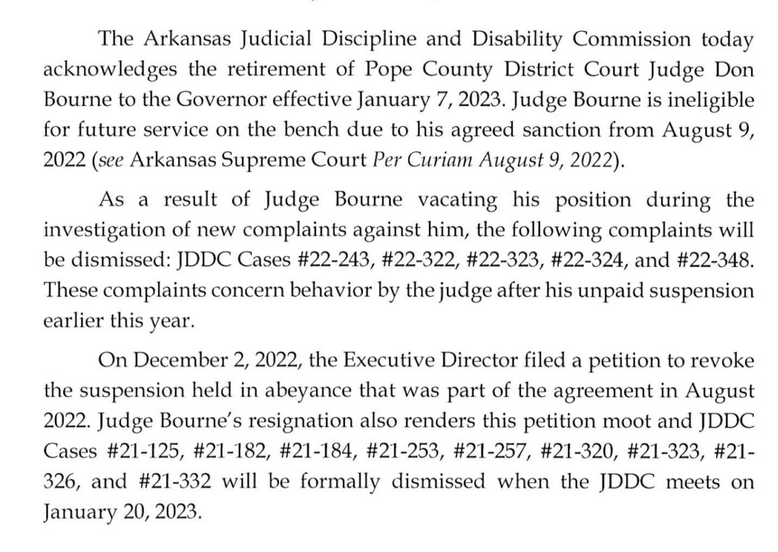
Details are lacking, but this news release suggests that Pope County District Judge Don Bourne, suspended without pay for two weeks for ethical infractions last year, didn’t learn his lesson.
In August,
the Arkansas Judicial Discipline and Disability Commission recommended
that the Arkansas Supreme Court suspend Bourne without pay for 90 days,
with 75 days held in abeyance if his behavior improved. He also accepted
a censure. The deal meant that, with good behavior, he could hold his
office until the end of his term on Dec. 31, 2024.
The disciplinary body moved to revoke the suspension held in abeyance
on Dec. 2, following five more complaints about the judge’s conduct.
Bourne, who had 20 years as a judge and 20 years as a city attorney
and deputy prosecutor, had a sketchy record dating back a long while. As
we wrote in August:
One count of the complaint said he made demeaning
comments to defendants — such as telling Spanish speakers they should
learn English and making negative comments about people who were not
from Pope County.
Another count said he had mishandled indigence requests. Requests for
indigent status were rarely approved and records weren’t kept. In some
misdemeanor cases, he told defendants he wouldn’t appoint an attorney,
telling them instead “Get a job.” The count cites extensive reporting by
KARK on Bourne’s court.
Bourne had been disciplined before for making a campaign contribution in a partisan political race.
The finding said Bourne lacked “humility and compassion” and he did
not attempt to make court fair to the powerless and vulnerable.
It said Bourne’s actions were part of an extended pattern of conduct
and he didn’t appear to see the problem and begin to change his behavior
until advice from legal counsel.
The Supreme Court followed the disciplinary recommendation. He agreed to several remedial measures.
*Observing and reflecting on the conduct of other judges.
*Record proceedings in his court.
*Allow commission courtroom monitors
*Attend a judicial ethics class.
*Read about and take training about bullying and harassment.
I’m attempting to learn more about the nature of new allegations that prompted his early departure from the bench.
UPDATE: David Sachar, executive director of the commission, said days
after Bourne was back on the bench he continued making discourteous
comments about people in court — about their weight, where they lived
and how they earned a living. The disciplinary staff was able to confirm
complaints received about Bourne because of the recording devices
installed in the courtroom as part of the previous discipline.
Sachar added:
The public should be treated with dignity,
patience, and courtesy when they appear in front of a judge. This
increases the public’s confidence in the justice system. Proper judicial
demeanor is not an afterthought – it is a necessary quality for a judge
to fulfill their oath to the people of the State of Arkansas.
Allegations of systemic mistreatment of
people who appear in court are taken seriously. Judges hold incredible
power. The vast majority of them wield that power effectively while also
being as courteous as possible. I am thankful for the judges that
uphold their oath while treating everyone with dignity.
Judge Bourne agreed to leave the bench
after we filed a motion to petition the Supreme Court to instate his
remaining unpaid suspension. We had new complaints – some literally from
just days after he returned to the bench – and those were being
investigated as well. Now all his complaints will be closed as he will
no longer be a judge.
Rensselaer City Court Judge Kathleen
Robichaud was disciplined by the state's Commission on Judicial
Conduct for invoking her judicial status while representing her niece's
boyfriend in seven courts in three counties
by Robert Gavin
JamesBrey, Contributor / Getty Images
ALBANY – The state’s watchdog panel for the judiciary
has disciplined a longtime Rensselaer City Court judge for invoking her
judicial status while representing her niece's boyfriend in seven
courts in three counties.
Judge Kathleen Robichaud, who emailed local courts and a Family Court
magistrate in her own county using her judicial account that contained
the word “judge” in the title, received a censure — the second-most
severe of the three punishments meted out by the state Commission on
Judicial Conduct.
Robichaud,
an attorney since 1990 who has been on the bench since Jan. 1, 1996, is a
part-time judge in the city of 9,200 residents across the Hudson River
from Albany. She violated ethical rules for judges that prohibit them
from using their judicial titles to advance their private interests or
the interests of others.
In a stipulation, Robichaud, 60, and the commission agreed that between
March 2019 and April 2021, Robichaud used an email address on court
filings and legal correspondence in Rensselaer, Albany and Rockland
counties that identified her as a judge.
The cases involved Robichaud's legal representation of her niece's
boyfriend in an effort to clear his driver's license for suspensions he
received due to traffic tickets he faced in the local courts of Sand
Lake, as well as Bethlehem, Watervliet, Guilderland, Knox and Stony
Point in Rockland County — as well as a child custody matter in
Rensselaer County Family Court.
In the Sand Lake case, both sides agreed, Robichaud
crossed out the words “notary public” and identified herself as “City
Court Judge.”
The commission said she used her judicial email
address to communicate with the support magistrate handling the Family
Court case, as well as the opposing attorney, in the matter in her own
county.
"By using her judicial title in this way, respondent
violated the rules and lent the prestige of her office to benefit her
client," the commission's determination said.
Robichaud told the commission that since 2014, she had assisted three
clients free of charge and no longer practices law, while remaining a
member of the New York State Bar Association. She said she would create a
new email address that did not mention her judicial post, the agreement
said.
The commission's administrator, Robert Tembeckjian,
recommended Robichaud be censured, as opposed to a less-severe public
admonition, because she was previously disciplined by the commission in
2007. That time, Robichaud was disciplined for delays in her rendering
of judgments and decisions on motions and cases and in her reporting of
it to the administrative judge.
“Part-time judges who practice law must scrupulously
avoid even the appearance of asserting their judicial title for the
benefit of private clients," Tembeckjian said in a statement. "Using an
email address as an attorney – that announces you are also a judge –
crosses an ethical line and undermines the integrity of the judiciary.”
Robichaud's term ends at the end of 2025.
Robichaud represented herself. The commission's case was handled by its
deputy administrator, Cathleen Cenci, senior attorney Kathleen Klein and
investigator Laura Misjak.
Detroit ― A Detroit judge is "unfit" for
the bench and should be removed from the position, according to a report
from the Michigan Judicial Tenure Commission.
The
commission determined each of 36th District Court Judge Kahlilia
Davis's multiple acts of misconduct are "egregious in their own right," according to the organization's decision and recommendation for discipline that was released Friday night.
Davis was accused of failing to record court proceedings, refusing to
abide by a performance plan the court set up for her and blanketly
dismissing cases from a specific process server because she did not
trust him.
Judge Kahlilia Davis - Facebook.com
"When
Respondent was not prejudicing the actual administration of justice or
missing work or incorrectly applying the law or disrespecting her
colleagues and administrators or conducting unrecorded proceedings,
Respondent tried using her status as a judge while out in the public for
improper personal gain," the JTC wrote in its report.
The commission called her "incorrigible and incapable of conforming her behavior to the standards required of a judge."
Davis was suspended by the Michigan Supreme Court
in June 2020 and has not been on the bench since. She is not running for
reelection because the Michigan Secretary of State determined she lied
on her affidavit of identity and therefore was not eligible. Davis is a
judge through January 2023.
Davis' attorney,
Michael Alan Schwartz, did not respond Monday to a request for comment.
In previous court filings, Schwartz has said the JTC made "some
unfortunate observations that are not appropriate." He did not like that
the commission made its own decisions on matters after members didn't
find the fact-finder's conclusions to be sufficient.
Schwartz said Davis made some mistakes, but that
the fact-finder, Michigan Court of Appeals Judge Cynthia Stephens,
showed in her August report that the JTC didn't prove misconduct.
The
case will now go to the Michigan Supreme Court for a disciplinary
decision. The JTC recommends the Supreme Court remove Davis and suspend
her without pay for six years. The suspension would only become
effective if she ends up on the bench again during that period.
JTC: Davis lied during probe
The
commission, a state watchdog agency that investigates judicial
misconduct, noted its unhappiness with the fact-finder's decisions,
which "absolved her of every instance of the most serious misconduct."
The fact-finder ignored important evidence and resolved every
credibility determination in Davis' favor, it wrote.
In
its report to the Supreme Court recommending discipline, the commission
noted its disagreements. The JTC also said Davis knowingly made at
least 13 statements that she knew to be false, according to the JTC's
response to Stephens' report.
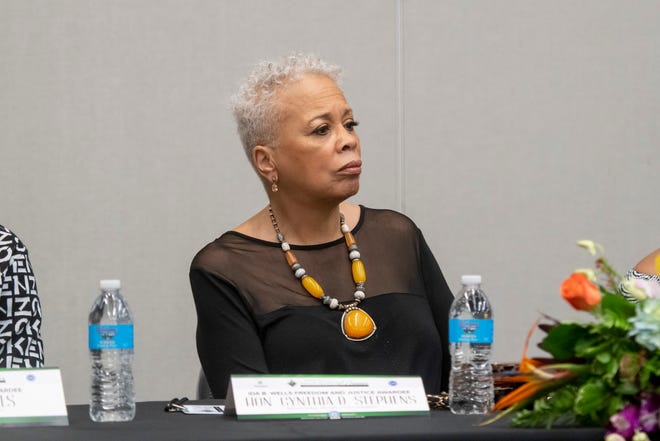
Michigan Court of Appeals Judge Cynthia Stephens'
fact-finding report on 36th District Court Judge Kahlilia Davis was
critized by the Michigan Judicial Tenure Commission. David Guralnick, The Detroit News
"Dishonesty
in these circumstances erodes the public’s confidence in the
judiciary," the commission wrote in its report to the Supreme Court.
"(Davis') misconduct has been the subject of repeated media coverage in
Wayne County, which casts not only (Davis), but the judiciary as a
whole, in a negative light."
The JTC determined there was evidence that Davis had:
Incorrectly and "incompetently" applied contempt law and ordered thousands of dollars to be unjustly paid.
Believed
a process server to be untrustworthy, so she dismissed or adjourned
every case that server brought to her, without considering the merits of
the case, even after the chief judge ordered her to stop. The JTC said
more than 22 cases were proven to have been affected by the judge's
conduct.
Routinely showed up late, missed
days of work and performed the job poorly, according to the report. The
State Court Administrative Office stepped in to make a performance plan
for her, in which Davis refused to participate. Instead, she attacked
the people assigned to help her "with discourteous and unprofessional
written threats and barbs, including biblical quotes insinuating that
her colleagues and the administrators should or would go to Hell."
Disabled
the video equipment in her courtroom because she didn't want colleagues
or court administrators watching her. She did not have a court
reporter, however, so she conducted most of her court proceedings with
no record. Davis recorded some proceedings with her personal phone and
published one of the hearings on Facebook Live. The JTC determined she
repeatedly lied under oath about this.
Parked
in the handicap loading zone, blocking the side door of a disabled
person's car, at her gym while displaying a Detroit police "official
business" placard. She showed her judge's badge to the Detroit police
officer who responded after the person whose car was blocked called
police.
Schwartz said a lot of the issues JTC brought up
were only because Davis was treated unfairly by the 36th District Court
after she was elected. He said she was the only judge not allowed to
have a court reporter and she did not receive training on the video
equipment, which was not mandatory to use.
Schwartz
said it is possible the 36 District Court chief judge was trying to
sabotage Davis, and that Davis' health issues complicated her role. The
fact-finder found that most of her absences from work were due to
medical reasons.
"With the health problems that Respondent suffered, she did her best to work to the fullest of her ability," Schwartz wrote.
Davis suspended multiple times
Davis
was elected in November 2016 and began her term in January 2017. She
was initially assigned to the landlord-tenant docket and remained there
until October 2017. At this point, then-Chief Judge Nancy Blount removed
her from presiding over any cases and set up her performance
improvement plan.
Blount's plan required Davis to attend work daily. Later, Blount requested she report her arrival and departure times.
Davis
refused to do so, however, and said the actions were "unfair and
unnecessary," according to the JTC report. She began sending Blount, the
regional court administrator and the 36th District Court administrator
emails containing biblical passages that they found "threatening and
baffling." Davis routinely told them to "find someone else to harass."
The
judge sent 12 such emails, even after a meeting with the regional court
administrator and her attorney, according to the JTC report.
Immediately after the meeting, Davis sent another email that began with
"You brood of vipers, how can you who are evil say anything good?"
During this time, Davis was an auxiliary judge,
which essentially functioned as a substitute judge, Davis testified
during the JTC investigation.
Blount assigned
her to the business license docket in January 2019. Davis requested a
court reporter, but the 36th District Court administration did not send a
court reporter because she had video recording equipment, according to
JTC records.
Davis was again suspended in March 2019 for failing to record the business license hearings. In January 2020, she was assigned to the traffic misdemeanor docket.
The
JTC filed its formal complaint against Davis on March 16, 2020. She was
consequently suspended again in June 2020 by the Michigan Supreme
Court.
Two months later, she filed a federal
lawsuit against the 36th Circuit Court alleging she was discriminated
against and harassed. A judge dismissed the lawsuit in June 2021.
PATERSON — The New Jersey Supreme Court
disciplined Paterson Municipal Judge Cecilia Sardina Guzman with a
public censure last week for hearing city cases while she was ineligible
to practice law.
It's the second time the
judge has been rebuked by the state's highest court. Guzman previously
came under censure from the Supreme Court’s Disciplinary Review Board
for lapses in her private law practice in handling two divorce cases.
The censure announced last week
— essentially a public reprimand — said Guzman violated codes of
judicial conduct, but it did not require her removal from her role as
one of Paterson’s judges. City officials could not be reached for
comment about Guzman’s status in the Municipal Court.
Her
lawyer, Robert Ramsey, said Guzman has decided to give up her private
law practice in order to focus on her work as a city judge.
“She’s thrilled to put this behind her and move on with her professional life,” Ramsey said.
Paterson Mayor Andre Sayegh said in February 2021 that Guzman's tenure was under review.
“We will let this matter continue in its proper course," he said at the time. "Judge Guzman is entitled to due process and a fair hearing, and we respect her rights in that regard.”
“To date,” the mayor added, “there has been no
known impact or effect on Paterson Municipal Court cases or operations.
We will continue to monitor the progress of this case.”
Guzman’s
salary as a city judge is $45,900, according to recent payroll records.
She was appointed to the position in 2014. She is one of six municipal
judges in Paterson.
She previously served in
the same role in Dover in Morris County. Her lawyer said she was
replaced in Dover as part of the changing of the political guard in that
town’s municipal government.
Guzman lost her eligibility to practice law from
Oct. 22, 2018, until Oct. 17, 2019, because she failed to properly
register a trust fund used to deposit clients' money, according to court
records. In February 2021, she filed a three-page response with the
Supreme Court’s Advisory Committee on Judicial Conduct in which she
admitted all 20 claims made by the state Supreme Court panel in its
two-count disciplinary complaint.
Ramsey said
Guzman had not known about her ineligibility to practice law and
properly registered the trust fund within 48 hours of finding out to get
her status restored.
Guzman has been the
target of double-barrel disciplinary proceedings. In addition to the
complaint by the Judicial Conduct committee, she also has been censured
by the Supreme Court's Disciplinary Review Board, which oversees
complaints about lawyers' conduct and ethics.
The
review board decision said Guzman committed "gross neglect," "lack of
diligence" and "failure to communicate with the client" in those cases.
The decision also cited "recordkeeping violations and negligent
misappropriation of client funds."
Family Court Judge Jill S. Polk admonished by Commission on Judicial Conduct, an organization she once worked for
by Robert Gavin
Judge Jill Polk
ALBANY – A state judiciary watchdog panel on Wednesday disciplined a Family Court judge in Schenectady County who used her secretary to plan her daughter’s bat mitzvah celebration – a violation of rules that prohibit judges from using court resources for their own benefit.
The Commission on Judicial Conduct imposed the punishment of
admonishment on Judge Jill S. Polk, who began a 10-year term in January
2015. It is the most lenient of the commission’s options to discipline
judges; more serious options include censure and removal from the bench.
Polk – a former attorney for the commission based in
Albany from 2008 to 2014 – had the secretary, close friend Chara Ritter,
do other tasks as well, such as researching options for Polk for
vacation rentals, vehicle service, a locksmith and the cost of a
landscaper, the commission said. It noted the judge did not in any way
coerce the work.
And the commission found that between 2015 and 2017, Polk allowed her
daughter to be unsupervised in the courthouse, where the child
regularly spoke to court officers as they worked a magnetometer at a
security checkpoint. The girl, 12 and then 13 at the time, would
innocently ask the officers about items being scanned. Still, the
commission noted it was a distraction that impeded the officers' work,
which included possible confiscation of weapons and dealing with
disputes between nearby Family Court litigants.
Polk, who has served as an acting state Supreme Court
justice since 2017, was first accused of the misconduct in September
2019. Represented by attorney Stephen Coffey, the judge disputed
allegations of wrongdoing. The commission appointed attorney Michael
Hutter, an Albany Law School professor once nominated for the Court of
Appeals, to preside over a four-day hearing via video where the judge
testified on her own behalf.
In June 2021, Hutter determined Polk violated rules governing
judicial conduct. The commission’s administrator, Robert Tembeckjian,
recommended that Polk be removed from the bench. Coffey asked for
Hutter's determination to be disaffirmed or, in the alternative, a
punishment of admonishment be imposed.
"To impose a severe sanction on a hardworking judge who
accepted a little help from a close friend where no one, including the
state, was negatively affected as a result, would be ludicrous and
unwarranted," Coffey stated in a brief to the commission last August.
Polk apologized for her actions when given a chance to speak in October, following Hutter's ruling.
"I should have done it differently," Polk told the
commission. She said she initially rejected Ritter's offer to plan the
bat mitzvah, but later agreed to it if Ritter did the work off-hours,
which did not happen. "It has, you know, it got away from me," she said.
"But it wasn't done with any kind of intent to violate any rule. It was
done in a compassionate way. It was done in a humanity way and I'm
sorry that I didn't recognize it at that time and stop it."
The investigation noted that Polk worked for the commission when it
scrutinized two judges for using staff for personal purposes.
The commission went for the lighter sanction. Its
determination noted that Polk had no prior disciplinary history and was a
relatively new judge at the time of the wrongdoing.
“Although the commission and I disagreed on the appropriate sanction in
this case, the commission made clear that it was wrong for Judge Polk to
have her court-paid secretary perform extensive acts of personal
assistance, using court resources, on court time,” Tembeckjian said in a
statement.
“It was also wrong for Judge Polk to allow a security issue to
fester, despite specific notice from a ranking officer that her young
child’s regular, unsupervised presence at courthouse magnetometers was
problematic," Tembeckjian said. "Judge Polk knew better, having been an
attorney at the Commission when two other judges were publicly
disciplined for similar misconduct.”
In November 2014, Polk, a Niskayuna Democrat and an
attorney since 1988, won a three-candidate race over Deanna Siegel and
Ursula Hall to win the judgeship.
In its determination, the commission noted that when Polk
worked as a commission attorney, it rendered two decisions on judges
who used court staff for personal purposes.
Ritter started working as the judge's confidential
secretary in January 2015 after interviewing with Polk and Polk's court
attorney, Nancy Stroud. Ritter, a former receptionist, taught Stroud's
nieces in Hebrew school, the commission's determination said.
According to the determination, the judge, Stroud and Ritter would
have lunch daily. The judge planned to have a bat mitzvah for her
daughter in the spring of 2016, but did not have a planner, Polk
planned to hire a party planner until Ritter offered to do it. Ritter
used her court system email to send emails out to vendors. At the end of
the email, Ritter was identified as "Secretary to Honorable Jill S.
Polk." The address Schenectady County Family Court was included.
"These emails from Ms. Ritter's '@nycourts.gov' email address lent the prestige of judicial office for (Polk's) personal benefit and gave
at least the appearance that court resources were being used for
(Polk's) personal purposes," the determination said. "All judges must
be mindful that court resources are to be used for court purposes and
that any appearance that they are not undermines public confidence in
the judiciary."
When asked if there were limitations on the work Ritter
did for her, Polk responded: "We're friends and we're family and so
that's our relationship. And so we have a relationship that is outside
of our professional relationship."
OTTAWA COUNTY (WKBN) – An Ohio judge was sanctioned by the Ohio
Supreme Court for having conversations with a defendant through
Facebook.
Ottawa County Judge Bruce Winters was issued a six-month suspension, but that was stayed pending several conditions.
The court found that Judge Winters violated several codes of
conduct when he began communicating with Keith Blumensaadt outside of
the courtroom.
According to court documents, Winters was Blumensaadt’s probation
officer in the early 1980s before he was a judge. The two had minimal
contact until 30 years later when Winters signed a protection order
against Blumensaadt, issued by Blumensaadt’s brother and nephew.
Blumensaadt was subsequently arrested on 12 felony counts and
appeared before Winters where the judge disclosed his prior relationship
with the defendant, but the prosecutor and defense counsel said they
didn’t have an issue with it.
Blumensaadt accepted a plea deal in which he pleaded guilty to two
felonies and one misdemeanor. Winters sentenced him to time served and a
180-day jail term.
About 30 days after Blumensaadt was released from jail, he and
Winters became Facebook friends and communicated regularly using the
Facebook Messenger app.
Several audio conversations included discussions about personal and
professional matters, including multiple cases over which Winters
presided, according to court documents.
On August 21, 2019, an Ottawa County grand jury indicted a person on
drug charges. Blumensaadt messaged Winters and told him that the
defendant had sold his daughter heroin and asked him to not impose a
“bond he can make.”
At the defendant’s arraignment, Winters apparently did not honor the
request and released the defendant on a recognizance bond, which
involves no money.
Winters presided over the case and the defendant was sentenced to 24
months in prison. However, Winters did not disclose his prior
conversations with Blumensaadt, according to court documents.
The panel found that Winters’ actions violated the code of conduct,
including his conversations with Blumensaadt and the information he
shared with him about other court cases.
In addition, the two communicated about Blumensaadt’s divorce and
custody case, which was pending in Winters’ court. Winters granted
custody of the couple’s child to Blumensaadt in September 2019.
Blumensaadt also messaged Winters about his mother’s pending funeral
and the protection order that was filed against him and a personal
injury claim.
The board said they considered numerous cases with sanctions ranging
from a public reprimand to permanent disbarment but subsequently decided
to suspend Winters from the practice of law for six months, with the
suspension stayed on the condition that he complete a minimum of three
hours of continuing judicial education focusing on communications
outside of the courtroom and appropriate use of social media, refrain
from further misconduct and pay court costs. The decision was
unanimous.
Circuit Judge Martin Zilber was at the
center of a NBC 6 Investigators story over allegations of
inappropriately behavior toward an assistant
A
Miami-Dade circuit judge who admits getting paid for excessive days off
and misusing court staff has agreed to suspension and paying a steep
fine. NBC 6’s Tony Pipitone reports
Miami-Dade Circuit Judge Martin Zilber, who was at the center of a
NBC 6 Investigators story over allegations of inappropriately behavior
toward an assistant, has announced his resignation.
In a letter dated Friday, Zilber said it was a "privilege to serve the people of Miami-Dade County."
Former judicial assistant Dixie Dent told NBC 6 investigator Tony
Pipitone in April she sensed the judge was acting inappropriately
shortly after being hired.
Over the next 18 months, she would later tell the state Judicial
Qualifications Commission (JQC), she witnessed him not showing up for
work, requiring her and a bailiff to do personal tasks and endure what
she said was a rant from the judge after she informed him she was
pregnant.
Having had previous miscarriages, she said she needed the job's
health benefits and endured his behavior - even when he required her to
wheel his heavy chair up several floors to his courtroom bench while she
was pregnant, which Zilber admitted doing.
"I had to put up with it," she said in an exclusive interview, "but
what I saw, (was) injustice to the constituents of Miami-Dade County."
In the end, the JQC found probable cause to support most of her
allegations and Zilber entered into a stipulation where he admitted his
behavior was “intemperate, inappropriate and damaged the public’s
perception of the judiciary.”
He also agreed to the recommended discipline: a 60-day suspension
without pay from his $161,000-a-year job and a $30,000 fine, calculated
to cover the proceeds of 51 days he was absent from the courthouse
without notifying court administration he was taking leave.
Attorney Deborah Baker, who said she spoke to Zilber's lawyer after
NBC 6 inquired about the judge, volunteered that she had "never seen him
treat a woman any different than a man" and, as far as she could tell
from years of practicing before him, there "wasn't a sexist bone in his
body."
In recommending the discipline to the Florida Supreme Court, the JQC
notes Zilber "immediately accepted responsibility (and) expressed
remorse for his intemperate treatment and misuse of his court staff."
He admitted requiring his staff to do more than help run the
courtroom, including at times doing his online shopping, registering his
car, working on his scrap book and picking up his Art Basel tickets.
Dent said it did not take her long to realize "he wasn’t being honest
with his time sheet. It was made very clear to me that the most
important thing was to hold up the appearance that he was there, but in
reality that wasn’t happening."
Not there on many Mondays and Fridays, she said, and not there for a
week last August when he vacationed in Malibu without taking leave, the
judge subsequently admitted, though he said he did do some work while in
California.
"There’s a lot of good judges on the bench who don't behave this way,
and it’s guys like this that are abusing their power, taking advantage
of people like Dixie," said attorney Bruce Jacobs, who has his own
long-running beef with the judge over contentious foreclosure
litigation.
He is helping Dent challenge the deal Zilber reached with the JQC,
which only recommends discipline to the state Supreme Court, which has
final say.
"We’re asking that the Florida Supreme Court reject the JQC’s
recommendation, which we think is a slap on the wrist, and we want him
removed from the bench and disbarred," Jacobs said.
Dent said she is glad he is accepting responsibility, but one personal attack, she said, still hurts.
"The moment I told him I was pregnant, he said, 'Oh geez. This is
such an inconvenience. This is going to ruin all my plans. This is the
worst possible time for you to be pregnant,'" she recalled.
Soon after, Zilber was "requiring his pregnant JA to wheel his chair
up several floors to the courtroom and then lift it onto the dais prior
to hearings," the JQC found and Zilber admitted, later telling an
investigator he made other arrangements "once the issue was brought to
his attention."
"I simply could not do it because it was so heavy and I wasn’t going to risk the baby," Dent said.
After having her daughter and returning from leave, Dent said the
final straw came in August when Zilber berated her over a Zoom session
witnessed by her other children. She submitted her resignation the next
day.
LOS ANGELES (AP) — A
Los Angeles County judge with a history of bad behavior has been
disciplined for being irritable with defense lawyers and telling an
acquitted man that “there’s no question in my mind that you’re guilty.”
Judge
Patrick Connolly was publicly admonished for displaying improper
demeanor toward two criminal defense lawyers and for an inappropriate
remark after a jury verdict, the Commission on Judicial Performance said
Friday.
It was
the third time Connolly has been disciplined since he became a Los
Angeles County Superior Court judge in 2009. He was admonished in 2016
for abusing his authority by conducting a hearing to determine if a
defense lawyer should face contempt charges. He was privately admonished
in 2010 for using profanity with lawyers.
Connolly, a former
gang prosecutor who presides in the Compton courthouse, told a man
acquitted in a shooting case in 2018 that he was lucky.
“Let
me tell you, you’ve been given a gift from God,” Connolly told Eugene
Germany. “Because there’s no question in my mind that you’re guilty of
this crime.”
Germany
and a co-defendant had been charged with opening fire at a fleeing
vehicle after the driver had stabbed one of their friends.
Connolly
appeared to chastise Germany, for not accepting a plea deal that would
have sent him and a co-defendant, Dalisha Monique Jordan, to prison for
six years if they both agreed to plead guilty.
Jordan wanted to accept the plea offer, but it was relinquished when Germany rejected it.
“I’ll
tell you, chivalry is not dead,” Connolly told Germany. “If you’d taken
the deal, Ms. Jordan would have had that six-year deal. She’s going to
get a lot more time than that. So, you know, take that into
consideration.”
Jordan was sentenced to 14 years in prison.
In
another instance last year, Connolly was irritable with defense lawyers
who had requested to appear at an arraignment by telephone because they
feared they had been exposed to COVID-19. Connolly had agreed to the
telephone hearing but then appeared to hold it against the lawyers and
their clients.
The
attorneys for brothers Jorge and Felipe Ramirez, who were charged with
assaulting a police officer, asked that their clients be released
without bail because of concerns they could be susceptible to
coronavirus in jail.
Defense
lawyer Martin Lijtmaer said he had letters attesting to his client’s
health and the judge repeatedly snapped: “How am I going to see that
letter, if you’re not in my courtroom?”
Lijtmaer tried to respond, saying, “Your honor, respectfully, the reason I didn’t ... ” before being cut off.
“Respectfully?” Connolly said. “You have not come to the courtroom.”
Connolly refused to release either man without bail.
Lijtmaer
said his client and brother had to post “ridiculously high bail” that
has nearly bankrupted their family. He said the cases both ended without
prison time and the charges will ultimately be dismissed.
Connolly
acknowledged he “spoke too sharply” to the lawyers and asked the
commission to consider “the highly unusual circumstances” that the
hearing was just a day after Gov. Gavin Newsom issued a stay-home order.
The commission said Connolly did not acknowledge his misconduct or show contrition.
Connolly did not immediately return a message seeking comment left with his courtroom clerk.
LAS VEGAS (AP) — A former Las Vegas justice of the peace has been
barred for life from the court bench in Nevada as punishment for a
series of courtroom confrontations, including ordering a defense
attorney to be handcuffed when she wouldn't stop arguing to keep a
client out of jail.
Conrad Hafen agreed Feb. 4 not to contest censure by the Nevada
Commission on Judicial Discipline for four incidents between December
2014 and last May, when he had Deputy Clark County Public Defender Zohra
Bakhtary detained on a misdemeanor contempt finding.
The Nevada Supreme Court posted the order Monday.
Banishing a judge is rare in Nevada. However, the commission also
acted a year ago to prohibit a former Las Vegas-area family court judge
from ever returning to the bench after he was convicted and imprisoned
in a federal fraud case.
Hafen's law license in Nevada was unaffected by the judicial commission action
Hafen, who lost a bid for re-election in June and now lives in
Highland, Utah, represented himself before the disciplinary commission.
Attempts to reach him Tuesday and Wednesday were unsuccessful.
Bakhtary said she respected the ruling. She declined additional comment.
Attorney Dominic Gentile represented Bakhtary when she was cleared by
a Nevada state court judge last August of the contempt-of-court
finding. Gentile said Bakhtary was only advocating for her client's best
interest. The public defender represents people who are unable or can't
afford to hire their own lawyer.
Gentile said Tuesday it appeared Hafen had trouble switching from
advocacy as a lead prosecutor in the Nevada state attorney general's
office to a judicial role after he was elected to a six-year term on the
court in 2010.
A court transcript showed Bakhtary kept talking and that Hafen warned
her several times that she faced being held in contempt for
interrupting while he tried to rule.
Hafen said at the time that he ordered Bakhtary taken into custody
because she wouldn't stop arguing, and he wanted to teach her a lesson
about courtroom decorum and etiquette.
"I think it's unfortunate, because he's a good lawyer and he was a
really good advocate," Gentile said of Hafen, with and against whom
Gentile worked. "But he pretty clearly had difficulty in the role of a
judge."
Justices of the peace in Nevada hear misdemeanor cases and hold
preliminary hearings to determine if there is enough evidence to move
felony cases to state courts for trial.
Bakhtary's client's petty theft conviction and was thrown out and his
sentence cut short in July after a judge ruled that he hadn't been
represented by a lawyer when he was sentenced.
Handcuffing Bakhtary drew a public protest from board members of the
105-member Clark County Defenders Union, and prompted the 150-member
Nevada Attorneys for Criminal Justice to seek sanctions from the Nevada
Commission on Judicial Discipline.
Three of the four courtroom confrontations cited in the commission order involved Bakhtary.
In each case, Hafen failed to file written contempt-of-court findings.
Pulaski County Circuit Judge Mary McGowan has accepted an "informal adjustment" for taking too long to rule on a lawsuit in her court, the Arkansas Judicial Discipline and Disability Commission announced on Friday.
McGowan, a circuit judge since 1991, acknowledged that she took 13 months to resolve the lawsuit, which involves litigation that attorney Sam Perroni brought against the commission in 2012. He had challenged the legality of the way the commission operated.
All arguments were submitted to McGowan by the end of 2014, but she didn't dismiss the lawsuit until January 2016, the commission's sanctioning letter says.
McGowan has acknowledged that the delay violated judicial canons that require a judge to promote public confidence in the integrity and impartiality of the judiciary while avoiding the appearance of impropriety, perform judicial duties diligently and put judicial duties ahead of any personal activities or interests, the letter says.
The "adjustment" letter issued by the commission is its mildest reproach, according to the announcement.
McGowan was not in the office Friday afternoon when a reporter went to her seeking a comment.
She was reprimanded by the commission in November 2008 for failing to report cases that had taken longer than three months to rule on.
When McGowan finally dismissed Perroni's suit, she sided with the Arkansas attorney general's office argument that the commission operated in accordance with the law that created it and the state Supreme Court rules that govern it.
McGowan found that the circuit courts do not have the authority to review the operations of an agency controlled by the Supreme Court and that Perroni had not been harmed by any action of the commission, so he could not challenge its procedures.
Perroni is now appealing McGowan's decision to the state Supreme Court.
In his suit against the commission, Perroni accused it of exceeding its authority when it failed to sanction another judge about whom Perroni had complained: Pulaski County Circuit Judge Tim Fox.
In 2012, Perroni won a Freedom of Information Act lawsuit against the commission. In deciding that lawsuit, McGowan agreed with Perroni that the agency had to reveal the names of the commission members who had cleared Fox of the allegations Perroni had made against him.
State law shields the commission's investigation records from public disclosure, but those protections do not extend to the names of the commission members who hear complaints, McGowan ruled.
In the commission's announcement of the sanction against McGowan, the agency reported that McGowan had received all of the evidence and testimony she needed to decide Perroni's 2012 lawsuit by December 2014, but she did not issue her ruling for about 13 months.
In its letter, the disciplinary commission stated that it took into consideration how McGowan has improved since her 2008 reprimand.
Her acknowledgment of wrongdoing in the current case and her agreement to improve kept the commission from taking action to impose more serious sanctions on her, the letter said.
"Your willingness to accept that your actions were in violation of the Code [of Judicial Conduct] and your commitment to be more aware of the issues in the future, have led [the commission] to refrain from recommending a more serious sanction, public charges or a public disciplinary hearing in this case," the letter said.
Perroni's original litigation named the commission's executive director at the time, David Stewart. He was replaced as the defendant by his successor at the commission, David Sachar, when Stewart retired.
DADEVILLE, Ala. (AP) — Two Alabama probate judges have been disciplined by a judicial court: one for sexting a litigant and the other for ruling on matters in her father's estate.
According to AL.com (http://bit.ly/2aZ9PZG ) Tallapoosa County Probate Judge Leon Archer was suspended Monday for six months without pay for sexting with a litigant. Archer admitted that sexually explicit Facebook messaging exchanges included photos of his genitals, taken while at the county courthouse.
Probate Judge Earlean Isaac was charged with ethical violations regarding her actions on distributing money from her father's estate. Isaac agreed to resign effective Saturday. She also will never seek judicial office again.
Both Archer and Isaac had worked out agreements with the Alabama Judicial Inquiry Commission on what their discipline would be before the Court of the Judiciary.
Alaska's highest court ruled Friday that Nome Superior Court Judge
Timothy Dooley made inappropriate comments while on the bench that
harmed witnesses and victims and betrayed the public's perception of the
court's integrity.
Dooley was censured — essentially a public statement of wrongdoing — by
the Alaska Supreme Court in the decision, the culmination of an ethics
complaint and subsequent recommendation from the Alaska Commission on
Judicial Conduct.
The Alaska Supreme Court accepted the commission's findings, made in its recommendation in December,
that Dooley's statements in open court were negligent, "undignified and
discourteous" and "suggest bias or prejudice." The actions harmed the
public's perception of the court system, it wrote in the decision.
Dooley and the commission agreed in December that the comments were
inappropriate and that he had violated the Alaska Code of Judicial
Conduct.
The comments that led to the complaint against him began several weeks
after his appointment by then-Gov. Sean Parnell. The first one occurred
on May 29, 2013. During a sentencing, Dooley asked a defendant, "Has
anything good ever come out of drinking, except for sex with a pretty
girl?"
A total of five comments
were subject to the ethics complaint. In December, Dooley apologized
for each comment during the disciplinary hearing. He wrote in a
statement to the commission that his May 29 comment "was wrong for me to
say especially in view of the fact that sex offenders were present in
the gallery."
In December, Dooley spoke of the challenges in transitioning from
private practice as an attorney to a judgeship. Dooley said he has "quit
going off script," that he regretted causing trouble for the "wonderful
people" at the Nome court, and that "my poor wife did a lot of crying
at night and I caused her an amazing amount of stress."
During the December hearing, Dooley's attorney Bill Satterberg argued
that the court system was partly to blame, having not provided adequate
training or support staff for the new Superior Court judge.
The Alaska Supreme Court, however, said Dooley was responsible for his own statements.
"Contrary to the arguments … Judge Dooley is not the victim in this disciplinary matter," the court wrote.
Efforts to reach Dooley for comment were unsuccessful Monday, and Satterberg declined to speak about the ruling.
During the December disciplinary hearing, the Alaska Commission on
Judicial Conduct recommended that Dooley be publicly censured and
receive a year's worth of mentoring and additional sensitivity training.
Dooley is retiring in February 2017, so the recommendations for training were not ordered by the Alaska Supreme Court.
Public censure is the least severe form of public discipline the
commission can recommend, judicial commission Executive Director Marla
Greenstein said at the time.
Removal from office is the most severe discipline, and only one judge —
Dennis Cummings of Bethel — has faced such a recommendation, Greenstein
said. Cummings ultimately retired before the Supreme Court heard the
case, though the court still ruled to remove Cummings even after his
retirement.
EL DORADO -- A Union County District Court judge is being disciplined after the investigation of several complaints.
The Arkansas Judicial Discipline and Disability Commission today announced the action taken against Judge George Van Hook, Jr., who has served the state's Thirteenth Judicial District since 1991.
The action amounts to a Letter of Censure issued to Judge Van Hook, which cites six complaints.
Disciplinary Actions — December 2014 State Bar list (verbatim from the State Bar of Texas)
General questions regarding attorney discipline should be directed to the Chief Disciplinary Counsel’s Office, toll-free (877) 953-5535 or (512) 453-5535. The Board of Disciplinary Appeals may be reached at (512) 475-1578. Information and copies of actual orders are available at www.txboda.org. The State Commission on Judicial Conduct may be contacted toll-free, (877) 228-5750 or (512)
463-5533. Please note that persons disciplined by the Commission on
Judicial Conduct are not necessarily licensed attorneys.
Houston area discipline:
JUDICIAL ACTION
On Sept. 4, 2014, the Hon. Denise Pratt [#16238500], former judge of the 311th District Court, Houston, Harris County,
was issued a public reprimand by the State Commission on Judicial
Conduct for failing to be diligent and failing to timely execute the
business of the court in violation of Article V, Section 1-a(6)A of the
Texas Constitution. The commission found that Judge Pratt’s decisional
delays, which inclu-ded a failure to timely issue orders, renditions,
and findings of fact in numerous family law cases pending before her
court, were unreasonable and unjustified; that Judge Pratt’s frequent
tardiness and cancelation of hearings and trials contributed to the
court’s enormous backlog; and that her dismissal for want of prosecution
of more than 600 cases on Dec. 30-31, 2013, without notice to the
parties or their attorneys, failed to comply with the law under Canon
2A, demonstrated a lack of professional competence in the law under
Canon 3B(2), and deprived litigants of their right to be heard under
Canon 3B(8). The commission noted that prompt disposition of cases is
critical to the parties appearing in court, especially when vulnerable
children are involved, and necessary to prevent backlogs that interfere
with the administration of justice. The commission also noted that a
judge who fails to show up for court hearings, appears late to court, or
delays making decisions and signing orders in cases involving the
rights of parents and the best interests of children, causes harm and a
great disservice to parties, lawyers, witnesses, jurors, and other
judges.
DISBARMENT
On Sept. 15, 2014, Melonie Dwan Jones [#24032483], 49, of Sugar Land,
was disbarred in three separate disciplinary actions composed of
multiple cases. An evidentiary panel of the District 5 Grievance
Committee found that in all three disciplinary matters, Jones failed to
keep her clients reasonably informed about the status of their legal
matters; failed to promptly comply with reasonable requests for
information from the clients about their legal matters; failed to
explain the status of the legal matters to the extent reasonably
necessary to permit the clients to make informed decisions regarding the
representation; engaged in conduct involving dishonesty, fraud, deceit,
or misrepresentation; failed to timely furnish to the Office of Chief
Disciplinary Counsel a response or other information as required by the
Texas Rules of Disciplinary Procedure; and engaged in the practice of
law when her right to practice had been administratively suspended for
failure to timely pay required fees and assessments or for failure to
comply with Article XII of the State Bar rules relating to mandatory
continuing legal education. The panel found that, upon receiving funds
in which some of the clients had an interest, Jones failed to promptly
notify the clients; failed to promptly deliver to the clients funds that
they were entitled to receive; failed to hold funds, belonging at least
in part to the clients, that were in Jones’s possession in connection
with the representation separate from her own property; and distributed
funds, belonging at least in part to the clients, that were in Jones’s
possession in connection with the representation to persons or entities
who were not entitled to receive them by virtue of the representation or
by law. The panel found that Jones failed to abide by some clients’
decisions of whether to accept an offer to settle the clients’ legal
matters and that she knowingly disobeyed a ruling by a tribunal and
committed a serious crime or other criminal act that reflects adversely
on her honesty, trustworthiness, or fitness as a lawyer. Jones violated
Rules 1.01(b)(1), 1.02(a)(2), 1.03(a), 1.03(b), 1.14(a), 1.14(b),
1.14(c), 3.04(d), 8.04(a)(2), 8.04(a)(3), 8.04(a)(8), and 8.04(a)(11).
She was ordered to pay $60,955 in restitution and $3,944.99 in
attorneys’ fees and direct expenses.
SUSPENSIONS
On Oct. 9, 2014, Ty Alexander Gibson [#24083069], 28, of Houston,
agreed to a 28-month, 15-day partially probated suspension effective
Nov. 1, 2014, with the first four months and 15 days actively suspended
and the remainder probated. An evidentiary panel of the District 4
Grievance Committee found that Gibson ordered, encouraged, or permitted
conduct by a non-lawyer that would have been a violation of the Texas
Disciplinary Rules of Professional Conduct if engaged in by Gibson; paid
a non-lawyer to solicit and refer prospective clients; accepted or
continued employment in a matter when that employment was procured in a
manner contrary to the disciplinary rules; committed a criminal act that
reflects adversely on his honesty, trustworthiness, or fitness as a
lawyer; and engaged in conduct that involves dishonesty, fraud, deceit,
or misrepresentation and that constitutes barratry as defined by the law
of this state. Gibson violated Rules 5.03(b)(1), 7.03(b), 7.06(a),
8.04(a)(2), 8.04(a)(3), and 8.04(a)(9). He agreed to pay $2,000 in
attorneys’ fees and $620.80 in direct expenses.
On Sept. 15, 2014, Charles L. Thorn [#19963700], 61, of Webster,
received a two-year probated suspension effective Oct. 1, 2014. An
evidentiary panel of the District 7 Grievance Committee found that
complainant hired Thorn for representation regarding two traffic
citations. In representing complainant, Thorn neglected the legal
matters entrusted to him by failing to provide legal services for
complainant and failing to keep complainant reasonably informed about
the status of the legal matters. Thorn violated Rules 1.01(b)(1) and
1.03(a). He was ordered to pay $100 in restitution and $1,300 in
attorneys’ fees and direct expenses.
A veteran Contra Costa County judge disciplined twice by a state legal watchdog agency has been publicly admonished for meddling in a case in which his son failed to comply with a court order that he perform volunteer service.
The state Commission on Judicial Performance said Tuesday that it had reprimanded Superior Court Judge Bruce Mills for "engaging in judicial misconduct" by having private conversations with court staffers on his son's behalf. The panel voted 10-0, with another Contra Costa County judge on the panel abstaining.
The commission said it decided against more severe discipline, such as ordering Mills' removal from the bench, because the judge "was acting as a concerned parent."
The commission also said it had heard testimony from witnesses describing Mills as "hardworking, conscientious and fair."
But the panel - made up of three judges appointed by the state Supreme Court, two attorneys named by the governor and six members of the public named by the governor, a state Senate committee and the Assembly speaker - revealed that this was not the first time Mills had been disciplined for using his position as a judge to bypass normal channels on behalf of his son.
Attorney 'outraged'
In 2011, Mills received an "advisory letter" for allowing his son to accompany a police officer executing a search warrant the judge had signed "without going through the ordinary application process for going on a ride-along," the commission said.
Mills' attorney, James Murphy, said Wednesday that he is "outraged" by the commission's decision and said the special masters - three judges who investigated the case and turned over their findings to the panel - had concluded that his client's actions were improper but did not constitute misconduct.
"Judge Mills never requested any favors," Murphy said. "I don't think the judge obtained due process."
The case that led to Mills' reprimand began in October 2010 when his son, who was a juvenile, was cited for illegal possession of tobacco. He pleaded guilty to an infraction in March 2011 and was ordered to perform 20 hours of volunteer service, but did not complete the work after enrolling in an out-of-state treatment program, the commission said.
Clerk, judge visited
A hearing on the youth's noncompliance was scheduled for October 2011 in the same Walnut Creek courthouse where his father worked.
On the day of the hearing, the commission said, Mills spoke with court clerk Jane Sims and later with Helen Peters, a temporary judge hearing the case, asking that his son's out-of-state program count as credit for the volunteer work that he had been ordered to do.
The judge agreed and gave Mills' son credit without holding a hearing, the commission said.
The judge's private conversations on his son's behalf "created an appearance of impropriety" and constituted "prejudicial misconduct," the commission said.
The panel said the resolution "was not more lenient than likely would have occurred" if an attorney for Mills' son had appeared in court before Peters.
Nancy E. Smith, a justice of the Appellate Division, Fourth Department, in Rochester reportedly used her position to try to get an early release of a man in prison for vehicular manslaughter.
Smith was admonished for sending an unsolicited letter of support on behalf of an inmate she had never met who was applying for parole, said Commission Administrator Robert H. Tembeckjian.
Admonishment is the mildest form of judicial discipline.
Smith has 30 days to accept or appeal the decision.
In its ruling released Friday, the commission said Smith's actions were "inconsistent with well-established ethical standards prohibiting a judge from lending the prestige of judicial office to advance private interests," Tembeckjian said. "This marks the first time the Commission has publicly disciplined an Appellate Division Justice, whose high rank should have made her especially sensitive to setting an example and obeying the ethics rules."
The matter involved the case of Craig Cordes who was sentenced in May 2008 to up to 10 years in state prison after he was convicted of first-degree vehicular manslaughter. Cordes, who had just completed his second year in law school, was intoxicated when he smashed his boat into another on July 8, 2007, on Skaneateles Lake, killing two people.
On several occasions during the summer of 2011, someone stole money from a farm stand that James P. Roman operated on his property in Madison County, N.Y. Convinced he had found the culprit that August, Mr. Roman, a justice of the nearby Sullivan Town Court, decided to take action, according to a complaint filed last year by the New York State Commission on Judicial Conduct.
What followed was an obscenity-ridden confrontation during which, according to the complaint, Mr. Roman pushed a 15-year-old boy to the ground, took his bike, threw it in the boy’s yard and threatened him with a baseball bat.
On Tuesday, the commission, the state agency that disciplines judges, announced that Mr. Roman had agreed to resign from his post. He also agreed never to seek or accept judicial office again.
Neither Mr. Roman nor his lawyer, Alan J. Pope, returned calls for comment on Tuesday.
Mr. Roman filed a response to the complaint in October 2012 in which he admitted using “harsh words and expletives,” damaging the boy’s bicycle and telling him to stay off his property. But he denied that he had pushed the boy off the bicycle or used a baseball bat “in a menacing manner.”
Robert H. Tembeckjian, administrator and counsel for the commission, said in a phone interview on Tuesday: “It is clearly improper for a judge who is obliged to uphold the law to act outside the courtroom in a manner that disrespects the law and takes disputes to such an extreme level. Mr. Roman recognized that in deciding to leave the bench.”
A Connecticut state judge has been suspended for 30 business days after admitting being late in issuing child welfare rulings.
The suspension approved Wednesday by the state Judicial Review Council was the second discipline in four years against Judge E. Curtissa R. Cofield. She was also suspended for eight months in 2009 after being accused of drunken driving and using racial slurs while arguing with Glastonbury police.
Cofield apologized for her conduct Wednesday during a more than 30-minute speech before the council. She said she has done many good deeds including helping women get off drugs and prostitution.
A St. Louis judge has been suspended without pay for six months, according to a ruling issued Friday by the Missouri Supreme Court.
The unpaid suspension of Associate Circuit Judge Barbara Peebles begins Monday. She has been suspended with pay since August, when the Missouri Commission on Retirement, Removal and Discipline voted 5-1 to recommend her removal. The sixth member favored a six-month suspension.
The one-page order, issued by Chief Justice Richard B. Teitelman, said that the court found that Peebles “engaged in misconduct” but does not go into specifics.
The state commission had cited a series of reasons, including her abdication of duties to a clerk while on vacation in China and her destruction of a court document that complained about the clerk’s conduct.
She also was cited for starting court late, talking to a newspaper reporter about a pending case and a lack of credibility regarding the investigation.
Courthouse rumors in St. Louis had long speculated that the court would decline to follow the commission’s recommendation to remove Peebles, and that the high court would time its announcement for a day when the legislature was out of session to minimize any repercussions there.