Showing posts with label Disabled. Show all posts

Monday, September 4, 2023

Should disabled man see husband who showed ‘abusive behavior’?

Column: After ardent pleas, judge said she doesn't make law, but has to follow it, and the answer is clear


By Teri Sforza

The judge had so much to weigh, it seemed.

Declarations from the psychiatrist and therapist saying no, not yet: Ryan Morris is still vulnerable, adjusting to a new home with his biological family for the first time in his life, away from his adoptive mom (who stands accused of involuntary manslaughter, cruelty to children and dependent adults, and lewd/lascivious conduct) and his husband (who threatened to send him to the psych ward and/or end their marriage when Morris “misbehaved”). Morris shouldn’t visit with such folks just now, the health professionals said.

Then there was the petition from Morris’s husband: He hasn’t been allowed to see Morris since the bio family took over guardianship in May, and asked the court to step in and order regular visits between them.

And finally, there was the request from Morris himself. At age 29, he has the intellectual capacity of a kindergartener. He wasn’t in the courtroom, but he would, indeed, like to see his husband, Morris’ attorney told the judge.

In a highly unusual and contentious case that has raged for years — raising profoundly uncomfortable questions about the hard-won right for disabled people to marry and have sex lives, just like everyone else, and their right to be protected from abuse and undue influence — a Riverside County judge on Wednesday, Aug. 30 said that there was really no choice to make at all.

The law, especially in the wake of the Britney Spears conservatorship debacle, requires the court to honor Morris’ wishes.

“The right to control his social and sexual contacts and relationships are his and his alone,” Judge Jacqueline Jackson told Morris’ biological aunt and new legal conservator, Monica Mukai of San Juan Capistrano, who beseeched the judge to hold off on visits for now.

“Only Ryan holds consent. It’s not a joint right, not given to you, you do not share that right. Only Ryan has that right, under the orders that I’m holding,” the judge said.

Mukai and Morris’s biological family have long had “grave concerns” that Morris is a victim of sexual abuse and dependent-adult abuse. Mukai and the judge did some verbal sparring, but the outcome was not in doubt.

The judge was mindful, however, of the “abusive behavior” that removed Morris’ husband, Sean Spicer, as Morris’ legal guardian in 2019.

‘Misread’?

“The lines between spouse and conservator have been blurred to such an extent that it is no longer in Ryan’s best interest to have Sean in the role of conservator,” a judge wrote back then. “This is evidenced by numerous instances of abusive behavior.”

That includes Spicer, a man of regular intelligence, threatening to send Morris back to his adoptive mother when he misbehaved, threatening to remove his wedding ring and end the marriage, threatening to send Morris for emergency mental health treatment, punishing Morris by restricting visits with his biological family and taking his phone away to prevent contact with them. Morris had bouts of violence, even fighting with Spicer himself.

Morris and Spicer will indeed get to visit, the judge said, but those visits will be supervised. Spicer will pay for the supervision.

Jack Osborn, the publicly appointed attorney charged with representing Morris’ wishes, defended Spicer. The bio family refers to Spicer as a “court-adjudicated abuser” in court filings, but Osborn said that was a “misread” of the 2019 ruling that removed Spicer as conservator.

“The court did say there were certain acts that were abusive,” Osborn said, “but the real issue was that Mr. Spicer was unable to separate his role as conservator and as spouse.” Spicer made some “wrong choices,” Osborn said, including convincing Morris that he was in a battle with his aunt, Mukai, that they had to win. But that baked-in conflict is gone now that Mukai is conservator, and, simply put, Morris wants to see Spicer.

We’ll leave the parsing of the difference between “people who exhibit abusive behavior” and “abusers” to the lawyers, but Mukai worries. She understands that Osborn’s job is to represent Morris’ wishes — but it’s also to make sure Morris is safe, she told the court. As his conservator, that’s her job, too. Morris is easily led and often flip-flops on what he wants, and Mukai feared that his progress could be jeopardized by visits with Spicer right now.

Unaddressed was the elephant in the room: Can Morris legally consent to marriage? In a report for the court, a psychologist concluded that Morris did not have that capacity, “based on his concrete thinking and his limited understanding of a mutual nature of a relationship creating expectations between adults.” His adoptive mother — the one currently facing manslaughter and abuse charges — told Morris he could get a cell phone if he got married, the report said. Video of the ceremony shows that Morris mistook his wedding for a baptism.

That issue, though, was not before this court, the judge said.

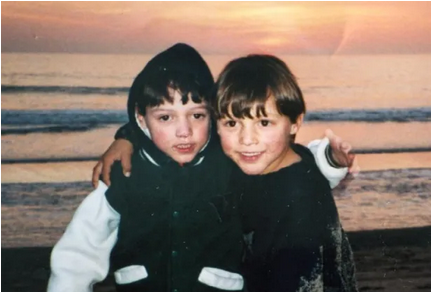
Identical twins Ryan and Ronald Moore about age 7.
They liked to watch the trains together in San
Clemente, (Photo courtesy of Monica Mazzei)
Back home

In a longed-for victory for the family, Morris’ conservatorship case will be transferred from Riverside — where his adoptive mother moved to escape “persecution” from Orange County officials who accused her of having Munchausen by proxy (a behavior disorder in which caretakers exaggerate children’s health problems and subject them to unnecessary or inappropriate medical treatment) — and back home to Orange County, where this all began.

That will mean a fresh start for Morris, Mukai said.

Ryan Morris and his identical twin brother Ronald Moore were swept into state custody shortly after their birth in O.C. in 1994, due to their parents’ history of mental illness. Moore emerged healthy; Morris’ diagnoses included cerebral palsy, schizophrenia, attention-deficit/hyperactivity disorder, behavior disorder, epilepsy and intellectual disability. Their grandmother sought custody of both boys, but got only Moore, the healthy twin. Morris remained in foster care because of his many special needs, which social workers said were beyond his grandmother’s ability to address.

Morris’ foster mother, Michelle Morris-Kerin, ran a home for the severely disabled. A former social worker, she wanted to adopt the boy. The biological family vehemently objected, but the adoption was approved by the court anyway. Morris-Kerin soon cut off all communication with her new son’s biological family.

Spicer was working in Morris-Kerin’s foster home for severely disabled children in Riverside County when he met Morris. Their wedding was held in Morris-Kerin’s backyard.

Transferring the case to Orange County will take time. There are hiccups getting all the paperwork transferred from the Riverside Public Guardian’s office to Mukai, and with getting services once provided by the Inland Regional Center picked up by the Regional Center of Orange County (quasi-governmental agencies that distribute state funding for the disabled). Mukai has been paying for all that out-of-pocket since she was appointed conservator in May, she said.

But she’s enormously pleased with Morris’ progress since he moved into her bungalow on historic Los Rios Street in San Juan Capistrano. He is having fewer and fewer outbursts, has started classes at Saddleback College — adaptive yoga, core strengthening and conditioning, community skills, a reading lab — attends the Happening Club in San Clemente and recently went with her to Mammoth for a disabled sports program that had him zooming around on a three-wheeled bike.

“No more group homes,” she said he told her.

Full Article & Source:
Should disabled man see husband who showed ‘abusive behavior’?

See Also:
Could woman accused of murder be appointed disabled man’s guardian?

Biological family’s fight for disabled California man finally lands before judge


Thursday, July 27, 2023

The Vast Surveillance Network That Traps Thousands of Disabled Medicaid Recipients

Technology is perpetuating discrimination.

By Ariana Aboulafia and Henry Claypool


In Arkansas, the Guardian reported on a disabled Medicaid recipient who depleted his savings to pay for a smartphone for his Medicaid-covered caregiver—and then had to pay even more to cover caregiver wages that were withheld due to technical glitches. In Ohio, the Mighty reported on someone who placed the electronic device meant to certify his caregiver’s activities in the refrigerator when not in use because he was concerned about privacy. And throughout the U.S., other outlets have reported on disabled people who have been forced to share photographs and biometric data with third-party apps if they want to continue receiving government support to pay for their in-home care.

All of this is thanks to a program known as electronic visit verification, or EVV. EVV ostensibly aims to reduce waste, fraud, and abuse in the Medicaid system by requiring that caregivers of disabled people “prove” that the covered individual is actually receiving their approved care. Under federal law, all states must require that health and home care providers utilize some form of electronic visit verification; if they do not, they risk a reduction in funding for their Medicaid programs.

Medicaid-funded in-home care helps to make life more accessible for many Americans with disabilities, and has done so for decades. However, EVV creates barriers to accessing that care, and in doing so contravenes the intent of anti-discrimination statutes like the Americans with Disabilities Act. When the ADA was signed into law on July 26, 1990, it marked a critical turning point in the modern disability rights movement. The ADA had the noble intention of eliminating discrimination against people with disabilities, partially by providing for accessibility in all arenas of American life. But 33 years later, the law has been unable to entirely fulfill its ideals—and in many cases, the rapid proliferation of technology can serve as a barrier, not only to the mission of advancing accessibility, but also to reducing discrimination against disabled people more generally. Electronic visit verification illustrates what discrimination can look like for people with disabilities in a digital age, and serves as a reminder that successfully combating disability discrimination requires looking beyond accessibility.

Technology can intersect with disability in unique and devastating ways. For example, algorithmic bias—which shows up in employment via the use of algorithm-driven hiring tools and tests—can harm people with disabilities by unfairly screening them out of jobs. Because a significant amount of their health-related data may be stored on devices or apps, disabled people are also especially at risk when it comes to issues of data privacy—which have become even more important in the wake of the 2022 Dobbs decision. The use of surveillance technology in schools, like student activity–monitoring software and student threat assessment software, can lead to adverse consequences for disabled students, including a disproportionate chilling effect on speech both in and outside of school. As is the case with electronic visit verification, many of these concerns—data privacy, surveillance, and personal privacy—often manifest simultaneously, thus amplifying their effects.

In practice, EVV can look different depending on the state—for example, some states use mobile apps that require Medicaid-funded home-care workers to submit photographs of the disabled person to whom they are providing care periodically throughout the day. At times, those photographs must pass through facial recognition procedures to verify that the individual receiving care is actually who the worker says they are. A worker’s ability to be paid hinges upon successfully capturing, uploading, and verifying these photographs, regardless of whether the service recipient objects to the photography or facial recognition process. Many EVV schemes also use GPS to track caregivers’ locations, and by extension, the location data of the disabled people they work with. Often, the caregiver and care recipient both must prove they’re at the recipient’s home to properly verify the visit, which can limit the disabled person’s ability to leave home and engage in community activities.

While EVV was initially required as an alleged attempt to prevent public benefits fraud, whatever preventative benefit it may provide (most of which seems, at this point, to still be largely speculative) is largely outweighed by its detriments. On the financial front, according to the Guardian, the state of Arkansas secured only three convictions for personal care-services fraud in 2020, recovering a total of $1,930; as of mid-2021, EVV had cost the state $5.7 million to implement. Outside of this, EVV creates a system in which disabled people who require Medicaid-funded in-home services are frequently surveilled by the government; their photographs or location data are uploaded to apps via their caregivers’ personal devices; the services they need and are entitled to are disrupted; and their independence, freedom to leave their homes, and legally protected right to participate fully in their communities is hindered. Disabled travel blogger and professional editor Karin Willison has written that “Electronic visit verification is the equivalent of putting an ankle monitor on people with disabilities and telling us where we can and can’t go. It turns having a disability into a crime.”

The harms that disabled people already experience as a result of EVV would only be amplified in the case of a data breach or cyberattack. A breach that impacted apps used for EVV could result in unauthorized disclosure of a disabled person’s extremely sensitive data—which, again, they likely didn’t wish to share in the first place. And the harms stemming from EVV, like many other issues that exist at the intersection of disability and technology, not only disproportionately affect disabled people, but particularly those who are multiply marginalized: in this case, disabled and low-income individuals who qualify for Medicaid, many of whom are Black and brown. Furthermore, disabled people are affected on both sides of this issue, as care workers are often disabled themselves, as well.

The solution lies largely in the hands of policymakers. Congress could choose to reverse or reduce EVV requirements. It could also pass federal privacy legislation, which might then compel certain states to revise their EVV policies to better protect privacy. Even without federal policymaking action, because there is some leeway in the existing law, states could choose to implement a form of EVV that requires and collects as little data as possible—for example, rather than collecting location data and requiring real-time photos of caregivers and those receiving care, a state could choose to have a form of EVV that requires only that a caregiver call in, perhaps using a landline instead of a smartphone (although landlines are being phased out, which limits the pragmatism of a solution such as this one). Limiting data collection to only what is absolutely and directly relevant and required to accomplish a particular purpose—a practice known as data minimization—can help to mitigate at least some of the data privacy and security concerns that disabled people currently face.

While electronic visit verification is but one of a number of issues within the tech policy world that implicates the civil rights and liberties of disabled people, relatively little conversation in that world centers centers disability, or even considers disabled people. It is only by prioritizing the needs of disabled people in all aspects of technology policy that the noble intention of the ADA—equality for disabled people, in all arenas of American life—can fully be realized.

Full Article & Source:
The Vast Surveillance Network That Traps Thousands of Disabled Medicaid Recipients

Monday, September 5, 2022

Biological family’s fight for disabled California man finally lands before judge

Column: Tragically, officials got the Ryan Morris case wrong at just about every turn. Will anything change now?

Ryan Morris with his aunt Monica Mukai during a Christmas tree lightening in San Juan Capistrano. (Photo courtesy of Monica Mukai)

By Teri Sforza

So very much has happened in the six years since Ryan Morris’ biological relatives sought to become his legal guardians.

Morris’ adoptive mother and father in Murrieta were charged with lewd conduct with dependent adults “with the intent of arousing, appealing to, and gratifying the lust, passions, and sexual desires” of themselves and their charges, as well as with neglect contributing to the death of a disabled child in their care. (That eliminated the adoptive mom’s request to be re-appointed Morris’s legal guardian.)

The court removed Morris’ husband from the legal guardian job — his adoptive mother allowed him to marry a man nearly twice his age, despite the fact that Morris has the intellectual ability of a kindergartener and mistook the wedding for a baptism — and found that the husband was abusive toward Morris and kept him in a volatile household. (Morris’ publicly financed attorneys asked the appeals court to return Morris to the husband’s home anyway — a request the court denied.)

Then the Riverside County Public Guardian’s office was appointed as Morris’ “temporary” legal guardian, moving him to a low-stress, neutral home where he could finally start visiting with his biological family from Orange County without fear of being punished. (Both his adoptive mother and husband talked down his bio family and threatened to take away privileges — or send him to the psych ward — when he expressed desire to see or talk to them, according to court documents.)

Ronald Moore, left, and identical twin Ryan Morris embrace after seeing each for the first time in 13 years at a court hearing on Ryan's conservatorship in July 2015. (Photo courtesy of Monica Mazzei)
Ronald Moore, left, and identical twin Ryan Morris embrace after seeing each for the first time in 13 years at a court hearing on Ryan’s conservatorship in July 2015. (Photo courtesy of Monica Mukai) 

Visits with Morris are professionally monitored and going well, according to documents filed with the court. Morris sometimes panics about being punished for being with his biological family, but his relatives are adept at reminding him he’s safe, helping him breathe and talking him down. They help him brush his teeth, learn to bend his knees when walking up stairs, and button his own shirt.

But this “temporary” public guardianship has stretched on for years. Morris’ biological family has clashed with officials there, objecting to constraints on visitation, fearing Morris is being isolated, even filing a court declaration from a social worker saying he was misled about the bio family by the Public Guardian’s office.

Finally, on Thursday, Sept. 1, the court began hearing his biological aunt Monica Mukai’s request to appoint her as his conservator. It was filed in 2016. The bio family has been fighting Morris’ removal from their fold for most of his life, and a well-appointed bedroom has been awaiting him in San Juan Capistrano’s quaint Los Rios Street Historic District for years.

The next court date is Oct. 3, when a trial date is expected to be set.

“This case is old,” said Riverside Superior Court Judge Jacqueline Jackson, “and we need resolution.”

The plight of Brittany Spears focused attention on the abuses that can be attendant to conservatorships, California’s official parlance for legal guardianships for the disabled. The nettlesome issues were probed in a three-part series, “Twins, Divided,” by the Southern California News Group in 2017.

But the outstanding question remains: What does Morris want?

Ryan Morris, right, and husband Sean Spicer, at their wedding in 2014. Morris mistook the ceremony for a baptism. (Photo courtesy probate court file)
Ryan Morris, right, and husband Sean Spicer, at their wedding in 2014. Morris mistook the ceremony for a baptism. (Photo courtesy probate court file) 

It’s complicated

Morris is easily influenced and subject to manipulation, court proceedings have found.

When he visits with the bio family, he becomes upset when it’s time to leave and says he wants to stay. But his county-appointed attorneys say Morris opposes having anyone in his bio family as conservator, and wants his husband — who was removed for the aforementioned abusive behavior — for that job.

That husband, Sean Spicer, opposes Mukai as legal guardian as well.

To clear up confusion, the bio family has been pushing to get Morris into the courtroom to tell the judge directly what he wants, but his attorneys said Morris doesn’t want to come.

Identical twins Ryan and Ronald Moore about age 7. They liked to watch the trains together in San Clemente, (Photo courtesy of Monica Mazzei)
Identical twins Ryan and Ronald Moore about age 7. They liked to watch the trains together in San Clemente. (Photo courtesy of Monica Mukai) 

The bio family does not believe them. “Ryan’s lawyers knew that Sean was abusing him for years and did nothing about it. They knew that a doctor and a judge determined that Ryan was incapable of entering into marriage and maintaining marriage, and they did nothing about it. I don’t trust anything they say,” said Charles S. Krolikowski of Newmeyer & Dillion LLP, attorney for Morris’s identical twin brother, Ronald Moore.

And then there’s the Public Guardian, which has the job temporarily, saying it takes on conservatorships only as a last resort, but there are clearly others who want to volunteer for the job. But the office fears that a trial on Mukai’s request for conservatorship will turn into an “attack” on how the Public Guardian’s office has handled Morris’ case, putting the Public Guardian itself on trial.

Mukai’s critique of the office has, indeed, been withering. But after decades of astonishing acts by the state and its representatives — from deciding that Morris was too disabled to be cared for by his own family, to approving his adoption by Michelle Morris, a woman who cut off all contact with them and now stands accused of abuse, to placing more and more severely disabled children in Michelle Morris’ care despite the Orange County Regional Center asserting she suffered from Munchausen by proxy (a behavior disorder in which caretakers exaggerate children’s health problems and subject them to unnecessary or inappropriate medical treatment), to officials looking past reports of sexual abuse in her home and taping children to wheelchairs and putting wheelchair-bound children into closets until, finally, Michelle Morris was charged with neglect in the case of a girl in her care who died — perhaps some criticism is understandable?

Michelle Morris Kerin (Courtesy of Riverside County DA)
Michelle Morris Kerin (Courtesy of Riverside County DA) 

Forward

This reporter has been following this case for nearly 20 years. The family has learned that it must fight. And there’s some evidence that the Public Guardian’s office has not been completely neutral here.

A social worker asked to provide “relationship building services” among the parties in this case said he was never given the judge’s order removing Spicer or other pertinent background information. He was “fed” misinformation that led him to believe the culprits in this drama were the biological family members, and he blasted Riverside County officials for manipulation and bias in a court declaration.

“I came to the conclusion that I was being used as a pawn by the Public Guardian’s Office to render findings and recommendations without having all of the information I needed to do so,” it said.

The judge did not seem too receptive to the Public Guardian’s fear of criticism at trial, so we’ll see how that unfolds. Officials there may need to toughen up a bit.

Mukai, meanwhile, is excited for her nephew’s future, and she hopes to “set him free.”

“Ryan Morris has voiced a desire to attend college, get help with his dental and medical needs, and spend multiple nights at my residence, where he is provided appealing educational and social opportunities in a very integrative manner with his family and the community at large,” she said in a declaration to the court.

“Ryan’s cries have tragically fallen on deaf ears by the county representatives and agencies for too long. Instead Ryan’s former conservators — Sean Spicer and Michelle Morris — have utilized Ryan’s court appointed attorneys and county representatives, including County Counsel, to keep a wedge between Ryan and his biological family, essentially preventing us from assisting him accomplish these goals….

“I respectfully request that this court allow Ryan to return to Orange County with his biological family where, as the proposed successor conservator, I will work with the Regional Center of Orange County to ‘select the least restrictive appropriate residence….’ I understand very clearly that it would be my duty by law to secure housing, treatment, services, and opportunities that will assist him … to develop maximum self-reliance and independence.”

It can be argued that, tragically, officials got the Ryan Morris case wrong at just about every turn. Will this time be any different?

Full Article & Source:
 
See Also: 


Thursday, June 2, 2022

Messenger: Missouri county clerk threatens to take away disabled man's right to vote

Mark Murphey works at the sheltered workshop in Rolla on Tuesday, May 30, 2022. (Photo courtesy of John Murphey)
Courtesy of John Murphey

By Tony Messenger

Before each Election Day, Mark Murphey generally calls his dad to set the schedule.

“Are you taking me to vote before work, or after work?” he asks.

This year, a county clerk where he lives is trying to make sure that conversation never happens. Last week, Phelps County Clerk Pamela Grow told the Phelps County Commission that she planned to remove all people from the voting rolls who have a guardian appointed by the court to oversee some of their affairs, even if they have a court order that preserves their right to vote.

“I would submit, ‘How is a person who is unable to manage their own financial affairs to be allowed to vote on someone else’s taxes?’ That’s just kind of putting it a little bit bluntly,” Grow told the commissioners. “I don’t mean to be hard hearted, but you have to think about the people who are working hard, paying their taxes and voting. Where are their rights? Elections can be won or lost with one vote.”

Murphey, who is 35, suffers from seizures, and some mental capacity issues that have led him to be declared disabled. He has lived on his own most of his adult life. He works at Phelps County Industrial Solutions, the sheltered workshop in Rolla. He has voted his entire adult life.

When his parents, John and Ann Murphey, saw Grow’s comments in the Phelps County Focus, they were dumbfounded.

“This just came out of the blue,” his father said. “We’re amazed that she’s doing this. Mark works hard and he pays taxes. He pays more attention to politics than I do. We went through a lot of trouble and expense to make sure he had the right to vote.”

Last year, for the first time, the Murpheys sought a legal guardianship over their son. During the COVID pandemic, John had taken him to an emergency room, and the doctors wouldn’t let him accompany their son because he is an adult, and they didn’t have guardianship. The family decided to go to court to get a guardianship award to help them oversee Mark’s medical treatment.

The court order, issued in May after a hearing, specifically maintains Mark Murphey’s ability to both marry and vote. That’s not good enough for Grow. John Murphey said he went to Grow’s office to talk with her after he saw her comments. All she did was point to the Missouri Constitution, where Article VIII says: “No person who has a guardian of his or her estate or person by reason of mental incapacity, appointed by a court of competent jurisdiction and no person who is involuntarily confined in a mental institution pursuant to an adjudication of a court of competent jurisdiction shall be entitled to vote.”

Tony Rothert, legal director for the American Civil Liberties Union in Missouri, says Grow is getting the law wrong.

“While some adults with disabilities will be appointed a guardian when they need assistance with aspects of their day-to-day affairs, Missouri cannot — and does not — automatically strip them of the right to vote,” Rothert says. “Probate judges across the state routinely determine that a person under guardianship retains the capacity to vote, and local election authorities respect those determinations. They do so because federal anti-discrimination laws and the Missouri Constitution read as a whole require it. This is not a decision left to the discretion of low-level ministerial officials.”

A 2007 federal appeals court decision affirmed the power of a Missouri judge to maintain a person’s right to vote even if they have a guardianship order.

Grow didn’t return a phone call seeking comment. Her actions, unfortunately, are not unique in Missouri. More voters have been removed from the voting rolls for “mental incapacity” in Missouri than any other state in the past three election cycles, according to federal records. Kentucky, in second place, has removed fewer than half as many voters for the same reason since 2008.

The Murpheys grew up in St. Louis, but moved to Rolla in 1985, where they’ve lived ever since. Ann, a retired nurse, used to have a seat on the City Council. “Mark certainly has the capacity to vote,” she says. In the last presidential election, Mark Murphey voted differently than his parents did. He studies the ballot and comes to his own conclusions, his parents say.

What upset Laura Taylor about Grow’s comments is how the county clerk diminished the capacity of people who have various disabilities. Taylor runs the sheltered workshop where Mark Murphey works. About 50 other disabled adults work there. Some of them have guardians; some don’t.

“The thing that stuck out to me about her comments was she really devalued the individual,” Taylor says. Now, some of her employees, including Mark Murphey, might lose their ability to vote. “The people who I work with are extremely hard working. They pay their taxes just like everybody else does. I have individuals here under guardianship who are very capable of making an informed decision.”

The Murpheys went public with their story, they say, because they want to make sure people know this is happening, so they can advocate for their loved ones if Grow’s actions are adopted in other counties.

“Why she’s decided to do this now is beyond us,” John Murphey says. “It’s not something I really want to get mixed up in but it’s my son. How they can arbitrarily and unilaterally take his rights away is beyond me.”

Full Article & Source:

Tuesday, May 17, 2022

Judge demands harsh sentence for ex-attorney accused of embezzling millions from Utah clients

Former Salt Lake City attorney Calvin Curtis faced about six years in prison as part of a plea agreement. The judge insisted on more prison time.
 
(Francisco Kjolseth | The Salt Lake Tribune) Traffic passes the federal courthouse in Salt Lake City on Friday, March 13, 2020. At a hearing on Tuesday, a federal judge tossed out a sentencing proposal for former Salt Lake City estate attorney Calvin Curtis, demanding that the lawyer accused of defrauding his clients of millions receive a harsher prison sentence.

By Kolbie Peterson

A federal judge in Utah tossed out a sentencing proposal Tuesday for former Salt Lake City estate attorney Calvin Curtis, demanding that the man accused of defrauding his clients out of millions receive a harsher prison sentence.

The proposal of about six years in prison had been agreed upon by federal prosecutors and Curtis’ defense attorney ahead of the hearing. U.S. District Judge David Barlow was expected to take it into consideration before imposing a sentence.

Instead, rejecting the proposal altogether, Barlow said that as Curtis allegedly stole $12.7 million from 26 of his clients — all elderly, disabled or incapacitated — over about 13 years, the suspected fraud was “cold-blooded, premeditated and repeated.”

Curtis “perverted” the law, Barlow continued, and “enriched himself on the backs of those who needed his help.”

‘Lavish lifestyle’

Prosecutors have argued Curtis used that money to fund a “lavish lifestyle,” which included frequent travel, expensive gifts, tickets to basketball and football games, and pricey renovations and mortgage payments on his former mansion home and office on South Temple.

Assistant U.S. attorney Ruth Hackford-Peer said in Tuesday’s hearing that the proposed sentence of 73 months in prison was not a perfect resolution, “but it’s a good one.”

Several of Curtis’ victims attended the hearing, filling the courtroom along with family members and caregivers. One mother pushed in a stroller her disabled 9-year-old daughter, who wore a yellow bow in her hair and braces on both wrists.

They were expecting Barlow to issue a sentence, and many made statements during the hearing. One woman walked up to the podium while holding onto a loved one’s arm to steady herself. A man in a wheelchair gave 62-year-old Curtis a long look as he passed the table where Curtis sat with his attorney.

As the victims shared their stories of how devastating it has been to lose money that they would have used for various needs such as food, clothing, medicine and health care, a common refrain was for Barlow to impose the maximum sentence.

“I don’t think Calvin is human,” one woman said quietly. “I feel that he’s the devil.”

In a statement Tuesday, Curtis said, “A lot of people have talked about me, and most of what they have said is true. I’m very sorry for that.”

‘Heinous’ crimes

When it came time for Barlow to announce a decision, he said the proposed prison sentence — plus a restitution judgment of $12.7 million and supervised release for three years as part of Curtis’ plea agreement — was not harsh enough.

Since Curtis’ crimes were “so heinous,” Barlow said, he should receive a prison sentence at the higher end of the range that is customary in such a case, which is 10 years.

The judge added that he is “not convinced” that Curtis — who is charged with wire fraud and money laundering — takes responsibility for his actions or feels remorse.

Barlow asked the attorneys for both sides to negotiate again and come up with a new sentencing proposal. A new hearing date was not immediately set.

A spokesperson for the U.S. Attorney’s Office declined to comment.

Laura Milliken Gray, an attorney for a woman with Alzheimer’s disease from whom Curtis has admitted to embezzling more than $9 million, called Barlow’s decision a “surprise.”

Her client’s daughter-in-law, Sherry McConkey, said she is “excited” at the prospect of Curtis getting more time in prison than expected. But she added that it’s “hard” the case will go on longer, “because I just want it to be over and done with.”

Greg Skordas, Curtis’ attorney, said, “We were not surprised. We’re disappointed.”

“We came a long way and hoped to be able to seal the deal today,” he continued. “It’s not the end. We’re not finished.”

Full Article & Source:

Wednesday, March 16, 2022

‘The Power to End a Person’s Life’

by Eleanor J. Bader

A crowd protesting artist Peter Max's forced guardianship.

The Population Reference Bureau estimates that within the next eight years, more than seventy-six million U.S. residents will be over the age of sixty-five. Many will remain healthy, active, and engaged for the duration of their lives. Others, however, will need assistance.

This is also true for the more than sixty-one million Americans who live with a disability, nearly eight million of whom are estimated to need help with personal care. That’s where guardianship—or if real estate is involved, conservatorship—comes into play.

In its most perfect form, a guardian is appointed by a court to help an elderly or disabled person who has been deemed “incapacitated”—defined as being unable to manage self-care or the tasks of daily living. The goal is to protect them from abuse, neglect, and exploitation. But as the well-publicized guardianship cases of Peter Falk, Britney Spears, and Wendy Williams have revealed, guardianship can include gross judicial overreach and lead to overly restrictive control by one person over another.  (Click to continue reading)

Full Article & Source:

Wednesday, December 16, 2020

As Hospitals Fear Being Overwhelmed By COVID-19, Do The Disabled Get The Same Access?

by Joseph Shapiro
 

Kimberly Conger, Sarah McSweeney's nurse at her group home, shows a photo of McSweeney on her phone. She says McSweeney was outgoing and fun: "She absolutely adored going into malls and getting her makeup done and getting her hair done."

Celeste Noche for NPR

On the morning of April 21, Sarah McSweeney woke up with a temperature of 103 degrees — and it kept rising. Staff at her group home worried that the woman with multiple disabilities — she couldn't walk or speak words — had contracted COVID-19. They got her into her bright pink wheelchair and hurried to the hospital, just a block down the street from the group home in Oregon City, Ore.

That afternoon, Heidi Barnett got a phone call from the doctor in the emergency room.

He was puzzled, she says, by a one-page document that McSweeney's caregivers brought with her. It was a legal document that explained what medical care this disabled woman — who couldn't speak for herself — wanted.

"We had her at full code. So all treatment. Because she was young and vibrant and had a great life," says Barnett. "And that was her wishes, that's what we gathered from her. She wanted to be alive."

Barnett works for The Arc Oregon, the agency that was McSweeney's guardian. She had helped McSweeney fill out that document, called a POLST form, for a moment just like this. 

It's normal for a doctor to want to understand a patient's wishes. However, Barnett, who kept daily notes on her conversations with medical workers about McSweeney, felt the doctor was challenging the order.

"They wanted it to be a DNR," says Barnett.

A Do Not Resuscitate Order is a medical order to doctors not to treat a patient — like McSweeney — if she stops breathing or her heart stops.

That emergency room doctor would be the first at the hospital to raise a question that would shadow decisions about McSweeney's care over nearly three weeks at the hospital: Why does a woman with significant and complex disabilities have a legal order that requires the hospital to take all measures to save her life?

McSweeney was 45 when she died on May 10. Her death would raise another question, one that people with disabilities and the elderly have worried about since the start of the coronavirus pandemic: Are they denied care when it gets scarce — like drugs or treatment, including ventilators — that might save their lives?

An NPR investigation looked into McSweeney's death and about a dozen reports of discrimination in Oregon: Of doctors and hospitals denying equipment like ventilators; insisting that an elderly or disabled person sign a DNR — maybe when they couldn't understand it and in the middle of a crisis — or even denying a COVID-19 test.

These decisions are made behind closed doors, NPR found, and as a result are little known and little understood. McSweeney's case offers a rare look at how those decisions are made.

When people met Sarah McSweeney they saw different things.

Most saw what she couldn't do. McSweeney had quadriplegia, cerebral palsy and other disabilities.

Because she couldn't walk, or even use her hands, someone had to push her in her wheelchair.

Because she couldn't speak words, she communicated by making sounds and gestures.

Because she couldn't eat solid foods, someone fed her a supplement of nutrients through a tube to her stomach.

A smaller number of people, but the ones who knew her best, saw something different. They saw what was possible for McSweeney. They saw the choices she made and the things she did.

"She absolutely adored going into malls and getting her makeup done. And getting her hair done and doing typically girly stuff that girls like to do — get pedicures and manicures," says Kimberly Conger, the nurse manager for Community Access Services, or CAS, the nonprofit agency that provided services and ran the group home where McSweeney lived.

Kimberly Conger, the nurse manager for McSweeney's group home, objected when a doctor said the disabled woman needed to be on a ventilator but then questioned her quality of life: "I feel like they didn't feel like she was worth that."

Celeste Noche for NPR

She loved country music, especially Kenny Chesney, whose poster she had on the wall of her room. She enjoyed when her staff took her to country music concerts — she'd met Tim McGraw twice — and to country bars to watch people in boots and denim do the flips and swing of country dancing.

The people who worked with her enjoyed her vivacious personality. She smiled and laughed and loved to make others smile and laugh. There's a picture of McSweeney sticking out her tongue and laughing at the camera. Her dark hair is dyed a bright red, a color that clashed with her neon-pink wheelchair.

"Her smile would bring a smile to everyone in the room," says Anna Keenan-Mudrick, who runs CAS.

The two views of Sarah McSweeney would collide once she went to the hospital — and during the nearly three weeks she was there.

On April 21, a Tuesday, in the emergency room at Providence Willamette Falls Medical Center, the doctor wrote down his diagnosis: "acute cystitis with hematuria," a urinary tract infection with the presence of blood in the urine.

Hospital medical records indicate the ER doctor was thorough. With his stethoscope, he listened to McSweeney's lungs. "No wheezes, no crackles," he'd write. Those would be signs of pneumonia, a common killer of people with intellectual and developmental disabilities.

But to be sure, he ordered an X-ray. It would show a small pneumonia. It is not unusual for people with swallowing problems to have a chronic build up of saliva in their lungs that they live with every day, sometimes called "silent aspiration."

NPR reviewed hospital records from McSweeney's case file. The information in the records was shared with an NPR reporter by someone with access to them.

NPR made multiple requests to speak to doctors, staff, and officials at the Providence Willamette Falls Medical Center. "We are not able to comment on the care of a specific patient," a spokesperson for the hospital said. "We do not pressure or force anyone to sign a DNR order, and we are unaware of any evidence to the contrary. We honor decisions by patients and/or their legal representatives. We are not aware of any care needed by any of the patients that was not provided."

As a precaution to prevent the spread of COVID-19, McSweeney was moved to the ICU.

Within a day or two, Barnett says, she got word that the COVID-19 test had come back negative. A second test would return a negative result, too. After the first test, McSweeney was moved from the ICU, back to the general floor of the hospital.

The hospital had a strict limit on visitors because of the pandemic. Barnett and Conger, the nurse manager for McSweeney's group home, spoke every day to doctors, nurses and social workers over the phone and in Zoom calls.

Nearly a week later, on Monday, April 27, another doctor who was leading the care team called Barnett, and said it was "urgent" that she come to the hospital. McSweeney's left lung was "kaput," he told Barnett. She asked what that meant "in medical terms" and he explained that her lung was filled with fluid and not receiving oxygen.

"She was young and vibrant and had a great life," says Heidi Barnett, who works at The Arc Oregon, of McSweeney. "She wanted to be alive."

Celeste Noche for NPR

Barnett and Conger hurried to the hospital. The doctor showed them the X-ray of McSweeney's lung.

The doctor told them the pneumonia had developed on Friday.

Conger and Barnett told the doctor they should have been notified of the problem then or over the weekend.

This was not the kind of pneumonia associated with COVID-19. Or the small pneumonia, Conger says, that may have shown up on the X-ray on April 21. It was aspiration pneumonia, which occurs when food, saliva or liquids are breathed into the lungs or airways, instead of being swallowed into the esophagus and the stomach, because McSweeney was fed through a gastrostomy tube — or G-tube — directly to her stomach.

Conger says McSweeney did not have a history of that kind of pneumonia at the group home. She had lived there since 2005.

In the hospital that Monday, the doctor said McSweeney, as a result of the aspiration pneumonia, needed to be on a ventilator. It was "critical" that she go, Barnett recalls him saying.

Conger agreed because that's standard treatment. It's what, she felt, a hospital would do for anyone.

"We discussed the possibility of her being intubated and letting that lung rest, giving her time to heal and letting the antibiotics do their magic," Conger recalled.

But then the doctor surprised Conger and Barnett, the women say, when he pushed to rewrite McSweeney's care document. He wanted a new order that would say the disabled woman should not be resuscitated or intubated.

That would be an order to deny McSweeney the ventilator the doctor had just said she needed.

"He said intubating her was a matter of risk versus quality of life," Conger recalls. "I was like, 'But she has quality of life.' And he looked at me and goes, 'Oh, she can walk? And talk?'"

The doctor lifted his index and middle fingers and moved them in a walking motion, like in the old advertisements for the Yellow Pages.

Conger pushed back: "And I said 'Well, no, but there's a lot of people who don't walk who have full quality of life.' And he gets kind of irritated with me and left the room at that point."

When the doctor walked out, Conger and Barnett understood that they had failed to change the medical team's negative view of McSweeney.

Conger — "she was livid," Barnett says — called her bosses at CAS, the women who were in charge of McSweeney's care. They decided to file a formal complaint with the hospital.

The next day, Tuesday, April 28, Conger filed the complaint, in a phone call with a hospital official. Keenan-Mudrick, the executive director of CAS, would later testify, in the state legislature, about this incident and the doctor's "pressure" to change McSweeney's orders to a DNR.

Anna Keenan-Mudrick, executive director of Community Access Services, told state lawmakers how her staff pushed back when doctors and social workers wanted to override McSweeney's legal document asking for full medical care.

Celeste Noche for NPR

Conger, in her complaint with the hospital, too, protested the pressure to change McSweeney's stated wishes for health care. She said that staff at the hospital failed to see McSweeney, as she put it, as "a whole person."

At The Arc Oregon, Barnett spoke with her bosses and decided they should try to find another hospital for McSweeney. Barnett notified the hospital. She got a call back from another doctor who told her that insurance would not pay to transfer McSweeney, according to Barnett's notes.

The doctor apologized, too, Barnett says, for the lead doctor's brusque manner and promised she and other advocates for McSweeney would be kept up to date about the woman's condition.

The lead doctor was trying harder, too. Later that day, he called Barnett to say he had called in a specialist, a pulmonologist, to see McSweeney.

On that same day, April 28, Kelly Gauthier, one of McSweeney's direct service professionals — a caregiver from her group home — was allowed to visit. She showed the nurses how to communicate with the disabled woman. She explained how they could ask McSweeney direct questions and she could indicate yes or no.

Gauthier brought a sheet of paper, a one-page introduction to McSweeney. It listed things she liked — country music, getting her hair done, trips to the mall — and things she didn't like. The aide played some Kenny Chesney CDs for McSweeney. In the hospital notes that day, someone writes that McSweeney responded positively to the visit and the music. And that she was breathing "more easily" and at "normal depths."

It's common that doctors often see someone with multiple disabilities, like McSweeney, one way and the person's friends, family and caregivers see her another.

Researchers call this the "disability paradox" — the large gap between how a person with a disability rates the quality of their life and what a doctor would rate it.

A "vast majority" of doctors say people with a significant disability have a worse quality of life, according to a recent poll by Dr. Lisa Iezzoni, a Harvard Medical School professor and physician who studies health care disparities for people with disabilities. Her research will be published in the journal Health Affairs in early 2021.

There are, for sure, doctors who take extra steps to understand the lives of their patients with disabilities and who work to help them achieve health and independence.

Still: Doctors save lives. They cure people. They help them get better.

But Iezzoni says, they often hold a bias — often an unconscious bias — about people who won't be cured and as a result "do not make the same effort to restore patients to their baseline health."

McSweeney's advocates at CAS and The Arc Oregon saw their job differently. It was to help the disabled woman live as full a life as possible, according to her wishes.

For example, when McSweeney said she wanted to work--maybe as a greeter in one of those stores in the mall she loved — Susan Gustavson, a veteran advocate at CAS said: OK, let's figure it out.

Gustavson arranged for McSweeney to get trained to use a voice output device called a Tobii Dynavox.

Because McSweeney couldn't move her fingers to type on a keyboard, the Dynavox was set up to track where her eyes gazed. She could look at a letter or a symbol on a computer screen and the device would read and then speak it for her.

Gustavson told the doctors and medical staff about McSweeney's dream to work, and how she was working on the machine when she went to the hospital. And when they asked — why does this disabled woman have medical orders for a full code — she explained something else.

That what was an acceptable part of life for McSweeney was different than what might be acceptable for others.

McSweeney wasn't afraid of being on a ventilator, for example. She'd been ventilated before — in 2017 when she was hospitalized for pneumonia.

When McSweeney wanted a job, Susan Gustavson, associate director of Community Access Services, arranged for McSweeney to get trained on a special voice output device.

Celeste Noche for NPR

But mostly she wasn't afraid because, as Gustavson explained, "Sarah has friends who are vent dependent, 24 hours a day, with traches," a reference to a tracheostomy, a surgical opening in the windpipe to insert a breathing tube.

"These folks were her friends," says Gustavson. "They participate in the same community activities together. They hang out."

They went to the mall and to the movies.

"That is the norm for Sarah. That is not extraordinary," says Gustavson. "It was definitely received as extraordinary from the hospital staff. They were blown away."

Hospital records say the medical team was debating the best course for McSweeney, who was now dealing with aspiration pneumonia. According to hospital records, on Thursday, April 30, a hospital palliative care team met to discuss whether to put her on a ventilator.

The palliative care nurse argued in favor of keeping McSweeney at full code, to honor her goal to try to get better and go home. But a hospital ethicist argued that intubating McSweeney put her at risk of cardiopulmonary risk and other bad outcomes, according to hospital records. Aggressive treatment, he said, according to the records, could cause "more harm than benefit."

The ethicist, according to the records, said if McSweeney's guardians at The Arc Oregon disagreed, they could seek a second opinion or they could move her to another hospital. But the women in charge of her guardianship say they were never told of this.

Still, hospital staff — after the complaint was filed — started calling with regular updates. Conger, the agency nurse, complained that she, with her medical background, wasn't getting these calls. Her boss, Keenan-Mudrick, would tell state lawmakers that this was "grossly inadequate" communication — and unusual. "We typically do not have this issue of the hospital not directly returning calls to our RNs," she said.

But the hospital was notifying Barnett, McSweeney's certified guardian, and Barnett's boss, Emily Braman, who runs the guardianship program for The Arc Oregon.

Over the course of McSweeney's second week in the hospital, McSweeney's health seemed to be getting better. The pulmonologist called Barnett twice, according to her notes, to say McSweeney's lungs were improving and that she was breathing more easily.

McSweeney's advocates started to plan for her to leave the hospital.

On Thursday, May 7, Barnett looked into possibilities to move her out of the hospital to a group home with nurses who would suction her lungs and provide medical care while she recovered. It would be a temporary stop before she moved back to her group house in Oregon City.

"We were getting notified that it sounded like she was getting better, that things weren't that bad," Braman says.

Then everything changed.

"All of sudden we got a call that it's dire straits," Braman says. On Friday, May 8, a case worker called to say McSweeney's lungs were failing.

There had been added episodes of aspiration pneumonia, on April 29 and May 7 and a clogged feeding tube on May 2 that, according to Braman, Barnett and Conger, had not been disclosed to them.

The next day, on Saturday, Conger and Barnett were summoned to the hospital to talk about McSweeney's worsening condition.

The pair got there early and went to McSweeney's hospital room. "We're standing there in the room waiting for the doctor to be paged and to come into the room," Conger says. "The case manager came up and she really didn't even say hi. She just said, 'So, I'm under the impression that Sarah was going to go for employment and she used to go get her hair done.' I said 'Yeah. She loved to get her hair done and she just finished Discovery for employment.'"

Discovery was the program that was helping McSweeney figure out a way to use that voice computer and find a job.

"And she looked at me and she pointed to Sarah and she's like: 'Her. She used to get her hair done and she was going to be employed?' And I was like: 'Yes.' I mean, it was gross," Conger says.

Barnett could see that Sarah, in her hospital bed, was listening. "She heard it and she understood it." Sarah used her eyes to communicate. And now her eyes followed the case manager — and then her friends — when each spoke.

"She had a very worried look on her face," says Barnett. "And it just broke my heart."

Now Conger could see something had changed. The treatment in the hospital was not working.

"Sarah was desperately trying to communicate something," she recalls. She didn't smile, as she usually did. "It was: Mouth wide open. Arms clinched up. Tears running down her eyes."

And she was in distress.

"She was struggling to get air," Conger remembers, "and you could just see the panic and the fear in her eyes. She would rest for a minute, take a nice long breath for a minute, close her eyes, then wake up in absolute fear. She could not take a breath."

Now, Conger and Barnett agreed with the medical staff that it was time to begin palliative, or comfort care for McSweeney.

They said goodbye to McSweeney and left the hospital.

Just hours later, at 3:30 Sunday morning, a phone call woke up Barnett at her home.

It was the charge nurse at the hospital. "I'm sorry to inform you," he said, "that Sarah passed away."

Painted rocks sit outside Sarah McSweeney's group home in Oregon City, Ore., on Nov. 24, 2020. McSweeney's housemates painted a rock to read "The World Just Lost Some Sparkle" in pink and purple after McSweeney's death.

Celeste Noche for NPR

McSweeney didn't die of COVID-19.

She died of severe sepsis due to aspiration pneumonia.

Aspiration pneumonia is a serious medical condition. But, usually, it's treatable.

Conger says doctors could have stopped the feeding tube and instead fed McSweeney through an IV line.

Conger and Barnett said they made repeated suggestions for the IV feedings. Hospital records say a doctor considered it and concluded there was "no evidence" that it would make a difference. But by then it was May 9, when the pneumonia was out of control and McSweeney was just hours from death.

Over more than two and a half weeks, doctors and social workers had questioned why this disabled woman had medical instructions for full care, instead of a Do Not Resuscitate order.

McSweeney's advocates had pushed back.

Says Conger of McSweeney's care at the hospital: "I don't feel like they — and this is my personal opinion — I feel like they didn't feel like she was worth that."

Because of the pandemic, there was no funeral service for McSweeney. Her friends were her housemates and the other disabled people in nearby group homes and the staff that helped her live independently.

In a rock garden outside McSweeney's group home, her housemates placed a stone they'd painted in pink and purple that said: "The World Just Lost Some Sparkle."

"She was so happy and goofy and funny," Barnett says of McSweeney. "I was lucky to know her for the last three years. And I got to know her and how she communicates and what's important to her and how she jokes around. I used to tease her that she was a princess and I was going to buy her a tiara and she'd laugh. And she was so much fun. And even though she had these medical issues, she was vivacious. She just lived her life."

Barnett pauses, and then apologizes for crying. "She was a beautiful person ... I just think she could have gone out better. They owed her more respect than she got."

 
Full Article & Source:

Sunday, May 31, 2020

What’s Behind the Nursing Home Horror

After decades of mistreatment, older Americans are bearing the worst of the pandemic.

By Charles C. Camosy
Dr. Camosy teaches bioethics and moral theology at Fordham University.

Credit...John Minchillo/Associated Press
We knew it from the beginning. A nursing home in Washington State was the center of the first known coronavirus outbreak in the United States. We knew that institutions caring for the elderly and disabled in close quarters would be particularly vulnerable during the pandemic.

But we did not act. Personal protective equipment, special training and extra staff went almost exclusively to our critical care facilities. Nursing homes got virtually nothing. Well, that’s not entirely true. In New York and other places we gave them patients, and even nurses, infected with the virus.

The result has been a raging wildfire of infection and death. We don’t have full reporting of anywhere close to all the deaths at this point, but the best estimates right now are that about half of those who have died from Covid-19 have been nursing home residents. In some places, it’s much more: Connecticut reported that nearly 90 percent of its Covid-related deaths between April 22 and April 29 occurred in nursing homes.

We tend to see this as a public health failure, but it is also a moral failure. That fact hit me recently, after I went on Fox News’s “Tucker Carlson Tonight” to talk about the plight of nursing homes.

Even before the pandemic, these were places where what I call “throwaway culture” was thriving. The staff aren’t paid a living wage, often have poor training and are hopelessly overworked. The residents face elder abuse, and large percentages of them are desperately lonely. A good number get no visitors at all, which pushes rates of dementia among residents to unbelievable levels.

I suggested to Mr. Carlson’s audience that it was no surprise that throwaway culture kicked into hyperdrive in nursing homes during our current moment. I was excited to be able to make my case to a national audience; afterward, I was exhausted. All I wanted to do was help my wife get our 2-year-old to bed and go to sleep myself.

But that’s when the messages started coming in. Email. Facebook messenger. LinkedIn. Twitter. One after the other after the other. And they were horrifying.

It is one thing for a professor of bioethics to cite abstract numbers and trends and offer a theoretical explanation for them. It is another thing to get message after message detailing the human toll of what you had just discussed.

One of the most moving — and frightening — was from a nursing home staffer. She said she was given inadequate P.P.E. and training, and had likely been exposed to the virus. Her communications with management were ignored. Staff members at her facility were not being tested. She decided to quit her job rather than risk infecting her residents. “I don’t know if you can help me,” she said. “I feel that what you said is true; the elderly need a voice by someone that cares.”

Another correspondent, who had worked in health care administration, said that she was “not surprised in the least that the hospitals were trying to discharge their Covid-19 infected patients” back to long-term-care facilities because, in her experience, this has “been happening for quite some time.” It got worse: Agreeing with me about the radical understaffing of nursing homes, she said that it is “increasingly common is to discharge high cost and difficult patients to homeless shelters … Yep, you heard me right … HOMELESS SHELTERS.”

Not every story was coronavirus-specific. One man told me the story of the fatal neglect of his father — after which the nursing home falsified his father’s records and hid behind state laws that nursing home lobbyists had written.

A former director of nursing at a long-term-care facility said that given her terrible professional experiences, she had refused to put her 78-year-old husband, who was suffering from dementia, anywhere outside her own home. Another clearly frightened woman explained that she had just had a horrible experience with her mother in a nursing home; she even gave me, a complete stranger, her phone number, in the desperate hope that I could raise the alarm about how bad things were.

We need to listen to people like this and act on what they are saying. The pandemic doesn’t have many silver linings, but as the number of nursing-home deaths piles up, the news media is being forced to cover a world many of us would prefer to ignore.

It is understandable that we would. Part of the price we pay for living in a death-denying, consumerist, throwaway culture is that we must push these kinds of grim realities to unseen places that afford us plausible deniability. The pandemic forces us to look. If we want to understand the current phase of the coronavirus pandemic, we can no longer look away.

After receiving this waterfall of messages, I expected to fall into despair. But while I do have my bad days, I also have hope. Times like this have produced major cultural changes in our past. If we do take a hard look, we may change more than just the way we treat older Americans. We may, along the way, find a way to push against throwaway culture in all its forms.

Instead of denying the reality of cognitive impairment, aging and death, could our culture begin to embrace it forthrightly in ways which lead us to honor the final years we have with the family members and friends who go before us? To honor the moral and social equality of every human being, regardless of their mental or physical status?

Why not? Many of us are staying home and practicing physical distancing, not primarily for ourselves but for the benefit of our elders and others who find themselves at risk. Let us build on that good and decent impulse by challenging a throwaway culture that, right up until this very moment, has marginalized these populations and made the nursing-home crisis a tragic inevitability.

Charles C. Camosy (@ccamosy) is an associate professor of theological and social ethics at Fordham University. His most recent book is “Resisting Throwaway Culture.”

Full Article & Source:
What’s Behind the Nursing Home Horror