Showing posts with label COVID-19 deaths. Show all posts

Friday, February 26, 2021

Woman whose father who died in nursing home says without answers 'there's really no closure'

By Daniella Genovese

His name is Anthony Rodriguez. He was an "amazing father" and most commonly seen as the "John Wayne" of the household before he died, his daughter, Joann Rodriguez, told Fox News. 

Joann Rodriguez was one of his primary caretakers while he was in the nursing home. And her time with him was abruptly cut short earlier this year after more than 9,000 recovering coronavirus patients in New York state were released from hospitals into nursing homes. 

The Cuomo administration’s March 25 directive barred nursing homes from refusing people just because they had COVID-19. It was intended to free up space in hospitals swamped in the early days of the pandemic.

Anthony Rodriguez was one of nearly 15,000 nursing home residents who died after the order was implemented. 

Joann Rodriguez and her father Anthony Rodriguez (Joann Rodriguez)

Joann Rodriguez and her father Anthony Rodriguez (Joann Rodriguez)

"They allowed us FaceTime visits with my dad because we could not go in. And that happened twice, three times a week with me and my sister," Joann Rodriguez told Fox News. "At the very beginning of April that changed." 

The Rodriguez family had tried to contact the nursing home several times by phone, email and text multiple times but couldn't get ahold of anyone. 

It wasn't until later they found out about the order, which effectively "created a war zone inside the nursing home," she said. 

Even before the pandemic, nursing homes had already faced insufficient staffing and did have not enough adequate care, Joann Rodriguez said. 

"They relied on me and my sister to come in and help feed him, to help do the simple hygiene, things like clipping his nails," she said. "I mean, we actually did a lot in his care because they lacked sufficient staffing." 

Knowing this, she said that it's impossible to fathom why the order was put in place, calling it a "very callous decision." 

The last time she saw her father was on FaceTime from the emergency room. He died two days later on April 28. 

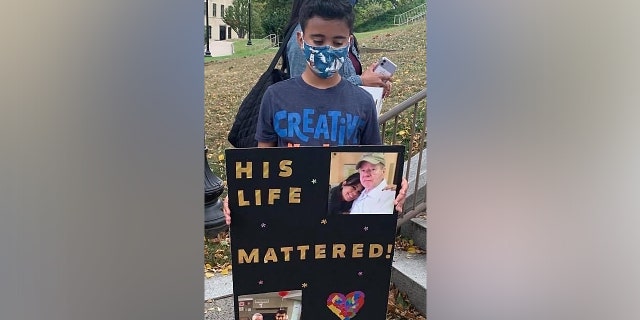
Anthony Rodriguez' grandson, Aiden. (Joann Rodriguez)

Anthony Rodriguez' grandson, Aiden. (Joann Rodriguez)

"I just felt so helpless, helpless towards him," she said. "He had a lot, a lot of life in him left." 

She described her father as a warm and welcoming man who was quiet but "very, very strong-minded." In fact, he was to go-to in an emergency situation.

Even on FaceTime, he always smiled and finished every conversation with "I love you," she said.

It's been almost a year since Joann Rodriguez and her family lost him to the pandemic. However, they still struggle with being "denied the right to know what happened" and why.  

"There's really no closure," she said. "When you finally find out about this mandate that potentially killed thousands ... it's incomprehensible that our government could do that." 

Even after her father died, the nursing home didn't answer their questions, she said. 

"In fact, they blew it off," she said. "And the only thing they had to tell us was 'when will you be able to pick up your father's belongings?'"

The decision was "irresponsible and it's unacceptable" Joann Rodriguez said. Her hope is that those who are responsible are finally held accountable.

"[It's] something that needs to be brought out into the open and people need to be held accountable," she said. 

Full Article & Source:

Why did Governor Cuomo give nursing homes immunity from Covid deaths?

by Ron Kim

Was the corporate immunity linked to $1.5m in political contributions from lobbyists? Only a full investigation can help us find out


Imagine fielding hundreds of calls from worried constituents at the peak of the first Covid-19 wave, trying to help scared families protect loved ones in nursing homes.

Imagine being stonewalled by those nursing homes and the department of health as you sought answers to life-and-death questions, knowing that Governor Andrew Cuomo’s directive forced these unprepared facilities to take in thousands of Covid-positive patients.

This was what I was going through as a New York state assemblyman when I received a call from a New York Times reporter about a corporate legal immunity provision that gave for-profit nursing homes and hospitals get-out-of-jail-free cards.

My heart sank as I read it. I did not need a PhD or law degree to understand the repercussions of handing out legal immunity to for-profit nursing homes, which now had legal and criminal shields to disincentivize them from saving lives.

Many of my colleagues had no idea the 2020 budget contained a legal shield that gave nursing home executives, trustees and board members blanket immunity. I voted against the budget bill, but if more members knew about the full implications of the legal immunity clause, there was no chance it would have passed.

So how and why did a blanket corporate immunity clause end up in the state budget?

In Albany and state capitals across the country, powerful governors routinely sneak toxic, corporate-friendly provisions into annual budget bills, hoping that lawmakers and the public are not paying attention. These are laws – like corporate legal immunity – that would never pass as stand-alone legislation.

The bigger question is why this provision was added in.

During the peak of the first wave, the Greater New York Hospital Association (GNYHA), a lobbying arm of hospitals and nursing home facilities, drafted immunity legislation and sent it to the governor’s office. On 3 April, they bragged in a post on its website (later taken down) that they had drafted and passed the “gold standard” of legal immunity for their members in New York’s 2020 budget.

At the time, New York’s nursing home fatalities were among the highest in the nation. As my office began investigating, what became certain was a clear connection between early blanket corporate immunity and higher rates of fatalities at nursing homes.

I felt as if I had to make this public: we believed in our data, compiled three reports and drafted a bill to fully repeal the corporate immunity law.

However, shortly after our reports were published, the governor’s administration changed how fatalities were being counted. Nursing home residents who died in hospitals were now attributed to the hospitals and not the nursing homes. As a result, New York’s nursing home deaths “decreased” and no longer seemed as awful compared with other states.

In August, at a joint oversight hearing, the president of GNYHA admitted they “lobbied extensively for the immunity law”, and that he was “proud to have done it and continue to do it right now in Washington as it relates to the federal level”.

There is a strong link between Governor Cuomo’s push for legal immunity and lobbyists like the Greater New York Hospital Association, which in one year gave him more than $1.5m in political contributions. There is more than a good chance that he continued to listen to these lobbyists after the budget – and the immunity clause – passed.

And there is a real possibility that lobbyists for hospital executives and for-profit nursing homes pushed the administration to suppress death numbers to defend their legal immunity.

Despite many pleas to disclose the full data, the governor and his administration purposefully suppressed this information until very recently, when the New York state attorney general reported an almost 50% underreporting in nursing home deaths.

For these reasons, we must thoroughly investigate why Governor Cuomo gave these for-profit facilities legal immunity, and who influenced him to suppress the nursing home death numbers.

  • Ron Kim is in the New York state assembly representing the 40th district

Full Article & Source:

Friday, February 19, 2021

Sen. Tedisco responds to news of FBI, U.S. Attorney investigation into nursing home deaths

NewsChannel 13 has confirmed the FBI and US Attorney’s Office in Brooklyn have opened an investigation into the governor’s COVID-19 Task Force and its handling of nursing homes during the pandemic, as first reported by the Times Union. 

Sen. Jim Tedisco is responding to the news. He released the following statement:

“This was never about politics as some things, like the deaths of 15,000 nursing home residents, rise above politics. Given this federal investigation into the Cuomo Administration, the legislature should revoke the Governor’s emergency powers as there’s bi-partisan agreement among Democrats and Republicans who believe we should restore the legislature’s role as an equal branch of government. This must be the top legislative priority when we reconvene on Monday afternoon as Cuomo can no longer be trusted with his ‘Emperor-like’ powers.”  

“Once we take Cuomo’s powers away, the legislature should send our own subpoenas to the Administration to begin a state investigation of the nursing home cover-up or pass my legislation with Assemblyman Ron Kim for a bi-partisan, independent investigation of the nursing home scandal.”

 “If the facts demonstrate a cover-up and obstruction of justice, and they certainly seem to with the drip, drip, drip of new information revealed on a daily basis, then Governor Cuomo must resign or face impeachment and removal from office.”

Full Article & Source:
The Fallout for Cuomo Over Nursing Home Deaths

By Troy Closson
 
Johannes Eisele/Agence France-Presse — Getty Images

Gov. Andrew M. Cuomo wrote a memoir on pandemic leadership last year. But questions around New York’s incomplete count of coronavirus-related deaths in nursing homes have undercut his national image.

Now, the Democratic leaders of the State Senate are in the final stages of crafting a bill that would strip him of emergency powers granted during the pandemic.

“I believe they should be taken away, hopefully sooner than later,” State Senator Gustavo Rivera said on Wednesday, adding that “we need to remind them that state government is not one big branch: There’s three of them.”

[Read more about the move by lawmakers.]

Here’s what you need to know:

Nearly a year ago, Mr. Cuomo was granted far-reaching authority to supersede state laws to combat the pandemic. He has signed dozens of executive orders since then, mandating shutdowns and instituting quarantine requirements for travelers, among other actions.

The bill’s passage, which could occur as soon as next week, would limit those powers and would be a remarkable rebuke in the aftermath of Mr. Cuomo’s admission that he withheld nursing home data from the Legislature, according to my colleagues Jesse McKinley and Luis Ferré-Sadurní. It would also establish a 10-person commission to evaluate his future pandemic-related directives.

It remains unclear if the State Assembly would follow the Senate’s lead, and any bill passed would also need to be signed by the governor himself — though Democrats could override a veto with supermajorities in both chambers.

The governor also faces a federal inquiry by the F.B.I. and the U.S. attorney for the Eastern District over his handling of nursing homes during the pandemic.

Critiques of the governor’s nursing home policies have been raised for months, and Mr. Cuomo had long dismissed them as partisan attacks. But on Wednesday, he lashed out at a critic from his own party, Assemblyman Ron Kim, a Queens Democrat who had said the governor had threatened him earlier.

After a report from the state attorney general and a court order, the official count of deaths of nursing home residents nearly doubled from about 8,500 to more than 15,000. Those who died in hospitals had not been initially included.

Mr. Cuomo’s top aide, Melissa DeRosa, also privately told some lawmakers last week that officials had withheld data because they worried about a possible Trump Justice Department investigation, sparking further allegations of a cover-up. The governor has since said that his administration’s lack of transparency was “a mistake,” but has stopped short of a full apology.

“That void of information caused the families who lost a loved one tremendous pain,” he said on Wednesday. “My administration created the void — and that I feel bad about. Not illegal, not unethical. But just failed people in that moment.”

Full Article & Source:
Saturday, February 13, 2021

COVID-19 Deaths in Nursing Homes and Long-Term-Care Fa­cil­ities Closer to 15,000, New Data Shows


By Zack Fink

The overall picture of how COVID-19 devastated nursing homes in New York is growing grimmer. It comes after the Cuomo administration quietly released new data late last week that included deaths of residents who were in long-term care or assisted living facilities. 

“The number of hospital deaths of long-term-care facility residents was 1,500. Over 1,500. So that number went from being 200 to 1,700 overnight,” explained Bill Hammond, a senior fellow of health policy for think tank Empire Center.

As a result of the revised figures, the total number of nursing home and long-term-care facility deaths went from 9,154 last month to 14,933. That’s an increase of 5,778, or 63%.

The new numbers only came out because of a lawsuit from the Empire Center.

“We filed a FOIL request,” Hammond said. “They delayed responding. Because of that delay, which we thought was not in keeping with the law, we filed a lawsuit. And the judge agreed with us. She said the flats by the Health Department was unreasonable and not within the law. She found three in violation of the law.”

The reason for the discrepancy is that the Cuomo administration was not counting deaths of nursing home residents or long-term care-facility residents who died in hospitals. Nor were they counting probable COVID-19 deaths as part of the overall total. Critics say the obfuscation seems purposeful.

“Administration, the Department of Health, have only released this information after being forced to by a judge and after being shamed by a report from their own Democratic Attorney General,” said Senate Minority Leader Rob Ortt. “So, there is no question they were construing this data differently to paint a different picture than the one that is real. And that is what’s most troubling.”

We reached out to the Cuomo administration for a response and they referred us to an older statement from Health Commissioner Howard Zucker, which said, “New York State Department of Health has always publicly reported the number of fatalities within hospitals irrespective of the residence of the patient, and separately reported the number of fatalities within nursing home facilities and has been clear about the nature of that reporting.”

Zucker is expected to testify before the legislature later this month. Republicans are asking that he appear on multiple days, to allow for more questions, rather than just that one day.

Full Article & Source:

Saturday, January 30, 2021

N.Y. Severely Undercounted Virus Deaths in Nursing Homes, Report Says

The state attorney general, Letitia James, said it’s likely that the Cuomo administration failed to report thousands of Covid-19 deaths of nursing home residents.

 
Credit...Dave Sanders for The New York Times

By Jesse McKinley and Luis Ferré-Sadurní

ALBANY, N.Y. — For most of the past year, Gov. Andrew M. Cuomo has tried to brush away a persistent criticism that undermined his national image as the man who led New York through the pandemic: that his policies had allowed thousands of nursing home residents to die of the virus.

But Mr. Cuomo was dealt a blow when the New York State attorney general, Letitia James, reported on Thursday morning that Mr. Cuomo’s administration had undercounted coronavirus-related deaths of state nursing home residents by the thousands.

Just hours later, Ms. James was proved correct, as Health Department officials made public new data that added more than 3,800 deaths to their tally, representing nursing home residents who had died in hospitals and had not previously been counted by the state as nursing home deaths.

The state’s acknowledgment increased the overall death toll related to those facilities by more than 40 percent. Ms. James’s report had suggested that the state’s previous tally could be off by as much as 50 percent.

The findings do not change the overall number of Covid-19 deaths in New York — more than 42,000, the most of any state — but the recalculation in the number of nursing home deaths illustrates how unprepared the nursing home industry was in the first and deadliest weeks of the pandemic.

Mr. Cuomo, a third-term Democrat, had long dismissed the critiques of his policies governing those facilities as partisan attacks from the Trump administration and other Republican adversaries.

But the report by Ms. James, a fellow Democrat, casts a renewed light on the state’s decision to send nursing home residents who had been hospitalized with the coronavirus back to the nursing homes, a policy that Mr. Cuomo has defended as following federal guidelines.

At the same time, Ms. James’s assertion of an undercount of deaths gave credence to theories that the state may have intentionally played down the number of those deaths to avoid blame.

“This is shocking and unconscionable,” said Assemblyman Richard N. Gottfried, the Democratic chairman of the Assembly Health Committee. “But not surprising.”

The 76-page report, which included critiques of other policies promulgated by the Department of Health and of the behavior of nursing home operators, led to a scramble by Mr. Cuomo’s administration to rebut its assertions, including a lengthy response late Thursday afternoon from the health commissioner, Dr. Howard Zucker.

Dr. Zucker said that the state website had always been clear that deaths it listed did “not include deaths outside of a facility.”

“The word ‘undercount’ implies there are more total fatalities than have been reported,” he said. “This is factually wrong.”

He also asserted that the lack of data on hospital deaths of nursing home residents was due to concern and caution about the accuracy of data that nursing homes supplied — an issue also raised by the attorney general. “D.O.H. does not disagree that the number of people transferred from a nursing home to a hospital is an important data point,” he said.

The new data released by Dr. Zucker puts the total number of deaths connected to nursing homes at 12,743.

Ms. James’s findings would seem to put her in rare conflict with Mr. Cuomo; she was the governor’s preferred candidate after Eric T. Schneiderman suddenly resigned as attorney general in 2018, and she readily embraced Mr. Cuomo’s political backing.

Her report seemed certain to inspire more questions about the handling, oversight and performance of the state’s nursing homes in the early stages of the pandemic. Indeed, on Thursday, Mr. Cuomo’s critics in Washington and Albany had already seized on the attorney general’s report as evidence of his dishonesty, amid calls for Dr. Zucker to resign.

“This is now more than a nursing home scandal,” said Representative Elise Stefanik, a conservative Republican from upstate New York. “This is a massive corruption and cover-up scandal.”

Deaths in nursing homes and other long-term care facilities have accounted for about a third of the nation’s some 430,000 Covid-19 deaths. Federal and state authorities have made vaccinating staff and residents at such facilities a top priority, though that effort has been slower than hoped.

But even as state officials in New York tackle vaccine shortages, the count of deaths in the state’s nursing homes remained a source of controversy. Mr. Cuomo had been accused of obscuring a more accurate estimate of nursing home deaths, because the state’s count only included the number of deaths at the facilities, rather than accounting for the residents who died at a hospital after being transferred there.

For its report, Ms. James’s office surveyed dozens of homes and found consistent discrepancies between deaths reported to the attorney general’s investigators and those reported to and officially released by the Health Department.

In one instance, an unnamed facility reported to the Health Department that it had 11 confirmed and presumed deaths on site through early August. The attorney general’s survey of that same facility, however, found 40 deaths, including 27 at the home and 13 in hospitals.

Another facility reported one confirmed and six presumed Covid-19 deaths to the Health Department, according to the report. The attorney general’s office, however, said the facility reported to its investigators that there were more than four times that number — 31 dead — by mid-April.

The attorney general’s report also scrutinized immunity provisions granted to health care providers codified by Mr. Cuomo in the state budget. The report said the protection of immunity may have prompted some nursing homes to make financially motivated decisions at the height of the pandemic, like admitting patients even when the facilities were facing staff shortages or were unequipped to care for them.

Indeed, Ms. James’s office is still investigating and weighing legal action stemming from complaints made to her office about shortcomings and neglect that may have placed residents at risk. Those include allegations of nursing homes that failed to isolate Covid-19 patients, maintain stockpiles of personal protective equipment, properly screen employees for the virus or ensure adequate staffing levels even before the pandemic.

The report also cast a critical eye on perhaps the governor’s most criticized decision since the beginning of the pandemic last year: a March 25 directive from the Health Department that ordered nursing homes to accept and readmit patients who had tested positive.

The Health Department responded in July with a report that sought to absolve the state from any blame resulting from the March directive. The report concluded that most of the patients sent back to nursing homes “were no longer contagious when admitted and therefore were not a source of infection.” The Health Department concluded that the virus was instead spread by employees who did not know they were contagious.

While acknowledging that Mr. Cuomo’s memo to nursing homes was consistent with federal guidance, the attorney general’s report said the governor’s policy “may have put residents at increased risk of harm in some facilities.” Under the policy, some nursing homes stopped testing residents for the coronavirus, a factor that might have obscured data reported by the facilities, the report found.

For its part, the Health Department also cited Ms. James’s findings on the March 25 memo, saying the report had found no evidence that the policy outlined in the directive “resulted in additional fatalities in nursing homes.”

Ms. James’s report also found a number of homes that “failed to comply with critical infection-control policies,” including failing to isolate residents who had tested positive for the virus or screen employees for it.

The state’s reporting of nursing homes deaths has been the focus of a lawsuit by a conservative economic think tank, the Empire Center for Public Policy, which has sued, seeking to force the Health Department to release more complete data. 

Last year, the Democratic-controlled Legislature held hearings partly in an attempt to pry the data from the administration, to no avail.

Dr. Zucker was supposed to testify next week during a state budget hearing, where lawmakers were expected to press him on nursing home deaths, but his appearance was recently pushed back to late February.

The Democratic chairman of the investigations and government operations committee in the State Senate, James Skoufis, who has accused the Health Department of stonewalling investigators, suggested on Thursday that he would use a subpoena to compel the release of data from Dr. Zucker’s office.

“The D.O.H. commissioner’s unresponsiveness to the Legislature’s many questions and concerns is insulting and unacceptable,” the senator said in a statement.

The attorney general asked 62 nursing homes — about a tenth of the state’s total — for information about on-site and in-hospital deaths related to the virus; investigators then cross-referenced that information with public reports of deaths issued by the Health Department. The deaths reported to the attorney general’s office at most of those facilities totaled 1,914, compared to the state’s much lower count of 1,229.

Ms. James said that her office was investigating those circumstances “where the discrepancies cannot reasonably be accounted for by error or the difference in the question posed.”

The attorney general said she was continuing to conduct investigations of more than 20 nursing homes across the state that “presented particular concern,” noting that “other law enforcement agencies also have ongoing investigations relating to nursing homes.”

Under normal circumstances, the attorney general’s office “would issue a report with findings and recommendations after its investigations and enforcement activities are completed,” Ms. James said in her report. “However, circumstances are far from normal.”

Full Article & Source:
Friday, January 29, 2021

NY data show nursing home deaths undercounted by thousands

Click for Video

by MARINA VILLENEUVE, BERNARD CONDON and MATT SEDENSKY

ALBANY, N.Y. (AP) — New York Gov. Andrew Cuomo's administration confirmed Thursday that thousands more nursing home residents died of COVID-19 than the state's official tallies had previously acknowledged, dealing a potential blow to his image as a pandemic hero.

The surprise development, after months of the state refusing to divulge its true numbers, showed that at least 12,743 long-term care residents died of the virus as of Jan. 19, far greater than the official tally of 8,505 on that day, cementing New York's toll as one of the highest in the nation.

Those numbers are consistent with a report released just hours earlier by Attorney General Letitia James charging that the nursing home death count could be off by about 50%, largely because New York is one of the only states to count just those who died on facility grounds, not those who later died in the hospital.

“While we cannot bring back the individuals we lost to this crisis, this report seeks to offer transparency that the public deserves,” James said in a statement.

The 76-page report from a fellow Democratic official undercut Cuomo's frequent argument that the criticism of his handling of the virus in nursing homes was part of a political “blame game," and it was a vindication for thousands of families who believed their loved ones were being omitted from counts to advance the governor's image as a pandemic hero.

“It’s important to me that my mom was counted,” said Vivian Zayas, whose 78-year-old mother died in April after contracting COVID-19 at a nursing home in West Islip, New York. “Families like mine knew these numbers were not correct.”

Cuomo’s office referred all questions to the state health department. Several hours after the report, State Department of Health Commissioner Howard Zucker released a lengthy statement attempting to refute James' report but which essentially confirmed its central finding.

Zucker's figure of 12,743 nursing home resident deaths included for the first time 3,829 confirmed COVID-19 fatalities of those residents who had been transported to hospitals.

Those figures could be even higher, but the health department said its audit was ongoing, didn't break out deaths presumed but not confirmed to be caused by the virus, and omitted those in assisted living or other types of long-term care facilities.

Zucker, however, still took issue with James' characterization of his department's official tally as an “undercount.” He said “DOH was always clear that the data on its website pertains to in-facility fatalities."

James has for months been examining discrepancies between the number of deaths being reported by the state's Department of Health, and the number of deaths reported by the homes themselves.

Her investigators looked at a sample of 62 of the state’s roughly 600 nursing homes. They reported 1,914 deaths of residents from COVID-19, while the state Department of Health logged only 1,229 deaths at those same facilities.

Thursday's release backed up the findings of an Associated Press investigation last year that concluded that the state could be understating deaths by as much as 65%.

State Sen. Gustavo Rivera, a Democrat who has blasted the Cuomo administration for its incomplete death count, said he was “sadly unsurprised” by the report.

“Families who lost loved ones deserve honest answers,” Rivera said. “For their sake, I hope that this report will help us unveil the truth and put policies in place to prevent such tragedies in the future.”

Cuomo, who last fall released a book touting his leadership in dealing with the virus, has not been shy about using New York's lower nursing home death count to make the argument that his state is doing better than others in caring for those in such facilities.

“There's also no doubt that we’re in this hyper-political environment so everybody wants to point fingers,” Cuomo told CBS “This Morning” in October. “New York, actually, we’re number 46 out of 50 in terms of percentage of deaths in nursing homes ... it’s not a predominantly New York problem.”

The attorney general’s report also took aim at New York's controversial March 25 policy that sought to create more space in hospitals by releasing recovering COVID-19 patients into nursing homes, which critics contended was a driving factor in causing nursing home outbreaks.

James’ report said those admissions “may have contributed to increased risk of nursing home resident infection and subsequent fatalities,” noting that at least 4,000 nursing home residents with COVID-19 died after that guidance. But James’ report said the issue would require further study to conclusively prove such a link.

New York’s health department released a much-criticized report last summer that claimed the March 25 policy, which was reversed in May, was “not a significant factor” in deaths.

James’ review also found that a lack of infection controls at nursing homes put residents at increased risk of harm, that homes with lower federal scores for staffing had higher fatality rates, and that a broad measure Cuomo signed in April shielding nursing homes and other health care providers from lawsuits may have actually encouraged homes to hold back on hiring and training.

“As the pandemic and our investigations continue," she wrote, “it is imperative that we understand why the residents of nursing homes in New York unnecessarily suffered at such an alarming rate.”

 
Full Article & Source:
Wednesday, January 27, 2021

Thousands died at a nursing home chain. Its CEO got a $5 million bonus

By Kate Gibson

Click to Watch Video

As COVID-19 took a deadly toll among residents of Genesis Healthcare facilities, the financially troubled company gave CEO George Hager Jr. a $5.2 million "retention payment." 
 
At the helm of the large U.S. nursing home chain during a pandemic that has killed more than 1,500 of its residents and threatens to push it into bankruptcy, Hager received the bonus in late October. He then resigned from the for-profit company, where he had served as chief executive for 17 years, less than three months later, earlier this month.

Nursing homes account for a sizable portion of the more than 419,000 U.S. COVID-19 deaths, and outbreaks at Genesis facilities caught the attention of lawmakers over the summer. "More than 1,500 Americans have died and many more have been infected at facilities owned by your company, with at least 187 of your facilities reporting cases of the coronavirus," members of a House panel looking into the impact of COVID wrote Hager in June.

The toll at Genesis reportedly nearly doubled in the second half of 2020, with 14,352 confirmed cases among its residents and 2,812 deaths as of December 20, according to the Washington Post. An analysis of Medicare data by the news outlet found almost all of Genesis' nursing homes running short on personal protective equipment up until late November, after the company's board had signed off on Hager's bonus. 

Genesis did not respond to requests for comment from CBS MoneyWatch. 

In a regulatory filing in November, the company said its first report of a positive case of COVID-19 in one of its facilities occurred on March 16, 2020. Since then, 266 of its 360 nursing facilities and assisted living communities had reported positive cases among patients and residents, the filing stated. More than 70% of those cases occurred in five states — Connecticut, Maryland, Massachusetts, New Jersey and Pennsylvania — with those facilities representing 45% of its beds. Genesis operates in 24 states.

Hager was also running the Kennett Square, Pa.-based chain when it agreed in 2017 to pay the federal government nearly $54 million, partly for providing "grossly substandard nursing home care" at multiple facilities. Genesis denied the allegations, some of them involving events that occurred at nursing homes before they'd been acquired by the company.

In financial distress for years, Genesis has cautioned its investors since the summer that the pandemic had worsened matters to the point where it might have to file bankruptcy. 

"The virus continues to have a significant adverse impact on the company's revenues and expenses," Hager stated in a November 9 earnings release in which the company reported a net loss of $62.8 million for the third quarter of 2020. Government stimulus in the third quarter fell almost $60 million short of the company's COVID-19 costs and lost revenue, he said.

"There is no question Genesis will need ongoing support from the federal government and our capital partners to sustaining operations," Hager told an earnings call that day. 

For the first nine months of last year, Genesis reported a loss of $96 million, a period in which it was given $254 million in federal aid related to COVID-19, as well as commitments of $85 million from some of the states where it does business. 

With Hager continuing as a consultant, board chairman Robert Fish has taken over as Genesis CEO. 

Full Article & Source:
'They just did it wrong': How COVID-19 ravaged Pennsylvania's long-term care facilities

by Jasmine Brooks


Nearly 20,000 Pennsylvanians have died from COVID-19 in less than a year, with seniors accounting for half of those deaths.

We're getting a firsthand account of what happened inside some of the nursing and personal care facilities from a nurse who says, she witnessed it.

"No one should ever die alone," says Margaret Barajas of the Pa Department of Aging.

Pennsylvania's nursing and personal care facilities; ground zero for COVID-19.

"The amount of overall death and destruction I’ve seen has been tremendous."

The deadly virus has already taken the lives of more than 10,000 seniors.

"By the time they found maybe one or two people who had positive tests, within a day or two those numbers doubled, tripled sometimes quadrupled."

A candid conversation with a nurse who has asked us to conceal her identity to protect her job. She's worked the floors of nearly ten-facilities in Pennsylvania, witnessing hundreds of patients trying to survive the quick and aggressive virus.

"Describe the worst situation that you've witnessed," asks CBS 21’s Jasmine Brooks.

"Honestly, there were some days where in a 12-hour shift there would be 10 to 15 people that would die. That was just hard as a nurse to watch day in and day out.”

"When COVID broke out around March in these nursing homes, were the nursing facilities prepared, Brooks asks.

"No," says Barajas.

"There are fingers to be pointed at systems that have failed our elders over and over again," she adds.

Margaret Barajas says, this pandemic has revealed the challenges that have existed in long term care facilities for years.

"Everything from facility design and structural limitations to maximize profits. Many homes still have four residents to a room," she explains.

"What were they lacking the most," Brooks asks our undercover nurse.

"I would say the knowledge of what to do. There would be no direction for anybody. You would show up at a facility and the director of nursing or anybody that probably should've been more prepared and have the knowledge really didn't know what to do, didn't know where to start, didn't know where to direct people where to go," she replies.

"What was the biggest complaint you were getting from family members on the outside?"

"That their family members were unfortunately isolated, which was absolutely true."

"Many of them are in rooms with no television, no telephone, no way to connect to the outside world," Barajas adds.

"If you had Dr. Levine in front of you what would you ask of her? Or tell her," asks Brooks.

"That they just did it wrong," the nurse says.

We went to the Department of Health to get some answers.

"What went wrong? Again, I understand it was a pandemic, unpresented times, but what went wrong," asks Brooks.

"How could anyone have truly been prepared for something of this magnitude and duration?" replies Keara Klinepeter with the Pa Department of Health.

Pennsylvania has now surpassed 60,000 resident cases.

"I am hoping that as we now move towards a brighter day with the vaccine on the horizon that we don't miss this opportunity to get better at this and to redesign and to bulldoze where necessary and start afresh," says Barajas.

"I personally was infected with COVID. It wasn't fun. I was pretty sick for a while. Emotionally I will say this has taken a greater toll. Emotionally, mentally, psychologically," she explains.

Full Article & Source:

Sunday, January 10, 2021

Poor staffing, missed reforms, 3,100 COVID deaths: How Indiana failed nursing home residents

by Tim Evans, Emily Hopkins and Tony Cook

For more than nine months, Indiana officials reassured the public that nursing homes were receiving the help they needed to handle the pandemic and protect vulnerable residents.

But the state never really got it under control.

The weekly death toll inside nursing homes is as bad as it has ever been. In all, more than 3,100 nursing home residents have died from COVID-19. Many died alone, their families unable to offer comfort or even say goodbye.

It didn’t have to be that way.

An IndyStar investigation has found longstanding, systemic problems left thousands of Hoosiers in nursing homes that are among the most poorly staffed in the nation. In some, even the simplest aspects of care are too often ignored. Now, Indiana’s long-term care residents are dying of COVID-19 at a rate that is among the highest in the U.S.

We'll never know how many lives could have been saved if the nursing homes had been better staffed, but preliminary research suggests it could be in the hundreds.

For more than a decade, efforts to reform the system have been ignored or knocked down by state leaders who have benefited from millions of dollars in campaign contributions from the industry. Instead, state officials endorsed a loosely regulated program, shrouded in secrecy, where money meant for nursing home care is instead used to bankroll county hospitals that own more than 90% of the state’s nursing homes.

The state's failure to reform the system has left Indiana with bare-minimum staffing standards and limited home care options. Meanwhile, county hospitals collect millions of taxpayer dollars with virtually no ties to care or quality in their nursing homes.

“It was like a catastrophe waiting to happen already before we had this horrible epidemic,” said Erica Reichert with the Center for At-Risk Elders, a nonprofit that represents more than 100 elderly and disabled Hoosiers in nursing homes.

More than 3,100 Indiana nursing home residents have died from COVID-19. These Hoosiers have seen the pandemic's devastating effects firsthand.
Jenna Watson, jenna.watson@indystar.com
 
With the virus racing across Indiana, Gov. Eric Holcomb and other state leaders failed to take aggressive action to protect the population most vulnerable to the virus. Other states were quick to send in the National Guard, mandate testing and publicly disclose outbreaks. Holcomb’s administration was slow to take those critical steps, acting only after federal mandates and a second surge of cases and deaths this fall.

Holcomb has defended his administration’s response. He and his top health officials point to the deployment of strike teams to assist nursing homes with outbreaks. They also tapped into a network of retired health care workers to help fill nursing home staffing gaps, and in October announced a limited pilot program to speed up approvals for home care.

But the governor has never directly addressed the state’s reliance on federal nursing home money to help fund county hospitals, or whether that money should be used to improve staffing at nursing homes. He declined multiple interview requests from IndyStar since March.

“We know COVID-19 disproportionately affects older Hoosiers and even more so those with underlying health conditions,” Holcomb said in an August email response to questions about issues in the nursing homes. “Now more than ever Hoosiers should expect increased quality and value in nursing homes and more readily accessible options in home and community based settings.”

Four months later, amid a resurgence of the virus, many of the problems that plagued nursing homes before the pandemic remain. And the number of deaths continues to climb.

“We knew from public health experts that something was coming. It was an eventuality, whether it was COVID, or a really horrible flu or something. We knew that it would adversely impact our elderly population,” said Reichert, whose organization served as a legal advocate for 16 long-term care residents killed by the virus. 

“But we did virtually nothing to prepare for it.”

Poor staffing, then a pandemic

That lack of preparation was evident at Cardinal Nursing and Rehabilitation, a nursing home in South Bend owned by the Health & Hospital Corp. of Marion County. 

Like a majority of Indiana’s nursing homes, Cardinal ranked in the bottom third of all nursing homes in America for the amount of time nurses and aides spent with residents before the pandemic, according to data from the federal Centers for Medicare and Medicaid Services.

So when the virus hit Cardinal in early April, officials admitted they were basically helpless. A local hospital official who suspected an outbreak rushed 60 swabs and urged the facility to immediately test each resident, a state inspection report said.

But the home didn’t have enough staff to swab the residents and couldn’t isolate those who were infected, an official told inspectors. Nineteen Cardinal residents have died of COVID-19, according to state data.

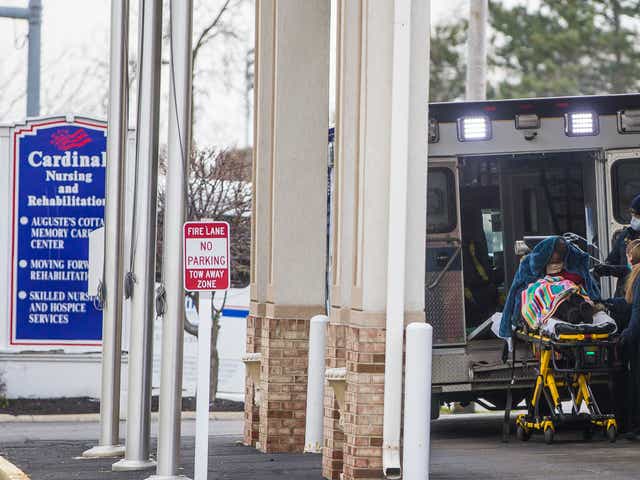
A person is loaded into an ambulance outside Cardinal Nursing and Rehabilitation on Tuesday, April 14, 2020, in South Bend, Ind.
A person is loaded into an ambulance outside Cardinal Nursing and Rehabilitation on Tuesday, April 14, 2020, in South Bend, Ind. - Robert Franklin/South Bend Tribune via USA TODAY Network

A spokesman for Health & Hospital did not directly respond to questions about Cardinal, but defended the quality of the agency’s nursing homes, noting they are above average compared to other Indiana nursing homes. 

That's little comfort to Kristin Billings. She said she had to call the police to check on her mother because the staff was stretched so thin that they stopped responding to her calls. After her mother recovered from COVID-19, Billings moved her out of Cardinal.

“I was fighting like crazy for my mom,” she said. “Never again would I put anybody in that place.”

The tragedy at Cardinal highlights how Indiana’s nursing home system fails its vulnerable residents. HHC, which operates the Sidney & Lois Eskenazi Hospital in Indianapolis, is the state’s largest nursing home owner. In 2019 alone, the public agency received $182 million in extra federal funds for its 78 nursing homes. But the hospital spent $117 million on other uses instead of on improving care at the homes.

The same scenario has played out at hundreds of nursing homes owned by HHC and other county hospitals. More than $1 billion in nursing home money has been used to prop up hospital projects, such as the construction of the $754 million Eskenazi hospital.

The hospitals have defended the funding arrangement, arguing it benefits both nursing home residents and hospital patients. But as the pandemic has played out, it has become clear that Indiana’s nursing homes lacked the staff and resources to protect residents from COVID-19.

Indiana has had among the highest number of deaths per 1,000 nursing home residents. More than 20% of long-term care residents who have contracted COVID-19 in Indiana have died. The national rate is 13%.

About 39% of COVID-19 deaths across the country have been linked to long-term care facilities. In Indiana, long-term care residents account for more than 52% of the deaths, but less than 1% of the population.

And almost no facility has been spared: 484 of the 534 facilities in Indiana have had at least one case. More than 393 have had at least one COVID-19 death.

The pandemic further overwhelmed a workforce that was already among the thinnest in America. Going into the pandemic, Indiana ranked 48th for the amount of time nursing staff spent with residents after adjusting for their needs, according an IndyStar analysis of federal data.

Zach Cattell, president of the Indiana Health Care Association, which represents the nursing home industry, acknowledged the staffing issues in an emailed statement, but blamed them on "hiring challenges" outside of the industry's control. He did not, however, provide an explanation for how those hiring challenges are unique to Indiana or why 47 other states have done a better job of staffing positions.

A months-long IndyStar investigation published in March found scores of inspection reports and malpractice claims involving injuries or deaths that may have been prevented with adequate staffing: bed sores allowed to fester until limbs had to be amputated, repeated falls that left residents with broken bones or fatal head injuries, and violent attacks among unsupervised residents.

That was before the pandemic presented an unprecedented public health crisis. As signs touting “heroes work here” sprouted up in front of nursing home facilities, a workforce already stretched thin was pushed to the brink.

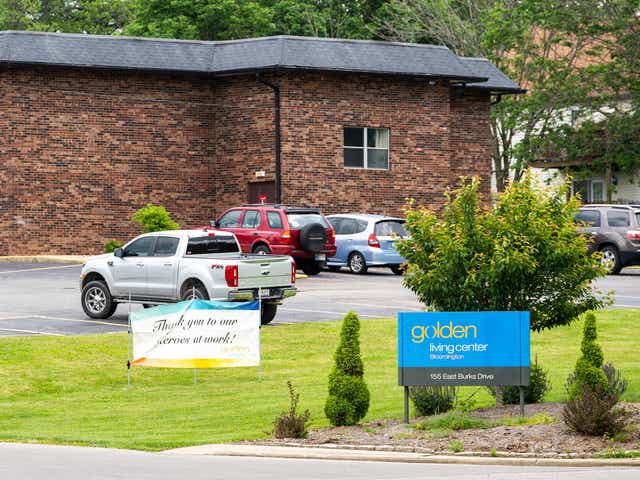
Golden Living Center in Bloomington, Ind., on Thursday, June 4, 2020.
Rich Janzaruk/Bloomington Herald Times via USA TODAY Network

Employees who spoke to IndyStar describe being pressured to work with symptoms or without proper protective equipment. They watched their teams shrink as staff became sick and were sent home, with little hope for reinforcements.

“We were short and overworked,” an aide told IndyStar of her experience working at Golden LivingCenter in Bloomington this spring. “We had nurses that sat at the desk and was in tears, crying because either one of their co-workers or another nurse had tested positive and had been sent home.”

Wesley Rogers, president of Golden LivingCenters, dismissed such complaints in a statement, saying they “inaccurately or incompletely report events.”

Carmela Canale, who had been a licensed practical nurse for 27 years, quit her job at another nursing home in March when the management company introduced new coronavirus measures but did not bring in additional staff.

Carmela Canale stands for a portrait at a park in Indianapolis on Sunday, Sept. 27, 2020. Canale had been a licensed practical nurse for 27 years, but quit her job in March when the management company introduced new coronavirus measures but did not hire additional staff. Canale, who has worked as an LPN in several states, said nurses are pulled in too many directions, underpaid, and facilities are chronically understaffed. "It breaks my heart because people are not getting the care they need," Canale said.
Jenna Watson/IndyStar

“I was already so overwhelmed by what needed to be done,” Canale said. When additional duties were added, such as changing protective equipment between residents, she said to herself: “I just can’t, I can’t do everything that you want and put something else on top.” 

Preliminary research has shown that facilities with poor staffing before the pandemic were more likely to have more coronavirus deaths.

While the presence of the virus in the community surrounding a nursing home was the most important factor, having more nurses and aides prior to the pandemic was associated with fewer deaths in facilities with outbreaks, according to a national study by Tamara Konetzka, a professor of public health sciences at the University of Chicago.

A handful of other studies focused on specific states have also found associations between higher nursing staff levels and fewer COVID-19 cases or deaths.

The human reality of those trends is documented in recent inspection reports. Even though the availability of testing, protective equipment and infection control training has improved since the early months of the pandemic, staffing shortages and the problems they cause have continued to put vulnerable nursing home residents in danger. 

At Countryside Manor in Anderson, where 14 residents have died, inspectors found employees caring for COVID-positive and negative residents alike in September, potentially exposing residents to the virus. An employee told inspectors the facility could have prevented a recent increase in falls if they’d had more staff. 

At Southwood Healthcare Center in Terre Haute, where six residents have died, inspectors found “a systemic failure” in infection control practices in October. “Residents were not closely monitored for symptoms of COVID-19 during the outbreak,” a report said, adding some with unknown COVID-19 status were observed smoking with healthy residents. “No staff were observed in the area to redirect residents to social distance at this time,” the inspection found. 

A sign informs passersby that Bethany Village Healthcare is hiring, seen on the south side of Indianapolis on Thursday, Aug. 6, 2020.
Jenna Watson/IndyStar

Southwood, owned by Hancock Regional Hospital, was also cited for insufficient staffing in August and again in September. Employees told inspectors “they did not feel there were enough staff to take care of the residents.” Call lights were not answered, residents were not groomed and some did not receive their medicines. One man was found on the ground calling out for help, having soiled his pants. Southwood was in the bottom 6% in the nation for total nursing staff hours as of Oct. 1.

A spokeswoman for Southwood acknowledged staffing has been challenging "given the high infection rates" in the area, and the facility has used temporary workers to care for residents during the pandemic.

How we got here

The lack of staffing is a product of the way Indiana funds nursing homes.

For years, county hospitals have been gaming the Medicaid system with the permission of state and federal officials. An arcane federal law allows government-owned nursing homes to draw extra funds. The intent was to provide extra financial assistance to homes that often serve as the last resort for poor and medically needy residents. 

But Indiana has exploited the program, effectively turning it into a major revenue stream for 22 county hospitals that have snatched up — at least on paper — more than 500 of the state’s nursing homes in recent years. Indiana now receives more of the extra money than any other state. More than California and New York — combined. The haul was more than $679 million last year alone. 

Much of it never reaches the nursing homes. County hospitals have diverted more than $1 billion to their own operations. Neither the state nor federal government require an accounting of how the money is spent. The loose oversight has allowed rampant fraud, with allegations of roughly $65 million in losses at just two county-owned systems since 2008.

As a result, Indiana has had one of the most expensive, least efficient nursing home systems in the nation. In sheer dollars, Indiana ranked fourth in 2019 for Medicaid spending on nursing home care. The price tag: A whopping $2.6 billion. That’s more per resident than every state but West Virginia. Yet staffing, widely regarded as the most important factor in quality care, has consistently been among the worst in America.

David Grabowski, a professor of healthcare policy at Harvard Medical School, compared Indiana hospitals to private equity firms that extract money with little concern about care outcomes or long term viability.

“This just really gives me pause,” he said. “I wonder how these county hospitals are viewing ownership of these nursing homes other than this is a way to pull down more money and not actually invest in patient care.”

The irresistible funding source has kept Indiana’s eldercare system skewed in favor of institutionalized care. As of 2016, the most recent data available, 48 other states devoted a larger share of their long-term care Medicaid funds to home and community-based care. That not only allows residents to age at home where they are more comfortable, but it is also less expensive for taxpayers. 

Nationally, states spend an average of about 57% of their long-term care funds on home and community-based care. Indiana spends just 32%. 

“Right now, if someone is hospitalized and they're about to be discharged from the hospital and they need care, the default in too many cases is institutional care,” said state Rep. Ed Clere, a New Albany Republican who is chairman of the House Ways & Means subcommittee on health and Medicaid. “They could have a high quality of life in their home. But that is not the way the system is designed.” 

The imbalance has become even more consequential amid the pandemic. If fewer Hoosiers were trapped in Indiana’s nursing homes where the virus can spread so easily, more may have survived.

Edward Nave, a General Motors retiree, was a Vietnam veteran and longtime deacon at Second Missionary Baptist Church in Anderson.
Photo provided by Hazel Nave

Edward Nave, a General Motors retiree, was a Vietnam veteran and longtime deacon at Second Missionary Baptist Church in Anderson.

Nave, 72, died April 6 at Bethany Pointe Health Campus in Anderson where he had gone in February for a 30-day rehab stint following surgery.

Nave was ready to leave Bethany Pointe and return home, but a home care assistant his wife hired needed proof he had been tested for COVID-19. His family frantically fought to get him tested, but said they got a runaround from county and state health departments and the nursing home.

"I talked to him Wednesday and he told me he was doing okay, but he was ready to come home. And I said, 'Ed, I'm getting you home.' I said, 'give me to Friday, and I'm going to come and get you,'" Nave's wife, Hazel, promised her husband five days before he died.

Reform efforts fall flat

The shortcomings of Indiana’s nursing home system have been well-known to state officials and lawmakers for years. They have repeatedly studied the problems, but proposals to improve the system have consistently failed.

A 2015 report by the state’s Family and Social Services Administration said a surplus of nursing home beds and low occupancy rates at Indiana nursing homes were expensive, inefficient and contributed to a decrease in the quality of care for thousands of vulnerable Hoosiers.

Indiana’s long-term care system “must transform, and soon,” the report warned.

But reforms have failed to materialize, in part due to pushback from the nursing home industry. Lawmakers instead cloaked the program in secrecy by granting county hospitals unusual exemptions to public records laws. 

Members of both parties have tried to establish minimum staffing requirements for Indiana nursing homes, which the industry has said won't help. Five bills have been filed since 2009. None of them even received a committee hearing.

Former state Rep. Clyde Kersey, a Democrat from Terre Haute who filed four of the bills, said the industry has a lot of clout at the Statehouse. “I couldn't get any traction,” he said. “I couldn't even get people from my own side to support it.”

Under then-Gov. Mike Pence, FSSA officials tried another approach. After years of negotiations, they reached a tentative deal with the nursing home industry that would have shifted more funds to home care, incentivized the closure of some nursing homes, and tied 25% of the extra nursing home funds to quality standards. The goal was to improve care for older Hoosiers, including those in nursing homes, while reducing costs.

But when Gov. Eric Holcomb took office, the deal was scrapped. Holcomb has not explained why. IHCA's Cattell said his organization supports "appropriate steps" to rebalance Indiana's long-term care sector, tie supplemental funds to quality and right-size nursing home capacity. He did not explain what happened to the deal with the state that would have done just that.

While reform efforts fell flat, lawmakers had no problem granting unparalleled levels of financial secrecy to the county hospitals that own the homes.

In 2006, they passed a law that allows county hospitals to keep “proprietary and competitive” information confidential. Most are now using the exemption to hide their deals with private management companies and the amount of nursing home money they divert to other uses.

Lawmakers again singled out county hospitals in 2016, allowing them to withhold employee pay information, including executive compensation. No other government agency in Indiana is granted such an exemption and even private hospitals must typically disclose the earnings of their highest paid employees. 

As a result, it’s impossible for the public to know how county hospitals have spent the more than $4.4 billion in extra Medicaid funds their nursing homes have generated since 2003.

Money and power

One reason Indiana’s broken nursing home system persists is because it is extremely profitable for those involved.

County hospitals now technically own most of Indiana’s nursing homes, but their former private owners have not gone away. Instead, they continue to run the nursing homes in exchange for lucrative management fees — and in turn, spend large amounts of money on state campaign contributions.

The arrangements helped make many of those operators wildly rich. Take, for example, American Senior Communities, which is owned by the Jackson family of Indianapolis. During the past 10 years, Marion County’s HHC has paid the company and related entities nearly $550 million in fees and lease payments. That doesn’t include millions more in revenue from other businesses, also owned by the Jacksons, that provide products and services to HHC’s nursing home system.

Flush with the extra cash, the nursing home industry has poured nearly $3 million into Indiana political campaigns since 2009, according to an IndyStar analysis of campaign finance data. 

The vast majority of the money — more than $2 million — can be traced to just five nursing home operators and their various homes, companies, and executives. At least $437,000 came from the Jacksons, their affiliated companies and ASC executives. 

The owner of Magnolia Health Systems, which operates about 30 homes, and his companies spent about $565,000. And it wasn’t just cash. Stuart Reed, who lives in a $4 million Zionsville mansion, also provided an additional $10,000 in event catering and travel services for Pence during his initial run for governor, campaign finance records show.

The case files of some clients that the Center for At-Risk Elders has lost due to COVID-19, seen on Tuesday, Oct. 13, 2020. The center represents more than 150 elderly and disabled Hoosiers through its adult guardianship program and had lost 16 clients to COVID-19 as of December 11, 2020.
Jenna Watson/IndyStar

The biggest beneficiaries include Pence’s campaigns for governor, which received $739,000, and Gov. Holcomb’s campaign committees, which received $250,000 from the industry. Another $458,000 went to the Republican House and Senate campaign committees.

Those sums give the operators and their trade group, the Indiana Health Care Association, tremendous sway at the Indiana Statehouse, according to former lawmakers and state officials.

The industry’s ties run even deeper. Many state officials have personal financial relationships with the industry. Some lawmakers find jobs at nursing home chains or owners while serving. Others worked in the industry before getting elected. One lawmaker, former Rep. Eric Turner, stepped down after privately lobbying against a measure that would have hurt his family’s nursing home investments.

The deep connections allow the industry to push back against perceived threats. In 2015, existing nursing home operators successfully lobbied for a three-year moratorium on new nursing home construction, effectively blocking potential competition. Pence, who was governor at the time, expressed reservations about the measure, but in a rare move allowed it to become law without his signature.

Five years later, and amid a pandemic, Indiana is barely any closer to fixing its nursing home troubles. During the pandemic, residents have died of the virus at a rate of one every two hours. Yet state officials routinely have chosen to defer to the industry — often keeping important information from the public.

'Immediate jeopardy'

Early in the pandemic, state health commissioner Dr. Kristina Box praised nursing home operator Magnolia for creating a dedicated COVID unit.

“What they're doing is amazing,” Box said on March 31. “These folks have stepped up, saying this is who I am and this is what I do, so that we can take good care of residents and their communities by simply doing the right thing.”

That’s not how things played out at Magnolia's Brooke Knoll Village in Avon. Just days after Box hailed Magnolia’s COVID-19 response, her own inspectors discovered staff at the facility didn’t have enough PPE and failed to isolate symptomatic residents. Instead, they would run a battery of tests to rule out everything but COVID-19 before taking precautions. State inspectors said the situation amounted to “immediate jeopardy” for failing to protect residents during a COVID-19 outbreak.

Staff at the facility hid information about the outbreak from families, according to Tammy Bowman, whose sister resided at Brooke Knoll. In interviews with IndyStar, Bowman said staff repeatedly claimed they had no coronavirus cases — even after her sister was taken to the hospital and tested positive.

“I'm just flabbergasted,” Bowman said. “I will never wrap my head around it.”

Abby Gray of Magnolia Health Systems, which operates Brooke Knoll on behalf of Daviess Community Hospital, said she could not specifically speak to Bowman’s situation because of privacy laws, but said proper notification had been made.

If the state had been more forthcoming about outbreaks, families like Bowman’s could have made life-saving decisions about whether to remove their loved ones. But they were never given that choice. Bowman’s sister, Kim Blanchar, died April 16.

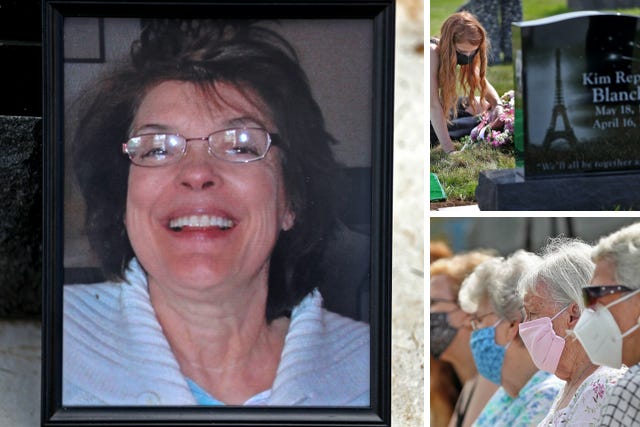
Kim Blanchar, a former French teacher at Brebeuf high school, suffered from multiple sclerosis.
Photo provided by Tammy Bowman

Kim Blanchar, a former French teacher at Brebeuf high school, suffered from multiple sclerosis.

She was a resident of Brooke Knoll Village in Avon. She died from COVID-19 on April 16.

State health inspectors discovered the facility didn't have enough PPE and failed to isolate symptomatic residents.

"She had a big heart," her sister, Tammy Bowman, said. "She was a very generous person."

Despite outcry from families, the Holcomb administration rejected records requests from IndyStar and other media outlets seeking the information. At one point, Holcomb defended the state’s stance by incorrectly calling the nursing homes private businesses — even though more than 90% are owned by public hospitals that rake in hundreds of millions of dollars in extra payments every year because of their government ownership.

Not until late July, after CMS said it would begin releasing facility-level data, did the state finally release that information. Indiana was one of only a handful of states to wait so long.

Indiana also was behind other states in requiring regular testing for workers, widely regarded as the leading source of the virus getting into nursing homes. In New York, for instance, the governor issued an executive order May 10 requiring all nursing home employees to be tested twice a week.

But Indiana did not enact a comprehensive testing program until June. Even then, it involved just a single test for all workers while other states were testing staff much more frequently.

After CMS mandated regular testing, Indiana nursing homes struggled to keep up. Inspectors cited 27 homes for failure to test their workers this fall, more than most states, according to preliminary federal reports.

'Complicated, unwieldy and increasingly dysfunctional'

Fixing Indiana’s broken nursing home system won’t be easy. Any effort at meaningful reform will likely create ripples across the complex financial relationships between the state, county hospitals and their private operators.

“We have an incredibly complicated, unwieldy and increasingly dysfunctional health care system at every level,” Clere, the lawmaker, said. “At some point we are going to have to step back and address the system as a system, rather than continuing to nibble around the edges without ever getting to systemic solutions.”

Advocates and family members say the complicated nature of the problem shouldn’t prevent change — and now is the time to act.

“I think that this needs to be a critical learning opportunity for all providers, all public health officials, all stakeholders, all lawmakers that there are things happening right now,” said Reichert of the Center for At-Risk Elders. “Let's make sure it never happens again.”

In early December, IndyStar requested an interview with the governor to discuss Indiana’s nursing home system, the state’s coronavirus response, and ways lawmakers might improve the system. His spokeswoman quickly responded:

“The Governor is not available.”
 
Full Article & Source: