Showing posts with label COVID-19 outbreak. Show all posts

Monday, December 21, 2020

California psychiatric hospital's Covid-19 outbreak has sickened almost 700

Lawyers have asked a judge to order the release or transfer of half of the patients at Patton state hospital


Lawyers representing patients at a southern California psychiatric hospital describe the state-run facility as a “tinderbox” for Covid-19 infections.

In documents filed earlier this week in federal court, attorneys from the advocacy organization Disability Rights California and the private law firm Covington & Burling asked the judge Jesus G Bernal to order the release or transfer of half of the patients at Patton state hospital.

Patton is located in San Bernardino, east of Los Angeles. With 1,527 beds, it is one of the largest psychiatric hospitals in the US. The majority of people confined to the facility have been accused of a crime but found by a judge to be incompetent to stand trial or not guilty by reason of insanity.

Since May, at least 335 Patton patients and 327 staff have tested positive for Covid-19; 10 patients have died, according to court documents and the Department of State Hospitals (DSH) patient tracker.

The attorneys’ emergency request is part of a class-action lawsuit filed in August on behalf of four men committed to Patton. Prior to the lawsuit, several organizations, including the California Public Defenders Association and the ACLU of Northern California, urged the department of state hospitals to evaluate patients for release or transfer to facilitate social distancing.

Some patients “no longer need treatment in a secure and locked facility”, the organizations said in a letter to Stephanie Clendenin, the head of DSH. “Many have family or friends to support them in the community if released.”

The letter echoes pleas from medical experts, who have said since the start of the pandemic that the only way to prevent Covid-19 outbreaks in crowded correctional facilities is to significantly reduce the population.

Anne Hadreas, an attorney with Disability Rights California, said she and her colleagues met several times with DSH officials, but were unable to reach an agreement over how to reduce the hospital’s population. They filed the emergency request after learning of a new outbreak at Patton.

“Based on the staggeringly high numbers we couldn’t wait any longer,” she said.

Since mid-November, more than 150 Patton detainees have tested positive for Covid-19, including all four of the plaintiffs named in the lawsuit. Eleven people have been hospitalized with severe cases of the virus.

“Defendants have failed to conduct an adequate systematic review of high-risk patients in order to identify who can be safely discharged to a less dangerous setting; facilitate the release or transfer of such high-risk patients to safer, non- or less-congregate settings; or otherwise reduce the patient population to allow for anything close to adequate social distancing,” the new court filing says.

Sworn statements submitted by patients as part of the lawsuit describe an environment where social distancing is impossible. Patients sleep as many as five to a room, share bathrooms, eat in the same area, use the same telephones and gather in the same common area. Patients also described Patton as unsanitary and lacking ventilation.

The USC medical center. California’s hospitals have nearly run out of ICU beds for Covid-19 patients amid a surge in cases. Photograph: Damian Dovarganes/AP

Charles Gluck, one of the lawsuit’s plaintiffs, told the Guardian that staff never explained the threat the virus posed. Gluck has diabetes, heart disease and high blood pressure; he learned from watching television that his health conditions put him at risk for complications if he contracted Covid-19.

“Nobody warned us,” he said.

Gluck recently tested positive for Covid-19. Over the phone, he sounded run down. He said he had a fever and pain in his kidneys and hadn’t been able to sleep.

Gluck’s roommate, Ricardo Tapia, also contracted the virus. Tapia said more than 20 people in their unit fell ill after a man who was showing symptoms was moved to the unit at the beginning of December. The man was supposed to remain in his room, but he used the unit’s communal restroom and would often open his door.

Tapia and Gluck were both moved to an isolation unit with large dorm-style rooms with up to a dozen other patients. Both men said there is little to do besides watching television.

“There’s no treatment here,” Tapia said, referring to therapeutic programs that have been put on hold since March.

A spokesman for DSH said he couldn’t discuss specific allegations in the lawsuit, but said that “DSH continues to take all actions necessary to protect its patients and staff from Covid-19, following guidance from the California Department of Public Health, the Centers for Disease Control and Prevention, and other state and local partners.”

In their response to the plaintiffs’ emergency request, state attorneys asked judge Bernal to halt all further proceedings because Covid-19 vaccines could render the lawsuit moot.

“DSH anticipates that a sufficient number of doses of an approved Covid-19 vaccine will be made available for inoculation of more than half of DSH healthcare staff in the highest level priority category in early January 2021,” the attorneys argued.

Hadreas, the lead attorney on the emergency filing, said that waiting until January, when only a portion of staff might be inoculated, isn’t an option.

“It will not help the people who are getting sick right now, and those who will get sick over the next weeks,” she said. “The fact that at some point in the future conditions may improve does not change the fact that conditions are extremely dangerous now.”

On 7 December, DSH did move 43 women from Patton to a “surge capacity” facility in Norwalk, a Los Angeles suburb. In a signed declaration, Peter Chin-Hong, an infectious disease specialist at the University of California, San Francisco and expert witness, called the move “necessary” yet inadequate. Chin-Hong chastised state officials for waiting until “an untenable number of patients have tested positive at DSH-Patton”, instead of proactively finding alternative facilities.

Chin-Hong was critical of the dorm-style isolation units, noting that a person with Covid-19 can acquire a more serious infection by being exposed to others with the virus. There is also a risk for reinfection.

“It is important to note that immunity may be short-lived, setting the stage for potential reinfection even after recovery,” he wrote.

Hadreas acknowledged that moving people from Patton will require careful assessment.

“It’s really not a one-size-fits-all approach, and that’s not what we’re asking for,” she said, adding, “The only way to make it a safer environment is for there to be fewer people for social distancing to be possible.”

A hearing on the emergency order is scheduled for 22 December.

Full Article & Source:

Monday, October 12, 2020

Coronavirus outbreaks ravage nursing homes again, even after Newsom safety measures

The Sundial Bridge in Redding. Coronavirus outbreaks have recently hit nursing homes in that Northern California city and also in Santa Cruz County.
(William Koplitz / Getty Images)

By Maura Dolan, Anita Chabria

After a steady slide in the statewide number of new coronavirus infections at skilled nursing homes, facilities in Santa Cruz and Shasta Counties are grappling with severe outbreaks, with several dozen people at both places testing positive and residents dying of COVID-19.

The outbreaks raise questions on whether a May directive by state health officials, requiring regular testing of nursing home residents and staff, is being comprehensively implemented. Some watchdogs fear another spike could be in the offing at facilities that care for some of California’s most frail and vulnerable.

“Something is terribly wrong because they shouldn’t be having deaths,” Charlene Harrington, a professor emeritus at UC San Francisco who studies skilled nursing facilities, said Thursday. “There is a breakdown.”

At the Watsonville-Post Acute Center in Santa Cruz County, 61 people, including nine staff members, have tested positive since mid-September. Nine residents, whose ages ranged from the low 70s to 90s, have died, county health spokeswoman Corinne Hyland said Tuesday.

The facility is licensed for 95 beds.

In Redding, the Windsor Redding Care Center, another skilled nursing home, also is coping with an outbreak. Sixty residents and 20 staff members have contracted the virus, and seven have died from COVID-19, said Shasta County Health and Human Services spokeswoman Kerri Schuette.

Patricia McGinnis, executive director of California Advocates for Nursing Home Reform, said new California testing requirements imposed on nursing homes were being followed only sporadically and with little follow-up enforcement from the state.

In addition, rapid antigen tests the federal government has sent to nursing homes recently have been “absolutely useless,” she said. They produce too many false results.

State officials did not immediately respond to a request for comment.

State records show that about a half-dozen facilities across the state have significant outbreaks, and more have minor ones. Though the worst toll of the virus for elder care and skilled nursing facilities came early in the pandemic, infection numbers crept up again in August before once again declining in California.

In July and August, there were about 1,000 deaths a month in nursing homes and assisted living facilities, according to The Times’ coronavirus tracker. That number dipped to 562 in the month of September, according to the tracker. But danger persists. Over the last week, those facilities have averaged 142 new cases and 13.7 new deaths per day.

Hyland said the Watsonville facility had been following state guidelines for employee testing, which exposed the outbreak. The center reported an infected resident on Sept. 17. An outbreak at a nursing home is defined as an infection in one resident. Visitors have been barred during the pandemic, she said.

“It spread pretty quickly,” Hyland said. “Unfortunately, this is a very vulnerable population.”

Dr. David Ghilarducci, deputy health officer for Santa Cruz County, said the county’s public health staff was working closely with the facility to control the outbreak.

Santa Cruz County health officials have been visiting the facility daily to review protocols on isolation, quarantine, testing and screening, and to respond to requests for more resources.

Officials from the California Department of Public Health also have made multiple visits to the facility to assess the situation and make recommendations, and the California National Guard is also providing help, the county said.

Because many nursing home employees work in more than one facility, the county immediately alerted other homes of the outbreak, Hyland said. She added that the county was tracing the contacts of the infected.

“This is really a large outbreak,” Hyland said. “We haven’t seen this sort of thing in our county until now.”

The Watsonville center’s website has reported previous infections in the past but in small numbers. The website indicates that past infections have been among employees.

Gerald E. Hunter, the facility’s administrator, said on the website that there were 23 residents and four staff members who were still positive for the virus on Oct. 5. He said the county’s numbers reflected the total infected since the outbreak started.

“Each day we evaluate all of our residents following CDPH and County of Santa Cruz guidelines to determine whom meets the criteria to be transferred out of the unit,” said Hunter on the website. He did not respond to a request for an interview.

Shasta County’s Schuette said the Windsor Redding Care Center was not accepting visitors when the outbreak occurred. The county and state public health teams, she said, were working with the facility to control the infections.

To date, nursing homes and senior facilities have accounted for 7% of California’s coronavirus cases, but 36% of its deaths, according to The Times’ coronavirus tracker.

On Sept. 29, Gov. Gavin Newsom signed a law requiring skilled nursing facilities in California to report disease-related deaths to health authorities within 24 hours during declared emergencies.

The law was written in response to concerns that health agencies were slow to respond to outbreaks because they did not receive timely information about the facilities.

Earlier, in May, California required testing of all residents and staff in nursing facilities to halt the spread of the coronavirus. The effect has varied.

“It depends on the place, it depends on the facility, and I am not sure there is a lot of follow-up,” said McGinnis, the nursing home reformer.

 
Full Article & Source:

Monday, July 13, 2020

‘A catastrophic outbreak’: How Oregon failed to slow coronavirus before death overtook nursing home

By Fedor Zarkhin

Oregon’s top nursing home regulators received repeated warnings and even acknowledged privately that the coronavirus could decimate a Southeast Portland care facility but failed to take fast and aggressive action before the first 10 residents died, an investigation by The Oregonian/OregonLive has found.

State officials were told as early as March 25, about a month after Oregon’s first case, that Healthcare at Foster Creek was struggling to protect its residents from coronavirus, records obtained by the newsroom show.

A caregiver who worked in the facility filed a complaint that day, warning the Oregon Department of Human Services of inadequate safeguards and impending death.

“We have residents who I believe will not survive and I’m fearful for them,” the caregiver wrote.

A top state regulator, Jack Honey, expressed alarm over other alleged problems at the facility. “And just between you and me,” Honey later wrote to a colleague, “I am so worried about this erupting into a devastating outbreak.”

That anxiety was prophetic.

Coronavirus cases linked to Healthcare at Foster Creek quickly ballooned, eventually infecting 120 people and killing 34 Oregonians. By the time the last resident was evacuated May 5, the facility accounted for about one out of every four deaths statewide, and it remains Oregon’s deadliest outbreak.

The newsroom’s investigation found that despite warning signs state officials took days and in some cases weeks to act, losing critical time to help slow spread inside the nursing home.

Blaming a lack of protective equipment for state regulators, authorities waited nine days to inspect the facility after the March 25 complaint but inexplicably found no violations during their 47-minute visit – only to return one week later to uncover a slew of problems, including some outlined in the initial and subsequent complaints.

Among them: caregivers wearing the same masks for entire shifts, employees not washing hands between interactions with residents, and workers moving between units with and without known coronavirus infections – potentially serving as conduits to spread the dangerous disease.


Kevin Fortune was a resident at Healthcare at Foster Creek when he got sick with the coronavirus and died. Fortune's brother is now suing the nursing home. Here Fortune is in his 1979 high school graduation photo. Photo courtesy Fortune family
It’s impossible to know if the state’s drawn-out response contributed to the immense death toll at Healthcare at Foster Creek. But Charlene Harrington, a professor at the University of California San Francisco, said delays almost certainly cost lives.

“Every day of delay was spreading it,” said Harrington, who has been researching senior care oversight for two decades. “They had the authority. I don’t understand why they didn’t act sooner.”

The state could have put in place a temporary management company, immediately gone into the facility, or sent inspectors to monitor Foster Creek’s workers, Harrington said.

“I feel sad when I see a leadership failure,” Harrington said. “They could have saved lives.”

The newsroom’s findings, based on more than a dozen interviews and more than a thousand pages of documents obtained through public records requests, underscore the chaos of the state’s overall response to the pandemic in the first months after coronavirus emerged Feb. 28 in Oregon.

The state became overwhelmed by an onslaught of unemployment claims filed by laid-off workers. It repeatedly held back information vital to the public. But nowhere was Oregon’s failure more stark than at Healthcare at Foster Creek.


Healthcare at Foster Creek, now closed, saw the largest and most fatal coronavirus outbreak in the state. Kevin Fortune was one of the residents who died. His brother is now suing the nursing home. July 3, 2020. Beth Nakamura/Staff
State officials knew how devastating the disease could be if left unchecked inside a nursing home, where residents are mostly elderly and suffer from underlying health conditions, making them the most likely to die from COVID-19.

In Washington, a nursing home outbreak near Seattle drew international headlines and accounted for more than half of all known coronavirus deaths across America by mid March. In Oregon, officials already had two weeks’ experience responding to an outbreak at a veterans home in Lebanon that ultimately infected 38 and killed 8.  (Click to Continue)

Full Article & Source:
‘A catastrophic outbreak’: How Oregon failed to slow coronavirus before death overtook nursing home

Friday, July 3, 2020

How Nursing Homes Got Away With Hiding Bodies During the COVID-19 Outbreak


by Brooke Madubuonwu and Charlotte Lawrence

When COVID-19 first reached the U.S., the epicenter was a single nursing home in Washington State, where 45 people died. That nursing home outbreak was a precursor of what was to come. Ever since, the virus has been devastating nursing homes across the country, due in part to systemic mismanagement and discrimination against the people who live and work inside.

To date, deaths in nursing homes and other congregate care facilities account for almost half of all COVID-19 deaths in the country, despite these groups making up less than 1 percent of the population. Residents of these congregate facilities are dying from COVID-19 at 8.6 times the rate of the overall 75+ population.
 
If current trends hold, that means nearly 90,000 people living in nursing homes and other congregate care settings could die by October 1.

Grim as this projection is, the actual death toll to date is likely much higher than currently reported. It took the Department of Health and Human Services (HHS) months after declaring COVID-19 a national emergency to start requiring nursing homes to report deaths and infections despite ample evidence that these facilities were at high risk. Even now, nursing homes are only required to report data from May 8 onward. HHS doesn’t require other congregate settings for people with disabilities, such as psychiatric homes, to report at all. This lack of transparency, in addition to the government’s systemic mismanagement of nursing homes and other congregate settings, has helped create the crisis we see today.

In some cases, facilities have not only failed to report, but have actively hidden deaths from residents, families, and the government. For example, a nursing home in the Harlem neighborhood of New York City hid 26 COVID-related deaths from the state by covertly shipping bodies out of the facility. At a nursing home in New Jersey, 17 bodies were packed into a shed and later crowded into a morgue meant to house only four bodies. Other stories emerged of residents’ families being left in the dark about whether loved ones were dead or alive.
 
While HHS has lagged in collecting data, states can independently choose to require reporting and publicize this information. But too often, states are slow to report, and the data is often piecemeal and insufficient for analyzing the full scale of the pandemic.

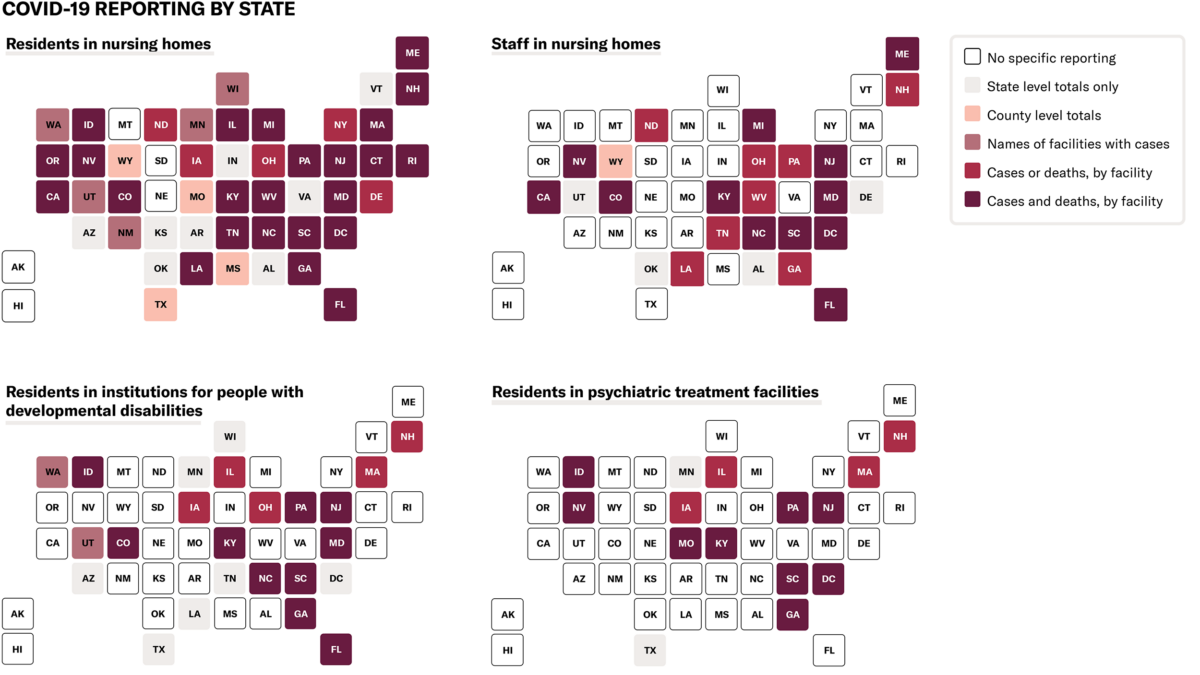
As of June 29, only 41 states report deaths in nursing homes, and the level of detail varies from state to state. Some states offer only state or county totals (such as Arkansas, Indiana, Vermont, and others) while others break down data by facility (including North Carolina, West Virginia, and Nevada). Only 12 states go as far as naming facilities, reporting both cases and deaths, and disaggregating between residents and staff. Disaggregating data in this manner allows us to more accurately measure the impact on various groups of people. Residents are mostly seniors and all are people with disabilities. Staff are disproportionately people of color, women, and low-income. All of these demographic variables are relevant and integral to any adequate public health response.  

Even when states do report deaths and infections in nursing homes, most do not offer critical demographic data. This information is essential for assessing the impact of COVID-19 on different communities and demographic groups and facilitating our response. Yet only two states — Mississippi and Iowa — report the demographics of residents or staff who have tested positive or died.

People with disabilities and the people who work with them deserve to be counted. States can and should modify current policies to collect and publicize vital data while maintaining privacy standards. Last week, the ACLU filed a petition calling on HHS to do its job to address this crisis — and its job includes collecting and reporting full data from facilities that receive Medicaid or Medicare dollars.

The government needs good data to adequately respond to COVID-19. Data helps to inform where to investigate, where to channel resources, and what policies and practices to adopt. At the individual level, data helps people decide which facilities to live in and which to avoid. And in the long run, data can propel change to ensure this crisis never happens again.
 
The first step to change the system is to get to the truth. HHS must tell the truth about what is happening in the nursing homes and other congregate settings for people with disabilities that it oversees and funds with our taxpayer dollars.

Maps reflect public data reporting as of 06/29/2020. Links to state-level data sources available here.

This piece is part of a series, read the previous entry here:

 
Full Article & Source:

Monday, May 18, 2020

FDOH confirms major COVID-19 outbreak at Sarasota nursing home

by: Allyson Henning

SARASOTA COUNTY (WFLA) – COVID-19 is greatly impacting our most vulnerable population. Many of the deaths we’ve seen in Tampa Bay have been tied to nursing homes and assisted living facilities.

8 On Your Side has been keeping a close eye on nursing homes in our area. We’ve learned the latest outbreak is at a facility in Sarasota County.

Tarpon Point Nursing and Rehabilitation Center is tucked away on Park Club Drive just off of Honore Avenue. As of Wednesday evening, state data shows 15 COVID-19 cases at the facility. A source told 8 On Your Side those numbers have recently multiplied.

We contacted officials with the Florida Department of Health in Sarasota County who confirmed there is currently an outbreak at Tarpon Point.

FDOH in Sarasota explained all staff and residents were recently tested at the facility and results came back late Tuesday night — approximately 45 people tested positive for COVID-19.

The Florida Dept. of Health in Sarasota County sent 8 On Your Side this statement regarding the outbreak:
“DOH Sarasota is working with multiple facilities in Sarasota County, including Tarpon Point in response to COVID-19 positive residents. DOH Sarasota provides guidance utilizing CDC recommendations: on disease prevention methods, mitigation strategies and infection control processes. The health department in response to COVID-19 is also able to coordinate additional testing, infection control SME referrals and staff augmentation in certain situations.  With an increase in testing Tarpon Point identified approximately 45 additional positives (residents/staff). We will continue to work with these facilities to ensure that they have the information and guidance to respond appropriately.”
Florida Dept. of Health
8 On Your Side made multiple calls to Tarpon Point throughout the day Wednesday. We were eventually told to email a list of questions to management.

In the email, we asked the facility what is being done to keep the virus from spreading and have also asked the facility to confirm the cumulative number of residents and staff members who have tested positive for COVID-19. We are still waiting for a response.

Full Article & Source:
FDOH confirms major COVID-19 outbreak at Sarasota nursing home

Friday, May 15, 2020

Pennsylvania AG Opens Criminal Probes Into Nursing Homes

Pennsylvania Attorney General Josh Shapiro attends a news conference near the White House, Monday, Feb. 26, 2018
By Mark Scolforo, Marc Levy and Michael Rubinkam

Pennsylvania's top prosecutor has opened criminal investigations into several nursing homes amid a coronavirus outbreak that has killed 2,600 residents of nursing homes and other facilities that care for older adults, more than two-thirds of the state’s death toll, his office announced Tuesday.

The attorney general's office did not say how many facilities it is investigating, or reveal their names or provide any other details about the specific allegations. In general, the attorney general's office has jurisdiction in manners of criminal neglect.

“We will hold nursing facilities and caretakers criminally accountable if they fail to properly provide care to our loved ones," Attorney General Josh Shapiro said in a written statement. “While we salute and appreciate nursing home staff on the front lines during this pandemic, we will not tolerate those who mistreat our seniors and break the law.”

He said “active criminal investigations" are underway.

Adam Marles, president and CEO of LeadingAge PA, which represents hundreds of nonprofit nursing homes statewide, said: "We will continue to support our members, their front line workers and residents during any investigation.”

Long-term care facilities have struggled for months to contain the coronavirus. The virus has sickened about 12,000 residents of 540 nursing and personal care homes, accounting for about one-fifth of the state’s confirmed infections, according to the Health Department. The National Guard has been deployed to more than a dozen homes with severe outbreaks.

One of the worst is at Brighton Rehabilitation and Wellness Center in Beaver County, near the Ohio border, where dozens of people have died and the Health Department has installed a temporary manager.

Shapiro's involvement comes as the administration of Gov. Tom Wolf — itself under fire for its management of the nursing home crisis — rolls out a plan to begin universal coronavirus testing at nursing homes and other facilities that provide elder care.

Nursing homes have long said they haven’t been able to do enough diagnostic testing to quickly identify and isolate patients and staff who have the virus. They say testing is critical because people can spread the virus without knowing they have it.

The new Health Department guidance encourages facilities where COVID-19 is already present to test all residents and staff, whether or not they have symptoms of the disease. Nursing homes without any known infections of the virus should test 20% of residents weekly, the guidance says. Testing will be required for residents returning to a nursing home from the hospital.

The health secretary, Dr. Rachel Levine, said Tuesday that shortages of testing supplies had previously made surveillance testing at nursing homes impossible. But she said there are now sufficient numbers of tests to allow for such testing of every resident and staff member. The testing will serve as an early-warning system, she said.

“This effort will give us a clearer picture of the extent of outbreaks in nursing homes, and a head start at stopping them,” she said.

In the state Senate, senators unanimously approved legislation to direct $507 million from Pennsylvania’s $4 billion share of emergency federal aid to help nursing homes, home care services and other services for the elderly absorb coronavirus-related costs.

The House of Representatives could take up the bill as early as Thursday, a spokesman for House Majority Leader Bryan Cutler, R-Lancaster, said.

Independent Sen. John Yudichak of Luzerne County welcomed universal testing but said the Wolf administration has been far too slow to act.

“While other states were ramping up testing in nursing homes and were transparent in granting access to the public about COVID-19 deaths occurring in those facilities, Pennsylvania’s nursing homes had been forgotten about in our war against COVID-19," he said in a written statement. “Nine weeks without a robust plan is far too long.”

The Health Department, meanwhile, reported more than 800 new virus infections on Tuesday, and 75 new deaths.

Overall, the virus has sickened about 58,000 people. The statewide death toll has reached 3,806.

In other Pennsylvania pandemic developments:

COVID-19 Drug


The state Department of Health said Tuesday that it has received 1,200 doses of a drug with promise in alleviating COVID-19 and is sending it to 51 hospitals in Pennsylvania.

The hospitals that will receive the first shipments of remdesivir were determined based on the number of COVID-19 patients and the severity of those patients' illnesses, the department said.

Remdesivir is given intravenously once a day for up to 10 days, the department said.

The Food and Drug Administration issued an emergency use authorization for the drug after preliminary results from a government-sponsored study showed that remdesivir shortened the time to recovery by 31%, or about four days on average, for hospitalized COVID-19 patients.

The drug may also help avert deaths, but that effect is not yet large enough for scientists to know for sure.

No drugs are currently FDA-approved for treating COVID-19, and remdesivir will still need formal approval. The drug does have side effects, including potential liver inflammation.

Nonetheless, the National Institutes of Health’s Dr. Anthony Fauci has said remdesivir would become a new standard of care for severely ill COVID-19 patients.

National Guard


The Pennsylvania National Guard says some personnel are sick with COVID-19, including those who contracted the virus that causes the disease while deployed.

Guard spokesman Lt. Col. Keith Hickox said his agency has helped 13 long-term care facilities in response to the pandemic.

It’s nearly impossible to know how the Guard troops became sick, he said, describing the total number as relatively low, considering what they have been doing.

Hickox said that medical staffers have helped out at nine facilities and that training has been done at five of them. The Guard is not disclosing the list of nursing homes and similar places they have been assisting.

The effort has involved more than 180 medical workers, mostly helping with comparatively less sick residents, so the facilities’ own medical staff can focus where patients need it the most.

Others with the Guard are providing logistical help, cleaning, and training of facility staffers in the use of personal protective gear and decontamination, Hickox said.

All members are quarantined and tested when high-risk missions are completed, he said.

Full Article & Source:
Pennsylvania AG Opens Criminal Probes Into Nursing Homes

Saturday, April 11, 2020

Visitor restrictions extended to May 3 during COVID-19 outbreak

By Aileen Wingblad

Governor Gretchen Whitmer has extended restrictions for visiting hospice care centers, nursing homes, juvenile detention facilities and other residential places providing care through May 3.

Executive order 2020-37 renews the restrictions on entry into designated facilities that were put in place in March and set to expire on April 5. It applies to:

• Health care facilities

• Residential and congregate care facilities including nursing homes, adult foster care facilities, hospice facilities, substance abuse treatment facilities, independent and assisted living facilities, conand others

• Juvenile justice facilities

The order requires the facilities to prohibit entry by visitors who aren’t “necessary for the provision of medical care, the support of activities of daily living, or the exercise of power of attorney or court-appointed guardianship” for someone under the facility’s care. For residents of facilities age 21 and under, visitors will be prohibited if they aren’t a parent, foster parent or guardian.

Also prohibited are visits to people who aren’t in serious or critical condition or in hospice care. Visits from people performing official governmental functions or “exigent circumstances” such as a doula and partner accompanying a mother in labor are permitted if they pass required health screenings.

“We must continue to do everything we can to protect Michiganders,” Whitmer said. “This is a hard time for families, and we will continue to put their health and safety first when making these decisions. I encourage everyone in Michigan to remain flexible and do their part to slow the spread of COVID-19.”

The order further requires facilities to “use best efforts to facilitate remote visitations between individuals under their care and their loved ones, using phone or video conferencing software.”

Full Article & Source: 
Visitor restrictions extended to May 3 during COVID-19 outbreak

Saturday, March 28, 2020

How to Support Older Relatives During the Covid-19 Outbreak

Cathleen Colón-Emeric, MD, chief of the Division of Geriatrics at the Duke School of Medicine
by Mary-Russell Roberson

Like many of us, Dr.  Cathleen Colón-Emeric, chief of the Division of Geriatrics at the Duke School of Medicine, has older parents who live nearby. Here are some of her suggestions for navigating the new and urgent conversations and decisions facing many families, including her own.

Q: What conversations should we be having with our older relatives?
Colón-Emeric: This is challenging because it requires talking about difficult topics like mortality. The message we’re giving to older adults is that after age 70 your risk of dying from this infection goes up exponentially, from less than 1 percent for younger people to as high as 13 percent for adults in their 70s and 80s. If your father says, “I’m healthy and strong,” change your appeal to “You could bring the virus home to mom and she’s more frail.” 

For older adults with cognitive impairment, we suggest putting up signs on the refrigerator or the door as an extra reminder they need to stay put. Frequent reminders and daily check-in calls can be really helpful. Think proactively of how you can facilitate their social distancing by making sure their pantries are stocked and arranging for home delivery of medications. 

Q: My parents and I are arguing about what’s safe for them to do. What’s the most important point I need to make?
Colón-Emeric: The activities you want to discourage are where they are going to be in close proximity with a lot of folks. If there is something that your older loved one is insisting on doing, try to understand their motivation. Is there a compromise to make that activity safer? With going to grocery store, it may be they are worried about imposing on you. Set up a grocery delivery option, or curbside pickup.

Q: How can I keep my extroverted dad from getting socially isolated?
Colón-Emeric: There’s plenty of literature to suggest that if we completely cut off older adults from social engagement, that’s not healthy. It’s a matter of judging risk versus benefit for those social contacts. If your dad has a friend that he goes out to lunch with, have them convert that to a walk where they can maintain more social distance. Or they could develop an online chat group. 

Be creative and look for opportunities to engage virtually. Set up a video chat time every night. Try games and apps where you can interact virtually, like Words with Friends. Do online crossword puzzles “together.” Many of the symphony orchestras are converting to virtual concert halls, including the Berlin Philharmonic. My family is going to watch a concert virtually in our own homes and we’ll be able to talk about it afterward. We’re celebrating my husband’s birthday by going to a park with my parents, just the four of us.

Q: Should my older relatives go to routine medical appointments?
Colón-Emeric: For routine check-ups, or routine visits to the dermatologist or a specialist for a chronic medical condition that’s stable, we’re suggesting those get converted to telemedicine appointments. If they need to be seen face to face, that’s fine, but for most folks it’s to their benefit to stay put and touch base via telemedicine.

Q: How can I encourage my parents to stay physically active while self-isolating?
Colón-Emeric: Sitting on the couch all day is not healthy either, so encourage them to get out and take a walk. Most local parks are staying open, and there are lots of lovely trails they can explore. The National Institute on Aging has an online program called “Go 4 Life” with great at-home exercise videos, a downloadable book, online chat groups, and the option to make and track exercise goals.  

Q: Should my parents move in with me?
Colón-Emeric: If you are working in healthcare and potentially bringing home the virus, that would be something you want to avoid. If your parents need a lot of care or if social isolation is getting to them and your whole family is going to be hunkered down, it could be a reasonable solution for some families.

Q: My parents receive visits from professional caretakers. Should we cancel this service?
Colón-Emeric: Again, that’s going to be an individual family risk-benefit decision. All home care agencies have protocols in place to screen workers each day and they are making sure they are doing hygiene between visits, but it’s still a risk. Some families are temporarily suspending those services; others are saying the family isn’t able to provide those services, so the risk is worth it. There is no one-size-fits-all. 

Q: What if my older relative develops symptoms of COVID-19?
Colón-Emeric: The most appropriate thing to do is call their primary care provider. All primary care providers have protocols in place for how they are going to assess people over the phone. Let the primary care provider make the call about whether they meet testing guidelines. If they do, the provider will have to decide whether to send the public health nurse to their home, or have them come to a drive-through testing site, or go to the emergency room.

If a loved one doesn’t have a primary care provider, then the local public health department has these services available. If they are going via 911, let the dispatcher know that they are displaying symptoms so EMS workers can take specific precautions.

Full Article & Source:
How to Support Older Relatives During the Covid-19 Outbreak

Wednesday, March 25, 2020

Action News Investigation: Local nursing homes cited for infection control before COVID-19 outbreak

Click to Watch Video
By Chad Pradelli and Cheryl Mettendorf, Yun Choi

An Action News Investigation analyzed data to see which local facilities had a history of infection control problems.

The American Health Care Association, which represents nursing homes, called COVID-19 a perfect killing machine of the elderly.

And, with cases in nursing facilities, the rising potential spread of the virus is leaving families with loved ones in homes on edge.

Mirian Williams' 93-year-old mother suffers from congestive heart failure and upper respiratory problems.

She lives at ManorCare Health Services in Yeadon, Pennsylvania.

"I am concerned because I can't check on my mom," said Williams.

Medicare and Medicaid gave the nursing home a 1-star rating for overall care, the worst designation.

Action News found health inspectors cited the home for poor pest control earlier this year.

"We've seen a lot of unclean conditions there, under-staffing, German cockroaches, insects flying around and mice," she added.

Inspectors also cited ManorCare Yeadon for poor infection control in September of 2018 and October of 2019.

With nursing homes locked down to visitors, the family is concerned.

"My mother is 100% dependent on ManorCare Yeadon," said Williams.

An Action News Investigation analyzed data to find out which nursing homes had a history of infection control problems.

Despite ManorCare Yeadon's 1-star rating, Action News found ManorCare is not even our region's nursing home with the most infection control related citations.

Infection control covers a wide range of nationally recognized standards.

The Investigative Team did a deep dive into state inspections over the last five years and found these nursing homes had the most citations in our area for either failing to have adequate infection control plans or failing to implement them properly.

We found these facilities cited four times during the five-year analysis: New Castle Health and Rehabilitation in Delaware, Atrium Post Acute Care of Woodbury in New Jersey and Immaculate Mary Center for Rehab and Healthcare in Philadelphia.

New Castle Health and Rehabilitation had its last citation in 2017.

ManorCare Health Services Pike Creek in Delaware and Brinton Manor Nursing and Rehabilitation in Pennsylvania were cited three times, most recently in March 2019.

Martin Kardon, an attorney and nationally recognized expert in the field of elder abuse and neglect said people are placing their trust in nursing homes to incorporate best practices, provide quality care and prevent a COVID-19 outbreak.

"I'm concerned that with the coronavirus out there, some of these places are going to consider it a free pass to fall asleep on the job," Kardon said.

He acknowledges there are challenges.

"It's hard to keep people healthy when they're bunched together with everyone else," said Kardon.

The Action News five-year data analysis found of the 25 most cited nursing homes for infection control in our region, 20 were for-profit corporations and partnerships.

Advocates for the elderly will tell you nursing home staff are poorly paid and overworked, but they're on the front lines for the elderly in this outbreak.

Dr. Thomas Lawrence, who is the director of geriatric medicine for Mainline Health, said a lot has been learned since a COVID-19 outbreak at a nursing facility in Washington state.

"It was a medical mess...literally a disaster," he said.

So far, nearly three dozen people have died there.

Dr. Lawrence said handwashing, restricted visitation and screening for symptomatic patients and employees are critical.

"The message to nursing home staff: isolate and keep yourself away from people because you have a duty to care," said Lawrence.

Lawerence also said that for nursing homes meeting the CDC requirements, "the safest place to be actually is in the hallways of a nursing facility where the staff has been screened coming in and the residents have not had travel exposure."

New Castle Health and Rehabilitation, Immaculate Mary Center for Rehab and Healthcare and Brinton Manor Nursing and Rehabilitation did not respond to Action News' requests for comment on our findings.

ManorCare released the following statements:

"ManorCare Yeadon and Pike Creek cleared their previous citations and are currently in compliance with those infection control citations. The infection control citations did not have any harm in scope or severity. We take all surveys seriously and whenever there is a citation, such as infection control, the process to correct that deficiency requires heightened focus on training and self-auditing."

Specific to COVID-19, we have followed and implemented the Centers for Disease Control (CDC) and state recommendations to limit exposure and reduce risk of our vulnerable population. These recommendations include restricted visitation, temperature and symptom checks for entry by anyone entering the center including vendors, employees and authorized visitors. We have also increased our screening and monitoring of patients for fever and respiratory symptoms and reaching out to family and friends to inform them of our processes."


As for the pest citations at ManorCare Yeadon:

"Last year, we did have a pest issue resulting from water issues. We have since corrected the issue, regraded the area and improved the drainage. While we are still working through this issue, we feel we have had excellent results and believe this will soon be completely remedied," ManorCare said.

The spokesperson also said they've been in contact with families since the visitation restrictions went into place and have had many satisfied families on the phone, Skype, Facetime, and visiting through the windows of the center.

"We have an iPad on its way to the center for additional social engagement with loved ones. We realize the COVID19 concerns and our visitation restrictions are causing a lot of stress for everyone and we appreciate our families' and residents' patience as well as our employees' commitment as we work through this together. We are here to make it as easy as possible during this time," ManorCare added.

Atrium Post Acute Care of Woodbury, a Spring Hills managed facility, told us they take the prevention of infection very seriously:

"As two of the listed deficiencies occurred before the management change, we knew that we had quite a bit of work to do to bring this building to its current deficiency-free status as it relates to infection control.

The remaining two deficiencies occurred in our first year of management while evaluating what changes needed to be made. Seeing this, we brought in a new Administrator, Patricia Hedeman.

In September 2019, she received a letter from the Department of Health that stated, "we have accepted your plan of correction and find that as of September 30, 2019, your facility has achieved substantial compliance with all participation regarding the deficiencies stated on the August 9, 2019 survey."

As part of her efforts to correct these deficiencies, Mrs. Hedeman hired a full time Infection Preventionist, Dr. Pat Madden, who has come to Atrium after being the Corporate Director of Nursing for Jefferson Hospital.

Since Dr. Madden was hired, we have invited the Department of Health into the facility to see the changes we are making which includes the development a Sepsis Program designed to identify high-risk patients and treat prior to sepsis, preventing the need for re-hospitalization."


Full Article & Source:
Action News Investigation: Local nursing homes cited for infection control before COVID-19 outbreak