Showing posts with label Reverse Mortgage. Show all posts

Monday, December 7, 2020

A prosecutor and police chief were adored in their community. Then their scheme unraveled.

Retired Honolulu police chief Louis Kealoha and his then-wife, Katherine, leave federal court in Honolulu on Oct. 20, 2017. (Caleb Jones/AP)

By Kim Bellware

What’s described as the biggest corruption case in Hawaii’s history started with a stolen mailbox and unspooled into a seven-year legal saga that concluded Monday with a once-esteemed Honolulu power couple handed 13 and seven-year prison sentences for conspiracy, bank fraud and other charges.

For federal public defender Alexander Silvert, who has since retired, it began in 2013 with a low-level crime and a familiar plea. Gerard Puana, accused of stealing his niece’s mailbox, insisted he was being framed.

Silvert was appointed to the case, which he quickly sized up as a loser: Puana’s accusers were his popular and powerful niece, Katherine Kealoha, the third-ranking boss in the Honolulu prosecutor’s office, and her husband, Louis, the Honolulu police chief.

They claimed to have Puana on video committing the crime.

“I took the case assuming he was guilty but that I could help him avoid being over-sentenced,” Silvert told The Washington Post. Still, he found the case unusual from the start. “In my entire career, I’ve never heard of a charge of a mailbox theft going to federal court.”

Silvert, and later federal investigators, would reveal how the Kealohas leveraged their powerful roles in law enforcement to frame Puana and cover up an array of schemes that fueled a lavish lifestyle at the expense of those who trusted them most.

Among the victims was Florence Puana, Katherine’s 100-year-old grandmother; Puana lost her home of 58 years after Katherine pocketed the money from a reverse mortgage plot. Before Florence died in February, she wrote a letter to Katherine that was read in court during sentencing Monday.

“I trusted you,” Florence wrote her granddaughter. “Yet you betrayed me.”

Reversing the flow

Katherine Kealoha oversaw investments for those in her orbit, including her uncle and grandmother. She was even put in charge of the trust funds for the surviving 10- and 12-year-old children of a family friend who died. But under her control, the money never grew — it disappeared.

Court records show the Kealohas’ expenses included Maserati and Mercedes car payments, a trip to Disneyland and $2,000 concert tickets to see Elton John. In 2009, Katherine racked up a $23,976 brunch tab at the Sheraton Waikiki to fete Louis after he was appointed police chief.

To conceal the fraud, Katherine invented a notary and faked witness signatures on financial documents; she filed bogus identity-theft claims to deflect negative questions about the couple’s credit history; she had statements for the reverse mortgage diverted to a P.O. box that only she could access.

The Puanas learned of the fraud only because of an administrative error: When the mortgage debt was sold to a new company several years on, the new statements were mistakenly sent to the property address instead of the P.O. box.

Florence Puana, by then in her 90s, realized that Katherine hadn’t paid off any of the outstanding balance as promised and that she was about to lose her home. Alleging elder and financial abuse, the Puanas filed a lawsuit against Katherine.

Watch your back

Initially, the lawsuit against the Kealohas didn’t raise eyebrows in the community, where there was little appetite for seeing a prominent native Hawaiian couple disgraced.

“The community adored them — and they were very powerful people,” said Lynn Kawano, a reporter and anchor for KGMB/KHNL Hawaii News Now. “Not just because of their titles, but because of their family. Your family name goes a long way here.”

Kawano, a Hawaii native, told The Post that she faced pushback in the early days of covering the case. Some encouraged her to drop the story altogether and told her and her husband to “watch their backs.”

By 2016, two years after the mailbox arrest, the corruption allegations were gaining traction, but the community still clung to doubts.

“People told me, ‘No way is this about a mailbox,' ” Kawano said. The couple’s supporters found ways to rationalize how even top-ranking public employees could afford luxury cars, Rolex watches and a home in the tony suburb of Kahala, considered the “Beverly Hills of Honolulu.”

A wealthy local lawyer who estimated his income as being three times that of the Kealohas, encouraged Kawano to keep digging, she recalls. “He told me, 'I can’t even afford to live in that neighborhood.’ ”

Attention from Honolulu police

Facing pressure from the lawsuit, the Kealohas devised a countermeasure to intimidate and discredit Katherine’s uncle, Silvert said.

The couple told police that Gerard Puana stole their mailbox, worth $380 — a value that would bump petty theft to a felony charge. Tying in the U.S. mail would make it a federal case, while their surveillance video (which would later be revealed as doctored) would easily lock a conviction against him.

A felony conviction might silence Puana, or at least provide ammunition to weaken and discredit him as a witness in the civil trial, Silvert said.

But the plan started to fall apart under basic fact-checking. The suspect in the grainy surveillance footage looked younger and smaller than Puana. Appraisers and investigators found the Kealohas had lied about the type of mailbox they owned and falsely claimed one of higher value in an apparent effort to crack the $300 threshold for felony theft charges.

Silvert combed through old photos from Google Maps to prove that the mailbox that was stolen in the setup was a different brand entirely — and cost less than $200. Plus, he couldn’t square why that crime would attract so much attention from Honolulu police.

“There was a homicide detective assigned to investigate a petty mailbox theft,” Silvert said. Eventually, he was able to prove that every police report — from the Kealohas’ initial 911 call to logs the assigned officers kept — had been falsified.

‘Rue the day’

At Puana’s theft trial in 2014, the U.S. attorneys in Honolulu planned to cast him as an embittered schemer in contrast to the Kealohas’ status as pillars of the community. To undercut that narrative, Silvert opened with what he calls the “rue the day letter.”

“HOW DARE ANYONE make such MALICIOUS and FALSE STATEMENTS against me!” read a letter Katherine wrote in response to her grandmother’s lawsuit. “They will rue the day that they decided to state these TWISTED LIES!”

“We were well-prepared for trial thinking we could convince the jury,” Silvert said. But in the second hour of the trial, the unthinkable happened.

On the stand, Louis, the police chief, introduced prohibited testimony, which caused a mistrial. Silvert and other observers believe it was done on purpose.

“The chief has a master’s degree in criminal justice and years of experience. He trains rookie cops on how to testify,” Silvert said.

Kawano, the reporter, was sitting behind Silvert in the courtroom and recalled how the federal public defender “threw his arms up and slammed both fists on the table.”

Silvert remembers it the same way. Furious, he soon made the unusual move to reach out to the opposition — the FBI. He hoped that if Puana’s case didn’t get retried, federal investigators could still expose the Kealohas.

“When you meet with the FBI, who I cross-examine and call liars all the time, you can imagine it was a very difficult meeting,” Silvert said. But the investigation eventually gained traction.

Honolulu’s U.S. attorney’s office recused itself, having prosecuted Puana’s case. Federal prosecutors from the Southern District of California stepped in and spent five years investigating before securing convictions and guilty pleas from the Kealohas last year, along with conspiracy and obstruction convictions against two former police officers in the Honolulu Police Department’s Criminal Intelligence Unit acting at Louis’s behest; both were sentenced to prison.

The Kealohas’ unraveling has been met with sadness and anger. Kawano said it was a blow to Honolulu’s Hawaiian community but also a hit to the taxpayers, who will shoulder the “millions” in city and county settlements to the couple’s victims. Together, they are also liable for at least a combined $455,000 in restitution to victims.

“There’s a lot of anger now — how could this have happened? Why was there no oversight?” she said.

Michael Wheat, the special prosecutor from the California U.S. attorney’s office, said the Kealohas’ situation was unique.

“I don’t think you’d see again where the police department and the prosecutor’s office is literally the same family,” he told The Post.

The Kealohas are no longer the family they once were, with some members now estranged — including Katherine and Louis. After their 2019 convictions, Louis filed for divorce.

Full Article & Source:

Friday, December 4, 2020

Former Prosecutor and Police Chief Sentenced for Framing Their Relative with a Crime to Conceal Their Own Fraud


Department of Justice
U.S. Attorney’s Office
Southern District of California

FOR IMMEDIATE RELEASE
Monday, November 30, 2020

Former Prosecutor and Police Chief Sentenced for Framing Their Relative with a Crime to Conceal Their Own Fraud

Special Attorneys Michael Wheat (619) 546-8437, Joseph Orabona (619) 546-7951, Janaki Chopra (619) 546-8817, and Colin McDonald (619) 546-9144

NEWS RELEASE SUMMARY – November 30, 2020

HONOLULU, Hawaii – Former prosecutor Katherine Kealoha and former police chief Louis Kealoha were sentenced during separate hearings in federal court today to 13 years and seven years in prison, respectively, following a number of convictions, including conspiring to frame a relative with a crime to conceal their own fraud.

Chief U.S. District Judge J. Michael Seabright of the District of Hawaii also ordered the Kealohas to pay $454,984.78 and $237,698.56, respectively, in restitution to their victims, and ordered forfeiture of property representing proceeds of fraud, including the Kealohas’ former home in Honolulu, a Rolex watch, and $228,746.79. Katherine Kealoha is already in custody; Louis Kealoha was ordered to report to prison on April 12, 2021.

Judge Seabright rebuked the Kealohas for their “grotesque deprivation of civil rights,” which “staggered the community in many ways” and had “truly shaken confidence in our governing institutions.” He further remarked that “the Kealohas used their power to nurture, feed, and conceal their corrupt activity.”

The sentences imposed today mark the end of a series of criminal cases against the Kealohas. In June 2019, after six weeks of trial and one day of deliberation, a federal jury in Honolulu convicted the Honolulu power couple and Honolulu police officers Derek Hahn and Minh-Hung “Bobby” Nguyen of conspiracy and attempted obstruction of justice pertaining to the false arrest and prosecution of Katherine’s uncle, Gerard Puana. The evidence at trial established that the Kealohas used their considerable power, including commandeering the Honolulu Police Department’s elite Criminal Intelligence Unit, to frame Gerard with stealing their mailbox. To accomplish this, the conspirators prepped the mailbox to be “stolen,” selectively edited grainy surveillance video to conceal their preparatory acts, falsely identified Gerard as the culprit captured by the video, falsified police reports, withheld and destroyed evidence, and repeatedly lied about their activity to investigators, the federal grand jury, and the District Court for the District of Hawaii.

The Kealohas’ motive for framing Gerard was to discredit and intimidate him after he accused Katherine Kealoha of fraud. Trial evidence established that Katherine stole over $200,000 from him and Katherine’s elderly grandmother, Florence Puana. Acting as her grandmother’s “attorney,” Katherine convinced Florence—who was 89 years old at the time—to place a reverse mortgage on Florence’s family home. Katherine promised Florence that she would pay off the reverse mortgage after using some of the proceeds to consolidate the Kealohas’ debt. Instead, unbeknownst to Florence, Katherine funneled the reverse mortgage proceeds into a bank account that Katherine controlled. And within seven months, the Kealohas drained the account dry—spending over $148,000 on various personal expenses, including mortgage payments, Elton John concert tickets, Mercedes and Maserati car payments, a trip to Disneyland, and a $23,976 brunch tab at the Sheraton Waikiki to celebrate Louis Kealoha’s induction as Honolulu Police Chief in 2009. In the meantime, Katherine made no payments on the reverse mortgage, allowed the balance to balloon out of control, and diverted mortgage statements away from Florence’s mailbox to keep Florence from finding out. Once Florence did find out—almost a year and a half later—she was forced to sell her family home.

After they learned of the missing money and ballooning mortgage, Florence and Gerard confronted Katherine Kealoha about her actions. Katherine responded indignantly, threatening in a letter to seek “the highest form of legal retribution against ANYONE and EVERYONE who has written or verbally uttered those LIES about me!” True to her word, after Florence and Gerard filed a civil lawsuit against her, Katherine attempted to have Florence declared legally incompetent, and Katherine and her co-conspirators had Gerard arrested for a crime he did not commit. At Gerard’s theft trial, Louis Kealoha testified falsely that Gerard was the person displayed taking the mailbox in the grainy surveillance video. “That’s what makes this case so shocking: this could not have succeeded but for you and your position,” Judge Seabright told Louis Kealoha.

“Today, after years of manipulating the levers of justice to shroud their own crimes, justice was delivered to two corrupt public officials,” said U.S. Attorney Robert Brewer. “This was a flagrant and stunning abuse of power that victimized an entire community by undermining public confidence in its leaders and the rule of law. If not for the initial dogged investigation by former First Assistant Federal Defender Alexander Silvert, who brought this matter to the attention of federal authorities, followed by incredible work by FBI agents and prosecutors Michael Wheat, Joseph Orabona, Janaki Chopra and Colin McDonald, the Kealohas would still be manipulating justice, not meeting it.”

“Our citizens entrust public servants with great powers and authorities. It is our responsibility to serve our community with integrity and authenticity – with truth and justice as our hallmark,” said Special Agent in Charge Eli S. Miranda. “The Kealohas betrayed this trust for their own selfish entitlements, using deception and breaking the same laws they swore to uphold. The FBI will enthusiastically continue to investigate any corrupt public official who willfully and maliciously abuse their office.”

Today’s sentences also accounted for separate crimes committed by the Kealohas. In October 2019, Katherine pleaded guilty to misprision of a felony after using her position of authority within the city prosecutor’s office to actively conceal the drug distribution activities of her brother, Rudolph B. Puana, an anesthesiologist in Hawaii. In her plea agreement, Katherine admitted she arranged to have herself assigned as the prosecutor overseeing the investigation of her brother’s co-conspirators and that she cultivated a close relationship with one co-conspirator—a defendant Katherine was then prosecuting—to reduce the likelihood that the individual would reveal Rudolph Puana’s role in the drug conspiracy. “I always got ur back, I love you and will protect you always!!!” read one private text message Katherine sent to the defendant she was prosecuting. “GO TEAM!!! Can’t wait for this s*** to be over,” read another, to which the defendant replied, “Ditto[.] Then we’re free[.]”

Finally, in October 2019, the Kealohas pleaded guilty to bank fraud. As part of their pleas, the Kealohas admitted that between January 1, 2009 and December 31, 2014, they spent more than $591,000 derived from stolen funds or loan proceeds obtained through fraud. Their bank fraud scheme included falsely claiming assets that belonged to others (including money belonging to children over whom Katherine had been appointed guardian), falsely inflating their monthly income, and falsely denying derogatory information on their credit. To legitimize their denial of poor credit, the Kealohas submitted a forged police report in loan applications that purported to document Katherine’s false claims of identity theft. The act of forging the police officer’s signature on the report was itself identity theft, for which Katherine pleaded guilty. Katherine further admitted using an alias “Alison Lee Wong” to facilitate the bank fraud. This alias also played a role in Gerard Puana’s claims of fraud. As evidence at trial established, in 2009, Katherine used the “Wong” alias to notarize and create a fraudulent trust in Gerard’s name. And in 2008, under the customer name “Kathryn Aloha,” Katherine ordered a notary seal for “Alison Lee Wong” from the American Association of Notaries and had it mailed to the State of Hawaii’s Office of Environmental Quality Control, where Katherine served as Director. As Judge Seabright stated today, Katherine “perverted justice over and over and over and over again.”

The Kealohas’ co-conspirators, Derek Wayne Hahn and Bobby Nguyen, are scheduled to be sentenced on December 1, 2020 for their involvement in framing Gerard Puana. Katherine Kealoha’s brother, Rudolph B. Puana, is currently facing drug distribution and firearm charges, and is scheduled for trial in April 2021.

DEFENDANTS                               

Katherine P. Kealoha                          Age: 50                       Honolulu, Hawaii

Louis M. Kealoha                               Age: 60                       Honolulu, Hawaii

SUMMARY OF CONVICTIONS

Katherine Kealoha                          

CR No. 17-00582-JMS-WRP

Conspiracy to Commit Offenses Against the United States – Title 18, U.S.C., Section 371

Maximum penalty: Five years in prison, $250,000 fine

Obstruction of Official Proceeding – Title 18, U.S.C., Section 1512(c) (three counts)

Maximum penalty: Twenty years in prison, $250,000 fine

CR No. 18-00068-JMS-WRP

Bank Fraud, in violation of 18 U.S.C. § 1344

Maximum Penalty: Thirty years in prison, $1 million fine

Aggravated Identity Theft, in violation of 18 U.S.C. § 1028A

Maximum Penalty: Mandatory term of imprisonment of two years, to be served consecutive to the sentence imposed for any underlying charge; fine of up to $250,000

CR No. 19-00015 JMS-WRP

Misprision of Felony, in violation of 18 U.S.C. § 4

Maximum Penalty: Three years in prison; fine of up to $250,000;

Louis Kealoha                                  

CR No. 17-00582-JMS-WRP

Conspiracy to Commit Offenses Against the United States – Title 18, U.S.C., Section 371

Maximum penalty: Five years in prison, $250,000 fine

Obstruction of Official Proceeding – Title 18, U.S.C., Section 1512(c) (three counts)

Maximum penalty: Twenty years in prison, $250,000 fine

CR No. 18-00068-JMS-WRP

Bank Fraud, in violation of 18 U.S.C. § 1344

Maximum Penalty: Thirty years in prison, $1 million fine

AGENCY

Federal Bureau of Investigation

Honolulu, Portland, and San Diego Divisions

Topic(s): 
Public Corruption
 
Press Release Number: 
CAS20-1130-Kealoha
 
Full Article & Source:

Saturday, July 13, 2019

A Paradigm Shift: The End Of Inheritance For The Middle Class


Diversity & Inclusion
I am an attorney, author and consultant on employment discrimination.
uncaptioned
ASSOCIATED PRESS.
 
Increasingly, the old family homestead is not being passed down to the family when the parents die.

Older parents are taking advantage of reverse mortgages to pay off credit cards and to escape poverty and debt. This reduces equity in the home and often leads to foreclosure, leaving traditional heirs with nothing but memories.

Not only are reverse mortgage companies feasting upon the assets of older Americans; so too are health insurers and prescription drug companies.

Moreover, seniors on a fixed income were adversely affected by President Trump’s Tax Cuts and Jobs Act, which raised the threshold on medical expense tax deductions and placed a cap of $10,000 on the itemized deductibility of state and local taxes.

America seems to be in the midst of a paradigm shift. Wealth transfer is skipping the deceased’s traditional heirs and going directly into the pockets of mortgage companies, banks, international corporations and the government.

The Lure of Reverse Mortgages

An alarming percentage of older Americans have insufficient money to cover basic necessities. According to the Institute on Assets and Social Policy, one-third of senior households have no money left over each month or are in debt after meeting essential expenses. This makes them vulnerable to the lure of reverse mortgages.

Reverse mortgages allow homeowners age 62 and above to withdraw a portion of their home’s equity to help them pay expenses in retirement. The debt usually comes due when the borrower dies and is repaid through the sale of the home. However, borrowers can face foreclosure while living if they fall behind on property taxes or homeowner’s insurance.

USA Today recently did an investigation of foreclosure actions related to reverse mortgages and found they are disproportionately concentrated among poor minority homeowners in urban areas, including San Francisco, Chicago, Miami and Philadelphia.

It should come as no surprise that older Americans need income in retirement.

Little more than a decade ago, the U.S. was plunged into the worst recession in 100 years due to financial misdealing (involving risky mortgages) that led to the collapse of Wall Street. Many older workers lost good jobs, pensions and health care. Many spent down their savings. Few had the time or opportunity to rebuild.

Older workers today, and especially women, continue to suffer from epidemic levels of age discrimination in hiring. Many are relegated to low-wage part-time work until they are dumped into a financially insecure retirement.  The average Social Security benefit in 2019 was $17,532 but the actual benefit is far lower for women and minorities due to pay gaps, discrimination and other challenges. These groups also tend to lack pensions and savings. The Social Security Administration says 43% of single Social Security recipients aged 65+ depend on Social Security for 90% or more of their income. Meanwhile, Go Banking Rate recently estimated the cost of a comfortable retirement in the least expensive state (Mississippi) in the United States is more than $50,000 a year.

It is disappointing  for adult children to discover too late that their parents tapped out the equity of a home that, in some situations, their parents had inherited from their parents. It is  tragic when their inheritance disappeared into the coffers of a predatory lender. But what are older homeowners supposed to do in the absence of effective federal, state and local policy initiatives that allow them to age in place with dignity?

Poor Public Policy

In response to the USA Today series, Peter Bell, Chief Executive Officer of The National Reverse Mortgage Leaders Association, called reverse mortgages a “lifesaver” for seniors who “have little to no savings and rely primarily on Social Security.” He notes seniors may be ineligible for home equity loans and cash-out refinancing because of insufficient income to cover monthly payments or poor credit profiles.

However, forcing seniors to take out reverse mortgages to stave off poverty represents poor public policy at best.

For one thing, taxpayers are footing the final bill. The Federal Housing Administration, a part of the Department of Housing and Urban Development, insures reverse mortgages, otherwise known as Home Equity Conversion Mortgages or HECMs. As USA Today pointed out, the FHA fund is in the red more than $13.6 billion because of an increase in claims paid out to reverse mortgage lenders since the recession.

Congress has done nothing to help retirees. However, State Rep. John B. Larson, D-CT, the Ranking Member of the House Ways & Means Subcommittee on Social Security, has  proposed the  Social Security 2100 Act, HR 1902, which would increase Social Security benefits by about 2% and set the minimum benefit at 25% above the poverty line. It would ensure the Social Security cost-of-living adjustment reflects actual costs incurred by seniors and would cut taxes for more than 12 million Social Security recipients. Moreover, the bill, which has 210 cosponsors (all Democrats), would increase funding coming into the system. Presently, payroll taxes are not collected on wages over $132,900. This legislation would apply the payroll tax to wages above $400,000, which would affect the top 0.4% of wage earners. Initially, earnings between $139,900 in 2019 and $400,000 would not face payroll taxes but this “donut hole” would eventually disappear. The bill also would phase in an increase in the contribution rate so that by 2043 workers and employers would pay 7.4% instead of 6.2% today.

Several hearings have been held on the bill, which was originally introduced in 2017 and is supported by the NAACP, NOW and Latinos for a Secure Retirement. A final version, incorporating amendments, is expected this fall.

If Congress continues to do nothing, America’s retirees will face increasingly difficult choices. These choices will inevitably trickle down to their children, who will be deprived of an inheritance that was customary for prior generations. This will be the end of inheritance as we know it for all but the most wealthy.

Full Article & Source:
A Paradigm Shift: The End Of Inheritance For The Middle Class

Thursday, June 13, 2019

Seniors were sold a risk-free retirement with reverse mortgages. Now they face foreclosure.

Click to Watch Video
In a stealth aftershock of the Great Recession, nearly 100,000 loans that allowed senior citizens to tap into their home equity have failed, blindsiding elderly borrowers and their families and dragging down property values in their neighborhoods.

In many cases, the worst toll has fallen on those ill-equipped to shoulder it: urban African Americans, many of whom worked for most of their lives, then found themselves struggling in retirement.

Alarming reports from federal investigators five years ago led the Department of Housing and Urban Development to initiate a series of changes to protect seniors. USA TODAY’s review of government foreclosure data found a generation of families fell through the cracks and continue to suffer from reverse mortgage loans written a decade ago.

These elderly homeowners were wooed into borrowing money through the special program by attractive sales pitches or a dire need for cash – or both. When they missed a paperwork deadline or fell behind on taxes or insurance, lenders moved swiftly to foreclose on the home. Those foreclosures wiped out hard-earned generational wealth built in the decades since the Fair Housing Act of 1968.

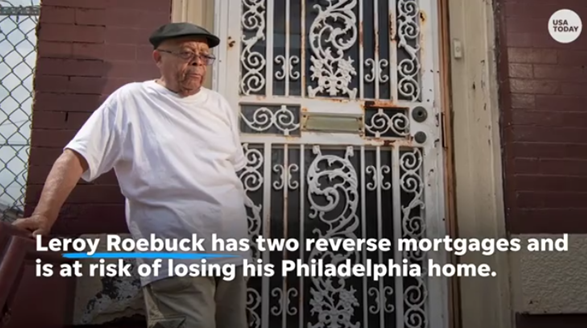
Leroy Roebuck, 86, rode the bus his entire career to a nearby curtain manufacturer. When he needed to make home repairs, he turned to reverse mortgages after seeing an ad on television.

Ten years ago, he forgot to renew his homeowners insurance, which cost about $2,000 a year. Including fees and penalties, his loan servicer says he now owes more than $20,000.

Roebuck’s first foreclosure notice came in the mail six years ago, and he is still fighting to hold on to the brick walk-up he bought from his parents in 1970, living in it through a special health exemption to foreclosure. 

“I told my son, ‘Never. They ain’t gonna take this house,’ ” Roebuck said. “I’ll go to the deep blue sea, they’re not going to take this house.”

Elderly homeowners and their adult children told similar stories in big city neighborhoods across the USA.

Borrowers living near the poverty line in pockets of Chicago, Baltimore, Miami, Detroit, Philadelphia and Jacksonville, Florida, are among the hardest hit, according to a first-of-its-kind analysis of more than 1.3 million loan records. USA TODAY worked in partnership with with Grand Valley State University, with support from the McGraw Center for Business Journalism.

Consumer advocates said the analysis supports what they have complained about for years – that unscrupulous lenders targeted lower-income, black neighborhoods and encouraged elderly homeowners to borrow money while glossing over the risks and requirements.

USA TODAY found that reverse mortgages end in foreclosure six times more often in predominantly black neighborhoods than in neighborhoods that are 80% white.  

Even comparing only poorer areas, black neighborhoods fare worse. In ZIP codes where most residents make less than $40,000, the analysis found reverse mortgage foreclosure rates were six times higher in black neighborhoods than in white ones.

The foreclosure disparity resembles a more familiar scenario from the late 2000s, when subprime lenders targeted specific neighborhoods with risky loans doomed to fail, according to the nation’s lead reverse mortgage researcher.

Full Article & Source:
Seniors were sold a risk-free retirement with reverse mortgages. Now they face foreclosure.

Sunday, June 25, 2017

FED: Man Schemed Elderly With Reverse Mortgages

(CHICAGO) — A Chicago businessman has been arraigned on federal fraud charges for his alleged role in a scheme to bilk elderly homeowners out of millions of dollars.

Federal prosecutors say Mark Steven Diamond, a mortgage loan originator with offices in Chicago and Calumet City, engaged in a home repair and loan fraud scheme that targeted elderly homeowners and lenders. According to the indictment, Diamond fraudulently caused lenders to make reverse-mortgage loans to homeowners who either did not sign up for the loans or did so unwittingly after Diamond intentionally misrepresented the terms. They say Diamond fraudulently pocketed the loan checks by causing title company representatives, including a co-schemer, to provide the checks to Diamond rather than the homeowners. The indictment seeks forfeiture of $7 million from Diamond.

Diamond, 60, pleaded not guilty at his arraignment this week to seven counts of wire fraud.

According to the indictment, Diamond targeted his victims, who ranged in age from 62 to 97, based on the equity in their homes and their relative lack of financial sophistication. If a victim’s relative questioned Diamond on the need for a reverse mortgage, prosecutors say Diamond would schedule a time to visit the victim’s home when he knew the relative would not be there.

Also charged in the indictment is Cynthia Wallace, 47, of Chicago. Prosecutors say Wallace solicited homeowners to have home repairs performed by Diamond, knowing that Diamond would not actually perform the work. They say Wallace also posed as a representative of the U.S. Department of Housing and Urban Development to fraudulently obtain money from victims.

Wallace has pleaded not guilty to nine counts of wire fraud and two counts of falsely pretending to be an employee of the United States.

Full Article & Source:
FED: Man Schemed Elderly With Reverse Mortgages

Thursday, March 2, 2017

90-year-old woman foreclosed, evicted from home of over 60 years

Rob & Gloria Turano
By Kevin Shea | For NJ.com 

LAWRENCE -- It wasn't supposed to end this way.

Gloria Turano thought she'd be living on Skillman Avenue when she died, in the ranch home her late husband Louis built for them in 1953. She never wanted to leave it, and the decades of memories of raising a family it holds for her.

"I thought the undertaker would take me out of here," the 90-year-old Turano said with a smile recently, sitting on a couch in the home's den.

But as she spoke, the house was not hers anymore.

It belonged to Fannie Mae, the government-sponsored mortgage company, which bought it for $100 at a sheriff's sale last year after a reverse mortgage company foreclosed on it - shutting down a loan Turano took in 2004.

She borrowed the money to help her pay her property taxes - in an effort to stay in the home. The taxes would be the loan's undoing.

The money ran low, and Turano's attempts to contact the lender, Financial Freedom, and refinance or work things out were never answered, she said.

She fell more behind in the taxes, and then legal notices started coming to the home from the lender around 2012 and 2013.

A little scared and embarrassed, she called her son, Rob Turano. He started what amounted to a last-minute legal battle to straighten things out.

It didn't work.

Rob entered the picture too late, as well as a lawyer he hired.

In January 2016, Mercer County Judge Paul Innes lowered his gavel and completed the foreclosure. "You had two years," Rob recalls the judge saying.

Then Fannie Mae started eviction proceedings against Turano, which heated up late last year. As he examined his mother's paperwork, Rob said he found instances of deceit.

A letter to state Sen. Shirley Turner and the state Attorney General's office were answered, but they did not help. They said his mother's situation warranted concern - and maybe an investigation - but they too were powerless to stop the eviction proceedings.

Rob and the lawyer were able to get some delays, but Fannie Mae collected Gloria's house keys on Feb. 5 - from Rob.

"It was a very sad day for me," he said. Gloria now lives with her son, across town.

Rob said he'll never forget what a lawyer told him early on in his fight: "You're not going to lose this house." Just like the television ads.

They did, and now Rob and Gloria want others to know her plight to save others from falling into the same trap.

Gloria said she hasn't told many people she lost her home. But she's ready now, saying, "If it can do something for someone else, if nothing at all."

THE REVERSE MORTGAGE

Reverse mortgages are loans eligible to homeowners over the age of 62. It's a "reverse" loan because the loan does not have to be paid back while the homeowner is alive and in the house - and taxes and insurance are up to date.

Lenders typically get their money back when the homeowner sells the house, or dies. Homeowners can make monthly payments if they want, but the lure for seniors on fixed income is not having to, lenders say.

Gloria's husband died in 1981, and by 2004, money was getting tight. Property taxes kept rising, but Social Security was not keeping up the same pace, she said.

A friend in Pemberton told her she'd taken a reverse mortgage, and gave Gloria the number for Financial Freedom. After calling it, a vigorous young salesman was promptly at her door. She made him blueberry muffins.

If the money runs out, could she get more? What happens then?

Gloria said the man had perfect answers to all her questions. If she needed more money, they'd refinance the deal because her house would "only go up in value," the man said. The deal was done in about 6 hours, Gloria said.

Due to their complexity, the U.S. Housing and Urban Development requires reverse mortgages require borrowers to be "counseled" before they sign the deal. Gloria said she was counseled over the phone.

Gloria's house was worth about $300,000 in 2004, she recalled, and her reverse mortgage was for about $180,000. She got $104,000 after Financial Freedom paid off an existing $60,000 line of credit she had, plus some other smaller debts.

Rob had no idea. "I didn't tell him anything," she said.

MONEY RUNS OUT

The Turanos put much of the blame on Gloria's situation on the reverse mortgage, which experts say can be tricky - and some say an icky business.

They acknowledge Gloria should have reacted quicker and told someone, but she lived alone and for years had taken care of herself, Rob said.

Everything was fine until about 2007, when the loan funds were running low, but Gloria was unable to reach anyone at Financial Freedom, she said.

Financial Freedom, a subsidiary of OneWest Bank/CIT, did not return a message seeking comment on Gloria's foreclosure. Fannie Mae also did not respond to a request for comment.

Her 2004 salesman told her he'd "always be there for her," she recalls. "I never heard from him again," Gloria said.

She says she hung in there for several more years, but then had to stop making tax payments to get by. "The taxes just kept going up and I did not have the money," Gloria said.

Gloria knew reverse mortgage rules state that taxes on properties must be kept current.

Then, several years ago, as Rob got involved, Financial Freedom apparently started paying down her property tax bills.

But they were also foreclosing - because they were paying the taxes, Rob believes, but he is not totally sure that was the foreclosure reason. The reverse loan balance had ballooned to over $300,000, Rob said.

Reverse mortgage foreclosures are rare, and evictions rarer, experts say.

Mark Kriegel, the lawyer Rob hired to try and save the house, said unpaid property taxes are vulnerable to public auction, which would then add a lien on the property - which lenders do not like.

Rob has since examined his mother's stack of paperwork, and from his calls and correspondence in trying to untangle the loan, he said he's found a case of shady lending to a senior and instance of fraud.

"I think she was just taken advantage of," Rob said. "In 2004, I think they saw a 77-year-old woman and thought, 'Well how much longer does she have on the planet?' "

Again, Gloria did not tell initially tell her son about the notices that started coming to the house because she knew he was having career issues at the time, she said.

But Rob said he found foreclosure notices were for a time being sent to Vernon, in Sussex County, and he found a document that states his mother "met with a certain lawyer early in the process, around 2013."

The meeting never happened, and Rob said he never got an explanation for the wrong address.
He started making calls to lawyers that focus on senior law, and other agencies. "This is fraud," people would tell him.

None of it mattered to the Superior Court of New Jersey, though.

Kriegel said he wished he was involved sooner.

"It's very unfortunate," he said. Reverse mortgages can be confusing, and the companies hedge on borrowers dying,  he said. "It's a morbid assumption and it does not work out for every borrower."
The silver lining is that Gloria Turano, even though she lost her home, outlasted the loan by living so long, Kriegel said. It's likely not what the lender expected.

Rob implored anyone considering a reverse mortgage to consult a lawyer, and make sure your family knows all about it.

THE COMPANIES

In 2011, three major reverse mortgage providers Bank of America, Wells Fargo and Financial Freedom, stopped offering reverse mortgages. Together, the were half of the reverse business at the time.

Wells Fargo cited falling home values and challenges in assessing the homeowner's ability to keep up with taxes and insurance obligations as the reason, Bankrate.com reported.

As for Financial Freedom, it was once part of failed bank IndyMac, which was taken over by the government in 2008.

In 2009, Steven Mnuchin led an investors group to buy the bank's remains - including subsidiary Financial Freedom - and renamed it OneWest. He is now President Donald Trump's Secretary of the Treasury.

This angered Turano, who started studying OneWest and Mnuchin.

Rob found, as Bloomberg News reported, that after Mnuchin sold OneWest Bank last year, HUD opened an investigation into foreclosure practices at subsidiary Financial Freedom.

And new owner CIT found more than $230 million in missing money, Bloomberg reported. Financial Freedom, as of December, 2016, had foreclosed on 16,220 loans - about 39 percent of the country's reverse-mortgage foreclosures, the site reported.

Combined with the way his mother was ignored, Rob said, and then finding out about the investigation and Mnuchin's ascension to government leader was too much to Rob.

He watched Mnuchin's confirmation hearings.

"I was taken by the manner in which he portrayed having to foreclose on homeowners as a tough job that he didn't seem to want to do; 'cleaning up the mess' I think he called it," Rob said of Mnuchin.

On the weekend of Donald Trump's inauguration celebrations, an estate sale company the Turanos hired held an open house at the Turano home, where workers had put price tags on nearly everything Gloria Turano owned, from her furniture to paperback books, and the fur coat she once cherished.

"The stark contrast of this weekend for us is this: as billionaire appointments and their friends descend on Washington to celebrate their victory, people will traipse through our family home buying - at a discount - my family's 65 years of life," Rob said then.

A FINAL INDIGNITY

Fannie Mae initially said Gloria had until the end of this month to leave the home, but then started offering her cash to leave early.

"First it was $5,000, then $2,000," Rob said. Gloria left on her own, without any rush money to exit early.

"I'm just so upset at the way she, and we, we're treated throughout this," Rob said.

The home on Skillman Avenue - where her husband loved to cook on a special indoor charcoal grill he installed, where she cleaned the "pecky cypress" walls by hand with a special solution and where the family loved to gather in the long, skinny backyard - sits empty, awaiting sale to a new owner.

Gloria Turano is healthy as one can expect at 90, save for some minor back problems, Rob says. And she has not lost her cooking skills, a bright spot for mother and son as she settles into her new digs with Rob.

"At least I'll get gnocchi out of it," Rob said as Gloria chuckled.

Full Article & Source:
90-year-old woman foreclosed, evicted from home of over 60 years

Saturday, April 12, 2014

West Orange Woman Sentenced to 2.5 Years for Bilking Elderly East Orange Resident


Shawn Craig
TRENTON, N.J. – Shawn L. Craig, 47, of West Orange, was sentenced on Wednesday to 2.5 years in federal prison for defrauding an elderly East Orange woman of nearly  $100,000. Craig took the woman's social security payments and also applied for a reverse mortgage on the victim's home.

After gaining power of attorney over the victim, Craig gained access to the victim's bank accounts and diverted monies for her own personal use and benefit of her own family. She paid her auto insurance, purchased a home bar; paid tuition, and entertainment expenses. The bulk of the funds in the woman's accounts were primarily Social Security benefits.

Craig then applied for the reverse mortgage, and after receiving the money, the U.S. District Attorney's Office stated that she "made purchases at stores like Gucci, Coach, Nike, Apple, Footlocker and various other shoe stores; paid  for meals and entertainment at restaurants, liquor stores and other establishments, including the Taj Mahal in Atlantic City, the Staples Center in Los Angeles and Amazing LA Tours in Santa Monica, Calif.; traveled to hotel in New Jersey, California and Florida; and paid personal bills, including automobile insurance, gas and electric, cell phone and cable bills."

Full Article & Source:
West Orange Woman Sentenced to 2.5 Years for Bilking Elderly East Orange Resident

Tuesday, January 21, 2014

Press readers aid man impoverished during guardianship


TOMS RIVER — Ken Schmidt, who won an uphill battle last month to regain the legal rights he lost when he suffered a brain injury in a fall two years ago, is starting the new year on a happier note, thanks in part to the generosity of Asbury Park Press readers.

The 75-year-old Toms River resident finally was able to extricate himself from the confines of a court-ordered guardianship on Dec. 16, only to find his old life in disarray.

While under the protection of the state Public Guardian, who was responsible for making medical and financial decisions on Schmidt’s behalf, his savings were wiped out, most of his furniture and other belongings were disposed of, and his townhouse wound up in foreclosure.

His home wasn’t even habitable when the guardianship was terminated because all the utilities had been shut off for nonpayment during his absence. Helen C. Dodick, the acting Public Guardian, told the Press last month that her agency is constrained by the limits of a ward’s assets, if any exist, and often can’t pay off all of the person’s debts.

Over the past few weeks, however, the kindness of strangers has given Schmidt’s spirits a boost.

So far, more than a dozen people who read about Schmidt’s predicament in the Press have contributed more than $700 to help him out, in addition to donating a sofa, new dishes and other household items to replace the possessions Schmidt lost.

“I want to say thank you from the bottom of my heart, and God bless you,” Schmidt said.

The Office of the Public Guardian has stepped up, too. The agency’s attorney, Suzanne Dykes, arranged to have Schmidt’s utilities restored, and has persuaded Schmidt’s bank not to pursue the foreclosure, he said. Schmidt paid off his mortgage years ago, but the reverse mortgage he obtained in 2005 gave the bank the right to foreclose if he stopped living in the home.

Full Article & Source:
Press readers aid man impoverished during guardianship

See Also:
NJ guardian laws leave Toms River man fighting to regain freedom

NJ Man Free of Guardianship He Said He No Longer Needs!

Monday, June 3, 2013

"I Made a Small Change"


Source: Woman's Day Magazine, May 2013

Note: Attorney Tara Wilson is the daughter of NASGA Member Diane Wilson

Monday, April 1, 2013

Conservatorship Ward Wins Against Santa Clara County Public Guardian


Source: Elderly Woman Wins Case Over Public Guardian

ABC7's First Investigative Report:

We're told to protect our assets with things like living trusts and wills. But a case in Santa Clara County is raising questions about when our plans can be changed by someone else, possibly against our wishes.

In early February, 85-year-old Grace Alaimo was in a Santa Clara superior courtroom surrounded by people arguing over what she wants.
Source:
Family Member, County Face Off Over Woman's Best Interests

See Also:
Repost:  ABC7 Investigates the Santa Clara County Public Guardian

Thursday, November 8, 2012

Repost: ABC7 Investigates the Santa Clara County Public Guardian

Note: We felt ABC did such a great job investigating the Santa Clara County Public Guardian, we wanted to post those excellent reports again:
Source:
Santa Clara County Public Guardian Under Fire for Isolating Elderly


Source:
I-Team Investigates Santa Clara County Public Guardian

SPECIAL THANKS AND APPRECIATION TO NASGA CALIFORNIA ADVOCACY LIAISON, LINDA KINCAID AND REPORTER DAN NOYES!

Dan Noyes is the chief investigative reporter for the ABC7 News I-Team. Dan joined the station in May 1994, bringing to local news 13 years of experience in network news and nationally syndicated news magazines. Dan was previously the co-anchor of the ABC7 Weekend News at 6 and 11 p.m.

Dan has been honored with numerous industry awards. The National Academy of Television Arts and Science (NATAS) has presented him with seven Emmy Awards for Outstanding Achievement: Investigative Reporting and Continuing Coverage. The Radio and Television News Directors Association (RTNDA) has honored Dan six times, for Best Investigative Reporting and Best News Reporting in Northern California. Dan also received the RTNDA Regional Edward R. Murrow Award for Investigative Reporting. The Associated Press Television and Radio Association (APTRA) has also honored Dan for Best Investigative Reporting. The Anti-Defamation League has given him the Pursuit of Justice Award.