Showing posts with label conservatorship battle. Show all posts

Saturday, August 20, 2022

'I want to live at home' | The battle of a conservatorship funded by tax dollars

Garth Schutte, 40, is under a conservatorship. His family isn't allowed to know where he is or speak to him. What's funding this is your tax dollars.

SACRAMENTO, Calif — Garth Schutte, 40, has been taken by the state.

His mother, Jill, and older brothers, Ian and Russell, aren't allowed to speak to or see Garth. They don't know where he lives.

That's because Garth has been placed under a limited conservatorship.

In California, a conservatorship is a legal tool approved through the probate court which takes away the rights of someone who is unable to care for themselves and gives them to another person.

While general conservatorships strip someone of their civil rights entirely, limited conservatorships have seven separate powers that can be taken and given to another person depending on the conserved person’s unique needs and ability to handle certain aspects of their lives.

But Garth has not been conserved by just anyone; he is under the custody of a $12 billion state agency: The Department of Developmental Services (DDS).

DDS serves hundreds of thousands of Californians with disabilities and their families with services and support. The Schutte family shared their story with us in hopes it will shine a light for others who receive these services — especially those considering conservatorship.

“360,000 people could potentially be subject to this system,” said Ian.

360,000 is the number of people the Department of Developmental Services serves as of our interview. In 2023, that number is expected to increase to over 400,000.

“I want to help as many of those 360,000 people as I can because even it just happening to one person is awful,” said Ian.

“We never expected anything like this,” said Jill. “If I could’ve predicted this... we would’ve left the state of California.”
Credit: Jill Schutte
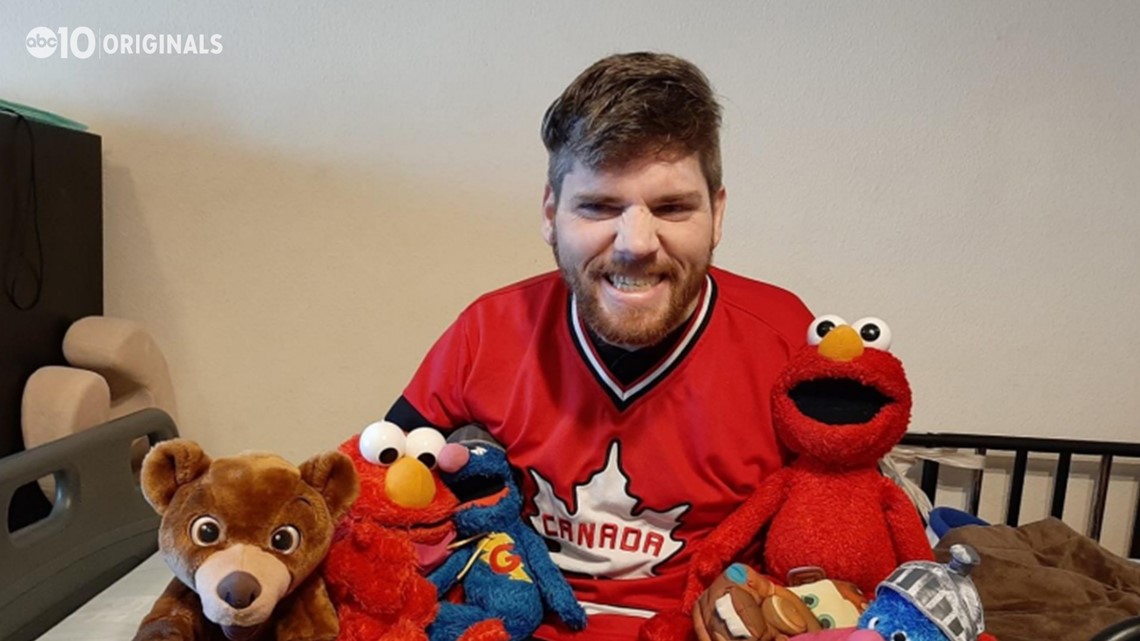
Garth Schutte, 40, smiles with his favorite stuffed animals in his room at his mother's house in Sacramento.

Garth has developmental disabilities; autism and obsessive-compulsive disorder, court and medical records show. For the first 39 years of his life, he relied on his mother to assist him with everyday things like showering, shaving and even using a catheter because of a diagnosis of catatonia.

“He was catheterized in the home and I was trained by three different medical staff,” said Jill. “Kaiser was providing all his medicine and his catheter, which was being mailed to the house. You can’t buy catheters — they’re prescription only.”

The catheter is part of how Garth’s conservatorship began.

In Aug. 2020, record-breaking heat hit Sacramento. Jill noticed Garth wasn't eating or drinking quite as much and took him to the doctor.

“Garth says things differently and he mentioned to one of the nurses, ‘My mom puts a red plastic straw in my private part,'" Jill said.

Hospital staff are mandatory reporters. By law they have to report any sign of potential abuse – Jill said Garth was trying to explain how he needed to be catheterized and it sent an abuse alert to Sacramento Adult Protective Services (APS) as well as Alta Regional Center — the state-run facility under DDS providing services and support directly to people with disabilities as well as their families.

“When we look at California state law regarding mandated reporters, the reporters only report suspicions. It’s the sheriff and police that do the investigation,” said Jill. “Adult Protective Services expand the investigation, not the regional center.”

Yet court records show Alta Regional Center took Garth and placed him in a state-funded care facility.

Jill, Ian and Russell were not notified, despite Jill having Kaiser’s model of power of attorney over Garth.

For three months, no one told their family where Garth was.

“We had absolutely no idea. They would not even say, is he in Sacramento?” Jill said. “We did not know.”

This wasn’t unfamiliar territory to the Schutte family.

Fifteen years prior, Garth had been taken by an Alta Regional Center employee who was helping watch Garth in Jill’s home. In court records, the regional center wrote Jill was unable to care for Garth, but a court investigator’s report later said Garth was taken in a “deceptive” manner.

The first time Garth was taken, it took Jill nine months and an attorney to get him back. 15 years later, in 2020, they were at a loss, which is why the Schutte family decided to get conservatorship over Garth, despite not doing so for Garth’s 39 years of life to help maintain his independence.

As they began the lengthy legal process, Garth was suddenly dropped off at Jill’s home by medical technicians after three months with no knowledge of his whereabouts.

“I was shocked. I was thrilled,” said Jill.

Less than 24 hours later, three Sacramento sheriff’s deputies arrived saying Garth had been returned to Jill due to a “clerical error.”

The deputies took Garth outside and spoke with him alone. Ian recorded all 47 minutes the deputies were there; throughout the recording, Garth expressed his desire to remain at home with his mother to the deputies several times.

After Garth made his wishes clear and the deputies did a home inspection, their concern vanished.

“We’re glad he’s got such a good home here,” a deputy said.

The deputies updated Adult Protective Services and Alta Regional Center on their welfare check. Before leaving, one deputy offered the Schutte’s advice: “The most important thing you can do is go get that conservatorship as quickly as you can because that’ll prevent them from pulling all this.”

The Schutte family took it to heart and moved forward with the legal conservatorship process.

By petitioning the probate court for conservatorship, several things are instigated, including the court appointing an attorney for the potential conserved person.

The court appointed attorney Dewey Harpainter to represent Garth. Harpainter’s office is in Auburn.

As Garth’s attorney, Harpainter is legally required to advocate and represent what Garth wants. Jill says Harpainter refused to meet in person with Garth.

“At one point I said, ‘If you’d like I can drive Garth up to Auburn. I will sit in the car so you can have private questioning with him,'” Jill said. “He denied that at least five times.”

When the Schutte family attorney brought this up in court and requested a new attorney be appointed for Garth, the judge refused, Jill said and court records show.

At the time of our interview with the Schutte family in early June 2022, Harpainter had yet to meet with Garth.

That changed less than a month later after we reached out for an interview. Court records show Harpainter eventually met in person with Garth after we began investigating. The meeting took place just six days after our initial interview request to Harpainter.

Harpainter did not respond to repeated requests for an interview.

When a conservatorship is requested – the court also appoints an investigator to interview the conservatee, assess the family dynamic, and write a report that goes directly to the judge.

“The court investigator called me and we talked over many, many things,” said Jill. “I (also) encouraged him to talk to Garth privately.”

After the investigator spoke with Garth in a one-on-one phone call, he wrote that Garth “expressed a very strong desire to remain at home” and told the investigator, “(I) don’t wanna go to a group home. I would like to live at home.”

Criminal background checks were done on Jill and Russell — who were petitioning for shared conservatorship custody. The investigator’s report also went through Adult Protective Services records and past abuse referrals, which “were deemed inconclusive.”

It means they didn’t have evidence to confirm or deny Garth was abused, APS told us.

The court investigator recommended to the judge that his family care for Garth, and the conservatorship “should be granted.”

But the state regional center, Alta, told the judge a different story — it claimed a number of allegations of abuse by the family from medical professionals in their written assessment of Garth.

Jill said she’s had years of experience with Garth — as well as a 22-year career as a disability expert for the California State of Rehabilitation —  and that, “at no time did any doctor or professional advise me that anything being done was abusive.”

The assessment also alleged Jill locked Garth in a windowless room, which Jill admits to, for Garth’s own protection. Because of his OCD, Garth often tries to break through the window glass in his room so he can pick up litter at all times of the day and night.

“I mentioned that to a doctor… the doctor said, ‘Can you put a plywood or something based on the size of the window?’” Jill recalled.

She did, but not before she said she consulted with the fire department about it.

“It’s always putting Garth first,” Jill said. “His needs and wants but above his needs and wants... his safety.”

The assessment also said Garth spoke directly to Roseville police after a lieutenant contacted Garth and the regional center following the Schutte's filing a missing persons report when Garth was taken in 2020. The assessment said Garth told the lieutenant he didn't want to return to his mother’s house as well as recounted “physical and sexual abuse by his mother and brother.”

We reached out to the Roseville Police Department. They said they have “no records” of the call and therefore couldn’t confirm it.

The regional center told the judge just because APS reports of abuse were “inconclusive,” it “does not mean the claims are unfounded” and that Jill and Russell would be inappropriate conservators.

Instead, they recommended the Department of Developmental Services be appointed as conservator. They also said DDS should ask for a power the family didn’t: control over who Garth sees.

Ultimately, the judge listened to the regional center. He gave temporary conservatorship of Garth to DDS... not to the family as recommended by the court investigator.

With the conservatorship appointed, DDS decided Garth should move out of his mother’s home and into one of their care facilities — what they call a “vendor.”

After 39 years of living with Garth, Jill moved Garth into the new facility.

“We did not want him to see our tears as we drove away,” Jill recalled.

But the DDS care home struggled with Garth.

“Because they couldn’t help him sleep and he couldn’t sleep - they call 911,” Jill said she learned.

Court records show Garth had been “hospitalized for 43 out of 88 days” after being moved to care homes and under the care of DDS, meaning between November 2021 and February 2022 Garth spent about half his time at that point in emergency rooms rather than the care home.

Because Garth is under the conservatorship of DDS, taxpayers are footing the pricey ambulance rides and hospital stays.

One of the caretakers had so much trouble she actually asked for help from the family Garth had just been taken away from.

“She would call (us asking), ‘Can we come help her?’” Jill said. “She actually wanted us to spend the night there.”

Jill shared text messages between her and the care home facilitator with us. Here are a few, including the facilitator addressing the regional center’s abuse allegations:

  • “Please help me tonight. I don’t want to call the hospital.”
  • “Ms. Jill please help me.”
  • “What would u do?”
  • “I didn’t see any abuse at all.”
  • “I believe u are a good family.”
  • “I really don’t know what they (regional center) are doing. Just help me transition (him).”
  • “He keeps writing I miss my mom.”

Garth no longer lives at this care home. Jill said he has moved residences five times in six months. With each move, Jill’s involvement in Garth’s life has been drastically cut by DDS, claiming Jill and Ian are “triggering” Garth. Jill believes what’s triggering is the memory of the home Garth had with her.

As of mid-July 2022, Jill hadn’t seen or spoken with Garth for 12 weeks. Visitation, including phone calls, between Garth and his family, has been severed... especially between Jill and Russel, the two who tried to get co-conservatorship.

“We have not been (to his care home). We are not allowed to go there. We are not allowed to know the exact address,” said Jill. “We have not seen him or heard from him.”

It’s not for a lack of trying; Jill has repeatedly requested visitation with Garth’s regional center service coordinator, who is acting as his conservator in making decisions for Garth on behalf of DDS.

“We can’t provide you a date when you will be able to call or visit Garth,” his service coordinator wrote in an email to Jill. She also said, “Garth has not expressed any interest in having contact with you at this time.”

Jill said she’ll respect his wishes, but wants to hear them from Garth himself.

“Because we will follow the instructions,” said Jill. “[The regional center] could not do that.”

We also reached out to Garth’s service coordinator asking to speak with Garth. Alta Regional Center’s legal manager responded with the same message: “Garth has expressed no interest in speaking with you.”

We asked if Garth was informed that an investigative reporter wanted to speak with him — and if we could ask him directly. We never got a response.

We were, however, able to speak with Garth directly during a visitation with his brother Russell.

Since DDS got conservatorship, Russell has laid low in hopes of continuing to remain in contact with Garth, unlike other family members who've lost all visitation. As of June 2022 he hadn't seen Garth for six months. Russell requested visitation and was approved. He, his wife Elizabeth, and their kids met at a local park while a care home worker supervised.

About halfway through their visit, we were able to speak with Garth.

“I terribly miss my mom,” Garth said.

When asked who he would like to live with, he told us “his family,” specifically his “mom.”

Garth also expressed the same desire weeks later directly to a judge.

On July 27, 2022, the Department of Developmental Services’ temporary conservatorship over Garth expired. The agency wanted to renew it and a court hearing was held in Sacramento’s probate court.

Judge Gevercer granted us permission to film, despite DDS’s repeated objections.

During the 40-minute hearing, the judge gave time for all to speak including Garth himself, who until this point has rarely had a voice in court.

“I want to live with my mom,” Garth said to the judge.

The judge told Garth to talk to his court-appointed attorney, Harpainter, about his desires. He also ordered DDS and the Schutte’s to meet and hopefully reach an agreement over Garth’s current situation.

In the meantime, he extended DDS’s conservatorship over Garth until the next hearing in December.

We requested an on-camera interview with the Department of Developmental Services for seven months. They declined all requests for interviews.

Prior to releasing our investigation, we sent them a three-page letter outlining our findings and asking 15 questions related to allegations of failed practices, including a 2022 state audit that found numerous failures for the last 10 years. 

They refused to answer our questions and sent us a written statement (available in full at the bottom of this article) about how their priority was to keep their clients safe and a short video (below) of Director Nancy Bergmann reading the written statement. Neither answered any of our questions.

So, we attempted to talk to DDS attorney Meredith Nixon following the hearing. She also refused saying, “no comment.”

Two days prior to our investigation airing, the Department of Developmental Services announced immediate "actions to support" the individuals they conserve in a three-page press release. The release named three items DDS will do to improve the system for those in "conservatorships where DDS is the court-appointed conservator." They include forming a panel of experts to conduct a review of DDS' conservatorship program, forming a "working group" from multiple state departments to review their conservatorships, and "enhance oversight and review."

However, the press release didn't include direct actions or steps, like budgeting nor an exact time frame of when these items will take place. We reached out again asking for an interview so we could ask about the specifics of their new plan. They declined.
Credit: Jill Schutte

Jill had retired to care and spend more time with Garth. Following the hearing, she decided to return to work at an organization assisting people with autism, like Garth, so she can continue paying for the costly legal fees in hopes of gaining care for Garth.

The Schutte family plans to continue fighting in hopes of getting Garth home. They also hope in sharing their story, they shed a light on limited conservatorships and the system around it for others - as well as taxpayers.

Department of Developmental Services statement:

“In California, unlike any other state in the nation, individuals with intellectual and developmental disabilities have a right to the services and supports to help them live their most independent and productive life. With the passage of the ground-breaking Lanterman Act in 1969, the state affirmed its commitment to these rights for Californians. We at the California Department of Developmental Services have the responsibility to deliver on the assurances made by the law. 

It is our obligation to hold ourselves and our system partners accountable, while ensuring that individuals with intellectual and developmental disabilities receive community-based services and supports that embraces choice and allows them to live with purpose and dignity. We are constantly looking to improve how we serve the whole person, all while protecting the health and well-being of those we serve.

We are striving to create effective, culturally responsive, and efficient services. We have advanced this vision by the historic investments made over the last two years that, when put together, drive us toward a system of value-based services and supports, where our main objective is quality and better outcomes.”

Department of Developmental Services response to our questions:

“DDS does not actively seek conservatorships. In all instances, the Department of Developmental Services’(DDS) involvement in the conservatorship process begins with a submission by a third party requesting that the Director of DDS become conservator of a person with developmental disabilities. DDS only decides to petition to become conservator when clear and convincing evidence shows that a conservatorship is needed to protect the consumer’s health, safety, or well-being. The submission can come from a variety of sources, such as the courts, a regional center, a law enforcement agency, a family member, the county public guardian, the consumer’s court-appointed counsel, local adult protective services, or any other person interested in the consumer’s health, safety, or well-being. The conservatorship process is a court-based, legal process. As such, DDS has the legal burden to present conclusive evidence to a judge demonstrating that the conservatorship is necessary to protect the person’s health, safety or well-being.

 Family members can and do participate in the judicial proceedings that decide whether a conservatorship petition should be granted, the scope of the conservatorship, and whether the Director of DDS should be appointed as conservator. Furthermore, a court-appointed counsel is part of this process. These are officers of the court appointed by a judge to represent the interests of the proposed conservatee. These counsels are completely independent of DDS and do not receive any funds from the Department. Court-appointed counsel have a fiduciary duty to act independently and in the best interest of the proposed conservatee to determine whether a conservatorship is necessary and who, if anyone, should serve as conservator. 

 DDS does not seek to become a person’s conservator without a third-party submission having first being made and thoroughly vetted. DDS conducts a comprehensive, detailed inquiry when it receives a conservatorship nomination. DDS will not seek to become conservator if there are alternate, less restrictive means to protect a consumer’s health, safety, or well-being. DDS also will not seek to become conservator if there is a family member, friend or other close person in the consumer’s life that can protect the consumer’s health, safety or well-being. DDS has a legal and moral obligation to protect the consumer no matter the desires or objections from family members.

 It is important to understand that under state law every regional center consumer participates in the development of an Individual Program Plan (IPP) that identifies the supports and services the person needs. An IPP is developed regardless of the legal status of individuals. The amount of funds spent on a consumer is based on costs for the supports and services identified in the IPP, and not on any other factor such as whether a conservatorship is in place. Thus, absolutely no additional funds are spent simply because a consumer is subject to a conservatorship by DDS. In addition, neither DDS nor the regional center receives any additional administrative funding for individuals who are conserved versus those who are not conserved.”

Editor's note: This article has been updated to correct that Russell was the Schutte brother that initially petitioned co-conservatorship of Garth.

Full Article & Source:

Sunday, July 10, 2022

‘Star Trek’ Actress Nichelle Nichols Struggling With Dementia, Trapped in Conservatorship Battle: Report

by Lawrence Ukenye

Mike Coppola/Getty

Nichelle Nichols, the actress who played the beloved Nyota Uhura in Star Trek, is caught at the center of a years-long conservatorship battle made worse by her bout with dementia, the Los Angeles Times reports.

Kyle Johnson, her only child, claimed his mother could be exploited due to her dementia and sought a petition for her conservatorship, which he won, in 2018. Johnson alleges that Gilbert Bell, Nichols’ former manager, has used his used his influence to take control of Nichols’ assets and personal affairs. Bell, in turn, has filed a lawsuit against Johnson claiming he is orchestrating an “aggressive” attempt to remove him from Nichols’ guest home. (In a countersuit, Johnson accuses Nichols of taking “control over Ms. Nichols’ assets and personal affairs” as her dementia worsened.)

Angelique Fawcette, a friend of Nichols whom the actress named as her successor, claims that Bell left the home in a state of “disrepair” even as he took care of Nichols’ meals and medical appointments—and that Bell proposed that he marry Nichols, prompting concern from her family and friends. However, Fawcette objected to Johnson’s petition for conservatorship as she believes the former actress can manage her own affairs. 

Read it at Los Angeles Times

Full Article & Source:

Tuesday, August 31, 2021

Actress Nichelle Nichols in Conservatorship Battle Surrounding Dementia

By Jonny Lupsha
 
Dementia concept, head silhouette puzzle becoming undone
The CDC defines dementia as an impaired ability to remember, think, or make decisions, thus interfering with doing everyday activities. Photo By Pixel-Shot / Shutterstock

Nichelle Nichols, best known for her role as communications officer Lt. Nyota Uhura on Gene Roddenberry’s original Star Trek series, finds herself at the center of a conservatorship battle, much like that of singer Britney Spears. Like Spears, Nichols is a famous entertainer at risk of exploitation by her legal conservators.

In Nichols’s case, a tug-of-war over the actress’s care has erupted between her only child, her former manager, and a concerned friend, each of whom claims that at least one other party will exert undue influence over and exploit her. Unlike Spears, Nichols, 88, suffers dementia.

In his video series The Aging Brain, Dr. Thad Polk, an Arthur F. Thurnau Professor in the Department of Psychology and the Department of Electrical Engineering and Computer Science at the University of Michigan, explained the difference between dementia and normal mental lapses.

When to Worry and When Not to Worry

Forgetfulness is a normal part of human existence. The elderly tend to forget things more than younger people do, often leading to unnecessary concerns about dementia. Of course, dementia should be taken seriously, but not every instance of forgetfulness should raise a red flag.

“Most older people experience memory problems from time to time,” Dr. Polk said. “Perhaps they forget where they put their glasses or their keys, or they forget where they parked the car; maybe they neglect to make one of their monthly payments or have trouble remembering a specific word or an acquaintance’s name. Many people experience problems like these as they age and they aren’t normally a cause for concern.”

At the same time, genuine cases of dementia shouldn’t be ignored. So when is it time to worry? According to Dr. Polk, when memory lapses become severe enough that they disrupt daily life, they might be a sign of early dementia.

“Temporarily forgetting the word for toothbrush probably doesn’t indicate a problem, but forgetting what a toothbrush is for might,” he said. “Warning signs include symptoms like asking for the same information over and over, finding it really hard to complete mental tasks that used to be easy, or forgetting what season it is.

“Other early symptoms could include getting lost in a very familiar environment, having trouble carrying on a simple conversation, or failing to take care of basic personal hygiene.”

Types of Dementia

There are many different kinds of dementia. Some are reversible, depending on what causes them. Depression, vitamin B12 deficiency, and Lyme disease all cause dementia-like symptoms and can be cured. Benzodiazepines like xanax, ativan, and valium can also cause memory loss, as can opioid painkillers like vicodin and percocet.

However, dementia can also be caused by brain disease. The most common and well-known is Alzheimer’s disease, but there are others.

“For example, over 50% of patients with Parkinson’s disease eventually develop symptoms of dementia, although it typically takes about 10 years after the onset of Parkinson’s for such symptoms to appear,” Dr. Polk said. “Progressive loss of neurons in the frontal and temporal cortex can also produce a dementia called Pick’s disease or frontotemporal dementia.

“This disorder is characterized by significant personality changes, by apathy, and by problems understanding and producing language.”

Vascular dementia, also known as multi-infarct dementia, is common in older people. An infarct, Dr. Polk said, is a localized area of tissue that dies from oxygen deprivation. People have a stroke when they have an infarct in the brain.

Full Article & Source:

Wednesday, August 18, 2021

Drew Barrymore shares Britney Spears support amid her conservatorship battle

Barrymore was herself raised in the sometimes volatile Hollywood sportlight

 By Tyler McCarthy

Drew Barrymore spoke out in support of Britney Spears amid her conservatorship battle. (Getty Images)

Drew Barrymore
is speaking out in support of Britany Spears as the pop star finally receives some good news in her ongoing conservatorship battle.

After years under a conservatorship, Spears has only just been speaking out publicly as she takes to the courts to try and end what she says is an oppressive deal that leaves her with precious little legal control over decisions in her life that most people take for granted.

Speaking to Entertainment Tonight, Barrymore, 46, noted that she’s been trying her best to stay out of the #FreeBritney movement since she doesn’t know the singer personally. However, that has changed for her in recent weeks as it became clear that Spears needed as many voices as possible to champion her cause. 

"I feel that there's a human being at the core of this. But since she put herself out there more... she's the key to her freedom," Barrymore said. "This is about her and her life and everybody deserves the freedom to make mistakes or a success of their life and everything in between. That is what a life is."

The talk show host added: "So whether it's about her or anyone else, I want people to have their civil liberties; to have the freedom to live their lives."

Barrymore’s comments come months after she lightly touched upon the Spears drama during an appearance on Howard Stern's SiriusXM show, where she likened the situation to her own wild days that led to an involuntary psychiatric ward stay when she was 13 years old.

"My mom put me in a place that was like a full psychiatric ward. I used to laugh at those, like Malibu 30-day places. They talked about things that p---d me off. I was just like... A little spa vacation for 30 days in Malibu was sort of the opposite of the experience I had," she explained. "I was in a place for a year and a half called Van Nuys Psychiatric and you couldn’t mess around in there. If you did, you’d get thrown either in the padded room or get put in stretcher restraints and tied up."

As a result of her experience, she noted at the time that she sees stories of Hollywood "privileged" girls and often finds people forget the human element underneath it all. 

Barrymore noted to Entertainment Tonight that she believed not posting about Spears was an exercise in giving her privacy as a human being. However, she also admits that the "Toxic" singer may not have needed silence at the time.

"I think one of the things I thought that I could [do to] respect her the most is not Instagram about it, and not talk on social media. This is too big for that," the actress explained. "But I also think on the other side of the coin, the noise had to be made in order to start to have change here. Social media is a very tricky animal. It can lead to great outcry and people listening, and it can also be a place that has a little bit of empty calories."

Fortunately, regardless of Barrymore’s involvement, Spears was able to take a positive step forward in her conservatorship battle. Last week, after more than a decade of legal strife, her father, Jamie P. Spears, agreed to step down as her conservator once a proper plan is in place. According to a court filing, Jamie hopes to work with the court and his daughter's attorney, Mathew Rosengart, to resolve pending matters related to his job as he passes the torch in order to facilitate a "smooth transition."

Full Article & Source:

Tuesday, July 20, 2021

#FreeBritney - How the pop star’s conservatorship battle could change lives around the country


By Kayla Molander

SYLVANIA, Ohio (WTVG) - The hashtag #FreeBritney is about letting pop star Britney Spears make her own decisions, but disability activists say it can end up helping people across the country take control of their own lives.

Spears is being allowed her own lawyer and is asking to press charges against her father, Jamie Spears, for conservator abuse. The pop princess has been living under a conservatorship for the last 13 years. It limits her ability manage her finances and make decisions about her life. Now she’s fighting back.

“I feel like it’s brought light to something that we’ve been trying to bring light to for a very long time,” says Dawn Bentley, with the Ability Center of Greater Toledo.

Britney Spears is not the only adult in this country with a court-appointed conservator. Here in Ohio, an adult guardian is the equivalent of California’s conservator. It is a person who is court-appointed to make decisions on behalf of another adult who has been deemed mentally incompetent.

“The reason guardianships exist so that someone who is unable to care for themselves or their property can be properly cared for,” says Nicolas Linares, an attorney with Shumaker, Loop & Kendrick.

Linares specializes in trust and estate law, including probate matters, such as guardianships. He says that the Spears case is so unusual that it likely won’t have much influence in case law that shapes future guardianships.

“I find that it’s most common that the types of people that have guardianships are elderly people, those with Alzheimer’s or dementia,” he says.

But guardianships are also commonly given to people with disabilities. That’s how disability advocates, like the Ability Center, often get involved in the process. She says parents or guardians of children with disabilities often start to think about guardianship when their child is in high school.

“High school is a scary time for parents of youth with disabilities... when you start to think about what does adulthood look like for my child?”

Bentley says that guardianships grow from good intentions, but she advocates for less extreme alternatives.

“You’re taking away their independence,” she says.

According to Linares, in Ohio judges must consider those alternatives before appointing a guardian. He also says that those being put under the care of a guardian (known as wards) have a right to their own legal representation. Wards can also contest the appointment of a guardian, and have the right to request the guardianship be reevaluated annually, which would allow a person who has gained their competency to regain their decision-making power.

As Britney Spears publicly fights for her own power in court, Bentley says that the case is changing the conversation about guardianship nationwide.

“For so long, guardianship was looked at as the rights of the guardian, and what they oversee, and now people are starting to see that it’s about the person and what their rights are, and what independence means to them,” she says.

Bentley says that watching the Spears’ case has been empowering for others with disabilities who want to gain more independence. She also says it is opening the door to conversations about alternatives to guardianship, something that disability advocates have been trying to educate the public about for years.

The Ability Center has a guide to guardianship alternatives which is attached below.

Full Article & Source:

Sunday, June 27, 2021

Britney Spears' public support amid conservatorship battle may not mean much in court: lawyers

By Melissa Roberto

Britney Spears’ powerful plea to a judge to end the conservatorship that has controlled her life since 2008 brought sympathy and outrage from fans, famous supporters and even casual observers who say she deserves independence.

Yet lawyers who deal in such matters say the speech itself may not have helped her in the legal process, which will be long and arduous.

"When Britney spoke, I mean, the world listened. This was amazing," family law attorney Peter Walzer said. "Now, whether the judge will buy it, whether the judge will let her out of her conservatorship, my bet is no."

Spears' passionate, at times emotional address Wednesday to Los Angeles Superior Court Judge Brenda Penny was the first time in 13 years she has spoken in open court on the conservatorship, which she called "abusive" and "stupid." The conservatorship was put in place as Spears, hounded by paparazzi and media scrutiny while a new mother, underwent a very public mental health crisis in 2008.

Spears revisited the speech in an Instagram post Thursday, apologizing "for pretending like I’ve been ok the past two years.

A Britney Spears supporter waves a "Free Britney" flag outside a court hearing concerning the pop singer's conservatorship at the Stanley Mosk Courthouse, Wednesday, June 23, 2021, in Los Angeles.
A Britney Spears supporter waves a "Free Britney" flag outside a court hearing concerning the pop singer's conservatorship at the Stanley Mosk Courthouse, Wednesday, June 23, 2021, in Los Angeles. (AP Photo/Chris Pizzello)

"I did it because of my pride and I was embarrassed to share what happened to me," she said, later adding, "Believe it or not pretending that I’m ok has actually helped."

In court, Spears said she is forced to keep using an intrauterine device for birth control and take other medications, is prevented her from getting married or having another child, and is not allowed let her have her own money. She condemned her father and the others who control it.

The speech was compelling for the same reasons it may be problematic to the court. She spoke very quickly, often profanely, and could seem out of control as she rattled off injustices and the emotional turmoil they have brought her.

"It just seems to me that her presentation to her court didn’t do herself any favors," said David Glass, a family law attorney with a doctorate in psychology. "The words came out like bullets. She shifted rapidly between thoughts and ideas. She also admitted to being depressed and crying all the time. I’m not her psychologist, but these are things that potentially point to being in the middle of mental illness."

Penny did not tip her hand or offer much reaction to the dramatic presentation, other than to say Spears’ speech was "courageous." It's unclear how much the judge has heard before, either during Spears' previous addresses to the court in closed sessions or in the numerous sealed documents filed in the case.

Britney Spears spoke directly to a judge on Wednesday 13 years into a court-enforced conservatorship that has exercised vast control of her life and money by her father, Jamie Spears. Spears has said the conservatorship saved her from collapse and exploitation. But she has sought more control over how it operates, and says she wants her father out. 
Britney Spears spoke directly to a judge on Wednesday 13 years into a court-enforced conservatorship that has exercised vast control of her life and money by her father, Jamie Spears. Spears has said the conservatorship saved her from collapse and exploitation. But she has sought more control over how it operates, and says she wants her father out.  (AP Photo/Nick Ut, File)

"The court didn’t say ‘I don’t agree with you,’ or ‘I’m concerned for you’ or ‘I’m disappointed these issues were not brought before me previously,’" Glass said.

There is evidence that Penny considers Spears’ opinions in her decisions.

She recently appointed estate-management firm the Bessemer Trust as co-conservator of Spears’ finances, though kept her father James Spears as its co-conservator against her wishes. And Penny has been keeping court hearings like Wednesday’s increasingly public and leaving more documents unsealed since Spears pushed for greater transparency in the case last year.

Short of ending the conservatorship, Penny may alter it to make it more palatable to Spears, and could order an immediate investigation into some of the allegations.

"I’m alarmed if I’m the judge," said Sarah Wentz, an attorney who specializes in estates and conservatorships. "I’m going to find out ASAP if there are things we need reviewed or corrected, for the court to see if there are not human rights violations."

There is plenty of room for Penny to make changes that don’t end the conservatorship entirely.

"What they can do is try to put together a plan that meets her goals and wishes in every way possible, so she only has a few things that she needs to check in on," Wentz said. "It doesn’t have to be an all-in kind of thing."

Spears' court-appointed attorney, Samuel Ingham III, said that despite his client's pleas to Penny to end the conservatorship, she has yet to even ask him to file a petition to do so. He said before the presentation Wednesday that he made no attempt to "control, or filter, or edit" his client’s words.

On June 23, 2021, she addressed the court calling the legal guardianship 'abusive' and asking the judge to terminate it.
On June 23, 2021, she addressed the court calling the legal guardianship 'abusive' and asking the judge to terminate it. (Jordan Strauss/Invision/AP, File)

That most likely meant that while he felt compelled to pass along Spears’ request to speak, it doesn’t necessarily mean he agreed with her approach.

"This is why lawyers don’t like their clients speaking a lot," family law attorney Chris Melcher said. "We know what to say and how to say it. Sometimes what the client says can really come back and bite them and end up proving the other side’s case."

Melcher said a different approach could have proven more effective.

"I think she would be best served by a calm demeanor, acknowledgement of her past problems, and acceptance of the court's previous decisions," he said.

That was the approach taken by Ingham in recent filings for Spears that attempted to get her father removed and assert more control. Those documents acknowledged that the conservatorship had done a lot of good in its early days while forcefully arguing for change and saying she reserved the right to end it eventually.

One thing that will certainly not happen is the conservatorship being terminated, as Spears requested, without any further evaluation of her.

A petition to terminate the conservatorship, which Ingham said he may file soon, would be only the beginning of a process that places the burden on Spears to show her competence.

"It’s up to Britney or another interested person to convince the court that it needs to end," Melcher said. "This is not a voluntary process where she can just walk out the door."

Full Article & Source:

Friday, November 16, 2018

Journey Guitarist Neal Schon Helps Wife Michaele Schon Battle In Court to Save Elderly Mother

Journey star Neal Schon is helping his wife, Michaele Schon gain a conservatorship over her mother to take the woman out of a facility where they feel she is being given insufficient care.

Michaele, who is formerly a “Real Housewives D.C.” star, is trying to become the conservator over her mother, Rosemary Holt.

According to documents, filed by both Neal and Michaele, Rosemary recently fell in the parking lot and was hospitalized. During the hospitalization, the hospital made the decision to release her and file to appoint a temporary guardian (a lawyer connected to the hospital) to handle her care, and admitted her to an assisted living facility.

Michaele claims she wasn’t involved in the decision to leave her mother, and says that since being admitted she is now being held against her will and has developed severe medical issues. Included in the filing, Michaele claims her mother developed an sacral wound on her back that caused her to become delirious.

The documents, filed by attorney Troy Martin, ask that the Schons take over full control of Rosemary’s personal decisions and her estate. Neal and Michaele claim it has gotten so bad that she is “in a substandard and dangerous assisted living facility,” and claim “She has suffered lacerations and contusions at this facility. She is being denied dental care which has resulted in severe dental problems.”

The couple attached graphic photographic evidence of the injuries and sores, and also included photos of the 91-year old Rosemary sleeping upright in a chair and appearing to be in pain while laying on a couch. They say, “She is so uncomfortable in her room, she frequently sleeps on the couches or chairs in the lobby.”

Rosemary Holt
The Blast
She also says her mother was diagnosed with dementia by the hospital, but they believe she was just dimerous from the wound, and cannot express the severity of the situation. In seeking to become a guardian, Michaele also explains she and Neal want to move Rosemary out to California.

The stars claim they’ve already been paying for Rosemary’s expenses and care, and have recently purchased her a home where they will pay the full cost of hiring a nurse and provide constant care.

However, we’re told the other members of Michaele’s family are supportive of Rosemary staying in the Virginia assisted living facility, so it appears the fight will have to be settled in court.

Full Article & Source:
Journey Guitarist Neal Schon Helps Wife Michaele Schon Battle In Court to Save Elderly Mother