(WXYZ) — A local family is fighting to keep their special needs brother in the only home he’s ever known.
They say he’s at risk of losing the house because of the actions of someone else’s court-appointed guardian.
Christian Chambers loves golf, football and Clarkston.
The 50-year-old has cerebral palsy, but is more than able to live independently in his childhood home.
And
the house is close to Clarkston High School where Christian volunteers
as an assistant coach for the football team. But instead of enjoying
this year’s football season, Christian is extremely upset.
That’s because someone wants to sell the only home Christian has ever known.
“He's
been here 50 years. And this is where he wants to stay,” said John
Chambers, one of Christian’s four older brothers who help with
Christian’s care.
"It's horrible to do this to anybody, but it's horrible to do it to
Christian because of his heart,” said John. “He doesn't have the ability
to go just get an apartment.”
Back in 2014, Christian’s mom and dad created a special needs trust
for him, leaving Christian the family home. They also made family friend
Ron Dunlap a trustee to look out for Christian’s welfare.
“It reads that it's going to be Christian's house forever. That was their full intent,” said Dunlap about the Trust.
In
2016, Christian’s mom started having health issues and his dad later
passed away. The Oakland County Probate Court determined Doreen Chambers
was legally incapacitated and appointed a professional guardian. The
guardian has total say over Doreen’s life, and Doreen was moved to a
nursing home.
Attorney Jennifer Carney is Doreen’s guardian. Her Birmingham-based
guardianship company is called Advocates for Independence and
Self-Reliance.
The Chambers say the family and Carney recently
learned the deed for the house was still technically in Doreen’s name,
and not in Christian’s trust as it should have been. And that’s when
things got messy.
“She wanted to meet us here at the house with her supervisor. And I'm
thinking to myself, how does she have a supervisor? I mean -- she owns
this law firm,” said Dunlap.
Dunlap says he and Christian watched while Carney brought not a supervisor, but a real estate agent into the home.
“Starts just wandering around the house, taking pictures, measuring, and I'm going, What? What are you doing,” said Dunlap.
The Chambers brothers say they later got an email from Carney that
says: “I need to manage the property in [Doreen’s] best interest, not
Christian’s…. Christian will need to find other living arrangements.”
“I think it's totally unethical. I think she should be sanctioned,” said Dunlap.
Court
records show Carney signed a purchase agreement for the home, even
though guardians are not legally allowed to sell a ward’s property.
“That seems like they're putting the cart before the horse because a
guardian doesn't have authority to sell that property,” said Nicole
Shannon, the Michigan Elder Justice Initiative’s Systemic Litigation and
Advocacy Attorney.
Shannon says even though the guardian is now asking the judge to
become a conservator so she can sell the Chambers home, the court should
take into account Doreen Chambers’ original plan for the home.
“It
sounds as if this person took a lot of steps to make clear what it is
that they wanted. They wanted to ensure that their son was going to be
able to remain in this home long term,” Shannon told 7 Investigator
Heather Catallo.
The 7 Investigators did contact Jennifer Carney to ask her why she
wants to sell the house if Doreen is staying in a nursing home, but she
would not agree to an interview and refused to answer questions.
Court
records show, Carney already charges Doreen Chambers’ modest estate
thousands of dollars. For 2021, even though Doreen only received
$10,465.80 in Social Security income, Carney charged her $3064.50 in
fiduciary and legal fees.
The Chambers family is now fighting in
Oakland County Probate court to stop Carney from selling the family
home. They say they’re also hoping Carney can see just how much pain
she’s causing Christian.
“He may not be able to speak very well. He may have some
disabilities. But I will tell you. His hear has a lot more ability,”
said John Chambers. Judge Linda Hallmark set another hearing to determine what will happen with the house , but that won’t be for several weeks.
In the meantime the Chambers family has created this fund to help Christian try to stay in the home.
Garth Schutte, 40, is under a conservatorship. His family isn't allowed
to know where he is or speak to him. What's funding this is your tax
dollars.
SACRAMENTO, Calif — Garth Schutte, 40, has been taken by the state.
His mother, Jill, and older brothers, Ian and Russell, aren't allowed to speak to or see Garth. They don't know where he lives.
That's because Garth has been placed under a limited conservatorship.
In California, a conservatorship
is a legal tool approved through the probate court which takes away the
rights of someone who is unable to care for themselves and gives them
to another person.
While general conservatorships strip someone of their civil rights
entirely, limited conservatorships have seven separate powers that can
be taken and given to another person depending on the conserved person’s
unique needs and ability to handle certain aspects of their lives.
DDS serves hundreds of thousands of Californians with disabilities
and their families with services and support. The Schutte family shared
their story with us in hopes it will shine a light for others who
receive these services — especially those considering conservatorship.
“360,000 people could potentially be subject to this system,” said Ian.
360,000 is the number of people the Department of Developmental
Services serves as of our interview. In 2023, that number is expected to
increase to over 400,000.
“I want to help as many of those 360,000 people as I can because even it just happening to one person is awful,” said Ian.
“We never expected anything like this,” said Jill. “If I could’ve predicted this... we would’ve left the state of California.”
Credit: Jill Schutte
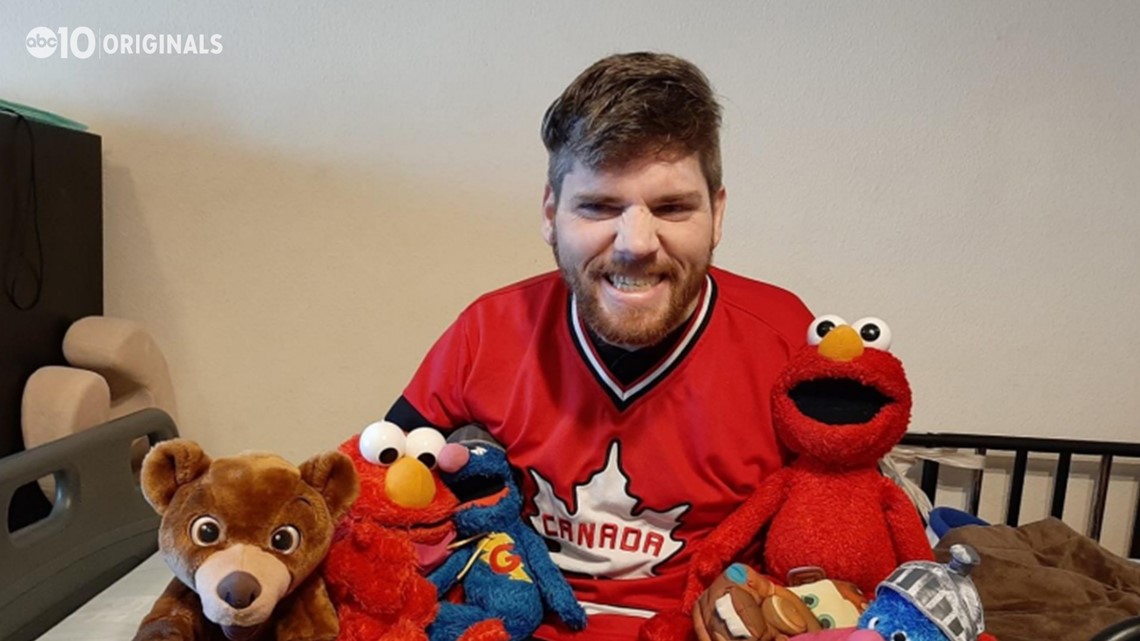
Garth Schutte, 40, smiles with his favorite stuffed animals in his room at his mother's house in Sacramento.
Garth has developmental disabilities; autism and obsessive-compulsive
disorder, court and medical records show. For the first 39 years of his
life, he relied on his mother to assist him with everyday things like
showering, shaving and even using a catheter because of a diagnosis of catatonia.
“He was catheterized in the home and I was trained by three different
medical staff,” said Jill. “Kaiser was providing all his medicine and
his catheter, which was being mailed to the house. You can’t buy
catheters — they’re prescription only.”
The catheter is part of how Garth’s conservatorship began.
In Aug. 2020, record-breaking heat hit Sacramento. Jill noticed Garth
wasn't eating or drinking quite as much and took him to the doctor.
“Garth says things differently and he mentioned to one of the nurses,
‘My mom puts a red plastic straw in my private part,'" Jill said.
Hospital staff are mandatory reporters. By law they have to report
any sign of potential abuse – Jill said Garth was trying to explain how
he needed to be catheterized and it sent an abuse alert to Sacramento
Adult Protective Services (APS) as well as Alta Regional Center — the
state-run facility under DDS providing services and support directly to
people with disabilities as well as their families.
Photos: Life for Garth prior to conservatorship
1/9
Jill Schutte
“When we look at California state law regarding mandated reporters,
the reporters only report suspicions. It’s the sheriff and police that
do the investigation,” said Jill. “Adult Protective Services expand the
investigation, not the regional center.”
Yet court records show Alta Regional Center took Garth and placed him in a state-funded care facility.
Jill, Ian and Russell were not notified, despite Jill having Kaiser’s model of power of attorney over Garth.
For three months, no one told their family where Garth was.
“We had absolutely no idea. They would not even say, is he in Sacramento?” Jill said. “We did not know.”
This wasn’t unfamiliar territory to the Schutte family.
Fifteen years prior, Garth had been taken by an Alta Regional Center
employee who was helping watch Garth in Jill’s home. In court records,
the regional center wrote Jill was unable to care for Garth, but a court
investigator’s report later said Garth was taken in a “deceptive”
manner.
The first time Garth was taken, it took Jill nine months and an
attorney to get him back. 15 years later, in 2020, they were at a loss,
which is why the Schutte family decided to get conservatorship over
Garth, despite not doing so for Garth’s 39 years of life to help
maintain his independence.
As they began the lengthy legal process, Garth was suddenly dropped
off at Jill’s home by medical technicians after three months with no
knowledge of his whereabouts.
“I was shocked. I was thrilled,” said Jill.
Less than 24 hours later, three Sacramento sheriff’s deputies arrived
saying Garth had been returned to Jill due to a “clerical error.”
The deputies took Garth outside and spoke with him alone. Ian
recorded all 47 minutes the deputies were there; throughout the
recording, Garth expressed his desire to remain at home with his mother
to the deputies several times.
After Garth made his wishes clear and the deputies did a home inspection, their concern vanished.
“We’re glad he’s got such a good home here,” a deputy said.
The deputies updated Adult Protective Services and Alta Regional
Center on their welfare check. Before leaving, one deputy offered the
Schutte’s advice: “The most important thing you can do is go get that
conservatorship as quickly as you can because that’ll prevent them from
pulling all this.”
The Schutte family took it to heart and moved forward with the legal conservatorship process.
By petitioning the probate court for conservatorship, several things
are instigated, including the court appointing an attorney for the
potential conserved person.
The court appointed attorney Dewey Harpainter to represent Garth. Harpainter’s office is in Auburn.
As Garth’s attorney, Harpainter is legally required to advocate and
represent what Garth wants. Jill says Harpainter refused to meet in
person with Garth.
“At one point I said, ‘If you’d like I can drive Garth up to Auburn. I
will sit in the car so you can have private questioning with him,'”
Jill said. “He denied that at least five times.”
When the Schutte family attorney brought this up in court and
requested a new attorney be appointed for Garth, the judge refused, Jill
said and court records show.
At the time of our interview with the Schutte family in early June 2022, Harpainter had yet to meet with Garth.
That changed less than a month later after we reached out for an
interview. Court records show Harpainter eventually met in person with
Garth after we began investigating. The meeting took place just six days
after our initial interview request to Harpainter.
Harpainter did not respond to repeated requests for an interview.
When a conservatorship is requested – the court also appoints an
investigator to interview the conservatee, assess the family dynamic,
and write a report that goes directly to the judge.
“The court investigator called me and we talked over many, many
things,” said Jill. “I (also) encouraged him to talk to Garth
privately.”
After the investigator spoke with Garth in a one-on-one phone call,
he wrote that Garth “expressed a very strong desire to remain at home”
and told the investigator, “(I) don’t wanna go to a group home. I would
like to live at home.”
Criminal background checks were done on Jill and Russell — who were
petitioning for shared conservatorship custody. The investigator’s
report also went through Adult Protective Services records and past
abuse referrals, which “were deemed inconclusive.”
It means they didn’t have evidence to confirm or deny Garth was abused, APS told us.
The court investigator recommended to the judge that his family care for Garth, and the conservatorship “should be granted.”
But the state regional center, Alta, told the judge a different story
— it claimed a number of allegations of abuse by the family from
medical professionals in their written assessment of Garth.
Jill said she’s had years of experience with Garth — as well as a
22-year career as a disability expert for the California State of
Rehabilitation — and that, “at no time did any doctor or professional
advise me that anything being done was abusive.”
The assessment also alleged Jill locked Garth in a windowless room,
which Jill admits to, for Garth’s own protection. Because of his OCD,
Garth often tries to break through the window glass in his room so he
can pick up litter at all times of the day and night.
“I mentioned that to a doctor… the doctor said, ‘Can you put a
plywood or something based on the size of the window?’” Jill recalled.
She did, but not before she said she consulted with the fire department about it.
“It’s always putting Garth first,” Jill said. “His needs and wants but above his needs and wants... his safety.”
The assessment also said Garth spoke directly to Roseville police
after a lieutenant contacted Garth and the regional center following the
Schutte's filing a missing persons report when Garth was taken in 2020.
The assessment said Garth told the lieutenant he didn't want to return
to his mother’s house as well as recounted “physical and sexual abuse by
his mother and brother.”
We reached out to the Roseville Police Department. They said they
have “no records” of the call and therefore couldn’t confirm it.
The regional center told the judge just because APS reports of abuse
were “inconclusive,” it “does not mean the claims are unfounded” and
that Jill and Russell would be inappropriate conservators.
Instead, they recommended the Department of Developmental Services be
appointed as conservator. They also said DDS should ask for a power the
family didn’t: control over who Garth sees.
Ultimately, the judge listened to the regional center. He gave
temporary conservatorship of Garth to DDS... not to the family as
recommended by the court investigator.
With the conservatorship appointed, DDS decided Garth should move out
of his mother’s home and into one of their care facilities — what they
call a “vendor.”
After 39 years of living with Garth, Jill moved Garth into the new facility.
“We did not want him to see our tears as we drove away,” Jill recalled.
But the DDS care home struggled with Garth.
“Because they couldn’t help him sleep and he couldn’t sleep - they call 911,” Jill said she learned.
Court records show Garth had been “hospitalized for 43 out of 88
days” after being moved to care homes and under the care of DDS, meaning
between November 2021 and February 2022 Garth spent about half his time
at that point in emergency rooms rather than the care home.
Because Garth is under the conservatorship of DDS, taxpayers are footing the pricey ambulance rides and hospital stays.
One of the caretakers had so much trouble she actually asked for help from the family Garth had just been taken away from.
“She would call (us asking), ‘Can we come help her?’” Jill said. “She actually wanted us to spend the night there.”
Jill shared text messages between her and the care home facilitator
with us. Here are a few, including the facilitator addressing the
regional center’s abuse allegations:
“Please help me tonight. I don’t want to call the hospital.”
“Ms. Jill please help me.”
“What would u do?”
“I didn’t see any abuse at all.”
“I believe u are a good family.”
“I really don’t know what they (regional center) are doing. Just help me transition (him).”
“He keeps writing I miss my mom.”
Garth no longer lives at this care home. Jill said he has moved
residences five times in six months. With each move, Jill’s involvement
in Garth’s life has been drastically cut by DDS, claiming Jill and Ian
are “triggering” Garth. Jill believes what’s triggering is the memory of
the home Garth had with her.
As of mid-July 2022, Jill hadn’t seen or spoken with Garth for 12
weeks. Visitation, including phone calls, between Garth and his family,
has been severed... especially between Jill and Russel, the two who
tried to get co-conservatorship.
“We have not been (to his care home). We are not allowed to go there.
We are not allowed to know the exact address,” said Jill. “We have not
seen him or heard from him.”
It’s not for a lack of trying; Jill has repeatedly requested
visitation with Garth’s regional center service coordinator, who is
acting as his conservator in making decisions for Garth on behalf of
DDS.
“We can’t provide you a date when you will be able to call or visit
Garth,” his service coordinator wrote in an email to Jill. She also
said, “Garth has not expressed any interest in having contact with you
at this time.”
Jill said she’ll respect his wishes, but wants to hear them from Garth himself.
“Because we will follow the instructions,” said Jill. “[The regional center] could not do that.”
We also reached out to Garth’s service coordinator asking to speak
with Garth. Alta Regional Center’s legal manager responded with the same
message: “Garth has expressed no interest in speaking with you.”
We asked if Garth was informed that an investigative reporter wanted
to speak with him — and if we could ask him directly. We never got a
response.
We were, however, able to speak with Garth directly during a visitation with his brother Russell.
Since DDS got conservatorship, Russell has laid low in hopes of
continuing to remain in contact with Garth, unlike other family members
who've lost all visitation. As of June 2022 he hadn't seen Garth for six
months. Russell requested visitation and was approved. He, his wife
Elizabeth, and their kids met at a local park while a care home worker
supervised.
About halfway through their visit, we were able to speak with Garth.
“I terribly miss my mom,” Garth said.
When asked who he would like to live with, he told us “his family,” specifically his “mom.”
Garth also expressed the same desire weeks later directly to a judge.
On July 27, 2022, the Department of Developmental Services’ temporary
conservatorship over Garth expired. The agency wanted to renew it and a
court hearing was held in Sacramento’s probate court.
Judge Gevercer granted us permission to film, despite DDS’s repeated objections.
During the 40-minute hearing, the judge gave time for all to speak
including Garth himself, who until this point has rarely had a voice in
court.
“I want to live with my mom,” Garth said to the judge.
The judge told Garth to talk to his court-appointed attorney,
Harpainter, about his desires. He also ordered DDS and the Schutte’s to
meet and hopefully reach an agreement over Garth’s current situation.
In the meantime, he extended DDS’s conservatorship over Garth until the next hearing in December.
We requested an on-camera interview with the Department of
Developmental Services for seven months. They declined all requests for
interviews.
Prior to releasing our investigation, we sent them a three-page
letter outlining our findings and asking 15 questions related to
allegations of failed practices, including a 2022 state audit that found
numerous failures for the last 10 years.
They refused to answer our questions and sent us a written statement
(available in full at the bottom of this article) about how their
priority was to keep their clients safe and a short video (below) of Director Nancy Bergmann reading the written statement. Neither answered any of our questions.
So, we attempted to talk to DDS attorney Meredith Nixon following the hearing. She also refused saying, “no comment.”
Two days prior to our investigation airing, the Department of Developmental Services announced immediate "actions to support" the individuals they conserve in a three-page press release.
The release named three items DDS will do to improve the system for
those in "conservatorships where DDS is the court-appointed
conservator." They include forming a panel of experts to conduct a
review of DDS' conservatorship program, forming a "working group" from
multiple state departments to review their conservatorships, and
"enhance oversight and review."
However, the press release didn't include direct actions or steps,
like budgeting nor an exact time frame of when these items will take
place. We reached out again asking for an interview so we could ask
about the specifics of their new plan. They declined.
Credit: Jill Schutte
Jill had retired to care and spend more time with Garth. Following
the hearing, she decided to return to work at an organization assisting
people with autism, like Garth, so she can continue paying for the
costly legal fees in hopes of gaining care for Garth.
The Schutte family plans to continue fighting in hopes of getting
Garth home. They also hope in sharing their story, they shed a light on
limited conservatorships and the system around it for others - as well
as taxpayers.
Department of Developmental Services statement:
“In California, unlike any other state in the nation, individuals
with intellectual and developmental disabilities have a right to the
services and supports to help them live their most independent and
productive life. With the passage of the ground-breaking Lanterman Act
in 1969, the state affirmed its commitment to these rights for
Californians. We at the California Department of Developmental Services
have the responsibility to deliver on the assurances made by the law.
It is our obligation to hold ourselves and our system partners
accountable, while ensuring that individuals with intellectual and
developmental disabilities receive community-based services and supports
that embraces choice and allows them to live with purpose and dignity.
We are constantly looking to improve how we serve the whole person, all
while protecting the health and well-being of those we serve.
We are striving to create effective, culturally responsive, and
efficient services. We have advanced this vision by the historic
investments made over the last two years that, when put together, drive
us toward a system of value-based services and supports, where our main
objective is quality and better outcomes.”
Department of Developmental Services response to our questions:
“DDS does not actively seek conservatorships. In all instances,
the Department of Developmental Services’(DDS) involvement in the
conservatorship process begins with a submission by a third party
requesting that the Director of DDS become conservator of a person with
developmental disabilities. DDS only decides to petition to become
conservator when clear and convincing evidence shows that a
conservatorship is needed to protect the consumer’s health, safety, or
well-being. The submission can come from a variety of sources, such as
the courts, a regional center, a law enforcement agency, a family
member, the county public guardian, the consumer’s court-appointed
counsel, local adult protective services, or any other person interested
in the consumer’s health, safety, or well-being. The conservatorship
process is a court-based, legal process. As such, DDS has the legal
burden to present conclusive evidence to a judge demonstrating that the
conservatorship is necessary to protect the person’s health, safety or
well-being.
Family members can and do participate in the judicial
proceedings that decide whether a conservatorship petition should be
granted, the scope of the conservatorship, and whether the Director of
DDS should be appointed as conservator. Furthermore, a court-appointed
counsel is part of this process. These are officers of the court
appointed by a judge to represent the interests of the proposed
conservatee. These counsels are completely independent of DDS and do not
receive any funds from the Department. Court-appointed counsel have a
fiduciary duty to act independently and in the best interest of the
proposed conservatee to determine whether a conservatorship is necessary
and who, if anyone, should serve as conservator.
DDS does not seek to become a person’s conservator without a
third-party submission having first being made and thoroughly vetted.
DDS conducts a comprehensive, detailed inquiry when it receives a
conservatorship nomination. DDS will not seek to become conservator if
there are alternate, less restrictive means to protect a consumer’s
health, safety, or well-being. DDS also will not seek to become
conservator if there is a family member, friend or other close person in
the consumer’s life that can protect the consumer’s health, safety or
well-being. DDS has a legal and moral obligation to protect the consumer
no matter the desires or objections from family members.
It is important to understand that under state law every
regional center consumer participates in the development of an
Individual Program Plan (IPP) that identifies the supports and services
the person needs. An IPP is developed regardless of the legal status of
individuals. The amount of funds spent on a consumer is based on costs
for the supports and services identified in the IPP, and not on any
other factor such as whether a conservatorship is in place. Thus,
absolutely no additional funds are spent simply because a consumer is
subject to a conservatorship by DDS. In addition, neither DDS nor the
regional center receives any additional administrative funding for
individuals who are conserved versus those who are not conserved.”
Editor's note: This article has been updated to correct that Russell
was the Schutte brother that initially petitioned co-conservatorship of
Garth.
Many Americans with disabilities continue to have difficulties
covering their monthly expenses as they age, despite myriad federal
disability supports, according to U.S. Sen. Susan Collins (R-ME),
chairman of the Senate Aging Committee, who thinks they need additional
financial options.
“More than 56 million people in the United States live with a
disability, and about 34 million of them are at the working age of 16 to
64,” the senator said in her opening statement during the committee’s
July 18 hearing, entitled Supporting Economic Stability and
Self-Sufficiency as Americans with Disabilities and their Families Age.
“It hasn’t always been easy, however, for people with disabilities
who can and want to work to save for their own futures,” Sen. Collins
said, noting that federal law caps the assets of a single person with
disabilities who receives Supplemental Security Income (SSI) at $2,000.
“Being able to save money to make necessary modifications to a car,
or a home, or just to pay for unexpected life events, can preserve the
independence of individuals with disabilities. And aging parents of
disabled children should also feel secure about their children’s futures
as they enter into their own retirement years,” she added.
During the hearing, lawmakers and witnesses discussed federal
policies, including ABLE accounts, a government system to help people
with disabilities save money while they continue to receive their SSI
benefits.
“Parents of children with disabilities were once discouraged from
saving for their children’s future. This led to needless worry,
sleepless nights and a lack of financial security,” Sen. Collins said.
“Today, ABLE accounts offer a means to saving that can turn the tide.
These options provide a sense of security to help produce a brighter
future full of hope.”
ABLE accounts were established under the 2014 Achieving a Better Life
Experience (ABLE) Act, a federal law that Sen. Collins cosponsored.
Thus far, 39 states have started an ABLE program under the act. The
senator’s home state of Maine is currently implementing an ABLE program
to assist people with disabilities, according to a July 20 statement
from her office.
But witnesses testified during the Senate Aging Committee hearing
that many government-sponsored public support programs inadvertently
prevent low-income individuals and families, including those with
disabilities, from maintaining their eligibility for disability
benefits.
For instance, Edward Mitchell, an independent living specialist for
the Jackson Area Center for Independent Living in Jackson, Tenn., whose
legs, hands and a portion of his chest are paralyzed from an injury,
testified he’s only permitted to work part-time jobs so he may retain
his federal benefits.
“I have been gaining experience and have completed my masters, but I
can’t accept a full salary because it would impact my nursing benefits,”
Mitchell said. “If I accepted a full salary, I would make too much and
lose my disability benefits, but I would not make enough to directly pay
for nursing care, even if I gave the home care agency my entire check.”
Likewise, in Pennsylvania, the state’s ABLE program currently has
more than 1,400 account holders with $8.3 million under management,
testified Jack Stollsteimer, Deputy State Treasurer for Consumer
Programs and Public Engagement in the Pennsylvania Office of the State
Treasurer in Harrisburg.
“And each of those account owners has their own story as to why ABLE
is the best option for them to save, pay bills and make debit card
purchases through their PA ABLE account,” Stollsteimer said.
“We have made so much progress – but we have so much more work to
do,” he added, noting there are more than 60,000 children with
disabilities in Pennsylvania. “With ongoing support from federal and
state policy makers, our goal is to reach as many of them as we can,”
said Stollsteimer.
Sen. Collins pointed out that roughly 27 percent of Americans with
disabilities live in poverty, “the highest rate of any subgroup in the
country.”
“This figure demonstrates why we must provide these individuals with
more opportunities for financial freedom and stability, particularly
during their older years,” said the senator.
Every so often, Korrie
Johnson closes her eyes and tries to forget that she is a healthy
25-year-old living in a nursing home surrounded by older people with
dementia and other debilitating conditions.
Time and
again, reality intrudes. In the past year, more than a dozen of her new
friends at the GracePointe Crossing nursing home in Cambridge, Minn.,
have died of various health problems. Staff wearing hospice badges pass
through the hospital-like corridors outside her room. Propped on her
pillow is a stuffed animal given to her by a resident just days before
his death.
“This is
no place for someone my age,” said Johnson, who has cerebral palsy and
limited mobility of her limbs. “I love these people, but I feel like I’m
missing out on life every day that I’m stuck here.”
Johnson
dreams of living in an apartment of her own, but the bright and outgoing
young woman has been forced to put her dreams on hold because she can’t
find enough home health workers to care for her at home.
Across
Minnesota, a chronic and deepening shortage of home care workers is
forcing scores of younger people with disabilities to move into sterile
and highly restrictive institutions, including nursing homes and
assisted-living facilities, designed for vulnerable seniors. Pleasures
that young Minnesotans take for granted — visiting friends or even
stepping outside without permission — are beyond their grasp.
The trend
worries civil rights advocates, who say it could imperil decades of
effort by state officials to desegregate housing for people with
disabilities and to help them live more independently in the community.
Around the
state, some 1,500 people under age 65 are living in nursing homes under
long-term stays paid for by the state’s Medicaid program. Hundreds more
are in less formal assisted-living facilities designed for seniors.
With help,
many of these individuals could live at home, hold jobs and lead
productive lives, say disability advocates. In addition to impinging on
their freedom, the shortage of home aides creates extra costs for
taxpayers, because nursing home stays are usually far more expensive
than home care.
“This is a
civil rights issue,” said Barnett Rosenfield, supervising attorney for
Mid-Minnesota Legal Aid’s Minnesota Disability Law Center. “We have too
many people in our state stuck in nursing homes who don’t want to be
there and have no easy way out.”
Some national disability law specialists say state and county agencies are now vulnerable to legal action. In a 1999 ruling,
the U.S. Supreme Court ruled that, unless a nursing home is medically
necessary, people have a right under the Americans with Disabilities Act
to receive care without being segregated from mainstream society. The
ruling, known as “Olmstead,” required states to eliminate unnecessary
segregation of persons with disabilities, and ensure they receive care
in the “most integrated setting appropriate to their needs.”
In 2016,
the U.S. Justice Department determined that thousands of people in South
Dakota were being illegally institutionalized in nursing facilities
because the state failed to provide adequate services for them in the
community. Many South Dakota residents were confined based on
disabilities, such as cerebral palsy or multiple sclerosis, that they
acquired at birth or at a young age, the Justice Department found.
“People
get dumped into nursing homes because there is no community option for
them,” said Jennifer Mathis, director of policy and legal advocacy at
the Bazelon Center, a nonprofit group that has sued several states over
the segregation of people in nursing homes.
In Minnesota, advocates argue that underfunding of the state-supported personal care assistance program
is partly to blame. The program was created 40 years ago to help people
with disabilities live in the community and today serves more than
40,000 people. But its reimbursement rates have not kept pace with the
cost of doing business and the growing demand for workers. Personal care
aides typically make $12 to $13 an hour, often part-time and with few
benefits.
As a
result, even those who qualify for state assistance under the program
are often unable to find and retain home health aides who can help them
with basic activities like eating, dressing and bathing. As of December,
there were nearly 8,000 unfilled home health care jobs across the state
— the most in at least 16 years, according to the Minnesota Department of Employment and Economic Development.
“It’s
difficult to find quality staff when they can make the same pay flipping
burgers at McDonald’s and do a lot less work,” said Carla Friese, 54,
of Hopkins, who has quadriplegia.
Prediction comes true
In the
spring of 2016, Lauren Thompson delivered a stirring speech at the
state’s annual “Ms. Wheelchair” pageant in Forest Lake.
Thompson,
who is 29 and was born with cerebral palsy, broke from the event’s
normally upbeat program and warned of a “catastrophic crisis,” in which
the shortage of support services would leave large numbers of people
stranded in care facilities. “Too many people with disabilities live in
inappropriate, more-expensive settings, and that makes me so sad I’m
speechless,” Thompson said.
Two years
later, Thompson finds herself living the crisis she predicted. Unable to
secure round-the-clock care, she moved into an assisted-living facility
in Champlin, where she is isolated from her friends, family and the
political advocacy work that she always envisioned. Her schedule is
largely dependent on the facility’s staff, who come and go from her room
at all hours of the day.
“I survive here,” Thompson said, “but I want to do more with my life than just survive.”
An
aspiring writer, Thompson has begun composing poetry in her head, often
as she lies for hours waiting for someone to help her in the mornings.
Lying in bed one day recently, she recited verses from one of her poems,
“Walking with Words”:
“The many roads
that I cannot travel;
the joys of a moonlit stroll is
beyond my comprehension.”
No other options
Josh Berg
is director of program services at Accessible Space, Inc., a nonprofit
that provides round-the-clock care at 16 assisted-living facilities
across the state. The facilities were designed to provide a “bridge” to
help people stabilize before returning to their own homes or apartments.
In recent years, however, many people have been staying in his
facilities even after they no longer need intensive services.
“With the
workforce challenges, they can’t get their needs met in their homes,” he
said. “They stay because they have no other options.”
Kim
Higgins never imagined that she would consider moving into an
assisted-living facility for seniors while still in her 50s. Higgins,
who has quadriplegia from a spinal cord injury, had built a network of
reliable caregivers who helped her live and work from her small
apartment in Hopkins. But her life was thrown into turmoil last summer
by the sudden departure of a longtime caregiver.
After a
fruitless effort to recruit a replacement, Higgins toured an
assisted-living facility in Blaine, but she was turned off by the
cramped rooms and lack of independence. Fees there would have consumed
nearly all of her Medicaid funds, which meant Higgins would have to give
up the wheelchair-accessible van that she used to go shopping and visit
friends. She also feared that no one would want to visit her at the
facility, and her life would be controlled and limited by schedules set
by staff.
“Suddenly
the thought of having to live in an assisted-living facility became
terrifying,” she said. “You lose a lot of freedom in an institution like
that.”
Still,
without someone to help her bathe and dress each morning, Higgins had to
make a move. Last August, she left the Hopkins neighborhood that has
been her home for 30 years and moved three hours away to Marshall,
Minn., closer to her sisters and other relatives. The move has enabled
Higgins to continue living on her own but has cut her off from the many
Twin Cities friends that she made over the years.
“It hurts,” she said. “I miss the barbecues in spring. I miss the Twins games. I miss all the friends who made my life special.”
Stigma
This week
will mark the one-year anniversary of Johnson’s arrival at the nursing
home in Cambridge, a move triggered by the sudden illness of her mother,
who was unable to take care of her following a serious car crash.
Since her
move, Johnson has been afraid to talk to old friends and classmates from
Cambridge, fearing their reaction to her living situation.
“There is a
certain element of stigma and shame,” she said. “People assume that
there must be something seriously wrong with you to end up in a nursing
home at my age.”
Johnson
still dreams of becoming a schoolteacher one day and has not given up
hope of living independently. Last fall, she rented a small apartment in
nearby Braham, Minn., which she has prepared for the day when she has
adequate home care. She’s already decorated the apartment with her
artwork and hand-painted birdhouses.
She looks
forward to the small freedoms: waking up when she wants to and making
coffee the way she likes it, without someone telling her what to do.
“I can go crazy in my own home,” Johnson said, her eyes widening. “Just imagine — I can be my own person again.”
In 2012, Sara Gordon,
a young mother with an intellectual disability, had her 2-day-old
daughter taken by the state of Massachusetts and placed in foster care.
Specifically, the state believed she was unable to care for her newborn
because of her disability, based on difficulty officials said she
displayed with feeding and diapering. While these are common challenges for most new mothers,
for Gordon, it led to a battle involving the federal government. After
more than two years, she regained custody of her daughter.
Gordon’s story is not unique. As people with disabilities become more
integrated into their communities, a growing number are becoming
parents. Researchers estimate that at least 4 million parents in the United States—roughly
6 percent of the parent population—have a disability. At the same time,
disabled parents often contend with bias and speculation concerning
their parenting ability, especially by the child welfare system.
More than two-thirds of state child welfare laws
still allow for a parent’s disability to be considered for the purposes
of terminating parental rights. And tellingly, a recent study found
that 19 percent of children in foster care had been removed from their home at least in part because they had a disabled parent. According to the National Council on Disability,
“The child welfare system is ill-equipped to support parents with
disabilities and their families, resulting in disproportionately high
rates of involvement with child welfare services and devastatingly high
rates of parents with disabilities losing their parental rights.”
Now, however, legislatures across the country are considering changes
to state laws that would ensure the rights of parents and prospective
parents with disabilities, along with their families. This week, a
committee in the Colorado House will vote on the Family Preservation for Parents With Disability
Act (HB 18-1104). The bill, sponsored by Rep. Jessie Danielson (D-Wheat
Ridge), establishes safeguards for parents and prospective parents with
disabilities—which “are critical to family preservation and the best
interests of the children of Colorado.”
HB 18-1104 is based on the idea that ensuring the rights of parents
with disabilities is compatible with protecting the bests interests of
children. To that end, the legislation establishes a number of
protections: First, the bill prohibits a parent’s disability from
serving as the basis for denying or restricting custody, visitation,
adoption, foster care, or guardianship, when it is otherwise considered
to be in the best interest of the child. Second, the legislation
requires courts to consider the benefits of providing supportive
parenting services, which may assist parents or prospective parents with
disabilities in fulfilling parenting responsibilities, when determining
custody, visitation, adoption, foster care, and guardianship. Finally,
the bill requires the state’s child welfare agency to provide reasonable
accommodations to parents with disabilities and their families based on
individual need.
Last month, Carrie Ann Lucas, executive director of Disabled Parents
Rights, along with several parents with disabilities, testified before
the Colorado House Committee on Public Health Care and Human Services in
support of HB 18-1104. “In my parent defense practice, between 75 and
80 percent of my clients in child protection cases had a disability.
Oftentimes disabled parents are not receiving the accommodations they
are entitled to. Too often decisions are made to prevent a child from
going home, without providing parents a fair opportunity to parent,”
Lucas told Rewire.News.
“This bill provides some checks and balances for families, ensuring
parents have a fair chance to parent, and ensuring children are not
denied the opportunity to live in the family of origin due to
discrimination,” she continued.
Notably, there is opposition to the legislation. According to CBS Denver,
“Some social workers are concerned the bill goes too far and one
lawmaker suggested better training for social workers, in how to
accommodate parents with disabilities, may be a better approach.”
According to the National Research Center for Parents with Disabilities
(full disclosure: I am employed there as an attorney and researcher),
16 states have successfully passed similar legislation. Last year, for
example, South Carolina Gov. Henry McMaster (R) signed the Persons with Disabilities Right to Parent Act
(H 3538) into law. This legislation prohibits discrimination against
parents and prospective parents with disabilities in matters of custody,
visitation, child welfare, guardianship, and adoption. The bill also
eliminates disability as grounds for termination of parental rights.
The legislatures in ten more states, including Colorado, are
considering bills that would forbid discrimination in the child welfare,
family law, and adoption systems based on parental disability.
These policies can have devastating effects on families, especially
for those who are already at higher risk of being targeted by the child
welfare system.
Heather Watkins, a Black disabled woman, disability rights advocate,
writer, and mother, is among those who have been steadfast in urging
lawmakers in Massachusetts to pass legislation that would prevent
discrimination against parents with disabilities. She told Rewire.News,
“As a disabled parent of color, I am deeply concerned about protecting
the rights of parents with disabilities. No one should have to worry
that their disability will be used adversely to separate them from
parenting their children.”
Jennifer, a mother who requested that Rewire.News use a
pseudonym for her, has epilepsy and bipolar disorder; she is also a
stroke survivor who lives in a state without legal protections for
disabled parents. Recently, she told Rewire.News that she had a
“bogus” call made to her state’s child welfare agency after women from
her boyfriend’s church unexpectedly stopped by their home.
“We were unloading groceries [from the car and] it was cold and
raining so I was dropping them in the living room,” she recounted. The
women told her that her house was “deplorable” and days later a social
worker showed up at her door. Jennifer continued, “I’m not the most
organized but my kids weren’t in danger and now a child really needing
help went unserved.”
“I was terrified I’d lose my kids,” she told Rewire. “I was
scared [that] once I told them of my stroke and bipolar, it would be
used against me.” Jennifer was equally worried about the wellbeing of
her three children, all of whom also have disabilities. She was
especially concerned that her son, who has physical, intellectual, and
emotional disabilities, would be institutionalized because others would
be unable to care for him. Luckily, upon meeting with Jennifer, the
child welfare agency closed their report, finding no problems.
Others, however, face different consequences. Longstanding research
has revealed the overrepresentation of certain racial and ethnic
populations—including Black and Native people—in the child welfare
system when compared to their numbers in the general population. In
addition, disability rates are higher among Black and Native parents,
meaning that many disabled parents face double discrimination because
of their multiple marginalized identities. “As persons of color and
parents, our abilities are often second-guessed, given a side-eye, and
profiled in disproportionate ways,” Watkins said.
Amy Mulzer, instructor of clinical law in Brooklyn Law School’s Disability and Civil Rights Clinic, agrees. She told Rewire.News,
“All parents with disabilities are at risk of discrimination as a
result of societal assumptions about their ability to parent. But when
you are a parent with a disability who is also a person of color or
low-income or a member of the LGBTQ community, the risk is that much
greater.”
Mulzer has represented many parents with disabilities who are also
members of other vulnerable communities. “You face a real danger of
losing your children to the child welfare system, and once your children
have been removed, it’s almost impossible to get the accommodations you
need to complete your court-ordered case plan and bring them back
home,” she said.
Contrary to pervasive stereotypes about the capabilities of parents
with disabilities, having a disability does not inherently make someone
an unfit parent. In fact, research has consistently found
that the majority of parents with disabilities and their children fare
quite well when given the opportunity. Scholars are now beginning to
take notice of the many ways in which children actually benefit from
having a disabled parent, such as exhibiting increased empathy.
Likewise, having a disability may be beneficial to parents. “Disability
permeates every aspect of my lived experience and has factored in key
quality of life decision-making and helped chart the course of my life’s
trajectory. My parenting has benefited as I’ve had to consider how I
would respond to challenges knowing that my child would be a direct
recipient of how I internalized my disability,” Watkins told Rewire.News.
The right to raise a family is undeniably one of our most cherished
in the United States. However, for people with disabilities, especially
those from marginalized communities, it is often challenged solely
because of bias and speculation. Changing state laws is an important
first step to finally addressing this unjust treatment—in addition to
shifting priorities toward creating stronger societal support for
everyone, including those with disabilities.
As Watkins put it, “Though it hasn’t always been easy, I’m grateful
for the dimension and experience that being a disabled parent has
granted me. I know that adaptations, support networks, and eliminating
access barriers—structural and attitudinal—are keys to greater quality
of life.”
In 1936, Ann Cooper Hewitt filed a lawsuit
against her mother — and with good reason. At the age of 20, her mother
Ann had sterilized her against her will. Having succeeded in
classifying her as having an intellectual disability, Ann’s mother was
legally allowed to authorize the operation over Ann’s objections. Her
mother’s lawyer responded by claiming that Ann’s sterilization had been
“for society’s sake” due to the girl’s “erotic tendencies.”
Even
in the age of the eugenics movement, where tens of thousands were
involuntarily sterilized by state governments who sought to breed
“better” human beings by removing disability from the gene pool, the
Hewitt case attracted nationwide attention. Could a diagnosis of
disability allow parents to control their child’s reproductive future
against his or her will?
Ann believed it could not, summarizing
her fate matter-of-factly. “I had no dolls when I was little, and I'll
have no children when I'm old,” she said. “That’s all there is to it.”
We’ve
come a long way since the age of the eugenics movement, particularly
when it comes to matters of reproductive choice and bodily autonomy. And
yet, state laws still allow people with disabilities to be sterilized
without their consent. Today the state of Washington is considering a
proposal that the ACLU believes could expand the use of sterilization
for individuals under guardianship. Guardianship is a surprisingly
common legal arrangement where a third-party is authorized to make
virtually all decisions for a person with a disability.
Currently,
state law fortunately prohibits guardians from authorizing
sterilization without court approval — but the state judicial system is currently considering a proposal to create a form
to more clearly articulate how guardians can request permission for
this procedure. While the proposal is designed to clarify existing law,
advocates with disabilities and the ACLU believe that creating this form
will streamline the process and increase the number of guardians
requesting the sterilization of those under their power.
Ivanova Smith, a new mother with a developmental disability, has written beautifully in the ACLU of Washington’s blog
about how people with disabilities can become loving, responsible
parents, if they so choose. People with disabilities should not be
denied this choice. Given the unfortunate history of involuntary
sterilization of people with disabilities across the country, states
must take extra caution to avoid imposing sterilization against those
who, for whatever reason, do not freely choose it. It is vital that we
leave behind the days in which people with disabilities lacked
reproductive choice.
Whether it comes from parents, the court
system, or anyone else, sterilization should never be imposed on a
person without their consent.
For those who do choose it for
themselves, sterilization can be an appropriate medical procedure. But
the presence of guardianship seriously complicates the issue.
Guardianship entails loss of legal adulthood, meaning that an individual
lacks capacity in the eyes of the law to make their own decisions or
express their own will and preference on how they should be treated.
Measures to make it easier for guardians to permanently sterilize people
with disabilities should be viewed as suspect. The Hewitt case is only
one example in a long line of disagreements over who gets to make
choices about medical procedures applied to people with intellectual
disabilities.
Such
decisions are often treated as family choices rather than questions of
individual autonomy, which should require an expression of preference on
the part of the person receiving the procedure. Some guardians cite
fears of sexual assault in choosing to sterilize people with
disabilities — yet sterilization in no way prevents the sexual assault
of people with developmental disabilities, an all too common occurrence.
Instead, it can merely hide evidence of it. As such, there are credible
concerns that guardians may seek sterilization as a means of lessening
the complications emerging from abuse, rather than taking the measures
necessary to stop it. The state of Washington should decline to
streamline the process for guardian-imposed sterilization. The state can
ensure that individuals who require decision-making support have a
clear process by which they — rather than their guardian — can request
such a procedure (if it is truly their choice to do so). Guardianship,
with its total loss of decision-making authority by the individual, is
not the appropriate mechanism for this. Instead, the state should
consider joining Texas, Delaware, and jurisdictions around the world in implementing supported decision-making,
a new legal arrangement that allows people with disabilities to choose
trusted advisors to help them with their choices without surrendering
final decision-making authority.
Control over one’s own body is
one of the most fundamental civil liberties. Everyone deserves the right
to have the final say about what happens to their own body. People with
disabilities are no different.
Rob Zink, an officer with the St. Paul Police Department in Minnesota
An Op-Ed essay
last month about the fraught encounter between an Arizona teenager with
autism, Connor Leibel, and a police officer inspired thoughtful
comments, so we invited the author, Steve Silberman, to address a few in
this follow-up. Comments have been edited for clarity and length.
Hen3ry in Westchester County, N.Y.:
It’s not only police officers who need to understand how autistic
people behave. Plenty of “normal” people should as well. What I’ve seen
is this: People find young handicapped children adorable or great but
once those children grow into tweens, teens and young adulthood they run
from them. They also tend to react badly to developmentally handicapped
adults and read various things into their behavior that aren’t there.
A.
I agree completely. This is a problem for people with many types of
disabilities, in part because fund-raising organizations have
historically put cute kids front and center to tug at donors’
heartstrings, going all the way back to Jerry Lewis’s annual Labor Day
telethons for the Muscular Dystrophy Association featuring “Jerry’s kids.”
Portraying disabled people as infantile, dependent and incapable of
making their own decisions adds to stigma and fear, while sidelining the
needs of disabled adults for suitable accommodations in employment,
housing and health care in favor of an often elusive search for a cure.
Even
profoundly disabled adults (including those often described in the
press as “wheelchair-bound”) can take a very active role in public life,
as evidenced by the bold protests mounted last week in Washington against the Republican Party’s proposed cuts to Medicaid by grass-roots groups like Adapt.
For
decades, autism was defined by the psychiatric establishment as a form
of childhood psychosis akin to schizophrenia, and teenagers and adults
in this country were unlikely to receive a diagnosis of autism until the
introduction of the concept of Asperger’s syndrome in the early 1990s.
Furthermore,
for most of the 20th century, the recommended course of treatment for
autism was lifelong institutionalization, largely because psychiatrists
mistakenly believed that autism was caused by cold and unloving “refrigerator mothers.”
Removing the child from the allegedly toxic family environment was
considered therapeutic, while parents were told that they should quietly
remove their son’s or daughter’s pictures from the family photo albums
and “move on.” Thus the first two generations of children with autism
diagnoses disappeared behind the walls of state-run institutions as they
grew into adolescence and adulthood.
The fear-mongering messaging of parent-run advocacy organizations like Autism Speaks — such as a retracted 2009 video called “I Am Autism,”
which featured images of children being stalked through playgrounds by a
disembodied threat that works “faster than pediatric AIDS, cancer and
diabetes combined” — hasn’t helped to frame autism as what it truly is
for a vast majority of those affected: a chronic condition that requires
accommodations and support for life. The relentless focus on children
also skews research priorities worldwide,
favoring studies that focus on kids while neglecting the needs of
adults, which include learning how to advocate for themselves once their
parents are no longer alive.
From KidsDoc in New York:This
article highlights the challenges special-needs people face daily. By
no means do only autistic people face these difficulties. Imagine a
hearing-impaired person not “responding” to an officer’s command. The
real issue is not lack of training but lack of empathy and an
overwhelming deference to law enforcement in this country. If you are a
person of color and autistic, as many of my patients are, it is scary.
The Americans With Disabilities Act mandates all kinds of
accommodations, but it cannot mandate empathy.
A.
You’re absolutely right that these problems are not limited to
interactions between autistic people and the police. Last month in
Oklahoma City, Madgiel Sanchez, a deaf Hispanic man who carried a short
pipe that he used to communicate, was fatally shot by an officer outside his home as his young neighbor shouted, “Don’t kill him, he’s deaf.”
This
situation is even more dire for disabled people of color. Starting in
2010, a black teenager with autism named Reginald Latson, convicted of
assaulting a police officer, endured a hellish four-year journey through the criminal justice system
in Virginia, including stints in solitary confinement. The county
prosecutor who handled the case dismissed the relevance of his
diagnosis, determined to prove that the teenager was motivated by
“racial hate” and “hate for law enforcement.” (Mr. Latson was
transferred to a secure treatment facility in Florida after being granted a conditional pardon by Gov. Terry McAuliffe in 2015.)
Cases
like Mr. Latson’s are not isolated incidents but a systemic problem.
Last February, a jury exonerated police officers of wrongdoing in the
case of Tario Anderson, a black autistic man who was taking a walk on Christmas Eve in 2014
when officers responding to a report of gunshots in the neighborhood
shocked him with a Taser and arrested him. “These are police officers,”
Mr. Anderson’s mother, Carolyn, said after the verdict. “We don’t stand a
chance, especially when you’re poor and black.”
You’re
also right that laws like the A.D.A. can’t mandate empathy, and I agree
that a pervasive lack of empathy for people with disabilities is one of
the most serious challenges that we face as a society. The photographs of disabled activists being arrested last week for protesting potential cuts to Medicaid
should shock the conscience and motivate our congressional
representatives to develop a bipartisan approach to health care that
doesn’t condemn disabled people to lives of misery and poverty. In a
sense, however, it’s not the job of laws like the A.D.A. to mandate
empathy. It’s their job to provide people with disabilities with the
means to seek legal recourse when they are discriminated against. The
A.D.A. is like any other civil-rights law in that way.
Jonathan Baker in New York City:It
was harrowing watching the video of Connor Leibel’s encounter with the
police officer because I was expecting the worst possible outcome. But
the boy’s caretaker wisely defused the situation, carefully and politely
explaining the boy’s medical condition. The policeman was receptive and
willing to adjust to that reality. It was a misunderstanding.
A.
I agree that Connor’s caretaker, Diane Craglow, handled a frightening
situation with calm, grace, efficiency and good humor. One thing that
struck me on reviewing the video was how many times Ms. Craglow said,
“I’m sorry,” to Officer David Grossman, as if any of the events that had
transpired were her or Connor’s fault. In fact, they’d done nothing
wrong.
But
I also don’t blame Officer Grossman for overreacting to Connor’s
behavior. I blame the kind of institutionalized neglect that puts
officers on the street without the training that would enable them to
recognize one of the most common ways that people with autism soothe
themselves in tense situations: “stimming,” the repetitive movements
that Connor was making that made the officer suspicious.
Stimming
and unusual movements are Autism 101, so to speak — they’re among the
first behaviors you learn to recognize by observing people on the
spectrum. Given how common autism is (1 in 68
schoolchildren are on the spectrum, according to the Centers for
Disease Control and Prevention), this is like putting cops on the beat
who are unable to tell the difference between a drunken driver and a
driver navigating through an unfamiliar neighborhood. It’s not fair to
the policemen, and it’s not fair to the disabled people they encounter.
These
misunderstandings have serious consequences. The traumatic memories of
this incident have had a lasting effect on Connor’s ability to feel
secure in public, Ms. Craglow says. Connor has become fearful of men in
general, and when Connor’s grandfather offered to shake his hand
recently, the boy replied, “Will you hurt me?” Ms. Craglow also says
that she can hear Connor verbally rehearsing the incident to himself, as
autistic people often do, saying: “You pushed me into a tree. You
shouldn’t have done that. That wasn’t nice.”
Thomas Zaslavsky in Binghamton, N.Y.: There’s
a bigger question here, behind the autism question: Why are the police
confrontational? Why do they, as described here, provoke intensification
of difficult situations? Why are they seeking out signs of guilt or of
incipient violence? Behind that, why are we training them that way? Why
are we providing them with face masks, or armored cars with mounted
machine guns? What happened to community policing, when the police are
part of the community, not enemies?
A. I think you’re right that the militarization of local law enforcement — which has accelerated under the Trump administration
— increases the temptation for the police to use excessive force,
particularly when they confront the unknown. That’s why I believe
programs to familiarize police with the challenges that people with
disabilities face are so important. A new law in Florida that requires police departments to provide autism training for law enforcement officers
took effect this week. Several programs are already in place to reduce
the risk of interactions between law enforcement and people with
disabilities escalating into traumatic incidents. One of the best is the
National Center on Criminal Justice and Disability, run by the Arc,
one of the oldest and largest disability-rights organizations in the
United States. The center provides an extensive list of resources for
local governments, law enforcement officers, lawyers and advocates for
the disabled seeking to address this problem. “We get hundreds of calls a
year about this,” said Sarah Suniti Bal, the public relations director
of the Arc. “It’s a very serious problem that deserves much more media
attention.”
Another resource available to law enforcement is the Ruttenberg Autism Center,
which provides training on autism to police departments. The main
challenge for the center, said its chief executive, David M. Maola, is
“convincing departments that this is something in which they should
invest.”
Training
programs alone, however, may not be enough to enable disabled people
and their families to feel safe in interactions with law enforcement. A
disability-rights activist, Kerima Çevik, the mother of a nonspeaking
teenager named Mustafa, proposes
the establishment of a 911-type number dedicated to handling
mental-health emergencies, with community crisis-response teams at the
ready rather than police officers.
In
my own thinking, I keep coming back to something that Ms. Craglow said
to me in the wake of Officer Grossman’s interaction with Connor. “I had
to try to calm the officer down,” she recalled. “Isn’t that his job?”