Showing posts with label resident died. Show all posts

Thursday, May 26, 2022

Miami-Dade leaders announce task force to investigate abuse of those in elder and vulnerable care

By Raphael Pires, Tavares Jones


MIAMI (WSVN) - Group home horror has landed three employees in hot water, and this, as well as other cases, has led to the formation of a new task force.

Miami-Dade State Attorney Katherine Fernandez Rundle released surveillance video of the employees back in December struggling to restrain a patient at the group home known as the Family Tree Concept, Wednesday.

The video showed them aggressively taking him down, putting the patient in a choke-hold, which ultimately ended his life.

“He was lifeless, and they basically choked hold him to death,” said Rundle. “The group home staff appeared to have little training on how to actually deal with problems related to mental illnesses or training on how to restrain a person without injuring them or killing them.”

Katherine Hair, Terrence Nelson Jr. and Derrick Coley have all been charged with manslaughter and aggravated abuse in connection with the man’s death.

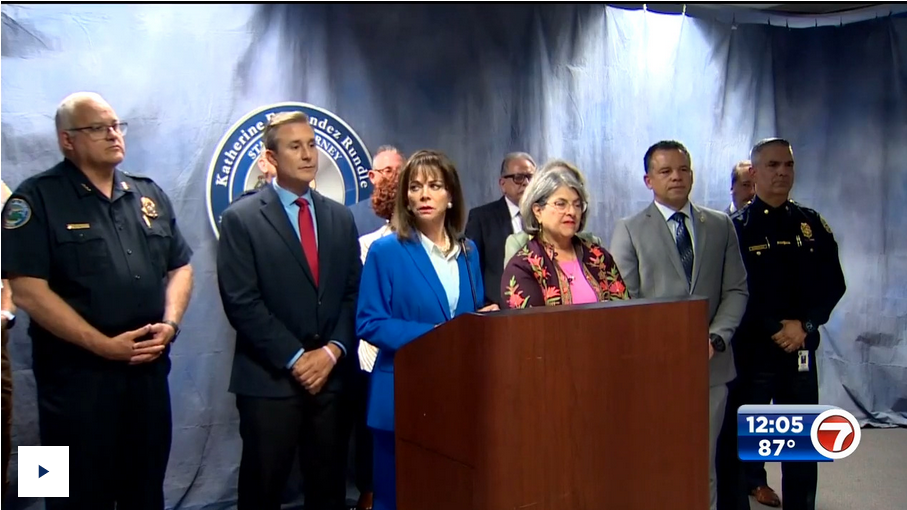
Rundle, along with the county’s mayor and several other officials, gathered Wednesday afternoon to announce the formation of the Elder and Vulnerable Abuse Work Group with the goal to stop incidents like this from happening again.

“We need to do more to fight elder and vulnerable adult exploitation abuse,” said Rundle.

7News stopped by the facility at 1370 NE 138th St. in North Miami to try get some answers, but no one wanted to talk.

The group also spoke about several other cases involving elderly abuse and exploitation, including one where a woman allegedly pretended to be someone else online to gain the trust of an elderly victim and was able to swindle her out of large sums of money.

Another example is a case where a woman in Doral, pretended to be the daughter of an elderly cancer patient to sneak into a hospital and scam her out of hundreds of thousands of dollars. That suspect has not been arrested, although her son has a connection to the crime.

“We are going to get to work protecting our older adults, our vulnerable population from abuse, fraud and exploitation,” said Miami-Dade County Mayor Daniella Levine Cava.

Florida ranks second in the nation for the number of victims of crime against those age 60 and older. Miami-Dade County ranks number one in the state.

“Sadly, of course, the problem hasn’t gotten better, it has only gotten worse,” said Levine Cava.

The multiple agencies working together said they are in need of the public’s help because they rely on reports filed. Then, they are able to pursue the people responsible.

The three employees are due back in court on June 23.

Full Article & Source:

Monday, March 21, 2022

Report: CT nursing home resident died after not receiving medication

by Dave Altimari
 

Gregory Brooks, left, takes a stroll on the driveway of is the Quinnipiac Valley Center with his friend and visitor Marc. Brooks is the Resident Council President at the nursing home, who takes complaints from residents and joins monthly meetings.Yehyun Kim / CTMirror.org


A resident of Quinnipiac Valley Center nursing home in Wallingford had a fatal heart attack in February after the staff failed to give her all of her prescribed medications for several days, an investigation report shows.
 
The resident, identified by the state medical examiner’s office as a 41-year-old woman, was admitted to the Quinnipiac Valley Center on Jan. 28. She had a seizure disorder and “profound intellectual disabilities,” according to an investigation by the state Department of Public Health. Among the medications that they were supposed to be administered daily were Clobazam, Diazepam and Dilantin to help control the seizures.
 
Investigators learned that in the five days since the woman had been admitted, the staff had administered only one dose of the Diazepam, none of the Clobazam until the date of death and only one dose of Dilantin. The woman was found unresponsive in her bed on the evening of Feb. 2 and pronounced dead of a heart attack by a staff doctor.
 
The woman was one of three residents who died within a month, according to the office of the state medical examiner. On Jan. 16, a 70-year-old woman died of COVID at Yale New Haven Hospital, and on Jan. 24, a 64-year-old man died of complications from diabetes.

The deaths led to the DPH investigation that began Feb. 3, the day after the 41-year-old woman died. Earlier this week, the DPH issued an order to close the facility and move its 94 residents to other long-term care facilities. DPH officials have said they had no choice but to close the facility because of concerns for patients’ safety.

The death was detailed in a 73-page inspection report, compiled by DPH inspectors after multiple visits to the facility and obtained by the Connecticut Mirror.

Among the other findings: Another patient, diagnosed with diabetes, was rushed to the hospital because staff had failed to monitor their glucose level for several days as their blood/sugar level fell to dangerously low levels; staff treated recently admitted COVID patients without wearing the proper personal protection equipment because they were unaware the person had tested positive; and that staff treated patients who had COVID on the same shifts and on the same floor as patients who didn’t, violating protocols.

‘A bombshell’

“This whole thing that’s going on right now is a bombshell,” said Gregory Brooks, a resident at Quinnipiac Valley for eight years who has acted as a residents’ advocate, discussing complaints and issues with the staff and administrators.

“This is come out of the blue like a lightning bolt. I was not involved in any meeting. I was not involved in any sit-down discussions,” Brooks said. “How did this happen? Everybody in here is in the same boat as I am — shocked.”

Brooks said that there haven’t been major problems at the facility before and that he assumed that a facility run by Genesis, a national chain, would be a safe location.

“There’s four-star ratings, plaques all over the walls, and while there’s been issues with staffing, my guess they aren’t alone with that problem,” Brooks said. “Why should the residents have to pay for a mistake that the corporation made, you know?”

Brooks said he found out the facility was going to be closed from a staff member who came to check on him.

“Well, he goes, ‘I’m losing my job. And all the other staff are too, we’re all out of here. We’re all gone,’” Brooks said. “I hadn’t heard anything from anyone about anything. And to me, that’s like common courtesy that you would give people — even a landlord would take a few minutes to go up and tell you why he is evicting you.”

‘Immediate jeopardy’

Investigators with DPH’s Facilities Licensing and Investigations Section entered the building on Feb. 10 after receiving a complaint. It is unclear if the complaint was about the death of the resident a week earlier.

The initial inspection resulted in two findings of “Immediate Jeopardy,” meaning the violations were serious enough to risk imminent harm to life. Those two cases were the woman who died and the resident who needed to go to the hospital because their glucose levels were not monitored.

DPH investigators interviewed staff and administrators to determine how staff had failed to administer medication or conduct basic checks.

The DPH report states that administrators were “unable to explain why medications were not ordered and ensure they were received timely for administration to the resident, and why a resident receiving insulin was not monitored after a decrease in blood glucose levels was ordered. The interview failed to identify why admitting documentation was not reviewed by the attending physician for a resident receiving insulin, and why the facility was unable to prevent the significant medication errors.”

DPH directed a plan of correction, which included the appointment of a temporary manager on March 3. DPH appointed Kathrine Sachs as the temporary manager, the same person who was placed into the Three Rivers Health care facility in Norwich in 2020 when a COVID outbreak occurred in that faculty and four people died.

Three Rivers was the last long-term care facility closed down by the state. Sachs recommended that it be closed after only a few days overseeing that facility.

Sachs reported to DPH additional issues with the facility, including, among other things, systemic problems with medication errors, DPH officials said.

DPH identified five more instances of immediate jeopardy related to failure to administer medications appropriately and accurately to residents and failure to report adverse incidents.

COVID patients

The facility also failed to put proper infection control precautions in place, the report states.

The infection control issues revolved around two COVID patients who came to the facility in early February.

The inspection revealed that they weren’t identified as COVID patients to staff, so many of them went into their rooms not wearing proper PPE such as isolation gowns. Inspectors unknowingly visited the room of one of the COVID patients during one of their inspections.

Several staff members told DPH inspectors they had no idea one of the residents was COVID positive and that they had treated other patients after going into the rooms of the COVID-positive resident.

Following the inspections, DPH notified Quinnipiac Valley officials that they had until early March to present a plan of correction, but after Sachs took over as temporary manager, the decision was made to close the facility and find new homes for 94 people.

“We have given QVC ample time to correct the issues, and DPH staff have been monitoring the facility almost daily. We no longer have confidence that the facility can keep its residents safe. Moving people from their homes on short notice is a serious action that we do not take lightly. But we are convinced that this order is necessary to ensure the safety of all the residents there,” said Department of Public Health Commissioner Manisha Juthani.

Quinnipiac Valley is owned by the Genesis Corporation, a national chain. Genesis issued a statement earlier this week that it was cooperating with the temporary manager and helping to relocate residents.

Asked if the health department is investigating any other Genesis facilities, DPH spokesman Christopher Boyle said, “DPH is not able to confirm or discuss any types of impending investigations at other facilities.”

State Long-Term Care Ombudswoman Mairead Painter said her office has been working with families and Sachs, the temporary manager, to find new homes for residents, hopefully within proximity to Wallingford.

“We are supporting the residents in as much choice as possible, related to the transfer and where they would like to go to try to remain close to either family or care providers or to stay with a roommate,” Painter said. “This isn’t something that we really see happening often. And because of the level of concern, we are really prioritizing the safety and well-being of residents.”

For Brooks, the ordeal of waiting to see what’s next has become excruciating.

“I gave them my three choices, and they were all shut down,” Brooks said. “They don’t have any beds, which I can understand, since it’s 94 people getting thrown out.”

Full Article & Source:

Tuesday, February 1, 2022

Officials ID woman found outside Iowa assisted living home

Officials ID woman found outside Iowa assisted living home. (Storyblocks)

BONDURANT, Iowa — Polk County authorities have identified a woman who died after she was found outside an assisted living home in sub-zero temperatures.

The Polk County Sheriff's Office says 77-year-old Lynne Harriet Stewart died at a hospital after being found last Friday outside the Courtyard Estates at Hawthorne Crossing in Bondurant.

Officials say the temperature outside when she was found by facility staff members was minus 8 degrees.

A department news release Wednesday said that investigators do not know how long Stewart had been outside when she was found.

The facility, which serves people with dementia, was fined $1,500 in 2020 after a male resident was able to leave the home and climb over a secure fence.

Full Article & Source:

Sunday, May 23, 2021

Man, 83, dead after assault by fellow Bronx nursing home resident

By Elizabeth Keogh

An elderly man died after he was assaulted by a fellow resident of a Bronx nursing home, police said Friday.

Officers were called to Pinnacle Multicare Nursing & Rehabilitation Center in Co-Op City about 6:30 p.m. for an assault, cops said.

When they arrived, they found an 83-year-old resident of the home face down and unconscious with severe trauma to his head.

The man was pronounced dead at the scene.

Police believe an 87-year-old resident entered the victim’s room and repeatedly smashed his head on the concrete floor.
 
The suspect, who police sources say suffers from dementia, was taken into custody.
 
His charges were pending late Friday night.
 
Full Article & Source:

Tuesday, June 9, 2020

Man in N.J. nursing home was buried before his family even knew he was dead

Thomas E. Comer and his granddaughter, BriannaCourtesy of Brianna Comer
By Ted Sherman

Thomas E. Comer’s final hours are a mystery to his family.

In fact, they never even knew the 88-year-old retired machinist — who lived out the last four years of his life at the Bayshore Health Care Center in Holmdel — had died from COVID-19 on April 13th until long after he was buried.

“Somebody could have told me something,” said his son, David. “He was my dad.”

His father, who suffered from dementia, was under state guardianship because of financial necessity, Comer said. But neither the state nor the nursing home reached out to contact his family after the Irish expatriate succumbed to the coronavirus.

“I understand what’s going on,” he said of the crisis in the state’s nursing homes that has killed more than 6,200 people in an outbreak that has taken 1 in 12 residents. “But they couldn’t spare me five minutes?”

Bayshore Health Care has reported the deaths of 21 of its residents in the outbreak. Another 119 residents tested positive for COVID-19.

Comer first learned of his father’s death after his daughter called the nursing facility to find out how he was doing.

“We had not heard anything. We knew they were overwhelmed, but I had this false sense nothing would ever happen to him,” Brianna Comer recalled. “The woman who answered the phone said she could not find him.”

Then she was told he had expired.

“I went, ‘what? When did he die?’”

“Oh, I can’t tell you that,” a staff member told her. “You’re not on the list.”

“Who is on the list?” she asked.

“I can’t tell you that either,” the staffer said.

It was not until she Googled her grandfather’s name that she discovered he had been sent to Laurel Funeral Home in West Keansburg following his death.

“We were told by the funeral home that he was already buried, against his wishes of being cremated, and they also attempted to contact my father, but they were only given an outdated phone number by the nursing home,” Comer remarked.

Funeral home officials said they tried calling the number given by Bayshore, but got only a click and no answer when they reached out. “That was the only phone number we had,” explained Kathleen Sperling, whose family owns the funeral home.

Brianna Comer said her father updated his phone number four times with Bayshore Health Care, giving it to nurses who directly cared for her grandfather, the nursing director, and the front desk.

“We visited frequently, always bringing a small black coffee, jelly donuts and occasionally a bottle of Guinness,” she said. “There was no reason for anyone in the facility to assume he was not wanted or loved.”

She said it was clear that no one bothered to update his file.

Hackensack Meridian Health, which operates Bayshore Health Care, said in a statement they followed state laws governing how notifications are to be made.

“Our thoughts and prayers go out to the Comer family. This is undoubtedly a sad situation and it’s understandable the process would be questioned. When an individual passes at a nursing or health care facility, a guardian or next of kin is notified,” the statement said. “If the individual is under the supervision of the Office of Public Guardian, this would be the entity that would receive appropriate notifications related to private health information — including death. Privacy laws prohibit the sharing of health protected information unless designated otherwise.”

The Office of the Public Guardian is administratively located in the Department of Human Services, but not part of it. Acting Public Guardian Helen Dodick said they do not discuss specific cases. But when an individual protected by her office passes away, she said the assigned care manager — or depending on the hour, the on-call care manager — notifies the family.

“If the staff cannot reach the family through the notification numbers provided by the family, staff will then try multiple means of finding the family, including working with the nursing home, funeral director and doing Internet searches,” she said. “The office — as part of its mission to aid, empower and protect New Jersey’s older adults who need assistance — does everything it can to contact families.”

Comer, a retired Passaic County Sheriff’s Officer, said it would not have been hard to find him.

“They could have called the Holmdel police and given my name and they would have found me in minutes,” he said.

Born on September 2, 1931 in County Mayo on Ireland’s west coast in the town of Westport, Thomas Comer was a proud Irishman who never lost his brogue, said his granddaughter.

“He never got sick. He always said he had Irish immunity,” Brianna Comer remembered. “When we got sick, he said we weren’t Irish enough.”

She said he loved math and loved chess and for some reason, dogs always seemed to love him.

He was a veteran of the Royal Air Force, where he was an air traffic controller. He followed his parents and siblings to the United States, arriving here in 1958, but never became a naturalized citizen. While he talked about returning one day to Ireland, he never did. He was afraid to fly, Comer said. He settled in Orange, and lived for 40 years in Passaic, working as a machinist before his retirement. He later moved to Union Beach.

In recent years, however, it became clear he would need nursing care.

“My grandfather suffered from dementia and would frequently leave the house and disappear on walks, no matter the weather,” said Comer. “Due to overwhelming costs of nursing homes, we sought help from the state by making him a ward of the state with a social worker to place him in a home where he thought he would be safe and monitored.”

The family is now trying to obtain his medical records in order to find answers regarding what happened to him and locate his belongings.

“I would have just appreciated his few effects,” said David Comer. “Some pictures. The wristwatch my son gave him. It’s just a $10 watch, but it was his.”

Survived by his older son John, of North Carolina, and youngest son David, of Keyport, he left behind 7 grandchildren and 3 great- grandchildren. He was predeceased by his wife, Eileen, and a son, Steven. He is buried at Bay View Cemetery in Leonardo.

“It was a direct burial,” said Sperling. “Our funeral director did say prayers there, which is normal if there is no family there.”

For now, the pandemic has prevented David Comer from going to his father’s grave.

“No one’s allowed to visit,” he said. “They said you have to wait.”

Full Article & Source:
Man in N.J. nursing home was buried before his family even knew he was dead

Wednesday, April 29, 2020

Coronavirus Entered My Father’s Nursing Home and Nobody Warned Me. I Did Not Get the Chance to Save Him.

Reporter Jan Ransom’s father was the fourth resident of his nursing home to get COVID-19. Nobody told her about the first, so she couldn’t move him before he got sick. “I think that’s very unfair,” her father told her a week before he died.

by Jan Ransom

The call came around 9 a.m. on March 25. It was my father.

“I’m not doing too good,” he said in between gasps for air. I asked him what was wrong. “I’m coughing up blood,” he said, adding that the medical staff at the nursing home in the Bronx where he lived wanted to send him to a nearby hospital.

The author and her father in 2002.
(Courtesy of Jan Ransom)
My father, 75, had chronic obstructive pulmonary disease (COPD), a crippling illness that causes severe breathing difficulty and can lead to death. He had lived in nursing homes since 2017 after X-rays showed his lungs had badly deteriorated.

“Do we really have to send him to the hospital?” I asked a nursing supervisor over the phone. I worried about my father, already in poor health, waiting in an emergency room full of patients infected with the coronavirus.

What I did not know was that he already had the virus. Shortly after being admitted to the hospital, he tested positive for COVID-19. Hours later, I called the nursing home to alert the staff. A nursing home staffer told me that my father was not the first resident to test positive. He was the fourth. I was stunned.

I’m a reporter for The New York Times and have been covering the pandemic’s impact on New York City jails, including Rikers Island, and the state’s prison system.

Other journalists at the Times and elsewhere have been writing about the toll the virus was taking on nursing homes, killing hundreds of residents and infecting thousands more. As I read those harrowing stories, my dad was never far from my thoughts.

After realizing my dad’s nursing home had left me in the dark, I started to make some calls. I thought about my father’s roommate and the families of other residents at the facility who were unaware of the storm brewing inside.

I was certain I should have been alerted that the virus had been detected in the home they shared. I was wrong.

When I called the state Department of Health to complain on my family’s behalf, I was informed that nursing homes in New York — the epicenter of the crisis in the United States — were not obligated to tell families when the virus is detected in other residents.

“Guidelines require nursing home operators to notify a resident’s family of illness, they do not require notification to relatives of other residents,” a Department of Health spokesman later said in a statement.

That left me even more puzzled, and not just as a daughter but as a journalist. So I emailed the state asking if the agency was weighing whether to change the policy in response to the growing crisis.

A day later the policy had changed. The Department of Health is now directing nursing home officials to tell residents and families within 24 hours of learning of a suspected COVID-19 case.

More than 6,470 nursing home residents in New York have tested positive for the coronavirus, according to the state Department of Health. The disease had killed 42% of infected nursing home residents as of Friday. The outbreak has now spread to 354 of the 613 licensed nursing homes in New York and, and in hot spots from New Jersey to Seattle, nursing home residents have been especially hard hit.

Last week, the Centers for Disease Control and Prevention announced that nursing home providers will soon be required to report potential infectious disease outbreaks not only to state health departments but directly to federal health officials to accelerate efforts to contain outbreaks.

But the revised New York state guidelines came too late for my family, and for many others. My father died on April 9, due to complications from the virus, 15 days after he was admitted to the hospital.

The lack of notification deprived us of the chance to move my father out of the nursing home before he got sick. “I think that’s very unfair,” my father said more than a week before he died. “They have no consideration — in other words you’re just cattle. It goes to show a great indifference.”

My experience was not unique. My colleagues at the Times have reported that several other families said nursing homes did not tell them when a resident tested positive or what steps the homes were taking to prevent the virus from spreading. Outside of New York state, families are raising similar alarms and demanding the release of better information by governments and facilities. In recent days, Florida and California began releasing information on which nursing homes have outbreaks.

Indeed, it was only by chance that I learned my father was not the first resident at his nursing home to test positive. When I called to update the home about his test results, a staffer asked how he was doing. I sighed and told the staffer he had tested positive for coronavirus. To my surprise, the staffer said that there were others and that the facility had been slow to quarantine floors. My heart dropped. How could this have happened?

On March 12, I had received a robocall letting me know that all medically nonessential visits to the facility had been suspended, but reassuring us that there were no cases in the facility. My father started hearing rumors from staff and residents that the virus had quietly seeped into the nursing home. One staffer told him that another staffer had fallen sick and could not work, and residents spoke about another resident who was hospitalized.

My father said he and some of the other residents were still being allowed to move around the nursing home without masks and were never warned that the virus had entered the 159-bed facility.

And while my father had symptoms of the disease — a persistent dry cough, diarrhea, fever, headaches and body aches — no one at the home, including the doctor who called to follow up with me about his persistent cough, told him or me that they suspected he might have the virus.

On March 18, I received another reassuring robocall from the nursing home. “We continue to take stringent precautions in ensuring that your loved ones remain safe,” the automated call stated. “To date, we do not have any presumed or positive cases in any of our facilities and will continue to provide you with relevant updates as they become available.”

On March 23, I emailed Aharon Wolf, the administrator of my father’s facility, Hudson Pointe at Riverdale Center for Nursing and Rehabilitation in the Bronx, asking for an update and whether the virus had made its way there. I did not get a response. Two days later my father was hospitalized and the next day tested positive for COVID-19.

After I learned my father was the fourth resident to test positive, I immediately called Wolf.

He explained that three residents had tested positive for the virus at a hospital before my father was hospitalized. A staff member at the home had also tested positive around the same time, he told me. He said that infected residents had been transferred to hospitals and were no longer in the nursing home.

It was a day after I received my father’s positive test result that a staffer finally left a voicemail message to inform me that the virus was in the nursing home. Then, three days before my father died, I received another robocall from the facility stating that some residents had tested positive for COVID-19.

When I called Wolf back while reporting this story, he told me relatives were being updated and that notifying 150 families takes time.

My father fought hard to beat the virus. His condition changed every few days. At first he was stable, and then his symptoms worsened. At one point, his blood pressure dropped, and his breathing became labored.

The other times he was hospitalized with complications from his lung disease, I would drop by his hospital room after work with a hamburger and a smile. I would hug him, rub his mostly bald head and encourage him to hang in there.

This time was different. I could only talk to him over a video chat app. This virus has made it unsafe to visit our infected and dying loved ones in the hospital, leaving them isolated and alone.

I tried to keep his spirits high, reminding him he was a fighter. I played for him the songs he loved and that I grew up listening to: “Cruisin’” by Smokey Robinson and “Lovely Day” by Bill Withers.

When he had the energy, we chatted and I blew him kisses over the phone. “Hey, big guy,” I’d say, to my dad, who was 6-foot-7. My father, whose name I share, was a retired Metropolitan Transportation Authority employee who had spent much of his time there doing trackwork and swore that he had the answers to fixing the beleaguered subway system. (The transit authority has suffered its own losses, with more than 50 MTA workers killed by the virus.)

Sometimes he griped about the hospital food — it was too cold, he said, or they were served chicken for dinner, again.

But in his last week, he looked increasingly tired. He was out of breath and had lost his booming voice.

Hours before he died, I called him on his cellphone, but he did not answer. Minutes later, he called me back, and I was overjoyed to see his face.

Full Article & Source:
Coronavirus Entered My Father’s Nursing Home and Nobody Warned Me. I Did Not Get the Chance to Save Him.

Saturday, February 1, 2020

State fines nursing homes over falls

Injury fatal for one resident, report says

by David C.L. Bauer


Two west-central Illinois nursing homes were among those fined by the Illinois Department of Public Health after one resident was injured and another died, according to the department’s quarterly report released Tuesday.

Aperion Care Jacksonville, a 113-bed skilled care facility at 1021 N. Church St., was fined $25,000 for failure to provide supervision and implement intervention for a resident to prevent multiple falls, according to the state.

Pittsfield Manor, an 89-bed skilled care facility at 610 Lowry St. in Pittsfield, was fined $25,000 for failure to provide supervision to prevent a fall, according to department records.

According to Illinois Department of Public Health documents, policies and requirements were not followed and that resulted in a resident falling, lacerating her head and suffering a fracture that required surgery and the pinning of her hip.

When the woman was admitted to the facility in 2018, it was determined she was at risk for falls, according to the state, but “the facility failed to implement effective interventions and provide supervision to prevent injury for multiple falls.”

At Pittsfield Manor, according to Illinois Department of Public Health documents, the facility also failed to provide supervision to prevent falling for a resident, resulting in her falling, hitting her head and being sent to the emergency room.

The resident suffered “a traumatic skull fracture, subarachnoid hemorrhage (bleeding in the space between the brain and the tissue covering the brain) and subdural hematoma (a pool of blood between the brain and its outermost covering) that caused her death.”

The woman had been admitted to the facility in February and had been diagnosed with Alzheimer’s disease, a history of falls, unsteadiness, anxiety and vertigo.

The state documented a series of falls that occurred although the resident was urged to use a call light to get staff assistance. In the days before the most significant fall, nursing home staff reported she required more assistance and complained more often of headaches and dizziness.

In June, the woman was taken from the facility for a dental appointment, according to the state’s report. A nurse’s aide and bus driver called a few hours later and said the woman had fallen and was taken to the emergency room, where she was diagnosed with a brain bleed. The diagnosis was that the woman would “likely soon pass related to the intracerebral hemorrhage.”

She died about three days later, according to the report. The cause of death was “blunt force trauma” resulting from “falling and striking head on ground.”

Both facilities were cited with type “A” violations of the Nursing Home Care Act and processed between October and December. An “A” violation pertains to a condition in which there is a substantial probability that death or serious mental or physical harm will result or has resulted, according to the Illinois Department of Public Health.


Full Article & Source:
State fines nursing homes over falls

Wednesday, October 24, 2018

‘He screamed for hours for help and no one came.’ How her dad died in a nursing home


Wanda Delaplane, former Kentucky assistant attorney general, recounts the story of how she lost her father to nursing home neglect in 2006 and how she now advocates for safety in nursing homes.

Read more here: https://www.kentucky.com/news/local/watchdog/article218600285.html?fbclid=IwAR2IDhS22oiBLsf6um0bzXdQFiRlnmK-l9rSEXB8hggHA9rQDhXz2cY6bF0#storylink=cpy

Source:
‘He screamed for hours for help and no one came.’ How her dad died in a nursing home