Gerald Harten says he’s been separated from his wife and held in various group homes for months. Monday a court hearing was finally held to determine Jerry’s fate, but justice for Jerry is delayed yet again.
By: Heather Catallo
MOUNT CLEMENS, Mich. (WXYZ) — Last fall, the 7 Investigators raised
the voice of a Vietnam veteran who said he felt like he’s become a
prisoner of Michigan’s guardianship system.
Gerald "Jerry" Harten
says he’s been separated from his wife and held in various group homes
for months. On Monday, a court hearing was finally held to determine
Harten’s fate, but justice for him is delayed yet again.
Harten has been wanting to appear in person to talk to a judge at the
Macomb County Probate Court. But once again on Monday, his public
guardian would not let him attend the hearing.
Harten is an aging veteran who is so frustrated about being under
court-ordered guardianship that he called the police on his own family
several times last summer.
The 77-year-old Vietnam veteran’s
journey into guardianship started in November of 2023, after he had back
surgery and other health complications. His wife Mary had power of
attorney to make his medical decisions, but she had her own medical
emergency at the same time and could not care for him. So, Macomb County
Probate Judge Sandra Harrison declared Harten legally incapacitated and
made his son his guardian.
“I was in a hospital and my boy stepped up to be my overseer of
medicine,” Harten told 7 Investigator Heather Catallo in an interview
last fall.
Harten says after his health improved, he still was not allowed to
leave his son’s home, and court records show Harten’s wife and his son
started fighting over who should care for him.
So the judge appointed public guardian George Heitmanis, but the family conflict continued and so did the police visits.
Harten was then moved to three different group homes and now, he’s been moved to a rehab facility.
“I
am really almost crying out for desperation. I want to go home,” Harten
said. “They always get me away from court deals. And that's what made
me mad. I said 'what? I can't see the judge.'”
After 15 months under guardianship, court records show Harten’s son is
now trying to get him back under his roof. And instead of holding a
long-awaited hearing for Harten Monday, lawyers for all of the parties
asked for another adjournment.
“The one thing we did agree to is that we probably need a third party
who is not any of us to investigate everybody and then report back who
appears to be suitable,” said attorney Elizabeth Ferguson, who
represents Harten’s son and daughter-in-law.
Harten’s new court-appointed attorney, Ben Schock, advocated fiercely
for him in court, objecting that his client’s guardian would not allow
Harten to appear in front of the judge for his own case.
“Why was Jerry not allowed to come to court today?” Catallo asked.
“There
is a statement from a licensed medical doctor that indicates that his
presence in the hearing can exasperate his medical condition,” Schock
said.
“But that statement is a year old, and he’s had other
evaluations since then. Hasn’t he expressed a desire to come to court?”
Catallo asked.
“Absolutely, he’s expressed a desire to come. That was part of my
objection today. We are going to get additional medical, hopefully for
Mr. Harten, which allow him to attend future hearings,” Schock said.
Harten’s son and his wife declined again to speak to us on camera.
All of the parties are expected to be back in court in early May.
Gerald Harten says he’s been separated from his wife and held in various group homes for months. Monday a court hearing was finally held to determine Jerry’s fate, but justice for Jerry is delayed yet again.
Wendy Williams is headed to the Magic City for a special occasion.
The former talk show host, 60, is currently under a court-order
guardianship, confined to a New York assisted living facility that she
describes as a “prison.”
But the brazen small-screen star will be able to flu to Miami for 48 hours to attend her father Thomas’ 94th birthday.
On Friday, sources told TMZ that a judge authorized private security to accompany Williams from the Big Apple to celebrate with her dad and family.
Meanwhile, the judge is also prohibiting Williams from having further contact with the media, per the outlet.
Williams also claimed she had just $15 in her possession and that her beloved cats has been taken from her.
During the interview, Williams became emotional talking about her
father’s upcoming 94th birthday, admitting she wasn’t sure if she would
be allowed to fly to Miami to celebrate with him.
The radio alum made it clear she wanted freedom from the controversial guardianship.
Williams — who was diagnosed with aphasia and frontotemporal
dementia in May 2023 — compared her current living situation to that of a
“prison.”
A few days prior, Williams’ loved ones launched a GoFundMe to raise $50,000 to help free her from her guardianship.
“For far too long, Wendy has faced the challenges of being unjustly
placed under guardianship and labeled as incapacitated, despite her
strong will and determination to live her life independently,” the
description reads.”
“Her current situation is not only unfair but also deeply isolating.
The guardian assigned to her has severed her connections with friends
and family, leaving her without the support network she so desperately
needs. This isolation in New York has made it increasingly difficult for
her to maintain her strength and resilience.”
Sources told TMZ that
Redlisky was let go after the lawyer allegedly failed to file paperwork
for a trial about whether Williams’ guardianship was necessary when the
author asked her to do so.
Cindy Hagen Triumphs Over Guardianship Battle, Returns Home After 294 Days
Cindy Hagen's prolonged hospital stay ended as she returned home to Mankato, marking a significant victory for her and disability rights advocates
in Minnesota. After being hospitalized for an infection, Hagen faced a
challenging battle against an imposed emergency guardianship, which
threatened her autonomy. Her case has reignited discussions on the civil
rights of individuals with significant disabilities and the ongoing
crisis in home health care staffing.
From Hospital to Home: A Journey of Persistence
Hagen's case
began when she was admitted to the Mayo Clinic hospital in Austin for an
infection treatment. Despite her recovery, a staffing shortage for her
care prevented her return home, leading to an emergency guardianship
that confined her to the hospital for nearly ten months. The
guardianship, potentially stripping her of her independence, was
contested by Hagen and her legal representation. Their fight culminated
in her triumphant return to her Mankato apartment this week, following a
court's decision to dismiss the guardianship petition.
The Broader Implications: Disability Rights and Care Staffing Crisis
Hagen's ordeal has cast light on the larger issues facing individuals
with disabilities in Minnesota and across the nation. A critical
shortage of home health care workers has heightened the struggle for
many to maintain their independence, forcing some into institutions.
This staffing crisis, exacerbated by inadequate Medicaid reimbursement
rates, poses an ongoing challenge for those who rely on personal care
assistance for their daily needs. Hagen's story emphasizes the urgent
need for systemic changes to support both the disabled community and
their caregivers.
Looking Ahead: Hagen's New Beginning
Despite
the hurdles, Hagen's return home signifies a new chapter in her life
and a moment of reflection on the importance of self-determination for
individuals with disabilities. She now faces the task of rebuilding her
in-home care team, a daunting yet hopeful endeavor. Hagen's resilience
and the community's support for her case underscore the broader dialogue
on enhancing the lives of those with significant disabilities, ensuring
they can live where they feel wanted and maintain autonomy over their
lives.
Friends of an
Upper West Side woman are making an unusual offer to try to prevent the
93-year-old from being removed from her rent controlled apartment. Sarah
Wallace reports.
Adrianne Whitney, right, has been fighting to become the legal guardian of her brother, Nicholas Whitney.
Courtesy of Adrianne Whitney
by Matt deGrood
Galveston prosecutors charged Rebecca Doxey with stealing
from her developmentally disabled nephew. Then officials in Brazoria
County kept her as his sole legal guardian.
It is a case that has upset at least one family
member, but guardianship advocates said it is the latest example of how
backlogged courts and a patchwork county-by-county system are leaving
some of the state's most vulnerable residents at risk for victimization.
Now it is up to a judge to decide whether Doxey, 69,
can remain in charge of Nicholas Whitney, whose family urged her to look
after as relatives died or were not able to meet his needs. The judge
must weigh all this as Whitney's sister is now fighting to gain legal
control over her brother and has become a driving force behind legal
challenges to her aunt's guardianship.
The case is the latest test of a state guardianship
program sometimes drenched in fraught family feuds, a program that must
try to protect tens of thousands of disabled residents across Texas.
Advocates say these problems are particularly acute in Texas' smaller
counties, where these nuanced cases come barreling at staffs that are
often inexperienced, judges whose dockets are jammed with cases and at
times poor communications between jurisdictions.
Courts in smaller counties often "don’t have
intensive guardianship sections, so they don’t have specialized staff to
work on the cases,” said Terry Hammond, the executive director of the
Texas Guardianship Association, a nonprofit organization. "You could
visit Texas in 1870 or 2023 and see largely the same guardian program we
had in place.”
Accusations of fraud
Nicholas Whitney’s father died in 2006, leaving his
mother as his sole surviving parent, said his sister, Adrianne Whitney.
His mother was in poor health, so the family gathered together to
discuss who might care for him. Adrianne Whitney was fresh out of
college at the time, living in New York, and his aunt,Rebecca Doxey, was the family member who agreed to do it.
Nicholas Whitney is at the center of a legal fight between and his sister, Adrianne, right, and his legal guardian.
Courtesy Adrianne Whitney
To become a guardian, a person must be appointed by a
judge to manage all legal and financial aspects for someone the court
has deemed declared incapacitated, usually because of a disability.
Around 55,000 Texans fall under the state’s guardianship program,
Hammond said.
The decision to place someone under a guardian can be
hugely consequential, according to a 2022 report from Disability Rights
Texas, an advocacy group for Texans with disabilities.
“Even in the most well-intentioned cases, a person
can still lose complete independence for the rest of their life,” the
report said. “This loss of self and civil rights is why it is important
that mechanisms for ending guardianships are accessible and effective,
and guarantee due process.”
Between 2016 and 2017, Whitney’s grandparents, Carol
and Vernon Whitney, died and left a trust with just under $100,000 to
care for him, Adrianne Whitney said.
The money became the root of the trouble, Adrienne Whitney said.
Adrianne Whitney said she filed a complaint in
Galveston County, saying Doxey wrote herself a $40,000 check in 2019
from the trust as a loan. Doxey apparently told the family she filed a
lien against her own home as collateral. But there is no proof the lien
ever existed and was never filed in the county, meaning the loan had no
backing, according to Adrianne Whitney and the Galveston County
Sheriff's Office.
Deputies first began investigating Doxey in May 2022
when someone reported an allegation of fraud, according to Maj. Ray
Nolen of the sheriff’s office. A family member told investigators Doxey
submitted fraudulent paperwork for a property lien in Galveston County,
using money from her ward’s trust, Nolen said.
An attorney for Disability Rights Texas, Taft
Robinson, is listed as Nicholas Whitney’s attorney, according
to Brazoria County court records. Officials with the organization
declined to comment about the case.
Matthew Edquist, an attorney previously appointed to
represent Nicholas Whitney, said he'd come to believe Doxey was the best
person to care for him, despite the allegations she's facing in
Galveston County.
None of the allegations relate to the care of Nicholas Whitney or say he is being harmed under Doxey's oversight.
Doxey, for her part, has repaid the money, with interest, said Tad Nelson, Doxey’s criminal defense attorney.
System needs communication improvements, lawyer says
The repayment does not resolve the guardianship issue, however.
The case is further complicated by the fact that the
guardianship issue is playing out in Brazoria County and the criminal
case involving the alleged loan rests in Galveston County.
Doxey's case was moved to different courts in
Brazoria County. The previous court’s coordinator, Donna Norsworthy, did
not respond to a request for comment about why the case had been moved.
The change in venue came days after Norsworthy said Judge
Thomas Pfeiffer learned about Doxey’s indictment, and that he planned
to address the matter soon.
“If anyone had known an indictment was going on, that would have been taken into consideration,” she said.
Whitney’s appointed attorneys and emails Adrianne
Whitney shared with the Chronicle show the courts had the information
about the charges, but it is not known if it was seen by anyone in
authority.
“The Galveston allegations and the police report were
made a part of the record in Brazoria County last fall,” said Edquist.
“And the Galveston PD records were provided to all.”
Adrianne Whitney sent emails to the court’s
investigator April 2022, raising questions about Doxey’s conduct in
Galveston County on March 30, including a copy of the grand jury
indictment against her. She included a Dec. 6 letter her attorney Chase
Chapman sent, informing them of Doxey’s arrest.
“Rebecca obviously cannot fulfill her duties as
guardian while in jail,” Chapman wrote in the Dec. 6 email. “Do you all
agree to Adrianne being named temporary guardian while Rebecca is in
jail? This is an emergency situation so your immediate response would be
appreciated.”
The court’s investigator never responded to any of Whitney’s emails, she said.
RIVERSIDE (KABC) -- The
trial is now underway in Riverside County to decide who will care for
Ryan Morris, a 29-year-old intellectually disabled man who says he was
raped while in foster care.
Morris' biological family is fighting for legal guardianship in a very complicated case.
Morris, who has cerebral palsy, spent the vast majority of his life in either foster care or in the custody of public guardian.
"Ryan ended up getting stuck in the system," his aunt, Monica Mukai, told Eyewitness News.
She
says Morris' twin brother Ronald was born first, and Morris was not
born for another 2.5 hours, depriving him of oxygen and causing his
disability.
He was first adopted by a foster parent when he was 3 years old, Mukai told Eyewitness News.
Mukai
says Morris' foster mom Michelle Morris, who ran a facility in
southwest Riverside County known as the Morris Family Home, allowed him
to be the subject of all kinds of abuse.
Michelle
Morris and her husband have both been arrested and charged with a
number of crimes including lewd conduct and child endangerment.
"Ryan
has told me that he has been raped. Not only in the jacuzzi, but also
in his own bed, while he was under the care of Michelle Morris," said
Mukai.
Mukai also says the sexual
abuse goes even further. She says Ryan Morris was forced to marry an
employee at his foster home, Sean Spicer, by his foster mom.
Spicer is also fighting for guardianship of Ryan Morris, even though a judge has previously removed him from that position.
Mukai has been fighting for guardianship of Ryan Morris for seven years, yet he remains in the system.
And
it gets even more complicated. Ryan Morris' lawyer does not want Mukai
to be appointed conservator because he is afraid she will cut off
contact between Ryan Morris and his husband, Spicer.
The
trial is expected to end by this week, and the judge will decide if
Ryan Morris stays in the system or is returned to his biological family.
Ryan Morris' brother, Ronald Moore, hopes his twin returns to be with his family.
"You
know, I'm here for him, and us as his family, we care about him. And,
for our good times, to kind of flourish, so we can make good memories,"
Moore said.
(WXYZ) — Christian Chambers has lived his whole life in a small house
in Clarkston. His parents left Christian, who has Cerebral palsy, the
home so he would always have a place to live. But his mom’s
court-appointed guardian recently tried to sell that house.
Christian
is a constant in Clarkston. The 50-year-old volunteers as a coach with
the Clarkston High School football team and he’s well-known around town.
“He's been here 50 years. And this is where he wants to stay,”
Christian’s brother, John Chambers told 7 Investigator Heather Catallo
in October.
Last fall, the 7 Investigators showed you how
Christian was devastated to learn that his mother’s court-appointed
guardian was trying to sell the home.
“It's horrible to do this to anybody,” said John.
Several years
ago, a judge appointed Attorney Jennifer Carney to be Doreen Chamber’s
guardian, which means Carney has total say over Doreen’s medical and
financial decisions. Christian’s brothers say their parents left the
family home to Christian in a Special Needs trust. But a mix up with the
deed prompted Carney to count the home as Doreen’s asset, so Carney
entered into a purchase agreement to try to sell it. Christian’s trustee
says just before Carney told the family Christian would need to find a
new place to live, she brought a realtor through the home.
“Starts just wandering around the house, taking pictures, measuring, and
I'm going, ‘What? What are you doing,’” said Trustee Ron Dunlap in
October 2022.
According to court records, Carney billed Doreen’s estate $750 for
that visit to the home. Records show she also billed $120 to sign the
purchase agreement, even though legal experts say guardians are not
allowed to sell property without court approval.
The Chambers family started an online fundraiser to help save Christian’s home and pay for improvements.
And after the 7 Investigators shared Christian’s story in October, legal experts stepped in to help Christian.
We’ve now obtained court records that show Carney and the family
recently came to an agreement that will allow Christian to keep the home
his parents left him.
The court records reveal, Carney will
receive $9,300 as part of the settlement and will continue on as
Doreen’s guardian without receiving further payment.
On Christian’s online fundraising page, the family issued a statement thanking the community for their generous support.
"GRATITUDE! There is no better word to sum up
Christian’s heart for the Clarkston Community’s generosity and
participation in the effort to save his home. IT WORKED! With your
assistance and pro-bono legal counsel, Christian resolved his court
battle and will be able to live out his days in his childhood home. This
life-long Clarkston resident and community servant will continue to be
able to walk through his backyard to “coach” on the sidelines of
sporting events. He will still be able to attend and serve in Clarkston
Community Church. And he will continue to share his hallmark smile with
all those he meets.
Though we can all rejoice in the news
that Christian’s home has been saved, work remains to make it more
accessible and functional. To date, one of two bathrooms has been
renovated and safety rails have been put up for Christian to safely
navigate steps. New, more accessible kitchen cabinets will soon be
installed thanks to the generosity of Drew’s Home of Clarkston. And
Christian’s brother, John, has created a comfortable space for a future
roommate to help offset household expenses.
With your
continued support, Christian can ensure his house will be safe and
accessible for the rest of his life. We are halfway to our goal so let’s
keep the momentum going! If you would like to join the effort visit https://www.givesendgo.com/savechristianshome.
With deepest gratitude to the Clarkston Community,
Christian and family"
Donors gave more than $13,000 to help Christian. The family hopes
donations can continue to come in to keep Christian’s home safe and
easier to navigate.
The 7 Investigators called, texted and emailed the guardian, Jennifer
Carney. So far she has not commented on the settlement in the case.
(WXYZ) — A local family is fighting to keep their special needs brother in the only home he’s ever known.
They say he’s at risk of losing the house because of the actions of someone else’s court-appointed guardian.
Christian Chambers loves golf, football and Clarkston.
The 50-year-old has cerebral palsy, but is more than able to live independently in his childhood home.
And
the house is close to Clarkston High School where Christian volunteers
as an assistant coach for the football team. But instead of enjoying
this year’s football season, Christian is extremely upset.
That’s because someone wants to sell the only home Christian has ever known.
“He's
been here 50 years. And this is where he wants to stay,” said John
Chambers, one of Christian’s four older brothers who help with
Christian’s care.
"It's horrible to do this to anybody, but it's horrible to do it to
Christian because of his heart,” said John. “He doesn't have the ability
to go just get an apartment.”
Back in 2014, Christian’s mom and dad created a special needs trust
for him, leaving Christian the family home. They also made family friend
Ron Dunlap a trustee to look out for Christian’s welfare.
“It reads that it's going to be Christian's house forever. That was their full intent,” said Dunlap about the Trust.
In
2016, Christian’s mom started having health issues and his dad later
passed away. The Oakland County Probate Court determined Doreen Chambers
was legally incapacitated and appointed a professional guardian. The
guardian has total say over Doreen’s life, and Doreen was moved to a
nursing home.
Attorney Jennifer Carney is Doreen’s guardian. Her Birmingham-based
guardianship company is called Advocates for Independence and
Self-Reliance.
The Chambers say the family and Carney recently
learned the deed for the house was still technically in Doreen’s name,
and not in Christian’s trust as it should have been. And that’s when
things got messy.
“She wanted to meet us here at the house with her supervisor. And I'm
thinking to myself, how does she have a supervisor? I mean -- she owns
this law firm,” said Dunlap.
Dunlap says he and Christian watched while Carney brought not a supervisor, but a real estate agent into the home.
“Starts just wandering around the house, taking pictures, measuring, and I'm going, What? What are you doing,” said Dunlap.
The Chambers brothers say they later got an email from Carney that
says: “I need to manage the property in [Doreen’s] best interest, not
Christian’s…. Christian will need to find other living arrangements.”
“I think it's totally unethical. I think she should be sanctioned,” said Dunlap.
Court
records show Carney signed a purchase agreement for the home, even
though guardians are not legally allowed to sell a ward’s property.
“That seems like they're putting the cart before the horse because a
guardian doesn't have authority to sell that property,” said Nicole
Shannon, the Michigan Elder Justice Initiative’s Systemic Litigation and
Advocacy Attorney.
Shannon says even though the guardian is now asking the judge to
become a conservator so she can sell the Chambers home, the court should
take into account Doreen Chambers’ original plan for the home.
“It
sounds as if this person took a lot of steps to make clear what it is
that they wanted. They wanted to ensure that their son was going to be
able to remain in this home long term,” Shannon told 7 Investigator
Heather Catallo.
The 7 Investigators did contact Jennifer Carney to ask her why she
wants to sell the house if Doreen is staying in a nursing home, but she
would not agree to an interview and refused to answer questions.
Court
records show, Carney already charges Doreen Chambers’ modest estate
thousands of dollars. For 2021, even though Doreen only received
$10,465.80 in Social Security income, Carney charged her $3064.50 in
fiduciary and legal fees.
The Chambers family is now fighting in
Oakland County Probate court to stop Carney from selling the family
home. They say they’re also hoping Carney can see just how much pain
she’s causing Christian.
“He may not be able to speak very well. He may have some
disabilities. But I will tell you. His hear has a lot more ability,”
said John Chambers. Judge Linda Hallmark set another hearing to determine what will happen with the house , but that won’t be for several weeks.
In the meantime the Chambers family has created this fund to help Christian try to stay in the home.
ST. PETERSBURG, Fla. — A
Pinellas County man is fighting against his stepmother in a
guardianship case over how to best care for his dad.
The ABC
Action News I-Team has learned that the case involves questionable
documents submitted to the court, a new Maserati and a costly legal
battle that has dragged on for more than a year.
St.
Petersburg resident Wayne Beckford is at the center of the dispute.
Beckford, a Jamaican immigrant who worked for more than a quarter of a
century as a radiology technician, raised his only son Charles as a
single father.
Wayne supported Charles through an IB magnet high school program, college, and later law school at Florida State University.
“I
think he’s what everyone should aspire to be. He cares about his
family,” Charles Beckford said. “We didn’t have much, but he was putting
things aside so he could take care of me.”
“There is an army, a village Wayne has”
Wayne has three loving sisters who all reside in Florida.
“We only have each other. Our parents are gone. We are everything to each other,” said Wayne’s sister Desrine Beckford.
His
sisters said Wayne has almost five dozen cousins and countless
colleagues and friends, who have played an important role in his life
for decades.
“There is an army, a village Wayne has,” said Wayne’s sister Paula Beckford Harrilal.
WFTS
Wayne Beckford and his sisters at lunch
But his son and siblings said the court has ignored their pleas.
Wayne suffered a major brain bleed in June of last year, leaving him
unable to talk, walk and perform other tasks of daily living, according
to a doctor’s report.
“Everything is in place for Wayne to be
declared essentially as an incapacitated man,” Paula said. “He has not
been. And we are now talking about since the process started in October
of 2020.”
Wayne’s sister Paula said she doesn’t believe the judge
knew all the facts at an Emergency Temporary Guardianship hearing for
her brother held more than a year ago.
“We are at the hearing to
basically say here’s this man’s situation, we need you to intercede and
help us while we sort through this. And we didn’t get that,” she said.
The Emergency Temporary Guardianship Process
Guardianships
in Florida are often requested when family members disagree over how to
best care for a loved one. The court’s role is to protect alleged
incapacitated people from potential exploitation, danger, abuse, or
neglect.
A
judge can appoint an Emergency Temporary Guardian to care for someone
for up to 90 days while a committee of three health care professionals
assesses whether the person at the center of the case is incapacitated.
If
a committee rules that a person is incapacitated, then the judge can
appoint a permanent guardian, which can either be a family member or a
professional guardian who doesn’t represent any party.
Pinellas
County Probate Judge Pamela Campbell ruled against Charles’ request to
be Wayne’s emergency temporary guardian, saying Charles and other
witnesses offered no proof that Wayne was endangered.
The judge
allowed Wayne’s wife Donna to continue to care for him, instructing her
to allow other family members to visit him and to be informed of
decisions regarding his care.
Charles alleges Wayne’s wife was estranged when he became ill
Charles alleged in his petition that Donna and his dad were estranged and had not lived in the same home since January 2020.
“The
reason for the concern, and the immediate need for the establishment of
a guardianship over the person and property, is because the Father's
estranged wife, Donna Beckford, is improperly taking or moving his
assets, with a real fear of dissipation of the Father's monies,”
Charles’ petition said.
Charles testified in court that Donna and
his dad split up months before his illness. But Donna denied that during
the ETG hearing, saying she only moved out of the home before his
aneurism due to COVID concerns.
In a video deposition of Donna
Beckford recorded on May 26, 2021, she admitted she didn’t stay at the
home from April until his illness in June 2020.
“There’s some
concerning issues for me with Donna Beckford and the issues about the
marriage. Would this be a good case for a professional? Perhaps, but
that’s going to be for another day,” Judge Campbell said at the ETG
hearing.
WFTS
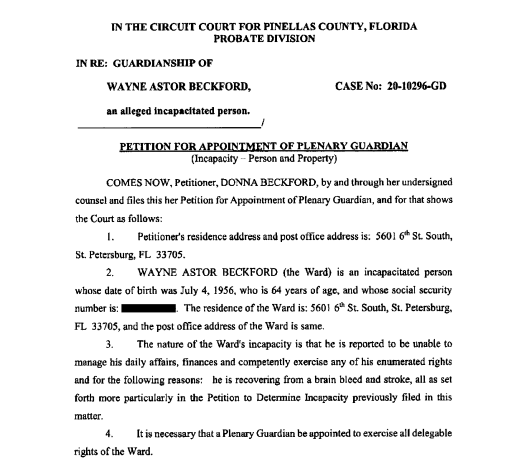
Donna Beckford Petition to Be Plenary Guardian of Wayne Beckford
Donna’s criminal past
Donna and Wayne met online and
married in 2003. Donna had multiple felony arrests before meeting Wayne,
including the Battery of a Law Enforcement officer, which she listed on
her application to be Wayne’s guardian “happened 27 years ago.”
Court records indicate that she entered a plea in January 1998, less than 24 years ago.
“Under
penalties of perjury, I declare that I have read the foregoing, and the
facts alleged are true, to the best of my knowledge and belief,” reads
the application Donna signed.
She did not list a second felony.
When asked about other crimes in her sworn deposition, Donna admitted
she left it off her application.
“I think the charge was robbery,” Donna testified.
That
charge from 1991 was resolved by a “no contest” plea and resulted in
Donna being placed on probation for two years, according to court
records obtained by the I-Team.
Last November, Charles’ attorney
filed a motion to disqualify Donna from serving as Wayne’s guardian.
That motion said, “On June 27, 1991, DONNA BECKFORD, under her maiden
name of Donna Alene Johnson, plead guilty to a felony for robbery, with
an adjudication withheld. The charge was based on an armed carjacking
that occurred in Pembroke Pines, Florida.”
“Donna
Beckford, due to her pleading guilty to a charge of a felony, for a
crime related to robbery, regardless of her adjudication, is
disqualified to serve as a Guardian in the State of Florida,” the motion
to disqualify her said.
Judge Campbell never ruled on the motion.
More
than a year later, Donna’s attorney filed a motion asking Judge
Campbell for an exemption from criminal disqualification to serve as
Wayne’s guardian, saying “The events took place twenty-four (24) and
thirty (30) years ago, and should not be a lifetime disqualification
barring Donna from serving as guardian for her own husband.”
That
motion said Donna already received exemptions from the state to obtain a
certified nursing assistant license and to operate a home care
business.
Donna’s Devoted Healthcare
Donna Beckford’s company, Donna’s Devoted Healthcare LLC, had 43 employees, according to a PPP loan application she filed with the US Small Business Administration.
Florida Secretary of State Records indicate she registered the company with the state in 2019. The company received a PPP loan of $307,200 which was forgiven.
Wayne assisted her in setting up the company and was on the payroll when he got sick.
“She wanted him under the care of her home companion care company,” Charles Beckford said.
The
company emailed Charles and his father multiple invoices for Wayne’s
care, charging $456 a day for 24/7 care. Charles said he never paid the
bills. Wayne’s sister Paula said employees of the company prevented her
and her sisters from spending time alone with her brother.
“It’s this entity, this companion care organization that has taken hold of my brother,” she said.
Donna’s attorney, Hamden H. Baskin III,
who declined an interview, said in an email, “Donna has and is paying
for caregivers…Wayne receives all therapies and caregiver support
recommended.”
“Everything that I’m billing for Wayne comes off of my taxes at the end of the year,” Donna said during her deposition.
After
Wayne was released from a rehab center, Charles and his aunts wanted
him moved into a facility with intensive on-site therapy.
“He
needs to get the most amount of therapy every single day. Every doctor
that we’ve talked to said that six month to one year period for his type
of brain injury was the most crucial,” Charles said.
“He’s gonna have more success at home. And I truly believe he’s gonna get better,” Donna said in her deposition.
“I sleep at the house with him each night. I’m a C.N.A.,” Donna said, referring to her license as a certified nursing assistant.
But
starting months before Wayne’s illness and continuing at least through
August of 2021, Donna was spending time at a condo left to her in a will
by one of her former clients, according to private investigators
Charles hired to follow Donna and account for her whereabouts.
“Private investigators over five to six weeks saw her at the condo 25… somewhere around there… 25 days,” Charles said.
A report prepared by private investigation firm Apex Surveillance and Investigations
shows Donna’s Maserati parked in the driveway of the condo during that
surveillance period. Investigators also shot video of Donna accompanied
by a male companion.
During
her deposition, Donna testified she began seeing that man in 2018 and
is still in a relationship with him. Donna also testified that in
September 2020, she used money from Wayne’s bank account for a down
payment on her Maserati.
Wayne was in a rehab center at the time and Donna’s name was not on any of his bank accounts.
“Did
you talk to Wayne about using $2,000 from his account to make your
Maserati down payment?” Charles’ attorney asked her during the
deposition.
“I did not,” Donna replied.
“Wayne didn’t have the capacity to know the difference between a Fisher-Price toy and an actual car,” Wayne’s sister Paula said.
Judge: It doesn’t pass the smell test
The legal fight between Charles and Donna started on October 13 last year, when Charles petitioned to be his father’s guardian.
“Someone
is in control of my Dad’s life. We’re filing for guardianship to
basically say that someone should come in under the guise of the court
and protect him,” Charles said.
The
day after Charles petitioned to be his father’s guardian, a lawyer who
Donna contacted showed up at Wayne’s home, saying he represented Wayne
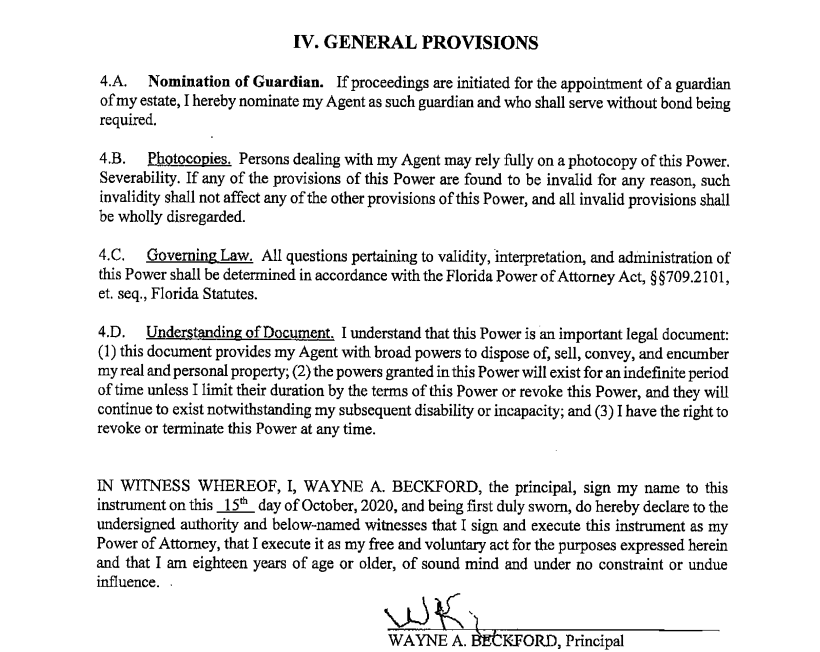
and brought a 14-page power of attorney agreement with him.
That
agreement would allow Donna to control his real estate, bank accounts,
vehicles, and other assets and according to the language in the
agreement “shall not terminate, should I become disabled or
incapacitated."
WFTS
The document Wayne signed indicated that by signing the agreement he
declared he was “of sound mind and under no constraint or undue
influence.”
“My brother did not call this lawyer to come to his home and bring those documents,” Paula said.
She said Wayne wasn’t able to call anyone at the time.
That
attorney, who was not Donna’s attorney Baskin, also brought a health
care surrogate designation and a living will for Wayne to sign. He was
accompanied by a witness who listed the lawyer’s office address as her
address and a notary.
Wayne’s sisters said Wayne has been unable
to read anything since his aneurysm. Wayne did not sign his full name on
any of the documents.
“The signatures are all over the place. They’re scribble,” Paula said.
During
the Emergency Temporary Guardianship hearing, the attorney who prepared
the document confirmed he was contacted by Donna, not Wayne, and
testified Wayne “couldn’t speak, but he could nod yes or no,” according
to the Emergency Temporary Guardianship hearing transcript.
The
attorney testified he held a clipboard for Wayne “and he had some
difficulty sometimes, you know, getting -- quite often actually, getting
right on the line.”
During Donna’s deposition, Charles’ attorney
asked, “On October 15, 2020, do you believe Wayne had the mental
capacity to understand a Power of Attorney and Health Care Surrogate
document?”
“Absolutely,” Donna replied.
“On October 16, the very next day, you filed a petition to be appointed guardian. Do you recall that?” Charles’ attorney asked.
“I think this is where we should bring Hamden in. This is some things that he was directing us,” she replied.
The petition for guardianship that Donna filed under oath said Wayne, “is an incapacitated person.”
In
his email response to the I-Team, Baskin wrote, “Donna asserts no
guardianship is needed, but if one must be entered, that she should be
appointed.”
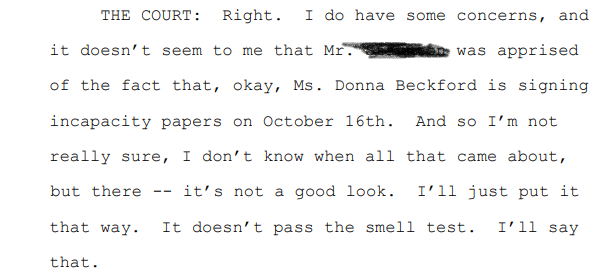
The transcript said Judge Campbell reserved ruling on
the validity of the documents until later and responded… “It’s not a
good look. I’ll just put it that way. It doesn’t pass the smell test.”
WFTS
Court transcript in Beckford guardianship hearing
But the judge denied Charles’ petition.
“Caring cannot be litigated in court”
The case has since gone through depositions, mediation and multiple hearings.
Charles
said the case has so far cost him more than $100,000, with no decision
made about whether his father would be appointed a guardian.
Attorney
Baskin blamed the delays and the excessive cost on Charles, who he said
in an email has issued, “unnecessary discovery… designed to harass
Donna or members of her staff.”
Baskin said Charles “has run up fees beyond reason, funds which should have been used for Wayne’s well-being.”
We went to Wayne’s home in late October to try to talk to Donna. A Maserati was in the driveway, but nobody answered the door.
Charles’ attorney filed a motion to withdraw from the case on November 17, citing “irreconcilable differences” with his client.
Charles said he will continue to fight until all his options run out.
“Who wouldn’t if they love their father,” he said.
He has no financial incentive to continue the court battle because most of Wayne’s money has been spent.
“If
we’re not fighting for money, then what are we fighting for? I guess
love cannot be litigated in court. Caring cannot be litigated in court.
So those aren’t terms that they’re used to,” Paula said.
The case is scheduled for trial in mid-December.
If you have a story you’d like the I-Team to investigate, email us at adam@abcactionnews.com
The “free
Britney” movement brought new scrutiny to guardianship and
conservatorships in America. Sarah Wallace reports on one family’s fight
with the system.
Sci-fi icon Nichelle Nichols, who made history as Lt. Uhura in the original Star Trek,
is undergoing a legal battle regarding her guardianship and estate. The
85 year old actress was recently diagnosed with “moderate progressive
dementia”, according to her her geriatrician. The doctor described
Nichols’ condition as “major impairment of her short-term memory and
moderate impairment of understanding abstract concepts, sense of time,
place and immediate recall.”
Since the diagnosis, Nichols’ friends and family have been squabbling
over her estate and conservatorship. At the center of the legal battle
is Nichols’ son Kyle Johnson, who brought in the doctor who made the
diagnosis. Johnson is trying to get control of the estate from other
people who claims have “unduly exerted themselves into Ms. Nichols’ life
to her detriment.” Since her diagnosis, four conservators have taken
over Nichols’ financial and health-related decisions.
Meanwhile, Angelique Fawcette, an alleged close friend of Nichols,
claims that Johnson is merely after the star’s money and that Nichols
wanted him removed from her will after he allegedly said, “I can’t wait
to get rid of this sh*t and sell [your] house and property.” Fawcett
also claims that the doctor’s diagnosis was inaccurate and that Nichols
is able to function and make decisions on her own.
The case, like Stan Lee’s current legal woes, is tragic. As the baby
boomer generation ages and the “silver tsunami” grows closer, issues of
guardianship and elder care are more important than ever. While many
obviously want to provide comfort and safety for aging seniors, these
people are vulnerable to con artists and abusers looking to scam their
money. Elderly celebrities are especially vulnerable, as their estates
can draw people who prey on the vulnerable.
Nichols’ co-star William Shatner recently appeared in a filmed PSA on Last Week Tonight with John Oliver, where the show did a segment on guardianship and elder abuse. The story is a tragic one, and we all hope that Nichelle Nichols get the care and treatment she deserves.
Stacy Hansford watched the news from afar back in 2005, even though
Sharen Gravelle was her first cousin. She says she made no judgments
back then, despite world-wide publicity and accounts of extensive child
abuse.
Fast-forward 12 years later, Hansford now worries if her
own 93-year-old mother, diagnosed with dementia, is living under similar
conditions with Sharen Gravelle.
Hansford is locked in a custody battle for her mother, fighting Gravelle in a courtroom in far-flung Houston, Missouri.
“It’s so hard to look at my friends when they ask me now, `Is your
mom caged up like those kids were’,” Hansford said. “I pray in my heart
that she hasn’t been.”
After serving two years in prison for child
abuse and endangerment, Gravelle divorced and dropped her notorious
last name. She’s now known as Sharen Curtis-Timperman.
The state
settled a lawsuit with the 11 foster children, awarding them $1.2
million in 2010. The children ranged in age from 1 to 14 when they were
rescued from the home.
Efforts to reach Curtis-Timperman were
unsuccessful. Her cell phone was not accepting messages. She did not
respond to notes and messages left with relatives in Wakeman. Her
attorney did not return a call for comment.
The court battle has
waged for months, mostly in a Texas County court where Curtis-Timperman
relocated with the elderly woman earlier this year.
Stacy
Hansford, the couple’s only child, said her mother, Barbara, was married
to long-time University of Akron vice president Richard Hansford, who
died in 2015 at age 95. The widow’s mental condition slipped afterward,
Stacy Hansford said.
The mother and daughter lived together in the
same Akron house her parents have owned for nearly 40 years. The house,
located in a wooded-setting in Akron, is valued at about $240,000.
Earlier this year, Stacy Hansford said, the home needed extensive renovations and she arranged for her mother to temporarily stay with Curtis-Timperman in Lorain. At some point, Stacy Hansford said, Curtis-Timperman fled Ohio and moved to Missouri, taking along the elderly woman and her six-figure bank account.
“I just couldn’t believe she was doing this,” Hansford said. “She’s taking my mother away. She took her away from all of us. I want her back where I know she’s safe.”
Akron attorney Warner Mendenhall said the custody fight – fairly or not - is taking place in Missouri and despite the dementia diagnosis for Barbara Hansford.
“I feel sorry for Stacy, she’s been taking care of her mother all these years,” he said.
Stacy Hansford said she’s had little to no contact with her mother for several months. That ended when she appeared in a Missouri courtroom early this summer to contest Curtis-Timperman’s attempt to be appointed guardian of Barbara Hansford.
“Finally, I was able to see her and hug her and she knew who I was,” Hansford said. “But it was hard leaving her. I know that, hopefully, I’m going to have her back where she belongs.”
Since then, Curtis-Timperman attempted to have Stacy Hansford evicted from her home. She also attempted to have the water shut off, she said.
“I knew it wasn’t my mother’s doing. It was all Sharen,” Hansford said.
A hearing is scheduled for next month and Hansford, a retired truck driver, has hired a Missouri attorney to argue her case. She intends to travel back to Missouri for the hearing.
“I have my mother’s best interests in mind, containing what’s left of that beautiful mind of hers,” she said. “Sharen doesn’t have that in mind.”
NORWALK — A woman a Huron County jury found guilty of child endangerment in 2006 — the subject of news stories that went viral — is in a custody battle over her wealthy aunt with dementia, according to court records.
In 2005, police removed 11 adopted children from Sharen Gravelle and her husband Michael’s home. Authorities claimed the couple had kept the children in cages, but a caseworker and the Gravelles contended the children were kept in enclosures for their own protection.
They lost custody of their adopted children and both Sharen and Michael Gravelle served prison terms.
Sharen Gravelle was released from prison in 2011 after serving a two-year term.
She has since divorced her husband and changed her name to Sharen Curtis-Timperman.
A Cleveland news news station, WKYC-TV 3, reported that Stacy Hansford left her 93-year-old mother, Barbara, with Curtis-Timperman while her home was being renovated.
Curtis-Timperman then allegedly fled to Houston, Mo., with Babara Hansford, where she’s trying to get appointed her legal guardian.
Babara Hansford was married to Richard L. Hansford — a former vice president and dean of student services at the University of Akron.
After his death in 2015, she was diagnosed with dementia, according to the news report from TV-3. Stacy Hansford believes that Curtis-Timperman is taking advantage of her mother to get to her sizable wealth, WKYC reported.
COLUMBIA — A Lexington County mother of an intellectually disabled
woman whose sexual assault triggered a landmark State Supreme Court
ruling is fighting to regain guardianship of her daughter, who is living
in a Florence County group home.
Brenda Bryant’s legal battle
over guardianship took place for years in Greenville County courts
because her daughter lived then in a group home there.
Since the
Supreme Court ruling in 2006 that found the state Department of
Disabilities and Special Needs owed a duty of care to such vulnerable
adults, even if they are being cared for by a private provider that
contracts with DDSN, the provider and the agency have paid $300,000 to
settle the case.
But the litigation since has taken a series of
bizarre turns, including allegations of misappropriation of some of the
settlement money, contempt of court findings and assertions that Bryant
has not visited her daughter since 2011 and cannot be found in South
Carolina.
Yet on Wednesday, her attorney filed an appeal in the
State Court of Appeals over the appointment this summer of a permanent
guardian and an order that a criminal probe be reopened into allegations
that some of the settlement money was misappropriated.
Orin Briggs, Bryant's lawyer, told The Greenville News that Bryant has been out of state for years. He denied she had misappropriated funds.
"I do not know where she is," he said. "All she does is call me."
Bryant, reached by The News,
said there has been no misappropriation of funds and that she has been
out of state the past four years because of a bench warrant tied to a
contempt citation for not paying the legal fees of a guardian. She said
the notation on the warrant indicates that she could spend an
indefinite time behind bars.
She said she refused to pay the fees
because her daughter was assaulted multiple times in a Greenville group
home and alleged the guardian refused to move her. She said she paid
the fees for her guardian but not the guardian's legal fees.
"After
four years and the fact that (her daughter) was beaten, I do not
believe as a mother that I would have to pay a guardian's $10,000 in
legal fees," she said,
She declined to say exactly where she was living or what state.
Briggs argued
in the notice of appeal that Bryant had not been properly served with
legal papers in the case and that court rules require proof that she
cannot be served in the state. He wrote that could have been
accomplished by hand-delivering a copy to her husband at their home in
Lexington.
The Supreme Court
in 2006 took up the appeal of a ruling by a circuit judge dismissing
claims by Bryant of negligence against the Babcock Center, a Columbia
facility that houses intellectually disabled people, and the state
Department of Disabilities and Special Needs related to sexual incidents
involving her daughter.
Her daughter, then 32, lived in a Babcock
facility and had the emotional and intellectual maturity of a
7-year-old to 10-year-old child, according to the court.
"She can
read, write, and understand math at the level of a first- or
second-grade child," then Acting Justice Derham Cole wrote in the
ruling. "Appellant alleges her mental disability means she is not able
to live or work independently. She cannot, for example, cook, wash
clothes, run bath water, use a toaster oven, put on her own makeup, or
perform personal hygiene tasks without adult supervision."
In
1995, the daughter left her group home after everyone inside was asleep
and got into a car with two other males and a female who was later
dropped off, according to the ruling. One or both of the men later had
sex with her. According to the ruling, she initially said she had been
raped but later testified she had been talked into the sex.
She contracted herpes at some point related to her sexual encounters while at the home, according to the ruling.
Bryant,
appointed guardian in 1997, alleged that she had made repeated warnings
to staff about her daughter's sexual contact and that they failed to
properly supervise her.
A judge sided with the Babcock Center and
DDSN in the lawsuit, finding they “had no legal duty to maintain a
constant watch over the plaintiff so as to prevent her surreptitious
elopement.” The judge also ruled that the proximate cause of any
damages suffered by the daughter, as a matter of law, was her “own
voluntary and intentional acts.”
The Supreme Court disagreed.
"We
reverse the circuit court and hold that Babcock Center and its employee
have a common law duty to exercise reasonable care in supervising and
providing care and treatment to Appellant," Cole wrote in a unanimous
decision. "Department also owes a common law duty to Appellant."
Babcock Center eventually settled the case for $250,000, according to court records. DDSN paid $50,000 in the case.
In
2008, Associate Probate Judge Edward Sauvain in Greenville ordered
Bryant be replaced as guardian after a series of complaints by a
guardian ad litem alleging Bryant was uncooperative and had interfered
in her daughter's medical care.
"While I have substantial concerns
about some of the actions of the (Greenville County DSN) Board and
DDSN, I find that those agencies were not the motivators for filing this
action to remove Mrs. Bryant," he wrote. "Even if they had been the
motivators, I would reach the same result."
He noted that Bryant had received $40,000 from the litigation without any written authorization from the court.
While
records show Bryant's daughter had asked that her mother be replaced as
guardian, she changed her mind and Bryant was reinstated as guardian in
2009. Bryant also was made trustee of her daughter's special needs
trust.
According to court records, while Bryant placed her
daughter in a Florence County group home in 2009, she stopped visiting
in 2011.
It was in September of 2011 that Sauvain found Bryant in
contempt of court and ordered her to jail for six months if she did
not pay $10,338 to a former guardian that Bryant had refused to pay on
principle, Sauvain ruled. According to court records, Bryant was jailed
on the contempt charge and then paid the fees.
In September 2010,
Bryant sued multiple people and agencies as well as a former guardian
over her daughter's care. A judge dismissed the guardian from the suit,
who sought a sanction against Bryant because she alleged the suit was
frivolous since a previous probate action had released her from all
claims. Circuit Court Judge Edward Miller agreed and ordered Bryant to
pay $5,062 to the guardian for her legal fees. By April 2012, Miller
ruled that no payment nor payment arrangements had been made and
added another $3,983 for the guardian's attorney's fees. He then issued
a bench warrant that Bryant be jailed for contempt but said she could
be released once the bill was paid.
Bryant said the warrant remains active.
In
2013, Bryant was terminated as guardian and conservator and replaced
temporarily with Jay Elliott. According to court records, an official
with the group home where her daughter now stays testified this summer
that Bryant is "unable" to come into the state.
Florence County
Probate Judge J. Munford Scott ruled in July that Bryant's daughter
wanted Elliott to serve as her guardian and conservator so he was
appointing him as such.
Elliott, according to the order, has
alleged that Bryant had "misappropriated" her daughter's funds and that
none of the $250,000 was left and that $46,000 of the $50,000 settlement
remained.
Bryant said of the $250,000, only $87,000 was left
after attorneys fees and court costs were paid. Of that amount, she
said, most was spent on more legal costs, on a vehicle to enable family
to visit and transport her daughter in Florence, on spending money and
items for her daughter's room and on vacation costs with her daughter.
She said the question is more of documentation than of misappropriation
and being out of state has hindered her ability to gather all the
receipts and records, though she is trying.
"Why would a probate
judge in Greenville give me back the guardianship and conservatorship in
2010 had I misappropriated her funds?" she asked. "Never. There is not
enough money to pay for all the legal proceedings we have been in. The
money can be accounted for."
Elliott told The News that
he had not seen the appeal but thinks the argument of Bryant not being
properly served "is an interesting assertion from a fugitive."
"I certainly think the probate judge acted with great rectitude in what he did," he said.
In
his order, Scott asked that the Richland County Solicitor's Office
"reopen the prior investigation" into Elliott's allegations, though
Bryant and her husband live in Lexington County.
"If I were a
mother who had done wrong by my child, I can assure you I would not have
been fighting as hard as I fought for her and now for others," Bryant
said.