IT’S TIME to sound the alarm on the
growing elder abuse crisis. Across the United States, our most
vulnerable citizens are experiencing premature death, physical and
psychological harm, and financial ruin due to malicious actors.
The
U.S. Department of Justice has found that nearly 10% of adults over the
age of 65 experience abuse of some kind. Yet, the number is likely even
larger. The DOJ has determined that only 1 in 12 victims of
psychological abuse, 1 in 20 victims of physical abuse, 1 in 44 victims
of financial exploitation, and 1 in 57 victims of caregiver neglect will
report their case. Underreporting is not just a national phenomenon,
underreporting occurs in New Hampshire as well.
According to New Hampshire’s Bureau of
Elderly & Adult Services, only 1 in 14 cases of abuse will be
reported. According to the National Council on Aging, the reasons for
underreporting are myriad — fear of retaliation by the offender,
reluctance to disclose the incident because of shame or embarrassment,
concern they will be institutionalized, dependency on the offender, and
an inability to report because of physical limitations or cognitive
impairments. An abuser may be a caregiver, someone that is trusted by
the senior citizen, but studies indicate that 60 to 90% of elder abuse
is committed by family.
Cleary,
elder abuse is a pervasive issue. New Hampshire must afford greater
protections to our most at risk citizens. Addressing this growing crisis
is not without challenges, but there are solutions within our grasp.
There are three actions we can take to address the growing elder abuse
crisis:
First, we must help New
Hampshire residents understand the issue. Elder abuse relative to other
forms of intimate partner violence has lagged behind in dedicated
research funding, national data collection, and federal legislation. The
Elder Justice Act passed by Congress came 24 years after the passage of
the Children’s Justice and Assistance Act and was not funded by
appropriations. For every dollar spent by the federal government to
address family violence, only a penny was spent to address elder abuse.
The lack of allocated funding to study elder abuse has stymied
awareness. Elder abuse is not a new phenomenon. It simply has not been
discussed enough. More must be done to spread public awareness.
Second, we must prevent seclusion of the
elderly. A University of Southern California study published in the
Journal of Aging and Mental Health found that minimizing loneliness and
social isolation can prevent elder abuse. Moreover, the research found
that “individuals with a higher interpersonal dysfunction… (had) greater
financial exploitation vulnerability.” Loneliness and social isolation
make adults over 65 more likely to be victims of abuse. In New
Hampshire, we must improve community support services. There are close
to 40 senior day centers in the state — 14 of which are covered by
Medicaid — that provide essential services while granting a home-based
caregiver or family member a respite. These centers have done a lot of
good but there must be greater access to them across New Hampshire.
Finally,
we must improve reporting methods. A national survey of emergency
department physicians found that 74% of doctors could not characterize
or define instances of elder abuse and 58% of physicians could not say
confidently whether they could identify when elder abuse has occurred.
All too often, traits of abuse are similar to the most common medical
conditions of those over 65. Burns are similar to contact dermatitis and
bone fractures are a symptom of osteoporosis. Research, greater
resources, and improved training must be a priority so that the medical
expertise of frontline workers can be utilized effectively in the fight
against elder abuse.
In 2020,
one in five New Hampshire residents was over 60. By 2030, the over-60
population here is expected to top one in four. This is an estimated
overall increase of 30% over the next decade. As New Hampshire ages,
elder abuse will become more prolific, but we aren’t powerless. There
are actions we can take immediately.
New
Hampshire Adult Protective Services is staffed by 37 professionals
charged with the responsibility for investigating and documenting abuse
for a population of 370,000 elderly citizens in the state.
If
we add just five more full-time APS professionals to lead
investigations into abuse, the effect would be significant. Since 2019,
the state has increased the APS budget by 11% to a total of $6.7
million. We are taking the right steps to combat elder abuse, but more
must be done. If we do not spread awareness, prevent loneliness and
isolation, and improve resources and training, then elder abuse will
become widespread.
District 3 Executive Councilor Janet Stevens (R) lives in Rye.
"I suddenly woke up one day and thought, you idiot, you are letting your life fade away, you have got to do something."
Christian Langballe / Unsplash
by Chao Fang and Sam Carr
Paula* had not been living in her retirement apartment for very long
when I arrived for our interview. She welcomed me into a modern,
comfortable home. We sat in the living room, taking in the impressive
view from her balcony and our conversation unfolded.
Paula, 72, told me how four years ago she’d lost her husband. She had
been his carer for over ten years, as he slowly declined from a
degenerative condition.
She was his nurse, driver, carer, cook and
“bottle-washer”. Paula said she got used to people always asking after
her husband and forgetting about her. She told me: “You are almost
invisible … you kind of go in the shadows as the carer.”
While she
had obviously been finding life challenging, it was also abundantly
clear that she loved her husband dearly and had struggled profoundly to
cope with his death. I asked Paula how long it took for her to find her
bearings, and she replied:
Nearly four years. And I
suddenly woke up one day and thought, you idiot, you are letting your
life fade away, you have got to do something.
There
were photographs of Paula’s late husband on the wall behind her. I
noticed a picture of him before his illness took hold. They seemed to be
at some sort of party, or wedding, holding glasses of champagne. He had
his arm around her. They looked happy. There was a picture of her
husband in a wheelchair too. In this picture they both looked older. But
still happy.
Losing
her husband had left Paula with an irreplaceable void in her life that
she was still working out how to fill. In our interview, I glimpsed the
extent of the deep, unavoidable sense of loneliness that losing a spouse
can create for the bereaved partner – a painful theme our team would
revisit many times in our interviews with older people.
The Loneliness Project
The pandemic brought the longstanding
issue of loneliness and isolation in the lives of older people back into
the public consciousness. When COVID-19 hit, we had only just completed
the 80 in-depth interviews which formed the dataset for what we called The Loneliness Project – a large-scale, in-depth exploration of how older people experience loneliness and what it means for them.
I
(Sam) am a psychologist with a particular interest in exploring human
relationships across the lifespan. Chao, meanwhile, is a research
associate based in the Centre for Death and Society at the University of
Bath. His research focuses on bereavement experiences and exploring
emotional loneliness of people living in retirement communities. For the
last two years, we’ve been working on the Loneliness Project with a
small research team.
Above all, the project sought to listen to
older people’s experiences. We were privileged to hear many people, like
Paula, talk to us about their lives, and how growing old and ageing
creates unique challenges in relation to loneliness and isolation.
The research – now published in Ageing and Society – generated over 130 hours of conversations and we started to make sense of what our participants told us with an animated film.
We
found that ageing brings about a series of inevitable losses that
deeply challenge people’s sense of connection to the world around them.
Loneliness can often be oversimplified or reduced to how many friends a
person has or how often they see their loved ones.
But a
particular focus for us was to better understand what underpins feelings
of loneliness in older people on a deeper level. Researchers have used
the term “existential loneliness”
to describe this deeper sense of feeling “separated from the world” –
as though there is an insurmountable gap between oneself and the rest of
society. Our objective was to listen carefully to how people
experienced and responded to this.
The older people in our study
helped us to better understand how they felt growing old had affected
their sense of connecting to the world – and there were some core
themes.
Loss
For
many, ageing brought about an inevitable accumulation of losses. Put
simply, some of the people we spoke to had lost things that had
previously been a major part of feeling connected to something bigger
than themselves.
Loss of a spouse or long-term partner (over half
of our sample had lost their long-term spouse) was particularly palpable
and underlined the deep-rooted sense of loneliness associated with
losing someone irreplaceable. Reflecting on the loss of her husband,
Paula said:
When he was gone, I didn’t know where I
fitted anymore. I didn’t know who I was anymore because I wasn’t [upset]
… You just existed. Went shopping, when you needed food. I didn’t want
to see people. I didn’t go anywhere.
There was
evidence of how painful this irreplaceable void was for people. Douglas,
86, lost his wife five years before speaking to us. He tried his best
to articulate the sense of hopelessness, despair – and sheer loss of
meaning – it had created for him. He said it hadn’t stopped being
difficult, despite the passing of time, adding: “They say it gets
better. It never gets better.”
Douglas explained how he never stops thinking about his wife. “It’s hard for people to understand a lot of the time,” he said.
People
also talked about how learning to live in the world again felt alien,
terrifying and, frequently, impossible. For Amy, 76, relearning how to
do the “little things in life” was a lonely and challenging experience.
It
took me a long time … just to go down for breakfast on my own … I’d
have to bring a paper or a book to sit with. And never ever, I would
never, ever go and have a cup of coffee on my own in a coffee shop. So, I
literally ‘learnt’ to do that. And that was a biggy, just going to a
coffee shop and having a coffee.
Amy said going into
busy places on her own was hard because she thought everyone was looking
at her. “I would always do it with Tony, my husband, whatever … But to
do it on your own, a biggy. It’s stupid, I know, but anyway, hey ho.”
For
Peter, 83, the loss of his wife had created a painful void around
feelings of touch and physical intimacy that had always made him feel
less alone.
I suppose all my life sex has been
lovemaking. I mean, we are really getting personal now, but when my wife
died, I missed that so, so much. It’s much more enjoyable in old age,
you know, because, I mean, if I said it to you you’d think oh good
grief, that horrible old body and all the spots and bumps and cuts and
wounds and … takes off a wooden leg and … takes out the eye. Sorry
[laughs] … But it’s not anything like that because you know you are in
the same boat … you get round it, some peculiar way, you accept it all.
Another man, Philip, 73, also described the pain in this loss of intimacy. He said:
At
my wife’s funeral, I said the one thing I will miss most is a kiss
goodnight. And blow me, afterwards, one of our friends came round, and
she said, ‘well, we can send each other kisses if you like but by text
every night’, and would you believe, we still are, we still do.
With
the very old people we talked with, there was a sense that loss of
close and meaningful connections was cumulative. Alice, 93, had lost her
first husband, her subsequent partner, her siblings, her friends and,
most recently, her only son. With a sense of sadness and weariness, she
explained:
You know, underneath it all I wouldn’t mind leaving this world. Everyone has died and I think I’m lonely.
Researchers
at Malmö University, Sweden, have described an acute sense of
existential loneliness in very old age, that is partly a reflection of
an accumulated loss of close connections.
The study found that the
result can be understood as if the older person “is in a process of
letting go of life. This process involves the body, in that the older
person is increasingly limited in his or her physical abilities. The
older person’s long term relationships are gradually lost and finally
the process results in the older person increasingly withdrawing into
him or herself and turning off the outside world”.
‘A stiff upper lip’
Studies of loneliness
have highlighted how an inability to communicate can bring about a
feeling that “the soul is incarcerated in an insufferable prison”.
This
was reflected in our study too. Many of our participants said they had
trouble communicating because they simply didn’t have the tools required
to convey such complicated emotions and deeper feelings. This led us to
contemplate why some older people might not have developed such
essential emotional tools.
Research has suggested
that older people born in the first half of the 20th century were
unwittingly indoctrinated into the concept of the “stiff upper lip”.
Through most of their lives – including wartime, peacetime employment,
conscription to military service, and family life – there was a
requirement to maintain high levels of cognitive control and low levels
of emotional expression.
Some of our participants seemed to be
implicitly aware of this phenomenon and how it had shaped their
generation. Polly, 73, explained it succinctly for us:
If
you don’t think about it, if you don’t give it words, then you don’t
have to feel the pain … How long is it since men cried in public? Never
cry. Big boys don’t cry. That is certainly what was said when I was
growing up. Different generation.
People said that
wartime childhoods had “hardened them”, led to them suppressing deeper
feelings and feeling the need to maintain a sense of composure and
control.
For example, Margaret, 86, was a “latchkey child” during
the war. Her parents went out at 7am and she had to get up and make her
own breakfast at the age of nine. She then had to catch a tram and a bus
to get to school and when she got back at night her parents would still
be out, working late.
So I used to light the fire,
get the dinner ready. But when you are a child, you don’t think about
it, you just do it. I mean, no way did I count myself as a neglected
child, it was just the way it was in the war, you just had to do it …
Margaret
said it was “just an attitude”. She went to 11 schools, travelled
around the country because of the war and had nothing really to do with
other people. She added: “I think it makes you a little bit hard … I
think sometimes I am a hard person because of it.”
As interviewers
who have grown up in a culture that is perhaps more permissive of
emotional expression than had been the case for many of the people we
interviewed, it was sometimes difficult for us to witness how
deep-rooted people’s inability to express their suffering could be.
Douglas
was clearly struggling deeply after the death of his wife. But he
lacked the tools and relationships to help him work through it. He said
he had nobody who was close to him who he could confide in. “People
never confided in my family. It was different growing up then,” he
added.
Heavy burdens
The burden of loneliness for older
people is intimately connected to what they are alone with. As we reach
the end of our lives, we frequently carry heavy burdens that have
accumulated along the way, such as feelings of regret, betrayal and
rejection. And the wounds from past relationships can haunt people all
their lives.
Gerontologist professor, Malcolm Johnson, has used the term “biographical pain”
to describe psychological and spiritual suffering in the old and frail
that involves profoundly painful recollection and reliving of
experienced wrongs, self-promises and regretted actions.
He has
written that: “Living to be old is still considered to be a great
benefit. But dying slowly and painfully, with too much time to reflect
and with little or no prospect of redressing harms, deficits, deceits,
and emotional pain, has few redeeming features.”
Many of those we
spoke to told us how hard it was to be left alone with unresolved pain.
For example Georgina, 83, said she learned in early childhood that she
was “a bad person … stupid, ugly”. She remembered her brother, as an
older man, dying in hospital, “connected to all these machines”.
However, she could neither forgive nor forget the abuse he had inflicted
upon her during childhood. “My faith told me to forgive him but,
ultimately, he scratched me in my soul as a kid,” she added.
People
carried memories and wounds from the past that they wanted to talk
about, to make sense of and to share. Susan, 83, and Bob, 76, talked
about painful and difficult memories from their early family lives.
Susan
spoke about how she had a nervous breakdown when her family “disowned”
her after she fell pregnant at the age of 17. She said:
I
come from this secret family. We all had to present as expected. If you
didn’t, you were out, and that was the bottom line. I look back on my
life and I wonder that I survived.
While Bob
remembered a life of violence at the hands of his father. “I copped so
many hidings from him. Then one night … my old man had a bad habit. He
would get up and walk past you and smack you in the ribs. I sensed it
coming, I was out of my chair in a flash, I caught him, crossed his
hands over his wrists, and jammed my knuckle into his Adam’s Apple. That
was family life,” he said.
Janet, 75, explained to us that she
felt what was lacking from her life was a space where she could talk
about, make sense of, and reflect on the biographical pain she had
accumulated.
This is what I miss a lot, a private
space to talk … All my life I’ve suffered … and some things I do find
very hard … With everything that’s gone wrong, I would like to talk to
somebody, no advice, I want to let off steam, make sense of it all, I
suppose. But it doesn’t happen.
Your life mattered
Thinking
about how older people can be supported must involve a fuller
understanding of what loneliness really means for them. Some of our own
efforts have focused on ways of helping older people retain a sense that
they are valued in the world and that they matter.
For example, the Extraordinary Lives Project
sought to listen to older people’s recollections, wisdom and
reflections. Sharing these recollections with others, including younger
generations, has been mutually beneficial and helped older people to
feel that the lives they have lived counted for something.
There
is also a need to consider how to support older people in relation to
coping with some of the inevitable losses ageing creates that threaten
their sense of connection to the world. Organisations seeking to connect
people going through these struggles can play a role in developing a
sense of “coping together”.
Such organisations already exist in relation to support for widows, provision of spaces like death cafes to talk about death and dying and improving access to and awareness of psychological and emotional therapies for older people.
So
support is out there but it is often fragmented and difficult to find. A
core challenge for the future is to create living environments in which
these mechanisms of support are embedded and integrated into older
people’s communities.
Listening to all these experiences helped us
to appreciate that loneliness in later life runs deep – much deeper
than we might think. We learned that growing old and approaching the end
of life create unique sets of circumstances such as loss, physical
deterioration and biographical pain and regret that can give rise to a
unique sense of disconnection from the world.
Yet people can and
did find their way through the significant challenges and disruptions
that ageing had posed them. Before I (Sam) left her apartment, Paula
made me a cup of tea and a ham sandwich and told me:
It’s
funny, you know, I had a building which I had inherited, and I had some
money in the bank but who was I, what was I anymore? That was my main
challenge. But now, four years later, I’ve moved to a retirement village
and I’m noticing there’s just a little thrill associated with being
able to do exactly as I please – and if people say, ‘Oh but you should
do this,’ I go, ‘No, I shouldn’t!’
*All names in this article have been changed to protect the anonymity of those involved.
Homebound senior Louise Delija, 93, receives a meal
delivery in Brooklyn, New York. Since the pandemic began, demand for
help from seniors has ballooned.
Ted Shaffrey/AP
Growing up in the 1930s in a small, marshy town in the Calabrian
region of Italy, Rose Frusciante was constantly bombarded by mosquitoes.
But one bite in particular proved dangerous.
Frusciante, who
is now 85, still remembers the sweating, fever and chills that followed
as well as being heaped under blankets and all the clothing she had as
her mother desperately tried to keep her warm. The tiny bite had given
her malaria, which also claimed the lives of three of her siblings.
Still,
Frusciante, who now lives in Mount Vernon, N.Y., says there is no
comparison between the insect-born disease and the invisible threat that
is the coronavirus.
"I'm afraid to go out," she says. "Because if you walk outside, somebody may have it and they don't even know."
According to the Centers for Disease Control and Prevention, eight out of ten deaths during the pandemic have been among seniors
like Frusciante. And while seniors are among the first in line for the
vaccine, other safety nets in place to catch the elderly are unraveling
quickly.
Frusciante's husband died last year and she lives alone in an apartment. She uses a walker to get around.She needs help, but can't afford it on $2,000 a month.
Rose Frusciante and her husband Mario, who died in 2017.
Rose Frusciante
So she applied for a part time aide paid for by the state, she was put on a waiting list with 11,000 names of seniors like her.
Since
the pandemic began, demand for help from seniors has ballooned. New
York state has 3.2 million people aged 65 or older. At one in six
residents, that's more than ever before, and more than the entire
population of many states.
According to the National
Association of Area Agencies on Aging, the most recent round of federal
aid for seniors has left a gaping $575 million hole nationwide. For a
state like New York, which is already grappling with a budget deficit of
billions, that means its system meant to help protect seniors is left
straining — tens of millions of federal aid dollars short.
Jay Bhattacharya, who teaches medicine and studies aging at Stanford,
says the fate of a senior citizen today often depends on how much
they've saved during their working years.
"In many ways, the
experience of older Americans mimics the experience of the rest of the
population," he says. Those who have considerable savings and retirement
security are doing better.
"It mainly is rich versus poor."
For seniors with limited income, the problem is exacerbated by a
shortage of home health aides. In Mount Vernon, the Department of Senior
Programs and Services says many are afraid of riding the bus to work
for fear of catching COVID-19.
Agencies that supply elderly
people with aides say they are now forced to compete with hospitals
facing staff shortages. And with much of school moving online, aides are
facing a care issue of their own. If they go to work, who will watch
their children?
Beth Finkel of AARP New York says that when seniors won't
or can't go out and family or aides aren't going in, a troublesome
snowball can start to form — isolation and loneliness.
In
normal times, it's hard to live without someone to squeeze your hand,
help you put on a favorite sweater, or reminding you to swallow a pill
from one of those little plastic cups.
"Our research shows that being isolated is equal to smoking 15 cigarettes a day," she says.
According to the CDC, isolation and loneliness can lead to an increased risk of dementia, stroke, heart disease — even suicide.
But
with the pandemic, another kind of safety net is disintegrating — the
kind created by the daily social interactions seniors might typically
have with a waiter at a coffee shop or a teller at a bank.
"If
that is not in place, if people can't get out to visit those sites,
then who's going to be able to say, 'Oh, no! Mrs. S. doesn't have a
winter coat on today?' " she said.
As she stays inside and waits for help from the state, Frusciante says she is not scared to die.
"I
mean, we're all going to die," she says. "I'm afraid to go in a place
in a hospital clinic and I am dying and I couldn't even see my family."
But
what does devastate this woman, who has lived through a world war, the
assassination of a president and more, is having to wave hello to her
two grandchildren through a window.
"That killed me, not to touch my grandkids," she says.
Joanne
Miles Thomas looks through a screened window at her father, George
Miles Sr., a resident at a facility in Rochester, N.Y., on Oct. 10.Mariana Henninger / NBC News
By Suzy Khimm
The moment that Tammy Roberg stepped off the elevator, she could hear her father’s booming voice.
Chester
Peske, 98, loved to sit in the lunchroom at Copperfield Hill and talk
to the other memory care residents about everything from the weather to
the history of the highway that connected his hometown to downtown
Minneapolis, 6 miles away. While he had Alzheimer’s disease, Peske still
recognized his children when they came to the Robbinsdale, Minnesota,
facility for weekly visits.
“He would talk and talk and talk,” Roberg said with a laugh.
Then, in March, there was almost no one that Peske could talk to.
When
the pandemic hit, long-term care facilities across the country,
including Copperfield Hill, shut their doors to visitors and largely
kept residents to their rooms, suspending most group activities and
communal meals to protect residents from Covid-19. Peske was hard of
hearing, so phone calls were a struggle. Roberg’s only lifeline to her
father was the staff of the facility, who reassured her that he was
doing well.
The first sign of a problem came in mid-May
when her father tested positive for Covid-19. Roberg prayed for his
health, but was relieved when his case appeared to be asymptomatic.
Then
in late May, Roberg got another alarming call from the facility. It
wasn’t the virus, they said — something else was wrong. “His head was
down into his chest, and he was sitting slumped in his wheelchair,” her
father’s aide said, according to Roberg. “He was not his perky, chatty
self.”
Roberg later learned that her
father, who’d always had a healthy appetite, had been losing weight.
Even more isolated in quarantine after his Covid-19 diagnosis, he was
becoming quiet and disengaged, even with the staff members who tended to
him, a nurse later told her.
He still had
no coronavirus symptoms — he was just withdrawn, according to Roberg and
an administrator at Copperfield Hill. Roberg was hopeful that he would
bounce back with more hands-on attention from the facility. But four
days later, on June 2, she got another call: She should come right away.
Her father was dying.
That morning, Roberg
flew in from Wisconsin and met her brother in the parking lot of
Copperfield Hill. Together they walked into the entryway of the
facility, where they were temperature-checked, and then put on gowns,
gloves and face shields. A nurse finally brought them up to her father’s
floor and opened the door.
“Oh wait a minute—” she said, stopping short. “I think he’s gone.”
Roberg
gasped when she saw her father’s gaunt body lying on the bed. After
three months of separation, she missed her only chance to see her father
by minutes.
His death certificate listed
the cause of death as the progression of Alzheimer’s disease and “social
isolation / failure to thrive related to COVID-19 restrictions.”
Social
isolation was listed as a contributing cause of death for at least nine
other Minnesotans — almost all long-term care residents — from June to
September, according to state death records; no deaths in the previous
two years cited social isolation as a cause.
One
of the nurses who treated Peske later described his deterioration as a
burning candle with no oxygen left to draw from the air. It was as if a
light had gone out, Roberg said: “He couldn’t survive from being
isolated.”
Tammy Roberg with her father, Chester Peske.Courtesy of Tammy Roberg
The
effort to shield elderly, frail and disabled residents from the
coronavirus has created another wrenching health crisis: The confinement
meant to protect the most vulnerable is also threatening their lives.
“The
isolation is robbing them of whatever good days they have left — it
accelerates the aging process,” Joshua Uy, associate professor at the
University of Pennsylvania Perelman School of Medicine, said.
“You
see increased falls, decrease in strength and ability to ambulate. You
see an acceleration of dementia, because there is no rhythm to your day.
There isn’t a single part of a person’s life that isn’t affected.”
With
help from staff members, a nursing home resident stands to wave to
family members below at St. John's Home in Rochester, N.Y., on April 24.Tina MacIntyre-Yee / Rochester Democrat and Chronicle
While
there is no comprehensive tally of elderly people dying from causes
linked to social isolation and confinement, evidence is mounting that
restrictions related to Covid-19 are taking a toll on their health,
according to a review of recent research and interviews with medical
experts and dozens of families across the country. The phenomenon is far
harder to track than the number of Covid-19 deaths linked to long-term
care facilities — 84,000 as of early October, according to the Kaiser Family Foundation — as it is unusual to list isolation as an official cause of death. But the harms are still real, experts say.
One recent study
of a Chicago-area nursing home found that from December 2019 to the end
of April 2020, two-thirds of the residents had lost weight, in some
cases dramatically — a change that researchers attributed to reduced
social interaction, the cessation of family visits and schedule changes
due to the pandemic.
Confinement, social isolation and the lack of external stimulation are also fueling cognitive decline and depression,
which in turn increase the risk of high blood pressure, heart disease
and stroke, according to Dr. Louise Aronson, a geriatrician and
professor of medicine at the University of California, San Francisco.
“Sometimes
the doors to their rooms are open, and you just see someone sitting in a
chair with tears running down their face,” Aronson, who is assisting
San Francisco’s response to the pandemic in long-term care facilities,
said. “People ask me, ‘Is this the rest of my life? If so, I don’t want
to go on.’”
Do you have a story to share about how the coronavirus is affecting nursing homes? Contact us
While most states have begun allowing
some form of routine in-person visits for long-term care facilities,
the guidelines vary widely, and many restrictions remain — not only to
protect residents, but also vulnerable front-line staff members, many of whom are low-wage Black and Hispanic workers. Some states and facilities are only allowing limited indoor visits,
and colder weather is already curtailing outdoor visits. Many nursing
homes have resumed communal dining and group activities, but still
require residents to remain distanced from one another. And a single
case of the virus can put a facility back on lockdown for weeks.
The
threat from the pandemic has not receded: On Friday, the U.S. hit a new
record number of Covid-19 cases, and nursing homes from Massachusetts to Wisconsin
are reporting new outbreaks. At the same time, policymakers need to
weigh the competing risks, said David Grabowski, a health policy
professor at Harvard Medical School, who recently served on an
independent federal commission that recommended expanding in-person visitation at long-term care facilities.
“We’ve
locked these older adults in their rooms in the name of safety without
thinking about the unintended consequences here,” Grabowski said. “In
many respects, the side effects are worse than the potential harm of a
slightly higher risk of infection.”
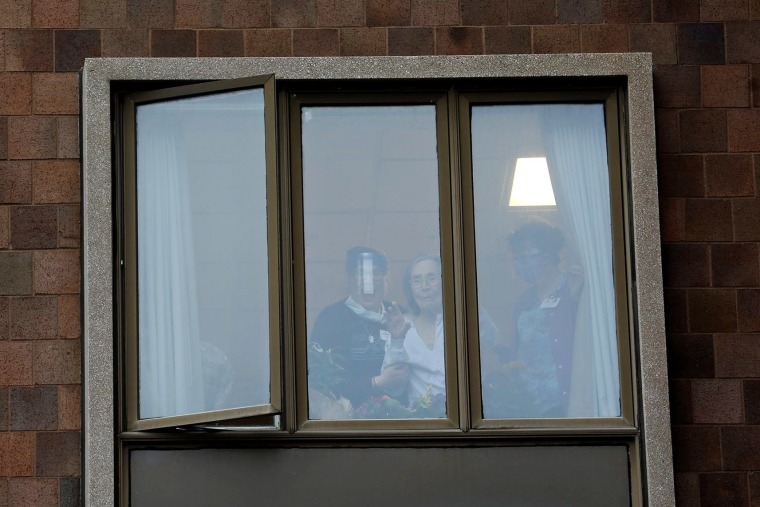
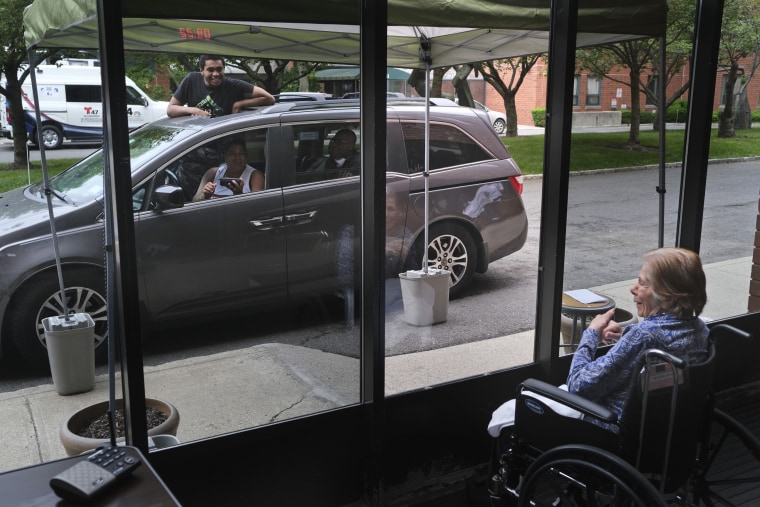
Gloria
DeSoto, 92, visits with her family in their car through a window of the
Hebrew Home at Riverdale in Bronx, N.Y., on June 11.Seth Wenig / AP file
Strict,
prolonged lockdowns can dramatically alter residents’ health. Uy said
that he saw some patients rapidly lose the ability to perform basic
tasks — such as standing, feeding themselves and swallowing safely —
while confined to their rooms. Physical therapy and other rehabilitation
services have also been cut back because of the pandemic.
“Until
the pandemic, ‘sudden frailty’ would have been an oxymoron,” Aronson
said. “Normally, it would take months to years, and we are now seeing it
in weeks.”
But while deadly coronavirus
outbreaks at nursing homes tend to grab headlines, the slower-moving
health crisis inside these facilities caused by social isolation and
confinement remains largely invisible.
Unlike
cases of Covid-19, it is not always clear when a resident’s health is
deteriorating because of pandemic-related restrictions, given the
complex medical issues that brought them to the facilities in the first
place. “Failure to thrive,” for instance, is often characterized by
weight loss, reduced appetite and lower activity levels — symptoms that
could also be linked to other underlying health conditions. But the
biggest marker is psychological, and closely linked to isolation.
“It
means, they give up,” said Dr. Joseph Ouslander, a professor at Florida
Atlantic University’s Charles Schmidt College of Medicine. “You do
everything to get them to participate, to get them to eat, and despite
that they continue to go downhill.”
Beverly
Noody used to drop by her mother’s assisted living facility in upstate
New York at least twice a week. The first thing she would do: Walk over
to her mother’s chair to see that her feet were propped up.
Barbara
White, 94, had congestive heart failure, so her limbs tended to swell
from fluid buildup. She was supposed to keep her legs elevated when she
was sitting down, and to get up and about a few times a day. But her
daughter knew that wouldn’t always happen unless she made sure it did.
“She never had her feet up when I came to visit,” Noody said. “If her
ankles and knees were swollen, I would have noticed it.”
Two
months into the pandemic, Noody got a call that her mother was en route
to the hospital because of dangerous swelling in her legs. She
recovered, but the same thing happened again in June, Noody said. She
could no longer use her walker to get around safely, as she kept
falling. Her condition ultimately deteriorated so much that she was
moved out of assisted living and into the adjoining nursing home,
Premier Genesee, where she could be supervised around the clock.
Noody
had always thought of her mother as the no-nonsense type, true to her
German roots. But in July, when she was helping to move her mother’s
possessions into the nursing home, she found a letter that White had
written during the pandemic, but hadn’t given her.
"Beverly,
I want to come home for good. I don’t know how to get out of here,” her
mother wrote. “I would do anything to get away. I was told today this
was forever. Do you know how I can get away?”
Barbara White with her daughter Beverly, her grandson Brad, and her great-granddaughter Hunter.Courtesy of Beverly Noody
New
York was the first state to ban visitors from nursing homes in
mid-March, and other states quickly followed suit. The virus has still
taken a devastating toll on residents, many of whom were highly
vulnerable because of their advanced age and underlying health
conditions. At least 6,600 long-term care residents in New York have
died from Covid-19, an undercount that doesn’t include those who died after they were taken to the hospital.
While nursing home cases and deaths have ebbed
since the spring, New York has remained cautious about reopening
long-term care facilities to visitors. In July, the state announced that
limited outdoor visits and residential activities could resume, but
only after facilities were free of Covid-19 cases for 28 days.
Premier
Genesee was preparing to begin outdoor visits under the state’s new
guidelines when a staff member tested positive in late July, pushing
back the reopening, as required by the state. Noody and other angry
family members held a local rally in early September protesting the state’s visitation restrictions; other grassroots groups have held similar protests elsewhere in New York and other states.
“If
she got Covid and she passed away, I would be heartbroken,” Noody said
of her mother. “But do I want her to live walled up in a room?
Absolutely not. It’s not fair. Nobody wants to live like that, but
they're not even given a choice.”
Under mounting pressure, New York officials relented in mid-September and lowered the threshold
for in-person visits to 14 days without a coronavirus case. They also
added a requirement for visitors to have a verified negative Covid-19
test. There are still strict caps on the number of visitors allowed in
the facility, as well as social distancing and mask requirements.
New
York officials say the restrictions are critical to protecting
residents and front-line workers at these facilities. “This pandemic is
not over,” Jill Montag, a spokeswoman for the state health department,
said in a statement. “Our decisions will continue to be driven by data
and science, and now is not the time for anybody to let their guard
down.”
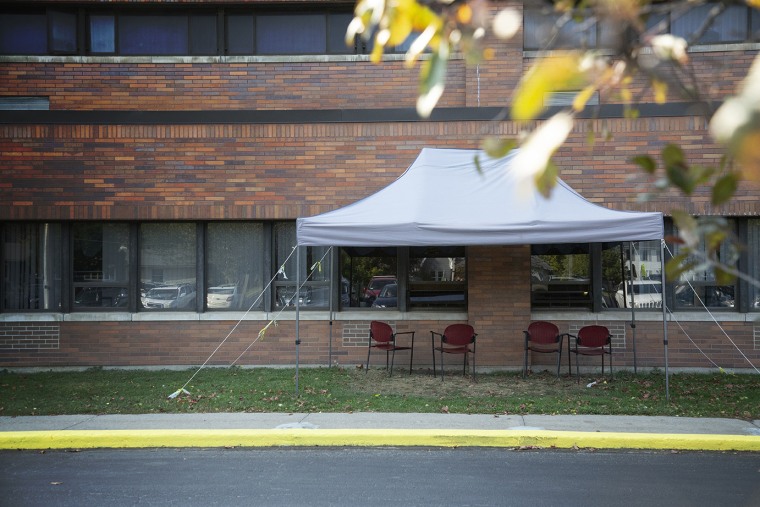
A
tent is set up near the windows where visitors can see residents at the
Premier Genesee Center for Nursing and Rehabilitation in Batavia, N.Y.,
on Oct. 9.Mariana Henninger / NBC News
The
Covid-19 restrictions are especially painful when residents themselves
can’t understand why their family members have stopped coming to visit.
More than half of nursing home residents have moderate or severe
cognitive impairment from Alzheimer’s, dementia and other conditions, according to the Centers for Medicare and Medicaid Services.
Before
the pandemic, Adele Billig constantly circulated throughout her nursing
home in Delray Beach, Florida, always showing up for bingo, poker night
and karaoke, where she loved belting Frank Sinatra.
“I’m never in my room, so don’t call my room, because you’re not going
to get me,” the 95-year-old often told her daughter, Melinda.
Under
lockdown, Adele’s social life disappeared. Mostly confined to her room,
she had little to keep her engaged: She had trouble following
television programs, and phone calls could be difficult, as her hearing
aids regularly went missing. “She’d say, ‘I can’t hear you, I can’t hear
you.’ Then she’d just give up,” Melinda said. Sometimes when Melinda
called, her mother assumed that her daughter was in the building,
waiting to come up for a visit, and was crestfallen when she learned she
wasn’t there.
Adele began sleeping more
and more, even falling asleep during their phone calls, which had never
happened before, Melinda said. By June, she was developing wounds that
were not healing — a serious sign that her body was breaking down. But
the most upsetting part for Melinda was the feeling that her mother
didn’t fully grasp why she had stopped visiting, as her memory was
spotty.
“I wish I could be there with you,” Melinda told her mother in July.
“If you say so,” her mother responded flatly.
It
was the last conversation they had. The next week, the nursing home
called to tell Melinda that her mother had died. The official cause of
death was heart failure, but Melinda doesn’t think that conveys the full
story.
“Part of why she died,” she said, “is that her quality of life had diminished to such a point that there wasn’t any.”
Even
when family visits resume, there are usually significant restrictions
in place. When Gelsey Randazzo Markese went to see her grandmother Rose
Violet Randazzo for the first time in seven months, the rules made her
almost regret showing up at all.
It was the
last week of September when she arrived at the Edna Tina Wilson Living
Center in Rochester, New York, with her grandfather Vincent Randazzo,
who had been married to her grandmother for 69 years. Markese had been
raised by her grandparents, who adopted her as a baby, so it was
especially hard to be separated from Rose Violet for so long.
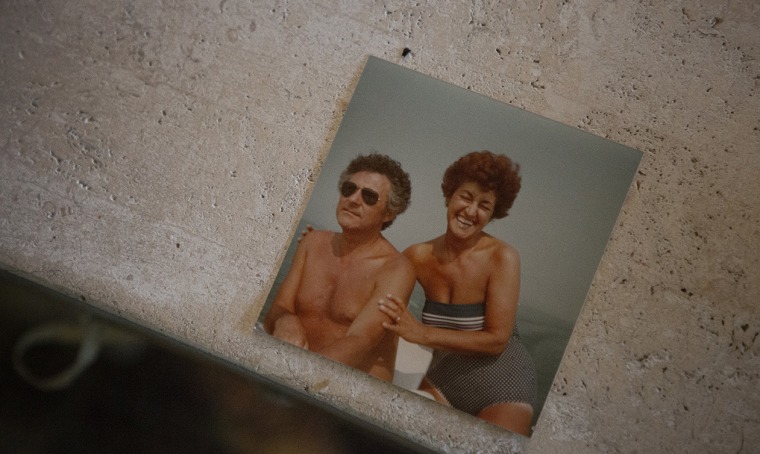
Vincent Randazzo and his wife, Rose Violet Randazzo.Mariana Henninger / NBC News
When
a staff member brought her out in a wheelchair, Rose Violet, 91,
instinctively stretched out both arms to touch Markese, then broke down
sobbing when the aide told her that they had to remain at least 6 feet
apart.
“My baby, my baby...” she wept, her arms still reaching for her granddaughter, who was also in tears. “She’s my baby.”
It
was a wrenching experience for Markese, who was seven months pregnant
and had been waiting to tell her grandmother in person. “To me it was
almost more tortuous being there, so close but not being able to touch,”
she said. “It was like being punched in the stomach.”
Markese and other family members are now pushing New York officials to create a program
that would enable them to be recognized as “essential caregivers” — a
designation that would allow them to provide hands-on assistance and
companionship for loved ones in long-term care facilities.
In
June, Indiana became the first state to permit essential caregiver
visits for family members who had tended to residents at least two times
a week prior to the pandemic, subjecting them to the same Covid-19
testing requirements as staff members. Minnesota, New Jersey, Florida, Texas
and other states have made similar accommodations for family members,
stressing their role in monitoring their loved ones and advocating on
their behalf. Florida recently announced that facilities can allow outdoor visits even if they have recently reported coronavirus cases.
Markese knows how deadly Covid-19 can be; 11
residents and one staff member have died of the virus at her
grandmother’s nursing home, according to federal data. But she believes that visits without social distancing can be done safely.
“If
we follow the same protocols in place as the staff members do — the
staff members who bathe my grandmother and help toilet her and help
comfort her by holding her hand — then why can't I hold her hand? Why
can't I give her a hug?” Markese said. “Why can't my grandfather embrace
her when she's crying out to touch him?”
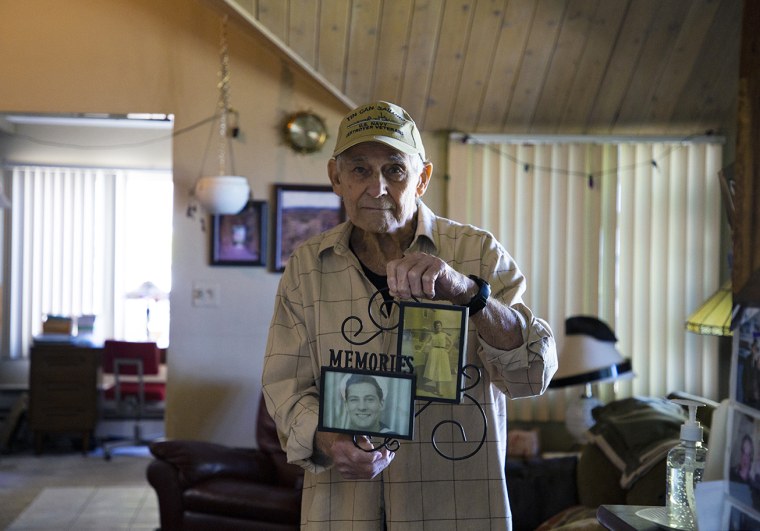
Vincent Randazzo holds a frame containing photos of him and his wife, Rose Violet Randazzo.Mariana Henninger / NBC News
To address the impact of prolonged isolation, the Centers for Medicare and Medicaid Services issued new guidance
in September to help expand “compassion care” visits in nursing homes.
In addition to allowing end-of-life visits, facilities could also permit
families to visit residents who are losing weight or dehydrated and
need encouragement to eat or drink, as well as residents who are
“experiencing emotional distress, seldom speaking, or crying more
frequently,” the new guidance said.
State
and local governments, however, can still impose stricter rules for
nursing home visits and usually give facilities considerable leeway in
deciding when to reopen. The push for more visitation is also coming
amid signs that the pandemic could reach a dangerous new crisis point in
the fall and winter, increasing the risk of community spread.
Nearly
eight months into the pandemic, some long-term care facilities are
still struggling to protect themselves from Covid-19. Nursing homes
across the country continue to report a lack of reliable testing and personal protective equipment,
as well as staffing shortages. Without adequate protections in place,
in-person visits could put both residents and staff members at greater
risk.
Industry lobbyists are now pushing Congress for more money
for facilities to prepare for the next wave of the virus, while
admitting there is a tough trade-off when it comes to protecting
residents.
“We too are concerned about
prolonged social isolation for our residents,” the American Health Care
Association, which represents for-profit long-term care facilities, said
in a statement. “With cases rising in many parts of the country, we
must be vigilant about protecting our nation’s most vulnerable, but
balance that with the need to stay connected with loved ones.”
Tammy
Roberg is still haunted by the circumstances of her father’s death.
Shocked by the weight he had lost at the end, she asked the staff to
show the logs of what he ate at every meal, only to be told there
weren’t any. A nurse later told Roberg that isolation often prompts deep
depression among Alzheimer’s patients, which helped explain why her
father had deteriorated so quickly.
Ashley
Fjelstad, a spokeswoman for Copperfield Hill, said that Peske’s health
had not declined dramatically until his final days. She said the
facility typically only notes if residents refuse to eat at all, not the
portions they eat at each meal. And she noted that changes in routine
are especially disruptive for those with Alzheimer’s disease: The common
areas of the facility, where residents can socialize and do activities
together, “are the heart and soul of memory care,” she said.
On
the morning of her father’s death, Roberg sat down beside his body and
took his hand in her own. She prayed and told her father that she loved
him. But she couldn’t shake how he looked lying there. “Why was he so
skinny?” she wondered. “When did he last eat?”
Several
weeks after his death, Minnesota enacted a policy allowing essential
family caregiver visits in long-term care facilities, including
Copperfield Hill.
Roberg never got that time. Months later, she keeps holding onto the same thought: “It didn’t have to happen.”
Machines can hold simple conversations and have been found to improve mental health
The wheeled robots, called Pepper, have been successfully trialled in the UK and Japan.
Robots that can hold simple conversations and
learn people’s interests are to be deployed in some UK care homes after
an international trial found they boosted mental health and reduced
loneliness.
The wheeled robots, called
“Pepper”, move independently and gesture with robotic arms and hands and
are designed to be “culturally competent”, which means that after some
initial programming they learn about the interests and backgrounds of
care home residents. This allows them to initiate rudimentary
conversations, play residents’ favourite music, teach them languages,
and offer practical help including medicine reminders.
The
researchers, led by Dr Chris Papadopoulos at the University of
Bedfordshire, said the trial was not intended to explore the replacement
of human carers with robots, but to help fill lonely periods when,
because of a stretched social care system, staff do not have time to
keep residents company.
The trial, in the UK
and Japan, found that older adults in care homes who interacted with the
robots for up to 18 hours across two weeks had a significant
improvement in their mental health. There was a small but positive
impact on loneliness severity among users and the system did not
increase feelings of loneliness, academics found.
The robots’ limitations centred on their
conversations feeling superficial and lacking “richness”, users said.
They lacked personalisation and sometimes did not show enough cultural
awareness, and their head movements and hand gestures were sometimes
distracting. The analysis was part of a £2.3m research project funded by
the European commission and Japanese government.
Advinia
Healthcare, a trial location and one of the largest providers of
dementia care in the UK, said it was “working towards implementing this
into routine care of vulnerable people to reduce anxiety and loneliness
and provide continuity of care”.
“This is the
only artificial intelligence that can enable an open-ended communication
with a robot and a vulnerable resident,” said Dr Sanjeev Kanoria, the
Advinia chairman. “Now we are working towards bringing the robot into
routine care, so it can be of real help to older adults and their
families.”
He said the robots would not
directly lead to job cuts but would be worth using because happier
residents mean less work for staff and improve satisfaction ratings,
boosting occupancy.
The initiative comes amid a
continuing staffing crisis for UK care homes exacerbated by the
coronavirus pandemic, during which more than 18,000 residents have died of confirmed or suspected Covid-19.
Before
the outbreak, the care industry had at least 120,000 vacancies and the
largest operators this week told MPs that staff are suffering “burnout”,
and the strain is being increased by the financial difficulties many
operators are facing, after costs soared and occupancy levels fell.
A
single robot loaded with software costs about £19,000, about £1,000
more than the average salary of a care worker in south-east England. But
cheaper robots could also be used.
Care
England, which represents the largest providers, said the robots were
not likely to replace staff but might help create deeper and
higher-quality relationships with residents.
“In
the UK alone, 15,000 people are over 100 years of age and this figure
will only increase,” said Irena Papadopoulos, a professor of
transcultural health and nursing at the University of Middlesex.
“Socially assistive, intelligent robots for older people could relieve
some pressures in hospitals and care homes. No one is talking about
replacing humans – the evaluation demonstrates that we are a long way
from doing that – but it also reveals that robots could support existing
care systems. While results demonstrate that our experimental robot was
more culturally competent to users, they also reveal that there is room
for improvement.”
Vic Rayner, the executive
director of the National Care Forum, which represents charitable care
providers, said: “Robots in social care should not be seen as part of a
frightening futuristic vision. They offer key additions to how care is
delivered that need to be explored further and understood. Covid-19 has
shown us that rather than being a sector which does not understand
technology, it is in fact one that is ripe to explore how technology can
improve efficiency, support data flow and enhance communication with
families and loved ones.”
GREELEY — Waving signs that read such things as “I’d rather die of
COVID than loneliness,” and “We are prisoners in our home,” residents of
one nursing facility staged their own anti-lockdown protest along one
of the busiest streets in Greeley, directly across the street from the
city’s largest and longest operating hospital.
“Freedom, freedom, freedom,” one lady chanted while waving a sign that read “we want our families back.”
The protest against the Colorado Department of Public Health and
Environment (CDPHE) and Gov. Jared Polis’ mandates that do not allow
nursing home residents to see their loved ones, was thought up,
organized and carried out by the residents, with oversight from their
nurses and other staff members, said the Assistant Administrator of
Fairacres Manor Ben Gonzales.
Gonzales said the facility has a resident council that meets monthly
to discuss things that are on residents’ minds. They usually discuss
caregivers, things they’d like to do, or offer suggestions, among other
things.
However, recently, they brought up the idea of protesting the
lockdown as they enter their eighth month of no hugs, no smiles, no
kisses from their loved ones.
“We are here to support our residents,” Gonzales said. “If they want
to get their voices heard, they have rights just like we should have
rights as well. We wanted to make sure that they were able to express
those.”
Gonzales said the staff made sure the residents were all placed six
feet apart on the grass across from the entrance to North Colorado
Medical Center, along a busy 16th Street in the center of
town. They were wearing masks and each one had their own member of the
staff nearby. The nurses and other personnel were also in all the
appropriate personal protection equipment required for their jobs.
Hospital administration who happened to hear of the protest,
applauded their efforts and took time to go across the street as well.
One woman, who was not from Greeley, but happened to be at the
hospital during the protest yelled across the street “tell them to let
you out of jail.”
She identified herself only as a nursing home administrator in
another community. She said has seen more deaths due to depression among
her residents since the pandemic than she has COVID itself, blaming
mandates and restrictions more than the virus.
“The isolation is what kills these people,” she said. “It’s just
incredibly sad that they can’t live out the last part of their lives
with their family surrounding them.”
Gonzales agreed. He said although the homes are now preparing for
indoor visits as the weather gets colder, residents will still not be
able to touch or hug their loved ones.
“But that’s what they need,” Gonzales said. “They need that physical contact, to hug their grandchildren.”
Gonzales agreed some of the signs they created were tough to read.
“We as staff members get to go see our family and our loved ones,”
Gonzales said. “So, it’s tough when they don’t get to do that. We are
held to standards by the government and the state health department. But
it’s very understandable. I feel for them. I can’t imagine what they
are going through. So, it’s nice to be able to support them in this way.
We are here to come together and to support each other.”
Weld County Commissioner Scott James stopped by the facility to lend
his support for the protest as well. He said his heart breaks for all
the residents of Fairacres and every other facility like it in Colorado.
“They are members of the greatest generation,” James said. “The very
generation who fought to overturn tyranny and protect our freedoms. Now
these members of that generation have had their freedom taken away via a
tyrannous act by unelected bureaucrats. The governor and the CDPHE
should immediately work with these facilities to give them a way by
which they may hug their loved ones.”
Social isolation was associated with about
a 50% increased risk of dementia and other
serious medical conditions.
Loneliness and social
isolation in older adults are serious public health risks affecting a
significant number of people in the United States and putting them at
risk for dementia and other serious medical conditions.
A new reportexternal icon
from the National Academies of Sciences, Engineering, and Medicine
(NASEM) points out that more than one-third of adults aged 45 and older
feel lonely, and nearly one-fourth of adults aged 65 and older are
considered to be socially isolated.1 Older adults are at
increased risk for loneliness and social isolation because they are more
likely to face factors such as living alone, the loss of family or
friends, chronic illness, and hearing loss.
Loneliness is the feeling being alone, regardless of the amount of
social contact. Social isolation is a lack of social connections. Social
isolation can lead to loneliness in some people, while others can feel
lonely without being socially isolated.
Health Risks of Loneliness
Although it’s hard to measure social isolation and loneliness
precisely, there is strong evidence that many adults aged 50 and older
are socially isolated or lonely in ways that put their health at risk.
Recent studies found that:
Social isolation significantly increased a person’s risk of
premature death from all causes, a risk that may rival those of smoking,
obesity, and physical inactivity.1
Social isolation was associated with about a 50% percent increased risk of dementia.1
Poor social relationships (characterized by social isolation or
loneliness) was associated with a 29% increased risk of heart disease
and a 32% increased risk of stroke.1
Loneliness was associated with higher rates of depression, anxiety, and suicide.
Loneliness among heart failure patients was associated with a nearly
4 times increased risk of death, 68% increased risk of hospitalization,
and 57% increased risk of emergency department visits.1
Immigrant, LGBT People Are at Higher Risk
The report highlights loneliness among vulnerable older adults,
including immigrants; lesbian, gay, bisexual, and transgender (LGBT)
populations; minorities; and victims of elder abuse. It also points out
that the literature base for these populations is sparse and more
research is needed to determine risks, impacts, and appropriate actions
needed.
Current research suggests that immigrant, and lesbian, gay, bisexual
populations experience loneliness more often than other groups. Latino
immigrants, for example, “have fewer social ties and lower levels of
social integration than US-born Latinos.” First-generation immigrants
experience stressors that can increase their social isolation, such as
language barriers, differences in community, family dynamics, and new
relationships that lack depth or history, the report states. Similarly,
gay, lesbian, and bisexual populations tend to have more loneliness than
their heterosexual peers because of stigma, discrimination, and
barriers to care.
What Can You Do If You Are Experiencing Loneliness?
Your doctor can assess your risk for loneliness and social isolation
and get you connected to community resources for help, if needed. The
following national organizations also offer helpful resources:
Area Agencies on Agingexternal icon
(AAA)—A network of over 620 organizations across America that provides
information and assistance with programs including nutrition and meal
programs (counseling and home-delivered or group meals), caregiver
support, and more. The website can help you find your local AAA, which
may provide classes in Tai Chi and diabetes self-management.
Eldercare Locatorexternal icon—A
free national service that helps find local resources for seniors such
as financial support, caregiving services, and transportation. It
includes a brochure that shows how volunteering can help keep you
socially connected.
National Council on Agingexternal icon—Works
with nonprofit organizations, governments, and businesses to provide
community programs and services. This is the place to find what senior
programs are available to assist with healthy aging and financial
security, including the Aging Mastery Program® that is shown to increase
social connectedness and healthy eating habits.
AARPexternal icon—Provides helpful information to seniors to help improve quality of life and provides access to Community Connection Tools.
Health Care System Interventions Are Key
People generally are social by nature, and high-quality social
relationships can help them live longer, healthier lives. Health care
systems are an important, yet underused, partner in identifying
loneliness and preventing medical conditions associated with loneliness.
Nearly all adults aged 50 or older interact with the health care
system in some way. For those without social connections, a doctor’s
appointment or visit from a home health nurse may be one of the few
face-to-face encounters they have. This represents a unique opportunity
for clinicians to identify people at risk for loneliness or social
isolation.
NASEM recommends that clinicians periodically assess patients who may
be at risk and connect them to community resources for help. In
clinical settings, NASEM recommends using the Berkman-Syme Social
Network Index (for measuring social isolation) and the three-item UCLA
Loneliness Scale (for measuring loneliness).
But patients must make their own decisions. Some people may like
being alone. It is also important to note that social isolation and
loneliness are two distinct aspects of social relationships, and they
are not significantly linked. Both can put health at risk, however.
Reference
1 National Academies of Sciences, Engineering, and Medicine. 2020. Social Isolation and Loneliness in Older Adults: Opportunities for the Health Care System. Washington, DC: The National Academies Press. https://doi.org/10.17226/25663external icon.
DENVER – June 15, 2020 – In recognition of World Elder Abuse Awareness Day (WEAAD) in the month of June, Colorado Securities
Commissioner Tung Chan and Division of Securities, part of the
Department of Regulatory Agencies (DORA), remind financial professionals
and the public throughout Colorado that heightened isolation and
loneliness during the COVID-19 pandemic have created a perfect storm for
senior financial exploitation.
“Social isolation has long been one of the
leading factors contributing to the financial exploitation of older
investors, and the unprecedented quarantines to protect against the
spread of the novel coronavirus have taken social isolation to a new
dimension for many seniors, making them more vulnerable to financial
exploitation,” Commissioner Chan said.
While financial abuse can happen at any
time, perpetrators often strike during times in a senior’s life when
they may be more vulnerable, such as during a health crisis or after the
death of a loved one. Scammers often gather personal details from
obituaries and social media posts and use this information to target
their victims. Some even will exploit trust within seniors’ social and
support groups to become more involved in their lives.
How You Can Help:
While in-person visits may not be possible yet, be sure to keep in
touch with older family members, friends, and neighbors. Call or leave a
note on their front door. If they have the technology, send them a text
or email, or contact them via Facetime, Skype, Zoom or other video
apps. Contact is key to letting your loved ones know you are thinking of
them and that they are not alone.
Let your older family members know that fraudsters and scammers have
found ways to exploit the pandemic. Make them aware of the red flags of
fraud, which remain consistent regardless of the fraud or scam.
Information regarding COVID-19 scams can be found in a
previously-released DORA consumer advisory.
Additional information on general red flags of fraud and exploitation
can be found on the Division of Securities investor education website’s “Learn how to avoid being a victim” section.
Commissioner Chan asks anyone with
suspicions of possible senior financial exploitation to contact the
Division of Securities by calling 303-894-2320 or emailing us at dora_SecuritiesWebsite@state.co.us.
About the Securities Division:
The Division of Securities exists
to protect investors and maintain confidence in the securities market,
while avoiding unreasonable burdens on the marketplace by licensing
securities professionals, enforcing securities law violations, and
helping Coloradans become more informed investors.
About DORA:
DORA is dedicated to preserving the
integrity of the marketplace and is committed to protecting a fair and
competitive business environment in Colorado. Consumer protection is our
mission. Visit dora.colorado.gov for more information or call 303-894-7855 / toll-free 1-800-886-7675.