Showing posts with label South Dakota. Show all posts

Saturday, February 28, 2026

Sioux Falls guardian arrested, accused of neglecting special needs adult

By Dakota News Now staff

SIOUX FALLS, S.D. (Dakota News Now) - A Sioux Falls woman is in custody, facing accusations of abuse and neglect of an 18-year-old victim with special needs.

Kimberly Marshall faces one felony count of Abuse or Neglect of a Disabled Adult or Elder.

The investigation began when bystanders called a welfare check for the victim, who was standing outside at a bus stop for nearly 2 hours in September 2025.

When officers arrived, the victim was wearing an adult diaper that reportedly smelled strongly of urine.

Police later learned from educators at the victim’s school that they required assistance from caretakers to function.

The teacher reported to officers that the victim had a feeding tube and noticed it to be unsanitary and had leftover contents.

Police also learned the victim would occasionally wear the diaper for more than one day at a time.

An arrest warrant was issued on Feb. 18, and Marshall was arrested that day.

According to online court records, Marshall’s first hearing was on Thursday, and she was released from jail without having to pay bond. 

Full Article & Source:
Sioux Falls guardian arrested, accused of neglecting special needs adult 

Tuesday, June 4, 2024

Former resident, families question care at Garretson nursing home

Several families are speaking up about their concerns for their loved ones in a Minnehaha County nursing home.

By Beth Warden

GARRETSON, S.D. (Dakota News Now) - Several families are speaking up about their concerns for their loved ones in a Minnehaha County nursing home.

In her cozy apartment, a woman who wished to remain anonymous is grateful for every day she can wake up in her own bed.

When she had to move into a nursing home herself, she never dreamed how bad it would be. In 2021, she was placed at Palisade Healthcare Center in Garretson.

“I had a huge bedsore while I’d only been there for two weeks. It took a long time, of healing, a lot. It was horrible,” the woman recounted.

Meanwhile in Texas, her daughter, who also worked in a nursing home for 18 years, had concerns.

“She didn’t go there to get worse. She went there to get better,” the daughter expressed.

When learning of the bedsore, she called the state.

Her mother eventually recovered and never wants to see the inside of Palisade again.

“I just love life because I do remember how horrible my experience was. Horrible. It’s a miracle I actually got to come home,” the woman said.

Sheri Rokusek’s experience ended with a broken heart. She always had a soft spot for her brother Jerry Erhart.

“[He had a] political science degree, wanted to be a teacher, joined the National Guard. And unfortunately in his 30s, he began to show signs of schizophrenia.” Sheri explained.

While living in the Yankton Human Services Center with his health declining, a state-appointed guardian looked for a nursing home for Jerry. Last November there was an opening at Palisade.

“And I had concerns right away. I did bring those to her attention. And her answer was that she hadn’t had any problems with them,” Sheri recalled.

Sheri hoped to visit her brother in the spring, but that ended with a phone call.

“He passed away at 2:30 in the morning. And I didn’t get a call until almost 10:00 a.m.,” Sheri said.

That’s when the family learned for the first time, that Jerry had been in hospice and had never been notified.

“Hospice versus saying Garretson should have contacted us and Garretson is saying hospice should have contacted us,” Sheri recalled.

Our team spoke with Lordes Parker, the Executive Director at Palisade Healthcare, offering to interview her and any satisfied patients. We have not received a return call.

Parker said that all of the Department of Health’s reports on the home, like an 86-page list of deficiencies in 2021, are in a notebook on-site for all to review. The Department of Health said those reports are unavailable online.

The 2021 reports found health, safety and care deficiencies, such as bedsores, not properly clothing residents, staff not using proper hygiene, overdue fire sprinkler certifications, and undelivered mail.

If you have a loved one in need of nursing home care, these families offered advice from their experience.

“Have the care plan. Go over the care plan, you know, really get involved in their care. And if they know that you’re there for your loved one. They’re more likely to follow the rules and regulations,” the daughter said.

“If you are not getting the information you need, go find somebody that will give you the information. So you can have the opportunity to say goodbye to your loved one,” Sheri said.

Full Article & Source:
Former resident, families question care at Garretson nursing home

Wednesday, May 29, 2024

Brandon woman ordered to pay over $100k for exploiting elderly adult

Full Article & Source:
Brandon woman ordered to pay over $100k for exploiting elderly adult

Wednesday, April 17, 2024

Attorney General Jackley Announces Texas Couple Convicted By Jury on Theft Charges

Attorney General Marty Jackley | Atty. Gen. Marty Jackley Official Website

By Press Release
Apr 15, 2024
 

South Dakota Attorney Marty Jackley has announced that a Texas couple has been convicted of a combined six charges in connection with stealing or attempting to steal the property of another person.

A Bon Homme County jury Wednesday convicted Richard Spry, 82, of two felony counts of Grand Theft and one felony count of Conspiracy to Commit Grand Theft. Susan Spry, 75, was convicted of separate felony counts of Grand Theft and Conspiracy to Commit Grand Theft as well as one misdemeanor count of Theft by Exploitation. Both individuals are from League City, Texas.

The two were convicted of stealing money or property from an adult who was elderly or had a disability. The thefts ranged from $100,000 to $500,000 and included money from bank accounts and possession of vehicles.

“These two defendants preyed on a vulnerable member of our society,” said Attorney General Jackley. “Thank you to the Attorney General’s Elder Abuse and Financial Exploitation Unit for investigating and prosecuting this case, and to the jury for its just verdict.”

Sentencing for both individuals is scheduled for July 9. Richard Spry faces a maximum combined sentence of 27 years and Susan Spry faces a maximum combined sentence of 26 years. Both defendants remain out on bond.

The case was investigated and prosecuted by the Elder Abuse and Financial Exploitation Unit of the South Dakota Attorney General’s Office.

Original source can be found here.

Full Article & Source:
Attorney General Jackley Announces Texas Couple Convicted By Jury on Theft Charges

Saturday, May 6, 2023

Ramona Woman Sentenced for Grand Theft


FOR IMMEDIATE RELEASE:
Wednesday, May 3, 2023

Contact: Tony Mangan, Communications Director, 605-773-6878


Ramona Woman Sentenced for Grand Theft

PIERRE, S.D.  – South Dakota Attorney General Marty Jackley has announced that Melba Jean Bickett of Ramona, S.D. has been sentenced to two years in the South Dakota Women’s Prison after pleading guilty to one count of Grand Theft. Both years were suspended on the condition that Bickett serve 60 days in the Lake County Jail and perform 40 hours of Community Service.

Between Jan.1, 2008 and Dec. 31, 2013, while working as a teller for First American State Bank, Bickett took $153,000 from her father’s bank account and moved the money into her bank account or her son’s bank account. All the transactions were done without her father’s permission.

Bickett was sentenced Monday in Kingsbury County Court. She also was ordered to pay back the entire $153,000 to her father’s estate.

The case was investigated by the Lake County Sheriff’s office, the Kingsbury County Sheriff’s office, and the South Dakota Division of Criminal Investigation. The case was prosecuted by the South Dakota Attorney General’s Office and its Elder Abuse and Financial Exploitation Unit.

Source:
Ramona Woman Sentenced for Grand Theft

Friday, December 23, 2022

“An ongoing fight”: Elder abuse in South Dakota remains widespread despite years of effort

by Michael Patton

RAPID CITY, S.D. – From financial scams to neglectful nursing homes, seniors in South Dakota are at risk of falling victim to elder abuse. Despite years of efforts to combat the problem, the situation remains bleak.

In 2015 the South Dakota Elder Abuse Task Force issued a series of recommendations to combat elder fraud and abuse, such as making financial exploitation of seniors a felony and clarifying mandatory reporting requirements. Many of these recommendations were implemented, but the problem remains.

According to the Department of Health website, complaints at nursing homes have increased 117% from 2021, with 39 complaints filed compared to the previous year’s 18.

Beyond just nursing homes, a study by Wallethub ranked South Dakota 5th worst in the nation for the prevalence of elder abuse, factoring in the number of abuse and neglect complaints as well as the rate and severity of elder fraud.

Taking advantage

The 2015 Task Force report found that over 5 million seniors fall victim to financial exploitation each year nationally, with only 1 in 25 of those instances being reported.

South Dakotans are particularly vulnerable to this form of abuse. The WalletHub study estimated that 12.11% of elders in South Dakota have been the victims of fraud, the 17th highest rate in the nation. The average amount lost per fraud was $12,785.

“By nature, South Dakotans are hardy, trusting folks. Unfortunately, that trust can be taken advantage of, and there are many tools that are used by scammers and fraudsters to take advantage of that trust, particularly among seniors,” said AARP South Dakota Associate State Director for Advocacy Erik Nelson. “We’re a midwestern state with a high percentage of seniors, trusting seniors, which we appreciate, but unfortunately it means the bad guys target our population for fraud and scams.”

And whether it’s calls pretending to be from law enforcement demanding money for made-up fines, emails claiming that the recipient won a sweepstake they never entered, or fake fundraisers exploiting the generosity of victims’ donations, scammers have no shortage of ingenuity.

Beyond just scams, there are a number of ways people try to take advantage of senior citizens.

“Elder abuse can take on a few different forms whether it’s physical abuse, emotional abuse, or financial abuse,” Nelson said. “It’s not just one thing.”

And in many cases, it isn’t anonymous scammers taking harming the elderly. It’s their own caretakers.

A strained system

Many nursing homes are unable to recruit and retain the staff they need to care for those under their supervision. According to Cole Uechre, Executive Director of Disability Rights South Dakota, this lack of manpower can cause harm to nursing home residents.

“I can say the system is strained to the breaking point,” Uechre said. “I’m sure you know staffing is a major problem in our facilities. Any time that you have people that provide support to individuals and they’re spread thin, and they’re overworked, they’ll get to a point where they’re careless, agitated or worn out, then things like abuse can occur,”

The problems were only exacerbated by the COVID-19 pandemic, which prevented family and friends from being able to visit their loved ones living in nursing homes out of concern for the residents’ safety.

“Any time you have a situation where there’s not great communication or visitation and things like that, that creates an environment where abuse can occur,” Uechre said.

This abuse can be intentional and malicious, such as nursing home workers stealing medications or hitting patients, but it can just as often be a case of well-workers lacking the resources to provide proper care.

“It could be a lack of resources available to provide adequate meals or medications at the right time. It could be that there aren’t enough staff to provide supervision for people that maybe have a tendency to get up and fall, and so without the resources, staffing, they may resort to inappropriate restraint to keep them in place and avoid physical injury.” Uechre said. “Well now you’ve just put them into a restraint situation because of a lack of available staff resources, and that type of thing would be an abusive situation.”

Combatting abuse

Elder abuse is a multifaceted issue, and solving it requires solutions that come at the problem from many different angles. One of these angles is reducing the strain on nursing homes by making it so people don’t need to enter them in the first place.

“Community supports weren’t always being provided. Nursing homes were being overutilized. Since then, there have been measures that have been put into place that have been, I think, effective in many ways, but that process should continue to work toward providing people the opportunity to live in the community as long as possible,” Uechre said.

One of these measures is the HOPE waiver system, which provides low-cost access to a variety of assisted-living services to help seniors who aren’t capable of living completely independently access assisted-living resources at a reduced cost. Programs like these help keep seniors in the community when they may otherwise be forced to move into a nursing home.

At the same time, a combination of education and prosecution is making progress in fighting financial fraud.

“All those mass targeted scams are targeted usually towards seniors, and we work to alert our members in cooperation with state officials and state agencies to know what frauds are out there,” AARP South Dakota’s Nelson said, “We also hold seminars to let them know what to look for, and it’s an ongoing process of education.”

Meanwhile, the South Dakota Attorney General’s office has been instrumental in working to crack down on the financial exploitation of seniors from the legal side, according to Nelson. Increased prosecution efforts and stricter penalties were one of the most significant measures to come from the 2015 workgroup proposal.

“Unfortunately it’s not a matter of time.” said AARP South Dakota Associate State Director for Advocacy Erik Nelson “When it comes to frauds and scams, it feels like the bad guys are always one step ahead when it comes to finding new ways to try and force scams upon our senior population. It’s an ongoing fight.”

What to do

If you or someone you know is being abused, there are many resources available in South Dakota to help.

  • In the case of any criminal abuse, including physical abuse, sexual abuse, or neglect, contact your local law enforcement office, or call 911
  • In the case of abuse of care at a long-term-care facility (such as a nursing home) contact the State Ombudsman Office at 866-854-5465.
  • In the case of Medicaid fraud, file a complaint with the South Dakota Attorney General.
  • In the case of financial fraud, call the national elder fraud hotline at 833–372–8311
  • In the case that you suspect someone you know is being abused, report it to South Dakota Adult Protective Services.

Full Article & Source:
“An ongoing fight”: Elder abuse in South Dakota remains widespread despite years of effort

Sunday, April 17, 2022

Woman Wears Her Original Wedding Dress While Celebrating 70th Anniversary with Husband

 Lovebirds Nancy Lubbers, 87, and Melvin Lubbers, 91, met at a skating rink and wed in 1952
 
By People Staff

Nancy and Melvin Lubbers
| Credit: @anna.behning/CATERS

A pair of teenage sweethearts rang in their 70th year of marriage by staging a swoon-worthy photoshoot featuring the bride in her original wedding dress. 

Nancy Lubbers, 87, and her 91-year-old husband Melvin met at a skating rink when Nancy was just 16, according to Caters News Agency. Seven decades later, the couple has five children, 12 grandchildren, 21 great-grandchildren — and nearly a lifetime of memories under their belts.

The South Dakota natives decided the best way to celebrate their 70th anniversary was with a special photoshoot in the family garden, captured by their youngest granddaughter, Anna, who works as a professional wedding photographer. 

"My grandparents only have a couple of photos from their wedding day," Anna said, per Caters. "I came up with the idea to take photos of Grandma in her dress and then my mom, Melissa, found Grandpa's Korean War Army suit for him to wear."

Nancy and Melvin Lubbers
| Credit: @anna.behning/CATERS

The memorable ensembles were on display at the love birds' church wedding in 1952, following Melvin's proposal at a ballpark.

Nancy originally purchased her dress for about $35 and her veil for $15, according to Caters.

Asked how she felt to wear her gown again, Nancy said, "It really was an honor that I could still get in it."

Melvin Lubbers
| Credit: @anna.behning/CATERS

"My dress was something special and I loved it, so I just preserved it and kept it all these years," she added. "It felt really good to wear it again and we had fun reminiscing about our wedding day and the photo shoot was a lot of fun."

"Oh boy, that certainly brought back some good memories," Melvin said of seeing his wife in the gown again.

Caters reported that Melvin likes to joke he bought Nancy's rings from a gumball machine, but the young couple was actually able to pay for their own wedding and reception in the basement of the church, where they celebrated with ice cream and cake for dessert. 

Nancy and Melvin Lubbers' wedding day on Jan. 6, 1952
| Credit: @anna.behning/CATERS

Shortly after getting hitched, Melvin was called to serve in the Korean War as a tank commander for eight months, forcing him and Nancy to forgo a honeymoon, according to Caters.

The two went on to raise their children together while Nancy worked in a grocery store and Melvin worked as a salesman and maintained a hobby farm. 

The Lubbers with their family
| Credit: @anna.behning/CATERS

Along the way, they learned the secret for a long and happy marriage.

"You won't always agree, sometimes you have a disagreement, but when you have one of those you sit down and talk about it and come up with an answer — and once it's resolved, don't bring it back up," Melvin told Caters.

"Always respect each other even when you don't agree," Nancy added. "Just make the best of your life."

Full Article & Source:

Wednesday, December 2, 2020

Disbarred Sturgis lawyer accused of stealing from second client

The Federal Courthouse in Rapid City.

by Arielle Zionts

A disbarred lawyer who previously worked in Sturgis is accused of stealing money from a second client and covering her fraud by giving false documents to a tax preparer and lying to a legal assistant, lawyer and judge.

Rena Hymans, a 48-year-old from Vale, is now facing 57 charges in federal court related to allegedly stealing $217,699 from two clients between 2014 and 2019, according to a 21-page indictment.

Hymans pleaded not guilty in September at the federal courthouse in Rapid City to 38 counts of wire fraud, 17 counts of money laundering, one count of mail fraud and one count of bank fraud. She was released pre-trial.

If convicted, Hymans faces up to 30 years in prison on the bank fraud charge and up to 20 years on each mail fraud, wire fraud and money laundering count.

The charges come after Hymans resigned from the South Dakota State Bar on Jan. 22, which means she’s no longer eligible to practice law, according to documents provided by the state court administrator.


Hymans resigned after learning the state bar was investigating a complaint that accused her of breaking a law that says it’s illegal for attorneys to use clients' money in unauthorized ways. She was also accused of violating professional rules about misconduct and safekeeping property.

“I do not desire to contest or defend against the above-described complaint, allegations or instances of alleged misconduct,” Hymans wrote in her resignation letter.

Hymans was indicted in August on charges related to allegedly stealing $167,699 between May 2017 and July 2019 from a client who inherited the money from a relative. She was indicted on additional charges the next month related to allegedly stealing $50,000 from a second client between February 2014 and November 2015.

According to the new indictment:

In February 2014 Hymans put $50,000 in her client trust account for the Gilbert Keester Estate and was supposed to hold the money until litigation surrounding the estate was settled. Hymans instead embezzled the money into other accounts and used it for work and personal expenses.

In order to conceal the fraud, Hymans told her legal assistant that the transferred funds were earnings for her legal services. She also provided falsified documents to her income tax preparer that made the embezzled money look like income.

The mail fraud charge relates to Hymans sending a 2016 letter to a lawyer involved in the estate litigation that said the $50,000 remained in her client trust account when she had already spent it.

Hymans appeared in the Oglala Sioux court in 2018 on behalf of the Gilbert Keester Estate and falsely told the judge that she still had all of the money in her client trust account.

Later that year she wrote a check from her client trust account to the estate by using money that belonged to the other client she defrauded. ​

 
Full Article & Source:
 
See Also: 
 

Tuesday, August 25, 2020

Disbarred Sturgis lawyer accused of stealing $168,000 inheritance from client

The Federal Courthouse in Rapid City.
by

A disbarred Sturgis-based lawyer is accused of stealing $167,699 from a client who inherited the money from a relative and trying to cover the fraud by lying to a tax preparer, judge and bank employee.

Rena Hymans, a 48-year-old from Vale, was indicted last week in federal court on 30 counts of wire fraud, 10 counts of money laundering and one count of bank fraud. She's accused of embezzling the money and using it to pay for business and personal expenses between May 2017 and July 2019.

The indictment says Hymans went to great lengths to hide the fraud by providing false documents to a tax preparer, making false statements in state court and lying to a bank employee.

Hymans pleaded not guilty to the 41 counts Monday at the federal court in Rapid City, records show. She was released pre-trial.

If convicted, Hymans faces up to 30 years in prison on the bank fraud charge and up to 20 years on each wire fraud and money laundering count

The criminal charges are the result of an investigation by the FBI, IRS and South Dakota Division of Criminal Investigations, according to a news release from the U.S. Attorney's Office in South Dakota.

The charges come after Hymans resigned from the South Dakota State Bar on Jan. 22, which means she’s no longer eligible to practice law, according to documents provided by the state court administrator. She previously worked out of Sturgis.

Hymans resigned after learning the state bar was investigating a complaint that accused her of breaking a law that says it’s illegal for attorneys to use clients' money in unauthorized ways. She was also accused of violating professional rules about misconduct and safekeeping property.

“I do not desire to contest or defend against the above-described complaint, allegations or instances of alleged misconduct,” Hymans wrote in her resignation letter.

The South Dakota Supreme Court disbarred Hymans on Feb. 24 without holding a hearing or issuing any opinion since she resigned. The court later ordered Hymans to pay $5,040 — the amount spent investigating her complaint — to the state bar.

DOWNLOAD PDF


Alleged scheme

What follows is alleged in Hymans’ 14-page indictment:

Doris Lauing hired Hymans in November 2016 to represent her relative Leo Drillig in an estate matter related to the death of Lauing’s uncle, Leo Miller. Miller left an inheritance for Drillig — who lives in Germany — so Lauing hired Hymans to serve as Drillig’s personal representative in the U.S.

Hymans deposited $167,699 — the amount of Drillig’s inheritance — in her client trust account in May 2017 and was supposed to immediately transfer the money to Drillig.

But Hymans instead decided to “defraud Drillig and enrich herself,” causing “Drillig’s inheritance to be entirely depleted,” the indictment says.

Hymans transferred the money in her client trust account to her business account and then her personal bank accounts. She concealed the fraud by telling her legal assistant that the transfers were for legal services and providing false documentation to her income tax preparer.

Lauing made multiple attempts to contact and ask Hymans to transfer the inheritance to Drillig, but Hymans never responded. She hired an attorney in September 2018 to help retrieve the funds, but Hymans provided the attorney with false explanations for the delay of the transfer.

The attorney filed a petition at the Meade County Court in January 2020 to force Hymans to turn over the money. Hymans falsely told a judge on Jan. 3 that she was reluctant to give Drillig his money because she was concerned he was trying to hide it in the U.S. The court ordered Hymans to pay Drillig the money minus $2,709, which Hymans said she earned as attorney’s fees.

Hymans made her false statements to the attorney and judge after she had spent all of Drillig’s money.

Hymans deposited a check Jan. 3 to Drillig’s estate from her client trust account knowing that the account had insufficient funds. She called her bank and asked an employee to honor the check, falsely saying she would soon be making a large deposit.

Lauing then attempted to deposit the check but the bank told her Hymans’ client trust account had insufficient funds. She contacted Hymans who sent emails that falsely stated the bank told her she did have enough funds.

Hymans has still not put money into her client trust account so she can pay Drillig.

Full Article & Source:
Disbarred Sturgis lawyer accused of stealing $168,000 inheritance from client

Monday, August 3, 2020

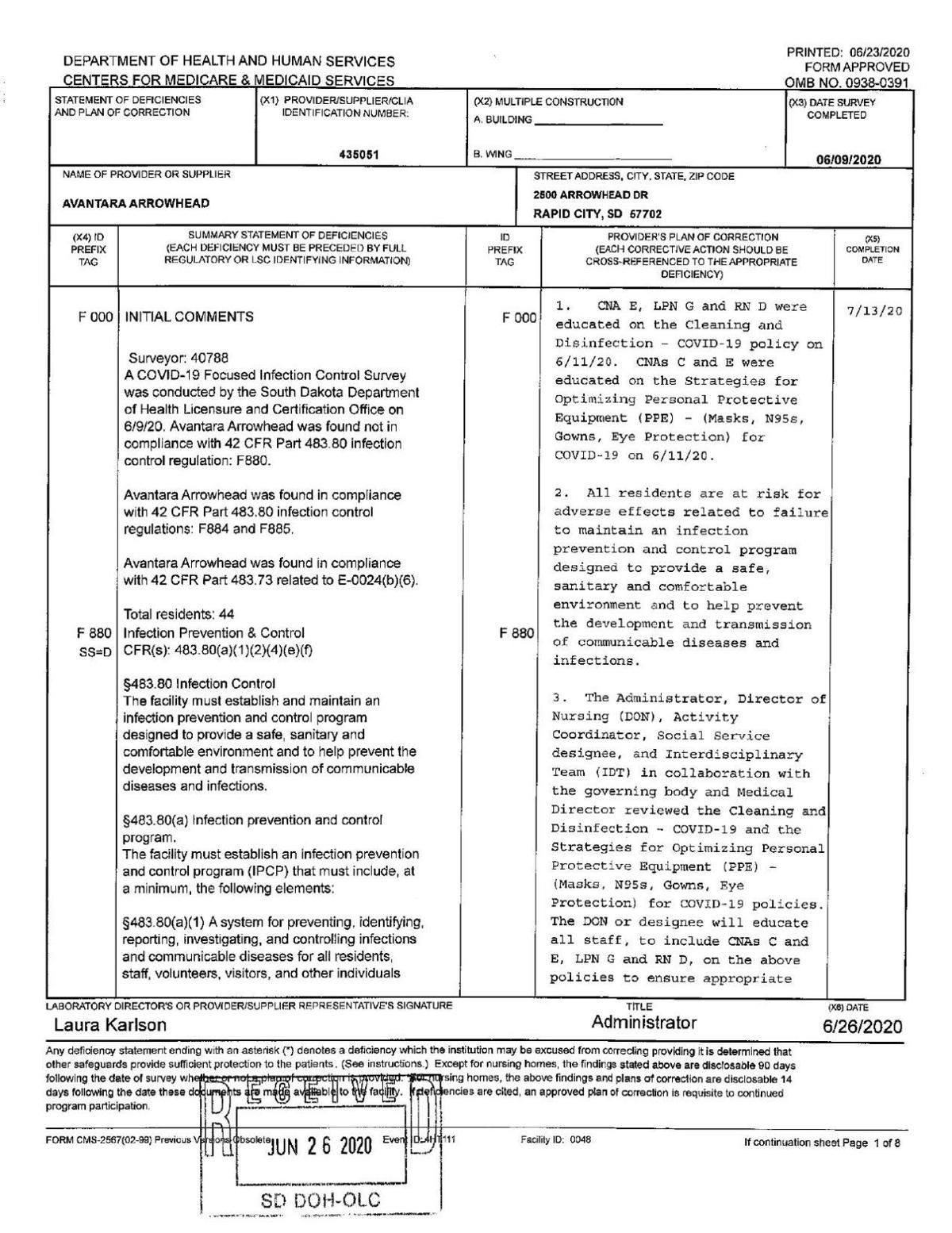
Rapid City nursing homes with 13 coronavirus deaths have recent history of infection violations

Forty-five of 68 residents have had the virus, a rate of 66% - at Avantara Saint Cloud in Rapid City. Five have died.
Jeff Easton
Two Rapid City nursing homes with significant COVID-19 outbreaks are some of the worst-ranked facilities in the state and have a history of infection control violations, public records show.

Avantara Arrowhead has seen 45 of 49 residents — or 92% — contract the virus as of Thursday, said Tatiana Johnson, regional director of operations at Legacy Healthcare, which operates the nursing homes. Eight of those residents have died while 32 have already recovered. Nineteen of 21 staff members infected with the virus have recovered.

At Avantara Saint Cloud, 45 of 68 residents, or 66%, have had the virus. Five have died while 19 are recovered. Twenty-four staff members tested positive for the virus and 10 have recovered.

Both facilities have a history of infection control violations related to staff not following proper procedures for cleaning, disinfecting, hand washing, glove wearing and making sure residents are cleaned properly.

The most recent violation was found when the Department of Health inspected Arrowhead on June 9, after 15 residents and nine employees had already contracted the virus.

The inspector found staff failed to properly clean and disinfect shared equipment, insulin injection devices and the unit for residents who tested positive for the virus or were exposed but tested negative. A logbook said the unit had been cleaned nine out of nine mornings, two out of eight afternoon shifts, and none of the evening shifts. Staff also wore their N-95 masks outside of the building and then stored them in a paper bag inside their cars, which would have exposed them to heat.

"All residents are at risk for adverse effects related to failure to maintain an infection prevention and control program," Arrowhead wrote in its plan of correction, which involved random audits and educating staff on proper cleaning, disinfecting and mask storage.

DOH spokesman Derrick Haskins said visits on July 14 and this week showed Arrowhead had addressed these issues.

An experienced certified nursing assistant who works at Saint Cloud says her facility could have better prepared for the pandemic.

“Things could have been done better from the beginning," said the woman, who contracted COVID-19 and passed it on to relatives.

Saint Cloud is the fourth-lowest ranked of South Dakota's 104 long-term care facilities that participate in Medicare and Medicaid. It also has Medicare’s lowest possible overall and health inspection ratings of “much below average.”

Arrowhead is the lowest-ranked facility in the state. It's also the only one labeled a Special Focus Facility, which means it's subject to frequent inspections and possible Medicare/Medicaid termination due to “a history of persistent poor quality of care.”

Arrowhead was designated a Special Focus Facility in August 2019 and is inspected every six months, Haskins said. Johnson said Arrowhead has graduated the program and is expected to be taken off the list.

"Avantara Saint Cloud and Avantara Arrowhead and their heroic staff have been on the front lines fighting against this unforgiving virus, protecting our residents, who are among some of the most vulnerable in our community," she said.

Johnson said the nursing homes are unsure how the virus first entered their facilities but have and continue to take "full precautionary measures" based on guidance from the DOH, CDC, and Centers for Medicare and Medicaid.

CNA speaks out 

The CNA was granted anonymity for this story because she fears retaliation for speaking out. The Journal has seen a photo of the woman in personal protective gear and a document confirming her job title and place of work.

The woman began working at Saint Cloud this year but has been a CNA for more than two decades. She said the nursing home has taken some steps to prevent the virus: no visitors are allowed, there have been at least four mass testings, and staff have their temperatures taken daily and wear personal protective equipment.

She said the first mass testing was in late May or early June and it took a week to learn the results. It turned out that one staff member — who was asymptomatic and continued to work — and two residents were positive. She said she’s not sure who provided the equipment but it was Saint Cloud's medical staff that did the testing.

Saint Cloud had a few cases at a time until late June or early July when “all of a sudden it was boom, boom, boom … it was all over the building," the CNA said.

She said staff wore loose-fitting surgical masks until N-95 masks arrived on July 6 after about 20 residents were already infected. She said the facility still needs more masks so they can change them more often.

Staff who clean and disinfect areas need to do a better job, the CNA said. For example, she said rooms aren’t properly disinfected when a resident is moved to a different area after contracting the virus.

The CNA said she knows three staff members who had high temperatures when they arrived at work, but instead of leaving they took their temperature again after 30 minutes and wrote down the new, lower one. She said staff who miss work because they develop symptoms or a confirmed case of the virus have to use their saved paid time off.

She said Saint Cloud’s residents are “very susceptible” to the virus and since they all have Alzheimer's or other forms of dementia many do not understand the pandemic and continue walking into the hallways and each other's rooms.

The CNA said she’s considering looking for work elsewhere even though she is well paid.

“Is that money worth my health? No.” ​

DOH, Legacy respond

Legacy Healthcare operates Arrowhead, Saint Cloud and 16 other long-term care facilities in South Dakota, according to its website. They are owned by Cascade Capital Group and both for-profit companies are based in a Chicago suburb. Legacy Healthcare operates 52 facilities, mostly in Illinois and South Dakota but also in Montana and Utah.

Cascade says it bought 16 of its South Dakota facilities in July 2019. The nursing homes were previously operated by Skyline Health Care.

Legacy took over "a struggling operator who had previous issues with clinical results and public health violations resulting in subpar Medicare ratings," Johnson said. "While this posed some challenges at first, our selfless staff have been instrumental in improving many different facets of the facilities, which has created many positive results in the last year."

Arrowhead was labeled a Special Focus Facility a month after Legacy took over and all but one of the inspections reviewed by the Journal occurred after Legacy became the operator. The company's South Dakota facilities range from low-ranking ones like Arrowhead and Saint Cloud to ones rated by Medicare as "much above average."

Johnson said Arrowhead and Saint Cloud have worked to prevent the virus by not allowing visitors, stopping group meals and activities, and following masking and social distancing when possible. She said staff are screened for symptoms each day and have proper Personal Protective Equipment. Both nursing homes voluntarily mass tested all residents and staff with help from local and state health departments, Johnson added.

Haskins said the department has been holding weekly calls, providing Personal Protective Equipment and conducted 18,598 mass tests of staff and residents at long-term care facilities. The facilities are also conducting random testing of staff and residents each week.

During the pandemic, the DOH has conducted 145 infection control inspections at all 104 South Dakota long-term care facilities that use Medicare and Medicaid, Haskins said. The department does an extra inspection and provides daily check-ins facilities after a resident develops the virus.

Saint Cloud inspections 

Nursing homes that are part of Medicare and Medicaid programs are inspected once a year for re-certification and more often if there is a complaint or they are a Special Focus Facility, according to Medicare's "Nursing Home Compare" website. The inspections are conducted by trained inspectors and at least one nurse with the South Dakota Department of Health on behalf of the federal government.

The inspectors note any violations and the facility must explain how they will correct them within a certain amount of time, Haskins said. Medicare then gives ratings for health inspections, staffing and quality of resident care by using a five-star system ranging from “much below average” to “much above average.” Those three ratings are used to determine the overall rating.

Medicare gave Saint Cloud its lowest ranking — one star or “much below average” — for its overall and health inspection ratings during its September 2019 annual inspection. It was ranked average for staffing and above average for quality of resident care.

Saint Cloud, which used to be called Bella Vista, was fined $19,321 after being cited for 14 health violations. South Dakota facilities have an average of 3.5 health deficiencies while U.S. ones have an average of 8.2, Medicare says.

One infection prevention issue was a dirty salon/spa area, including dirty toilets. Inspectors saw a staff member fail to properly clean a different shower area. Some staff members did not follow proper hand/glove hygiene for themselves and sanitation for residents while cleaning residents after they went to the bathroom.

Saint Cloud said it re-educated staff on disinfecting these areas, hand/glove hygiene, bathroom hygiene and infection control.

DOH staff inspected Saint Cloud in March 2020 after a complaint about resident safety related to falls and infection control but found the facility was following all rules. They inspected the facility in April and on June 17 and found it was following infection procedure and was prepared for the coronavirus pandemic.

Arrowhead inspections 

Arrowhead, which used to be called Meadowbrook, specializes in caring for people in need of medical and rehabilitative treatment. It has no Medicare rankings due to its Special Focus Facility status.

Inspections show that Arrowhead has yo-yoed in its preparedness for infections and the coronavirus since March.

DOH staff found Arrowhead was following infection and coronavirus protocols during a visit this week and on July 14, Haskins said. Those visits came after staff found the facility wasn't following infection rules during the June 9 visit.

Federal inspectors previously found the facility implemented COVID-19 practices and was following infection control regulations during an April 23 visit, Haskins said. But that visit came after a March 12 visit in which inspectors found the facility was not meeting professional or infection standards.

Inspectors found some staff failed to properly care for incontinent patients and follow medical procedures. They also found some staff failed to properly disinfect a whirlpool tub and follow hand hygiene and glove use rules, including while caring for a patient with a contagious infection.

The inspectors also found Arrowhead was violating a South Dakota law that says new employees must be evaluated for vaccines and contagious diseases within 14 days of being hired.

Arrowhead said it would remedy the problems in the April 23 and June 9 inspections by educating staff and conducting audits.

But those weren't the first time the facility had violations it said would be remedied through training and audits. DOH staff also found violations — including infection control ones related to hand/glove hygiene and disinfection — during inspections in January, September and December 2019.
Arrowhead was fined $6,805 in January 2019 after inspectors found 13 health deficiencies.

Full Article & Source:
Rapid City nursing homes with 13 coronavirus deaths have recent history of infection violations

Sunday, March 10, 2019

Nursing Homes Are Closing Across Rural America, Scattering Residents

Ramona Labrensz with a photo of her husband Harold at her home in Mobridge, S.D. When the local nursing home where he was living failed, Mr. Labrensz was transferred to another nursing home 220 miles away in North Dakota.CreditCreditKristina Barker for The New York Times
By Jack Healy 

MOBRIDGE, S.D. — Harold Labrensz spent much of his 89-year life farming and ranching the rolling Dakota plains along the Missouri River. His family figured he would die there, too.

But late last year, the nursing home in Mobridge, S.D., that cared for Mr. Labrensz announced that it was shutting down after a rocky history of corporate buyouts, unpaid bills and financial ruin. It had become one of the many nursing homes across the country that have gone out of business in recent years as beds go empty, money troubles mount and more Americans seek to age in their own homes.

For Mr. Labrensz, though, the closure amounted to an eviction order from his hometown. His wife, Ramona, said she could not find any nursing home nearby to take him, and she could not help him if he took a fall at home. So one morning in late January, as a snowstorm whited out the prairie, Mr. Labrensz was loaded into the back of a small bus and sent off on a 220-mile road trip to a nursing home in North Dakota.

“He didn’t want to go,” said Mrs. Labrensz, 87, who made the trip with her husband. “When we stopped for gas, he said, ‘Turn this thing around.’ ”

More than 440 rural nursing homes have closed or merged over the last decade, according to the Cowles Research Group, which tracks long-term care, and each closure scattered patients like seeds in the wind. Instead of finding new care in their homes and communities, many end up at different nursing homes far from their families.

In remote communities like Mobridge, an old railroad town of 3,500 people, there are few choices for an aging population. Home health aides can be scarce and unaffordable to hire around the clock. The few senior-citizen apartments have waiting lists. Adult children have long since moved away to bigger cities.

“How often have you heard somebody say, ‘If I go to a nursing home, just shoot me?’” said Stephen Monroe, a researcher and author who tracks aging in America. “In the rural areas, you don’t have options. There are no alternatives.”
Small communities like Mobridge, an old ranching and railroad town of 3,500 people, often offer few local options for elder care, and winter weather can make it impossible to visit loved ones placed in distant nursing homes.CreditKristina Barker for The New York Times
The relocations can be traumatic for older residents, and the separation creates agonizing complications for families. Relatives say they have to cut back visits to one day a week. They spend hours on the road to see their spouses and parents.

“Before, I could just drop by five days a week,” said the Rev. Justin Van Orman, a Lutheran pastor who moved back to Mobridge to be closer to his 79-year-old father, Robert. “He knew I was there.”

Not long after Mr. Van Orman’s father moved from Mobridge to a new nursing home about 50 miles away, Mr. Van Orman got a call saying his father had fallen out of bed. Mr. Van Orman had to decide: Should he upend his day to check on him, or wait and take the nursing home’s word that his father was O.K.?

Similar scenes are playing out in other heavily rural states. Five nursing homes closed in Nebraska last year, with more at risk of closing. Six shut down in Maine — a record, according to the Bangor Daily News.

Thirty-six rural nursing homes across the country have been forced to close in the last decade because they failed to meet health and safety standards. But far more have collapsed for financial reasons, including changing health care policies that now encourage people to choose independent and assisted living or stay in their own homes with help from caregivers.

Some nursing homes cannot find people to do the low-paying work of caring for frail residents. Others are losing money as their occupancy rates fall and more of their patients’ long-term care is covered by Medicaid, which in many states does not pay enough to keep the lights on.

South Dakota chips in less than any other state in the nation to pay for long-term care for residents on Medicaid, said Mark B. Deak, executive director of the South Dakota Health Care Association. He added that the state’s low payment level — a product of South Dakota’s fiscal conservatism and distrust of government-run health care — has now created a crisis.

Blowing snow created hazardous driving conditions in February near Mobridge. After the closure of a local nursing home, many area residents wishing to visit loved ones in nursing care face drives of up to four hours even in good weather.CreditKristina Barker for The New York Times
Five South Dakota nursing homes have shut down in the past three years, and dozens more are losing money because the majority of their residents rely on Medicaid. At current reimbursement rates, nursing homes in the state lose about $58 a day for each resident on Medicaid, Mr. Deak said. It adds up to $66 million a year in losses statewide.

“The state has not held up its obligation to seniors,” Mr. Deak said. “How many more nursing homes closing is it going to take?”
Gov. Kristi Noem has proposed a 5 percent increase in the state’s Medicaid reimbursement rate. Mr. Deak said that would not be nearly enough to cover the losses.

The 89-bed Mobridge Care and Rehabilitation Center was rated overall as “below average” by Medicare’s Nursing Home Compare program, though for patient care, the home received four out of five stars in the agency’s assessment. The brown brick building was getting old, and had been damaged by a bad summer storm in 2018.

The nursing home had been part of a chain that switched hands and foundered financially, ultimately ending up in court-appointed receivership. In November, the receiver told a South Dakota judge that the chain’s operations were bleeding money, and that it needed to close down the two homes in the chain that were deepest in the red. Mobridge was one.

The South Dakota Department of Health did not object, and the judge agreed to the closure. Word began to spread through the home and through town: The residents had about two months to find somewhere else to go.

Black Hills Receiver, which had taken over operation of the nursing home, said in a November statement announcing the closure that it was working with residents, their families and employees “to make this transition as smooth as possible.” The company declined an interview request.
For six days this winter, Loretta Leonard could not make the 20-mile drive from Mobridge to Selby, S.D., to see her husband, Dick, who is 91 and suffers from severe dementia.CreditKristina Barker for The New York Times
On paper, South Dakota and other rural states still have enough long-term care beds for people who need round-the-clock care. The problem is where they are. When a nursing home closes in a small town, the available beds are often so far away that elderly spouses cannot make the drive, and the transferred residents become cut off from the friends, church groups and relatives they have known all their lives.

Even the closest town can feel as though it is a world away when a blizzard rakes across the prairie and turns the two-lane road out of Mobridge into a billowing scarf of snow.

For six days this winter, Loretta Leonard could not make the 20-mile drive to see her husband, Dick, who is 91 and suffers from severe dementia, at his new nursing home. When he was living close by at the Mobridge home, she often visited him twice a day, sitting down at the piano to play the old polkas and hymns and Depression-era tunes their daughters sang growing up.

“He always knew me,” Ms. Leonard, 88, said. “Sometimes I wonder whether he knows me anymore.”

The part-time bus driver for the Mobridge nursing home began keeping a list as he dropped people at their new homes: “Residents Who Left.” One resident was moved to Aberdeen, 100 miles east. A husband and wife went 73 miles down Highway 12 to Ipswich. Roommates said goodbye. Fast friends landed in different homes. One person ended up in Nebraska.

“Like cattle,” said Nadine Alexander, a certified nursing assistant who worked at the Mobridge nursing home for 29 years. “They were just hauling them out.”

On the snowy day that Harold Labrensz left Mobridge for his new nursing home in North Dakota, not even the bus driver wanted to make the trip. For seven hours, they crept north along icy roads before arriving.

Mrs. Labrensz chose the facility because it was close to her son’s home, and she was able to find a small efficiency apartment just across the street from the nursing home. They spent 68 years together working their land, fishing and raising a family, and Mrs. Labrensz said she wanted to stay close.

“We spent our whole life together,” she said.

She was also close by when, three days after arriving in North Dakota, Mr. Labrensz died. The date was Jan. 31 — the same day that, 220 miles away, the Mobridge nursing home officially closed its doors.

Correction: An earlier version of this article, using information from a source, misstated Ramona Labrensz’s age. She is 87, not 76.

Full Article & Source: 
Nursing Homes Are Closing Across Rural America, Scattering Residents

Saturday, October 6, 2018

Corsica Man Pleads Guilty to Financial Exploitation

PIERRE, S.D. (AP) — The South Dakota attorney general says a Corsica man is facing up to 10 years in prison for exploiting money from an elderly family member.

Attorney General Marty Jackley said Friday 48-year-old David Anthony Stetson has pleaded guilty to felony theft by exploitation. Authorities say Stetson must pay restitution of more than $27,000.

The felony is also punishable by a fine of up to $20,000.

Full Article & Source:
Corsica Man Pleads Guilty to Financial Exploitation

Monday, July 23, 2018

Corsica man accused of elder abuse exploitation

(KSFY) - A Douglas County man has been arrested on several counts connected to financial abuse of an elder.

Forty-eight-year-old David Stetson of Corsica was arrested on three counts of felony exploitation, according to Attorney General Marty Jackley.

Officials say the theft charge alleges that Stetson took funds from an elderly family member.

Full Article & Source:
Corsica man accused of elder abuse exploitation

Tuesday, June 5, 2018

Dignity in Old Age

We are not equal in old age.

That's the tragic truth.

As equal as we are in human dignity and value in God's sight, some are treated very differently, especially as age limits physical ability.

Some have the advantage of family members who live nearby and can take time to be with them. Some have family with accessible homes who invite them in. Some have family who can ensure they have the best treatment in a senior residence.

Some don't.

Some have the advantage of money to pay for the best care.

Some don't.

In Huron, where I served before moving here, Medicaid-covered residents at the larger nursing home were two to a room, while others enjoyed single occupancy. When visiting people in nursing homes in Pierre, it is not hard to tell whose care is paid for by Medicaid. Often - not always, but often - that person's circumstances are worse.

For a younger person, we might encourage them to work harder and make more money, but someone well past retirement age? I don't think so.

Of Pierre's senior residences, assisted living facilities, and nursing homes, some are fantastic environments.

Some are not.

Caregivers and nursing home staff are well intentioned, work hard, and have so much kindness to share. But when staff are poorly treated or run ragged, residents are going to be poorly served.

We deserve equal dignity in old age. From the Ten Commandments on, God has always affirmed that, and will hold anyone accountable for not treating people with the dignity they deserve.

God commands "honor your father and mother that your days may be long in the land." So what can we do?

1. Live with elderly parents.

A friend of mine and her family are about to move into her mother's house to care for her in the midst of Parkinson's. That used to be common, but today it's rare. People living farther from parents as well as the economic realities of two income households and more irregular work hours make this harder, and the community (workplaces included) can support families in this. But there's also a cultural shift that needs to happen, and it's going to take bold people giving it a shot.

2. Advocate for elders.

There are some magnificent people who regularly volunteer their time to play music and visit people in nursing homes and assisting living. There ought to be more. Families and the professionals serving people are on the front lines, but the whole community can be invested in their well being.

3. Don't tolerate exploitation.

Exploiting elders for financial gain is an attack on the dignity of vulnerable people. God hates exploitation, and we should hate it too. Where we can, we should drive exploitation out of town, because we don't want that in our community.

Never treat someone with anything less than full human dignity, especially for your own financial gain. Whether in good health or in infirmity, treat elderly parents, neighbors, and fellow Pierre residents with honor.

Full Article & Source:
Dignity in Old Age