Wednesday, December 7, 2016

FSU criminology team tackles elder fraud issues

Dean Thomas Blomberg
Around the holidays people tend to be in the giving spirit, but there are also scammers well aware of such generosity. The U.S. Consumer Financial Protection Bureau reports that although fraud targeting seniors happens every day, scammers often increase their efforts during the holiday season.
 
Enter Florida State University’s College of Criminology and Criminal Justice. Researchers, including Dean Thomas Blomberg, doctoral student Julie Mestre Brancale and George Pesta, director of the Center for Criminology and Public Policy Research, recently completed a full report on elder fraud and how to combat it. 

“We needed to have better firsthand knowledge of how extensive the problem of elder financial fraud is in order to develop needed policies and practices that can effectively reduce this growing problem,” Blomberg said.

In 2011, the MetLife Market Institute reported that $2.9 billion was exploited from elderly victims — a 12 percent increase from 2008. The fastest growing segment of the U.S. population is 65 and older, so the occurrence and impact of elder financial fraud will likely continue to escalate.

Despite these alarming trends, there was little research on the facts, prevention and policies related to elder financial fraud. This lack of information led the College, in partnership with Merrill Lynch and Seniors vs. Crime, to begin a study on elder financial fraud in The Villages, one of the largest retirement communities in the nation.

The team addressed four questions through their research: One, what are the most common types of financial fraud perpetrated against the elderly? Two, what role do salient life events, such as retirement, death of a spouse and declining health have on the risk of elder financial fraud? Three, what are protective factors against elder financial exploitation? Four, what are the consequences of elder fraud victimization?

Combing through diverse data — including reported incident data, arrest statistics, national surveys, focus groups and interviews — researchers found that in The Villages between January 2010 and May 2015, there were 3,735 complaints of elder fraud victimization, but only 265 arrests. The average age of fraud victims was 72, and the average lost among the victims was $2,000 per claim. They also found the most common source of fraud was in home services, particularly unnecessary repairs. 

The researchers also examined other types of fraud The Villages residents were exposed to, including misleading sales and advertisements, investment fraud, embezzlement, sweepstakes scams, fraud by health professionals, identity theft and forgery crimes. The report also addresses the methods used to exploit elderly victims and what made them particularly vulnerable to each type of fraud.
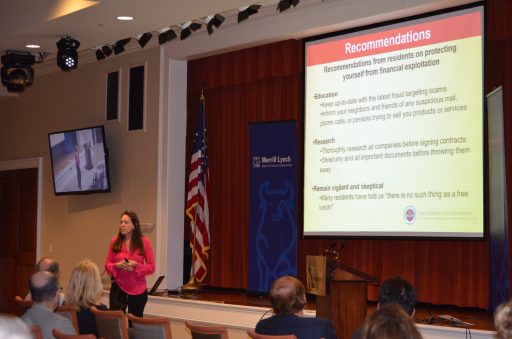
 Doctoral student Julie Mestre Brancale presents report recommendations to senior residents at Westminster Oaks Retirement Community.
Doctoral student Julie Mestre Brancale presents report recommendation 
to senior residents at Westminster Oaks Retirement Community.

Salient life events, or “turning points,” such as death or incapacitation of a spouse, a significant health diagnosis, moving and changing social support networks proved to be the most common precursors for financial exploitation. As a result of victimization, residents of The Villages suffered psychological and emotional distress, impact on their quality of life and health, and devastating consequences for their financial security.

“I was surprised at how prevalent this problem is and how deeply affected residents were,” Mestre Brancale said. “No matter if they lost $50 or they lost $100,000, this victimization changed their lives and they were drastically impacted.”

Researchers also discovered that retirement communities provided a false sense of security to residents, raising the likelihood of exploitation among residents. Further, they determined that elder fraud is significantly underreported because victims are embarrassed and/or unaware how to report victimization.

In the report, Blomberg, Mestre Brancale, and Pesta give recommendations to help reduce vulnerability when it comes to elder fraud. They note that protective factors, such as education, skepticism and strong support networks help to reduce incidents of fraud.

The researchers also recommended that community service centers providing comprehensive services at a single location for seniors could help reduce elderly victimization. Effective services within the community service centers would be hotlines, list of “endorsed” services, classroom education, media outreach, “shopping buddy” programs, support groups and referral services. 

Accordingly, community service centers that provide such services can act as a surrogate family or trusted friend, educating seniors to avoid exploitation and guiding them through the recovery process. The research team anticipates the recommendations, if applied and fostered, will reduce the prevalence of financial fraud. 

“This is just another example of how the college is working to bring research to life,” Blomberg said.

“Here, the college’s research provides real insight into problems confronting some of Florida’s most vulnerable citizens, the elderly, as well as recommendations for the prevention of elder financial exploitation.” 

Researchers said there is more they hope to learn in order to help combat the crime.

“We really want to go out to other retirement communities and see if what we found in The Villages, we find in other retirement communities,” Pesta said. “We ultimately want to pursue an institute for the study of elder fraud and abuse at Florida State University in the College of Criminology and Criminal Justice.”

Read the full report, “Elder Financial Exploitation in a Large Retirement Community,” here.

Full Article & Source:
FSU criminology team tackles elder fraud issues

Tuesday, December 6, 2016

Who guards the guardians: Journal series distorts good work of guardians

In a recent series in the Albuquerque Journal, Diane Dimond has painted a remarkably unfair and distorted portrait of the guardianship profession, using a few cases out of thousands to make her biased case. Her case needlessly attacked good people doing good work, and even in her few examples, she got it completely wrong.

The Journal’s stories create both the need to respond to the inaccuracies, but also a chance for the public to understand how the guardianship process in this state works to the benefit of our most vulnerable citizens.

Guardians are charged with protecting our most vulnerable citizens. The Journal stories attempted to make a case that guardians and conservators are draining the bank accounts of protected people. It’s actually the other way around.

The guardians and conservators shore up the finances of the protected people and save their money to allow them to live decently by making sure they get proper medical care, housing and nutrition. All too often when conservators are called in the protected person’s way of life has been threatened, and their money is in danger of being lost completely.

In a few hundred cases per year, the courts step in to create a guardian for people who have some very serious conditions, such as Alzheimer’s disease, Down Syndrome, traumatic brain injuries and substance abuse problems. In most of these cases, the vulnerable adult involved needs a guardian to keep them from losing their homes, their money and their way of life.

In many cases, the family members cannot take care of the ailing person and the court intervenes in the best interest of the person. And in some cases, the family members cannot agree on the right course of action and the court must take over.

The vulnerable person who needs a guardian then enters into a system of qualified and dedicated professionals who are devoting their lives to the help and care of these people. These guardians aren’t getting rich.

The Journal stories inaccurately portray these hardworking individuals as taking advantage of the situation. Nothing could be further from the truth.

These guardians and conservators step in in very difficult circumstances to protect people suffering from dementia and other ailments, to maintain their way of life, keep them in their homes if requested, and maintain finances. This is all done to honor the wishes of the protected person.

In the case of Blair Darnell, whose situation was vastly mischaracterized in the Journal story, a conservator and guardian were called in to protect her assets and ensure proper medical care so she could live out her life in her home according to her wishes. The system worked. She lived out her life at home with her family by her side.

The Journal stories also implied that the family members of the protected people are then banned from seeing their parents. Nothing could be further from the truth.

Yes, there may be a few cases when the courts determine that some family members pose a danger to the protected person, but that’s rare, and in almost all cases the family has access and is encouraged to see the protected person.

The courts go out of their way to ensure that the family is completely involved, if they wish, in the process and get to state their case. It is unfortunate that the Journal stories have damaged the court’s reputation by implying that there is something unethical going on here.

In short, there is an honorable profession operating in a lawful and ethical manner. It protects vulnerable people who are in need of special care. The guardians rescue people who can be in unimaginably horrible circumstances, and when the protected person no longer needs a guardian and life is back together, the guardian steps aside. We operate by a strict code of ethical standards and the vast majority of our families are very satisfied with our results.

This recent five-part series failed to accurately report how the system actually works. This failure is a disservice to the vulnerable and their families looking for help.

Full Article & Source:
Who guards the guardians: Journal series distorts good work of guardians

See Also:
Diane Dimond's Five-Part Series:  Who Guards the Guardians?

El Paso County judge suspended pending disciplinary hearing

COLORADO SPRINGS, Colo. (The Gazette) - A nine-year El Paso County judge has been suspended with pay pending a disciplinary hearing before a state judicial commission.

Judge Jonathan Walker was suspended Nov. 8 by the Colorado Commission on Judicial Discipline, a copy of the commission's order shows.

Grounds for the suspension weren't disclosed. Rob McCallum, a Colorado State Judicial Branch spokesman, said he didn't know the cause, and 4th Judicial District Administrator Danny Davis couldn't be reached for comment.

A phone message left on the commission's voice mail wasn't returned.

Walker, who previously practiced as a deputy state public defender and as a private defense attorney, was appointed to the county bench in 2007. He served with the Army Special Forces in Southeast Asia "in the Vietnam era," according to his biography on the state judicial branch website.

Full Article & Source:
El Paso County judge suspended pending disciplinary hearing

A cannabis marketing company is bringing pot parties to the elderly

In April 2015, Carrie Tice was despairing over her 80-year-old mother’s advancing Alzheimer’s when a caregiver at her senior center in California recommended giving her a topical dose of marijuana. Many other drugs had failed, but the marijuana made her feel better immediately. She was more alert, more active and looked younger. By October last year, she had moved out of the senior center, and this year she moved in with her daughter in Mill Valley.

“The change in my mom was so remarkable that I wanted to shout it from the mountaintops,” Tice said. “She seemed 10 years younger after 20 minutes, and was happy.”

The experience inspired Tice to quit her job of 20 years at video game software maker Ubisoft and found a company that would supply marijuana to seniors, helping them navigate the state’s intimidating medical marijuana system. Since April 2015, Octavia, as the company was first called, has helped older seniors get doctor recommendations online and order weed products to ease their pain and help them sleep.

The service is needed because seniors often aren’t familiar with the many varieties of weed that can be used. Pot is for sale in many forms: flowers, edibles, oils, vaporizers, concentrates, tinctures, sprays, ointments, and more. “One time mom told me she preferred a tincture because it didn’t burn her eyes and I freaked out! She was supposed to put the stuff on her tongue!” Tice said.

In 2016, the company merged with a marijuana sales party company called Viva to form Octavia Wellness. The merged company in July began a pilot program at four elder care facilities in the Bay Area, holding gatherings to help residents with their weed needs. In one facility that Octavia Wellness serves, a secret cannabis club with 10 members had clandestinely smoked joints out on the adjoining golf course at night. Now, gatherings are officially sanctioned and standing-room-only, with 190 residents in attendance. The company also has clients from centers that allow brochures but not meetings. Next year it will sell products packaged especially for the elderly, with large type and extra instructions.

The weed needs of the elderly are unique, Tice said. “There are some old rockers at a senior center in Mill Valley who like to get high and buy pre-rolled joints. But most want pain relief, to sleep better and stop fretting. They’re on opiates, constipated, and can’t function on their pills, so once they discover marijuana helps them, stigma’s not an issue.”

Octavia raised $300,000 from investors in this year’s second quarter, and has had 10% weekly sales growth since then. It aims to raise $1 million by the first quarter of next year; so far, $300,000 has been committed. Approval last month of California’s Proposition 64, legalizing recreational marijuana, is spurring interest from more investors.

Revenue from California’s cannabis industry is projected to grow to $6.5 billion by 2020 from $2.8 billion in 2015, the Cannabist reports. The national market is projected to generate $20 billion in sales by 2020 according to market research commissioned by Arcview Group, a marijuana industry incubator. According to another market research report, by analysts from Cowen & Co., the national cannabis industry could reach $50 billion by 2026.

Octavia Wellness, with its niche clientele, may thrive. Now it’s still a startup, and Tice says she’s working 80-hour weeks. “Do I miss steady paychecks,” she asks rhetorically. “Sure. But I love working with seniors, more than anything I’ve ever done. This is the least-served community, and it has the greatest need for cannabis.”

Full Article & Source:
A cannabis marketing company is bringing pot parties to the elderly

Monday, December 5, 2016

Fixing a well-meaning but flawed guardian system

Editor’s note: The Journal published a five-part investigative report from Sunday, Nov. 27, through Thursday, Dec. 1, about the problems and heartache in the state’s elder Guardianship system:  Who Guards the Guardians?

Today, some possible solutions.

It won’t be easy to overcome budget challenges and opposition from entrenched interests. Earlier efforts have failed. But judges, lawyers, aggrieved family members and others agree there are ways to fix some of the flaws in New Mexico’s guardianship system as outlined in a five-part Albuquerque Journal series.

Here are some of their suggestions to cure an ailing system that can make inheritances disappear, fracture families and take away the elder person’s dignity and freedom.

• Curb excessive secrecy – except for medical information protected by federal law. Time and time again, people critical of the system say transparency would be the best deterrent. Responding to the Journal series, retired District Judge Anne Kass of Albuquerque told the Journal she believes, “We need to have a really profound conversation between privacy and secrecy and develop a better way of measuring it … (deciding) when it’s OK and when it isn’t.”

• Give aggrieved family members a meaningful forum to air their complaints – a forum that can hold accountable the paid professionals in the guardianship industry.

• Family members should be involved, not shut out of the ward’s life. Instead of labeling family members as “in conflict” or “upsetting” to the elder and curbing their visits, guardians and conservators should include them in the elder’s everyday decisions. Rep. Conrad James, R-Albuquerque, says the process of “isolating the senior is the first step of abuse in these cases.”

• Elevate the evidentiary requirement for an elder to be declared incapacitated and make sure all family members are heard. Require the elderly person to actually appear in court and be questioned by the judge unless it is physically impossible.

• Require specific training and issue state licenses for guardians and conservators. New Mexico has more licensing requirements on the books for hairdressers and landscapers – because there are none for guardians and conservators. If a court appointee is going to manage cases with complex medical or financial issues, they should show they are qualified in those fields.

• The Legislature needs to recognize the problem and approve additional court funding. Judges need sufficient resources to monitor the growing number of guardianship cases. As described in the Journal series, the program currently runs on the “honor system” with little or no auditing or oversight of how appointees spend the ward’s money. ...

Sunshine
Unlike those of most states, New Mexico’s guardianship system is steeped in secrecy. Courts here routinely sequester proceedings, citing vaguely written sections of the state’s Uniform Probate Code, and order all participants to remain mum about the case to protect the privacy of the elder person. Critics say this lack of transparency quashes legitimate concerns and allows judges and attorneys to ignore both family members and important legal documents prepared by the elder, such as wills, estate plans and powers of attorney.

One Albuquerque lawyer who is representing a family in a guardianship drove the point home.
“There are bad things happening. Even if they’re legal, they are bad things,” he said. “The societal cost of this secrecy is too damn high.”

Marcia Southwick of Santa Fe established the popular Facebook page Boomers Against Elder Abuse a few years ago, and it now boasts more than 150,000 members. As one of three directors of the National Association to Stop Guardian Abuse, she suggests a strong state disciplinary board where family complaints are taken seriously and published for all to see. Only when the secrecy of the system is lifted, she said, can citizens know if there are multiple complaints against a court appointee and disciplinary action or criminal charges can be pursued.

Retired Judge Kass says that when she read some of the comments from guardian system insiders quoted during the Journal series, “What popped into my head was: the code of silence and how inbred this thing is with the people who work in it.” She added, “From my perspective, self-regulation doesn’t work, has never worked and can never work.”  (Click to Continue)

Full Article & Source:
Fixing a well-meaning but flawed guardian system

See Also:
Who Guards the Guardians?

Lawmaker: ‘We are faking it’

ALBUQUERQUE, N.M. — Sen. Jerry Ortiz y Pino sounds frustrated and weary.

He read the Journal’s five-part investigative series on problems within the state’s elder guardian system and observed that of the cases cited, there are “probably many, many dozens (more) that could explode at any time in this state and it’s because we are faking it. We pretend like we have a guardian system and there’s nothing in place.”

Senator Gerald Ortiz y Pino, D-Albuquerque (Greg Sorber/Albuquerque Journal)
Senator Gerald Ortiz y Pino, D-Albuquerque 
It’s not for lack of trying, Ortiz y Pino told the Journal.

He recalls several times over the past decade that he and his colleagues have tried to propose legislative patches to the fraying system. They’ve tried to appropriate money to study ways to strengthen the system, to provide more oversight on how court appointees spend their elderly ward’s money, to set rules on visitation for children of wards when there is a dispute. Every time, Ortiz y Pino said, opponents of change win.

The senator put it bluntly: “Anytime we got into guardianship issues the attorneys who deal with probate in the state went ballistic.”

The biggest problem with the system? “I think you alluded to it in your articles,” he said. “It’s an honor system and there’s nobody checking.”

The senator, a social worker by occupation, believes the situation will get worse in the years ahead as the baby boomer generation ages.

“The problem is nobody is in charge,” he said. “So, there’s nobody to come before the Legislature to request a budget increase, nobody to say we need to improve regulations governing this. There’s nobody to set standards for the guardians (or) to hear complaints from the families.”

Ortiz y Pino believes there should be state certification and licensing of guardians and conservators but wonders where the money will come from. Likewise, his idea to set up special elder courts to exclusively hear guardianship and elder-issue cases would also need funding.

Because that money can only be approved by state lawmakers, the ball is in their court.

Full Article & Source:
Lawmaker: ‘We are faking it’

See Also:
Who Guards the Guardians?

Sunday, December 4, 2016

Alzheimer's diagnosis renders Cook Co. judge accused of letting ex-clerk hear cases unfit, report says

A Cook County judge accused of urging and allowing a now-fired law clerk to preside over cases from the bench as if she were a judge has been diagnosed with Alzheimer’s disease and is no longer fit to continue as a judge, a state judicial discipline board has reported.

On Friday, Dec. 2, the Illinois Judicial Inquiry Board filed a complaint with the Illinois Courts Commission against Cook County Circuit Judge Valarie E. Turner, alleging she was “mentally unable to perform her duties.”

The Inquiry Board asked the Illinois Courts Commission to ratify those findings, and ultimately effectively remove her from her post within the Cook County court system.

The JIB complaint did not elaborate on Turner’s purported diagnosis, including when doctors may have diagnosed her with the illness, or when judicial authorities became aware of the diagnosis, saying only Turner had been diagnosed “recently.”

The complaint comes as the latest disciplinary action after Turner was removed from hearing cases in August by the Cook County Circuit Court’s Executive Committee, which included Cook County Chief Judge Timothy Evans and the judges supervising the circuit’s various divisions and courthouses, after allegations first surfaced accusing her of allowing then-circuit court law clerk Rhonda Crawford to preside over traffic cases during an afternoon court call at the county’s courthouse in suburban Markham.

In March, Crawford, who had worked at the Markham courthouse, had secured the Democratic nomination for a judgeship in the county’s First Judicial Subcircuit. She had won despite receiving a grade of “Not Qualified” from the Illinois State Bar Association, as part of that organization’s work of evaluating judicial candidates.

No Republican or independent candidate had filed to seek the judicial post, leaving Crawford to run unopposed.

However, in August, Judge Marjorie Laws, who presides over the Markham courthouse, purportedly notified her superiors of a substantiated complaint first brought by a municipal prosecutor, who complained of the conduct of Turner and Crawford during the Aug. 16 court call to hear traffic ticket cases.

Evans then fired Crawford, and reassigned Turner, pending the outcome of the investigation into the incident.

The Illinois Supreme Court, acting at the request of the Illinois Attorney Registration and Disciplinary Commission, suspended Crawford’s law license and barred her from taking the bench, pending the outcome of the formal investigation into the matter.

Crawford received enough votes during the November general election to win a seat on the county bench. However, a write-in candidate who opposed her, appointed Judge Maryam Ahmad, has asked a Cook County court to invalidate those election results, arguing Crawford was not a lawful candidate at the time of the election after the Supreme Court suspended her license and prohibited her from taking the judicial oath. That case remains pending.

No further action had been taken against Turner, until the Judicial Inquiry Board released its complaint Dec. 2, publicly revealing Turner’s health diagnosis for the first time.

Turner had been first elected to the Cook County bench in 2002, and was first admitted to the state bar to practice law in 1991. She was twice retained by voters in the county’s Second Judicial Subcircuit in 2008 and 2014.

In an evaluation posted in 2008, the Chicago Council of Lawyers rated her “not qualified,” saying lawyers were mixed in their review of Turner’s work.

“Some lawyers appearing before her find her to be well-versed in the relevant law, impartial, and fair. Others question her grasp of the law or her confidence in her own understanding of points of law,” the evaluation said. “She is generally well-prepared for hearings, though some lawyers question her diligence, believing that she under-schedules her calendar. Judge Turner’s temperament is strongly criticized by some lawyers, who report that she becomes too easily frustrated with attorneys and litigants and sometimes reprimands or chastises them in ways that may be inappropriate.”

According to public records, Turner earned a salary of $188,000 per year.

Full Article & Source:
Alzheimer's diagnosis renders Cook Co. judge accused of letting ex-clerk hear cases unfit, report says

Practical Probate: Honoring Powers of Attorney

A common shortcoming of powers of attorney is that Connecticut had no requirement for third parties (for example, financial institutions) to honor them. This is a serious issue because powers of attorney are frequently created to allow the person to whom the power of attorney is granted (called the agent) to manage accounts in financial institutions on behalf of the account owner (called the principal), particularly when the principal becomes incapacitated.

Some financial institutions would refuse to recognize valid powers of attorney unless they were drafted on the financial institution’s own POA form.  Frequently, these “forms” amounted to nothing more than an indemnity of the financial institution for following the POA. This approach by certain financial institutions effectively thwarted a valid POA when it was needed most - when the principal became incapacitated. In those cases, families often had to institute conservatorship proceedings in the probate court.

With the 2007 revision of the conservatorship laws, conservatorship proceedings in Connecticut probate courts have become complex, time-consuming, and expensive.

The new Connecticut Uniform Power of Attorney Act addresses this issue by instituting penalties for third parties that refuse to recognize valid powers of attorney. It also provides third parties with options that address concerns they may have about the validity of a power of attorney.

The new law provides that if the power of attorney is acknowledged by a notary public or attorney, it’s presumed to be valid, and a third party may rely on it.

There are protections in the new law for third parties asked to honor or rely upon a power of attorney.

For example, a third party may request that the agent answer certain questions it may have about the agent, the principal, or the power of attorney document. The third party may also request an affidavit stating that the power of attorney is in full effect and has not been revoked.

A third party may request an opinion of counsel as to any matters of law, but must state the reason for the request.

These requests must be in writing and made within seven days of when the power of attorney is presented to the third party. This minimizes opportunities for the third party to delay honoring a valid power of attorney under the premise of requesting additional information.

The principal is responsible for expenses of complying with these requests. Beyond the seven-day period in the new law, the cost of complying with such requests may be the responsibility of the third party.

There are also six “safe harbors” defining circumstances under which it is permissible for a third party to refuse to honor a power of attorney.

If a third party refuses to accept or honor an acknowledged power of attorney, without falling under the safe harbor provisions, it will be subject to an order by a court mandating acceptance of the power of attorney.

Full Article & Source:
Practical Probate: Honoring Powers of Attorney

10 Simple Ways to Make Your Brain 10 Years Younger

Regular Natural Health Insiders readers know that exercise isn’t just key to a trim, healthy body, but to a healthy brain as well. Now, new studies show exercise may be dramatically more important than previously thought

According to a 2016 study published in Neurology, older folks who didn’t exercise or only lightly exercised experienced cognitive decline at a much faster rate. Their cognitive abilities were effectively ten years older than those who exercised moderately or intensively.1

Does this mean you need to start doing one of those insane workouts we see on TV to protect your brain? Not at all.

I’ve pulled together ten of the highest leverage exercises, lifestyle changes and activities that can turn your cognitive clock back ten years or – to try on another metaphor – subtract a hundred thousand miles off your brain’s “odometer” — no matter what your previous exercise habits have been.

When I say “highest leverage” I mean they give you highest return for the effort you put in.

And by the way, only the first four are exercise-related.

Start with a couple that look approachable, and gradually add more to your routine as you feel comfortable. Taking just one of these steps can change your life.

Exercising for Ultimate Brain Health


1. Do a 5-minute warm-up first.
Here’s a “triple threat” warm-up: I recommend doing a few basic yoga flows before you exercise to get your whole body warm.

A flow is something you can do “cold,” without pulling muscles or causing injury—and you can adapt it to your level of fitness.

Plus, you get the mind and hormonal benefits of doing five minutes of meditation, too. One study showed that 50-year-old meditators had the gray matter of a 25-year-old.2

If you don’t know a thing about yoga, classes are just about ubiquitous these days. All you’re trying to do is learn four or five simple, basic yoga postures. A couple of hours of instruction should be enough to get you going, then you can do them at home.

Or maybe you’ll have so much fun, you’ll want to continue with the class!

As with almost everything, you can run into an instructor who wants to push you too hard or classmates who want to turn it into a competition. Don’t let yourself get rolled. Get what you need from the instructor, or bail out and find someone more congenial.

2. Bodyweight squats and lunges.
Interestingly enough, leg strength is one of the most telling factors in cognitive health, especially in women. Twin studies have demonstrated that leg strength is significantly related to gray matter volume and future cognitive change.3

And you don’t need fancy gym equipment to do it — sets of “air” squats and bodyweight lunges can kick your quad and hamstring strength up a notch; besides that, this step and step 3 are great for cardio health.

See instructional videos here:
https://www.youtube.com/watch?v=p3g4wAsu0R4
https://www.bing.com/videos/search?q=lunges&qpvt=lunges&view=detail&mid
=8ACBD42F7B289666C4BA8ACBD42F7B289666C4BA&FORM=VRDGAR


3. Walking, bike-riding, jogging.
A brisk walk, jog, or bike ride is one of the best things you can do. Also consider taking a dance class – square dance, ballroom, whatever strikes your fancy. One 65-year-old friend of mine took hip-hop classes.

Not only will this help develop leg strength, but animal studies showed that the longer a rat ran at a moderate pace, the more neurogenesis (generation of new brain cells) it experienced, compared to high intensity intervals and weight lifting.4

4. Weight training.
Not just for bodybuilders anymore, weight training — especially in the legs — is a great way to build muscle, stability, and endurance.

Hamstring curls, extensions, and leg press are great for beginners — and these exercises can make an immediate difference in your brain activity. This will probably involve joining a health club, and the social aspect of that is also good for brain health.

A study published in Acta Psychologica showed those who performed leg extensions at their maximum effort increased their levels of norepinephrine (an important neurotransmitter) and had ten percent better short-term memory recall than did passive participants.5

Plus, another study published in the Journal of the American Geriatrics Society showed that women who weight-trained just twice per week for a year showed significantly less brain shrinkage and slower growth of age-related white matter brain lesions than did women who lifted once per week or who only focused on balance and stability exercises.6

And ladies, don’t be afraid of increasing your weights as you get stronger — you won’t turn into Arnold Schwarzenegger.

Eat Healthy for a Sharp Mind


5. Healthy eating patterns.
Let’s avoid the word “diet” here and talk about what you should aim for – healthy habits you can do every day for the rest of your life, NOT temporary fixes that you practice for a while before returning to your old, bad habits.

A healthy eating pattern avoids inflammatory foods — especially processed and high-glycemic foods. The latter include not only sugar but also rice, potatoes and all wheat products. In general, you can eat just about as much protein and fat as you want, and you should eat as few carbs as you can. That’s oversimplying, but that’s the basic principle.

Make sure you’re getting plenty of lean protein and healthy fats (nuts, coconut oil, avocado) and organic produce. Take antioxidant supplements.

Three supplements I consider essential are krill oil (omega 3s), turmeric, and a multivitamin / mineral.

6. Challenge your mind often.
Crossword puzzles and word games are great, but try more complex challenges as well. Change your routine. Take a different path on your walk. Do something backwards, like repeating the alphabet or counting backwards from 100 by 7s. It’s tricky, but a low effort way to put your brain to work.

Use your left hand to do things you’d normally do with your right (or vice versa, if you’re naturally left-handed). It makes you think and gets a conversation going between your brain, your body, and the rest of the world.

7. Learn a new hobby, craft or skill.
Pick something you’ve always wanted to learn and stick with it. Playing a musical instrument, speaking a foreign language or cooking a new recipe creates new pathways and connections in the brain.7

Consider a hobby like quilting, painting, drawing, even playing bridge or poker. You don’t have to be good at it. Do it for fun.

Turn off the TV and read a book.

8. Watch your alcohol intake.
If you drink, make sure you’re not overindulging on a regular basis. Studies show 1.3 ounces of alcohol is the line between healthy and overindulging. That refers to the alcohol content of your drink, not to the total volume of the drink.8

9. Sleep.
If you don’t get enough sleep, your hippocampus begins to work overtime… making mistakes, encoding new information improperly, and causing your emotions to go out of whack.

Consistent poor quality sleep – often caused by sleep apnea – is now known to be one of the main causes of dementia. If you don’t sleep well, find out if there’s a medical problem and if there is, get it fixed.

For garden variety sleep problems, exercise can help you sleep better, along with avoiding caffeine in the afternoon and alcohol before bed.9

Make sure you sleep in a totally darkened room – no glowing red or green lights from electronic devices. If you have to wear an eye mask to get rid of the light, do it.

10. Stay social.
Make new friends, go new places and try new things. There’s no reason that getting older should keep you from the many pleasures this world has to offer.10

The number of social contacts a person has is one of the most powerful predictors of whether he or she will get dementia. If you don’t currently have a lot of friends or nearby family, then join clubs, become active in a church, volunteer for a charity, take a class.

You’ll meet lots of wonderful new friends and the mental stimulation is worth more than all the “memory drugs” in the world. (Admittedly, that’s not setting the bar very high since the pharmaceutical memory drugs like Namenda and Aricept are nearly useless.)

Now more than ever, you have the power to take control of your brain health.

Whether it’s simply getting up and moving, learning to weight-train, or taking an afternoon nap, these high-leverage activities can make a huge difference on the “age” of your brain.


  1. Exercise may slow brain aging by 10 years for older people
  2. Harvard neuroscientist: Meditation not only reduces stress, here’s how it changes your brain
  3. Kicking back cognitive ageing: leg power predicts cognitive ageing after 10 years in older female twins
  4. Which type of exercise is best for the brain?
  5. What kinds of exercise can boost long-term memory?
  6. Resistance Training and White Matter Lesion Progression in Older Women: Exploratory Analysis of a 12-Month Randomized Controlled Trial.
  7. 10 brain exercises that boost memory
  8. The truth about alcohol and brain health
  9. Aging and Sleep—Coping
  10. Engage Your Brain
Full Article & Source:
10 Simple Ways to Make Your Brain 10 Years Younger